
What is the real size of the MedTech market today?
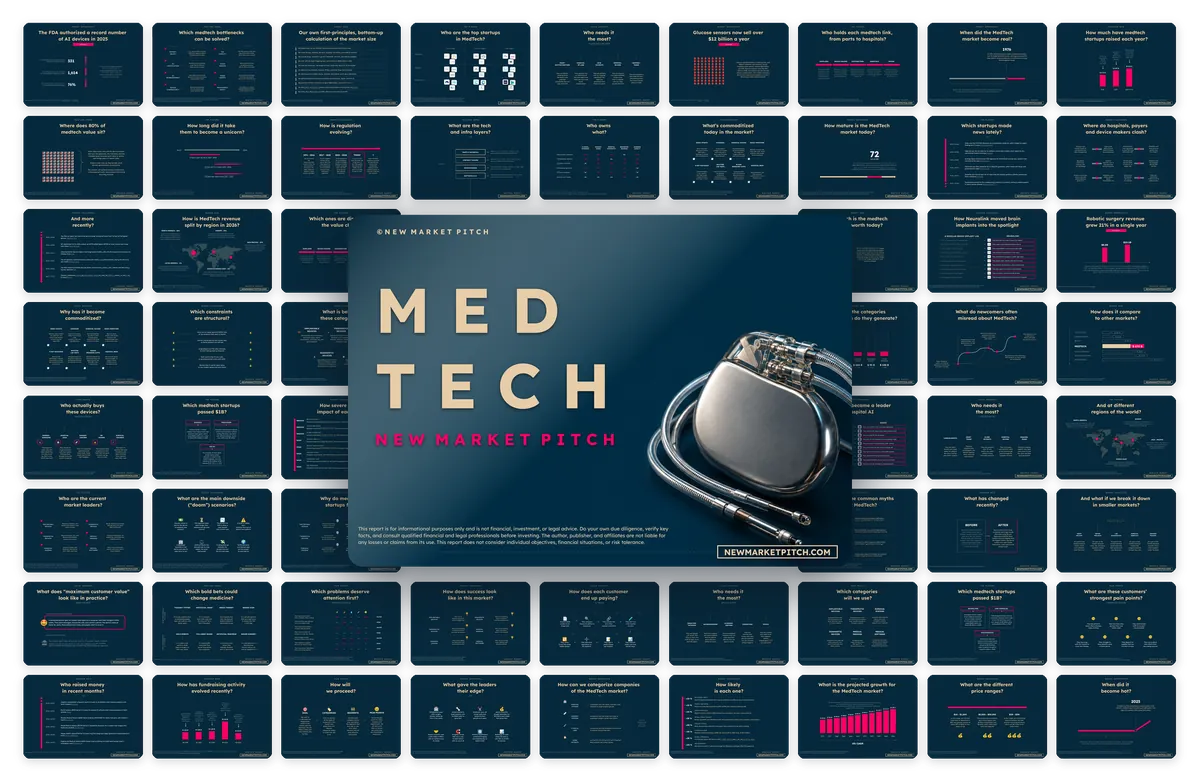
Whether you're building or investing in the MedTech market, our report covers everything you need to know: the players, the money, and what's coming next.
Summary
The real global MedTech market is about $670 billion a year today, with a defensible core range of roughly $600 billion to $700 billion depending on how diagnostics and regulated medical software are counted.
The biggest source of confusion is scope, not forecasting. Device-focused estimates cluster around roughly $570 billion to $605 billion, while figures approaching $1 trillion usually add large parts of digital health, healthcare IT and adjacent software.
Company revenue makes the mid-$600 billions hard to dismiss. Medtronic, Johnson & Johnson MedTech, Stryker, Siemens Healthineers, BD, Abbott Medical Devices and GE HealthCare alone generate well over $170 billion a year.
Diagnostics is a major part of the industry, but it is unusually hard to pin down precisely. A practical current range is around $80 billion to $110 billion, with recurring reagents and consumables doing much of the economic work.
Digital health should only be counted where the software itself performs or directly supports a regulated medical function. Pulling in billing systems, generic telehealth, scheduling tools or consumer wellness apps quickly turns MedTech into a catch-all healthcare-technology category.
The market is fragmented at the top level but often concentrated inside individual niches. No company controls more than a mid-single-digit share of global MedTech, yet categories such as surgical robotics, continuous glucose monitoring and cardiac rhythm management can behave like oligopolies.
MedTech is growing more like a mature technology-enabled industry than a hypergrowth software market. The broad market appears to be expanding around 5% to 7% annually, while selected categories such as electrophysiology, continuous glucose monitoring and structural heart are growing much faster.
A surprisingly large share of MedTech economics is recurring. Diagnostics needs reagents, diabetes platforms need replacement sensors, surgical systems need instruments and disposables, and imaging systems carry service and software revenue around the installed base.
The U.S. remains the commercial center of gravity, while Europe is still large but losing global share. China matters less because of one precise market-share figure than because centralized procurement is showing how quickly a huge healthcare system can pressure prices.
MedTech is becoming more software-enabled, but not software-only. Hardware, diagnostics, consumables and procedures still generate most of the industry's revenue, with AI increasingly embedded inside the products rather than replacing them as standalone software businesses.
A genuine $1 trillion core MedTech market is plausible later on, but calling it a $1 trillion industry today stretches the definition too far. At roughly $670 billion and mid-single-digit growth, the industry can get there without relying on accounting tricks or an AI boom.

Written by the New Market Pitch teamWe track new markets so founders and investors can move faster. About us

In our report covering the medtech market, we always try to gather several sources and make estimates that make sense, so you can work with solid numbers.
What actually counts as MedTech today?
The MedTech market today is best defined as regulated technology used to diagnose, monitor or treat patients: medical devices, diagnostic equipment, implants, surgical systems, patient-monitoring products and the software directly tied to those products.
That sounds simple until we look at companies such as Abbott, Siemens Healthineers or Intuitive Surgical. Abbott's FreeStyle Libre is a physical glucose sensor, a connected device and a software platform at the same time. Siemens Healthineers sells scanners, diagnostics, cancer-treatment equipment, AI and clinical software. Intuitive Surgical combines robotic hardware, instruments, software and services.
For market sizing, we need a boundary that survives these overlaps. MedTech Europe treats medical devices, in-vitro diagnostics and digital health as parts of medical technology, although its market statistics still lean heavily toward devices and diagnostics. Statista follows a similar logic, separating a roughly $577 billion medical-device market from a wider medical-technology category.
We therefore count medical devices and equipment, IVD and the regulated software that performs or directly supports a medical function. General hospital IT, electronic health records, telehealth marketplaces, pharmaceuticals, healthcare services and consumer wellness stay outside the core number. Otherwise, almost any technology used somewhere in healthcare can end up being called MedTech.
Why do MedTech market estimates range from $570 billion to almost $1 trillion?
MedTech market estimates are all over the place because researchers keep using the same name for different combinations of medical devices, diagnostics, software, digital health and healthcare IT.
The gap is much too large to dismiss as normal forecasting noise. Fortune Business Insights currently values the 2025 medical-device market at $572 billion. Woodside Capital puts global MedTech at $584 billion. MarketsandMarkets estimates $695 billion. Kings Research reaches $939 billion.
Once we open the methodologies, the gap becomes easier to explain. Fortune includes categories such as cardiovascular devices, imaging, IVD, diabetes technology and surgery. Kings Research adds digital health, healthcare IT and healthcare robotics; within its $939 billion total, medical devices themselves account for about $595 billion.
Statista gives us another useful comparison because it publishes both layers in the same framework. Its current estimate is about $577 billion for medical devices and $671 billion for medical technology overall.
So these figures are better read as nested markets. A researcher can reach roughly $600 billion by staying close to regulated devices, around the high-$600 billions by adding diagnostics and adjacent medical technology, or well above $900 billion by bringing broad healthcare software into the calculation.
| Current market estimate | Approximate size | What the estimate includes |
|---|---|---|
| Fortune Business Insights | $572B | Medical devices including IVD |
| Woodside Capital | $584B | Relatively narrow MedTech definition |
| Statista medical devices | $577B | Device-focused market |
| Statista medical technology | $671B | Devices plus additional medical technology |
| MarketsandMarkets | $695B | Broader MedTech industry |
| Kings Research | $939B | Devices, digital health, healthcare IT and robotics |

Theory only gets you so far. In our research about medical devices, we dig up the real signals from the field and show you the ones worth watching.
So how big is the real MedTech market right now?
The core global MedTech market is currently around $650–700 billion a year, and roughly $670 billion is the most useful single number if we need one.
We get there by triangulating definitions rather than choosing whichever market-research report has the largest number. Statista currently puts medical technology at $670.7 billion, including $576.9 billion of medical devices. MarketsandMarkets was already at $694.7 billion for 2025. More device-focused estimates from Fortune Business Insights and Woodside Capital sit closer to $570–585 billion.
The companies themselves provide a useful reality check. Medtronic generated $36.4 billion in its latest fiscal year. Johnson & Johnson's MedTech segment produced $33.8 billion in 2025. Stryker reached $25.1 billion, Siemens Healthineers €23.4 billion, BD $21.8 billion, Abbott's Medical Devices business $21.4 billion and GE HealthCare $20.6 billion.
Those seven businesses alone generate well over $170 billion of annual revenue, before adding Boston Scientific, Philips, Roche Diagnostics, Intuitive Surgical, Baxter, Edwards Lifesciences, Zimmer Biomet, Alcon, Olympus and thousands of smaller manufacturers. A global market somewhere around the mid-$600 billions fits the actual revenue base far better than either a very narrow $400 billion definition or an everything-healthcare-tech $1 trillion definition.
About $670 billion is the number we would use today, with the scope made explicit whenever it is quoted.
If you want more recent data on this point, please see our latest MedTech market report.
How big is the diagnostics part of MedTech?
In-vitro diagnostics is probably a roughly $80–110 billion MedTech market today, large enough to change the industry total materially but difficult to measure with unusual precision.
The disagreement between current estimates is striking. Fortune Business Insights values global IVD at $81.8 billion in 2026. Grand View Research estimates about $111 billion. IMARC starts from a much higher $122.6 billion in 2025. Different treatment of laboratory products, consumables, molecular diagnostics and adjacent testing categories explains part of that spread.
Grand View's underlying mix is especially useful. It estimates that reagents generated 65.7% of IVD revenue in 2025. Fortune's latest methodology gives reagents and consumables an even larger share. In other words, diagnostics is heavily driven by repeated testing rather than by laboratories buying new analyzers every year.
Roche Diagnostics shows the scale in the real world. The division produced CHF13.8 billion in 2025. BD Life Sciences generated about $5.2 billion, including $1.8 billion from Diagnostic Solutions, while Abbott's Diagnostics business is another multibillion-dollar operation.
The pandemic temporarily made this market look much bigger and faster. Abbott's COVID-testing revenue, for example, fell from roughly $1.6 billion in 2023 to $747 million in 2024 and $297 million in 2025. European IVD followed the same boom-and-normalization pattern after the huge testing increases of 2020 and 2021.
That distortion has largely washed out now. The diagnostics revenue we see today gives us a much cleaner picture of the underlying MedTech market.

In our market report about medical devices, we don't want to repeat what boring consulting reports say. Instead, we show you the real and latest market signals that matter.
Should digital health be counted as MedTech?
Only the regulated and clinically embedded part of digital health belongs comfortably inside MedTech today; adding the whole digital-health market would badly inflate the number.
A radiology algorithm cleared as a medical device belongs in MedTech. Software controlling an insulin pump belongs there too. The same applies to regulated software that detects disease, calculates treatment decisions or performs another clinical function.
Hospital billing software, generic scheduling tools, broad telehealth platforms and consumer fitness apps are much harder to justify. They may sell to healthcare customers, but that alone does not make them medical technology.
The distinction becomes important when we compare market estimates. Kings Research reaches $939 billion partly because its MedTech definition explicitly includes digital health and healthcare IT. Its medical-device component is only about $595 billion. Statista also moves from roughly $577 billion in medical devices to $671 billion when it widens the scope to medical technology.
Digital products are becoming more important inside the industry, but much of that value is already attached to physical products. Abbott does not sell FreeStyle Libre as an unrelated software business. Siemens Healthineers embeds AI into imaging workflows. Medtronic combines algorithms, sensors and therapeutic hardware.
Adding broad digital-health estimates on top of device revenue can therefore count some of the same healthcare spending twice.
If you want more recent data on this point, please see our latest MedTech market report.
How much of the MedTech market comes from the United States and Europe?
The United States is currently the biggest MedTech market by a wide margin, while Europe remains number two but is slowly losing global share.
MedTech Europe's latest industry data puts the U.S. at 47.6% of the worldwide medical-device market and Europe at 25.6%. Statista uses a broader methodology and gives the United States about $246 billion of a $671 billion global medical-technology market, or roughly 37%. The methodologies differ, but both make the same point: American demand is enormous.
Europe currently represents around €173 billion of annual medical-device spending according to MedTech Europe. Germany accounts for roughly one-quarter of that market, followed by the UK, France, Italy and Spain. Together, those five countries represent more than 70% of European demand.
The latest European numbers are less flattering on growth. Medical-device spending increased only 1.8% in 2025, far below the roughly 5.6% annual average recorded over the previous decade. Europe's worldwide share also slipped from 26.4% to 25.6%, continuing a longer decline from around 29% in 2015.
The regional picture is clear enough. Europe remains a huge MedTech market, but incremental industry growth is increasingly being captured elsewhere. For manufacturers, the U.S. is still the commercial center of gravity.

In our document detailing everything you need to know about medtech, we like to show you the big picture. We know your time is precious, so we make every page quick to read and packed with as much learning as possible per minute.
Is MedTech really one market?
Calling MedTech a single $670 billion market is useful for sizing the industry, but commercially it behaves like hundreds of separate markets.
A continuous glucose monitor does not compete with an MRI scanner. A hip implant does not compete with a molecular-diagnostics reagent. A robotic surgery platform has almost nothing in common with a patient-monitoring sensor beyond both being regulated medical technologies.
Even broad categories reach very different scales. Statista expects cardiology devices alone to generate about $89 billion in 2026. IVD is somewhere around $80–110 billion depending on the methodology. Imaging, orthopaedics, diabetes technology, ophthalmology, surgical products and patient monitoring each contain another set of large submarkets.
Company portfolios make the fragmentation obvious. Medtronic generated almost $14 billion from cardiovascular products in its latest fiscal year, more than $10 billion from neuroscience and close to $9 billion from medical-surgical products. Abbott's device business includes almost $8 billion of diabetes care alongside electrophysiology, rhythm management, structural heart, vascular devices and heart-failure products.
For competitive analysis, the total MedTech number has limited value on its own. A company can dominate a $5 billion niche while barely registering across the rest of the industry.
Do a few giant companies control MedTech?
No single company comes close to controlling MedTech today; even the largest players hold only a mid-single-digit share of the global market.
Medtronic generated $36.4 billion in its latest fiscal year and Johnson & Johnson MedTech $33.8 billion in 2025. Against a market around the high-$600 billions, each represents roughly 5% of global revenue. Stryker, Siemens Healthineers, BD, Abbott Medical Devices, GE HealthCare and Boston Scientific each sit around or above the $20 billion level, yet individually remain much smaller than the industry.
Europe also had more than 36,000 MedTech companies in 2025, and the vast majority were SMEs. MedTech Europe counts thousands of generic device groups and more than two million individual medical technologies.
Concentration becomes much stronger once we zoom into particular products. Surgical robotics, continuous glucose monitoring, cardiac rhythm management and several imaging modalities are controlled by much shorter lists of companies. MedTech is fragmented overall and oligopolistic in some of its most valuable niches.
| MedTech company or segment | Latest annual revenue | Main exposure |
|---|---|---|
| Medtronic | $36.4B | Cardiovascular, neuroscience, surgery, diabetes |
| Johnson & Johnson MedTech | $33.8B | Surgery, orthopaedics, cardiovascular, vision |
| Stryker | $25.1B | Orthopaedics, MedSurg, neurotechnology |
| Siemens Healthineers | €23.4B | Imaging, diagnostics, cancer care |
| BD | $21.8B | Medical products, diagnostics, interventional |
| Abbott Medical Devices | $21.4B | Diabetes and cardiovascular devices |
| GE HealthCare | $20.6B | Imaging, ultrasound, monitoring, diagnostics |
| Boston Scientific | ~$20.0B | Cardiovascular and MedSurg |
| Philips Diagnosis & Treatment + Connected Care | €13.6B | Imaging, image-guided therapy, monitoring |
| Roche Diagnostics | CHF13.8B | Laboratory, molecular and pathology diagnostics |

In our report covering the medtech market, we turn what is vague and complex into simple, useful visuals. Market maps like this one show you at a glance where every startup stands.
Is the MedTech market actually growing fast right now?
MedTech is currently growing at a solid mid-single-digit pace overall, while the strongest companies and categories are growing considerably faster.
The market-research estimates cluster around that level. Statista expects 5.2% annual growth for medical technology through 2031 and 5.5% for medical devices. Fortune Business Insights is more aggressive at 6.9%. Woodside Capital currently describes MedTech as a 6–7% growth industry.
Recent company results give us a better test than forecasts alone. Medtronic delivered 5.8% organic growth in its latest fiscal year, its strongest annual top-line performance in a decade. Stryker grew organic sales 9.0% in its most recent quarter. Abbott's Medical Devices business grew 8.4% on a comparable basis, while Boston Scientific posted 7.0% organic growth.
Johnson & Johnson MedTech was slower at 3.7% adjusted operational growth in its latest quarter. GE HealthCare grew 3.5% organically in 2025. Philips' Diagnosis & Treatment business was flat on a comparable basis.
Put together, these numbers look much more like a 5–7% industry than a 10–15% one. MedTech is growing faster than many mature industrial sectors, but describing the whole market as hypergrowth would be hard to defend.
If you want more recent data on this point, please see our latest MedTech market report.
Which parts of MedTech are growing the fastest?
Continuous glucose monitoring, electrophysiology, structural heart, minimally invasive cardiovascular treatment and selected surgical technologies are currently pulling MedTech growth above its mature-market baseline.
Abbott gives us a particularly clean example. Its Medical Devices business grew 8.4% comparably in its latest quarter, with electrophysiology up in the low teens and continuous glucose monitoring up 9.5%. In 2025, Abbott's diabetes-care revenue had already approached $8 billion after years of rapid FreeStyle Libre adoption.
Stryker's latest 9.0% organic growth was also broad: MedSurg and Neurotechnology grew 9.2%, while Orthopaedics grew 8.6%. Boston Scientific generated 7.8% organic growth in cardiovascular products in its latest quarter after growing 15.8% organically across the company in 2025.
Now compare those figures with the slower parts of the industry. European medical-device spending grew just 1.8% in 2025. Philips' Diagnosis & Treatment sales were flat on a comparable basis. Roche Diagnostics increased only 2% at constant exchange rates in 2025 as Chinese pricing reform offset stronger demand elsewhere.
MedTech has a two-speed growth profile. Mature equipment and established product categories can sit around low-single-digit growth while newer procedure-driven platforms grow close to or above 10%.

Our research about medical devices gets updated several times a month, so you always get the latest view of where things stand.
Does MedTech make money mainly by selling equipment once?
A large part of MedTech revenue now comes from products that customers must keep buying, which makes the market much more recurring than the word “equipment” suggests.
Diagnostics is the clearest case. Grand View Research estimates that reagents represented 65.7% of IVD revenue in 2025. Laboratories may keep an analyzer for years, but every additional test requires chemicals, cartridges or other consumables.
BD offers an even broader example. The company says more than 90% of the revenue profile of the business it is shaping into “New BD” comes from consumables. Abbott's diabetes business also relies on continuous glucose-monitoring sensors that patients repeatedly replace rather than on a one-time device purchase.
Surgical and interventional companies follow a similar model. Hospitals may buy a capital system once, then continue purchasing instruments, catheters, implants, accessories or procedure-specific disposables whenever the equipment is used. Imaging businesses add maintenance, software and service contracts to their installed equipment.
The exact recurring share of global MedTech cannot be calculated cleanly from public reporting, but company mix tells us enough to reject the idea that this is mainly a one-off machinery market. A substantial part of industry growth comes from expanding installed bases that generate more sales every time patients are tested or treated.
How big is MedTech compared with total healthcare spending?
MedTech is a huge technology industry but still takes a surprisingly small share of the money spent on healthcare overall.
Europe gives us one of the cleanest comparisons. MedTech Europe estimates that medical technology represents roughly 7% of European healthcare expenditure once devices, imaging and IVD are combined. Healthcare itself consumes around one-tenth of European GDP.
That means the €173 billion European medical-device market sits inside a healthcare system spending vastly more on hospital staff, pharmaceuticals, long-term care, facilities and other services.
The ratio helps explain how MedTech can keep compounding without requiring healthcare budgets to double. An aging population means more cardiac interventions, joint replacements, diagnostic tests and chronic-disease monitoring. At the same time, a technology that shortens a hospital stay or moves monitoring into the home can win spending even when hospitals are trying to control their total costs.
So a $600-billion-plus device industry can simultaneously be enormous and represent only a small slice of healthcare expenditure.

In our market report about medical devices, you will always find fresh funding data, taken straight from our own verified funding database.
How important is China to the MedTech market right now?
China is already a major MedTech market, but its biggest impact on multinational companies today comes from its scale combined with unusually aggressive pricing reform.
The exact global share depends heavily on the dataset. MedTech Europe's latest device statistics assign China 5.4% of the world market, while broader Asia-Pacific studies produce higher estimates once diagnostics and additional technologies are included. We would therefore avoid pretending that one precise China share settles the issue.
Company results tell us more about what is happening on the ground. Roche Diagnostics' Asia-Pacific sales fell 12% at constant exchange rates in 2025 because of healthcare pricing reforms in China. In the first half of 2026, the decline moderated but Asia-Pacific diagnostics was still down 5% at constant exchange rates for the same reason.
Siemens Healthineers has also repeatedly pointed to China's diagnostics transition, while other device makers have had to adapt to volume-based procurement programs that trade larger purchasing volumes for lower prices.
China deserves attention beyond its current revenue share. It is showing what happens when a very large healthcare system uses centralized purchasing power to squeeze device and diagnostic prices. For global MedTech companies, that can increase procedure volumes while putting revenue per procedure under pressure.
If you want more recent data on this point, please see our latest MedTech market report.
Is MedTech becoming an AI and software market?
AI and software are becoming standard layers inside MedTech products, but hardware, diagnostics, consumables and procedures still generate most of the industry's revenue today.
Look at the biggest businesses. Medtronic generates $36 billion-plus from cardiovascular devices, neuroscience products, surgical technology and diabetes care. Siemens Healthineers' €23.4 billion business is centered on imaging, diagnostics, cancer care and minimally invasive therapy. GE HealthCare's $20.6 billion revenue still comes largely from imaging, ultrasound, monitoring and pharmaceutical diagnostics.
Software increasingly changes what those products can do. Imaging systems can automate acquisition and interpretation. Diagnostic platforms can use algorithms to help classify results. Continuous glucose monitors connect sensors to apps and automated insulin-delivery systems. Surgical platforms increasingly combine hardware with planning, visualization and data.
That integration is probably more important for the size of MedTech than the standalone medical-software market. AI can increase the value of a scanner, make a monitoring system more useful or expand the clinical situations in which a device can be used.
For now, MedTech is becoming software-enabled much faster than it is becoming software-only.

In our document detailing everything you need to know about medtech, we look at what the winners do differently, so you can learn from the best instead of guessing.
Could MedTech already be a $1 trillion market?
Calling MedTech a $1 trillion market today requires a definition broad enough to include large chunks of digital health and healthcare IT.
The current numbers make the boundary visible. Fortune Business Insights reaches about $605 billion for medical devices in 2026. Statista reaches roughly $577 billion for devices and $671 billion for medical technology. MarketsandMarkets is close to $695 billion. Kings Research reaches $939 billion only after explicitly including digital health, healthcare IT and robotics.
That final estimate is useful because Kings also breaks out its medical-device component: about $595 billion in 2025. Roughly $344 billion of the difference comes from the additional categories.
A trillion-dollar MedTech market is still very plausible within the next several years. Starting around $670 billion and compounding at 5–6% annually eventually gets the core industry there without requiring an AI boom or a definitional trick.
Today, though, describing the core MedTech industry as already worth $1 trillion overstates its size by several hundred billion dollars.
If you want more recent data on this point, please see our latest MedTech market report.
What is the real size of the MedTech market today?
The best current estimate for the real global MedTech market is about $670 billion a year, with a defensible core range of roughly $600–700 billion depending on how diagnostics and regulated software are counted.
The evidence converges much more tightly once we stop comparing definitions that measure different things. Device-focused estimates currently sit around $570–605 billion. Broader MedTech methodologies cluster around the high-$600 billions. Figures approaching $1 trillion generally bring digital health, healthcare IT or other adjacent businesses into the total.
The industry underneath that number is also healthier than a single market-size figure suggests. Recent results range from 3–4% growth at slower large companies to roughly 7–9% at Boston Scientific, Abbott and Stryker, with several individual technologies growing faster again. At the same time, Europe's latest 1.8% growth rate shows how uneven the expansion has become.
MedTech today is roughly a two-thirds-of-a-trillion-dollar core industry growing around the mid-single digits, with much faster growth concentrated in specific device categories. That is already large enough to rank among the world's biggest technology-enabled industries, while still leaving a credible path toward a genuine $1 trillion core market later on.
Our methodology
This analysis asks what the MedTech market is actually worth today once medical devices, diagnostics and regulated medical software are separated from the much broader universe of healthcare technology. We did not start with one headline estimate and work backward; we compared differently scoped market estimates with company revenue, regional data, category growth and regulatory definitions.
The core boundary is regulated technology used to diagnose, monitor or treat patients. That includes medical devices, diagnostic equipment, implants, surgical systems, patient-monitoring products, IVD and software that performs or directly supports a medical function. General hospital IT, electronic health records, generic telehealth, pharmaceuticals, healthcare services and consumer wellness are kept outside the core estimate.
Market-research estimates were treated as differently scoped datasets rather than interchangeable answers. Device-focused estimates from Fortune Business Insights and similar sources sit near the high-$500 billions, while broader MedTech estimates from Statista and MarketsandMarkets move into the high-$600 billions. Estimates approaching $1 trillion were treated separately when they explicitly included digital health, healthcare IT or robotics.
We then used company-reported revenue as a reality check. Medtronic, Johnson & Johnson MedTech, Stryker, Siemens Healthineers, BD, Abbott Medical Devices, GE HealthCare, Boston Scientific, Philips and Roche Diagnostics show how much revenue is already concentrated in the largest device, diagnostics and imaging businesses, and help test whether the top-down market estimates are economically plausible.
Diagnostics was handled as a range rather than a false point estimate because current IVD methodologies differ on the treatment of reagents, consumables, molecular testing and adjacent laboratory products. Company disclosures from Roche, BD and Abbott were used to check the scale and recurring nature of that market.
For digital health, we used the FDA's medical-device software framework to distinguish software with a regulated medical function from broader healthcare software. That prevents generic healthcare IT and consumer applications from being added on top of device revenue and inflating the MedTech total.
Regional comparisons were kept within the scope in which they were originally calculated. MedTech Europe's device-market data was used for Europe, U.S. share, company counts and historical growth, while broader datasets were not treated as if they measured exactly the same thing.
Growth was assessed from both industry forecasts and recent company operating results. Organic growth at Medtronic, Stryker, Abbott, Boston Scientific, Johnson & Johnson MedTech, GE HealthCare, Philips and Roche was used to distinguish the underlying pace of the overall industry from faster product categories such as continuous glucose monitoring, electrophysiology and selected cardiovascular technologies.
Key sources used for this analysis include MedTech Europe: Facts & Figures 2026, MedTech Europe: Facts & Figures industry page, MedTech Europe: Market Data Hub, MedTech Europe: About the industry, FDA: Software as a Medical Device, FDA: Digital Health Terms, Medtronic FY2026 results, Johnson & Johnson 2025 full-year results, Stryker company facts, Siemens Healthineers FY2025 reference data, BD FY2025 results, Abbott FY2025 results, GE HealthCare FY2025 results, Boston Scientific 2025 Annual Report, Boston Scientific Q2 2026 results, Roche FY2025 results, Roche H1 2026 results, and Philips 2025 annual results.
The final estimate is the point at which those differently scoped market estimates, regulatory boundaries, company revenues, regional data and recent operating results line up most convincingly. That is why we use about $670 billion as the current MedTech market rather than selecting the highest or lowest headline number.

If you build or invest in the medtech market, you need to know which business models pay off now and which ones are fading. That's why our report covering it has a whole section on it.
Written by the New Market Pitch teamWe track new markets so founders and investors can move faster. About us