Who are the top investors in PC and console gaming?
Whether you're building or investing in the PC and console gaming market, our report covers everything you need to know: the players, the money, and what's coming next.
Summary
BITKRAFT Ventures is the most active investor in PC and console gaming startups, with 5 equity rounds joined. It was named as lead in 4. Its overall lead comes with a catch: the firm has not joined a new qualifying round this year.
Merak Capital and ADATA Technology are setting the pace right now, with 3 rounds each this year. Their deals take them into very different businesses, from new Saudi games to a publisher building international distribution.
Merak Capital, ADATA Technology and Krafton sit together behind BITKRAFT Ventures. Their similar participation counts hide quite different priorities. Merak helps finance studios, ADATA keeps backing 4Divinity, and Krafton invests in game developers it understands as a publisher.
There is room for plenty of other backers. We identified 94 named investors across the market, with gaming specialists, publishers and funds that support developers' tools appearing alongside larger investment firms.
Who actually leads deals matters too. BITKRAFT Ventures, Merak Capital and ADATA Technology were each named as lead in 4 qualifying rounds. A familiar name on a funding announcement tells us much less than knowing who took responsibility for the round.
Founders seeking their first investors will encounter a different group from studios raising money to make a larger game. Seed accounts for 18 of the 31 rounds with a known stage. Krafton stands out in Series A, where it joined 3 rounds.
Publishers remain part of the picture. Krafton has backed developers including Ruckus Games and Red Rover Interactive. Square Enix has joined a round for Magic Potion Games, whose Imagine Island targets younger players.
The software behind games gets funded as well. Tencent led W4 Games' $18M Series B to help the company sell professional tools and services around the Godot Engine. Konvoy has backed tools for teams making games.
Some investors keep meeting in the same deals. Impact46 and Merak Capital joined 3 rounds together across Ash Games Studio, Majestic Mind Games and Starvania Studio. Their shared focus on Saudi developers is unusually clear.
That leaves a practical answer for founders. BITKRAFT Ventures has the strongest overall record of participation, Merak Capital and ADATA Technology are the busiest today, and the right backer still depends on whether a company makes games, publishes them or sells technology to developers.

Written by the New Market Pitch teamWe track new markets so founders and investors can move faster. About us

In our report covering the PC and console gaming market, you will always find fresh funding data, taken straight from our own verified funding database.
Which VCs invest the most in PC and console gaming right now?
BITKRAFT Ventures leads PC and console gaming startup investing with 5 equity rounds joined, although it has not joined a new round this year.
Merak Capital, ADATA Technology and Krafton are tied behind it with 4 rounds each. The overall leader and the investors doing the most deals right now are therefore different.
BITKRAFT has backed game developers such as Ruckus Games and Distinct Possibility Studios, as well as Beamable, which supplies technology to other studios. Merak Capital works with Saudi game companies through a dedicated fund and accelerator. ADATA Technology has taken a much narrower path, repeatedly financing publisher 4Divinity. Each investment points to a different kind of founder.
We identified 94 named investors in this market. A big fund's reputation is a poor shortcut for finding a current backer: some firms invest broadly in games, while others focus on developers, publishing or the tools studios use.
The table below ranks the 20 most active PC and console gaming investors by the number of equity rounds they joined, with the rounds they led, their main stages, the startups they backed and the biggest round they joined.
If you want to go more into detail and get more data to understand what investors are betting on now, please check our PC and console gaming report.
| # | Investor | Rounds | Led | Main stages | PC and console gaming startups backed | Biggest round joined | Latest round |
|---|---|---|---|---|---|---|---|
| 1 | BITKRAFT Ventures ▼ | 5 | 4Usually leads (80% of its rounds) |
Seed 2Series A 2 | Beamable, Distinct Possibility Studios, Ruckus Games, Welevel, Jabali | $31MDistinct Possibility Studios · 2025 | Jul 2025 |
| 2 | Merak Capital ▲ | 4 | 4Named as lead in every round found | Seed 1 | Ash Games Studio, Majestic Mind Games, Lambda Studios, Starvania Studio | $1.5MAsh Games Studio · 2026 | Nov 2026 |
| 3 | ADATA Technology ▲ | 4 | 4Named as lead in every round found | — | 4Divinity | $10M4Divinity · 2026 | Aug 2026 |
| 4 | Krafton | 4 | 3Named as lead in every round found (lead known for 3 of 4 rounds) |
Series A 3Seed 1 | Ruckus Games, Red Rover Interactive, Eschatology Entertainment, Torpor Games | $19MRuckus Games · 2024 | Nov 2025 |
| 5 | Impact46 ▲ | 3 | 3Named as lead in every round found | Seed 1 | Ash Games Studio, Majestic Mind Games, Starvania Studio | $1.5MAsh Games Studio · 2026 | Aug 2026 |
| 6 | The Games Fund | 3 | 1Mostly follows (led 33% of its rounds) |
Series A 2Seed 1 | Red Rover Interactive, Eschatology Entertainment, ROAR Games | $15MRed Rover Interactive · 2024 | Aug 2024 |
| 7 | 1Up Ventures ▼ | 3 | 0Lead not published | Seed 2Series A 1 | Magic Potion Games, Galaxy Grove, Torpor Games | $3.7MMagic Potion Games · 2026 | Jul 2026 |
| 8 | GEM Capital | 3 | 0Never led (lead known for 2 of 3 rounds) |
Series A 2 | Red Rover Interactive, Eschatology Entertainment, Odd Meter | $15MRed Rover Interactive · 2024 | May 2026 |
| 9 | Chimera VC | 2 | 2Named as lead in every round found | Seed 2 | ARC, 1312 Interactive | $1.1MARC · 2026 | Sep 2026 |
| 10 | 1AM Gaming | 2 | 1Named as lead in every round found (lead known for 1 of 2 rounds) |
Series A 2 | Magic Potion Games, Emptyvessel | $3.7MMagic Potion Games · 2026 | Jul 2026 |
| 11 | Konvoy | 2 | 1Named as lead in every round found (lead known for 1 of 2 rounds) |
Seed 1Series A 1 | Magic Potion Games, Diversion | $4.5MDiversion · 2025 | Jul 2026 |
| 12 | Square Enix | 2 | 1Named as lead in every round found (lead known for 1 of 2 rounds) |
Series A 1 | Magic Potion Games, BetaDwarf | $3.7MMagic Potion Games · 2026 | Jul 2026 |
| 13 | Decasonic | 2 | 1Leads half its rounds | — | Distinct Possibility Studios | $31MDistinct Possibility Studios · 2025 | Apr 2026 |
| 14 | ForsVC | 2 | 1Named as lead in every round found (lead known for 1 of 2 rounds) |
Seed 2 | Mystic Forge, Galaxy Grove | $2.2MMystic Forge · 2024 | Oct 2025 |
| 15 | Enterprise Ireland | 2 | 0Never led (lead known for 1 of 2 rounds) |
Seed 2 | Entity, Outlier Games | $5.8MEntity · 2026 | Aug 2026 |
| 16 | Bpifrance | 2 | 0Never led | Series A 1 | Amplitude Studios, Gamestream | $14MAmplitude Studios · 2025 | May 2025 |
| 17 | T-Accelerate Capital | 1 | 1Named as lead in its only round found | Seed 1 | 1312 Interactive | $1M1312 Interactive · 2026 | Sep 2026 |
| 18 | MIXI Global Investments | 1 | 1Named as lead in its only round found | Seed 1 | ARC | $1.1MARC · 2026 | Sep 2026 |
| 19 | Tencent | 1 | 1Named as lead in its only round found | Series B 1 | W4 Games | $18MW4 Games · 2026 | Aug 2026 |
| 20 | ACT | 1 | 1Named as lead in its only round found | Seed 1 | Entity | $5.8MEntity · 2026 | Aug 2026 |
No investors match this search.
Data from January 2024 through 19 November 2026, which is enough to show who is active today and who has been for years. Rounds: equity rounds in which the investor is named. Led: rounds it led or co-led. ▲ more rounds in 2026 so far than its 2025 pace, ▼ fewer.

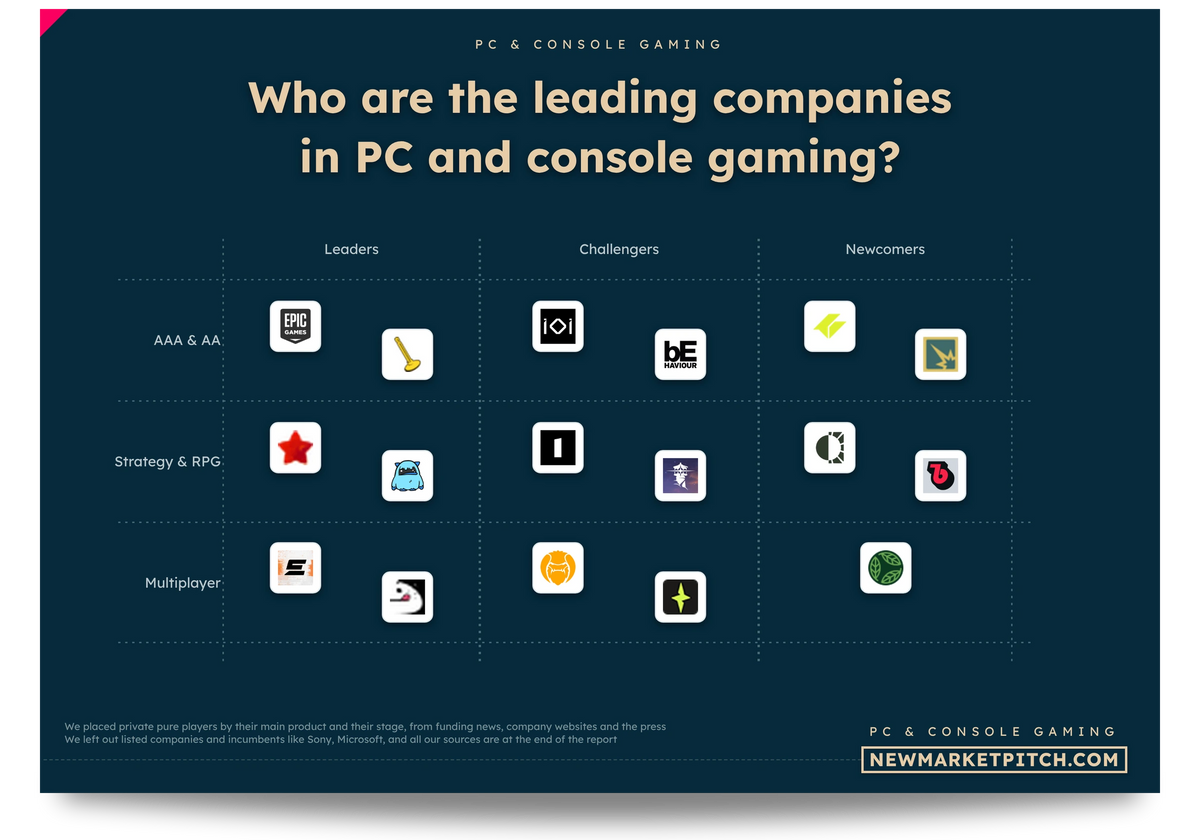
In our research about PC and console gaming startups, we turn what is vague and complex into simple, useful visuals. Market maps like this one show you at a glance where every startup stands.
Is BITKRAFT Ventures still the investor to beat in PC gaming?
Yes, BITKRAFT Ventures still leads PC and console startup investing overall, despite a quiet year.
Look at the range of companies it has backed. Distinct Possibility Studios is building REAPER ACTUAL, a persistent online shooter led by John Smedley. Ruckus Games is working on cooperative action play. Beamable sells backend technology to game developers. Those are separate bets on studios, players and the software needed to keep games running.
BITKRAFT also operates well beyond the PC and console businesses covered here. In December 2024, it announced a minority investment from Blue Owl and said its wider investment platform managed more than $1 billion. That includes investment strategies outside this article's market, so the announcement tells us something about the firm's reach but little about its most recent PC and console deals.
The real question for founders is whether a fund is adding companies like theirs today. BITKRAFT still has the stronger overall participation record. A developer looking for an investor making deals today should also look closely at Merak Capital, publisher-backed rounds and the other specialists currently active.
Are PC and console gaming specialists beating Silicon Valley's famous VCs?
In PC and console gaming startup rounds, specialist investors and established game publishers appear more often than the famous generalist VCs.
Andreessen Horowitz and other large firms still invest in games, but their wider gaming strategies do not make them the most frequent backers of this particular market.
Andreessen Horowitz announced a $600M games fund in April 2024. Griffin Gaming Partners also focuses on games and their underlying technology. Both are important names for founders to know, yet fund size and market activity answer different questions. A fund can have money ready to invest without appearing repeatedly in the private PC and console rounds we counted.
The repeated investors in our research include BITKRAFT Ventures, Krafton, Merak Capital and The Games Fund. Their companies range from Ruckus Games and Red Rover Interactive to Beamable and Ash Games Studio. Each has a business tied directly to PC or console games, rather than to the much broader world of mobile apps, streaming personalities or consumer technology.
A list of the biggest venture capital firms will miss several investors that have actually financed independent game teams. It will also include some famous gaming backers whose recent deals are mainly in other parts of entertainment.

In our market report about PC and console gaming startups, we always try to gather several sources and make estimates that make sense, so you can work with solid numbers.
Which investors actually lead PC and console gaming rounds?
BITKRAFT Ventures, Merak Capital and ADATA Technology share the top spot for named leads in PC and console gaming startup rounds, with 4 each.
Each of the three leads a different kind of deal.
BITKRAFT was named as lead in 4 of its 5 rounds, while Merak Capital and ADATA Technology were named as lead in every round we found for them, 4 each. Krafton led 3 of its 4 qualifying rounds; the lead was published for 3 of them. That is worth separating from participation. Several investors may join a round, but the named lead usually plays a more visible part in getting the financing agreed and closed. The announcement still does not tell us how much money that investor contributed.
The Games Fund shows why smaller participants deserve attention too. It says it led an earlier Red Rover Interactive financing, then remained involved when Krafton led the developer's Series A. GEM Capital also joined financings involving Red Rover Interactive and Eschatology Entertainment. A founder may need different investors as a project grows, and the investor who leads a later deal can change.
Lead rates have a limitation: announcements tend to identify leads more reliably than the other people who wrote checks. We use the rates to compare publicly documented roles, not to guess ownership or control.
The table below shows the reported lead activity of selected repeat investors in PC and console gaming.
| Investor | Rounds joined | Named leads | Lead rate |
|---|---|---|---|
| BITKRAFT Ventures | 5 | 4 | 80% |
| Merak Capital | 4 | 4 | 100% |
| ADATA Technology | 4 | 4 | 100% |
| Krafton | 4 | 3 | 100% |
| Impact46 | 3 | 3 | 100% |
| The Games Fund | 3 | 1 | 33% |
| GEM Capital | 3 | 0 | 0% |
Lead rate uses rounds with a publicly identified lead; Krafton's lead was known in 3 rounds.
Why is Merak Capital so active in PC and console gaming?
Merak Capital keeps funding PC and console gaming startups because it has built a pipeline of Saudi studios to invest in.
The firm launched a dedicated gaming fund and runs the Exel Gaming Accelerator, which offers mentoring, business support and introductions to publishers. That gives Merak a chance to work with teams before a conventional fundraising process begins.
The companies are concrete. Ash Games Studio released Azooma Escape and is developing Nomad: The Legend of Zarqa, inspired by Arabian folklore. Starvania Studio released Bahamut and the Waqwaq Tree. Lambda Studios developed games on Roblox and has recently raised financing led by Merak to bring its own games to platforms including Steam. Moving from Roblox to Steam is a particularly revealing bet: Merak is backing a team that wants to win over a different audience, not merely reproduce its earlier success.
Merak and Impact46 have also jointly financed TakaHouse, a mobile-game developer. That deal sits outside our PC and console definition, but it shows how much broader the investors' Saudi gaming work is. The repeated PC and console deals reflect a genuine studio-building effort, even though whether those games will become commercial hits remains to be seen.
Is ADATA Technology becoming a major gaming venture fund?
No, ADATA Technology keeps financing one PC and console gaming publisher, 4Divinity, so it looks nothing like a broad venture fund.
Its deals show commitment to that publisher, without a wider portfolio of independent studios.
ADATA Technology's repeat financings all involve 4Divinity. Merak Capital, by comparison, backed Ash Games Studio, Majestic Mind Games, Starvania Studio and Lambda Studios. BITKRAFT's activity also covers separate businesses. A repeat investment in a single publisher shows sustained interest, but a developer looking for its first round should not assume ADATA routinely backs new teams.
GCL Global Holdings, which owns 4Divinity, explained the relationship in public filings. The money supports publishing rights, international distribution and new opportunities linked to ADATA's memory and storage products. In January 2026, GCL described possible game-branded memory cards and peripherals. Its August filing described another ADATA investment and continued work on 4Divinity's publishing operation.
ADATA's investment logic is therefore fairly clear: game content and distribution could help it build relationships beyond hardware, while 4Divinity gains support from a major technology company. That makes ADATA worth watching for publishing businesses, even if its recent record tells a new indie studio much less about its chances of getting funded.
Does Krafton invest in PC game startups differently from VCs?
Yes, Krafton tends to back PC and console game studios whose projects fit the experience of a major publisher.
Its recent rounds look different from a venture fund investing across game tools, software and studios.
Krafton led Red Rover Interactive's $15M Series A for work on a multiplayer survival game. It also led funding for Eschatology Entertainment, which is building a narrative-driven title, and a $19M Series A for Ruckus Games, a cooperative action developer. These companies need to finish games, bring them to players and maintain confidence during long production cycles. A publisher has direct experience of those problems.
Compare that with Konvoy's investment in Diversion, which makes tools for teams handling complex game files, or ADATA Technology's repeated backing of 4Divinity. They serve different businesses and bring different kinds of experience. Krafton has also invested in Torpor Games, the studio behind Suzerain, giving the publisher a connection to an established narrative universe.
Publisher backing does not automatically give the investor creative control or guarantee a publishing contract. But for a studio preparing an ambitious PC or console release, Krafton can assess a project through its own experience shipping games. That is a different conversation from pitching a general-purpose software investor.

Our document detailing everything you need to know about PC and console gaming gets updated several times a month, so you always get the latest view of where things stand.
Is Tencent still backing independent PC game technology?
Yes, Tencent is still backing independent PC and console game technology, most clearly through W4 Games.
Tencent led W4 Games' $18M Series B. W4 Games sells enterprise technology and professional support for Godot, the open-source engine used to build games. The company said it plans to grow its team by 50% with the money and develop its commercial products faster. It also announced a multi-year partnership with Tencent focused on helping the Godot ecosystem grow in Asia.
The investment is easy to understand from the customer's side. A studio may want the flexibility of an open-source engine but still need commercial support, tools and reliable service when shipping a game. W4 Games tries to sell that reassurance. Red Rover Interactive and Ruckus Games, by comparison, use financing to make their own games. The investors are buying into quite different business plans.
Tencent's broader gaming reputation includes publishing, distribution and large corporate stakes that are outside this startup-round count. What stands out here is the decision to finance an independent company commercializing an open-source development platform. For founders building tools that other studios use, Tencent's deal shows a specific interest rather than a vague willingness to invest in anything connected to games.
Do Square Enix and Krafton back the same types of gaming startups?
No, Square Enix and Krafton have recently backed quite different PC and console gaming startups.
Krafton has led rounds for Ruckus Games, Red Rover Interactive and Eschatology Entertainment, whose projects center on action, multiplayer survival and narrative play. Square Enix joined the financing of Magic Potion Games, maker of Imagine Island, a moderated social game designed for children. Square Enix also appears in our research through BetaDwarf. The contrast is obvious when you look at what the studios are building.
Imagine Island welcomed more than one million players during its beta, Magic Potion Games said in August 2026. The studio's founders have experience at Club Penguin and other established game companies. Investors such as 1Up Ventures, 1AM Gaming and Konvoy joined the company's backing group, bringing a combination of game-development and community-building experience.
A child-friendly online world needs ongoing moderation, frequent activities and trust from parents. A multiplayer shooter has different technical and production demands. The mere presence of a major publisher in both types of deal tells founders little about which publisher they should approach. The games themselves are the better clue.
Which PC and console gaming investors are still investing this year?
Merak Capital and ADATA Technology are tied as the busiest PC and console gaming investors this year, with 3 rounds each.
BITKRAFT Ventures, the overall leader, has not joined a qualifying round this year after 3 last year. Recent dealmaking has a different set of leaders.
Merak's current investments include Lambda Studios, whose founders want to bring their work beyond Roblox to platforms such as Steam. ADATA Technology has continued backing game publishing. Impact46, Chimera VC, Square Enix and Konvoy have also appeared in recent qualifying financings. The names give a useful picture of what is happening: Saudi studios are attracting early support, publishers are looking for game developers, and developer technology is still getting attention.
We counted 21 rounds with at least one named investor this year against 15 last year, with the current year still in progress. That wider activity does not mean every older specialist has become busier. A firm can remain active in mobile gaming, acquisitions or other investments without appearing in these PC and console equity rounds.
The table below shows, year by year, how many rounds 12 of the most active PC and console gaming investors joined, so it is easy to see who is still investing and who has slowed down.
If you want to go more into detail and see which investors are still writing checks and which have slowed down, please check our PC and console gaming report.
| Investor | 2024 | 2025 | 2026* | Total |
|---|---|---|---|---|
| Merak Capital | 1 | 3 | 4 | |
| ADATA Technology | 1 | 3 | 4 | |
| Impact46 | 1 | 2 | 3 | |
| Chimera VC | 2 | 2 | ||
| 1Up Ventures | 2 | 1 | 3 | |
| GEM Capital | 2 | 1 | 3 | |
| 1AM Gaming | 1 | 1 | 2 | |
| Konvoy | 1 | 1 | 2 | |
| Square Enix | 1 | 1 | 2 | |
| Decasonic | 1 | 1 | 2 | |
| Enterprise Ireland | 1 | 1 | 2 | |
| T-Accelerate Capital | 1 | 1 |
* 2026: January to 19 November. Darker cells mean more rounds that year. Data from January 2024 through 19 November 2026.
Can smaller PC and console gaming investors matter without leading?
Yes, smaller PC and console gaming investors can be valuable even when a larger fund or publisher leads the round.
They can bring specialist experience and stay involved as a studio grows.
Magic Potion Games is a good example. Konvoy has explained why it backed the team behind Imagine Island, while 1AM Gaming, 1Up Ventures and Square Enix are among the company's other supporters. The project has to keep a child-friendly online world fun, safe and active. Investors who understand game production, publishers and online communities may contribute different skills to that work.
Red Rover Interactive offers another example. The Games Fund describes leading an earlier financing before returning for a Series A led by Krafton. GEM Capital was also involved. The studio could keep relationships with earlier investors while gaining a publisher that understood what it would take to finish and sell a multiplayer survival game.
We should be careful about how we describe investors that are not named as lead. In the qualifying rounds involving 1Up Ventures, no lead investor was publicly identified. That does not establish whether 1Up took a lead role behind the scenes. What we can say is that founders gain more than a single logo from a well-chosen group of supporters, while the actual size of each investor's check remains private.

In our report covering the PC and console gaming market, we look at what the winners do differently, so you can learn from the best instead of guessing.
Which PC and console gaming investors back seed rounds, and which back growth rounds?
Krafton backs the most PC and console gaming Series A rounds, with 3, while no single investor stands out in seed rounds and growth rounds are too rare to have a clear leader.
Seed is the busiest stage we can identify, accounting for 18 of the 31 rounds with a known stage. Seed checks are spread across many investors, with no clear leader among them.
Seed financing can pay for a first team, a prototype or an early game that is still finding its audience. Startups such as Ash Games Studio and Starvania Studio illustrate that part of the market. Krafton's Series A deals with Red Rover Interactive, Eschatology Entertainment and Ruckus Games show a different need: a studio has to fund a much larger stretch of game development and eventually reach players.
Tencent's support for W4 Games points to another path as a gaming company grows. W4 sells commercial technology around Godot rather than depending on the launch of a single game. Across the market, we found only 3 rounds at Series C or later. That is too narrow a group to claim any investor consistently dominates growth-stage PC and console deals.
The table below shows, for 12 of the most active PC and console gaming investors, how many rounds they joined at each stage, from seed to growth.
If you want to go more into detail and see where each investor places its bets, from seed to growth, please check our PC and console gaming report.
| Investor | Seed | Series A | Series B | Series C | Series D+ | Growth |
|---|---|---|---|---|---|---|
| BITKRAFT Ventures | 2 | 2 | · | · | · | · |
| Merak Capital | 1 | · | · | · | · | · |
| ADATA Technology | · | · | · | · | · | · |
| Krafton | 1 | 3 | · | · | · | · |
| Impact46 | 1 | · | · | · | · | · |
| The Games Fund | 1 | 2 | · | · | · | · |
| 1Up Ventures | 2 | 1 | · | · | · | · |
| GEM Capital | · | 2 | · | · | · | · |
| Chimera VC | 2 | · | · | · | · | · |
| 1AM Gaming | · | 2 | · | · | · | · |
| Konvoy | 1 | 1 | · | · | · | · |
| Square Enix | · | 1 | · | · | · | · |
Most active at each stage, among all PC and console gaming investors: Seed, 5 investors tied with 2 rounds · Series A, Krafton · Series B, no investor joined more than one round · Series D+, no investor joined more than one round · Growth, no investor joined more than one round. Bigger dots mean more rounds. Data from January 2024 through 19 November 2026.
Can independent PC and console studios still raise Series A funding?
Yes, independent PC and console studios still raise Series A money, especially teams with a strong track record and a clear game to make.
Ruckus Games raised a $19M Series A led by Krafton. Its developers have worked on well-known action and role-playing games, and the new studio is building a cooperative action title. Red Rover Interactive raised a $15M Series A, also led by Krafton, to develop a multiplayer survival game. Eschatology Entertainment secured backing for a dark, narrative-led project. The games differ, but the investors could point to particular teams and identifiable products.
Torpor Games offers a useful contrast. It already had Suzerain and an audience interested in the game's political storytelling when it brought in outside investment. A studio with an established title may have an easier way to explain who will buy its next release than a team with only concept art.
These examples do not mean an unknown developer needs a famous founder to raise money. They do show why a playable project, relevant experience and a credible route to launch matter so much. With games that can take years to build, investors want evidence that the team can deliver what it promises.
Are developer tools as attractive as PC and console games to investors?
Yes, PC and console gaming investors also back developer tools, which can sell to many studios rather than depend on one hit game.
Beamable provides technology that helps games run behind the scenes, including services used in connected experiences. BITKRAFT Ventures led a Series A for the company. Konvoy backed Diversion, which helps development teams work on large files and keep track of changing versions of game projects. Studios pay for these products to solve practical problems during production, even if the supplier never releases a game itself.
W4 Games offers another approach. Its commercial products support studios working with Godot, an open-source game engine. Tencent's investment gives W4 a large industry partner as it sells services to developers internationally. That sale depends on whether studios adopt its technology and pay for support, not on whether one particular game dominates a chart.
For founders, the investor overlap can be useful. A gaming specialist may understand both the risks of making a successful game and the recurring problems of the studios building those games. The business plans still need different pitches: developer tools are sold to professional customers, while game studios sell entertainment to players.

Learning from others' mistakes is the cheapest lesson there is. In our research about PC and console gaming startups, we look at what broke startups before you, so you don't repeat it.
Do famous PC and console game developers have an edge when raising?
Yes, veteran game developers have an edge when pitching new PC or console studios, though a famous name cannot guarantee a hit.
Distinct Possibility Studios is led by John Smedley, whose career includes major online worlds. The team is building REAPER ACTUAL, a persistent shooter with the sort of technical and design demands that are easier to judge when the developers have tackled similar work before. BITKRAFT Ventures has also backed Ruckus Games, whose team brings experience from established action and role-playing franchises.
Magic Potion Games has a different kind of credibility. Its founders worked on Club Penguin and other online games before creating Imagine Island. Running a child-friendly social world requires safety systems, moderation and activities that encourage players to come back. Previous experience with online communities makes the team's plans easier for investors to evaluate.
An impressive résumé cannot predict sales or guarantee that people will enjoy a new game. It can, however, make the hardest parts of development less mysterious to a backer. In the rounds we studied, experienced teams appear across very different genres, suggesting investors are paying attention to the people who must actually build and run the product.
Are cloud gaming and game distribution startups getting venture backing?
Yes, PC and console gaming investors have backed companies trying to make games easier to reach, from cloud delivery to playing through a browser.
Entity, an Irish startup, raised a seed round joined by ACT and Enterprise Ireland. Its plan is to let people play console-quality games in a browser, cutting out some of the steps between finding a title and starting it. The company still has to persuade studios to offer games through the service and convince players that the experience works well enough to return.
Gamestream takes a different approach to cloud gaming. It appears among Bpifrance's backed businesses, while Bpifrance also financed Amplitude Studios, known for the ENDLESS strategy series. That comparison shows the range of gaming investments one backer can make: one company helps deliver games and another develops them.
W4 Games belongs to the technology side of this picture too, though it sells development services rather than distributing games to players. Entity and Gamestream need good games, reliable delivery and commercial partners. Game studios need strong releases. Investors can support both sides of the market, but the reasons customers pay each company are different.
Does a huge PC gaming round mean every backer wrote a huge check?
No, a large PC and console gaming funding round does not reveal how much each backer contributed.
The headline amount belongs to the startup's entire group of investors.
Distinct Possibility Studios had a qualifying round of at least $31M joined by BITKRAFT Ventures and other backers. Ruckus Games' Series A involved Krafton, BITKRAFT and additional investors. W4 Games' Series B was led by Tencent alongside others. In each case, the announced amount belongs to the company and its entire round. It cannot be assigned to the investor whose name is most prominent in the press release.
A lead may organize a round and help recruit other investors without providing most of the money. Ownership percentages and individual allocations are often private. A founder searching for a backer that can write a larger check needs to understand the firm's mandate and past deals, rather than infer spending from a headline amount.
We therefore compare investors by how many qualifying equity rounds they joined and, separately, how often they were named as lead. That gives a much firmer answer than claiming to know which firm spent the most money when the personal checks have not been disclosed.
Which PC and console gaming investors most often invest together?
Impact46 and Merak Capital are the PC and console gaming investors that teamed up most often, joining 3 rounds together across Ash Games Studio, Majestic Mind Games and Starvania Studio.
No other pair matched that level of repeated activity in our research.
The connection fits the businesses they are backing. These Saudi developers are building original games and working to reach players beyond their home market. Merak Capital brings a dedicated gaming fund and accelerator; Impact46 has repeatedly joined the same studio financings. That makes the relationship useful for a founder to understand, especially when looking for investors already comfortable working together.
A separate cluster involves GEM Capital, Krafton and The Games Fund. Each pair among those investors appears together in 2 rounds involving Eschatology Entertainment and Red Rover Interactive. Here, a major publisher sits alongside funds familiar with independent game development. Earlier investors can remain involved while a different backer leads a larger round.
Repeated partnerships can help an investor find and evaluate a deal, but they do not mean a startup must recruit a fixed group. The main benefit for founders is knowing which firms have already made decisions together about companies like theirs.
The table below lists the pairs of PC and console gaming investors named together in at least two equity rounds, with the startups they backed together.
If you want to go more into detail and see which investor networks back the same startups, please check our PC and console gaming report.
| Investor pair | Rounds together | Startups backed together |
|---|---|---|
| Impact46 + Merak CapitalAsh Games Studio, Majestic Mind Games, Starvania Studio | 3 | Ash Games Studio, Majestic Mind Games, Starvania Studio |
| GEM Capital + KraftonEschatology Entertainment, Red Rover Interactive | 2 | Eschatology Entertainment, Red Rover Interactive |
| Krafton + The Games FundEschatology Entertainment, Red Rover Interactive | 2 | Eschatology Entertainment, Red Rover Interactive |
| GEM Capital + The Games FundEschatology Entertainment, Red Rover Interactive | 2 | Eschatology Entertainment, Red Rover Interactive |
Pairs of investors named in the same equity round. Data from January 2024 through 19 November 2026.
Do PC and console gaming investors keep backing startups after the first round?
Yes, some PC and console gaming investors return to the same startups for later rounds, although that support has to be earned each time.
Distinct Possibility Studios has raised money across several financings while developing REAPER ACTUAL. BITKRAFT Ventures was involved in earlier backing, and the studio announced another round led by Decasonic in April 2026 as it prepared for a Steam Early Access launch. The company also added experienced game-industry figures to its board. New investors can join when a project gets closer to release and its needs change.
Red Rover Interactive followed a related path. The Games Fund says it led an earlier round and then returned when Krafton led the studio's Series A. That arrangement gave Red Rover both continuity and another investor familiar with bringing games to market.
ADATA Technology's repeated support of 4Divinity illustrates a different case: continuing to fund a publishing subsidiary through an established corporate relationship. It would be misleading to treat that pattern as identical to new investors joining an indie game studio. Founders should welcome backers who might participate again, while planning for the possibility that the next round will need fresh investors and a new lead.
So, who are the most important investors in PC and console gaming today?
BITKRAFT Ventures is still the most active PC and console gaming startup investor overall.
Merak Capital and ADATA Technology have done the most recent qualifying deals, while Krafton is the standout publisher backer at Series A. The strongest name depends on the type of game business a founder is trying to build.
BITKRAFT has financed both independent developers and companies that sell services to studios. Merak's current strength lies in finding Saudi teams and helping them build businesses around their own games. ADATA focuses on publishing and distribution rather than funding a broad group of indie studios. Krafton's recent investments point toward experienced developers making ambitious games.
Those differences are more useful than a single investor league table. A studio making its first prototype has different needs from one financing a complex multiplayer game. A startup selling tools to developers has yet another kind of customer and risk. We would start with the investor's recent companies, lead activity and stage, then ask whether that backer understands what the founder actually needs.
The table below shows what we found.
| Question | Answer |
|---|---|
| Can BITKRAFT still claim the overall lead? | BITKRAFT Ventures remains the most frequent backer across PC and console rounds. Its reported lead rate reached 80% in rounds with named leads. Recent inactivity means founders should also consider the busiest current investors. |
| Has Saudi money changed who backs game studios? | Merak Capital is now particularly active in Saudi game development. It joined 3 qualifying rounds this year alongside a strong local pipeline. The investors are financing identifiable studios rather than merely announcing ambitions. |
| Will publishers fund online worlds for younger players? | Square Enix has joined the backers of Magic Potion Games. Imagine Island welcomed more than one million players during its beta. That traction makes its child-friendly social world easier for investors to assess. |
| Which publisher understands large new game projects? | Krafton has repeatedly supported independent studios making substantial PC and console games. It joined 3 Series A rounds, more than any other investor. Its publishing experience makes it unusually relevant to those development teams. |
| Are smaller game funds useful without leading? | Smaller backers can continue helping a studio after a larger investor arrives. The Games Fund remained involved when Krafton led Red Rover Interactive. Founders can keep specialist relationships while bringing in new expertise. |
| Are seed investors or later investors busier? | Seed is the busiest known stage of PC and console startup funding. It accounts for 18 of the 31 rounds with identified stages. That gives early-stage specialists a central role in the market. |
| Can software companies attract the same game investors? | Yes, investors also back technology that game developers use every day. Tencent led W4 Games' $18M Series B for Godot-related services. Developer adoption matters to those businesses more than a single hit game. |
| Does experience help studios win publisher funding? | Experienced creators appear frequently in the rounds joined by major publishers. Ruckus Games raised a $19M Series A led by Krafton. A record of shipping games makes its development plan easier to assess. |
| Do game investors work together more than once? | Certain investor partnerships keep appearing across separate independent game studios. Impact46 and Merak Capital joined 3 qualifying rounds together. Founders can use those relationships to find compatible financing partners. |
| Does a big round reveal each backer's check? | No, a round announcement reports the startup's combined new funding. Distinct Possibility Studios had a qualifying round of at least $31M with several backers. The headline amount reveals nothing about one investor's personal contribution. |
| Can distribution companies compete for venture attention? | Yes, investors have backed browser access and cloud gaming businesses. Entity and Gamestream offer different ways to deliver games to players. Their commercial challenge is winning partners and repeat player use. |
Our methodology
Our data runs through November 19, 2026. We then reviewed this article and updated its answers on November 24, 2026, the date shown under the title. We systematically tracked equity rounds deal by deal from January 2024, a long enough window to show which investors are active in this market today. PC and console gaming includes independent developers, publishers, game distribution businesses and specialist products used primarily for PC or console play, including relevant cloud gaming and development tools. Every company counted qualifies as a startup under our definition: it is independently developed, founded in 2007 or later and built for rapid growth, with recently acquired businesses retained when eligible. We include companies at the boundary of the market when their PC or console business is substantial rather than excluding them arbitrarily.
For each investor, we count qualifying equity rounds joined and rounds in which it was publicly identified as a lead, never the amount it invested, which is rarely disclosed. IPOs and post-listing offerings are excluded because they are not private rounds joined by startup investors. We standardize investor names across company announcements and reliable reporting, merge reports of the same round and exclude anonymous labels such as "existing investors" or "angel investors." The current-year column starts in March, once three months of the year are available. One round appears once in a funding-deals total, but can appear under several investors in an investor ranking; rounds without any named investor do not appear in those investor tables.
Announcements name lead investors more reliably than smaller participants, so rounds that an investor joined without leading are undercounted and lead rates are an upper bound.
Rounds confirmed by a company announcement, a press article or a regulatory filing are counted in full. Where no article exists, a round is counted only when at least two recognised databases agree on its date (within one month) and amount (within 5%), and it is marked as low confidence; a round found in a single database stays in the company's history but is left out of totals. For companies that have raised more than $100M, every round counted is backed by an article.
We do not rely on investor lists from commercial databases such as Crunchbase or PitchBook alone: they can attach investors to rounds they did not join or mix private equity funding with debt and grants. Of the 55 qualifying rounds identified, 47 name at least one investor, so these counts are a floor for each investor rather than proof of every investment made. This also explains why the total number of investor participations is not the same as the number of deals shown in a market funding tracker.
The main objection to an activity ranking is that it can place a focused but smaller investor ahead of a famous fund with much more capital. We deliberately rank completed participation in this defined market, not fund assets, general gaming publicity or deals in mobile games, XR, esports and unrelated software. We show lead activity and stage preferences separately because frequent small early rounds and selective publisher-backed Series A deals represent different kinds of influence. No investor should be described as committing the full amount of a round unless that personal contribution is disclosed.
Key sources include BITKRAFT's rationale and earlier backing of Distinct Possibility Studios., Beamable's financing and game infrastructure business., Merak Capital's fund history and gaming investments., Merak's direct announcement of its gaming fund and accelerator., 4Divinity's publishing focus and potential ADATA hardware collaboration., GCL's later ADATA financing and 4Divinity's ownership context., Krafton's financing of Eschatology and participation of specialist investors., Krafton's lead investment in Red Rover Interactive., W4 Games' Tencent-led financing and Godot enterprise plans., Bpifrance and Griffin's backing of Amplitude Studios., Konvoy's developer-tool investment rationale., Konvoy's investment in Imagine Island and Magic Potion Games., Ruckus Games' Krafton-led Series A and developer background., Andreessen Horowitz's announced games fund strategy., Entity's browser gaming product and investment group., BITKRAFT's broader investment platform and Blue Owl transaction., Merak Capital's direct portfolio listing for Starvania., Merak gaming accelerator structure and support for founders., Merak and Impact46 mobile-game deal, outside this market., Magic Potion Games on Imagine Island players and its Series A., Distinct Possibility Studios follow-on round and board additions., and Recent Merak investment and Lambda Studios expansion toward Steam..
Written by the New Market Pitch teamWe track new markets so founders and investors can move faster. About us