PC And Console Gaming Funding Tracker (50+ deals)
Whether you're building or investing in the PC and console gaming market, our report covers everything you need to know: the players, the money, and what's coming next.
Summary
From January 2024 to November 2026, PC and console gaming startups completed 53 deals across 45 companies and raised at least $638M. ModRetro's $145M round of undisclosed stage in March 2026 was the largest single financing, putting a maker of retro handheld consoles ahead of every game studio by deal size.
That headline can give the wrong impression of what a developer usually raises. The median disclosed round was $5.4M, and most checks would never make the kind of headline attached to a major console launch or an expensive new franchise.
A few big rounds changed the picture. Just 3 deals above $50M accounted for 6% of financings and at least $311M in disclosed money. Those checks make the market look much bigger than the experience of the average studio.
Studios nevertheless drew the most attention from investors. Premium and indie game developers recorded 25 deals and at least $192M, from smaller teams building individual titles to established developers preparing a larger slate.
Online multiplayer studios attracted a different kind of check. Their $31M median reflects businesses that must keep a game running, update it and bring players back long after launch.
Hardware is the surprise. The PC and console gaming hardware category contained only 3 deals, yet its 2 companies raised $165M between them. One giant handheld-console round did most of the work.
Publishers and development tools also found backers. Sound Games sells a different way to buy premium games, while W4 Games earns money by helping studios work with the Godot engine and release on consoles.
Getting funded early was far more common than climbing through successive venture rounds. Seed made up 19 deals, while the later named stages were much less common and no Series C financing was recorded.
Europe matched North America in deal count, but American companies received bigger disclosed checks. Meanwhile, specialist gaming investors kept showing up across very different businesses.
The picture is clear: there is serious money for PC and console gaming, but it does not reach studios evenly. Most developers are looking for a few million dollars; a small number of hardware makers, online-game teams and ambitious studios can raise far more.

Written by the New Market Pitch teamWe track new markets so founders and investors can move faster. About us

In our report covering the PC and console gaming market, you will always find fresh funding data, taken straight from our own verified funding database.
Our funding tracker covering the PC and console gaming market
Below is the table listing all the deals. You can find our methodology at the end of this page.
If you want a deeper understanding of the market and its current dynamics, get our PC and console gaming market report.
| Company | Category | Date | Stage | Deal size | What they do | Region | Lead investors | Country | Rank |
|---|---|---|---|---|---|---|---|---|---|
| Lambda Studios | Premium and indie game studios | November 2026 | Unknown | $1.3M | Develops and publishes games, expanding from Roblox onto PC distribution via Steam. | Middle East | Merak Capital | Saudi Arabia | |
| Gardens Interactive | Multiplayer and live-service studios | October 2026 | Series B | $35M+ | Creates shared online fantasy adventure games | North America | Not disclosed | United States | |
| 1312 Interactive | PC and console publishing | September 2026 | Seed | $1M | Publishes globally distributed indie and AA games | Asia-Pacific | T-Accelerate Capital, Chimera VC | India | |
| ARC | PC and console gaming hardware | September 2026 | Seed | $1.1M | Handheld gaming console and operating system | Asia-Pacific | Chimera VC, MIXI Global Investments | India | |
| W4 Games | Game development infrastructure | August 2026 | Series B | $18M | Godot engine support and console ports | Europe | Tencent | Ireland | |
| Entity | Cloud and remote-play services | August 2026 | Seed | $5.8M | Browser platform for console-quality games | Europe | ACT, Delta Partners, Elkstone | Ireland | |
| Pretty Cool Games | Premium and indie game studios | August 2026 | Unknown | Undisclosed | Develops physics-based cooperative puzzle games | Europe | Coreblazer | United Kingdom | |
| Blacknut | Cloud and remote-play services | August 2026 | Growth Equity | Undisclosed | Cloud gaming subscription for consumers | Europe | Digital Alpha | France | |
| 4Divinity | PC and console publishing | August 2026 | Unknown | $9M | Publishes PC and console action games | Asia-Pacific | ADATA Technology | Singapore | |
| Majestic Mind Games | Premium and indie game studios | August 2026 | Unknown | $1.5M | Develops Steam PC games including Tri Survive | Middle East | Merak Capital, Impact46 | Saudi Arabia | |
| Ash Games Studio | Premium and indie game studios | July 2026 | Seed | $1.5M | Develops folklore-inspired PC and console adventures | Middle East | Merak Capital, Impact46 | Saudi Arabia | |
| Hypercent | Multiplayer and live-service studios | July 2026 | Seed | Undisclosed | Creates cooperative horror games for Steam | Asia-Pacific | Not disclosed | South Korea | |
| Magic Potion Games | Premium and indie game studios | July 2026 | Series A | $3.7M | Develops original video games | North America | Not disclosed | United States | |
| Welevel | Premium and indie game studios | June 2026 | Unknown | $8.5M | Video game development studio | Europe | Not disclosed | Germany | |
| 4Divinity | PC and console publishing | May 2026 | Unknown | $10M | Publishes PC and console action games | Asia-Pacific | ADATA Technology | Singapore | |
| Odd Meter | Premium and indie game studios | May 2026 | Unknown | $5M | Develops narrative adventure game INDIKA | Asia-Pacific | Not disclosed | Kazakhstan | |
| Distinct Possibility Studios | Multiplayer and live-service studios | April 2026 | Unknown | Undisclosed | Creates multiplayer PC and console games | North America | Decasonic | United States | |
| Playruo | Cloud and remote-play services | April 2026 | Unknown | $2.5M | Browser cloud streaming for game demos and playtests | Europe | Kameha Ventures, Blast Club | France | |
| ModRetro | PC and console gaming hardware | March 2026 | Unknown | $145M | Retro handheld gaming consoles and cartridges | North America | Not disclosed | United States | |
| Ironwood Studios | Premium and indie game studios | February 2026 | Seed | $4M | Develops survival driving game Pacific Drive | North America | Lifelike Capital | United States | |
| 4Divinity | PC and console publishing | January 2026 | Unknown | $10M | Publishes PC and console action games | Asia-Pacific | ADATA Technology | Singapore | |
| Sound Games | PC and console publishing | January 2026 | Seed | $6.5M | Publisher of buy-once cross-platform premium games | North America | Point72 Ventures | United States | |
| Magic Potion Games | Premium and indie game studios | December 2025 | Unknown | $675K | Develops original video games | North America | Not disclosed | United States | |
| 4Divinity | PC and console publishing | December 2025 | Unknown | $3M | Publishes PC and console action games | Asia-Pacific | ADATA Technology | Singapore | |
| Torpor Games | Premium and indie game studios | November 2025 | Seed | Undisclosed | Narrative political role-playing video games | Europe | Not disclosed | Germany | |
| Fictions | PC and console publishing | November 2025 | Unknown | $17M | Publishes PC and console games including LEGO Party | North America | Not disclosed | United States | |
| Galaxy Grove | Premium and indie game studios | October 2025 | Seed | $1M | Develops 3D management and building games | Europe | Not disclosed | Netherlands | |
| PolyDream Studio | Premium and indie game studios | October 2025 | Seed | $500K | PC and console game development | Europe | Not disclosed | Azerbaijan | |
| Studio Lassa | Premium and indie game studios | August 2025 | Unknown | $7.2M | Develops original console games for global audiences | Asia-Pacific | Wemade | South Korea | |
| Starvania Studio | Premium and indie game studios | August 2025 | Unknown | $1.1M | Console and PC game development | Middle East | Merak Capital, Impact46 | Saudi Arabia | |
| Shortgun Games | Premium and indie game studios | August 2025 | Seed | $1M | PC and console action games | Asia-Pacific | Not disclosed | India | |
| Distinct Possibility Studios | Multiplayer and live-service studios | July 2025 | Unknown | $31M+ | Creates multiplayer PC and console games | North America | BITKRAFT Ventures, Brevan Howard Digital | United States | |
| BetaDwarf | Multiplayer and live-service studios | July 2025 | Unknown | Undisclosed | Creates cooperative multiplayer games including Minion Masters | Europe | Square Enix | Denmark | |
| Emptyvessel | Premium and indie game studios | June 2025 | Series A | Undisclosed | PC and console game development | North America | NCSoft, 1AM Gaming | United States | |
| Diversion | Game development infrastructure | May 2025 | Seed | $4.5M | Cloud version control for game development | Middle East | Konvoy | Israel | |
| Amplitude Studios | Premium and indie game studios | May 2025 | Series A | $14M | Strategy and action video games | Europe | Griffin Gaming Partners | France | |
| Human Computer | Premium and indie game studios | March 2025 | Seed | $5.7M | Independent PC and console game studio | North America | Not disclosed | United States | |
| Welevel | Premium and indie game studios | March 2025 | Seed | $5.7M | Video game development studio | Europe | BITKRAFT Ventures | Germany | |
| Beamable | Game development infrastructure | February 2025 | Series A | $14M | Supplies backend services and live operations tools | North America | BITKRAFT Ventures | United States | |
| Bonfire Studios | Multiplayer and live-service studios | January 2025 | Series B | $56M | Develops multiplayer action games including Arkheron | North America | Andreessen Horowitz | United States | |
| ModRetro | PC and console gaming hardware | December 2024 | Unknown | $19M | Retro handheld gaming consoles and cartridges | North America | Not disclosed | United States | |
| Ruckus Games | Multiplayer and live-service studios | November 2024 | Series A | $19M | Builds cooperative third-person action shooters | North America | Krafton | United States | |
| Radical Forge | Premium and indie game studios | November 2024 | Unknown | $3.3M | PC and console game development studio | Europe | Mercia Ventures | United Kingdom | |
| Outlier Games | Premium and indie game studios | October 2024 | Seed | $634K | Creates inventive strategy video games | Europe | Not disclosed | Ireland | |
| Eschatology Entertainment | Premium and indie game studios | August 2024 | Series A | $11M | PC and console action games | Europe | Krafton | Cyprus | |
| Medal | Player communities and discovery | July 2024 | Series D+ | $13M | Gaming clips and video sharing | North America | Not disclosed | United States | |
| Mystic Forge | PC and console publishing | July 2024 | Seed | $2.2M | Publishes independent strategy PC and console games | Europe | ForsVC, ROM Utrecht Region | Netherlands | |
| Red Rover Interactive | Multiplayer and live-service studios | April 2024 | Series A | $15M | Multiplayer survival game development studio | Europe | Krafton | United Kingdom | |
| Gamestream | Cloud and remote-play services | March 2024 | Unknown | $4.9M | White-label cloud gaming platform | Europe | Audacia | France | |
| ROAR Games | Premium and indie game studios | March 2024 | Seed | $1.5M | Develops Tenet of the Spark action game | North America | The Games Fund | United States | |
| Jabali | Game development infrastructure | March 2024 | Seed | $5M | Creates playable games from natural-language prompts | North America | BITKRAFT Ventures | United States | |
| Magic Potion Games | Premium and indie game studios | February 2024 | Seed | $3.3M | Develops original video games | North America | Not disclosed | United States | |
| Build A Rocket Boy | Premium and indie game studios | January 2024 | Series D+ | $110M+ | PC and console video game studio | Europe | RedBird Capital Partners | United Kingdom |

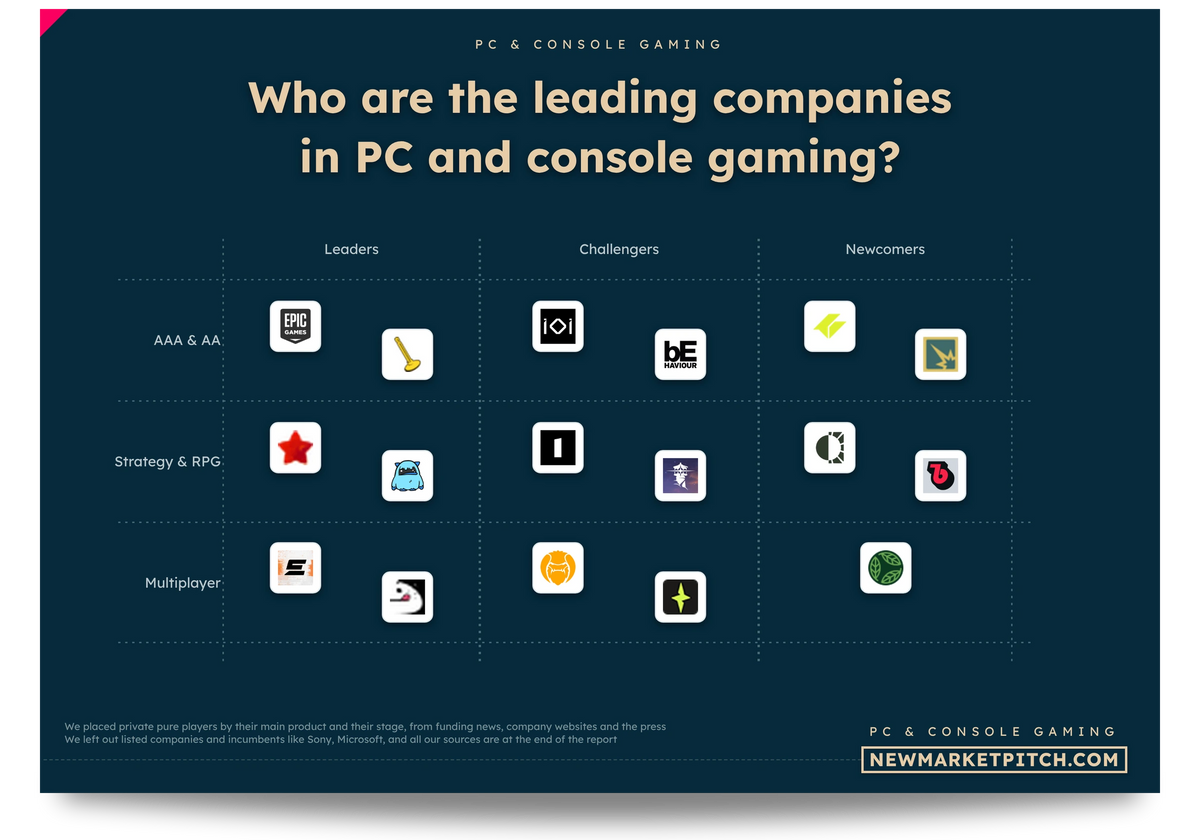
In our research about PC and console gaming startups, we turn what is vague and complex into simple, useful visuals. Market maps like this one show you at a glance where every startup stands.
Are investors still putting serious money into PC and console games?
Yes, PC and console gaming startups still raise serious money, although the biggest checks give a misleading impression of what most developers can expect.
We have counted 53 financings involving 45 companies and at least $638M in disclosed capital. The businesses range from teams developing Steam games to console publishers, game-engine specialists, cloud platforms and handheld makers. They all serve PC or console players, but they need money for very different things.
Build A Rocket Boy's Series D of at least $110M in January 2024 is a useful example of a large studio financing, backing several linked products rather than one game. A studio building a single narrative game has a different spending plan. A developer-tools business is different again: it gets paid by studios instead of selling its own game to players.
Big announcements tell us that investors will still back expensive gaming plans. They tell us much less about whether a small team with one promising PC game can get financed. To answer that, we have to look at the smaller rounds as well as the outliers.
How much money does a typical PC or console gaming startup raise?
A normal PC and console gaming financing is much closer to $5.4M than to the nine-figure rounds that attract headlines.
The median disclosed deal was $5.4M. Among deals with a public amount, 21 were under $5M, or 46%, while 20 were $5M to under $20M, or 43%. Most funded teams were therefore working with amounts suited to making games, hiring people and getting products to market rather than launching an entire entertainment platform.
Ironwood Studios' $4M Seed in February 2026 illustrates a particularly strong position for a modest raise. Its debut game Pacific Drive had sold over 1.5 million copies, according to the studio's February 2026 update, and the new money was intended for its next project. Sound Games took a different approach: its $6.5M Seed in January 2026 backed a publisher trying to make premium games easier to buy across devices. Neither business needs a gigantic check to make sense.
The contrast with giant financings is important. A founder pitching a carefully scoped indie game should not judge the market by what a hardware company or a large multiplayer studio raises. Those are different products with different costs.
Are $50M rounds becoming normal for PC and console gaming startups?
Rounds above $50M are still rare in PC and console gaming, even though they account for a surprisingly large share of the money.
Only 3 eligible financings crossed that threshold. They represented 6% of deals and at least $311M of disclosed funding. There were also 2 rounds of $100M or more, accounting for 4% of deals and at least $255M in disclosed capital. The market has an active smaller end and a very narrow group getting the biggest checks.
Those large rounds were attached to distinct plans. Build A Rocket Boy's Series D of at least $110M in January 2024 backed a studio planning several linked products. Bonfire Studios' $56M Series B in January 2025 financed the team making Arkheron, a competitive multiplayer title. The largest hardware raise concerned physical handheld consoles and games, which brings manufacturing and distribution costs into the picture.
Investors are willing to pay for those ambitions, but the amount raised does not tell us whether players will show up or stay. A giant check buys time to build and launch; a successful game still has to earn its audience.
Are PC and console investors backing games or other businesses?
Investors are mainly financing PC and console game studios, but gaming hardware, publishing and developer tools also attract substantial checks.
Premium and indie game studios drew at least $192M across 22 companies. Multiplayer and live-service studios added 8 deals involving 7 companies and at least $156M. Those are the two categories most closely tied to making and running games. Hardware, by contrast, needed far fewer financings to account for a large sum.
Look at what the money buys. Amplitude Studios' €12M (about $14M) Series A in May 2025, led by Griffin Gaming Partners with Bpifrance, backed an experienced maker of strategy games after its return to independence. Gardens Interactive's Series B of at least $35M in October 2026 supported the launch and continuing operation of a social role-playing game. Diversion's $4.5M Seed in May 2025 backed cloud version control built for game developers. Each company has a different route to customers and revenue.
The table below shows the seven parts of PC and console gaming, ordered by disclosed capital.
| Category | Deals | Companies | Capital |
|---|---|---|---|
| Premium and indie game studios | 25 | 22 | $192M+ |
| PC and console gaming hardware | 3 | 2 | $165M |
| Multiplayer and live-service studios | 8 | 7 | $156M+ |
| PC and console publishing | 8 | 5 | $58M |
| Game development infrastructure | 4 | 4 | $41M |
| Cloud and remote-play services | 4 | 4 | $13M+ |
| Player communities and discovery | 1 | 1 | $13M |

In our market report about PC and console gaming startups, we always try to gather several sources and make estimates that make sense, so you can work with solid numbers.
Can a small independent PC game studio still get funded?
Independent PC and console game studios are getting funded, and they account for more deals than any other type of gaming company.
The premium and indie group made up 47% of all deals, with a $3.3M median. That range includes teams with different levels of proof. Ironwood Studios had already shipped Pacific Drive before its new funding. Amplitude Studios could point to its ENDLESS strategy franchise and a seasoned development team. Human Computer's $5.7M Seed in March 2025 went to a newer independent developer.
These cases show investors have more than one reason to write a check. A released game can show that a studio knows how to finish and sell something. A familiar franchise gives investors a clearer picture of its audience. Founders with a strong track record may get money before their next title is public. None of those guarantees that the next game will work.
For a small studio, this is encouraging without being a blank check. A few million dollars can be meaningful if the team has a realistic plan for making and selling its game. The very large rounds belong to a different level of spending and risk.
Why do multiplayer PC game studios raise much bigger checks?
Multiplayer PC and console studios raise bigger rounds because their work continues long after the game first goes on sale.
The multiplayer and live-service category had a $31M median disclosed deal, compared with $3.3M for premium and indie studios. Bonfire Studios' $56M Series B in January 2025 supported the team developing Arkheron. Ruckus Games raised a $19M Series A in November 2024 for cooperative action games. Gardens Interactive's announcement in October 2026 expressly linked its financing to launching a social role-playing game and running it afterwards.
The costs are easy to understand. A multiplayer studio has to build networking systems, handle unpredictable numbers of players, balance competitive play and release new content. If users leave after the launch, even a well-built online game can struggle. Distinct Possibility Studios raised a round of at least $31M, with undisclosed stage, in July 2025 for the multiplayer shooter REAPER ACTUAL, the same demanding kind of game.
Investors are paying for a game and the team that must operate it. That's a credible reason for larger checks, though nobody should mistake a large production budget for proof that a lasting player community already exists.
Can one ambitious PC game really attract $100M in funding?
PC and console studios can raise $100M for an ambitious project, but investors usually expect a business bigger than one launch.
Build A Rocket Boy's Series D of at least $110M in January 2024 is the clearest case. The company connected MindsEye with EVERYWHERE and ARCADIA, pitching a broader set of entertainment and creation products under former Rockstar North leader Leslie Benzies. The financing backed a business expected to keep building beyond the first release. It did not last: Build A Rocket Boy entered administration in September 2026 and stopped operating in October 2026.
Contrast that with studios whose case rests on a shipped title or an established team. Ironwood Studios pointed to the reception of Pacific Drive before raising new money. Amplitude Studios entered its new independent chapter with a known catalog and experienced developers. Both examples show why evidence of a studio's ability to finish games counts, even when the eventual round is much smaller.
There's nothing wrong with a founder pitching an expensive premium title. But when a studio asks investors for an enormous amount of money, it needs a credible plan for what happens after launch as well. The difference between financing one game and financing a whole development business becomes impossible to ignore at that size.

Our document detailing everything you need to know about PC and console gaming gets updated several times a month, so you always get the latest view of where things stand.
Is retro console hardware suddenly getting huge venture rounds?
Retro console hardware has attracted one huge financing, with little evidence of a wider rush to back handheld startups.
ModRetro's $145M round of undisclosed stage in March 2026 was the largest eligible financing. Its Chromatic handheld and physical cartridges sit in a market that depends on device design, manufacturing, inventory and retailers. A later SEC Form D reported the private securities offering and dated the first sale to March. That is a different set of costs from hiring a game-design team.
The category's other two financings show how wide the gap can be. ModRetro itself had raised $19M in December 2024, while ARC's $1.1M Seed in September 2026 went to an Indian startup developing a handheld console and operating system. Both businesses are built around portable play, yet they are at different points in their development and funding.
A big hardware round can make the category look fashionable almost overnight. We would be careful with that conclusion: the evidence shows one exceptional company and another much smaller bet. It does not show a long line of device makers raising blockbuster rounds.
Are independent PC and console game publishers still getting funded?
Independent PC and console publishers are still raising venture money, especially when they have a clear way to find and sell games.
The publishing category recorded 8 deals across 5 companies, with $58M in disclosed capital. Sound Games' $6.5M Seed in January 2026 backed a pay-once model for premium games across devices. Mystic Forge's $2.2M Seed in July 2024 supported a label focused on independent strategy games. Fictions' $17M round of undisclosed stage in November 2025 backed a publisher associated with titles including LEGO Party.
4Divinity is an unusual case within that group. The Singapore publisher's $9M round of undisclosed stage in August 2026 was one of several investments led by ADATA Technology. GCL's public announcement linked that backing to game rights and distribution. Several financings went to one publisher, rather than to a wave of newly founded labels.
Publishers have to choose games, buy rights, market releases and manage relationships with developers. A good catalog can spread their risk, but they still need people to buy the titles. That's why backing a publisher is a different decision from financing the studio making one particular game.
Can Godot and other game development tools attract big investors?
Companies selling tools to PC and console developers can raise meaningful rounds without producing a hit game of their own.
Game development infrastructure recorded 4 deals involving 4 companies and $41M in disclosed capital. W4 Games' $18M Series B in August 2026 is a strong example. Tencent led the round, and W4 Games said it would expand international hiring, build out paid Godot services and work with Tencent to support developers in Asia. Godot's official console documentation also points studios to specialist middleware providers, including W4 Games.
Other teams tackle problems developers run into every day. Beamable's $14M Series A in February 2025 supported backend and live-game services. Diversion's $4.5M Seed in May 2025 backed cloud version control for game teams. Jabali's $5M Seed in March 2024 backed software that turns written prompts into playable games.
The appeal is straightforward: these businesses can sell the same useful service to many studios. But they still need developers who will pay for it. A tool with no customers is no safer than a game nobody plays.

In our report covering the PC and console gaming market, we look at what the winners do differently, so you can learn from the best instead of guessing.
How big are cloud gaming startup rounds?
Not very big: PC and console cloud and remote-play startups are getting funded, but the publicly reported checks remain modest.
Cloud and remote-play services recorded 4 deals involving 4 companies and at least $13M in disclosed money. Entity's $5.8M Seed in August 2026 backed a browser platform promising console-quality games. Playruo raised $2.5M in a round of undisclosed stage in April 2026 for browser-based demos and playtesting. Gamestream's $4.9M round of undisclosed stage in March 2024 supported a service sold through distributors and other partners.
Blacknut, which runs a cloud gaming subscription, also announced Growth Equity backing in August 2026. It did not disclose the amount. Blacknut discussed a wider investment arrangement with Digital Alpha, but a possible future amount should not be treated as cash already raised.
These companies are pursuing different customers: subscribers, publishers wanting playable previews, and businesses offering gaming to their own users. There is also a neighboring business in player discovery. Medal's $13M Series D in July 2024 financed a game-clip platform that was expanding into desktop AI, as TechCrunch reported at the time. Neither case gives us evidence that cloud play or gaming communities have suddenly replaced PC and console game sales.
How young are PC and console gaming startups when investors back them?
Most funded PC and console gaming startups are young, but the companies receiving the biggest checks tend to be older.
The median company age at a recorded financing was 3 years. Among companies raising rounds above $50M, the median was 8 years. For companies raising less than $5M, it was 3 years. A small seed round can support an early team and prototype, while a very large check often needs more evidence that the people behind the game can build and run an expensive product.
The mix includes veteran-led businesses and teams that have already shipped something. Build A Rocket Boy was developing several connected products under an experienced founder. Ironwood Studios had a successful debut release to show investors before its next raise. ARC was financing the development of a handheld gaming platform. Their stories help explain why company age alone does not settle the funding question.
We also found that 93% of funded companies were founded since 2015, 71% since 2020 and 62% since 2022. The money is reaching genuinely young businesses, even if the unusually large checks more often require a longer track record.
Do PC and console game startups make it past seed funding?
Some PC and console gaming startups reach major later rounds, but far fewer appear at Series B or beyond than at Seed.
Seed accounts for 19 deals involving 19 companies, while Series A accounts for 7 deals and Series B for 3. No Series C deal appeared in the eligible financings. We also counted 2 Series D+ deals and 1 Growth Equity transaction. This is a market in which early checks are common enough to be visible, while successful progression through every named stage is much harder to establish.
The businesses at later stages differ. Bonfire Studios financed a persistent multiplayer game. W4 Games sells software and services to other developers. Build A Rocket Boy combined game production with a wider platform ambition. Getting to a later funding label therefore does not require every company to follow the same product strategy.
There is an important limit to what the stage labels tell us: 21 deals had no announced stage. That prevents us from treating the absence of a Series C announcement as proof that no developer is mature enough for one. Still, the published record offers little sign of a smooth climb from Seed through successive lettered rounds.
The table below shows the recorded stages, ordered by disclosed capital.
| Stage | Deals | Companies | Capital |
|---|---|---|---|
| Unknown | 21 | 16 | $279M+ |
| Series D+ | 2 | 2 | $123M+ |
| Series B | 3 | 3 | $109M+ |
| Series A | 7 | 7 | $76M+ |
| Seed | 19 | 19 | $51M+ |
| Growth Equity | 1 | 1 | Undisclosed |
| Series C | No deal | – | – |
Do PC and console gaming startups keep raising from the same backers?
Most funded PC and console gaming startups appeared only once in the recent deals, though a few returned to investors for more.
Of the 45 funded companies, 40 appeared in just 1 eligible round, or 89%. Only 5 companies raised more than once. That distinction is easy to lose when a publisher makes several announcements over a short span: the announcements all involve real funding, but they do not represent a fresh company each time.
4Divinity is the clearest example of repeat backing. It recorded 4 financings and $32M from investments led by ADATA Technology. Magic Potion Games also appeared repeatedly, while ModRetro, Welevel and Distinct Possibility Studios returned for another round. Their products differ, from original games to multiplayer development and handheld hardware, so repeat fundraising does not point to a single winning business model.
We can say that some investors stayed with companies they already knew. We cannot conclude from fundraising alone that the extra money produced a profitable game or a large player base. For that, we would need evidence of sales, players and repeat customers, not another financing announcement.

Learning from others' mistakes is the cheapest lesson there is. In our research about PC and console gaming startups, we look at what broke startups before you, so you don't repeat it.
Does PC and console gaming funding arrive steadily every month?
PC and console gaming deals come in bursts rather than arriving at a steady monthly pace.
Across 34 completed months, the median month had 1 deal and $11M in disclosed funding. There were 5 months with no eligible deal, while August 2026 had the highest number of financings, at 6 deals. March 2026 brought in the most disclosed money, $145M, from a single hardware round.
The busiest month was varied: it included a Godot tools business, browser gaming services, publishers and independent studios. The highest-money month looked different, with a single, exceptional financing. You can have a relatively busy month without a giant funding total, or a big dollar headline without many deals.
This irregular pattern is worth remembering when a quiet month makes people wonder whether investors have lost interest. A deal closes after conversations that often began much earlier, and the announcement can come later still. Monthly totals are useful for showing when news broke, but they are a poor basis for declaring the whole market healthy or dead.
Do American game startups get bigger checks than European studios?
American PC and console gaming startups have attracted bigger disclosed checks than European studios, despite the regions recording the same number of deals.
North America recorded 19 deals involving 15 companies, representing 36% of deals and at least $378M in disclosed funding. Europe also recorded 19 deals, involving 18 companies, but raised at least $203M. The regional median was $13M in North America and $5.7M in Europe. The difference is in check size, not the number of funded deals.
Several large US rounds came from hardware and ambitious multiplayer development. Europe had its own heavyweight investment: Build A Rocket Boy's British studio financing. The United Kingdom as a country recorded 4 deals across 4 companies and at least $128M in disclosed funding, while Red Rover Interactive's $15M Series A in April 2024 showed that a separate British multiplayer studio could also raise a significant check.
The rest of Europe includes smaller, more specialized bets, such as Mystic Forge's strategy-game publishing business in the Netherlands and Gamestream's cloud platform in France. The regional figures do not mean American founders are automatically favored. They show that the funded US companies in this period included more of the types of businesses receiving giant checks.
Are investors backing PC and console game studios in Saudi Arabia and India?
PC and console gaming startups in Saudi Arabia and India are getting funded, though their checks are far smaller than the market's biggest Western rounds.
Saudi Arabia recorded 4 deals involving 4 companies and $5.4M in disclosed capital, with a $1.4M median. Ash Games Studio's $1.5M Seed in July 2026 backed folklore-inspired PC and console games. Majestic Mind Games raised $1.5M in a round of undisclosed stage in August 2026 for games including Tri Survive. Lambda Studios' $1.3M round of undisclosed stage in November 2026 supported an expansion from Roblox toward PC games.
India recorded 3 deals involving 3 companies and $3.1M in disclosed capital. Those were different bets too: Shortgun Games' $1M Seed in August 2025 backed action-game development; ARC's $1.1M Seed in September 2026 funded a handheld gaming platform; and 1312 Interactive's $1M Seed in September 2026 supported independent game publishing.
None of these cases establishes that investors will write a huge check for every team in those markets. What they do establish is that PC and console projects outside the traditional US-European centers can win backing for studios, publishers and even hardware. Small first checks are part of the market, too.
Are Krafton and Tencent backing independent PC game companies?
Krafton and Tencent have both backed independent PC and console gaming companies, though they chose different kinds of businesses.
Krafton led 3 deals with a combined round size of $45M. Red Rover Interactive's $15M Series A in April 2024 backed multiplayer survival development. Eschatology Entertainment's $11M Series A in August 2024 supported an action-game studio, while Ruckus Games' $19M Series A in November 2024 backed a cooperative action team. These are named lead investments, and the combined financing amounts should not be mistaken for Krafton's own checks.
Tencent's involvement took a different form. It led W4 Games' $18M Series B in August 2026 and signed a longer-term partnership to support adoption of Godot tools in Asia. Instead of financing an individual game, Tencent was backing technology that studios can use across many releases.
Both approaches are understandable. A publisher can learn from working closely with the studios making future games. A major industry company can also benefit when the tools behind game production become more widely used. But each investment still has to stand on the quality of the company receiving it.
Are Andreessen Horowitz and other big VCs funding PC games?
Sometimes, and with large checks, but specialist gaming funds and industry investors lead PC and console gaming deals more often.
Andreessen Horowitz led Bonfire Studios' $56M Series B in January 2025, one of the largest rounds we recorded. Point72 Ventures led Sound Games' $6.5M Seed in January 2026. Both are generalist investors backing a team with a specific plan, rather than spreading money across many small studios.
The most active named leads were BITKRAFT Ventures, ADATA Technology and Merak Capital, with 4 rounds each. BITKRAFT comes first because the rounds it led add up to at least $55M, against $32M for ADATA Technology and $5.4M for Merak Capital. BITKRAFT's rounds include developer services such as Beamable along with game studios, ADATA Technology's all went to 4Divinity, and Merak Capital's went to Saudi studios. These totals describe the size of the financings each investor led, not its own investment amount.
A founder should take a practical lesson from that mix. Generalist venture funds sometimes pay for ambitious gaming companies, especially when the upside looks large. Specialist funds and industry backers show up across a wider set of deals. No single kind of investor controls all the money going into PC and console gaming.
Do PC and console gaming companies have to disclose what they raised?
PC and console gaming companies can announce an investment without saying how much they raised, so public funding totals are incomplete.
We found 7 deals with undisclosed amounts and 48 deals with a public figure, representing 87% of eligible financings. The missing amounts still count as deals; they simply cannot be added to disclosed capital. This distinction matters when comparing a publisher with a public financing figure against a studio whose investors chose not to release one.
For example, Torpor Games announced minority backing in November 2025 for the studio behind Suzerain, with plans to expand its fictional political universe. Blacknut announced new backing in August 2026 as it pursued a larger cloud-gaming business. In both cases, there was an identifiable transaction and a business reason for taking investment, but no completed deal amount to put alongside the public checks.
Funding reports can also omit the stage. A company may say exactly what it raised without calling the financing Seed or Series A. We should not turn those omissions into a verdict on a startup's progress. The useful conclusion is simpler: published funding figures show where money went, but they do not capture every dollar invested.
So, what do PC and console gaming funding deals really look like today?
PC and console gaming funding is mostly a market of modest checks for young businesses, punctuated by a few exceptionally large deals.
The typical deal finances a studio building a game, a publisher bringing titles to market or a specialist selling tools to developers. The huge rounds are real, but most startups never see that kind of money. Investors will finance a promising indie project, pay much more for a multiplayer world that needs years of support, or make an extraordinary bet on gaming hardware.
ModRetro raised the largest single round, while BITKRAFT Ventures, ADATA Technology and Merak Capital tied as the most active named lead investors, with 4 rounds each. Those are different kinds of leadership, and neither tells the whole story. Looking at the type of product, the normal round and the number of companies raising gives a much clearer answer than staring at a market total.
The table below shows what we found.
| Question | Answer |
|---|---|
| Are big gaming rounds now everyday events? | No, huge gaming checks remain the exception for funded startups. Just 3 rounds were above $50M in this period. They heavily influence the total without describing the typical deal. |
| Can an indie studio still get backed? | Yes, independent PC developers continue to win meaningful venture funding. Premium and indie studios recorded 25 deals, more than any category. Their frequent smaller checks keep the market open to new teams. |
| Do investors need proof a game sells? | A shipped game can strengthen a studio's case considerably. Pacific Drive had sold over 1.5 million copies before Ironwood raised. Investors could judge its developers on a product players bought. |
| Are online games harder to finance cheaply? | Yes, multiplayer projects often carry bigger ongoing production costs. The median multiplayer studio financing reached $31M among disclosed rounds. Keeping an online world alive takes work after launch. |
| Do smaller handheld makers find venture money too? | Yes, smaller PC gaming hardware businesses have secured early funding. ARC raised a $1.1M Seed in September 2026. That investment shows hardware funding exists beyond the standout console deal. |
| Do independent game publishers still get funding? | Yes, investors still back companies that bring games to market. PC and console publishers recorded 8 financing deals. Publishing money can pay for rights and distribution across titles. |
| Can engine tools succeed without publishing games? | Yes, developers' recurring problems create customers for specialist software providers. Game development infrastructure raised $41M in disclosed capital. Those businesses sell useful tools rather than their own game worlds. |
| Is cloud play already attracting giant checks? | No, cloud-gaming startups have mostly raised smaller disclosed sums. Cloud and remote-play companies received $13M+ in the period. Browser demos and subscriptions remain distinct bets with uncertain reach. |
| Do game startups usually reach later rounds? | Few PC and console startups appear in the later named stages. Only 3 Series B gaming deals were recorded. Missing stage labels mean the full progression remains partly hidden. |
| Are American and European gaming deals comparable? | Their deal counts match, but the money differs substantially. North America and Europe each recorded 19 deals. Larger US hardware and studio checks widened the gap. |
| Is one investor backing every kind of game? | No, different gaming companies attract different sources of money. BITKRAFT Ventures, ADATA Technology and Merak Capital led 4 rounds each. Specialists, publishers and generalist funds all play distinct roles. |
Our methodology
Our data runs through November 19, 2026. We then reviewed this article and updated its answers on November 24, 2026, the date shown under the title. We reviewed financings completed from January 1, 2024 to November 19, 2026, rather than using a rolling recent-year comparison or adding companies' earlier fundraising histories.
We count qualifying equity financings of private companies at or above $300K. Debt, grants, loans, unconverted convertibles, SAFEs and public offerings are excluded. Each financing is counted once, and duplicate reports of the same transaction are merged rather than treated as extra rounds.
PC and console gaming covers companies developing, publishing, distributing or operating games primarily for PCs, dedicated consoles and gaming handhelds, as well as specialist tools, communities, cloud services and devices serving that ecosystem. Substantial multiplatform studios qualify. We exclude mobile-first titles with incidental PC ports, headset-first XR, gambling, esports-only operations, speculative tokens and general technology suppliers. We examine borderline companies rather than automatically omitting them, and every counted company must meet our startup definition: founded in 2007 or later, independently built for fast product-led growth, and private or recently listed under our eligibility rules.
Undisclosed deal amounts contribute to the count but not the total capital, which makes some sums minimums. We classify investment stages using announced Seed, Series A, Series B, Series C, Series D+ and Growth Equity labels; rounds without a reliable label remain Unknown. We assign regions from a company's headquarters country and divide companies into our seven functional PC and console gaming categories.
We prioritize company announcements, regulatory filings, investor releases and reliable press reports for funding dates, amounts, stages and lead investors. A reporting source may use a different currency or describe a transaction differently, but the amounts and groupings published here follow one consistent research record.
Rounds confirmed by a company announcement, a press article or a regulatory filing are counted in full. Where no article exists, a round is counted only when at least two recognised databases agree on its date (within one month) and amount (within 5%), and it is marked as low confidence; a round found in a single database stays in the company's history but is left out of totals. For companies that have raised more than $100M, every round counted is backed by an article.
A broader press total can differ because it includes mobile-first games, acquisitions, debt, grants, publicly listed businesses or financings outside these dates. A famous game company may not appear because its relevant round occurred earlier or its main business falls outside this market. Similarly, an apparently quiet latest month does not by itself indicate that investors stopped funding the sector; announcements and filings arrive irregularly.
Key sources include ModRetro private equity offering and first-sale date, Build A Rocket Boy products and January 2024 financing, Gardens Interactive launch and live operations plans, W4 Games Series B and Tencent partnership, Godot console middleware provider information, Beamable's backend and network plans, Distinct Possibility Studios and REAPER ACTUAL, Ruckus Games team and cooperative-game investment, Amplitude Studios' independence and ENDLESS games, Ironwood Studios funding and Pacific Drive sales, Entity browser game platform and financing, Playruo playtesting and streaming services, Blacknut and Digital Alpha transaction description, 4Divinity funding and publishing strategy, 4Divinity August investment from ADATA, Sound Games pay-once cross-platform model, Medal clip-sharing origins and desktop AI expansion, Torpor Games investment and Suzerain plans, Krafton backing Eschatology and Red Rover, and Bonfire Studios Series B investor context.
Written by the New Market Pitch teamWe track new markets so founders and investors can move faster. About us