Who are the top investors in procurement software?
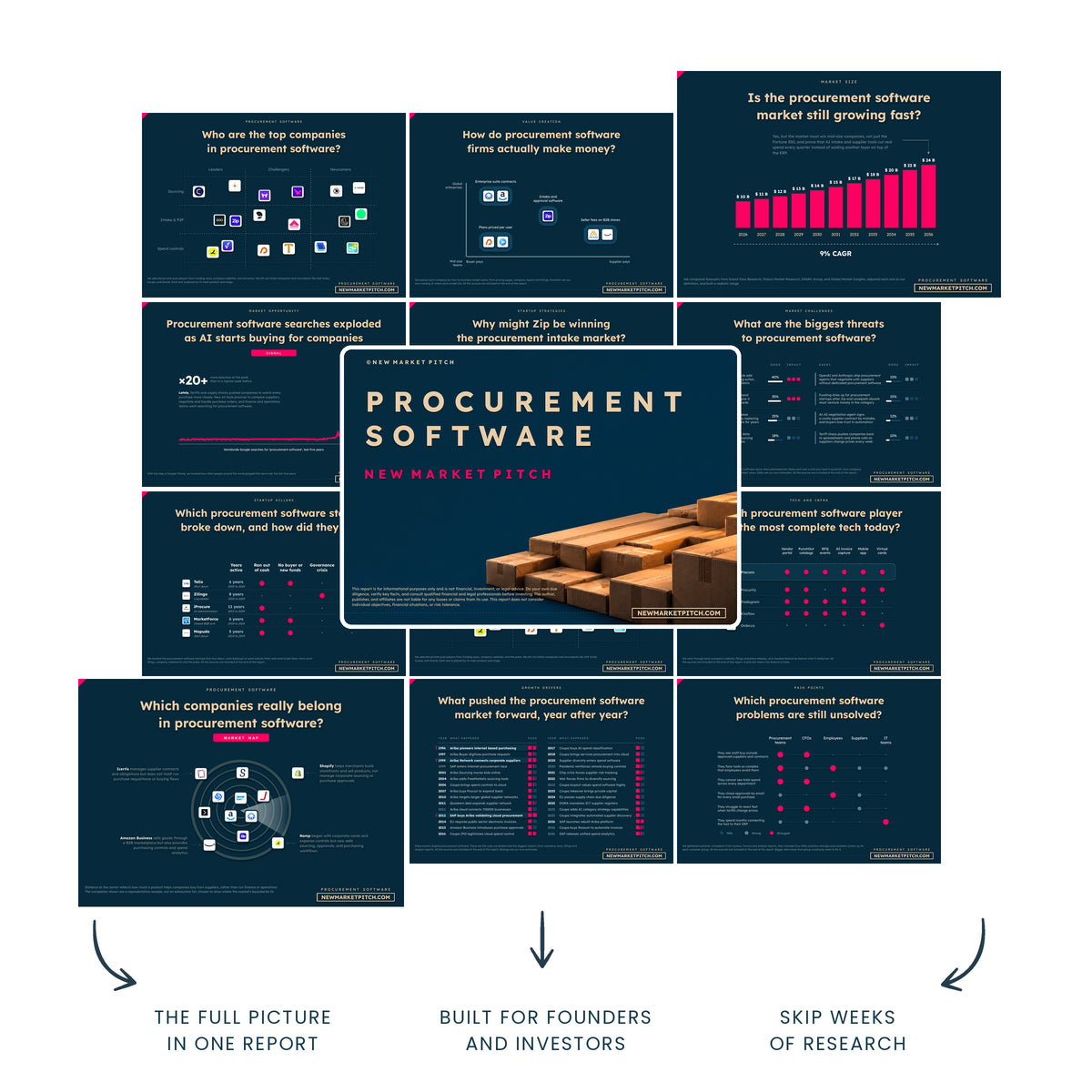
Whether you're building or investing in the procurement software market, our report covers everything you need to know: the players, the money, and what's coming next.
Summary
Insight Partners is the most active investor in procurement software in our coverage window, having joined 4 rounds and been named lead in 4. Headline and Notion Capital follow with 3 rounds joined and 2 led each. No firm has the market to itself.
We identified 178 named investors in procurement software financings. Of the 123 qualifying rounds, 113 named at least one investor. Founders have a much wider set of potential backers than the best-known VC names.
Leading and joining are different jobs. Insight Partners was named lead in every round we found involving it. Headline and Notion Capital have sometimes led and sometimes invested alongside other funds.
Headline and Notion Capital have been the busiest this year among the main recurring investors, with 2 rounds each. Their deals span procurement AI, industrial supplier information, corporate events and purchasing controls, so recent activity tells a different story from the full-period ranking.
Battery Ventures has backed Levelpath and Freehand, both focused on large enterprise workflows. Lightspeed Venture Partners backed Naboo and LightSource, while Notion Capital appeared in Naboo and Pivot. Those firms are buying into different versions of the procurement problem.
Seed funding is more widely spread. Seed is the busiest stage with a published name, yet no single investor leads its participation count. A procurement founder looking for a first check has to look beyond a supposed default fund.
Growth investing is more selective. Insight Partners, Notion Capital and Battery Ventures share the lead in Series B participation, with 2 rounds each, but their companies tackle different purchasing tasks. What a startup actually sells matters as much as its stage.
There are buyers of procurement software with close ties to the market itself. IndiaMART joined rounds for industrial purchasing companies, and Wa’ed Ventures backed BRKZ's construction-materials marketplace. Those backers bring experience beyond conventional software investing.
Repeated co-investing is rare. No pair of investors appears together in more than one qualifying round in our records. A well-publicized co-led deal does not mean the same funds regularly work as a team.
For procurement software founders, Insight Partners leads across the full window, and Headline and Notion Capital lead this year's most active recurring investors. The rest of the market is spread across generalist funds, specialists and investors close to specific buying industries.

Written by the New Market Pitch teamWe track new markets so founders and investors can move faster. About us

In our report covering the procurement software market, you will always find fresh funding data, taken straight from our own verified funding database.
Which VCs invest the most in procurement software right now?
Insight Partners has backed the most procurement software rounds in recent years, with 4 rounds joined and 4 named leads. Headline and Notion Capital follow with 3 rounds joined and 2 led each, and both have been busier than Insight this year.
Battery Ventures belongs to a group of 9 investors tied at 2 rounds joined. Among tied investors, firms named lead more often come first, then those with the most recent round. That is why Headline, last seen in SPARETECH's November 2026 round, comes ahead of Notion Capital, and why Battery Ventures comes ahead of Lightspeed Venture Partners. A fund can be famous for one giant deal without being a regular procurement investor. We count participation, not the size of the venture firm's own checks.
Insight Partners has backed Omnea, Pactum AI, SPARETECH and Remarcable, while Headline appears with Didero, SPARETECH and Procure Ai. Both back software that handles real supplier or purchasing tasks. SPARETECH's recent company announcement described expansion of an industrial parts network; Didero's company announcement described AI agents that act on purchase-order and supplier information. Their portfolios overlap in procurement, but the products do different jobs.
The table below ranks the 20 most active procurement software investors by the number of equity rounds they joined, with the rounds they led, their main stages, the startups they backed and the biggest round they joined.
If you want to go more into detail and get more data to understand what investors are betting on now, please check our procurement software report.
| # | Investor | Rounds | Led | Main stages | Procurement software startups backed | Biggest round joined | Latest round |
|---|---|---|---|---|---|---|---|
| 1 | Insight Partners ▼ | 4 | 4Named as lead in every round found | Series B 2Series A 1 | Pactum AI, Omnea, SPARETECH, Remarcable | $54MPactum AI · 2025 | Nov 2026 |
| 2 | Headline ▲ | 3 | 2Usually leads (67% of its rounds) |
Seed 1Series A 1 | Didero, SPARETECH, Procure Ai | $30MDidero · 2026 | Nov 2026 |
| 3 | Notion Capital ▲ | 3 | 2Usually leads (67% of its rounds) |
Series B 2Series A 1 | Naboo, Pivot | $70MNaboo · 2026 | May 2026 |
| 4 | Battery Ventures | 2 | 2Named as lead in every round found | Series B 2 | Freehand, Levelpath | $75MFreehand · 2026 | Jul 2026 |
| 5 | Vertis | 2 | 2Named as lead in every round found | Seed 1 | Soource, TimeFlow | $4.4MTimeFlow · 2025 | Jun 2026 |
| 6 | Base10 Partners | 2 | 2Named as lead in every round found | Seed 2 | BRM, Traza | $6.6MBRM · 2024 | Apr 2026 |
| 7 | Lightspeed Venture Partners | 2 | 2Named as lead in every round found | Series A 1Series B 1 | Naboo, LightSource | $70MNaboo · 2026 | Feb 2026 |
| 8 | Navitas Capital | 2 | 2Named as lead in every round found | Seed 1Series A 1 | Field Materials | $10MField Materials · 2025 | Apr 2025 |
| 9 | Wa’ed Ventures | 2 | 1Leads half its rounds | Series A 1Series B 1 | BRKZ | $13MBRKZ · 2026 | Sep 2026 |
| 10 | D11Z Ventures | 2 | 1Leads half its rounds | Seed 2 | akirolabs, Resourcly | $5Makirolabs · 2024 | Oct 2025 |
| 11 | IndiaMART | 2 | 0Never led | Series A 1Series B 1 | ProcMart, Aerchain | $30MProcMart · 2024 | Mar 2026 |
| 12 | Y Combinator | 2 | 0Lead not published | Seed 2 | Response, Hazel | $4MResponse · 2025 | Feb 2025 |
| 13 | Blume Equity | 1 | 1Named as lead in its only round found | Series B 1 | SPARETECH | $20MSPARETECH · 2026 | Nov 2026 |
| 14 | DBL Partners | 1 | 1Named as lead in its only round found | Seed 1 | Atmospheric AI | $10MAtmospheric AI · 2026 | Nov 2026 |
| 15 | Supply Change Capital | 1 | 1Named as lead in its only round found | Seed 1 | Kodiact | $2.5MKodiact · 2026 | Nov 2026 |
| 16 | Radical Investments | 1 | 1Named as lead in its only round found | Seed 1 | SpendRule | $4MSpendRule · 2026 | Oct 2026 |
| 17 | Chalfen Ventures | 1 | 1Named as lead in its only round found | — | Opply | $7.5MOpply · 2026 | Oct 2026 |
| 18 | High-Tech Gründerfonds | 1 | 1Named as lead in its only round found | Seed 1 | Finches | $2.2MFinches · 2026 | Oct 2026 |
| 19 | Vanagon Ventures | 1 | 1Named as lead in its only round found | Seed 1 | Finches | $2.2MFinches · 2026 | Oct 2026 |
| 20 | SNAK Venture Partners | 1 | 1Named as lead in its only round found | Seed 1 | Bloom | $3.6MBloom · 2026 | Oct 2026 |
No investors match this search.
Data from January 2024 through 14 November 2026, which is enough to show who is active today and who has been for years. Rounds: equity rounds in which the investor is named. Led: rounds it led or co-led. ▲ more rounds in 2026 so far than its 2025 pace, ▼ fewer.

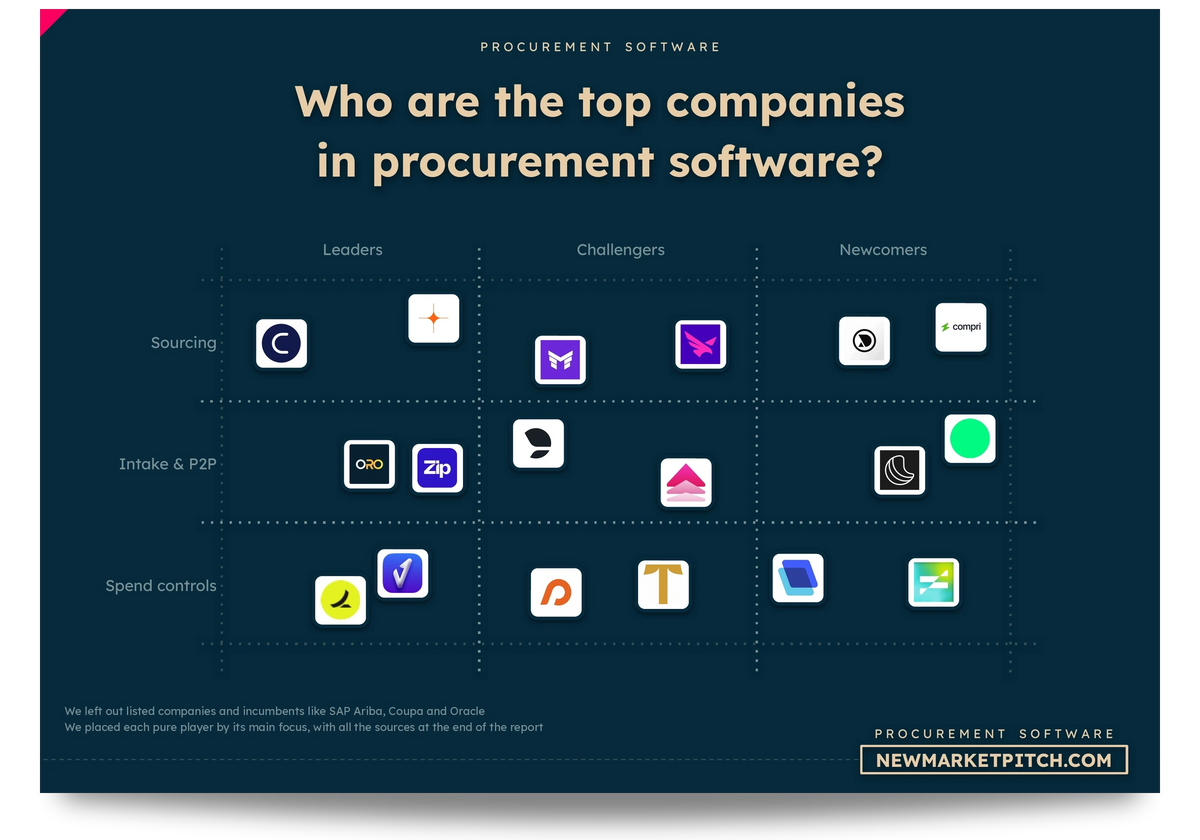
In our research about procurement software startups, we turn what is vague and complex into simple, useful visuals. Market maps like this one show you at a glance where every startup stands.
Why is Insight Partners such a prominent procurement investor?
Insight Partners is the most active procurement software investor because it keeps backing products used in everyday enterprise purchasing.
In our research it joined 4 rounds and was named as a lead in all 4. The companies were Omnea, Pactum AI, SPARETECH and Remarcable. Pactum AI's $54M Series C in 2025 is the largest round it joined in this market within the window. That amount belongs to the full round, not Insight's own check.
Look at the companies Insight backed. Omnea manages intake and supplier workflows; Pactum AI runs supplier negotiations; SPARETECH standardizes industrial spare-parts data and purchasing; Remarcable serves procurement for construction and specialty contractors. They serve different buyers, but all handle tasks that companies do repeatedly.
Insight Partners' own analysis of vertical AI argues that durable software companies need control of workflows and useful customer data, not just access to foundation models. Omnea's September 2025 announcement named Spotify and Wise among customers, while SPARETECH's November 2026 release described Nestlé factories using its parts network. Those customers help explain why Insight keeps returning to enterprise purchasing software.
Is Headline catching up with Insight Partners in procurement software?
Yes, Headline is catching up with Insight Partners in procurement software, helped by its recent activity.
Headline joined 3 procurement software rounds, against Insight Partners' 4. Headline led 2 of its rounds, compared with 4 for Insight. It joined 2 rounds this year, while Insight joined 1. We count rounds joined without inventing each fund's check.
The recent deals show Headline moving between related but different products. It led Procure Ai's seed financing, co-led Didero's $30M Series A in February 2026 and participated in SPARETECH's $20M Series B in November 2026. Procure Ai aims to automate sourcing and purchasing across existing company systems; Didero handles manufacturer supplier communications; SPARETECH helps industrial customers identify and manage spare parts.
Headline is worth considering for founders building AI that handles purchasing tasks. We cannot tell from round announcements how much capital Headline contributed. Its recent deals cover several procurement jobs rather than one narrow product type.

In our market report about procurement software startups, we always try to gather several sources and make estimates that make sense, so you can work with solid numbers.
Do big generalist VCs dominate procurement startup funding?
No, generalist VCs have a strong presence in procurement software, but plenty of other investors also back these startups.
Insight Partners, Headline and Notion Capital stand out for repeated participation, while Battery Ventures, Lightspeed Venture Partners, Vertis and Base10 Partners all appear among investors with 2 rounds joined. The market contains 178 named investors, including many that appear in just one financing. Founders should check which firms actually lead rounds at their stage.
The larger enterprise deals have attracted familiar VC names. Battery Ventures backed Levelpath and Freehand, which sell expensive enterprise workflows. Lightspeed Venture Partners backed Naboo and LightSource, different approaches to structured sourcing and purchasing. Base10 Partners backed BRM and Traza at seed. Meanwhile Vertis supported Soource and TimeFlow rather than chasing the largest software financing. These firms back quite different procurement products.
A famous logo does not mean a fund invests in procurement often. Most names appear much less often than the leaders. For founders, product fit and a fund's history of leading relevant rounds matter more than its reputation.
Do procurement investors prefer leading rounds or joining them?
Some procurement software investors repeatedly lead rounds, while others more often join a deal led by another firm.
Insight Partners was named lead in 4 rounds out of 4 joined, while Headline and Notion Capital each led 2 of their 3 participations. Battery Ventures was named lead in both of its 2 recorded rounds. Wa’ed Ventures led 1 of its 2 BRKZ rounds, and IndiaMART was not named lead in either of its 2 participations. We do not interpret these patterns as proof of who wrote the largest check, because round announcements rarely disclose each investor's contribution.
Founders need to know who is willing to lead. Leads help organize the deal. Other investors can still bring customers or useful experience. In SPARETECH's November 2026 announcement, Blume Equity and Insight Partners were named co-leads and Headline a participant. Didero's February 2026 announcement similarly named Chemistry and Headline as co-leads.
Published leads are easier to identify than quiet participants. That means apparent lead rates are upper bounds rather than evidence that a fund refuses to participate without leading. So we count who was publicly named, without pretending to know every investor's role.
The table below shows how often recurring procurement investors joined and led rounds.
| Investor | Joined | Led |
|---|---|---|
| Insight Partners | 4 | 4 |
| Headline | 3 | 2 |
| Notion Capital | 3 | 2 |
| Battery Ventures | 2 | 2 |
| Vertis | 2 | 2 |
| Base10 Partners | 2 | 2 |
| Lightspeed Venture Partners | 2 | 2 |
| Navitas Capital | 2 | 2 |
| Wa’ed Ventures | 2 | 1 |
Investors tied on rounds joined are ordered by rounds led, then by their most recent round.
Is Battery Ventures still backing procurement software companies?
Yes, Battery Ventures is still backing procurement software, especially tools for enterprise purchasing and spend work.
We found 2 procurement rounds involving Battery Ventures and 2 named leads. They covered Levelpath and Freehand, with Freehand's $75M Series B in 2026 the largest round Battery joined in this market. Battery joined 1 round this year after 1 last year. The round sizes do not tell us Battery's own check.
Levelpath sells AI-native procurement software intended to become a purchasing entry point for enterprises. Its June 2025 announcement described a move toward automated agents for sourcing and workflow coordination. Freehand takes a different path, using autonomous agents to manage supplier spending, invoice reviews and related transactions. Its July 2026 announcement named customers including Unilever and Pfizer and described concrete work performed in existing enterprise systems.
Battery is backing software that can take on more work after customers start using it. Its deals are especially relevant to founders who can show a customer savings or time saved.
Is Lightspeed Venture Partners making procurement a serious bet?
Lightspeed Venture Partners backs procurement software selectively, without dominating the market.
We tracked 2 rounds joined and 2 named leads for Lightspeed Venture Partners. The companies were Naboo and LightSource, and the largest whole financing it joined was Naboo's $70M Series B in 2026. The firm joined 1 deal this year and 1 last year, giving it a visible presence without matching the repeat activity of Insight Partners, Headline or Notion Capital.
Naboo standardizes corporate event venue selection, approvals and supplier purchasing for enterprise customers. Its February 2026 company announcement described expansion into New York and a plan to automate event sourcing. LightSource applies procurement technology to another purchasing workflow. Both startups make messy supplier decisions easier to repeat and control.
Lightspeed backs procurement as part of a much broader venture portfolio. Naboo shows that a specialist purchasing category can win a major VC when large customers use it repeatedly.

Our document detailing everything you need to know about procurement software gets updated several times a month, so you always get the latest view of where things stand.
Why has Notion Capital moved up among procurement investors?
Notion Capital now ties Headline on rounds joined, because it came back for Naboo's latest round and also backed Pivot.
We found 3 procurement rounds involving Notion Capital, and it was named lead in 2. They covered Naboo and Pivot, with Naboo's $70M Series B in 2026 the largest round it joined in this market. It joined 2 rounds this year after 1 last year. Headline ranks just ahead because its latest round, SPARETECH in November 2026, is more recent than Notion Capital's latest, Pivot in May 2026.
Naboo's February 2026 announcement named Notion Capital among the investors in its Series B, which Lightspeed Venture Partners led. Notion Capital also co-led Pivot's $40M Series B in May 2026. Returning to the same company is a stronger signal than a single appearance, but the round sizes still do not tell us Notion Capital's own check.
Which procurement software investors are still investing this year?
Headline and Notion Capital are the busiest procurement software investors this year among the tracked leaders, with 2 rounds each. Insight Partners remains active with 1 round this year after 3 last year. Their order changes when we look at recent deals rather than the full window.
Among the 20 investors shown in our main ranking, 17 have joined a procurement round this year, while 3 have not. Headline's activity includes Didero and SPARETECH, Notion Capital's includes Naboo and Pivot, and Insight Partners participated in SPARETECH. The current year's activity is still in progress, so we do not treat a lower count than a completed year as a verdict on long-run investor interest.
The investor picture is refreshed by firms with a recent, targeted thesis. Battery Ventures remains involved in AI-driven spend operations, and Blume Equity joined industrial supplier data through SPARETECH. The fact that established leaders and newer names are active at once matters more than treating a few quiet portfolios as proof of a funding retreat.
The table below shows, year by year, how many rounds 12 of the most active procurement software investors joined, so it is easy to see who is still investing and who has slowed down.
If you want to go more into detail and see which investors are still writing checks and which have slowed down, please check our procurement software report.
| Investor | 2024 | 2025 | 2026* | Total |
|---|---|---|---|---|
| Headline | 1 | 2 | 3 | |
| Notion Capital | 1 | 2 | 3 | |
| Insight Partners | 3 | 1 | 4 | |
| Battery Ventures | 1 | 1 | 2 | |
| Vertis | 1 | 1 | 2 | |
| Base10 Partners | 1 | 1 | 2 | |
| Lightspeed Venture Partners | 1 | 1 | 2 | |
| Wa’ed Ventures | 1 | 1 | 2 | |
| IndiaMART | 1 | 1 | 2 | |
| Blume Equity | 1 | 1 | ||
| DBL Partners | 1 | 1 | ||
| Supply Change Capital | 1 | 1 |
* 2026: January to 14 November. Darker cells mean more rounds that year. Data from January 2024 through 14 November 2026.
Which major procurement investors have gone quiet recently?
Navitas Capital, D11Z Ventures and Y Combinator have no recorded procurement software round this year.
Navitas Capital's 2 rounds involved Field Materials, most recently in April 2025. D11Z Ventures joined 2 rounds involving akirolabs and Resourcly, most recently in October 2025. Y Combinator joined 2 seed financings involving Response and Hazel, with its latest participation in February 2025. None has joined a qualifying procurement round this year.
That pattern needs careful interpretation. A firm can remain supportive through board work, recruiting, customer introductions and follow-on financing that falls outside the tracked market or period. It can also change its priorities without announcing the decision. The fund's portfolio history tells us where it made earlier procurement bets; the recent participation column tells us what it joined within the present observation window.
Headline and Notion Capital have recently been busier, and Insight Partners still appears in a SPARETECH round. A quiet investor does not mean a whole market has stopped raising.
Are new venture firms still entering procurement software?
Yes, new investor names are showing up in procurement software rounds, although the investment firms themselves are not necessarily new.
Blume Equity entered through SPARETECH, while DBL Partners backed Atmospheric AI, Supply Change Capital backed Kodiact, Radical Investments backed SpendRule, and High-Tech Gründerfonds and Vanagon Ventures backed Finches. These firms have invested elsewhere before. Their appearance here means they recently joined the procurement market we track.
The companies solve very different problems. SPARETECH offers industrial spare-parts management, Atmospheric AI models raw-material supply chains, Kodiact works on sourcing decisions, SpendRule targets contract compliance and Finches tracks supplier risk in agriculture. The investment cases range from data accuracy in factories to the execution of purchasing tasks. SPARETECH's November 2026 release emphasized the value of spare-parts availability for manufacturers.
Even a fund with one relevant procurement deal may be a good fit for a particular startup.

In our report covering the procurement software market, we look at what the winners do differently, so you can learn from the best instead of guessing.
Are Andreessen Horowitz and Sequoia investing in AI procurement agents?
Yes, Andreessen Horowitz and Sequoia Capital have backed procurement AI agents, but neither leads this market in completed rounds.
Andreessen Horowitz led Lio's announced enterprise procurement financing, while Sequoia Capital participated in Magentic's development of agents for industrial operations. Both companies aim to automate work inside the tools procurement teams already use. Lio focuses on purchasing decisions and execution across systems. Magentic places digital workers into manufacturers' sourcing and supply-chain operations. Both products do actual purchasing work inside companies.
The products are trying to take over work people still do. They aim to handle supplier emails, comparisons, approvals and exceptions that keep procurement teams busy. Gartner's April 2026 forecast also shows why companies are interested in automating supply-chain work. Its forecast covers software spending, not equity funding for procurement startups.
Neither firm's participation makes it the market's leading procurement backer. It shows large generalist VCs are willing to back software that does the purchasing work.
Why are investors backing procurement AI agents instead of existing ERP vendors?
Investors back procurement AI agents because supplier emails, approvals and order changes still involve work ERP systems have not automated.
The startups tackle different parts of purchasing. Pactum AI negotiates supplier terms, Didero coordinates communications and order exceptions, Fragment follows direct-procurement changes, and Magentic automates sourcing tasks for manufacturers. Insight Partners backed Pactum AI; Headline backed Didero; 8VC backed Fragment. These agents work alongside existing software, handling tasks that ERP records alone do not finish.
The companies' releases provide concrete context. Didero's February 2026 statement described supplier interactions scattered across emails and ERP tools. 8VC's October 2026 article argued that direct purchasing still depends on repeated conversations about dates, quantities and discrepancies. Gartner's October 2026 procurement survey found that organizations were changing job roles more slowly than expected given the promises of AI. The software can save staff time, but only if customers trust it to act within purchasing rules.
These investors are betting that agents will handle purchases reliably while keeping the ERP systems customers already use.
Does Y Combinator have a real presence in procurement startup funding?
Y Combinator has funded procurement startups at seed, but it has no recorded qualifying round this year.
We identified 2 seed rounds joined by Y Combinator, involving Response and Hazel. Lead investors were not published for those rounds, so its role should not be described as leading or never leading. Its latest recorded procurement participation is Response in February 2025; it has no recorded round this year.
Y Combinator enters earlier than the investors funding established enterprise platforms. A startup can enter procurement through a narrow workflow, such as automating a public-sector request or helping a team compare supplier bids, without having a mature suite. Later funding often requires a different investor with experience in deploying software across enterprise customers and systems.
Their startup choices make that difference clear. Base10 Partners also backed BRM and Traza at seed, while Battery Ventures and Insight Partners later backed procurement companies with wider enterprise reach. The firms serve different stages of a startup's life. Some earlier financings fall outside our coverage window.
Are corporate investors changing procurement startup financing?
Corporate and industry-linked investors are backing procurement software, especially platforms connected to physical supplier networks.
IndiaMART joined 2 rounds involving ProcMart and Aerchain and was not named lead in either. Wa’ed Ventures joined 2 rounds involving BRKZ and led 1. The largest whole round we track for IndiaMART was ProcMart's $30M Series B in 2024; for Wa’ed Ventures it was BRKZ's $13M Series B in 2026. Those numbers do not represent the amounts IndiaMART or Wa’ed Ventures themselves contributed.
Their interest is tied to the markets they already know. IndiaMART operates a business-to-business supplier discovery business, making purchasing workflows and industrial marketplaces a natural area of interest. Wa’ed Ventures co-led BRKZ's latest round, and the BRKZ announcement described construction-material sourcing, supplier pricing and fulfillment across a local industrial network. Both cases involve real goods bought from real suppliers.
Those investors can bring supplier relationships and access to buyers as well as money. A corporate investor's presence, however, does not prove its company is also a customer.

In our research about procurement software startups, we don't want to repeat what boring consulting reports say. Instead, we show you the real and latest market signals that matter.
Which procurement software investors back seed rounds, and which back growth rounds?
Seed is the busiest procurement software stage, with 57 of the 104 rounds that have both a named investor and a known stage. No single seed investor stands out: Base10 Partners, D11Z Ventures and Y Combinator share the top seed count with 2 rounds each. Later-stage deals are rarer, with 7 of those rounds at Series C or beyond.
Insight Partners, Notion Capital and Battery Ventures are tied for the most Series B participations, with 2 rounds each. The early market has far more firms making occasional seed bets. A founder should not pitch every investor as though it funds the same stage.
The companies make those differences clear. Base10 Partners joined the seed financings of BRM and Traza, while Battery Ventures joined later financings of Levelpath and Freehand. Insight Partners backed later procurement platforms including Pactum AI and SPARETECH. A founder should look at the stage and product types a fund has actually financed.
The table below shows, for 12 of the most active procurement software investors, how many rounds they joined at each stage, from seed to growth.
If you want to go more into detail and see where each investor places its bets, from seed to growth, please check our procurement software report.
| Investor | Seed | Series A | Series B | Series C | Series D+ | Growth |
|---|---|---|---|---|---|---|
| Insight Partners | · | 1 | 2 | 1 | · | · |
| Headline | 1 | 1 | 1 | · | · | · |
| Notion Capital | · | 1 | 2 | · | · | · |
| Battery Ventures | · | · | 2 | · | · | · |
| Vertis | 1 | · | · | · | · | · |
| Base10 Partners | 2 | · | · | · | · | · |
| Lightspeed Venture Partners | · | 1 | 1 | · | · | · |
| Navitas Capital | 1 | 1 | · | · | · | · |
| Wa’ed Ventures | · | 1 | 1 | · | · | · |
| D11Z Ventures | 2 | · | · | · | · | · |
| IndiaMART | · | 1 | 1 | · | · | · |
| Y Combinator | 2 | · | · | · | · | · |
Most active at each stage, among all procurement software investors: Seed, Base10 Partners, D11Z Ventures and Y Combinator · Series A, no investor joined more than one round · Series B, Insight Partners, Notion Capital and Battery Ventures · Series C, no investor joined more than one round · Series D+, no investor joined more than one round · Growth, no investor joined more than one round. Bigger dots mean more rounds. Data from January 2024 through 14 November 2026.
Can procurement software startups still find investors after Series B?
Yes, procurement software startups can find investors after Series B, but very few deals reach those stages.
Of the 104 rounds with a named investor and a known stage, 7 were Series C or beyond. That count is not a forecast for today's seed startups. A company seeking that check needs to prove customers use the product. Buyers must trust the software with purchasing decisions and repeated use across teams or sites.
Insight Partners led Pactum AI's $54M Series C in 2025, supporting automated supplier negotiations. At a different point in the buying process, Battery Ventures backed Freehand's $75M Series B in 2026, while Lightspeed Venture Partners backed Naboo's $70M Series B in 2026. These are whole-round sizes. We do not know the investors' individual checks.
Big checks are still rare, and they go to companies that can connect software to decisions a customer makes regularly: negotiating, sourcing, approving, monitoring and purchasing. Investors want customers to keep using the product for real purchasing decisions.
Are procurement marketplaces attracting the same investors as enterprise SaaS?
Sometimes, procurement marketplaces attract the same large software investors, but supplier-network investors also have a place.
IndiaMART backed ProcMart and Aerchain, and Wa’ed Ventures backed BRKZ. Those names are close to trade networks, industrial buyers or regional business development. Lightspeed Venture Partners' investment in Naboo illustrates a different model: a category-specific buying platform that helps large organizations standardize corporate event sourcing. Investors in those companies can have very different reasons for joining.
At the enterprise software end, Insight Partners backed Omnea and Pactum AI, while Battery Ventures backed Levelpath and Freehand. Procurement marketplaces need reliable supply, repeat transactions and buyer access; enterprise orchestration products need deep workflow adoption and integration. Each needs different proof that customers will stay.
BRKZ's September 2026 company release separated its equity fundraising from a debt commitment. A buying platform may also need credit or inventory funding. Only its equity financing belongs in the venture count.
Does the location of a startup change which procurement investors show up?
Yes, where a procurement startup sells often affects which investors are most interested.
Wa’ed Ventures backed BRKZ's construction procurement business in Saudi Arabia. IndiaMART backed the purchasing companies ProcMart and Aerchain in India. Vertis backed Soource and TimeFlow, while Notion Capital backed Naboo and Pivot. The portfolios do not prove a firm only invests in one country, but they show how different its customers and suppliers can be.
Big investors also back companies selling across borders. Lightspeed Venture Partners led Naboo's $70M Series B in 2026, and Notion Capital co-led Pivot's $40M Series B in 2026. Naboo's February 2026 company announcement described expansion in North America; Pivot's May 2026 announcement described global enterprise customers and deep ERP integrations. Both companies can sell to organizations far beyond their original home markets.
Founders should explain which buyers and suppliers they can reach. Local supplier networks can make an industry-focused investor useful. Software for global approval workflows can attract a fund that invests internationally.

Learning from others' mistakes is the cheapest lesson there is. In our market report about procurement software startups, we look at what broke startups before you, so you don't repeat it.
Which procurement software investors most often invest together?
No pair of procurement software investors has joined more than 1 qualifying round together. There are well-known co-investments but no pair that repeatedly shows up. The market includes 178 named investors across many combinations.
Insight Partners and Headline both participated in SPARETECH, where Blume Equity and Insight Partners were named co-leads. Didero paired Chemistry and Headline, while Pivot paired Forestay Capital and Notion Capital. Omnea and Pactum AI also show that some procurement backers return to similar company types without always partnering with the same firms. Backing similar products does not mean the same funds keep co-investing.
A founder should not expect the same investor group to appear at the next round. The lead and the company's product fit matter much more than a past pairing.
So, who actually backs procurement software startups today?
Insight Partners is the most active procurement software investor of recent years, while Headline and Notion Capital have joined the most rounds this year among the recurring leaders.
Insight Partners joined 4 rounds and was named lead in 4, spanning Omnea, Pactum AI, SPARETECH and Remarcable. Headline and Notion Capital each joined 3 and led 2, while Battery Ventures belongs to a group of 9 investors tied behind them. There is no fund that controls procurement investing. Different companies recruit different investors according to their buying workflow, product stage and commercial partners.
The investor list includes different kinds of backers. Established software funds back platforms handling enterprise-wide purchasing, earlier-stage firms test specialized sourcing tools, and ecosystem investors support buyer-supplier marketplaces. For a founder, recent deals in the right product and stage are more useful than a famous name on a portfolio page.
The table below shows what we found.
| Question | Answer |
|---|---|
| Is one firm funding every major procurement startup? | No, even the busiest investor backs only selected companies. Insight Partners joined 4 qualifying rounds and led 4. Its companies sell different tools for real enterprise buying work. |
| Has Headline started setting a faster pace? | Yes, Headline and Notion Capital have been the busiest repeat investors this year. Each joined 2 procurement rounds in the current year. Insight Partners still leads when we consider the full period. |
| Does Battery Ventures still fund purchasing software? | Yes, Battery remains involved in software for enterprise buying. It joined 2 rounds backing Levelpath and Freehand. Both products take on purchasing or supplier spending work. |
| Can corporate event purchasing attract famous VCs? | Yes, Lightspeed Venture Partners has backed Naboo's buying platform. The largest round Lightspeed joined was Naboo's $70M Series B. Specialist purchasing software can attract major generalist venture firms. |
| Are famous early investors still leading deals? | Some early backers have gone quiet in the current year. D11Z Ventures joined 2 procurement seed rounds, the latest in October 2025. Earlier portfolio success does not prove a new deal is coming. |
| Do busy investors lead or just participate? | Both roles matter, and different firms prefer different approaches. Headline was named lead in 2 of its 3 rounds. Each fund's own check remains separate from the announced total. |
| Do supplier networks attract industry-linked investors? | Yes, investors tied to commerce and industry back procurement startups. IndiaMART joined 2 rounds involving ProcMart and Aerchain. Such backers can understand local suppliers as well as software. |
| Are new names joining big procurement rounds? | Yes, procurement keeps attracting investors appearing in this market recently. Blume Equity co-led SPARETECH's $20M Series B in November 2026. It backed software for industrial spare-parts data. |
| Is one VC the default seed investor? | No, no single investor leads procurement seed participation. We found 57 rounds at seed with published stages. Many different firms make those first bets on purchasing products. |
| Do procurement startups have options after Series B? | Yes, but the pool of later-stage rounds gets much smaller. We counted 7 rounds at Series C or beyond. Growth investors want proof customers use the product repeatedly. |
| Do the same investors keep funding together? | No, recurring procurement investment pairs have not emerged so far. No pair joined more than 1 qualifying round together. Founders must judge each firm's interest on its own. |

If you build or invest in the procurement software market, you need to know which business models pay off now and which ones are fading. That's why our report covering it has a whole section on it.
Our methodology
Our data runs through November 14, 2026. We systematically track qualifying private-company equity rounds in procurement software from January 2024 through November 14, 2026. We include software for sourcing, supplier management, purchase intake, procure-to-pay, procurement-focused spend controls and buyer-side purchasing marketplaces, including AI agents working on these tasks. Borderline businesses with substantive purchasing workflows remain included. Every company meets our startup definition: founded in 2000 or later, built to grow around a new product or technology and eligible under our private-company and recent-listing rules.
We count the equity rounds an investor joined and those where it was named lead, never an inferred amount invested by that firm. We exclude IPOs and post-listing offerings, merge duplicate reports of a financing and consolidate investor-name variants. We count identifiable firms named in announcements or reliable press, not unspecific phrases such as existing investors or angel investors. A round appears for each named investor who joined it, whereas a round without an identified investor appears in the market deal count but not an investor ranking. We begin publishing the current-year comparison after March, once a usable initial period is available.
Announcements name lead investors more reliably than smaller participants, so rounds that an investor joined without leading are undercounted and lead rates are an upper bound.
Rounds confirmed by a company announcement, a press article or a regulatory filing are counted in full. Where no article exists, a round is counted only when at least two recognised databases agree on its date (within one month) and amount (within 5%), and it is marked as low confidence; a round found in a single database stays in the company's history but is left out of totals. For companies that have raised more than $100M, every round counted is backed by an article.
We never rely on a commercial database's investor list alone because such lists can include firms that did not join the specific round, or financing types that are not equity. We recorded named participants in 113 of the 123 qualifying rounds, so each investor's joined-round count is a floor rather than a complete map of every quiet investment. Stage groupings follow the announced stage where known, and the current-year comparison is year to date rather than a full-year projection.
This approach deliberately favors the investor who repeatedly appears in confirmed procurement financings over one with a famous brand or an unusually large fund. A large financing is not an investor's individual check, and a past investment is not a current deal. That is why the participation ranking, lead count and recent activity may point to different firms without contradicting one another.
Key sources include SPARETECH's named co-leads, Headline participation and industrial customers., Insight Partners' Pactum AI investment and AI procurement negotiations., Omnea's investor group and customer traction., Didero's Series A co-leads and procurement agents., Battery Ventures' role in Levelpath and AI procurement workflows., Battery Ventures and Freehand's deployed spend agents., Lightspeed Venture Partners' Naboo financing and event procurement., Notion Capital's participation in Pivot's Series B., 8VC's first procurement investment case for direct purchasing., Headline's lead role in Procure Ai's Seed., Andreessen Horowitz backing Lio's procurement agents., Sequoia Capital's involvement in Magentic and industrial AI agents., Wa’ed Ventures' BRKZ co-lead and sourcing operations., Insight Partners' workflow-ownership approach to vertical AI., Enterprise procurement funding example and established investor participation., Enterprise orchestration, existing systems and growth-stage procurement interest., Enterprise procurement software's expansion needs and financing context., Gartner's 2026 supply-chain AI adoption outlook., and Gartner's procurement role-redesign findings..

In our report covering the procurement software market, we like to show you the big picture. We know your time is precious, so we make every page quick to read and packed with as much learning as possible per minute.
Written by the New Market Pitch teamWe track new markets so founders and investors can move faster. About us