What are the most valuable procurement software startups?
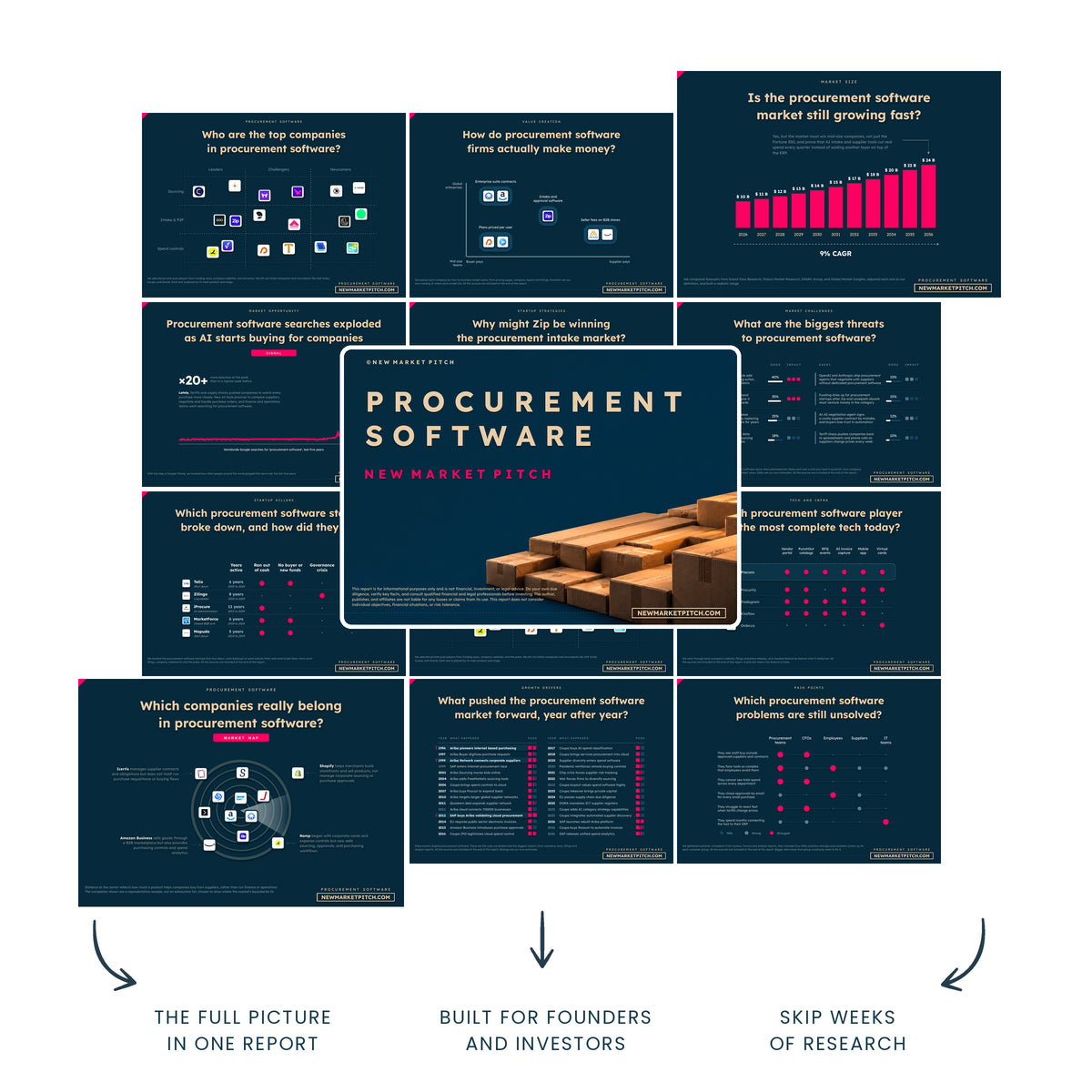
Whether you're building or investing in the procurement software market, our report covers everything you need to know: the players, the money, and what's coming next.
Summary
Zip leads procurement software valuations at $2.2B, a price stated by investors. ORO Labs is next, with a range of $667M–$1.2B that we estimate from its last round. Interos announced $1.0B in 2021, but that price is now more than five years old, so Interos sits at the end of our table as NR, without a rank.
Zip is the only one of the 102 ranked startups, out of 103 in our table, with a valuation entirely at or above $1B. The other 101 fall short of that test, even though some have estimated ranges that reach the unicorn threshold.
ORO Labs is also the name to watch. It has won large enterprise customers and struck a distribution agreement with SAP. Its potential value is substantial, but the figure comes from our estimate rather than a price disclosed by investors.
That difference matters across procurement software. Only 6 valuations are backed by a stated or reported figure, and the other 96 are estimates. A large funding round can suggest a valuable business without establishing what its shares would sell for today.
The companies near the top also sell different things. Zip handles purchase requests and approvals. Prewave monitors supplier risk, while Pactum AI negotiates contracts with suppliers. A customer might use several of them at once.
Europe has some strong contenders. Naboo helps companies buy events, Tacto serves industrial purchasing teams, and Vertice combines software procurement with pricing information. Their niches give them a place to grow without having to copy Zip.
Specialists are worth looking at too. Labviva helps laboratories buy supplies, ProcMart serves industrial purchasers, and SPARETECH deals with factory spare parts. Buyers often have specific needs that broad procurement suites handle poorly.
Fundraising doesn't settle the valuation question. Globality has raised $326M but has an estimated value of $100M–$188M. A company's financing history tells us how much equity it has attracted, not what the whole business is worth now.
AI is opening more parts of procurement to automation, from supplier emails to contract negotiations. The harder task is getting companies to trust that software with real orders, approvals, and vendor records. That's where established workflows and actual customer use still count.
Zip is the clear valuation leader today, but there is room for more than one winner. The next big jump will come from startups that make customers' buying processes work better, then keep those customers using the software.

Written by the New Market Pitch teamWe track new markets so founders and investors can move faster. About us

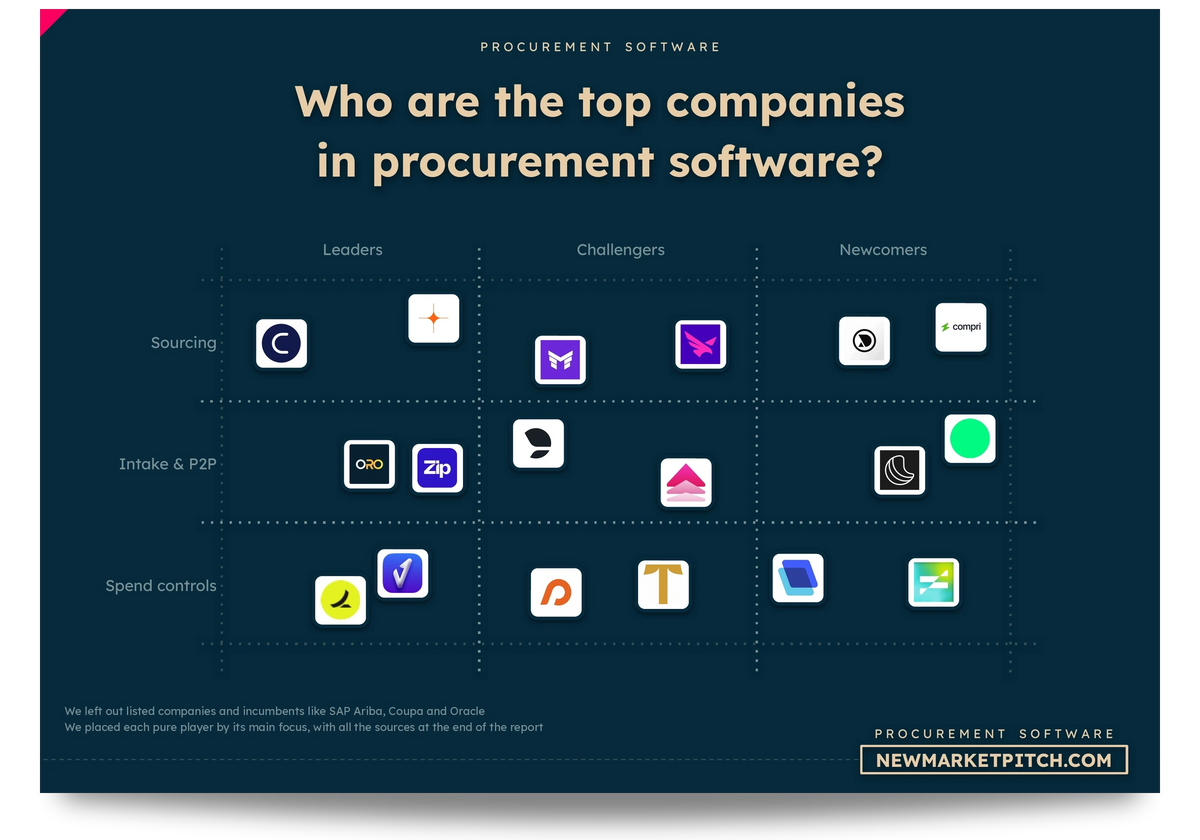
In our report covering the procurement software market, we turn what is vague and complex into simple, useful visuals. Market maps like this one show you at a glance where every startup stands.
Top startups in the procurement software market ranked by valuation
Here is the current ranking of the most valuable procurement software startups. For each one you will also find our confidence level and the valuation basis we used.
If you want to go deeper into the procurement software startup landscape, check our report covering the procurement software market.
| # | Startup | Valuation | Confidence | Valuation basis | Last round | Total funding |
|---|---|---|---|---|---|---|
| 1 | ZipPurchasing intake and procurement workflow software | $2.2Bas of Oct 2024 | Full | Announced private round valuation | $190MSeries D+ · Oct 2024 | $358Mvalued at 6.1× this |
| 2 | ORO LabsEnterprise procurement requests approvals and supplier workflows | $667M–$1.2Bas of Mar 2026 | Low | Estimated from last round | $100MSeries C · Mar 2026 | $125Mvalued at 7.3× this |
| 3 | FreehandAI invoice auditing and spend management | $500M–$938Mas of Jul 2026 | Low | Estimated from last round | $75MSeries B · Jul 2026 | $100Mvalued at 6.8× this |
| 4 | NabooCorporate event venue sourcing and procurement | $467M–$875Mas of Feb 2026 | Low | Estimated from last round | $70MSeries B · Feb 2026 | $100Mvalued at 6.4× this |
| 5 | PrewaveSupply chain supplier risk monitoring software | $462M–$866Mas of Jun 2024 | Low | Estimated from last round | $69MSeries B · Jun 2024 | $101Mvalued at 6.3× this |
| 6 | StampliAI-powered accounts payable automation | $407M–$762Mas of Oct 2023 | Low | Estimated from last round | $61MSeries D · Oct 2023 | $143Mvalued at 3.9× this |
| 7 | LevelpathProcurement intake and purchasing workflow software | $367M–$688Mas of Jun 2025 | Low | Estimated from last round | $55M+Series B · Jun 2025 | $100M+valued at 5.0× this |
| 8 | TactoIndustrial midmarket sourcing and supplier management | $367M–$688Mas of Dec 2023 | Low | Estimated from last round | $55MSeries B · Dec 2023 | $61M+valued at 8.3× this |
| 9 | VerticeProcurement and SaaS spending management software | $500Mas of Jan 2025 | Strong | Reported private round valuation | $50MSeries C · Jan 2025 | $101Mvalued at 5.0× this |
| 10 | Pactum AIAI agents for supplier negotiations | $360M–$675Mas of Jun 2025 | Low | Estimated from last round | $54MSeries C · Jun 2025 | $77M+valued at 6.4× this |
| 11 | OmneaProcurement requests and supplier management software | $333M–$625Mas of Sep 2025 | Low | Estimated from last round | $50MSeries B · Sep 2025 | $75Mvalued at 6.1× this |
| 12 | ProcurifyPurchase order and procurement workflow software | $333M–$625Mas of Oct 2023 | Low | Estimated from last round | $50MSeries C · Oct 2023 | $82Mvalued at 5.5× this |
| 13 | CandexTail-spend supplier payment and procurement platform | $267M–$500Mas of Mar 2026 | Low | Estimated from last round | $7M+Series C extension · Mar 2026 | $44M+valued at 8.4× this |
| 14 | Green CabbageProcurement intelligence and cost benchmarking | $267M–$500Mas of Oct 2025 | Low | Estimated from last round | $40MSeries B · Oct 2025 | $40M+valued at 9.1× this |
| 15 | PivotProcurement intake and spend management software | $267M–$500Mas of May 2026 | Low | Estimated from last round | $40MSeries B · May 2026 | $68Mvalued at 5.4× this |
| 16 | ArkestroPredictive procurement and sourcing software | $240M–$450Mas of May 2025 | Low | Estimated from last round | $36MSeries B · May 2025 | $62Mvalued at 5.3× this |
| 17 | FairmarkitAutonomous sourcing and tail-spend management | $237M–$445Mas of Sep 2022 | Low | Estimated from last round | $36MSeries C · Sep 2022 | $77Mvalued at 4.2× this |
| 18 | BeroeProcurement intelligence and supplier research software | $227M–$425Mas of Sep 2025 | Low | Estimated from last round | $34MGrowth equity · Sep 2025 | $34Mvalued at 9.1× this |
| 19 | LightyearTelecom procurement and network inventory software | $207M–$388Mas of Nov 2024 | Low | Estimated from last round | $31MSeries B · Nov 2024 | $48Mvalued at 5.9× this |
| 20 | LabvivaLife sciences procurement marketplace and software | $167M–$312Mas of Jan 2025 | Low | Estimated from last round | $25MSeries B · Jan 2025 | $45M+valued at 5.1× this |
| 21 | KeelvarSourcing optimization and autonomous bid events | $160M–$300Mas of May 2022 | Low | Estimated from last round | UndisclosedOther · Jun 2023 | $43M+valued at 5.1× this |
| 22 | DideroAI procurement agents for manufacturers | $150M–$250Mas of Feb 2026 | Low | Estimated from last round | $30MSeries A · Feb 2026 | $37Mvalued at 5.2× this |
| 23 | LioAI agents for enterprise procurement | $150M–$250Mas of Mar 2026 | Low | Estimated from last round | $30MSeries A · Mar 2026 | $30Mvalued at 6.5× this |
| 24 | SPARETECHEnterprise MRO software identifies spare-part suppliers and alternative sources while optimizing parts spend and inventories. | $133M–$250Mas of Nov 2026 | Low | Estimated from last round | $20MSeries B · Nov 2026 | $20Mvalued at 9.1× this |
| 25 | GlobalityAI sourcing and procurement platform | $100M–$188Mas of Sep 2024 | Low | Estimated from last round | $15MSeries D+ · Sep 2024 | $326Mvalued at 0.4× this |
| 26 | MercanisProcurement sourcing and supplier management software | $100M–$167Mas of Jun 2025 | Low | Estimated from last round | $20M+Series A · Jun 2025 | $30M+valued at 4.3× this |
| 27 | SiFiProcurement and spend management software | $100M–$167Mas of Feb 2026 | Low | Estimated from last round | $20MSeries A · Feb 2026 | $30Mvalued at 4.3× this |
| 28 | ProcMartB2B marketplace for industrial supplies | $120Mas of Apr 2024 | Strong | Reported private round valuation | $30MSeries B · Apr 2024 | $43Mvalued at 2.8× this |
| 29 | BRKZConstruction materials procurement marketplace | $87M–$162Mas of Sep 2026 | Low | Estimated from last round | $13MSeries B · Sep 2026 | $21Mvalued at 5.7× this |
| 30 | MagenticAI agents for procurement teams | $90M–$150Mas of Sep 2026 | Low | Estimated from last round | $18MSeries A · Sep 2026 | $24Mvalued at 4.9× this |
| 31 | CoverbaseThird-party risk management software | $82M–$138Mas of Nov 2025 | Low | Estimated from last round | $16MSeries A · Nov 2025 | $20Mvalued at 5.3× this |
| 32 | NajarSoftware procurement and spend management | $82M–$138Mas of Oct 2024 | Low | Estimated from last round | $16MSeries A · Oct 2024 | $16Mvalued at 6.5× this |
| 33 | ProcureProConstruction procurement and contract management software | $73M–$138Mas of May 2026 | Low | Estimated from last round | $11MSeries B · May 2026 | $15Mvalued at 6.7× this |
| 34 | BRMAI procurement and vendor management software | $75M–$125Mas of Dec 2024 | Low | Estimated from last round | $15MSeries A · Dec 2024 | $22Mvalued at 4.5× this |
| 35 | ReecoHotel procurement and inventory software | $75M–$125Mas of Jan 2025 | Low | Estimated from last round | $15MSeries A · Jan 2025 | $15Mvalued at 6.5× this |
| 36 | RemarcableProcurement and materials software for contractors | $75M–$125Mas of Jun 2025 | Low | Estimated from last round | $15MSeries A · Jun 2025 | $15Mvalued at 6.5× this |
| 37 | ValderaDigital sourcing marketplace for chemicals | $75M–$125Mas of Oct 2024 | Low | Estimated from last round | $15MSeries A · Oct 2024 | $15Mvalued at 6.5× this |
| 38 | comstructConstruction procurement software | $69M–$115Mas of Feb 2025 | Low | Estimated from last round | $14MSeries A · Feb 2025 | $15Mvalued at 5.9× this |
| 39 | AerchainAI sourcing and procurement software | $65M–$108Mas of Mar 2026 | Low | Estimated from last round | $13MSeries A · Mar 2026 | $13Mvalued at 6.5× this |
| 40 | SpendfloSaaS purchase procurement and spend management | $55M–$92Mas of Apr 2023 | Low | Estimated from last round | UndisclosedOther · Jun 2025 | $15M+valued at 4.6× this |
| 41 | Field MaterialsConstruction procurement and materials software | $52M–$88Mas of Apr 2025 | Low | Estimated from last round | $10MSeries A · Apr 2025 | $14Mvalued at 4.8× this |
| 42 | Procure AiAI procurement automation software | $52M–$87Mas of Nov 2025 | Low | Estimated from last round | $13MSeed · Nov 2025 | $13Mvalued at 5.2× this |
| 43 | BuildVisionProcurement software for construction materials | $50M–$83Mas of Mar 2025 | Low | Estimated from last round | $10MSeries A · Mar 2025 | $10Mvalued at 6.5× this |
| 44 | GainAI employees for procurement teams | $48M–$80Mas of Sep 2025 | Low | Estimated from last round | $12MSeed · Sep 2025 | $12Mvalued at 5.2× this |
| 45 | Kodiak HubSupplier relationship and procurement management software | $44M–$82Mas of Nov 2024 | Low | Estimated from last round | $6.6MSeries B · Nov 2024 | $12Mvalued at 5.1× this |
| 46 | SkySelectAircraft parts procurement automation software | $36M–$90Mas of Mar 2026 | Low | Estimated from last round | $9MMar 2026 | $9Mvalued at 6.3× this |
| 47 | AxyaProcurement execution software for manufacturers | $44M–$73Mas of Sep 2026 | Low | Estimated from last round | ~$8.8MSeries A · Sep 2026 | $12Mvalued at 4.9× this |
| 48 | Atmospheric AIAI models raw-material production chains to inform supplier cost, supply risk and sourcing decisions. | $40M–$67Mas of Nov 2026 | Low | Estimated from last round | $10MSeed · Nov 2026 | $10Mvalued at 5.2× this |
| 49 | ZinitAI procurement sourcing and bidding platform | $48Mas of Nov 2025 | Full | Announced private round valuation | $8MSeed · Nov 2025 | $8Mvalued at 6.0× this |
| 50 | OpplyCPG sourcing and procurement automation | $30M–$75Mas of Oct 2026 | Low | Estimated from last round | $7.5MOct 2026 | $7.5Mvalued at 6.3× this |
| 51 | SubBaseConstruction procurement management software | $35M–$58Mas of Jun 2026 | Low | Estimated from last round | $7MSeries A · Jun 2026 | $7Mvalued at 6.5× this |
| 52 | MatchorySupplier data and matching software | $26M–$44Mas of Jan 2025 | Low | Estimated from last round | $6.6MSeed · Jan 2025 | $8.4Mvalued at 4.1× this |
| 53 | sun.storeB2B marketplace for solar equipment | $26M–$44Mas of Sep 2025 | Low | Estimated from last round | $6.6MSeed · Sep 2025 | $6.6Mvalued at 5.2× this |
| 54 | ScaleraAI procurement platform for construction firms | $26M–$43Mas of May 2025 | Low | Estimated from last round | ~$6.5MSeed · May 2025 | $6.5Mvalued at 5.2× this |
| 55 | EezeeB2B marketplace for industrial procurement | $20M–$50Mas of Feb 2026 | Low | Estimated from last round | $5MFeb 2026 | $12M+valued at 2.5× this |
| 56 | AronAI procurement negotiation and sourcing assistant | $24M–$40Mas of Sep 2026 | Low | Estimated from last round | $6MSeed · Sep 2026 | $6Mvalued at 5.2× this |
| 57 | TimeFlowIT vendor management and procurement software | $18M–$44Mas of Feb 2025 | Low | Estimated from last round | $4.4MOther · Feb 2025 | $4.4Mvalued at 6.3× this |
| 58 | ProloAI procurement and supplier sourcing software | $22M–$36Mas of Jul 2026 | Low | Estimated from last round | $5.4MSeed · Jul 2026 | $5.4Mvalued at 5.2× this |
| 59 | akirolabsAI procurement strategy and sourcing software | $20M–$33Mas of Jan 2024 | Low | Estimated from last round | $5MSeed · Jan 2024 | $5Mvalued at 5.2× this |
| 60 | Infinity LoopProcurement negotiation intelligence software | $20M–$33Mas of Aug 2025 | Low | Estimated from last round | $5MSeed · Aug 2025 | $5Mvalued at 5.2× this |
| 61 | DiagonProcurement software for manufacturing equipment | $17M–$29Mas of Apr 2024 | Low | Estimated from last round | $4.3MSeed · Apr 2024 | $4.3Mvalued at 5.2× this |
| 62 | DroppeB2B marketplace for industrial supplies | $17M–$29Mas of Jun 2024 | Low | Estimated from last round | $4.3MSeed · Jun 2024 | $4.3Mvalued at 5.2× this |
| 63 | ResponseProcurement intake and vendor management software | $16M–$27Mas of Feb 2025 | Low | Estimated from last round | $4MSeed · Feb 2025 | $4Mvalued at 5.2× this |
| 64 | SpendRuleContract compliance software for healthcare spending | $16M–$27Mas of Oct 2026 | Low | Estimated from last round | $4MSeed · Oct 2026 | $6Mvalued at 3.4× this |
| 65 | VallorAI procurement workflows and supplier sourcing | $16M–$27Mas of Apr 2025 | Low | Estimated from last round | $4MSeed · Apr 2025 | $4Mvalued at 5.2× this |
| 66 | 1Buy.AIElectronics procurement intelligence and sourcing software | $16M–$26Mas of Jan 2026 | Low | Estimated from last round | $3.9MSeed · Jan 2026 | $3.9Mvalued at 5.2× this |
| 67 | Mandel AIAI sourcing and ordering coordination platform | $16M–$26Mas of Mar 2026 | Low | Estimated from last round | $3.9MSeed · Mar 2026 | $3.9Mvalued at 5.2× this |
| 68 | compriAI procurement automation software | $15M–$25Mas of Jun 2026 | Low | Estimated from last round | ~$3.7MSeed · Jun 2026 | $5.4Mvalued at 3.5× this |
| 69 | BloomSoftware matching manufacturing buyers with suppliers | $14M–$24Mas of Oct 2026 | Low | Estimated from last round | $3.6MSeed · Oct 2026 | $3.6M+valued at 5.2× this |
| 70 | ElevatryAI strategic procurement software | $14M–$23Mas of Oct 2026 | Low | Estimated from last round | ~$3.5MSeed · Oct 2026 | $3.5Mvalued at 5.2× this |
| 71 | SoourceAI procurement and supplier automation | $13M–$22Mas of Jun 2026 | Low | Estimated from last round | $3.3MSeed · Jun 2026 | $5Mvalued at 3.4× this |
| 72 | Civic MarketplaceMarketplace for government procurement and vendors | $13M–$21Mas of Nov 2024 | Low | Estimated from last round | $3.2MSeed · Nov 2024 | $3.2Mvalued at 5.2× this |
| 73 | BelidorProcurement automation and sourcing software | $12M–$21Mas of Oct 2025 | Low | Estimated from last round | $3.1MPre-Seed · Oct 2025 | $3.1Mvalued at 5.2× this |
| 74 | FreqensAgentic planning software for finance teams | $12M–$20Mas of Nov 2024 | Low | Estimated from last round | $3MSeed · Nov 2024 | $3Mvalued at 5.2× this |
| 75 | MonqAI procurement workflow software | $12M–$20Mas of Nov 2025 | Low | Estimated from last round | $3MPre-Seed · Nov 2025 | $3Mvalued at 5.2× this |
| 76 | ResourclyAI procurement and supplier management software | $12M–$20Mas of Oct 2025 | Low | Estimated from last round | $3MSeed · Oct 2025 | $3.8Mvalued at 4.0× this |
| 77 | TorgFood supplier sourcing marketplace | $12M–$20Mas of Apr 2024 | Low | Estimated from last round | $3MSeed · Apr 2024 | $3Mvalued at 5.2× this |
| 78 | DefinicVendor intelligence for IT procurement teams | $11M–$18Mas of Jun 2026 | Low | Estimated from last round | $2.8MSeed · Jun 2026 | $2.8Mvalued at 5.2× this |
| 79 | CientyProcurement marketplace for independent pharmacies | $11M–$18Mas of Jul 2025 | Low | Estimated from last round | $2.7MSeed · Jul 2025 | $2.7Mvalued at 5.2× this |
| 80 | KodiactSimulation and AI sourcing platform helps manufacturers optimize raw-material procurement decisions. | $10M–$17Mas of Nov 2026 | Low | Estimated from last round | $2.5MSeed · Nov 2026 | $2.5Mvalued at 5.2× this |
| 81 | MazepayLong-tail procurement and payment software | $7.9M–$20Mas of Aug 2024 | Low | Estimated from last round | $2MOther · Aug 2024 | $6.4Mvalued at 2.0× this |
| 82 | TrestleContractor vendor qualification and management | $9.2M–$15Mas of Sep 2024 | Low | Estimated from last round | $2.3MSeed · Sep 2024 | $2.3Mvalued at 5.2× this |
| 83 | CrownProcurement e-auction software | $8.8M–$15Mas of Feb 2025 | Low | Estimated from last round | $2.2MPre-Seed · Feb 2025 | $2.2Mvalued at 5.2× this |
| 84 | FinchesAgricultural sourcing risk intelligence software | $8.8M–$15Mas of Oct 2026 | Low | Estimated from last round | $2.2MPre-Seed · Oct 2026 | $2.2Mvalued at 5.2× this |
| 85 | TrazaAI agents for procurement operations | $8.4M–$14Mas of Apr 2026 | Low | Estimated from last round | $2.1MPre-Seed · Apr 2026 | $2.1Mvalued at 5.2× this |
| 86 | TradeFormAI procurement agents for direct materials | $8M–$13Mas of Apr 2026 | Low | Estimated from last round | $2MPre-Seed · Apr 2026 | $2Mvalued at 5.2× this |
| 87 | KunzappProcurement analytics and supplier management software | $10Mas of Aug 2025 | Strong | Reported private round valuation | $2MSeed · Aug 2025 | $2.8Mvalued at 3.6× this |
| 88 | SpeyaSupplier intelligence for industrial procurement | ~$9.5Mas of May 2025 | Full | Announced private round valuation | $1.2MSeed · May 2025 | $1.2Mvalued at 7.7× this |
| 89 | ProcureYardConstruction materials procurement and supplier platform | $6.9M–$11Mas of Jan 2025 | Low | Estimated from last round | $1.7MSeed · Jan 2025 | $1.7Mvalued at 5.2× this |
| 90 | DelfioAI procurement software for industrial purchasing | $6.6M–$11Mas of Jun 2025 | Low | Estimated from last round | $1.6MPre-Seed · Jun 2025 | $1.6Mvalued at 5.2× this |
| 91 | PegboConstruction procurement and supplier management software | $5.6M–$9.3Mas of Nov 2024 | Low | Estimated from last round | $1.4M+Pre-Seed · Nov 2024 | $1.4M+valued at 5.2× this |
| 92 | PrediktAI procurement and supplier intelligence software | $5.5M–$9.2Mas of May 2025 | Low | Estimated from last round | $1.4MSeed · May 2025 | $2.2Mvalued at 3.2× this |
| 93 | givvableSupplier sustainability and procurement intelligence | $4.5M–$11Mas of Jun 2026 | Low | Estimated from last round | $1.1MOther · Jun 2026 | $1.1M+valued at 6.3× this |
| 94 | NvelopAI sourcing and procurement automation | $5.3M–$8.8Mas of Jun 2025 | Low | Estimated from last round | $1.3MSeed · Jun 2025 | $1.3Mvalued at 5.2× this |
| 95 | BlueBeanAI procurement automation for business purchasing | $5.2M–$8.7Mas of Feb 2024 | Low | Estimated from last round | $1.3MSeed · Feb 2024 | $1.3Mvalued at 5.2× this |
| 96 | Shoppable BusinessB2B procurement marketplace for business supplies | $4.6M–$7.7Mas of Mar 2025 | Low | Estimated from last round | $1.2MSeed · Mar 2025 | $2.3Mvalued at 2.6× this |
| 97 | FittingConstruction materials procurement marketplace | $4.4M–$7.3Mas of Aug 2026 | Low | Estimated from last round | $1.1MSeed · Aug 2026 | $1.6Mvalued at 3.6× this |
| 98 | Project SuppliersIndustrial supplier discovery and procurement marketplace | $4M–$6.7Mas of Oct 2026 | Low | Estimated from last round | $1MPre-Seed · Oct 2026 | $1Mvalued at 5.2× this |
| 99 | BuddyScrap metal trading marketplace | $3.6M–$6Mas of Mar 2024 | Low | Estimated from last round | $900KPre-Seed · Mar 2024 | $900Kvalued at 5.2× this |
| 100 | ConnexusMultifamily procurement and vendor management | $3.2M–$5.3Mas of Jun 2024 | Low | Estimated from last round | $800KSeed · Jun 2024 | $800Kvalued at 5.2× this |
| 101 | MatBookConstruction materials procurement and logistics software | $3M–$5Mas of Apr 2025 | Low | Estimated from last round | $750KPre-Seed · Apr 2025 | $750Kvalued at 5.2× this |
| 102 | SyncmeonAI-powered B2B procurement marketplace that helps small businesses find suppliers and automate purchasing. | $2.4M–$4Mas of Oct 2026 | Low | Estimated from last round | $600KSeed · Oct 2026 | $600Kvalued at 5.2× this |
| NR | InterosSupply chain risk intelligence software | Undisclosed | Last published price over 5 years old (2021) | $20MConvertible preferred stock · Jan 2026 | $120M |
No startups match this search.

Our research about procurement software startups gets updated several times a month, so you always get the latest view of where things stand.
Is Zip still the most valuable procurement software startup?
Zip is still the most valuable independent procurement software startup, at $2.2B, and no other startup in this market has a higher stated valuation.
Investors stated Zip's valuation in October 2024. The company has also raised $358M in equity. Neither figure depends on us guessing its worth from a round size.
Zip sits where purchases begin. Employees submit requests, the system routes security and finance reviews, and procurement teams can follow the purchase through supplier onboarding and payment. On its customer page, Zip describes how OpenAI uses procurement AI agents and how Snowflake gained visibility into spending before approval. Both examples show why businesses pay for software their employees use whenever they need to buy something.
ORO Labs is next by valuation, and Levelpath is another close product rival, but both values remain estimated from their last rounds. For now, Zip combines the clearest price evidence with customers who depend on its software for everyday buying. A new financing would be needed to establish a new price.
Why is Interos no longer ranked among the most valuable procurement startups?
Interos still has a published $1.0B valuation, but that price dates from July 2021, so we no longer use it to rank the company.
The figure was announced with a funding round more than five years ago. Interos raised $20M in convertible preferred shares in January 2026, but that round came without a published price. We do not carry a price that old into today's ranking, so Interos sits at the end of our table as NR, without a rank, and is not counted as a unicorn here. The difference with Zip is also strategic: Interos helps buyers understand which suppliers and supply-chain links may fail, whereas Zip handles the purchasing request itself.
Interos has raised $120M. In April 2026, the company introduced its iQ platform to connect supplier-risk intelligence with enterprise systems and show procurement and finance teams where a disruption could affect operations. In October, it added iflow to move risk findings into workflows inside those systems. Its customer references include L3Harris and major government organizations.
Interos can earn a large procurement budget when a supplier failure could stop production. Its software still handles a different job from Zip's purchase requests. Many businesses need both services, so even its old $1.0B price never meant Interos was close to displacing Zip's product. Today, Interos stands out as a supplier-risk specialist with its own buyers and use cases.

In our market report about procurement software startups, we look at what the winners do differently, so you can learn from the best instead of guessing.
How many procurement software unicorns are there today?
Only 1 procurement software startup has a valuation entirely at or above $1B: Zip.
The other 101 of the 102 ranked companies do not qualify under our conservative definition, and Interos's $1.0B, set in 2021, is too old to count, so the market has far fewer confirmed unicorns than its AI publicity might imply.
ORO Labs is a useful example. Its $667M–$1.2B range reaches the unicorn line, but the lower end falls short. We estimate that range from its March 2026 financing, rather than from an announced valuation. Freehand, Naboo, Prewave, and Stampli have large estimated ranges too, Stampli's from a Series D+ dated October 2023. A company can therefore look close to a billion-dollar price without anyone having published one.
Below that line, companies already have substantial customer work. ORO helps global manufacturers and drugmakers connect purchasing systems; Pactum AI negotiates with suppliers; Tacto serves factories. Some estimated ranges also pass the half-billion-dollar mark, including Freehand's. Yet only a priced deal or reliable disclosure can confirm a specific valuation. Revenue growth, renewals, and repeat purchasing activity will eventually decide whether those high expectations hold up.
Could ORO Labs become the next procurement software unicorn?
ORO Labs could become the next procurement software unicorn, although no billion-dollar valuation has been publicly established.
We estimate it at $667M–$1.2B from the size of its last equity round, dated March 2026; that range is our estimate, not a price announced by the company or its investors.
ORO has a stronger commercial argument than an AI-only pitch. The company connects requests, supplier checks, sourcing, and contract steps across applications that enterprises already use. Its September 2026 announcement named Coca-Cola, Pfizer, Danone, BASF, and Booking.com among customers. In October 2026, ORO announced an agreement for its orchestration product to be offered as an SAP Ariba solution extension. ORO can now reach companies already using SAP instead of asking them to replace it.
ORO also said in its March 2026 company announcement that revenue had grown 300% over the previous year. The growth rate comes from ORO itself and does not prove profitability. Still, the customers, faster sales, and SAP agreement give the company a stronger case than a large financing alone. The next test is whether its customers keep adding departments and buying more of the product.

In our document detailing everything you need to know about procurement software, you will always find fresh funding data, taken straight from our own verified funding database.
Is Vertice catching up with bigger procurement software companies?
Vertice has become a serious procurement software challenger, with a reported $500M valuation and a growing product for buying business software.
Vertice helps procurement teams negotiate software contracts using prices other buyers have paid. That is a specific reason to try the service, even for companies that already have a broader purchasing system.
The company has raised $101M, and the valuation we use was reported rather than formally announced by Vertice. In June 2026, Vertice announced its acquisition of Vendr, combining procurement workflow software with a large collection of real software contract and pricing observations. Its customer references include ClearScore, Factorial, Arm, and Staffbase. The company says ClearScore achieved savings through its software procurement service, while Factorial used Vertice to streamline purchasing and gain visibility.
The Vendr deal adds more real contract information, but good data must still lead to better deals for customers. Software prices change with contract size, usage, and terms, so a benchmark alone cannot negotiate a renewal. Vertice now has more information to work with and more customers to serve. It also has to integrate the two businesses. No new valuation follows automatically from the acquisition.
Could Levelpath beat Zip at enterprise purchasing?
Levelpath can win enterprise purchasing deals against Zip, but it still trails the procurement software leader by valuation.
We estimate Levelpath at $367M–$688M from the size of its last equity round, dated June 2025. It is our estimate rather than an announced valuation.
Levelpath and Zip both address the employee's first purchasing request, but Levelpath has emphasized making supplier bids, contracts, and approvals easier for procurement teams. Its case study with railcar company GATX describes automated bid comparisons, faster request-for-proposal preparation, and substantial savings from contract analysis. That gives buyers a reason to pay for Levelpath beyond the promise of an AI feature.
Buyers can also compare ORO Labs, Omnea, and Procurify, depending on whether they need intake, supplier records, approvals, or purchase orders. Winning a pilot is one thing; spreading through the whole purchasing department is harder. Levelpath has serious enterprise use cases, but its estimated value should not be confused with a price a new investor has paid.
The table below shows selected procurement workflow challengers and their current valuation measures.
| Company | Focus | Valuation |
|---|---|---|
| ORO Labs | Orchestration | $667M–$1.2B |
| Levelpath | Intake | $367M–$688M |
| Vertice | Software buying | $500M |
| Omnea | Intake | $333M–$625M |
| Procurify | Purchase orders | $333M–$625M |
| Pivot | Spend control | $267M–$500M |
| Arkestro | Sourcing | $240M–$450M |
Vertice's figure is reported; the other figures shown here are estimates from the relevant last equity rounds. ORO Labs and Levelpath appear ahead of Vertice because we order ranges by their middle (geometric mean), which is above $500M for both, not by a higher announced price.
Is Pactum AI actually a billion-dollar procurement startup?
Pactum AI is not yet a confirmed billion-dollar procurement software startup.
It is one of the more substantial autonomous negotiation companies, but its valuation range is $360M–$675M, not a confirmed billion-dollar figure. This is our estimate from the size of its last equity round, dated June 2025, rather than a company-announced price.
The commercial case is unusually easy to understand. Buyers negotiate with a small part of their supplier base because humans cannot handle every small contract. Pactum's software conducts conversations within rules set by the buying organization, with human staff handling exceptions. The company's customer page describes deployments at Walmart, Honeywell, and SUEZ, along with procurement teams using the system for supplier negotiations and requisition reviews.
Pactum says suppliers preferred its negotiation process in a Walmart project and that Honeywell used it for repeated transactions. Those are vendor-reported results, but they describe actual buyer-supplier conversations. The size of the opportunity depends on how many negotiations companies will trust software to handle. Pactum can build a valuable business around those tasks even if it never becomes the software that starts every purchase.

Learning from others' mistakes is the cheapest lesson there is. In our report covering the procurement software market, we look at what broke startups before you, so you don't repeat it.
Can AI procurement agents replace traditional purchasing software?
AI procurement agents can handle more purchasing tasks now, but they still depend on traditional procurement systems for approvals and records.
Companies need to know who approved a purchase, what the supplier promised, and which budget paid for it. Sending a good email is only one part of that job.
The difference appears in the companies themselves. Didero, estimated at $150M–$250M, focuses on messages, purchase orders, and supplier follow-up for manufacturers. Lio has the same estimated range but aims at enterprise procurement tasks more broadly. Fragment concentrates on direct purchasing exceptions and manufacturing systems, but it has no valuation in our ranking, because its announced funding combines a seed round and a Series A without a published split. The Didero and Lio figures are our estimates from the size of their last rounds, dated February 2026 and March 2026, not announced valuations.
Meanwhile, Zip and ORO Labs are adding agents to workflow platforms already used across departments. Didero's February 2026 company explanation stresses that its software works inside existing ERP systems and communications rather than replacing all the enterprise records. Didero's approach tells us how vendors expect customers to buy this technology: add useful automation to systems the company already trusts. Supplier follow-ups and invoice discrepancies are natural first tasks. Replacing approvals, purchasing records, and audits across a large company will take much longer.
Can supplier-risk startups be as valuable as purchasing platforms?
Yes, supplier-risk startups can reach valuations comparable to major purchasing software companies, even though they serve a different need.
Prewave's value is estimated at $462M–$866M, fifth in our ranking. We derived that range from the size of its last equity round, dated June 2024, and it was not announced as a company valuation. Interos announced $1.0B in 2021, a price now too old for us to rank, so Interos appears in our table only as NR.
The reason is straightforward: a supplier failure can cost a manufacturer much more than the procurement team's software subscription. Prewave's platform maps disruptions through suppliers and components, then helps customers prioritize the production that could be affected. Its automotive case material describes using supplier monitoring to shorten disruption response. Interos extends the same logic with its supplier-network intelligence and integrations with enterprise systems.
Manufacturers watch direct and indirect suppliers because delivery interruptions, material shortages, and compliance failures can stop production. That explains why both Prewave and Interos sell to buyers who care about continuity as much as negotiated discounts. Interos and Prewave don't need to process purchase orders to justify large risk-monitoring budgets. A manufacturer can use their software alongside Zip, SAP Ariba, or another purchasing platform. The products compete for company spending, but they can work together rather than replace one another.

In our research about procurement software startups, we always try to gather several sources and make estimates that make sense, so you can work with solid numbers.
Could Tacto become Europe's most valuable procurement startup?
Tacto could become Europe's most valuable procurement software startup, but it has not clearly overtaken its rivals today.
We estimate the German company at $367M–$688M from the size of its last equity round, dated December 2023. That is an estimate, not a company-stated valuation, and several European peers have overlapping valuation ranges.
Tacto concentrates on industrial procurement, where buyers manage component specifications, supplier availability, contracts, and cost pressure. Its own customer materials feature manufacturers including voestalpine, Kubota, and other industrial groups. Tacto knows exactly whom it is selling to: industrial purchasing teams. Manufacturers also have practical reasons to retain a supplier data system: they cannot substitute a critical component as casually as an office software license.
Naboo sells event purchasing, Prewave supplier-risk monitoring, and Vertice software price intelligence. They can all attract large procurement budgets without being direct substitutes for Tacto. Tacto's next challenge is winning more factories and becoming the place those customers manage supplier information. Several European values are close or overlap as ranges, so the present evidence doesn't establish a single winner.
How can an event-booking startup like Naboo be so valuable?
Naboo has become a valuable procurement software contender by helping businesses control how they buy corporate events.
We estimate the French company at $467M–$875M from the size of its last equity round, dated February 2026; this is our estimate, not a valuation announced by the company or its investors.
At first glance, event booking might seem far removed from procurement software. But a large company organizing meetings and retreats must choose suppliers, compare quotes, follow purchasing policies, approve budgets, and collect invoices. Naboo combines event sourcing with those controls. Its October 2026 rebrand emphasized procurement and finance teams alongside event organizers, and its Control Tower product allows buyers to apply spending rules before a booking is made.
Naboo goes beyond showing a list of venues. Procurement and finance teams can set rules, track quotes, and handle invoices for events booked by different departments. Those purchases often slip past a company's regular controls. Event spending is a limited slice of the procurement budget, though. Naboo can own that category without becoming a replacement for Zip or a general sourcing platform.

If you build or invest in the procurement software market, you need to know which business models pay off now and which ones are fading. That's why our report covering it has a whole section on it.
Can a niche procurement startup be worth hundreds of millions?
Yes, niche procurement software companies can reach valuations in the hundreds of millions by solving a buying problem that general platforms handle poorly.
Labs, factories, and construction sites buy different products, often from suppliers that general software catalogs barely cover.
Labviva serves scientific purchasing, where researchers need to compare chemicals and equipment rather than generic office supplies. In September 2024, the University of California described expanding Labviva across its research purchasing operations. SPARETECH addresses industrial spare parts: an Idahoan Foods customer story describes how better part records helped find unused inventory and improve maintenance purchasing. ProcMart, meanwhile, runs industrial supply sourcing and fulfillment for Indian enterprises. These products solve problems a single generic request form cannot cover deeply.
The catch is how far each product can expand. Lightyear manages telecom purchases, Keelvar automates sourcing events, and BRKZ helps construction firms buy materials. Those are useful businesses, but their software may not spread across every department. A specialist can win loyal customers and still be worth less than a company that controls the entire purchasing process.
The table below shows selected procurement specialists across distinct buying categories, ordered by their valuation positions.
| Company | Specialty | Valuation |
|---|---|---|
| Lightyear | Telecom | $207M–$388M |
| Labviva | Life sciences | $167M–$312M |
| Keelvar | Sourcing | $160M–$300M |
| SPARETECH | Spare parts | $133M–$250M |
| ProcMart | Industrial MRO | $120M |
| BRKZ | Construction | $87M–$162M |
| Zinit | AI sourcing | $48M |
ProcMart's valuation is reported and Zinit's was announced; the other valuations are estimates from their last equity rounds.
Is Globality still a major procurement software contender?
Globality remains a recognizable AI sourcing company, but its valuation is now well below the biggest procurement software startups.
Globality has raised $326M in equity, while we estimate its value at $100M–$188M from the size of its September 2024 round. That is our estimate, not a newly disclosed price. Raising more money therefore does not automatically make a company more valuable.
Globality focuses on helping employees describe sourcing needs, find suppliers, and run structured buying processes. Its Tesco customer case explains how the retailer allowed staff to initiate sourcing while procurement retained guidance over spending. That is a practical use case, particularly when a company wants to bring indirect purchases under control without increasing the central procurement team's workload.
Competition has grown around the work Globality does. ORO Labs connects purchasing systems, Fairmarkit runs sourcing events, Pactum AI negotiates, and Zip handles requests. Globality needs customers to see a clear advantage in its own approach. Total funding offers no answer about that. Among companies with a stated value and a complete equity total, Speya has the highest valuation-to-funding multiple at 7.7x, while ProcMart has the lowest at 2.8x. These are valuation comparisons, not revenue multiples or investment returns.

In our document detailing everything you need to know about procurement software, we don't want to repeat what boring consulting reports say. Instead, we show you the real and latest market signals that matter.
Can a brand-new procurement AI startup already be worth hundreds of millions?
Some young procurement AI startups already carry estimates worth hundreds of millions, even before there is much evidence of large deployments.
Freehand was founded in 2024 and is estimated at $500M–$938M, third in our ranking. That range comes from our estimate based on the size of its last equity round, a Series B dated July 2026, not from a company-announced valuation.
Didero and Lio, both founded in 2023, are each estimated at $150M–$250M. Didero works on supplier messages and purchasing exceptions, while Lio takes a broader enterprise-agent approach. Their estimated values, derived from the sizes of equity rounds dated February 2026 and March 2026 respectively, should not be read as company-announced prices. Fragment, which Axios described emerging from stealth in October 2026, has no valuation here because its announced funding combines two rounds without a published split.
Factories have a reason to try them: agents can chase suppliers and spot order mismatches without replacing the factory's ERP. Scaling is tougher. Suppliers send documents in different formats, products have strict specifications, and a mistaken order can stop work. The high early estimates show investors' interest in the problem; large customer deployments and repeat use would make the values more convincing.
Are the most valuable procurement startups mostly American?
The United States leads procurement software startup valuations, with Zip, ORO Labs and Freehand holding the top three positions.
We track 46 startups from the United States, compared with 10 from Germany, 8 from the United Kingdom, and 5 from France. Those are company counts, not a claim about each country's total value.
Europe still has multiple serious challengers near the upper end. Naboo makes event purchasing easier to control, Prewave sells supplier-risk monitoring, Tacto serves manufacturing procurement, and Vertice develops software negotiation intelligence. Their models differ enough that no single European company represents the entire region. Some sit on stated prices and most on estimated ranges, so any precise claim about Europe's combined enterprise value would be misleading.
There are contenders elsewhere too: Canada's Procurify handles purchasing approvals, India's ProcMart supplies industrial buyers, and Saudi firms are building regional purchasing tools. The American lead is clear today, but supplier networks and buying habits differ across markets. That leaves space for regional companies to build strong businesses without selling the same product as Zip.
The table below shows selected European procurement software companies that illustrate the range of valuable business models.
| Company | Country | Valuation |
|---|---|---|
| Naboo | France | $467M–$875M |
| Prewave | Austria | $462M–$866M |
| Tacto | Germany | $367M–$688M |
| Vertice | United Kingdom | $500M |
| Omnea | United Kingdom | $333M–$625M |
| Pivot | France | $267M–$500M |
| Mercanis | Germany | $100M–$167M |
Vertice is reportedly valued at the figure shown; the others are estimates from their last equity rounds. We order estimated ranges by geometric mean; being listed ahead of Vertice does not establish a higher stated price.
Could India produce the next billion-dollar procurement startup?
India could produce a billion-dollar procurement software startup, but no Indian procurement startup has a confirmed unicorn valuation today.
ProcMart, an Indian industrial purchasing marketplace, is reportedly valued at $120M. Saudi Arabia's SiFi is estimated at $100M–$167M, while BRKZ is estimated at $87M–$162M; those Saudi ranges come from our assessment of their last equity rounds, dated February 2026 and September 2026, not announced company valuations.
Their opportunities reflect the needs of buyers in different markets. ProcMart helps manufacturing and service companies source maintenance and indirect supplies through a single procurement channel. Its company materials describe purchasing operations across Indian cities and expansion into nearby Asian markets. BRKZ organizes construction materials purchasing, while SiFi focuses on company spending and procurement controls. Zinit, based in the United Arab Emirates, has a stated $48M valuation and develops AI sourcing tools.
India and the Gulf give procurement platforms room to digitize buying that still happens through phone calls, spreadsheets, and supplier relationships. To reach a much larger valuation, they need repeat customers across industries and cities, reliable catalogs, and purchasing controls large companies trust. ProcMart and the Saudi contenders are building toward that opportunity. Their current values, though, remain far below a confirmed unicorn price.

In our report covering the procurement software market, we like to show you the big picture. We know your time is precious, so we make every page quick to read and packed with as much learning as possible per minute.
Can startups really replace SAP Ariba and Coupa?
Procurement startups can take business from SAP Ariba and Coupa, but a full replacement of either suite is unlikely today.
The easier sale is fixing a part of purchasing that employees dislike, such as requests, supplier forms, or repeated approvals. Companies can often add that software while keeping the existing system that stores the purchase records.
Zip makes buying requests and approvals easier for employees, ORO Labs connects fragmented procurement applications, and Fairmarkit automates sourcing events. These businesses frequently sell an improvement to an installed system rather than requiring a company to rebuild all its supplier and purchasing records. ORO's October 2026 agreement to offer orchestration through SAP Ariba makes the strategy explicit: a challenger can gain distribution by cooperating with an incumbent that it might otherwise be expected to displace.
The incumbents are adapting too, and adding the same kinds of AI intake and automation features that startups offer. That creates a harder sales pitch for newcomers, even as it shows large customers want those tools. Smaller vendors may still ship a better user experience faster. Expect more add-ons, partnerships, and selective replacements before any broad switch away from major procurement suites.
Why isn't Coupa among the most valuable procurement startups?
Coupa is absent from today's independent procurement startup rankings because it was acquired after years as a publicly traded software company.
Thoma Bravo completed its purchase of Coupa in February 2023. Coupa still sells major procurement products, but it is now part of an investment firm's portfolio. Its previous public-market value doesn't belong beside current private startup valuations.
SAP Ariba is an even clearer case. SAP completed its acquisition of Ariba in October 2012, and the product now sits inside a much larger enterprise software company. Neither the value of SAP as a listed group nor a historic acquisition price would be comparable with a current private-round valuation for Zip, Levelpath, or Pactum AI. The absence of these famous names should not be mistaken for evidence that they have stopped selling procurement software.
A large, familiar procurement vendor can dominate customer budgets without qualifying as a startup. We keep private independent companies in the main comparison and show recent acquisitions or listings separately. That prevents the value of a global software group from being mistaken for the value of a young procurement business.

When you build or invest in the procurement software market, you need clarity, not confusion. In our research about procurement software startups, we always try to put numbers on and quantify whatever is usually vague and confusing.
What could make procurement startup valuations fall?
Procurement startup valuations could fall sharply if customers stop expanding, AI savings disappoint, or new investors offer lower prices.
Even useful purchasing software can disappoint investors when sales and renewals grow more slowly than expected.
We have 96 Low-confidence valuations, chiefly ranges inferred from the size of a company's last equity round. These estimates offer a useful comparison, but none is proof of what a buyer would pay now. A product that negotiates contracts or books company events may remain valuable without taking over every purchasing task. Trouble starts when a valuation assumes a narrow product will spread into departments that have no reason to use it.
Fairmarkit points to sourcing savings at Alcoa, while Procurify and Vertice publish customer purchasing results. Those examples tell us the tools can work. The bigger questions are whether clients renew, expand their use, and keep saving money. A new financing at a lower price would expose an overly optimistic old value. Strong repeat sales could move a smaller specialist in the opposite direction.
So, which procurement software startups are worth the most today?
Zip is the most valuable procurement software startup today, with a stated $2.2B valuation.
ORO Labs follows as a strong contender, although its valuation is inferred from a financing. The field has a clear leader and a larger group whose prices are still uncertain.
They aren't all chasing the same purchase order. Zip manages requests before spending begins. Prewave warns about supplier problems. Vertice and Pactum AI focus on negotiating better deals, while Naboo and Labviva handle particular categories of spending. Different buyers can need several of these tools at once.
Our view is that Zip's lead is real, while the next tier deserves attention without taking every estimate literally. Customers already use these startups to solve expensive purchasing problems. The companies that keep those customers, win new departments, and show repeat savings have the best chance of earning higher valuations.
The table below shows what we found.
| Question | Answer |
|---|---|
| Is the procurement leader far ahead? | Yes, Zip holds a clear lead over its nearest valuation rival. ORO Labs, second, has an estimated range that tops out at $1.2B. It makes the current leader difficult to challenge through publicity alone. |
| Has procurement created many verified unicorns? | No, only Zip qualifies with a valuation securely above the threshold. Several promising ranges extend higher but their lower ends remain below. The next unicorn still needs stronger price evidence to be certain. |
| Can a supplier-risk specialist reach a high valuation? | Yes, Prewave serves factories trying to avoid costly supply interruptions. Its estimated range is $462M–$866M, supported by a practical manufacturer use case. The estimate is not proof that every buyer would pay it. |
| Does AI negotiation already guarantee unicorn status? | No, Pactum AI demonstrates real adoption without a confirmed unicorn price. Its negotiation software is used by major companies including Walmart. Customer uptake matters, but enterprise-wide market capture remains unproven. |
| Can general procurement suites ignore orchestration? | No, ORO Labs has attracted meaningful enterprise deployment and partnerships. Its SAP relationship connects a challenger to an incumbent suite. That distribution route could matter more than competing head-on. |
| Can specialized purchasing products matter at scale? | Yes, Labviva solves an unusually complex scientific buying problem. Its estimated valuation stands at $167M–$312M in our research. Smaller valuations can still reflect a valuable specialist workflow. |
| Are manufacturing agents already replacing every ERP? | No, Didero and Fragment focus on specific purchasing problems. They automate supplier messages and exceptions alongside existing enterprise records. A focused deployment is not a complete system replacement. |
| Does the most funding automatically win? | No, raising more capital never guarantees a higher company valuation. Globality raised $326M but is estimated at $100M–$188M. Funding shows money attracted, not what the business is worth now. |
| Are industrial marketplaces already procurement unicorns? | Not yet, ProcMart serves a concrete industrial sourcing need. It remains a specialist platform rather than a billion-dollar leader. Regional expansion could broaden its addressable customer base over time. |
| Are Europe's challengers all selling identical software? | No, European contenders address different purchasing and supplier problems. Tacto serves industrial buyers while Naboo manages corporate events. Their valuation ranges should not be mistaken for identical businesses. |
| Will legacy procurement vendors disappear soon? | No, SAP Ariba and Coupa still handle major enterprise purchasing workflows. ORO's SAP integration shows how newer firms can complement incumbents. Coexistence and selective replacement look more plausible than wholesale displacement. |

A good product starts with a real problem. In our market report about procurement software startups, we show you the ones customers still live with.
Our methodology
Our data runs through November 14, 2026. We cover software primarily built for organizational sourcing, supplier discovery and oversight, procurement approvals, purchasing workflows, procurement-linked spend intelligence, and buyer-side purchasing marketplaces, including AI agents that perform these tasks. We include borderline companies when substantive purchasing workflows justify inclusion, but exclude general ERP, payment-only rails, seller-side order-to-cash tools, and standalone accounts payable products without material procurement functions. Every company in the main ranking is an independent startup under our definition: founded in 2000 or later to scale a new product or technology, with venture, angel, founder, or grant support; acquisitions and listings are treated separately under the recency rules. The ranking examines each company's financing history, not just deals in the current year.
Every startup in this ranking has raised equity funding, and each valuation comes with a confidence level that shows how it was obtained. A Full rating means the company announced the valuation itself, or several independent sources report the same figure. A Strong rating means a credible press report gives the valuation, or it follows directly from the terms of a funding round, such as the amount raised and the stake sold.
When no valuation has been disclosed, it is estimated. A Partial rating means the startup was compared with similar companies at the same stage, using indicators such as revenue, deal terms or recent transactions in the sector. A Low rating means the only reliable data point is the last equity round: the valuation is then derived from the amount raised and the share of the company that startups usually give up at that stage, which is why it is shown as a range and dated to that round.
Several safeguards keep these figures honest. Valuations that appear only in commercial databases, with no article or company statement behind them, are not used, and neither are share sales between existing shareholders, which often take place at a discount or a premium. Rounds older than five years are not used to estimate a valuation, debt and grants never count as equity, and companies whose claims are disputed are left out of the ranking. Companies whose last published price is more than five years old, such as Interos, appear at the end of the table without a rank (NR) and never count as unicorns. Startups that have since been acquired or have gone public are listed separately, valued at their acquisition price or market capitalization rather than at a past private round.
We order valuation ranges by the geometric mean of their lower and upper ends, so an optimistic ceiling does not dominate the ordering. Total raised includes equity only, excluding debt, grants and post-IPO offerings; a plus sign means the confirmed total is a minimum. We add a round to total funding when an announcement, filing or press report confirms it, or, in the absence of an article, when two recognized databases agree on the amount and date. This database-only exception receives low confidence and is never used for a company with more than $100M raised; one-database rounds are excluded. Valuations themselves must be grounded in company disclosures, filings or reliable reporting, never a database figure alone.
The most important caution is that a recent-round estimate can appear above a smaller stated valuation, as ORO Labs does relative to Vertice, without being equally certain. We order companies by the geometric mean of estimated low and high values, not by the high end alone; a Low estimate reflects typical ownership sold in a round of that stage and size, and is dated to that round. The confidence rating tells readers which prices are reported or announced and which are inferred. This permits a coherent comparison without turning an undisclosed valuation into an asserted transaction price.
Key sources include Named enterprise customers and purchasing workflow results for Zip., Interos April 2026 iQ product launch and enterprise risk use cases., Interos October 2026 workflow automation expansion., ORO customer references and procurement deployments., ORO's March 2026 account of enterprise growth and product adoption., ORO and SAP October 2026 procurement orchestration agreement., Vertice's June 2026 acquisition of Vendr and pricing intelligence strategy., Named Vertice customers and purchasing efficiency examples., Levelpath deployments and outcomes from enterprise procurement., Pactum AI's named customers and autonomous negotiation use cases., Didero's procurement-agent product and manufacturing workflows., Prewave's supplier disruption and procurement risk technology., Tacto's industrial sourcing platform and customer references., Naboo's corporate event purchasing controls and supplier workflows., University of California procurement deployment using Labviva., SPARETECH industrial spare parts procurement customer case., ProcMart's industrial procurement marketplace and operations., Globality's AI sourcing work with Tesco., Fairmarkit industrial sourcing implementation and results., Coupa acquisition completion and public-company status., SAP's acquisition of Ariba and its position inside the wider software group., Procurify customer purchasing efficiency and approval results., and Fragment's October 2026 launch and manufacturing procurement focus..
In our document detailing everything you need to know about procurement software, we turn what is vague and complex into simple, useful visuals. Market maps like this one show you at a glance where every startup stands.
Written by the New Market Pitch teamWe track new markets so founders and investors can move faster. About us