Can top smart glasses startups survive Meta and Google?
Whether you're building or investing in the smart glasses market, our report covers everything you need to know: the players, the money, and what's coming next.
Summary
Yes. Top smart glasses startups can survive Meta and Google, but their best chances lie in specialized displays, optical technology, and applications that mainstream AI glasses do not serve particularly well. XREAL and RayNeo have the strongest demonstrated positions, while VITURE, Rokid, and Even Realities are emerging as credible specialists.
Meta's mainstream lead is formidable. Counterpoint estimates that its share of global smart glasses shipments reached 84% in the first half of 2026, up from 73% a year earlier, while EssilorLuxottica reported more than 7 million AI glasses sold during 2025. Startups competing directly with Ray-Ban Meta face a distribution machine that is already operating at enormous scale.
The market looks very different once entertainment displays and augmented-reality eyewear are separated from ordinary AI glasses. RayNeo captured 42% of video-centric AR shipments in the second half of 2025, ahead of XREAL at 28%, while the three leading manufacturers, including VITURE, controlled 96% of the segment.
RayNeo is currently beating XREAL in comparable video-glasses shipments, but XREAL has a potentially bigger platform opportunity. Its collaboration with Google on Android XR gives it access to software and developers that would be expensive to reproduce independently, although its premium Aura glasses still need to prove they can sell beyond early enthusiasts.
VITURE is the fastest-moving challenger within the established display-glasses group. Shipments increased more than 200% year over year in the second half of 2025, and the company announced more than $200 million in financing within six months. Those are strong indicators of momentum, though neither establishes profitability.
Lightweight display glasses may be the more important long-term battleground. Waveguide devices increased from 13% to 38% of AR glasses shipments between the second halves of 2024 and 2025, with shipments growing more than 600%. Rokid led that category in the first quarter of 2026, ahead of Meta, showing that specialist manufacturers can still establish an early lead.
Even Realities demonstrates another possible route: deliberately leaving features out. Its camera-free glasses address customers who want discreet information displays without the privacy concerns of recording eyewear. A 9% share of waveguide shipments and a reported $150 million financing suggest genuine interest, but its $1 billion valuation sets a demanding growth target.
Google is both a threat and a possible lifeline. Android XR will make generic AI glasses harder to differentiate, but it can also give specialist hardware manufacturers access to Gemini and a larger application ecosystem. XREAL's partnership illustrates the opportunity, along with the risk of becoming dependent on another company's platform.
The biggest unresolved issue is economics. Most leading private manufacturers disclose shipment growth, financing, or product demand rather than comparable revenues and margins. Vuzix provides a warning from the enterprise market: it generated just $6.3 million in 2025 revenue against $12.6 million in research and development spending.
Our assessment favors XREAL and RayNeo for their established commercial positions, followed by VITURE, Rokid, and Even Realities for their differentiated opportunities. Meta is likely to remain dominant in mainstream AI eyewear, but a smaller group of independent manufacturers can build sustainable businesses if their products remain distinctive and their sales eventually support the cost of developing them.

Written by the New Market Pitch teamWe track new markets so founders and investors can move faster. About us
Is Meta already winning the smart glasses market?
Meta is clearly winning the mainstream smart glasses market, and its lead has grown even as more competitors have entered.
Counterpoint Research estimates that Meta accounted for approximately 84% of global smart glasses shipments in the first half of 2026, compared with 73% a year earlier. The market itself grew 212% year over year, making Meta's rising share particularly impressive. New manufacturers are selling more glasses, but Meta is taking an even larger proportion of the market.
EssilorLuxottica's financial results explain how large that advantage has become. The company reported more than 7 million AI glasses sold during 2025 through its partnership with Meta. It had previously disclosed approximately 2 million cumulative sales since the Ray-Ban Meta launch in 2023. Sales have moved from early adoption to several million devices annually.
Meta also has a distribution advantage that technology startups cannot easily replicate. EssilorLuxottica brings Ray-Ban, Oakley, prescription lenses, optical stores, and established manufacturing relationships. Oakley Meta HSTN and Vanguard already accounted for more than 30% of Meta's fourth-quarter 2025 shipments, according to Counterpoint.
The picture changes when we look at glasses designed mainly for entertainment displays, spatial computing, or discreet information overlays. Companies such as XREAL, RayNeo, VITURE, Rokid, and Even Realities have built meaningful businesses in these smaller categories.
A startup can build a successful specialist business without approaching Meta's 7 million annual sales. Trying to compete directly with Ray-Ban Meta on everyday AI glasses is considerably harder.
If you want more recent data on this point, please see our latest smart glasses market report.
Will Google's smart glasses make things even worse for startups?
Google's entry makes life harder for generic smart glasses startups, but it could actually help companies building specialized hardware.
At Google I/O in May 2026, Google and Samsung presented smart glasses developed with Warby Parker and Gentle Monster. The products use Android XR and Gemini, combining Google's software with Samsung's engineering and established eyewear brands. Samsung showed the designs again at its July Galaxy Unpacked event.
Google is developing two types of eyewear: audio-first glasses for everyday assistance and display glasses that show information directly in front of the user. Both compete with areas where independent brands have been developing products.
However, Google is also working with XREAL on Aura, a spatial computing device powered by Android XR. This makes XREAL both a potential competitor to Google's hardware partners and a customer of its software platform.
Startups building basic AI glasses will face stronger competition as Android XR spreads across established manufacturers. Companies with specialized optical technology could instead benefit from a software platform they would struggle to build themselves.
There is still no evidence that Google's new glasses have achieved sales anywhere near Meta's scale. For now, Google is changing the competitive landscape through its partners and software ecosystem rather than through demonstrated shipment leadership.

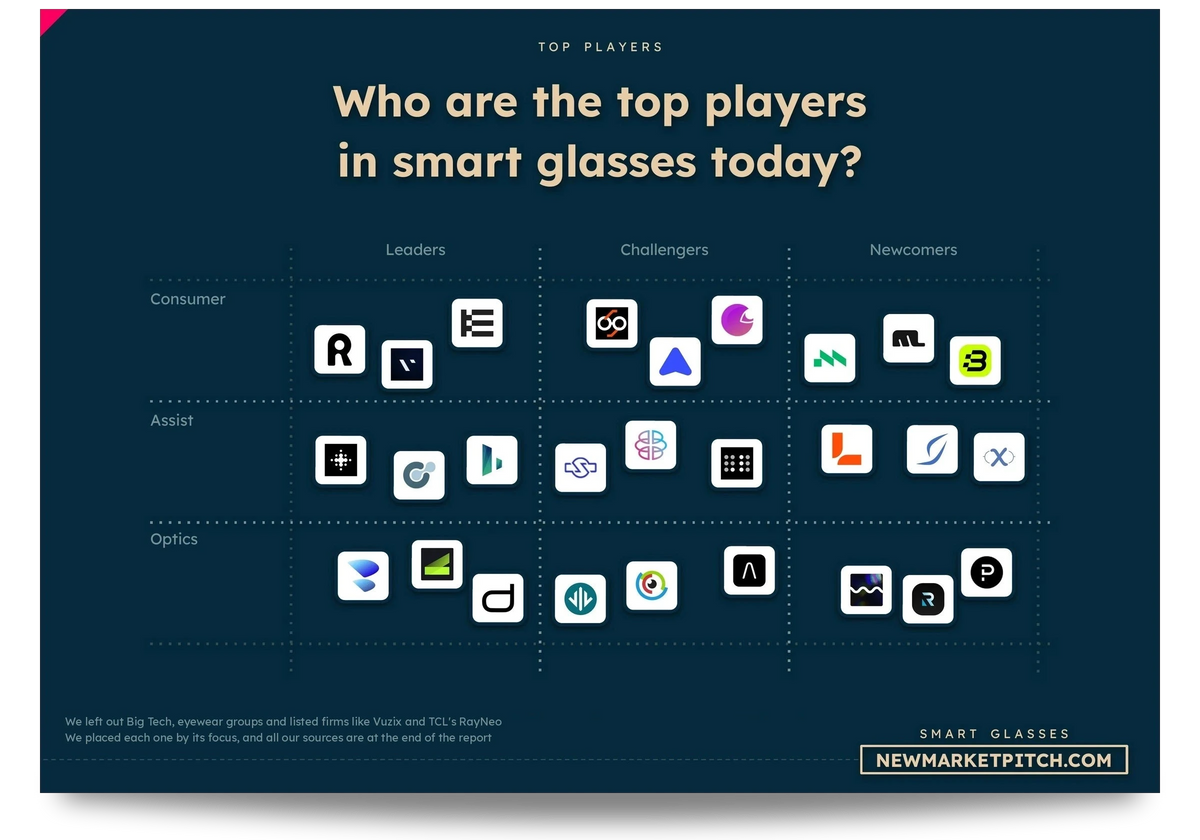
In our report covering the smart glasses market, we turn what is vague and complex into simple, useful visuals. Market maps like this one show you at a glance where every startup stands.
Which smart glasses startups have actually sold enough products to be taken seriously?
RayNeo, XREAL, VITURE, Rokid, and Even Realities have the strongest public evidence of meaningful consumer market traction, although their products compete in different categories.
Counterpoint Research's second-half 2025 AR tracker found that RayNeo controlled 42% of video-centric AR glasses shipments, XREAL held 28%, and VITURE was part of a leading trio representing 96% of the segment.
That is a remarkably concentrated market. The top three manufacturers increased their combined share from 85% in the second half of 2024 to 96% one year later. Smaller brands were losing ground even while demand for AR glasses was rising.
Lightweight waveguide glasses tell a different story. Counterpoint ranked Rokid first in the first quarter of 2026, with Meta taking 38% of shipments, Even Realities 9%, and Alibaba 5%. These devices display information through transparent optical components and are closer to ordinary glasses than many larger entertainment-focused products.
We should be careful when comparing these figures. A 42% share of video-centric AR glasses is not equivalent to 42% of all smart glasses. Meta's broader market remains much larger, and individual manufacturers rarely disclose comparable absolute unit sales.
Still, the shipment data help separate established competitors from startups known mainly for impressive demonstrations. RayNeo, XREAL, and VITURE have already built a dominant position in one product category, while Rokid and Even Realities are gaining customers in another.
| Company | Main product category | Strongest evidence | Biggest remaining question |
|---|---|---|---|
| RayNeo | Entertainment and AR displays | 42% of video-centric AR shipments, H2 2025 | Can it maintain margins? |
| XREAL | Spatial displays and computing | 28% of video-centric AR shipments, H2 2025 | Will Aura sell beyond enthusiasts? |
| VITURE | Portable entertainment displays | Shipments up more than 200% YoY, H2 2025 | Is growth profitable? |
| Rokid | Lightweight AI display glasses | First in waveguide AR shipments, Q1 2026 | Can it retain leadership? |
| Even Realities | Camera-free information glasses | 9% of waveguide AR shipments, Q1 2026 | Can its niche support a large business? |
| Mentra | Open AI glasses and software | Initial 1,000-unit hardware batch sold out | Can its software ecosystem scale? |
| Vuzix | Enterprise glasses and optics | $6.3M revenue in 2025 | Can it reach profitability? |
Can XREAL really compete with Meta's latest glasses?
XREAL is one of the few smart glasses startups that can challenge Meta in a specific high-end product category, although its overall sales remain much smaller.
XREAL already has a strong position in portable display glasses. Its One Pro offers dual 1080p micro-OLED displays, a 57-degree field of view, and spatial tracking. The glasses connect to compatible phones, computers, and gaming devices, allowing users to work or watch content on a large virtual screen.
Its new Aura product goes considerably further. Developed with Google and Qualcomm, Aura runs Android XR, uses transparent lenses, and offers a 70-degree diagonal field of view. Prices start at $1,279 for the 12GB RAM and 256GB model, rising to $1,499 for the higher-end version.
That puts Aura almost directly against Meta's newly announced $1,299 mixed-reality glasses. Both products use separate computing hardware, but Meta emphasizes immersive experiences and eye tracking, while XREAL combines optical transparency with Android applications and hand tracking.
The strongest commercial sign so far is that XREAL reported more than 10,000 Aura reservations, with two reservation packages selling out. However, the first Founder's Edition allocation is limited to 2,000 units, and shipments are expected before the holiday season. Reservations are encouraging, but they are not completed sales.
XREAL has moved into more direct competition with Meta while keeping its Google partnership. It now has a route into a much bigger software ecosystem, provided Android XR attracts developers and customers.
Whether Aura can sell in the hundreds of thousands rather than thousands remains unanswered. That is the test that will determine whether XREAL has created a mainstream spatial computing product or another successful enthusiast device.
If you want more recent data on this point, please see our latest smart glasses market report.

Our research about smart glasses gets updated several times a month, so you always get the latest view of where things stand.
Is RayNeo actually beating XREAL in smart glasses sales?
RayNeo is currently selling more video-focused AR glasses than XREAL, according to Counterpoint's latest comparable segment figures.
In the second half of 2025, RayNeo held 42% of global video-centric AR glasses shipments, against 28% for XREAL. That gives RayNeo a 14-percentage-point lead and approximately 1.5 times XREAL's shipment share.
Counterpoint linked RayNeo's performance to aggressive pricing, a broader product portfolio, and expansion across China, North America, Europe, and Japan. RayNeo is also backed by TCL's electronics ecosystem, giving it access to established manufacturing and distribution capabilities.
XREAL attracts considerable attention through its Google collaboration and premium spatial computing products, while RayNeo has been particularly effective at selling established display-glasses formats.
RayNeo has also expanded into AI and augmented-reality products beyond portable entertainment screens. That could allow the company to use its existing customer base and supply chain as demand shifts toward lighter display-enabled glasses.
RayNeo deserves to rank ahead of XREAL in demonstrated video-glasses sales today. XREAL has a particularly interesting opportunity in Android XR, but that opportunity is still largely ahead of it. Neither company has published enough detailed financial information for a reliable profitability comparison.
Is VITURE growing fast enough to catch RayNeo and XREAL?
VITURE is growing unusually quickly in AR glasses, but there is still no evidence that it has caught RayNeo or XREAL in total shipments.
Counterpoint recorded more than 200% year-over-year shipment growth for VITURE in the second half of 2025. Its Luma and Beast product families helped drive the increase, alongside a broader sales network.
The financing story supports that growth. VITURE announced a $100 million investment in September 2025, followed by another $100 million financing in February 2026 led by Legend Capital. The company said it had raised more than $200 million within six months.
Independent shipment research shows accelerating customer adoption during roughly the same period that investors committed substantial new funding. Few independent AR glasses manufacturers have demonstrated that combination so clearly.
However, shipment growth from a smaller starting point can look impressive without closing the absolute sales gap. Counterpoint still ranked RayNeo and XREAL ahead of VITURE in video-centric AR glasses.
VITURE is a serious competitor, with growing shipments, several product generations, and capital to fund further expansion. Its most important unanswered questions concern revenue, hardware margins, and the cost of acquiring customers.
Those financial details will determine whether VITURE can turn its rapid growth into a durable independent business.

In our market report about smart glasses, we look at what the winners do differently, so you can learn from the best instead of guessing.
Could Rokid beat Meta in smart glasses with built-in displays?
Rokid has already beaten Meta on shipment share in one specific smart glasses category: waveguide-based AR glasses during the first quarter of 2026.
Counterpoint ranked Rokid first globally in that segment, ahead of Meta's 38% share. The result was helped by Rokid's international expansion and stronger offline distribution.
Rokid Glasses combines a visual display, 12-megapixel camera, translation features, voice assistance, and open-ear audio in a frame weighing approximately 49 grams. That is much closer to the everyday AI glasses experience that Meta and Google are pursuing than the larger entertainment displays sold by XREAL and VITURE.
Rokid also demonstrated early customer demand through Kickstarter. Its campaign attracted 5,875 backers and approximately HK$31.36 million in pledges. Crowdfunding is useful evidence of purchase interest, although pledges do not tell us how many customers will buy another generation.
The broader product category has been growing quickly. Counterpoint reported that waveguide glasses increased from 13% of AR shipments in the second half of 2024 to 38% one year later.
Meta has already entered that market through Ray-Ban Display, and its production capacity was constrained by component yields and limited US availability in early 2026. Those constraints may ease.
Rokid's current leadership deserves attention, but it could be temporary. Its advantage depends on bringing capable, lightweight display glasses to customers faster and more affordably than the larger manufacturers. Once Meta's supply improves, Rokid will have a much tougher fight.
Can Even Realities win customers who don't want cameras in their glasses?
Even Realities has one of the clearest reasons for customers to choose an independent smart glasses brand: its glasses provide useful visual information without a built-in camera.
The company's G2 product focuses on text, notifications, navigation, and discreet information displays. Compared with Ray-Ban Meta's camera-equipped products, Even Realities has deliberately prioritized privacy and a more conventional eyewear experience.
Its progress is measurable. Counterpoint estimated that Even Realities captured 9% of waveguide AR glasses shipments in the first quarter of 2026. In July, TechCrunch reported a $150 million pre-Series B financing led by Meituan and Tencent, valuing the company at $1 billion.
The privacy argument has also become more concrete. Norway's government recently proposed restrictions on AI camera glasses in sensitive places, including schools, hospitals, swimming pools, and gyms. Those discussions highlight a problem for recording glasses that a camera-free product can largely avoid.
But Even Realities still faces a difficult commercial question. Removing the camera makes the glasses more acceptable in some settings, while also eliminating photography and visual AI features that attract mainstream buyers.
The company has also faced criticism over connectivity and software reliability. At a $1 billion valuation, it needs to develop far beyond an enthusiast product.
Even Realities has a credible opportunity to build a specialist business around discreet visual information. Its decision to avoid cameras is a genuine product distinction, rather than another attempt to match Meta feature for feature. The harder question is whether enough customers want that trade-off to justify a billion-dollar company.
If you want more recent data on this point, please see our latest smart glasses market report.

In our document detailing everything you need to know about smart glasses, you will always find fresh funding data, taken straight from our own verified funding database.
Are display smart glasses growing fast enough to support independent startups?
Display-equipped smart glasses are growing quickly enough to create opportunities for several startups, although ordinary camera-and-audio AI glasses still dominate total shipments.
Counterpoint's AR research shows an especially interesting shift. Waveguide-based glasses represented 13% of AR shipments in the second half of 2024, 19% in the first half of 2025, and 38% in the second half of 2025.
That is a 25-percentage-point increase in just one year. Waveguide shipments grew more than 600% year over year during the second half of 2025, compared with approximately 80% growth for video-centric AR devices.
The market as a whole also expanded. Counterpoint measured 98% annual growth in AR glasses shipments during 2025, with growth accelerating to 148% in the second half.
These numbers explain why Rokid, Even Realities, and other display-focused manufacturers are attracting attention. Transparent optical displays are moving from a small specialist segment toward a more meaningful share of AR demand.
However, AR shipment statistics cover a narrower market than the broader smart glasses tracker dominated by Meta. We should not interpret 38% waveguide penetration within AR glasses as 38% of all smart glasses.
Customer demand for built-in displays is accelerating. Independent manufacturers have a chance to establish their positions while this part of the market is still developing, before any single company achieves the dominance Meta already enjoys in mainstream AI glasses.
Can smart glasses startups compete on price without losing money?
Competing mainly on price looks dangerous for smart glasses startups because Meta and established electronics manufacturers have much stronger production and distribution advantages.
The price differences between leading products illustrate why these companies increasingly focus on different customer needs.
XREAL One Pro launched at $599 and offers a portable spatial display that connects to other devices. Meta Ray-Ban Display launched at $799 with an integrated display and Neural Band. XREAL Aura starts at $1,279, almost matching Meta's new $1,299 mixed-reality glasses.
These products have different functions, so cheaper does not automatically mean better value. Someone who wants a large virtual screen for a Steam Deck may prefer XREAL One Pro. Someone looking for a wearable AI assistant could find a Meta product more useful.
The pricing environment also appears relatively healthy for smart glasses overall. Counterpoint reported that the average selling price of AI smart glasses increased from approximately $347 in the first half of 2025 to $360 in the second half.
That suggests buyers have been willing to spend slightly more as product features improve. It tells us almost nothing about whether independent manufacturers are making money.
Hardware profitability is particularly difficult to judge because XREAL, RayNeo, VITURE, Rokid, and Even Realities do not publish comparable gross margins.
For now, startups have a better chance by charging for something customers specifically value, such as better optics, portable entertainment, or discreet displays. Trying to undercut Meta with cheaper versions of essentially the same glasses looks like a poor business to be in.

Learning from others' mistakes is the cheapest lesson there is. In our report covering the smart glasses market, we look at what broke startups before you, so you don't repeat it.
Could Mentra build a smart glasses software platform that competes with Google?
Mentra has an interesting opportunity in open smart glasses software, but its ecosystem is still tiny compared with Google's Android XR ambitions.
Mentra Live combines camera-equipped AI glasses with an open development environment. The company disclosed an $8 million funding raise in 2025, and its initial 1,000-unit hardware batch sold out.
The more interesting part of its business is MentraOS. The platform supports applications across compatible glasses, including Mentra Live, Even Realities G1 and G2, and Vuzix Z100.
That addresses a practical problem. A developer building software for one small smart glasses brand may struggle to reach enough users. Compatibility across several manufacturers makes the opportunity more attractive.
Google is pursuing a related goal with Android XR, backed by Gemini, Qualcomm, Samsung, and an enormous existing developer ecosystem.
Mentra cannot currently match that distribution. Its opportunity lies with smaller manufacturers that want an open platform and developers building specialized applications.
Mentra remains an early-stage software experiment rather than an established rival to Google. Its initial hardware sales are encouraging, but the company has not yet demonstrated large-scale recurring software revenue.
Can enterprise smart glasses startups survive without selling millions of devices?
Enterprise smart glasses companies have a plausible route to survival through specialized customers, but Vuzix shows how difficult it can be to turn those customers into a profitable business.
Vuzix reported $6.3 million in revenue for 2025, up from $5.8 million in 2024. That represents approximately 8.6% growth. Its fourth-quarter revenue increased from $1.3 million to $2.2 million, helped by M400 smart glasses and engineering services for defense and security customers.
The financial results are mixed. Vuzix recorded an $8.7 million fourth-quarter net loss attributable to common shareholders, despite the improvement in revenue.
Its research and development expenses reached $12.6 million for 2025, approximately twice the company's annual revenue. That gap illustrates the cost of competing in advanced optical hardware when sales volumes remain limited.
Enterprise customers can create opportunities that Meta's consumer business does not directly address. Remote assistance, defense applications, industrial workflows, and optical engineering services require specialized hardware and customer relationships.
But enterprise contracts do not guarantee attractive economics. Vuzix has years of product experience and measurable revenue, yet its financial position remains pressured.
We would be particularly cautious about enterprise smart glasses startups that announce numerous pilots without disclosing purchases, deployment volumes, or recurring contracts. Vuzix has already passed many of those early commercialization milestones, and the economics are still tough.

Your time is limited. In our research about smart glasses, we put numbers on each part of the market, so you can see where it makes sense to focus.
Could smart glasses startups survive by partnering with Google instead of fighting it?
Partnering with Google may be one of the best survival strategies for smart glasses specialists, particularly those with valuable optical technology.
XREAL is already showing how this can work. Aura combines XREAL hardware, Google's Android XR and Gemini ecosystem, and Qualcomm computing technology. The arrangement allows XREAL to offer a broader software experience than it could realistically develop alone.
The partnership also gives Google access to a manufacturer with years of experience in compact spatial displays.
Other startups have different forms of industrial support. RayNeo benefits from TCL's electronics expertise, while VITURE has brought in substantial outside capital. Vuzix is developing waveguide components and engineering services that can be supplied to other manufacturers.
Independent startups may end up playing several roles in the industry. Some will keep building their own consumer brands. Others may supply optical components, develop specialized hardware, or work within larger software ecosystems.
However, partnership can create dependence. If Android XR becomes dominant, Google could gain substantial influence over software features, app distribution, and the customer experience. Manufacturers might then struggle to differentiate their products.
For a startup, the ideal arrangement is to contribute something its partner cannot easily replace, whether that is optical engineering, manufacturing expertise, or access to a particular customer group. Otherwise, joining Google's ecosystem risks exchanging one competitive problem for another.
If you want more recent data on this point, please see our latest smart glasses market report.
Can Meta and Google simply copy what smart glasses startups are building?
Meta and Google can copy many smart glasses software features, but reproducing specialized hardware and building an established customer base is more difficult.
Live translation, navigation, voice assistance, notifications, and AI-powered questions are becoming standard capabilities. Startups relying mainly on those features will find it increasingly hard to stand out.
Meta has already moved beyond audio-first glasses with Ray-Ban Display and its newer mixed-reality products. Google is bringing Gemini into both everyday eyewear and spatial computing through Android XR.
That puts pressure on startups to offer something more specific. XREAL has developed portable display hardware and a position in spatial computing. RayNeo has established pricing and distribution strengths. Rokid has demonstrated lightweight waveguide integration. Even Realities has built a recognizable camera-free product concept.
These advantages are harder to reproduce immediately, especially when they involve years of optical engineering or established relationships with customers and suppliers.
Still, the gap will probably narrow. Established eyewear manufacturers can develop lighter frames, larger companies can invest in better displays, and software features can spread quickly across platforms.
The startups most exposed are those selling generic AI glasses assembled from components available to many manufacturers. They have limited protection against companies with much larger manufacturing and marketing budgets.

In our market report about smart glasses, we always try to gather several sources and make estimates that make sense, so you can work with solid numbers.
Which smart glasses startups are most likely to survive Meta and Google?
XREAL and RayNeo currently have the strongest evidence of commercial staying power, while VITURE, Rokid, and Even Realities have promising but less proven positions.
XREAL combines a substantial share of video-centric AR shipments with a major Google partnership and a new premium product. RayNeo leads that same segment on shipments and benefits from TCL's manufacturing ecosystem.
VITURE is another serious contender. Its reported shipment growth and more than $200 million raised within six months suggest it has the resources to keep developing products and expanding distribution.
Rokid has a strong opportunity in lightweight waveguide glasses, although Meta's investment in display-equipped products makes competition increasingly direct. Even Realities has differentiated itself through camera-free eyewear and attracted $150 million in financing, but its valuation assumes substantial future growth.
Mentra is an interesting software-focused startup, with much more limited proof of commercial scale. Vuzix has an established enterprise presence but faces clear financial challenges.
We cannot reliably rank these companies by financial runway or profitability because most are privately held and do not publish comparable accounts. The following assessment therefore weighs demonstrated sales, distribution, partnerships, product specialization, and financial evidence.
| Startup | Survival outlook | Main reason | Biggest risk |
|---|---|---|---|
| XREAL | Strong | Established shipments and Google partnership | Dependence on Android XR and premium demand |
| RayNeo | Strong | Segment-leading sales and TCL support | Price competition and hardware margins |
| VITURE | Promising | Fast shipment growth and major financing | Profitability remains undisclosed |
| Rokid | Promising | Leadership in waveguide AR | Larger competitors increasing production |
| Even Realities | Promising, but less proven | Camera-free niche and $150M financing | Limited scale and high valuation |
| Mentra | Highly uncertain | Open software and multi-brand approach | Small installed base and Google competition |
| Vuzix | Financially pressured | Enterprise customers and optical engineering | Low revenue relative to development costs |
Can top smart glasses startups survive Meta and Google?
Yes. Several top smart glasses startups have a credible chance of surviving Meta and Google, although very few look capable of challenging Meta's mainstream consumer leadership anytime soon.
Meta has already built an enormous advantage. Its share of global smart glasses shipments reached approximately 84%, while EssilorLuxottica reported more than 7 million AI glasses sold in 2025. That scale, combined with Ray-Ban and Oakley distribution, makes direct competition extremely difficult.
Yet the market is developing in several directions. As we saw above, RayNeo, XREAL, and VITURE have become the dominant manufacturers of video-centric AR glasses. Rokid has taken an early lead in waveguide displays, and Even Realities is finding customers for discreet, camera-free eyewear.
Google's entry adds pressure but also creates opportunities. XREAL's Android XR partnership is particularly important because it shows how a specialized startup can participate in a major technology ecosystem while continuing to develop its own hardware.
XREAL and RayNeo have the best demonstrated positions today. VITURE is catching up quickly, while Rokid and Even Realities have opportunities in product categories that are still taking shape.
We are much less confident about generic AI glasses startups offering features that Meta, Google, and their manufacturing partners can easily reproduce.
The likely outcome is a market where Meta dominates mainstream AI eyewear, Google becomes an important software platform, and a smaller group of independent manufacturers survives by serving customers with different needs.
For these startups, success will come from selling glasses that people specifically prefer over what Meta and Google offer. Several companies have already demonstrated that demand exists. The next challenge is making enough money from it to remain independent.
If you want more recent data on this point, please see our latest smart glasses market report.

If you build or invest in the smart glasses market, you need to know which business models pay off now and which ones are fading. That's why our report covering it has a whole section on it.
Our methodology
This analysis assesses whether independent smart glasses startups can maintain viable businesses as Meta expands its consumer hardware leadership and Google develops Android XR. We examined recent shipment performance, product adoption, technical differentiation, distribution, financing, partnerships, and available financial results across seven manufacturers: XREAL, RayNeo, VITURE, Rokid, Even Realities, Mentra, and Vuzix.
We first separated the competitive landscape into mainstream AI smart glasses, video-centric AR glasses, lightweight waveguide eyewear, and specialized enterprise applications. These categories overlap technologically but differ substantially in customers, pricing, and use cases. We compared companies within the most relevant categories before drawing broader conclusions. In particular, a leading share of video-centric or waveguide AR shipments was not treated as a comparable share of the entire smart glasses market.
For commercial traction, we prioritized independently measured shipments and growth rates, followed by disclosed sales and financial results. We also examined product reservations, crowdfunding campaigns, and initial hardware allocations, while distinguishing preliminary customer interest from completed deliveries and repeat purchases. This allowed us to assess the strength of demand without assigning equal weight to fundamentally different commercial indicators.
Our competitive analysis brought together actual product specifications, optical technologies, hardware form factors, prices, and software ecosystems. We assessed where manufacturers had demonstrable advantages in entertainment displays, lightweight waveguides, camera-free information delivery, and spatial computing, then compared those positions with Meta's current products and Google's Android XR partnerships. We gave greater weight to differentiation already supported by commercial adoption than to announced capabilities awaiting broad deployment.
Financial resilience was evaluated through disclosed fundraising, corporate relationships, manufacturing and distribution support, revenue, and operating expenses. Financing was treated as evidence of access to capital, rather than proof of profitability. For privately held manufacturers without comparable financial accounts, we avoided estimating precise margins, cash runway, or survival probabilities. Vuzix's publicly reported results provided a useful illustration of the development costs and commercial challenges facing specialized optical hardware companies.
We also assessed how competition is changing. Recent market measurements were aggregated with product launches, emerging waveguide adoption, Meta's expansion into display-equipped eyewear, and Google's relationships with hardware manufacturers. For each dimension, we examined the freshest available evidence, compared it with earlier measurements, and assessed whether it represented an established advantage or an opportunity that still depends on execution.
The final survival outlooks combine demonstrated commercial traction, defensible product specialization, industrial support, financial evidence, and exposure to competition from larger technology platforms. They are editorial assessments rather than statistically modeled failure probabilities. A company with strong shipment share but undisclosed margins may receive a favorable competitive assessment without being considered financially secure, while a well-financed early-stage business may remain commercially unproven.
Key sources include Counterpoint Research's AR smart glasses shipment analysis, Counterpoint's broader smart glasses market research, and EssilorLuxottica's 2025 financial results for shipment trends and Meta's commercial scale. For platform competition and hardware development, we used Google's Android XR announcements, Google's XREAL Aura update, XREAL's product documentation, and Meta's Ray-Ban Display announcement.
Company-level evidence was drawn from VITURE's September 2025 financing announcement and February 2026 financing update, Rokid's crowdfunding campaign, Even Realities' product documentation, TechCrunch's reporting on Even Realities' financing and valuation, MentraOS's public software repository, and Vuzix's full-year 2025 financial results. We also reviewed EssilorLuxottica's Oakley Meta partnership announcement and its expanded eyewear partnership disclosures to assess the distribution and manufacturing advantages available to Meta.
We prioritized original market research, official financial disclosures, technical documentation, and reporting containing attributable company information. The findings reflect a structured aggregation of recent evidence across multiple competitive dimensions, with stronger conclusions reserved for companies whose market positions are supported by more than one observable measure.

In our report covering the smart glasses market, we don't want to repeat what boring consulting reports say. Instead, we show you the real and latest market signals that matter.
Written by the New Market Pitch teamWe track new markets so founders and investors can move faster. About us