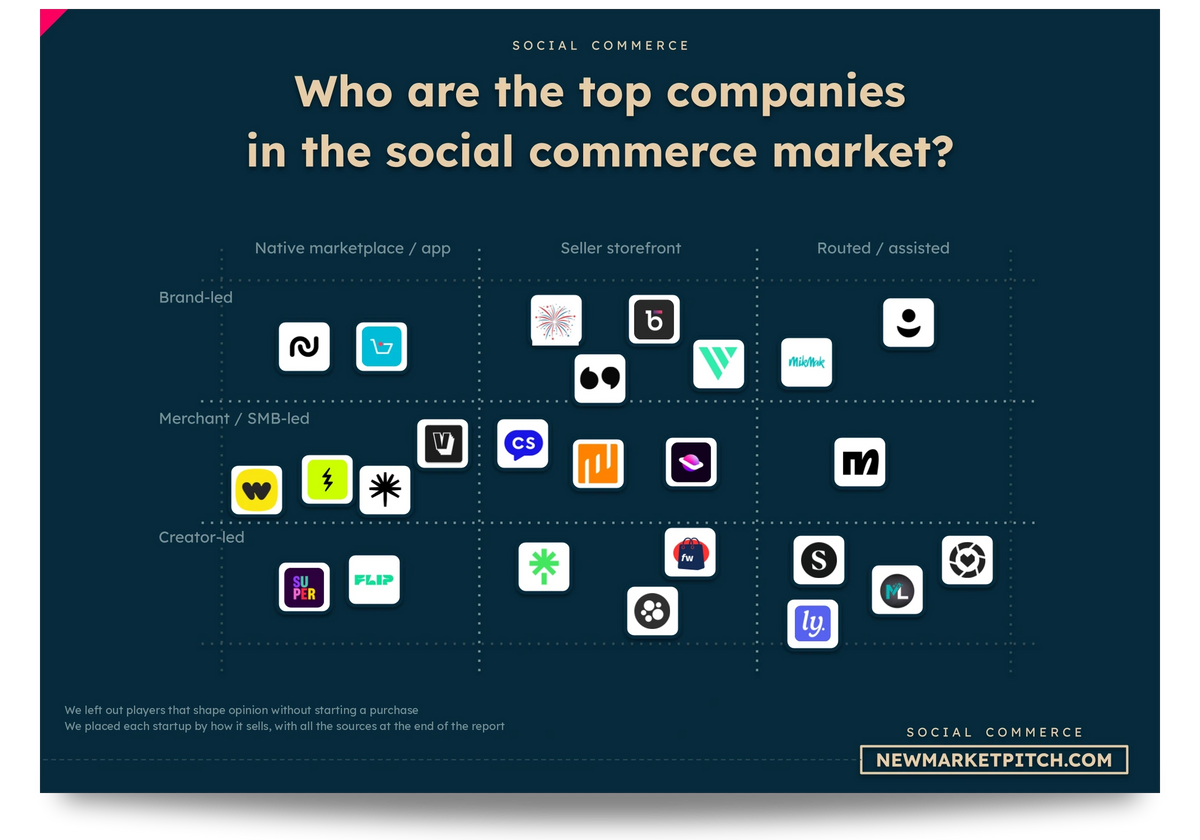
What are the top social commerce startups by total funding raised?
Building a startup or looking for your next investment in social commerce? Our report gives you the full picture.
Summary
Whatnot is the number one social commerce startup by total funding raised, with $1.5B. India's Meesho follows with $1.1B, ahead of China's Xiaohongshu ($900M).
All three built large shopping platforms, but they started in very different places. Meesho grew out of India's reseller economy, Whatnot began with collectibles, and Xiaohongshu became popular for lifestyle reviews.
Whatnot is particularly worth watching now. Its sellers have expanded into new product categories, and the company has secured fresh backing for that expansion.
Creator commerce has also produced well-funded independent businesses. LTK and ShopMy help creators earn commissions when followers buy recommended products.
Firework takes a different route, selling video shopping technology to retailers that already have customers of their own.
Only 9 of the 67 social commerce startups we track have raised above $100M. The median is at least $6.8M.
A smaller software business can work with existing shoppers on Instagram, WhatsApp or retail websites. It can grow without paying to build an entire marketplace.
The United States has the largest group of companies in our research, including the funding leader. In India and Indonesia, Meesho and Evermos built substantial businesses around local resellers.
Some of the biggest fundraisers have gone years without new equity rounds. Others have been bought by larger companies, including Mavely, which now operates under the Later name.
Whatnot's lead could keep growing as it raises again. Among the smaller companies, the most interesting challengers are often building tools for creators and sellers rather than launching another general shopping app.

Written by the New Market Pitch teamWe track new markets so founders and investors can move faster. About us

In our report covering the social commerce market, we turn what is vague and complex into simple, useful visuals. Market maps like this one show you at a glance where every startup stands.
Top startups in the social commerce market ranked by total funding raised
Here is the current ranking of the social commerce startups that raised the most, with the total each one has raised and our confidence level.
If you want to go deeper into the social commerce startup landscape, check our report covering the social commerce market.
| # | Startup | Total raised | Last round | Status | Confidence |
|---|---|---|---|---|---|
| $1B and above | |||||
| 1 | WhatnotLive video shopping and seller auctions | $1.5B | Aug 2026$545M · Series G | Active | Full |
| 2 | MeeshoSocial commerce marketplace for consumers | $1.1B1 | Sep 2021$570M · Series D+ | IPO | Low |
| $500M to $1B | |||||
| 3 | XiaohongshuSocial commerce and lifestyle platform | $900M | Nov 2021$500M · Series E | Active | Full |
| $100M to $500M | |||||
| 4 | LTKCreator shopping and affiliate platform | $300M | Nov 2021$300M · Series B | Active | Full |
| 5 | LaterInfluencer marketing and social management | $255M | Apr 2022$135M · Growth equity | Active | Full |
| 6 | FireworkShoppable video and livestream infrastructure | $250M | May 2022$150M · Series B | Active | Full |
| 7 | ShopMyCreator storefronts and affiliate shopping links | $174M | Oct 2025$70M · Growth / late VC | Active | Full |
| 8 | ManychatAutomated customer messaging and chat assistants | $158M | Apr 2025$140M · Growth capital (stage not named) | Active | Full |
| 9 | CityMallCommunity-distributed value commerce | $112M+ | Mar 2022$75M · Series C | Active | Full |
| Below $100M | |||||
| 10 | EvermosSocial commerce reseller platform | $77M | May 2023$39M · Series C | Active | Strong |
| 11 | FERMÀTCommerce platform for social advertising | $74M | Jun 2025$45M · Series B | Active | Full |
| 12 | NTWRKLive auctions and creator-curated drops | $60M+ | Sep 2021$50M · Series B | Active | Full |
| 13 | SuperOrdinaryTikTok Shop brand distribution and creator sales | $58M+ | Oct 2023$58M · Series B | Active | Full |
| 14 | TiltLive marketplace for trading cards | $44M | Jun 2026$26M | Active | Full |
| 15 | LevantaCreator affiliate links and commerce attribution | $43M | Aug 2026$22M · Series B | Active | Full |
| 16 | VideoShopsSocial commerce storefronts for creators | $42M | Aug 2025$24M · Seed extensions 2023-2025 (announced Aug 2025) | Active | Full |
| 17 | ShopShopsLive social shopping marketplace | $35M+ | Jun 2021$15M · Series B | Acquired | Partial |
| 18 | ConnectlyAI agents for conversational commerce | $28M | Sep 2024$20M · Series B | Active | Full |
| 19 | WishlinkCreator commerce and affiliate platform | $28M | Feb 2026$18M · Series B | Active | Full |
| 20 | DuelCreator advocacy management platform | $21M | Sep 2025$16M · Series A | Active | Full |
| 21 | VambeConversational agents for sales and support | $18M | Dec 2025$14M · Series A | Active | Full |
| 22 | FourthwallCreator storefronts and memberships | $17M+ | May 2023Undisclosed · Other | Active | Low |
| 23 | KomiCreator link-in-bio and commerce platform | $17M+ | Jul 2023$12M · Series A | Active | Strong |
| 24 | TalkShopLiveLivestream shopping platform for brands | $16M | Oct 2023$7M · Seed | Active | Full |
| 25 | VudooEmbedded checkout infrastructure for shoppable media | $15M | Nov 2026~$15M · Series B | Active | Low |
| 26 | SleekFlowOmnichannel messaging and social commerce software | $15M+ | Aug 2024$7M · Series A | Active | Full |
| 27 | DistrictLive-stream shopping marketplace and seller storefronts for collectibles | $15M | May 2026$15M · Seed | Active | Full |
| 28 | Live2.aiShoppable social video operating system | $14M | Oct 2026$14M · Pre-Series B | Active | Full |
| 29 | TaagerSocial commerce platform for online sellers | $13M | Feb 2025$6.8M · Series B | Active | Full |
| 30 | OmniChatWhatsApp sales and marketing automation | $13M+ | Jun 2025$9.1M · Series B | Active | Full |
| 31 | YASOSocial commerce storefronts for creators | $11M | Sep 2025$11M · Series A | Active | Full |
| 32 | BuywithLive co-shopping and shoppable sessions | $11M | May 2022$9.5M · Seed | Active | Partial |
| 33 | KioskCreator storefronts for social commerce | $10M | May 2024$10M · Seed | Active | Full |
| 34 | DoersMarketplace for creator brand collaborations | $6.8M+ | Feb 2025$6.8M · Series A | Active | Full |
| 35 | EukaCreator affiliate automation for TikTok Shop and Instagram brands | $5M | Active | Full | |
| 36 | GallaboxOmnichannel AI agents for customer messaging | $4.7M | Jan 2025$3.5M · Seed | Active | Full |
| 37 | LeadsalesCRM for WhatsApp social selling | $4.1M | Aug 2023$3.7M · Seed | Active | Full |
| 38 | VendahSocial commerce platform for resellers | $4M | Aug 2023$2.5M · Seed | Active | Full |
| 39 | TextYessWhatsApp commerce and customer service software | $3.3M | Sep 2025$2.8M · Seed | Active | Full |
| 40 | ChatLabsAI personalization that converts social traffic into site sales | $3.2M | Dec 2024$3.2M · Seed | Active | Full |
| 41 | SUKHIBAWhatsApp social commerce platform | $3.1M | Aug 2024$1.6M · Seed | Active | Full |
| 42 | DealCartCommunity group-buying grocery marketplace | $3M+ | Jul 2024$3M · Seed | Active | Partial |
| 43 | TrendioTikTok/YouTube creator-commerce execution | $3M | May 2022$3M · Seed | Active | Full |
| 44 | WoovlySocial commerce platform for beauty shopping | $2.9M+ | Nov 2023Undisclosed · Other | Active | Full |
| 45 | MAKALivestream fashion and beauty marketplace | $2.7M | Dec 2023$2.7M · Pre-Seed | Active | Full |
| 46 | MercatelyWhatsApp CRM and social selling software | $2.6M | Aug 2024$2.6M · Seed | Active | Full |
| 47 | LockerSocial shopping and product discovery app | $2.5M | Feb 2024$2.5M · Seed | Active | Full |
| 48 | PickyouSocial commerce marketplace for fashion | $2.4M | Apr 2025$1.5M · Series A | Active | Full |
| 49 | PaageCreator storefront and selling platform | $2.2M | Nov 2025$2.2M · Seed | Active | Full |
| 50 | MavelyAffiliate shopping links for creators | $2M | 2020$2M · Seed | Acquired | Full |
| 51 | nFuseMessaging-based wholesale ordering for small retailers | $2M | Apr 2026$2M · Seed | Active | Full |
| 52 | DimensionTikTok Shop seller operations software | $1.7M | Jul 2026$1.7M · Seed | Active | Full |
| 53 | UnboxCreator commerce operations and analytics | $1.6M | Sep 2025$1.6M · Seed | Active | Full |
| 54 | LehLahCreator affiliate commerce and influencer marketing | $1.5M | Apr 2025$1.5M · Seed | Active | Full |
| 55 | SwirlVideo commerce platform for online retailers | $1.4M | Feb 2024$1.1M · Seed | Active | Full |
| 56 | ChpterWhatsApp commerce tools for merchants | $1.2M | Sep 2024$1.2M · Seed | Acquired | Full |
| 57 | RwajSocial commerce marketplace for local sellers | $1.2M | Sep 2026$1.2M · Seed | Active | Full |
| 58 | WassistWhatsApp shopping and support agents | $1.1M | Jun 2026$1.1M · Pre-seed | Active | Full |
| 59 | LiveMeUpLive shopping software for online stores | $1.1M | Jan 2024$1.1M · Seed | Active | Full |
| 60 | WyrldCreator storefronts for social commerce | $1M | Feb 2025~$1M · Seed | Active | Full |
| 61 | YaVendióWhatsApp AI sales agents for ecommerce | $850K | Feb 2025$850K · Seed | Active | Full |
| 62 | ReviSocial commerce tools for local businesses | $410K | Nov 2024$410K · Pre-Seed | Active | Full |
| Undisclosed | |||||
| 63 | MojoSocial shopping and product discovery app | Undisclosed | Mar 2024Undisclosed · Seed | Active | Low |
| 64 | OrderfazSocial commerce tools for online sellers | Undisclosed | Jul 2023Undisclosed · Pre-Seed | Acquired | Low |
| 65 | PalmstreetLive shopping marketplace for collectibles | Undisclosed | Oct 2024Undisclosed · Other | Active | Low |
| 66 | SiinLive shopping and auction marketplace | Undisclosed | May 2026Undisclosed · Seed | Active | Low |
| 67 | Wired CompanyInfluencer commerce infrastructure for brands | Undisclosed | Jul 2025Undisclosed · Series B | Active | Low |
No startups match this search.
- Includes the primary proceeds of its IPO.

Our research about social commerce gets updated several times a month, so you always get the latest view of where things stand.
Why has Meesho raised so much money?
Meesho became one of the best-funded social commerce startups by making it easier for small Indian sellers to reach shoppers.
Its original resellers recommended products on WhatsApp, Facebook and Instagram without needing a physical store. Reuters reported in September 2021 that Meesho also handled payments and logistics. That gave investors a way to reach merchants and customers who were difficult for conventional online stores to serve.
Meesho has since developed a direct shopping marketplace. According to its investor relations website, it had 284 million annual transacting users and 2.95 billion placed orders in the twelve months through September 2026. Its latest results still identify content commerce as part of the marketplace business.
Meesho raised $1.1B across 9 equity rounds before its December 2025 IPO, as many rounds as Whatnot. The IPO is not counted in this market: Meesho has become a general marketplace and does not publish the share of its content commerce, so only its rounds up to 2021 count here. Investors kept putting money into Meesho as it expanded from reseller-led shopping to a much larger retail business.
Has Whatnot overtaken Meesho in social commerce funding?
Yes. Whatnot is now the best-funded social commerce startup, with $1.5B against $1.1B for Meesho.
The American live-shopping business has completed 9 equity rounds, including its $545M Series G round in August 2026. In the announcement, Whatnot said its sellers had already exceeded the previous full year's sales by the middle of 2026. Those are sellers' merchandise sales rather than Whatnot's own revenue.
Meesho raised $473M through its IPO in December 2025, but that IPO is not counted in social commerce because Meesho has become a general marketplace. Its $1.1B covers its private rounds up to 2021. Whatnot's lead could keep growing as it moves beyond the collectibles that made it popular.

In our market report about social commerce, we look at what the winners do differently, so you can learn from the best instead of guessing.
Is Xiaohongshu still one of the best-funded social commerce startups?
China's Xiaohongshu remains among the biggest social commerce fundraisers despite having a much older funding history than Whatnot.
Reuters reported that existing shareholders invested in the lifestyle app in November 2021. Its $500M Series E in November 2021 involved Temasek, Tencent and Alibaba, according to the news agency's source. The app had already become a popular place to discover products through reviews and recommendations.
Xiaohongshu is also looking beyond China. Rest of World reported in April 2026 that the company, known internationally as RedNote, was establishing a US presence and launching a shopping portal for overseas buyers. The age of its last recorded equity round tells us little about whether its shopping business is growing today.
Is social commerce funding dominated by a few big startups?
A small group of social commerce startups has pulled far ahead of most specialist companies in total funding.
Only 2 have raised above $1B. Xiaohongshu sits between that group and the 6 companies in the $100M to $500M bracket. Some 87% of the companies we track fall below that lower threshold.
Look at the kinds of businesses that sit below the biggest marketplaces. LTK and ShopMy work with creators, Firework sells shopping technology to retailers, and Manychat helps merchants sell through messages. These companies can grow by serving shoppers who already use other platforms. They have less reason to raise the kinds of sums needed to build a national consumer marketplace.
The table below shows the leading companies by total funding.
| Company | Total raised | Country | Status |
|---|---|---|---|
| Whatnot | $1.5B | United States | Active |
| Meesho | $1.1B | India | IPO |
| Xiaohongshu | $900M | China | Active |
| LTK | $300M | United States | Active |
| Later | $255M | United States | Active |
| Firework | $250M | United States | Active |
| ShopMy | $174M | United States | Active |
| Manychat | $158M | United States | Active |
| CityMall | $112M+ | India | Active |
| Evermos | $77M | Indonesia | Active |
"+" indicates a minimum; the precise order of close totals with undisclosed rounds is uncertain.

In our document detailing everything you need to know about social commerce, you will always find fresh funding data, taken straight from our own verified funding database.
Can social commerce startups still raise half a billion dollars in one round?
Half-billion-dollar social commerce rounds are still possible for companies with large, established shopping platforms.
The biggest single financing among the companies we follow remains Meesho's $570M Series F in September 2021. Reuters reported that Fidelity and B Capital Group led the investment, with Prosus Ventures and SoftBank among returning investors. Orders and the number of shoppers making purchases had grown sharply.
Xiaohongshu reached that scale through backing from existing shareholders. Whatnot has more recently raised a comparable amount for its live-shopping business. Each had already established a sizable consumer platform before securing these unusually large checks. A new shopping feature alone is unlikely to attract that kind of money.
Can a social commerce startup raise hundreds of millions in one round?
LTK shows that a social commerce startup can become one of the biggest fundraisers with a single recorded investment.
Founded in 2011, LTK had years to build its creator shopping business before its $300M Series B in November 2021. Latham & Watkins, which advised SoftBank Vision Fund 2, said the investment would support products for creators, shoppers and brands.
We record only one equity round for 27 social commerce companies, but LTK is unusual among them. Younger companies such as District and Kiosk raised their first money to introduce or expand products. LTK had already established a network that linked creators' recommendations to retail sales. A founder can spend years building that kind of business before approaching a major institutional investor.
Is ShopMy catching up with LTK?
ShopMy is closing the funding gap with LTK in creator commerce, though the older company is still ahead.
Founded in 2020, ShopMy has completed 4 rounds. Its $70M Growth Equity round in October 2025 was led by Avenir, with Bain Capital Ventures, Bessemer Venture Partners and Menlo Ventures participating, according to the company.
Both businesses let creators earn money from the products they recommend. ShopMy's October 2026 creator documentation explains how direct brand partnerships can offer custom commission codes and paid collaborations alongside ordinary affiliate links. A brand can track purchases and pay creators through the same service. That gives ShopMy a way to win more business from brands even if they already work with another affiliate platform.

Learning from others' mistakes is the cheapest lesson there is. In our report covering the social commerce market, we look at what broke startups before you, so you don't repeat it.
Can creator shopping startups make it big without owning checkout?
Creator affiliate startups can raise serious money in social commerce while leaving payments and shipping to existing retailers.
Levanta has raised $43M by building tools that connect sellers and creators. In August 2026, it announced plans to expand into additional retail marketplaces with fresh backing from Volition Capital. The company helps sellers find creators, track their sales and pay commissions.
Wishlink is pursuing a similar business in India. In February 2026, Vertex Ventures Southeast Asia & India said Wishlink would expand its brand and creator partnerships and improve its shopping technology. These companies can reach people who already follow creators and buy from established retailers. They can grow without having to persuade those shoppers to install an entirely new shopping app.
Is influencer marketing software becoming a big social commerce business?
Later has become a major social commerce fundraiser by helping brands turn creator campaigns into sales.
In January 2025, it bought affiliate platform Mavely, which gave it a way to track purchases and pay creators for orders. By September 2026, Mavely had been integrated under the Later name, with existing creator links and commissions preserved. Later also said creators would gain access to brands such as Nike, Wayfair and Unilever.
According to Later's September 2026 announcement, company revenue had more than doubled over the preceding two years. The combined service makes it possible for a brand to find a creator, run a campaign and see which purchases followed. That is a much broader job than scheduling posts or tracking likes.

Your time is limited. In our research about social commerce, we put numbers on each part of the market, so you can see where it makes sense to focus.
Can live-shopping software companies raise as much as marketplaces?
Live-shopping software has attracted large investments, although the biggest consumer marketplaces have raised far more.
Firework's $150M Series B in May 2022 was led by SoftBank. Its software lets a retailer put shoppable videos and live sales directly on its website, where the retailer's customers already shop.
Firework has since announced partnerships with Walmart Connect in September 2022, The Fresh Market in February 2023 and Pacvue in June 2026. These agreements bring video shopping into retailers' existing stores and advertising businesses. Whatnot, by comparison, has to build and maintain its own network of buyers and sellers. Firework can add new retailers without having to create that audience from scratch.
Which live-shopping startups can challenge Whatnot?
Tilt is one of the better-funded independent social commerce challengers to Whatnot in live shopping, although it remains much smaller by funding.
The British company has raised $44M in the rounds we can document, while Tilt says its total is over $50M. Business Insider reported in June 2026 that Tilt was developing AI-assisted auctions, including tools that help sellers create product listings and price items shown on camera. Its categories include clothing and trading cards.
District has raised $15M and gives sellers tools to run auctions and live streams in their own communities. Its May 2026 announcement named Midwest Box Breaks and Stacked Golf as users. NTWRK built its business around curated product drops, while Palmstreet focuses on live sales of collectibles.
A specialist marketplace can start with sellers who already have a following. Tilt and District have a chance to win merchants with easier listing tools or more control over their own communities, without matching Whatnot across every category.

In our market report about social commerce, we always try to gather several sources and make estimates that make sense, so you can work with solid numbers.
Are WhatsApp commerce startups attracting big investments?
Messaging-based social commerce has already produced a well-funded company in Manychat, with smaller competitors selling more specialized tools.
Summit Partners led Manychat's $140M growth capital round in April 2025. The company helps merchants automate conversations on Instagram, WhatsApp and other channels. A seller can answer product questions, recommend items and move a customer toward a purchase without asking that customer to download another app.
Connectly's $20M Series B in September 2024 was led by Alibaba, according to TechCrunch. Connectly reports $37.2M raised in total and Manychat $163.3M, against the $28M and $158M of equity rounds we can document. It uses merchants' product catalogs to personalize recommendations. SleekFlow and OmniChat also help retailers sell through messaging, while Vambe builds automated sales and support agents. For AI-based services to attract larger rounds, they will need to show merchants that these conversations generate orders as well as save time answering questions.
The table below shows messaging-related social commerce startups by total funding.
| Company | Total raised | Country |
|---|---|---|
| Manychat | $158M | United States |
| Connectly | $28M | United States |
| Vambe | $18M | Chile |
| SleekFlow | $15M+ | Singapore |
| OmniChat | $13M+ | Brazil |
| Gallabox | $4.7M | India |
| Leadsales | $4.1M | Mexico |
| TextYess | $3.3M | Italy |
| SUKHIBA | $3.1M | Kenya |
| Mercately | $2.6M | Ecuador |
"+" indicates a minimum, so totals may overlap.
Why have Indian social commerce startups raised so much money?
Indian social commerce startups have raised large sums by serving small merchants and shoppers who are especially sensitive to price.
CityMall raised at least $112M through its Series C in March 2022 by building community group buying for value-conscious customers in smaller cities, where delivery costs and prices can matter more than speed. The company has since moved away from community group buying, so its September 2025 round is not counted in this market.
Meesho grew from local reselling into a national marketplace. Wishlink takes a different approach, using creators to help shoppers discover products. India accounts for 8 of the social commerce companies we track. Its leading businesses have found different ways to reach customers who may be poorly served by conventional retail channels.

If you build or invest in the social commerce market, you need to know which business models pay off now and which ones are fading. That's why our report covering it has a whole section on it.
Does the US have the most heavily funded social commerce startups?
The US has the broadest group of funded social commerce companies, and it also holds the individual funding record through Whatnot.
American companies account for 37% of the businesses we follow. Alongside Whatnot's marketplace are creator platforms, shopping video software and messaging companies. There are several ways to build a social commerce business in the country.
FERMÀT is another example. In June 2025, it named BISSELL, Glossier and GNC among its customers. Its software lets retailers tailor the shopping page to the advertisement or recommendation that brought someone there. Retailers can use social networks to bring in shoppers while keeping their own online stores. The breadth of the American group is clearer when we look beyond shopping apps.
Can European social commerce startups catch up with American ones?
European social commerce startups have yet to reach the funding levels of the biggest American marketplaces or creator platforms.
The UK has 6 companies in our research, including Tilt, Duel and Komi. Tilt competes for shoppers directly, while Duel and Komi sell tools to creators and brands. France's Paage builds creator storefronts, Italy's TextYess helps merchants sell over WhatsApp, and Bulgaria's nFuse lets small retailers place orders over WhatsApp.
These smaller businesses can sell their software across borders without setting up a general shopping marketplace in each country. European companies may have a better chance of competing in specialized tools than of matching the resources of an American consumer platform.
Are there big independent social commerce startups in Southeast Asia?
Indonesia's Evermos is a well-funded independent social commerce business in a region where large retail platforms attract much of the attention.
Evermos has raised $77M. In May 2023, the International Finance Corporation announced an investment to help Indonesian small businesses and micro-entrepreneurs reach customers. The company distributes merchandise through a network of local resellers.
Singapore's SleekFlow works with merchants that use messaging apps to sell. In August 2024 it announced plans to expand into the Middle East and Europe. Both businesses can coexist with Shopee and TikTok Shop: Evermos reaches shoppers through local relationships, while SleekFlow helps merchants serve customers across different messaging channels.
Are the best-funded social commerce startups still raising money?
Some social commerce leaders are attracting new investments today, while others built their funding lead years ago.
Of the companies we follow, 12 last raised before 2023. Another 19 have their most recent recorded round in 2025 and 12 in 2026. These figures count companies by the date of their last round, so they do not measure the annual number of deals.
Whatnot recently returned to investors. LTK and Xiaohongshu still rank highly on the strength of much older investments, and Firework has continued to announce partnerships with retailers. A business may have enough cash or sales to fund expansion without another round. We would look at recent customer growth and commercial results alongside lifetime funding before judging which company is doing best today.
Why aren't TikTok Shop and Instagram among the biggest social commerce fundraisers?
TikTok Shop and Instagram are major social commerce platforms operated by much larger technology companies, rather than independently funded startups.
TikTok Shop is part of TikTok, and Instagram belongs to Meta. TikTok reported in October 2026 that US live shopping sales had more than doubled in the first half of the year. Its size makes it an important competitor for specialist shopping platforms.
WhatsApp is also part of Meta. Companies such as Manychat and Connectly build their own products around messaging channels and raise equity independently. The entire amount raised by a parent company would include money for many activities unrelated to shopping, so it would give a misleading comparison with those startups.
Can a small social commerce startup be worth buying?
Mavely shows how a social commerce startup can attract a big acquisition offer after raising relatively little equity.
We record $2M in funding before Later bought Mavely for $250 million in January 2025. That purchase price reflects the value of the creator and retail network to the buyer; it was not new equity raised by Mavely.
In August 2023, CommentSold also announced that it had acquired Popshop Live's assets to combine its shopping community with CommentSold's selling and fulfillment tools. The price was undisclosed. Of the companies in our ranking, 4 were acquired within the last 3 years. Some buyers want an established shopping audience, while others want technology or relationships with creators. The amount originally raised tells us little about the price they will pay.
So, which social commerce startups have raised the most money today?
Whatnot is number one in lifetime social commerce funding with $1.5B, followed by Meesho ($1.1B) and Xiaohongshu ($900M).
Whatnot's latest financing widened its lead, while Meesho's count stops at its last private round in 2021 because its IPO is not counted in this market. The biggest totals belong to businesses that built their own shopping platforms. LTK, ShopMy and Firework show that companies can also attract substantial funding by helping other businesses sell.
The table below shows what we found.
| Question | Answer |
|---|---|
| Which company leads social commerce funding? | Whatnot leads with $1.5B raised across 9 equity rounds. Its $545M Series G round in August 2026 was its largest. Another major investment would widen the gap. |
| Why is Meesho now second? | Meesho's IPO is not counted in social commerce. It has become a general marketplace without a published content commerce share. Its $1.1B covers its private rounds up to 2021. |
| How rare is a billion-dollar funding history? | Very few social commerce companies have raised that much equity. Only 2 companies have crossed the billion-dollar threshold so far. Most specialist businesses operate with far smaller amounts of funding. |
| Can creators build a heavily funded commerce business? | Creator shopping platforms have already attracted large investments from venture firms. LTK secured $300M through a single recorded equity round. It had spent years building its network before that investment. |
| Can retailers' video suppliers attract big investors? | Firework has raised substantial funding by helping established retailers sell online. Its $150M Series B in May 2022 was led by SoftBank. Retailers can add video shopping where customers already buy products. |
| Can smaller auction apps challenge Whatnot? | Specialist live shopping marketplaces can build businesses around particular audiences. Tilt has raised $44M since the company was founded. Easier listing tools could help it win merchants from competitors. |
| What makes American social commerce funding stand out? | The American group includes much more than just shopping marketplaces. US companies represent 37% of the businesses we follow. Affiliate and messaging software offer other ways to reach customers. |
| Can messaging software raise serious social commerce funding? | Manychat has attracted large investments by helping businesses automate customer conversations. Its $140M growth capital round in April 2025 was led by Summit Partners. Merchants can sell through apps their customers already use regularly. |
| Can modest funding lead to a large exit? | Mavely shows how valuable a creator affiliate network can become. Later bought the business for $250 million in January 2025. An acquisition price measures something very different from accumulated equity. |
| Have older shopping platforms stopped expanding internationally? | Xiaohongshu is still pursuing new markets despite its older financing history. Its $500M Series E dates back to November 2021. Recent overseas shopping plans show why funding age alone proves little. |
Our methodology
Our data runs through November 19, 2026. We then reviewed this article and updated its answers on November 24, 2026, the date shown under the title. We define social commerce as shopping initiated or completed through social networks, creators, communities, messaging and interactive shopping content, together with software primarily designed to initiate, track or complete those purchases. We include businesses at the boundaries of that definition when social-origin or interactive transactions form a core part of their product, but exclude general ecommerce, ordinary advertising and support-only messaging. Every ranked company meets our startup definition: an independent business founded in 2007 or later and built for rapid growth, funded by investors or founders, unlisted or listed within the last five years; businesses acquired within the last three years are included as part of their acquirers. Companies that have gone public, been acquired or shut down retain their historical positions with their status identified, and their totals stop at the IPO, including primary proceeds, or the acquisition.
We count equity raised since founding, including the earliest private equity rounds and the primary proceeds of an IPO. We exclude debt, venture debt, grants, unconverted convertible instruments and SAFEs, secondary share sales and offerings after an IPO. Converted SAFEs are included only within the equity round that absorbed them. We merge duplicate reports of the same financing. A total followed by "+" is a minimum because at least one round has no published amount.
Rounds confirmed by a company announcement, a press article or a regulatory filing are counted in full. Where no article exists, a round is counted only when at least two recognised databases agree on its date (within one month) and amount (within 5%), and it is marked as low confidence; a round found in a single database stays in the company's history but is left out of totals. For companies that have raised more than $100M, every round counted is backed by an article.
We do not adopt the aggregate totals or valuations published by commercial databases such as Crunchbase and PitchBook because those figures can include debt, grants, unpaid commitments or estimates. A database is never the sole source for a round counted in full; rounds found in two agreeing databases alone carry low confidence. Where the press or a company reports a different aggregate, we retain the sum of the equity rounds that meet our sourcing standards, with notes under the ranking for the principal discrepancies. Our confidence classifications (Full, Strong, Partial and Low) describe the extent to which confirmed rounds support the reported total.
Our historical funding comparison includes recent IPOs because it measures the equity accumulated while building the business, including the new money raised at flotation. Meesho is the exception: it has become a general marketplace and does not publish the share of its content commerce, so its December 2025 IPO is left out and only its earlier rounds count in this market. It does not include cash received by existing investors selling shares or assign the full value of an acquisition to the acquired company's equity financing. Close totals that include undisclosed financing should be treated as overlapping minimums rather than definitive differences in the amount raised.
Key sources include Reuters on Meesho's reseller model and financing, Popshop Live asset acquisition and integration, Meesho annual users and orders through September 2026, Later's acquisition of Mavely and transaction value, Whatnot's announcement and first-half seller sales, Reuters on Xiaohongshu's November 2021 investment, RedNote's international shopping expansion, LTK investment and product development, ShopMy's financing and investors, FERMÀT's retailer customers and commerce tools, ShopMy's direct brand partnerships and affiliate attribution, Levanta's expansion and returning investor, Later revenue growth and Mavely integration in September 2026, Firework's financing and retail partnerships, Tilt's auction technology and product categories, District's commerce tools and merchant examples, Manychat's messaging products and funding announcement, Connectly's AI commerce product and Alibaba investment, SleekFlow's international expansion plans, Wishlink's creator and brand expansion, Evermos's Indonesian micro-entrepreneur and reseller model, and Recent US TikTok Shop live sales growth.
Written by the New Market Pitch teamWe track new markets so founders and investors can move faster. About us