What are the most valuable social commerce startups?
Building a startup or looking for your next investment in social commerce? Our report gives you the full picture.
Summary
Xiaohongshu is the most valuable social commerce startup, reportedly valued at $50.0B in secondary share transactions, followed by Whatnot at $20.0B. Both are far ahead of the other private companies in this market.
Whatnot is the company putting the most pressure on that lead. Its live auction business has grown quickly enough to attract a new investment at a much higher price.
The next names are LTK and ShopMy. These companies help creators earn commissions from recommendations, and retailers pay for the sales they generate. Neither needs to run a general-purpose social network.
ShopMy's rapid growth has made the rivalry especially interesting. LTK, which has been around much longer, is adding new ways for shoppers to find products and buy through creator links.
Software could also produce the next unicorns. Manychat helps merchants turn comments and messages into shopping conversations, while Later has bought an affiliate business that connects creators with retailers.
Selling through somebody else's platform can be lucrative. SuperOrdinary helps brands operate on TikTok Shop, and Firework lets retailers add shopping videos to their own websites.
Look at where the companies are based, and the American market stands out for its variety. China, however, has the biggest individual private company.
India has developed its own social commerce businesses. Wishlink helps creators earn money when followers shop online, whereas Live2.ai turns social videos into shopping experiences.
In Europe, Tilt has made trading cards its main focus. Collectors who keep returning for auctions could give the startup a better chance of competing with large marketplaces.
We count 4 established unicorns among the 53 social commerce startups we track. There are plenty of ways to make money from social shopping, but very few independent businesses have crossed the billion-dollar mark.

Written by the New Market Pitch teamWe track new markets so founders and investors can move faster. About us

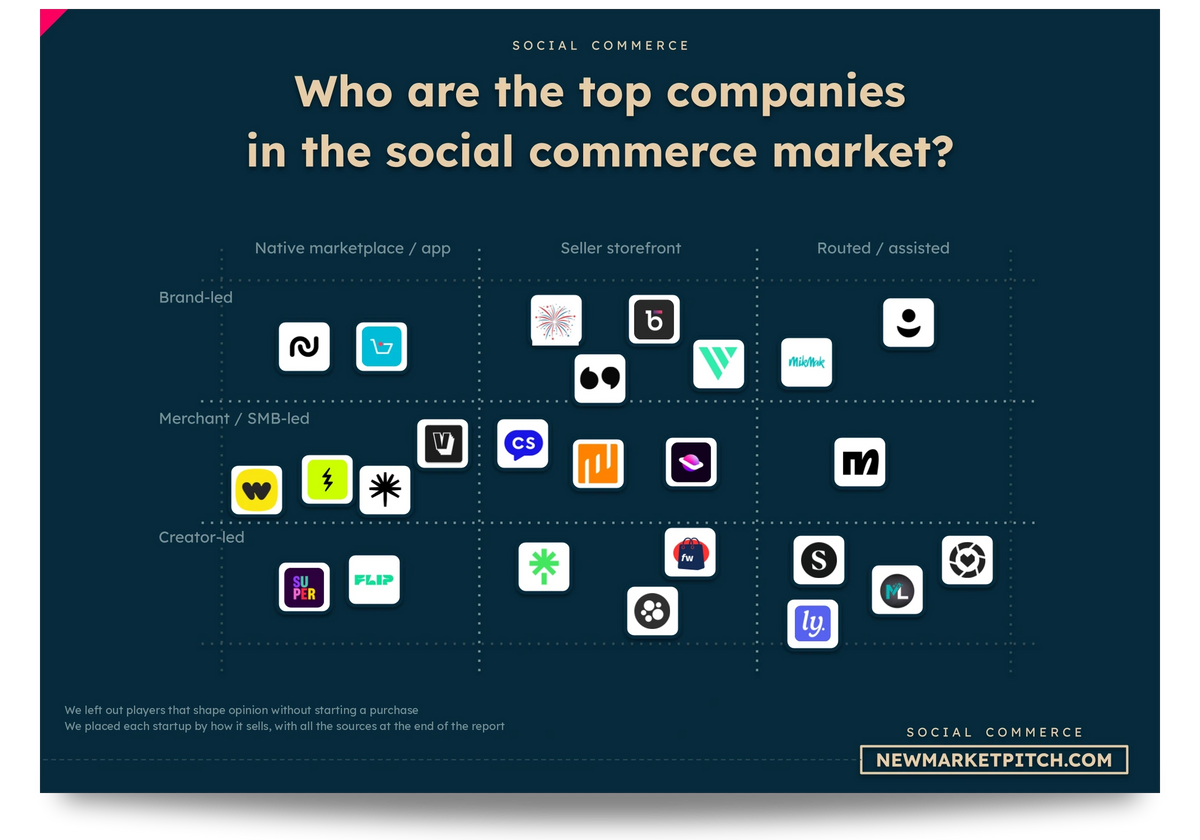
In our report covering the social commerce market, we turn what is vague and complex into simple, useful visuals. Market maps like this one show you at a glance where every startup stands.
Top startups in the social commerce market ranked by valuation
Here is the current ranking of the most valuable social commerce startups. For each one you will also find our confidence level and the valuation basis we used.
If you want to go deeper into the social commerce startup landscape, check our report covering the social commerce market.
| # | Startup | Valuation | Confidence | Valuation basis | Last round | Total funding |
|---|---|---|---|---|---|---|
| 1 | XiaohongshuSocial commerce and lifestyle platform | $50.0Bas of Jun 2026 | Strong | Reported private round valuation | $500MSeries E · Nov 2021 | $900Mvalued at 55.6× this |
| 2 | WhatnotLive video shopping and seller auctions | $20.0Bas of Aug 2026 | Full | Announced private round valuation | $545MSeries G · Aug 2026 | $1.5Bvalued at 13.2× this |
| 3 | LTKCreator shopping and affiliate platform | $2.0Bas of Nov 2021 | Full | Announced private round valuation | $300MSeries B · Nov 2021 | $300Mvalued at 6.7× this |
| 4 | ShopMyCreator storefronts and affiliate shopping links | $1.5Bas of Oct 2025 | Full | Announced private round valuation | $70MGrowth / late VC · Oct 2025 | $174Mvalued at 8.6× this |
| 5 | ManychatAutomated customer messaging and chat assistants | $933M–$1.8Bas of Apr 2025 | Low | Estimated from last round | $140MGrowth capital (stage not named) · Apr 2025 | $158Mvalued at 8.1× this |
| 6 | LaterInfluencer marketing and social management | $900M–$1.7Bas of Apr 2022 | Low | Estimated from last round | $135MGrowth equity · Apr 2022 | $255Mvalued at 4.8× this |
| 7 | SuperOrdinaryTikTok Shop brand distribution and creator sales | >$800Mas of Oct 2023 | Full | Announced private round valuation | $58MSeries B · Oct 2023 | $58M+valued at 13.8× this |
| 8 | FireworkShoppable video and livestream infrastructure | $750Mas of May 2022 | Strong | Reported private round valuation | $150MSeries B · May 2022 | $250Mvalued at 3.0× this |
| 9 | FERMÀTCommerce platform for social advertising | $300M–$562Mas of Jun 2025 | Low | Estimated from last round | $45MSeries B · Jun 2025 | $74Mvalued at 5.5× this |
| 10 | EvermosSocial commerce reseller platform | $260M–$488Mas of May 2023 | Low | Estimated from last round | $39MSeries C · May 2023 | $77Mvalued at 4.6× this |
| 11 | LevantaCreator affiliate links and commerce attribution | $147M–$275Mas of Aug 2026 | Low | Estimated from last round | $22MSeries B · Aug 2026 | $43Mvalued at 4.6× this |
| 12 | TiltLive marketplace for trading cards | $104M–$260Mas of Jun 2026 | Low | Estimated from last round | $26MJun 2026 | $44Mvalued at 3.7× this |
| 13 | WishlinkCreator commerce and affiliate platform | $117M–$219Mas of Feb 2026 | Low | Estimated from last round | $18MSeries B · Feb 2026 | $28Mvalued at 5.8× this |
| 14 | FourthwallCreator storefronts and memberships | $113M–$212Mas of Nov 2021 | Low | Estimated from last round | UndisclosedOther · May 2023 | $17M+valued at 9.1× this |
| 15 | VudooEmbedded checkout infrastructure for shoppable media | $101M–$189Mas of Nov 2026 | Low | Estimated from last round | ~$15MSeries B · Nov 2026 | $15Mvalued at 9.1× this |
| 16 | VideoShopsSocial commerce storefronts for creators | $96M–$160Mas of Aug 2025 | Low | Estimated from last round | $24MSeed extensions 2023-2025 (announced Aug 2025) · Aug 2025 | $42Mvalued at 3.0× this |
| 17 | DuelCreator advocacy management platform | $80M–$133Mas of Sep 2025 | Low | Estimated from last round | $16MSeries A · Sep 2025 | $21Mvalued at 4.9× this |
| 18 | ConnectlyAI agents for conversational commerce | ~$100Mas of Sep 2024 | Strong | Reported private round valuation | $20MSeries B · Sep 2024 | $28Mvalued at 3.6× this |
| 19 | VambeConversational agents for sales and support | $70M–$117Mas of Dec 2025 | Low | Estimated from last round | $14MSeries A · Dec 2025 | $18Mvalued at 5.1× this |
| 20 | Live2.aiShoppable social video operating system | $69M–$114Mas of Oct 2026 | Low | Estimated from last round | $14MPre-Series B · Oct 2026 | $14Mvalued at 6.5× this |
| 21 | OmniChatWhatsApp sales and marketing automation | $61M–$114Mas of Jun 2025 | Low | Estimated from last round | $9.1MSeries B · Jun 2025 | $13M+valued at 6.5× this |
| 22 | KomiCreator link-in-bio and commerce platform | $60M–$100Mas of Jul 2023 | Low | Estimated from last round | $12MSeries A · Jul 2023 | $17M+valued at 4.6× this |
| 23 | DistrictLive-stream shopping marketplace and seller storefronts for collectibles | $59M–$98Mas of May 2026 | Low | Estimated from last round | $15MSeed · May 2026 | $15Mvalued at 5.2× this |
| 24 | YASOSocial commerce storefronts for creators | $56M–$92Mas of Sep 2025 | Low | Estimated from last round | $11MSeries A · Sep 2025 | $11Mvalued at 6.5× this |
| 25 | TaagerSocial commerce platform for online sellers | $45M–$84Mas of Feb 2025 | Low | Estimated from last round | $6.8MSeries B · Feb 2025 | $13Mvalued at 4.7× this |
| 26 | KioskCreator storefronts for social commerce | $40M–$67Mas of May 2024 | Low | Estimated from last round | $10MSeed · May 2024 | $10Mvalued at 5.2× this |
| 27 | BuywithLive co-shopping and shoppable sessions | $38M–$63Mas of May 2022 | Low | Estimated from last round | $9.5MSeed · May 2022 | $11Mvalued at 4.7× this |
| 28 | SleekFlowOmnichannel messaging and social commerce software | $35M–$58Mas of Aug 2024 | Low | Estimated from last round | $7MSeries A · Aug 2024 | $15M+valued at 3.0× this |
| 29 | DoersMarketplace for creator brand collaborations | $34M–$57Mas of Feb 2025 | Low | Estimated from last round | $6.8MSeries A · Feb 2025 | $6.8M+valued at 6.5× this |
| 30 | TalkShopLiveLivestream shopping platform for brands | $28M–$47Mas of Oct 2023 | Low | Estimated from last round | $7MSeed · Oct 2023 | $16Mvalued at 2.3× this |
| 31 | LeadsalesCRM for WhatsApp social selling | $15M–$25Mas of Aug 2023 | Low | Estimated from last round | $3.7MSeed · Aug 2023 | $4.1Mvalued at 4.7× this |
| 32 | GallaboxOmnichannel AI agents for customer messaging | $14M–$23Mas of Jan 2025 | Low | Estimated from last round | $3.5MSeed · Jan 2025 | $4.7Mvalued at 3.8× this |
| 33 | ChatLabsAI personalization that converts social traffic into site sales | $13M–$21Mas of Dec 2024 | Low | Estimated from last round | $3.2MSeed · Dec 2024 | $3.2Mvalued at 5.2× this |
| 34 | DealCartCommunity group-buying grocery marketplace | $12M–$20Mas of Jul 2024 | Low | Estimated from last round | $3MSeed · Jul 2024 | $3M+valued at 5.2× this |
| 35 | TrendioTikTok/YouTube creator-commerce execution | $12M–$20Mas of May 2022 | Low | Estimated from last round | $3MSeed · May 2022 | $3Mvalued at 5.2× this |
| 36 | TextYessWhatsApp commerce and customer service software | $11M–$19Mas of Sep 2025 | Low | Estimated from last round | $2.8MSeed · Sep 2025 | $3.3Mvalued at 4.5× this |
| 37 | MAKALivestream fashion and beauty marketplace | $11M–$18Mas of Dec 2023 | Low | Estimated from last round | $2.7MPre-Seed · Dec 2023 | $2.7Mvalued at 5.2× this |
| 38 | MercatelyWhatsApp CRM and social selling software | $10M–$17Mas of Aug 2024 | Low | Estimated from last round | $2.6MSeed · Aug 2024 | $2.6Mvalued at 5.1× this |
| 39 | VendahSocial commerce platform for resellers | $9.8M–$16Mas of Aug 2023 | Low | Estimated from last round | $2.5MSeed · Aug 2023 | $4Mvalued at 3.2× this |
| 40 | PaageCreator storefront and selling platform | $8.8M–$15Mas of Nov 2025 | Low | Estimated from last round | $2.2MSeed · Nov 2025 | $2.2Mvalued at 5.2× this |
| 41 | nFuseMessaging-based wholesale ordering for small retailers | $8M–$13Mas of Apr 2026 | Low | Estimated from last round | $2MSeed · Apr 2026 | $2Mvalued at 5.2× this |
| 42 | PickyouSocial commerce marketplace for fashion | $7.7M–$13Mas of Apr 2025 | Low | Estimated from last round | $1.5MSeries A · Apr 2025 | $2.4Mvalued at 4.1× this |
| 43 | LockerSocial shopping and product discovery app | $9Mas of Feb 2024 | Full | Announced private round valuation | $2.5MSeed · Feb 2024 | $2.5Mvalued at 3.6× this |
| 44 | DimensionTikTok Shop seller operations software | $6.6M–$11Mas of Jul 2026 | Low | Estimated from last round | $1.7MSeed · Jul 2026 | $1.7Mvalued at 5.2× this |
| 45 | UnboxCreator commerce operations and analytics | $6.5M–$11Mas of Sep 2025 | Low | Estimated from last round | $1.6MSeed · Sep 2025 | $1.6Mvalued at 5.2× this |
| 46 | SUKHIBAWhatsApp social commerce platform | $6.2M–$10Mas of Aug 2024 | Low | Estimated from last round | $1.6MSeed · Aug 2024 | $3.1Mvalued at 2.6× this |
| 47 | LehLahCreator affiliate commerce and influencer marketing | $5.9M–$9.9Mas of Apr 2025 | Low | Estimated from last round | $1.5MSeed · Apr 2025 | $1.5Mvalued at 5.2× this |
| 48 | RwajSocial commerce marketplace for local sellers | $4.8M–$8Mas of Sep 2026 | Low | Estimated from last round | $1.2MSeed · Sep 2026 | $1.2Mvalued at 5.2× this |
| 49 | SwirlVideo commerce platform for online retailers | $4.4M–$7.3Mas of Feb 2024 | Low | Estimated from last round | $1.1MSeed · Feb 2024 | $1.4Mvalued at 4.2× this |
| 50 | WassistWhatsApp shopping and support agents | $4.4M–$7.3Mas of Jun 2026 | Low | Estimated from last round | $1.1MPre-seed · Jun 2026 | $1.1Mvalued at 5.2× this |
| 51 | LiveMeUpLive shopping software for online stores | $4.3M–$7.2Mas of Jan 2024 | Low | Estimated from last round | $1.1MSeed · Jan 2024 | $1.1Mvalued at 5.2× this |
| 52 | WyrldCreator storefronts for social commerce | $4.1M–$6.9Mas of Feb 2025 | Low | Estimated from last round | ~$1MSeed · Feb 2025 | $1Mvalued at 5.2× this |
| 53 | YaVendióWhatsApp AI sales agents for ecommerce | $3.4M–$5.7Mas of Feb 2025 | Low | Estimated from last round | $850KSeed · Feb 2025 | $850Kvalued at 5.2× this |
No startups match this search.

Our research about social commerce gets updated several times a month, so you always get the latest view of where things stand.
Why is Xiaohongshu worth so much?
Xiaohongshu's reported $50.0B valuation reflects the unusual position it holds in Chinese social commerce: people go there to decide what to buy, even when they have no particular purchase in mind.
Known internationally as RedNote, the platform combines personal recommendations with product discovery. Someone researching a skincare routine may spend time comparing posts, reading comments and looking at products before choosing a brand. Retailers can reach these shoppers much earlier than they would through a conventional online store.
Caixin reported in July 2026 that Xiaohongshu was reorganizing its leadership, trying to attract a broader audience and investing in AI as it developed its advertising and retail businesses. There is a delicate balance here. More sponsored content may bring in money but could also make personal recommendations feel less trustworthy.
Reuters reported in June 2026 that the company had brought in banks for a possible Hong Kong listing. A prospectus would help us judge how much of the business comes from shopping and how much comes from advertising. Reuters tied the $50.0B to secondary share transactions at the end of 2025, while Xiaohongshu's last equity round, a Series E, dates back to November 2021. That price tells us what some investors are willing to pay, with less certainty than a newly completed equity round.
Is Whatnot catching up with Xiaohongshu?
Whatnot is catching up in social commerce valuations, but Xiaohongshu is still worth 2.5x as much on the available figures.
Fortune reported in August 2026 that Whatnot's new financing had lifted its valuation considerably since October 2025. It is unusual to see a retail marketplace grow this quickly when consumers already have so many places to shop online.
The two apps work very differently. A Whatnot auction gives sellers an immediate way to turn an audience into paying customers. Xiaohongshu users may spend much of their time browsing recommendations, including for products they eventually buy elsewhere. That gives the Chinese business additional ways to sell advertising, while Whatnot can demonstrate its growth through marketplace orders.
The rise of Whatnot is convincing, particularly given that it started with collectible products such as Funko Pop figures. Whether it can narrow the gap further depends on how well its auctions work beyond their original communities. Xiaohongshu already appeals to people interested in many aspects of everyday life, from beauty to travel, and that audience is difficult to recreate.

In our market report about social commerce, we look at what the winners do differently, so you can learn from the best instead of guessing.
Is Whatnot overvalued right now?
Whatnot's $20.0B valuation looks less extravagant when we consider how fast the social commerce marketplace is growing, although its profitability will ultimately determine whether the price holds up.
Inc. reported in August 2026 that Whatnot had handled over $8 billion in merchandise sales in the first half of the year, surpassing its entire 2025 volume. The company also expected to exceed $1 billion in annual revenue. According to the same report, the number of buyers had more than doubled over the previous year.
Revenue is the more useful figure when assessing the valuation because most of the money spent on the app goes to sellers. The marketplace has to pay for technology, customer service and fraud prevention out of the portion it keeps.
We would pay particular attention to the newer categories, including fresh food and fashion, and to Whatnot's expansion abroad. A platform that can attract repeat buyers in several kinds of retail has much more room to grow than a collectibles marketplace alone. The sales figures make the price understandable; we still need more evidence about the cost of that expansion and the company's margins.
How many social commerce startups are unicorns?
There are at least 4 social commerce unicorns: Xiaohongshu, Whatnot, LTK and ShopMy.
LTK has an announced valuation of $2.0B, and ShopMy was priced at $1.5B. Both help creators earn commissions on products that their audiences buy. Their success is particularly striking because the biggest social commerce companies run very different consumer apps.
Manychat and Later could also be worth a billion dollars, although neither has established that price through an announced valuation. Their estimated ranges cross the threshold, so we leave them out of the confirmed unicorn count. Their businesses are worth watching because they help merchants sell through messages and creator recommendations, without having to build a new consumer audience from scratch.
The below-billion valuation bracket contains 51 companies, or 89% of the startups we track. Even in a market with enormous consumer audiences, getting a substantial share of retail spending is hard. A popular shopping feature can sit inside another company's social network or retailer website without ever becoming a billion-dollar independent business.
Is the US ahead of China in social commerce valuations?
The US has more highly valued independent social commerce companies, but China's Xiaohongshu remains the most valuable startup in the market.
Among the 53 companies we track, 20 are based in the United States. The American businesses include Whatnot, a marketplace; LTK, a creator affiliate network; and Manychat, a provider of messaging software. Their valuations show how many different businesses can grow around the same shopping habits.
Xiaohongshu is the only Chinese representative in this group. Much of the country's social commerce also takes place through established businesses such as Kuaishou, Alibaba and ByteDance's Douyin. Those businesses sit outside the independent specialist startup comparison.
We would be careful about using the number of American companies to draw conclusions about China's retail industry. Chinese shoppers have access to large apps that already combine short videos, livestreams and shopping. American specialists often sell tools or services that connect existing social networks to retailers. There is more variety among the American private companies we follow, but counting them tells us little about which country's consumers spend more.

In our document detailing everything you need to know about social commerce, you will always find fresh funding data, taken straight from our own verified funding database.
Can ShopMy overtake LTK?
ShopMy could overtake LTK as the most valuable creator platform in social commerce, especially if it maintains the growth rates it reported when investors last priced the business.
The Information reported in October 2025 that ShopMy's revenue had risen 200% year over year, that annual merchandise sales exceeded a billion dollars and that the business was profitable. Avenir, Bain Capital Ventures, Bessemer Venture Partners and Menlo Ventures backed its new investment. The company also started adding features to help shoppers find products directly.
LTK has a considerable head start. Its June 2025 TIME100 announcement put annual retail sales at over $5 billion. In both cases these sales describe the products bought through the platforms, rather than the revenue they keep.
By September 2026, Axios reported that ShopMy worked with more than 300,000 creators and 2,000 brands. That makes it harder to dismiss as a niche affiliate tool for luxury products. Still, LTK has longstanding relationships with retailers and creators who may use its tools daily. ShopMy's challenge will be to attract that kind of repeat business as it moves beyond the brands that first made the platform popular.
Is LTK still worth $2B?
LTK has a credible case for keeping its social commerce unicorn valuation, particularly now that it is improving the way shoppers find products inside its app.
When SoftBank invested in November 2021, LTK said that it had already been profitable for several years. Investors were buying into an established business with creators who earned commissions from retail purchases. That gave LTK a stronger starting point than a social app still searching for a way to earn money.
In September 2026, Axios reported that LTK's new AI search experience had lifted clicks from search results to retailers' websites by 84% since its rollout began earlier that month. LTK is also making it easier for creators to publish product recommendations and for brands to find people for their campaigns.
The short measurement period means we cannot extrapolate that improvement to annual sales. But the work addresses a genuine threat from newer shopping tools: if LTK makes product discovery easier, shoppers and creators have a reason to keep using it. Its old price remains plausible, even though we would need fresh financial disclosures to know what investors would pay today.

Learning from others' mistakes is the cheapest lesson there is. In our report covering the social commerce market, we look at what broke startups before you, so you don't repeat it.
Could Manychat become a social commerce unicorn?
Manychat could already be a social commerce unicorn, though no announced valuation establishes that it has crossed the billion-dollar mark.
We estimate Manychat at $933M–$1.8B from the size of its April 2025 growth capital round. The middle of that range, taken in proportion, puts it ahead of SuperOrdinary's announced floor of more than $800M and Firework's reported $750M. In its announcement that month, the company said it planned to improve its AI tools for businesses and creators that sell through social and messaging channels.
Think of a creator who asks followers to comment on a video if they want a product link. Manychat can start a direct conversation automatically, send the relevant link and follow up. A merchant can handle far more of those conversations without having to hire someone to respond to each comment.
The appeal is that merchants already have customers on platforms such as Instagram. Manychat can charge them for tools that make those audiences commercially useful. Its potential is therefore broader than that of a conventional customer support chatbot, provided the messages really generate orders. The biggest external risk is access to the social platforms themselves: changes to their rules could make some of those automated conversations harder to run.
Can Later make more money from creator shopping?
Later has a good chance of becoming a more valuable social commerce business now that it earns a place in the affiliate shopping process.
We estimate Later at $900M–$1.7B from the size of its April 2022 Growth Equity round, which is why it sits ahead of SuperOrdinary's announced floor of more than $800M. That estimate predates the purchase of Mavely in January 2025 for $250 million, so it needs to be read in the context of a substantially changed company.
Mavely connects creators with retailers that pay commissions on sales. Before the acquisition, Later was better known for content scheduling and influencer campaigns. In September 2026, Later announced the integration of Mavely into its own brand and told creators that their commissions and payouts would continue.
That is a useful change for Later because brands can now work with it on both publishing content and measuring the purchases that follow. The affiliate network also puts the company closer to the actual revenue generated by a campaign. We cannot use Mavely's purchase price to establish Later's valuation, but the acquisition gives the company a more convincing route to competing with the established creator commerce unicorns.

Your time is limited. In our research about social commerce, we put numbers on each part of the market, so you can see where it makes sense to focus.
Is SuperOrdinary more than a TikTok Shop agency?
SuperOrdinary has built a social commerce business around selling products for brands, with services that extend well beyond advertising campaigns.
Its announced valuation exceeded $800M in October 2023. That is a minimum, so we cannot tell exactly how its price compares with potential unicorns such as Manychat and Later. Their values are our estimates from the sizes of their respective last equity rounds, dated to those rounds, whereas SuperOrdinary's floor was announced.
In January 2024, SuperOrdinary launched a US TikTok Shop service covering store setup, creator affiliates, content and livestream selling. Its early partners included Milk Makeup, BABOR and BYRD Hair. It brought experience working with brands in China to a newer shopping channel in the US.
SuperOrdinary's role in retail is important when judging its value. A company that distributes merchandise or manages live productions may have more expenses than one that simply licenses software to a retailer. Its ability to retain brands and sell their products profitably will tell us more about the valuation than the total value of products moving through the stores it runs.
Is Firework still a serious live shopping competitor?
Firework remains a substantial social commerce software company built on shoppable video, although its reported $750M valuation dates to May 2022.
A retailer using Firework can put videos on its own site and let viewers shop the featured products. That is useful for businesses that already have plenty of visitors and would rather keep the sale on their website than send shoppers to a separate app.
Firework's product documentation was still expanding in 2026, with instructions for interactive short videos and video distribution. Prerecorded product demonstrations have a particular advantage for retailers: they can help sell products even when the presenter is no longer live. For example, a cosmetics brand could reuse a makeup tutorial across several product pages.
There is room for valuable social commerce companies that sell technology to existing retailers. FERMÀT applies a similar idea to shoppers arriving through advertisements. These businesses can grow with merchant traffic, avoiding the cost of attracting a large consumer audience themselves. In Firework's case, the real test is whether retailers keep paying for the tools because they see more sales. Continued product development alone cannot establish that investors would still pay the 2022 price.
Can startups that help brands sell through social ads become unicorns?
Social commerce software that helps retailers turn advertising clicks into purchases could produce another unicorn, although FERMÀT has yet to reach that level.
We estimate FERMÀT at $300M–$562M from the size of its June 2025 Series B. At the time, the company said that the investment led by VMG Partners would help it adapt online stores to different shopping journeys, including those involving AI.
Imagine clicking a social advertisement for a specific jacket and landing on the retailer's generic homepage. You may have to search all over again to find the product. FERMÀT helps merchants build shopping pages that reflect what the visitor saw in the advertisement. Affiliate software such as Levanta solves another problem by working out which creator led a shopper to a purchase.
The case for a valuable business here is fairly straightforward. A merchant already spends money bringing visitors to its website. If a tool helps more of those people buy something, the retailer can justify paying for it. We would want evidence that the improvements last beyond an initial trial and can be repeated across merchants with different products and advertising budgets.

In our market report about social commerce, we always try to gather several sources and make estimates that make sense, so you can work with solid numbers.
Is affiliate marketing producing the next big social commerce companies?
Creator affiliate commerce has already produced major social commerce companies, and newer specialists are finding opportunities by serving particular types of merchants and creators.
Levanta announced in August 2026 that it was bringing its affiliate technology to more retail marketplaces, backed again by Volition Capital. We estimate its valuation at $147M–$275M from the size of its August 2026 Series B.
Wishlink connects Indian creators to online retailers, while Fourthwall gives creators their own storefronts. The difference is who supplies the products and deals with the customer. A fashion creator earning commission from an established retailer can recommend a wide variety of merchandise without holding inventory. A creator selling branded products through a storefront has more control over the offer.
The simple affiliate link is the easy part of these businesses. Merchants need accurate records of which orders came from which creators, and creators want to be paid on time. Software that reliably handles those tasks across a wide network of retailers can become hard to replace. That is where we see the strongest opportunity for the next generation of affiliate startups to become valuable.
Are WhatsApp shopping startups becoming valuable businesses?
WhatsApp commerce startups are building sizeable businesses around messaging, although the biggest confirmed social commerce unicorns still make their money in other ways.
Meta's WhatsApp Business app already has catalogs and shopping carts. A customer can browse a merchant's products and send an order request within a conversation. Specialist providers help businesses automate that interaction, suggest relevant products and connect conversations with their existing retail systems.
TechCrunch reported in September 2024 that Alibaba backed Connectly, which uses AI and retailer catalogs to personalize messages. OmniChat in Brazil and SleekFlow in Singapore address related problems in quite different markets, and more recent companies such as TextYess are entering the same business. That suggests messaging-based sales tools have customers well beyond the biggest US social platforms.
Except for Connectly, whose ~$100M valuation TechCrunch reported with its Series B, the valuations below are our estimates from the size of each company's last equity round, dated to the round shown. A risk common to these businesses is that Meta can change the rules for businesses using WhatsApp, or add features that merchants previously needed specialist software to access.
The table below shows conversational social commerce startups and their valuations.
| Startup | Valuation | Last round | Country |
|---|---|---|---|
| Connectly | ~$100M | September 2024 | United States |
| Vambe | $70M–$117M | December 2025 | Chile |
| OmniChat | $61M–$114M | June 2025 | Brazil |
| SleekFlow | $35M–$58M | August 2024 | Singapore |
| TextYess | $11M–$19M | September 2025 | Italy |
| Leadsales | $15M–$25M | August 2023 | Mexico |
| Gallabox | $14M–$23M | January 2025 | India |

If you build or invest in the social commerce market, you need to know which business models pay off now and which ones are fading. That's why our report covering it has a whole section on it.
Is India producing its own social commerce unicorns?
India's independent private social commerce challengers have yet to establish unicorn valuations, and the country's best-known social seller, Meesho, is no longer valued in this market.
Live2.ai, which helps brands turn social videos into shopping experiences, is estimated at $69M–$114M from the size of its October 2026 Series A. Its investors are betting that retailers will pay for shoppable video on their own channels.
Wishlink offers a different route to growth. We estimate it at $117M–$219M from the size of its February 2026 Series B. Vertex Ventures said the company would use the funding to work with more brands and creators and improve its technology. Wishlink earns its place by connecting the products people see in creator content to goods sold by established retailers.
We track 5 independent Indian companies in this market. For a company like Live2.ai, becoming a unicorn will depend on retailers renewing their contracts as the videos generate sales. For Wishlink, the question is whether enough creators and retailers can generate repeat sales to build a large business from commissions and services. Both have room to grow, but they face different costs along the way.
Is Meesho still a social commerce startup?
Meesho still meets our startup definition, since it listed in December 2025, but it is no longer valued in this social commerce ranking: it has become a general marketplace and does not publish how much of its business comes from content commerce.
The Bombay Stock Exchange admitted its shares to trading on December 10, 2025. The value of the company now changes with its share price every trading day, and that price covers a much broader retail business than social selling.
Meesho began by helping people sell products through their personal networks and developed into a broader ecommerce marketplace. The original idea gave people with an existing audience of friends or neighbors an opportunity to make money from retail sales. The newer Indian companies are pursuing narrower opportunities within that business, such as creator affiliate links or shoppable video.
We see the listing as evidence that a business built around social selling can grow into a major retailer. For someone comparing private social commerce startups, though, Meesho is now better treated as a public-market reference than as a candidate for the next private unicorn.
Could Indonesia's social commerce startups become unicorns?
Indonesia has a sizeable social commerce challenger in Evermos, but the company has yet to establish a billion-dollar valuation.
We estimate Evermos at $260M–$488M from the size of its May 2023 Series C. Its business relies on people who sell products to their own local networks, a model quite different from the live auction platforms that lead much of the Western discussion about social shopping.
In May 2023, the International Finance Corporation said Evermos had over 160,000 active resellers selling goods from over 1,600 local brands, particularly in smaller Indonesian cities. Evermos gives those resellers access to products, training and tools for running their businesses.
The company's advantage is its ability to connect local brands with customers they may otherwise struggle to reach. There is a limit, however, to the revenue a platform earns if resellers only sell a few inexpensive items. To support a unicorn valuation, we would look for evidence that existing resellers are handling more orders, merchants are staying with the platform, and the business can keep the cost of distributing products low as it expands.
Could Tilt become Europe's answer to Whatnot?
Tilt could become a major European live shopping marketplace in social commerce, although its estimated valuation is still far behind Whatnot's announced price.
We estimate Tilt at $104M–$260M from the size of its June 2026 round. Vinted Ventures joined the investors in that financing. Tilt had expanded from Britain into Italy and Spain the previous year, bringing its live auction experience to more shoppers.
Its subsequent decision to focus on trading cards is particularly interesting. The company says that cards became its fastest-growing category as collectors returned and sellers built businesses on the platform. It has developed auctions, box breaks and video listings around that audience.
Collectors often want to see the condition of a card or watch a sealed pack being opened. The format gives viewers something they cannot get from an ordinary product listing, and repeat buyers make it easier for sellers to attract bidders. Tilt now has a much clearer market to compete for than when it was selling across many categories. To become as valuable as Whatnot, it would eventually need to demonstrate that its auction business can grow considerably beyond its current scale.
Can TikTok Shop wipe out independent social commerce startups?
TikTok Shop is a serious threat to independent social commerce marketplaces, but its expansion also helps startups that sell tools and services to TikTok merchants.
TikTok reported in October 2026 that American live shopping sales had more than doubled in the first half of the year compared with the same period in 2025. It already has a huge entertainment audience and can let viewers buy products without leaving the app.
That creates a difficult problem for marketplaces trying to persuade shoppers to spend time in another app. A specialist auction marketplace has a better chance if it offers a kind of shopping experience that users cannot easily get on TikTok. Collectible communities, for example, may value trusted sellers and auction formats built around the products they buy.
Other startups benefit directly from the competition. SuperOrdinary can serve brands that need help launching shops, while Dimension and Euka build tools for merchants and creators. As sales grow on TikTok, the pool of potential customers for those businesses can grow too. Their risk is that TikTok controls the fees, rules and features of the marketplace on which they rely.
Do social commerce startups need to raise a lot to become valuable?
High social commerce valuations can follow relatively modest equity investment, particularly when a company already has a popular consumer product or a network of retail customers.
Xiaohongshu's valuation is 55.6x its total equity raised, compared with 3.0x for Firework. The ratio compares the recorded value of a business with the money it has raised from equity investors. It does not measure profitability or the returns made by individual investors.
LTK and ShopMy offer an interesting comparison because both help retailers sell through creators, yet their ratios differ. One business may fund growth through its earnings, while another raises money to hire employees or expand into new markets. A recent funding round can also change the recorded valuation considerably, making the timing of the comparison important.
We compare only companies with stated valuations and complete equity funding totals here. That keeps an estimated price or an incomplete fundraising history from giving a misleading impression of how much value a company has built with investors' money.
The table below shows valuation-to-funding multiples for companies with stated valuations and complete equity totals.
| Startup | Valuation / funding |
|---|---|
| Xiaohongshu | 55.6x |
| Whatnot | 13.2x |
| ShopMy | 8.6x |
| LTK | 6.7x |
| Locker | 3.6x |
| Firework | 3.0x |
So, which social commerce startups are worth the most today?
Xiaohongshu is the most valuable social commerce startup, reportedly valued at $50.0B, with Whatnot second at $20.0B.
Behind them, LTK and ShopMy are the established creator commerce unicorns. Both have built businesses around the purchases that follow a creator's recommendations, and their rivalry is worth following closely as retailers look for better ways to sell through social content.
Manychat and Later are the leading candidates for the next group of unicorns. Their values are estimates from the sizes of their last equity rounds, dated to April 2025 and April 2022 respectively. SuperOrdinary and Firework offer further evidence that startups can become valuable by selling services and software to brands that already have customers.
For now, the biggest prizes in social commerce go to businesses that own a shopping audience, but companies helping other merchants turn attention into sales have also built substantial valuations. Whatnot's recent expansion makes the race at the very top more interesting than it has been for years.
The table below shows what we found.
| Question | Answer |
|---|---|
| Who sets the pace in private social commerce? | Xiaohongshu remains the most valuable independent company in social commerce. Its reported price is far ahead of its American challenger. Advertising and shopping both help the platform earn from discovery. |
| Can live shopping grow beyond a niche? | Whatnot has already built a large business around live shopping. Its buyer count more than doubled in a single year. New categories will determine how much further the marketplace can grow. |
| Do creators need their own social networks? | Creator commerce already supports independent companies with established unicorn valuations. LTK and ShopMy connect product recommendations with purchases from retailers. Their businesses can grow through audiences that already exist elsewhere. |
| Is LTK facing a genuinely serious rival? | ShopMy has become a credible competitor to the older network. Its announced private valuation reached $1.5B in October 2025. The challenge now is making retailers and creators keep returning. |
| Can messaging tools join the unicorn club? | Manychat is a plausible unicorn in the social commerce software market. Its estimated valuation range crosses the billion-dollar threshold without confirming it. A newly priced round would make its position considerably clearer. |
| Can influencer software make money from shopping? | Later has moved deeper into the business of creator shopping. Buying Mavely in 2025 added a network of affiliate retailers. Later now helps brands measure sales alongside their social campaigns. |
| Can retailers sell through videos on their websites? | Firework gives retailers a way to run interactive shopping videos. Its reported private valuation reached $750M in May 2022. Merchant adoption and repeat usage will determine whether that price holds. |
| Where could India's next retail unicorn emerge? | Wishlink and Live2.ai pursue different customers within Indian social commerce. Wishlink links creators with retailers while Live2.ai sells shoppable video. Both need to grow repeat sales to support much higher valuations. |
| Could Europe build a big live marketplace? | Tilt has a credible opportunity in Europe's live shopping market. Vinted Ventures joined its investors in the June 2026 financing. Its focus on trading cards gives collectors a reason to return. |
| Why is Meesho not in this ranking? | Meesho has become a listed general marketplace. The company began trading on December 10, 2025 in India. Its content commerce share is not published, so its value is not shown here. |
Our methodology
Our data runs through November 19, 2026. We then reviewed this article and updated its answers on November 24, 2026, the date shown under the title. We define social commerce as purchases originating in social networks, creator recommendations, communities, messaging or interactive shopping content, together with software primarily designed to initiate, attribute or complete those transactions. We include businesses on the border of these activities when social-origin retail sales are a substantial part of what they do. The main ranking covers independent startups under our definition, founded from 2007 onward and built to grow around a new product or technology. Acquired and listed companies are shown separately. We examine each company's entire equity funding history.
Every startup in this ranking has raised equity funding, and each valuation comes with a confidence level that shows how it was obtained. A Full rating means the company announced the valuation itself, or several independent sources report the same figure. A Strong rating means a credible press report gives the valuation, or it follows directly from the terms of a funding round, such as the amount raised and the stake sold.
When no valuation has been disclosed, it is estimated. A Partial rating means the startup was compared with similar companies at the same stage, using indicators such as revenue, deal terms or recent transactions in the sector. A Low rating means the only reliable data point is the last equity round: the valuation is then derived from the amount raised and the share of the company that startups usually give up at that stage, which is why it is shown as a range and dated to that round.
Several safeguards keep these figures honest. Valuations that appear only in commercial databases, with no article or company statement behind them, are not used, and neither are share sales between existing shareholders, which often take place at a discount or a premium. Rounds older than five years are not used to estimate a valuation, debt and grants never count as equity, and companies whose claims are disputed are left out of the ranking. Startups that have since been acquired or have gone public are listed separately, valued at their acquisition price or market capitalization rather than at a past private round.
We order companies by the geometric mean of the two ends of each valuation range, so an optimistic upper estimate cannot disproportionately lift a company. Total funding counts equity only, excluding debt, grants and post-IPO offerings. A total ending in "+" is a minimum because some equity amounts are undisclosed. We include a round when confirmed by a company announcement, filing or press article, or, without an article, when two recognized databases agree on the date and amount. The latter is low-confidence evidence and never used for a company above $100M raised. A round recorded by only one database is excluded. Valuations require company announcements, filings or reliable press coverage rather than database entries alone.
A range can appear above a disclosed valuation because we compare every company using the middle of its range taken in proportion, not its optimistic upper end. A Low estimate reflects the ownership typically surrendered in a round of that size and stage, and is dated to that financing rather than to the publication date. Manychat and Later appear ahead of companies with stated valuations for this reason; SuperOrdinary's announced floor does not establish an exact price either. We retain the confidence distinction so readers can weigh estimated values against prices actually stated by a source.
Key sources include Reuters reporting on Xiaohongshu's potential listing and private pricing evidence, Xiaohongshu's retail strategy and pre-IPO organizational changes, Whatnot's valuation development and marketplace origins, Whatnot's merchandise sales, revenue outlook and category expansion, LTK's June 2025 retail sales and creator network, LTK's financing and historical profitability, ShopMy's revenue growth, profitability and consumer features, Manychat's April 2025 financing and AI automation strategy, Later's January 2025 Mavely acquisition, September 2026 integration of Mavely into Later, SuperOrdinary's TikTok Shop services and initial US brand partnerships, Firework's interactive shopping video features and documentation dates, FERMÀT's June 2025 investment and tailored shopping technology, Levanta's August 2026 retail affiliate expansion, Connectly's messaging technology, Alibaba investment and reported valuation, Live2.ai's October 2026 financing and shoppable video products, Wishlink's creator and retail partnerships, Evermos reseller activity and Indonesian brand distribution, LTK's September 2026 search rollout and ShopMy creator network, WhatsApp Business catalogs and shopping carts, Bombay Stock Exchange notice of Meesho's listing, Tilt's international expansion and trading card focus, and TikTok Shop's US live shopping growth in the first half of 2026.
Written by the New Market Pitch teamWe track new markets so founders and investors can move faster. About us