What are the most valuable stablecoin payments startups?
Whether you're building or investing in the stablecoin payments market, our report covers everything you need to know: the players, the money, and what's coming next.
Summary
Tempo is the most valuable stablecoin payments startup at $4.5 billion to $5.5 billion, followed by RedotPay at $4 billion to $5 billion, Rain at $1.95 billion, Mesh at $1 billion, and Fasset at approximately $1 billion.
Five startups are valued at $1 billion or more, with Mesh and Fasset sitting exactly at that threshold. The biggest valuations are concentrated in payment networks, consumer financial services, and infrastructure that other fintech companies use to move money.
The commercial market is growing much faster than its share of global payments suggests. McKinsey and Artemis estimated $390 billion in annualized stablecoin payments in February 2026, but that represented just 0.02% of global payment volumes.
Businesses are driving most of that activity. B2B transactions account for approximately $226 billion, or 58% of measured stablecoin payments, and were growing 733% year over year. International business transfers are becoming a much bigger opportunity than everyday consumer purchases.
Tempo and RedotPay illustrate two very different valuation bets. Tempo is worth more because investors see enormous potential in enterprise settlement infrastructure, while RedotPay already reports 8.5 million users, $14 billion in annualized payment volume, and approximately $180 million in annualized revenue.
RedotPay's valuation is also one of the easiest to test financially. At $4 billion to $5 billion, the company trades at roughly 22 to 28 times its reported annualized revenue. That is a demanding multiple for a payments business, even one growing quickly and reporting profitability.
Stablecoin cards have become an important route to mainstream adoption. Monthly crypto card payments climbed from approximately $100 million in early 2023 to more than $1.5 billion by late 2025, with Rain, RedotPay, and KAST pursuing different parts of the opportunity. Traditional card networks still handle much of the actual merchant acceptance.
Transaction volume can be misleading when comparing valuations. OpenFX reported $45 billion in annualized transaction activity and Fasset more than $40 billion, yet neither figure tells us how much revenue the companies retain. A payment business handling $40 billion at a 0.1% fee earns $40 million, while one retaining 0.5% earns $200 million.
The next potential unicorns include Félix Pago, KAST, Stable, OpenFX, Lemon Cash, and ARQ. Their opportunities range from remittances and stablecoin-funded cards to foreign exchange and business payments, with very different revenue models and capital requirements.
Regulation and competition will increasingly shape which valuations survive. The GENIUS Act is bringing clearer rules to the US market, while Visa, Mastercard, and Stripe already have the distribution, regulatory capabilities, and financial relationships that many startups are still building.
Our conclusion is that stablecoin payments have become a serious fintech category, with genuine commercial adoption supporting several billion-dollar valuations. But the biggest long-term winners will be determined by retained fees, recurring revenue, and profitability rather than the number of billions moving through their systems.

Written by the New Market Pitch teamWe track new markets so founders and investors can move faster. About us

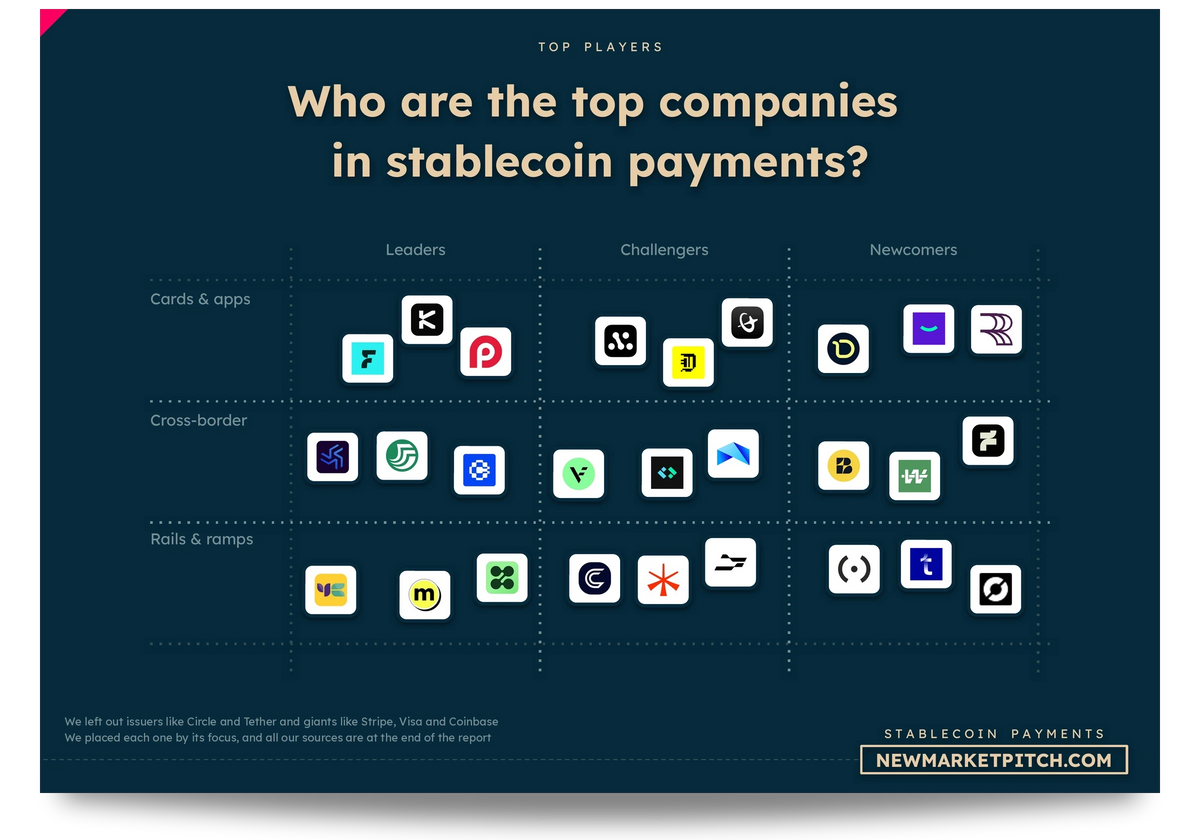
In our report covering the stablecoin payments market, we turn what is vague and complex into simple, useful visuals. Market maps like this one show you at a glance where every startup stands.
Top startups in the stablecoin payments market ranked by valuation
Here is an updated table that ranks the top startups in the stablecoin payments market based on their latest reported or estimated valuations.
If you need to dig deeper and get more detailed data, please check our report covering the stablecoin payments market.
| # | Startup Name | What They Do | Current Valuation ($) | Valuation Confidence Level | Valuation Type | Evidence Status | Total Funding ($) | Funding Confidence Level | Country |
|---|---|---|---|---|---|---|---|---|---|
| 1 | Tempo | Enterprise stablecoin payment blockchain | $4.5B–$5.5B | Strong Confidence | Implied Valuation from Raise | Estimated | $500M | - | United States |
| 2 | RedotPay | Stablecoin cards and global payments | $4.0B–$5.0B | Partial Confidence | Active Raise Valuation | Estimated | $194M | Full Confidence | Hong Kong |
| 3 | Rain | Stablecoin card issuing infrastructure | $1.95B | Strong Confidence | Implied Valuation from Raise | Estimated | $339M | Strong Confidence | United States |
| 4 | Mesh | Unified crypto payment connectivity network | $1.0B | Strong Confidence | Implied Valuation from Raise | Estimated | $205M1 | Partial Confidence | United States |
| 5 | Fasset | Stablecoin neobanking and global payments | $1.0B | Full Confidence | Announced Private Round Valuation | Observed | $150M+ | - | United Arab Emirates |
| 6 | Félix Pago | WhatsApp-based cross-border remittances | $629M | Partial Confidence | Implied Valuation from Raise | Estimated | ~$187M | - | United States |
| 7 | KAST | Stablecoin banking accounts and cards | $600M | Strong Confidence | Implied Valuation from Raise | Estimated | $90M | Full Confidence | Singapore |
| 8 | Stable | USDT-native blockchain for payments | $400M–$650M | Low Confidence | Proxy-Based Estimate | Estimated | $28M | - | Singapore |
| 9 | OpenFX | Real-time global foreign exchange infrastructure | $460M–$540M | Strong Confidence | Implied Valuation from Raise | Estimated | $117M | - | United States |
| 10 | Lemon Cash | Latin American crypto financial services | $400M–$600M | Partial Confidence | Comparables-Based Estimate | Estimated | ~$66M | - | Argentina |
| 11 | ARQ | Stablecoin-powered global financial accounts | $350M–$580M | Partial Confidence | Implied Valuation from Raise | Implied | $75.5M | - | United States |
| 12 | Plasma | Stablecoin-focused Layer 1 blockchain | $300M–$450M | Low Confidence | Proxy-Based Estimate | Estimated | $24M+ | - | United States |
| 13 | Yellow Card | African stablecoin payments infrastructure | $270M–$450M | Partial Confidence | Implied Valuation from Raise | Implied | $130M1 | Partial Confidence | United States |
| 14 | Eco | Cross-chain stablecoin liquidity infrastructure | $220M–$400M | Low Confidence | Comparables-Based Estimate | Estimated | $94.5M | - | United States |
| 15 | Wirex | Crypto cards and stablecoin banking | $200M–$350M | Low Confidence | Comparables-Based Estimate | Estimated | $8M1 | Low Confidence | United Kingdom |
| 16 | Better Payment Network | Multi-stablecoin cross-border settlement network | $200M–$330M | Partial Confidence | Implied Valuation from Raise | Implied | $50M | - | Singapore |
| 17 | Lightnet | Blockchain-based international payment infrastructure | $180M–$320M | Low Confidence | Comparables-Based Estimate | Estimated | ~$79M | - | Singapore |
| 18 | Conduit | Stablecoin-powered international business payments | $180M–$300M | Partial Confidence | Comparables-Based Estimate | Estimated | $53M | Partial Confidence | United States |
| 19 | HIFI | Stablecoin settlement and tokenized finance | $185M–$265M | Strong Confidence | Implied Valuation from Raise | Implied | $37M | - | United States |
| 20 | Noah | Enterprise stablecoin cross-border payment infrastructure | $160M–$240M | Partial Confidence | Implied Valuation from Raise | Implied | $38M | - | United Kingdom |
| 21 | Velocity | Enterprise stablecoin payment infrastructure | $190M–$210M | Strong Confidence | Implied Valuation from Raise | Estimated | $58M | - | United States |
| 22 | Latitude | Stablecoin-powered international payout infrastructure | $175M–$220M | Strong Confidence | Implied Valuation from Raise | Implied | $43M | - | United States |
| 23 | Pave Bank | Programmable banking and stablecoin infrastructure | $150M–$220M | Partial Confidence | Comparables-Based Estimate | Estimated | $44.2M | - | Singapore |
| 24 | Fin.com | Global cross-border payment infrastructure | $140M–$220M | Partial Confidence | Implied Valuation from Raise | Implied | $20M | - | United States |
| 25 | dtcpay | Regulated stablecoin payments and cards | $125M–$208M | Strong Confidence | Implied Valuation from Raise | Implied | $41.5M | - | Singapore |
| 26 | Zebec | Real-time blockchain payroll and payments | $100M–$230M | Low Confidence | Proxy-Based Estimate | Estimated | $33.83M2 | - | United States |
| 27 | Orbital | Global fiat and stablecoin payments | $100M–$180M | Low Confidence | Comparables-Based Estimate | Estimated | $6.4M | - | United Kingdom |
| 28 | Coinflow | Unified crypto and fiat payments | $100M–$170M | Partial Confidence | Implied Valuation from Raise | Implied | $28.7M | - | United States |
| 29 | Cyclops | Stablecoin infrastructure for payment processors | $100M–$167M | Strong Confidence | Implied Valuation from Raise | Implied | $28M | - | United States |
| 30 | Kredete | Remittances and immigrant credit building | $105M–$155M | Partial Confidence | Comparables-Based Estimate | Estimated | ~$24.8M | - | United States |
| 31 | Toku | Compliant global stablecoin payroll infrastructure | $90M–$160M | Partial Confidence | Comparables-Based Estimate | Estimated | $20M | - | United States |
| 32 | xMoney | Regulated crypto and stablecoin payments | $90M–$160M | Partial Confidence | Implied Valuation from Raise | Implied | $21.5M | - | Luxembourg |
| 33 | Immersve | Web3 card issuance infrastructure | $80M–$160M | Low Confidence | Proxy-Based Estimate | Estimated | ~$17M | - | New Zealand |
| 34 | Fin | High-value stablecoin-powered global transfers | $85M–$142M | Strong Confidence | Implied Valuation from Raise | Implied | $17M+ | - | United States |
| 35 | Atum | Open global payments coordination network | $85M–$135M | Partial Confidence | Implied Valuation from Raise | Implied | $13.5M | - | United States |
| 36 | Mural | Stablecoin accounts and payment infrastructure | $90M–$125M | Strong Confidence | Implied Valuation from Raise | Implied | $28M | - | United States |
| 37 | Oobit | Crypto spending and wallet transfers | $75M–$130M | Partial Confidence | Comparables-Based Estimate | Estimated | $25M+ | - | Israel |
| 38 | 1Money Network | Stablecoin payments blockchain and orchestration | $75M–$125M | Partial Confidence | Comparables-Based Estimate | Estimated | $20M+ | - | United States |
| 39 | Koywe | Latin American crypto payment APIs | $85M–$115M | Partial Confidence | Implied Valuation from Raise | Implied | $27.1M | - | Chile |
| 40 | VelaFi | Global stablecoin settlement infrastructure | $80M–$120M | Partial Confidence | Implied Valuation from Raise | Implied | $40M+3 | - | United States |
| 41 | Alfred | Latin American cross-border payment infrastructure | $75M–$115M | Partial Confidence | Implied Valuation from Raise | Implied | $15.3M–$19.2M | - | United States |
| 42 | Fipto | Regulated international stablecoin payment rails | $70M–$120M | Partial Confidence | Comparables-Based Estimate | Estimated | $19.2M | - | France |
| 43 | Belo | Stablecoin wallet and international payments | $70M–$115M | Partial Confidence | Implied Valuation from Raise | Implied | $17M | - | Argentina |
| 44 | Triple-A | Regulated digital currency payment processing | $60M–$110M | Partial Confidence | Comparables-Based Estimate | Estimated | $14M | - | Singapore |
| 45 | Afriex | International remittances and digital accounts | $65M–$105M | Partial Confidence | Comparables-Based Estimate | Estimated | $11.3M–$11.5M | - | United States |
| 46 | TransFi | Stablecoin-powered cross-border payment infrastructure | $57M–$85M | Strong Confidence | Implied Valuation from Raise | Implied | $14.2M+ | - | Singapore |
| 47 | Sling Money | Global stablecoin money transfer app | $50M–$90M | Partial Confidence | Comparables-Based Estimate | Estimated | $20M | - | United States |
| 48 | Flexa | Cryptocurrency merchant payment network | $45M–$90M | Low Confidence | Comparables-Based Estimate | Estimated | $20.1M | - | United States |
| 49 | Diameter Pay | Institutional dollar and stablecoin payments | $50M–$83M | Strong Confidence | Implied Valuation from Raise | Implied | $10M | - | United States |
| 50 | Cybrid | Embedded fiat and stablecoin infrastructure | $50M–$83M | Strong Confidence | Implied Valuation from Raise | Implied | $13.1M | - | Canada |
| 51 | Obita | Enterprise stablecoin cross-border payment network | $45M–$85M | Low Confidence | Comparables-Based Estimate | Estimated | $10M+ | - | Singapore |
| 52 | Limited | Global stablecoin business banking accounts | $54M–$70M | Partial Confidence | Implied Valuation from Raise | Implied | $18.5M | - | United States |
| 53 | Littio | Multicurrency digital accounts and payments | $40M–$80M | Partial Confidence | Proxy-Based Estimate | Estimated | $4.2M | - | Colombia |
| 54 | Rise | Stablecoin payroll and contractor payments | $40M–$75M | Partial Confidence | Comparables-Based Estimate | Estimated | $10M | - | United States |
| 55 | HiGlobe | Cross-border freelancer payment accounts | $35M–$75M | Low Confidence | Comparables-Based Estimate | Estimated | $14M | - | United States |
| 56 | Checker | Institutional stablecoin liquidity and payments | $40M–$65M | Partial Confidence | Implied Valuation from Raise | Implied | $8M | - | United States |
| 57 | Cedar Money | Stablecoin-powered cross-border business payments | $35M–$65M | Partial Confidence | Implied Valuation from Raise | Implied | $9.9M | - | United States |
| 58 | CoinGate | Cryptocurrency merchant payments and payouts | $30M–$65M | Low Confidence | Revenue or ARR Multiple Estimate | Estimated | Undisclosed | - | Lithuania |
| 59 | Merge | Regulated stablecoin payment infrastructure APIs | $30M–$60M | Low Confidence | Comparables-Based Estimate | Estimated | $9.5M | - | United Kingdom |
| 60 | Caliza | Digital dollar accounts and transfers | $30M–$55M | Partial Confidence | Comparables-Based Estimate | Estimated | $13.8M–$18.2M | - | United States |
| 61 | Adhara | Institutional tokenized money settlement infrastructure | $25M–$60M | Low Confidence | Comparables-Based Estimate | Estimated | $7.5M+ | - | United Kingdom |
| 62 | Due | Embedded stablecoin and fiat payments | $30M–$55M | Partial Confidence | Comparables-Based Estimate | Estimated | $7.3M | - | United States |
| 63 | Sphere | Compliant stablecoin cross-border payment infrastructure | $28M–$55M | Partial Confidence | Comparables-Based Estimate | Estimated | $7.8M | - | United States |
| 64 | Nilos | Cross-border payments focused on Africa | $25M–$55M | Low Confidence | Proxy-Based Estimate | Estimated | ~$5.5M | - | France |
| 65 | HoneyCoin | Stablecoin payments across emerging markets | $25M–$55M | Partial Confidence | Comparables-Based Estimate | Estimated | ~$5M | - | Kenya |
| 66 | Utexo | Bitcoin-native USDT settlement infrastructure | $30M–$50M | Partial Confidence | Implied Valuation from Raise | Implied | $7.5M | - | Switzerland |
| 67 | Request Finance | Crypto invoicing and payment management | $25M–$50M | Low Confidence | Comparables-Based Estimate | Estimated | $5.5M+ | - | France |
| 68 | Codex FX | Stablecoin-based wholesale currency exchange | $20M–$55M | Low Confidence | Proxy-Based Estimate | Estimated | Undisclosed | - | United Kingdom |
| 69 | Walapay | Cross-border payments and settlement APIs | $28M–$46M | Partial Confidence | Implied Valuation from Raise | Implied | $4.6M | - | United States |
| 70 | Infini | Stablecoin accounts and corporate cards | $24M–$40M | Strong Confidence | Implied Valuation from Raise | Implied | $6M | - | Singapore |
| 71 | Payy | Privacy-focused stablecoin payment network | $24M–$40M | Partial Confidence | Implied Valuation from Raise | Implied | $8M | - | United States |
| 72 | NAKA | Stablecoin card and merchant infrastructure | $15M–$45M | Low Confidence | Proxy-Based Estimate | Estimated | Undisclosed | - | United States |
| 73 | Shield | Stablecoin payments for international trade | $22M–$38M | Partial Confidence | Implied Valuation from Raise | Implied | $7.1M | - | United States |
| 74 | Parallax | Cross-border payments for global businesses | $18M–$30M | Low Confidence | Comparables-Based Estimate | Estimated | $4.5M | - | United States |
| 75 | Sorted Wallet | Lightweight stablecoin wallet for emerging markets | $17M–$29M | Partial Confidence | Implied Valuation from Raise | Implied | $5.9M | - | United Kingdom |
| 76 | Bitnob | African Bitcoin and stablecoin payments | $15M–$30M | Low Confidence | Comparables-Based Estimate | Estimated | $1M–$3M | - | Nigeria |
| 77 | UnblockPay | Stablecoin banking and payment APIs | $18M–$26M | Partial Confidence | Implied Valuation from Raise | Implied | $4.5M | - | United States |
| 78 | BlindPay | Stablecoin payment and banking APIs | $15M–$28M | Partial Confidence | Implied Valuation from Raise | Implied | $3.3M–$3.4M | - | Brazil |
| 79 | Stables | Stablecoin wallet and international payments | $15M–$28M | Low Confidence | Comparables-Based Estimate | Estimated | ~$5.2M | - | Australia |
| 80 | Infinia | Stablecoin-to-local-payment APIs | $12M–$30M | Low Confidence | Proxy-Based Estimate | Estimated | ~$0.5M | - | Uruguay |
| 81 | PEXX | Stablecoin-to-fiat global payout infrastructure | $12M–$25M | Low Confidence | Comparables-Based Estimate | Estimated | $4.5M | - | Singapore |
| 82 | BoomFi | Crypto payment acceptance and subscriptions | $12M–$25M | Partial Confidence | Comparables-Based Estimate | Estimated | $4.55M | - | United Kingdom |
| 83 | Keyrails | Institutional stablecoin settlement and FX | $12M–$25M | Partial Confidence | Comparables-Based Estimate | Estimated | ~$4.6M | - | United States |
| 84 | Acctual | Crypto invoicing and payment automation | $12M–$23M | Partial Confidence | Comparables-Based Estimate | Estimated | $3.85M | - | United States |
| 85 | Bitpace | Cryptocurrency merchant payment gateway | $8M–$25M | Low Confidence | Proxy-Based Estimate | Estimated | Undisclosed | - | Turkey |
| 86 | Stable Sea | Enterprise stablecoin off-ramping and treasury | $11M–$20M | Low Confidence | Implied Valuation from Raise | Implied | $3.5M | - | United States |
Which startups in the stablecoin payments market have been acquired or gone public?
These startups no longer have a private-market valuation of their own, so we list them separately, using their acquisition price or their current market capitalization.
| # | Startup Name | What They Do | Current Valuation ($) | Valuation Confidence Level | Valuation Type | Evidence Status | Total Funding ($) | Funding Confidence Level | Country |
|---|---|---|---|---|---|---|---|---|---|
| 1 | Iron | Enterprise stablecoin treasury infrastructure | $100M–$120M4 | Partial Confidence | Acquisition Value | Estimated | Undisclosed | - | United States |
| 2 | Arf | Stablecoin liquidity for payment institutions | $10M–$30M4 | Low Confidence | Acquisition Value | Estimated | $13M5 | - | Switzerland |
| 3 | Wind | Stablecoin wallet and international transfers | $15M–$23M4 | Low Confidence | Acquisition Value | Estimated | $3.8M | - | United States |
| 4 | Loop Crypto | Stablecoin merchant payment processing | $5M–$15M4 | Low Confidence | Acquisition Value | Estimated | ~$6M | - | United States |
- Total may change as earlier equity rounds are confirmed.
- Zebec's total varies depending on whether token sales are included.
- VelaFi's funding is reported for its parent, Galactic Holdings.
- Estimate tied to an acquisition, not a disclosed price or standalone value.
- Includes debt or liquidity facilities; equity alone may be lower.

Our research about stablecoin payments gets updated several times a month, so you always get the latest view of where things stand.
Why are stablecoin payment startups attracting billion-dollar valuations now?
Stablecoin payment startups are getting billion-dollar valuations because real businesses are starting to use digital dollars for international transfers, card payments, and financial accounts.
The growth is substantial. In February 2026, McKinsey and Artemis estimated that annualized stablecoin payments had reached approximately $390 billion, including $226 billion in business-to-business transfers. B2B payments were growing 733% year over year.
These figures are particularly interesting because stablecoins still represented only around 0.02% of global payment volumes. There is already enough activity to support commercial businesses, yet adoption remains tiny compared with conventional payment systems.
Investors have started paying for that potential. Tempo is valued at $4.5B–$5.5B, RedotPay at $4.0B–$5.0B, and Rain at $1.95B. Each has attracted capital around a different part of the payment process, from blockchain settlement to consumer cards and card issuance infrastructure.
The question now is how much money these companies can make from the transactions they process. A payment network moving $10 billion annually and retaining 0.1% generates $10 million in revenue before expenses. At 0.5%, the same volume generates $50 million.
That difference is huge. Investors are betting on future payment volumes, but also on which businesses can keep a meaningful share of the fees.
Which stablecoin payment startups are worth the most today?
Tempo, RedotPay, Rain, Mesh, and Fasset currently occupy the top five positions in our stablecoin payments valuation ranking, with valuations ranging from approximately $1 billion to more than $5 billion.
Tempo leads at $4.5B–$5.5B. The company is developing blockchain infrastructure for enterprise payments, an approach that could become extremely valuable if banks and payment providers start using dedicated stablecoin networks at scale.
RedotPay follows at $4.0B–$5.0B, with a consumer-facing business that allows customers to spend and transfer digital assets. Rain, valued at $1.95B, focuses on the infrastructure that other businesses need to issue stablecoin-funded cards.
Mesh holds fourth place at $1.0B, level with Fasset at $1.0B. Mesh connects wallets, exchanges, and payment applications, while Fasset operates stablecoin-based financial services and settlement infrastructure.
The five companies have different ways of making money. RedotPay depends heavily on consumer financial activity, Rain supplies other fintech companies, and Tempo is betting on the adoption of a payment-focused blockchain.
There is also a substantial gap between the leaders and the next group. Félix Pago, ranked sixth, stands at $629M, while KAST follows at $600M.
For now, the largest valuations belong to a handful of businesses, even though dozens of startups are developing payment infrastructure, remittance services, cards, and international financial accounts.

In our market report about stablecoin payments, we look at what the winners do differently, so you can learn from the best instead of guessing.
How many stablecoin payment startups are unicorns?
Five stablecoin payment startups have valuation ranges reaching at least $1 billion: Tempo, RedotPay, Rain, Mesh, and Fasset.
All five are valued at $1 billion or more. Mesh and Fasset sit exactly at the threshold, at $1.0B each.
Several of these companies completed major financing rounds in 2026.
In January, Mesh announced a $75 million Series C at a $1 billion valuation, bringing its cumulative financing above $200 million. Fasset subsequently announced a $68 million Series C at a $1 billion valuation in August.
Rain raised $250 million in January 2026 at a valuation of approximately $1.95 billion, according to The Block. That financing followed a $58 million Series B in August 2025.
RedotPay attracted even higher valuation expectations. Bloomberg reported in October 2026 that the company was discussing a pre-IPO financing at $4 billion to $5 billion.
The next group is still some distance from the threshold. KAST, for example, is valued at $600M and would need substantial additional growth to join the billion-dollar category.
Five unicorns might not sound like many for such a fast-growing market. But stablecoin payments are still relatively young as a distinct fintech category, and the biggest financing rounds have happened within the past two years.
Is Tempo really worth more than RedotPay?
Tempo currently ranks above RedotPay in stablecoin payments, with a valuation of $4.5B–$5.5B against RedotPay's $4.0B–$5.0B, although RedotPay has disclosed more concrete consumer adoption figures.
The comparison is interesting because the two companies are pursuing very different businesses.
Tempo is developing a blockchain specifically intended for payment activity. If financial institutions adopt its network widely, it could support large transaction volumes without needing to acquire millions of consumers.
RedotPay already has a customer-facing financial product. In December 2025, it reported more than 6 million registered users and over $10 billion in annualized payment volume across more than 100 markets.
By August 2026, RedotPay reported more than 8.5 million users and approximately $14 billion in annualized payment volume. The increase from 6 million to 8.5 million users represents roughly 42% growth, while annualized payment volume rose approximately 40% between the two company disclosures.
Tempo's valuation depends more heavily on the future importance of its infrastructure. RedotPay's can already be tested against customer numbers, payment activity, revenue, and profitability.
There are trade-offs on both sides. A blockchain can process enormous amounts while earning very small transaction fees. A consumer payment company can earn more per transaction but face much higher costs for compliance, distribution, and customer service.
RedotPay has the stronger commercial track record today. Tempo nevertheless retains the higher valuation because investors see a potentially much larger role for its network in enterprise settlement.

In our document detailing everything you need to know about stablecoin payments, you will always find fresh funding data, taken straight from our own verified funding database.
Could RedotPay become the biggest stablecoin payments company?
RedotPay has a credible chance of eventually challenging Tempo's valuation, especially if its rapid user growth translates into sustained revenue and profits.
The company's financial disclosures have become more substantial.
In August 2026, RedotPay stated that it was generating approximately $180 million in annualized revenue from a business it described as profitable. Its annualized payment volume was approximately $14 billion.
Taken together, those figures suggest revenue equivalent to about 1.3% of reported payment volume. That ratio is only an approximation, since revenue can include products beyond transaction processing.
At its current $4.0B–$5.0B valuation, RedotPay trades at roughly 22–28 times that reported annualized revenue figure.
That's expensive for a payment business, particularly when card networks, banking partners, and compliance operations all require spending. But it becomes more understandable if RedotPay can keep growing quickly while maintaining profitability.
There is also an important development in its potential exit.
Bloomberg reported in August 2026 that regulatory and legal matters had delayed plans for a US initial public offering. In October, the publication reported that RedotPay was again considering a confidential filing before year-end, alongside discussions about a pre-IPO financing.
The changing IPO timetable shows that rapid commercial growth doesn't remove regulatory hurdles.
RedotPay's strongest argument is that customers are already using its products at considerable scale. Its biggest test will be whether that activity produces enough lasting profit to support a multibillion-dollar public valuation.
Are stablecoin payment cards becoming a major business?
Stablecoin-linked cards are now a serious payment business, with annualized industry volume exceeding $18 billion by late 2025 and continued rapid growth reported during 2026.
Artemis tracked a striking increase in crypto card payments, from approximately $100 million per month in early 2023 to more than $1.5 billion per month by late 2025.
That's at least fifteenfold growth in monthly spending.
In September 2026, Visa reported more than 160 live stablecoin-linked card programs worldwide, with payment volume across those programs growing nearly 200% year over year.
The appeal is straightforward. Customers can spend stablecoin balances at ordinary merchants without requiring every shop to integrate a blockchain payment system.
Rain, RedotPay, and KAST participate in different parts of this business. Rain supplies issuing and payment infrastructure, while RedotPay and KAST offer financial products directly to users.
The growth also reveals how important existing card networks remain.
Artemis estimated that Visa accounted for more than 90% of the onchain card volume it tracked. Stablecoins are changing how money reaches and funds card programs, while familiar payment networks continue handling merchant acceptance.
Cards are likely to remain one of the easiest ways for stablecoin companies to reach mainstream spending. But keeping enough revenue after network fees, issuing costs, fraud prevention, and customer acquisition will be a tougher challenge than growing transaction volume.

Learning from others' mistakes is the cheapest lesson there is. In our report covering the stablecoin payments market, we look at what broke startups before you, so you don't repeat it.
Is Rain worth its $1.95B valuation?
Rain's $1.95B valuation has a stronger commercial foundation than many early-stage crypto infrastructure valuations because its card issuing and settlement systems are already operating at meaningful scale.
The company raised $250 million in January 2026, at a valuation of approximately $1.95 billion. The round was led by ICONIQ and brought cumulative funding to approximately $338 million at the time.
One of the more interesting operating figures comes from Visa.
In September 2026, Visa disclosed that Rain had financed approximately $2 billion in cumulative settlement volume through an onchain revolving credit arrangement operating since August 2023.
The arrangement had repeatedly funded card settlement obligations, allowing Rain to bridge the time between paying the card network and collecting the corresponding customer funds.
This addresses a real problem for card issuers. Even when a transaction uses stablecoins, the issuing company still needs liquidity to settle payments on time.
Rain's advantage comes partly from combining issuing relationships, compliance infrastructure, funding, and payment technology into a service that other fintech companies can use.
That combination is harder to reproduce than a basic wallet interface.
However, the $2 billion financing figure measures settlement activity, not Rain's revenue. The long-term economics depend on the fees it earns, the cost of serving clients, and the margins it can maintain as the business expands.
Rain has already demonstrated that its infrastructure works repeatedly at commercial scale. That's a meaningful advantage over competitors selling mainly on the promise of future adoption.
Why is Mesh valued at around $1 billion?
Mesh commands a $1.0B valuation because it connects payment applications, crypto wallets, and exchanges that would otherwise need separate integrations.
The company announced a $75 million Series C in January 2026 at a $1 billion valuation.
According to its CEO, Mesh had connected more than 300 wallets and exchanges by that point. Its SmartFunding technology allows customers to pay using one supported asset while merchants receive their preferred settlement currency.
That simplifies a fragmented payment system.
A business accepting digital assets may otherwise need multiple technical integrations, liquidity arrangements, and procedures for handling different networks. Mesh attempts to bring those connections together through one service.
The opportunity becomes particularly attractive when payment platforms expand internationally. A company that already supports hundreds of integrations could be easier to adopt than building the same connections internally.
The main risk is pricing power.
Large exchanges, wallets, and payment processors may eventually build direct connections or negotiate lower fees. Mesh must keep offering enough convenience, coverage, and reliability to remain valuable.
Its valuation therefore depends on how much payment activity flows through those integrations and how much revenue the company retains.
Mesh has a clear use case and an extensive network of integrations. Turning that coverage into a profitable, hard-to-replace payments business is the next challenge.

Your time is limited. In our research about stablecoin payments, we put numbers on each part of the market, so you can see where it makes sense to focus.
Which stablecoin payment startups have raised the most money?
Tempo, Rain, Mesh, RedotPay, and Félix Pago are among the most heavily financed stablecoin payment startups, although the money raised doesn't necessarily indicate which business is the most profitable.
Tempo's funding total stands at $500 million, followed by Rain at $339 million, Mesh at $205 million, RedotPay at $194 million, and Félix Pago at approximately $187 million.
The underlying financing histories help explain why these companies have attracted so much capital.
Rain's $250 million Series C came only months after its $58 million Series B. Mesh secured $75 million in January 2026, while RedotPay raised $107 million in December 2025, bringing its reported 2025 financing to $194 million.
Félix Pago raised a $75 million Series B in April 2025. Bloomberg reported at the time that the company had processed more than $1 billion in remittances during 2024.
Large funding rounds can pay for international expansion, regulatory approvals, acquiring customers, engineering, and the liquidity needed to operate payment services.
But these companies have very different capital requirements. Consumer finance apps spend heavily on acquiring and supporting users. Payment infrastructure providers invest in integrations, compliance, and institutional relationships.
Funding totals also need to distinguish equity investment from debt facilities and other forms of financing, since they don't have the same economic effect.
Ultimately, raising $200 million is only impressive if the company can turn that money into a business worth substantially more. Revenue growth and capital efficiency will tell us much more than the size of the funding rounds.
Which stablecoin payment startups could become unicorns next?
Félix Pago, KAST, Stable, OpenFX, Lemon Cash, and ARQ are among the stablecoin payment startups approaching the billion-dollar category, although their current valuations and business models differ substantially.
Félix Pago is valued at $629M. The company's WhatsApp-based remittance service has already demonstrated meaningful international transfer activity, with more than $1 billion processed in 2024.
KAST stands at $600M. In March 2026, Bloomberg reported that its $80 million financing valued the company at approximately $600 million. KAST also expected its annual revenue run rate to approach $100 million during 2026.
Stable is valued at $400M–$650M and is developing blockchain infrastructure focused on USDT payments.
OpenFX, meanwhile, stands at $460M–$540M. Its founder reported approximately $45 billion in annualized transaction activity when announcing a $94 million Series A in March 2026. Reuters also reported a financing valuation of approximately $500 million.
Lemon Cash, valued at $400M–$600M, and ARQ, at $350M–$580M, offer different routes through consumer financial services and international accounts.
These companies barely resemble one another. Some need millions of retail users, while others can reach substantial volumes through a relatively small number of institutional customers.
The following table highlights the commercial milestones most likely to support their next stage of growth.
| Startup | Growth opportunity | What would strengthen its case |
|---|---|---|
| Félix Pago | International remittances | Higher repeat-transfer volume and profitability |
| KAST | Stablecoin accounts and cards | More active paying users and recurring revenue |
| Stable | USDT payment infrastructure | Large, repeated institutional settlement flows |
| OpenFX | International currency exchange | Higher retained revenue on growing transaction volume |
| Lemon Cash | Latin American digital finance | Stronger monetization and customer retention |
| ARQ | Global financial accounts | Revenue growth across active business accounts |
| Yellow Card | African payment infrastructure | More institutional payment activity and profitable corridors |

In our market report about stablecoin payments, we always try to gather several sources and make estimates that make sense, so you can work with solid numbers.
Are stablecoin payment companies actually making money from all these transactions?
Stablecoin payment companies are processing billions of dollars, but the amount they earn varies enormously, and transaction volume alone tells us very little about profitability.
The clearest contrast comes from RedotPay, OpenFX, and Fasset.
RedotPay has disclosed approximately $180 million in annualized revenue alongside $14 billion in annualized payment volume.
OpenFX reported $45 billion in annualized transaction activity in March 2026, while Fasset reported more than $40 billion in annualized transaction volume in August, alongside more than 3 million wallets and over 1,000 enterprise customers.
OpenFX and Fasset therefore reported much larger transaction volumes than RedotPay, but that doesn't mean either company generated more revenue.
Payment companies earn through different combinations of transaction fees, foreign exchange spreads, subscriptions, financial services, and infrastructure charges.
The economics become especially important when evaluating a startup worth hundreds of millions or billions.
At a hypothetical retained fee of 0.1%, $40 billion in annual transactions produces $40 million in revenue. At 0.5%, it produces $200 million. Operating costs and partner payments then determine how much profit remains.
For investors, the key numbers are recurring revenue, net fees, transaction margins, and the cost of handling additional volume.
Actual stablecoin payment activity is growing very quickly. Profitability across the sector is another story, and the companies processing the most money won't necessarily be the ones earning the most.
Are stablecoin payments already a trillion-dollar market?
Real-world stablecoin payments remain well below $1 trillion annually under McKinsey and Artemis's commercial payment definition, despite total blockchain transfers running into the tens of trillions.
Visa's stablecoin analytics reported approximately $33 trillion in overall stablecoin transfers over a twelve-month period.
After removing certain forms of automated and non-economic activity, Visa estimated approximately $10.2 trillion in adjusted transfers. Even this adjusted figure included activity related to exchanges and other financial movements beyond everyday payments.
McKinsey and Artemis took a narrower approach, estimating approximately $390 billion in annualized commercial stablecoin payments.
That $390 billion represents only around 1.2% of the $33 trillion broader transfer figure.
The distinction changes how we should think about market size. A transfer between a cryptocurrency exchange's own wallets contributes to blockchain activity but doesn't necessarily create payment revenue for a fintech company.
By contrast, a business paying an overseas supplier creates a transaction with an identifiable commercial purpose and a possible willingness to pay for speed, currency conversion, or convenience.
The $390 billion estimate is therefore more useful when examining the current commercial market, while broader transfer data help explain the scale of the underlying blockchain infrastructure.
The difference is enormous. Calling stablecoin payments a $33 trillion market today would dramatically overstate how much genuine commercial payment activity is taking place.

If you build or invest in the stablecoin payments market, you need to know which business models pay off now and which ones are fading. That's why our report covering it has a whole section on it.
Are businesses using stablecoin payments more than consumers?
Business-to-business transactions currently dominate measured stablecoin payment volume, accounting for approximately 58% of the commercial payments studied by McKinsey and Artemis.
Their February 2026 research estimated $226 billion in annualized B2B payments, compared with $77 billion in consumer-to-consumer transfers, $76 billion in consumer-to-business payments, and $11 billion in business-to-consumer payments.
Business transfers were therefore almost three times as large as either major consumer payment category.
This helps explain the investor attention around infrastructure businesses such as OpenFX, Conduit, Noah, and other cross-border payment providers.
An international company may move hundreds of thousands of dollars to suppliers or subsidiaries in a single transaction. It can save time and potentially reduce costs by using more efficient settlement systems.
Consumer payments are different. A customer buying groceries or paying for a subscription may already have convenient card or bank payment options.
Stablecoins become attractive when they solve a specific problem, such as access to dollars, international transfers, or payments that conventional banking services handle poorly.
Business payments have a clear advantage in transaction size, while consumer financial products can still build substantial businesses through frequent payments and additional services.
| Payment category | Annualized volume | Share of measured payments |
|---|---|---|
| Business-to-business | $226B | 57.9% |
| Consumer-to-consumer | $77B | 19.7% |
| Consumer-to-business | $76B | 19.5% |
| Business-to-consumer | $11B | 2.8% |
| Total | $390B | 100% |
| B2B versus consumer-to-consumer | 2.9× | Volume comparison |
| B2B versus consumer-to-business | 3.0× | Volume comparison |
Why are Latin American stablecoin payment startups attracting investors?
Latin American stablecoin payment startups have a strong opportunity because digital dollars can solve everyday problems involving international transfers, currency access, and cross-border business payments.
The region includes several quite different businesses.
Félix Pago, valued at $629M, focuses on remittances through WhatsApp. Lemon Cash, at $400M–$600M, offers digital financial services in Argentina. Koywe, at $85M–$115M, develops crypto payment infrastructure connecting digital assets with local payment systems.
Other relevant businesses include Alfred at $75M–$115M, Belo at $70M–$115M, and Caliza at $30M–$55M.
Their opportunities depend heavily on the countries and customers they serve.
In Argentina, dollar-linked financial products can appeal to customers seeking alternatives to local-currency exposure. For remittance providers, the more immediate problem is moving money cheaply and reliably between countries.
Businesses also need access to local bank accounts, currency conversion, and payouts. A stablecoin transfer can simplify the international part of the transaction, but a local partner still needs to deliver usable funds.
That local infrastructure is particularly valuable. It can create customer relationships and operating advantages that are difficult to replace with a simple blockchain application.
Investors clearly recognize the opportunity. The strongest companies will be those that turn recurring demand for dollar access and international payments into profitable businesses without relying on temporary customer incentives.

In our report covering the stablecoin payments market, we don't want to repeat what boring consulting reports say. Instead, we show you the real and latest market signals that matter.
Can African stablecoin payment startups reach billion-dollar valuations?
African stablecoin payment startups have a credible path toward billion-dollar valuations, but their ability to manage local currencies, liquidity, and compliance will matter more than the speed of blockchain transfers alone.
Yellow Card is one of the most established examples. It is valued at $270M–$450M and operates stablecoin payment infrastructure across African markets.
In October 2024, Yellow Card announced a $33 million Series C, bringing completed equity financing to $85 million at that point. Its expansion reflects demand for payment infrastructure that connects digital dollars with local financial systems.
Other relevant businesses include HoneyCoin, valued at $25M–$55M, and Bitnob at $15M–$30M.
The appeal of the region comes from the complexity of international payments. Businesses frequently need to work with local banks, payment providers, currencies, and regulatory systems that differ significantly between countries.
A stablecoin can move across borders quickly, but converting it into usable local funds remains difficult without reliable liquidity and banking relationships.
Companies that build those relationships could become essential service providers.
There is a catch, though. Operating across many countries can increase compliance costs, while fragmented liquidity may limit margins. A company can grow its footprint without seeing the same growth in profit.
Yellow Card and its peers have room to become much larger businesses. Reaching billion-dollar valuations will depend on building profitable payment corridors and attracting more institutional customers, rather than simply expanding into more countries.
Will the GENIUS Act make stablecoin payment startups more valuable?
The GENIUS Act should make stablecoin payments easier for established financial institutions to adopt in the United States, but it will also bring more competition and higher operating standards.
The legislation was signed into law in July 2025, creating a federal framework for payment stablecoin issuance.
In October 2026, the Office of the Comptroller of the Currency issued a final rule covering reserve assets, redemption, risk management, reporting, custody, and supervision for entities within its jurisdiction. The rule becomes effective on January 18, 2027.
For banks and enterprise payment providers, clearer rules can reduce the uncertainty associated with using digital dollars.
That could benefit infrastructure businesses serving institutions, including Rain, OpenFX, Conduit, and Noah.
Regulation can also make it easier for larger financial companies to enter the market. Banks and established processors already have compliance departments, customer relationships, and financial resources that smaller startups may struggle to match.
There is another important distinction: the GENIUS Act's framework for issuing payment stablecoins doesn't apply identically to every business that uses them. Wallet providers, card companies, and payment intermediaries have different regulatory obligations depending on their activities.
Clearer regulation should help the overall market grow. But it won't automatically lift every startup's valuation, particularly if banks and established payment companies use the same regulatory clarity to launch competing products.

In our research about stablecoin payments, we like to show you the big picture. We know your time is precious, so we make every page quick to read and packed with as much learning as possible per minute.
Could Visa, Mastercard, and Stripe dominate stablecoin payments?
Visa, Mastercard, and Stripe could capture a large share of stablecoin payment revenue because they already control important parts of how businesses and consumers move money.
Their involvement has become increasingly concrete.
Visa's expansion into stablecoin settlement and card programs shows that digital-dollar balances can operate alongside existing payment networks.
Stripe took a more direct approach by acquiring Bridge, completing the transaction in February 2025. The acquisition gave Stripe specialized stablecoin infrastructure that it could integrate into its broader payment services.
These companies bring established merchant relationships, regulatory experience, financial resources, and distribution. That makes them formidable competitors.
But startups can still build valuable businesses around them.
Rain supplies infrastructure for card programs. Mesh connects financial applications across different wallets and networks. OpenFX focuses on foreign exchange and international money movement.
Such services may be easier for established financial platforms to purchase from specialized providers than to develop independently.
The long-term risk is that large payment companies eventually build equivalent products or negotiate away much of the startup's margin.
The independent companies most likely to survive will be those controlling difficult-to-replace integrations, local banking relationships, or important institutional customers. A simple payment interface probably won't be enough.
Which stablecoin payment startups have already been acquired?
Iron, Arf, Wind, and Loop Crypto have been acquired, showing how stablecoin payment technology can become valuable to larger financial and technology businesses.
Their estimated acquisition values are $100M–$120M for Iron, $10M–$30M for Arf, $15M–$23M for Wind, and $5M–$15M for Loop Crypto.
The transactions cover different services.
Iron developed enterprise stablecoin treasury infrastructure. Arf focused on liquidity for payment institutions. Wind developed wallet and international transfer capabilities, while Loop Crypto offered merchant payment processing.
Buyers can gain useful infrastructure, customer relationships, technical teams, and product capabilities through these acquisitions.
Acquisition prices can also differ considerably from earlier venture valuations. A buyer may value a company for its technology or distribution rather than the size of the independent business it could eventually become.
Stripe's acquisition of Bridge, discussed above, is another important example of the strategic interest in stablecoin payment infrastructure, although Bridge sits outside our independent-startup ranking and this four-company comparison.
Acquisitions are likely to remain an important exit route for smaller payment businesses, particularly those whose technology can help larger financial companies launch stablecoin products faster.

When you build or invest in the stablecoin payments market, you need clarity, not confusion. In our market report about stablecoin payments, we always try to put numbers on and quantify whatever is usually vague and confusing.
Are stablecoin payment startup valuations getting too high?
Some stablecoin payment startup valuations are already demanding, especially when compared with the limited financial information available publicly.
RedotPay is a useful example because the company has disclosed meaningful operating figures. At $4.0B–$5.0B, its valuation represents approximately 22–28 times its reported $180 million annualized revenue.
That multiple leaves little room for a major slowdown unless profitability improves substantially.
Other businesses are harder to judge because public disclosures focus on users, payment volumes, or financing rather than revenue.
Fasset's $1.0B valuation, for instance, comes alongside more than $40 billion in reported annualized transaction volume. That's impressive activity, but it says much less about retained fees and profit.
Tempo's $4.5B–$5.5B valuation reflects expectations about enterprise settlement adoption. The network will eventually have to generate economic value at a scale consistent with that price.
The same pressure applies throughout the sector.
Lower transaction fees can benefit customers while reducing revenue per payment. Larger competitors can make infrastructure less expensive, and regulation can increase the costs of operating internationally.
A company may therefore double transaction volume without doubling revenue. If its costs rise at the same time, the improvement in profit could be even smaller.
The commercial growth behind stablecoin payment valuations is real. Some of the highest prices, however, assume several more years of rapid expansion and strong execution. Not every company will deliver both.
Which stablecoin payment startups are really worth the most, and will their valuations hold?
Tempo remains the highest-valued stablecoin payments startup at $4.5B–$5.5B, followed by RedotPay at $4.0B–$5.0B, Rain at $1.95B, Mesh at $1.0B, and Fasset at $1.0B.
Investors are assigning the largest premiums to three kinds of businesses: companies building payment networks, companies attracting large numbers of financial customers, and infrastructure providers that other fintech businesses rely on.
All three can become valuable, but they face different tests.
Tempo must demonstrate large-scale institutional adoption and show how that activity translates into economic value. RedotPay needs to keep growing revenue and profitability while managing regulatory requirements. Rain and Mesh must show that their infrastructure can generate recurring revenue without losing too much margin to financial partners or larger competitors.
The broader opportunity is substantial. McKinsey and Artemis's estimated $390 billion in commercial stablecoin payments remains a small part of global payment activity, leaving considerable room for adoption.
At the same time, the gap between payment volume and company revenue is where some of the most ambitious valuations could disappoint.
Stablecoin payments have become a serious fintech category, and several startups have enough commercial traction to support substantial valuations. The biggest premiums are still bets on future market share, margins, and institutional adoption.
The companies that hold their valuations over time will be the ones that turn growing payment activity into recurring revenue and lasting profits. Moving billions of dollars is impressive. Keeping a profitable share of those billions is what ultimately counts.

A good product starts with a real problem. In our document detailing everything you need to know about stablecoin payments, we show you the ones customers still live with.
Our methodology
This analysis ranks the most valuable independent private startups in the stablecoin payments market as of November 2026. We focus on companies whose core businesses involve stablecoin payment networks, settlement infrastructure, payment cards, remittances, cross-border transfers, and closely related financial services. Established financial groups and their divisions are excluded from the independent-startup ranking.
We estimated current valuations using completed funding rounds, company and investor announcements, reputable financial reporting, revenue and operating metrics, and comparable transactions. Recent financing valuations carry the greatest weight, while older valuations are adjusted where changes in business performance or market conditions justify doing so. Reported fundraising discussions and future financing targets are treated differently from completed transactions.
When financing amounts were announced without a company valuation, we considered typical dilution at the relevant funding stage, comparable-company valuations, and available financial information. Revenue multiples were assessed in the context of growth, margins, maturity, geography, and business model. Where reliable revenue figures were unavailable, payment volume, customer adoption, partnerships, and operating scale helped inform valuation ranges.
We also distinguish between company valuation, cumulative funding, transaction volume, and revenue. These figures measure different things. For payment businesses in particular, large transaction volumes can translate into very different revenues depending on retained fees, foreign exchange spreads, partner costs, and the services involved. Acquired businesses are discussed separately using acquisition-related values rather than treating them as active independent startups.
For market sizing, we use McKinsey and Artemis's commercial payment estimates rather than treating all onchain stablecoin transfers as commercial payments. We separately consider the broader blockchain transfer figures tracked by Visa, the development of stablecoin-funded card programs, and the growing role of business-to-business transactions. This distinction is essential when comparing the size of the stablecoin ecosystem with the revenue opportunities available to payment startups.
A company can appear in this ranking even when its total funding is undisclosed: its position depends on its valuation, not on the capital it has raised.
Key sources for market size and payment activity include McKinsey's analysis of stablecoin commercial payment volumes, Visa's stablecoin transfer analysis, Artemis's research on stablecoin payment cards, and Visa's September 2026 discussion of card programs and Rain's settlement financing.
For company valuations and operating performance, we used RedotPay's December 2025 financing announcement, RedotPay's August 2026 operating update, RedotPay's revenue and US expansion disclosures, Bloomberg's reporting on RedotPay's IPO plans, and The Block's reporting on Rain's Series C.
Additional financing sources include Mesh's $75 million Series C announcement, Mesh's CEO update on integrations and SmartFunding, Fasset's $68 million Series C announcement, Bloomberg on KAST's financing, OpenFX's Series A announcement, Reuters on OpenFX's valuation, Bloomberg on Félix Pago's Series B, and Yellow Card's Series C announcement.
For regulation and established payment-industry competition, we consulted the Office of the Comptroller of the Currency's October 2026 GENIUS Act regulatory update and Stripe's official announcement confirming its acquisition of Bridge. We prioritized attributable financial reporting, official company disclosures, regulatory publications, and transaction information over promotional claims or unsupported valuation figures.
Written by the New Market Pitch teamWe track new markets so founders and investors can move faster. About us