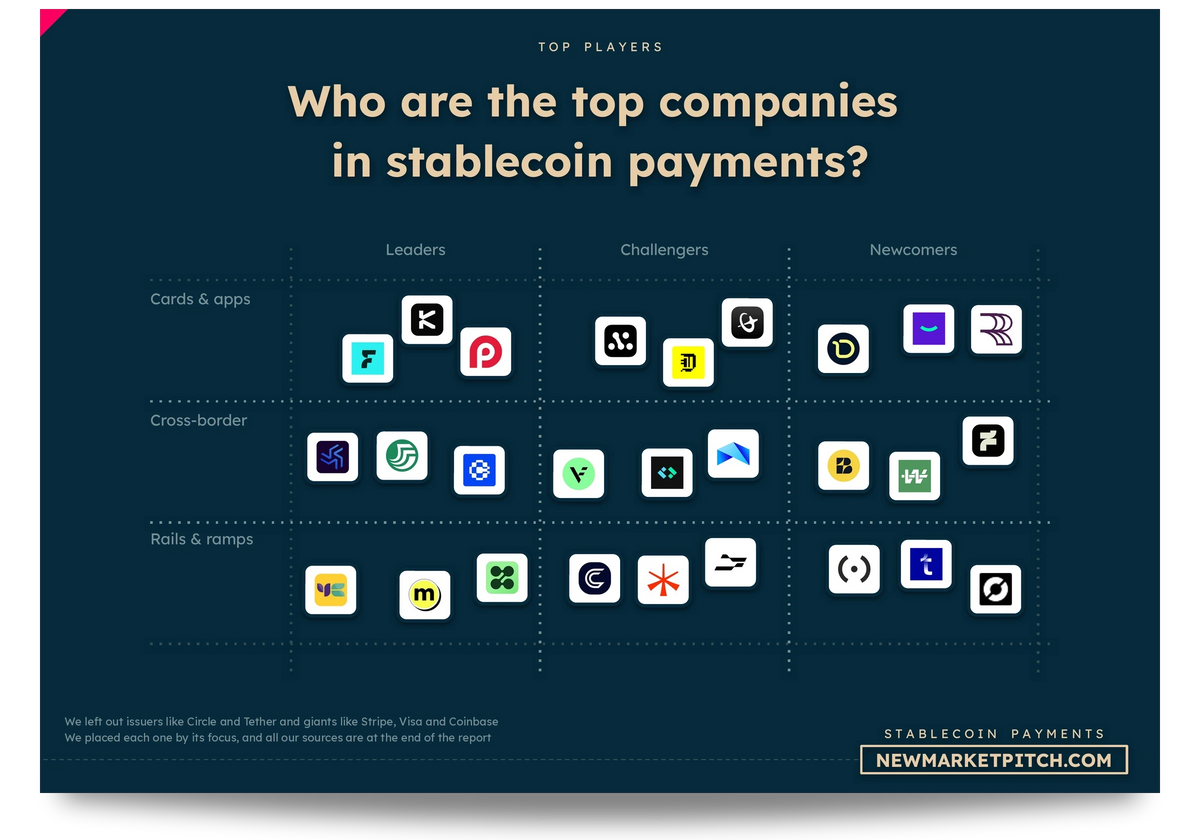
What are the top stablecoin payments startups by total funding raised?
Whether you're building or investing in the stablecoin payments market, our report covers everything you need to know: the players, the money, and what's coming next.
Summary
Tempo, Rain and Mesh are the top startups in the stablecoin payments market by cumulative funding raised, with $500 million, $339 million and $205 million, respectively. The ten leading companies have raised a combined $2.003 billion, with RedotPay, Félix Pago, Fasset, Yellow Card, OpenFX, Eco and KAST completing the ranking.
Funding is heavily concentrated at the top. Tempo and Rain alone account for $839 million, almost 42% of the ten companies' combined funding, although their financing histories are quite different: Tempo raised its entire amount in one Series A, while Rain built its total across four rounds.
The biggest investments are going into several layers of the payment system. Tempo is developing a dedicated payment blockchain, Rain is building card issuing infrastructure, Mesh connects wallets and payment networks, while OpenFX and Conduit focus on international settlement and foreign-exchange liquidity.
Stablecoin payment cards have become one of the clearest consumer applications. RedotPay reported more than six million registered users and over $10 billion in annualized payment volume in November 2025, while Rain's infrastructure supports card and wallet programs for more than 200 partners.
Institutional payment infrastructure is attracting equally serious attention. OpenFX reported $45 billion in annualized transaction volume in February 2026, while Fasset reported more than $40 billion in August. These figures show substantial operating activity, although transaction volume should never be confused with revenue or profitability.
B2B payments currently represent the largest identifiable commercial use case for stablecoins. McKinsey and Artemis Analytics estimated annualized real stablecoin payment activity at $390 billion, including approximately $226 billion in business-to-business payments, but that remains just 0.02% of global payment volumes.
Cross-border transfers are another major opportunity. Companies such as Félix Pago, Yellow Card, OpenFX, Conduit and TransFi are targeting expensive international payment corridors, where stablecoin settlement can reduce intermediary costs and improve transfer speeds. Local currency conversion and banking access remain important parts of the equation, however.
Investor interest is coming from both crypto-native venture capital firms and traditional financial institutions. Sequoia Capital, Andreessen Horowitz, Dragonfly Capital, Pantera Capital and Coinbase Ventures have backed several companies, while SBI Group and SC Ventures are helping bring established financial industry relationships into the sector.
Regulation is becoming a more concrete competitive factor. The GENIUS Act established a federal framework for US payment stablecoins, and the OCC finalized its implementing regulations in October 2026, ahead of their January 18, 2027 effective date. International expansion will still require companies to navigate different licensing and compliance regimes.
There is already evidence that fundraising alone does not guarantee success. Some smaller startups, including Kulipa and Payy, have shut down, while Loop Crypto, Wind and Arf are listed as acquired. Even well-funded businesses will need to demonstrate recurring payment activity, reliable banking relationships and sustainable margins.
Our conclusion is that stablecoin payments have developed into a serious fintech infrastructure category, with Rain, Mesh, OpenFX, Fasset and RedotPay among the most interesting businesses to follow. Tempo has the largest financial head start, but the long-term winners will be determined by their ability to turn funding into widely used payment services, not simply by the size of their financing rounds.

Written by the New Market Pitch teamWe track new markets so founders and investors can move faster. About us

In our report covering the stablecoin payments market, you will always find fresh funding data, taken straight from our own verified funding database.
Top startups in the stablecoin payments market ranked by total funding raised
Here is an updated table that ranks the top startups in the stablecoin payments market based on the total amount of funding they have raised to date.
The table also includes the total number of funding rounds, the date and size of the latest round, the financing type (e.g. Series A, equity financing), key investors, the startup’s current status (active, IPO, acquired, or shut down), and a confidence score based on the data collected (we excluded startups with very low data confidence, to make sure everything is reliable).
If you need to dig deeper and get more detailed data, please check our report covering the stablecoin payments market.
| # | Startup | What They Do | Total Raised ($) | Total Rounds | Last Round Date | Last Round Amount ($) | Last Round Type | Key Investors | Current Stage | Confidence | Country |
|---|---|---|---|---|---|---|---|---|---|---|---|
| 1 | Tempo | Stablecoin-focused blockchain payments network | $500M | 1 | October 2025 | $500M | Series A | Greenoaks, Thrive Capital, Sequoia Capital | Active | Strong | United States |
| 2 | Rain | Stablecoin card issuing and payments infrastructure | $339M | 4 | January 2026 | $250M | Series C | ICONIQ | Active | Full | United States |
| 3 | Mesh | Universal cryptocurrency payment connectivity network | $205M | 6 | January 2026 | $75M | Series C | Dragonfly Capital, Paradigm, Coinbase Ventures | Active | Partial | United States |
| 4 | RedotPay | Stablecoin cards and digital payments | $194M | 3 | December 2025 | $107M | Series B | Goodwater Capital, Pantera Capital, Blockchain Capital | Active | Full | Hong Kong |
| 5 | Félix Pago | WhatsApp-based international remittances | $185M 1 | 4 | September 2026 | $87M | Series C | Andreessen Horowitz, QED Investors, Castle Island Ventures | Active | Partial | United States |
| 6 | Fasset | Stablecoin neobanking and global settlement | $148M | 6 | August 2026 | $68M | Series C | SBI Group, Speedinvest | Active | Strong | United Arab Emirates |
| 7 | Yellow Card | Stablecoin payments infrastructure across Africa | $130M | 5 | August 2026 | $40M | Strategic / Series D | SC Ventures, Sony Innovation Fund, Polychain Capital | Active | Strong | United States |
| 8 | OpenFX | Global stablecoin-powered FX settlement infrastructure | $117M | 2 | March 2026 | $94M | Series A | Accel, Atomico, Pantera Capital | Active | Full | United States |
| 9 | Eco | Stablecoin wallet and payment routing | $95M | 3 | July 2021 | $60M | Series B | Activant Capital, L Catterton, Andreessen Horowitz | Active | Strong | United States |
| 10 | KAST | Stablecoin banking and international payments | $90M | 2 | March 2026 | $80M | Series A | QED Investors, Left Lane Capital, Peak XV Partners | Active | Full | United States |
| 11 | Lightnet | Blockchain-powered cross-border payment infrastructure | $79M 2 | 2 | November 2021 | $48M | Venture / Strategic | Chatchaval Jiaravanon, Tridbodi Arunanondchai | Active | Partial | Thailand |
| 12 | ARQ | Digital dollar accounts and payments | $75M | 2 | March 2026 | $70M | Series A | Founders Fund, Sequoia Capital, Kaszek Ventures | Active | Strong | Mexico |
| 13 | Lemon Cash | Cryptocurrency wallet and payment cards | $65M | 6 | October 2025 | $20M | Series B | F-Prime Capital, ParaFi Capital, VanEck | Active | Strong | Argentina |
| 14 | Conduit | Stablecoin-powered international payment infrastructure | $53M | 2 | May 2025 | $36M | Series A | Dragonfly, Altos Ventures, Circle Ventures | Active | Full | United States |
| 15 | Better Payment Network | Multi-stablecoin cross-border payment network | $50M | 1 | October 2025 | $50M | Seed | YZi Labs | Active | Full | Poland |
| 16 | Velocity | Enterprise stablecoin treasury and settlement | $48M | 2 | July 2026 | $38M | Series A | Dragonfly, FirstMark, Coinbase Ventures | Active | Full | United Kingdom |
| 17 | Pave Bank | Programmable banking and digital asset services | $44M | 2 | October 2025 | $39M | Series A | Accel, Tether Investments, Quona Capital | Active | Full | Singapore |
| 18 | Latitude | Stablecoin-powered global payouts and conversion | $43M | 2 | September 2026 | $35M | Series A | Oak HC/FT, NEA, Coinbase Ventures | Active | Full | United States |
| 19 | dtcpay | Regulated stablecoin and fiat payments | $42M | 3 | September 2026 | $15M | Series A Extension | SBI Group, Genedant Capital, Kwee Liong Tek | Active | Full | Singapore |
| 20 | Noah | Enterprise stablecoin payment settlement APIs | $38M | 2 | October 2026 | $16M | Seed Extension | Endeit Capital, LocalGlobe, Felix Capital | Active | Full | United Kingdom |
| 21 | HIFI | Tokenized money and stablecoin infrastructure | $37M | 1 | September 2026 | $37M | Series A | Left Lane Capital | Active | Partial | United States |
| 22 | VelaFi | Stablecoin-powered global financial infrastructure | $36M | 3 | January 2026 | $20M | Series B | XVC, Ikuyo, Alibaba Investment | Active | Partial | United States |
| 23 | Obita | Stablecoin-based enterprise cross-border payment network | ~$30M | 2 | January 2026 | ~$20M | Pre-Series A | Monolith, Vision Plus Capital, Mirana Ventures | Active | Partial | China |
| 24 | Coinflow | Instant merchant payments and settlement | $29M | 3 | October 2025 | $25M | Series A | Pantera Capital, Coinbase Ventures, CMT Digital | Active | Full | United States |
| 25 | Cyclops | Stablecoin infrastructure for payment processors | $28M | 2 | July 2026 | $20M | Series A | Nava Ventures, Castle Island Ventures, Coinbase Ventures | Active | Full | United States |
| 26 | Oobit | Cryptocurrency tap-to-pay mobile payment application | $28M | 2 | February 2024 | $25M | Series A | Tether, CMCC Global, 468 Capital | Active | Strong | Singapore |
| 27 | Stable | USDT-native blockchain for digital payments | $28M | 1 | July 2025 | $28M | Seed | Bitfinex, Hack VC, Franklin Templeton | Active | Full | United States |
| 28 | Wirex | Crypto payments cards and accounts | $28M | 4 | December 2021 | $20M | Series B | Undisclosed | Active | Partial | United Kingdom |
| 29 | Mural | Stablecoin accounts and payment infrastructure | $28M | 2 | October 2026 | $15M | Series A | Tether, North Island Ventures | Active | Partial | United States |
| 30 | Toku | Global compliant stablecoin payroll infrastructure | $25M | 3 | November 2024 | $5M | Series A | Winklevoss Capital | Active | Partial | United States |
| 31 | Kredete | Diaspora remittances and credit building | $24M | 2 | September 2025 | $22M | Series A | AfricInvest, Partech, Polymorphic Capital | Active | Strong | United States |
| 32 | Plasma | Blockchain optimized for stablecoin transfers | $24M+ | 3 | May 2025 | Undisclosed | Strategic Equity | Founders Fund | Active | Partial | United States |
| 33 | Fin | High-value stablecoin payment infrastructure | $23M | 2 | December 2025 | $17M | Series A | Pantera Capital, Sequoia Capital, Samsung Next | Active | Strong | United States |
| 34 | Koywe | Latin American stablecoin payment infrastructure | $21M | 3 | July 2026 | $13M | Series B | Concentric, Franklin Templeton, Y Combinator | Active | Partial | Chile |
| 35 | Zebec | Real-time stablecoin payroll and payments | $21M 3 | 2 | February 2022 | $15M | Series A | Solana Ventures, Distributed Global, Coinbase Ventures | Active | Partial | United States |
| 36 | 1Money Network | Dedicated stablecoin payments blockchain | $20M | 1 | January 2025 | $20M | Seed | F-Prime Capital, Galaxy Ventures, Hack VC | Active | Strong | United States |
| 37 | Fin.com | Global stablecoin and fiat payments | $20M | 1 | September 2026 | $20M | Seed | Expa, Garrett Camp, Coinbase Ventures | Active | Full | United States |
| 38 | Sling Money | International stablecoin money transfer application | $20M | 2 | August 2024 | $15M | Series A | Union Square Ventures, Ribbit Capital, Slow Ventures | Active | Full | United Kingdom |
| 39 | Fipto | Blockchain-enabled treasury and international payments | $19M | 2 | September 2023 | $17M | Seed | Serena, Motier Ventures | Active | Strong | France |
| 40 | Limited | Global stablecoin-enabled corporate banking | $19M | 2 | September 2026 | $12M | Seed Extension | Third Prime, The House Fund, Collab+Currency | Active | Strong | United States |
| 41 | Belo | Crypto wallet and stablecoin payments | $17M | 2 | April 2026 | $14M | Series A | Tether, G2 Momentum Capital, TheVentureCity | Active | Strong | Argentina |
| 42 | Codex FX | Stablecoin-native institutional FX platform | $16M | 1 | April 2025 | $16M | Seed | Dragonfly Capital, Cumberland, Wintermute | Active | Full | United States |
| 43 | Alfred | Latin American stablecoin payment infrastructure | $15M | 3 | January 2026 | $15M | Series A | F-Prime Capital, Brevan Howard Digital, White Star Capital | Active | Partial | United States |
| 44 | TransFi | Cross-border stablecoin payments and settlement | $14.2M+ | 3 | March 2026 | $14.2M | Series A | Turing Financial Group, Blockchain Founders Fund, Cambrian Fintech | Active | Partial | United States |
| 45 | Caliza | Digital dollar and payment infrastructure | $14M | 2 | April 2024 | $9M | Series A | Initialized Capital, Digital Currency Group, Abstract Ventures | Active | Strong | Brazil |
| 46 | Atum | Open global payment coordination network | $14M | 1 | September 2026 | $14M | Seed | Variant, PayPal Ventures, Abstract Ventures | Active | Full | United States |
| 47 | HiGlobe | Stablecoin-based international salary transfers | $14M | 1 | September 2022 | $14M | Series A | Battery Ventures, Paxos, Digital Currency Group | Active | Strong | United States |
| 48 | Infinia | Latin American stablecoin payment infrastructure | $14M | 2+ | July 2026 | $14M | Series A | Bain Capital Crypto, Variant, Y Combinator | Active | Partial | Uruguay |
| 49 | Triple-A | Regulated stablecoin merchant payment processing | $14M | 2 | October 2023 | $10M | Series A | Peak XV Partners, Shorooq Partners | Active | Strong | Singapore |
| 50 | Cybrid | Embedded stablecoin and banking infrastructure | $13M | 2 | October 2025 | $10M | Series A | BDC Capital, Golden Ventures, Luge Capital | Active | Full | Canada |
| 51 | Afriex | Stablecoin-powered international money transfers | $11M | 5 | June 2022 | $0M | Venture Round | Adaverse, EMURGO, Everest Ventures Group | Active | Partial | United States |
| 52 | Cedar Money | Stablecoin-powered cross-border business payments | $10M | 1 | January 2025 | $10M | Seed | QED Investors, North Island Ventures, Wischoff Ventures | Active | Full | United States |
| 53 | Diameter Pay | Dollar accounts and stablecoin infrastructure | $10M | 1 | September 2026 | $10M | Series A | CMT Digital, Lightspeed Faction, SixThirty Ventures | Active | Full | United States |
| 54 | Merge | Fiat-crypto banking and payments APIs | $10M | 1 | May 2022 | $10M | Seed | Octopus Ventures, Hashed, Coinbase Ventures | Active | Full | United Kingdom |
| 55 | Rise | Fiat and stablecoin payroll platform | $10M | 2 | November 2024 | $6M | Series A | Draper Associates, Polymorphic Capital, Digital Currency Group | Active | Strong | United States |
| 56 | Kulipa | Stablecoin-funded payment card issuing infrastructure | $9M | 2 | April 2026 | $6M | Seed | Flourish Ventures, 1kx, White Star Capital | Shutdown | Full | France |
| 57 | Checker | Institutional stablecoin liquidity and payments | $8M 4 | 2 | May 2026 | Undisclosed | Seed / Pre-Seed | Galaxy Ventures, Al Mada Ventures, Framework Ventures | Active | Partial | United States |
| 58 | Payy | Privacy-focused stablecoin payments network | $8M | 2 | March 2026 | $6M | Seed | FirstMark Capital, Robot Ventures, DBA | Shutdown | Strong | United States |
| 59 | Sphere | Stablecoin payment APIs and settlement | $8M | 2 | December 2024 | $5M | Strategic | Coinbase Ventures, Kraken Ventures, Anagram | Active | Strong | United States |
| 60 | Utexo | Bitcoin-native USDT payment settlement infrastructure | $8M | 1 | March 2026 | $8M | Seed | Tether, Big Brain Holdings, Portal Ventures | Active | Full | United Arab Emirates |
| 61 | Adhara | Institutional blockchain payment infrastructure | $7.5M+ | 4 | May 2021 | $7.5M | Series A | Yabeo Capital, Force Over Mass Capital, Tokentus | Active | Partial | United Kingdom |
| 62 | Due | Cross-border fiat and stablecoin payments | $7M | 2 | July 2025 | $4M | Seed Extension | Speedinvest, Semantic Ventures, Fabric Ventures | Active | Full | United Kingdom |
| 63 | Shield | Stablecoin international business payment infrastructure | $7M | 2 | September 2025 | $5M | Seed | Giant Ventures, a16z crypto | Active | Full | United States |
| 64 | Infini | AI-powered global stablecoin financial services | $6M | 1 | September 2026 | $6M | Seed | Reforge, Fortwest Capital, Enlight Capital | Active | Full | China |
| 65 | Loop Crypto | Stablecoin subscription and merchant payments | $6M | 2 | August 2025 | $2M | Strategic | Fabric Ventures, VanEck, Andreessen Horowitz | Acquired | Strong | United States |
| 66 | Orbital | Enterprise fiat and stablecoin payments | $6M | 1 | August 2023 | $6M | Growth Equity | Golden Record Ventures, New Form Capital, GSR Ventures | Active | Strong | United Kingdom |
| 67 | Request Finance | Crypto invoicing and financial operations | $6M | 2 | March 2025 | Undisclosed | Seed Extension / Strategic | Balderton Capital, Bpifrance, XAnge | Active | Partial | France |
| 68 | BoomFi | Multi-chain cryptocurrency payment processing | $5M | 2 | February 2024 | $1M | Seed Extension | Triton Capital, Yolo Investments | Active | Strong | United Kingdom |
| 69 | HoneyCoin | Stablecoin payments and African remittances | $5M | 3 | August 2025 | $5M | Seed | TLcom Capital, Flourish Ventures, Visa Ventures | Active | Partial | Kenya |
| 70 | Nilos | Cross-border fiat and stablecoin payments | $5M | 1 | April 2022 | $5M | Seed | Viola Ventures, Fabric Ventures, Mensch Capital Partners | Active | Full | Israel |
| 71 | Stables | Stablecoin wallet and payment cards | $5M | 1 | February 2022 | $5M | Seed | Global Founders Capital, FinTech Collective, Jump Capital | Active | Partial | Australia |
| 72 | Sorted Wallet | Accessible stablecoin wallet for emerging markets | $5M | 2 | May 2026 | $3M | Seed | Tether, Gnosis, Movement | Active | Strong | China |
| 73 | Parallax | Cross-border stablecoin payments for workers | $5M | 1 | September 2023 | $5M | Seed | Dragonfly Capital, Circle Ventures, General Catalyst | Active | Full | United States |
| 74 | PEXX | Stablecoin-to-fiat international money transfers | $5M | 1 | July 2024 | $5M | Seed | TNB Aura, Antler, EMO Capital | Active | Full | Singapore |
| 75 | Walapay | Cross-border accounts payments and FX | $5M | 2 | September 2026 | $5M | Seed | Generative Ventures, Commerce Ventures, Polygon | Active | Partial | United States |
| 76 | UnblockPay | Stablecoin-native banking and payments APIs | $5M | 1 | March 2026 | $5M | Seed | Prelude, Plug and Play, Wintermute | Active | Full | Brazil |
| 77 | Acctual | Crypto accounts payable and accounting | $4M | 3 | November 2023 | $4M | Seed | Third Prime Capital, IDEO CoLab Ventures, Alchemy Ventures | Active | Partial | United States |
| 78 | Stable Sea | Stablecoin offramping and treasury infrastructure | $4M | 1 | March 2025 | $4M | Seed | Kindred Ventures, Ludlow Ventures, DFS Lab | Active | Full | United States |
| 79 | Wind | Stablecoin wallet and global transfers | $4M | 1 | November 2023 | $4M | Pre-Seed | Global Founders Capital, Spartan Group, Saison Capital | Acquired | Strong | Singapore |
| 80 | Littio | Dollar-denominated accounts for Latin Americans | $4M | 1 | March 2022 | $4M | Seed | Global Founders Capital, 166 2nd, JAM Fund | Active | Partial | Colombia |
| 81 | BlindPay | Stablecoin payment API and gateways | $3M | 2 | August 2025 | $3M | Seed | Y Combinator, 468 Capital, Circle Ventures | Active | Strong | United States |
| 82 | Keyrails | Stablecoin-enabled international banking APIs | $3M | 2 | November 2025 | $1M | Seed Extension | 212, Cloudberry Ventures, H2O Investment | Active | Partial | United States |
| 83 | Bitnob | Bitcoin and stablecoin payment solutions | $1M | 2 | January 2022 | $1M | Seed | Flourish Ventures, Lightning Ventures | Active | Partial | Nigeria |
| 84 | Arf | Institutional cross-border settlement and liquidity | $1M | 3 | October 2022 | Undisclosed | Seed (Equity + Debt) | Circle Ventures, Stellar Development Foundation, UOB Venture Management | Acquired | Partial | Switzerland |
- The September 2026 round also included $113M of debt, excluded here.
- Excludes a $50M capital commitment and an unconfirmed $5M share purchase.
- Rounds may include token allocations; excludes $28M of later token sales.
- The $8M combines two rounds whose separate amounts are undisclosed.

In our research about stablecoin payments, we turn what is vague and complex into simple, useful visuals. Market maps like this one show you at a glance where every startup stands.
Why are investors putting so much money into stablecoin payment startups?
Investors are backing stablecoin payment startups because digital dollars are increasingly seen as a practical way to modernize international payments, business banking and card infrastructure. The biggest opportunities are emerging around companies that make stablecoins usable through familiar financial products.
The financing activity is substantial. Rain raised $250 million in January 2026, bringing its cumulative funding to $339 million. Mesh secured $75 million in the same month, taking its total above $200 million. OpenFX raised $94 million in March 2026 to expand its international FX infrastructure, while Fasset secured $68 million in August 2026 to develop its stablecoin neobanking and settlement network.
There is also a regulatory reason behind the growing interest. The GENIUS Act, signed into law in July 2025, established a federal framework for payment stablecoins in the United States. The OCC finalized its implementing regulations in October 2026, with the rules scheduled to take effect in January 2027.
However, investors are financing a much bigger future market than the one currently generating payment revenue. McKinsey and Artemis Analytics estimated annualized stablecoin payment activity at approximately $390 billion, based on December 2025 data. That represents around 0.02% of global payments. The opportunity is considerable, but companies still have to convince businesses and consumers to move real payment activity onto these networks.
Which stablecoin payment startups have raised the most funding?
Tempo, Rain and Mesh lead the stablecoin payments fundraising ranking, with $500 million, $339 million and $205 million in cumulative funding, respectively. The ten leading companies have raised a combined $2.003 billion, showing just how much capital has gone into the businesses at the top of the market.
Tempo occupies the first position with $500 million raised in a single Series A round in October 2025. Greenoaks, Thrive Capital and Sequoia Capital are among its key investors. The company is developing a blockchain specifically designed for payments.
Rain follows with $339 million across four rounds. Its $250 million Series C in January 2026, led by ICONIQ, was a major financing event for its stablecoin card issuing and enterprise payment infrastructure business.
Mesh comes next with $205 million across six rounds. Its $75 million Series C in January 2026 attracted Dragonfly Capital, Paradigm and Coinbase Ventures.
RedotPay and Félix Pago complete the top five, with $194 million and $185 million, respectively. RedotPay focuses on stablecoin cards and digital payments, while Félix Pago uses WhatsApp to facilitate international remittances.
The remaining companies in the top ten are Fasset, Yellow Card, OpenFX, Eco and KAST. Their businesses cover stablecoin banking, African payment infrastructure, international FX, payment routing and digital-dollar financial services.
| Rank | Startup | Total raised | Rounds |
|---|---|---|---|
| 1 | Tempo | $500M | 1 |
| 2 | Rain | $339M | 4 |
| 3 | Mesh | $205M | 6 |
| 4 | RedotPay | $194M | 3 |
| 5 | Félix Pago | $185M | 4 |
| 6 | Fasset | $148M | 6 |
| 7 | Yellow Card | $130M | 5 |
| 8 | OpenFX | $117M | 2 |
| 9 | Eco | $95M | 3 |
| 10 | KAST | $90M | 2 |

Your time is limited. In our market report about stablecoin payments, we put numbers on each part of the market, so you can see where it makes sense to focus.
How much funding is concentrated among the biggest stablecoin payment startups?
The concentration is striking: the ten leading companies have raised $2.003 billion, with Tempo and Rain alone accounting for $839 million. Those two companies represent almost 42% of their combined funding.
The next group is also well financed. Mesh, RedotPay and Félix Pago have each raised between $185 million and $205 million, creating a relatively close cluster behind the two largest fundraisers.
After the top ten positions, the funding figures fall considerably. ARQ has raised $75 million, Conduit $53 million, Better Payment Network $50 million, Velocity $48 million and Pave Bank $44 million.
The difference between these groups is substantial. Tempo has raised more than six times as much as Conduit, while Rain has raised more than three times as much as ARQ.
Investors are making a few large bets on companies they believe could become important payment networks, while spreading smaller investments across specialized providers. There are plenty of funded competitors, but access to capital is far from evenly distributed.
Which stablecoin payment startups have raised the biggest funding rounds?
Tempo and Rain stand out with individual financing rounds of $500 million and $250 million, respectively. These are unusually large investments for payment infrastructure startups and represent a different level of financial backing from the typical seed or Series A round.
Tempo's October 2025 Series A accounts for its entire $500 million cumulative funding total. Thrive Capital and Greenoaks led the financing, with Sequoia Capital among the participating investors.
Rain's January 2026 Series C was led by ICONIQ and brought in $250 million. The financing followed earlier rounds in the same year of the company's rapid expansion.
Other major rounds include Félix Pago's $87 million Series C in September 2026, KAST's $80 million Series A in March 2026, Mesh's $75 million Series C in January 2026 and ARQ's $70 million Series A in March 2026.
Félix Pago deserves particular attention because the overall financing announcement was $200 million, combining $87 million of equity with a $113 million credit facility. Only the equity component counts toward its $185 million cumulative funding figure.
Fasset also raised $68 million in August 2026, following a $51 million Series B earlier that year. The two rounds illustrate how quickly some companies are attracting additional capital as they expand their international operations.

In our document detailing everything you need to know about stablecoin payments, we always try to gather several sources and make estimates that make sense, so you can work with solid numbers.
Which stablecoin payment startups have raised more than $100 million?
Eight companies have crossed the $100 million funding threshold: Tempo, Rain, Mesh, RedotPay, Félix Pago, Fasset, Yellow Card and OpenFX. Together, they have raised $1.818 billion.
Their business models show that investors are financing several different parts of the stablecoin payments ecosystem.
Tempo is developing a dedicated payment blockchain, while Rain provides card issuing and enterprise payment infrastructure. Mesh connects wallets, exchanges and payment systems, making it easier for customers to spend digital assets.
RedotPay and Félix Pago are closer to consumer financial services, focusing on stablecoin cards and international remittances. Fasset combines stablecoin banking with international settlement, while Yellow Card is building payment infrastructure for businesses across African markets.
OpenFX takes a different approach by focusing on foreign-exchange liquidity and settlement between financial institutions.
What connects these businesses is their effort to make stablecoins useful in ordinary financial transactions. Investors are backing the infrastructure that connects digital dollars to the existing financial system, rather than concentrating exclusively on blockchain technology.
Who are the biggest investors in stablecoin payment startups?
Sequoia Capital, Andreessen Horowitz, Pantera Capital, Dragonfly Capital, Coinbase Ventures, Accel and QED Investors are among the most recognizable investors in the stablecoin payments ranking.
Several venture capital firms have backed multiple companies. Dragonfly Capital has invested in Mesh, Conduit, Velocity and Codex FX, among others. Coinbase Ventures appears among the investors in Mesh, Coinflow, Cyclops, Velocity and several other payment infrastructure businesses.
Pantera Capital has backed RedotPay, OpenFX and Coinflow, while Sequoia Capital appears among the investors in Tempo, ARQ and Fin.
Tether's investment ecosystem is also increasingly visible. Its investments and strategic backing include Pave Bank, Oobit, Mural, Belo, Utexo and Sorted Wallet.
Traditional financial institutions are joining the picture. SBI Group has backed Fasset and dtcpay, while SC Ventures, the investment arm of Standard Chartered, participated in Yellow Card's strategic financing.
It is an interesting mix of investors. Venture capital firms are looking for companies with the potential to build large technology platforms, while established financial groups want access to payment infrastructure that could become increasingly important to their existing businesses.

Our report covering the stablecoin payments market gets updated several times a month, so you always get the latest view of where things stand.
What do stablecoin payment startups actually sell?
Stablecoin payment startups sell payment cards, international transfers, foreign-exchange conversion, merchant processing, corporate treasury systems, dollar accounts, payroll infrastructure and APIs connecting banks to blockchain networks.
Some companies focus on individual consumers. RedotPay provides stablecoin cards and digital payments, KAST combines stablecoin banking with international payments, and Oobit focuses on mobile tap-to-pay functionality. Lemon Cash and Belo offer cryptocurrency wallets and payment services.
Other companies operate mainly behind the scenes. Conduit, OpenFX, Noah and TransFi provide infrastructure designed to move money between businesses, currencies and financial institutions. Their customers may never interact directly with a blockchain.
A third group is developing financial accounts and banking infrastructure. Fasset, Pave Bank, ARQ and Yellow Card are examples of companies trying to connect stablecoin balances with more conventional financial services.
The commercial differences are significant. A consumer application needs to attract millions of users and convince them to spend their digital dollars. An infrastructure provider can potentially generate substantial transaction volume through a much smaller number of institutional customers.
Are stablecoin payment cards becoming the main consumer use case?
Stablecoin payment cards are one of the most visible ways to bring digital dollars into everyday spending, and companies such as Rain, RedotPay, KAST and Oobit are building around this opportunity.
Rain provides card issuing and payment infrastructure that other businesses can integrate into their products. RedotPay focuses on consumer stablecoin cards and digital payments, while Oobit emphasizes mobile tap-to-pay functionality. KAST combines stablecoin banking with international payment services.
RedotPay provides an interesting example of the potential scale. In its December 2025 Series B announcement, the company reported more than six million registered users across over 100 markets, annualized payment volume exceeding $10 billion and payment volume that had nearly tripled year-on-year.
Rain's January 2026 Series C announcement also highlighted its enterprise infrastructure, including card and wallet programs serving more than 200 partners.
These figures suggest that stablecoin cards are becoming a practical distribution channel for digital dollars. Consumers can spend their balances through familiar payment networks without having to understand blockchain settlement.
The remaining challenge is making the economics work. Card providers still depend on merchant acceptance, conversion costs, card network relationships and regulatory permissions. Strong user growth alone does not guarantee attractive margins.

In our research about stablecoin payments, we look at what the winners do differently, so you can learn from the best instead of guessing.
Are stablecoins actually being used for payments at scale?
Stablecoins are already processing meaningful real-world payment activity, but their share of global payments remains tiny. McKinsey and Artemis Analytics estimated annualized stablecoin payments at approximately $390 billion, based on December 2025 activity, equivalent to around 0.02% of global payment volumes.
The composition is particularly interesting. Business-to-business payments accounted for approximately $226 billion, while payroll and remittances represented around $90 billion.
These figures are much more useful than the headline blockchain transaction volumes frequently quoted by the industry. Total stablecoin transactions can reach tens of trillions of dollars annually, but a large proportion comes from trading, internal transfers, liquidity management and automated blockchain activity.
McKinsey's analysis specifically tried to separate actual payment activity from these other movements. Its conclusion was that stablecoins have already found commercial use cases, particularly in business payments, but their penetration of the traditional financial system remains extremely low.
We are therefore looking at a market with genuine adoption and considerable room to grow. The important question is how quickly businesses and consumers will move additional payment activity onto stablecoin networks.
Are cross-border payments the biggest opportunity for stablecoin startups?
Cross-border payments are one of the strongest opportunities because traditional international transfers can involve several banks, currency conversions and settlement intermediaries.
OpenFX, Yellow Card, Félix Pago, Fasset, Conduit and TransFi are approaching this market from different angles.
OpenFX focuses on FX liquidity and settlement infrastructure for financial institutions. In its March 2026 funding announcement, the company reported annualized transaction volume of $45 billion, compared with $8 billion when it emerged from stealth in May 2025.
Yellow Card is building business payment infrastructure across African markets, combining stablecoin settlement with local currency payment rails. Its August 2026 announcement brought in $40 million in strategic financing, with participation from SC Ventures, Sony Innovation Fund and Polychain Capital.
Félix Pago takes a more consumer-oriented approach by using WhatsApp to facilitate international remittances. This allows customers to send money without having to interact directly with blockchain applications.
The World Bank has consistently highlighted the high cost of international remittances. Its global average has remained around 6.5%, although prices vary considerably by corridor.
Stablecoins can reduce some of these costs, particularly when they avoid multiple correspondent banking relationships. However, the final price still depends on local liquidity, foreign-exchange conversion, banking access and withdrawal fees.

In our market report about stablecoin payments, we don't want to repeat what boring consulting reports say. Instead, we show you the real and latest market signals that matter.
Are B2B stablecoin payments more important than consumer payments?
B2B payments are currently the largest identifiable category of real-world stablecoin payment activity, according to McKinsey and Artemis Analytics. Their research estimated approximately $226 billion in annualized B2B payments, compared with around $90 billion in payroll and remittances.
This helps explain why so much funding is going into enterprise payment infrastructure.
Companies such as Conduit, OpenFX, Velocity, Noah, Cedar Money and Yellow Card are developing products for businesses that need to move money internationally. Their services include settlement APIs, treasury infrastructure, local currency payouts and international business payments.
For companies operating in several countries, stablecoins can reduce the need to maintain large balances across multiple banking systems. They can also make it easier to move money outside traditional banking hours.
The opportunity is particularly interesting for businesses with frequent international payments. However, high transaction volume does not automatically translate into high profits. Payment providers still have to pay for liquidity, banking relationships, compliance, foreign-exchange conversion and local payout networks.
Which stablecoin startups are building international FX and settlement infrastructure?
OpenFX, Conduit, Velocity, Noah and Codex FX are among the most relevant companies in the ranking for businesses looking to move money internationally using stablecoin infrastructure.
OpenFX has raised $117 million across two rounds, including its $94 million Series A in March 2026. Its business focuses on providing access to global FX liquidity and settlement.
Conduit has raised $53 million across two rounds, with its $36 million Series A in May 2025. It focuses on stablecoin-powered international payment infrastructure.
Velocity has raised $48 million across two rounds, including a $38 million Series A in July 2026, targeting enterprise treasury and settlement.
Noah has raised $38 million, including a $16 million Seed Extension in October 2026. The company focuses on enterprise stablecoin settlement APIs and reported that its 2026 year-to-date revenue had increased 538% year-on-year in its funding announcement.
Codex FX has raised $16 million in a single seed round, concentrating on institutional foreign-exchange infrastructure.
These companies are competing for an important part of the payment value chain: connecting local currencies, liquidity providers, financial institutions and blockchain settlement systems. Their commercial advantage will depend heavily on reliability, pricing, liquidity depth and the number of financial institutions using their infrastructure.

Learning from others' mistakes is the cheapest lesson there is. In our document detailing everything you need to know about stablecoin payments, we look at what broke startups before you, so you don't repeat it.
Is stablecoin regulation becoming a competitive advantage for payment startups?
Regulatory compliance is becoming increasingly important because stablecoin payments involve regulated activities such as money transmission, custody, payment processing and financial intermediation.
The GENIUS Act created a federal framework for payment stablecoin issuance in the United States. The OCC finalized its implementing regulations in October 2026, with the framework scheduled to take effect on January 18, 2027.
The rules address reserve assets, redemption, risk management, supervision and custody. They should provide more clarity for companies working with regulated stablecoin issuers and financial institutions.
Yellow Card's strategy illustrates the importance of regulatory relationships. The company is building business payment infrastructure across African markets and has attracted investment from SC Ventures, Standard Chartered's investment arm.
Fasset also emphasizes regulated infrastructure connecting banks, payment providers and liquidity partners across international markets.
However, US regulatory clarity does not solve the licensing requirements faced by companies operating in Africa, Latin America, Asia and Europe. Each market still has its own rules governing payment services, custody and financial intermediation.
Companies that can navigate these requirements while maintaining reliable banking relationships should have an advantage when selling to larger institutional customers.
Are stablecoin payment startups mature enough to compete with traditional fintech companies?
The leading stablecoin payment startups are already operating at meaningful commercial scale, although the industry still has a long way to go before it can challenge traditional payment networks across the board.
RedotPay reported more than six million users and annualized payment volume above $10 billion in November 2025. OpenFX reported $45 billion in annualized transaction volume in February 2026, while Fasset reported more than $40 billion in annualized transaction volume in August 2026.
These examples show that some companies have moved well beyond early product experimentation. They are processing substantial transaction volumes and working with financial institutions, businesses and payment partners.
However, the figures are company-reported and are not directly comparable. Annualized transaction volume is also very different from revenue or profit. A company can process billions of dollars in payments while retaining only a small fraction as revenue.
The strongest businesses are beginning to resemble established fintech infrastructure providers. Their next challenge is to prove that they can retain customers, maintain banking relationships and generate sustainable margins as competition increases.

If you build or invest in the stablecoin payments market, you need to know which business models pay off now and which ones are fading. That's why our report covering it has a whole section on it.
Have stablecoin payment startups already started shutting down or being acquired?
Yes. The wider group of stablecoin payment companies includes several businesses that have shut down or been acquired, showing that fundraising alone does not guarantee long-term survival.
Kulipa and Payy are listed as shut down. Kulipa raised $9 million across two rounds, while Payy raised $8 million across two rounds.
Loop Crypto, which raised $6 million across two rounds, is listed as acquired. Wind, which raised $4 million in one round, is also listed as acquired, as is Arf, with $1 million in cumulative funding.
These cases illustrate the risks of building a financial infrastructure business. Payment startups need reliable banking partners, regulatory permissions, liquidity, fraud prevention and enough recurring transaction activity to cover their operating costs.
The distinction between an acquisition and a shutdown is important. An acquisition can preserve a company's technology, customer relationships or team, while a shutdown generally means the independent business has ceased operating.
The market is still developing, and some companies that attracted significant funding may eventually disappear, merge or become part of larger financial infrastructure groups.
Does raising more money mean a stablecoin payment startup is more successful?
No. Funding measures how much capital investors have committed to a company, while commercial success depends on customers, transaction volume, revenue, retention and profitability.
Tempo's $500 million demonstrates exceptional access to capital, but it does not automatically establish that the company processes more payments than every other startup in the ranking.
Rain's $339 million across four rounds, Mesh's $205 million across six rounds and RedotPay's $194 million across three rounds also reflect different financing histories and business models.
The distinction becomes clearer when we compare operating figures. OpenFX reported $45 billion in annualized transaction volume in February 2026, while RedotPay reported more than $10 billion in annualized payment volume in November 2025.
Those figures provide useful evidence of commercial activity, but they do not tell us how much revenue each company retains or how profitable its transactions are.
We should therefore view cumulative funding as a measure of investor commitment and financial resources. A company's ability to turn those resources into recurring, profitable payment activity is a separate question.

In our research about stablecoin payments, we like to show you the big picture. We know your time is precious, so we make every page quick to read and packed with as much learning as possible per minute.
Which stablecoin payment startups have the strongest potential to become major financial infrastructure providers?
Rain, Mesh, OpenFX, Fasset, Yellow Card and RedotPay are particularly interesting because they combine substantial financing with products that address identifiable problems in the payment system.
Rain has built card issuing and enterprise payment infrastructure. Mesh is connecting wallets, exchanges and payment systems, while OpenFX is targeting international FX liquidity and settlement.
Fasset is developing stablecoin banking and international financial infrastructure. Yellow Card is expanding business payment services across African markets, while RedotPay provides a consumer-facing route through stablecoin cards and digital payments.
These companies have different customers, revenue opportunities and operating requirements. Their common advantage is that they are trying to make digital dollars useful without requiring customers to become cryptocurrency specialists.
The next competitive battle will involve banking relationships, liquidity, licensing, distribution and pricing. Companies that can combine those elements have a much better chance of becoming important financial infrastructure providers than businesses relying on technology alone.
What should investors watch next in the stablecoin payments market?
The next stage of the stablecoin payments market will depend on whether the infrastructure being financed translates into sustained real-world payment activity.
The first development to watch is the implementation of the GENIUS Act. Its January 2027 effective date creates an important milestone for regulated payment stablecoin issuers and the companies providing services around them.
The second is enterprise adoption. OpenFX, Yellow Card, Fasset, Conduit and Velocity are all targeting institutional payment flows, making their customer growth and recurring transaction activity particularly interesting.
The third is the relationship between transaction volume and revenue. OpenFX's reported increase from $8 billion to $45 billion in annualized transaction volume between May 2025 and February 2026 illustrates how quickly infrastructure businesses can grow their activity. Noah's reported 538% year-on-year increase in 2026 revenue provides another example of the commercial traction investors are looking for.
We should also watch whether companies can maintain their margins as more providers enter the market. Competition in payment infrastructure can quickly reduce fees, particularly when customers have several providers offering similar settlement services.
The biggest opportunity remains the conversion of traditional international payment activity into stablecoin-based settlement. The companies that can make this transition easy for businesses and consumers are likely to become the most important players in the market.

When you build or invest in the stablecoin payments market, you need clarity, not confusion. In our market report about stablecoin payments, we always try to put numbers on and quantify whatever is usually vague and confusing.
Which stablecoin payment startups are the most important to watch?
Tempo leads the cumulative funding ranking with $500 million, followed by Rain at $339 million and Mesh at $205 million. RedotPay, Félix Pago, Fasset, Yellow Card and OpenFX also stand out because of their funding levels and their positions in different parts of the payment ecosystem.
Our research points to a market becoming increasingly institutional, with investors backing payment networks, card infrastructure, international settlement and stablecoin banking. The biggest rounds are going to companies trying to connect digital dollars with everyday financial services.
There is still a significant gap between the money going into these startups and the proportion of global payments actually handled through stablecoins. McKinsey's estimated $390 billion in annualized real stablecoin payments remains a tiny share of the traditional payment market.
Our conclusion is that stablecoin payment infrastructure has become a serious fintech investment category, but the long-term winners have yet to emerge. Rain, Mesh, OpenFX, Fasset and RedotPay are among the companies worth watching closely, while Tempo's fundraising scale gives it a substantial financial head start.
The decisive test will be whether these startups can turn their capital and technology into payment services that businesses, consumers and banks use repeatedly.
Our methodology
This ranking compares startups in the stablecoin payments market by cumulative equity funding raised. We focused on companies whose core business is genuinely centered on stablecoin payments and related infrastructure, including payment cards, international transfers, merchant processing, foreign-exchange settlement, corporate treasury and stablecoin-based financial accounts.
We considered individual financing rounds, their dates, amounts and participating investors, giving priority to company and investor announcements, regulatory filings and reputable financial and industry reporting. Funding totals reflect cumulative equity financing, with historical rounds remaining part of each company's total. Companies that were subsequently acquired or shut down were also considered when reporting their historical fundraising.
We paid particular attention to the distinction between financing types, especially where a headline announcement combined equity investment with a separate credit facility. This is relevant to Félix Pago's September 2026 financing, where the $87 million equity round is counted separately from the $113 million credit facility.
For market adoption, we used company announcements covering customer numbers, annualized payment volumes, revenue growth and international expansion. We treated transaction volume as a measure of payment activity rather than company revenue or profitability, since these figures describe different aspects of a business.
Our market analysis also draws on McKinsey and Artemis Analytics' research into actual stablecoin payment activity, including their estimates of annualized payment volumes and B2B adoption. The World Bank's Remittance Prices Worldwide database provides context for the cost of traditional international money transfers, while the OCC's official publications establish the regulatory framework and implementation timetable for the GENIUS Act in the United States.
Key sources include The Block's reporting on Tempo's $500 million Series A, Rain's $250 million Series C announcement, Mesh's Series C announcement, RedotPay's funding and operating update, OpenFX's $94 million Series A announcement, Fasset's $68 million Series C announcement, and LAVCA's coverage of Félix Pago's financing.
For broader market and regulatory context, we also used McKinsey and Artemis Analytics' analysis of stablecoin payments, the World Bank's Remittance Prices Worldwide database, and the OCC's October 2026 final rule implementing the GENIUS Act.

A good product starts with a real problem. In our document detailing everything you need to know about stablecoin payments, we show you the ones customers still live with.
Written by the New Market Pitch teamWe track new markets so founders and investors can move faster. About us