Who are the top investors in wearables?
Whether you're building or investing in the wearable technology market, our report covers everything you need to know: the players, the money, and what's coming next.
Summary
Khosla Ventures, Ant Group, Balderton Capital and Pentland Ventures are tied as the most active wearable technology investors, with 3 equity rounds joined each. Across the market we identified 259 named investors. No single venture firm has taken charge of this category.
Their bets could hardly look more different. Khosla Ventures backs Somnee, Clair Health and Sabi, companies working on sleep, hormones and brain signals. Ant Group backs Hypershell, Looki and Future Intelligence, whose products help people move, record their surroundings or use AI through audio. Balderton Capital joined all 3 rounds of SAVA, a glucose-sensor startup, and Pentland Ventures backs SAVA and PlayerData.
The biggest financing does not automatically make its lead investor the busiest. Fidelity Management & Research Company joined 2 Oura rounds, including a $900M financing. That gave it an important role in a smart-ring company with real customers, without making it the most frequent wearable backer.
Startups at different stages are finding different investors. Seed accounts for 68 of the 132 wearable rounds with a named investor and a known stage, and Khosla Ventures is the leading seed investor. Fidelity stands out much later, when an established hardware business needs capital to grow.
Look at who is investing now, and the picture changes again. Khosla Ventures, Ant Group, Pentland Ventures, Lightspeed Venture Partners, South Park Commons, Afore Capital and Legend Capital are tied at 2 rounds this year. Several familiar names from older wearable deals are absent from the current activity.
Smart glasses draw some of the clearest contrasts. Legend Capital has backed VITURE and INAIR, Amazon Alexa Fund backed IXI and Mentra, and Afore Capital supported The Subvocal Company. Displays, autofocus lenses and silent computer input pose distinct problems for investors.
In wearable health, patience matters. Balderton Capital and Pentland Ventures have followed SAVA's sensor development, while Oura already sells a device and software to consumers. The risks of backing a new biosensor are very different from the risks of expanding a known brand.
Powered wearables are gaining serious backers too. Hypershell's lower-body exoskeleton drew Ant Group; WIRobotics' walking-assistance products drew Hana Ventures. These startups must prove that people will actually use powered devices, not simply admire the technology.
Even investors who appear together frequently are not necessarily long-term partners across wearable startups. We found 8 pairs tied on 2 shared rounds each, often because they returned to a single company such as SAVA, Friend or Afference.
So the answer changes when a founder asks a more practical question. Khosla Ventures, Ant Group, Balderton Capital and Pentland Ventures share the lead on repeat deal activity, and Fidelity is an important later-stage backer; and the right investor depends on the wearable product, its customers and how far the company has developed.

Written by the New Market Pitch teamWe track new markets so founders and investors can move faster. About us

In our report covering the wearable technology market, you will always find fresh funding data, taken straight from our own verified funding database.
Which VCs invest the most in wearable technology right now?
Khosla Ventures, Ant Group, Balderton Capital and Pentland Ventures are tied for the most wearable technology equity rounds joined, with 3 each. Within that tie, Khosla Ventures and Ant Group were named as lead in all 3, against 2 for Balderton Capital and Pentland Ventures, which is why the table lists them in that order.
Khosla Ventures backed Sabi, Somnee and Clair Health, and Ant Group backed Hypershell, Looki and Future Intelligence. Balderton Capital joined SAVA at seed, Series A and Series B, and Pentland Ventures backed SAVA and PlayerData. No firm leads alone. Lightspeed Venture Partners joined 2 Nirva rounds, and 16 investors share that activity count.
These investors are betting on different kinds of hardware. Sabi is developing a cap that reads brain signals; Hypershell sells powered movement assistance; Nirva is building a wearable AI assistant. Khosla Ventures is a VC, while Ant Group is a corporate investor. The top tie therefore tells us who keeps appearing in disclosed financings, not which type of wearable technology will win.
The table below ranks the 20 most active wearable technology investors by the number of equity rounds they joined, with the rounds they led, their main stages, the startups they backed and the biggest round they joined.
If you want to go more into detail and get more data to understand what investors are betting on now, please check our wearable technology report.
| # | Investor | Rounds | Led | Main stages | Wearable technology startups backed | Biggest round joined | Latest round |
|---|---|---|---|---|---|---|---|
| 1 | Khosla Ventures ▲ | 3 | 3Named as lead in every round found | Seed 3 | Sabi, Clair Health, Somnee | $50MSabi · 2026 | Oct 2026 |
| 2 | Ant Group ▲ | 3 | 3Named as lead in every round found | Series A 2Series B 1 | Hypershell, Looki, Future Intelligence | $50MHypershell · 2026 | May 2026 |
| 3 | Balderton Capital | 3 | 2Usually leads (67% of its rounds) |
Seed 1Series A 1 | SAVA | $36MSAVA · 2026 | Oct 2026 |
| 4 | Pentland Ventures ▲ | 3 | 2Usually leads (67% of its rounds) |
Series A 2Series B 1 | SAVA, PlayerData | $36MSAVA · 2026 | Oct 2026 |
| 5 | Lightspeed Venture Partners | 2 | 2Named as lead in every round found | Seed 2 | Nirva | $25MNirva · 2026 | Oct 2026 |
| 6 | Fidelity Management & Research Company | 2 | 2Named as lead in every round found | Series D+ 2 | Oura | $900MOura · 2025 | Oct 2025 |
| 7 | South Park Commons | 2 | 1Leads half its rounds | Seed 2 | Nirva | $25MNirva · 2026 | Oct 2026 |
| 8 | Afore Capital | 2 | 1Named as lead in every round found (lead known for 1 of 2 rounds) |
Seed 2 | The Subvocal Company | $1.3MThe Subvocal Company · 2026 | Sep 2026 |
| 9 | Antler | 2 | 1Leads half its rounds | Seed 2 | Aina, DUSQ | $5.5MAina · 2026 | Jul 2026 |
| 10 | E14 Fund | 2 | 1Named as lead in every round found (lead known for 1 of 2 rounds) |
Seed 1 | Elemind, SOND | $12MElemind · 2024 | May 2026 |
| 11 | Bolt Ventures | 2 | 1Named as lead in every round found (lead known for 1 of 2 rounds) |
Seed 1Series A 1 | PlayerData | $15MPlayerData · 2025 | May 2026 |
| 12 | Legend Capital | 2 | 1Named as lead in every round found (lead known for 1 of 2 rounds) |
Series A 1Series B 1 | INAIR, VITURE | $100MVITURE · 2026 | Apr 2026 |
| 13 | Steadview Capital | 2 | 1Leads half its rounds | Seed 1Series B 1 | Ultrahuman, Temple Wearables | $54MTemple Wearables · 2026 | Feb 2026 |
| 14 | Dinghan Investment | 2 | 1Named as lead in every round found (lead known for 1 of 2 rounds) |
Seed 2 | Microlumin | $6.9MMicrolumin · 2025 | May 2025 |
| 15 | ScaleWolf | 2 | 1Named as lead in every round found (lead known for 1 of 2 rounds) |
Seed 1 | UAB Pulsetto | $2.2MUAB Pulsetto · 2025 | Feb 2025 |
| 16 | Granite Asia | 2 | 0Never led (lead known for 1 of 2 rounds) |
Seed 1Series B 1 | Hypershell, Gyges Labs (Halliday) | $50MHypershell · 2026 | May 2026 |
| 17 | Hana Ventures | 2 | 0Never led (lead known for 1 of 2 rounds) |
Series B 1Series C 1 | WIRobotics, bHaptics | $68MWIRobotics · 2026 | May 2026 |
| 18 | Hannah Grey Ventures | 2 | 0Never led (lead known for 1 of 2 rounds) |
Seed 1Series A 1 | Afference | $15MAfference · 2025 | Dec 2025 |
| 19 | Konvoy Ventures | 2 | 0Never led (lead known for 1 of 2 rounds) |
Seed 1Series A 1 | Afference | $15MAfference · 2025 | Dec 2025 |
| 20 | Amazon Alexa Fund | 2 | 0Never led (lead known for 1 of 2 rounds) |
Seed 1Series A 1 | IXI, Mentra | $36MIXI · 2025 | Jul 2025 |
No investors match this search.
Data from January 2024 through 14 November 2026, which is enough to show who is active today and who has been for years. Rounds: equity rounds in which the investor is named. Led: rounds it led or co-led. ▲ more rounds in 2026 so far than its 2025 pace, ▼ fewer.

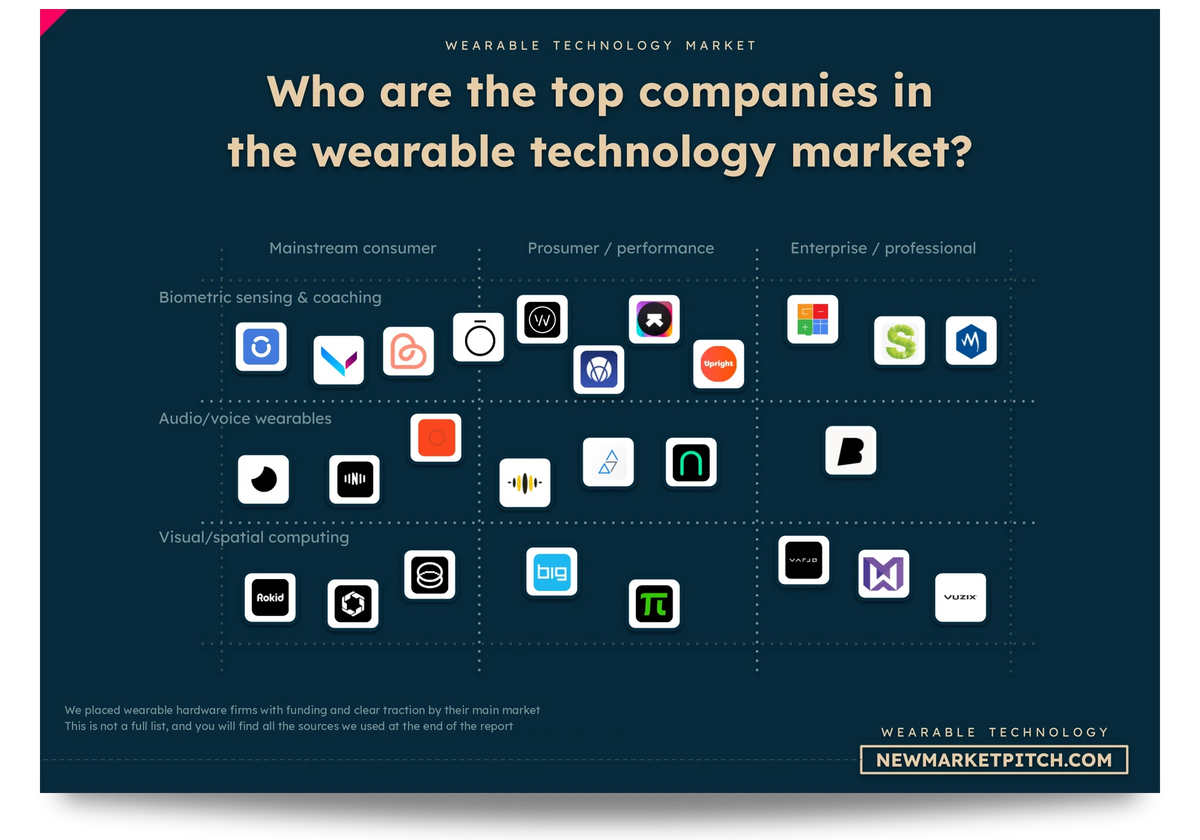
In our research about wearables, we turn what is vague and complex into simple, useful visuals. Market maps like this one show you at a glance where every startup stands.
Do big Silicon Valley VCs control wearable investing?
No, Silicon Valley's best-known VC firms do not control who gets funded in wearable technology.
Khosla Ventures is tied at the top, and Lightspeed Venture Partners has recently joined Nirva's rounds. But Ant Group, London-based Balderton Capital and Pentland Ventures match Khosla's frequency. Legend Capital appears behind VITURE and INAIR, and Fidelity Management & Research Company financed Oura at a much later stage. The names change as soon as we move from brain-sensing caps to smart glasses or established smart rings.
We found 259 named investors backing 99 wearable startups that raised equity. That spread explains why a founder cannot simply send the same pitch to every famous technology fund. A company seeking approval for a new health sensor needs a different backer from a headset maker trying to sell more units. The hardware, distribution channels and timescales are different.
There is still a role for big generalist funds. Khosla has shown it will lead unusual early hardware bets, while Lightspeed is interested in wearable AI. But the idea that a handful of famous US firms decides the future of every wearable product is hard to square with who actually joined the rounds.
Is Khosla Ventures backing health devices or AI wearables?
Khosla Ventures is backing both health monitoring and new AI controls through wearable hardware.
Somnee uses a headband to read brain activity and deliver personalized stimulation for sleep. Clair Health is developing wrist-worn hormonal-health monitoring. Sabi wants a baseball-cap-style device to read neural signals and turn intended actions into computer commands. Each asks the body for information that an ordinary phone cannot easily collect.
The announcements show how broad Khosla's approach has become. Somnee disclosed a Khosla-led financing in June 2025. Clair Health announced Khosla's involvement in June 2026. Then Sabi announced a $50M seed round led by Khosla in October 2026, with a planned demonstration at CES 2027. The products range from sleep support already offered to consumers to an early brain-interface device.
We count Khosla Ventures as the leading seed backer for wearable technology. What connects these investments is a desire to make body signals useful, not a preference for another step counter. Sabi still needs to show that silent neural input works well enough for everyday use. Somnee faces the more familiar challenge of turning a sleep gadget into a lasting customer habit.
Why is Ant Group betting on wearable hardware?
Ant Group is backing wearable devices that could bring AI into daily life without making people reach for a phone.
Its portfolio includes Hypershell, Looki and Future Intelligence. Hypershell sells powered exoskeletons for movement; Looki is building a camera people can wear to capture daily experiences; Future Intelligence works on connected audio devices. These businesses have little in common, but all put technology closer to the user than a desktop screen or smartphone app.
Ant Group led Future Intelligence's announced financing in October 2025. Looki later reported Ant Group as the lead in its Series A. Hypershell's May 2026 announcement named Ant Group and DragonBall Capital as co-leads of a $50M Series B, alongside a new exoskeleton lineup. A wearable camera, an audio device and walking assistance show that Ant Group is testing several ways of making AI useful in the physical world.
There is no evidence here that Ant Group plans to manufacture every kind of wearable itself. Its investments hint at where new ways of using AI devices may show up. Khosla Ventures is also active in unusual devices, but the portfolios do not point to one shared product strategy. That makes the tie at the top more interesting than a simple VC league table.

Your time is limited. In our market report about wearables, we put numbers on each part of the market, so you can see where it makes sense to focus.
Did Oura's giant round make Fidelity a leading wearable investor?
Fidelity Management & Research Company is a major Oura backer, but it is not the most active investor across wearable startups.
Fidelity joined 2 Oura rounds in our coverage. One was the $900M financing announced in October 2025, which Oura said Fidelity led alongside participation from ICONIQ, Whale Rock and Atreides. That figure is the size of Oura's full round, not a disclosed Fidelity check. Frequency and deal size answer different questions, and we rank investors by how often they joined an equity round.
Oura could attract investors that rarely back experimental hardware because its rings were already being sold internationally. It had also expanded the software and health services associated with those devices. By October 2026, Oura reported six million paid members. A business selling a health subscription to an established customer base is a different bet from a startup still proving its first sensor.
Fidelity's role matters most when we ask who backs wearable companies that have already found customers and need to grow. Khosla Ventures and Ant Group appear more often across recent financings, while Fidelity shows that large, established investment firms can become important once a particular wearable company reaches maturity.
Are Oura and Ultrahuman attracting different investors?
Oura and Ultrahuman are attracting different groups of wearable investors, though both want to turn body data into a bigger health business.
Fidelity Management & Research Company is closely associated with Oura's later rounds. Steadview Capital appears in our equity-round coverage for Ultrahuman and Temple Wearables. Ultrahuman announced a separate September 2026 financing involving Qualcomm Ventures, Labcorp, Alpha Wave and Blume, illustrating how additional investors have been drawn to its approach to health monitoring.
The companies are competing over more than the ring itself. Oura combines hardware, sleep and health data, software and subscriptions. Ultrahuman is also trying to connect body measurements across products and services. Their rivalry reached the US patent system: In September 2025, Oura announced a U.S. International Trade Commission ruling in its favor in a patent case against Ultrahuman. That dispute matters to anyone thinking about the cost of growing a hardware brand.
A financier backing Oura's large commercial expansion is solving a different problem from one helping a challenger develop products and distribution. Our investor records show both paths. They cannot tell us which ring will ultimately win, and it would be a mistake to interpret any single financing as a verdict on the whole smart-ring market.
Are Chinese investors becoming important to wearable glasses?
Chinese investors are already backing serious smart-glasses and wearable-display companies, not just conventional consumer electronics.
Legend Capital joined financings for VITURE and INAIR, while Ant Group has looked beyond eyewear to connected cameras, audio devices and powered movement support. VITURE's February 2026 announcement named Legend Capital as the leader of a $100M round for its XR hardware. Those devices aim to deliver large virtual displays through glasses, giving investors a concrete product to assess.
Smart-glasses funding is not all going to the same product idea. IXI is trying to make ordinary prescription glasses adjust focus automatically, with backing from Amazon Alexa Fund. The Subvocal Company is developing glasses that can translate silently formed words into computer input, and Afore Capital appears in its seed financing. A headset for entertainment, adjustable prescription lenses and silent text input have different buyers and technical obstacles.
That range also makes a simple geographic winner hard to name. Investors based in different countries can back devices that sell internationally. What stands out in the rounds we tracked is that wearable eyewear now offers distinct products worth funding, rather than one all-purpose promise about smart glasses.
Will investors fund wearable health sensors before doctors use them?
Wearable health-sensor investors are financing devices during testing, well before hospitals adopt them widely.
Balderton Capital backed SAVA at seed and later joined Pentland Ventures to lead its $19M Series A in July 2025. SAVA is working on a worn biosensor that reads molecules beneath the skin. Its financing followed early clinical results, but the company still had to develop the sensor into a product that people and health providers could rely on. Both firms returned for SAVA's $36M Series B in October 2026, which puts them in the four-way tie at the top of our ranking. Some early investors clearly stay involved as a wearable company moves beyond seed.
Clair Health is pursuing wrist-worn hormone-related insights, with Khosla Ventures leading its announced financing. Somnee approaches sleep through an EEG headband and has already introduced a consumer product. These examples all involve body data, but clinical validation, device reliability and customer adoption carry different weight in each case.
Our rounds show that wearable-health investors will fund promising sensing technology before the full business is proven. That does not make the risks disappear. A strong experiment can justify an early check; reliable readings, a useful product and repeat customers must eventually justify the next one.

In our document detailing everything you need to know about wearable technology, we always try to gather several sources and make estimates that make sense, so you can work with solid numbers.
Do sports wearables still get venture funding?
Yes, investors are still financing sports wearables that help athletes and teams measure something they can act on.
PlayerData began with GPS wearables and has since expanded its connected performance tools. Sports Business Journal reported in May 2026 that Pentland Ventures, Darco Ventures and Bolt Ventures led its Series A. The company has also worked on connected-ball technology, extending its products beyond the original player tracker.
Somnee offers a different sports-related use case. Its headband targets sleep and recovery through brain sensing and personalized stimulation. Somnee joined the NBA Launchpad program, and the NBA later backed the company. Oura has built relationships with sports organizations too, although its rings target a much wider customer base than elite athletes.
These investments show that sports-related wearables are still fundable, but they do not all serve the same buyer. PlayerData sells performance information to teams, Somnee focuses on sleep, and Oura tries to keep customers using health software day after day. A wearable with a clear job has a better story for investors than another device that merely counts activity.
Which wearable technology investors are still investing this year?
Khosla Ventures, Ant Group, Pentland Ventures, Lightspeed Venture Partners, South Park Commons, Afore Capital and Legend Capital are tied as this year's busiest wearable technology investors, with 2 rounds joined each.
Among the 20 investors with the most rounds in our ranking, 14 joined a round this year and 6 have not. Khosla Ventures backed Sabi and Clair Health, Ant Group appeared in Hypershell and Looki, Pentland Ventures backed SAVA and PlayerData, and Lightspeed Venture Partners and South Park Commons both backed Nirva. Legend Capital backed VITURE and INAIR, while Afore Capital supported The Subvocal Company.
The products span smart glasses, personal AI devices and movement-assistance hardware. Fidelity Management & Research Company and Amazon Alexa Fund have not joined a newly identified wearable round this year, despite their earlier work with Oura, IXI and Mentra. A quiet year tells us about new financings, not whether those older investments remain valuable.
The table below shows, year by year, how many rounds 12 of the most active wearable technology investors joined, so it is easy to see who is still investing and who has slowed down.
If you want to go more into detail and see which investors are still writing checks and which have slowed down, please check our wearable technology report.
| Investor | 2024 | 2025 | 2026* | Total |
|---|---|---|---|---|
| Khosla Ventures | 1 | 2 | 3 | |
| Ant Group | 1 | 2 | 3 | |
| Pentland Ventures | 1 | 2 | 3 | |
| Lightspeed Venture Partners | 2 | 2 | ||
| South Park Commons | 2 | 2 | ||
| Afore Capital | 2 | 2 | ||
| Legend Capital | 2 | 2 | ||
| Balderton Capital | 1 | 1 | 1 | 3 |
| Antler | 1 | 1 | 2 | |
| E14 Fund | 1 | 1 | 2 | |
| Bolt Ventures | 1 | 1 | 2 | |
| Steadview Capital | 1 | 1 | 2 |
* 2026: January to 14 November. Darker cells mean more rounds that year. Data from January 2024 through 14 November 2026.
Does a quiet wearable investor mean its startups failed?
No, a wearable investor can go quiet in new funding rounds while the companies it backed keep selling and developing products.
Fidelity Management & Research Company has no newly identified wearable round this year. It previously backed Oura, which has continued building out its health services and membership business. Amazon Alexa Fund backed IXI and Mentra. None of those earlier investments becomes a failure simply because the investor does not appear in a current financing announcement.
The reasons for a gap vary. A company may not need to raise fresh equity. A fund may be waiting for a later stage or may have finished the checks it planned for a particular product. In wearable hardware, long periods can pass between prototype, manufacturing, clinical work and the next round. Counting deals is useful for identifying active backers, but it cannot measure how often investors advise founders or whether their existing companies are making progress.
We can say who is joining disclosed equity rounds today. We cannot turn an investor's absence into evidence that it has stopped helping its portfolio or lost faith in wearables. That conclusion would require facts that new-deal counts alone do not contain.
Can newcomer VC firms still get into wearable technology?
Yes, VC firms with little recent wearable history are getting into the market through AI companions, smart glasses and new computer controls.
Lightspeed Venture Partners and South Park Commons appear in the Nirva financings, and Afore Capital backed The Subvocal Company. Legend Capital appears behind VITURE and INAIR. These investors first show up in our covered wearable rounds this year, but they are not all betting on the same device. Nirva uses a pendant for personal AI assistance, while The Subvocal Company is developing glasses that read silent mouth movements.
South Park Commons discussed Nirva in July 2026 and returned to the company in an October update. VITURE announced new XR hardware alongside a Legend-led financing. Both cases suggest that investors are looking at the product experience and its likely users, rather than merely buying into the word 'wearable.'
That gives founders outside the traditional fitness-tracker category a way to find backers. They still need a useful device people will want to wear. A novel interface can get a meeting; making it accurate, comfortable and worth paying for is the more demanding part of winning investment.
Are AI pendants taking investors away from smartwatches?
AI pendants have not displaced smartwatches or smart rings as a focus for wearable investors.
Lightspeed Venture Partners and South Park Commons joined Nirva's financing as the company developed a pendant built around personal speech and memory. Friend takes a more conversational approach to an AI necklace, with backing from individual technology founders and an evolving product that can speak to its wearer. Both projects suggest people are exploring new ways to use AI without staring at a phone.
The broader investor picture is less one-sided. Fidelity backed Oura's established smart-ring business. Khosla Ventures funded a sleep headband, a hormone-monitoring wrist device and a brain-reading cap. Ant Group backed exoskeletons, connected audio and a wearable camera. Several different ideas for everyday body-worn computing are getting attention at the same time.
AI pendants still have to prove that customers want to keep them on, trust what they record and pay for their services. There is not enough evidence that pendants have replaced watches or rings as the favored wearable bet. For now they have opened a new lane alongside products that already serve clear health, sports or mobility needs.

Our report covering the wearable technology market gets updated several times a month, so you always get the latest view of where things stand.
Is Amazon's Alexa Fund still investing in smart glasses?
Amazon Alexa Fund has a clear history in wearable eyewear, but we find no new smart-glasses equity round joined by the fund this year.
The fund backed Mentra and IXI, with 2 wearable rounds recorded last year. IXI is developing autofocus prescription lenses that can respond to the wearer's viewing distance. Mentra has worked on smart glasses that developers can build applications for. Neither company is simply copying a smartwatch with a screen attached.
Amazon itself explained the direction in March 2025. It described the Alexa Fund as moving beyond voice assistants into AI-enabled hardware and other new computer interfaces. Amazon's technical coverage of IXI also focused on making vision correction more convenient in ordinary glasses, a specific problem people already understand.
That makes Alexa Fund relevant to founders building wearable interfaces, even without a fresh disclosed deal this year. But past backing does not establish a current investment pace, and it does not promise that Amazon will lead the next eyewear company. The evidence supports an ongoing connection to the category, not a claim that the fund currently leads its financing.
What are smart-glasses investors actually paying for?
Smart-glasses investors are backing very different uses for eyewear, from bigger digital displays to better vision and silent computer input.
VITURE makes head-worn XR displays and announced a $100M financing led by Legend Capital in February 2026. IXI is designing prescription glasses with automatically adjustable lenses, with support from Amazon Alexa Fund. The Subvocal Company is developing eyewear that picks up silent mouth movements so users can control software without speaking aloud. These products share a form factor but have different jobs.
The tests for success differ too. A VITURE customer must find the visual experience and comfort worth the price. IXI needs to prove that its optics work reliably in everyday life. The Subvocal Company needs input that is faster or easier than typing or speaking. None can rely indefinitely on excitement around AI glasses if the actual device is awkward to use.
This is why the names of their backers are useful. Legend Capital is financing XR display products; Amazon Alexa Fund has backed an everyday vision problem; Afore Capital has joined an experiment in silent control. A wearable founder will learn more by looking at those precise bets than by asking which investor likes 'AI hardware' in general.
Which wearable technology investors back seed rounds, and which back growth rounds?
Seed is the busiest known stage for wearable technology rounds, with 68 of the 132 rounds that have a named investor and a known stage, and Khosla Ventures leads at seed with 3.
Much later, Fidelity Management & Research Company leads at Series D and later with 2 rounds; Series C and later account for 20 rounds in the market. Between those stages, Ant Group and Pentland Ventures are tied at Series A with 2 rounds each. These are different jobs: Khosla Ventures has backed early sensing and neural-input experiments, Pentland Ventures helped SAVA and PlayerData develop, and Fidelity financed an established smart-ring company.
An investor that pays for an early sensor prototype may not be the right one to finance factories, distribution or a large consumer business. Some investors do follow companies into later rounds, as Balderton Capital did with SAVA from seed to Series B. Still, the investors most active at one stage are not necessarily the investors founders will want at the next.
The table below shows, for 12 of the most active wearable technology investors, how many rounds they joined at each stage, from seed to growth.
If you want to go more into detail and see where each investor places its bets, from seed to growth, please check our wearable technology report.
| Investor | Seed | Series A | Series B | Series C | Series D+ | Growth |
|---|---|---|---|---|---|---|
| Khosla Ventures | 3 | · | · | · | · | · |
| Ant Group | · | 2 | 1 | · | · | · |
| Balderton Capital | 1 | 1 | 1 | · | · | · |
| Pentland Ventures | · | 2 | 1 | · | · | · |
| Lightspeed Venture Partners | 2 | · | · | · | · | · |
| Fidelity Management & Research Company | · | · | · | · | 2 | · |
| South Park Commons | 2 | · | · | · | · | · |
| Afore Capital | 2 | · | · | · | · | · |
| Antler | 2 | · | · | · | · | · |
| E14 Fund | 1 | · | · | · | · | · |
| Bolt Ventures | 1 | 1 | · | · | · | · |
| Legend Capital | · | 1 | 1 | · | · | · |
Most active at each stage, among all wearable technology investors: Seed, Khosla Ventures · Series A, Ant Group and Pentland Ventures · Series B, no investor joined more than one round · Series C, no investor joined more than one round · Series D+, Fidelity Management & Research Company · Growth, no investor joined more than one round. Bigger dots mean more rounds. Data from January 2024 through 14 November 2026.
Are powered exoskeletons actually attracting big investors?
Yes, powered exoskeleton startups now attract well-known investors and funding for products already being sold or tested with users.
Hypershell is building devices worn around the lower body to assist walking and outdoor movement. Its May 2026 announcement described a $50M Series B co-led by Ant Group and DragonBall Capital, plus new products and international distribution. The pitch is easy to understand: make physically demanding movement less tiring, then persuade people to keep wearing the machine.
WIRobotics provides a different example. Its WIM wearable helps people walk, and the company has used experience from that product as it expands into broader robotics. In May 2026, WIRobotics announced a $68M Series B that included Hana Ventures. Its release discussed commercial sales and real-world deployment, giving backers something beyond a video demonstration to evaluate.
Neither investment means exoskeletons will become as common as smart rings. Weight, reliability, comfort, battery life and repeat use all matter. But the category has moved beyond laboratory curiosity: investors are backing companies with physical products, new generations of hardware and plans to reach more customers.

In our research about wearables, we look at what the winners do differently, so you can learn from the best instead of guessing.
Which wearable technology investors most often invest together?
Wearable technology has no dominant investor pair: the 8 pairs in our table are tied with 2 rounds joined together each.
Balderton Capital and Pentland Ventures head the list, having joined SAVA's Series A and Series B together. Anatoly Yakovenko and Aravind Srinivas recur in rounds for Friend, while Hannah Grey Ventures and Konvoy Ventures recur for Afference. Lightspeed Venture Partners and South Park Commons also joined both of Nirva's rounds. Those relationships matter to the startups involved, but they do not necessarily describe investors working together across many different wearable companies.
Several other top pairings involve the same group of individuals around Friend, including Cory Levy and Raj Gokal. A repeated pair can simply mean that several backers supported the next round of the same startup. We count each named shared round; the list says nothing about the private size of an investor's check or whether the pair will join another deal.
The table below lists the pairs of wearable technology investors named together in at least two equity rounds, with the startups they backed together.
If you want to go more into detail and see which investor networks back the same startups, please check our wearable technology report.
| Investor pair | Rounds together | Startups backed together |
|---|---|---|
| Balderton Capital + Pentland VenturesSAVA | 2 | SAVA |
| Anatoly Yakovenko + Aravind SrinivasFriend | 2 | Friend |
| Anatoly Yakovenko + Cory LevyFriend | 2 | Friend |
| Anatoly Yakovenko + Raj GokalFriend | 2 | Friend |
| Aravind Srinivas + Cory LevyFriend | 2 | Friend |
| Aravind Srinivas + Raj GokalFriend | 2 | Friend |
| Cory Levy + Raj GokalFriend | 2 | Friend |
| Hannah Grey Ventures + Konvoy VenturesAfference | 2 | Afference |
Pairs of investors named in the same equity round. Data from January 2024 through 14 November 2026.
Do famous tech founders dominate AI wearable startup funding?
No, well-known technology founders have helped finance AI wearables, but they do not dominate the wider wearable investor market.
Friend brought in individual backers including Anatoly Yakovenko, Aravind Srinivas, Cory Levy and Raj Gokal. It promoted a necklace-style AI companion instead of a fitness device, and TechCrunch covered its investor group in July 2024. The company later changed how the product interacted with users, showing how quickly an early wearable AI idea can evolve.
Several pairs involving these individuals recur in our shared-round analysis, but their appearances center on Friend. Compare that with Lightspeed Venture Partners and South Park Commons backing Nirva together, or with Fidelity's earlier financing of Oura. A familiar name around one product should not be confused with repeat funding across rings, clinical sensors, XR headsets and movement assistance.
A founder with a famous individual investor may gain advice, introductions and public attention. We cannot tell from an announced round what that person invested personally. The useful question is whether their help fits the company's next hurdle, and that answer is not the same for an AI pendant and a health device.
So, who actually funds wearable startups today?
Khosla Ventures, Ant Group, Balderton Capital and Pentland Ventures are tied as the busiest wearable technology investors, with 3 equity rounds joined each, but the right backer depends on the device and its stage.
Khosla Ventures leads seed activity, Ant Group is active across AI-linked wearables, and Fidelity Management & Research Company stands out later in the life of a successful smart-ring brand. Balderton Capital and Pentland Ventures have stayed with SAVA, Lightspeed Venture Partners and South Park Commons have joined Nirva's rounds, Legend Capital has backed wearable displays, and Amazon Alexa Fund previously supported connected eyewear. Those investments are different enough that a founder should look at the actual companies an investor backed, rather than rely on a famous name.
The most frequent participant is not necessarily the one financing the largest round. Oura's growth funding shows why a later-stage firm can be crucial to a single company without topping a market-wide count. And a seed backer can take a major early risk without being the natural investor for the next phase of manufacturing and distribution. We count rounds joined and led; no public record lets us turn each entire round into an individual's or firm's check.
The table below shows what we found.
| Question | Answer |
|---|---|
| Can corporate investors rival Silicon Valley VCs? | Yes, corporate backing shares the wearable activity lead with VC firms. Ant Group tied Khosla Ventures at 3 joined rounds. That makes corporate investors impossible to ignore in wearable hardware. |
| Does one huge deal decide who's busiest? | No, a giant company round can have relatively few repeat backers. Fidelity joined 2 Oura rounds, including its $900M financing. Deal frequency and the size of a round tell different stories. |
| Are early wearables still finding willing backers? | Yes, investors keep financing devices before they reach mass adoption. Seed represents 68 of the 132 rounds with named investors and known stages. That leaves considerable room for companies still proving their products. |
| Will a seed investor always fund growth? | No, a seed check does not promise another at scale. Khosla Ventures led 3 wearable seed rounds we counted. Later manufacturing and distribution may require other investment firms. |
| Does a quiet investor mean a failed bet? | No, a pause in disclosed rounds says little about product sales. Fidelity has no newly identified wearable equity round this year. Its relationship with Oura still matters to that company. |
| Are powered wearables drawing serious company money? | Yes, exoskeleton investors now finance products that assist real movement. Ant Group co-led Hypershell's $50M Series B financing. That brings powered mobility into the wider wearable investment picture. |
| Can new computer interfaces attract major VC firms? | Yes, familiar investors are backing unfamiliar ways to use computers. Lightspeed Venture Partners joined 2 rounds for Nirva. Investors are looking beyond watches toward devices people interact with daily. |
| Can sports wearables still attract repeat investors? | Yes, performance technology still gives specialized backers reasons to return. Pentland Ventures backed PlayerData and SAVA in our coverage. Those bets reach sports measurement and wearable health through different products. |
| Do all smart-glasses investors want the same product? | No, eyewear investors are solving different problems for their customers. Legend Capital backed VITURE while Amazon Alexa Fund backed IXI. Virtual displays and adjustable prescription lenses are distinct products. |
| Are repeat investment partners building large wearable alliances? | Rarely, because shared investments often remain tied to one startup. We found 8 leading pairs with 2 shared rounds each. SAVA and Friend show how backing one company creates recurring pairs. |
| Is a small circle controlling wearable startup funding? | No, the investor field is broad despite recognizable leading names. We identified 259 named investors across 99 funded wearable startups. The relevant backer changes by product, stage and commercial needs. |

Theory only gets you so far. In our market report about wearables, we dig up the real signals from the field and show you the ones worth watching.
Our methodology
Our data runs through November 14, 2026. We systematically tracked wearable technology equity rounds deal by deal since January 2024, a window long enough to identify investors active in today's market. We define wearable technology as independent companies built around electronic devices worn on the body and integrated with software or other digital systems. We include rings, hearables, smart glasses, XR headsets, sensor garments, neural-input wearables, safety devices and powered exoskeletons, including companies on the border of related fields such as femtech and remote patient monitoring. We exclude implants, standalone software, non-worn devices and diversified incumbents without a wearable-first identity. Every company counted qualifies as a startup under our definition.
We count the equity rounds an investor joined and the rounds it was named as leading, not the amount the investor personally committed, which is seldom public. We exclude IPOs and offerings after a stock-market listing because these are not private startup rounds joined by investors. We take named participants from company announcements and reliable reporting, merge variant names for the same investor, and merge duplicate reports of a round. References to unnamed "existing investors" or "angel investors" do not count as identified participants. Our current-year activity column starts in March, once the year has enough observations to be useful. A funding round can appear under multiple investors, whereas a deal tracker counts that round once; rounds with no named participant do not appear in investor rankings.
Announcements name lead investors more reliably than smaller participants, so rounds that an investor joined without leading are undercounted and lead rates are an upper bound.
Rounds confirmed by a company announcement, a press article or a regulatory filing are counted in full. Where no article exists, a round is counted only when at least two recognised databases agree on its date (within one month) and amount (within 5%), and it is marked as low confidence; a round found in a single database stays in the company's history but is left out of totals. For companies that have raised more than $100M, every round counted is backed by an article.
We do not use investor lists from commercial databases such as Crunchbase or PitchBook on their own. They may misattribute earlier backers to a new round or mix equity with debt and grants, so we check the underlying announcement and exclude uncertain investor names. Of 176 counted equity rounds, 148 name at least one investor, representing 84%. That means every investor's identifiable round count is a floor, not a claim that all investment activity is visible.
The obvious objection is that a famous fund may matter more than an unfamiliar investor with more rounds. We agree that influence can mean different things, which is why we separate rounds joined, rounds led, stage and current activity. We do not rank investors by the total size of the rounds they joined: the figure belongs to the company and all participants, not to one investor's check. This keeps a single very large growth financing from being mistaken for repeated direct investment throughout the market.
Key sources include Sabi announces Khosla-led seed financing and its brain-interface cap, Somnee's official press chronology and sleep-headband launches, Clair Health's Khosla-led wearable hormone-monitor financing, Hypershell announces Ant-backed financing and exoskeleton products, Looki financing led by Ant Group, Oura confirms Fidelity-led growth financing and other participants, Oura confirms earlier financing with Fidelity and Dexcom, Oura's official history of IPO, launches and partnerships, Oura's September 2025 trade ruling against Ultrahuman, Oura reports growth in paid members, Balderton describes SAVA's seed funding and sensor technology, Balderton and Pentland Ventures co-lead SAVA's Series A, South Park Commons explains its Nirva wearable investment, South Park Commons describes Nirva's subsequent financing, VITURE describes Legend Capital's financing and XR hardware, Amazon explains Alexa Fund's shift toward AI hardware, Amazon describes IXI's adaptive eyewear technology, Ultrahuman announces investors and its expanded health-device ambitions, PlayerData's financing and sports-technology products, NBA follow-on investment in Somnee after Launchpad participation, WIRobotics names Hana Ventures and details WIM commercialization, Friend's individual technology-founder investors, and SAVA's October 2026 Series B and its investors.

In our document detailing everything you need to know about wearable technology, we don't want to repeat what boring consulting reports say. Instead, we show you the real and latest market signals that matter.
Written by the New Market Pitch teamWe track new markets so founders and investors can move faster. About us