Wearables: what are the biggest unsolved problems?
Whether you're building or investing in the wearable technology market, our report covers everything you need to know: the players, the money, and what's coming next.
Summary
The biggest unsolved problems in wearables are unreliable health measurements, limited proof that health recommendations improve outcomes, and the difficulty of delivering enough everyday value to keep people using these devices.
Worldwide wearable shipments reached 145.7 million units in the first quarter of 2026, but roughly two-thirds were hearables. The industry's enormous shipment volumes can obscure how much harder it is to build a dependable health-monitoring device than a useful pair of wireless earbuds.
Sensor accuracy remains surprisingly uneven. Heart-rate measurements can achieve average errors around 3%, while estimates of physical-activity intensity show errors ranging from 29% to 80%. A smartwatch can measure someone's pulse accurately and still be badly wrong about the calories they burned.
Noninvasive glucose monitoring and cuffless blood pressure measurement remain two of the most valuable unsolved technical challenges. Smartwatches can already screen for possible hypertension, but screening is very different from delivering a dependable blood pressure reading.
Sleep and recovery scores create another problem: false precision. WHOOP, Oura, and Garmin turn multiple physiological measurements into convenient numbers, but those proprietary scores have not been proven to consistently improve training or health outcomes when followed.
Medical detection has advanced faster than evidence of medical benefit. The Apple Heart Study demonstrated that wearables can identify meaningful heart-rhythm abnormalities, yet the industry still needs stronger evidence showing how many strokes, hospitalizations, and other serious complications these alerts actually prevent.
Fitness trackers can increase physical activity, particularly when combined with goals and coaching. But improving step counts does not automatically reduce sedentary time, and the long-term benefits of continuously following wearable recommendations remain uncertain.
Retention may be as important as better sensors. Users can lose interest once their measurements become predictable, while subscriptions make them question whether another sleep score or recovery chart is worth paying for every month.
Wearable health data also needs to become more reliable across different people and more useful to doctors. Optical sensors can behave differently depending on measurement conditions and individual characteristics, while clinicians often lack the context and validated workflows needed to act on consumer-generated information.
Battery life, repairability, privacy, and affordability are becoming harder to ignore. Screenless devices can operate for more than two weeks between charges, but full smartwatches face tougher power constraints, and sophisticated health monitoring is difficult to justify if the device is expensive to maintain or uncomfortable to use continuously.
The industry's next major breakthrough may come from a better sensor, but the larger opportunity is proving what people should actually do with the data. Companies that can connect dependable measurements to useful decisions and measurable health improvements will have a stronger advantage than those simply collecting more information.

Written by the New Market Pitch teamWe track new markets so founders and investors can move faster. About us
Why are wearables still struggling when so many people already use them?
Wearables are selling in huge numbers, but the industry still struggles to turn all the health data these devices collect into advice people can genuinely trust.
According to IDC's July 2026 market update, worldwide wearable shipments reached 145.7 million units in the first quarter of 2026, up 4.3% year over year. Hearables accounted for roughly two-thirds of those shipments, while smart rings and glasses were among the fastest-growing categories. IDC expects the overall market to approach 693 million annual shipments by 2030.
There is an interesting gap in these numbers. Most wearable shipments come from devices people use for straightforward activities such as listening to music, making calls, and communicating hands-free. Health-focused wearables have a harder job. They need to measure biological signals accurately, explain what those measurements mean, and give people a reason to keep using them.
Three problems run through the industry. First, sensors are getting better faster than the science behind some of their interpretations. Second, detecting a possible health issue is much easier than proving that acting on the warning improves someone's health. Third, the continuous monitoring needed to deliver those benefits creates problems around battery life, privacy, affordability, and everyday comfort.
These problems affect different products in very different ways. A running watch can be extremely useful despite imperfect calorie estimates, while a device claiming to measure blood glucose needs a much higher standard of accuracy.
Are smartwatch health sensors accurate enough today?
Smartwatch sensors are currently reliable for several basic measurements, especially heart rate, but some of their most popular health metrics still have surprisingly large errors.
A 2024 umbrella review published in Sports Medicine examined 24 systematic reviews covering 249 validation studies and approximately 430,000 participants. It found heart-rate measurement bias around ±3%, while estimates of physical-activity intensity showed mean absolute errors ranging from 29% to 80%, depending on activity intensity.
A separate Apple Watch meta-analysis published in npj Digital Medicine in 2026 reviewed 82 studies involving 430,052 participants. The average heart-rate bias was only -0.27 beats per minute, although individual readings varied more widely. The researchers found moderate accuracy for sleep and step counting, while energy expenditure estimates were frequently much less reliable.
Calories are a good example. Smartwatches estimate energy expenditure using movement, heart rate, personal characteristics, and algorithms. They do not directly measure the body's metabolic activity. An earlier review of 47 validation studies reported energy-expenditure errors of 10% to 40% in many wrist-worn devices.
For someone whose watch reports 600 calories burned during exercise, a 30% error represents 180 calories. That's a pretty meaningful difference if the person uses the estimate to decide how much to eat.
The pattern is fairly clear across the studies we reviewed. Heart-rate monitoring has become dependable enough for many fitness applications, but calorie expenditure and detailed sleep measurements have not improved to the same degree. Manufacturers can measure certain signals quite accurately while still struggling to interpret what those signals say about the body.
| Wearable measurement | Current performance | Biggest remaining problem |
|---|---|---|
| Heart rate | Generally accurate during ordinary activities | Motion and individual measurement errors |
| Step count | Reasonably accurate during steady walking | Slow walking, unusual gait, and nonwalking movement |
| Calories burned | Frequently large estimation errors | Individual differences in metabolism |
| Sleep duration | Useful for tracking broad patterns | Confusing quiet wakefulness with sleep |
| Sleep stages | Moderate accuracy | Distinguishing light, deep, and REM sleep |
| Blood oxygen | Low average bias in some studies, but wide individual errors | Reliability across conditions and populations |
| Estimated VO2 max | Useful for trends, with variable accuracy | Indirect estimation of aerobic capacity |
| Atrial fibrillation | Clinically useful in validated applications | Missed episodes and appropriate follow-up |

A good product starts with a real problem. In our report covering the wearable technology market, we show you the ones customers still live with.
Can smartwatches finally measure blood glucose without needles?
No commercially established smartwatch can currently measure blood glucose noninvasively with the accuracy needed to replace conventional glucose monitoring.
In February 2024, the FDA warned consumers against smartwatches and smart rings claiming to measure blood glucose without penetrating the skin. The agency said it had not authorized, cleared, or approved any such devices for that purpose.
Companies such as Dexcom and Abbott already provide continuous glucose monitoring systems that connect to smartphones and smartwatches. Their sensors measure glucose in interstitial fluid through a small filament placed beneath the skin. The watch displays the data, but it does not independently measure glucose.
The technical problem is enormous. Blood glucose readings must be accurate enough to support decisions about insulin, food, and medication. Optical methods have to distinguish glucose-related signals from the effects of skin, tissue, hydration, temperature, and movement.
A successful noninvasive glucose sensor could reach far beyond diabetes management. It could support metabolic-health monitoring for much broader populations. But the commercial opportunity doesn't make the underlying science any easier.
Noninvasive glucose monitoring remains one of the biggest potential breakthroughs in wearables. There's a huge difference between a promising laboratory result and a consumer device that can provide safe, dependable readings throughout everyday life.
Can a smartwatch really detect high blood pressure?
Smartwatches can now help identify people who may have hypertension, but reliable blood pressure measurement without a cuff remains an open problem.
Apple received FDA clearance for its hypertension notification feature in September 2025. The system examines patterns in optical heart-sensor data associated with possible high blood pressure and recommends follow-up using a traditional blood pressure cuff.
That's meaningful progress. A device someone already wears every day could encourage people with previously undiagnosed hypertension to get tested.
However, the feature does not provide a conventional blood pressure reading such as 120/80 mmHg. It identifies patterns associated with possible hypertension rather than directly measuring systolic and diastolic pressure.
WHOOP has also introduced blood pressure insights in its higher-end health offering. These wellness estimates face a similar challenge: blood pressure changes with posture, exercise, stress, medication, and time of day, while optical signals are also affected by movement and sensor contact.
The distinction is important for consumers. Screening for possible hypertension can be useful even when a device cannot tell someone their exact blood pressure.
For now, validated cuff-based monitors remain the reference for routine home measurement and clinical decisions. Wearable hypertension screening is advancing faster than dependable cuffless measurement.

If you build or invest in the wearable technology market, you need to know which business models pay off now and which ones are fading. That's why our report covering it has a whole section on it.
Why do sleep trackers still get sleep stages wrong?
Sleep trackers can estimate when someone sleeps fairly well, but identifying exactly how much time they spend in each sleep stage remains much less reliable.
Clinical sleep studies use polysomnography, which records brain electrical activity, eye movements, muscle activity, and other physiological signals. Watches and rings normally infer sleep stages from movement, heart rate, heart-rate variability, and temperature.
That explains much of the accuracy gap. A wrist sensor cannot directly observe the brain activity used to classify sleep stages in a laboratory.
The 2026 Apple Watch meta-analysis found only moderate overall accuracy for sleep measurements. The earlier Sports Medicine umbrella review also identified a tendency for consumer wearables to overestimate total sleep time.
Companies such as Oura, WHOOP, Garmin, and Fitbit can give users detailed nightly charts, percentages of REM and deep sleep, and numerical sleep scores. Those displays can look extremely precise even when the underlying classification contains substantial uncertainty.
A person might therefore receive a poor sleep-stage score despite feeling well rested, or a good score despite spending long periods awake.
For tracking bedtime consistency and longer-term sleep duration, these devices are genuinely useful. We would be much more careful about treating a reported 72 minutes of deep sleep as an exact biological measurement.
Can WHOOP, Oura, and Garmin really tell when your body has recovered?
Recovery scores from WHOOP, Oura, and Garmin are useful for spotting personal trends, but there is still limited evidence that their exact scores reliably tell people how ready their bodies are to perform.
WHOOP bases its recovery assessment on measurements such as heart-rate variability, resting heart rate, and sleep. Oura combines several physiological signals into readiness and resilience scores. Garmin uses heart-rate variability, sleep, training load, and related measurements to guide training decisions.
All three approaches rely partly on genuine physiological relationships. Heart-rate variability, for example, can change with training fatigue, illness, alcohol consumption, stress, and sleep quality.
The harder question is what a particular number means. One platform might suggest rest while another considers the same person sufficiently recovered, because each company uses its own algorithms, reference ranges, and weightings.
There is also a difference between predicting a person's subjective readiness and demonstrating that following the recommendation improves their performance.
If an athlete consistently changes training intensity according to a wearable recovery score, we would want to know whether that athlete performs better, experiences fewer injuries, or recovers faster than someone following an established training plan.
Until larger controlled studies settle those questions, recovery scores are best treated as additional information alongside how someone feels, their training history, and their actual performance. A red recovery score is not automatically a reason to cancel a workout.
If you want more recent data on this point, please see our latest wearable technology market report.

Learning from others' mistakes is the cheapest lesson there is. In our market report about wearables, we look at what broke startups before you, so you don't repeat it.
Can smartwatches detect serious diseases without creating false alarms?
Wearables can already detect some meaningful health abnormalities, particularly irregular heart rhythms, but the balance between useful early warnings and unnecessary medical follow-up remains difficult.
The Apple Heart Study, published in the New England Journal of Medicine in 2019, enrolled 419,297 participants. Only 0.52% received irregular-pulse notifications. Among 450 notified participants who later returned analyzable ECG patches, atrial fibrillation was detected in 34%.
Those results are often misunderstood. The 34% figure does not mean the remaining 66% received false alarms. Atrial fibrillation can come and go, and the ECG patches were applied an average of 13 days after the initial alert. When irregular-pulse notifications coincided with ECG monitoring, the positive predictive value reached 84%.
We can see why this category has expanded. Apple has since introduced FDA-cleared screening features for sleep apnea and hypertension, moving beyond heart-rhythm notifications into other conditions.
But detecting more abnormalities also means more follow-up appointments and tests. Some will identify important problems early, while others will provide little medical benefit.
The next challenge is measuring actual health outcomes. How many strokes, hospitalizations, or serious complications are prevented because someone received a wearable alert? How many additional tests are needed to achieve those results?
There is strong evidence that certain wearable screening features can detect real conditions. The evidence for their broader effect on healthcare outcomes is still developing.
Do fitness trackers actually make people healthier?
Fitness trackers can help people become more active, but buying a wearable does not automatically lead to lasting improvements in health.
A 2025 systematic review published in the Journal of Medical Internet Research analyzed 23 randomized trials involving 4,566 older adults. Tracker-based interventions increased physical activity and daily step counts compared with usual care immediately after intervention. However, the researchers did not find a statistically significant reduction in sedentary time.
That's an interesting distinction. Someone can increase their daily step count through planned walks while continuing to spend most of the day sitting.
The studies also frequently involved more than simply handing participants a device. Goals, reminders, feedback, coaching, or other structured support helped encourage activity.
That makes it harder to determine how much of the improvement comes from the wearable itself.
The bigger unanswered question concerns long-term clinical outcomes. A higher step count is encouraging, but it does not automatically demonstrate fewer cardiovascular events, lower mortality, or reduced healthcare spending.
Wearables seem to work best when they support a specific behavioral goal. Someone using a watch to build a consistent walking routine has a clearer benefit than someone collecting dozens of metrics without changing anything. The broader promise of continuously improving health through passive monitoring still needs much stronger proof.
If you want more recent data on this point, please see our latest wearable technology market report.

When you build or invest in the wearable technology market, you need clarity, not confusion. In our document detailing everything you need to know about wearable technology, we always try to put numbers on and quantify whatever is usually vague and confusing.
Why do people eventually stop using fitness trackers?
People often stop using fitness trackers when the initial excitement wears off and the device stops telling them anything especially useful.
A 2026 study published in the Journal of Enterprise Information Management examined why former fitness-tracker users discontinued using their devices. The reasons included technical limitations, tracking anxiety, declining motivation, privacy concerns, and a lack of perceived value.
These problems can reinforce each other. Someone who checks their sleep and activity scores every morning may initially find the information motivating. After several months, the same metrics can become repetitive, especially if the device offers few practical recommendations.
Subscriptions add another layer. A person paying every month for recovery or sleep analysis needs to see some continuing benefit from the information.
Switching between brands can also be frustrating. Apple Health and Google Health Connect support the exchange of certain health measurements, but proprietary scores and personalized recommendations do not transfer easily between Oura, WHOOP, Garmin, and other platforms. Users may retain some raw data while losing the way their previous device interpreted it.
We should be careful about claiming a universal abandonment rate. Different studies count temporary breaks, device replacement, and permanent discontinuation differently.
Still, the underlying challenge is easy to recognize: once users understand their normal habits, a wearable needs to offer something more valuable than another chart showing approximately the same numbers.
Is wearable battery life still a big problem?
Battery life remains a serious limitation for feature-rich smartwatches, although rings and screenless fitness trackers have already shown that continuous monitoring can work for much longer between charges.
Apple's Watch Series 11 was rated for up to 24 hours of normal use, while Oura advertised approximately five to eight days for Ring 4 and WHOOP more than 14 days for its fifth-generation sensor.
These products have very different power requirements. Apple Watch supports a bright screen, applications, wireless communication, GPS, and frequent interactions. Oura and WHOOP avoid the energy demands of a conventional smartwatch display.
Across a 30-day period, a device delivering 24 hours per charge creates roughly 30 charging cycles. A seven-day device needs approximately five, and a 14-day device around three. Real-world results depend on usage and charging habits.
The difference becomes particularly important when people want uninterrupted sleep and recovery monitoring. Taking off a device overnight can interrupt the very measurements that make it useful.
Battery improvements are also tied to repairability. Rechargeable batteries degrade over time, and replacing the battery inside a tiny waterproof device is often difficult.
The industry has largely demonstrated that long battery life is possible in specialized wearables. What remains difficult is combining long endurance with the screen, connectivity, computing power, and health-monitoring capabilities of a full smartwatch.
| Wearable | Manufacturer-stated battery life | Main compromise |
|---|---|---|
| Apple Watch Series 11 | Up to 24 hours | Large interactive display and extensive functionality |
| Apple Watch Series 11, Low Power Mode | Up to 38 hours | Reduced background functionality |
| Oura Ring 4 | Approximately 5-8 days | No interactive screen |
| WHOOP 5.0 | More than 14 days | Screenless design focused on monitoring |
| WHOOP MG | More than 14 days | Specialized health features without smartwatch interface |
| Screenless fitness trackers generally | Often several days or longer | Limited on-device interaction |
| Smartwatches during extended GPS activity | Highly dependent on usage | GPS and continuous tracking increase power consumption |
If you want more recent data on this point, please see our latest wearable technology market report.

In our report covering the wearable technology market, we look at what the winners do differently, so you can learn from the best instead of guessing.
Do wearable health sensors work equally well on everyone?
Wearable sensors still perform differently across individuals, and manufacturers need much stronger evidence that their health measurements work reliably across diverse populations.
Optical sensors are particularly sensitive to measurement conditions. Skin pigmentation, temperature, circulation, motion, and sensor positioning can all influence the light signals used to estimate physiological measurements.
A 2024 systematic review published in the Journal of Medical Internet Research examined wearable photoplethysmography measurements across different pigmentation groups. It identified variation in oxygen-saturation errors, although the overall pulse-rate analysis did not establish a significant bias associated with skin pigmentation.
In January 2025, the FDA proposed updated guidance for medical pulse oximeters, calling for stronger testing across skin tones and more representative study populations.
That guidance primarily concerns medical pulse oximeters, but the underlying optical measurement problems are relevant to many consumer wearables.
Another issue is the quality of validation research. In the 2026 Apple Watch meta-analysis, the median study involved only 44 participants, even though the combined participant count exceeded 430,000. Most participants came from a small number of very large studies, while many individual measurement tests used much smaller samples.
A device can therefore have a substantial published evidence base overall while some specific features remain supported by relatively limited research.
Consumers should be able to find out how accurately a device performs for their health metric, activity, and relevant physiological characteristics. Today, that information is often difficult to obtain.
Why don't doctors use more data from smartwatches?
Doctors still make limited routine use of wearable data because most consumer measurements arrive without the validation, context, and clinical workflow needed to act on them safely.
Apple Health, Google Health Connect, and other platforms have made it easier to collect information from multiple devices. That helps consumers maintain personal records, but it does not automatically produce information clinicians can use to diagnose or treat a condition.
Consider an irregular-heartbeat notification. A cardiologist may need the original ECG tracing, the time of the event, the patient's symptoms, medication history, and confirmation that the recording was technically reliable.
A daily recovery score or a chart of heart-rate trends may offer useful context, but it is generally much harder to translate into a treatment decision.
Apple's sleep apnea notification feature shows how the gap can be narrowed. Users can export reports and discuss their results with healthcare professionals, who can then decide whether formal sleep testing is appropriate.
There is also a workload problem. If millions of people continuously share health data, doctors need systems that identify the small fraction of information worth reviewing.
For wearables to become a routine part of healthcare, manufacturers and providers will need clearer standards for clinical accuracy, data exchange, alert management, and responsibility for follow-up.

Your time is limited. In our research about wearables, we put numbers on each part of the market, so you can see where it makes sense to focus.
Can wearable companies really protect all this personal health data?
Wearables create unusually sensitive privacy risks because they can accumulate years of information about someone's health, movements, routines, and behavior.
A smartwatch may record heart rhythms, sleep patterns, physical activity, location, and reproductive-health information. Individually, many measurements appear harmless. Combined over long periods, they can reveal far more about a person's private life.
The Federal Trade Commission updated its Health Breach Notification Rule in 2024 to clarify coverage of certain health applications and connected technologies outside traditional HIPAA-regulated healthcare.
Earlier FTC enforcement actions involving GoodRx and the Premom fertility application showed how sensitive health information could be exposed through commercial data-sharing practices. Those cases did not primarily concern smartwatch hardware, but they are relevant because wearable data often passes through connected applications and services.
The risks extend beyond hacking. Users can grant permissions without fully understanding where information goes, how long it is stored, or whether third parties receive it.
Companies can reduce these risks through stronger encryption, local processing, limited data collection, clear permissions, and dependable deletion controls.
Still, the privacy problem becomes harder as devices collect more biological information and AI systems analyze longer personal histories. Consumers want better personalized recommendations, but those recommendations often depend on processing exactly the information people most want to protect.
Are wearable subscriptions getting too expensive?
Wearable subscriptions are becoming a significant cost for consumers, especially when the most valuable health insights remain locked behind recurring payments.
Oura's US membership costs $5.99 per month or $69.99 annually. WHOOP offers annual membership tiers at $199 for One, $239 for Peak, and $359 for Life, with hardware included under its subscription model.
Oura generally requires users to buy the ring separately, so the two pricing structures are not directly comparable.
Still, the long-term costs are worth calculating. Maintaining Oura's annual membership for five years would cost approximately $350, excluding hardware and assuming unchanged pricing. Five years of WHOOP Peak would cost $1,195, while WHOOP Life would reach $1,795.
For serious athletes, these expenses may be worthwhile if the insights help them manage training, recovery, and performance. For people primarily interested in steps, heart rate, and basic sleep tracking, the extra expense is harder to justify.
The challenge becomes even more obvious when products are replaced or upgraded. Consumers may face a new hardware purchase while continuing to pay for software access.
Subscription businesses face a tougher question as competitors offer more health features without mandatory ongoing payments: what useful decisions can a paid recovery or wellness platform help someone make that a cheaper device cannot? That's the real test of whether those monthly fees are justified.
If you want more recent data on this point, please see our latest wearable technology market report.

In our market report about wearables, we always try to gather several sources and make estimates that make sense, so you can work with solid numbers.
Can AI glasses become useful without invading people's privacy?
AI glasses are becoming more capable, but their biggest problem is making cameras, microphones, and assistants useful in everyday life without making other people uncomfortable.
IDC's 2026 outlook projected that smart glasses could approach 27.3 million annual shipments by 2030, representing approximately 19% compound annual growth. Yet the research also suggested that always-available AI assistants were not the main reason people bought these devices. Audio, communication, and content capture remained important uses.
Meta's Ray-Ban smart glasses illustrate the appeal. People can take photos, record videos, listen to audio, make calls, and interact with an assistant without taking out a phone.
The difficulty is that some of these functions involve the people around the wearer. A camera-equipped device raises questions about when recording is appropriate and whether bystanders understand what is happening.
Continuous AI processing also creates practical problems. Microphones, cameras, wireless connectivity, and computation all consume energy, while unnecessary notifications can quickly make an assistant irritating.
There's a clearer opportunity in specific tasks such as translation, navigation, accessibility, and hands-free assistance. These uses give people a reason to accept the hardware's limitations.
A continuously observing AI assistant could eventually become more valuable, but it will need much better judgment about when to listen, when to respond, and when to stay silent.
Why are some smartwatches still so hard to repair?
Many smartwatches remain unnecessarily difficult to repair, and recent comparisons show that manufacturers can make very different choices without sacrificing advanced health features.
In October 2026, iFixit examined the Apple Watch Series 12 and Ultra 4. Both received repairability scores of 4 out of 10. The Series 12 introduced a battery pull tab and a simpler internal connector, but accessing the battery still required removing the glued display.
The Ultra 4 showed little improvement over previous generations. Battery replacement remained difficult, and Apple did not provide the official parts and repair instructions that iFixit considered necessary for accessible independent repairs.
Google's Pixel Watch 5 offered a striking comparison. iFixit gave it a provisional 9 out of 10, highlighting its use of screws and gaskets, easier screen and battery access, and official repair support.
A five-point difference on the same repairability scale is substantial, particularly because both devices support advanced health monitoring.
Small form factors and waterproofing still create real engineering constraints, especially for smart rings. But the Apple-Google comparison makes it difficult to argue that compact health wearables must always be hard to repair.
As consumers keep their devices for several years, battery replacement and long-term repair costs will become increasingly important parts of the ownership experience.

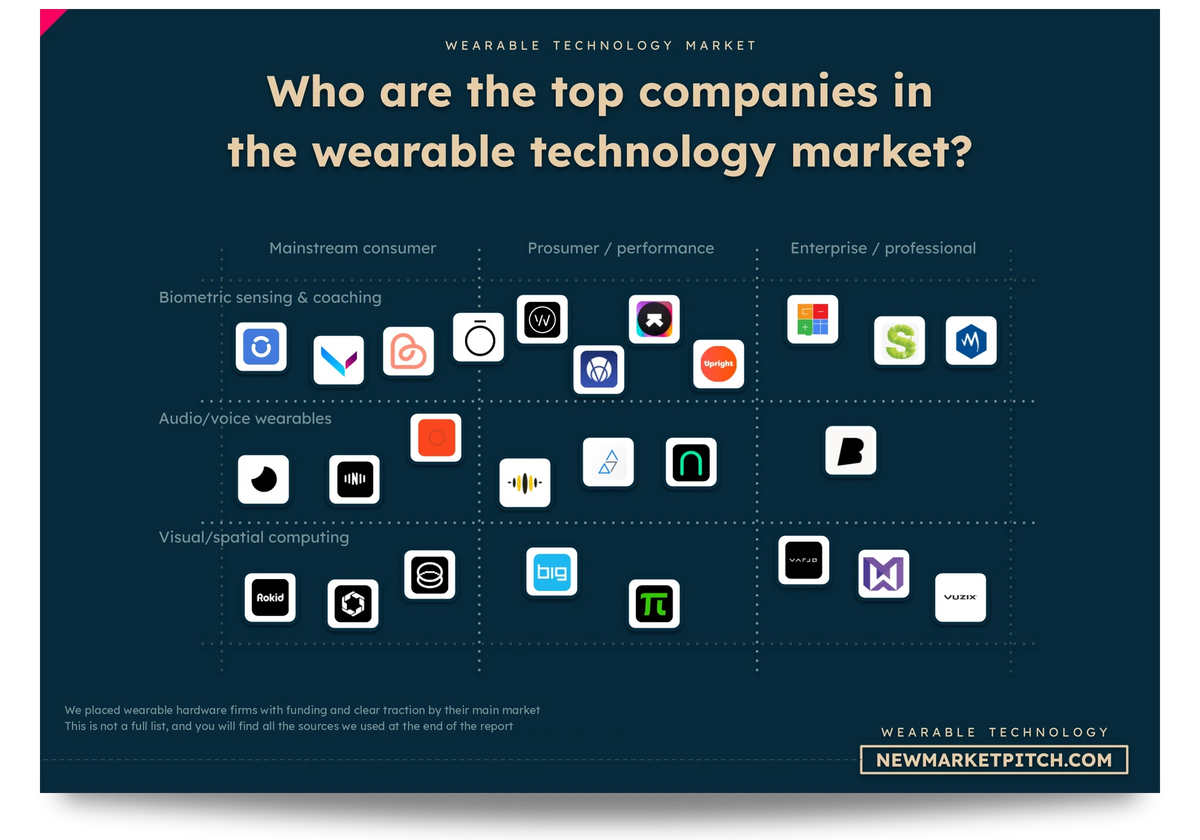
In our document detailing everything you need to know about wearable technology, we turn what is vague and complex into simple, useful visuals. Market maps like this one show you at a glance where every startup stands.
What are the biggest unsolved problems in wearables today?
The biggest unsolved problem in wearables is turning increasingly sophisticated health measurements into accurate, useful, and affordable advice that people can trust over time.
After reviewing the evidence across sensor validation, medical screening, consumer behavior, and hardware, we would put measurement reliability first.
The difference between heart-rate tracking and calorie estimation is particularly revealing. Both features have existed in mainstream wearables for years, yet one is now relatively dependable while the other still produces substantial errors. Better hardware has not solved every measurement problem.
Clinical usefulness comes next. The Apple Heart Study demonstrated that consumer wearables can identify meaningful heart-rhythm abnormalities, and newer screening features have expanded into sleep apnea and hypertension. But we still need stronger evidence showing exactly how much these technologies reduce serious health problems when used across large populations.
The same issue appears in fitness and recovery products. Activity trackers can help people move more, while WHOOP, Oura, and Garmin provide detailed physiological assessments. What remains much harder to prove is that following their recommendations produces consistently better outcomes than established alternatives.
Then come the practical barriers. Battery life, subscriptions, privacy, retention, and repairability may seem less exciting than new health sensors, but they directly affect whether people can and want to use these devices continuously.
Noninvasive blood glucose monitoring and accurate cuffless blood pressure measurement stand out as two particularly valuable technical breakthroughs still worth pursuing. Both could meaningfully expand the role of consumer wearables in healthcare.
The wearable industry has already solved many of the problems involved in collecting data from the body. It has made much less progress in proving what people should actually do with that data.
That's where the biggest opportunity now lies. The next major advance in wearables may come from a better sensor, but the companies that can demonstrate reliable measurements, useful recommendations, and measurable improvements in people's lives will have the strongest case for long-term success.
If you want more recent data on this point, please see our latest wearable technology market report.
Our methodology
This analysis examines the biggest unresolved problems in wearable technology using evidence available through October 2026. We assessed measurement accuracy, clinical usefulness, consumer behavior, product engineering, health-data privacy, and long-term adoption. The goal was to identify which problems most seriously limit the value people can get from wearable devices.
We prioritized systematic reviews, original scientific research, regulatory publications, independent hardware assessments, and directly documented market data. Manufacturer specifications were used to establish product capabilities, battery life, pricing, and feature availability, rather than as independent proof of health benefits.
We separated measurement accuracy from clinical outcomes, screening capabilities from validated diagnostic measurements, and short-term behavioral improvements from demonstrated long-term health benefits. We also considered how performance varies across devices, activities, measurement conditions, and user populations. The final assessment gives greater weight to problems affecting the reliability of health information and the decisions made using it.
For market size and product adoption, we used IDC's worldwide wearable market research and IDC's smart glasses market outlook. Measurement accuracy was assessed using the 2024 Sports Medicine umbrella review, the 2026 Apple Watch meta-analysis in npj Digital Medicine, and research on optical sensor performance across skin pigmentation groups.
For medical screening and regulatory standards, we relied on the FDA's warning on noninvasive glucose claims, its warning on unauthorized blood pressure devices, and its proposed pulse oximeter performance guidance. We also examined the original Apple Heart Study, Apple's hypertension notification documentation, and Apple's sleep apnea feature documentation.
To evaluate everyday usefulness and retention, we considered the 2025 meta-analysis of wearable activity-tracker interventions, research on why consumers discontinue fitness trackers, and Oura's explanation of its readiness score. Product comparisons drew on Apple Watch Series 11 specifications, Oura's battery documentation, WHOOP membership information, and Oura's membership pricing.
For privacy and repairability, we used the FTC's Health Breach Notification Rule and iFixit's independent smartwatch repairability assessments. Our conclusions reflect the strength and consistency of the available evidence across these sources, with greater weight assigned to independently validated findings than to manufacturer-reported capabilities or commercial forecasts.

Our report covering the wearable technology market gets updated several times a month, so you always get the latest view of where things stand.
Written by the New Market Pitch teamWe track new markets so founders and investors can move faster. About us