Wearable Tech: what are the top startups?
Building a startup or looking for your next investment in wearable technology? Our report gives you the full picture.
Summary
The top wearable tech startups right now are Oura, Whoop, Ultrahuman, Biolinq, Signos, Aktiia/Hilo, Xreal, Viture, XPANCEO, Neurable, Elemind, Natural Cycles, Hypershell, German Bionic, and Epicore Biosystems.
The category is no longer one single race between watches, rings, and fitness trackers. The strongest startups now cluster around preventive health, regulated biosensing, AI memory, visual interfaces, fertility, industrial safety, and body augmentation.
Oura is still the leader, and it now has hard public numbers behind that lead. Its SEC filing showed $1.21 billion in revenue and $60.8 million in net income for the nine months to 30 June 2026, even though it postponed its Nasdaq IPO in September 2026. Whoop remains the closest scaled rival. Both are now closer to consumer health platforms than simple wearable-device startups. Subscription logic layered on top of a device is one of the business models we compare for margins in our report on wearable technology.
Smart rings are the most mature consumer-health subcategory after watches. Oura remains the premium default. Ultrahuman is the profitable health-stack challenger and raised $70 million in September 2026, but a new Oura patent suit in October 2026 clouds its U.S. return. RingConn is using a no-subscription wedge to attack buyers who dislike paying forever for metrics.
The more serious wearable-health startups are moving away from vague wellness claims and toward regulated measurement. Biolinq, Aktiia/Hilo, Biobeat, VitalConnect, and BioIntelliSense matter because they are closer to medical sensing, clinical workflows, and FDA-cleared use cases.
Metabolic wearables are splitting into two models. Signos is winning commercially by moving closer to Dexcom’s distribution layer, while Biolinq is making the harder sensor-layer bet. In September 2026, the FDA cleared Biolinq Shine for over-the-counter use, which makes that bet much less theoretical.
Smart glasses are already divided between display scale and daily AI utility. Xreal and Viture look closest to real commercial relevance, and Xreal opened orders for its Android XR glasses, Aura, in October 2026. Meanwhile, XPANCEO, Even Realities, and Brilliant Labs are testing whether the next interface is a contact lens, lightweight AI glasses, or something more ambient.
The AI-wearable market looks strategically important but commercially unresolved. Bee and Limitless mattered because Amazon and Meta acquired them, not because standalone AI pendants and bracelets have already become mass-market products.
Sleep and brain wearables are still early, but Elemind and Neurable have the freshest evidence, and Neurable unveiled its own brain-sensing headphones in October 2026. Oura owns sleep tracking at scale today, while Elemind and Neurable are trying to move closer to brain signals rather than inferred biometric patterns.
Fertility is one of the clearest examples of wearable data becoming decision support. Natural Cycles has the regulated use case and added another FDA clearance in July 2026, Oura has the scaled overnight temperature data layer, and Movano shows that women’s-health positioning alone does not create a strong company.
Industrial wearables are less glamorous than AI glasses or smart rings, but they solve painful problems today. Hypershell, German Bionic, Kinetic, HeroWear, and Epicore are attacking worker strain, injury prevention, heat stress, hydration risk, and mobility assistance with clearer buyer logic than many consumer wearables.
The leader list and the moonshot list are not the same. Oura and Whoop are the strongest wearable companies now, with Oura clearly ahead on disclosed sales, while XPANCEO, Biolinq, Neurable, Hypershell, and Brilliant Labs are the names most likely to stretch what “wearable tech” even means.

Written by the New Market Pitch teamWe track new markets so founders and investors can move faster. About us

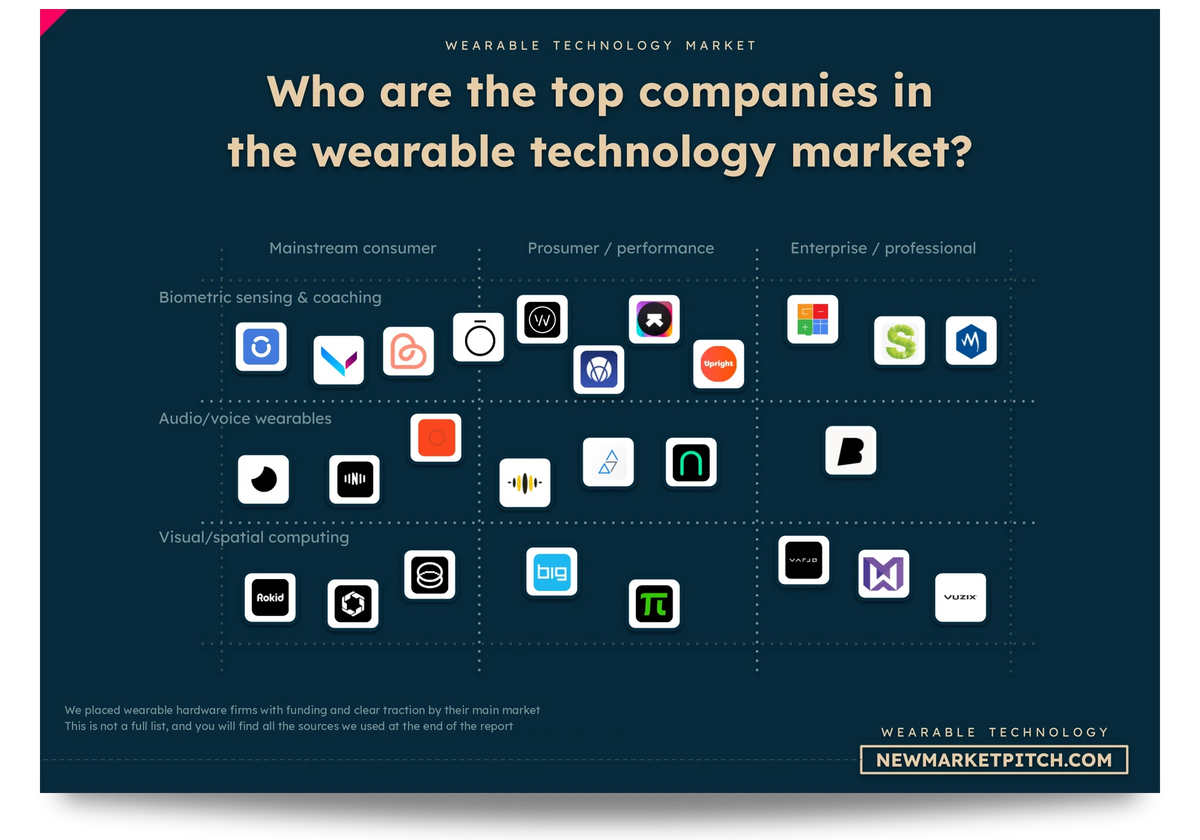
In our report covering the wearable technology market, we turn what is vague and complex into simple, useful visuals. Market maps like this one show you at a glance where every startup stands.
Is Oura still the biggest wearable startup after pulling its IPO?
Yes. Oura is still the biggest and strongest wearable startup, and Whoop and Ultrahuman are the two other names that stand out when we look at actual company scale.
Oura’s lead now rests on SEC-filed numbers rather than funding headlines. Its amended IPO filing with the SEC in September 2026 showed $1.21 billion in revenue for the nine months to 30 June 2026, up 74% from $698 million a year earlier, and $60.8 million in net income, against $1.6 million a year before. When it postponed the IPO on 29 September, citing market uncertainty, the company said it had 5.7 million paid members and forecast 90% revenue growth for its 2026 fiscal year. That growth figure is a forecast, not a reported result.
The IPO delay matters, but it does not change the ranking. The proposed $40 to $44 share range and the roughly $15.6 billion fully diluted valuation in the filing were never tested by public trading. Oura has the profits and members of a public company, not yet the public valuation. The last price actually paid is still the private one: about $11 billion in Oura’s October 2025 round of more than $900 million.
Whoop is the closest scaled rival, but it wins on a different axis. Oura has the stronger hardware category pull; Whoop has the cleaner subscription-athlete model. In March 2026, Whoop raised $575 million at a $10.1 billion valuation, said it had more than 2.5 million members, and reported around a $1.1 billion bookings and subscription run-rate after growing 103% year over year. The important comparison is simple: Oura looks broader and more mainstream; Whoop looks more focused and subscription-native. Who plays which role, from broad mainstream leaders to focused subscription-native ones, is shown on the player maps in our wearable technology market report.
Ultrahuman is not in the same size class yet, but it deserves to be in the conversation because its recent numbers show something many hardware startups never prove: profitable growth. In FY25, it reported about ₹565 crore in operating revenue, roughly $64 million, up 5.4x year over year, and about ₹73 crore in net profit. Its smart-ring revenue reportedly grew 9.5x and contributed more than 90% of operating revenue. In September 2026, it raised $70 million with Qualcomm Ventures and Labcorp, $65 million of it equity and $5 million debt; TechCrunch reported a $365 million valuation, which the company did not disclose itself. Compared with Oura and Whoop, Ultrahuman is much smaller. Compared with most emerging wearables, it looks unusually disciplined.
Can Ultrahuman still challenge Oura in smart rings?
Yes, but with a legal cloud over the U.S. market. Oura still dominates smart rings, and Ultrahuman and RingConn are the two challengers worth taking seriously right now.
Oura is the category leader because it has the best combination of brand, clinical partnerships, distribution, and paid-member scale. Most smart-ring startups can copy the form factor. Very few can copy Oura’s data advantage with 5.7 million paid members and years of longitudinal sleep, readiness, and health-tracking behavior. That installed base is the real moat, and Oura also defends it in court.
Ultrahuman is the more credible challenger because it has a broader health-stack strategy around its rings, glucose tracking, blood testing, and metabolic insights. Its FY25 profitability and the $70 million raised in September 2026 give it fuel. The problem is legal. In October 2026, TechCrunch reported that Oura had sued Ultrahuman again, this time over the redesigned ring meant to bring Ultrahuman back to U.S. shelves. These are allegations, not a ruling. Oura is much bigger; Ultrahuman is proving that a leaner ring business can work, as long as it can sell in the largest market.
RingConn is a different kind of challenger. It is winning on price logic and subscription resistance, not just on brand prestige. Its Gen 2 campaign crossed several million dollars in sales and more than 18,000 backers, and the company claimed more than 150,000 users across 80 countries by late 2024. Against Oura, the pitch is obvious: a ring with no monthly subscription. That will not beat Oura at the premium end, but it can pull in buyers who dislike paying forever for health metrics.
The smart-ring market is therefore not “Oura versus everyone” but rather Oura as the premium default, Ultrahuman as the serious health-platform challenger, and RingConn as the value wedge.

Our research about wearables gets updated several times a month, so you always get the latest view of where things stand.
Which wearable health startups are doing more than wellness claims?
Biolinq, Aktiia/Hilo, Biobeat, VitalConnect, and BioIntelliSense are the wearable health startups that stand out because they are closer to regulated medical sensing than lifestyle tracking.
Biolinq is the freshest breakout here. In April 2025, it raised $100 million to advance its intradermal glucose biosensor. In September 2025, Biolinq Shine received FDA De Novo classification for adults with Type 2 diabetes who do not use insulin. Then on 18 September 2026, the FDA cleared a new 510(k) for Shine, and Biolinq announced on 24 September that Shine was authorized for over-the-counter availability. Clearance is not proof of retail sales, and we found no disclosed sales figures. Compared with app-led metabolic startups, Biolinq is doing the harder thing: trying to change the sensor layer itself. That gives it more technical risk, but also more upside if the product expands glucose monitoring beyond today’s CGM user base.
Aktiia, now also operating under Hilo, is the clearest blood-pressure signal. In July 2025, the FDA cleared its cuffless G0 Blood Pressure Monitoring System as an over-the-counter device. That is a big deal because cuffless blood pressure has been one of the most overpromised wearable categories for years. Compared with smartwatch-style wellness estimates, Aktiia’s advantage is regulatory proof around a specific clinical problem.
Biobeat is less consumer-famous, but its positioning is stronger in clinical blood pressure. In December 2025, it raised $50 million to expand U.S. commercialization of its FDA-cleared patch-worn, cuffless 24-hour ambulatory blood-pressure monitor. Compared with Aktiia, Biobeat feels more clinical and less consumer-facing. That may make it less visible, but it also gives it a clearer reimbursement and provider workflow angle.
VitalConnect and BioIntelliSense are more mature remote-monitoring names. VitalConnect raised $100 million in February 2025 through equity and debt financing to expand its biosensor patch business. BioIntelliSense had already received FDA clearance for BioButton and BioDashboard continuous monitoring.
These companies are not the hottest consumer names today, but in hospitals and home care, boring reliability often matters more than newness.
Which metabolic wearable startups are winning the glucose and metabolism race?
Signos, Biolinq, Levels, and Ultrahuman are the metabolic wearable startups to watch, but Signos and Biolinq have the freshest momentum right now.
Signos has the strongest 2026 commercial signal. In May 2026, it raised $20 million from GV, Dexcom, and Blue Cross Blue Shield of Alabama, and it announced a partnership that puts Signos into Dexcom’s Stelo direct-to-consumer channel. The round size is not massive. The strategic distribution is the point. Compared with metabolic apps that still need to find users one by one, Signos gets to sit closer to the CGM company that already owns trust in the category. Borrowing a leader's distribution instead of hunting users one by one is the kind of edge we study in our report covering the wearable technology market.
Biolinq is more ambitious because it is not just building coaching around existing sensors. It is trying to make the glucose sensor itself more wearable and less invasive. Its September 2026 over-the-counter clearance moves it from a prescription niche toward the consumer market where Signos and Dexcom’s Stelo already play. The bar is also rising: in August 2026, the FDA authorized Abbott’s Libre Duo, which tracks both glucose and ketones continuously. Signos can move faster commercially; Biolinq could own a deeper layer of the stack.
Levels remains one of the best-known metabolic-health software brands. Its problem is that the freshest public signals are less sharp than Signos or Biolinq. Levels helped educate the market around CGM for non-diabetic metabolic health, but right now it looks more like a category pioneer than the startup with the hottest current proof.
Ultrahuman fits because it is trying to connect ring data, glucose, and blood markers into one health picture. Compared with Signos, it is broader. Compared with Biolinq, it is less sensor-deep. Its edge is that the ring gives it a daily wearable touchpoint that pure CGM apps do not have.
All things considered, Signos is the current commercial mover, Biolinq is the sensor-layer bet with the newest regulatory proof, Levels is the brand pioneer, and Ultrahuman is the broader health-stack challenger. That is a much more useful ranking than just saying they all have “traction.”

In our market report about wearables, we look at what the winners do differently, so you can learn from the best instead of guessing.
Does Android XR make Xreal the smart-glasses startup to beat?
Mostly, yes. Xreal and Viture are still the two smart-glasses startups with the strongest commercial momentum, but Xreal now has the stronger platform position. XPANCEO, Even Realities, and Brilliant Labs are the names to watch for the next form-factor shift.
Xreal is still the biggest independent smart-glasses player. In January 2026, it reportedly raised $100 million and crossed a valuation above $1 billion. On 28 October 2026, Google and Xreal opened orders for Aura, the Android XR glasses first shown at Google I/O 2026, with Gemini built in, a 70-degree field of view and a limited-time starting price of $1,099; earlier preorder coverage cited $1,279. Shipments are planned for mid-November, so orders are open but deliveries have not started. Xreal now sits inside Google’s XR ecosystem, but whether that makes it a platform depends on apps and sales that cannot be measured yet.
Viture is the sharper U.S. challenger. It raised more than $200 million across late 2025 and early 2026, including a $100 million round in February 2026. Coverage citing IDC data said Viture was outperforming Xreal in the U.S., even though Xreal remained the larger global seller. In August 2026, Viture was promoting a five-model lineup, from the Pro 2 to the Luma series and The Beast. Viture remains one of the few startups with a real “we are beating the leader somewhere important” signal.
XPANCEO should not be judged like Xreal or Viture. It is not trying to sell display glasses today but trying to leapfrog glasses with smart contact lenses. Its July 2025 $250 million Series A at a $1.35 billion valuation is enormous for such an early form factor. The right interpretation is not “XPANCEO is winning the market now” but that investors are willing to fund a very long, very technical bet because the prize could be the post-glasses interface.
Even Realities and Brilliant Labs are smaller but worth tracking because they are pushing toward daily AI utility. Even Realities’ G2 glasses add translation, notifications, navigation, live transcription, and a smart-ring controller. Brilliant Labs’ Halo glasses push a low-cost AI-assistant model with a small display, audio, and memory features. Compared with Xreal and Viture, these companies are not winning on display scale. They are trying to answer a more practical question: what would make someone wear smart glasses every day?
So it looks like the smart-glasses market has two tracks today. Xreal and Viture are the commercial display leaders. XPANCEO, Even Realities, and Brilliant Labs are trying to define what comes after “screen on your face”.
Which AI wearable startups proved that Big Tech actually cares?
Bee and Limitless are the clearest AI wearable signals because Amazon and Meta bought them in 2025.
Bee was acquired by Amazon in July 2025. Its bracelet was a roughly $50 always-on AI device that recorded conversations, summarized daily life, created reminders, and connected to user data with permission. We cannot use the acquisition as a financial ranking because the terms were not disclosed.
But strategically, it matters: Amazon did not need another cheap bracelet. It wanted the always-on AI memory concept and the team behind it.
Limitless was acquired by Meta in December 2025. Its $99 pendant recorded conversations and turned them into searchable notes and summaries. The product itself stopped being sold after the acquisition, so this is not proof that consumers were buying AI pendants at massive scale. It is proof that Meta saw enough value in the direction to move.
The comparison with Humane and Rabbit is important. Those companies showed how hard standalone AI hardware can be when the product is expensive, trust is weak, or the use case is unclear. Bee and Limitless point to a different path: lower-cost, narrow AI memory devices that Big Tech can absorb into larger assistant ecosystems. The October 2026 Xreal Aura launch adds a second route: Big Tech backing a startup’s hardware as the face of its own AI platform instead of buying it.

In our document detailing everything you need to know about wearable technology, you will always find fresh funding data, taken straight from our own verified funding database.
Which wearable sleep and brain-tech startups are more than lab demos?
Elemind and Neurable are the two emerging wearable neurotech startups with the most interesting recent evidence, while Oura remains the scaled sleep-tracking reference point.
Elemind is the sleep-specific name to watch. Its headband reads EEG brainwaves and uses personalized acoustic stimulation to help users fall asleep. The company reportedly generated $3.1 million in top-line sales after launch and grew 20% month over month in Q4 2025. Those are still early numbers, but they matter because neurotech often gets stuck in research language. Elemind has at least started to prove that people will pay for a brain-sensing sleep product. Whether people will really pay for a sleep product is the customer question we ask, problem by problem, in our market report about wearable technology.
Neurable is stronger on funding and broader brain-computer-interface ambition. In December 2025, it raised $35 million in Series A funding to deploy everyday BCI technology. In October 2026, WIRED covered Neurable One, the company’s own EEG-based focus headphones, a step beyond licensing its technology to other brands. Product claims are not yet independent proof of cognitive benefit. Compared with Elemind, Neurable is less narrowly about sleep and more about cognitive-state tracking. That makes the market bigger, but also harder to explain to consumers.
Oura belongs in the comparison because it already owns sleep behavior at scale. The difference is that Oura infers sleep through biometric signals from the finger, while Elemind and Neurable are trying to work closer to the brain signal itself. Today, Oura is the better company. Lately, Elemind and Neurable are the more interesting technology bets.
Finally, the brain-wearable category is still early enough that we should avoid pretending there is a broad pack of obvious leaders. Muse is established, and other neurotech startups exist, but the freshest recent signals point mainly to Elemind and Neurable. No new Elemind funding or sales update was found after its Q4 2025 figures.
Which fertility and women’s-health wearables are actually useful, not just pink hardware?
Natural Cycles and Oura are the strongest wearable-tech pair in fertility right now, while Movano’s Evie Ring remains technically interesting but commercially unproven.
Natural Cycles has the clearest use case because it is connecting wearable data to a regulated birth-control app. In January 2026, it launched a $129.99 wristband that tracks skin temperature, heart rate, and movement during sleep, replacing manual thermometer readings for users of its FDA-cleared app. In July 2026, the FDA gave Natural Cycles another 510(k) clearance, adding to its earlier ones. That makes the wearable useful because it removes friction from an existing behavior inside a regulated product.
Oura is powerful here because it gives Natural Cycles a much bigger wearable data layer. Oura users can already sync overnight temperature trends into the Natural Cycles app. Compared with Natural Cycles’ own wristband, Oura has the scale advantage. Compared with Oura, Natural Cycles has the sharper regulated fertility use case. Together, they make one of the cleaner examples of wearable data becoming decision support rather than just a pretty graph.
Movano’s Evie Ring is the cautionary comparison. The product was designed around women’s health, and its EvieMED ring received FDA clearance for pulse oximetry in late 2024. But by Q1 2025, reported revenue had fallen 76% year over year to about $0.2 million, and the company was dealing with liquidity and listing-pressure issues.
That is exactly why we cannot rank startups only by product story. In this category, Movano has interesting technology, but the business signal is weak.
At the end of the day, Natural Cycles is the fertility-wearable startup with the clearest current use case, Oura is the scaled data partner, and Movano shows how hard it is to turn a differentiated women’s-health wearable into a strong company.

Learning from others' mistakes is the cheapest lesson there is. In our report covering the wearable technology market, we look at what broke startups before you, so you don't repeat it.
Which industrial wearable startups are solving painful problems today?
Hypershell, German Bionic, Kinetic, HeroWear, and Epicore Biosystems are the industrial and safety wearable startups worth watching.
Hypershell has the hottest recent funding signal. In May 2026, it raised $50 million in a B+ round led by Ant Group and Meituan Dragonball, bringing its B-round funding to about $120 million in less than a year. Compared with traditional industrial exoskeleton companies, Hypershell is more consumer-adjacent. It wants exoskeletons to move from factories and hospitals into hiking, mountaineering, and outdoor mobility. In July 2026, it launched its X Series consumer exoskeletons in Europe. That makes it riskier, but also potentially much larger.
German Bionic is the more established workplace-exoskeleton company. In May 2025, it launched Exia, an AI-powered exoskeleton built from billions of real-world motion data points across manufacturing, logistics, retail, and healthcare. Compared with Hypershell, German Bionic is less about opening a new consumer category and more about making workers safer and more productive in existing industrial settings. We found no new deployment figures since.
Kinetic is more practical and less futuristic. It focuses on wearable injury prevention for frontline workers, detecting risky movements and helping employers reduce injuries and claims. That narrower wedge may actually be an advantage. Industrial buyers do not always want a robot suit; sometimes they want a measurable reduction in back injuries.
HeroWear plays in a similar practical lane. In April 2025, it raised $5 million in Series A funding for occupational exosuits that reduce strain during repetitive lifting and bending. Its claimed 20% to 40% strain reduction gives buyers a clear metric to evaluate. Compared with German Bionic, HeroWear looks lighter and more focused; compared with Kinetic, it is more physical-assistive than data-monitoring.
Epicore Biosystems is the standout sweat-sensing safety wearable. Its hydration and heat-stress monitoring products are used in energy, construction, manufacturing, aviation, shipping, and military contexts. Its 2025 Series B, later expanded to $32 million, supports global adoption and new biomarker targets. Compared with exoskeleton players, Epicore is not augmenting strength. It is helping companies avoid heat and hydration failures before they become incidents.
Which wearable tech moonshots could change the whole form factor?
XPANCEO, Biolinq, Neurable, Hypershell, and Brilliant Labs are the wearable tech moonshots that could matter most if their bets work.
XPANCEO is the boldest form-factor bet because smart contact lenses would make smart glasses feel like an intermediate step. Its $250 million Series A at a $1.35 billion valuation in July 2025 is one of the largest funding signals in the entire wearable market. The technology risk is huge, but the ambition is equally clear: display, sensing, power, and AI in a contact lens. XPANCEO still targets a first integrated prototype demonstration in 2027; that is a plan, not a working product today. Fitting display, sensing, power and AI into a contact lens is the kind of bet we sort by how mature the technology is in our report on wearable technology.
Biolinq is a more grounded moonshot. As pointed out above, it already has an FDA De Novo milestone for Biolinq Shine and, since September 2026, an over-the-counter clearance. The bigger question is whether its intradermal biosensor platform can move beyond glucose and become a broader body-chemistry layer. Compared with XPANCEO, Biolinq is less futuristic visually, but it may be closer to real medical adoption.
Neurable is trying to make brain data part of everyday headphones, now under its own Neurable One brand. That is not as dramatic as a contact lens, but it may be easier to adopt because people already wear headphones for hours. The hard part is turning EEG signals into consumer features that feel useful daily, not just impressive in demos.
Hypershell is a moonshot because it tries to make exoskeletons normal for outdoor mobility. Most wearable robotics companies start with workplaces or rehabilitation. Hypershell is asking whether ordinary people will wear powered assistance for hiking and movement. That question is still open, but the May 2026 funding and the July 2026 European launch suggest serious investors believe the category can stretch.
Brilliant Labs is the low-cost AI-glasses bet. At $299, Halo is not trying to win through cinematic immersion. It is trying to make a small display, AI memory, audio, and visual context cheap enough to test daily behavior. Compared with Xreal or Viture, Brilliant Labs looks less like an XR company and more like an AI-interface experiment.
Put everything together and the moonshot list is not the same as the leader list. Oura and Whoop are the strongest wearable companies today. XPANCEO, Biolinq, Neurable, Hypershell, and Brilliant Labs are the startups most likely to stretch the definition of wearable tech.

Your time is limited. In our research about wearables, we put numbers on each part of the market, so you can see where it makes sense to focus.
So, who are the top wearable tech startups right now?
The top wearable tech startups right now are Oura, Whoop, Ultrahuman, Biolinq, Signos, Aktiia/Hilo, Xreal, Viture, XPANCEO, Neurable, Elemind, Natural Cycles, Hypershell, German Bionic, and Epicore Biosystems.
Oura and Whoop sit in the top tier because they are already operating like large consumer health platforms. Oura is the clear number one: its SEC filing shows $1.21 billion in revenue and a profit over nine months, and the company says it has 5.7 million paid members. Its postponed IPO delays a public valuation but does not weaken that lead. Whoop is number two on its March 2026 round and its company-stated bookings run-rate.
Ultrahuman is the most credible emerging consumer-health challenger because its recent growth came with profitability and fresh funding in September 2026. That gives it a different quality of signal than a startup that only has a large funding round, but Oura’s new patent suit makes its U.S. future the open question.
Biolinq and Aktiia/Hilo stand out because wearable health is moving toward regulated sensing. Biolinq has the stronger glucose-sensor moonshot and, since September 2026, an over-the-counter clearance. Aktiia/Hilo has the cleaner cuffless blood-pressure clearance. Signos is the metabolic startup with the strongest 2026 distribution signal because of its Dexcom link.
Xreal and Viture are the smart-glasses companies closest to current commercial relevance, and Xreal’s Aura now puts it inside Google’s Android XR platform, with deliveries still to come. XPANCEO is the deeper form-factor bet. Brilliant Labs and Even Realities are smaller, but they matter because they are pushing smart glasses toward daily AI utility instead of pure display.
Neurable and Elemind are the brain and sleep-tech startups with the freshest evidence. Natural Cycles is the clearest fertility-wearable use case. Hypershell, German Bionic, Kinetic, HeroWear, and Epicore show that industrial wearables are quietly becoming one of the most practical parts of the market.
So we can conclude that wearable tech is not being led by one type of device anymore.
The strongest startups are clustering around five directions: preventive health, regulated biosensing, AI memory, visual interfaces, and body augmentation. The companies that appear across several of those directions, or own a very hard measurement layer inside one of them, are the ones that look most important now.
| Category | Startups selected and why |
|---|---|
| Scaled wearable tech companies | Oura leads on SEC-filed revenue and profit, plus 5.7 million company-stated paid members, despite its postponed IPO. Whoop is the closest private rival. Ultrahuman is smaller but stands out because it has disclosed profitable hypergrowth. |
| Smart rings | Oura remains the premium default. Ultrahuman is the health-platform challenger, newly funded but facing a fresh Oura patent suit. RingConn is the subscription-free value wedge. |
| Regulated wearable health sensing | Biolinq, with its September 2026 over-the-counter clearance, and Aktiia/Hilo have the freshest FDA-backed signals. Biobeat, VitalConnect, and BioIntelliSense are stronger clinical infrastructure names. |
| Metabolic wearables | Signos has the strongest 2026 distribution signal through Dexcom. Biolinq is the sensor-layer bet. Levels is the category pioneer. Ultrahuman is the broader health-stack challenger. |
| Smart glasses | Xreal leads globally and opened orders for its Android XR glasses, Aura, in October 2026. Viture is the sharp U.S. challenger. XPANCEO is the best-funded form-factor moonshot. Even Realities and Brilliant Labs are the daily-AI glasses bets. |
| AI wearable assistants | Bee and Limitless matter because Amazon and Meta acquired them in 2025. The category is strategically hot but not yet proven as a standalone startup market. |
| Sleep and brain wearables | Elemind has the clearest sleep-neurotech sales signal. Neurable has the strongest recent BCI-wearable funding signal and its own headphones. Oura remains the scaled sleep-tracking reference. |
| Fertility and women’s-health wearables | Natural Cycles has the clearest regulated fertility use case. Oura is the scaled data partner. Movano has interesting FDA-cleared technology but weak business momentum. |
| Industrial and safety wearables | Hypershell has the hottest recent exoskeleton funding. German Bionic leads workplace exoskeletons. Kinetic, HeroWear, and Epicore solve more specific injury, strain, hydration, and heat-risk problems. |
| Moonshot wearable form factors | XPANCEO, Biolinq, Neurable, Hypershell, and Brilliant Labs could change what “wearable” means, even if not all of them are commercial leaders today. |
Our methodology
Because the wearable-tech startup landscape is easy to misread from hype, product visibility, funding headlines, or general consumer buzz, we did not treat the question as one broad popularity ranking.
We broke it into clearer analytical dimensions: scaled consumer wearables, smart rings, regulated health sensing, metabolic wearables, smart glasses, AI wearables, sleep and brain tech, fertility, industrial wearables, and longer-term form-factor bets. For each dimension, we looked for recent signals that showed something concrete: revenue, users, funding quality, regulatory clearance, strategic distribution, acquisition interest, commercial traction, or real-world adoption.
We then aggregated those signals category by category before forming the final view. That is why the answer includes both companies that already look scaled, such as Oura and Whoop, and more specialized bets, such as Biolinq, XPANCEO, Neurable, and Epicore. The goal was not to reward the loudest wearable startups, but to identify where the evidence is strongest today across the different ways wearable tech is becoming useful, commercial, or strategically important.
Key sources used for this analysis include: Oura’s Form S-1 filed with the SEC, with nine-month revenue, net income, and paid members, TechCrunch on Oura postponing its IPO, TechCrunch on Ultrahuman’s $70 million financing and reported valuation, the FDA 510(k) record for Biolinq Shine, Android Authority on Xreal Aura pricing and availability, Business Wire on Oura’s October 2025 funding and valuation, WHOOP on its Series G funding and valuation, The Economic Times on Ultrahuman FY25 revenue and profitability, the FDA De Novo letter for Biolinq Shine, Hilo/Aktiia on FDA clearance for cuffless blood pressure monitoring, Business Wire on Biobeat’s $50 million Series B and FDA-cleared cuffless ABPM system, HLTH on Signos’ $20 million round and Dexcom/Stelo partnership, Xreal on Project Aura and Google I/O 2026, Viture on its $100 million round and $200 million raised in six months, Forbes on Viture’s U.S. market-share signal, XPANCEO on its $250 million Series A and $1.35 billion valuation, TechCrunch on Amazon’s acquisition of Bee, TechCrunch on Meta’s acquisition of Limitless, Business Wire on Neurable’s $35 million Series A, Natural Cycles on the NC° Band, PR Newswire on Movano EvieMED FDA clearance, EqualOcean on Hypershell’s $50 million B+ round, German Bionic on Exia, Business Wire on HeroWear’s $5 million Series A and strain-reduction claim, and HLTH on Epicore Biosystems’ Series B expansion to $32 million.

In our market report about wearables, we always try to gather several sources and make estimates that make sense, so you can work with solid numbers.
Written by the New Market Pitch teamWe track new markets so founders and investors can move faster. About us