What are the most valuable AI accounting startups?
Whether you're building or investing in the AI accounting market, our report covers everything you need to know: the players, the money, and what's coming next.
Summary
Pennylane is the most valuable AI accounting startup today, valued at $3.9B–$4.3B, followed by HighRadius at $2.2B–$3.4B and FloQast at $1.6B. Basis and Rillet complete the five-company group valued at $1 billion or more.
The AI accounting market is attracting serious investment because the technology is already being used by professionals. Thomson Reuters found that 81% of tax and audit professionals use AI at least several times a week, while 26% would reject a job without access to professional-grade AI tools.
Pennylane's lead is particularly interesting because it was founded in 2020, much later than HighRadius or FloQast. Its advantage comes from distribution through more than 6,500 accounting firms and a platform used by 1.5 million businesses, processing approximately 20 million invoices each month.
Investors are backing two very different approaches to AI accounting. Basis builds agents that help accountants work within existing systems, while Rillet, Campfire and DualEntry want businesses to move their financial records onto entirely new AI-native accounting platforms.
The newest companies are raising substantial amounts very early. Basis, Rillet and DualEntry collectively secured $290 million across three funding rounds between October 2025 and August 2026, showing how aggressively investors are financing accounting automation.
Campfire is already approaching the billion-dollar mark, with a valuation of $750M–$1.0B. Competition between AI-native accounting platforms is intensifying, particularly among growing businesses that need more sophisticated financial systems but want alternatives to traditional ERP software.
Replacing established accounting platforms will still be difficult. QuickBooks Online Accounting generated $5.051 billion in fiscal 2026 revenue, growing 23% year over year, and Intuit is adding AI capabilities to an already enormous customer base.
Some of the most convincing opportunities are in narrower financial workflows. Accounts payable and receivable startups can demonstrate measurable savings, from reducing invoice-processing work to collecting payments faster, without asking companies to replace their entire accounting infrastructure.
AI can also help accounting firms handle growing workloads without hiring at the same pace. But financial reporting accuracy, audit trails and professional accountability remain critical, which makes fully autonomous accounting harder than automating repetitive administrative tasks.
The next test is revenue. At a hypothetical 10× annual revenue multiple, a startup needs $100 million in annual revenue to justify a $1 billion valuation. Pennylane has already demonstrated significant operating scale, while newer companies such as Basis and Rillet still need to turn their early momentum into durable financial performance.

Written by the New Market Pitch teamWe track new markets so founders and investors can move faster. About us

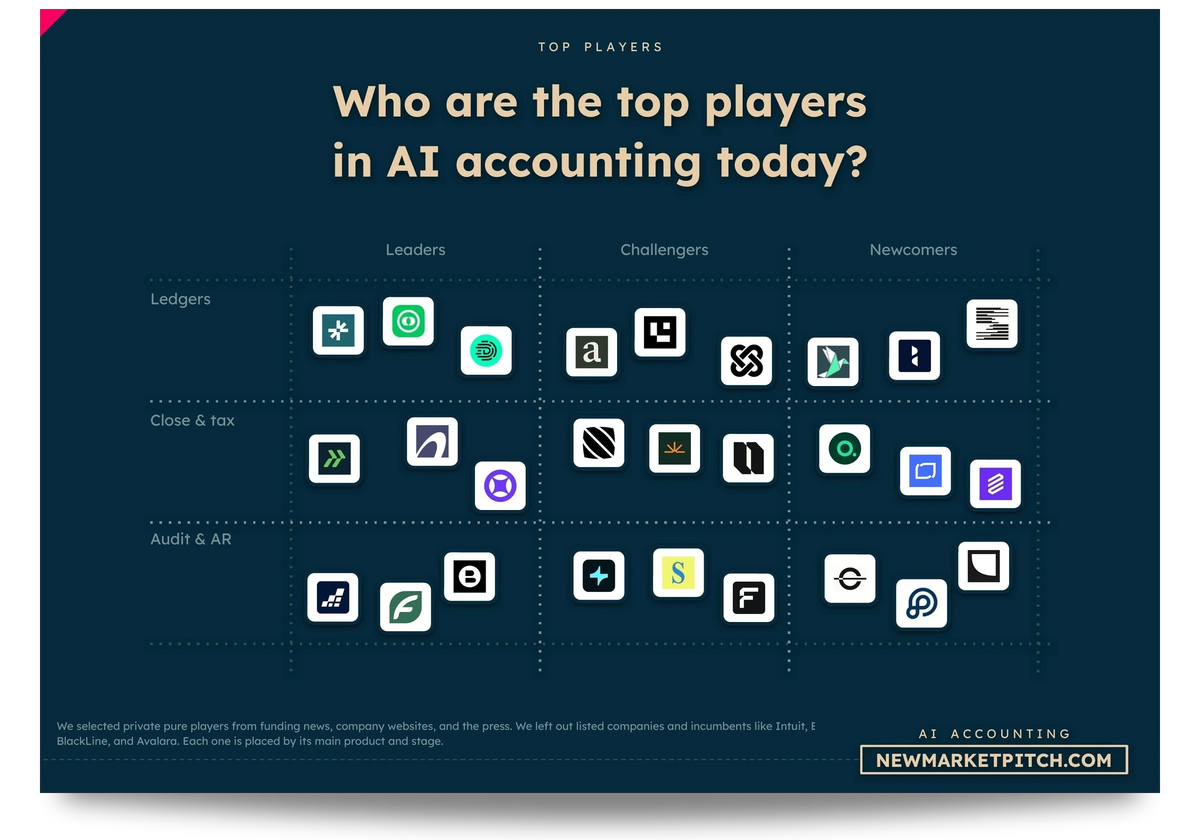
In our report covering the AI accounting market, we turn what is vague and complex into simple, useful visuals. Market maps like this one show you at a glance where every startup stands.
Top startups in the AI accounting market ranked by valuation
Here is an updated table that ranks the top startups in the AI accounting market based on their latest reported or estimated valuations.
If you need to dig deeper and get more detailed data, please check our report covering the AI accounting market.
| # | Startup Name | What They Do | Current Valuation ($) | Valuation Confidence Level | Valuation Type | Evidence Status | Total Funding ($) | Funding Confidence Level | Country |
|---|---|---|---|---|---|---|---|---|---|
| 1 | Pennylane | AI-powered accounting and financial management | $3.9B–$4.3B | Strong Confidence | Implied Valuation from Raise | Estimated | $444M–$460M | - | France |
| 2 | HighRadius | AI-powered autonomous finance automation | $2.2B–$3.4B | Partial Confidence | Implied Valuation from Raise | Implied | $475M | - | United States |
| 3 | FloQast | Financial close and accounting automation | $1.6B | Partial Confidence | Announced Private Round Valuation | Observed | $303M | Strong Confidence | United States |
| 4 | Basis | AI agents for accounting firms | $1.1B–$1.2B | Strong Confidence | Implied Valuation from Raise | Estimated | $138M | Full Confidence | United States |
| 5 | Rillet | AI-native accounting and ERP platform | $1.0B | Full Confidence | Announced Private Round Valuation | Observed | $209M | Strong Confidence | United States |
| 6 | Campfire | AI-native accounting and ERP platform | $750M–$1.0B | Partial Confidence | Active Raise Valuation | Estimated | $104M | Full Confidence | United States |
| 7 | Xelix | AI-powered accounts payable automation | $560M–$760M | Partial Confidence | Comparables-Based Estimate | Estimated | $165M | - | United Kingdom |
| 8 | Digits | AI-powered accounting and financial reporting | $400M–$600M | Partial Confidence | Implied Valuation from Raise | Implied | $98M | Full Confidence | United States |
| 9 | FundGuard | AI-powered investment accounting platform | $400M–$600M | Partial Confidence | Comparables-Based Estimate | Estimated | ~$156M | - | United States |
| 10 | Yunzhangfang | Automated accounting and tax management | $350M–$650M | Low Confidence | Comparables-Based Estimate | Estimated | $244.3M | - | China |
| 11 | AppZen | AI-powered enterprise finance automation | $495.6M | Strong Confidence | Implied Valuation from Raise | Implied | $283M | - | United States |
| 12 | DualEntry | AI-native ERP and general ledger | $400M–$500M | Strong Confidence | Implied Valuation from Raise | Implied | $100M+ | Partial Confidence | United States |
| 13 | Stampli | AI accounts payable management platform | $350M–$550M | Partial Confidence | Comparables-Based Estimate | Estimated | $148M+ | - | United States |
| 14 | Tabs | AI billing and collections automation | $360M–$460M | Strong Confidence | Implied Valuation from Raise | Implied | $87M–$92M | - | United States |
| 15 | Dougs | AI-enabled accounting services for businesses | $320M–$480M | Partial Confidence | Revenue or ARR Multiple Estimate | Estimated | $83M | - | France |
| 16 | Accrual | AI accounting and tax automation | $300M–$450M | Partial Confidence | Implied Valuation from Raise | Implied | $75M | - | United States |
| 17 | Stuut | AI-powered order-to-cash automation | $300M–$400M | Strong Confidence | Implied Valuation from Raise | Implied | $93M | - | United States |
| 18 | Indy | Automated accounting for self-employed professionals | $250M–$450M | Partial Confidence | Comparables-Based Estimate | Estimated | ~$94M | - | France |
| 19 | Cryptio | Digital asset accounting and compliance | $300M–$400M | Partial Confidence | Implied Valuation from Raise | Implied | $71.2M | - | United States |
| 20 | Pilot | AI-assisted bookkeeping and CFO services | $250M–$400M | Partial Confidence | Comparables-Based Estimate | Estimated | $161M | Partial Confidence | United States |
| 21 | Simetrik | AI transaction reconciliation and controls | $250M–$400M | Partial Confidence | Implied Valuation from Raise | Implied | $115.9M | - | Colombia |
| 22 | Collective | Automated bookkeeping and tax services | $240M–$390M | Partial Confidence | Comparables-Based Estimate | Estimated | ~$150M | - | United States |
| 23 | Numeric | AI-powered financial close automation | $260M–$360M | Partial Confidence | Implied Valuation from Raise | Implied | $89M | Full Confidence | United States |
| 24 | Vic.ai | Autonomous accounts payable processing | $180M–$330M | Low Confidence | Comparables-Based Estimate | Estimated | $115M | Strong Confidence | Norway |
| 25 | Ottimate | Automated accounts payable and payments | $180M–$320M | Low Confidence | Revenue or ARR Multiple Estimate | Estimated | $164M–$165M | - | United States |
| 26 | Apron | Automated business payments and bookkeeping | $180M–$280M | Partial Confidence | Comparables-Based Estimate | Estimated | $50.5M | - | United Kingdom |
| 27 | Netgain | Automated technical accounting and compliance | $170M–$280M | Partial Confidence | Comparables-Based Estimate | Estimated | $35M | - | United States |
| 28 | Auditoria.AI | AI automation for corporate finance | $170M–$260M | Partial Confidence | Implied Valuation from Raise | Implied | $59.5M | - | United States |
| 29 | Light | AI-native accounting and ERP platform | $175M–$250M | Partial Confidence | Implied Valuation from Raise | Implied | $43M | - | Denmark |
| 30 | BHub | AI-powered outsourced financial operations | $150M–$200M | Partial Confidence | Comparables-Based Estimate | Estimated | $56.2M | - | Brazil |
| 31 | Biller Genie | Automated invoicing and receivables management | $140M–$190M | Partial Confidence | Revenue or ARR Multiple Estimate | Estimated | $33.5M | - | United States |
| 32 | Finaloop | Automated bookkeeping for ecommerce businesses | $125M–$205M | Partial Confidence | Comparables-Based Estimate | Estimated | $55M | - | United States |
| 33 | Maxima | AI agents for enterprise accounting | $140M–$185M | Strong Confidence | Implied Valuation from Raise | Estimated | $41M | Partial Confidence | United States |
| 34 | Zeni | AI bookkeeping and financial operations | $110M–$210M | Low Confidence | Comparables-Based Estimate | Estimated | $48M | Partial Confidence | United States |
| 35 | Nominal | AI agents for accounting operations | $115M–$175M | Partial Confidence | Implied Valuation from Raise | Implied | $29M | Full Confidence | United States |
| 36 | Stacks AI | AI agents for financial close | $105M–$170M | Partial Confidence | Implied Valuation from Raise | Implied | $35M | - | United Kingdom |
| 37 | Fazeshift | AI agents for accounts receivable | $110M–$150M | Partial Confidence | Implied Valuation from Raise | Implied | $27M | - | United States |
| 38 | Monk | AI-powered accounts receivable automation | $100M–$150M | Strong Confidence | Implied Valuation from Raise | Estimated | $29M | - | United States |
| 39 | Integral | AI-enabled accounting and tax services | $100M–$145M | Partial Confidence | Implied Valuation from Raise | Implied | $34.6M | - | Germany |
| 40 | Kick | AI bookkeeping for small businesses | $75M–$120M | Partial Confidence | Comparables-Based Estimate | Estimated | $20M | - | United States |
| 41 | Docyt | AI-powered bookkeeping and reconciliation | $75M–$115M | Partial Confidence | Implied Valuation from Raise | Implied | $27M | Strong Confidence | United States |
| 42 | Tesorio | AI cash flow and collections | $70M–$120M | Low Confidence | Comparables-Based Estimate | Estimated | $37.5M | - | United States |
| 43 | Fondo | Accounting and tax services for startups | $70M–$110M | Partial Confidence | Revenue or ARR Multiple Estimate | Estimated | Undisclosed | - | United States |
| 44 | Inscope | Automated financial statement preparation | $75M–$105M | Strong Confidence | Implied Valuation from Raise | Implied | ~$19M | - | United States |
| 45 | RightRev | Automated enterprise revenue recognition | $70M–$110M | Partial Confidence | Implied Valuation from Raise | Implied | $31M+ | - | United States |
| 46 | Candis | AI invoice processing and payments | $65M–$105M | Low Confidence | Comparables-Based Estimate | Estimated | $33M–$40M | - | Germany |
| 47 | Trullion | AI accounting and audit automation | $60M–$110M | Partial Confidence | Comparables-Based Estimate | Estimated | $34M | Strong Confidence | United States |
| 48 | Zenskar | AI billing and revenue automation | $60M–$90M | Partial Confidence | Implied Valuation from Raise | Implied | $18.5M–$21.5M | - | United States |
| 49 | Quanta | AI-native accounting and financial reporting | $55M–$80M | Strong Confidence | Implied Valuation from Raise | Estimated | $19.7M | - | United States |
| 50 | Bitwave | Cryptocurrency accounting and tax software | $50M–$85M | Low Confidence | Comparables-Based Estimate | Estimated | $22M–$28M | - | United States |
| 51 | Osome | AI-enabled bookkeeping and corporate services | $45M–$85M | Low Confidence | Revenue or ARR Multiple Estimate | Estimated | Undisclosed | - | Singapore |
| 52 | Upflow | Accounts receivable and payment automation | $45M–$85M | Low Confidence | Comparables-Based Estimate | Estimated | ~$21M | - | France |
| 53 | Ledge | AI-powered financial close automation | $45M–$80M | Partial Confidence | Revenue or ARR Multiple Estimate | Estimated | $9M+ | - | United States |
| 54 | Truewind | AI accounting workflow automation | $45M–$80M | Partial Confidence | Comparables-Based Estimate | Estimated | $17M+ | Strong Confidence | United States |
| 55 | Wafeq | Cloud accounting for Middle Eastern businesses | $40M–$75M | Partial Confidence | Comparables-Based Estimate | Estimated | $10.5M | - | United Arab Emirates |
| 56 | Synthetic | Autonomous AI bookkeeping for startups | $40M–$65M | Partial Confidence | Implied Valuation from Raise | Implied | $10M | - | United States |
| 57 | OpenEnvoy | AI-driven invoice auditing and automation | $35M–$65M | Low Confidence | Comparables-Based Estimate | Estimated | $21.5M | - | United States |
| 58 | Puzzle | AI-native ledger and financial close | $25M–$75M | Low Confidence | Comparables-Based Estimate | Estimated | $50M | Strong Confidence | United States |
| 59 | Gappify | Automated accruals and accounting workflows | $35M–$60M | Partial Confidence | Comparables-Based Estimate | Estimated | ~$17M | - | United States |
| 60 | Uplinq | AI bookkeeping and tax automation | $35M–$55M | Partial Confidence | Implied Valuation from Raise | Implied | $15.6M+ | - | United States |
| 61 | Growfin | AI-driven accounts receivable automation | $30M–$50M | Partial Confidence | Comparables-Based Estimate | Estimated | $8.9M | - | India |
| 62 | Digitoo | AI document extraction for accountants | $25M–$55M | Low Confidence | Proxy-Based Estimate | Estimated | $4M–$5M | - | Czech Republic |
| 63 | PredictAP | AI invoice processing for real estate | $32M–$48M | Partial Confidence | Comparables-Based Estimate | Estimated | $10.8M+ | - | United States |
| 64 | Maximor | AI agents for finance teams | $30M–$50M | Partial Confidence | Implied Valuation from Raise | Implied | $54M | - | United States |
| 65 | Gaviti | Automated accounts receivable collections | $25M–$50M | Low Confidence | Comparables-Based Estimate | Estimated | ~$11.5M | - | Israel |
| 66 | Viewz | AI-native finance operating system | $28M–$47M | Partial Confidence | Implied Valuation from Raise | Implied | $7M | - | Israel |
| 67 | Hyperbots | AI agents for finance operations | $30M–$40M | Partial Confidence | Implied Valuation from Raise | Implied | $8.5M | - | United States |
| 68 | Kolleno | AI-powered collections and receivables management | $22M–$45M | Low Confidence | Comparables-Based Estimate | Estimated | $5.4M | - | United Kingdom |
| 69 | Mika | AI bookkeeping and tax automation | $25M–$34M | Strong Confidence | Implied Valuation from Raise | Implied | ~$8M | - | Germany |
| 70 | Paraglide AI | AI agents for accounts receivable | $20M–$32M | Strong Confidence | Comparables-Based Estimate | Estimated | $5M | - | United Kingdom |
| 71 | Outmin | AI-powered outsourced bookkeeping and accounting | $17M–$33M | Partial Confidence | Implied Valuation from Raise | Implied | $8.9M | - | Ireland |
| 72 | Donnerstag.ai | AI receivables management for suppliers | $17M–$30M | Partial Confidence | Implied Valuation from Raise | Implied | ~$5M | - | Germany |
| 73 | Mayday | Automated month-end accounting workflows | $18M–$28M | Partial Confidence | Implied Valuation from Raise | Implied | $4M+ | - | United Kingdom |
| 74 | Kabilio | AI accounting and tax automation | $15M–$27M | Partial Confidence | Implied Valuation from Raise | Implied | Undisclosed | - | Spain |
| 75 | Acctual | Crypto invoicing and payments automation | $12M–$25M | Low Confidence | Comparables-Based Estimate | Estimated | $3.85M | - | United States |
| 76 | OCTA | AI agents for accounting firms | $14M–$23M | Strong Confidence | Implied Valuation from Raise | Implied | $5.7M | - | United Arab Emirates |
| 77 | Peakflo | AI-powered receivables and payables automation | $10M–$25M | Low Confidence | Comparables-Based Estimate | Estimated | $4.7M | - | Singapore |
Which startups in the AI accounting market have been acquired or gone public?
These startups no longer have a private-market valuation of their own, so we list them separately, using their acquisition price or their current market capitalization.
| # | Startup Name | What They Do | Current Valuation ($) | Valuation Confidence Level | Valuation Type | Evidence Status | Total Funding ($) | Funding Confidence Level | Country |
|---|---|---|---|---|---|---|---|---|---|
| 1 | FinQuery | AI-powered accounting and subledger automation | $350M–$650M | Partial Confidence | Acquisition Value | Estimated | ~$67M | - | United States |
| 2 | Finmatics | AI-driven bookkeeping and invoice automation | $100M–$180M1 | Low Confidence | Acquisition Value | Estimated | ~$17M | - | Austria |
| 3 | Numarics | AI-powered accounting and fiduciary services | $35M–$85M | Low Confidence | Comparables-Based Estimate | Estimated | ~$13.4M | - | Switzerland |
- Price undisclosed; the range is an estimate of the deal value.

Our research about AI accounting tools gets updated several times a month, so you always get the latest view of where things stand.
Why are AI accounting startup valuations rising so fast?
AI accounting startups are attracting much larger investments because accountants are already using AI at work, and investors increasingly believe the technology can take over entire financial workflows.
The clearest change is how quickly AI has entered accounting firms. According to Thomson Reuters' 2026 Future of Professionals research, 81% of tax and audit professionals now use AI at least several times a week. More surprisingly, 26% say they would reject a job that didn't offer access to professional-grade AI tools.
Investors have responded with unusually large funding rounds. Basis raised $100 million in February 2026, Rillet secured another $100 million in August, and DualEntry announced a $90 million Series A in October 2025. These three rounds alone represent $290 million going into companies building AI accounting agents or new accounting systems.
There is a bigger opportunity behind those investments. Accounting software has traditionally helped people record transactions, prepare reports and manage compliance. The newest AI products aim to complete much of that work themselves, including reconciliations, financial close, invoice processing and tax preparation.
For accounting firms, that could mean serving more clients without hiring proportionally more employees. For businesses, it could mean spending less time moving financial information between systems.
The market has reached a point where these improvements are valuable enough to attract serious money. Whether the latest valuations hold up will depend on how much customers actually pay for the automation.
Which AI accounting startups are worth the most today?
Pennylane currently leads the AI accounting startup ranking at $3.9B–$4.3B, followed by HighRadius at $2.2B–$3.4B and FloQast at $1.6B.
These companies have reached their positions through rather different businesses.
Pennylane connects accountants and their business clients through accounting, invoicing and financial management software. HighRadius automates enterprise finance operations, including accounts receivable and treasury. FloQast focuses on financial close, accounting controls and reporting.
The gap between their valuations also reflects different types of customer relationships. Pennylane can reach thousands of businesses through accounting firms, while HighRadius sells into larger and more complex corporate finance departments.
HighRadius has been operating since 2006. FloQast was founded in 2013, while Pennylane launched in 2020. That makes Pennylane's position especially interesting: a much younger company has built a larger estimated valuation by combining accounting software with broader financial services.
Basis, valued at $1.1B–$1.2B, and Rillet, valued at approximately $1.0B, complete the five-company billion-dollar group. Their emergence shows how quickly investors are willing to value newer AI accounting products alongside established enterprise software businesses.

In our market report about AI accounting tools, we look at what the winners do differently, so you can learn from the best instead of guessing.
How many AI accounting unicorns are there?
Five AI accounting startups are valued at $1 billion or more: Pennylane, HighRadius, FloQast, Basis and Rillet.
Campfire is close behind with $750M–$1.0B. The Information reported in August 2026 that investors had offered to finance the company at a $1 billion valuation, putting it within reach of joining the group.
The recent arrivals are particularly revealing. Basis reached unicorn status in February 2026, while Rillet joined the group in August. Both achieved billion-dollar valuations despite having much shorter operating histories than HighRadius or FloQast.
There is also an important difference in what these unicorns sell. Basis develops agents for professional accountants, Rillet builds accounting infrastructure, and Pennylane combines accounting with financial management.
We now have billion-dollar companies pursuing several distinct parts of the accounting market. The opportunity has expanded well beyond AI bookkeeping applications.
Why is Pennylane worth more than other AI accounting startups?
Pennylane's $3.9B–$4.3B valuation is supported by a powerful combination of accounting firm distribution, business customers and recurring financial activity.
The French company currently reports more than 6,500 accounting firms and 1.5 million businesses using its platform. According to its own operating figures, Pennylane also processes approximately 20 million invoices and €21.7 billion in transaction value every month.
Those numbers are more interesting together than individually.
Across 1.5 million businesses, 20 million monthly invoices represent roughly 13 invoices per business per month on average. The €21.7 billion in monthly transaction value also represents more than €260 billion annualized, although transaction volume should never be mistaken for Pennylane's own revenue.
The company's distribution model helps explain the scale. Accountants recommend and use the platform with their business clients, allowing Pennylane to reach companies through existing professional relationships rather than acquiring every business directly.
Pennylane has also benefited from the transition toward electronic invoicing in France. Businesses need compatible systems, and accounting firms have a strong reason to standardize the software used by their clients.
Its January 2026 financing further strengthened that position. The company raised approximately $200 million in a round led by TCV, with Blackstone Growth and existing investors participating.
Pennylane's biggest advantage may be the relationship between its accounting software and everyday financial operations. The more invoices, payments and accounting records a business manages through one platform, the harder it becomes to switch to something else.

In our document detailing everything you need to know about AI accounting, you will always find fresh funding data, taken straight from our own verified funding database.
Is HighRadius still one of the biggest AI accounting companies?
HighRadius remains one of the largest AI accounting and enterprise finance automation startups, with a valuation of $2.2B–$3.4B and approximately $475M raised.
Its history shows how this market has evolved.
HighRadius raised $125 million in 2020 and another $300 million in 2021. The second round valued the business at $3.1 billion, according to the company's funding announcement.
By April 2021, HighRadius reported more than 600 customers, including over 200 companies from the Forbes Global 2000, and $2.23 trillion in annual receivables processed. Its annual recurring revenue had increased 47% year over year.
Those figures established that enterprise finance automation was already a large commercial opportunity before the latest wave of generative AI startups appeared.
Since then, HighRadius has expanded from traditional accounts receivable automation toward a broader autonomous finance platform. Its company materials describe more than 180 AI agents introduced as part of that evolution.
HighRadius has an advantage that newer companies cannot immediately reproduce: years of experience integrating software into large enterprises with complicated financial systems.
The main challenge is keeping that advantage relevant as newer platforms develop faster, more flexible AI workflows. Enterprise relationships are valuable, but they won't protect HighRadius forever if competitors can automate the same work more effectively.
Why are Basis and Rillet already worth more than $1 billion?
Basis and Rillet reached billion-dollar valuations because they are attacking two of the largest expenses in accounting: the people doing the work and the software used to manage it.
Basis develops AI agents for accounting firms. Its technology helps professionals prepare financial statements, handle tax-related work and complete recurring accounting tasks.
Bloomberg reported that Basis raised $100 million at approximately $1.15 billion in February 2026, with Accel leading the financing. The company's valuation stands at $1.1B–$1.2B in our ranking.
Rillet follows a different route. Its platform is built around an AI-native general ledger, allowing finance teams to automate accounting tasks inside the system that stores their financial records.
Rillet's August 2026 Series C raised $100 million at a $1.0B valuation. According to the company, it was the third funding round in just 14 months, bringing cumulative funding above $200 million.
That's an unusually fast fundraising pace for enterprise accounting software, where selling and implementing products can take considerable time.
The difference between the two startups will shape how they grow. Basis can sell productivity improvements to accounting practices without necessarily replacing their existing accounting platforms. Rillet needs companies to trust it with their core financial infrastructure.
Basis may have an easier initial adoption path, while Rillet could eventually earn more revenue per customer if it becomes the main accounting system.
Both approaches have attracted serious investors. The next question is how quickly commercial revenue can catch up with their financing valuations.

Learning from others' mistakes is the cheapest lesson there is. In our report covering the AI accounting market, we look at what broke startups before you, so you don't repeat it.
Can Campfire become the next AI accounting unicorn?
Campfire is one of the clearest candidates to reach a billion-dollar AI accounting valuation, with a current range of $750M–$1.0B.
The company builds an AI-native accounting and ERP system aimed at businesses that want to automate finance operations without relying on older software infrastructure.
In August 2026, The Information reported that Campfire had received investment offers valuing the business at $1 billion.
The same reporting contained an interesting detail: Campfire had reportedly not yet spent the $65 million raised in October 2025.
Investors were apparently willing to finance its next stage before the company had exhausted its previous capital. That puts Campfire in a stronger negotiating position than a startup that urgently needs another round.
Rillet's completed $100 million financing provides a recent comparison. Both companies are targeting businesses looking for modern accounting infrastructure, and investors have shown a willingness to finance that opportunity at substantial valuations.
Campfire could become another unicorn if it completes financing at the reported level. The tougher test will be attracting and retaining businesses that rely on the software to close their books, prepare financial reports and manage compliance.
Can Rillet, Campfire and DualEntry really replace traditional ERP software?
Rillet, Campfire and DualEntry are becoming credible alternatives to traditional accounting systems, especially for growing businesses, but large-scale replacement of established ERP software remains unproven.
DualEntry offers one of the clearest examples of how quickly newer platforms can develop.
In October 2025, the company announced a $90 million Series A led by Lightspeed Venture Partners and Khosla Ventures, with GV participating. DualEntry said its platform had already processed $100 billion in journal entries and attracted thousands of users globally.
That's substantial transaction throughput for a relatively new product. However, journal-entry volume doesn't tell us how much revenue DualEntry earns, how many enterprises pay for the platform or how many customers have fully replaced their previous ERP.
Rillet has taken a similar approach to redesigning accounting around a live general ledger and embedded automation. Campfire also wants companies to manage finance operations through a modern system.
These startups have a natural opening when businesses outgrow basic accounting tools.
A company with 50 employees, for example, may be able to migrate financial systems relatively quickly. An international group with dozens of subsidiaries, years of historical records and complex reporting requirements faces a much bigger project.
That makes growing businesses a particularly attractive starting point.
We expect AI-native ERP companies to win customers from older systems, especially during accounting software upgrades. But replacing the systems used by large international enterprises will take much longer.

Your time is limited. In our research about AI accounting tools, we put numbers on each part of the market, so you can see where it makes sense to focus.
Which types of AI accounting startups get the highest valuations?
Broad accounting platforms and enterprise finance automation businesses generally command the largest valuations, although focused AI products can also attract major investment when they solve expensive financial problems.
Several business models are competing for different customers.
| AI accounting category | Examples | Main customer | Main opportunity |
|---|---|---|---|
| Integrated accounting | Pennylane, Indy | Businesses and accounting firms | Manage accounting and financial operations |
| Enterprise finance automation | HighRadius, AppZen | Large finance departments | Automate complex financial processes |
| Financial close | FloQast, Numeric | Controllers and accountants | Close books faster |
| Accounting agents | Basis, OCTA | Accounting firms | Automate professional work |
| AI-native ERP | Rillet, Campfire, DualEntry, Light | Growing businesses | Replace core accounting systems |
| Accounts payable | Xelix, Stampli, Vic.ai | Finance teams | Process invoices and payments |
| Accounts receivable | Stuut, Fazeshift, Growfin | Credit and collections teams | Collect payments faster |
| Specialist accounting | FundGuard, Cryptio, Bitwave | Investment and digital asset businesses | Handle complex financial records |
The attraction of an integrated platform is straightforward. Once a business uses it for its general ledger, invoices, payments and reporting, the vendor can potentially sell more services without acquiring an entirely new customer.
Specialized products have a different advantage. They can demonstrate a specific result, such as fewer invoice-processing hours or faster collections.
Investors are currently prepared to finance both approaches, but the largest valuations tend to go to businesses that could own a substantial share of a customer's financial software spending.
A specialized product can still become very valuable if its customers have enough transaction volume and the automation produces measurable savings.
Are AI accounting startups raising more money than before?
AI accounting startups are seeing another wave of large funding rounds, with investors now backing AI-native accounting platforms as aggressively as they previously backed enterprise finance automation.
The change becomes clearer when we compare different funding periods.
HighRadius secured $300 million in 2021, during a period of strong investor interest in enterprise SaaS. FloQast followed with a $100 million Series E in April 2024.
The newer generation has attracted large rounds much earlier in its development.
DualEntry raised $90 million in October 2025. Basis announced $100 million in February 2026, and Rillet completed another $100 million round in August.
Three comparatively young companies raised $290 million across three announced rounds in less than a year.
Individual announcements don't establish a market-wide quarterly funding trend, and older enterprise software companies have historically raised substantial amounts. The interesting shift is toward businesses built around AI agents, real-time accounting and automated financial operations.
Meanwhile, specialized startups continue raising capital for narrower applications. Xelix, for example, announced a $160 million Series B in July 2025 to expand its AI accounts payable software.
Investment now extends from core accounting platforms to individual financial workflows. And unlike some earlier software booms, these companies are selling into a market where the cost of the work being automated is already easy for customers to understand.

In our market report about AI accounting tools, we always try to gather several sources and make estimates that make sense, so you can work with solid numbers.
Does raising more money make an AI accounting startup more valuable?
Funding totals have surprisingly little predictive value on their own when comparing AI accounting startup valuations.
HighRadius has raised approximately $475M, compared with Rillet's $209M. Yet both operate in billion-dollar valuation territory despite having very different histories.
FloQast has raised $303M, while Basis has raised $138M. Both are valued above $1 billion, at $1.6B and $1.1B–$1.2B respectively, even though FloQast has been operating far longer.
We also see the reverse situation among smaller businesses. Puzzle has raised $50M but carries an estimated valuation of $25M–$75M, with the lower end reflecting a significant reassessment of its value since earlier fundraising.
Historical fundraising and current valuation measure different things. A company can have raised more capital than it's currently worth, particularly if growth expectations have fallen or earlier financing occurred at much higher valuations.
Investors are ultimately paying for what they expect a company to earn in the future.
A mature finance software business with slow growth may receive a lower revenue multiple than a rapidly expanding AI-native platform. A startup with strong growth but high implementation costs may face the opposite problem.
Cumulative funding also says little about whether the capital was spent efficiently.
Revenue growth, customer retention, the scale of financial workflows handled and the company's ability to expand within existing accounts tell us much more about whether its valuation can last.
Are AI accounting startups actually helping solve the accountant shortage?
AI accounting startups are helping firms handle more work with existing teams, but there is still no good evidence that they have solved the shortage of qualified accountants.
The staffing problem is real. According to AICPA's 2025 Trends research, US institutions awarded 55,152 accounting degrees in the 2023–2024 academic year, down 6.6% from the previous year.
There are signs of improvement. AICPA subsequently reported that undergraduate accounting enrollment increased 7.3% in fall 2025, suggesting the pipeline of future graduates may be recovering.
Meanwhile, automation is changing how accounting professionals spend their time.
Basis targets work performed inside accounting firms. Numeric automates parts of financial close, while Vic.ai handles invoice-related tasks. These are areas where accountants and finance employees have traditionally spent substantial time collecting information, checking records and preparing documentation.
The potential gains can be significant even without replacing employees.
A practice that reduces the time required for routine bookkeeping and reconciliations can serve more clients, handle seasonal workloads more comfortably or dedicate additional time to advisory services.
There is also a new recruitment issue. Thomson Reuters found that 26% of surveyed tax and audit professionals would reject positions without access to professional-grade AI tools.
AI is becoming something accounting professionals expect from their employers, rather than a perk offered by particularly technology-focused firms.
We expect fewer hours to be spent on repetitive preparation work, while accounting judgment, client communication and regulatory responsibility remain important professional functions.

If you build or invest in the AI accounting market, you need to know which business models pay off now and which ones are fading. That's why our report covering it has a whole section on it.
Can AI accounting agents really work without human supervision?
AI accounting agents can now complete substantial parts of routine financial work, but leaving important accounting decisions entirely to autonomous systems is still risky.
The main problem is accuracy and accountability.
Accounting requires every relevant transaction to be recorded correctly, supported by evidence and reflected accurately in financial statements. A system that makes an incorrect classification may create errors across reports, tax calculations and management decisions.
That's why the design of newer products matters.
Rillet describes AI agents working within a general ledger with human approvals and audit trails. Basis develops agents around professional accounting workflows, where accountants remain responsible for reviewing important outputs.
HighRadius applies automation to structured corporate processes, where outcomes such as invoice matching and collections can often be checked against transaction records.
The broader profession has not fully solved the governance problem.
Thomson Reuters' 2026 survey found that 35% of tax and audit professionals were using AI tools their organizations had not authorized. That raises questions about data protection, recordkeeping and responsibility for errors.
The practical dividing line is between routine work with verifiable outputs and financial judgments that require professional interpretation.
Matching an invoice to a purchase order can often be automated with clear controls. Deciding how to account for an unusual transaction under complicated reporting rules is harder.
Accounting agents will take over more repetitive tasks as their accuracy improves. Human approval and reliable audit records will remain central to selling these systems into serious finance departments.
Can AI accounting startups beat QuickBooks and other established software companies?
AI accounting startups can win customers from established software companies, but replacing QuickBooks across the market would be extremely difficult.
The scale of the incumbent is the first obstacle.
According to Intuit's fiscal 2026 annual report, QuickBooks Online Accounting generated $5.051 billion in revenue, up 23% from $4.120 billion the previous year. Its Online Ecosystem as a whole reached $9.918 billion, growing 19%.
That's a business still growing quickly, even as AI-native competitors enter the market.
Intuit is also moving aggressively into AI. In July 2026, it expanded QuickBooks capabilities inside Claude and ChatGPT, including invoicing, payroll information and lending-related features.
The competition is becoming more interesting. Startups such as Rillet, Campfire and DualEntry can offer accounting platforms designed around AI from the beginning. Intuit can bring AI capabilities to an existing customer base and financial infrastructure.
For a growing business unhappy with its current software, moving to a modern accounting platform could make sense.
For a small business already using QuickBooks successfully, adopting its newest AI tools may be much easier than migrating every account and transaction to another provider.
The same tension exists in enterprise accounting. Specialist software can deliver better automation in particular workflows, but replacing the entire financial system takes much more effort.
The strongest startup opportunities may therefore come from businesses changing systems anyway, as well as customers with accounting needs their existing providers handle poorly.
QuickBooks' revenue growth is a reminder that established accounting platforms are far from losing ground across the board.

In our report covering the AI accounting market, we don't want to repeat what boring consulting reports say. Instead, we show you the real and latest market signals that matter.
Why are accounts payable and receivable AI startups attracting so much investment?
Accounts payable and receivable automation startups attract investors because their products can improve cash flow and reduce administrative costs in ways customers can measure.
Take Xelix, which raised $160 million in July 2025 to expand its accounts payable automation platform.
The company focuses on problems such as duplicate payments, invoice errors, supplier statement reconciliation and other repetitive tasks within large finance departments.
Stampli and Vic.ai address related invoice-processing and payment workflows, while Stuut, Fazeshift and Growfin concentrate on collections and accounts receivable.
These businesses have a straightforward sales argument: they can reduce the time finance teams spend processing transactions and potentially improve how quickly businesses collect money.
Consider a company with $100 million in annual credit sales.
If better collections software reduces its average payment collection time by five days, approximately $1.37 million in receivables could be released, assuming sales are evenly distributed throughout the year.
That's an illustrative calculation, but it shows why a relatively narrow automation product can create meaningful financial value.
The challenge for specialists is competition from larger software platforms that already manage invoices, payments and accounting records.
To retain customers, these startups need to outperform built-in features or offer capabilities that larger systems cannot easily match.
This is one of the more commercially convincing parts of AI accounting, especially for businesses with high transaction volumes. Customers can see the savings without having to believe in some distant vision of fully autonomous finance.
Which countries have the most valuable AI accounting startups?
The United States dominates the AI accounting startup market by breadth, while France has produced its highest-valued company, Pennylane.
American startups appear across almost every major business model, from accounting agents and ERP software to financial close, receivables and payments automation.
France has built a strong position around accounting software for businesses and professional accountants. Pennylane and Indy both address this opportunity, although their valuations are very different.
The United Kingdom has produced companies such as Xelix and Apron, concentrating on payment and financial workflow automation.
Other markets have developed more specialized businesses.
Simetrik, from Colombia, focuses on transaction reconciliation. Singapore's Osome combines bookkeeping and corporate services. Israel's Gaviti targets receivables management, while Germany's Candis automates invoice processing.
Local accounting and tax requirements play a major role in these differences.
France's electronic invoicing transition, for example, creates a reason for businesses and accountants to update their software. Other countries have different reporting obligations, tax filing systems and payment practices.
That gives locally focused startups opportunities to establish strong positions before expanding internationally.
However, international growth isn't simply a matter of translating a product. Accounting platforms must adapt to new tax rules, financial regulations and professional practices.
The US currently has the deepest collection of AI accounting startups, but Pennylane shows how far a company can grow by concentrating on a market where local regulation and accountant relationships create particularly strong distribution advantages.

In our research about AI accounting tools, we like to show you the big picture. We know your time is precious, so we make every page quick to read and packed with as much learning as possible per minute.
Are AI accounting startups being acquired instead of going public?
Acquisitions are becoming a realistic exit route for specialized AI accounting startups, especially when larger software companies want to add automation capabilities to their existing products.
Finmatics is a useful example.
In April 2025, Visma announced its acquisition of the Austrian company, which develops AI-powered pre-accounting and invoice automation software.
At the time, Visma said Finmatics served more than 1,200 accounting offices, corporations and small businesses across Austria and Germany.
The purchase gave Visma additional technology and distribution opportunities in the German-speaking accounting market.
The transaction price was not disclosed. Our estimated acquisition value is $100M–$180M.
The logic behind acquisitions like this is attractive for both sides.
Larger software groups already have established customers and distribution. Buying a specialized automation company can improve their products faster than developing every capability internally.
For a smaller startup, joining a larger group can mean access to thousands of potential customers without building its own sales organization from scratch.
Public listings remain another potential exit route, but the newest AI accounting businesses generally have limited public-market operating histories.
For now, acquisitions look particularly attractive for companies with strong specialist products that complement existing accounting platforms.
Can the AI accounting market support more billion-dollar startups?
The AI accounting market can support more billion-dollar companies, but future unicorns will need meaningful recurring revenue and products customers depend on every month.
The opportunity is large because accounting software serves several different groups.
Small businesses need bookkeeping and tax compliance. Accounting practices need tools to handle client work. Large companies spend heavily on reporting, financial controls, payments and reconciliation.
But a billion-dollar valuation still has to be supported by financial performance eventually.
We can illustrate the requirements using different hypothetical revenue multiples. These are valuation scenarios rather than reported multiples for individual accounting startups.
| Annual revenue multiple | Revenue for $1B valuation | Revenue for $2B valuation |
|---|---|---|
| 5× | $200M | $400M |
| 6× | $167M | $333M |
| 8× | $125M | $250M |
| 10× | $100M | $200M |
| 12× | $83M | $167M |
| 15× | $67M | $133M |
| 20× | $50M | $100M |
At 10 times annual revenue, a company would need $100 million in annual revenue to support a $1 billion valuation.
At a more demanding 5 times multiple, that requirement doubles to $200 million.
The difference becomes especially important when investor expectations change. A startup valued using a high revenue multiple can face substantial pressure even while continuing to grow, if investors become less willing to pay that multiple.
AI accounting has room for additional large companies, particularly those that become core financial systems or automate expensive recurring workflows.
The next generation of unicorns will need to show that customers continue paying for the software after the initial excitement around AI has faded.

When you build or invest in the AI accounting market, you need clarity, not confusion. In our market report about AI accounting tools, we always try to put numbers on and quantify whatever is usually vague and confusing.
Are AI accounting startup valuations actually justified today?
AI accounting startup valuations are broadly supported by a real commercial opportunity, but some of the newer billion-dollar companies still have a lot to prove.
There is strong evidence that accounting professionals want AI tools and that companies are prepared to invest heavily in developing them.
Thomson Reuters' research shows widespread professional adoption. Pennylane reports substantial business activity on its platform. HighRadius has a long operating history in enterprise financial automation, while Basis and Rillet have attracted large recent financing rounds.
The most convincing part of the market is the recurring nature of accounting work.
Every month, businesses need to record transactions, process invoices, reconcile accounts and prepare financial reports. Automation that consistently reduces the time or cost of those tasks can become a valuable recurring service.
The main risk lies in how much future success is already reflected in startup prices.
Companies valued at $1 billion or more must eventually produce substantial revenue, maintain attractive growth rates and defend their customers against competitors.
Established providers such as Intuit are also adding AI capabilities quickly. With QuickBooks Online Accounting revenue still growing 23% in fiscal 2026, the incumbent market is far from collapsing.
We expect the strongest AI accounting companies to emerge from three areas: integrated financial platforms, AI-native accounting infrastructure and specialist automation products that deliver clear financial savings.
Pennylane currently stands out for its distribution and scale. HighRadius has deep enterprise relationships, while Rillet and Basis represent two promising approaches to changing how accounting work gets done.
Overall, the AI accounting market has the potential to produce several more billion-dollar businesses. The category is already commercially meaningful, and demand is growing.
But the companies that justify the highest valuations over time will be those that become essential to their customers' financial operations. Useful AI features alone won't be enough.
Our methodology
This analysis ranks the most valuable independent private startups in the AI accounting market as of November 2026. We focus on businesses developing accounting software, AI agents, financial close platforms, enterprise finance automation, AI-native ERP systems and closely related financial workflows. Established corporate groups and their divisions are excluded from the private-startup ranking.
We estimated current valuations using completed funding rounds, company and investor announcements, financial disclosures, revenue and recurring revenue figures, operating metrics, comparable transactions and reputable financial reporting. Recent completed financings received the greatest weight, while older valuations were assessed alongside subsequent business developments and changes in enterprise software markets.
When a company had a recently announced transaction valuation, we used it as the main reference. For other businesses, we estimated valuation ranges using available financial information, comparable revenue multiples, financing history, customer growth and operating scale. Funding offers and acquisition estimates were distinguished from completed transactions. Ranges reflect differences in financial performance, business model, maturity and market conditions.
We also examined the commercial forces behind AI accounting valuations, including professional adoption, accounting labor shortages, automation economics, enterprise software replacement costs and competition from established providers such as Intuit. Our revenue-multiple scenarios are illustrative calculations designed to show what level of annual revenue could support billion-dollar valuations.
Key company and financing sources include Pennylane's company and operating information, Tech.eu on Pennylane's January 2026 financing, HighRadius' Series C announcement, HighRadius' operating metrics, FloQast's Series E announcement, Bloomberg on Basis' billion-dollar financing, Accel's investment announcement for Basis, Rillet's Series C announcement, DualEntry's financing announcement, The Information's reporting on Campfire and Xelix's Series B announcement.
For broader market context, we used Thomson Reuters' 2026 Future of Professionals research on AI adoption in tax and accounting, AICPA's research on accounting education and enrollment, Intuit's fiscal 2026 annual report, Intuit's announcement of expanded QuickBooks AI capabilities and Visma's announcement of the Finmatics acquisition.
A company can appear in this ranking even when its total funding is undisclosed: its position depends on its valuation, not on the capital it has raised.

A good product starts with a real problem. In our document detailing everything you need to know about AI accounting, we show you the ones customers still live with.
Written by the New Market Pitch teamWe track new markets so founders and investors can move faster. About us