Who are the top AI accounting startups beyond bookkeeping?
Whether you're building or investing in the AI accounting market, our report covers everything you need to know: the players, the money, and what's coming next.
Summary
Rillet, Basis, FloQast, Numeric, Fieldguide, Campfire, and Trullion are the top AI accounting startups beyond bookkeeping, with Blue J, TaxGPT, and Accrual also worth watching. They are competing to automate financial close, audit, tax, technical accounting, and entire ERP systems rather than simply categorizing transactions.
FloQast has the strongest disclosed commercial scale among these private companies, having surpassed $200 million in annual recurring revenue in January 2026. That is a more concrete business milestone than the billion-dollar valuations of Rillet and Basis, neither of which has published a comparable absolute revenue figure.
The market is splitting between companies that want to own the accounting system and those that automate work around existing systems. Rillet and Campfire face difficult ERP migrations but could capture more of the finance technology stack; Numeric, Basis, and Fieldguide have a more direct route into established workflows.
Rillet looks like the leading younger AI-native ERP challenger, with more than 600 reported customers and a $1 billion valuation. Approximately 40% of those customers reportedly come from outside technology and AI, an encouraging indication that its appeal extends beyond venture-backed startups.
Campfire is making the ERP race more competitive. After raising $100 million across two rounds in 2025, it expanded into multi-book accounting, lease accounting, forecasting, and ERP migration tools. Its reported migrations from NetSuite suggest that some established businesses are willing to replace incumbent systems.
Basis and Fieldguide have an unusually valuable distribution advantage: large professional accounting firms. Basis reports adoption among approximately 30% of the top 25 U.S. firms, while Fieldguide says it reaches about half of the top 100. A single firm relationship can potentially expose their software to recurring work across many clients.
Financial close is already a proven software market, not a speculative AI category. BlackLine generated $700.4 million in 2025 revenue, FloQast exceeded $200 million ARR, and Numeric has attracted enterprise customers including OpenAI, Brex, Plaid, and Wealthfront. The challenge for newcomers is winning work that incumbents already monetize.
Technical accounting and tax research may offer more defensible niches than general bookkeeping. Trullion connects contract interpretation with accounting calculations and audit evidence, while Blue J and TaxGPT focus on professional tax work where authoritative sources and reviewability matter.
Evidence of accounting automation is stronger than evidence of accountants being replaced. Lean finance teams, faster reconciliations, and shorter close processes demonstrate productivity gains, but company case studies rarely establish how many jobs were eliminated or how much human review remains necessary.
The biggest unresolved question is how much reliable work these products complete without intervention. Funding, customer logos, and firm-level adoption reveal momentum, but error rates, recurring revenue, customer retention, and actual task completion will ultimately separate durable accounting platforms from impressive AI demonstrations.

Written by the New Market Pitch teamWe track new markets so founders and investors can move faster. About us

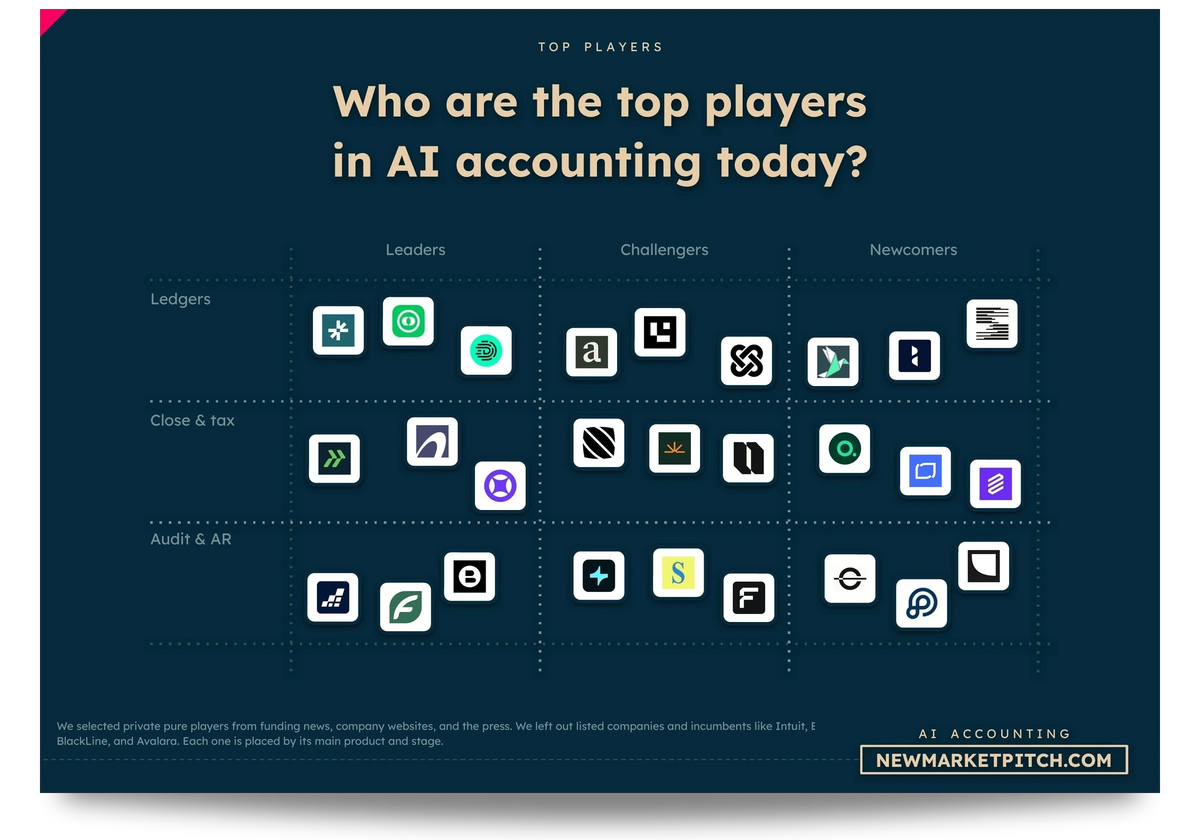
In our report covering the AI accounting market, we turn what is vague and complex into simple, useful visuals. Market maps like this one show you at a glance where every startup stands.
Why are AI accounting startups moving beyond bookkeeping?
The biggest opportunities in AI accounting now extend into financial close, audit, tax preparation, and enterprise accounting systems, and several startups pursuing these markets have already reached billion-dollar valuations.
Rillet raised $100 million at a $1 billion valuation in August 2026 to expand its AI-native ERP platform. Basis secured another $100 million at a $1.15 billion valuation in February 2026, focusing on AI agents for accounting firms. Fieldguide raised $75 million at a $700 million valuation that same month to automate audit and advisory work. Numeric secured $51 million in November 2025 to expand beyond financial close.
These companies are attacking different parts of the profession. Rillet wants to replace the accounting system itself. Basis wants to automate work performed by accounting firms. Fieldguide handles assurance engagements, while Numeric works alongside existing general ledgers.
The opportunity goes well beyond categorizing expenses or extracting invoices. Preparing financial statements, reconciling accounts, interpreting contracts, reviewing tax positions, and documenting audits all involve expensive, recurring work. Companies have already built substantial software businesses around these activities, and AI is giving newer entrants a chance to challenge them.
Which AI accounting startups are actually worth watching?
Rillet, Basis, FloQast, Numeric, Fieldguide, Campfire, and Trullion are among the strongest AI accounting companies beyond bookkeeping, although each leads in a different part of the market.
Rillet and Campfire are developing AI-native ERP systems. Numeric and FloQast focus on accounting operations, particularly financial close and reconciliations. Basis and Accrual are building AI agents for accounting firms, while Fieldguide specializes in audit and assurance. Trullion handles more technical accounting tasks, and Blue J and TaxGPT focus on tax professionals.
We also distinguish newer AI-native startups from established accounting software businesses adding AI. FloQast, founded in 2013, has a much longer commercial history than Rillet or Basis. Its inclusion makes sense because its revenue, customer relationships, and AI products provide an important comparison with younger challengers.
The ranking below combines disclosed revenue, customer adoption, funding, product depth, and actual use in accounting workflows. We give commercial traction more weight than fundraising alone.
| Company | Main specialty | Strongest evidence | Our assessment |
|---|---|---|---|
| Rillet | AI-native ERP | $1B valuation; 600+ customers | Leading new ERP contender |
| Basis | AI agents for accounting firms | $1.15B valuation; $100M round | Leading firm-side AI contender |
| FloQast | Financial close and controls | $200M+ ARR | Most commercially established |
| Numeric | Close and reconciliation | $51M Series B; major customers | Strong close specialist |
| Fieldguide | Audit and assurance | $700M valuation; $125M funding | Leading audit-native challenger |
| Campfire | AI-native ERP | $100M raised across 12 weeks in 2025 | Serious ERP competitor |
| Trullion | Technical accounting | Named enterprise customers and case studies | Specialist leader |
| Blue J | Tax research | Series C; authoritative tax content | Strong tax-research contender |
| TaxGPT | Tax research and preparation | 80,000+ claimed active users | Fast-developing tax AI platform |
| Accrual | Accounting-firm workflows | $75M initial financing | Well-funded emerging challenger |

Our research about AI accounting tools gets updated several times a month, so you always get the latest view of where things stand.
Is Rillet becoming a real threat to NetSuite?
Rillet is one of the strongest AI-native challengers to Oracle NetSuite right now, with more than 600 reported customers and annual recurring revenue that doubled in just three months.
TechCrunch reported in August 2026 that Rillet had raised $100 million in a Series C led by Iconiq, reaching a $1 billion valuation. The company had emerged from stealth in 2024 and accumulated approximately $200 million in financing within two years. Andreessen Horowitz and Sequoia were among its earlier investors.
The customer mix is particularly interesting. CEO Nicolas Kopp told Fortune that approximately 40% of Rillet's customers came from outside technology and AI. Applied to its 600-plus customer base, that would represent at least roughly 240 companies in other sectors, assuming both figures cover the same period.
That gives Rillet more credibility than an accounting product adopted almost exclusively by venture-backed AI companies. It also reported an alliance with EY and highlighted Mercor, a company with more than $2 billion in annual recurring revenue that reportedly operates with a three-person finance team.
Still, NetSuite serves a much broader range of organizations, including businesses with complex inventory, subsidiaries, international tax requirements, and established reporting controls. Rillet's customer growth is impressive, but 600 customers remain a relatively small base compared with a mature global ERP franchise.
We would currently rank Rillet as a leading new ERP challenger. Whether it becomes a broad NetSuite replacement depends on how well its product handles complex companies beyond its early customer base.
If you want more recent data on this point, please see our latest AI accounting market report.
Can Campfire catch Rillet in AI accounting software?
Campfire is a serious competitor to Rillet, and its expansion across accounting, forecasting, and ERP automation makes the contest considerably closer than their early funding histories suggested.
Campfire announced a $35 million Series A led by Accel in June 2025, then raised a $65 million Series B co-led by Accel and Ribbit Capital in October 2025. Combined with its Series A, the company raised $100 million in approximately four months. Its earlier $3.5 million seed round preceded both financings.
Campfire's adoption includes Replit, Coder, Advisor360°, and Trust & Will. TechCrunch reported that customers with more than 100 employees had migrated from NetSuite to Campfire, naming Advisor360°, Rhumbix, and Fooji among examples.
The company's development since then is worth examining. In May 2026, Campfire introduced multi-book accounting and lease accounting, followed by an ERP migration agent in September. It also expanded into forecasting and connected billing to its ERP through a Tabs integration in October.
These additions tackle a central weakness of young ERP products: businesses often outgrow software because they need more complex accounting features, rather than simply because their transaction volume increases.
Rillet has the stronger published customer-count evidence and a disclosed billion-dollar valuation. Campfire has demonstrated a rapid expansion of product functionality and real migrations from incumbent systems.
For now, Rillet has the clearer disclosed scale advantage. Campfire looks like one of the few younger companies capable of making that lead uncomfortable.

In our market report about AI accounting tools, we look at what the winners do differently, so you can learn from the best instead of guessing.
Is Numeric the best AI startup for financial close?
Numeric is one of the strongest younger AI accounting companies for financial close, especially for businesses that want better automation without replacing their existing ERP.
Numeric raised a $51 million Series B led by IVP in November 2025, bringing its disclosed funding to $89 million. Its customers include OpenAI, Brex, Plaid, and Wealthfront, according to the company's financing announcement.
Financial close involves far more than checking whether a month's transactions have been recorded. Accounting teams reconcile balances, investigate unusual changes, confirm cash movements, prepare explanations, and organize reviews. Numeric started with close management and has been expanding into the work behind those processes.
Its move into cash management in November 2025 was particularly relevant. Bank balances and cash movements are among the areas where accounting teams repeatedly move information between financial systems and spreadsheets. Bringing those tasks into the same platform creates opportunities to automate work throughout the month.
Numeric competes with FloQast and BlackLine, two businesses with established accounting-software customer bases. It also faces competition from Rillet and Campfire, which can build automated reconciliations directly into their ERP products.
Numeric's appeal is straightforward: companies can improve their close without undertaking an ERP migration. That is a meaningful advantage, although its private revenue and retention figures are not sufficiently disclosed to establish its market share.
If you want more recent data on this point, please see our latest AI accounting market report.
Is FloQast already bigger than the new AI accounting startups?
FloQast is considerably more commercially established than most younger AI accounting startups, having surpassed $200 million in annual recurring revenue in January 2026.
The company reached a $1.6 billion valuation after raising $100 million in April 2024. Its January 2026 announcement confirmed that annual recurring revenue had passed $200 million, supported by enterprise adoption and the expansion of its AI-enabled accounting platform.
That revenue figure changes the comparison. Rillet and Basis have attracted considerable attention for reaching billion-dollar valuations, but neither has published a directly comparable absolute ARR figure. FloQast has already demonstrated a recurring business of substantial size.
It also has a broader operating history. Founded in 2013, FloQast grew from financial-close management into reconciliations, compliance, audit support, and accounting operations. Its newer AI agents can reach customers that already use its software and understand its workflows.
The competitive pressure is real. Numeric offers specialized automation, while AI-native ERP vendors can integrate similar features into their underlying accounting systems. FloQast must keep adding capabilities that customers are willing to pay for rather than relying on its existing relationships.
Nevertheless, commercial maturity deserves more weight than startup hype. Among the private companies we reviewed, FloQast has the strongest disclosed recurring-revenue evidence.

In our document detailing everything you need to know about AI accounting, you will always find fresh funding data, taken straight from our own verified funding database.
Which AI accounting companies have the strongest proof of adoption?
FloQast has the strongest disclosed revenue evidence, Rillet has one of the clearest customer-growth stories, and Numeric and Campfire have credible enterprise references. Basis and Fieldguide offer strong evidence of adoption within professional accounting firms.
We can put these figures into context using BlackLine, the public financial-close and accounting automation company. BlackLine reported $700.4 million in 2025 revenue, up 7.2% from 2024, and ended the year with 4,394 customers. Its annual report also showed a 105% dollar-based net revenue retention rate.
BlackLine's figures provide a useful benchmark. FloQast's $200 million-plus ARR is substantial but remains far below BlackLine's annual revenue. Rillet's reported 600-plus customers represent meaningful early traction, yet they are still roughly one-seventh of BlackLine's customer count. The products and customer sizes differ, so this is a scale comparison rather than a market-share calculation.
Professional accounting platforms need a different comparison. Basis reports adoption among roughly 30% of the top 25 U.S. accounting firms, while Fieldguide says its technology reaches half of the top 100 firms. Such relationships are significant, although firm-level adoption does not reveal how many employees use the products or how much revenue each customer generates.
| Company | Public evidence | What we can reasonably conclude |
|---|---|---|
| FloQast | $200M+ ARR | Substantial recurring revenue |
| Rillet | 600+ customers; ARR doubled in three months | Strong early growth |
| Numeric | OpenAI, Brex, Plaid, Wealthfront | Credible enterprise adoption |
| Campfire | Replit, Coder, Advisor360° and other references | Real ERP deployments |
| Basis | Approximately 30% of top 25 U.S. accounting firms | Major-firm penetration |
| Fieldguide | Approximately half of top 100 U.S. accounting firms | Broad professional-firm reach |
| TaxGPT | 80,000+ claimed active users | Significant reported usage |
| BlackLine | $700.4M revenue; 4,394 customers | Established public-market benchmark |
The biggest information gap is still revenue among the younger private companies. We have enough evidence to identify serious competitors, but much less to compare how much customers spend, how long they stay, and whether those businesses are becoming profitable.
Is Basis winning the AI accounting-agent race?
Basis currently looks like the leading well-funded AI-native challenger for accounting-firm workflows, supported by a $1.15 billion valuation and reported adoption among major U.S. accounting firms.
Bloomberg reported in February 2026 that Basis raised $100 million in a round led by Accel, with GV and existing investor Khosla Ventures participating. Total disclosed funding reached approximately $138 million.
Basis develops AI agents that help accounting firms prepare financial statements, complete tax returns, and handle other client work. Its technology operates within professional workflows, allowing accountants to review work before it reaches clients or regulators.
The company reported relationships with about 30% of America's top 25 accounting firms, equivalent to approximately seven or eight firms. That is a particularly interesting customer base because large accounting partnerships manage recurring engagements across many clients. One successful firm-level deployment can potentially reach far more accounting work than one corporate customer.
Basis also has a new competitor with substantial financial backing. Accrual emerged from stealth in February 2026 after raising $75 million, including $65 million from General Catalyst. Its platform covers document intake, preparation, review, exception handling, and delivery.
Accrual's product ambitions overlap with Basis, but Basis has disclosed more evidence of institutional adoption. We therefore give Basis the lead while treating Accrual as a serious challenger whose commercial performance still needs to be demonstrated.
The next question is how much work these agents actually complete. The number of accounting firms using the software tells us where it has entered the market. Task completion, human review requirements, and recurring revenue will tell us how deeply it has changed accounting operations.
If you want more recent data on this point, please see our latest AI accounting market report.

Learning from others' mistakes is the cheapest lesson there is. In our report covering the AI accounting market, we look at what broke startups before you, so you don't repeat it.
Is Fieldguide the top AI startup for audit firms?
Fieldguide is one of the leading AI-native audit platforms, and its adoption among major U.S. accounting firms makes it a particularly credible contender.
Fieldguide raised $75 million in February 2026 at a $700 million valuation. Goldman Sachs Alternatives led the Series C, with Thomson Reuters, Bessemer Venture Partners, and 8VC among the participating investors. The financing brought its total disclosed funding to $125 million.
According to Fieldguide's fundraising materials, its software is used by roughly half of the top 100 U.S. accounting firms. If that figure refers to 50 distinct firms, it gives Fieldguide a substantial institutional presence relative to a six-year-old business.
Its product covers audit and advisory engagements from planning through reporting. AI agents assist with document analysis, evidence handling, testing, and the preparation of workpapers. These are activities that accounting firms repeat across engagements, making them natural targets for automation.
Fieldguide also benefits from a different buying dynamic than ERP vendors. Audit firms can deploy engagement software without convincing every client to replace its accounting system.
There is an important limitation, however. The company has not disclosed enough information to measure how many engagements are completed through its platform or what share of audit work its agents perform. It would be premature to call it the overall market leader ahead of established audit software suppliers.
Among younger AI-native audit companies, Fieldguide currently has one of the strongest combinations of institutional adoption, product focus, and investor backing.
Can Trullion automate accounting work that ChatGPT cannot reliably handle?
Trullion is particularly well positioned for technical accounting because it combines AI document analysis with specialized accounting calculations, controls, and supporting evidence.
Its product handles areas such as lease accounting, revenue recognition, and audit workflows. These activities require more than identifying information in a contract. Accountants must interpret clauses, apply accounting standards, calculate financial effects, and preserve documentation for review.
Trullion has published customer examples involving Claroty, Virgin Voyages, Taboola, and HMD Global. In one case study, Claroty reported saving 90% of the time previously spent on lease management. Virgin Voyages described reducing a lease-accounting process from days to minutes.
Those improvements are company-published case studies covering particular processes. They do not establish that Trullion reduces total accounting workloads by similar percentages.
The specialization nevertheless gives Trullion a clear position. A general-purpose AI assistant can summarize a lease agreement, but accounting software must connect relevant terms to calculations, journal entries, reporting, and audit evidence.
Trullion competes with specialist accounting software and the technical-accounting features being added to broader ERP platforms. Its strongest advantage lies in handling complicated documents and accounting treatments that are difficult to automate with generic tools.

Your time is limited. In our research about AI accounting tools, we put numbers on each part of the market, so you can see where it makes sense to focus.
Which AI tax startups are actually getting traction?
Blue J and TaxGPT are two of the strongest specialist AI tax companies, with Blue J benefiting from its professional research focus and TaxGPT reporting a substantial active-user base.
Blue J secured a Series C investment from Ten Coves Capital, announced by the company in June 2025. Its software uses AI and authoritative tax sources, including Tax Notes, to help professionals research complex tax questions.
TaxGPT reports more than 80,000 active users, over 650,000 tax questions answered, and a 95% satisfaction rate. These are company-reported platform metrics, rather than independently audited customer or revenue figures.
The scope of TaxGPT has also expanded. Beyond research, the company now offers tax-return review, preparation workflows, drafting, and software-assisted tasks through its Cowork product.
That expansion brings it closer to Basis, which uses AI agents to perform accounting and tax work within professional firms.
Blue J has a strong position in specialist research, particularly where professionals need to investigate tax law and review authoritative material. TaxGPT appears to have a wider publicly disclosed usage footprint and is pursuing more of the surrounding workflow.
We cannot establish which company generates more revenue from the available information. TaxGPT's user count is notable, while Blue J's specialist content relationships and financing history support its credibility among professional tax researchers.
Are AI accounting startups actually replacing accountants?
AI accounting startups are already reducing manual accounting work, but the evidence for widespread replacement of professional accountants remains weak.
Rillet has highlighted Mercor's ability to manage a business with more than $2 billion in annual recurring revenue using a three-person finance team. Campfire has published customer examples showing faster close processes, while Numeric automates reconciliations and analysis that accountants previously handled manually.
These examples suggest that software can help some organizations grow without increasing their accounting headcount at the same pace. They do not tell us how many people would otherwise have been hired, how much work is performed externally, or whether the outcomes apply to more complicated businesses.
The wider workforce evidence is mixed. The AICPA's 2025 Trends report recorded 55,152 accounting degrees awarded during the 2023–2024 academic year, down 6.6% from the previous year. However, a subsequent AICPA review reported that undergraduate accounting enrollment increased 7.3% in fall 2025.
Accounting firms also continue to recruit. In the AICPA's earlier survey, three-quarters of responding firms that recruited graduates in 2024 expected to hire at least as many in 2025.
We see stronger evidence for a change in how accountants spend their time than for an immediate collapse in employment. Routine preparation, reconciliation, and documentation are becoming easier to automate. Judgment, professional responsibility, client advice, and final approval remain more difficult to delegate.
The larger question is whether firms will use the productivity gains to serve more clients or reduce the number of people needed for the same workload. Public disclosures do not yet provide a reliable industry-wide answer.
If you want more recent data on this point, please see our latest AI accounting market report.

In our market report about AI accounting tools, we always try to gather several sources and make estimates that make sense, so you can work with solid numbers.
Can AI accounting agents be trusted with financial statements and audits?
AI accounting agents are becoming more useful for financial statements and audits, but companies still need reviewable calculations, clear audit trails, and strong controls before allowing agents to complete sensitive work.
The requirements become stricter as automation moves beyond simple transactions. Incorrectly categorizing a small expense may require a correction. Misstating revenue recognition, overlooking a tax obligation, or producing unsupported audit conclusions can create much larger problems.
Different startups have built their products around these constraints. Rillet places AI within an accounting system that supports financial controls and approval workflows. Fieldguide integrates AI agents into documented audit engagements. Trullion connects contract analysis with accounting calculations. Blue J and TaxGPT provide source-backed tax research that professionals can review.
The challenge is measuring reliability. A vendor might report that its software handles thousands of documents or automates a large share of a workflow, but those figures tell us little about the frequency of material errors.
Independent comparisons would need to measure correct completion, required human corrections, review time, and control failures across representative accounting tasks.
Such results remain scarce in public disclosures. For now, we place more confidence in products with real customer deployments and established review procedures than in claims that accounting agents can work completely autonomously.
Can AI accounting startups beat Oracle, Intuit, and BlackLine?
AI accounting startups can win important parts of the market, but Oracle, Intuit, and BlackLine have powerful advantages in existing customers, financial data, and established accounting workflows.
Oracle NetSuite is deeply integrated into finance departments. Intuit reaches small businesses and accountants through QuickBooks and its tax products. BlackLine has thousands of enterprise customers using its financial-close and accounting automation software.
The established vendors are also buying AI capabilities. Thomson Reuters acquired accounting AI startup Materia in October 2024. BlackLine acquired WiseLayer, an AI-powered accounting automation company, during 2025.
We can already see two different competitive approaches. Rillet and Campfire are trying to convince businesses to migrate to newer ERP platforms. Numeric and FloQast offer improvements to accounting processes without necessarily requiring a replacement of the general ledger. Basis and Fieldguide sell directly to professional accounting firms.
The migration question will be decisive for ERP challengers. Companies have to move historical data, integrate finance tools, test controls, retrain staff, and sometimes involve external auditors. Better AI features alone may not justify all that work.
Specialist software has a shorter route into existing organizations, although incumbents can eventually reproduce parts of its functionality.
The likely outcome is competition across several categories rather than one startup taking over accounting software. The newest entrants have proved they can attract serious customers and capital. Displacing the largest incumbents across the whole market will be a much longer process.

If you build or invest in the AI accounting market, you need to know which business models pay off now and which ones are fading. That's why our report covering it has a whole section on it.
Where are the biggest opportunities for AI accounting startups now?
Financial close, accounting-firm agents, audit, technical accounting, and AI-native ERP are currently the most attractive areas for ambitious AI accounting startups, based on the commercial adoption and investment activity we reviewed.
The choice between these areas has major consequences for how a startup can grow. ERP replacement gives a vendor control over the underlying financial system, but acquiring customers can involve complicated migrations. Accounting-firm agents can reach repeated client workflows through a single professional organization, although firms have demanding accuracy and review requirements.
Financial close is already a proven software category, with BlackLine and FloQast demonstrating substantial commercial scale. Audit and tax have deep specialist requirements that make professional credibility particularly important. Technical accounting offers narrower applications where contract interpretation and compliance create measurable work.
There are also different levels of competition. Rillet and Campfire face established ERP systems. Numeric faces BlackLine and FloQast. Fieldguide competes with existing audit software, while Blue J and TaxGPT must compete with established tax-research providers and increasingly capable general AI models.
| Opportunity | Main contenders | Commercial attraction | Biggest challenge |
|---|---|---|---|
| AI-native ERP | Rillet, Campfire | Broad financial-system ownership | Difficult customer migration |
| Financial close | Numeric, FloQast | Recurring monthly work | Established competitors |
| Accounting-firm agents | Basis, Accrual | Work repeated across many clients | Accuracy and professional review |
| Audit and assurance | Fieldguide, Trullion | Document-heavy engagements | Audit standards and trust |
| Technical accounting | Trullion | Specialized, valuable tasks | Narrower workflows |
| Tax research | Blue J, TaxGPT | Recurring professional research | Accuracy and authoritative sources |
| Reconciliations | Numeric, FloQast | Frequent exception handling | Data integration |
| Accounting compliance | FloQast, Fieldguide | Recurring controls and reporting | Enterprise buying cycles |
The opportunity we find particularly interesting is software that performs accounting work across existing systems. Basis, Numeric, and Fieldguide can expand without persuading companies to replace their ERP. Rillet and Campfire have a harder initial sale but potentially more control over their customers' accounting operations if they succeed.
Who are the top AI accounting startups beyond bookkeeping?
Rillet, Basis, FloQast, Numeric, Fieldguide, Campfire, and Trullion are currently the top AI accounting companies we would prioritize beyond bookkeeping, with Blue J, TaxGPT, and Accrual completing the strongest broader shortlist.
Rillet leads our ranking of newer AI-native ERP challengers, backed by more than 600 reported customers, rapid recurring-revenue growth, and a $1 billion valuation. Campfire is its closest emerging competitor in this selection, having raised $100 million across two rounds in 2025 and expanded into more demanding ERP functions.
Basis has the strongest position among the newer AI-agent companies serving accounting firms. Its $1.15 billion valuation and adoption among major U.S. firms put it ahead of less-established challengers, including Accrual.
For demonstrated commercial scale, FloQast deserves particular attention. Its $200 million-plus annual recurring revenue offers firmer evidence of a substantial business than the valuations of younger companies. Numeric is one of the most promising specialists in financial close, while Fieldguide has built a strong position in audit and assurance. Trullion stands out for technical accounting, and Blue J and TaxGPT are relevant contenders in tax.
The funding numbers also show how seriously investors are taking these markets. The $100 million Rillet round, $100 million Basis round, $75 million Fieldguide round, $51 million Numeric round, and $75 million Accrual financing together represent $401 million in disclosed financing events. Those rounds occurred across different dates and stages, so the total illustrates investment concentration among selected companies rather than the size of the entire AI accounting market.
We are more confident about the identity of the leading contenders than their eventual order. FloQast has proven recurring revenue, Rillet has a rapidly growing customer base, and Basis and Fieldguide have meaningful professional-firm adoption. Several others still disclose much more about fundraising and product development than about customer economics.
AI accounting has already moved well beyond bookkeeping. Rillet and Basis are two of the most compelling younger companies trying to redefine the category, while FloQast, Numeric, and Fieldguide demonstrate how valuable specialized accounting workflows can become. The winners will be decided by how much reliable accounting work their software handles in real organizations, and how many customers continue paying for it.
If you want more recent data on this point, please see our latest AI accounting market report.

In our report covering the AI accounting market, we don't want to repeat what boring consulting reports say. Instead, we show you the real and latest market signals that matter.
Our methodology
This analysis identifies the leading AI accounting startups beyond bookkeeping by comparing commercial scale, customer adoption, product capabilities, financing, competitive positioning, and evidence of real accounting automation. We cover AI-native ERP, financial close, accounting-firm agents, audit and assurance, technical accounting, tax research, and compliance.
For each dimension, we examined recent financing announcements, financial disclosures, product releases, customer deployments, and implementation examples. We aggregated the relevant developments, compared companies operating in similar workflows, and assessed where multiple findings supported a stronger conclusion. The ranking reflects that combined assessment rather than a single funding, revenue, or customer metric.
We distinguish financing momentum from commercial adoption. Disclosed valuations and investment rounds indicate the resources available to a startup, while annual recurring revenue, paying customers, and enterprise deployments provide stronger evidence of an established business. Company-reported adoption figures are treated according to what they actually measure: a customer organization, an active user, and a deployed accounting workflow are different units of analysis.
We also separate AI-native challengers from older accounting software vendors integrating AI into established platforms. FloQast is included because its commercial scale provides an important benchmark for younger companies such as Numeric, Rillet, and Basis. BlackLine is used as a public-company comparison rather than ranked as a startup. Competitive positions are assessed within specific accounting functions before drawing conclusions about the broader market.
For operational performance, we examined the complexity of the work being automated, integration with existing financial systems, documented customer outcomes, and professional review requirements. We distinguish improvements reported in individual case studies from industry-wide productivity or employment effects. Accounting reliability is assessed through evidence of controls, audit trails, reviewability, and real deployments rather than claims of fully autonomous work.
Key financing and company sources include Rillet's Series C announcement, Basis's Series B announcement, FloQast's $200 million ARR milestone, Numeric's Series B announcement, Fieldguide's Series C announcement, Campfire's financing announcement, Accrual's launch announcement, and General Catalyst's investment analysis.
For product development and specialized accounting workflows, we reviewed Campfire's product updates, Trullion's customer implementations, Blue J's Series C announcement, and TaxGPT's product offerings. These sources help establish functionality, commercial positioning, and documented use cases across ERP, technical accounting, and tax.
Industry benchmarks and workforce context come from BlackLine's 2025 financial results, the AICPA's 2025 Trends findings, its fall 2025 enrollment update and spring 2026 enrollment analysis. We also considered Thomson Reuters' acquisition of Materia when assessing incumbent competition and consolidation.
Our conclusions place the greatest weight on consistent evidence across commercial adoption, product maturity, and accounting workflow execution. A company's position can therefore differ by category: FloQast leads on disclosed recurring-revenue scale, Rillet and Campfire compete in AI-native ERP, Basis has a strong position in accounting-firm agents, and Fieldguide stands out in audit and assurance. The ranking reflects the evidence available as of October 12, 2026.

In our research about AI accounting tools, we like to show you the big picture. We know your time is precious, so we make every page quick to read and packed with as much learning as possible per minute.
Written by the New Market Pitch teamWe track new markets so founders and investors can move faster. About us