What are the top AI accounting startups by total funding raised?
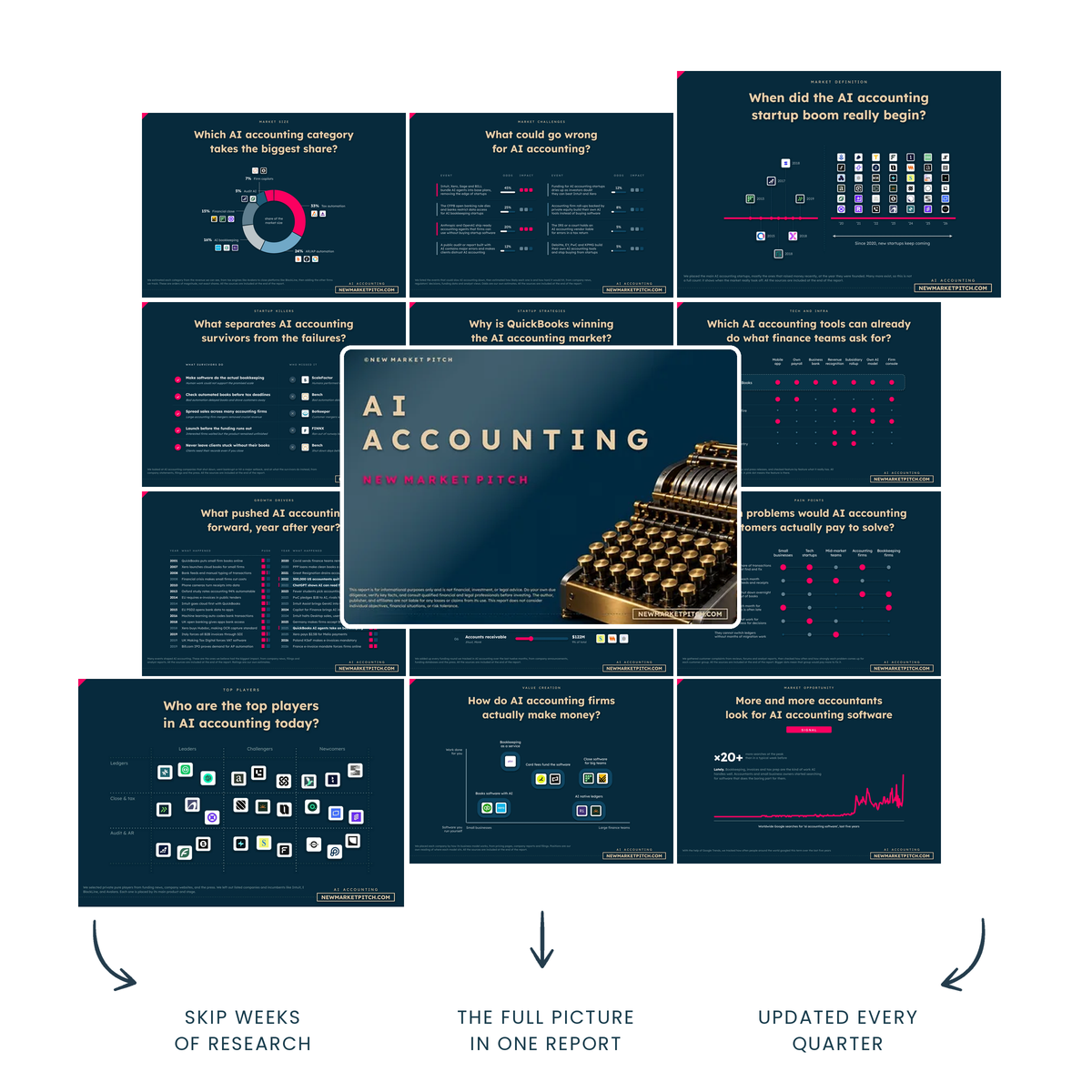
Whether you're building or investing in the AI accounting market, our report covers everything you need to know: the players, the money, and what's coming next.
Summary
The top AI accounting startups by total funding raised are HighRadius (at least $475 million), Pennylane ($409 million), FloQast ($303 million), AppZen ($283 million) and Yunzhangfang (at least $243 million). Together, HighRadius, Pennylane, FloQast, AppZen and Yunzhangfang have raised $1.7B+, while the 20 leading startups have accumulated $3.7B+.
HighRadius remains the biggest fundraising success in the category, but Pennylane is becoming an equally important player. Its $204 million Series E in January 2026 brought its total funding to $409 million, putting it ahead of several much older American enterprise software companies.
The funding is concentrated among established platforms, although newer AI-native competitors are catching up surprisingly quickly. Rillet has raised $208 million, Basis $138 million, and Campfire $104 million, with all three targeting increasingly automated accounting systems.
Some of the largest individual rounds have been enormous. HighRadius raised $300 million in its Series C, Pennylane secured $204 million in its Series E, AppZen attracted $180 million, and Xelix and Ottimate each raised $160 million.
ICONIQ Growth, Sequoia Capital, Insight Partners, Accel, General Catalyst, Lightspeed and Andreessen Horowitz are among the most active investors. Their investments overlap across several segments, from enterprise finance automation and financial close software to AI-native ERP platforms.
One of the biggest investment themes is the transition from accounting automation tools to complete AI-native financial systems. Rillet, DualEntry, Campfire, Digits and Puzzle want to automate the general ledger and much of the work surrounding it, potentially challenging established platforms such as QuickBooks, Xero and NetSuite.
AI accounting agents are also attracting substantial capital. Basis, Accrual, Truewind, Stacks AI and OCTA are developing systems that can prepare journal entries, reconcile accounts, produce accounting documentation and handle increasingly complex financial tasks. Accountants still want human review, however: only 6% of respondents in Intuit's 2026 survey preferred fully autonomous AI execution for client deliverables.
Accounts payable and receivables remain particularly attractive markets. Xelix, Ottimate, Stampli and AppZen are automating invoice processing and payments, while Stuut, Tabs, Simetrik and Tesorio are tackling collections, billing and reconciliation. These are repetitive processes with clear financial outcomes, making them easier to sell to enterprise customers.
The United States has the largest concentration of funded companies, but Europe has produced some serious competitors. France's Pennylane, Indy and Cryptio, the UK's Xelix, and Denmark's Light demonstrate that European startups can build substantial accounting businesses. China's Yunzhangfang and Colombia's Simetrik also stand out.
The next funding leaders will probably come from companies that can move beyond promising demonstrations and become part of everyday finance operations. Rillet, Basis, Pennylane, FloQast, AppZen and HighRadius have particularly interesting positions, while Campfire, DualEntry, Stuut, Numeric and Xelix are worth watching closely. The real test will be how reliably their products handle complex transactions, exceptions and financial reporting.

Written by the New Market Pitch teamWe track new markets so founders and investors can move faster. About us

In our report covering the AI accounting market, you will always find fresh funding data, taken straight from our own verified funding database.
Top startups in the AI accounting market ranked by total funding raised
Here is an updated table that ranks the top startups in the AI accounting market based on the total amount of funding they have raised to date.
The table also includes the total number of funding rounds, the date and size of the latest round, the financing type (e.g. Series A, equity financing), key investors, the startup’s current status (active, IPO, acquired, or shut down), and a confidence score based on the data collected (startups with very low data confidence are excluded to make sure the information is reliable).
For more detailed information, please check the report covering the AI accounting market.
| # | Startup | Total raised | Last round | Status | Confidence |
|---|---|---|---|---|---|
| $100M to $500M | |||||
| 1 | HighRadiusAI receivables and treasury automation | $475M+ | Mar 2021$300M · Series C | Active | Strong |
| 2 | PennylaneAccounting and financial management platform | $409M | Jan 2026~$205M · Series E | Active | Partial |
| 3 | FloQastAI financial close management software | $303M | Apr 2024$100M · Series E | Active | Strong |
| 4 | AppZenAI finance automation and spend controls | $283M | Sep 2025$180M · Series D | Active | Full |
| 5 | YunzhangfangAutomated accounting and tax management | $243M+ | Feb 2022$100M · Series E | Active | Partial |
| 6 | RilletAI-native accounting ERP platform | $208M | Aug 2026$100M · Series C | Active | Full |
| 7 | XelixAI accounts payable and audit automation | $165M+ | Jul 2025$160M · Series B | Active | Strong |
| 8 | OttimateAI accounts payable automation | $164M | Nov 2021$160M · Series B | Active | Strong |
| 9 | PilotAutomated bookkeeping and CFO services | $158M+ | Mar 2021$40M · Series C extension | Active | Strong |
| 10 | FundGuardAI investment accounting and asset servicing | $156M | Mar 2024$100M · Series C | Active | Full |
| 11 | StampliAI-powered accounts payable automation | $148M | Oct 2023$61M · Series D | Active | Strong |
| 12 | BasisAI agents for accounting firms | $138M | Feb 2026$100M · Series B | Active | Full |
| 13 | CollectiveAI bookkeeping, tax, payroll for solopreneurs | $119M+ | Oct 2026$40M · Series B | Active | Low |
| 14 | Vic.aiAutonomous invoice and accounting processing | $115M | Dec 2022$52M · Series C | Active | Full |
| 15 | SimetrikAI-powered enterprise financial reconciliation | $112M+ | Jun 2025$30M · Series B extension | Active | Strong |
| 16 | CampfireAI-native ERP and accounting platform | $104M | Oct 2025$65M · Series B | Active | Strong |
| Below $100M | |||||
| 17 | IndyAutomated bookkeeping for independent professionals | $98M | Nov 2023~$44M · Series C | Active | Strong |
| 18 | DualEntryAI-native ERP for finance teams | $96M | Oct 2025$90M · Series A | Active | Strong |
| 19 | DigitsAI-native bookkeeping and financial insights | $95M | Mar 2022$65M · Series C | Active | Full |
| 20 | TabsAI billing and collections automation | $92M | Sep 2025$55M · Series B | Active | Full |
| 21 | NumericAI financial close and reconciliation | $89M | Nov 2025$51M · Series B | Active | Full |
| 22 | DougsOnline accounting and tax services | $83M | Oct 2026$56M · Growth equity | Active | Full |
| 23 | StuutAutonomous accounts receivable management | $82M+ | Oct 2026$52M · Series B | Active | Strong |
| 24 | AccrualAI accounting automation for CPA firms | $75M1 | Feb 2026$75M · Series A | Active | Partial |
| 25 | CryptioDigital asset accounting and reconciliation | $71M+ | Mar 2026$45M · Series B | Active | Full |
| 26 | FinQueryAI lease accounting and spend management | $65M2 | Apr 2024$25M · Growth equity | Acquired | Partial |
| 27 | OsomeAutomated accounting and corporate services | $63M | May 2024$14M · Series B extension | Active | Partial |
| 28 | Auditoria.AIAI finance automation for enterprise accounting | $60M+ | Feb 2025$38M · Series B | Active | Strong |
| 29 | BHubOutsourced accounting and finance automation | $56M | Nov 2025$10M · Pre-Series B | Active | Full |
| 30 | MaximorAI finance and accounting agents | $54M | Oct 2026$45M · Series A | Active | Full |
| 31 | FinaloopAutomated ecommerce bookkeeping and tax accounting | $52M+3 | Jun 2024$35M · Series A | Active | Partial |
| 32 | ApronInvoice payments and accounts payable automation | $50M | Sep 2024$30M · Series B | Active | Full |
| 33 | PuzzleAI-native accounting and general ledger | $50M | Nov 2023$30M · Series B | Active | Strong |
| 34 | ZeniAI-powered bookkeeping and financial services | $48M | Nov 2025$1.5M · Unattributed VC | Active | Partial |
| 35 | LightAI-native accounting and finance platform | $43M | Sep 2025$30M · Series A | Active | Full |
| 36 | MaximaAI agents for enterprise accounting | $41M+ | Nov 2025$33M · Series A | Active | Full |
| 37 | CandisAI invoice management and accounting automation | $39M | Sep 2022$18M · Series C | Active | Full |
| 38 | NetgainNetSuite accounting workflow automation | $35M | Apr 2024$35M · Growth equity | Active | Partial |
| 39 | Stacks AIAgentic accounting and close automation | $35M+ | Feb 2026$23M · Series A | Active | Full |
| 40 | IntegralAI-powered bookkeeping, tax and payroll | $34.6M | Sep 2026$21M · Series A | Active | Partial |
| 41 | Biller GenieAccounts receivable automation platform | $34M | Jan 2026$22M · Series B | Active | Strong |
| 42 | TesorioAI cash flow and collections | $34M+ | Jul 2022$17M · Series B | Active | Partial |
| 43 | TrullionAI accounting and audit automation | $34M | Apr 2023$15M · Series A extension | Active | Low |
| 44 | RightRevAutomated enterprise revenue recognition | $30M+ | May 2025$13M · Series A | Active | Strong |
| 45 | NominalAI accounting and ERP automation | $29M | Jul 2025$20M · Series A | Active | Strong |
| 46 | MonkAI accounts receivable automation | $29M | Apr 2026$25M · Series A | Active | Full |
| 47 | DocytAI bookkeeping and accounting automation | $24M+ | Aug 2025$12M · Pre-Series B | Active | Partial |
| 48 | UpflowAI accounts receivable and payments | $23M+ | Apr 2024$5M · Series A extension | Active | Partial |
| 49 | BitwaveCrypto accounting, tax, and compliance | $22M | Dec 2022$15M · Series A | Active | Partial |
| 50 | OpenEnvoyAI invoice auditing and reconciliation | $22M+ | May 2023$15M · Series A | Active | Strong |
| 51 | FazeshiftAI agents for accounts receivable | $21M+ | Aug 2026Undisclosed · Strategic investment | Active | Full |
| 52 | QuantaAI accounting and financial reporting | $20M+ | Dec 2025$15M · Series A | Active | Full |
| 53 | InscopeAI financial reporting automation | $19M | Feb 2026$14M · Series A | Active | Full |
| 54 | ZenskarAI billing and revenue automation | $18M | Apr 2026$15M · Series A | Active | Strong |
| 55 | GappifyAI accrual and accounting automation | $17M+ | May 2023$10M · Series B | Active | Partial |
| 56 | TruewindAI accounting agents for businesses | $17M+ | Dec 2024$13M · Series A | Active | Strong |
| 57 | PredictAPAutomated real estate invoice processing | $16M+ | Sep 2025$5M · Venture equity | Active | Partial |
| 58 | UplinqAI bookkeeping and tax automation | $16M | May 2025$10M · Series A | Active | Partial |
| 59 | NumaricsDigital bookkeeping and business administration | $13M+ | Jul 2023~$11M · Seed | Active | Partial |
| 60 | FinmaticsAI document processing for accountants | $12M+ | Mar 2023~$6.5M · Series A | Acquired | Partial |
| 61 | GavitiAI accounts receivable collections automation | $11M+ | Apr 2022$9M · Series A | Active | Partial |
| 62 | WafeqCloud accounting and tax compliance | $10M | Dec 2024$7.5M · Series A | Active | Full |
| 63 | SyntheticFully autonomous AI bookkeeping | $10M | May 2026$10M · Seed | Active | Full |
| 64 | OutminAI bookkeeping and accounting services | $9M | May 2025$4.5M · Venture equity | Active | Strong |
| 65 | KickAI bookkeeping for small businesses | $9M | Nov 2025Undisclosed · Additional financing, type unconfirmed | Active | Partial |
| 66 | LedgeAI finance operations and reconciliation | $9M+ | Feb 2023$9M · Seed | Active | Strong |
| 67 | GrowfinAI accounts receivable management platform | $8.9M | Mar 2023$7.5M · Series A | Active | Full |
| 68 | HyperbotsAI agents automating financial operations | $8.5M | May 2025$6.5M · Series A | Active | Full |
| 69 | MikaAI bookkeeping and tax automation | $7.7M | Sep 2026$6.8M · Seed | Active | Strong |
| 70 | ViewzAI-native financial management platform | $7M | May 2026$7M · Seed | Active | Full |
| 71 | FondoAutomated startup bookkeeping and tax compliance | $5.8M | Nov 2024$4.6M · Seed | Active | Full |
| 72 | OCTAAI invoicing and collections automation | $5.8M | Sep 2026$3.5M · Seed | Active | Strong |
| 73 | DigitooAI invoice processing and accounting automation | $5.6M | Dec 2023$2.5M · Seed | Active | Partial |
| 74 | MaydayAutomated month-end accounting workflows | $5.5M+ | May 2026~$4.1M · Seed | Active | Low |
| 75 | KollenoAI receivables and collections management | $5.4M | Mar 2022~$5.4M · Seed | Active | Strong |
| 76 | PeakfloAI payables and receivables automation | $5.2M | Jul 2022$4.1M · Seed | Active | Partial |
| 77 | Donnerstag.aiAI accounts receivable management for suppliers | $5M | Nov 2025$5M · Seed | Active | Full |
| 78 | Paraglide AIAI accounts receivable agents | $5M | Jan 2026$5M · Pre-Seed | Active | Full |
| 79 | KabilioAI accounting automation for advisory firms | $4.3M | Nov 2025$4.4M · Pre-Seed | Active | Strong |
| 80 | AcctualCrypto and fiat AP/AR automation | $3.9M+ | Nov 2023$3.9M · Seed | Active | Partial |
No startups match this search.
- Includes about $10M not disclosed as a separate round.
- The 2025 majority acquisition's split between new equity and secondary sales is undisclosed.
- Known rounds total $52M; the company reports $55M.

In our research about AI accounting tools, we turn what is vague and complex into simple, useful visuals. Market maps like this one show you at a glance where every startup stands.
Which AI accounting startups have raised the most money?
HighRadius, Pennylane, FloQast, AppZen and Yunzhangfang lead the AI accounting funding market, with a combined $1.7B+ in reported funding. The top of the ranking is dominated by companies that have already built substantial accounting or enterprise finance businesses, although newer AI-native platforms are starting to attract comparable investor attention.
HighRadius leads with at least $475 million raised across four rounds. Its $300 million Series C in March 2021 was led by D1 Capital Partners and Tiger Global, with ICONIQ Growth and Susquehanna Growth Equity participating. Pennylane follows with $409 million across six rounds, including a $204 million Series E in January 2026 backed by TCV, Blackstone Growth and Sequoia Capital.
FloQast has raised $303 million across eight rounds, including a $100 million Series E in April 2024 led by ICONIQ Growth. AppZen has accumulated $283 million, including a $180 million growth financing in September 2025 led by Riverwood Capital. Yunzhangfang completes the top five with at least $243 million, including a $100 million Series E in February 2022.
The concentration is striking. The top five account for approximately 66.7% of the top ten's cumulative funding, while HighRadius and Pennylane alone account for around 34.4%. Investors have clearly committed much larger amounts to a small group of established platforms.
| Rank | Startup | Total raised |
|---|---|---|
| 1 | HighRadius | $475M+ |
| 2 | Pennylane | $409M |
| 3 | FloQast | $303M |
| 4 | AppZen | $283M |
| 5 | Yunzhangfang | $243M+ |
| 6 | Rillet | $208M |
| 7 | Xelix | $165M+ |
| 8 | Ottimate | $164M |
| 9 | Pilot | $158M+ |
| 10 | FundGuard | $156M |

Your time is limited. In our market report about AI accounting tools, we put numbers on each part of the market, so you can see where it makes sense to focus.
How much funding have the top 20 AI accounting startups raised collectively?
The top 20 AI accounting startups have raised $3.7B+ combined, showing that substantial venture investment extends well beyond the five largest companies. The next group includes several businesses building specialized financial software, as well as newer platforms trying to replace traditional accounting infrastructure.
After FundGuard come Stampli with $148 million, Basis with $138 million, Collective with at least $119 million and Vic.ai with $115 million. Simetrik has accumulated at least $112 million, while Campfire has raised $104 million. Indy has raised $98 million, DualEntry $96 million and Digits $95 million.
Tabs completes the top 20 with $92 million, just ahead of Numeric at $89 million.
The first ten companies account for $2.6B+ of the $3.7B+ raised by the top 20, so companies ranked 11–20 contribute about $1.1 billion, roughly 44% of the first ten's total. The funding opportunity is therefore much broader than the handful of companies at the top, although the largest businesses still have a considerable financial advantage.

In our document detailing everything you need to know about AI accounting, we always try to gather several sources and make estimates that make sense, so you can work with solid numbers.
What are the biggest funding rounds in AI accounting?
HighRadius, Pennylane, AppZen, Xelix and Ottimate have attracted some of the largest individual financing rounds among the ranked AI accounting startups. Several newer companies, particularly Rillet and Basis, have also secured nine-figure rounds, showing how quickly investor attention has expanded toward AI-native accounting.
HighRadius raised $300 million in March 2021, its largest disclosed round. Pennylane followed with a $204 million Series E in January 2026. AppZen secured $180 million in September 2025, while Xelix raised $160 million in July 2025 and Ottimate raised $160 million in November 2021.
FloQast, Yunzhangfang, Rillet, FundGuard and Basis each recorded a $100 million latest round in the ranking. DualEntry's $90 million Series A in October 2025 is another notable example, particularly because the company was still relatively young when it attracted that amount.
There is an interesting difference between the older and newer companies here. HighRadius, FloQast and Ottimate secured their large rounds after developing established products and customer relationships. Rillet, Basis and DualEntry attracted similarly substantial commitments while pursuing more ambitious AI-native software strategies.
| Startup | Latest round | Amount | Key investors |
|---|---|---|---|
| HighRadius | Series C | $300M | D1 Capital Partners, Tiger Global |
| Pennylane | Series E | ~$205M | TCV, Blackstone Growth, Sequoia Capital |
| FloQast | Series E | $100M | ICONIQ Growth |
| AppZen | Series D | $180M | Riverwood Capital |
| Yunzhangfang | Series E | $100M | Apax Digital, GF Investments |
| Rillet | Series C | $100M | ICONIQ, Sequoia Capital, Andreessen Horowitz |
| Xelix | Series B | $160M | Insight Partners, Passion Capital, LocalGlobe |
| Ottimate | Series B | $160M | FTV Capital |
| Pilot | Series C extension | $40M | Bezos Expeditions, Whale Rock Capital |
| FundGuard | Series C | $100M | Key1 Capital, Hamilton Lane, Blumberg Capital |

Our report covering the AI accounting market gets updated several times a month, so you always get the latest view of where things stand.
Who are the biggest investors in AI accounting startups?
ICONIQ Growth, Sequoia Capital, Insight Partners, Accel, General Catalyst and Lightspeed are among the most prominent investors in AI accounting, with several of these firms backing multiple companies across different parts of the market.
ICONIQ Growth has invested in HighRadius, FloQast, Rillet and Vic.ai. Its portfolio exposure covers enterprise receivables, financial close, autonomous accounting and AI-native ERP software. The firm has backed companies at very different stages of development, giving it exposure to both established finance platforms and newer products.
Sequoia Capital has invested in Pennylane, Rillet and Indy. These investments cover a broad range of customers, from independent professionals to larger finance teams. Insight Partners has backed Xelix, Stampli and Stuut, with investments spanning accounts payable, invoice automation and receivables management.
Accel has backed FloQast, Basis and Campfire. General Catalyst appears among the investors in Collective, Tabs, Accrual and Truewind. Lightspeed has invested in DualEntry, Apron, Puzzle and Zenskar.
Andreessen Horowitz is another important participant through its investments in Rillet and Stuut. Khosla Ventures has backed Rillet, DualEntry and Basis.
What stands out is the overlap between enterprise software investors and the new generation of AI investors. Firms that already understand finance departments, software distribution and enterprise sales are backing AI products that need to operate inside highly sensitive business systems.

In our research about AI accounting tools, we look at what the winners do differently, so you can learn from the best instead of guessing.
Why are investors putting so much money into AI-native accounting platforms?
Investors are putting substantial amounts into AI-native accounting platforms because these companies have the potential to replace entire financial software systems rather than simply automate individual tasks. Rillet, Campfire, DualEntry, Digits, Puzzle and Light are all pursuing versions of this opportunity.
Traditional accounting software is primarily built around recording transactions, maintaining ledgers and organizing workflows. AI-native platforms aim to handle more of the work themselves, including interpreting documents, creating journal entries, reconciling transactions and preparing financial reports.
Rillet is one of the strongest examples. Its AI-native ERP combines a general ledger with agents that perform finance work inside a real-time accounting environment. Its $100 million Series C in August 2026 was led by ICONIQ, with Sequoia Capital and Andreessen Horowitz participating.
DualEntry is pursuing a similar opportunity in ERP software. It raised a $90 million Series A in October 2025, led by Lightspeed Venture Partners and Khosla Ventures, with participation from GV. At the time of the announcement, the company said its platform had already processed $100 billion worth of journal entries using AI automation.
Campfire raised $65 million in its October 2025 Series B, co-led by Accel and Ribbit Capital. The company announced that it had raised $100 million across its Series A and Series B within just 12 weeks.
Digits and Puzzle are developing AI-native bookkeeping and general ledger products, while Light is building a broader accounting and financial management platform.
The real prize is to become the system where financial information is processed and acted upon, rather than simply stored. A company that controls the general ledger and automates the work around it could eventually capture a much larger share of finance departments' software budgets.

In our market report about AI accounting tools, we don't want to repeat what boring consulting reports say. Instead, we show you the real and latest market signals that matter.
Can AI accounting agents actually replace accountants?
AI accounting agents can already automate meaningful portions of accounting work, but replacing professional accountants entirely remains a much harder challenge. Basis, Accrual, Truewind, Stacks AI and OCTA are developing products that can execute accounting tasks, while keeping human professionals involved in reviewing important decisions.
Basis has raised $138 million across three rounds, including a $100 million Series B in February 2026 led by Accel, with GV and Khosla Ventures participating. Its agents can prepare journal entries, work through reconciliations, produce technical accounting memos and complete complex tax workbooks.
Accrual raised $65 million in its February 2026 Series A, backed by General Catalyst, PruVen Capital and Edward Jones Ventures. Its focus is automating the work performed by CPA firms.
Stacks AI raised $23 million in February 2026, with Lightspeed, General Catalyst and EQT Ventures participating. Truewind, backed by Rho Capital and Thomson Reuters Ventures, is also building AI accounting agents for businesses.
OCTA is targeting bookkeeping, reconciliations and month-end close. Its September 2026 seed round included MEVP, Wa'ed Ventures and Plug and Play.
The technology is already capable of handling many repetitive tasks, but accounting also involves interpreting unusual transactions, understanding contracts, evaluating tax implications and taking responsibility for financial statements.
Intuit's 2026 Accountant Technology Survey, which covered 725 US accounting and bookkeeping professionals, found that 88% had used AI for at least one client service during the previous year. However, only 30% said AI was embedded as the default in their daily workflows. When asked about AI's role in client deliverables, just 6% preferred fully autonomous execution.
We expect AI agents to take over an increasing amount of preparation, processing and reconciliation work, while accountants retain responsibility for reviewing exceptions and signing off on important financial decisions.

Learning from others' mistakes is the cheapest lesson there is. In our document detailing everything you need to know about AI accounting, we look at what broke startups before you, so you don't repeat it.
Why are AI accounts payable startups attracting so much funding?
Accounts payable automation attracts substantial investment because businesses process huge volumes of invoices, supplier statements, purchase orders and payment requests. Automating these workflows can reduce administrative costs while also helping companies identify duplicate payments, fraud and accounting errors.
Xelix has raised at least $165 million across two rounds, including a $160 million Series B in July 2025 led by Insight Partners. Its software focuses on invoice auditing, supplier statement reconciliation and identifying payment errors.
Ottimate has also accumulated $164 million, including a $160 million Series B in November 2021 led by FTV Capital. Its platform automates accounts payable workflows, particularly for restaurants and hospitality businesses.
Stampli has raised $148 million across five rounds. Its October 2023 Series D brought in $61 million, led by Blackstone, with Insight Partners and SignalFire participating. The company reported processing more than one million invoices worth over $5 billion in August 2023.
AppZen approaches the market from a broader finance automation perspective. Its $180 million growth financing in September 2025 was led by Riverwood Capital. The company said more than 500 enterprises, including over 65 Fortune 500 companies, were using its platform and that it had delivered more than $2 billion in customer savings.
Vic.ai, with $115 million raised, focuses on autonomous invoice and accounting processing.
These companies are tackling a problem that exists in practically every large organization. Invoices arrive continuously, payment terms differ, approvals are often fragmented and accounting teams must ensure that every transaction is correctly recorded. Automating the entire process gives these businesses a much larger market than document data extraction alone.

If you build or invest in the AI accounting market, you need to know which business models pay off now and which ones are fading. That's why our report covering it has a whole section on it.
Can AI receivables startups become major financial software companies?
AI receivables startups have a real opportunity to become major financial software providers because collections, billing, payment reconciliation and cash application are closely connected. Stuut, Tabs, Simetrik, Tesorio, Monk, Upflow and Biller Genie are targeting different parts of this process.
Stuut has raised at least $82 million across three rounds, including a $52.5 million Series B in October 2026. Insight Partners led the financing, with Andreessen Horowitz and M12 participating. The company says its platform has processed more than $3 billion and that customers have reduced days sales outstanding by 47%. These are company-reported operating figures, but they show the kind of financial outcomes the product is designed to deliver.
Tabs raised $55 million in September 2025, with Lightspeed, General Catalyst and Primary Venture Partners among its investors. It focuses on billing and collections automation.
Simetrik has accumulated $112 million, including a $30 million Series B extension in June 2025 backed by Goldman Sachs Alternatives. Its platform automates financial reconciliation for businesses handling large transaction volumes.
Tesorio has raised at least $34 million for cash flow and collections management. Monk has accumulated $29 million, including a $25 million Series A in April 2026. Upflow has raised at least $23 million, while Biller Genie has accumulated $34 million.
The biggest opportunity comes from connecting the entire payment cycle. An AI platform that can identify overdue invoices, understand why they remain unpaid, resolve disputes and coordinate collections could become a central part of a company's financial operations.

In our research about AI accounting tools, we like to show you the big picture. We know your time is precious, so we make every page quick to read and packed with as much learning as possible per minute.
Which AI accounting startups are building the next generation of bookkeeping software?
Pennylane, Pilot, Collective, Indy, Digits, Zeni, Finaloop and Osome are developing accounting platforms for different types of businesses, from independent professionals to ecommerce companies and larger SMEs.
Pennylane has raised $409 million across six rounds, making it one of the most heavily funded companies in the category. Its platform combines bookkeeping, invoicing and financial management, with products designed for both businesses and accounting professionals.
Pilot has accumulated $158 million across five rounds. Its $40 million Series C extension in March 2021 included Bezos Expeditions and Whale Rock Capital. Pilot combines bookkeeping with tax and CFO services, giving customers access to both software and financial expertise.
Collective has raised at least $119 million, with General Catalyst among its investors. It focuses on bookkeeping, tax and payroll for solopreneurs and independent professionals.
Indy has raised $98 million and targets independent workers with automated accounting and tax services. Digits has accumulated $95 million for AI-native bookkeeping and financial insights.
Zeni has raised $48 million, while Finaloop has accumulated at least $52 million and focuses on ecommerce bookkeeping and tax accounting. Osome has raised $63 million, combining accounting automation with corporate services.
These platforms are particularly interesting because small businesses often need bookkeeping, invoicing, payroll, tax compliance and financial reporting at the same time. Most cannot justify hiring a large finance team. A product that handles several of these responsibilities can become much more valuable than a basic bookkeeping application.

When you build or invest in the AI accounting market, you need clarity, not confusion. In our market report about AI accounting tools, we always try to put numbers on and quantify whatever is usually vague and confusing.
Which AI accounting startups are automating financial close and reconciliation?
FloQast, Numeric, FundGuard, Simetrik, Trullion, Gappify, RightRev and Nominal are developing software for financial close, reconciliation and reporting. These workflows are particularly attractive because businesses must repeat them every month, quarter and year.
FloQast has raised $303 million across eight rounds, including a $100 million Series E in April 2024 led by ICONIQ Growth. Its software helps accounting departments coordinate month-end close activities, manage reconciliations and prepare financial reports.
Numeric has accumulated $89 million. Its $51 million Series B in November 2025 was backed by IVP, Menlo Ventures and Alkeon Capital. The company focuses on financial close, reconciliation and reporting.
FundGuard has raised $156 million, including a $100 million Series C in March 2024. Its platform specializes in investment accounting and asset servicing, helping financial institutions manage complex portfolio accounting requirements.
Simetrik approaches reconciliation from the perspective of large businesses managing enormous volumes of transactions. Trullion focuses on accounting and audit automation, while Gappify specializes in accruals and accounting workflows.
RightRev has raised at least $30 million for automated revenue recognition. Nominal has accumulated $29 million and is developing AI accounting and ERP automation.
Month-end close remains a particularly attractive market because the process is unavoidable. Even businesses that already use sophisticated accounting software must reconcile accounts, investigate discrepancies and prepare financial statements. Software that reduces the number of manual steps can deliver recurring value to customers.

A good product starts with a real problem. In our document detailing everything you need to know about AI accounting, we show you the ones customers still live with.
Which countries have the biggest AI accounting startups?
The United States dominates AI accounting fundraising, with 49 of the 80 ranked companies headquartered there. However, several European companies have raised substantial amounts, and China, Singapore, Colombia and the Middle East also have meaningful representation.
The US group includes HighRadius, FloQast, AppZen, Rillet, Pilot, FundGuard, Basis, Campfire, DualEntry and Numeric. American companies are particularly prominent in enterprise finance automation and AI-native accounting infrastructure.
France has produced Pennylane, with $409 million raised, Indy, with $98 million, and Dougs, with $83 million. The United Kingdom is represented by Xelix, Apron, Stacks AI and other specialist finance automation companies.
Germany has produced Candis, Integral, Mika and Donnerstag.ai. Denmark's Light has raised $43 million, while Spain's Kabilio and Switzerland's Numarics illustrate the breadth of the European ecosystem.
China's Yunzhangfang has accumulated $243 million, making it one of the largest companies in the entire ranking. Singapore is represented by Osome and Peakflo, while India's Growfin has raised $8.9 million.
Latin America has a particularly interesting example in Colombia's Simetrik, which has raised at least $112 million. Brazil's BHub has accumulated $56 million.
The geographic spread reflects the fact that accounting is deeply connected to local tax systems, regulatory requirements and business practices. A product designed for French accountants, for example, may need very different features from one targeting American enterprises.

It's easy to get lost in the details. In our report covering the AI accounting market, we give you some perspective first, so you see the whole market before you make a move.
Are European AI accounting startups catching up with American competitors?
European AI accounting startups have built several substantial businesses, particularly in accounting platforms, tax compliance and specialized enterprise automation. Pennylane, Indy, Xelix, Cryptio, Apron and Light demonstrate that Europe can produce companies capable of attracting significant venture investment.
Pennylane is the clearest example, with $409 million raised across six rounds. Its January 2026 Series E brought in $204 million, backed by TCV, Blackstone Growth and Sequoia Capital.
Xelix has accumulated $165 million, including its $160 million Series B in July 2025. Cryptio has raised $71 million, including a $45 million Series B in March 2026 backed by BlackFin Capital Partners and Sentinel Global.
Indy has raised $98 million, while Apron has accumulated $50 million. Light has raised $43 million for its AI-native accounting and finance platform. Candis has raised $39 million, and Integral has accumulated $34.6 million.
The European opportunity is particularly interesting because accounting regulations and tax requirements vary considerably across countries. Local expertise and integrations can give European companies an advantage when serving businesses that need software adapted to their own regulatory environments.
American companies still dominate the upper end of the ranking, particularly in enterprise software and AI-native infrastructure. However, Pennylane's position shows that European accounting platforms can attract capital at a scale comparable to some of the largest American startups.

In our research about AI accounting tools, we try to remove everything that could confuse you, especially if you're investing or building in this market.
Can AI accounting startups replace QuickBooks, Xero and NetSuite?
AI accounting startups could eventually challenge established platforms such as QuickBooks, Xero and NetSuite, particularly among businesses that want more automation and less manual bookkeeping. Rillet, Campfire, DualEntry, Digits, Puzzle and Light are among the companies pursuing this opportunity.
Rillet is building an AI-native ERP with an integrated general ledger. Its $100 million Series C in August 2026 brought total funding beyond $200 million according to the company's announcement, although our ranking retains its specified cumulative figure of $208 million.
DualEntry is targeting legacy ERP software with an AI-native platform. It raised $90 million in October 2025, with Lightspeed Venture Partners and Khosla Ventures leading the round.
Campfire raised $65 million in its October 2025 Series B, while Digits has accumulated $95 million and Puzzle has raised $50 million.
These businesses are trying to improve the way accounting systems operate from the ground up. Rather than requiring employees to enter every transaction, categorize information and manually reconcile accounts, they want software that can handle much of the process automatically.
However, replacing an established accounting platform is difficult. Businesses have years of financial history, integrations, approval processes and reporting systems connected to their existing software. Migrating that infrastructure can be expensive and risky.
We expect the first major commercial wins to come from companies that can replace individual accounting workflows and gradually expand into broader financial systems. A complete ERP replacement will require a much higher level of trust.
Are accounting firms actually using AI agents today?
Accounting firms are already using AI, but most have not handed over their daily operations to autonomous agents. The latest Intuit Accountant Technology Survey provides a useful picture of how far adoption has progressed.
The survey covered 725 US accounting and bookkeeping professionals. It found that 88% had used AI for at least one client service during the previous 12 months, while 86% had used it for at least one firm operation.
However, only 30% said AI was embedded as the default in their daily workflows. Another 54% described their usage as situational.
The difference becomes even clearer when professionals were asked about client deliverables. Forty percent preferred AI as a support tool, while 34% wanted AI to prepare work that a human would subsequently review and approve. Only 6% preferred fully autonomous execution.
This helps explain why companies such as Basis, Accrual, Truewind and Kabilio are targeting accounting firms directly. They are selling software that can help firms process more work, improve turnaround times and reduce repetitive tasks without requiring accountants to surrender control of client deliverables.
The opportunity is substantial, particularly for smaller firms that struggle to recruit and retain experienced accountants. However, convincing professionals to use AI for everyday work is a much bigger challenge than convincing them to experiment with a chatbot.
Does AI actually make accounting teams more productive?
AI can make accounting teams faster, particularly when it handles repetitive transaction processing, reconciliations and financial reporting. However, productivity gains depend on how much of the workflow is automated and how much time employees must spend checking the results.
Research published in the Journal of Accounting Research by Jung Ho Choi and Chloe Xie examined transaction-level data from an AI-enabled accounting platform serving 79 small and medium-sized businesses. The study found that generative AI adoption was associated with changes in accounting productivity, financial reporting quality and the way accounting professionals allocated their time.
An earlier version of the research reported a 7.5-day reduction in monthly close time among participating businesses. The research also highlighted improvements in the granularity of accounting records.
This is particularly relevant to companies such as FloQast, Numeric, Rillet and Simetrik. Their products target workflows where even small reductions in processing time can have a meaningful impact across an entire finance department.
However, faster transaction processing does not automatically translate into a proportionate reduction in staffing costs. Employees may spend the time saved reviewing AI-generated work, investigating exceptions or communicating with clients.
The best accounting AI products will therefore be those that reduce the total time required to complete a financial process, including the review and correction stages.
Are acquired AI accounting startups still important in the market?
Acquisitions are an important part of AI accounting because established software groups can use specialized startups to expand their products and customer relationships. Finmatics and FinQuery illustrate two different ownership situations.
Finmatics, now acquired by Visma, developed AI-powered pre-accounting software for businesses and accounting offices. Visma announced the acquisition in April 2025, when Finmatics was serving more than 1,200 accounting offices, corporates and SMEs in Austria and Germany.
FinQuery, formerly LeaseQuery, received a majority growth investment from TA Associates in October 2025. Its management team also invested alongside the private equity firm, and the company continued operating under its own brand.
FinQuery has raised $65 million according to our ranking and serves more than 8,700 organizations, according to TA Associates. Its platform automates complex accounting processes involving leases, contracts, accruals and other financial obligations.
In September 2026, FinQuery acquired Innervision from IRIS Software Group, extending its presence in the UK.
These examples show how specialized accounting businesses can create value through ownership changes and acquisitions. A startup does not need to become a large independent software company to become strategically important to a bigger platform.
Which AI accounting startups are targeting crypto, tax and other specialized financial markets?
Some AI accounting startups are focusing on financial niches where traditional software struggles with complex data, specialized regulations or unusual transaction structures. FundGuard, Cryptio, Bitwave, PredictAP, RightRev and FinQuery are among the most interesting examples.
FundGuard has raised $156 million for investment accounting and asset servicing. Its $100 million Series C in March 2024 was backed by Key1 Capital, Hamilton Lane and Blumberg Capital.
Cryptio has accumulated $71 million for digital asset accounting and reconciliation. Its $45 million Series B in March 2026 was co-led by BlackFin Capital Partners and Sentinel Global, with 1kx participating.
Bitwave has raised $22 million and focuses on cryptocurrency accounting, tax and compliance. Both Cryptio and Bitwave address the growing need for businesses and financial institutions to reconcile digital asset transactions with conventional accounting systems.
PredictAP has raised at least $16 million and focuses on automated invoice processing for real estate companies. RightRev has accumulated $30 million for revenue recognition automation, while FinQuery specializes in accounting workflows involving leases and other contractual obligations.
These companies benefit from focusing on specific problems that general-purpose bookkeeping products may struggle to handle. The narrower focus can make it easier to build specialized integrations and establish strong relationships with customers operating in complex financial environments.
Is the AI accounting startup market becoming overcrowded?
The AI accounting market is becoming more competitive, particularly in bookkeeping, invoice processing and AI agents for finance teams. However, the companies in our ranking are not all chasing the same customers or solving the same problems.
Some are building complete accounting platforms, including Rillet, Campfire, DualEntry and Pennylane. Others focus on individual workflows, such as Xelix and Ottimate in accounts payable, Stuut and Tabs in receivables, and FloQast and Numeric in financial close.
There is also a growing group targeting accounting firms directly, including Basis, Accrual, Truewind and Stacks AI.
The competitive pressure comes from two directions. New startups can develop specialized products relatively quickly, while established software providers can integrate AI into systems that already have large customer bases.
A simple AI feature for invoice extraction or transaction categorization may become difficult to sell independently once established accounting platforms offer similar capabilities. Startups therefore need to own a broader workflow, deliver measurable financial benefits or develop particularly strong integrations.
We expect consolidation to become increasingly important as the market matures. Some companies will develop into substantial independent platforms, while others may become attractive acquisition targets for larger financial software providers.
Which AI accounting startups look best positioned to attract more funding?
Rillet, Basis, Pennylane, FloQast, AppZen and HighRadius look particularly well positioned to remain important companies in the next phase of AI accounting investment. They have attracted substantial funding and are targeting large parts of the financial software market.
Rillet has a strong position in AI-native ERP, with $208 million raised and a $100 million Series C backed by ICONIQ, Sequoia Capital and Andreessen Horowitz.
Basis has accumulated $138 million, including its $100 million Series B in February 2026. Its focus on automating accounting firm workflows gives it access to a large professional services market.
Pennylane has raised $409 million and is building a broad accounting and financial management platform in Europe. FloQast has accumulated $303 million and has an established position in financial close management.
AppZen has raised $283 million and is expanding its autonomous finance platform across expense management, accounts payable and corporate card operations. HighRadius remains a major enterprise finance business, with at least $475 million raised and a broad range of products for CFO organizations.
We would also keep a close eye on Campfire, DualEntry, Stuut, Numeric and Xelix. Their products target large financial workflows, and each has already attracted meaningful institutional investment.
The next funding leaders will probably emerge from companies that can prove their AI products are being used regularly, can handle complex accounting exceptions and can deliver measurable savings. Strong fundraising is a useful indication of investor confidence, but commercial adoption will ultimately determine which companies deserve the largest positions in this market.
Which AI accounting startups have raised the most money, and who is actually winning?
HighRadius, Pennylane, FloQast, AppZen and Yunzhangfang lead the AI accounting funding ranking, but the market is developing along several different competitive lines. The largest companies have raised substantial capital to build broad enterprise finance platforms, while newer startups are attracting investors with the promise of AI-native accounting systems and autonomous agents.
HighRadius leads with at least $475 million raised, followed by Pennylane with $409 million, FloQast with $303 million, AppZen with $283 million and Yunzhangfang with at least $243 million. Their combined $1.7B+ represents a substantial concentration of the funding accumulated by the top ten companies.
The next group is also important. Rillet has raised $208 million, Xelix at least $165 million, Ottimate $164 million, Pilot at least $158 million and FundGuard has accumulated $156 million.
The market's biggest strategic opportunity may lie with companies that can automate several connected accounting processes rather than simply offer another AI feature. Rillet, Basis, Campfire and DualEntry are pursuing broader platforms, while Xelix, Stuut, FloQast and Simetrik are building specialized products around important financial workflows.
Our view is that the market is still early enough for several different business models to succeed. Enterprise accounting platforms, specialist automation providers and AI agents for professional accountants can all build substantial businesses, provided they earn customer trust and deliver measurable improvements.
The funding race is already substantial. The real competition now is to turn that capital into products that finance teams rely on every day.
Our methodology
This analysis ranks startups in the AI accounting market by their total funding raised. We focus on businesses developing AI-powered accounting platforms, bookkeeping software, financial close tools, accounts payable and receivables automation, reconciliation systems and autonomous finance agents.
We count disclosed equity financing rounds, including historical fundraising by companies that have subsequently been acquired or gone public. Debt financing, grants and other non-equity funding are excluded from the totals.
Funding amounts, round dates and investor relationships are based primarily on company announcements and investor disclosures, supplemented by reputable financial and technology publications. We also use company-reported operating figures where they help explain the commercial reach of a product.
For the broader adoption and productivity picture, we refer to Intuit's 2026 Accountant Technology Survey and research by Jung Ho Choi and Chloe Xie published in the Journal of Accounting Research. Company announcements from Visma and TA Associates provide additional information on acquisitions and ownership changes.
Key sources for this analysis include:
| Company / subject | Source |
|---|---|
| HighRadius – $300M Series C, March 2021 | HighRadius funding announcement |
| HighRadius – enterprise scale and financial processing | HighRadius company overview |
| FloQast – $100M Series E, ICONIQ Growth | FloQast funding announcement |
| AppZen – $180M growth financing, Riverwood Capital | Riverwood Capital announcement |
| Xelix – $160M Series B, Insight Partners | Xelix funding announcement |
| Ottimate – FTV Capital investment | FTV Capital portfolio |
| Rillet – $100M Series C, ICONIQ, Sequoia and a16z | Rillet funding announcement |
| Basis – $100M Series B, Accel and GV | Basis funding announcement |
| DualEntry – $90M Series A, Lightspeed, Khosla and GV | DualEntry funding announcement |
| Campfire – $65M Series B, Accel and Ribbit | Campfire funding announcement |
| Stuut – $52.5M Series B, Insight Partners and operating figures | Stuut funding announcement |
| Simetrik – $30M additional Series B investment, Goldman Sachs Alternatives | Simetrik funding announcement |
| Pilot – Series C extension and Bezos Expeditions investment | Pilot funding announcement |
| Stampli – $61M Series D, Blackstone | Stampli funding announcement |
| Cryptio – $45M Series B, BlackFin and Sentinel Global | Cryptio funding announcement |
| Finmatics – acquisition by Visma | Visma acquisition announcement |
| FinQuery – majority growth investment from TA Associates | TA Associates announcement |
| Intuit – 2026 Accountant Technology Survey | Intuit survey coverage |
| FundGuard – $100M Series C financing details | Startup Nation Central company profile |
Written by the New Market Pitch teamWe track new markets so founders and investors can move faster. About us