
AI customer support funding: a quarter-by-quarter analysis
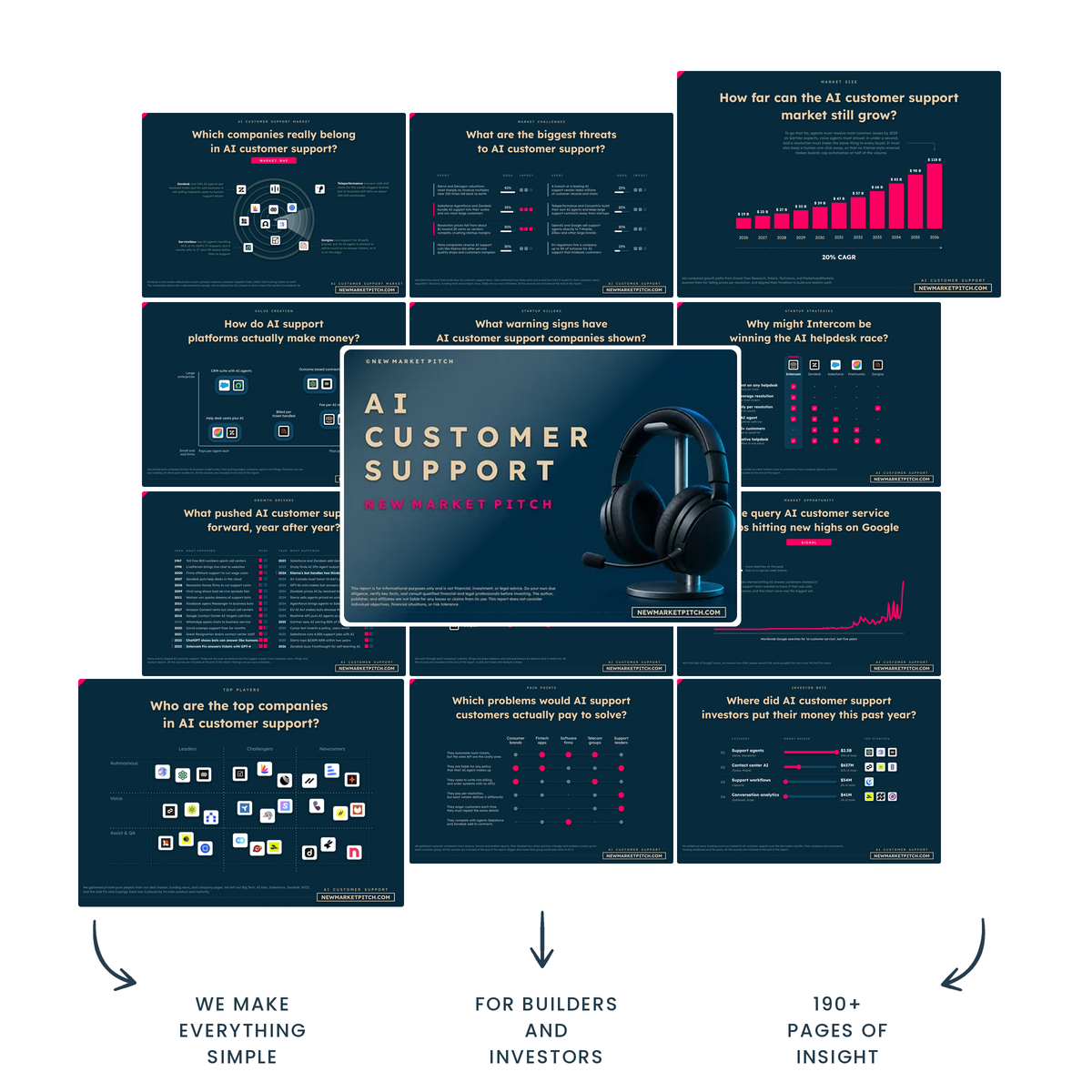
Whether you're building or investing in the AI customer support market, our report covers everything you need to know: the players, the money, and what's coming next.
Summary
AI customer support funding is becoming increasingly concentrated. Across five quarters from Q3 2025 to Q3 2026, investment remained substantial at $3.66 billion, but quarterly deal count fell from 20 to nine and the median round declined from $9.7 million to $6.4 million. The headline numbers increasingly reflect a handful of enormous financings rather than broad market growth.
Sierra, Wonderful, Parloa and Decagon collectively captured approximately $2.73 billion, nearly 75% of the five-quarter total. Their ability to attract capital has kept quarterly investment elevated even as fewer startups secure financing.
The divergence between average and median round sizes is striking. The average increased from $33.3 million to $77.9 million between Q3 2025 and Q3 2026, while the median fell by roughly a third. The biggest companies are raising much more, but the typical funded startup is raising less.
Q1 2026 was the only convincing recovery in market breadth. Deal count rebounded from seven to 17, seed financings increased and five companies received their first funding. Yet activity subsequently declined to 10 deals in Q2 and nine in Q3, erasing that recovery.
The two biggest recent quarters were dominated by individual companies. Sierra's $950 million financing represented 84% of Q2 2026 investment, while Wonderful's $550 million Series C accounted for 78% in Q3. Excluding each quarter's largest transaction, funding declined from $538.3 million in Q1 to $174.8 million in Q2 and $150.8 million in Q3.
The middle of the funding market is thinning out. Rounds between $20 million and under $100 million fell from six in Q3 2025 to just two in Q3 2026. Early-stage companies can still raise small checks, and category leaders can attract hundreds of millions, but financings between those extremes have become less frequent.
Autonomous support agents have emerged as investors' preferred category, accounting for 78% of Q3 2026 deals. Contact Center Automation briefly surged in Q1, largely through Parloa's $350 million financing, but failed to maintain that momentum.
New companies are still entering the funding market, although first financings are shrinking. Their median fell from $4.3 million in Q3 2025 to $2.5 million in Q3 2026. Across the full period, follow-on rounds attracted $3.56 billion of the $3.66 billion invested.
Later-stage financing is increasingly going to unusually young businesses with substantial enterprise adoption. Wonderful reached a $5 billion valuation after being founded in 2025, while Sierra and Decagon, both founded in 2023, secured exceptionally large rounds. Funding stage increasingly reflects commercial traction rather than company age alone.
Strategic investors are becoming more visible. Their participation rose from zero identified deals in Q3 2025 to 22% of transactions in Q3 2026, with Salesforce joining Wonderful's financing and NVentures participating in PolyAI. However, most capital still comes through a relatively narrow group of major funding transactions.
A durable recovery would require more than another billion-dollar round. The clearest evidence would be sustained growth in deal counts, more $20 million to $100 million financings, larger first rounds and a broader range of customer support categories attracting investment. None of those conditions was firmly established by Q3 2026.

Written by the New Market Pitch teamWe track new markets so founders and investors can move faster. About us

In our report covering the AI customer support market, you will always find fresh funding data, taken straight from our own verified funding database.
All funding deals in the AI customer support market over the last years
Below is the table listing all the deals. You can find our methodology at the end of this page.
If you want a deeper understanding of the market and its current dynamics, get our report covering the AI customer support market.
| Company | Category | Date | Stage | Deal size | What they do | Region | Lead investors | Country |
|---|---|---|---|---|---|---|---|---|
| Decimal AI | Autonomous Support Agents | September 2026 | Seed | $4M | Provides AI support engineers that investigate technical customer issues using application context, logs and code to accelerate resolution. | North America | Khosla Ventures; Kearny Jackson | United States |
| HeyDiga | Autonomous Support Agents | September 2026 | Seed | ≈$6.4M | Provides AI voice receptionists that answer customer questions, manage bookings and route incoming calls for service businesses. | Europe | 6 Degrees Capital | Spain |
| Wonderful | Autonomous Support Agents | September 2026 | Series C | $550M | Provides customer service and wider enterprise AI agents across IT HR and operations. | Middle East | Insight Partners | Israel |
| Capacity | Support Workflow Orchestration | September 2026 | Series D+ | >$54M | Unifies AI customer-support agents, agent assistance, knowledge management, quality assurance and support workflow automation. | North America | Kathy Ireland | United States |
| Wilmo AI | Autonomous Support Agents | August 2026 | Seed | ≈$1.3M | Automates e-commerce customer support with AI agents that answer shoppers' questions and resolve post-purchase requests. | Europe | Ugly Duckling Ventures | Denmark |
| Omilia | Contact Center Automation | August 2026 | Series B | $67M | Provides enterprise voice AI that automates contact-center customer conversations and assists human agents. | Europe | Expedition Growth Capital | Cyprus |
| Walaw | Autonomous Support Agents | July 2026 | Seed | ≈$1.1M | Provides an AI receptionist that answers patient inquiries, schedules appointments and automates clinic front-desk communications. | North America | Telegraph Ventures | Canada |
| Cue | Autonomous Support Agents | July 2026 | Unknown | $5M | Provides autonomous AI customer-service agents across messaging, email, webchat and voice, with escalation to human support teams. | Africa | Knife Capital; FAM Investments | South Africa |
| Hostie AI, Inc. | Autonomous Support Agents | July 2026 | Series A | $12M | Provides AI agents that handle restaurant guest inquiries, reservations, takeout orders and other incoming communications. | North America | Obvious Ventures | United States |
| Chaty AI | Contact Center Automation | June 2026 | Seed | $1.2M | Provides AI receptionists and website assistants that answer tourism customer enquiries and process bookings. | Asia-Pacific | Not disclosed | Australia |
| Mimir | Autonomous Support Agents | June 2026 | Seed | ≈$600K | Provides an AI-native e-commerce helpdesk that resolves customer enquiries about orders, deliveries, products and returns. | Europe | Sondo Capital | Norway |
| Enera | Autonomous Support Agents | June 2026 | Seed | $2M | Operates AI support agents that troubleshoot failed EV-charging sessions and analyze driver-support interactions. | Europe | Lakehouse Ventures | United Kingdom |
| fonio.ai | Contact Center Automation | June 2026 | Seed | $17M | Provides AI phone and messaging agents that handle customer enquiries, appointments and routine business calls. | Europe | 20VC | Austria |
| Sono (Closio Oy) | Contact Center Automation | June 2026 | Seed | $1.5M | Automates customer-service phone calls, including enquiries, appointment handling and call routing. | Europe | Maki.vc | Finland |
| Sierra | Autonomous Support Agents | May 2026 | Series D+ | $950M | Provides enterprise conversational AI customer-service agents. | North America | Tiger Global; GV | United States |
| Netomi | Autonomous Support Agents | April 2026 | Series C | $110M | Deploys enterprise AI customer-service agents that resolve requests across chat, email and voice. | North America | Accenture Ventures | United States |
| Solidroad | QA & Conversation Analytics | April 2026 | Series A | $25M | Automates quality assurance, conversation evaluation, coaching and training simulations for human and AI support agents. | North America | Hedosophia | United States |
| GuruSup | Autonomous Support Agents | April 2026 | Seed | $1.5M | Provides autonomous AI agents that resolve customer-service requests across WhatsApp, chat, email and voice. | Europe | 4Founders Capital | Spain |
| Phonely | Contact Center Automation | April 2026 | Series A | $16M | Builds AI voice agents that answer customer calls, resolve enquiries, route callers and manage appointments. | North America | Base10 Partners | United States |
| CiaoDott | Contact Center Automation | March 2026 | Seed | ≈$1.7M | Develops AI voice receptionists that answer patient calls and schedule appointments for medical practices. | Europe | The Techshop | Italy |
| Minimal AI | Autonomous Support Agents | March 2026 | Seed | $3.6M | Builds autonomous AI customer-support agents that handle and resolve e-commerce support tickets. | Europe | Not disclosed | Netherlands |
| Wonderful | Autonomous Support Agents | March 2026 | Series B | $150M | Provides multilingual AI customer service agents and enterprise integrations. | Middle East | Insight Partners | Israel |
| 14.ai | Autonomous Support Agents | March 2026 | Seed | $3M | Operates an AI-native customer-support service that uses proprietary agents to resolve support tickets across communication channels. | North America | Y Combinator | United States |
| Slang AI | Contact Center Automation | February 2026 | Series B | $28M | Builds AI telephone agents that answer customer calls, address inquiries and manage restaurant reservations. | North America | U.S. Venture Partners | United States |
| Scala | QA & Conversation Analytics | February 2026 | Seed | $8.5M | Provides AI-enabled operational intelligence and performance analytics for contact centers managing human and AI agents. | North America | Madrona; FUSE | United States |
| Newo.ai | Contact Center Automation | February 2026 | Series A | $25M | Offers AI receptionists and voice agents that answer, route and resolve inbound customer calls and messages for businesses. | North America | Ratmir Timashev | United States |
| Operata | QA & Conversation Analytics | February 2026 | Series A | ≈$7.8M | Provides AI-enabled observability and performance analytics for cloud contact centers and customer-service conversations. | North America | Tidal Ventures | United States |
| Tactful AI | Autonomous Support Agents | February 2026 | Unknown | $1M | Provides AI-powered customer-experience agents and tools that automate support interactions across service channels. | Africa | Foras AI; M Empire | Egypt |
| Linda AI | Contact Center Automation | February 2026 | Seed | ≈$3.1M | Provides AI dental receptionists that answer patient calls, handle inquiries and book appointments. | Europe | 6 Degrees Capital | Ireland |
| Decagon | Autonomous Support Agents | January 2026 | Series D+ | $250M | Develops autonomous customer-support agents that resolve customer requests across chat, email and voice. | North America | Coatue Management; Index Ventures | United States |
| Level3AI | Autonomous Support Agents | January 2026 | Seed | $13M | Creates AI customer-service agents that resolve multilingual support inquiries across conversational channels. | Asia-Pacific | Lightspeed India Partners | Singapore |
| Open CX | Autonomous Support Agents | January 2026 | Unknown | $7M | Automates complex customer-support interactions across voice, email, chat and messaging channels using AI agents. | Middle East | Y Combinator; X by Unifonic | Jordan |
| Elyos AI | Contact Center Automation | January 2026 | Series A | $13M | Provides AI voice agents that answer customer calls and arrange service bookings for trades and field-service companies. | Europe | Blackbird Ventures | United Kingdom |
| Fini | Autonomous Support Agents | January 2026 | Seed | $3.6M | Builds AI customer-support agents that answer questions and resolve requests using company knowledge and connected systems. | Europe | Matrix Partners | Netherlands |
| Parloa | Contact Center Automation | January 2026 | Series D+ | $350M | Develops enterprise AI voice agents that autonomously handle customer-service conversations and requests. | Europe | General Catalyst | Germany |
| Flip | Contact Center Automation | January 2026 | Series A | $20M | Provides AI-powered telephone support agents that automatically handle and resolve inbound customer-service calls. | North America | Next Coast Ventures; Ridge Ventures | United States |
| PolyAI | Contact Center Automation | December 2025 | Series D+ | $86M | Provides enterprise voice AI agents that resolve customer inquiries and execute multistep tasks within contact centers. | Europe | Georgian; Hedosophia; Khosla Ventures | United Kingdom |
| fonio.ai | Contact Center Automation | December 2025 | Seed | ≈$3.5M | Provides AI telephone assistants that answer customer inquiries, process requests and automate business call handling. | Europe | Not disclosed | Austria |
| GetVocal | Autonomous Support Agents | November 2025 | Series A | $26M | Develops governed conversational AI agents that automate enterprise customer-service interactions alongside human support teams. | Europe | Creandum | France |
| Vida | Contact Center Automation | November 2025 | Series A | $4M | Provides an AI voice-agent operating system that automates inbound customer telephone interactions and related service workflows. | North America | Trammell Venture Partners | United States |
| Wonderful | Autonomous Support Agents | November 2025 | Series A | $100M | Provides multilingual AI customer-service agents that independently handle requests through voice, chat and email. | Middle East | Index Ventures | Israel |
| Giga | Autonomous Support Agents | November 2025 | Series A | $61M | Develops autonomous voice AI agents that resolve complex enterprise customer-support requests in real time. | North America | Redpoint Ventures | United States |
| Aunoa | Autonomous Support Agents | October 2025 | Unknown | ≈$1.7M | Builds conversational AI agents that automate enterprise customer inquiries and service processes across messaging and voice channels. | Europe | Eoniq; Faraday | Spain |
| Assort Health | Autonomous Support Agents | September 2025 | Series B | $76M | Automates healthcare patient calls and service workflows, including appointment changes, prescription requests and referrals. | North America | Lightspeed Venture Partners | United States |
| Notch.cx | Autonomous Support Agents | September 2025 | Seed | $7M | Provides autonomous AI agents that resolve enterprise customer-support tickets and execute service workflows. | Middle East | Lightspeed Venture Partners | Israel |
| DOO | Autonomous Support Agents | September 2025 | Unknown | $1.7M | Provides Arabic-dialect AI agents that automate enterprise customer-support conversations across digital channels. | Middle East | Merak Capital | Saudi Arabia |
| Vocca | Contact Center Automation | September 2025 | Seed | $5.5M | Provides healthcare-specific AI phone agents that answer patient calls, manage appointments and resolve routine patient enquiries. | Europe | Speedinvest; firstminute capital | France |
| Rulebase | QA & Conversation Analytics | September 2025 | Seed | $2.1M | Uses AI to review support conversations for quality and compliance and automate associated dispute-resolution follow-ups. | North America | Bowery Capital | United States |
| Clarity (formerly Anecdote) | QA & Conversation Analytics | September 2025 | Series A | $12M | Combines AI-based customer-feedback analysis, support-conversation intelligence and automated customer-service workflows. | Europe | Prosus Ventures; STV AI Fund | United Kingdom |
| Eloquent AI | Autonomous Support Agents | September 2025 | Seed | $7.4M | Develops AI operators that resolve financial-services customer requests and execute associated regulated support workflows. | North America | Foundation Capital | United States |
| Parahelp | Autonomous Support Agents | September 2025 | Seed | $3.2M | Provides an autonomous AI support agent that resolves complex software-support tickets within existing help-desk platforms. | North America | Hidden Capital | United States |
| Parahelp | Autonomous Support Agents | September 2025 | Series A | $18M | Provides an autonomous AI support agent that resolves complex software-support tickets within existing help-desk platforms. | North America | Alt Capital | United States |
| Quack AI | Autonomous Support Agents | September 2025 | Seed | $7M | Builds proactive AI customer-support agents that identify and resolve software-user issues across service channels. | North America | Hanaco Ventures; Storytime Capital | United States |
| Hello Patient | Contact Center Automation | September 2025 | Series A | $22.5M | Automates healthcare patient-support calls, appointment requests and follow-up conversations using conversational AI agents. | North America | Scale Venture Partners | United States |
| Sierra | Autonomous Support Agents | September 2025 | Unknown | $350M | Provides enterprise AI agents that autonomously conduct customer-service conversations and perform related actions across business systems. | North America | Greenoaks | United States |
| Rauda AI | Autonomous Support Agents | September 2025 | Seed | ≈$2.8M | Builds voice-native AI customer-support agents that handle conversations and resolve service requests across channels. | Europe | JME Ventures | Spain |
| Pylon | Support Workflow Orchestration | August 2025 | Series B | $31M | Provides an AI-powered B2B customer-support platform combining ticket management, agent assistance and post-sales support workflows. | North America | Andreessen Horowitz; Bain Capital Ventures | United States |
| Cavalry AI | Autonomous Support Agents | August 2025 | Seed | $2.1M | Automates e-commerce customer-service interactions and resolves post-purchase support issues using AI agents. | North America | Not disclosed | United States |
| Kustomer | Support Workflow Orchestration | August 2025 | Series B | $30M | Operates an AI-native customer-service platform combining support CRM, autonomous agents, agent assistance and omnichannel workflows. | North America | Norwest | United States |
| Lorikeet | Autonomous Support Agents | August 2025 | Series A | $35M | Provides autonomous customer-service agents that resolve complex requests and execute actions across enterprise systems. | Asia-Pacific | QED Investors | Australia |
| Brainfish | Knowledge & Answer Engines | July 2025 | Unknown | $6.4M | Provides context-aware AI support agents that answer product questions and proactively guide users before they submit tickets. | Asia-Pacific | Prosus Ventures | Australia |
| Gradient Labs | Autonomous Support Agents | July 2025 | Series A | $13M | Builds autonomous AI customer-service agents for regulated financial institutions, including support resolution and related casework. | Europe | Redpoint Ventures | United Kingdom |
| Wonderful | Autonomous Support Agents | July 2025 | Seed | $34M | Develops multilingual AI agents that autonomously handle customer-service conversations across voice, chat and email. | Middle East | Index Ventures | Israel |

In our research about AI customer support tools, we turn what is vague and complex into simple, useful visuals. Market maps like this one show you at a glance where every startup stands.
Is AI customer support funding actually growing?
AI customer support funding is getting increasingly concentrated, and the latest figures suggest the market is weakening for most startups despite the enormous amounts raised by a few leaders.
We tracked 63 financings totaling $3.66 billion across five quarters, from Q3 2025 through Q3 2026. Quarterly investment increased slightly from $666.7 million to $700.8 million between the first and last periods, but the number of deals fell from 20 to nine.
The average round consequently more than doubled, rising from $33.3 million to $77.9 million, while the median declined from $9.7 million to $6.4 million. Investors are writing some exceptionally large checks, but the typical funded startup is raising less money.
Sierra, Wonderful, Parloa and Decagon collectively captured approximately $2.73 billion, nearly 75% of the five-quarter total. Their fundraising success explains much of the difference between the impressive headline figures and what is happening across the broader market.
| Quarter | Deals | Funding | Median round | Largest round |
|---|---|---|---|---|
| Q3 2025 | 20 | $666.7M | $9.7M | $350M |
| Q4 2025 | 7 | $282.2M | $26.0M | $100M |
| Q1 2026 | 17 | $888.3M | $8.5M | $350M |
| Q2 2026 | 10 | $1,124.8M | $9.0M | $950M |
| Q3 2026 | 9 | $700.8M | $6.4M | $550M |
| Total | 63 | $3,662.8M | - | $950M |
Are fewer AI customer support startups getting funded?
Yes. AI customer support deal activity has fallen for two consecutive quarters, and there is little evidence yet that the slowdown is reversing.
We counted 17 financings in Q1 2026, followed by 10 in Q2 and nine in Q3. That is a 47% decline over six months. The latest quarter also had fewer first financings, a smaller median round and less investment outside the largest transactions.
The earlier quarters were more volatile. Q3 2025 recorded 20 deals, but 13 were concentrated in September. Activity then dropped to seven in Q4 before rebounding to 17 in Q1 2026.
That unusual September cluster makes the initial Q4 collapse difficult to interpret. The subsequent decline is more concerning because it continued after the Q1 recovery.
With only nine or 10 transactions in each of the latest quarters, a few additional announcements could change the percentages considerably. Still, the combination of falling deal counts and smaller typical rounds is harder to dismiss.

Your time is limited. In our market report about AI customer support tools, we put numbers on each part of the market, so you can see where it makes sense to focus.
Why did AI customer support funding collapse in Q4 2025?
AI customer support funding hit a temporary low in Q4 2025 because deal activity dried up, particularly in North America, even as investors continued backing several established companies.
Quarterly investment fell 58%, from $666.7 million to $282.2 million, while transactions dropped from 20 to seven. North American deals declined from 11 to two, whereas Europe maintained four financings.
The companies that did raise money were hardly struggling to attract meaningful checks. Wonderful secured $100 million, PolyAI raised $86 million in December, and Giga completed another sizable financing.
PolyAI's round is particularly revealing. Georgian, Hedosophia and Khosla Ventures co-led the investment, with additional participation from NVentures and Citi Ventures. PolyAI reported more than 100 enterprise customers and over 2,000 live deployments across 45 languages and more than 25 countries.
Investors were clearly prepared to support companies with established enterprise deployments.
The quarter's unusually high $26 million median also needs context. Only seven financings occurred, and none fell between $5 million and $20 million. The disappearance of that middle-sized segment pushed the median up even as total investment dropped sharply.
The market recovered in deal count the following quarter, suggesting that Q4 was a temporary trough rather than the beginning of a sustained collapse.
Was the Q1 2026 funding rebound real?
The Q1 2026 rebound was real for AI customer support startups, although a handful of exceptionally large financings made the recovery look much stronger than it was.
Investment jumped from $282.2 million to $888.3 million, and transactions increased from seven to 17. Seed financings rose from one to seven, while first financings recovered from one to five. More young companies were receiving funding again.
Three transactions supplied most of the money: Parloa's $350 million Series D, Decagon's $250 million financing and Wonderful's $150 million Series B. Together, rounds of at least $100 million accounted for approximately 84% of quarterly investment.
These companies had substantial commercial progress to show.
Parloa announced its $350 million round in January 2026 at a $3 billion valuation, only seven months after its previous financing. It planned to accelerate international expansion and develop its AI Agent Management Platform.
Decagon raised $250 million later that month at a $4.5 billion valuation, having added more than 100 enterprise customers during the previous fiscal year, including Avis Budget Group, Block and Deutsche Telekom.
Wonderful followed with $150 million in March at a $2 billion valuation, reporting operations in more than 30 countries.
Investors were willing to commit large amounts to platforms that had moved beyond early demonstrations and were selling into major enterprises. Q1 combined a genuine recovery in startup activity with much faster fundraising by a few category leaders.

In our document detailing everything you need to know about AI customer support, we always try to gather several sources and make estimates that make sense, so you can work with solid numbers.
Was Q2 2026's record funding basically just Sierra?
Yes. Sierra's $950 million financing accounted for 84% of AI customer support funding in Q2 2026, making the quarter's $1.12 billion total a poor measure of how the wider market was performing.
At first glance, investment increased 27% from Q1. Yet removing Sierra leaves only $174.8 million, compared with $538.3 million after excluding Q1's largest transaction. On that basis, funding fell approximately 68%.
Sierra's May 2026 announcement helps explain the enormous check. The company reported serving more than 40% of Fortune 50 businesses, with AI agents handling billions of customer interactions. Tiger Global and GV led the financing at a valuation above $15 billion.
Sierra had raised another $350 million in September 2025, at a $10 billion valuation. Its latest investment therefore followed a period of rapid growth in reported enterprise adoption and valuation.
Meanwhile, total deals fell from 17 to 10, and the median round remained around $9 million. Five of those 10 financings were first rounds, but their combined capital amounted to only $6.8 million.
A spectacular fundraising event for Sierra coincided with a substantial decline in investment across the rest of the market.
Did AI customer support funding recover in Q3 2026?
No. AI customer support funding weakened again in Q3 2026, with Wonderful's $550 million Series C masking another decline in ordinary startup financing.
Total capital fell 38% from Q2 to $700.8 million, while deal count slipped from 10 to nine. Investment excluding rounds above $50 million reached just $29.8 million, the lowest quarterly figure in our analysis.
Wonderful represented 78% of all funding. Its September financing, led by Insight Partners with participation from Salesforce and existing backers, valued the company at $5 billion.
The startup's growth was remarkable. Since its $150 million Series B in March, Wonderful had expanded to more than 35 markets and 650 employees. It also broadened its product from customer service automation into what it calls an enterprise AI operating system, covering workflows and applications across different business functions.
That expansion complicates the market comparison. Wonderful increasingly operates beyond customer support, so including its entire financing arguably overstates how much capital went specifically toward this sector.
Without Wonderful, Q3 funding would have totaled approximately $150.8 million. Omilia's $67 million Series B and Capacity's approximately $54 million financing would then account for most of the remaining capital.
Omilia offers an interesting contrast. Founded in 2002, the company reported more than $60 million in annual recurring revenue and emphasized predictable costs and measurable returns when announcing its August 2026 financing.
Investors backed both fast-growing AI-native platforms and established contact center businesses. Smaller financings, though, continued to disappoint.

Our report covering the AI customer support market gets updated several times a month, so you always get the latest view of where things stand.
Are AI customer support funding rounds getting bigger or smaller?
The typical AI customer support funding round is getting smaller, even as the biggest checks have reached extraordinary levels.
The median fell from $9.7 million in Q3 2025 to $6.4 million in Q3 2026, while the average climbed from $33.3 million to $77.9 million.
Eight rounds of at least $100 million accounted for approximately 77% of total capital across the five quarters. At the other end, financings below $5 million represented about 35% of transactions but only a small share of investment.
The most revealing change happened between those extremes. We counted six rounds worth $20 million to under $100 million in Q3 2025. That number fell to three in Q4, three in Q1 2026, one in Q2 and two in Q3.
This leaves fewer visible financings for startups trying to move from their initial product and customer base toward broader commercial deployment.
The market still finances small startups, and it can clearly support enormous rounds for category leaders. Companies attempting to bridge those two stages appear to face the greatest difficulty.
| Deal size | Q3 2025 | Q1 2026 | Q3 2026 |
|---|---|---|---|
| Under $5M | 5 | 6 | 3 |
| $5M–under $20M | 8 | 5 | 3 |
| $20M–under $50M | 5 | 3 | 0 |
| $50M–under $100M | 1 | 0 | 2 |
| $100M+ | 1 | 3 | 1 |
| Total | 20 | 17 | 9 |
Are autonomous AI customer support agents taking over funding?
Autonomous support agents have become the clear favorite among AI customer support investors, accounting for almost four out of five financings in the latest quarter.
The category represented 65% of deals in Q3 2025, 47% in Q1 2026 and 78% in Q3. Its capital share also remained substantial, ranging from 49% to 95% across the five quarters.
Sierra, Wonderful and Decagon illustrate what is attracting investors. Their platforms aim to complete customer requests, connect with business systems and handle workflows that traditionally required human support teams.
This is a meaningful change from earlier generations of customer service software, where automation often centered on answering common questions or helping agents retrieve information.
Decagon's January 2026 financing followed the adoption of its AI concierge platform by customers across travel, financial services and telecommunications. Sierra's May announcement described AI agents handling tasks ranging from insurance claims to product returns. Wonderful expanded from customer service into broader enterprise automation.
The funding figures are heavily influenced by those same companies. Sierra drove the category's 95% capital share in Q2, while Wonderful supplied most of the money in Q3.
Autonomous agents dominate the funding mix. But smaller developers in the category aren't necessarily seeing better funding conditions.

In our research about AI customer support tools, we look at what the winners do differently, so you can learn from the best instead of guessing.
Did contact center AI have its own funding boom?
Contact Center Automation had a strong Q1 2026, but the boom quickly faded as funding moved back toward a smaller number of companies.
The category recorded seven deals and $440.8 million in Q1, compared with three deals and $93.5 million in Q4 2025. That increase showed genuine breadth, although Parloa alone contributed $350 million, nearly 79% of the quarterly category total.
Parloa's enterprise voice agents had already been deployed across major companies. At the time of its January financing, it highlighted more than one billion customer interactions handled by its technology and an expansion strategy targeting the United States and Europe.
Other businesses were also pursuing conversational automation, but the next two quarters failed to maintain Q1's activity.
Contact Center Automation fell to four deals and $35.6 million in Q2, then one deal worth $67 million in Q3.
That last financing came from Omilia, whose approach differs from some newer generative AI providers. The company combines different automation technologies and emphasizes using the most efficient system for each customer request. Its August 2026 announcement reported more than 10-fold recurring revenue growth since its previous major financing.
Contact center AI still attracts serious investment, particularly for providers with established enterprise customers. Its Q1 jump, however, looks like a short-lived surge rather than a sustained acceleration.
Are investors giving up on early-stage AI customer support startups?
Early-stage AI customer support startups are still getting funded, but they are receiving an increasingly small share of the available money.
Seed and Series A rounds accounted for 70% of transactions in Q3 2025 and 56% in Q3 2026. Their share even reached 80% in Q2, when eight of the 10 financings were early-stage.
The capital distribution tells a more worrying story. Early-stage companies received around 12% of Q1 2026 investment, 6% in Q2 and only 4% in Q3.
First financings have also become smaller. Their median dropped from $4.3 million in Q3 2025 to $2.5 million in Q3 2026, reaching a low of $1.5 million in Q2.
We identified 19 first financings across the entire period, compared with 44 follow-ons. The latter captured between 92% and 99% of invested capital every quarter.
These figures do not prove that fewer AI customer support companies are being founded. They do show that newly financed companies are receiving relatively modest checks while previously backed businesses absorb nearly all the capital.
| Quarter | First financings | Follow-ons | First-financing capital | Follow-on capital |
|---|---|---|---|---|
| Q3 2025 | 6 | 14 | $53.5M | $613.2M |
| Q4 2025 | 1 | 6 | $3.5M | $278.7M |
| Q1 2026 | 5 | 12 | $29.3M | $859.0M |
| Q2 2026 | 5 | 5 | $6.8M | $1,118.0M |
| Q3 2026 | 2 | 7 | $5.1M | $695.7M |
| Total | 19 | 44 | $98.2M | $3,564.6M |

In our market report about AI customer support tools, we don't want to repeat what boring consulting reports say. Instead, we show you the real and latest market signals that matter.
Are AI customer support investors betting on older companies now?
AI customer support investors are increasingly financing companies at later funding stages, but some of the biggest beneficiaries are remarkably young.
Series B and later rounds represented 15% of deals in Q3 2025 and 33% in Q3 2026. By the latest quarter, they accounted for 96% of capital.
Company age paints a more complicated picture.
Wonderful, founded in 2025, reached a $5 billion valuation with its September 2026 Series C. Sierra, founded in 2023, raised $950 million in May. Decagon, founded in 2023, secured $250 million in January 2026 at a $4.5 billion valuation.
These companies progressed through funding stages much faster than traditional software businesses.
Meanwhile, Omilia, founded in 2002, and other longer-established providers such as Capacity and Netomi continued attracting significant investment.
The average age of a funded company reached 5.8 years in Q3 2026, influenced heavily by Omilia, while the median was only 1.2 years.
Investors appear most interested in businesses that can demonstrate substantial customer adoption and the ability to scale, whether they achieved that position over two years or two decades.
Is Europe catching up with the US in AI customer support funding?
European AI customer support startups have a meaningful presence in deal activity, although the United States continues to produce some of the largest individual financings.
Europe accounted for 20% of deals in Q3 2025, 35% in Q1 2026, 50% in Q2 and 33% in Q3. North America's share moved from 55% to 44% between the first and last quarters.
The capital figures are much more volatile. North America received 98% of Q2 2026 investment, largely because of Sierra. Its share fell to 10% in Q3, when Wonderful dominated the market.
Wonderful's geographic classification also deserves attention. Founded in Israel and headquartered in Amsterdam, it operates across multiple international markets. Our dataset places its financing under the Middle East, giving that region 78% of Q3 capital.
Europe produced major financings of its own, including Parloa's $350 million round in Q1 and PolyAI's $86 million investment in Q4 2025.
European participation is substantial, particularly among voice and contact center automation providers. But the small quarterly samples and the influence of individual megarounds make it difficult to establish a lasting geographic shift.

Learning from others' mistakes is the cheapest lesson there is. In our document detailing everything you need to know about AI customer support, we look at what broke startups before you, so you don't repeat it.
Which investors keep backing AI customer support startups?
Several major venture capital firms keep returning to AI customer support, with Index Ventures, Insight Partners and General Catalyst particularly visible around the largest companies.
Index Ventures participated in Wonderful's early financings and co-led Decagon's $250 million Series D alongside Coatue in January 2026. Its activity extended across three consecutive quarters in our financing records.
Insight Partners led Wonderful's $150 million Series B in March and returned for its $550 million Series C in September, illustrating how quickly an investor can increase its exposure to a company undergoing rapid expansion.
General Catalyst led Parloa's $350 million Series D after previously backing the company. Redpoint appeared in Gradient Labs and Giga, while Hedosophia participated in PolyAI and Solidroad. Khosla Ventures appeared in PolyAI and Decimal AI.
The overall investor base remains reasonably diverse. We identified between nine and 21 unique lead investors per quarter, and few firms led multiple deals within the same quarter.
Still, the biggest checks repeatedly involve established venture firms backing companies they already know or businesses with strong commercial progress.
Why are big tech companies investing in AI customer support startups?
Strategic investors are showing greater interest in AI customer support as autonomous agents become more deeply connected to enterprise software and customer workflows.
We found no strategic-investor deals in Q3 2025, followed by one in Q4 and two in each subsequent quarter. Their share reached 22% of transactions in Q3 2026.
Several investments involved established businesses. PolyAI's December 2025 financing included NVentures, NVIDIA's venture capital arm, and Citi Ventures. Wonderful's September 2026 Series C included Salesforce, alongside Insight Partners and existing venture investors.
Other strategic participants identified in our research included Accenture, Adobe and Atlassian.
Four of the seven strategic-investor deals involved Series C or later companies, suggesting that established technology businesses are paying particular attention to providers with more mature products and enterprise customer relationships.
Salesforce's participation in Wonderful is especially relevant because Wonderful is now positioning itself as an operating system for enterprise AI workflows. Such platforms could become important partners, customers or competitors for existing software vendors.
Investment does not automatically establish a product partnership or future acquisition, though. And seven transactions remain too few to conclude that corporate investors are reshaping the entire sector.

If you build or invest in the AI customer support market, you need to know which business models pay off now and which ones are fading. That's why our report covering it has a whole section on it.
Is AI customer support becoming a winner-take-all market?
AI customer support funding increasingly looks like a winner-take-most market, with a small group of startups capturing a disproportionate share of available capital.
As seen above, four companies accounted for nearly three-quarters of total investment across five quarters. More importantly, this concentration persisted even when the leading company changed.
The three largest rounds represented 69% of Q3 2025 investment, 88% in Q4, 84% in Q1 2026 and 96% in both Q2 and Q3.
Investors are becoming highly selective about which businesses receive large amounts of growth capital.
There are understandable commercial reasons for favoring established providers. Enterprise customer support requires reliable integrations, security, multilingual capabilities, consistent performance and the ability to manage large volumes of interactions. Companies already operating at scale have more opportunities to demonstrate these capabilities.
Sierra's reported Fortune 50 adoption, Decagon's expanding enterprise customer base and Omilia's recurring revenue growth help explain why investors might favor certain businesses.
Commercial market share, however, could look different from fundraising concentration. We do not have enough comparable revenue, customer retention and market-share data to establish whether these companies will dominate customer support software itself.
For now, the concentration of venture capital is much clearer than the eventual competitive outcome.
What would a real AI customer support funding recovery look like?
A genuine AI customer support funding recovery would involve more startups raising meaningful rounds, rather than another billion-dollar financing pushing quarterly totals higher.
Removing the largest transaction from each quarter reveals how inconsistent the underlying market has been. Remaining investment totaled $316.7 million in Q3 2025, $182.2 million in Q4, $538.3 million in Q1 2026, $174.8 million in Q2 and $150.8 million in Q3.
The Q1 rebound failed to hold. Funding outside the single biggest deal has now declined for two consecutive quarters.
We would look for several developments before calling a turnaround: deal activity recovering beyond nine or 10 financings per quarter, more rounds between $20 million and $100 million, larger first financings and greater activity outside autonomous support agents.
A recovery across several categories would be particularly encouraging. Contact Center Automation briefly demonstrated that possibility in Q1 2026, but its activity declined afterward. Knowledge & Answer Engines and QA & Conversation Analytics have yet to establish meaningful momentum.
Strategic investment could also help broaden the market if more enterprise software companies begin financing smaller providers rather than concentrating their participation in established leaders.
The technology's commercial opportunity may continue expanding even if venture financing remains difficult for most startups. The latest quarterly figures make that distinction particularly important.

In our research about AI customer support tools, we like to show you the big picture. We know your time is precious, so we make every page quick to read and packed with as much learning as possible per minute.
What is the funding trend actually telling us?
Funding is getting narrower. AI customer support investment has remained substantial, but fewer companies are securing financing. Deal count dropped from 17 in Q1 2026 to nine in Q3, while the median round declined to $6.4 million. The broad recovery recorded at the beginning of 2026 did not last.
A handful of companies explain most of the money. Sierra, Wonderful, Parloa and Decagon captured approximately 75% of the five-quarter funding total. The three largest rounds represented 96% of investment in each of the latest two quarters.
Autonomous agents are winning the funding race. The strongest sustained investor interest is in platforms capable of handling customer interactions and executing workflows. Contact Center Automation experienced a short-lived surge in Q1 2026, while analytics, orchestration and knowledge tools attracted relatively little capital.
New startups are still raising, but their checks are smaller. First financings became less frequent and their median size declined. Follow-on rounds accounted for nearly all invested capital, while later-stage companies captured 96% of Q3 2026 funding.
The middle of the market is struggling. Rounds between $20 million and under $100 million fell from six in Q3 2025 to two in Q3 2026. This leaves a thinner financing bridge between small early-stage checks and the enormous rounds available to category leaders.
Big tech is becoming more involved. Strategic-investor participation rose from zero identified deals in Q3 2025 to 22% of transactions in Q3 2026. Salesforce's investment in Wonderful and NVentures' participation in PolyAI illustrate the growing interest from established technology companies.
The next recovery has to be broader. A healthier market would produce more mid-sized rounds, larger first financings and rising deal activity over several consecutive quarters. Until then, AI customer support can continue producing exceptional fundraising outcomes for a few fast-growing platforms while conditions remain difficult for everyone else.
Our methodology
This analysis examines AI customer support funding from July 1, 2025, through September 30, 2026, covering five complete calendar quarters. We analyzed 63 recorded financings totaling approximately $3.66 billion to assess how funding activity, deal sizes, company maturity, category composition, geographic distribution and investor participation evolved over the period.
Our approach combines a structured aggregation of recent financing records with original calculations and transaction-level research. For each quarter, we compiled announced investment amounts, deal counts, unique funded companies, funding stages, first financings, follow-on rounds, company ages, deal-size distributions, lead investors and strategic-investor participation. We then compared these measures across consecutive quarters to identify persistent patterns and distinguish them from temporary spikes.
Each recorded financing is counted as one transaction, while unique companies are calculated separately to distinguish repeat fundraising from the number of businesses receiving capital. Transactions are assigned to quarters according to their recorded announcement dates. Our comparisons use complete calendar quarters, with Q3 2026 as the latest analyzed period.
We paid particular attention to funding concentration. Alongside headline quarterly investment, we calculated median and average round sizes, funding excluding transactions above $50 million, capital excluding each quarter's largest transaction and the share captured by the largest rounds. These comparisons help establish whether a rise in investment reflects broader financing activity or a small number of exceptionally large deals.
To evaluate changes in market breadth, we compared deal-size bands, seed and Series A activity, later-stage financing, first financings and follow-on rounds. We assessed category momentum using both deal counts and invested capital, then examined company maturity, geographic distribution and investor participation. Developments repeated across multiple quarters carry more weight in our conclusions than movements dominated by a single transaction.
We also reviewed company announcements, investor communications and financial and technology reporting to connect major financings with commercial milestones, enterprise deployments, product development, valuations and geographic expansion. These sources provide context for the transactions, while the quarterly totals and market comparisons come from our underlying financing analysis. Approximate or lower-bound amounts were retained where appropriate, and undisclosed funding stages were not inferred from transaction size.
Market classification is particularly important because several AI customer support providers are expanding into broader enterprise automation. Wonderful is a notable example: its full financing remains included in the dataset, but we also examine the latest quarter without that transaction. Geographic classifications follow the recorded dataset, including Wonderful's classification under the Middle East despite its Amsterdam headquarters. First-financing classifications rely on the available financing histories.
Key sources include Sierra's September 2025 funding announcement, Sierra's May 2026 financing and commercial update, Wonderful's March 2026 Series B announcement, Wonderful's September 2026 Series C announcement, Parloa's $350 million Series D announcement, Decagon's January 2026 Series D announcement, PolyAI's December 2025 financing announcement, and Omilia's August 2026 Series B announcement.
Additional reporting used to examine valuations, investors and commercial developments includes TechCrunch's coverage of Sierra's $950 million round, TechCrunch's reporting on Wonderful's valuation and expansion, Bessemer Venture Partners' analysis of Wonderful's growth, British Business Bank's confirmation of its investment in PolyAI, and TechCrunch's reporting on Omilia's financing and enterprise business.
Our conclusions are based on the combined direction of deal activity, median rounds, funding concentration, stage distributions, company maturity, category movements and investor behavior. This approach distinguishes changes affecting the wider financing market from exceptional outcomes for individual companies. The results describe the identified financing activity within the defined period, with quarterly samples ranging from seven to 20 transactions.

When you build or invest in the AI customer support market, you need clarity, not confusion. In our market report about AI customer support tools, we always try to put numbers on and quantify whatever is usually vague and confusing.
Written by the New Market Pitch teamWe track new markets so founders and investors can move faster. About us