
Who are the top AI customer support startups after Sierra?
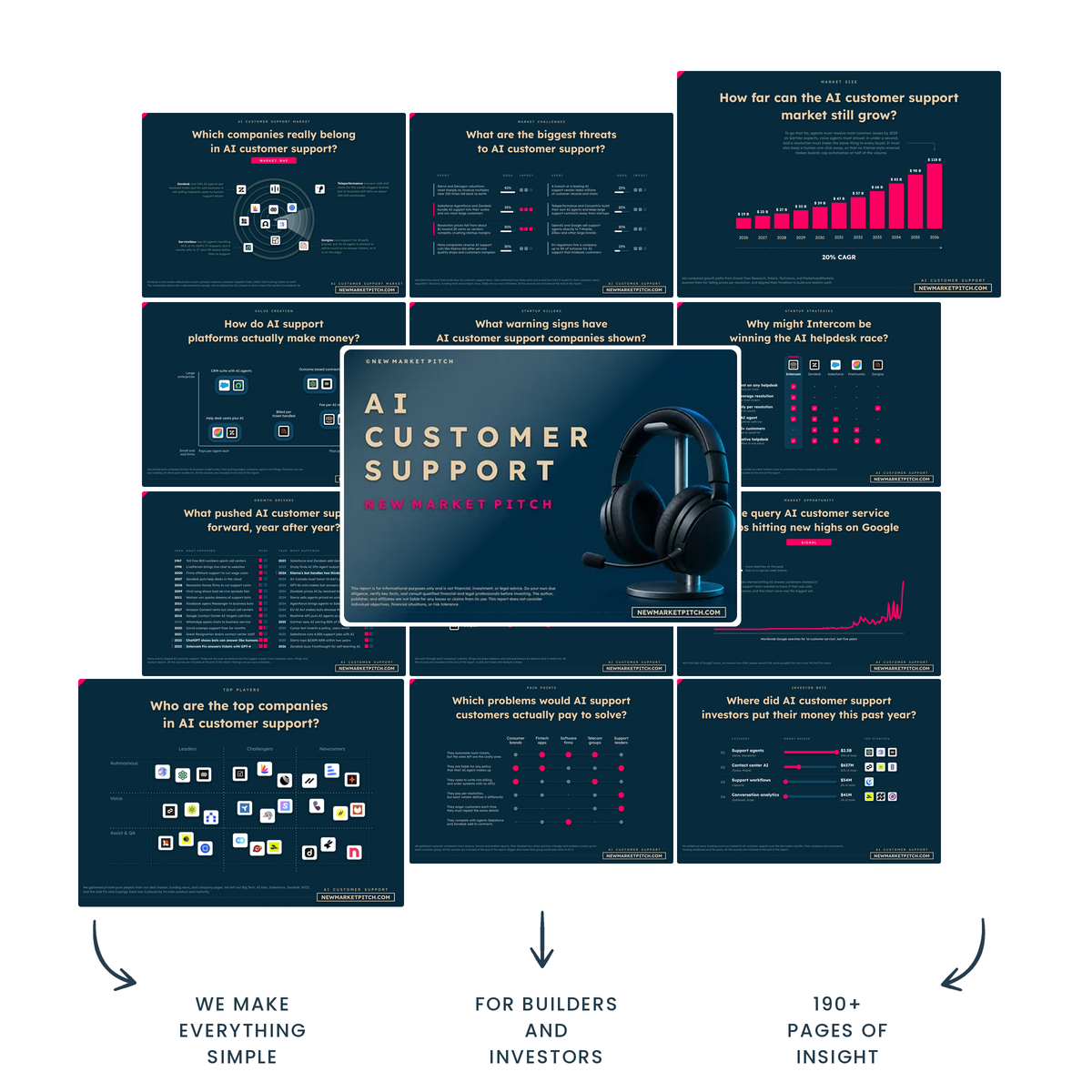
Whether you're building or investing in the AI customer support market, our report covers everything you need to know: the players, the money, and what's coming next.
Summary
Decagon is the top independent AI customer support startup after Sierra, followed by Parloa in enterprise voice, with Ada, PolyAI, Crescendo, Gorgias, and Maven AGI competing across different parts of the market. Fin is a major competitor by adoption, but its September 2026 acquisition by Salesforce means it is no longer an independent startup.
Sierra sets a formidable benchmark: a $15.8 billion valuation, approximately $200 million in estimated annual recurring revenue, and customers representing more than 40% of the Fortune 50. A challenger now needs substantial enterprise revenue and real deployments, not just a convincing AI demonstration.
Decagon is the closest direct rival, valued at $4.5 billion and estimated to have reached a $100 million annualized revenue run rate by July 2026. Its rapid expansion among large enterprises makes it the most credible independent challenger across chat, email, and voice.
Fin has a different kind of advantage. More than 12,000 reported customers and approximately 2 million successful resolutions per week give it one of the largest visible adoption footprints, while Salesforce ownership adds distribution that independent startups will struggle to match.
Parloa has emerged as a particularly strong voice AI specialist, with a $3 billion valuation, more than $50 million in reported 2025 recurring revenue, and 150% net revenue retention. Its expansion inside multinational contact centers suggests voice automation can support a large standalone software business.
Ada and PolyAI show why newer companies do not automatically win. Ada reported 146% net revenue retention and 108% growth in agentic AI recurring revenue, while PolyAI has more than 2,000 live deployments. Existing enterprise relationships and production experience remain valuable advantages.
Crescendo surpassed $100 million in reported annual recurring revenue by April 2026, making it commercially significant despite receiving less attention than Sierra or Decagon. Its combination of AI and human-managed customer service means its revenue cannot be compared directly with pure software subscriptions.
Gorgias has a defensible position in ecommerce because it operates close to merchant orders, returns, product catalogs, and purchases. For an online retailer, access to those workflows can matter more than the valuation or general intelligence of an AI agent provider.
The market's performance statistics are less comparable than they appear. A 76% resolution rate, thousands of deployed agents, and billions of conversations measure different things, and none establishes how many difficult customer problems were permanently solved at an attractive cost.
Incumbent distribution is becoming a bigger competitive threat. Zendesk acquired Forethought in March 2026, and Salesforce completed its acquisition of Fin in September. Independent startups increasingly need to prove that their agents outperform the AI already available through customers' existing software platforms.
Our conclusion is that Decagon has the best chance of catching Sierra as an independent enterprise AI support company, while Parloa is the strongest specialized voice contender. The longer-term winners will be determined less by headline automation rates than by completed customer resolutions, retention, integration quality, and the economics of delivering them.

Written by the New Market Pitch teamWe track new markets so founders and investors can move faster. About us
Why is Sierra the AI customer support startup everyone wants to catch?
Sierra currently sets the pace in AI customer support, with a $15.8 billion valuation, an estimated $200 million in annual recurring revenue, and customers representing more than 40% of the Fortune 50.
Founded in 2023 by former Salesforce co-CEO Bret Taylor and former Google executive Clay Bavor, Sierra builds AI agents that answer customer questions and carry out tasks such as handling returns, changing reservations, and processing account requests.
Its valuation went from approximately $1 billion in February 2024 to $4.5 billion in October 2024, then $10 billion in September 2025. A $950 million financing led by Tiger Global and GV in May 2026 pushed it to $15.8 billion, another 58% increase.
The business has grown quickly too. According to Sacra, Sierra's annual recurring revenue increased from approximately $26 million at the end of 2024 to $130 million at the end of 2025, before reaching an estimated $200 million run rate in May 2026. That represents nearly eightfold growth from the end of 2024, although these figures are third-party estimates.
Sierra also claims its technology has handled billions of customer interactions. Its customer list includes enterprises across financial services, telecommunications, retail, and insurance.
The combination is unusual for such a young company. Sierra has established substantial enterprise distribution while growing fast enough to attract nearly $1 billion in additional financing. For competitors, catching Sierra now means building a business with comparable revenue and customers, rather than merely demonstrating an impressive AI agent.
Is Decagon the biggest AI customer support competitor after Sierra?
Decagon is Sierra's closest direct independent competitor today, with a $4.5 billion valuation, more than 100 enterprise customers added during 2025, and an estimated $100 million annualized revenue run rate by July 2026.
Founded in 2023 by Jesse Zhang and Ashwin Sreenivas, Decagon builds AI customer service agents for chat, email, and voice. Its software can answer questions, process returns, change bookings, and complete other customer requests by connecting to a company's internal systems.
In January 2026, Decagon raised $250 million in a Series D led by Coatue and Index Ventures. Its valuation tripled from $1.5 billion to $4.5 billion in less than six months.
The customer growth behind that financing is worth examining. Decagon said it added more than 100 global enterprise customers during 2025, including Avis Budget Group, Block, and Deutsche Telekom. Those names cover travel, financial technology, and telecommunications, suggesting the product is finding demand beyond one industry.
Sacra estimates that Decagon finished 2025 with approximately $44 million in annual recurring revenue and reached a $100 million annualized run rate by July 2026. If the estimates are accurate and comparable, revenue more than doubled in seven months.
Decagon is still considerably smaller than Sierra. Its valuation is roughly 29% of Sierra's, and its estimated annualized revenue is approximately half Sierra's earlier reported run rate.
But the gap is narrowing. Decagon has found large enterprise customers, raised substantial capital, and built a product aimed at essentially the same buying decision. We rank it first among independent startups competing directly with Sierra.
If you want more recent data on this point, please see our latest AI customer support market report.

In our report covering the AI customer support market, we turn what is vague and complex into simple, useful visuals. Market maps like this one show you at a glance where every startup stands.
Is Fin actually ahead of Decagon in customer support AI?
Fin is ahead of Decagon in publicly reported customer adoption, with more than 12,000 customers and approximately 2 million successful AI support resolutions each week. But Fin is no longer an independent startup: Salesforce completed its acquisition of the company on September 10, 2026.
Fin was developed by Intercom, the customer messaging and support software company founded in 2011. In May 2026, Fin became the company's primary brand identity, while Intercom continued as the name of its support platform. The subsequent Salesforce acquisition brought Fin's technology and an established global customer base into the larger CRM company.
The customer figures are substantial. Fin reports an average resolution rate of 76%, with some customers exceeding 85%. At its reported weekly volume, 2 million resolutions would translate into approximately 104 million over a full year if activity remained constant.
That volume gives Fin one of the strongest publicly visible adoption records in the AI support market. However, its customer base includes companies of different sizes, and the number does not tell us how many are spending at the level of Decagon's biggest enterprise customers.
Fin's distribution helps explain its reach. Businesses can use it alongside Intercom's existing support software or deploy it with other customer service systems. Existing Intercom users already have conversations, workflows, and customer information inside the platform, which can make adding AI easier.
The strategy also reduces Fin's dependence on replacing a company's entire support stack. It can sell automation to businesses that want to keep their current helpdesk.
Salesforce ownership changes the competitive equation further. Fin now has access to a much larger enterprise distribution network, while Decagon remains an independent vendor competing for customer service contracts. We give Fin the stronger position on publicly reported adoption, but Decagon has clearer evidence of a rapidly growing standalone AI enterprise software business.
Can Parloa become the top AI voice customer support startup?
Parloa is one of the strongest contenders in enterprise voice AI, with a $3 billion valuation, more than $50 million in reported annual recurring revenue for 2025, and agents operating across more than 100 countries.
Founded in Berlin in 2018, Parloa builds AI agents for businesses handling large volumes of telephone and digital customer service conversations. Its Agent Management Platform allows companies to create agents, connect them to business systems, and manage their performance.
Parloa raised $120 million at a $1 billion valuation in May 2025. In January 2026, a $350 million Series D led by General Catalyst tripled that valuation.
The revenue numbers support the company's progress. Financial Times reporting placed its 2025 recurring revenue above $50 million. In a May 2026 update, Parloa also disclosed 150% net revenue retention, indicating substantial growth within its existing customer base after accounting for losses and contractions.
Its customers include Booking.com, Allianz Partners, and Swiss Life. Those businesses have complicated service requirements, frequently involving multiple languages, identity checks, reservations, insurance policies, or payment details.
Parloa says its technology has powered more than one billion interactions and operates across more than 140 languages. The one-billion figure is cumulative and does not tell us its current annual interaction volume, but the geographical reach is relevant for multinational enterprise buyers.
PolyAI is another established voice specialist, while Sierra and Decagon are expanding across the same channels. Parloa's advantage is its focus on managing voice agents inside large contact-center operations.
A business using AI to handle routine telephone calls across numerous countries faces a different challenge from one adding chat automation to its website. Parloa has built a credible position in that harder operating environment, and its 150% reported retention suggests customers are expanding their deployments.
If you want more recent data on this point, please see our latest AI customer support market report.

Our research about AI customer support tools gets updated several times a month, so you always get the latest view of where things stand.
Is Ada still one of the top AI customer support companies?
Ada remains a leading independent AI customer support company, and its recent results suggest that older automation specialists can compete with the new generation of AI startups.
Founded in Toronto in 2016, Ada originally focused on automated customer conversations using scripted workflows. It later shifted toward generative AI agents capable of answering questions and completing actions across enterprise systems.
In March 2026, Ada reported more than 100% year-over-year revenue growth, 108% growth in agentic AI annual recurring revenue, and 146% net revenue retention.
That last number is especially strong. It means revenue from an existing customer cohort increased by 46% over the measurement period after allowing for customers who reduced their spending or left.
Ada also reported more than 550 enterprise AI agents deployed globally, with customers including Ancestry, Cebu Pacific, Branch, Digicel, and Blackhawk Network.
The company has an advantage that newer startups must build over time: years of experience operating customer service automation in production, alongside relationships with established enterprise buyers.
However, Ada has not disclosed an absolute recurring revenue figure that allows us to compare its current financial size directly with Sierra, Decagon, or Parloa. More than 550 deployed agents also does not mean 550 separate customers, since one enterprise can deploy multiple agents.
We rank Ada among the leading specialists because its growth and retention figures are unusually strong. The missing revenue figure prevents a more confident claim that it belongs in the top three by financial scale.
Is PolyAI better positioned than Parloa for phone-based customer support?
PolyAI has a substantial base of real enterprise voice deployments, but Parloa currently has the stronger disclosed financial position.
Founded in 2017, PolyAI specializes in conversational voice agents for companies handling large volumes of telephone calls. Its customers include businesses in hospitality, retail, financial services, and other industries where phone support remains important.
In December 2025, PolyAI announced an $86 million Series D. By then, it reported more than 100 enterprise customers and over 2,000 live deployments across 45 languages and more than 25 countries.
That's a sizable operating footprint. A hotel chain, for example, can deploy different agents across properties, brands, and countries. Counting deployments helps show how deeply a product has been introduced, although it should never be confused with counting paying companies.
PolyAI's reported financing valuation of approximately $750 million is well below Parloa's $3 billion. The gap suggests investors are assigning considerably more value to Parloa, although valuation differences alone tell us little about voice quality or customer satisfaction.
Parloa also has greater publicly disclosed geographical coverage, while PolyAI can point to a sizable number of live deployments.
The competitive question is whether PolyAI's installed base can generate stronger revenue growth as customers automate more telephone work. Without similarly detailed revenue disclosures, we cannot establish that it is overtaking Parloa.
PolyAI deserves a place among the leading voice AI startups, particularly for businesses evaluating proven telephone deployments. Parloa gets the higher overall ranking because its financial scale and customer expansion are better documented.

In our market report about AI customer support tools, we look at what the winners do differently, so you can learn from the best instead of guessing.
Is Crescendo becoming bigger than traditional AI support startups?
Crescendo is a serious AI-native customer service competitor, with more than $100 million in reported annual recurring revenue by April 2026 and a business that can capture more spending per customer than standalone AI agents because it also provides human-assisted support and contact-center operations.
Founded in 2023, Crescendo combines AI agents with human specialists who handle complicated conversations. It sells a managed customer service offering rather than limiting itself to an AI software subscription.
In September 2025, Crescendo said it was on track to exceed $100 million in annual recurring revenue by the end of that year. In April 2026, the company confirmed it had surpassed $100 million in ARR in under two years. That moves the figure from an earlier forecast to a company-reported operating milestone.
The company has continued expanding its offering. In August 2026, it introduced a unified Customer Experience Platform covering AI agents, ticketing, quality assurance, workforce management, and knowledge management.
That approach gives Crescendo access to budgets covering customer service labor and operations, as well as software.
The financial comparison needs care. Revenue from a managed service that includes human labor typically comes with different delivery costs from revenue generated by a software subscription. Two companies reporting $100 million in recurring revenue may therefore have very different gross margins.
For businesses wanting to outsource much of their support operation, Crescendo could be more relevant than a vendor selling autonomous agents alone.
Crescendo has already reached a level of reported recurring revenue that puts it in the conversation with larger AI customer service businesses. Its ranking remains difficult because the company sells a different mix of software, automation, and human-operated services.
Could Gorgias beat Sierra and Decagon in ecommerce customer support?
Gorgias is better positioned than most general-purpose AI support startups to serve ecommerce merchants, thanks to its close connections with shopping platforms, order data, returns, and customer purchase behavior.
The company began as a customer support platform for online stores before expanding into AI-powered support and shopping assistance.
Its 2026 conversational commerce report examined more than 350 million customer conversations handled by merchants using Gorgias during 2025. Nearly 10 million conversations resulted in purchases.
That works out to roughly one purchase for every 35 conversations across the reported merchant base. The number includes broader merchant activity and does not mean Gorgias's AI independently generated all those sales.
The company also found that merchants using AI shopping assistance had conversion rates approximately 20% to 50% higher than merchants using its AI only for support. That is a comparison between merchant groups, not a controlled experiment proving the AI caused the difference.
Still, the commercial argument is easy to understand. An ecommerce AI agent can help customers track orders, process returns, choose products, and complete purchases within the same conversation.
Sierra and Decagon offer broader enterprise products, but Gorgias already operates inside the systems merchants use to manage customer relationships.
For an online retailer, having access to accurate order information and product catalogs can be more valuable than choosing the highest-valued AI startup.
We would rank Gorgias ahead of many general-purpose startups for ecommerce-specific customer support. Its narrower industry focus makes it less suitable as a direct overall competitor to Sierra.
If you want more recent data on this point, please see our latest AI customer support market report.

In our document detailing everything you need to know about AI customer support, you will always find fresh funding data, taken straight from our own verified funding database.
Is Maven AGI one of the next AI customer support startups to watch?
Maven AGI is one of the more promising smaller enterprise AI support startups, although its public revenue and customer disclosures remain too limited to justify placing it alongside Decagon or Parloa.
Founded in 2023, Maven develops AI agents that connect enterprise knowledge, customer conversations, and business workflows.
In June 2025, Maven raised $50 million in a Series B led by Dell Technologies Capital, bringing cumulative funding to $78 million.
The company has published customer case studies involving Clio, ClickUp, Thumbtack, Quest Software, and Rho. Reported outcomes include a 91% resolution rate for Enumerate and autonomous responses to 90% of customer inquiries for Papaya Pay.
Those figures refer to individual deployments and may use different definitions of success. We cannot assume the same performance applies across Maven's customer base.
Maven's product focus is appealing for businesses where answering a question requires retrieving information from multiple systems and completing several steps.
However, the company has not disclosed the kind of revenue scale, customer count, or retention data available for some of the larger competitors.
We see Maven as an emerging enterprise specialist with promising customers and use cases. Its next meaningful milestone would be evidence that those deployments are producing a substantial, repeatable recurring revenue business.
Which AI customer support startups are actually the biggest?
Sierra leads by disclosed valuation, Decagon is the largest clearly comparable independent challenger, and Parloa has the next-largest recent valuation among the independent specialists examined here. Fin leads the group in publicly reported customer adoption, but it now belongs to Salesforce.
There is a basic problem with comparing these businesses: private companies disclose different metrics. Some publish recurring revenue, others report automation rates, while others mainly disclose their financing valuations.
We have to distinguish company-confirmed figures from analyst estimates and customer activity from revenue.
| Company | Latest disclosed valuation | Most useful commercial evidence | Main market |
|---|---|---|---|
| Sierra | $15.8B | ~$200M estimated ARR | Enterprise omnichannel |
| Decagon | $4.5B | ~$100M estimated annualized revenue | Enterprise omnichannel |
| Parloa | $3B | $50M+ reported 2025 ARR | Enterprise voice |
| Fin (Salesforce-owned) | No standalone current valuation | 12,000+ reported Fin customers; ~2M weekly resolutions | AI support and helpdesk |
| Ada | No recent comparable valuation disclosed | 108% agentic ARR growth; 146% NRR | Enterprise support |
| PolyAI | ~$750M | 2,000+ live deployments | Voice support |
| Crescendo | No recent comparable valuation disclosed | $100M+ reported ARR by April 2026, including managed services | Managed AI customer service |
| Gorgias | No recent comparable valuation disclosed | 350M+ merchant conversations in 2025 | Ecommerce |
| Maven AGI | No recent comparable valuation disclosed | Enterprise deployments and published customer results | Enterprise knowledge and workflows |
The reported valuation figures imply a clear top three among independent companies with comparable recent financings: Sierra, Decagon, and Parloa.
Fin, Ada, Crescendo, and Gorgias complicate that hierarchy. They have customer relationships or recurring revenue that newer companies are still trying to build, but their public financial reporting does not allow an equivalent comparison. Fin's acquisition by Salesforce also removes it from the independent-startup ranking.
So the table should not be read as a precise ranking by revenue. It shows which companies have demonstrated substantial financial or operating scale and where the evidence is still missing.

Learning from others' mistakes is the cheapest lesson there is. In our report covering the AI customer support market, we look at what broke startups before you, so you don't repeat it.
Do AI customer support startups have an advantage over Zendesk and Salesforce?
Sierra and Decagon have room to win large enterprise contracts, but Zendesk, Salesforce, and other established customer service platforms have an important advantage: many companies already depend on their software.
Customer service platforms hold ticket histories, workflows, customer information, and integrations with internal business systems. Replacing those tools can be expensive and disruptive.
Gorgias benefits from its ecommerce integrations, while independent AI specialists such as Sierra and Decagon increasingly compete by connecting to existing systems instead of requiring customers to replace them.
The incumbent response has also become more aggressive.
In March 2026, Zendesk completed its acquisition of Forethought, an AI customer service startup founded in 2017 that had raised approximately $115 million. Forethought had built relationships with companies including Upwork, Grammarly, Airtable, and Datadog.
The acquisition gave Zendesk additional AI automation capabilities while removing an established independent competitor from the market.
Salesforce made an even more consequential move in September 2026 when it completed its acquisition of Fin, formerly Intercom. Fin brought an established customer base, an AI support agent with a reported 76% average resolution rate, and technology that works across different helpdesk platforms.
Salesforce has also been expanding its Agentforce products across customer service and other enterprise workflows. The company can now combine its existing CRM distribution with Fin's specialized support automation.
That creates a serious purchasing dilemma. A business can add AI from its existing software vendor or buy a specialized agent from a startup. The startup needs to deliver enough additional value to justify another contract and integration.
The most credible independent players already show that this is possible. Decagon has won large customers, Parloa has established multinational voice deployments, and Sierra reports customers representing a substantial share of America's largest corporations.
Still, incumbent distribution is becoming an increasingly difficult obstacle for smaller entrants. A specialized startup needs noticeably better outcomes to overcome the convenience of AI built into software its customers already use.
If you want more recent data on this point, please see our latest AI customer support market report.
Are AI customer support companies exaggerating their resolution rates?
AI customer support resolution rates are often hard to compare, and some impressive percentages can give a misleading picture of how many customer problems were actually solved.
Fin reports a 76% average resolution rate across its customers. Maven AGI has published individual customer examples above 90%. Other vendors emphasize containment, automation, ticket deflection, or the percentage of conversations handled without human involvement.
Those measures can produce very different results.
A customer may leave a conversation because the problem was solved, because the answer was unhelpful, or because they intend to contact support again. A workflow can also be partially automated while a human still completes the difficult part.
Fin's own reporting provides a useful example. In August 2026, Intercom changed parts of Fin's performance reporting to exclude certain conversations where Fin had no opportunity to respond from the resolution-rate calculation.
That raised the reported resolution percentage without increasing the absolute number of resolved conversations or changing the overall automation rate.
We would put more weight on verified actions than on conversation endings. A completed refund, successful reservation change, corrected account problem, or resolved insurance request provides clearer evidence than a chat that ends without escalation.
Repeat contact is another important test. If a customer returns the following day about the same issue, the first interaction may have been counted as successful even though the problem persisted.
Companies also need to disclose how much each completed resolution costs, particularly when expensive models or human supervision are involved.
For now, the high resolution rates reported by Fin, Maven, and other vendors show that substantial automation is possible. They do not prove one provider has a better product than another because the published measurements are not standardized.

In our research about AI customer support tools, we always try to gather several sources and make estimates that make sense, so you can work with solid numbers.
Is AI customer support becoming a winner-takes-all market?
The AI customer support market still has room for several large companies, and the available evidence shows different specialists building meaningful businesses at the same time.
Sierra and Decagon compete across enterprise industries, while Parloa and PolyAI are particularly focused on voice. Gorgias concentrates on ecommerce, Fin now operates within Salesforce, and Crescendo combines software automation with managed service operations.
There is also a commercial reason for this variety. A global airline handling telephone bookings, an online clothing retailer processing returns, and a software company answering technical support questions face different operational problems.
The economics differ too. Ecommerce support can generate incremental sales. Telephone automation can reduce staffing requirements and call-handling costs. Enterprise software support may be judged on resolution speed, customer satisfaction, and integration quality.
We've also seen several companies grow at similar times rather than one absorbing all the demand. Sierra and Decagon have reached substantial estimated recurring revenue, Parloa has reported more than $50 million in recurring revenue, Ada has disclosed triple-digit agentic revenue growth, and Crescendo has surpassed $100 million in reported ARR through its broader service model.
Those observations do not prove that every company will remain independent. Zendesk's Forethought acquisition and Salesforce's acquisition of Fin demonstrate that consolidation is already changing the market.
But current customer adoption and financing patterns give little reason to expect a single AI support vendor to dominate every channel and industry.
The more likely outcome is a small group of large enterprise providers alongside companies with stronger positions in particular industries or communication channels. Some of those providers will be independent. Others will become part of the established enterprise software companies they once competed against.
Who has the best chance of catching Sierra in AI customer support?
Decagon has the best chance of challenging Sierra as an independent enterprise AI customer support company, while Parloa has a particularly strong position in enterprise voice. Fin remains a formidable competitive benchmark, but as a Salesforce-owned platform rather than an independent startup.
Decagon competes most directly with Sierra for large enterprise customers seeking autonomous agents across several communication channels. Its financing, customer growth, and estimated revenue progression make it the clearest challenger on that basis.
Fin has another route to leadership. Its large installed base and Salesforce ownership give it an opportunity to distribute AI automation through existing enterprise relationships while continuing to serve companies using other helpdesks.
Parloa's strategy is more focused. Its growing enterprise revenue, high reported net retention, and global voice capabilities give it a credible path to becoming a leading contact-center AI provider without matching Sierra across every segment.
The other specialists deserve attention, particularly where their products fit specific customer needs better than a general-purpose agent.
| Position | Company | Strongest advantage | What still needs proving |
|---|---|---|---|
| Reference leader | Sierra | Enterprise scale and fast estimated revenue growth | Long-term economics and retention |
| 1 | Decagon | Direct enterprise competition and rapid growth | Closing the revenue gap with Sierra |
| 2 | Parloa | Enterprise voice and global deployment | Continued growth beyond its core voice advantage |
| 3 | Ada | Existing enterprise relationships and strong NRR | Absolute recurring revenue scale |
| 4 | PolyAI | Large base of live voice deployments | Faster growth relative to Parloa |
| 5 | Crescendo | $100M+ reported ARR and AI combined with managed customer service | Revenue mix and software profitability |
| 6 | Gorgias | Ecommerce distribution and merchant workflows | AI-specific revenue and broader applicability |
| Emerging | Maven AGI | Enterprise integrations and customer case studies | Repeatable revenue at larger scale |
| Acquired competitor | Fin (Salesforce) | Customer reach, resolution volume, and Salesforce distribution | Comparable AI-specific revenue and margins |
If you want more recent data on this point, please see our latest AI customer support market report.

If you build or invest in the AI customer support market, you need to know which business models pay off now and which ones are fading. That's why our report covering it has a whole section on it.
Who are the top AI customer support startups after Sierra?
Decagon is currently the top independent AI customer support startup after Sierra. Parloa is one of the leading independent companies for enterprise voice support, while Ada and PolyAI bring substantial enterprise experience and deployed products. Fin remains one of the strongest AI support platforms by publicly reported adoption, although its acquisition by Salesforce removes it from the independent startup ranking.
We place Crescendo, Gorgias, and Maven AGI among the other important challengers, with meaningful differences in their financial scale and the types of customers they serve.
The hierarchy becomes clearer when we look beyond financing announcements. Decagon has the strongest evidence of rapidly growing revenue among the newer direct challengers. Parloa has built a substantial enterprise voice business with strong reported customer expansion. Fin operates at a much larger disclosed customer volume, but now has the resources and distribution of Salesforce behind it.
Ada's retention is impressive, PolyAI has thousands of live deployments, Gorgias owns valuable ecommerce workflows, and Crescendo is pursuing a broader share of customer service spending with more than $100 million in company-reported ARR. Each has a plausible competitive advantage, although several still disclose too little financial information for a definitive comparison.
Sierra remains the financial leader among the independent specialists examined, but its position does not settle which company has the best technology or delivers the greatest value to customers.
As AI support becomes more widespread, the useful comparison will increasingly be how many difficult customer problems each company can fully resolve, how reliably those solutions work, and what customers pay for them.
For now, our independent-startup ranking puts Decagon first after Sierra, followed by Parloa, Ada, PolyAI, Crescendo, and Gorgias, with Maven AGI as an emerging contender. Decagon leads the direct enterprise challenge, Parloa stands out in voice, and Fin remains a powerful Salesforce-owned competitor whose scale could reshape the market.
Our methodology
This analysis identifies the AI customer support startups best positioned to challenge Sierra as of October 12, 2026. We compare commercial traction, revenue growth, enterprise adoption, deployment maturity, product performance, and competitive positioning. The ranking focuses on independent AI customer support companies, while including acquired platforms and established software vendors where they materially affect the competitive landscape.
We started with recent company announcements, financing disclosures, customer deployments, operating results, and independent financial estimates. We examined each dimension separately, aggregated the relevant evidence, and assessed whether the findings supported a stronger conclusion about a company's market position. We then compared those conclusions across companies, giving greater weight to demonstrated revenue, customer adoption, and production deployments than to funding announcements or isolated product claims.
Financial scale was assessed using the latest available valuations, disclosed recurring revenue, independently estimated annualized revenue, and customer expansion metrics. Sierra's and Decagon's estimated revenue figures come from Sacra and are distinguished from company-reported financial results. Parloa's recurring revenue is supported by Financial Times reporting, while Ada's growth and retention figures and Crescendo's recurring revenue milestone come from company disclosures. We did not treat valuation, revenue, and customer activity as interchangeable measures.
For customer adoption and deployment maturity, we compared reported paying customers, enterprise customers, live deployments, AI agents, and interaction volumes. These figures were interpreted according to their definitions. PolyAI's live deployment count, for example, measures operating installations rather than unique customers, while Fin's weekly resolutions measure support activity rather than revenue. We also distinguished cumulative interaction totals from current recurring usage.
Product effectiveness was evaluated through published resolution rates, automation results, customer case studies, and reporting definitions. We treated company-reported performance as evidence of operating capability, while recognizing differences between resolution, containment, deflection, and fully completed customer tasks. Fin's August 2026 changes to its performance metrics were particularly relevant when assessing the comparability of headline resolution rates.
Business-model differences also influenced the ranking. Sierra, Decagon, Parloa, Ada, and PolyAI primarily compete through AI software and enterprise deployments. Crescendo combines software with human-assisted contact-center operations, meaning its reported recurring revenue can include a different cost structure. Gorgias benefits from its ecommerce support platform, while Fin's relationship with Intercom and subsequent acquisition by Salesforce provide distribution advantages unavailable to newer independent startups.
We incorporated two developments that materially changed the comparison in 2026. On April 22, Crescendo reported that it had surpassed $100 million in annual recurring revenue, replacing its earlier projection with a company-confirmed milestone. On September 10, Salesforce completed its acquisition of Fin, formerly Intercom. Fin therefore remains in the analysis as a major competitor and adoption benchmark, but it is excluded from the numbered ranking of independent startups.
The final ranking combines the findings from these dimensions rather than assigning leadership based on any single figure. Direct competition with Sierra, demonstrated financial momentum, enterprise deployment evidence, and repeatable customer adoption carry the most weight. Specialized companies are also assessed within their strongest markets, particularly enterprise voice, ecommerce, and managed customer service. This produces a ranking of competitive position rather than a claimed measurement of which AI agent has the highest technical quality.
Key sources used for financial scale and enterprise traction include Sierra's May 2026 company update, Sacra's Sierra financial analysis, Decagon's Series D announcement, Sacra's Decagon revenue estimates, Parloa's January 2026 funding announcement, Financial Times reporting on Parloa, and Parloa's subsequent operating update.
Sources for adoption, operating performance, and specialist positioning include Fin's customer agent platform and reported performance, Fin's explanation of its resolution-rate reporting changes, Ada's March 2026 operating results, PolyAI's Series D and deployment figures, Gorgias's 2026 conversational commerce report, Maven AGI's Series B announcement, and Maven AGI's Enumerate customer case study.
For managed customer service and changes in market structure, we used Crescendo's earlier recurring revenue outlook, its April 2026 confirmation of more than $100 million ARR, its August 2026 platform announcement, Zendesk's confirmation of the Forethought acquisition, and Fin's September 2026 announcement confirming its acquisition by Salesforce.

In our document detailing everything you need to know about AI customer support, we don't want to repeat what boring consulting reports say. Instead, we show you the real and latest market signals that matter.
Written by the New Market Pitch teamWe track new markets so founders and investors can move faster. About us