What are the most valuable AI data center startups?
Whether you're building or investing in the AI data center market, our report covers everything you need to know: the players, the money, and what's coming next.
Summary
Crusoe is currently the most valuable AI data center startup at $30.9 billion, followed by Fluidstack at $17.5 billion to $19 billion, Nscale at $14.6 billion, Firmus at $11 billion to $16 billion, and Lambda at $9 billion to $13 billion. These companies lead a market where access to electricity, GPU capacity and large customer contracts can support enormous valuations.
The boom is being driven by extraordinary infrastructure spending. The world's largest technology companies invested more than $400 billion in capital expenditure in 2025, according to the International Energy Agency, with spending expected to rise another 75% in 2026. AI-focused data center capacity has already more than tripled in eighteen months.
One of the biggest valuation gaps is between infrastructure already operating and infrastructure promised for the future. Crusoe has more than 6 GW of gross contracted capacity, but only about 1 GW was operational as of September 2026. Investors are paying for years of construction and deployment before much of the revenue has arrived.
Nscale illustrates how enormous these commitments have become. Its active and contracted total contract value reached $103.4 billion in August 2026, compared with just $140.6 million in revenue during the first half of the year. The company has substantial commercial momentum, but converting that pipeline into cash will require massive investment.
We count 18 startups valued at $1 billion or more, representing approximately 55% of the 33 private companies in our ranking. Sixteen are valued entirely above that threshold, and two more, Kao Data and DeepInfra, have ranges reaching it. Billion-dollar valuations now extend well beyond campus builders into GPU clouds, inference platforms and regional computing infrastructure.
Financing is becoming almost as important as winning customers. Firmus arranged a $10 billion debt facility, while Lambda secured a $1 billion financing backed by contracted hyperscaler payments. These structures allow companies to finance expensive hardware, but they also create substantial repayment obligations before projects have fully matured.
Cloud operators offer a different investment case. RunPod surpassed $325 million in annual recurring revenue in October 2026, against an announced valuation of $1 billion, or roughly 3.1 times ARR. Together AI reached an $8.3 billion valuation, while Groq and Gimlet Labs show how inference optimization is becoming a multibillion-dollar market of its own.
Electricity may ultimately be a bigger competitive advantage than access to GPUs. The IEA estimates that grid constraints could delay around 20% of planned global data center capacity through 2030. Companies securing powered land and reliable connections early can develop an advantage that competitors cannot quickly reproduce.
The United States accounts for 20 of the 33 private startups in our ranking, but sovereign computing is creating opportunities elsewhere. Nscale in the UK, Neysa in India and Verda in Finland are among the companies benefiting from demand for domestic infrastructure, data residency and alternatives to global cloud providers.
Our conclusion is that the strongest AI data center valuations have substantial commercial support, but the financial risks vary enormously. Crusoe has contracted scale, RunPod has measurable recurring revenue, and Nscale has an extraordinary growth pipeline. Firmus' withdrawn IPO shows the other side: large contracts are not enough when the cost of delivering them raises serious questions. Over time, operating capacity, margins and cash flow will matter far more than announced megawatts or GPU commitments.

Written by the New Market Pitch teamWe track new markets so founders and investors can move faster. About us

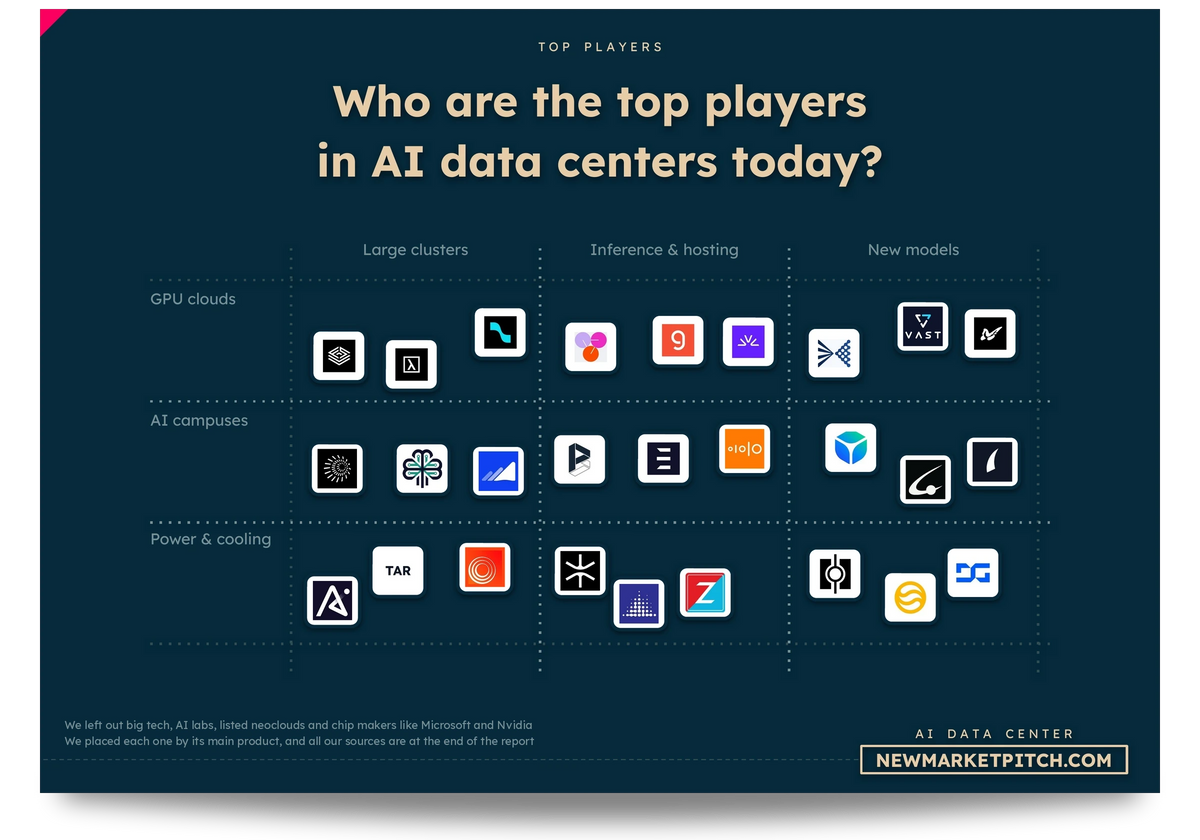
In our report covering the AI data center market, we turn what is vague and complex into simple, useful visuals. Market maps like this one show you at a glance where every startup stands.
Top startups in the AI data center market ranked by valuation
Here is an updated table that ranks the top startups in the AI data center market based on their latest reported or estimated valuations.
If you need to dig deeper and get more detailed data, please check our report covering the AI data center market.
| # | Startup Name | What They Do | Current Valuation ($) | Valuation Confidence Level | Valuation Type | Evidence Status | Total Funding ($) | Funding Confidence Level | Country |
|---|---|---|---|---|---|---|---|---|---|
| 1 | Crusoe | Vertically integrated AI compute infrastructure | $30.9B | Full Confidence | Announced Private Round Valuation | Observed | $6.4B | Full Confidence | United States |
| 2 | Fluidstack | Hyperscale GPU cloud infrastructure | $17.5B–$19.0B | Strong Confidence | Implied Valuation from Raise | Estimated | $1.0B | Partial Confidence | United States |
| 3 | Nscale | Vertically integrated AI cloud infrastructure | $14.6B | Partial Confidence | Announced Private Round Valuation | Observed | $3.3B | Full Confidence | United Kingdom |
| 4 | Firmus | Develops sovereign AI factory campuses | $11.0B–$16.0B | Partial Confidence | IPO or Listing Range Valuation | Estimated | $2.5B+1 | Partial Confidence | Australia |
| 5 | Lambda | Provides GPU cloud computing infrastructure | $9.0B–$13.0B | Partial Confidence | Comparables-Based Estimate | Estimated | $2.4B | Full Confidence | United States |
| 6 | Lancium | Develops powered AI data center campuses | $7.5B–$10.0B | Strong Confidence | Implied Valuation from Raise | Implied | ~$2.7B | - | United States |
| 7 | Together AI | AI model training and inference cloud | $8.3B | Full Confidence | Announced Private Round Valuation | Observed | $1.3B | Full Confidence | United States |
| 8 | 5C Group | Builds integrated AI data centers | $2.5B–$4.5B | Low Confidence | Comparables-Based Estimate | Estimated | $418M+ | - | Canada |
| 9 | Groq | Operates global AI inference cloud | $3.2B–$3.7B | Strong Confidence | Implied Valuation from Raise | Estimated | $2.8B | Strong Confidence | United States |
| 10 | PaleBlueDot AI | GPU clusters and AI compute marketplace | $3.2B | Full Confidence | Announced Private Round Valuation | Observed | $350M12 | Strong Confidence | United States |
| 11 | Gimlet Labs | Optimizes multi-chip AI inference | $3.0B | Full Confidence | Announced Private Round Valuation | Observed | $392M | Full Confidence | United States |
| 12 | GMI Cloud | Provides GPU inference cloud infrastructure | $2.0B–$3.5B | Partial Confidence | Comparables-Based Estimate | Estimated | $238M+1 | Partial Confidence | United States |
| 13 | Lightning AI | Integrates GPU infrastructure and AI development | $2.3B–$2.8B | Strong Confidence | Comparables-Based Estimate | Estimated | $109M+1 | - | United States |
| 14 | Panthalassa | Ocean-powered autonomous offshore AI data centers | $1.8B–$2.1B | Strong Confidence | Implied Valuation from Raise | Estimated | ~$454M | - | United States |
| 15 | TensorWave | AMD-powered AI GPU cloud infrastructure | $1.6B | Full Confidence | Announced Private Round Valuation | Observed | $495M | Strong Confidence | United States |
| 16 | Neysa | Enterprise AI acceleration cloud infrastructure | $1.2B–$1.6B | Partial Confidence | Comparables-Based Estimate | Estimated | $650M | Strong Confidence | India |
| 17 | Verda | Sovereign sustainable GPU cloud infrastructure | $1.0B–$1.4B | Strong Confidence | Implied Valuation from Raise | Estimated | $202M+13 | Partial Confidence | Finland |
| 18 | RunPod | Developer GPU cloud and serverless compute | $1B | Partial Confidence | Announced Private Round Valuation | Observed | $120M | Full Confidence | United States |
| 19 | Kao Data | Develops UK AI data centers | $800M–$1.0B | Strong Confidence | Comparables-Based Estimate | Estimated | $170M+1 | Partial Confidence | United Kingdom |
| 20 | DeepInfra | Serves low-cost AI model inference | $600M–$1.0B | Partial Confidence | Comparables-Based Estimate | Estimated | $133M | - | United States |
| 21 | General Compute | Deploys specialized AI inference chips | $760M–$840M | Strong Confidence | Implied Valuation from Raise | Estimated | $115M | - | United States |
| 22 | Nava | Enterprise private cloud and AI infrastructure | $650M–$850M | Partial Confidence | Active Raise Valuation | Estimated | $32M | Full Confidence | India |
| 23 | Hydra Host | Orchestrates distributed GPU cloud capacity | $500M–$800M | Partial Confidence | Implied Valuation from Raise | Implied | $103M+1 | - | United States |
| 24 | Bolt Data & Energy | Develops energy-backed AI data centers | $400M–$650M | Partial Confidence | Implied Valuation from Raise | Implied | $150M | Strong Confidence | United States |
| 25 | Polarise | European sovereign AI cloud infrastructure | $350M–$550M | Partial Confidence | Comparables-Based Estimate | Estimated | Undisclosed | - | Germany |
| 26 | NexGen Cloud | Enterprise GPU cloud computing infrastructure | $350M–$500M | Partial Confidence | Comparables-Based Estimate | Estimated | $59M | Full Confidence | United Kingdom |
| 27 | Eclairion | Operates modular high-density HPC campuses | $250M–$550M | Low Confidence | Comparables-Based Estimate | Estimated | $168M | Partial Confidence | France |
| 28 | Rune Energy | Renewable-powered modular AI data centers | $200M–$330M | Partial Confidence | Implied Valuation from Raise | Implied | $54M | Partial Confidence | United States |
| 29 | Parasail | Distributed AI inference and training cloud | $150M–$230M | Partial Confidence | Implied Valuation from Raise | Implied | $42M | - | United States |
| 30 | ai& Inc. | Develops vertically integrated inference infrastructure | $90M–$180M | Partial Confidence | Implied Valuation from Raise | Implied | $50M | Full Confidence | Japan |
| 31 | Lyceum | European sovereign AI GPU cloud | $40M–$70M | Low Confidence | Comparables-Based Estimate | Estimated | $12M | Full Confidence | Germany |
| 32 | HIGHRESO | Provides Japanese GPU cloud services | $35M–$65M | Low Confidence | Comparables-Based Estimate | Estimated | $16M | Partial Confidence | Japan |
| 33 | Cardinal Data Power | Develops powered hyperscale data center sites | $15M–$45M | Low Confidence | Proxy-Based Estimate | Estimated | Undisclosed | - | United States |
Which startups in the AI data center market have been acquired or gone public?
These startups no longer have a private-market valuation of their own, so we list them separately, using their acquisition price or their current market capitalization.
| # | Startup Name | What They Do | Current Valuation ($) | Valuation Confidence Level | Valuation Type | Evidence Status | Total Funding ($) | Funding Confidence Level | Country |
|---|---|---|---|---|---|---|---|---|---|
| 1 | Colovore | Operates liquid-cooled colocation data centers | $800M–$1.8B | Low Confidence | Comparables-Based Estimate | Estimated | Undisclosed | - | United States |
- Plus sign means a minimum; some amounts are undisclosed.
- Includes $255M of debt.
- Verda's wider $450M+ figure includes non-equity financing.

Our research about AI data centers gets updated several times a month, so you always get the latest view of where things stand.
Why are AI data center startup valuations rising so fast?
AI data center startup valuations are soaring because companies are spending hundreds of billions of dollars building the infrastructure needed to run artificial intelligence, and investors expect that spending to continue.
The scale is hard to ignore. According to the International Energy Agency's latest Energy and AI research, the world's largest technology companies spent more than $400 billion on capital expenditure in 2025, with spending expected to increase by another 75% in 2026. The IEA also estimates that AI-focused data center capacity has more than tripled over the past 18 months.
That spending is reaching startups. Crusoe secured a $3.9 billion Series F in September 2026, Nscale arranged $3.36 billion in convertible financing, and Together AI raised $800 million in July. Large infrastructure investors are joining venture capital firms because building AI capacity now requires amounts of money that few startups could raise through ordinary equity rounds alone.
There's a physical reason behind the rush. The IEA expects global data center electricity consumption to increase from approximately 485 TWh in 2025 to 950 TWh by 2030. AI-focused facilities should grow even faster, potentially tripling their electricity consumption over that period.
Still, valuations reflect different bets. Crusoe and Firmus are building large physical campuses, while companies such as RunPod and Together AI make computing capacity available through cloud platforms. Both benefit from AI demand, but their costs, financing needs and paths to profitability differ considerably.
Which AI data center startups are worth the most today?
Crusoe currently leads the AI data center startup ranking at $30.9B, followed by Fluidstack at $17.5B–$19.0B, Nscale at $14.6B, Firmus at $11.0B–$16.0B and Lambda at $9.0B–$13.0B.
These five companies share one important characteristic: they can arrange large-scale AI computing capacity for customers that need thousands of GPUs, substantial electrical power and reliable infrastructure.
Their approaches differ. Crusoe combines energy, campuses and cloud services. Nscale develops an integrated infrastructure platform with a growing international footprint. Fluidstack specializes in hyperscale GPU deployments, Firmus builds AI factory campuses, and Lambda provides GPU cloud infrastructure backed by large customer agreements.
Crusoe's September 2026 Series F put the company at $30.9 billion. Nscale and Firmus are pursuing similarly ambitious infrastructure projects, although both still have a great deal of capacity to bring online.
The ranking also extends well beyond these large builders. Together AI stands at $8.3B, Gimlet Labs at $3.0B and TensorWave at $1.6B, showing that investors also assign substantial value to inference software, specialized computing platforms and alternative GPU infrastructure.
The highest valuations currently favor companies that can combine access to infrastructure with large customer commitments. But owning or developing more data center capacity does not automatically mean earning more profit.

In our market report about AI data centers, we look at what the winners do differently, so you can learn from the best instead of guessing.
How many AI data center startups are unicorns?
We count 18 AI data center startups valued at $1 billion or more, representing approximately 55% of the 33 private companies in our ranking.
That is an unusually broad group for a market where building the underlying product can require hundreds of millions of dollars before customers start using it.
The unicorn group includes major campus developers such as Crusoe, Nscale and Firmus, GPU cloud operators such as Lambda and RunPod, inference specialists such as Groq and Gimlet Labs, and regional infrastructure companies such as Neysa and Verda.
Sixteen companies are valued entirely above $1 billion, while Verda and RunPod start at exactly $1 billion. Two others, Kao Data and DeepInfra, have ranges reaching the threshold.
RunPod's $1B valuation is particularly interesting because the company has built a substantial recurring-revenue business without developing the same enormous physical campuses as the sector's biggest names.
Looking below the threshold, General Compute at $760M–$840M, Nava at $650M–$850M and Hydra Host at $500M–$800M are among the companies closest to the next level.
Billion-dollar valuations are no longer reserved for companies building enormous data centers. Developers of AI inference platforms and specialized cloud services are reaching them too.
Is Crusoe really worth $30.9B today?
Crusoe's $30.9B valuation has strong commercial backing, although investors are paying for a business whose infrastructure and revenue are still growing into an enormous contracted pipeline.
Crusoe's September 2026 Series F established its valuation through a completed investment round. The company also disclosed more than $140 billion in total contracted value and over 6 GW of gross contracted capacity.
About 1 GW of that capacity was already operational. In other words, less than one-fifth of the reported gross contracted capacity had reached operation, leaving substantial construction and deployment work ahead.
That gap explains both Crusoe's valuation and its risk. Existing contracts give the company visibility into future business, but developing the remaining infrastructure requires billions in equipment, construction and financing.
Crusoe is also doing more than building facilities. Its Crusoe Cloud business reported bookings growth exceeding 20 times year over year, while managed inference services had already secured over $100 million in contracted annual recurring revenue.
The combination gives Crusoe several ways to earn money from AI infrastructure, from providing physical capacity to selling managed computing services.
One caution remains essential: $140 billion in total contracted value covers future contractual commitments across multiple years. It cannot be compared directly with annual revenue or operating profit.
Crusoe's commercial position is impressive. The harder question is how much profit the company will retain after financing and delivering its projects.

In our document detailing everything you need to know about AI data center, you will always find fresh funding data, taken straight from our own verified funding database.
Can Nscale become more valuable than Crusoe?
Nscale could eventually challenge Crusoe, but its announced $14.6B valuation remains well below Crusoe's $30.9B, and its business is still converting enormous contracts into live revenue.
Nscale's September 2026 SEC registration provides unusually detailed financial information for a private AI infrastructure company.
The company disclosed $103.4 billion in active and contracted total contract value as of August 31, up from $38.0 billion at the end of 2025. That's an increase of about 172% in eight months.
Revenue is growing quickly too. Nscale generated $140.6 million in the first half of 2026, compared with $10.4 million during the same period in 2025. Its full-year 2025 revenue was $33.0 million.
The difference between its contracted pipeline and operating business is enormous. The filing reported $2.6 billion in active contract value, compared with the much larger $103.4 billion active and contracted figure. The company had approximately 461,000 active or contracted GPUs, including equipment not yet operating.
Nscale's commitments could support a substantially larger business. For now, though, its contracted pipeline is vastly bigger than the revenue it actually recognizes.
Nscale has a credible path toward Crusoe's scale. Whether its shareholders eventually receive a higher valuation will depend on the pace of deployment, financing costs and the cash generated by those contracts.
Why are Fluidstack, Firmus and Lambda worth billions?
Fluidstack, Firmus and Lambda command multibillion-dollar AI data center valuations because they can organize huge GPU deployments for customers that want computing capacity without building everything themselves.
Fluidstack, valued at $17.5B–$19.0B, specializes in hyperscale GPU infrastructure. Its business is built around delivering computing capacity for large AI workloads rather than relying entirely on smaller, on-demand customers.
Firmus, at $11.0B–$16.0B, has been pursuing large AI factory projects across Asia-Pacific. In September 2026, it announced that OpenAI would become an anchor customer for two Malaysian facilities. Firmus also reported more than 900 MW of contracted capacity across its customers.
Lambda, valued at $9.0B–$13.0B, announced a multibillion-dollar agreement with Microsoft in November 2025 involving tens of thousands of NVIDIA GPUs. Its financing arrangements have become increasingly tied to specific customer deployments.
Large customers are making commitments that help support infrastructure construction before it is fully operational. That's the appeal of all three businesses.
Firmus also shows what can go wrong. In October 2026, the company withdrew its planned Australian IPO. ABC subsequently reported that its financial statements included approximately $8.3 billion in chip purchase commitments for an Indonesian project, with substantial payments dependent on new financing. Firmus also had projects awaiting funding or approval.
The contrast is striking. Firmus reported about $50.8 million in annual revenue for the year ending June 2026, while pursuing infrastructure commitments worth many billions.
Winning the contract is only half the job. Somebody still has to pay for the GPUs and get them running.

Learning from others' mistakes is the cheapest lesson there is. In our report covering the AI data center market, we look at what broke startups before you, so you don't repeat it.
Are AI data center startups raising more money than software startups?
The largest AI data center startups now raise money on a scale that looks closer to industrial infrastructure financing than traditional software venture capital.
Crusoe has $6.4B in reported funding, Nscale $3.3B, Lambda $2.4B and Fluidstack $1.0B. Lancium's approximate $2.7B financing figure also reflects the extraordinary amounts needed to develop large powered facilities.
But financing structures are becoming more interesting than the headline amounts.
In February 2026, Firmus announced a $10 billion debt facility led by Blackstone and supported by Coatue. In October, Lambda completed a separate $1 billion investment-grade financing backed by contracted payments from two hyperscale customers.
Lambda's transaction carried a 6.78% fixed interest rate and used a delayed-draw structure, allowing financing to be deployed as computing infrastructure entered service.
Lenders are increasingly willing to finance contracted GPU infrastructure against expected customer payments. That changes how quickly these companies can expand.
Neysa offers another example. Blackstone and co-investors agreed to invest up to $600 million of equity in February 2026, with the company planning to raise another $600 million through debt.
These transactions shouldn't be confused with conventional venture rounds. Debt must be repaid, and lending facilities are not always equivalent to cash already drawn.
Companies that secure customers but cannot finance the hardware may struggle to deliver what they have sold. In this market, access to capital can be as important as access to GPUs.
Is electricity becoming more valuable than GPUs for AI data center startups?
Electricity access is currently one of the biggest advantages an AI data center startup can have, especially when it can secure large amounts of usable power before competitors.
The International Energy Agency estimates that grid constraints could delay around 20% of global data center capacity planned through 2030. Building new transmission lines can take four to eight years in advanced economies, and lead times for important electrical equipment have increased substantially.
That creates an opportunity for companies such as Lancium and Cardinal Data Power, which focus on powered development sites, as well as integrated infrastructure developers such as Crusoe, Nscale and Firmus.
Crusoe reports more than 6 GW of gross contracted capacity. Nscale describes a portfolio exceeding 10 GW of owned and controlled power, while Firmus has more than 900 MW of contracted customer capacity. These measures aren't identical, and none should be mistaken for fully operational electrical load.
Developers are treating energy access as a strategic asset, sometimes years before the associated computing capacity can begin generating revenue.
There is also a distinction between companies solving the power problem and those solving the cooling or equipment problem. Kao Data and Eclairion specialize in high-density facilities, while Hydra Host and Parasail focus on coordinating computing capacity.
AI infrastructure has several bottlenecks, and they create different business opportunities.
| Infrastructure problem | Companies exposed | What customers need |
|---|---|---|
| Powered land | Lancium, Cardinal Data Power | Large sites with reliable electricity |
| AI campus development | Crusoe, Firmus, Nscale | Facilities capable of hosting major GPU clusters |
| High-density facilities | Kao Data, Eclairion | Cooling and power for demanding workloads |
| GPU deployment | Fluidstack, Lambda, TensorWave | Large operational GPU fleets |
| Distributed GPU capacity | Hydra Host, Parasail | Access to computing across different locations |
| On-demand GPU services | RunPod, GMI Cloud, DeepInfra | Flexible computing without long commitments |
| Inference optimization | Gimlet Labs, Groq, Together AI | Faster and cheaper model execution |

In our research about AI data centers, we always try to gather several sources and make estimates that make sense, so you can work with solid numbers.
Are GPU cloud startups catching up with the biggest AI data center builders?
GPU cloud startups are catching up in commercial scale and valuation, although the highest valuations still belong to companies combining cloud services with major physical infrastructure.
Together AI provides a clear example. Its valuation increased from $3.3 billion in February 2025 to $8.3B following an $800 million financing round in July 2026, a gain of approximately 152% in less than eighteen months.
According to Reuters, Together AI's annual bookings exceeded $1.15 billion in the second quarter of 2026. Bookings measure customer commitments rather than recognized annual revenue, but the figure shows substantial demand for its services.
RunPod is growing through a different customer base. The company reported more than $325 million in annual recurring revenue in October 2026, compared with $120 million in January.
GMI Cloud, valued at $2.0B–$3.5B, and DeepInfra, at $600M–$1.0B, also compete in AI computing services, particularly around inference.
These companies can serve developers and enterprises without necessarily owning every building or electrical connection involved in delivering compute.
That flexibility can help them grow quickly. But running GPU infrastructure is still expensive, and higher sales do not automatically produce software-like profit margins.
The important difference between the two groups is where they take risk. Large campus builders commit substantial capital to long-lived physical assets, while GPU cloud operators face more immediate pressure from equipment prices, utilization and customer spending.
Can RunPod really justify a $1B valuation?
RunPod's $1B valuation looks well supported because the company now has substantial recurring revenue and a fast-growing developer base.
In October 2026, RunPod announced that annual recurring revenue had surpassed $325 million, compared with $120 million in January. That represents approximately 171% growth in about nine months.
The company also reported more than 1.2 million developers, up from approximately 495,000 a year earlier. September alone brought more than 95,000 new signups.
We can use those figures to test the valuation. Dividing $1B by $325 million in ARR produces an indicative valuation multiple of roughly 3.1 times annual recurring revenue.
That's a useful comparison because RunPod has a substantial disclosed revenue run rate, unlike many infrastructure developers whose commercial pipelines are still years away from full deployment.
RunPod also reported 120% net dollar retention earlier in 2026, meaning existing customer spending grew after accounting for expansion, contraction and churn.
Profitability is the big question now. The company hasn't disclosed enough about gross margins, operating income or free cash flow to judge how much of its growing revenue it can retain.
Even so, RunPod has built a business with measurable customer adoption and revenue growth. Its valuation no longer rests mainly on expectations of future GPU demand.

If you build or invest in the AI data center market, you need to know which business models pay off now and which ones are fading. That's why our report covering it has a whole section on it.
Are AI inference startups becoming more valuable than GPU infrastructure companies?
AI inference startups are now reaching multibillion-dollar valuations because running models efficiently has become a large business of its own.
Together AI is valued at $8.3B, Groq at $3.2B–$3.7B, PaleBlueDot AI at $3.2B and Gimlet Labs at $3.0B. General Compute, at $760M–$840M, also focuses on specialized inference hardware.
These businesses approach the same demand from different directions.
Together AI offers model training and inference services, Groq operates a global inference cloud, PaleBlueDot AI provides GPU infrastructure and marketplace services, and Gimlet Labs works on executing AI workloads efficiently across different chip types.
Groq announced $350 million in financing in August 2026 and reported 13 operational data centers serving more than six million developers. Gimlet Labs raised $300 million in September at its $3.0B valuation, bringing total funding to $392 million.
The competition also extends beyond NVIDIA-based infrastructure. TensorWave, valued at $1.6B, focuses on AMD-powered GPU computing. Companies offering multi-chip optimization may benefit as customers look for ways to use different accelerators more efficiently.
For inference providers, the strongest commercial advantage comes from delivering useful model output at lower cost, with enough reliability and speed for real applications.
That is where the competition will get interesting. The companies that can consistently reduce the cost of running models may build stronger businesses than those simply adding more computing hardware.
Could cheaper AI computing hurt GPU cloud startups?
Cheaper AI computing could seriously hurt GPU cloud startups whose prices fall faster than their costs, even if demand for AI keeps growing.
RunPod, DeepInfra, GMI Cloud and Parasail all operate in markets where customers can compare compute prices and switch between providers for at least some workloads.
The danger is straightforward. A GPU bought at a high price may become less competitive when a newer generation delivers better performance or rivals lower their rental prices. Operators then need higher utilization, lower costs or better services to protect their margins.
To illustrate the pressure, a 30% price reduction combined with twice as much billable computing volume would still increase revenue by 40%. But a 50% price reduction with only 20% additional volume would reduce revenue by 40%.
Those are scenarios, not forecasts. They show why increasing demand does not guarantee rising revenue.
The exposure differs for companies with large long-term contracts. Crusoe, Nscale and Lambda may have greater revenue visibility on committed deployments, although financing costs and customer concentration remain concerns.
For developers selling flexible GPU services, customer retention and the cost of delivering each workload are particularly important.
The winners will be the companies that make compute cheaper faster than they have to cut prices. Providers that simply rent expensive hardware at shrinking margins could find their valuations under pressure.

Theory only gets you so far. In our document detailing everything you need to know about AI data center, we dig up the real signals from the field and show you the ones worth watching.
Is the US dominating AI data center startup valuations?
The United States dominates the AI data center startup ranking, with 20 of the 33 private companies headquartered there, or approximately 61%.
American businesses also occupy five of the first seven positions: Crusoe, Fluidstack, Lambda, Lancium and Together AI.
That concentration reflects access to large technology customers, financial markets, chip suppliers and established data center development networks.
However, international startups are already reaching significant valuations.
Nscale in the United Kingdom is valued at $14.6B, and Australia's Firmus at $11.0B–$16.0B. India's Neysa stands at $1.2B–$1.6B, while Finland's Verda is valued at $1.0B–$1.4B.
The geographical split also tells us something about customer demand. US companies are particularly strong in large-scale cloud infrastructure, while several European and Asian operators are building businesses around regional data control, enterprise demand and domestic AI capacity.
Headquarters location does not necessarily show where a company's data centers operate. Nscale and Firmus, for example, are pursuing international infrastructure networks.
Still, American startups account for the clear majority of the ranking.
| Country | Private startups | Share of ranking |
|---|---|---|
| United States | 20 | 60.6% |
| United Kingdom | 3 | 9.1% |
| Germany | 2 | 6.1% |
| India | 2 | 6.1% |
| Japan | 2 | 6.1% |
| Australia | 1 | 3.0% |
| Canada | 1 | 3.0% |
| Finland | 1 | 3.0% |
| France | 1 | 3.0% |
Why are countries investing in their own AI data center startups?
Countries are increasingly backing domestic AI infrastructure because governments and businesses want greater control over where sensitive data and computing workloads are hosted.
This is creating opportunities for companies such as Neysa in India, Verda in Finland, and Polarise and Lyceum in Germany.
The financing behind Neysa shows how significant the opportunity has become. In February 2026, Blackstone and co-investors agreed to invest up to $600 million in equity, with Neysa planning to secure another $600 million in debt financing.
The company aims to deploy more than 20,000 GPUs in India, serving enterprise and government customers.
Elsewhere, regional providers are pursuing customers concerned about data residency, infrastructure control and dependence on foreign cloud platforms. Nscale and Firmus also include sovereign or regional infrastructure needs in their expansion strategies.
But demand for domestic computing does not guarantee high returns. Smaller markets can struggle to keep expensive GPU clusters fully utilized, especially when global cloud providers compete aggressively on price.
Large cloud infrastructure companies can attract customers from around the world, while sovereign providers may win contracts because of location, local control or procurement requirements.
Sovereign computing should remain an important market, particularly for government and regulated enterprise workloads. The commercial test is whether customers will pay enough to cover the cost of operating dedicated regional infrastructure.

In our report covering the AI data center market, we don't want to repeat what boring consulting reports say. Instead, we show you the real and latest market signals that matter.
Which smaller AI data center startups could become the next unicorns?
Kao Data, General Compute, Nava and Hydra Host are among the smaller AI data center startups closest to achieving billion-dollar valuations.
Kao Data, valued at $800M–$1.0B, develops UK data centers suited to demanding AI workloads. It has a credible route to a higher valuation if it expands operational capacity backed by long-term customers.
General Compute, at $760M–$840M, operates in specialized inference infrastructure, where better performance and efficiency could attract additional enterprise demand.
Nava, valued at $650M–$850M, is positioned around private cloud and enterprise AI infrastructure in India. Hydra Host, at $500M–$800M, focuses on coordinating distributed GPU capacity.
Their potential paths to a billion-dollar valuation are different. Physical infrastructure companies can become more valuable by securing power, developing facilities and signing customers. Cloud platforms need to show growing usage, revenue and healthy margins.
Other companies are earlier in the valuation range. Bolt Data & Energy stands at $400M–$650M, Polarise at $350M–$550M, NexGen Cloud at $350M–$500M, Eclairion at $250M–$550M and Rune Energy at $200M–$330M.
Parasail, valued at $150M–$230M, and ai& Inc., at $90M–$180M, concentrate on computing and inference infrastructure. Lyceum and HIGHRESO are smaller regional GPU cloud providers, while Cardinal Data Power focuses on developing powered sites.
These companies won't all follow the same growth curve. A developer securing a major power connection has a very different path from a cloud operator growing developer revenue.
The next unicorns are most likely to emerge where a company can turn a specific infrastructure advantage into repeatable commercial demand.
Are AI data center acquisitions becoming more common?
AI data center companies are attractive acquisition targets when they own operational facilities, scarce power access or specialized cooling infrastructure, although there isn't yet a clear industry-wide acceleration in acquisition activity.
Colovore is one example. The liquid-cooled data center specialist was acquired by King Street in 2024 and appears separately from the private startup ranking, with an estimated value of $800M–$1.8B.
The company has continued expanding since the acquisition.
Its official company history shows that all 16 MW of capacity at its Reno facility were committed ahead of delivery in January 2026. In February, the first 6 MW of its Chicago facility were also committed.
Those commitments help explain why investors may prefer acquiring an established data center operator. Obtaining usable sites, cooling infrastructure, electrical access and customers can take years.
For a larger infrastructure owner, buying those capabilities may be faster than developing them from scratch.
Colovore's $800M–$1.8B valuation range should not be confused with the purchase price paid by King Street, which was not publicly disclosed.
Acquisitions offer a credible exit route for companies with valuable infrastructure, particularly when the alternative is spending years developing a comparable site. But one attractive deal does not establish a broader acquisition boom.

In our research about AI data centers, we like to show you the big picture. We know your time is precious, so we make every page quick to read and packed with as much learning as possible per minute.
Are AI data center startups ready to go public?
Some AI data center startups are approaching public-market scale, but Firmus' failed IPO shows that investors have become much more demanding about financing, construction and profitability.
Nscale has taken a significant step toward the public markets. Its September 2026 SEC registration disclosed $140.6 million in first-half revenue and more than $103 billion in active and contracted total contract value.
Investors can compare that revenue with future customer commitments and the financial obligations involved in delivering them.
Firmus has faced a more difficult reception. The Australian company withdrew its IPO application in October 2026 after market concerns about valuation, debt and the information available to investors.
Reporting by ABC on October 29 added further detail. Firmus had reported approximately $50.8 million in revenue for its latest financial year, while financial documents showed billions in future equipment commitments and significant payments that had depended on its proposed listing.
The company said it would seek private financing instead.
That experience exposes a major challenge for the sector. Customers may sign enormous contracts, but public investors also want to understand how much capital is required to deliver them and when the projects will generate cash.
Companies such as Lambda and Fluidstack may eventually face similar questions about long-term contracts, financing obligations and GPU depreciation.
Public listings remain a possible path for leading AI infrastructure startups. Firmus has shown that a large contracted pipeline alone won't guarantee investor support.
Are AI data center startup valuations actually justified?
AI data center startup valuations are partly justified today, especially for companies with operating infrastructure, signed customer contracts and real revenue. The biggest risk is that investors are pricing future capacity as though much of the hard work were already finished.
The strongest businesses have measurable commercial achievements. Crusoe has a $30.9B valuation established through financing and more than $140 billion in total contracted value. Nscale has shown exceptionally rapid revenue growth, while RunPod has reached more than $325 million in annual recurring revenue.
There is also genuine demand for specialized AI computing through Together AI, Groq and Gimlet Labs, alongside significant customer commitments supporting physical infrastructure developers.
The financial risks are substantial, though. Data center projects can take years to build, GPUs can lose economic value as newer hardware arrives, electricity connections can be delayed, and large financing packages leave less room for mistakes.
Firmus' withdrawn IPO is a particularly useful warning. Large customer commitments and strong institutional backing did not remove concerns about the cost of delivering its infrastructure pipeline.
The difference between the strongest and weakest valuations will become clearer as planned facilities enter service and operators report more revenue, margins and cash flow.
AI data centers are one of the most important infrastructure investment opportunities in technology, but valuations should increasingly be judged by operational capacity and earnings rather than ambitious project announcements.
Companies delivering profitable computing capacity can support enormous valuations. Those still depending on several rounds of financing to complete their promised projects face a much harder test.

When you build or invest in the AI data center market, you need clarity, not confusion. In our market report about AI data centers, we always try to put numbers on and quantify whatever is usually vague and confusing.
Sources and methodology
This analysis ranks the most valuable independent private startups in the AI data center market, covering AI data center developers, GPU cloud operators, inference infrastructure providers and closely related computing services. Established corporate groups and their divisions are excluded, while acquired businesses are considered separately.
We assessed 33 private companies using completed funding rounds, company announcements, regulatory filings, investor materials, revenue and annual recurring revenue disclosures, customer contracts, operating capacity and comparable transactions. Our aim was to determine a defensible current valuation for each company, rather than simply repeat its last funding announcement.
When recent completed financing established a company valuation, we generally treated that as the primary reference. For companies without a recent disclosed valuation, we considered financing amounts, plausible dilution, comparable businesses, commercial growth, contracted infrastructure and operating progress. We used precise figures where the financial evidence justified them and valuation ranges where uncertainty was greater. We did not mechanically average valuation methods or apply arbitrary adjustments.
We also distinguished between revenue already earned, annual recurring revenue, bookings, total contracted value and infrastructure capacity. These measures describe different stages of commercial development and should not be treated as interchangeable. Similarly, equity funding, debt facilities and planned financing commitments were considered separately when assessing capital requirements.
Our research prioritized primary company disclosures, regulatory filings and reporting from established financial publications. Particularly important were Crusoe's September 2026 financing, Nscale's SEC registration, RunPod's October 2026 revenue announcement, Firmus' financing and withdrawn IPO, and industry electricity forecasts from the International Energy Agency.
A company can appear in this ranking even when its total funding is undisclosed: its position depends on its valuation, not on the capital it has raised.
Key sources include TPG on Crusoe's $3.9 billion Series F and contracted infrastructure, Nscale's SEC filing, Reuters on Together AI's financing and bookings, RunPod's annual recurring revenue announcement, Firmus on its OpenAI agreement and contracted capacity, Firmus on its $10 billion debt facility, ABC's investigation into Firmus' financial commitments, and ABC on Firmus' canceled IPO.
Additional sources include Lambda's Microsoft infrastructure agreement, Lambda's October 2026 fixed-rate financing, Groq's August 2026 financing announcement, Gimlet Labs' $300 million Series B, Blackstone on Neysa's financing, Colovore's company history, and the International Energy Agency's research on AI infrastructure investment and electricity demand and power infrastructure constraints.

A good product starts with a real problem. In our document detailing everything you need to know about AI data center, we show you the ones customers still live with.
Written by the New Market Pitch teamWe track new markets so founders and investors can move faster. About us