What are the top AI data center startups by revenue today?
Whether you're building or investing in the AI data center market, our report covers everything you need to know: the players, the money, and what's coming next.
Summary
CoreWeave is the top AI data center startup by revenue today, followed by IREN, Lambda, Applied Digital, and DayOne Data Centers. CoreWeave reported $2.58 billion in Q2 2026 revenue, putting it well ahead of its closest competitors in recognized sales.
The ranking includes 20 companies, but their financial figures are not directly interchangeable. CoreWeave reports quarterly revenue, IREN a $1 billion annualized operating run-rate, Lambda an estimated $760 million run-rate, and DayOne $512 million in half-year sales. The differences in accounting periods and revenue definitions are substantial.
CoreWeave has achieved enormous scale, with quarterly revenue growing 112% year over year. Profitability remains another story: the company recorded a $626 million quarterly net loss, partly because financing its infrastructure expansion is extremely expensive.
IREN illustrates the gap between current revenue and future commercial commitments. Its FY2026 AI cloud revenue was $128.8 million, compared with a $1 billion operating run-rate in August 2026 and $4 billion in contracted ARR associated with planned capacity. Turning those commitments into billable services is the next test.
Physical data center operators are growing rapidly too. Applied Digital reported $342 million in quarterly revenue, DayOne generated $512 million over six months, and Core Scientific reached a $635 million annualized colocation revenue run-rate. Their businesses depend on construction, commissioning, and long-term infrastructure contracts rather than GPU rental alone.
Core Scientific's operating figures show how much growth is still waiting to be activated. It had approximately 1.1 GW of leased customer power capacity in July 2026, but only 437 MW was billing. Roughly 60% of its leased capacity had yet to contribute to that annualized revenue measure.
Smaller specialists have found sizable markets. Runpod exceeded $325 million in ARR by October 2026 with a developer-focused GPU cloud, while Cerebras generated $126 million in quarterly cloud and services revenue using its own AI processors. Both compete through specialized computing services rather than sheer facility size.
The market is geographically diverse. India's ST Telemedia Global Data Centres and CtrlS generate hundreds of millions of dollars from infrastructure operations, while European businesses such as Nscale, atNorth, and EcoDataCenter are expanding around regional hosting and high-density computing demand. Not all their reported sales are AI-specific.
Some of the largest infrastructure developers have no comparable public revenue figure. Aligned Data Centers reported more than 6.4 GW of operating and planned capacity, while Lancium disclosed 4 GW of leased capacity. Neither number tells us how much revenue is already being earned.
The industry's next constraint is physical infrastructure. Global data center electricity consumption reached an estimated 485 TWh in 2025 and could approach 950 TWh by 2030. Power availability, cooling, grid connections, and equipment delivery will determine how quickly contracted AI demand turns into actual revenue.

Written by the New Market Pitch teamWe track new markets so founders and investors can move faster. About us

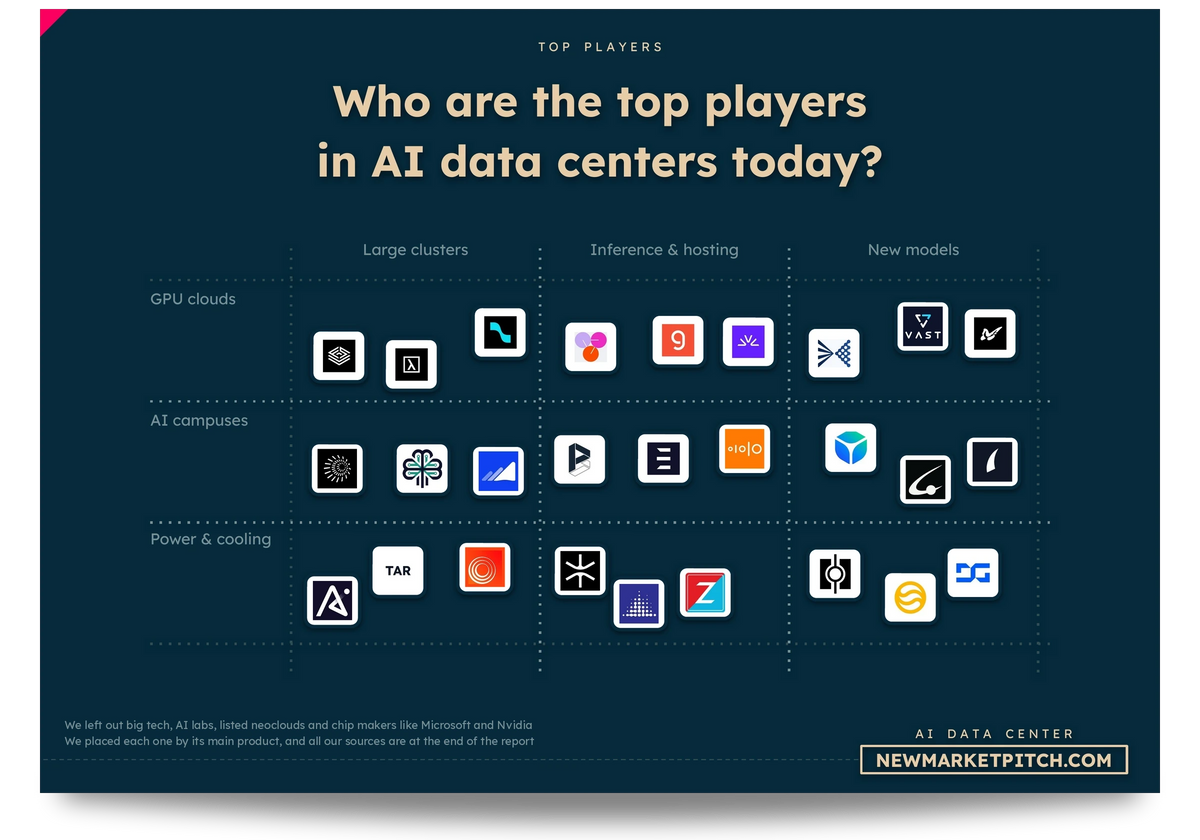
In our report covering the AI data center market, we turn what is vague and complex into simple, useful visuals. Market maps like this one show you at a glance where every startup stands.
The ranking of top startups in the AI Data Center Market by revenue
Below is a table ranking the startups of this market by their current revenue scale. You can find our methodology at the end of this page.
If you want a deeper understanding of the market and its current dynamics, get our report on the AI data center market.
| Ranking | Company | Latest Metric | Metric Type | Freshness | Disclosed When | Source Quality | Confidence | Segment | Why This Ranking | Local Metric | Country |
|---|---|---|---|---|---|---|---|---|---|---|---|
| 1 | CoreWeave | $2.58B | Quarterly Revenue | Very Fresh · 4mo | Aug 11, 2026 | Filed / Audited | High | Integrated AI Cloud & Data Centers | Highest-quality evidence of massive current AI-specific revenue. Its 2026 quarterly scale and concentration in AI warrant first position despite larger historical group revenues at diversified operators. | us | |
| 2 | IREN | $1B | Revenue Run-Rate | Very Fresh · 2mo | Aug 2026 | Company Disclosed | Medium | AI Cloud & High-Density Data Centers | More current AI-specific operating evidence than many diversified developers. FY2026 recognized AI cloud revenue was only $128.8M, so the $1B run-rate receives a material comparability discount. | au | |
| 3 | Lambda | ~$760M | Revenue Run-Rate | Fresh · 10mo | Apr 20, 2026 | Third-Party Estimate | Low | Dedicated GPU Cloud | Large estimated AI compute revenue, but weaker sourcing places it below IREN's direct operating disclosure and close to more transparent public operators. | us | |
| 4 | Applied Digital | $342M | Quarterly Revenue | Very Fresh · 2mo | Oct 2026 | Filed / Audited | Medium | AI/HPC Data Center Hosting | Very recent recognized revenue and strong growth justify placement above several older full-year disclosures. Fit-out and pass-through revenue limit its recurring-revenue comparability. | us | |
| 5 | DayOne Data Centers | $512M | Half-Year Revenue | Very Fresh · 4mo | Oct 5, 2026 | Filed / Audited | High | AI-Ready Hyperscale Data Centers | Strong prospectus evidence. Ranked immediately below Applied Digital on current growth momentum, though its recurring colocation economics may be more comparable than Applied's fit-out-heavy quarter. | sg | |
| 6 | Core Scientific | $635M | Revenue Run-Rate | Very Fresh · 3mo | Jul 28, 2026 | Company Disclosed | Medium | High-Density AI Colocation | Its $136.7M recognized Q2 colocation revenue corroborates an operating AI hosting business. Below DayOne Data Centers because its selected figure is annualized; above Cerebras Systems' quarterly cloud revenue. | us | |
| 7 | Cerebras Systems | $126M | Quarterly Revenue: Cloud & Other Services | Very Fresh · 4mo | Aug 1, 2026 | Filed / Audited | Medium | AI Inference Cloud | Selected the commercially delivered cloud business, excluding chip hardware revenue. More directly relevant to AI compute delivery than diversified colocation revenue below it. | us | |
| 8 | Runpod | >$325M | ARR | Very Fresh · 0mo | Oct 13, 2026 | Company Disclosed | Medium | Developer GPU Cloud | Exceptionally fresh, directly disclosed ARR. Below Cerebras because the latter supplies recognized quarterly revenue, but stronger than older or partial-company figures at several nearby firms. | us | |
| 9 | ST Telemedia Global Data Centres | ~$272M | Subsidiary Fiscal-Year Revenue | Aging · 19mo | Feb 2026 | Credible Reported | Low | Hyperscale & AI-Ready Colocation | The Indian subsidiary alone has substantial verified revenue (~$272M), below Runpod's >$325M ARR and above Nscale's $141M half-year figure. It should not be read as STT GDC's global turnover. | INR 23.5B | in |
| 10 | Nscale | $141M | Half-Year Revenue | Very Fresh · 4mo | Sep 18, 2026 | Filed / Audited | High | Vertically Integrated AI Compute & Data Centers | Excellent recent disclosure. Its enormous lifetime contracted value is deliberately excluded from revenue, keeping the company below operators with substantially larger realized sales. | gb | |
| 11 | Crusoe | ~$276M | Estimated Annual Revenue | Aging · 22mo | Third-Party Estimate | Low | Integrated AI Data Centers & Cloud | Current commercial scale may be much larger, but recent financing and contracted values cannot be substituted for earned revenue. Ranked below audited Nscale despite a larger historical estimate. | us | ||
| 12 | CtrlS Datacenters | ~$180M | Fiscal-Year Operating Revenue | Aging · 19mo | May 6, 2026 | Filed / Audited | Medium | AI-Ready Hyperscale & Managed Data Centers | Solid audited earnings evidence places it above many private developers, but the operating period is older than recent AI cloud figures and the AI revenue contribution is unknown. | INR 15.6B | in |
| 13 | Scala Data Centers | ~$164M | Fiscal-Year Net Operating Revenue | Fresh · 10mo | Mar 1, 2026 | Filed / Audited | Medium | Latin American AI-Ready Hyperscale Data Centers | Recent audited Brazilian revenue and directly relevant hyperscale operations support placement near CtrlS. Different currencies and revenue definitions prevent precise comparison without normalization. | BRL 916M | br |
| 14 | Ionic Digital | $48.6M | Quarterly Revenue | Very Fresh · 4mo | Aug 2026 | Company Disclosed | Medium | HPC/AI Data Center Leasing | Recognized current income and leased high-density capacity support a financial rank. Its $48.6M covers one quarter, below Scala Data Centers' ~$164M fiscal-year revenue and above atNorth's Icelandic-entity $72.2M. | us | |
| 15 | atNorth | $72.2M | Fiscal-Year Revenue: Icelandic Entity | Fresh · 10mo | Aug 31, 2026 | Filed / Audited | Low | Nordic AI/HPC Data Centers | Genuine entity-level income, but global revenue is not represented. Its position is therefore conservative and should not be taken as the group's actual size. | is | |
| 16 | EcoDataCenter | ~$69.9M | Fiscal-Year Net Sales | Fresh · 10mo | May 1, 2026 | Company Disclosed | Medium | Sustainable AI/HPC Data Centers | Substantial recognized annual sales with relevant AI infrastructure operations. Close to atNorth in available evidence; ordering is approximate due to entity scope and currencies. | SEK 685M | se |
| 17 | ESDS Software Solution | ~$53.8M | Fiscal-Year Operating Revenue | Fresh · 7mo | Sep 2026 | Credible Reported | Medium | AI Cloud & Managed Data Centers | Verified operating revenue supports inclusion, but material future AI cloud contracts were not yet producing revenue within the selected year. | INR 4.73B | in |
| 18 | TeraWulf | $31.9M | Quarterly HPC Lease Revenue | Very Fresh · 4mo | Aug 1, 2026 | Filed / Audited | High | AI/HPC Data Center Leasing | The selected AI/HPC-related lease revenue excludes bitcoin mining. Ranks below larger diversified operators but above an older, smaller HPC annual revenue figure. | us | |
| 19 | Sesterce | ~$12.9M | Historical Annual Revenue | Aging · 22mo | Oct 13, 2026 | Credible Reported | Low | AI Cloud & Data Center Development | Historical turnover is usable but does not establish current revenue from the planned European AI campuses. Penalized for age and perimeter uncertainty. | €11.9M | fr |
| 20 | Sharon AI | $1.9M | Quarterly Revenue | Very Fresh · 4mo | Aug 6, 2026 | Company Disclosed | High | Integrated AI Cloud & AI Factories | The relatively small actual quarterly revenue places it below existing scaled operators, despite billions in contractual value and a major announced capacity rollout. | au | |
| NR | Aligned Data Centers | 6.4 GW operating and planned capacity | Other Scale Signal: operating and planned capacity | Very Fresh · 3mo | Jul 21, 2026 | Company Disclosed | Low | AI-Ready Hyperscale Data Centers | Major operator that may rank very highly financially, but 6.4GW includes future capacity and no verified revenue amount was found. | us | |
| NR | Vantage Data Centers | AI deployment at CWL1 campus | Other Scale Signal: contracted AI data-center capacity | Very Fresh · 2mo | Aug 2026 | Company Disclosed | Low | AI-Ready Hyperscale Data Centers | Demonstrably supplies commercial high-density AI capacity. Large funding and projects do not disclose annual corporate revenue. | us | |
| NR | AirTrunk | >150 MW contracted capacity | Other Scale Signal: Johor JHB1 facility | Very Fresh · 3mo | Jul 2026 | Credible Reported | Low | AI-Ready APAC Hyperscale Data Centers | Fully contracted operating capacity supports meaningful commercialization, but the figure is one facility rather than AirTrunk's worldwide financial scale. | au | |
| NR | Princeton Digital Group | >1.1 GW portfolio capacity | Other Scale Signal: portfolio capacity | Fresh · 15mo | Jul 18, 2025 | Company Disclosed | Low | AI-Ready APAC Hyperscale Data Centers | Large international platform with substantial committed infrastructure, but the figure aggregates portfolio stages rather than revenue-producing capacity alone. | sg | |
| NR | EdgeCore Digital Infrastructure | >1.8 GW delivered or under development | Other Scale Signal: delivered or under development | Fresh · 9mo | Jan 13, 2026 | Company Disclosed | Low | AI-Ready Wholesale Hyperscale | Very relevant dedicated hyperscale platform, but future developments cannot be treated as revenue or as already billing capacity. | us | |
| NR | Firmus | >900 MW contracted capacity | Other Scale Signal: contracted future AI-factory capacity | Very Fresh · 1mo | Sep 8, 2026 | Company Disclosed | Low | Integrated AI Factories | Two operating sites and substantial customer contracts establish relevance, but the announced MW total includes projects not yet generating income. | au | |
| NR | Fluidstack | 300 MW contracted capacity | Other Scale Signal: contracted leased IT capacity at Cipher site | Fresh · 11mo | Nov 20, 2025 | Credible Reported | Low | Integrated AI Cloud & Infrastructure | Material contractual capacity is evidence of scale, but it is a future-oriented lease commitment, not Fluidstack's recognized cloud revenue. | gb | |
| NR | Lancium | 4 GW leased capacity | Other Scale Signal: leased AI-campus capacity | Very Fresh · 2mo | Aug 24, 2026 | Company Disclosed | Low | AI Data Center Campus Development | Large leased site portfolio, but Lancium primarily supplies power-secured campuses rather than all of the AI compute services provided by tenants and partners. | us | |
| NR | DataVolt | 100 MW AI campus under construction | Other Scale Signal: AI campus construction | Very Fresh · 2mo | Aug 31, 2026 | Company Disclosed | Low | Dedicated AI Data Center Development | First-stage construction is credible, but initial commercial availability is targeted for 2028; neither future 360MW nor 1.5GW is current revenue. | sa | |
| NR | Volta | 133 MW AI factory deployment | Other Scale Signal: first announced AI-factory deployment | Very Fresh · 2mo | Aug 4, 2026 | Company Disclosed | Low | Integrated AI Factories | Significant contracted infrastructure opportunity, but the deployment announcement does not establish earned revenue or that all 133MW was operational. | gb | |
| NR | Global Technical Realty | 24 MW under construction | Other Scale Signal: Swiss site under construction | Fresh · 11mo | Nov 2025 | Company Disclosed | Low | European AI-Ready Hyperscale Development | A credible European build-to-suit platform, but announced project size and financial backing cannot determine recognized operator revenue. | gb | |
| NR | Yondr Group | 96 MW campus capacity | Other Scale Signal: Northern Virginia campus | Fresh · 10mo | Dec 17, 2025 | Company Disclosed | Low | AI-Ready Hyperscale Data Centers | Evidence of operating and progressively commissioned commercial capacity, but only campus-level scale is comparable. | gb | |
| NR | DC BLOX | 470 MW committed and planned capacity | Other Scale Signal: committed and planned critical IT | Very Fresh · 0mo | 2026 | Company Disclosed | Low | AI-Ready Regional Hyperscale Data Centers | Twelve operational or developing campuses establish commercial relevance, but the combined figure includes planned infrastructure. | us | |
| NR | Metrobloks | >100 MW proposed capacity | Other Scale Signal: proposed AI/HPC development | Fresh · 9mo | Jan 15, 2026 | Company Disclosed | Low | AI-Ready Modular Data Centers | Relevant high-density developer, but a memorandum of understanding is weaker commercial evidence than existing contracted and operating facilities. | us | |
| NR | Empyrion Digital | >200 MW planned capacity | Other Scale Signal: planned Malaysian hyperscale campus | Fresh · 10mo | Dec 9, 2025 | Company Disclosed | Low | AI-Ready APAC Hyperscale Data Centers | Documented high-density design and secured initial power, but the campus is being developed in phases and does not establish annual group sales. | sg | |
| NR | Echelon Data Centres | 1.2 GW portfolio capacity | Other Scale Signal: total campus portfolio | Fresh · 8mo | Feb 24, 2026 | Company Disclosed | Low | European AI-Ready Hyperscale Data Centers | Its eight-campus portfolio is large, but only 400MW was described as operational or under development; total capacity does not establish current turnover. | ie | |
| NR | Fermi America | $0 | Pre-Commercial Revenue | Very Fresh · 4mo | 2026 | Filed / Audited | High | AI Data Center Campus Development | Filed financials confirm pre-commercial status. The company's proposed large AI campus is not treated as current commercial revenue. | us | |
| NR | TensorWave | 72 GPUs per rack | Other Scale Signal: announced infrastructure product/deployment technology | Very Fresh · 3mo | Jul 23, 2026 | Company Disclosed | Low | AMD GPU Cloud & AI Compute Infrastructure | Commercial AI GPU operator, but the figure describes an announced infrastructure configuration, not TensorWave's total customers, installed GPUs or revenue. | us | |
| NR | Starcloud | 1 orbital AI demonstrator | Other Scale Signal: operating demonstration satellite | Very Fresh · 2mo | Aug 21, 2026 | Credible Reported | Low | Orbital AI Data Centers | Distinctive AI data-center developer with demonstrated orbital computing, but no verified recurring commercial compute revenue. | us | |
| NR | PowerBridge | <2 GW optioned capacity | Other Scale Signal: optioned powered campus | Very Fresh · 6mo | Apr 2, 2026 | Company Disclosed | Low | AI Data Center Campus Development | Early development option rather than operational data-center infrastructure; no reliable lease or operating revenue identified. | us | |
| NR | STACK Infrastructure | Stargate AI campus project | Other Scale Signal: dedicated AI campus project | Fresh · 13mo | Sep 26, 2025 | Company Disclosed | Low | AI-Ready Hyperscale Data Centers | Identified developer for commercial AI infrastructure, but the announced project is part of Oracle's wider commitment, not independently reported STACK revenue. | us | |
| NR | Digital Edge | 1.8 GW secured IT power | Other Scale Signal: secured IT power | Fresh · 10mo | Apr 29, 2026 | Company Disclosed | Low | AI-Ready APAC Hyperscale & Edge | Significant cross-border footprint, but secured power aggregates operating and future capacity. No audited consolidated revenue figure was verified. | sg | |
| NR | T5 Data Centers | 200 MW planned IT load | Other Scale Signal: planned Atlanta IT load | Very Fresh · 0mo | 2026 | Third-Party Estimate | Low | AI-Ready Hyperscale Development | Established operator with relevant development capacity, but the disclosed figure is a planned project rather than a company-wide revenue measure. | us | |
| NR | Éclairion | 60 MW first-stage capacity | Other Scale Signal: first-stage AI/HPC site capacity | Very Fresh · 0mo | 2026 | Company Disclosed | Low | High-Density AI/HPC Colocation | Particularly strong AI-specific fit, with a commercial site designed for dense compute. No reliable standalone revenue disclosure establishes its financial position. | fr |

Our research about AI data centers gets updated several times a month, so you always get the latest view of where things stand.
Which AI data center startups make the most money today?
CoreWeave currently ranks first among AI data center startups by revenue, followed by IREN, Lambda, Applied Digital, and DayOne Data Centers. The gap is substantial: CoreWeave reported $2.58B in quarterly revenue for Q2 2026, while IREN's second-place figure is a $1B operating revenue run-rate as of August 2026.
The ranking covers 20 startups with credible financial figures, from large GPU cloud operators to companies developing and leasing high-density data centers. Core Scientific, Cerebras Systems, Runpod, ST Telemedia Global Data Centres, and Nscale complete the top ten.
The companies make money in different ways. CoreWeave sells AI computing services, DayOne develops hyperscale facilities, and Core Scientific leases computing infrastructure. We also encounter different financial measures: quarterly sales, annual revenue, half-year revenue, ARR, and revenue run-rates. Each remains labeled according to what the company actually reported.
CoreWeave generated more revenue in a single quarter than many independent data center companies reported over an entire year. Yet several developers with multigigawatt portfolios remain unranked because their disclosed capacity cannot establish how much revenue they earn.
| Rank | Startup | Revenue figure | Metric and period |
|---|---|---|---|
| 1 | CoreWeave | $2.58B | Quarterly Revenue, Q2 2026 |
| 2 | IREN | $1B | Revenue Run-Rate, Aug 2026 |
| 3 | Lambda | ~$760M | Revenue Run-Rate, end of 2025 |
| 4 | Applied Digital | $342M | Quarterly Revenue, Q1 FY2027 |
| 5 | DayOne Data Centers | $512M | Half-Year Revenue, H1 2026 |
| 6 | Core Scientific | $635M | Revenue Run-Rate, July 2026 |
| 7 | Cerebras Systems | $126M | Quarterly Cloud & Other Services Revenue, Q2 2026 |
| 8 | Runpod | >$325M | ARR, Oct 2026 |
| 9 | ST Telemedia Global Data Centres | INR 23.5B | India subsidiary FY2025 revenue |
| 10 | Nscale | $141M | Half-Year Revenue, H1 2026 |
| 11 | Crusoe | ~$276M | Estimated Annual Revenue, 2024 |
| 12 | CtrlS Datacenters | INR 15.6B | Fiscal-Year Operating Revenue, FY2025 |
| 13 | Scala Data Centers | BRL 916M | Fiscal-Year Net Operating Revenue, 2025 |
| 14 | Ionic Digital | $48.6M | Quarterly Revenue, Q2 2026 |
| 15 | atNorth | $72.2M | Icelandic Entity Fiscal-Year Revenue, FY2025 |
| 16 | EcoDataCenter | SEK 685M | Fiscal-Year Net Sales, FY2025 |
| 17 | ESDS Software Solution | INR 4.73B | Fiscal-Year Operating Revenue, FY2026 |
| 18 | TeraWulf | $31.9M | Quarterly HPC Lease Revenue, Q2 2026 |
| 19 | Sesterce | €11.9M | Historical Annual Revenue, 2024 |
| 20 | Sharon AI | $1.9M | Quarterly Revenue, Q2 2026 |
Why are AI data center startups making so much money now?
AI data center startups are making more money because companies are buying far more computing power to train and run AI models, and the infrastructure needed to deliver that power has become increasingly expensive.
The International Energy Agency estimates that data centers consumed 485 TWh of electricity worldwide in 2025 and projects approximately 950 TWh by 2030. Electricity use at AI-focused facilities is expected to triple over that period. The agency also found that AI server power density increased elevenfold between 2020 and 2025.
That demand is already showing up in sales. CoreWeave's second-quarter revenue more than doubled year over year, Runpod's ARR climbed from $120M in January 2026 to more than $325M in October, and Nscale's first-half revenue increased more than thirteenfold compared with the previous year.
There's another reason companies are spending so much: access to AI infrastructure can be difficult to secure. Building new capacity requires grid connections, transformers, cooling equipment, GPUs, and often years of construction. Customers with demanding AI workloads increasingly want infrastructure that is ready to use rather than capacity promised for a future date.
The financial winners so far have been companies that can turn that demand into operating computing services or billable facilities. Large construction pipelines may eventually produce substantial revenue, but the conversion often takes time.

In our market report about AI data centers, we look at what the winners do differently, so you can learn from the best instead of guessing.
How much revenue does CoreWeave make today?
CoreWeave generated $2.58B in Q2 2026 revenue, making it the first-ranked AI data center startup and the clearest example of how large a dedicated AI cloud business has become.
According to its August 11 financial results, revenue increased from $1.21B in Q2 2025 to $2.58B in Q2 2026, approximately 112% growth. CoreWeave added roughly $1.36B in quarterly revenue in twelve months.
Its first-half revenue reached approximately $4.65B, compared with $2.19B a year earlier. Few independent infrastructure companies have managed that kind of absolute growth in such a capital-intensive business.
CoreWeave rents GPU computing capacity to AI companies and enterprises, alongside infrastructure management, networking, storage, and software services. That allows it to earn revenue across much more of the computing stack than an ordinary data center landlord.
There is an important financial catch. CoreWeave reported an operating loss of approximately $49M in Q2 2026 and a net loss of around $626M, partly reflecting the substantial financing costs of its infrastructure expansion.
Still, the sales figures leave little doubt about its commercial scale. CoreWeave has already built a multibillion-dollar quarterly AI cloud business.
Is IREN catching up with CoreWeave?
IREN is growing quickly, but CoreWeave remains well ahead on recognized AI revenue. IREN ranks second with a $1B operating revenue run-rate, while its FY2026 results recorded $128.8M in actual AI cloud revenue.
IREN's August 27 financial announcement is especially revealing because it separates three measures that can easily be confused.
The company's AI cloud services produced $128.8M in recognized FY2026 revenue, up from $16.4M in FY2025. Its annualized operating revenue run-rate reached $1B as of August 26. Meanwhile, IREN disclosed $4B in contracted ARR associated with planned 2026 capacity.
The recognized AI cloud revenue increased almost eightfold in one fiscal year. However, the operating run-rate was approximately 7.8 times the completed-year AI revenue, illustrating how quickly the business was commissioning new capacity.
The $4B contracted amount is even further ahead of the historical accounts. It depends on planned equipment becoming operational and passing customer acceptance.
IREN's customer announcements include Microsoft, Cohere, Perplexity, and other AI companies. It has also been converting infrastructure previously used for bitcoin mining into AI computing facilities.
For now, IREN has a large contracted growth opportunity and a much smaller history of earned AI cloud revenue. We would need several quarters of substantial recognized sales before describing it as a close revenue rival to CoreWeave.

In our document detailing everything you need to know about AI data center, you will always find fresh funding data, taken straight from our own verified funding database.
How big is Lambda's AI cloud business?
Lambda ranks third among AI data center startups, with approximately $760M in estimated annualized revenue at the end of 2025. That puts it among the largest independent GPU cloud providers, although the figure is less certain than the financial results published by publicly listed competitors.
The estimate comes from Sacra's company estimates rather than a complete audited income statement. Lambda sells dedicated GPU infrastructure for AI training and inference, serving customers that need computing capacity without building their own facilities.
A business approaching $800M in annualized revenue is already operating far beyond the experimental stage of AI infrastructure. However, we cannot establish Lambda's recognized annual sales, margins, or capital expenditure with the same confidence as CoreWeave's and IREN's.
Lambda ranks behind IREN, whose selected operating run-rate is more recent and directly disclosed.
Is Applied Digital making more money from AI data centers?
Applied Digital has become a substantial AI infrastructure business, reporting $342M in revenue for Q1 FY2027, ended August 2026. It ranks fourth among AI data center startups.
The company's October 7 results showed quarterly revenue climbing from approximately $80.9M a year earlier to $341.9M, an increase of roughly 323%.
Applied Digital reported approximately $262.8M in services revenue and $79.1M from data center rental and other revenue. Its results include fit-out and service activity associated with developing large computing facilities.
A portion of its sales therefore comes from building and preparing infrastructure rather than receiving recurring rental payments from completed facilities.
Applied Digital also reported adjusted revenue of approximately $300.4M after excluding the contribution of its ChronoScale business, showing how corporate scope affects comparisons.
The company's rapid growth is clear, although recurring rental income remains a more useful indicator of its long-term hosting business than construction-related services.

Learning from others' mistakes is the cheapest lesson there is. In our report covering the AI data center market, we look at what broke startups before you, so you don't repeat it.
Is DayOne Data Centers already a big AI infrastructure company?
DayOne Data Centers is already a major commercial operator, generating $512M in consolidated revenue during H1 2026. That puts the company fifth among AI data center startups.
The figure comes from its securities prospectus, which provides a much clearer financial picture than the capacity announcements typically released by private data center developers.
DayOne's business focuses on building and operating hyperscale data centers, particularly across Asian markets. Its customers include large cloud and technology companies seeking infrastructure that can handle increasingly power-intensive workloads.
The company's October 2026 prospectus described approximately 4.6 GW of secured resources across ten markets and around 2.3 GW of bookings, primarily linked to seven large technology and hyperscale customers.
Those figures show the size of DayOne's commercial pipeline, while its $512M of recognized first-half revenue establishes the scale of the existing business.
DayOne ranks just below Applied Digital despite reporting a larger amount over six months than Applied Digital did in one quarter. Applied Digital's faster recent expansion and different revenue mix help explain the ordering.
How much money does Core Scientific make from AI data centers?
Core Scientific ranks sixth with a $635M annualized high-density colocation revenue run-rate as of mid-July 2026. Its transition into AI hosting is already producing substantial sales.
The company's July 28 results reported $136.7M in Q2 2026 colocation revenue, compared with $77.5M in Q1 and just $10.6M in Q2 2025.
That represents an increase of approximately 1,190% year over year. Core Scientific's quarterly colocation revenue has grown almost thirteenfold as infrastructure has entered commercial service.
The company also reported approximately 1.1 GW of leased customer power capacity, associated with more than $24B in potential contracted revenue.
Yet only 437 MW was billing as of mid-July, equivalent to roughly 40% of its leased power capacity. Those operational facilities generated the reported $635M annualized revenue measure.
Quite a gap. Core Scientific has already signed contracts for substantially more power capacity than it was billing at that point.
The opportunity is large, but the infrastructure still has to be delivered and activated before that contracted capacity becomes recurring revenue.

In our research about AI data centers, we always try to gather several sources and make estimates that make sense, so you can work with solid numbers.
Is Cerebras Systems making serious money from AI cloud services?
Cerebras Systems is already making substantial revenue from AI computing services, with $126M in cloud and other services revenue during Q2 2026. It ranks seventh in our AI data center startup ranking.
Cerebras is best known for developing specialized AI processors, but it also operates an inference cloud built around its own hardware.
Its August 12 financial results showed cloud and other services revenue increasing approximately 281% from the previous year. Total reported quarterly revenue reached $180.1M, but our ranking uses the narrower cloud and services figure because it better reflects commercial AI compute delivery.
The company has a different approach from GPU cloud providers that buy processors from Nvidia or AMD. Cerebras designs its own computing hardware and uses it to deliver AI inference services.
Its cloud business expanded much faster than the company's total GAAP revenue, which increased 74% year over year. Demand for Cerebras's computing services is growing rapidly, although its specialized architecture still faces competition from increasingly powerful GPU-based inference.
How quickly is Runpod growing right now?
Runpod is growing extremely fast, with annual recurring revenue rising from $120M in January 2026 to more than $325M in October. The developer-focused GPU cloud provider ranks eighth among AI data center startups.
Its October 13 announcement implies more than 170% ARR growth in approximately nine months. That means the business added more than $205M in annualized recurring revenue over that period.
Runpod also reported more than 1.2 million developers using its platform, up from approximately 495,000 a year earlier.
The developer population increased by roughly 142%, while the number of new signups reached more than 95,000 during September alone.
These figures point to a business benefiting from growing demand for smaller-scale AI infrastructure as well as enterprise workloads.
Runpod offers GPU computing for model development, training, and inference without requiring customers to operate their own servers. That makes it accessible to developers and smaller teams alongside larger organizations.
Its >$325M ARR is a strong commercial figure, although ARR should not be confused with completed annual sales. Runpod's ranking reflects the current scale of its recurring business rather than an audited full-year revenue statement.

If you build or invest in the AI data center market, you need to know which business models pay off now and which ones are fading. That's why our report covering it has a whole section on it.
Which AI data center startups are growing the fastest?
Nscale, Core Scientific, IREN, Cerebras Systems, Runpod, and CoreWeave have all reported exceptionally rapid growth in their selected business lines. Nscale recorded one of the largest percentage increases, while CoreWeave added far more revenue in absolute dollars.
Nscale's September 2026 IPO filing showed first-half revenue increasing from $10.4M to approximately $141M, a reported 1,252% gain. The percentage is enormous, although it partly reflects a low starting base.
Core Scientific's quarterly colocation revenue rose from $10.6M to $136.7M, an increase of roughly 1,190%.
IREN's FY2026 AI cloud revenue increased approximately 685%, while Cerebras Systems reported 281% growth in quarterly cloud and other services revenue.
Runpod's ARR climbed more than 170% between January and October 2026.
CoreWeave's growth rate was lower at approximately 112%, but its additional $1.36B of quarterly revenue represents a much larger absolute increase than the others.
We should also distinguish established operating growth from the first revenue recognized on new facilities. A data center coming online can create a spectacular year-over-year percentage increase that becomes difficult to repeat as the business matures.
| Startup | Revenue comparison | Calculated growth | Measurement |
|---|---|---|---|
| Nscale | $10.4M to $141M | ~1,256% | H1 revenue, YoY |
| Core Scientific | $10.6M to $136.7M | ~1,190% | Q2 colocation revenue, YoY |
| IREN | $16.4M to $128.8M | ~685% | Annual AI cloud revenue |
| Cerebras Systems | ~$33M to $126M | ~281% | Q2 cloud and services revenue, YoY |
| Runpod | $120M to >$325M | >170% | ARR, Jan–Oct 2026 |
| CoreWeave | ~$1.21B to $2.58B | ~112% | Q2 consolidated revenue, YoY |
| Applied Digital | ~$80.9M to $342M | ~323% | Q1 fiscal revenue, YoY |
Is Crusoe bigger than its reported revenue suggests?
Crusoe could be significantly larger today than its historical revenue estimate indicates, but we cannot verify that from its current public financial disclosures. It ranks eleventh with approximately $276M in estimated annual revenue for 2024.
The figure comes from Sacra's estimates and is less recent than the financial results available for several companies ranked above Crusoe.
Crusoe has expanded into large-scale AI computing infrastructure, developing major data center projects and offering cloud services. Its commercial plans now extend far beyond the energy-focused computing operations associated with its earlier business.
The complication is that most of the largest numbers associated with Crusoe concern financing, infrastructure investment, or contracted business rather than recognized annual sales.
A multiyear infrastructure agreement may eventually generate billions of dollars, but the revenue arrives as services are delivered over time.
Crusoe's business could now be much larger than the 2024 estimate suggests. Until stronger current financial disclosures become available, we cannot responsibly translate its development pipeline into annual revenue.

Theory only gets you so far. In our document detailing everything you need to know about AI data center, we dig up the real signals from the field and show you the ones worth watching.
Which AI data center startups have more than $100 million in revenue?
Thirteen ranked AI data center startups have selected financial figures above $100M, although their disclosures cover different periods and financial measures.
They are CoreWeave, IREN, Lambda, Applied Digital, DayOne Data Centers, Core Scientific, Cerebras Systems, Runpod, ST Telemedia Global Data Centres, Nscale, Crusoe, CtrlS Datacenters, and Scala Data Centers.
That is 13 of the 20 numbered companies, or 65% of the ranking.
The distinction between completed annual sales and other revenue measures remains important. Cerebras Systems reported $126M for one quarter, DayOne Data Centers recorded $512M over six months, and Runpod disclosed more than $325M in ARR.
Crusoe's ~$276M figure is also historical and estimated rather than a recent audited result.
Still, the aggregate tells us something useful. The AI data center market now contains a broad group of startups with financial activity measured in hundreds of millions, well beyond the handful of best-known GPU cloud operators.
How much money are Indian AI data center startups making?
Indian AI data center startups already generate substantial revenue from hyperscale facilities, cloud services, and managed infrastructure. ST Telemedia Global Data Centres, CtrlS Datacenters, and ESDS Software Solution are the ranked companies offering the clearest examples.
ST Telemedia Global Data Centres ranks ninth using INR 23.5B in FY2025 revenue from its Indian subsidiary, equivalent to approximately $272M. ICRA reported that the subsidiary's operating income increased 17.9% that year, supported by better utilization and new data centers.
CtrlS Datacenters ranks twelfth with INR 15.6B in FY2025 operating revenue, roughly $180M. ESDS Software Solution ranks seventeenth with INR 4.73B in FY2026 operating revenue, about $53.8M.
These businesses serve somewhat different customers. ST Telemedia Global Data Centres focuses on hyperscale and colocation services, CtrlS combines infrastructure with managed services, and ESDS operates cloud and managed data center services.
Their revenue also includes workloads beyond AI. Enterprise hosting, banking systems, conventional cloud infrastructure, and other digital services remain part of the business, so we cannot isolate their AI-specific revenue from the reported figures.

In our report covering the AI data center market, we don't want to repeat what boring consulting reports say. Instead, we show you the real and latest market signals that matter.
Are European AI data center startups making real money yet?
European AI data center startups are already generating meaningful revenue, led by Nscale, with atNorth, EcoDataCenter, and Sesterce offering additional evidence of commercial operations.
Nscale ranks tenth with $141M in H1 2026 revenue. Its September prospectus disclosed approximately $33M in full-year 2025 revenue, showing how quickly the company expanded during the following six months.
atNorth ranks fifteenth with $72.2M in FY2025 revenue from its Icelandic entity. Icelandic company accounts show that this business was growing rapidly, although the figure does not cover atNorth's entire international operation.
EcoDataCenter ranks sixteenth with SEK 685M in FY2025 net sales, approximately $69.9M. The Swedish operator focuses on high-density and energy-efficient computing facilities.
Sesterce ranks nineteenth with €11.9M in historical 2024 annual revenue. Its more recent AI data center plans may be substantial, but the available figure does not establish how much revenue those newer projects currently produce.
The Nordic companies are particularly interesting because electricity access and cooling conditions can support large computing operations. Their commercial advantage will depend on how much new capacity they can bring online and fill with paying customers.
Which major AI data center startups still have no disclosed revenue?
Some of the most ambitious AI data center startups remain unranked because their public figures describe infrastructure capacity, contracts, or development plans rather than comparable revenue.
Aligned Data Centers, Vantage Data Centers, AirTrunk, Princeton Digital Group, EdgeCore Digital Infrastructure, Firmus, Fluidstack, Lancium, DataVolt, Volta, Global Technical Realty, Yondr Group, DC BLOX, Metrobloks, Empyrion Digital, Echelon Data Centres, Fermi America, TensorWave, Starcloud, PowerBridge, STACK Infrastructure, Digital Edge, T5 Data Centers, and Éclairion all fall into this group.
Aligned Data Centers is particularly notable. A consortium including BlackRock's Global Infrastructure Partners and MGX completed its acquisition in July 2026 at an enterprise value of approximately $40B. The company reported 51 campuses and more than 6.4 GW of operating and planned capacity.
That acquisition occurred recently enough for Aligned to remain eligible under our startup rule, but the transaction price tells us nothing precise about annual revenue.
Similarly, Lancium reported 4 GW of leased capacity, EdgeCore described more than 1.8 GW delivered or under development, and Princeton Digital Group disclosed a portfolio exceeding 1.1 GW.
These companies may eventually generate very large sales. For now, assigning them numerical revenue positions would require assumptions about utilization, pricing, or future operations that the evidence cannot support.
| Unranked startup | Reported commercial scale | Main limitation |
|---|---|---|
| Aligned Data Centers | 6.4 GW operating and planned | Mixed current and future capacity |
| Vantage Data Centers | AI deployment at CWL1 campus | Revenue not disclosed |
| AirTrunk | >150 MW contracted at Johor JHB1 | Single-facility figure |
| Princeton Digital Group | >1.1 GW portfolio capacity | Different development stages |
| EdgeCore Digital Infrastructure | >1.8 GW delivered or developing | Includes unfinished projects |
| Firmus | >900 MW contracted capacity | Future AI factory deployments |
| Fluidstack | 300 MW contracted capacity | Future-oriented leasing commitment |
| Lancium | 4 GW leased capacity | Power-secured campuses |
| DataVolt | 100 MW under construction | Commercial availability pending |

In our research about AI data centers, we like to show you the big picture. We know your time is precious, so we make every page quick to read and packed with as much learning as possible per minute.
Do AI data center landlords make as much money as GPU cloud startups, even with more capacity?
AI data center landlords can generate hundreds of millions in revenue, but integrated GPU cloud startups currently occupy the highest positions in our ranking. Having more physical capacity does not guarantee higher sales.
CoreWeave, IREN, and Lambda sell computing services built around GPUs and related infrastructure. A landlord or colocation provider earns money from space, electricity, cooling, connectivity, and long-term hosting.
DayOne Data Centers reported $512M in half-year revenue, while Core Scientific disclosed a $635M annualized colocation run-rate. CtrlS Datacenters and Scala Data Centers also have substantial revenue from physical infrastructure and related services.
The business models carry different costs. GPU cloud providers can charge for the computing hardware and services inside a facility, but must finance expensive processors that depreciate quickly. Data center landlords generally rely more on occupancy, power supply, and long-term leases.
Even among landlords, announced capacity can be far ahead of revenue-producing infrastructure. As seen above, Core Scientific was billing for 437 MW out of approximately 1.1 GW of leased customer power capacity in mid-July 2026, leaving roughly 60% of that leased capacity not yet billing.
Compare that with Lancium's 4 GW of leased capacity or Aligned Data Centers' 6.4 GW operating and planned portfolio. Neither disclosure establishes annual sales without knowing how much capacity is operational, what customers pay, and when billing begins.
The largest announced data center portfolios may eventually produce enormous revenue. Today, integrated GPU cloud providers have the stronger disclosed financial scale.
Are AI data center startups profitable yet?
AI data center startups can generate enormous revenue while still losing money, and several of the largest companies have yet to demonstrate consistent profitability.
CoreWeave reported approximately $2.58B in Q2 2026 revenue alongside a $49M operating loss and a net loss of roughly $626M.
Its interest expense, net, was approximately $640M for the quarter. That financing burden helps explain why rapid sales growth does not automatically translate into net profits.
IREN reported a FY2026 net loss of approximately $702.6M against $707M in consolidated revenue. Its accounts included $638.8M of noncash impairments, primarily related to retiring bitcoin mining equipment as the company expanded its AI cloud business.
Cerebras Systems also reported substantial GAAP operating losses during Q2 2026, reflecting its investment in specialized processors, infrastructure, and commercial expansion.
These losses have different causes, so comparing net profit margins alone would give an incomplete picture.
For GPU cloud providers, the financial outcome depends heavily on hardware utilization, depreciation, customer pricing, and borrowing costs. Physical infrastructure operators face major construction expenditure but can sometimes secure longer-term contractual income.
The sector has already demonstrated that customers will spend heavily on AI computing. The harder test now is whether that revenue can support the cost of building and financing the infrastructure.

When you build or invest in the AI data center market, you need clarity, not confusion. In our market report about AI data centers, we always try to put numbers on and quantify whatever is usually vague and confusing.
Could electricity shortages stop AI data center startups from growing?
Electricity shortages and slow grid connections could seriously delay AI data center revenue growth, particularly for startups developing large new campuses.
The IEA's updated energy outlook estimates that global data center electricity consumption could nearly double between 2025 and 2030. The agency also warns that grid connections, transformers, semiconductors, and other equipment shortages may slow construction.
AI data centers are especially demanding because high-density computing racks require considerable electrical power and cooling.
An interesting detail from the IEA is that AI server power density increased elevenfold between 2020 and 2025, with another fourfold increase projected by 2027. Infrastructure that was suitable for conventional cloud computing may need substantial upgrades to accommodate newer accelerator systems.
A company can secure a customer contract and acquire computing equipment yet still be unable to earn the expected revenue until power and cooling systems are operational. For developers planning gigawatt-scale campuses, delays of several months can postpone substantial sales.
Can smaller AI data center startups compete with CoreWeave?
Smaller AI data center startups can compete successfully with CoreWeave by serving customers who want different hardware, more flexible access, or specialized infrastructure.
Runpod is a good example. Its developer-focused services have attracted more than 1.2 million developers and generated >$325M ARR, showing that smaller AI teams and enterprises represent a substantial market.
Cerebras Systems has chosen a different approach, selling inference services powered by its own processors. That gives customers an alternative to conventional GPU-based computing for certain workloads.
Regional infrastructure companies also have opportunities. atNorth and EcoDataCenter can compete for customers that prioritize local electricity availability, hosting requirements, and infrastructure services over a globally distributed GPU cloud.
CoreWeave's revenue lead is clear, but smaller operators can build substantial businesses around customers that need more specialized services. Their challenge will be keeping costs competitive as larger providers expand and computing hardware changes.

A good product starts with a real problem. In our document detailing everything you need to know about AI data center, we show you the ones customers still live with.
What could change the AI data center revenue ranking next?
The AI data center startup ranking could change quickly as contracted capacity becomes operational, particularly at IREN, Core Scientific, Nscale, and other companies expanding their computing infrastructure.
IREN's disclosed $4B contracted ARR for planned 2026 capacity represents a substantial opportunity beyond its $1B operating run-rate. How much of that future capacity begins generating recognized revenue will be critical.
Nscale offers another important case. Its H1 2026 revenue of $141M was already more than four times its $33M full-year revenue for 2025. Continued growth would make its annual financial results increasingly comparable with those of larger operators.
Developers such as Aligned Data Centers, AirTrunk, Vantage Data Centers, and Princeton Digital Group could also become easier to assess if they publish consolidated revenue figures.
The most revealing future disclosures will be completed-quarter revenue, audited annual sales, and recurring income from commissioned facilities. Those numbers will show how much of the industry's enormous contracted pipeline is actually turning into business.
We would pay less attention to another record funding round or a new gigawatt campus announcement unless it changes operating capacity or customer revenue.
So, what are the top AI data center startups by revenue today?
CoreWeave is currently the leading AI data center startup by revenue, followed by IREN, Lambda, Applied Digital, and DayOne Data Centers. CoreWeave's $2.58B in Q2 2026 sales puts it firmly ahead in recognized commercial scale.
Core Scientific, Cerebras Systems, Runpod, ST Telemedia Global Data Centres, and Nscale complete the top ten.
Crusoe, CtrlS Datacenters, Scala Data Centers, Ionic Digital, atNorth, EcoDataCenter, ESDS Software Solution, TeraWulf, Sesterce, and Sharon AI occupy the remaining ranked positions.
Our analysis also shows that several major AI infrastructure developers are still missing comparable revenue disclosures despite operating or planning enormous facilities.
The market has already produced a handful of very large businesses, but much of its future revenue remains tied to capacity that has yet to be commissioned.
For now, CoreWeave has the strongest claim to revenue leadership. IREN and other rapidly growing operators have substantial room to expand, while many physical data center developers are still working to convert their capacity pipelines into recurring sales.

It's easy to get lost in the details. In our report covering the AI data center market, we give you some perspective first, so you see the whole market before you make a move.
Our methodology
This analysis ranks AI data center startups by their latest credible revenue and commercial-scale figures as of November 2026. We cover GPU cloud providers, AI computing infrastructure operators, hyperscale data center developers, high-density colocation businesses, and companies whose cloud services are built around specialized AI processors.
We use one consistent startup definition: companies founded in 2000 or later that have never been publicly listed or first listed within the last five years, and that are independent rather than divisions or subsidiaries of established groups. Startups acquired within the last three years remain eligible, presented as part of their acquirer. Established companies are excluded even when their revenue is much larger.
We reviewed financial evidence published over the previous ten years, including annual reports, quarterly earnings releases, SEC filings, IPO prospectuses, company announcements, credit-rating assessments, and credible financial estimates. More recent disclosures generally carry greater weight, but older figures remain useful when they offer stronger evidence of actual revenue.
The ranking considers recognized annual revenue, fiscal-year revenue, trailing twelve-month sales, quarterly revenue, half-year revenue, annual recurring revenue, and revenue run-rates. These measures are labeled separately because they represent different levels of financial certainty. For example, CoreWeave's $2.58B quarterly revenue is recognized sales, while IREN's $1B operating run-rate annualizes a current business activity level and Lambda's ~$760M run-rate is a third-party estimate.
Where possible, we selected the financial figure most relevant to AI computing or data center operations rather than automatically using consolidated company revenue. Cerebras Systems is ranked using its cloud and other services revenue, Core Scientific using its high-density colocation run-rate, and TeraWulf using its HPC leasing revenue. For operators such as ST Telemedia Global Data Centres, CtrlS, and ESDS, the reported financial figures also include non-AI infrastructure services.
We checked the corporate scope and reporting period of each figure. DayOne's half-year revenue covers consolidated operations, ST Telemedia Global Data Centres' figure represents its Indian subsidiary, and atNorth's reported amount covers its Icelandic entity. These distinctions are essential when comparing companies operating across multiple markets.
We did not convert contracted megawatts, gigawatt portfolios, data center bookings, financing announcements, or future customer commitments into estimated revenue. Aligned Data Centers, Lancium, EdgeCore, and several other large developers remain unranked because their available operating and development figures do not establish a comparable revenue amount. We also avoided treating signed future contracts as completed sales.
For growth comparisons, we calculated percentage changes using figures covering the same business line and equivalent reporting periods whenever possible. ARR growth, quarterly sales growth, and fiscal-year revenue growth remain separately identified. Rounded financial figures can also produce slightly different calculated percentages from company-reported growth rates.
Key company sources include CoreWeave's Q2 2026 financial results, IREN's FY2026 financial results, Applied Digital's Q1 FY2027 results, DayOne Data Centers' SEC prospectus, Core Scientific's Q2 2026 results, Cerebras Systems' cloud business results, and Runpod's October 2026 ARR announcement.
Additional financial sources include ICRA's assessment of ST Telemedia Global Data Centres India, Nscale's September 2026 SEC filing, atNorth's Icelandic corporate accounts, TeraWulf's Q2 2026 earnings release, TeraWulf's quarterly SEC filing, and Sharon AI's Q2 2026 Form 10-Q.
For infrastructure capacity and energy demand, we used Aligned Data Centers' July 2026 acquisition announcement, Macquarie Asset Management's transaction confirmation, the International Energy Agency's Key Questions on Energy and AI, and its Energy and AI report. These sources establish the scale of infrastructure development, electricity consumption, and grid-related constraints without treating physical capacity as earned revenue.

In our research about AI data centers, we try to remove everything that could confuse you, especially if you're investing or building in this market.
Written by the New Market Pitch teamWe track new markets so founders and investors can move faster. About us