What are the top AI data center startups by total funding raised?
Everything we know about the AI data center market, in one place. Get our report whether you build or invest.
Summary
Crusoe is the top AI data center startup by total funding raised, with $6.4 billion, ahead of Nscale ($3.7 billion), Firmus ($2.8 billion), Lancium ($2.7 billion) and Fluidstack ($2.6 billion). These companies are attracting enormous amounts of capital as investors compete to build the infrastructure behind the AI industry.
The top five have raised $18.2 billion combined, representing approximately 64% of the $28.24 billion raised by the 33 startups in our ranking. Capital is heavily concentrated among companies building large-scale infrastructure, although specialized GPU clouds and inference platforms are attracting substantial investments too.
Crusoe's September 2026 Series F was particularly significant. Its $3.9 billion financing accounts for roughly 61% of its cumulative funding, and the company announced a $30.9 billion post-money valuation alongside more than 6 GW of gross contracted capacity.
Power and access to suitable locations are becoming major competitive advantages. Firmus is developing energy-efficient AI factories in Australia, while Lancium focuses on power-secured data center campuses in the United States. Both businesses are attracting investors who understand the economics of large infrastructure projects.
Specialized GPU cloud providers are building another important part of the market. Fluidstack and Lambda have each raised more than $2 billion, while Together AI has secured $1.3 billion. Their businesses give AI laboratories, developers and enterprises access to computing capacity without having to build their own infrastructure.
Inference is emerging as a particularly interesting investment category. Groq, Gimlet Labs, PaleBlueDot AI, DeepInfra and General Compute are pursuing different ways to make AI models faster and cheaper to run, from specialized processors to heterogeneous computing and GPU orchestration.
NVIDIA is one of the most visible strategic investors across the sector, with participation in companies ranging from Nscale and Firmus to Groq, Together AI and Gimlet Labs. However, alternative hardware ecosystems are developing too, with TensorWave raising $493 million around its AMD-powered AI cloud.
The United States accounts for 20 of the 33 companies, but the market is becoming increasingly international. Nscale and Fluidstack lead the European group, Firmus represents Australia's ambitions, and Neysa is building a substantial AI infrastructure business in India.
Electricity is becoming a critical constraint on expansion. The International Energy Agency expects data center electricity consumption to rise from 485 TWh in 2025 to approximately 950 TWh in 2030, helping explain why investors are putting so much money into energy-backed facilities and companies capable of securing power.
Funding alone will not determine the winners. The real test is whether these startups can turn financing, announced capacity and construction plans into operational data centers, reliable GPU availability, high utilization rates and recurring customer demand. Companies that can manage all four will have a substantial advantage.

Written by the New Market Pitch teamWe track new markets so founders and investors can move faster. About us

In our report covering the AI data center market, you will always find fresh funding data, taken straight from our own verified funding database.
Top startups in the AI data center market ranked by total funding raised
Here is an updated table that ranks the top startups in the AI data center market based on the total amount of funding they have raised to date.
The table also includes the total number of funding rounds, the date and size of the latest round, the financing type (e.g. Series A, equity financing), key investors, the startup’s current status (active, IPO, acquired, or shut down), and a confidence score based on the data collected (we excluded startups with very low data confidence, to make sure everything is reliable).
If you need to dig deeper and get more detailed data, please check our report covering the AI data center market.
| # | Startup | What They Do | Total Raised ($) | Total Rounds | Last Round Date | Last Round Amount ($) | Last Round Type | Key Investors | Current Stage | Confidence | Country |
|---|---|---|---|---|---|---|---|---|---|---|---|
| 1 | Crusoe | Energy-integrated AI compute infrastructure | $6.4B | 7 | September 2026 | $3.9B | Series F | Atreides Management, Mubadala Capital, Valor Equity Partners | Active | Full | United States |
| 2 | Nscale | Integrated AI hyperscale infrastructure | $3.7B | 5 | March 2026 | $2.0B | Series C | Aker ASA, 8090 Industries, NVIDIA | Active | Strong | United Kingdom |
| 3 | Firmus | Energy-efficient AI factory infrastructure | $2.8B | 5 | August 2026 | $2.0B | Strategic Equity | Blackstone, Coatue, NVIDIA | Active | Partial | Australia |
| 4 | Lancium | Energy-powered AI data center campuses | $2.7B | 4 | August 2026 | $2.0B | Strategic Equity | NVIDIA | Active | Partial | United States |
| 5 | Fluidstack | Cloud infrastructure for AI labs | $2.6B | 9 | September 2026 | $1.5B | Series B | Jane Street, Situational Awareness | Active | Partial | United Kingdom |
| 6 | Lambda | AI GPU cloud infrastructure | $2.4B | 7 | November 2025 | $1.5B | Series E | TWG Global, US Innovative Technology Fund | Active | Strong | United States |
| 7 | Groq | AI inference processors and cloud | $2.1B1 | 7 | August 2026 | $350M | Series A | Disruptive, NVIDIA | Active | Partial | United States |
| 8 | Together AI | AI training and inference cloud | $1.3B | 5 | July 2026 | $800M | Series C | Aramco Ventures, NVIDIA, Vista Equity Partners | Active | Full | United States |
| 9 | Neysa | Enterprise AI acceleration cloud | $650M2 | 3 | February 2026 | $600M2 | Growth Equity | Blackstone, Teachers' Venture Growth, TVS Capital Funds | Active | Partial | India |
| 10 | TensorWave | AMD-powered AI GPU cloud | $493M | 3 | June 2026 | $350M | Series B | Magnetar Capital, AMD Ventures, Maverick Silicon | Active | Strong | United States |
| 11 | Panthalassa | Ocean-powered offshore AI computing | $454M3 | 5 | August 2026 | $225M3 | Series B Extension | 8090 Industries, Hanwha Asset Management, Naver | Active | Partial | United States |
| 12 | Gimlet Labs | Heterogeneous AI inference cloud | $392M | 3 | September 2026 | $300M | Series B | Andreessen Horowitz, Sapphire Ventures, M12 | Active | Full | United States |
| 13 | PaleBlueDot AI | Global GPU compute infrastructure | $350M | 3 | October 2026 | $200M | Series C | ComputeCore, B Capital | Active | Strong | United States |
| 14 | Verda | Sustainable full-stack AI cloud | $266M4 | 4 | September 2026 | $189M | Series B | Emergence Capital, MUFG Innovation Partners, Supermicro | Active | Partial | Finland |
| 15 | GMI Cloud | GPU cloud infrastructure | $238M | 3 | September 2026 | $223M | Strategic Equity | Headline Asia, Banpu NEXT, Wistron | Active | Partial | United States |
| 16 | Eclairion | Modular AI data centers | $167M | 2 | February 2025 | $52M | Private Equity | Tikehau Capital | Active | Strong | France |
| 17 | Bolt Data & Energy | Powered AI data center campuses | $150M | 1 | December 2025 | $150M | Strategic Equity | Texas Pacific Land Corporation | Active | Partial | United States |
| 18 | Kao Data | High-performance AI data centers | $145M | 3 | July 2026 | Undisclosed | Strategic Equity | Siemens Financial Services, Infratil, Legal & General Capital | Active | Partial | United Kingdom |
| 19 | DeepInfra | Cloud inference infrastructure | $133M | 5 | May 2026 | $107M | Series B | 500 Global, Georges Harik, NVIDIA | Active | Partial | United States |
| 20 | RunPod | Developer-focused GPU computing cloud | $122M | 3 | June 2026 | $100M | Growth Equity | Summit Partners | Active | Partial | United States |
| 21 | Hydra Host | GPU data center infrastructure | $118M | 3 | June 2026 | $100M | Series A | Kindred Ventures, NVIDIA, Founders Fund | Active | Partial | United States |
| 22 | General Compute | Alternative-chip inference cloud | $115M | 2 | October 2026 | $100M | Series A | Blackbird Ventures, Abstract, Fuse Venture Partners | Active | Strong | United States |
| 23 | Lightning AI | AI development and cloud platform | $108M | 4 | November 2024 | $50M | Series C | NVIDIA, Cisco Investments, J.P. Morgan | Acquired | Strong | United States |
| 24 | Cardinal Data Power | Energy-backed AI data campuses | $70M | 1 | July 2026 | $70M | Series A | Hood River Capital Management, Empery Digital | Active | Strong | United States |
| 25 | NexGen Cloud | Sovereign GPU cloud infrastructure | $59M | 2 | April 2025 | $45M | Series A Extension | Undisclosed private investors | Active | Partial | United Kingdom |
| 26 | Rune Energy | Solar-powered modular data centers | $53M | 3 | September 2026 | $40M | Series A | Spark Capital, Union Square Ventures, Lowercarbon Capital | Active | Partial | United States |
| 27 | ai& Inc. | Vertically integrated Japanese AI inference | $50M | 1 | March 2026 | $50M | Seed | Undisclosed | Active | Strong | Japan |
| 28 | Parasail | GPU orchestration and AI inference | $42M | 2 | April 2026 | $32M | Series A | Touring Capital, Kindred Ventures, Samsung NEXT | Active | Full | United States |
| 29 | Nava | AI-native enterprise private cloud | $32M | 2 | April 2026 | $22M | Series A | Greenoaks Capital, RTP Global, Unicorn India Ventures | Active | Strong | India |
| 30 | HIGHRESO | GPU data centers and cloud | $12M | 5 | February 2026 | Undisclosed | Equity Financing | Mitsubishi UFJ Capital | Active | Partial | Japan |
| 31 | Lyceum | Sovereign European GPU cloud | ~$12M | 1 | June 2025 | ~$12M | Pre-Seed | Redalpine, 10x Founders | Active | Strong | Germany |
| 32 | Colovore | Liquid-cooled AI colocation facilities | $8M | 1 | July 2013 | $8M | Early VC | Undisclosed | Acquired | Strong | United States |
| 33 | Polarise | European sovereign AI infrastructure | ~$4M | 1 | January 2024 | ~$4M | Angel | Undisclosed | Active | Low | Germany |
- Includes $650M of growth capital whose equity type is unconfirmed.
- The $600M is an announced equity commitment ceiling, not necessarily fully funded.
- The $225M Series B extension has no definitive public closing confirmation.
- Minimum: part of a mixed equity-and-debt financing is unquantified.

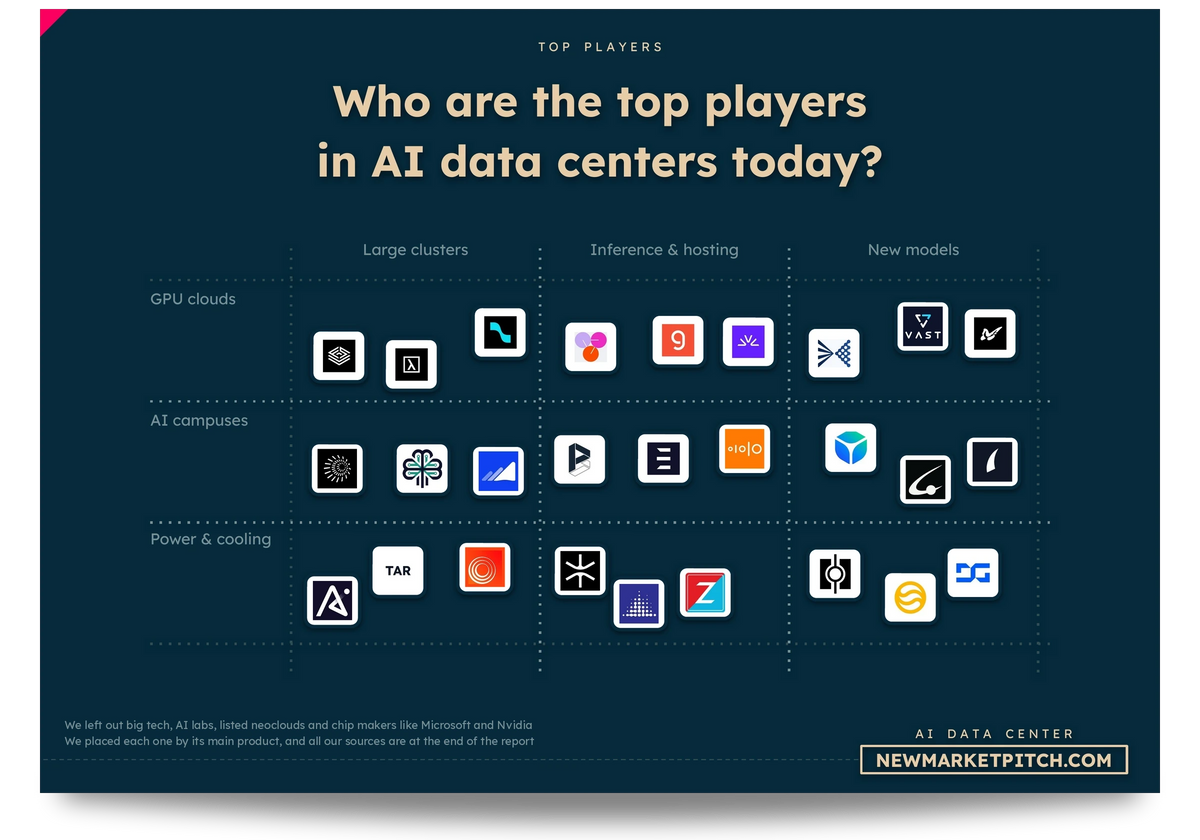
In our research about AI data centers, we turn what is vague and complex into simple, useful visuals. Market maps like this one show you at a glance where every startup stands.
What are AI data center startups actually building?
AI data center startups are building the infrastructure needed to train and run AI models, from electricity and physical data centers to GPU clusters and specialized cloud platforms. The category has grown quickly because AI companies need much more computing capacity, and traditional cloud infrastructure cannot always provide the scale, hardware availability or deployment speed they require.
Some startups focus on building and powering entire data center campuses. Crusoe develops energy-integrated AI infrastructure, Firmus builds energy-efficient AI factories, and Lancium develops power-secured data center campuses. Others concentrate on providing computing capacity through GPU clouds. Lambda, Fluidstack and Together AI are examples, although their services and customer bases differ.
A third group is developing more specialized computing infrastructure. Groq builds inference processors and cloud services, Gimlet Labs focuses on heterogeneous inference, and TensorWave operates an AMD-powered GPU cloud. Companies such as General Compute and Parasail are exploring ways to make AI inference more efficient through alternative hardware and GPU orchestration.
The distinction between these businesses is becoming increasingly important. Investors are financing the entire infrastructure chain, from securing electricity and constructing facilities to operating the computing platforms that AI developers actually use.
Which AI data center startups have raised the most funding?
Crusoe leads our AI data center startup funding ranking with $6.4 billion, followed by Nscale with $3.7 billion and Firmus with $2.8 billion. The top five companies have collectively raised $18.2 billion, approximately 64% of the $28.24 billion raised by the 33 startups.
Capital is heavily concentrated. Crusoe and Nscale alone account for $10.1 billion, while Firmus, Lancium and Fluidstack have raised another $8.1 billion. The five largest companies therefore represent roughly two-thirds of the funding in the ranking.
The next group includes Lambda at $2.4 billion, Groq at $2.1 billion and Together AI at $1.3 billion. Their funding histories show that specialized computing and cloud infrastructure can attract billions in equity without following exactly the same development model as large energy-integrated data center operators.
| Rank | Startup | Total funding |
|---|---|---|
| 1 | Crusoe | $6.4B |
| 2 | Nscale | $3.7B |
| 3 | Firmus | $2.8B |
| 4 | Lancium | $2.7B |
| 5 | Fluidstack | $2.6B |
| 6 | Lambda | $2.4B |
| 7 | Groq | $2.1B |
| 8 | Together AI | $1.3B |
| 9 | Neysa | $650M |
| 10 | TensorWave | $493M |

In our market report about AI data centers, we always try to gather several sources and make estimates that make sense, so you can work with solid numbers.
Why has Crusoe raised $6.4 billion?
Crusoe has raised $6.4 billion because investors are backing its ambition to build an integrated AI infrastructure business spanning energy, data centers and computing services. Its September 2026 Series F alone brought in $3.9 billion, representing approximately 61% of its cumulative funding.
The round was co-led by Atreides Management, Mubadala Capital and Valor Equity Partners, with participation from Founders Fund, GIC, NVIDIA, Qatar Investment Authority and TPG. Crusoe announced the financing at a $30.9 billion post-money valuation, which should be kept separate from the amount actually raised.
The company's strategy is particularly interesting because electricity is becoming a major constraint on AI infrastructure expansion. Crusoe combines energy sourcing and management with the construction of AI factories and its own cloud platform, giving it more control over the infrastructure needed to deliver computing capacity.
In its Series F announcement, Crusoe reported more than $140 billion in total contracted value and over 6 GW of gross contracted capacity, including 1 GW already delivered and operational. Those figures give an indication of the scale of its commercial ambitions, although contracted capacity should not be confused with operating capacity or cumulative equity funding.
Crusoe has become one of the clearest examples of the enormous financing requirements associated with building AI infrastructure at industrial scale.
How much funding has Nscale raised, and who are its biggest investors?
Nscale has raised $3.7 billion across five rounds, making it the second-largest company in our ranking. Its March 2026 Series C brought in $2 billion, representing approximately 54% of its cumulative funding.
Aker ASA and 8090 Industries led the round, with participation from NVIDIA, Dell, Nokia, Jane Street, Citadel, Lenovo and other investors. Nscale announced the financing at a $14.6 billion valuation.
The company is developing an integrated AI infrastructure platform combining GPU computing, networking, data services, orchestration software, data centers and power. Its ambition is to serve businesses and governments that need substantial computing capacity, particularly those looking for greater control over where their AI workloads run.
Nscale's European origins also give it an interesting position in the growing sovereign AI infrastructure market. It is expanding across Europe, North America and Asia, with a strategy that extends beyond providing GPU instances through a conventional cloud platform.
The $2 billion Series C shows how much capital investors are willing to commit to a company attempting to build a global AI infrastructure provider in a relatively short period.

Our document detailing everything you need to know about AI data center gets updated several times a month, so you always get the latest view of where things stand.
Are Firmus and Lancium attracting billions because of the AI power shortage?
Yes. Firmus and Lancium have raised $2.8 billion and $2.7 billion respectively, and both are benefiting from the growing need for data center sites with reliable access to electricity.
Firmus is developing energy-efficient AI factories through its Project Southgate initiative in Australia. Its August 2026 strategic equity investment brought in $2 billion, with Blackstone, Coatue, NVIDIA and Jane Street among the investors. The company is using the capital to accelerate its AI factory expansion across Australia and the wider Asia-Pacific region.
Lancium has a related but different business model. It develops power-secured AI data center campuses, giving large infrastructure operators access to sites designed for substantial electricity consumption. In August 2026, NVIDIA made a strategic investment in Lancium alongside a broader collaboration covering its AI factory development.
Lancium has reported 4 GW of leased capacity and a development pipeline exceeding 15 GW of powered land. Reuters reported that NVIDIA's initial investment was $2 billion, with a possible additional $1 billion subject to conditions.
The two companies illustrate why electricity access has become a major part of the AI infrastructure business. Firmus is building integrated AI factories, while Lancium is concentrating more directly on the powered campuses that make large-scale computing deployments possible.
Why have Fluidstack and Lambda raised more than $2 billion each?
Fluidstack and Lambda have attracted substantial funding because specialized GPU cloud infrastructure has become an important business in its own right. Fluidstack has raised $2.6 billion across nine rounds, while Lambda has raised $2.4 billion across seven.
Fluidstack's September 2026 Series B raised $1.5 billion, approximately 58% of its cumulative funding. Its business focuses on cloud infrastructure for AI laboratories that need large amounts of computing capacity. Its investor group includes Jane Street and Situational Awareness.
Lambda's November 2025 Series E also raised $1.5 billion, accounting for approximately 63% of its total funding. TWG Global and the US Innovative Technology Fund were the principal investors.
Both companies are exposed to the same broad demand for GPU infrastructure, but their approaches differ. Fluidstack has developed its business around serving AI laboratories and large computing deployments, while Lambda offers a specialized GPU cloud platform for AI developers and enterprises.
Their funding histories also show how quickly financing requirements can increase when a company moves from providing smaller GPU clusters to supporting much larger AI infrastructure projects.

In our report covering the AI data center market, we look at what the winners do differently, so you can learn from the best instead of guessing.
Which investors are backing the biggest AI data center startups?
Blackstone, NVIDIA, sovereign wealth funds and specialist infrastructure investors are among the most important names appearing across the largest AI data center financing rounds. The investor mix has become particularly interesting because the sector requires much more capital than a conventional software startup.
Blackstone is involved with Firmus, Lancium and Neysa. Its participation spans Australian AI factories, American data center campuses and Indian enterprise AI infrastructure.
NVIDIA is another recurring investor, appearing among the key backers of Nscale, Firmus, Groq, Together AI, TensorWave, Gimlet Labs and several other companies in the ranking.
Sovereign investors are also involved. Mubadala Capital and Qatar Investment Authority participated in Crusoe's $3.9 billion Series F, while Aramco Ventures led Together AI's $800 million Series C.
Other important investors include Aker ASA and 8090 Industries in Nscale, Atreides Management and Valor Equity Partners in Crusoe, Magnetar Capital and AMD Ventures in TensorWave, and Andreessen Horowitz in Gimlet Labs.
The investor base now includes institutions that understand physical infrastructure, energy markets and large technology deployments. That is a meaningful change in the way AI infrastructure companies are financed.
Why is NVIDIA investing in so many AI data center startups?
NVIDIA is investing across the AI data center ecosystem because its long-term opportunity depends on a large network of companies building and operating infrastructure around its computing technology. Its participation extends from physical data center development to GPU clouds and specialized inference platforms.
Nscale and Firmus are two examples of large infrastructure businesses in which NVIDIA is involved. Lancium is another, with its power-secured campuses providing potential deployment locations for NVIDIA's AI factory technology.
NVIDIA also appears among the key investors in Together AI, TensorWave, Groq, Gimlet Labs and Hydra Host. These companies operate at different levels of the computing stack, from GPU clouds to specialized inference infrastructure.
The strategy gives NVIDIA exposure to several parts of the market. It can support companies that deploy its hardware, help expand the number of infrastructure providers capable of offering AI computing services, and participate in businesses developing new ways to use accelerated computing.
However, an investment does not automatically mean that NVIDIA controls a company or that the company depends exclusively on NVIDIA technology. TensorWave, for example, is specifically developing an AMD-powered AI cloud.

Theory only gets you so far. In our research about AI data centers, we dig up the real signals from the field and show you the ones worth watching.
Is Blackstone becoming one of the biggest investors in AI data centers?
Blackstone is becoming an important investor in AI data center infrastructure, particularly in businesses that require substantial physical assets and long-term development capital. Its participation in Firmus, Lancium and Neysa demonstrates the breadth of its interest.
Firmus is developing AI factories in Australia, while Lancium focuses on power-secured data center campuses in the United States. Neysa is building enterprise AI acceleration infrastructure in India.
Neysa is especially interesting because its February 2026 financing involved up to $600 million in equity from Blackstone-affiliated funds and co-investors, with another $600 million of planned debt financing. The company aims to expand its GPU infrastructure substantially, including a planned deployment of more than 20,000 GPUs.
The equity and debt components must remain separate. Neysa's $650 million cumulative equity funding in our ranking does not include the additional planned debt financing.
Blackstone's involvement reflects a broader shift in AI infrastructure financing. Private equity firms are increasingly willing to fund businesses where electricity, land, construction and long-term computing demand are central to the investment case.
Which AI data center startups are raising money for AI inference?
Several AI data center startups are raising substantial funding specifically for inference infrastructure, as demand for running AI models continues to grow. The companies taking different approaches include Groq, Together AI, Gimlet Labs, PaleBlueDot AI, DeepInfra, General Compute and Parasail.
Groq has raised $2.1 billion through its inference processor and cloud business. Together AI has raised $1.3 billion and combines AI training and inference services within a broader cloud platform.
Gimlet Labs has raised $392 million, including a $300 million Series B in September 2026. It is developing a heterogeneous inference cloud that can distribute workloads across different types of silicon.
PaleBlueDot AI has raised $350 million, with its $200 million Series C in October 2026 providing a substantial part of its funding. Its infrastructure combines dedicated GPU clusters, a GPU marketplace and serverless inference.
DeepInfra has raised $133 million, including a $107 million Series B in May 2026. General Compute has raised $115 million, including a $100 million Series A in October 2026, while Parasail has accumulated $42 million.
The interesting difference is how these businesses approach the same underlying problem. Some focus on specialized processors, others on combining different chips, and others on making GPU infrastructure easier to allocate and operate. Investors are clearly interested in several competing approaches to making inference faster and cheaper.

In our market report about AI data centers, we don't want to repeat what boring consulting reports say. Instead, we show you the real and latest market signals that matter.
Can AMD-powered AI data centers compete with NVIDIA?
AMD-powered AI data centers are attracting substantial investment, although NVIDIA still has a much broader infrastructure ecosystem. TensorWave is the clearest example in our ranking of a startup attempting to build an alternative around AMD hardware.
TensorWave has raised $493 million across three rounds. Its June 2026 Series B brought in $350 million, approximately 3.5 times the $100 million raised in its previous Series A.
Magnetar Capital and AMD Ventures co-led the Series B, with participation from Maverick Silicon and other investors. The financing supports the expansion of TensorWave's AMD-powered AI cloud, including infrastructure built around AMD Instinct accelerators.
There are other approaches to reducing dependence on a single hardware architecture. Gimlet Labs is developing heterogeneous inference infrastructure, while General Compute combines GPUs with purpose-built inference chips.
These businesses are still operating in a market where NVIDIA has a significant advantage in hardware availability, software and developer adoption. However, the amount of capital flowing into TensorWave and other alternative infrastructure models suggests that investors see room for additional computing ecosystems.
What are the largest recent AI data center funding rounds?
Crusoe's $3.9 billion Series F is the largest latest round in our ranking. Nscale, Firmus and Lancium each secured $2 billion in their latest reported financing, while Fluidstack and Lambda each raised $1.5 billion.
The comparison shows how much of the market's capital is being concentrated in a small number of large transactions. Together AI's $800 million Series C and Neysa's $600 million growth equity financing also demonstrate that major rounds are reaching companies with more specialized cloud and regional infrastructure strategies.
| Startup | Latest round | Amount |
|---|---|---|
| Crusoe | Series F | $3.9B |
| Nscale | Series C | $2.0B |
| Firmus | Strategic Equity | $2.0B |
| Lancium | Strategic Equity | $2.0B |
| Fluidstack | Series B | $1.5B |
| Lambda | Series E | $1.5B |
| Groq | Series A | $350M |
| Together AI | Series C | $800M |
| Neysa | Growth Equity | $600M |
| TensorWave | Series B | $350M |

Learning from others' mistakes is the cheapest lesson there is. In our document detailing everything you need to know about AI data center, we look at what broke startups before you, so you don't repeat it.
Are smaller AI data center startups attracting serious investors too?
Yes. Several smaller AI data center startups have secured substantial financing despite operating at a much earlier stage than the largest infrastructure developers.
General Compute raised $100 million in its October 2026 Series A, bringing its cumulative funding to $115 million. Blackbird Ventures and Abstract co-led the financing, with participation from Fuse Venture Partners and other investors.
Cardinal Data Power raised $70 million in its July 2026 Series A, attracting Hood River Capital Management and Empery Digital. The company is developing energy-backed data center campuses.
Parasail has raised $42 million across two rounds, including a $32 million Series A backed by Touring Capital, Kindred Ventures and Samsung NEXT. Nava has accumulated $32 million, including a $22 million Series A backed by Greenoaks Capital, RTP Global and Unicorn India Ventures.
Further down the ranking, Lyceum has raised approximately $12 million in pre-seed financing, while Polarise has raised approximately $4 million in angel funding.
These companies are targeting more specific infrastructure opportunities. Their financing requirements are consequently much smaller than those of Crusoe or Nscale, but the investments show that institutional capital is reaching several layers of the AI infrastructure market.
Which countries have the most heavily funded AI data center startups?
The United States has the broadest group of companies in our ranking, with 20 of the 33 startups headquartered there. The United Kingdom, Australia, India, Finland, France, Germany and Japan also have companies developing AI data center infrastructure.
The American companies are Crusoe, Lancium, Lambda, Groq, Together AI, TensorWave, Panthalassa, Gimlet Labs, PaleBlueDot AI, DeepInfra, RunPod, Hydra Host, General Compute, Lightning AI, Cardinal Data Power, Rune Energy, Bolt Data & Energy, Parasail, GMI Cloud and Colovore.
The United Kingdom has Nscale, Fluidstack, Kao Data and NexGen Cloud. Australia is represented by Firmus, while India has Neysa and Nava.
European companies also include Verda in Finland, Eclairion in France, and Lyceum and Polarise in Germany. Japan has ai& Inc. and HIGHRESO.
The geographical distribution is interesting because AI infrastructure has become a strategic issue for governments and businesses seeking greater control over computing capacity. Europe and Asia-Pacific are developing their own providers, while the United States remains home to the largest concentration of heavily funded companies.

If you build or invest in the AI data center market, you need to know which business models pay off now and which ones are fading. That's why our report covering it has a whole section on it.
Is Europe catching up in AI data center infrastructure?
Europe has several well-funded AI infrastructure startups, although the funding gap with the largest American companies remains substantial.
Nscale has raised $3.7 billion and Fluidstack $2.6 billion, making them the two largest European companies in our ranking. Verda has raised $266 million, Eclairion $167 million, Kao Data $145 million and NexGen Cloud $59 million.
Lyceum has raised approximately $12 million, while Polarise has accumulated approximately $4 million.
The companies are developing different parts of the ecosystem. Nscale combines GPU infrastructure, data centers and cloud services, while Fluidstack focuses on infrastructure for AI laboratories. Kao Data operates high-performance AI data centers, and Verda is developing a full-stack AI cloud.
Eclairion focuses on modular facilities, while Lyceum and Polarise are developing sovereign European GPU cloud infrastructure.
Europe's opportunity is closely tied to demand for regional computing capacity, data sovereignty and infrastructure that can serve local enterprises and governments. Nscale and Fluidstack already have substantial financial backing, but the smaller companies will need to demonstrate that their infrastructure can compete on availability, price and performance.
Is India becoming a major destination for AI data center investment?
India is attracting substantial investment in domestic AI infrastructure, with Neysa and Nava representing two different approaches to the opportunity.
Neysa has raised $650 million, including a $600 million growth equity financing in February 2026. Blackstone, Teachers' Venture Growth and TVS Capital Funds are among its key investors. The company is targeting enterprises and government customers that need AI acceleration infrastructure within India.
Nava has raised $32 million across two rounds, including a $22 million Series A led by Greenoaks Capital, with RTP Global and Unicorn India Ventures participating.
The difference in scale is considerable. Neysa is financing a much larger infrastructure expansion, while Nava is developing an enterprise-focused private AI cloud platform.
India's opportunity comes from the growth of domestic AI demand, the need for local computing infrastructure and the desire of enterprises and governments to have more control over where sensitive AI workloads are processed.

In our research about AI data centers, we like to show you the big picture. We know your time is precious, so we make every page quick to read and packed with as much learning as possible per minute.
Are modular and energy-backed AI data centers attracting more funding?
Modular and energy-backed data centers are attracting investment because companies are looking for ways to bring AI computing capacity online faster and secure the electricity needed to operate it.
Eclairion has raised $167 million through two private equity investments from Tikehau Capital. The French company focuses on modular AI data centers.
Cardinal Data Power has raised $70 million through its first documented equity round, developing energy-backed data center campuses. Rune Energy has raised $53 million and focuses on solar-powered modular data centers.
Firmus also belongs in this broader infrastructure discussion through its energy-efficient AI factory platform. Lancium approaches the problem from the perspective of powered campuses, while Crusoe integrates energy sourcing with its own data center and cloud operations.
These companies are pursuing different technical and commercial models, but all are responding to the same challenge: getting enough suitable infrastructure and electricity in place to support high-density AI computing.
Is electricity becoming a bigger problem than finding GPUs for AI data centers?
Electricity is becoming one of the biggest constraints on AI data center expansion. GPU availability remains important, but even companies with financing and hardware procurement agreements can struggle to bring new computing capacity online if they cannot secure sufficient electricity and grid connections.
The International Energy Agency's updated analysis estimates that data center electricity consumption will rise from 485 TWh in 2025 to approximately 950 TWh in 2030. Electricity consumption from AI-focused data centers is projected to triple over the same period.
The scale of the infrastructure challenge is also visible in grid connection queues. The IEA's 2026 Electricity report identifies more than 2,500 GW of projects, including large electricity consumers such as data centers, waiting in connection queues worldwide.
This helps explain the financing attracted by Crusoe, Firmus and Lancium. Their business models address the power and physical infrastructure requirements of AI computing, giving them exposure to a constraint that could delay projects even when GPU hardware is available.
JLL's 2026 Global Data Center Outlook estimates that approximately 100 GW of additional data center capacity will be added globally between 2026 and 2030, requiring up to $3 trillion in combined real estate and computing infrastructure investment.
The companies that can secure power, sites and construction capacity are in a strong position as AI infrastructure demand keeps growing.

When you build or invest in the AI data center market, you need clarity, not confusion. In our market report about AI data centers, we always try to put numbers on and quantify whatever is usually vague and confusing.
Does raising billions guarantee that an AI data center startup will succeed?
No. Raising billions gives an AI data center startup the resources to build, but the company still has to turn that money into operational infrastructure and paying customers.
The distinction is particularly important in this industry because projects can take years to develop. Electricity connections, construction schedules, cooling systems, GPU procurement and customer commitments all affect whether a planned facility becomes a commercially useful asset.
Crusoe, for example, reported more than 6 GW of gross contracted capacity, but only 1 GW was described as delivered and operational in its Series F announcement. Both figures are important, but they measure very different stages of infrastructure development.
Firmus also has substantial expansion plans supported by its $2 billion strategic equity investment. Its success will depend on delivering AI factories, securing customers and operating them efficiently.
General Compute provides a smaller-scale example. The company raised $100 million in October 2026, but announced that its first major deployments were expected to go live in Q1 2027.
The next test for these companies is execution. Investors will want to see operational capacity, sustained GPU utilization, reliable power and recurring customer demand.
What happened to AI data center startups that were acquired?
Some AI data center startups have already been acquired, and they remain relevant when looking at the history of investment in the sector. Lightning AI and Colovore have both been acquired.
Lightning AI raised $108 million across four rounds, including a $50 million Series C in November 2024. Its key investors included NVIDIA, Cisco Investments and J.P. Morgan.
Colovore raised $8 million through one early venture financing round in July 2013. Its history also shows that specialized infrastructure companies were attracting investment long before the current AI data center expansion.
Both companies remain part of the sector's funding history, even though they are no longer independent startups.

A good product starts with a real problem. In our document detailing everything you need to know about AI data center, we show you the ones customers still live with.
Will AI data center startup funding keep growing?
AI data center startup funding is likely to remain substantial because the amount of computing infrastructure needed over the next few years is enormous. However, investors will increasingly look for proof that companies can actually deliver capacity and make money from it.
JLL estimates that nearly 100 GW of new data center supply could come online between 2026 and 2030. The associated investment requirement could approach $3 trillion when real estate and computing equipment are included.
The International Energy Agency also expects data center electricity consumption to roughly double over the same period. These forecasts help explain why investors are backing companies involved in power infrastructure, AI factories, GPU clouds and inference platforms.
Crusoe, Nscale, Firmus and Lancium are pursuing large infrastructure opportunities. Fluidstack, Lambda and Together AI are expanding specialized cloud capacity, while Groq, Gimlet Labs, TensorWave and General Compute are developing different approaches to AI computing and inference.
The funding environment should remain active, but the companies most likely to attract further investment will be those that can show that their announced infrastructure projects are becoming operational and generating real demand.
Which AI data center startups are worth watching most closely?
Crusoe and Nscale deserve particular attention because of their funding scale and their ambitions to build integrated AI infrastructure platforms. Firmus and Lancium are also important because they are addressing the increasingly difficult problem of securing power and deploying large data center campuses.
Fluidstack and Lambda are major specialized computing providers, while Together AI combines cloud infrastructure with AI training and inference services.
Groq, Gimlet Labs and TensorWave are developing different computing approaches that could become increasingly important as inference demand grows. Neysa is worth following for India's domestic infrastructure expansion, while Verda, Lyceum and NexGen Cloud represent different parts of Europe's developing GPU cloud ecosystem.
Smaller companies such as General Compute, Parasail, Nava, Cardinal Data Power and RunPod also deserve attention because they are targeting more specific opportunities in inference, enterprise cloud and physical infrastructure.
The market is developing across several layers simultaneously. Companies that combine access to electricity, computing hardware and customers with sustained demand for AI services have a particularly strong opportunity to build major infrastructure businesses.
Which AI data center startups have raised the most money overall?
Crusoe has raised the most funding in our ranking, with $6.4 billion, followed by Nscale at $3.7 billion, Firmus at $2.8 billion, Lancium at $2.7 billion and Fluidstack at $2.6 billion. Together, these five companies have attracted $18.2 billion, approximately 64% of the cumulative funding across all 33 startups.
The biggest financing opportunities are concentrated around companies building large-scale infrastructure, especially those capable of securing electricity, developing data center campuses and providing substantial computing capacity.
However, the rest of the ranking shows that investors are also committing significant capital to specialized GPU clouds, inference platforms and alternative computing architectures. Lambda, Groq, Together AI and TensorWave are prominent examples.
The investor base is changing alongside the market. Blackstone, NVIDIA, sovereign wealth funds, infrastructure investors and specialist venture capital firms are all participating in financing AI data center companies.
For now, the strongest funding positions belong to companies that can address the physical and computing requirements of the AI industry at scale. The next stage of competition will depend on how much of that capital can be converted into operational capacity and commercially successful infrastructure.
Our methodology
This ranking covers startups operating in the AI data center market, including energy-integrated facilities, GPU clouds, AI computing platforms and specialized inference infrastructure. We focus on companies whose core business is directly connected to building, powering or operating the infrastructure needed to train and run AI models. Large established technology groups and divisions of larger companies are excluded, while acquired startups remain eligible.
We compare cumulative equity funding raised across each company's financing history. Our totals include equity financing and exclude debt, grants and other non-equity capital. We consider financing rounds, strategic equity investments, investor participation and announced commitments, taking care to distinguish company valuations and planned financing from the actual amounts raised.
We prioritize company and investor announcements, regulatory filings, reputable financial publications and specialist industry reporting. When sources disagree, we favor direct company disclosures, investor announcements and regulatory information over unverified database figures.
Key sources used for this analysis include Crusoe's Series F announcement, Nscale's Series C announcement, Firmus's strategic equity announcement, Lancium's NVIDIA partnership announcement, Fluidstack's financing announcement, Lambda's Series E announcement, and Together AI's Series C announcement.
Additional financing information comes from Blackstone's announcement on Neysa, Simpson Thacher's TensorWave financing announcement, Gimlet Labs' Series B announcement, PaleBlueDot AI's Series C announcement, Verda's financing announcement, DeepInfra's Series B announcement, General Compute's Series A announcement, Empery Digital's SEC filing on Cardinal Data Power and Data Center Dynamics' coverage of Nava's Series A.
For the broader infrastructure outlook, we also use JLL's 2026 Global Data Center Outlook and the International Energy Agency's analysis of energy demand from AI and data centers.
Written by the New Market Pitch teamWe track new markets so founders and investors can move faster. About us