How big is the AI drug discovery market really?
Building a startup or looking for your next investment in AI in drug discovery? Our report gives you the full picture.
Summary
The AI drug discovery market is about $3 billion to $5 billion today, with roughly $4 billion the most defensible single estimate.
The published range is unusually wide for what looks like one market: Grand View Research is at $2.9 billion for 2026, while MarketsandMarkets and Fortune Business Insights are around $5 billion. The gap is mostly a definition problem, not a rounding problem.
A narrow market built around software and platform revenue naturally lands near the low end. Add discovery services, paid collaborations, milestone income and hybrid AI-biotech activity, and the upper end becomes much easier to defend.
Visible company revenue supports a multibillion-dollar category, but it does not neatly add up to the headline TAM. Public leaders generate hundreds of millions, while a large amount of spending remains spread across private companies, data suppliers, research contracts and internal pharma teams.
The biggest source of inflation is partnership accounting. AI discovery deals tracked by DealForma carried $29.7 billion of potential value in 2025, but only about $800 million was paid upfront, so headline deal value is a poor proxy for current market revenue.
The business model is changing too. Schrödinger still looks like a scaled software company, while Insilico and XtalPi increasingly make money from discovery programs, milestones and drug rights rather than pure software licenses.
Big Pharma adoption has moved beyond isolated pilots. Repeated deals, internal model-building, dedicated computing infrastructure and long-running discovery programs at companies such as Lilly, Roche, Genentech and Sanofi point to AI becoming part of the research stack.
That also means the commercial TAM understates AI's real economic footprint inside pharma. Internal salaries, compute, automation, proprietary datasets and model development are economically important, but they should stay outside the core vendor market if we want a clean comparison.
Clinical maturity has improved materially. Rentosertib has reached Phase III after peer-reviewed Phase IIa data, but the category still lacks the stronger proof that would come from approval and repeated clinical success across several AI-originated drugs.
A move toward roughly $15 billion over the next several years is credible only if AI becomes routine discovery infrastructure. The cleanest way to read the market is to keep current commercial revenue, contingent partnership value and the eventual pharmaceutical value of AI-generated drugs as three separate numbers.

Written by the New Market Pitch teamWe track new markets so founders and investors can move faster. About us

In our report covering the AI drug discovery market, we always try to gather several sources and make estimates that make sense, so you can work with solid numbers.
Why does one AI drug discovery estimate say $2.9B and another $5B?
AI drug discovery market estimates disagree so much because researchers are counting different businesses, and the gap is far too large to treat any single TAM figure as precise.
Grand View Research currently puts the global market at $2.9 billion for 2026. MarketsandMarkets says $5.09 billion. Fortune Business Insights lands at $5.0 billion. That gives us a 75% gap between the lowest and highest estimates for what appears to be the same market in the same year.
The definitions explain a lot of it. Some estimates mainly capture AI software, platforms and discovery services. Others stretch further into preclinical work, licensing, optimization and AI-enabled biotechnology companies developing their own drugs.
There is an even cleaner illustration. Fortune Business Insights separately estimates the entire AI-in-pharma-and-biotech market at $8.54 billion in 2026 and says drug discovery and development represents 29.8% of it. That works out to about $2.54 billion, barely half the $5.0 billion figure in its dedicated AI drug discovery report.
So we should already be skeptical of anyone presenting "$5.09 billion" or "$2.9 billion" as if the market were directly measurable to two decimal places. The useful answer has to be a range.
What should actually count as the AI drug discovery market?
The AI drug discovery market should mainly measure money being spent today on AI-enabled discovery work, software and intellectual property, rather than the theoretical future value of every drug that AI helps create.
Software subscriptions clearly belong. So do AI-enabled discovery services, platform-access fees, paid research collaborations, data products and payments earned when a discovery program reaches a contractual milestone.
Drug licensing gets more complicated. If an AI company discovers a molecule and receives a $50 million upfront payment for it, that payment is real commercial activity. A further $2 billion promised only if the molecule survives development, gets approved and reaches sales targets belongs to a different bucket.
The same distinction applies to eventual drug sales. If an AI-designed medicine someday generates $4 billion a year, calling the whole $4 billion "AI drug discovery market revenue" would inflate the technology market beyond recognition. Pharmaceutical manufacturing, clinical development, distribution and commercialization created much of that value.
The cleaner way to read the category is to keep three concepts separate: current AI drug discovery revenue and spending, potential value written into partnership contracts, and the eventual pharmaceutical value of AI-generated pipelines. Mixing those three is the main reason this market can appear to be worth $4 billion, $30 billion or hundreds of billions depending on who is talking.

In our research about AI drug discovery, we don't want to repeat what boring consulting reports say. Instead, we show you the real and latest market signals that matter.
So how big is the AI drug discovery market today?
The best working estimate for the AI drug discovery market today is roughly $3 billion to $5 billion a year, with about $4 billion as the most defensible single number.
We get there by combining the dedicated market estimates with observable company revenue and the size of adjacent discovery markets. Grand View Research gives us the conservative end at $2.9 billion. MarketsandMarkets and Fortune Business Insights both sit around $5 billion.
The $4 billion midpoint also passes a basic sanity check. It is large enough to accommodate hundreds of AI discovery companies, established software businesses, licensing income and work performed inside larger technology suppliers. Yet it remains well below the roughly $21 billion global drug discovery services market, which makes sense because AI still covers only part of the discovery stack.
The range matters more than the decimal point. A narrow software-only definition can fall toward $3 billion. Add AI-enabled research services, discovery collaborations and more hybrid biotech activity and $5 billion becomes easier to defend.
| Market measure | Current estimate | What it actually measures |
|---|---|---|
| Grand View Research, AI drug discovery | $2.9B | AI used in drug optimization, repurposing, preclinical work and related applications |
| MarketsandMarkets, AI drug discovery | $5.09B | Broad AI discovery tools, processes, use cases and services |
| Fortune Business Insights, AI drug discovery | $5.00B | AI software and services used in discovery |
| Fortune, drug-discovery share of broader AI pharma market | ~$2.54B | 29.8% of an $8.54B AI-in-pharma-and-biotech market |
| Grand View Research, U.S. AI drug discovery | $1.38B | U.S. portion alone |
| Fortune, global drug discovery services | $21.11B | Broader outsourced discovery work, with or without AI |
| Fortune, global drug discovery outsourcing | $8.75B | Outsourced discovery services rather than AI specifically |
If you want more recent data on this point, please see our latest AI in drug discovery market report.
Do real AI drug discovery companies actually add up to billions?
Real AI drug discovery companies already generate hundreds of millions of dollars, but the visible leaders still fall well short of the full $3 billion to $5 billion market estimate on their own.
Schrödinger gives us the cleanest benchmark. Its 2025 SEC filing shows $255.9 million of total revenue, including $199.5 million from software and $56.4 million from drug discovery. Recursion generated $74.7 million. Insilico Medicine reported $56.2 million. Absci generated $2.8 million. Relay Therapeutics recorded $15.4 million, while AbCellera generated $75.1 million.
Those six companies alone total about $480 million. XtalPi adds another sizable business: it reported RMB802.6 million of total 2025 revenue, with RMB537.9 million coming from drug discovery solutions.
The freshest numbers show how quickly individual companies can move. Insilico generated $106.3 million in only the first half of 2026, including $103.1 million from drug discovery and pipeline development. Schrödinger generated $117.5 million across the same six months. Recursion, meanwhile, generated only $14.1 million because collaboration revenue depends heavily on when programs hit milestones.
The takeaway is straightforward: the commercial market is real, but public-company revenue alone cannot map it cleanly. Much of the remaining spending sits across private AI biotechs, data providers, software vendors, research contracts and internal pharma teams.
| Company | 2025 revenue | Useful context |
|---|---|---|
| Schrödinger | $255.9M | $199.5M software and $56.4M drug discovery |
| AbCellera | $75.1M | Research fees, licensing, royalties and milestones |
| Recursion | $74.7M | Mostly collaboration-driven revenue |
| Insilico Medicine | $56.2M | Discovery, pipeline licensing and software |
| Relay Therapeutics | $15.4M | License and other revenue |
| Absci | $2.8M | Partner-program revenue |
| XtalPi | RMB802.6M | RMB537.9M came from drug discovery solutions |

In our market report about AI drug discovery, we like to show you the big picture. We know your time is precious, so we make every page quick to read and packed with as much learning as possible per minute.
Why can one AI drug discovery deal be worth more than the whole market?
AI drug discovery deals look enormous because the headline number usually describes years of possible future milestones, while only a small fraction is committed when the agreement is signed.
Nature's Biopharma Dealmakers analysis of DealForma data is the clearest aggregate we found. AI-based target and drug discovery deals reached $29.7 billion of potential value in 2025, up from $11.1 billion a year earlier. Actual upfront payments were close to $800 million.
We calculate that at roughly 2.7 cents paid upfront for every dollar of headline potential value.
Individual deals follow the same pattern. Insilico's current collaboration with Lilly carries a potential value of approximately $2.75 billion, with $115 million upfront. Its agreement with SK Biopharmaceuticals exceeds $2.5 billion in potential value, while upfront and near-term payments are capped at $18 million. The Takeda agreement is worth up to roughly $600 million, with about $60 million in project-initiation fees, near-term payments and milestones.
The older deals show that this structure has been around for years. Sanofi's Exscientia agreement offered $100 million upfront against as much as $5.2 billion of milestones. Recursion received $150 million upfront from Roche and Genentech for a collaboration covering as many as 40 programs, each carrying more than $300 million of potential downstream milestones.
As seen above, headline contract value can therefore be ten, twenty or even one hundred times larger than the cash initially entering the AI discovery company. Those multibillion-dollar agreements are useful evidence of pharma interest, but they make a terrible current-market-size metric.
| AI drug discovery collaboration | Potential value | Upfront / near-term commitment | Initial value vs headline |
|---|---|---|---|
| AI discovery deals tracked by DealForma in 2025 | $29.7B | ~$800M upfront | ~2.7% |
| Recursion + Roche/Genentech | >$12B theoretical across 40 programs | $150M upfront | <1.3% |
| XtalPi + DoveTree | ~$6.0B | $100M upfront and near-term | ~1.7% |
| Sanofi + Exscientia | $5.2B | $100M upfront | ~1.9% |
| Insilico + Lilly | ~$2.75B | $115M upfront | ~4.2% |
| Insilico + SK Biopharmaceuticals | >$2.5B | Up to $18M upfront and near-term | <0.8% |
| Generate:Biomedicines + Novartis | >$1.0B | $65M upfront consideration | <6.5% |
| Insilico + Takeda | ~$600M | ~$60M initiation, near-term and milestones | ~10% |
If you want more recent data on this point, please see our latest AI in drug discovery market report.
Are AI drug discovery companies really selling software anymore?
The center of gravity in AI drug discovery is moving from software licenses toward discovery programs, milestones and ownership of drug assets.
Schrödinger still proves that a conventional software business can work at scale. Its 2025 software revenue reached $199.5 million, nearly four times its drug discovery revenue. Even during the first half of 2026, software products and services generated $68.1 million.
Insilico looks very different. In the first half of 2026, it generated $106.3 million of revenue, but only about $2.7 million came from software solutions. Drug discovery and pipeline development generated $103.1 million. A company known worldwide for its AI software now makes almost all of its money from molecules, collaborations and drug rights.
XtalPi is moving in the same direction. Drug discovery solutions represented about 67% of its 2025 revenue, up sharply as milestone income from major partnerships came through.
This also explains why revenue can swing so violently. Insilico went from $85.8 million in 2024 to $56.2 million in 2025, then generated $106.3 million in the first six months of 2026. Recursion generated $74.7 million in 2025 but only $14.1 million during the first half of 2026. These businesses can make more money when one molecule or research program crosses a contractual line, even if underlying platform usage has changed much less.
So we should stop thinking of the category as biotech-flavored SaaS. The more successful AI discovery companies increasingly look like hybrids: part software company, part research organization and part biotech owner.

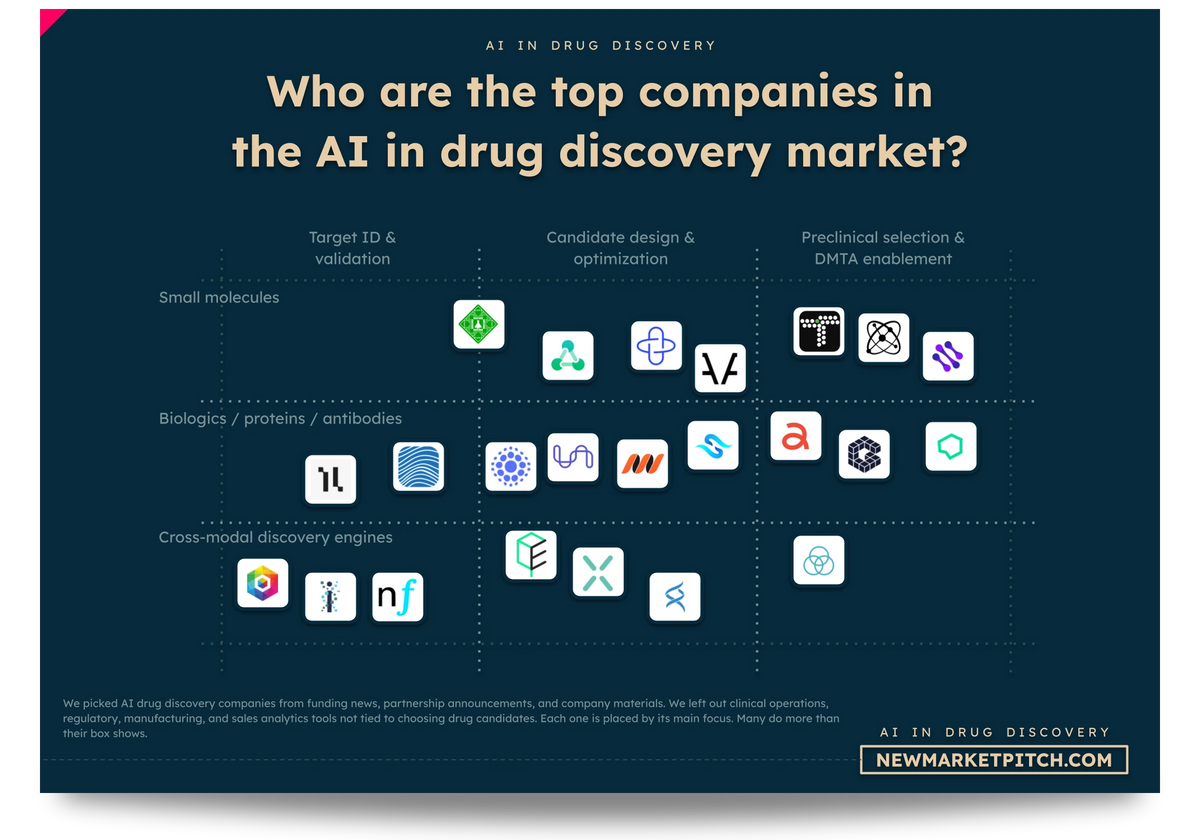
In our document detailing everything you need to know about AI drug discovery, we turn what is vague and complex into simple, useful visuals. Market maps like this one show you at a glance where every startup stands.
Is Big Pharma really using AI drug discovery at scale now?
Big Pharma is already using AI drug discovery at meaningful scale, and the strongest evidence comes from repeated transactions and internal infrastructure rather than isolated pilot projects.
DealForma counted 120 AI-based target and drug discovery deals during 2025 through its research cut-off. Those represented 23% of the 513 such deals it had recorded since 2017. Put differently, almost one quarter of eight years of tracked deal activity happened in less than a single year.
The buyers are hardly fringe players. Lilly has agreements spanning Insilico and other AI discovery companies. Roche and Genentech have a long-running collaboration with Recursion. Sanofi has worked with Exscientia. Novartis has partnered with Isomorphic Labs and Generate:Biomedicines. Takeda recently signed a roughly $600 million potential collaboration with Insilico.
The Recursion relationship shows that these partnerships can also progress beyond signing ceremonies. Genentech recently moved the first neuroscience target from its Recursion collaboration into a joint early-discovery program. Recursion says it has now received $216 million in upfront and milestone payments from that partnership.
Internal investment is getting harder to ignore too. Lilly has launched TuneLab using models trained on more than 500,000 preclinical datapoints gathered over more than 20 years. Lilly estimates that the data behind the first release represents more than $1 billion of historical research investment. Lilly and NVIDIA are separately committing up to $1 billion over five years to an AI co-innovation lab focused on drug discovery.
AI discovery inside large pharma has moved well beyond "testing the technology." The harder question now is how much value these systems will create.
If you want more recent data on this point, please see our latest AI in drug discovery market report.
How much AI drug discovery spending is hidden inside pharma companies?
A substantial part of the AI drug discovery economy never appears in the revenue of an AI startup because pharmaceutical companies increasingly build and operate the technology themselves.
Lilly is the clearest example. TuneLab exposes selected models externally, but those models came from decades of internal experiments and hundreds of thousands of preclinical datapoints. The company is also building dedicated AI computing infrastructure and a joint research lab with NVIDIA.
Sanofi describes a similar internal shift. Its AI-powered target discovery engines produced seven novel drug targets in one year. Its teams use generative models for molecular design, large language models for mRNA work and internal AI systems across clinical development.
Those activities create salaries, compute spending, laboratory automation costs, datasets and model-development expenses. None necessarily become "AI drug discovery vendor revenue."
A $3 billion to $5 billion commercial market therefore understates the total amount of drug discovery work currently touched by AI.
We would still leave that internal spending outside the core TAM. Otherwise the market becomes impossible to compare with normal software, services or biotech categories. But it explains why AI can feel much bigger inside pharma than the vendor revenue numbers suggest.

Our report covering the AI drug discovery market gets updated several times a month, so you always get the latest view of where things stand.
Is AI drug discovery already big compared with normal drug discovery?
AI drug discovery is already a serious commercial category, but it remains a minority of the broader drug discovery economy.
The global drug discovery services market is currently estimated at roughly $21 billion annually. Against that benchmark, a $3 billion to $5 billion AI market is equivalent to roughly 14% to 24%.
That is already substantial. Five years ago, AI was still regularly treated as an experimental layer on top of traditional discovery. These days, a meaningful part of outsourced discovery spending either uses AI directly or competes with companies built around computational discovery.
The wider pharmaceutical R&D denominator is much bigger again. AI discovery still represents only a small slice of everything required to bring medicines to market: target biology, medicinal chemistry, toxicology, animal work, clinical trials, regulatory work, manufacturing and commercialization all absorb enormous budgets.
Deloitte's latest analysis of the 20 largest biopharma companies puts the average cost of developing a drug at $2.67 billion in 2025. That figure includes the cost of failures and later-stage work, so it should never be compared dollar-for-dollar with an early-discovery software market. It does show why even a dramatic improvement in discovery efficiency could create far more economic value than the AI vendors capture directly.
AI drug discovery is already big enough to matter commercially, while still leaving plenty of room for more discovery budget to move toward AI-native tools and partners.
Has AI drug discovery actually produced clinical proof yet?
AI drug discovery has now reached genuine late-stage clinical development, but the industry is still waiting for the stronger proof that comes from regulatory approval and repeated success across several drugs.
Rentosertib is currently the most important example. Insilico Medicine used generative AI in both target identification and molecule design for the drug, which is being developed for idiopathic pulmonary fibrosis.
The peer-reviewed Phase IIa study in Nature Medicine randomized 71 patients. At the highest dose, mean forced vital capacity increased by 98.4 mL after 12 weeks, compared with a 20.3 mL decline in the placebo group. The trial's primary endpoint was safety, and the efficacy analysis came from a small study with short follow-up, so those lung-function results remain early evidence rather than definitive proof.
The program has moved much further since then. Rentosertib is now in Phase III, and the first patient has been dosed. The study is designed to enroll around 320 participants across 47 centers in China and follow treatment for 52 weeks.
AI drug discovery now has a program in the stage where an experimental medicine can potentially generate registrational evidence.
Approval would raise the bar again. One successful molecule would still leave plenty of uncertainty about whether AI systematically improves clinical success rates across diseases, targets and modalities. For now, however, the claim that AI drug discovery produces only attractive preclinical demos is outdated.
If you want more recent data on this point, please see our latest AI in drug discovery market report.

In our research about AI drug discovery, you will always find fresh funding data, taken straight from our own verified funding database.
Can the AI drug discovery market really reach $15B?
A $15 billion AI drug discovery market is realistic within the next several years, but getting there requires AI to become routine discovery infrastructure rather than a specialist tool used on selected programs.
Current forecasts land remarkably close to that order of magnitude even though their starting numbers differ. Grand View Research expects $13.8 billion by 2033. MarketsandMarkets is much more aggressive, forecasting $17.56 billion by 2031. Fortune Business Insights reaches $12.56 billion by 2034.
We would avoid pretending those endpoints are precise. The underlying growth case is stronger than the exact forecast.
Commercial evidence is moving quickly. Insilico alone says its announced 2026 transactions have reached about $7.3 billion of potential contract value, while first-half revenue jumped to $106.3 million. Schrödinger's trailing four-quarter annual contract value reached $208 million. Big Pharma is building its own AI infrastructure, and a generative-AI-discovered drug has now reached Phase III.
Capital is also available for companies trying to build this at enormous scale. Isomorphic Labs recently raised $2.1 billion in a Series B round specifically to expand its AI drug design engine and advance its pipeline.
The constraint is clinical reality. Better models can improve target selection, molecule design and experimental efficiency, but biology will continue killing plenty of promising drugs. A $15 billion market therefore requires pharma companies to keep seeing enough real productivity gains to move more discovery budgets toward AI platforms and AI-native partners.
We think the low tens of billions is a credible destination. Forecasts pushing far beyond that need a much broader definition that starts absorbing later-stage drug development and pharmaceutical value.
So how big is the AI drug discovery market really?
The AI drug discovery market is really about $3 billion to $5 billion today, and roughly $4 billion is the number we would use when a single estimate is required.
That answer is smaller than the industry's biggest headlines because a $5 billion partnership does not mean $5 billion changed hands. Across AI discovery deals tracked by DealForma in 2025, almost $30 billion of potential contract value produced less than $1 billion of upfront payments.
At the same time, $4 billion probably understates how deeply AI already affects pharmaceutical research. Lilly, Sanofi and other large drugmakers are building their own models, datasets, compute and automated discovery systems, and that internal activity barely appears in external market revenue.
The category is also changing shape. The companies creating the most economic value increasingly earn money through molecules, milestones and drug rights alongside software. Insilico's latest results make that especially clear: $103.1 million of its $106.3 million first-half revenue came from drug discovery and pipeline development rather than software.
Clinical progress now strengthens the growth case as well. Rentosertib has reached Phase III, moving AI drug discovery from mostly preclinical promise into late-stage testing.
So we would describe the market as a roughly $4 billion commercial industry today, a tens-of-billions partnership economy when contingent milestones are included, and a potentially much larger pharmaceutical value pool if AI-generated drugs eventually succeed at scale.
Those three numbers measure different things. Keeping them separate is the simplest way to see how large AI drug discovery really is.
If you want more recent data on this point, please see our latest AI in drug discovery market report.
Our methodology
This analysis estimates how big the AI drug discovery market really is by separating current commercial revenue from partnership headline value and the eventual pharmaceutical value of drugs that AI helps create. The research was updated through September 2026 and focuses on evidence that can be tied to observable spending, reported revenue, contracts, internal pharmaceutical investment and clinical progress.
We compared the main published market estimates rather than treating any one of them as the answer. Grand View Research, MarketsandMarkets and Fortune Business Insights were used to establish the current published range and show how different market definitions can produce estimates from roughly $2.9 billion to $5.09 billion for 2026.
Top-down estimates were checked against bottom-up company evidence. We used reported financials and regulatory filings for companies including Schrödinger, Recursion, Absci, XtalPi and Insilico Medicine to test whether the scale of observable revenue is consistent with a multibillion-dollar market.
Partnership economics were treated separately from market revenue. We compared headline potential value with upfront and near-term payments, using DealForma data reported by Nature Biopharma Dealmakers and primary collaboration disclosures from Recursion and Insilico. Contingent milestones were not counted as if they were cash already paid.
Pharmaceutical adoption was checked through repeated transactions and internal infrastructure rather than one-off pilot announcements. Lilly's TuneLab and its AI co-innovation lab with NVIDIA, Sanofi's internal AI discovery systems, and the progression of the Recursion-Genentech collaboration were used as evidence that AI is becoming part of the discovery stack inside large drugmakers.
Clinical maturity was assessed using peer-reviewed human data and later-stage trial progression. Rentosertib's Phase IIa results in Nature Medicine and its move into Phase III were treated as stronger evidence than preclinical announcements, while still keeping regulatory approval and repeated clinical success as a higher bar that has not yet been cleared.
Key sources used for this analysis include: Grand View Research on the AI drug discovery market, MarketsandMarkets on AI in drug discovery, Fortune Business Insights on AI in drug discovery, Schrödinger's 2025 SEC filing, Recursion's 2025 SEC filing, XtalPi's 2025 HKEX results, Insilico Medicine's 2025 HKEX results, Nature Biopharma Dealmakers on 2025 AI discovery deal activity, Lilly on TuneLab, Lilly on its NVIDIA AI co-innovation lab, Sanofi on its internal AI infrastructure, Nature Medicine on the rentosertib Phase IIa study, and Insilico Medicine on the Phase III rentosertib study.
Where estimates disagreed, we looked for convergence across market definitions, observable company revenue, deal cash flows, adoption evidence, adjacent-market benchmarks and clinical progress. The final $3 billion to $5 billion range is therefore a working estimate, not a claim that this market can be measured precisely to the decimal point.

In our market report about AI drug discovery, we look at what the winners do differently, so you can learn from the best instead of guessing.
Written by the New Market Pitch teamWe track new markets so founders and investors can move faster. About us