Which top AI materials discovery startups show results?
Whether you're building or investing in the AI materials discovery market, our report covers everything you need to know: the players, the money, and what's coming next.
Summary
Citrine Informatics, Lila Sciences, Materials Nexus and Orbital Industries are among the top AI materials discovery startups showing measurable results, although Citrine currently has the strongest public evidence of practical industrial value.
The dividing line in AI materials discovery is increasingly clear: generating promising chemical structures is relatively easy to demonstrate, but synthesizing those materials, measuring their properties and proving their usefulness in industrial applications remains considerably harder.
Citrine stands out because its customers are already using AI recommendations to improve real chemical formulations. Specialty-chemicals manufacturer Stepan reported five technical wins through its broader Citrine program, offering stronger evidence of industrial usefulness than computational discovery claims alone.
Lila Sciences has demonstrated a different kind of progress. Its AI-directed laboratory screened 2,942 physical catalyst samples, identified six promising palladium-based material families and reported screening 17 times faster than a conventional laboratory workflow. The leading candidate survived more than 1,000 hours of acidic testing, although commercial electrolyzer performance remains unproven.
Materials Nexus offers one of the clearest examples of AI helping discover an entirely new material. Its rare-earth-free MagNex magnet was synthesized and tested, while subsequent work through Project DREAM demonstrated repeated cycles of prediction, manufacturing and physical validation. Industrial qualification is still the missing step.
Orbital Industries is moving from computational materials discovery into physical products and commercial relationships. Its PFAS-free cooling technology targets data center infrastructure, while BASF's agreement to license CurieOS for automotive catalyst research demonstrates external industrial interest. Neither development yet establishes widespread deployment of its newly developed materials.
Kebotix shows that AI can produce value without discovering a revolutionary material. An industrial collaboration reported testing-time reductions of up to 50%, while a separate lubricant project narrowed approximately 2,300 candidate molecules to 10 leads, six of which were experimentally tested and four met the customer's target property profile.
Battery-materials research is progressing, but its commercial evidence remains weaker. Aionics has relevant scientific work on electrolytes and other battery chemistries, while the publicly documented achievements of Periodic Labs and CuspAI still lean more toward research capabilities than independently established industrial outcomes.
The spectacular speed claims need careful interpretation. A 17-fold increase in catalyst screening or a 200-fold acceleration in one discovery phase does not mean the entire process of developing, qualifying and manufacturing a new material becomes equally fast. Reliability testing, production economics and customer qualification still take time.
The strongest near-term business opportunities appear to be in improving existing chemical formulations and specialized industrial materials, where companies can work within established manufacturing processes. Novel magnets, hydrogen catalysts and battery components may ultimately produce larger breakthroughs, but they face longer paths to adoption. For now, Citrine leads on documented customer usefulness, Lila on recent AI-directed laboratory experimentation, and Materials Nexus on repeated physical discovery of new magnetic materials.

Written by the New Market Pitch teamWe track new markets so founders and investors can move faster. About us
Why is AI materials discovery suddenly getting so much attention?
AI materials discovery is finally producing measurable laboratory results, and startups are beginning to show how those discoveries could improve real industrial products.
Google DeepMind helped accelerate interest in the field when its GNoME project reported 2.2 million predicted crystal structures in November 2023, including 380,000 candidates predicted to be stable. Microsoft followed with MatterGen, a generative AI model whose experimental validation was published in Nature in 2025.
Since then, the focus has shifted toward companies that can make and test the materials their models suggest. Lila Sciences announced $350 million in Series A funding in October 2025, bringing its disclosed funding to $550 million. Orbital Industries raised another $50 million in May 2026 to develop AI-designed cooling hardware and industrial materials.
The scientific progress is substantial, but these companies are pursuing quite different businesses. Some sell software that helps manufacturers improve existing formulations. Others build autonomous laboratories or try to discover completely new materials.
That difference explains why a startup with thousands of successful experiments may be less commercially established than one helping a chemical manufacturer improve a product already on the market.
What counts as a real result in AI materials discovery?
An AI materials discovery result becomes convincing when researchers physically make a material, measure its properties and show that it solves a useful problem.
Computational predictions are a starting point. A model may identify a theoretically stable crystal, but that doesn't guarantee researchers can synthesize it, manufacture it cheaply or use it in a commercial product.
Microsoft's MatterGen provides a good example of the distinction. Researchers used the model to design TaCr2O6 with a target bulk modulus of 200 gigapascals. They then synthesized it and measured approximately 169 gigapascals. The experiment confirmed that AI could produce a physically realizable material reasonably close to the requested property.
Materials Nexus took another step by synthesizing MagNex, a rare-earth-free permanent magnet, with researchers at the University of Sheffield and the Henry Royce Institute. The material was made and tested, although its performance still needs to be established for specific industrial applications.
Citrine Informatics offers a different kind of proof. Its software helps chemical manufacturers create formulations that meet actual customer requirements. Stepan, for example, developed liquid dishwashing formulations using Citrine's recommendations and achieved five technical wins across its broader program.
For our comparison, we give the most weight to measured material properties, independently supported experiments, repeated customer applications and products moving toward commercial use.

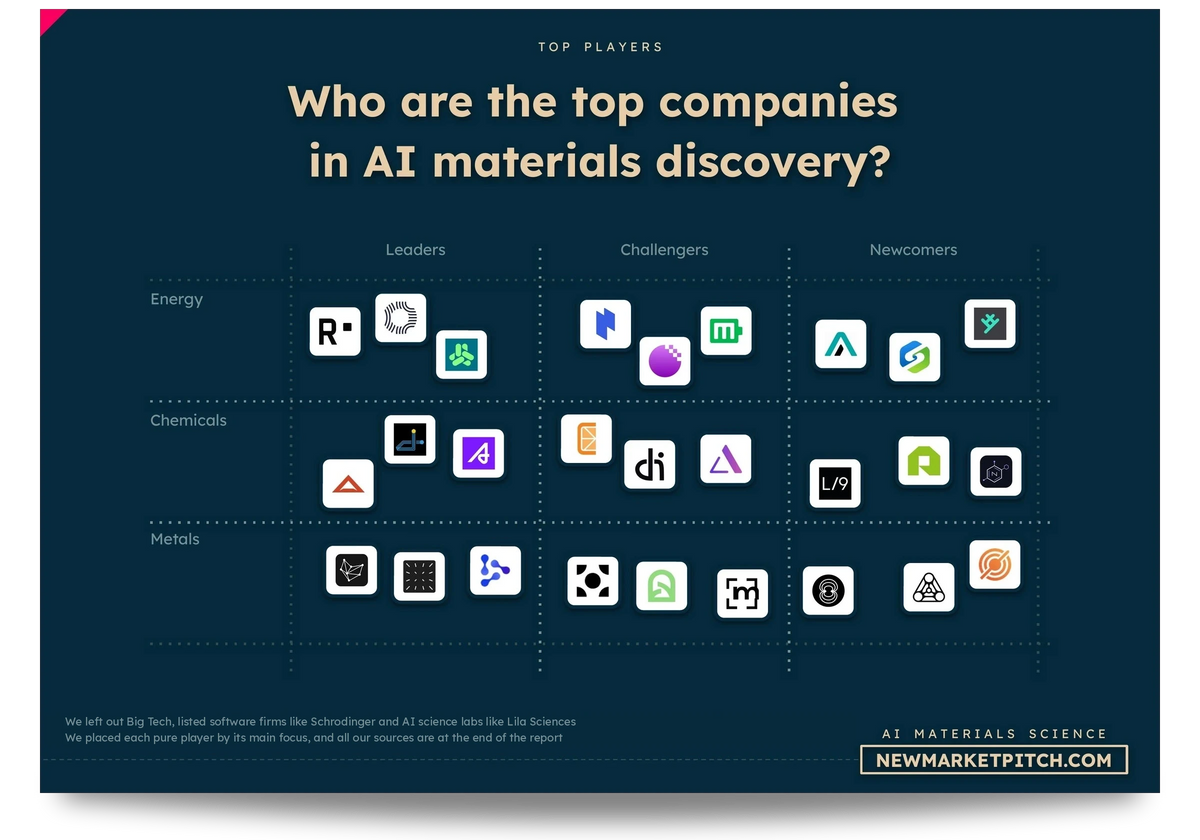
In our report covering the AI materials discovery market, we turn what is vague and complex into simple, useful visuals. Market maps like this one show you at a glance where every startup stands.
Which AI materials discovery startups have the best results today?
Citrine Informatics, Lila Sciences, Materials Nexus and Orbital Industries currently have some of the most convincing public evidence of useful AI materials discovery. They lead in different areas, which makes a single overall ranking misleading.
Citrine has documented practical improvements across chemical formulations and industrial materials. Lila has published unusually detailed results from thousands of physical experiments. Materials Nexus has created a new rare-earth-free magnet, while Orbital is connecting AI-developed materials with cooling hardware and industrial customers.
Kebotix also deserves attention for reducing experimental workloads through industrial collaborations. Aionics has published relevant battery-materials research, while CuspAI and Periodic Labs remain promising but have less publicly documented evidence of commercially useful material discoveries.
The gap between these companies becomes much clearer when we compare what they have actually demonstrated.
| Startup | Strongest documented result | Evidence level |
|---|---|---|
| Citrine Informatics | Customer formulations and multiple technical wins | Industrial use |
| Lila Sciences | 2,942 synthesized and screened catalysts | Physical laboratory validation |
| Materials Nexus | Synthesized rare-earth-free MagNex magnet | Physical synthesis |
| Orbital Industries | PFAS-free cooling fluid and BASF platform agreement | Product development and commercial engagement |
| Kebotix | Up to 50% shorter testing protocols in a customer project | Industrial proof of concept |
| Aionics | AI-guided battery chemistry research | Scientific validation |
| Periodic Labs | Scientific AI models integrated with laboratory operations | Research infrastructure |
| CuspAI | Computational discovery focused on new materials, including sorbents | Early research |
If you want more recent data on this point, please see our latest AI materials discovery market report.
Is Citrine Informatics the most commercially proven AI materials startup?
Citrine Informatics has one of the strongest records of AI materials discovery producing useful results for industrial customers, especially in chemical formulations.
The company has documented applications involving polymers, coatings, glass, semiconductors and specialty chemicals. These projects share a practical objective: helping manufacturers find better materials without testing every possible formulation.
One particularly revealing example comes from specialty-chemicals manufacturer Stepan. A customer wanted a liquid dishwashing formulation that maintained cleaning performance while reducing cost. Using Citrine's platform, Stepan developed predictive models and tested AI-recommended ingredient combinations.
After three experimental rounds, the team had surpassed its technical performance targets. Stepan provided its customer with two formulations, including one meeting the cost target and another meeting all performance requirements. A senior formulator with 30 years of experience said the AI had suggested combinations they would not ordinarily have tried.
Stepan subsequently reported five technical wins through its broader Citrine program and began applying similar models to crop protection and spray foam formulations.
Citrine has also published work involving semiconductor photolithography formulations, safer plastics and nuclear waste materials. The variety is important because it shows the platform can be applied beyond one narrow chemistry problem.
The evidence is mostly drawn from company and customer case studies, and Citrine does not disclose enough financial information to calculate how much revenue these improvements generate. Still, when we look at documented customer outcomes rather than scientific promises, Citrine belongs at the front of the field.

Our research about AI for materials discovery gets updated several times a month, so you always get the latest view of where things stand.
Has Lila Sciences actually discovered better materials with AI?
Lila Sciences has produced one of the strongest recent examples of AI-guided materials discovery, screening 2,942 physical catalyst samples and finding six promising material families for green hydrogen production.
In September 2026, the company published details of an AI-directed laboratory program focused on the oxygen evolution reaction, a difficult stage of splitting water into hydrogen and oxygen.
Its system screened oxide catalysts across 53 chemical systems and 26 elements. The experiments identified six palladium-based material families combining promising activity and stability, including a leading candidate tested for more than 1,000 hours in acidic conditions.
Palladium was an interesting discovery because researchers had generally regarded it as a poor candidate for this particular reaction. Lila's system found that adding small amounts of other elements could change its behavior considerably.
The speed of the experiments was also striking. According to the company's technical account, its workflow screened approximately 240 samples weekly and was 17 times faster than the conventional laboratory process used for comparison.
Lila's account describes two important research campaigns. The first took four months while the infrastructure was being developed; the second took four weeks. Although these campaigns were not identical, the improvement shows how an AI-directed laboratory can become more productive as its models and experimental processes mature. The workflow still used people to transfer some samples between machines, so it wasn't completely autonomous.
The results are supported by extensive physical testing, although the research was presented through a preprint and company materials rather than a completed commercial product validation.
Lila has demonstrated that AI can direct a large experimental program and uncover promising chemistry that researchers might otherwise overlook. Whether its catalysts outperform established alternatives inside commercial electrolyzers remains an open question.
If you want more recent data on this point, please see our latest AI materials discovery market report.
Is Materials Nexus's rare-earth-free magnet a real breakthrough?
Materials Nexus has genuinely synthesized a new rare-earth-free magnet using AI-guided discovery, and subsequent research has strengthened the case that its approach can accelerate materials development.
The company announced MagNex in June 2024 after working with the University of Sheffield and the Henry Royce Institute. The partners used AI to identify candidate compositions, then manufactured and tested the material.
Materials Nexus initially described the discovery process as 200 times faster than conventional approaches. That figure concerns the discovery phase and should not be treated as a measure of manufacturing productivity.
A more recent development provides stronger evidence of repeatability. Through Project DREAM, supported by Innovate UK, Materials Nexus and the Sheffield researchers continued developing rare-earth-free magnetic materials.
According to the University of Sheffield's project account, the collaboration produced new candidate alloy shortlists every three months. Researchers synthesized the suggested compositions, measured their magnetic properties and fed the results back into the models.
The partners also manufactured a small demonstration sample of a leading candidate using additive manufacturing. The project showed a potential route to reducing materials development timelines from roughly five years to one year.
That is more convincing than a single successful experiment. The company has now demonstrated repeated prediction, synthesis, measurement and refinement, including early manufacturing tests.
However, high-performance magnets used in electric vehicles must satisfy demanding requirements involving magnetic strength, temperature resistance, durability and cost. Public evidence still does not establish that MagNex can replace today's leading rare-earth magnets at industrial scale.
Materials Nexus is therefore among the strongest startups for genuine new-material discovery. Commercial qualification is the next hurdle.

In our market report about AI for materials discovery, we look at what the winners do differently, so you can learn from the best instead of guessing.
Is Orbital Industries already selling products built with AI materials discovery?
Orbital Industries is moving AI materials discovery toward industrial products, although the available evidence does not yet establish widespread commercial deployment of its new materials.
In May 2026, the company announced a $50 million Series B to develop its AI platform and data center hardware business. Its initial products include a non-toxic, PFAS-free dielectric cooling fluid designed for increasingly powerful computing equipment.
The commercial opportunity is clear. AI data centers are using hardware that produces enormous amounts of heat, and cooling technologies must improve as power density rises.
Orbital has also worked with AWS on data center-related engineering and development challenges, giving it exposure to the operational requirements of major infrastructure customers.
Another important development came in August 2026, when BASF Environmental Catalyst and Metal Solutions agreed to license Orbital's CurieOS platform for automotive emissions catalyst research.
The BASF agreement adds a second industrial application beyond data center cooling. It also provides a concrete example of an established manufacturer choosing Orbital's discovery technology.
What remains less clear is how many cooling systems currently use Orbital's developed fluid, how much customers are paying and whether its materials produce independently verified cost or efficiency improvements at scale.
Orbital has moved further toward industrial product commercialization than many purely computational discovery startups. Its next challenge is demonstrating that those products can compete economically in large installations.
If you want more recent data on this point, please see our latest AI materials discovery market report.
Has Kebotix proved that AI can cut materials research costs?
Kebotix has demonstrated that AI-assisted experimentation can reduce materials research workloads, with some of its strongest evidence coming from real industrial partnerships.
A particularly useful example involves Japanese manufacturer Valqua. According to a 2022 MIT Startup Exchange report, the company entered a three-year agreement with Kebotix following a six-month proof of concept.
The project reported reductions of up to 50% in the time required for certain testing protocols.
Kebotix has also worked with chemical manufacturer Koura on AI-assisted materials research. A separate lubricant-discovery case study provides a more detailed picture of what its screening technology can achieve.
In that project, Kebotix evaluated approximately 2,300 potential lubricant molecules using models trained and validated with experimental data. The screening narrowed the library to 10 lead candidates. Six were subsequently synthesized and tested, and four met the customer's desired property profile.
That's a reduction of more than 99% in the number of candidates carried forward for detailed consideration, although it shouldn't be confused with a 99% reduction in overall research costs. Kebotix also reported that its approach achieved a ninefold improvement in the success rate over the traditional method used for comparison.
These projects illustrate why industrial research teams can benefit from AI even without discovering an entirely new class of materials. Reducing unnecessary experiments can save laboratory time and help researchers reach useful candidates sooner.
There is one limitation to Kebotix's position: many of its most detailed public case studies date back several years. They provide credible technical evidence, but less visibility into its current commercial growth than we would ideally want.

In our document detailing everything you need to know about AI materials discovery, you will always find fresh funding data, taken straight from our own verified funding database.
Are AI startups actually discovering better battery materials?
AI battery-materials startups are generating useful scientific results, but we still have limited public evidence that their discoveries have produced better commercially deployed batteries.
Aionics is one of the companies worth watching. Its research covers machine-learning-assisted electrolyte discovery, solid-ion conductors and candidate cathode materials.
The company's publications describe computational screening and experimental validation methods designed to identify promising battery chemistries more efficiently.
But a material that performs well in laboratory measurements can still fail when integrated into a complete battery cell. Solid electrolytes, for example, must combine high ionic conductivity with chemical stability, suitable electrode interfaces, affordable processing and reliable operation through repeated charging cycles.
Academic groups and major technology companies have also made substantial progress here. Microsoft's collaboration with Pacific Northwest National Laboratory used AI and high-performance computing to identify promising battery-related materials, followed by experimental synthesis.
The difficulty is that a successful discovery campaign rarely tells us whether a manufacturer can produce batteries with lower cost, longer life or higher energy density at scale.
Aionics has credible research evidence, but the publicly available results are insufficient to call it the commercial leader in AI-discovered battery materials.
Are Periodic Labs and CuspAI already showing real results?
Periodic Labs and CuspAI are building serious AI materials discovery capabilities, but neither currently has the same publicly documented industrial results as Citrine Informatics or the physical synthesis evidence of Materials Nexus.
Periodic Labs launched publicly in September 2025 with a focus on combining AI models and autonomous laboratories.
In September 2026, it introduced Periodic Neon, a trillion-parameter scientific AI model used in its laboratory operations. The company has also described work applying AI to X-ray diffraction analysis, a technique researchers use to identify material structures.
These developments are relevant because interpreting experimental data is an essential part of materials research. Faster and more accurate analysis could help autonomous laboratories decide which experiment to run next.
Still, Periodic has not publicly demonstrated a similarly extensive collection of independently validated new materials or customer improvements.
CuspAI is pursuing computational materials discovery, including applications in carbon capture. Its approach is closely related to a broader research effort involving large databases of material structures and their predicted properties.
Meta's Open DAC 2025 dataset, for example, contains nearly 70 million density-functional-theory calculations covering approximately 15,000 metal-organic frameworks. This kind of data helps researchers predict which materials could capture specific gases.
Those computational advances are impressive, although we cannot treat them as discoveries commercialized by CuspAI.
Both startups have substantial technical ambition. The harder test will be showing that their systems repeatedly produce experimentally validated materials with clear advantages over existing alternatives.

Learning from others' mistakes is the cheapest lesson there is. In our report covering the AI materials discovery market, we look at what broke startups before you, so you don't repeat it.
Can AI materials startups compete with Google and Microsoft?
AI materials discovery startups can compete with Google and Microsoft by becoming better at solving specific industrial problems, even if the technology giants continue producing more powerful general-purpose models.
Google DeepMind's GNoME and Microsoft's MatterGen have already demonstrated that major AI research organizations can generate enormous numbers of candidate structures and design materials for targeted properties.
Competing solely on computational predictions therefore looks increasingly difficult for smaller companies.
Industrial work offers a different opportunity. Citrine can incorporate proprietary customer formulation data, manufacturing constraints and previous experiments. Lila is generating large amounts of physical data through AI-directed laboratories. Orbital can test candidate materials against the actual cooling requirements of data center hardware.
Those datasets can become particularly valuable when they are difficult for competitors to reproduce.
A general-purpose AI model may predict which chemical composition is promising. A manufacturer still needs to know whether that composition can be produced with available equipment, whether its raw materials are affordable and how its properties change during manufacturing.
Google and Microsoft may eventually address more of those challenges themselves, or work directly with major manufacturers.
For now, specialized startups have a credible opportunity to build businesses around the experimental and industrial work that connects predictions to useful products. Owning the laboratory workflow or the customer relationship may prove more defensible than owning the model alone.
If you want more recent data on this point, please see our latest AI materials discovery market report.
Do AI materials startups really make research 10 or 100 times faster?
AI materials discovery can make particular research tasks dramatically faster, but claims of 10-fold or 100-fold acceleration need to be read carefully because companies often measure very different things.
Lila Sciences reported a 17-fold improvement in catalyst screening speed relative to a conventional laboratory workflow. Kebotix documented testing-time reductions of up to 50% in its Valqua project. Materials Nexus reported a 200-fold acceleration in discovering MagNex and subsequently demonstrated repeated three-month research cycles in Project DREAM.
The comparisons are impressive, although none measures the entire process from identifying a candidate to selling a manufactured product.
We can see the distinction clearly in the leading examples. Lila's experiments identified promising catalysts quickly, but commercial electrolyzer testing remains necessary. Materials Nexus synthesized new magnets and tested their properties, while manufacturing scale-up is still being developed. Citrine has helped customers reach useful formulations within existing production processes, which may shorten the route to commercial use.
Research speed also depends on the type of material. Screening formulations using established laboratory tests is different from developing a new battery chemistry that needs years of durability evidence.
AI can dramatically reduce the time spent searching and experimenting. We still lack convincing evidence that these improvements translate into equivalent reductions in complete industrial development timelines.

Your time is limited. In our research about AI for materials discovery, we put numbers on each part of the market, so you can see where it makes sense to focus.
Which materials are giving AI discovery startups the best commercial opportunities?
Chemical formulations and specialized industrial materials currently offer some of the clearest commercial opportunities for AI materials discovery startups, while magnets and advanced battery components face longer development challenges.
Citrine's work with Stepan illustrates the appeal of formulation development. The customer had specific performance and cost requirements, the ingredients could be tested using existing procedures, and successful formulations could be offered without inventing a completely new manufacturing process.
Other applications are more demanding. New hydrogen catalysts need durability testing under industrial operating conditions. Permanent magnets must meet demanding magnetic and thermal specifications, while battery materials must work reliably inside complete cells.
The potential markets for these advanced materials can be enormous, but reaching customers usually takes longer.
The available evidence suggests that startups improving existing materials can generate useful customer outcomes sooner than those trying to replace entire classes of industrial components.
This also helps explain why Citrine's industrial case studies are stronger commercially than some more scientifically spectacular discoveries. Companies working on entirely new materials may ultimately create more valuable inventions, but their results need longer to establish.
Which top AI materials discovery startups are actually winning today?
Citrine Informatics, Lila Sciences, Materials Nexus and Orbital Industries are our strongest choices among AI materials discovery startups showing real results, with Citrine currently leading on demonstrated industrial usefulness.
Citrine has the most convincing collection of public customer applications. Its work across specialty chemicals, polymers and manufacturing formulations shows that AI can help companies produce better materials for real customers.
Lila is the standout for AI-directed experimentation. Its catalyst campaign provides unusually detailed evidence of physical discovery at speed, although commercial deployment is still unproven.
Materials Nexus has demonstrated the synthesis of a new rare-earth-free magnet and followed that result with repeated experimental development through Project DREAM. Orbital Industries has progressed toward industrial products and attracted external commercial interest, including its BASF technology licensing agreement.
Kebotix remains a credible contender because of its documented research efficiency improvements. Aionics deserves recognition for scientific battery-materials research. Periodic Labs and CuspAI could become important competitors, but their public results do not yet justify placing them ahead of startups with stronger physical or customer validation.
We can now be confident that AI-driven materials discovery works in the laboratory and can produce useful industrial improvements. What we cannot yet establish is that any independent startup has achieved broad commercial dominance through AI-discovered materials.
Among the leading companies, Citrine is the clearest example of repeatable customer value, Lila has the strongest recent AI-directed laboratory evidence, and Materials Nexus offers one of the most concrete examples of discovering and making an entirely new material.
The strongest businesses today appear to be those connecting AI discovery with practical industrial problems, while the biggest scientific breakthroughs still have more to prove before they transform large-scale manufacturing. That's the divide worth watching over the next few years.
If you want more recent data on this point, please see our latest AI materials discovery market report.

In our market report about AI for materials discovery, we always try to gather several sources and make estimates that make sense, so you can work with solid numbers.
Our methodology
This analysis examines which AI materials discovery startups have produced convincing scientific and industrial results as of October 2026. We compare eight companies across experimental validation, measured material properties, research productivity, documented customer applications, commercial engagement and repeatability. The comparison distinguishes startups developing new materials from those improving existing industrial formulations.
For each dimension, we collected recent developments from scientific publications, laboratory experiments, university research programs, company technical disclosures, customer case studies and industrial partnership announcements. We then aggregated these observations, assessed what each result actually established, and compared the strength of evidence across companies. The conclusions reflect the accumulation of observable results rather than a predetermined company ranking.
We distinguish four levels of evidence: computational prediction, physical synthesis and experimental measurement, repeated research or customer applications, and industrial adoption. Computational discoveries establish promising candidates, while experiments establish whether a material can be made and whether its properties match the prediction. Customer implementation and commercial qualification provide stronger evidence of practical usefulness, but require additional information about performance, repeatability and operating conditions.
Research productivity claims are evaluated against the specific process they measure. Lila Sciences' reported 17-fold acceleration concerns catalyst screening, Materials Nexus's 200-fold claim concerns its initial magnet discovery process, and Kebotix's reported 50% improvement concerns certain customer testing protocols. These measurements are not directly comparable and do not establish equivalent improvements in full industrial development timelines.
We also distinguish scientific progress from commercial traction. Citrine's customer formulation results, Materials Nexus's synthesis and subsequent research cycles, Lila's physical catalyst testing, and Orbital's product development and BASF licensing agreement demonstrate different stages of maturity. Company and customer case studies are treated as evidence of reported outcomes; they do not automatically establish independent performance verification, widespread deployment or meaningful commercial revenue.
We considered both recent breakthroughs and the development history behind them. This is particularly relevant when comparing newer laboratory demonstrations with older industrial case studies. For Kebotix, we checked its detailed lubricant-discovery report, which describes narrowing approximately 2,300 candidates to 10 leads, experimentally testing six and finding four that met the customer's target property profile. We use those specific experimental results rather than treating computational screening reductions as equivalent reductions in actual laboratory costs.
Our broader scientific context draws on Google DeepMind's GNoME research announcement and the Nature publication on Microsoft's MatterGen. These sources establish progress in computational discovery and experimental validation by major AI research organizations, providing a benchmark for assessing specialist startups.
For the leading companies, key sources include Citrine Informatics' Stepan customer case study, Lila Sciences' technical account of its green hydrogen catalyst experiments, and the University of Sheffield's Project DREAM research account. These sources provide experimental quantities, customer outcomes, research-cycle measurements and descriptions of physical material validation.
Orbital Industries' progress is assessed using its May 2026 financing and industrial product announcement and its August 2026 BASF ECMS licensing announcement. For Kebotix, we examined the Valqua collaboration report, the Koura partnership announcement and its detailed lubricant-discovery case study.
Additional scientific and technical context comes from Aionics' research publications, Microsoft's AI-assisted battery materials research with Pacific Northwest National Laboratory, PNNL's research collaboration account, Periodic Labs' technical announcements and Meta's Open DAC 2025 materials dataset publication. The Meta dataset is used to explain broader computational sorbent research, not as evidence of a discovery commercialized by CuspAI.
Our assessment gives greater weight to experimentally measured performance, repeatable validation and documented customer outcomes than to financing amounts, model size or projected material properties. The resulting comparison identifies companies with the strongest public evidence in their respective categories without treating laboratory leadership, industrial usefulness and commercial scale as interchangeable achievements.

If you build or invest in the AI materials discovery market, you need to know which business models pay off now and which ones are fading. That's why our report covering it has a whole section on it.
Written by the New Market Pitch teamWe track new markets so founders and investors can move faster. About us