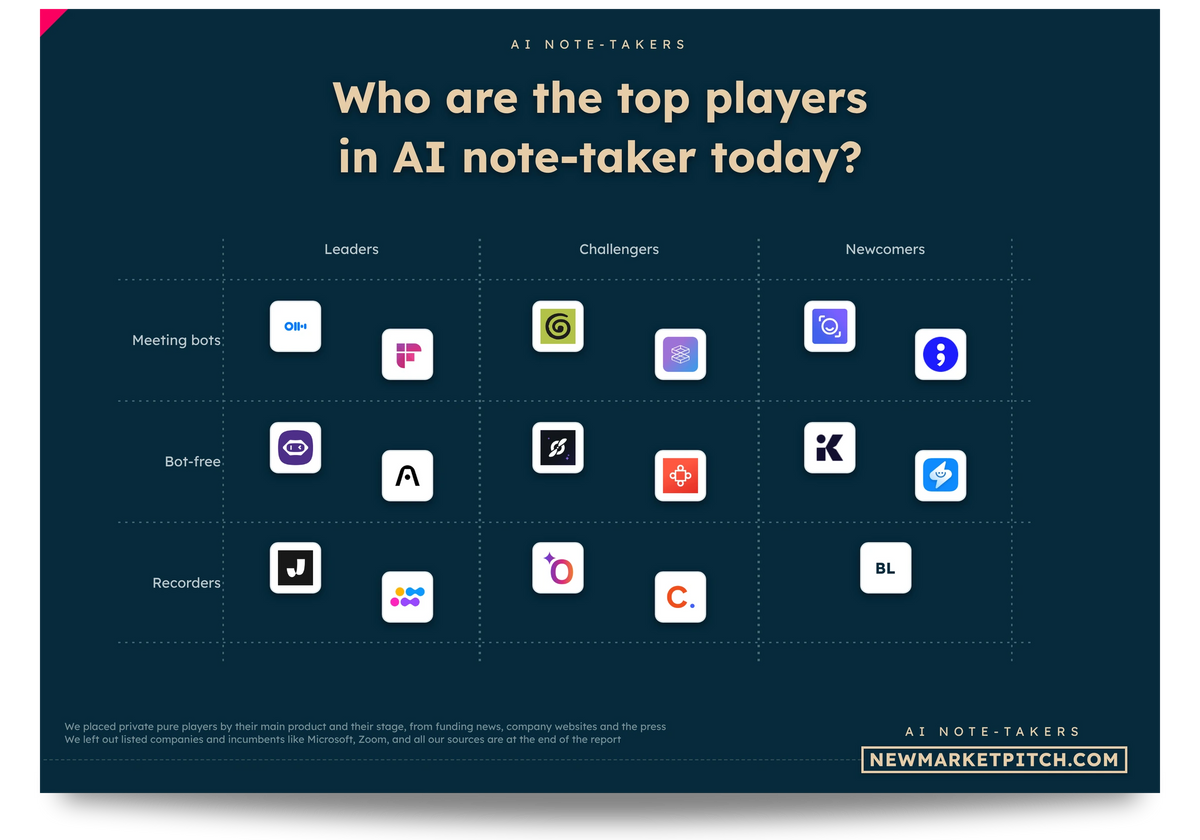
What are the top AI note-taker startups by total funding raised?
Whether you're building or investing in the AI note-taker market, our report covers everything you need to know: the players, the money, and what's coming next.
Summary
Granola leads AI note-taker startups with $192M raised. Jump follows at $105M and Read AI at $81M. The biggest checks are going to companies that can turn meeting conversations into useful work long after the call ends.
Granola reached the top through several rounds, including a $125M Series C in March 2026. Its pitch now goes beyond personal notes: teams can put their shared conversation history to work across company software.
Jump is taking a narrower route. Financial advisers use it to prepare for client meetings, document conversations and handle follow-ups. Zocks targets financial advisers too, giving this specialty an unusually strong presence near the top.
Read AI has taken meeting notes into workplace search and email. Its place among the leaders shows that a startup can raise serious money before the latest fundraising wave and still have an ambitious product to sell today.
Otter.ai tells a different story. Otter.ai recently announced a $320M arrangement with General Catalyst, but the money is repayable rather than equity. Its position in a lifetime equity comparison therefore stays below the newer leaders, despite a large existing user base.
Attention applies meeting intelligence to sales teams. Fireflies.ai, already a familiar meeting assistant, now works across inboxes, Slack and other tasks. Investors and customers are increasingly looking at what happens after a conversation has been recorded.
Acquisitions have also shaped the market. Superhuman bought Fathom, Meta acquired Limitless and Atlassian acquired Rewatch. Each deal moved a specialist product or team into a much larger software or hardware business.
American startups dominate the company count: 22 of the 34 companies we track are based in the United States, or 65%. Canada, Japan, Australia and European countries have credible challengers, although the largest disclosed equity totals belong to US companies.
Most AI note-takers operate with far less funding than the headline names. Only 2 companies have raised over $100M, while most have built their products with much less capital. A big check helps a startup expand, but it is hardly a requirement for building a useful meeting product.
Granola is the clear fundraising leader for now. That says something important about investors' expectations for shared company knowledge, while leaving plenty of room for specialist, smaller and acquired products to matter in customers' daily work.

Written by the New Market Pitch teamWe track new markets so founders and investors can move faster. About us

In our report covering the AI note-taker market, you will always find fresh funding data, taken straight from our own verified funding database.
Top startups in the AI note-taker market ranked by total funding raised
Here is the current ranking of the AI note-taker startups that raised the most, with the total each one has raised and our confidence level.
If you want to go deeper into the AI note-taker startup landscape, check our report covering the AI note-taker market.
| # | Startup | Total raised | Last round | Status | Confidence |
|---|---|---|---|---|---|
| $100M to $500M | |||||
| 1 | GranolaCreates AI-powered meeting notes | $192M | Mar 2026$125M · Series C | Active | Full |
| 2 | JumpConversational AI assistant for financial advisors | $105M | Feb 2026$80M · Series B | Active | Full |
| Below $100M | |||||
| 3 | Read AIAI meeting summaries and workplace assistant | $81M | Oct 2024$50M · Series B | Active | Full |
| 4 | ZocksMeeting assistant for financial advisory conversations | $64M | Jan 2026$45M · Series B | Active | Full |
| 5 | Otter.aiGenerates meeting notes and summaries | $50M | Feb 2021$40M · Series B | Active | Full |
| 6 | AttentionAI agents executing revenue team workflows | $47M | Jun 2026$30M · Series B | Active | Full |
| 7 | LimitlessBuilds wearable conversation memory and meeting notes | $33M | Jun 2023$18M · Series A | Acquired | Full |
| 8 | NottaTranscribes multilingual meetings and summarizes conversations | $32M | Dec 2025$15M · Series B | Active | Full |
| 9 | Future IntelligenceMakes transcription earbuds for meetings and calls | $29M+ | May 2026$15M+ · Series A+ | Active | Full |
| 10 | FellowUnifies meeting agendas notes and action items | $24M | Oct 2021$24M · Series A | Active | Full |
| 11 | RewatchCreates meeting summaries and searchable company video | $22M | May 2021$20M · Series A | Acquired | Full |
| 12 | FathomAI meeting recording and notes | $22M | Sep 2024$17M · Series A | Acquired | Full |
| 13 | Fireflies.aiAI meeting summaries and generated notes | $19M | May 2021$14M · Series A | Active | Full |
| 14 | GrainRecords and summarizes customer meetings for sales | $16M+ | Apr 2022$16M · Series A | Active | Full |
| 15 | AvomaCaptures meetings and analyzes customer conversations | $12M | Dec 2021$12M · Series A | Active | Full |
| 16 | PocketAI meeting notes and action tracking | $11M | Jun 2026$11M · Seed | Active | Full |
| 17 | SupernormalGenerates structured notes from video meetings | $10M | Jan 2023$10M · Seed | Active | Full |
| 18 | BubblesSummarizes meetings and supports asynchronous collaboration | $8.5M+ | May 2022$8.5M · Seed | Active | Partial |
| 19 | TactiqCaptures live meeting captions and AI takeaways | $7.3M | Jul 2024$7.3M · Series A | Active | Full |
| 20 | Quill MeetingsAI meeting notes and followups | $6.5M | Feb 2026$6.5M · Seed | Active | Full |
| 21 | TwinMindAmbient meeting transcription and memory assistant | $5.7M | Sep 2025$5.7M · Seed | Active | Full |
| 22 | tl;dvRecords and searches meetings across teams | $4.5M | Jun 2022$4.5M · Seed | Active | Full |
| 23 | Spinach AICaptures standups and creates project action items | $2.8M | Aug 2021$2.8M · Pre-Seed | Active | Full |
| 24 | Based HardwareMakes wearable open-source AI conversation memory device | $2.7M | Jan 2025$2M · Seed | Active | Strong |
| 25 | MeetRecordAnalyzes sales meetings and generates CRM summaries | $2.7M | Jun 2024$2.7M · Seed | Active | Full |
| 26 | MeetGeekRecords calls and automates meeting followups | $2.6M | Sep 2025$1.9M · Other | Active | Full |
| 27 | CirclebackAutomatically transcribes meetings and extracts action items | $2.5M | Nov 2024$2.5M · Seed | Active | Full |
| 28 | NootaSummarizes meetings and interviews across languages | $1.7M | May 2025$1.7M · Seed | Active | Full |
| 29 | LaxisTranscribes sales calls and extracts customer insights | $1.5M | Oct 2023$1.5M · Seed | Active | Full |
| 30 | VinylAI meeting notes for accounting and bookkeeping firms | $1.3M | Aug 2025$1.3M · Seed | Active | Full |
| 31 | BluedotRecords browser meetings without a visible bot | $600K | Apr 2024$600K · Pre-Seed | Active | Full |
| 32 | The PlatoAI meeting notes and transcription | $543K | Mar 2025$543K · Seed | Active | Full |
| 33 | WudpeckerRecords meetings and drafts summaries and tasks | $350K | Oct 2023$350K · Pre-Seed | Active | Full |
| Undisclosed | |||||
| 34 | Sembly AIProduces meeting notes decisions and task summaries | Undisclosed | Feb 2022Undisclosed · Seed | Active | Low |
No startups match this search.

In our research about AI note-taker startups, we turn what is vague and complex into simple, useful visuals. Market maps like this one show you at a glance where every startup stands.
Did one giant round make Granola the best-funded AI note-taker?
Granola became the best-funded AI note-taker through several fundraises, with one exceptionally large round giving it a clear lead.
Granola's $125M Series C in March 2026 is the largest individual equity round among the 34 AI note-taker startups we track. Granola had already raised a major round in May 2025, and it has completed 4 rounds altogether. Granola's cumulative funding puts it 1.8x ahead of Jump, the next company in the ranking. Investors kept backing Granola as the product grew beyond its original use case.
At first, the appeal was simple: Granola could make useful meeting notes from a person's computer without adding an obvious recording bot to the call. The March 2026 announcement named Vanta, Gusto, Thumbtack and Asana as business users. It also explained a bigger goal: let teams search and use the knowledge stored in their conversations, including through other software.
There's a practical reason to fund that expansion. Someone might use a note-taker only during a call, whereas a team can keep returning to past decisions, customer requests and project details. We still cannot tell how profitable that wider business will be. But Granola's funding lead has a clear product story behind it, and the size of its newest round reflects that change.
Can Jump catch Granola in the AI note-taker funding race?
Jump is the closest challenger to Granola by total AI note-taker funding, helped by a business focused entirely on financial advisers.
Jump's $80M Series B in February 2026 brought its lifetime equity funding to $105M. In the announcement, Jump said more than 27,000 advisers were using its product and more than 2,000 were joining each month. Those are company-reported usage figures, but they help explain why investors see a large opportunity in a product built for a particular profession.
A financial adviser needs more than a readable transcript. Jump prepares client meetings, records what was discussed and helps move the resulting information into the software advisers already use. A missing client detail can create real work later; accurate records and follow-ups have direct value. That gives Jump a more specific sales pitch than a general promise to save time.
Its funding also shows why the category is getting harder to describe as a race between identical meeting bots. Read AI sells a broader workplace assistant, Zocks serves the financial-advice market too, and Attention focuses on sales teams. Jump has a plausible way to grow, although Granola remains far ahead on cumulative capital.
The table below shows the leading AI note-taker startups by lifetime equity raised.
| Startup | Total raised | Country |
|---|---|---|
| Granola | $192M | United States |
| Jump | $105M | United States |
| Read AI | $81M | United States |
| Zocks | $64M | United States |
| Otter.ai | $50M | United States |
| Attention | $47M | United States |
| Limitless | $33M | United States |

In our market report about AI note-taker startups, we always try to gather several sources and make estimates that make sense, so you can work with solid numbers.
Is Read AI still near the top of AI note-taker fundraising?
Yes, Read AI remains one of the best-funded AI note-taker startups even though its last equity round came before the latest large deals.
Read AI's $50M Series B in October 2024 was led by Smash Capital. At the time, the company reported 100K new accounts each week and 81% first-month retention. We treat those as figures reported at the announcement, without assuming that growth rate continued. Even so, Read AI had already attracted major investors while many of today's rivals were raising much smaller rounds.
Its product was changing too. Alongside the financing, Read AI launched a Gmail extension that could bring meeting information into email summaries and responses. Instead of keeping each call in a separate folder, it wanted to help employees find and use details scattered across their work. Similar ambitions now appear in the offerings from Granola and Otter.ai, although the products work differently.
That older funding date can mislead people looking for the company with the newest announcement. Read AI is still third in lifetime equity raised. Whether its expansion into email and work search produces more paying customers is a separate question, and one a fundraising total cannot settle.
Why are investors giving financial-adviser AI note-takers such large checks?
Investors are putting serious money into AI note-takers for financial advisers because the software handles client work that firms already pay people to do.
Zocks raised a $45M Series B in January 2026, co-led by Lightspeed Venture Partners and QED Investors, bringing its counted equity funding to $64M, close to the $65M the company states. Jump is another leading startup in this niche. Both connect what an adviser says in a meeting to client records, financial plans, preparation for the next conversation and follow-up work.
There are real customers behind the pitch. Zocks has described adoption across financial firms and announced that Cetera selected its assistant for financial professionals in March 2026. Jump says it serves advisers at independent firms, broker-dealers and large financial institutions. These businesses already spend time keeping client records complete, so software that removes that work can have an easy-to-explain value.
The specialist route also comes with extra demands. Firms need controls over confidential information, accurate records and connections to their existing systems. Developing those features and selling into large institutions takes money. We cannot conclude that financial advisers make up most AI note-taker users; we can say this one profession has helped produce two of the category's largest funded businesses.

Our document detailing everything you need to know about AI note-taker gets updated several times a month, so you always get the latest view of where things stand.
Did Otter.ai's latest financing make it the top-funded AI note-taker?
No, Otter.ai remains below the leading AI note-taker startups in equity raised because its recent $320M growth financing has to be repaid.
Otter announced the General Catalyst Customer Value Fund arrangement in October 2026. CEO Sam Liang told Reuters the company would repay the money with interest as sales and marketing spending brought in business. The arrangement is a substantial way to fund expansion without selling new shares, and it leaves Otter's lifetime equity total at $50M. Otter's last equity round was a $40M Series B in February 2021.
Otter has certainly kept moving. Otter reported more than 40 million users in October 2026, up from 25 million in March 2025, when it also announced nine-figure annual recurring revenue. During 2026 it introduced a Conversational Knowledge Engine, live assistance during calls, and tools covering meeting preparation and follow-ups. Its business now reaches well beyond automatic transcripts.
That makes Otter an especially useful comparison with Granola. One company is raising new equity for a growing enterprise product; the other is using repayable growth capital while selling software to an established audience. That money gives Otter more room to grow, without changing who leads on equity raised.
Why has Attention raised so much for an AI meeting assistant?
Attention has attracted major AI note-taker funding by promising to finish sales work after a customer call, rather than just write down what happened.
Attention's $30M Series B in June 2026, led by RTP Global, lifted its lifetime equity raised to $47M. Attention said some customers also joined the round. That is worth noticing because sales teams already paying for the software chose to back the business, though an investment alone cannot prove customers will keep subscribing.
The product listens to sales conversations, then helps update CRM records, draft follow-ups and identify next steps. A sales manager can judge whether representatives spend less time typing up calls or miss fewer agreed actions. Jump applies a similar idea to advisers, while Read AI tries to make meeting information useful across the workplace. Their buyers and daily tasks differ, but each has something concrete to sell beyond a transcript.
Attention's place near the top is a reminder that the money is reaching AI products built for specific kinds of work. It does not mean every note-taker needs a sales automation engine. It means sales teams are one group of customers for whom taking action on a conversation can be valuable enough to attract a large investment.

In our report covering the AI note-taker market, we look at what the winners do differently, so you can learn from the best instead of guessing.
Is Fireflies.ai one of the best-funded AI note-taker startups?
No, Fireflies.ai is widely used but has raised much less equity than the best-funded AI note-taker startups.
Our research puts Fireflies.ai at $19M, including a $14M Series A in May 2021. Its product has kept growing since then. In September 2026, Fireflies said its Voice Agents had handled more than 40,000 conversations for more than 2,100 organizations across 97 countries. In November 2026, Fireflies expanded Fred from meeting notes into email, Slack, scheduling and tasks across connected applications, and said 140% more people were using Fred beyond meeting notes than six months earlier. Those company-reported numbers help show how far the product has moved beyond the original meeting bot.
The contrast with Granola is striking. Fireflies built a familiar name and has kept adding tools without announcing the kind of equity round that lifted Granola to first place. Its newer work also puts it closer to enterprise assistants that search and act on information from several applications. As more companies pursue that opportunity, the size of a past round tells us less about the product a customer can use today.
Fireflies can therefore be a serious commercial competitor while sitting below newer startups in cumulative funding. We should judge its success through paid usage and retention when reliable figures are available, rather than treat the absence of another venture round as evidence of a stalled business.
Did Fathom need a huge fundraise before Superhuman bought it?
Fathom became an attractive AI note-taker acquisition without raising anything close to the amounts secured by Granola or Jump.
Superhuman announced its acquisition of Fathom in September 2026. We count $22M in equity rounds for Fathom, with a $17M Series A in September 2024. TechCrunch reported over $30M raised in total, a figure that includes crowdfunding we do not count as an equity round. The acquisition price was not disclosed in those figures, so the fundraising total tells us how much the startup raised as an independent company, rather than what its buyer paid.
Fathom had users as well as technology. TechCrunch reported more than 400,000 monthly active users and said over a million people had recorded meetings with the service. TechCrunch also reported that Superhuman tested its own note-taking product before buying Fathom. Bringing in a working product was a way to add meeting context to the company's email, documents and other work tools much faster.
That deal is an important outcome for a company in a crowded market. Building an assistant that people already use can attract a buyer with a much larger distribution network, even when the startup has not kept raising venture capital. Fathom's place in the fundraising comparison remains historical because it no longer finances itself independently.

Learning from others' mistakes is the cheapest lesson there is. In our research about AI note-taker startups, we look at what broke startups before you, so you don't repeat it.
Why did Meta buy Limitless when other AI note-takers had raised more?
Meta's purchase of Limitless shows that an AI note-taker built around conversation memory can interest a major buyer even without a market-leading fundraising total.
Limitless raised $33M in 3 equity rounds, most recently an $18M Series A in June 2023. The company combined software that remembered conversations with its Pendant, a device people could wear. After Meta acquired it, Limitless stopped selling new Pendants on December 5, 2025 and said it would support existing owners for at least a year. The product's future changed with its new owner.
Two other acquired AI note-takers took different paths. Atlassian announced its purchase of Rewatch in August 2024 and planned to bring its meeting-video technology into Loom. Rewatch had previously raised a $20M Series A in May 2021. Superhuman bought Fathom to bring meeting information into a broader productivity product. Meta's interest in wearable AI gives Limitless a different fit. Each buyer could put an existing team and technology in front of users it already reaches.
We count 3 acquired startups in this market. Their earlier fundraises still matter, but readers should not mistake them for current independent fundraising candidates. The deals also show why a startup might find an exit before it ever comes close to the sums raised by the largest standalone rivals.
Can Fellow compete with AI note-takers that have raised more?
Fellow can compete for teams that want organized meetings, even though its equity funding is well below the biggest US AI note-takers.
The Canadian company raised a $24M Series A in October 2021. Its meeting product covers agendas, recordings, decisions and follow-up tasks, so people can prepare before a call and find what they agreed afterward. Fellow says its AI note-taker works with Google Meet, Zoom, Microsoft Teams and Slack Huddles, and supports 100 transcription languages.
The timing of a meeting matters here. A transcript might help someone remember a decision, but someone still has to make the agenda, assign the task and check whether it got done. Fellow keeps those pieces in one place. It also gives teams controls over which recordings can be shared and how long information is retained. Those are practical buying points for companies whose employees attend many recurring meetings.
Granola is betting on shared company knowledge, while Read AI is building search across different kinds of work information. Fellow's approach is more directly tied to planning and running meetings. The smaller fundraising history leaves open the more important customer question: how many teams will keep paying for the whole meeting workflow?
Is Japan's Notta a serious AI note-taker funding contender?
Notta is a meaningful Japanese AI note-taker challenger, eighth by equity raised, although its funding remains well below the American leaders.
We record $32M for Notta across 3 rounds. Notta's most recent round is a $15M Series B in December 2025, which lifted it above Fellow in our ranking. Lead investor Granite-Integral has discussed Notta's international expansion and its goal of turning spoken conversations into searchable information that employees can use.
Multilingual meetings create a genuine opening. A team moving between Japanese and English needs accurate records, good speaker recognition and summaries that work across languages. Buyers in different countries may also want local support and different ways to handle data. Notta has built its business around those needs instead of depending entirely on English-language meeting capture.
There is still a large funding gap between Notta and the biggest general-purpose products. Its international reach might help it grow, but a wider language offering alone cannot establish that it has caught Granola or Jump in capital raised. For now, Notta is one of the clearer examples of an overseas specialist with a distinct product reason to exist.

If you build or invest in the AI note-taker market, you need to know which business models pay off now and which ones are fading. That's why our report covering it has a whole section on it.
Can AI note-taking gadgets attract serious venture funding?
Yes, dedicated AI note-taking devices are attracting venture money, with Pocket showing that customers will buy a separate gadget to record their conversations.
Pocket raised an $11M Seed in June 2026. TechCrunch reported that its phone-mounted recorder sold for $129 and that the startup said it had sold more than 130,000 units. The device records real-world conversations and turns them into transcripts and to-do items without asking people to set up a meeting bot. Its backers included Accel and Y Combinator.
Other companies have tried a more wearable approach. Based Hardware has raised $2.7M across 2 rounds for an open-source conversation-memory device. China's Future Intelligence has raised at least $29M across 3 rounds for its transcription earbuds, enough to rank ninth. Future Intelligence's two most recent rounds were each announced as at least 100 million yuan, so its total is a minimum.
A physical recorder can be easier to reach for during interviews, client visits or hallway conversations. The trade-off is that its maker has to manufacture hardware, keep stock and handle returns while also building transcription software. Pocket's early sales show that convenience can have a market. They do not yet show that hardware note-takers will raise the kind of equity backing the leading enterprise software firms.
Does recording meetings without a bot help AI note-takers raise more money?
Bot-free recording has not produced a consistent funding advantage for AI note-takers, even though many customers like the simpler meeting experience.
Granola records audio through the user's computer and leads the category on funding. Tactiq, which captures browser captions without a bot, has raised $7.3M. The two companies sell similar capture methods but have very different funding histories.
Bluedot also records browser meetings without an extra visible attendee, and we count $600K in equity for the Ukrainian startup. Fellow and Circleback have offered several ways to capture a call as well. By now, the presence or absence of a meeting bot is a feature decision made by businesses of many sizes.
Some people dislike a bot joining a confidential conversation. Others prefer its obvious presence, which can help everyone notice that a meeting is being recorded. Consent, permissions, audio quality and privacy controls still matter in both cases. When investors fund a large AI note-taker, they appear to be looking at the customers and wider work the software could serve, rather than the recording method alone.

In our document detailing everything you need to know about AI note-taker, we like to show you the big picture. We know your time is precious, so we make every page quick to read and packed with as much learning as possible per minute.
Are European AI note-taker startups raising as much as US rivals?
No, European AI note-taker startups have much smaller recorded equity totals than the US leaders, although useful products have emerged across the region.
The United States accounts for 22 companies in our research, or 65% of the total. Germany's tl;dv has $4.5M in recorded equity, while Romania's MeetGeek has $2.6M. France's Noota, Finland's Wudpecker and Ukraine's Bluedot add several different approaches to meeting capture, languages and follow-ups. None sits among the largest fundraising names.
There are reasons a buyer might still choose one of them. tl;dv lets teams search recordings and share what happened in meetings. Noota handles meeting and interview notes across languages. MeetGeek automates summaries and the work that follows a call. They can win customers on product fit without matching the hiring budget of a heavily funded American rival.
These are headquarters counts, so they cannot tell us which country has the most users. They do show where the best-funded independent businesses have been built. On that measure, the American lead is unmistakable.
The table below shows the country distribution of the AI note-taker startups we track.
| Country | Startups | Share |
|---|---|---|
| United States | 22 | 65% |
| Australia | 2 | 6% |
| Canada | 1 | 3% |
| China | 1 | 3% |
| Finland | 1 | 3% |
| France | 1 | 3% |
| Germany | 1 | 3% |
| India | 1 | 3% |
| Japan | 1 | 3% |
| Romania | 1 | 3% |
| South Korea | 1 | 3% |
| Ukraine | 1 | 3% |
Does an AI note-taker need $100M to become a serious business?
Not at all: nine-figure funding is still unusual for AI note-taker startups, and several established products have been built with far smaller equity totals.
Only 2 of the 34 startups we track have raised more than $100M, representing 6% of the companies. The other 32, or 94%, remain below that line. The median total raised across our startups is at least $9.3M. That is a very different market from one where every credible competitor needs a nine-figure financing before it can ship software and find customers.
Avoma has raised $12M and helps teams record customer conversations and handle what happens next. Grain has raised at least $16M for meeting recording and customer insights. Supernormal has raised $10M to generate structured meeting notes. These companies have quite different products, but each demonstrates how a focused business can be built on a fraction of the capital attached to the leaders.
The largest checks are often attached to bigger expansion plans, such as turning a company's meeting history into searchable knowledge or handling complex work for advisers. That costs more to develop and sell. But fundraising totals cannot tell us which of those businesses is profitable or which has the happiest customers. The evidence gives a clear answer: nine-figure backing remains rare among specialist note-takers.

When you build or invest in the AI note-taker market, you need clarity, not confusion. In our report covering the AI note-taker market, we always try to put numbers on and quantify whatever is usually vague and confusing.
Do AI note-taker startups need repeat rounds to raise big money?
Some leading AI note-takers have returned to investors several times, but many companies have recorded only one equity round.
We count 18 startups with a single recorded round. Granola has the highest round count, with 4. A company can complete several modest deals or raise much more money in a later round. Counting announcements alone won't tell us which business has secured the most capital.
Fellow's entire recorded equity history consists of a $24M Series A in October 2021. Australia's Tactiq has one $7.3M Series A in July 2024, while Pocket has a single Seed financing in our records. They sell different products, and the number of rounds says very little about customer demand or whether they plan to raise again.
Granola gives us the clearest example of repeated fundraising supporting a wider ambition. Attention and Notta have each completed 3 rounds with far smaller totals, and both have kept building. What separates their fundraising positions is the amount investors committed over time, rather than simply how often they wrote a check.
Can new AI note-taker startups still raise money against established brands?
Yes, new AI note-taker startups are still winning early funding, even with well-known meeting assistants already on the market.
Quill Meetings, founded in 2023, raised a $6.5M Seed in February 2026. TwinMind, founded in 2024, raised a $5.7M Seed in September 2025 to build an assistant that remembers conversations over time. Pocket, another company founded in 2024, chose a device-led way to capture meetings and interviews. The three businesses start with different ideas about what people most want to remember.
Circleback is another example of a focused product, with $2.5M of recorded equity. Its May 2026 release brought information shown on shared screens into meeting notes, addressing a common problem: an audio transcript can miss the document or slide everyone was discussing. That is a practical improvement customers can notice, even without a giant fundraise.
These young businesses still have to compete with established products and built-in note-taking from conferencing platforms. A Seed round gives them time to prove that a particular approach is valuable. It would be premature to call any one of them the next fundraising leader. What we can see today is that investors have not closed the door on new approaches to capturing work conversations.

A good product starts with a real problem. In our research about AI note-taker startups, we show you the ones customers still live with.
Do AI note-takers have to become work assistants to win big funding?
Not necessarily, but many of the largest AI note-taker financings back products that help people act on a conversation afterward.
Granola wants teams to use their shared meeting history across company tools. Read AI connects meeting knowledge with email and search, while Attention helps salespeople update customer records. Jump and Zocks focus on client follow-ups and documentation for financial advisers. The products are different, yet they all give a business another reason to pay after the initial transcript has been delivered.
The idea has spread beyond the companies raising the largest rounds. Fireflies has broadened Fred into an assistant for inboxes and other work. Otter has added meeting preparation and live help. Fellow has connected agendas with action items for years. These are observable product choices, although their launches do not give us comparable revenue figures.
A team that just needs private, accurate notes may be perfectly happy with a narrow tool. But when a startup seeks a very large round, a plan to capture decisions and do useful work with them is easier to explain than a plan to generate another summary. That pattern appears repeatedly among the businesses with the largest equity totals.
So, which AI note-taker startups have raised the most today?
Granola is the number-one AI note-taker startup by lifetime equity raised, with $192M. Jump and Read AI follow, while specialized advisers' tools, meeting apps and acquired companies fill out the leading group.
The order looks different from a list of the best-known apps. Otter has a large user base and new repayable growth capital, while Fireflies keeps adding features despite having raised less equity. Fathom and Limitless now sit inside larger companies. Their histories explain why fundraising figures, product reach and current independence tell different stories.
The biggest equity checks are going to businesses with plans beyond the basic meeting transcript. Some want shared knowledge across an entire company; others want to finish work for sales teams or financial advisers. None of that means a customer needs the best-funded assistant to get the best notes. It tells us which plans have persuaded investors to write the largest checks so far.
The table below shows what we found.
| Question | Answer |
|---|---|
| Did one giant check create the leader? | Granola had already raised money before its biggest financing. Granola's $125M Series C arrived in March 2026. That gave its shared company-knowledge product much more room to grow. |
| Can specialist note-takers attract major money? | Yes, financial-adviser software is a serious fundraising contender. Jump's $80M Series B closed in February 2026. Detailed client records give advisers reasons to pay for the product. |
| Does older fundraising mean a weaker product? | No, Read AI remains highly funded despite an older round. Read AI has raised $81M in equity since its founding. Its workplace search expansion makes the old round date a poor shortcut. |
| Does repayable growth money change equity rankings? | No, Otter's financing comes with a repayment obligation. Otter's General Catalyst arrangement totals $320M in repayable capital. That capital supports expansion without putting Otter first in equity raised. |
| Can sales automation drive big meeting-assistant checks? | Yes, Attention gives sales teams more than transcripts. Attention raised a $30M Series B in June 2026. CRM updates and follow-ups create a clearer reason for customers to pay. |
| Does a famous product need huge equity rounds? | No, Fireflies.ai has kept expanding on smaller recorded funding. We count $19M raised in equity since its founding. Product reach and lifetime equity raised measure different things. |
| Can a smaller note-taker win an acquisition? | Yes, Superhuman chose to buy Fathom's working product. Fathom had raised $22M in counted equity before acquisition. The buyer gained meeting technology and an existing user base. |
| Are physical AI recorders getting venture backing? | Yes, Pocket shows there is demand for a dedicated device. Pocket's $11M Seed financing closed in June 2026. Hardware makes in-person capture easier while adding manufacturing costs. |
| Do American headquarters mean American customers dominate? | No, a startup's headquarters cannot reveal its customer geography. The AI note-taker startups we track span 12 countries. Usage patterns need their own evidence beyond the address of each business. |
| Is nine-figure funding normal for AI note-takers? | No, nine-figure equity rounds remain unusual in this market. Only 2 tracked startups have crossed that line. Most competitors build their products with considerably smaller checks. |
| Does the largest fundraise mean the best notes? | No, investors and customers are making different judgments. The median total raised across our startups is at least $9.3M. Accuracy, privacy and useful actions still matter when choosing a product. |

In our market report about AI note-taker startups, we try to remove everything that could confuse you, especially if you're investing or building in this market.
Our methodology
Our data runs through November 19, 2026. We then reviewed this article and updated its answers on November 24, 2026, the date shown under the title. We define AI note-takers as independent products or purpose-built devices that turn spoken work meetings, interviews and conversations into transcripts, structured notes, summaries, searchable records or follow-up actions. We include bot-based, bot-free, multilingual, local-first, vertical and device-led products, including companies close to the category boundary rather than silently dropping them. Every company in the ranking meets our startup definition: founded in 2007 or later, built around a growth-oriented new product and funded privately, or listed within the last five years. Companies subsequently acquired, listed or shut down keep their historical place and status; totals stop at the acquisition or the IPO, with primary IPO proceeds included.
We count equity raised since founding, including the oldest private rounds and primary proceeds of an IPO. We exclude debt, venture debt, grants, unconverted convertibles and SAFEs, post-IPO offerings and secondary share sales; a SAFE converted into shares stays in the financing round that absorbed it. We merge duplicate accounts of the same round rather than adding a financing announcement twice. A total marked "+" is a minimum because at least one round did not disclose a public amount. The ranking covers each startup's full financing history, not just recent years.
Rounds confirmed by a company announcement, a press article or a regulatory filing are counted in full. Where no article exists, a round is counted only when at least two recognised databases agree on its date (within one month) and amount (within 5%), and it is marked as low confidence; a round found in a single database stays in the company's history but is left out of totals. For companies that have raised more than $100M, every round counted is backed by an article.
We do not adopt cumulative funding or valuations published by Crunchbase, PitchBook or similar databases as our own totals, because those figures can mix equity with debt, grants, estimates or uncompleted commitments. Databases are not the sole support for any financing counted at full confidence. A round corroborated only by two agreeing databases receives low confidence. Where a company's advertised lifetime total differs from the sum of equity rounds we can verify, we preserve that sourced sum and explain the main discrepancy under the ranking. The confidence labels Full, Strong, Partial and Low indicate how much of each company total rests on confirmed rounds.
Readers may reasonably ask why an established name appears below a newer business or why an acquired product still appears at all. This is a ranking of lifetime equity financed into startup companies, not a ranking of revenue, users, valuations or current independence. Repayable growth arrangements do not become equity simply because an announcement describes them as investment. An acquired startup's fundraising history remains part of the market's history, while its status shows that it no longer raises independently.
Finally, our market boundary excludes stand-alone speech-recognition APIs, generic voice assistants, conventional conferencing or scheduling suites whose note-taking features are ancillary, CRM-only call analytics, clinical documentation centered on medical charts and lecture summarizers not designed for work conversations. Such providers may compete with some features discussed here, but inserting their corporate financing into a specialist startup league would make the comparison less informative rather than more complete.
Key sources include Granola's March 2026 round, enterprise customers and company-context strategy, Jump's February 2026 Series B, adviser adoption and enterprise customers, Read AI's Series B, account metrics and Gmail expansion, Zocks financing and financial-adviser platform, Zocks partnerships and Cetera announcement, Reuters reporting on the repayable Otter financing, Otter's October 2026 meeting agent features, Otter's conversational knowledge product, Attention's Series B and sales workflow product, Fireflies' November 2026 expansion beyond meeting notes, Fireflies' company-reported Voice Agents usage, Fathom acquisition and user metrics, Superhuman's direct Fathom acquisition announcement, Meta acquisition and Limitless Pendant customer arrangements, Rewatch acquisition and Loom integration, Fellow's updated support for 100 transcription languages, Investor announcement for Notta's Series B, Pocket's device sales and Seed financing, Circleback's May 2026 screen-context feature, Google Meet's Gemini note-taking feature, Microsoft Teams' AI meeting recaps and meeting memory, Zoom's AI meeting summary feature, and Otter.ai's March 2025 disclosure of recurring revenue and users.
In our document detailing everything you need to know about AI note-taker, you will always find fresh funding data, taken straight from our own verified funding database.
Written by the New Market Pitch teamWe track new markets so founders and investors can move faster. About us