What’s funding like in the AI note-taker market right now?
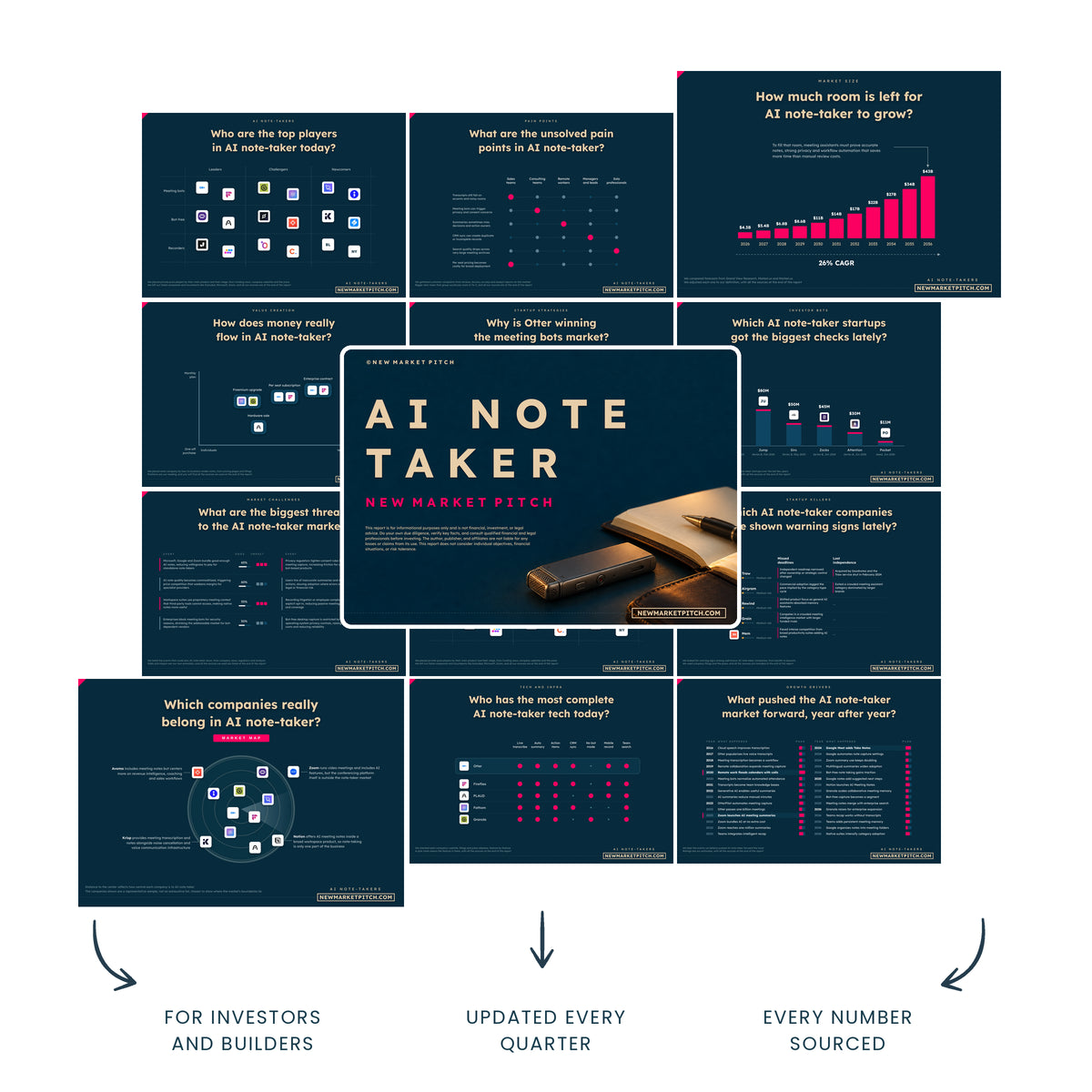
Whether you're building or investing in the AI note-taker market, our report covers everything you need to know: the players, the money, and what's coming next.
Summary
AI note-taker funding is bigger in dollars but narrower in reach. We tracked 8 deals worth at least $327M in the last 12 months, led by Granola's $125M Series C in March 2026. The 12 months before had 13 deals and at least $113M. A few big winners are attracting money that is no longer spread across as many startups.
Take out the outsized rounds, and the picture changes. Deals excluding rounds above $50M brought in at least $122M in the latest period, roughly level with the 12 months before. There is money for AI note-takers, but the total alone gives founders the wrong impression of how easy it is to raise.
The number of funded companies has also fallen. Investors made fewer separate bets, and the deals we could identify were increasingly follow-on rounds. That is a much tougher market to enter than the headline dollars suggest.
Seed funding has not disappeared, though it now reaches fewer teams. Pocket and Quill Meetings raised money with clear approaches to capturing conversations and using the results. A basic meeting transcript is no longer much of a sales pitch.
The biggest checks went to companies building something more specific. Granola turns conversations into shared company knowledge, while Jump and Zocks help financial advisers handle the work that follows client meetings. Attention applies a similar idea to sales teams.
These businesses have something that Microsoft Teams, Google Meet and Zoom do not necessarily provide inside a standard meeting recap: a way to connect a conversation to the rest of a customer's work. That distinction helps explain where the large rounds are going.
Granola has shown that a separate meeting app can still attract large investors. Its business customers and bot-free approach give it an identity beyond the generic recording tools now built into workplace software.
Recording devices present another possibility. Pocket wants to capture conversations away from video calls, and Future Intelligence is developing transcription earbuds. The use case is real, although the public funding record is still thin.
The geography of funding has narrowed too. American startups took 91% of the money with a public amount in the last 12 months, and Japan and China had one round each, against 7 countries in the 12 months before. That makes a worldwide boom especially hard to claim.
Our conclusion is that investors still like AI note-takers when they can see a convincing business beyond the notes. Funding looks good for selected companies and much less convincing for new entrants generally. With so few deals in either period, the difference in direction matters more than a dramatic percentage headline.

Written by the New Market Pitch teamWe track new markets so founders and investors can move faster. About us

In our report covering the AI note-taker market, you will always find fresh funding data, taken straight from our own verified funding database.
All funding deals in the ai note taker market over the last 24 months
Below is the table listing all the deals. You can find our methodology at the end of this page.
If you want a deeper understanding of the market and its current dynamics, get our ai note taker market report.
| Company | Category | Date | Stage | Deal size | What they do | Region | Lead investors | Country | Rank |
|---|---|---|---|---|---|---|---|---|---|
| Dedicated AI recording hardware | June 2026 | Seed | $11M | AI meeting notes and action tracking | North America | Accel | United States | ||
| Attention | Vertical meeting intelligence | June 2026 | Series B | $30M | AI agents executing revenue team workflows | North America | RTP Global | United States | |
| Future Intelligence | Dedicated AI recording hardware | May 2026 | Series A | $15M+ | Makes transcription earbuds for meetings and calls | Asia-Pacific | Not disclosed | China | |
| Granola | Bot-free and local-first | March 2026 | Series C | $125M | Creates AI-powered meeting notes | North America | Index Ventures | United States | |
| Quill Meetings | General-purpose meeting assistants | February 2026 | Seed | $6.5M | AI meeting notes and followups | North America | Basis Set Ventures | United States | |
| Jump | Vertical meeting intelligence | February 2026 | Series B | $80M | Conversational AI assistant for financial advisors | North America | Insight Partners | United States | |
| Zocks | Vertical meeting intelligence | January 2026 | Series B | $45M | Meeting assistant for financial advisory conversations | North America | Lightspeed Venture Partners, QED Investors | United States | |
| Notta | Multilingual and regional | December 2025 | Series B | $15M | Transcribes multilingual meetings and summarizes conversations | Asia-Pacific | Granite-Integral Capital | Japan | |
| Future Intelligence | Dedicated AI recording hardware | October 2025 | Series A | $14M+ | Makes transcription earbuds for meetings and calls | Asia-Pacific | Ant Group | China | |
| TwinMind | Bot-free and local-first | September 2025 | Seed | $5.7M | Ambient meeting transcription and memory assistant | North America | Not disclosed | United States | |
| MeetGeek | Team knowledge and workflow | September 2025 | Unknown | $1.9M | Records calls and automates meeting followups | Europe | Early Game Ventures | Romania | |
| Vinyl | Vertical meeting intelligence | August 2025 | Seed | $1.3M | AI meeting notes for accounting and bookkeeping firms | Asia-Pacific | Tidal Ventures | Australia | |
| Notta | Multilingual and regional | May 2025 | Series A | $6.9M | Transcribes multilingual meetings and summarizes conversations | Asia-Pacific | GL Ventures, Mizuho Leaguer Investments | Japan | |
| Noota | Multilingual and regional | May 2025 | Seed | $1.7M | Summarizes meetings and interviews across languages | Europe | Blast Club | France | |
| Granola | Bot-free and local-first | May 2025 | Series B | $43M | Creates AI-powered meeting notes | North America | NFDG | United States | |
| Zocks | Vertical meeting intelligence | March 2025 | Series A | $14M | Meeting assistant for financial advisory conversations | North America | Motive Ventures | United States | |
| The Plato | General-purpose meeting assistants | March 2025 | Seed | $543K | AI meeting notes and transcription | Asia-Pacific | Not disclosed | South Korea | |
| Jump | Vertical meeting intelligence | February 2025 | Series A | $20M | Conversational AI assistant for financial advisors | North America | Battery Ventures | United States | |
| Based Hardware | Dedicated AI recording hardware | January 2025 | Seed | $2M | Makes wearable open-source AI conversation memory device | North America | Tim Draper | United States | |
| Future Intelligence | Dedicated AI recording hardware | January 2025 | Seed | Undisclosed | Makes transcription earbuds for meetings and calls | Asia-Pacific | Wanwu Venture Capital | China | |
| Circleback | General-purpose meeting assistants | November 2024 | Seed | $2.5M | Automatically transcribes meetings and extracts action items | North America | Not disclosed | United States |

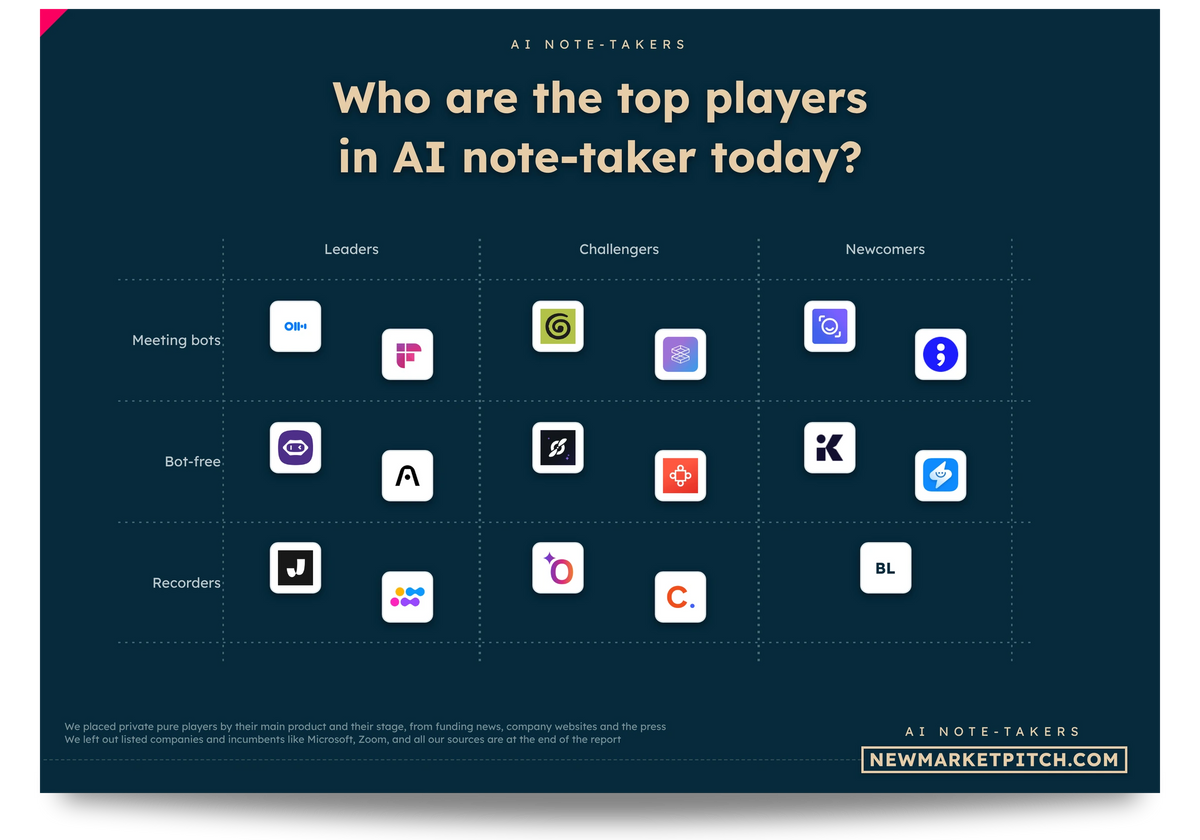
In our research about AI note-taker startups, we turn what is vague and complex into simple, useful visuals. Market maps like this one show you at a glance where every startup stands.
Is AI note-taker funding really booming right now?
No, AI note-taker funding is doing better in dollars than it is in the number of startups getting backed.
We found at least $327M across 8 deals in the last 12 months, against at least $113M across 13 deals in the 12 months before. That makes the boom story hard to swallow. A busy funding market should give more companies a shot instead of only producing bigger headlines.
Look at what investors actually backed. Granola is selling shared company knowledge built from meetings. Jump and Zocks use conversations to help financial advisers handle client work. Their products are moving well beyond automatic minutes. Meanwhile, Google has widened access to Gemini notes in Meet, and Microsoft includes recaps and suggested tasks in Teams. Those built-in alternatives make it harder for a new standalone app to stand out.
The comparison has a limit, though. Both periods contain few transactions, and some funding amounts are private. The totals are minimums, and the period-to-period differences cannot support reliable growth rates. The clear finding is much simpler: the larger amount raised has reached a smaller set of AI note-taker companies.
The table below shows the size and breadth of funding in the two periods.
| Measure | Last 12 months | 12 months before |
|---|---|---|
| Deals | 8 | 13 |
| Companies | 8 | 12 |
| Disclosed capital | $327M+ | $113M+ |
| Active categories | 5 | 6 |
| Rounds above $50M | 2 | No deal |
| Lead investors | 8 | 11 |
| Countries | 3 | 7 |
| Months without deals | 5 | 4 |
“+” means at least; some round amounts were not disclosed.
Would AI note-taker funding look weak without the biggest rounds?
Partly: without the biggest rounds, AI note-taker funding looks roughly flat rather than booming.
Excluding rounds above $50M leaves at least $122M in the last 12 months, compared with at least $113M in the 12 months before, a period that had no round that large. The jump in the headline total therefore comes almost entirely from 2 rounds. It shows how much of the apparent strength rests on companies able to raise checks that most startups will never see.
Granola and Jump explain the gap. Granola's bot-free meeting app has become a way for companies to search and reuse conversations across teams. Jump serves financial advisers with meeting notes tied to CRM, email and planning work. Those are quite different products, but both give investors a reason to believe customers will keep paying after meeting summaries become commonplace.
Where you draw the line changes the story. Excluding rounds above $100M still leaves at least $202M in the most recent period. Excluding rounds above $50M brings the remaining total close to the earlier period. Calling the whole AI note-taker market flush with cash would be a stretch. The large rounds are real; they simply tell us more about a few winners than about funding conditions for everyone else.
Why are investors putting so much money into Granola?
Granola keeps attracting major AI note-taker investors because it is turning personal meeting notes into company-wide knowledge.
Granola's $125M Series C in March 2026, led by Index Ventures, was the largest deal in the last 12 months. Granola had already raised a $43M Series B in May 2025, the largest deal of the 12 months before. The company has moved quickly from a note-taking utility toward a product designed for entire teams.
Its March announcement named Vanta, Gusto, Thumbtack and Asana among its business users, as well as Cursor and Mistral AI. Granola introduced shared spaces and ways to use meeting context inside other applications. Those are stronger clues about the opportunity than the size of the check alone, although a customer name tells us nothing about contract value or retention.
Granola also captures conversations without putting a visible bot into a video call. In June 2026, it explained how its desktop app handles live audio and participant notices without storing meeting recordings. That design can feel easier to use across different meeting platforms. Whether customers keep searching old conversations and sharing them with colleagues will decide how large the business becomes. The fundraising shows investor confidence, not proof that every company wants a separate meeting memory tool.

In our market report about AI note-taker startups, we always try to gather several sources and make estimates that make sense, so you can work with solid numbers.
Are fewer AI note-taker startups getting funded today?
Yes, fewer AI note-taker startups are finding investors, even as the successful ones raise larger checks.
Our count covers 8 funded companies in the last 12 months, against 12 in the 12 months before. Each company in the recent period appears in only one qualifying round, so repeat deals within that period cannot explain the smaller reach.
The earlier period included small financings for Circleback, Vinyl and MeetGeek. These companies approached meeting notes from different angles: a general assistant, a tool for accounting firms and a system for team follow-ups. The more recent group includes larger rounds for Granola, Jump and Zocks, which can point to broader use inside an organization or a specific professional workflow.
Built-in AI meeting features may make fundraising tougher, but the data cannot tell us why any particular company did not raise. What we can see is that Microsoft, Google and Zoom already handle much of the ordinary meeting-summary job. That raises the question every new founder has to answer: why would a team pay separately? The latest deals suggest that investors want a sharper answer than better notes.
Is it getting harder for a brand-new AI note-taker startup to raise money?
Not clearly: a brand-new AI note-taker can still raise money, but nothing shows that first-time fundraising has become easier.
The distinction between a seed round and a company's first-ever financing matters here. We classified 7 of the 8 deals in the last 12 months as follow-ons, including Quill Meetings' Seed. The financing status of the remaining deal, Pocket's Seed, is unknown, so we cannot call it a first round. In the 12 months before, we identified 5 follow-ons and 8 deals with unknown financing history. None of those unknowns can safely be turned into evidence of fresh startups entering the market.
New ideas still get funded. Accel backed Pocket's approach to capturing in-person conversations with a device that attaches to a phone. Quill Meetings, which had raised before, built a locally controlled assistant that can use information from meetings across AI tools. Both give customers a reason to try something different from the recorder already inside a meeting app.
The catch is that these companies were offering more than an early demo of a transcript generator. We cannot tell from the rounds how many founders tried and failed to raise or what a new team must prove to get its first check. We can say the door is open, but the visible deal flow gives little reason to call it wide open.
Are small AI note-taker seed rounds disappearing?
Small AI note-taker seed rounds have become harder to find in disclosed financings, although they have not vanished entirely.
The last 12 months contained 2 Seed deals totaling $18M, versus 7 Seed deals totaling at least $14M in the 12 months before. The larger current total went to fewer founding teams. There was also no deal under $5M in the latest period, compared with 6 deals totaling $9.9M in the earlier one. Every recent deal had a public amount, so small checks are not hiding behind undisclosed rounds.
Pocket's $11M Seed in June 2026 backed a device for recording conversations away from a laptop. Quill Meetings' $6.5M Seed in February 2026 backed an assistant with a local-first approach to meeting context. In the earlier period, Circleback's $2.5M Seed in November 2024 and Based Hardware's $2M Seed in January 2025 were typical of the small checks that still got announced.
The shift is not proof that investors have imposed a universal minimum check. It does mean founders should not look at a bigger total and assume raising a modest seed round is easier. Fewer seed companies made it into the public funding record, and the latest disclosed checks went to particularly distinct products.
Are $50M AI note-taker funding rounds becoming normal?
No, $50M-plus AI note-taker rounds are still exceptions rather than a normal funding option.
We counted 2 rounds above $50M in the last 12 months, raising $205M together. There was no deal above that threshold in the 12 months before. Granola's March 2026 Series C and Jump's February 2026 Series B account for the recent big checks, but they sell different things to different customers.
Granola lets employees reuse conversations across projects and tools. Jump focuses on financial advisers, whose meeting notes can feed client records, email and planning tasks. Investors can imagine a wider software business in each case. That does not mean other meeting assistants can raise similar amounts simply by adding AI features.
Zocks and Attention offer another useful comparison. They also went after professional tasks following a conversation, yet raised smaller Series B rounds than the headline deals. The market has produced sizeable checks for winners without establishing any predictable new check size. With so few qualifying deals, another large round could make the total jump again without making funding any easier for a typical founder.

Our document detailing everything you need to know about AI note-taker gets updated several times a month, so you always get the latest view of where things stand.
Are AI note-taker investors choosing established companies over newcomers?
Mostly yes: AI note-taker investors are putting more of the visible money into companies that have raised before.
In the last 12 months, 7 follow-on deals accounted for at least $316M, or 97% of the money with a public amount. The 12 months before had 5 follow-ons totaling at least $79M. We cannot turn the remaining rounds into confirmed first financings, because their status is unknown. Still, the pattern of repeat backing is hard to miss.
Granola followed an earlier Series B with a Series C. Jump and Zocks each returned with another round after building software specifically for financial advisers. Attention also moved forward with a tool intended to do revenue-team work rather than just describe a sales call. These companies could point to products, customers or distribution routes instead of asking investors to fund only an idea.
The round names tell the same story. Series B now appears much more often than it did in the previous period, while Seed and Series A appear less often. That can happen when a small cohort of startups matures. It does not establish that all AI note-taker companies are growing up together.
The table below shows qualifying deals by their announced stage in each period.
| Stage | Last 12 months | 12 months before |
|---|---|---|
| Seed | 2 | 7 |
| Series A | 1 | 4 |
| Series B | 4 | 1 |
| Series C | 1 | No deal |
| Series D+ | No deal | No deal |
| Growth | No deal | No deal |
| Unknown | No deal | 1 |
Why do financial advisers attract so much AI note-taker funding?
Financial advisers attract AI note-taker funding because a useful assistant can take work off their hands after every client meeting.
Jump's $80M Series B in February 2026 and Zocks' $45M Series B in January 2026 show how much investors like this specific customer. Both companies started with the information captured in conversations, then built tools that help advisers prepare, update records and follow up with clients.
Jump said in February 2026 that more than 27,000 advisers used its product. Its subsequent AI Associate release described work across CRM, email and planning applications, while an integration with Holistiplan announced in March 2026 connected tax information to adviser preparation. Zocks announced in March 2026 that Cetera would offer its assistant across its financial-professional network. It also developed documentation tasks for life-insurance producers.
A generic meeting recap can summarize what a client said. Advisers still need to turn that conversation into a usable client record, a planning action and sometimes a regulated piece of paperwork. Jump and Zocks are trying to handle that job. Their published adoption and distribution claims do not tell us profit margins, but they give the investors a clearer customer and a clearer reason to pay than ordinary transcription does.
Are sales AI note-takers becoming sales automation software?
Yes, sales-focused AI note-takers increasingly promise to complete the follow-up work instead of stopping at meeting notes.
Attention's $30M Series B in June 2026 backed software that can update CRM records, draft messages and carry out tasks after a sales conversation. That is a bigger job than creating a summary. The company is asking buyers to judge the product by work saved and opportunities followed up, rather than the quality of a transcript.
There is a similar idea in financial advice. Jump's March 2026 AI Associate announcement described actions across email, CRM and planning tools. Zocks has been building ways to carry facts from client conversations into documents and suggested next steps. These products serve different professions, but they are pushing meeting information into work people would otherwise do manually.
We should distinguish the promise from the proof. Attention reported customer involvement in its funding round, which suggests some users want the product to keep developing. It does not tell us how accurately the software completes tasks or how many humans must check the output. Investors have backed an understandable direction: turning a conversation into finished work. The commercial test is whether customers keep trusting those actions once the novelty wears off.

In our report covering the AI note-taker market, we look at what the winners do differently, so you can learn from the best instead of guessing.
Is there still room for another general-purpose AI meeting assistant?
There is still room for an independent general-purpose AI note-taker, but a plain transcript-and-summary app has a tough sales pitch now.
General-purpose meeting assistants recorded 1 deal worth $6.5M in the last 12 months, compared with 2 deals totaling $3M in the 12 months before. Fewer products persuaded investors to back them, even though the disclosed dollars were higher.
Quill Meetings is one example. Its February 2026 announcement described an assistant that lets users control local information and connect conversation context to other AI tools. Granola takes another route: it lets people capture meetings without a bot and share useful context across their organization. Both are easier to explain to a buyer than another app that makes minutes after a call.
Meanwhile, Microsoft Teams, Google Meet and Zoom already handle common meeting recaps. Those products sit where meetings happen, so customers do not need another login just to get a summary. An independent startup can still win by working across platforms, being easier to trust or handling a specific job better. But it has to sell that difference clearly, because the basic feature now comes bundled with software many teams already use.
Can independent AI note-takers survive Microsoft and Google?
Independent AI note-takers can survive Microsoft and Google when they solve problems the meeting platforms leave unfinished.
Microsoft offers intelligent recaps and suggested actions inside Teams. Google expanded Gemini notes in Meet in June 2026. Zoom also provides meeting-summary features in its workplace products. These companies already own the call, the calendar or the workplace account, so a startup faces a distribution problem before it even competes on note quality.
Granola has chosen to work across meetings instead of belonging to one video platform. Its desktop approach can capture in-person conversations and online calls without sending a bot into the meeting. The company has also built shared spaces and integrations so people can reuse information after the call ends. Jump and Zocks show a different route: they put the meeting details directly into financial-advice work that ordinary video suites do not complete.
That does not make every independent product safe. Microsoft and Google can add features, offer them at little extra cost and put them in front of existing customers. But a company using multiple tools may still value one place for its conversation history. We see a defensible opening for some startups, especially those connected to everyday work rather than video calls alone.
Are investors betting on more private AI note-taking?
Privacy is becoming part of what AI note-taker customers buy, but the funding data cannot isolate how much investors pay for it.
Granola, Quill Meetings and Zocks all stress control over sensitive conversations in different ways. Granola records live audio for transcription without keeping meeting recordings, according to its June 2026 explanation, and has added participant notices and workspace controls. Quill has emphasized local processing and user choice over where an AI request runs. Zocks works with financial-client information, where careless handling of meeting notes can create problems well beyond an awkward summary.
Pocket faces a different challenge. A recording device is physically present in the room, so consent, clear recording controls and secure storage shape whether people will use it. Its June 2026 announcement emphasized deliberate recording and security commitments. Google Meet's own documentation also describes participant notifications and organizer permissions. Those decisions affect whether people trust the product enough to use it.
Privacy alone cannot explain these large checks. The deal records do not tell us which feature convinced an investor. They do show that credible independent products must answer sensitive questions about where conversation data goes, who can see it and how long it stays there. For many workplaces, a good summary without those answers is not enough.

Learning from others' mistakes is the cheapest lesson there is. In our research about AI note-taker startups, we look at what broke startups before you, so you don't repeat it.
Do people really need a separate AI recording device?
Dedicated AI note-taking devices have a real use case in face-to-face work, but their business case is still being tested.
Dedicated AI recording hardware drew 2 deals totaling at least $26M in the last 12 months: Pocket's $11M Seed in June 2026 and Future Intelligence's round of at least $15M in May 2026. The 12 months before also included 3 hardware deals worth at least $16M, so the idea did not arrive overnight.
Pocket makes a small recorder that attaches to a phone and turns everyday conversations into searchable notes and tasks. TechCrunch reported in June 2026 that Pocket said it had sold more than 130,000 units. That is useful evidence that customers will buy a separate object, though it is the company's reported sales figure, not audited demand across the category. Future Intelligence is trying another format with transcription earbuds for meetings and calls.
The obvious competitor is the smartphone already in everyone's pocket. It can record audio and send files to an app, often without buying another device. Pocket and similar startups must make capture so quick and dependable that people actually use it in the field, on calls and in unscheduled conversations. The funding shows interest in that problem; it does not yet settle hardware margins or lasting demand.
Is multilingual AI note-taking getting left behind?
Not left behind: multilingual AI note-takers still raise money, but they remain a small corner of the market.
We tracked 1 multilingual and regional deal worth $15M in the last 12 months, 5% of the money with a public amount. The 12 months before included 2 deals totaling $8.6M. One company, Notta, accounts for the recent figure, so the category is active without being crowded.
Notta's Series B in December 2025, led by Granite-Integral Capital, is that deal. The Japanese company offers meeting transcription and translation, including bilingual features for conversations that move between languages. Its documentation describes tools for capturing and translating meetings with participants who cannot all follow the same language. That solves a problem an English-only meeting recap does not address.
Google Meet also supports AI notes in multiple languages, although its own documentation sets conditions on how different languages work within a meeting. Companies like Notta therefore have a feature gap to pursue, especially with teams working across borders. But a meaningful customer need does not automatically become a hot funding category. The visible deals show multilingual providers staying active without demonstrating a rush of new capital toward them.
Has AI note-taker funding become a US-only business?
No, AI note-taker companies outside the United States still raise money, but American startups now take 91% of the money with a public amount.
The United States accounted for 6 deals and $298M during the last 12 months. Japan had 1 deal of $15M and China 1 deal of at least $15M. In the 12 months before, the United States recorded 6 deals and $87M, with additional disclosed activity in Asia-Pacific and Europe.
Future Intelligence continued working on transcription earbuds in China, and Notta raised a new round for its multilingual meeting product in Japan. Neither belongs in a claim that Asian investors have disappeared. Europe, on the other hand, had no qualifying deal in the most recent period, after the earlier financing of Romania's MeetGeek and France's Noota.
The American deals also have an identifiable customer base: Granola sells across business teams, Jump and Zocks target financial advisers, and Attention works with sales teams. We cannot tell whether that makes US startups fundamentally stronger or simply better placed to raise large checks. The fair conclusion is that the dollars are concentrated in the United States, while the wider map of investor interest is less certain.
Are AI note-taker startups raising their next rounds faster?
No clear acceleration shows up in how quickly funded AI note-takers return for another round.
Funded AI note-takers waited a median of 10 months between rounds in the last 12 months, against 10.5 months in the 12 months before, almost the same pace. The medians cover the rounds where the previous round is known, 75% of recent deals and 62% of earlier ones.
Granola raised its Series B in May 2025 and its Series C in March 2026. Jump moved from a Series A in February 2025 to a Series B in February 2026. Zocks went from a Series A in March 2025 to a Series B in January 2026. Those founders clearly found investors willing to return, but their timelines are different and the overall sample is small.
There are sensible reasons investors might come back: more customers, better distribution or a product expanding into a bigger job. Granola has named enterprise users; Jump has published adviser adoption; Zocks has added distribution partnerships. We should not turn those announcements into invented growth rates. The evidence supports repeat backing for selected companies, while the measured median gives no basis for saying every AI note-taker can now raise faster.

If you build or invest in the AI note-taker market, you need to know which business models pay off now and which ones are fading. That's why our report covering it has a whole section on it.
Are VCs pulling back from AI note-taker funding?
Some VCs are still writing large AI note-taker checks, although fewer firms are appearing across the recent deals.
We identified 8 different lead investors in the last 12 months, compared with 11 in the 12 months before. Counting all participating investors, the figures were 15 and 29. A smaller number of rounds naturally leaves fewer chances for investors to appear, so these counts do not tell us what every venture firm's opinion of the market has become.
The investors who did show up were substantial. Index Ventures led Granola's March 2026 Series C, Insight Partners led Jump's February 2026 Series B, and Lightspeed Venture Partners and QED Investors co-led Zocks' January 2026 Series B. These were commitments to established, quite different products rather than repeated checks to one generic note-taking model.
No lead investor appeared more than once within either comparison period. That makes it hard to talk about one firm dominating new deals. For founders, the practical problem is the smaller pool of visible opportunities, not that professional investors have declared the market dead. Investors are still interested, they are just publicly backing fewer companies.
Will AI note-taking end up free inside meeting apps?
Basic AI note-taking is already bundled into major meeting apps, but software that handles the work after a meeting can still charge separately.
Google Meet can create summaries and action items through Gemini. Microsoft Teams offers recaps inside its workplace products, while Zoom has built AI meeting summaries into eligible plans. That leaves less reason to subscribe to a standalone service whose only job is producing ordinary notes.
Yet investors are still backing businesses with a different promise. Granola helps teams search and use conversation history across applications. Jump links adviser meetings to financial planning and client records. Zocks turns client discussions into follow-up tasks, while Pocket focuses on conversations that never happened on a video call. Each company is trying to own a problem that remains after the transcript is finished.
Some of those features may also be copied by bigger platforms. The question is whether an independent provider can move faster, understand a profession better or work across tools the customer already uses. Our funding research points toward that narrower opportunity. The ability to summarize speech is rapidly becoming a standard feature; turning conversation history into useful work is where separate companies still have something to sell.
So, what does AI note-taker funding look like right now?
AI note-taker funding is healthy for a few proven companies and far less encouraging for startups trying to break in.
The last 12 months brought fewer deals than the 12 months before, despite bigger publicly announced checks. Granola led the period, while Jump, Zocks and Attention helped show why financial and sales workflows now attract serious backing. These companies are selling an answer to a business problem, rather than asking buyers to pay for automatic notes alone.
There is still room for early products, privacy-focused tools, recording hardware and multilingual software. But the earlier spread of small rounds has thinned, and we cannot tell from such a short deal history whether first-time founders are getting more opportunities. The influence of exceptionally large checks makes an easy boom story especially misleading.
The most useful question for a founder is therefore what happens after a meeting. A product that helps an adviser prepare a client plan or a salesperson update the CRM is easier to defend than a transcript generator bundled into Teams or Meet. We see a selective market with real winners, not a wave lifting every AI note-taking app.
The table below shows what we found.
| Question | Answer |
|---|---|
| Is this boom reaching more startup founders? | No, fewer AI note-taker companies are getting funded now. The last 12 months reached 8 companies with qualifying rounds. Bigger checks have not created more funded businesses overall. |
| Would the market thrive without oversized checks? | The overall picture flattens when unusually large rounds disappear. Excluding rounds above $50M leaves at least $122M recently. About level with the 12 months before. |
| Have major venture firms stopped investing here? | No, major funds still choose individual AI note-taker winners. Index Ventures led Granola's $125M Series C in March 2026. Its commitment should not be mistaken for wider enthusiasm. |
| Is seed funding becoming easier for newcomers? | No, fewer AI note-taker teams reached the seed stage. The last 12 months contained 2 Seed deals total. Big seed checks do not mean broad access to investors. |
| Are giant note-taking rounds an everyday occurrence? | No, exceptionally large meeting-software rounds remain unusual events. We tracked 2 rounds above $50M in the latest period. A few winners cannot establish a normal check size. |
| Why does financial advice attract venture checks? | Advisers need client conversations turned into useful ongoing work. Jump raised $80M in its February 2026 Series B. Planning integrations give its meeting assistant a clearer purpose. |
| Do sales teams need more than meeting notes? | Yes, sales assistants increasingly try to complete follow-up work. Attention raised $30M in its June 2026 Series B. CRM updates and drafted messages are the product promise. |
| Can independent apps compete with built-in summaries? | Some independent apps serve needs that meeting suites miss. General-purpose assistants recorded 1 deal in the latest period. Cross-platform knowledge and specific workflows offer better defenses. |
| Is hardware becoming the dominant meeting-note business? | No, recording devices remain a smaller and uncertain opportunity. Dedicated recording hardware recorded 2 deals in the latest period. Customers must prefer separate devices over phone-based recording. |
| Is international investor interest really disappearing entirely? | No, some overseas AI note-taker rounds still take place. The last 12 months covered deals from 3 countries. Missing disclosed amounts make comparisons across borders difficult. |
| Are returning startups raising money much faster? | The observed fundraising intervals do not show clear acceleration. Returning startups waited a median of 10 months between rounds. Successful repeat rounds do not establish faster fundraising everywhere. |

In our document detailing everything you need to know about AI note-taker, we like to show you the big picture. We know your time is precious, so we make every page quick to read and packed with as much learning as possible per minute.
Our methodology
Our data runs through November 19, 2026. We then reviewed this article and updated its answers on November 24, 2026, the date shown under the title. We compare the last 12 months, November 20, 2025 to November 19, 2026, with the 12 months before, November 20, 2024 to November 19, 2025. Both periods fall within our complete deal coverage beginning in January 2024. The two periods contain 8 and 13 deals respectively. We could not extend the comparison to 18 months, because the earlier window would begin before our complete market coverage. This market is too small for reliable percentage changes, so we give period figures side by side rather than treating the changes as statistically robust.
We count announced or otherwise adequately verified equity financings of private companies worth at least $300K. We exclude debt, grants, loans, unconverted convertibles, SAFEs and public offerings. Every qualifying financing is counted once, and reports of the same round are merged. We count rounds with undisclosed amounts in deal totals but not in disclosed capital; reported capital totals are therefore minimums rather than claims to know every dollar raised.
Our AI note-taker market covers independent software and purpose-built devices primarily used to turn workplace conversations, meetings and interviews into searchable transcripts, useful notes, summaries and follow-up actions. It includes bot-free and locally controlled products, multilingual meeting tools, specialist conversation workflows and dedicated recording hardware. We retain borderline products when meeting documentation is a genuine primary proposition, rather than deleting cases that complicate the comparison. We exclude generic speech APIs, ordinary dictation, conferencing suites where notes are secondary, clinical encounter documentation and general lecture summarizers not built around work conversations.
Every company counted meets our startup definition: an independent, growth-oriented business founded in 2007 or later and backed by venture capital, angels, grants or founders. Eligible businesses are private, or went public within the last 5 years; an acquired startup remains included for 3 years after acquisition as part of its acquirer. Stages follow the published round label, with early stages separated from later stages where known. Regions reflect headquarters country, and the market's categories reflect our classification of what each product primarily does.
We use company statements, regulatory filings, investor announcements and reliable reporting to establish the details of individual rounds. We record the announced amount, date and stage without re-estimating unpublished checks. We compare deals, disclosed dollars, stages, companies and investors in the two periods. Other pages on our site may use a company's entire financing history rather than these two windows, so their totals can differ.
Rounds confirmed by a company announcement, a press article or a regulatory filing are counted in full. Where no article exists, a round is counted only when at least two recognised databases agree on its date (within one month) and amount (within 5%), and it is marked as low confidence; a round found in a single database stays in the company's history but is left out of totals. For companies that have raised more than $100M, every round counted is backed by an article.
A reader may find a different funding total in a press release or a larger count on a venture database. Those figures may include older company rounds, loans, instruments outside our definition, acquisitions, companies whose core product is not meeting notes, or events outside the two comparison windows. We retain undisclosed deals in the count without filling in speculative amounts. That is why our totals should be read as a consistent comparison of qualifying financings, not as a claim that all money in the wider voice-AI industry is captured here.
Key sources include Granola's March 2026 Series C announcement, named business users and enterprise product direction., Index Ventures' explanation of its investment in Granola., Jump's February 2026 Series B, adviser adoption and enterprise users., Zocks' January 2026 Series B and financial-adviser workflow strategy., Attention's June 2026 financing and revenue-team actions beyond summaries., Pocket's June 2026 round, device business and privacy statements., Quill Meetings' February 2026 seed funding and locally controlled assistant., Granola's June 2026 explanation of bot-free capture, consent and retention., Granola's security practices and enterprise controls., Examples of Granola's meeting-context integrations into work tools., Jump's March 2026 AI Associate product announcement., Jump and Holistiplan's financial-planning integration., Zocks' March 2026 Cetera distribution partnership., Zocks' March 2026 life-insurance documentation use case., Zocks' product details on client intelligence and AI tool integrations., Google's June 2026 expansion of Gemini-generated notes in Meet., Google Meet note-taking language, permissions and participant controls., Microsoft's native Teams recap, summary and action-item functionality., Zoom's account of built-in meeting summaries and its broader AI assistant., Notta's supported languages and translation functions as of November 2026., Notta's bilingual meeting transcription and translation use case., Independent reporting on Pocket's device design and smartphone competition., and Vanta's case study of Granola's enterprise security preparation..

When you build or invest in the AI note-taker market, you need clarity, not confusion. In our report covering the AI note-taker market, we always try to put numbers on and quantify whatever is usually vague and confusing.
Written by the New Market Pitch teamWe track new markets so founders and investors can move faster. About us