What are the most valuable AI note-taker startups?
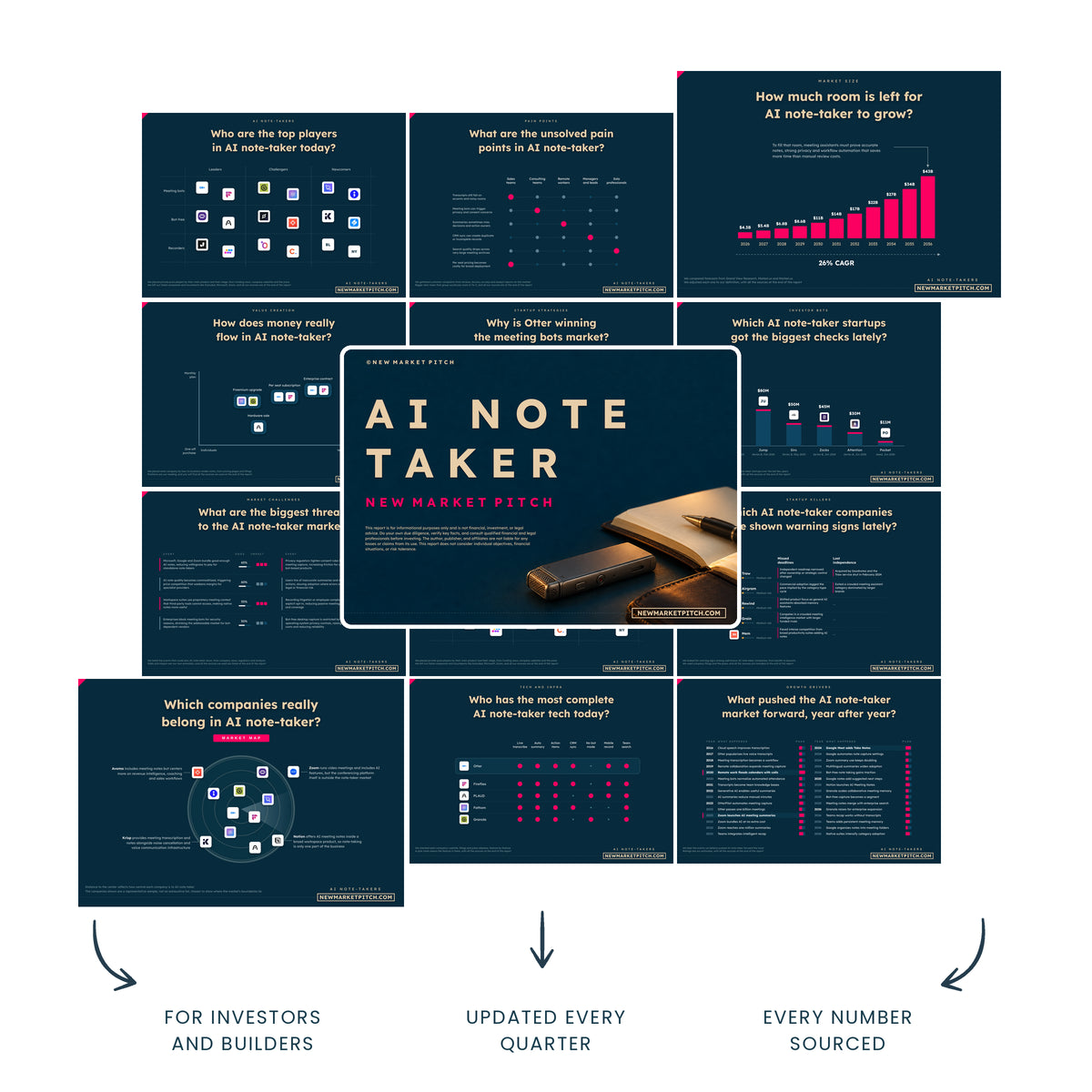
Whether you're building or investing in the AI note-taker market, our report covers everything you need to know: the players, the money, and what's coming next.
Summary
Granola is the most valuable AI note-taker startup, valued at $1.5B. Granola is the only confirmed unicorn among the 26 startups we can value. All other values remain below that threshold.
Granola has one advantage its closest rivals cannot yet claim: investors announced its price. Its bot-free notes have also grown into a way for teams to find and reuse what people said in meetings.
Jump comes next at an estimated $533M–$1.0B. It focuses on financial advisors, where a useful note can feed directly into a client's financial plan.
Read AI follows at an estimated $333M–$625M. Its meeting assistant now searches connected email and calendars and helps people prepare for the next conversation.
Zocks also serves financial advisors, while Attention turns sales calls into CRM updates and follow-up work. Several valuable challengers are trying to get paid for what happens after a meeting.
There is a catch with those numbers. Only 1 startup has a valuation stated by a source. The other 25 figures are our estimates from the sizes of their last equity rounds, dated to those rounds. They are useful comparisons, but they are not announced sale prices.
The United States accounts for 15 of the 26 startups we can value. Japan, China, Australia and Europe have interesting competitors, though the American names lead the valuation order.
The products differ more than the phrase “AI meeting notes” suggests. Some work without a bot, some handle multilingual conversations, and others record meetings away from a laptop.
Google Meet and Microsoft Teams are already giving millions of people AI notes. Independent startups now have to do something more useful than the feature included with a workplace subscription.
Granola leads for now, but the real contest is moving toward reliable meeting memory and follow-up work. A nice summary is easy to copy. Making past conversations useful to a business every day is much harder.

Written by the New Market Pitch teamWe track new markets so founders and investors can move faster. About us

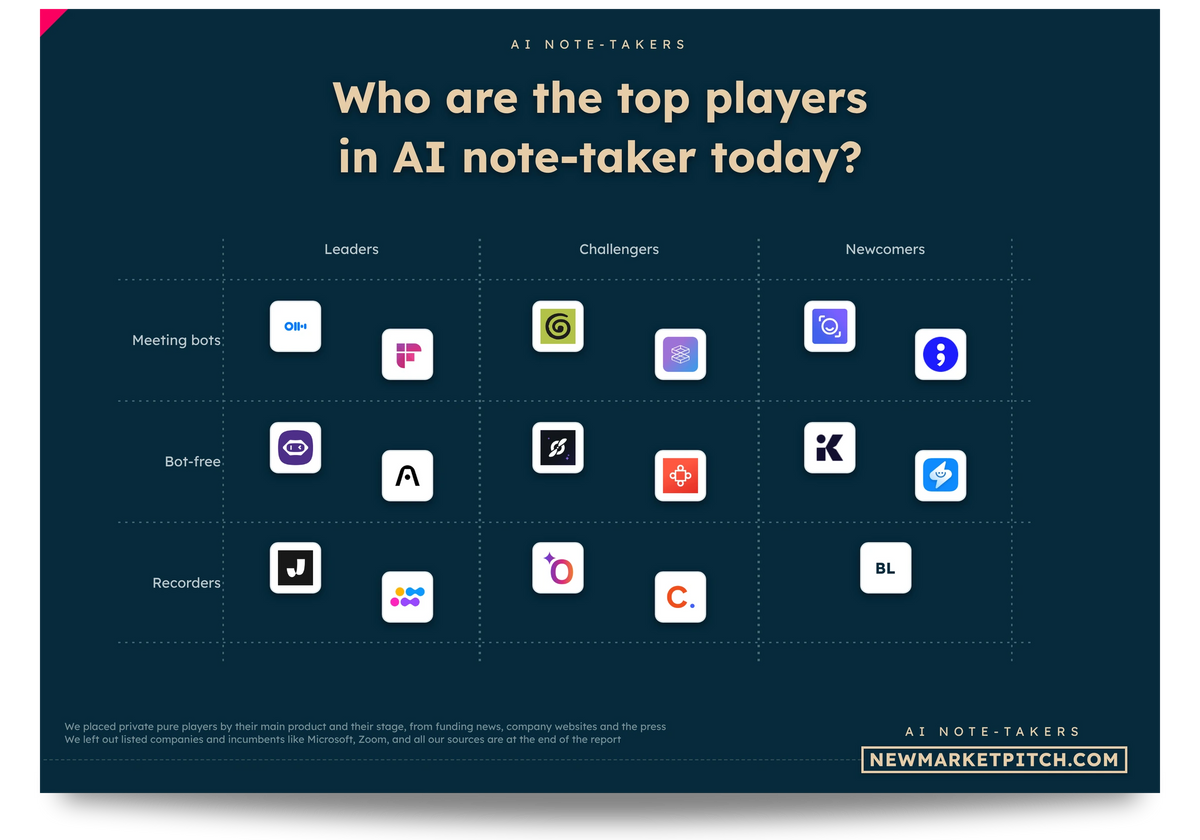
In our report covering the AI note-taker market, we turn what is vague and complex into simple, useful visuals. Market maps like this one show you at a glance where every startup stands.
Top startups in the AI note-taker market ranked by valuation
Here is the current ranking of the most valuable AI note-taker startups. For each one you will also find our confidence level and the valuation basis we used.
If you want to go deeper into the AI note-taker startup landscape, check our report covering the AI note-taker market.
| # | Startup | Valuation | Confidence | Valuation basis | Last round | Total funding |
|---|---|---|---|---|---|---|
| 1 | GranolaCreates AI-powered meeting notes | $1.5Bas of Mar 2026 | Full | Announced private round valuation | $125MSeries C · Mar 2026 | $192Mvalued at 7.8× this |
| 2 | JumpConversational AI assistant for financial advisors | $533M–$1.0Bas of Feb 2026 | Low | Estimated from last round | $80MSeries B · Feb 2026 | $105Mvalued at 7.0× this |
| 3 | Read AIAI meeting summaries and workplace assistant | $333M–$625Mas of Oct 2024 | Low | Estimated from last round | $50MSeries B · Oct 2024 | $81Mvalued at 5.6× this |
| 4 | ZocksMeeting assistant for financial advisory conversations | $300M–$562Mas of Jan 2026 | Low | Estimated from last round | $45MSeries B · Jan 2026 | $64Mvalued at 6.4× this |
| 5 | AttentionAI agents executing revenue team workflows | $200M–$375Mas of Jun 2026 | Low | Estimated from last round | $30MSeries B · Jun 2026 | $47Mvalued at 5.8× this |
| 6 | NottaTranscribes multilingual meetings and summarizes conversations | $100M–$188Mas of Dec 2025 | Low | Estimated from last round | $15MSeries B · Dec 2025 | $32Mvalued at 4.3× this |
| 7 | GrainRecords and summarizes customer meetings for sales | $80M–$133Mas of Apr 2022 | Low | Estimated from last round | $16MSeries A · Apr 2022 | $16M+valued at 6.4× this |
| 8 | Future IntelligenceMakes transcription earbuds for meetings and calls | $74M–$123Mas of May 2026 | Low | Estimated from last round | $15M+Series A+ · May 2026 | $29M+valued at 3.3× this |
| 9 | AvomaCaptures meetings and analyzes customer conversations | $60M–$100Mas of Dec 2021 | Low | Estimated from last round | $12MSeries A · Dec 2021 | $12Mvalued at 6.5× this |
| 10 | PocketAI meeting notes and action tracking | $44M–$73Mas of Jun 2026 | Low | Estimated from last round | $11MSeed · Jun 2026 | $11Mvalued at 5.2× this |
| 11 | SupernormalGenerates structured notes from video meetings | $40M–$67Mas of Jan 2023 | Low | Estimated from last round | $10MSeed · Jan 2023 | $10Mvalued at 5.2× this |
| 12 | TactiqCaptures live meeting captions and AI takeaways | $37M–$61Mas of Jul 2024 | Low | Estimated from last round | $7.3MSeries A · Jul 2024 | $7.3Mvalued at 6.5× this |
| 13 | BubblesSummarizes meetings and supports asynchronous collaboration | $34M–$57Mas of May 2022 | Low | Estimated from last round | $8.5MSeed · May 2022 | $8.5M+valued at 5.2× this |
| 14 | Quill MeetingsAI meeting notes and followups | $26M–$43Mas of Feb 2026 | Low | Estimated from last round | $6.5MSeed · Feb 2026 | $6.5Mvalued at 5.2× this |
| 15 | TwinMindAmbient meeting transcription and memory assistant | $23M–$38Mas of Sep 2025 | Low | Estimated from last round | $5.7MSeed · Sep 2025 | $5.7Mvalued at 5.2× this |
| 16 | tl;dvRecords and searches meetings across teams | $18M–$30Mas of Jun 2022 | Low | Estimated from last round | $4.5MSeed · Jun 2022 | $4.5Mvalued at 5.2× this |
| 17 | MeetRecordAnalyzes sales meetings and generates CRM summaries | $11M–$18Mas of Jun 2024 | Low | Estimated from last round | $2.7MSeed · Jun 2024 | $2.7Mvalued at 5.2× this |
| 18 | CirclebackAutomatically transcribes meetings and extracts action items | $10M–$17Mas of Nov 2024 | Low | Estimated from last round | $2.5MSeed · Nov 2024 | $2.5Mvalued at 5.2× this |
| 19 | MeetGeekRecords calls and automates meeting followups | $7.5M–$19Mas of Sep 2025 | Low | Estimated from last round | $1.9MOther · Sep 2025 | $2.6Mvalued at 4.6× this |
| 20 | Based HardwareMakes wearable open-source AI conversation memory device | $8M–$13Mas of Jan 2025 | Low | Estimated from last round | $2MSeed · Jan 2025 | $2.7Mvalued at 3.8× this |
| 21 | NootaSummarizes meetings and interviews across languages | $6.8M–$11Mas of May 2025 | Low | Estimated from last round | $1.7MSeed · May 2025 | $1.7Mvalued at 5.2× this |
| 22 | LaxisTranscribes sales calls and extracts customer insights | $6M–$10Mas of Oct 2023 | Low | Estimated from last round | $1.5MSeed · Oct 2023 | $1.5Mvalued at 5.2× this |
| 23 | VinylAI meeting notes for accounting and bookkeeping firms | $5.2M–$8.7Mas of Aug 2025 | Low | Estimated from last round | $1.3MSeed · Aug 2025 | $1.3Mvalued at 5.2× this |
| 24 | BluedotRecords browser meetings without a visible bot | $2.4M–$4Mas of Apr 2024 | Low | Estimated from last round | $600KPre-Seed · Apr 2024 | $600Kvalued at 5.2× this |
| 25 | The PlatoAI meeting notes and transcription | $2.2M–$3.6Mas of Mar 2025 | Low | Estimated from last round | $543KSeed · Mar 2025 | $543Kvalued at 5.2× this |
| 26 | WudpeckerRecords meetings and drafts summaries and tasks | $1.4M–$2.3Mas of Oct 2023 | Low | Estimated from last round | $350KPre-Seed · Oct 2023 | $350Kvalued at 5.2× this |
No startups match this search.

Our research about AI note-taker startups gets updated several times a month, so you always get the latest view of where things stand.
Is Granola really the most valuable AI note-taker startup?
Granola is the most valuable AI note-taker startup with a published price, at an announced $1.5B.
Granola reported that price alongside its $125M Series C in March 2026. Index Ventures and Kleiner Perkins backed the financing, and the company named Vanta, Gusto, Asana, Cursor and Mistral AI among its customers. That customer list shows the app has moved beyond individuals trying a new productivity tool, although it cannot tell us how much those businesses spend.
Jump is next in our ordering, followed by Read AI and Zocks. Their values come from our estimates based on the size of each company's last equity round, dated to those rounds. No investor announced a directly comparable price for them. So the gap at the top is also a gap in how certain we can be about the numbers.
Granola captures Zoom, Meet and Teams conversations without adding a recording bot. Recent updates let teams search shared notes and pass meeting context to Claude, ChatGPT and other tools. Those capabilities help explain the interest in the business. They do not prove that Granola will earn enough revenue to justify its private price, but right now it is the clearest valuation leader.
Is Granola's billion-dollar valuation backed by a real business?
Granola has real customers for its AI note-taker, but its public financial figures do not tell us whether the billion-dollar price is fair.
We track $192M in Granola's total equity funding. Granola's valuation is 7.8x that amount, which compares its company value with capital raised, not with sales. Granola has not disclosed the revenue information needed for a proper comparison with software businesses whose accounts are public.
What we can see is a steady push beyond taking notes. Granola identified Vanta, Gusto, Thumbtack and Asana as customers in its March 2026 financing announcement. In February it connected notes to external AI tools through MCP. Meeting briefs followed in May. Most recently, its agent brief began pulling earlier conversations into a daily digest that other assistants could use. Those releases have a common purpose: make yesterday's meetings useful for today's work.
The threat is straightforward. Google and Microsoft already put summaries inside their workplace products. Granola needs people to keep choosing it because its notes travel across apps and help with work after the call. Without customer retention and revenue figures, we cannot say whether its price is justified. But we can say that investors backed a product with identifiable business users, not just an attractive demo.

In our market report about AI note-taker startups, we look at what the winners do differently, so you can learn from the best instead of guessing.
How many AI note-taker startups are unicorns today?
Only 1 AI note-taker startup, Granola, has a confirmed unicorn valuation.
A billion-dollar valuation needs evidence. Jump's estimated range reaches the threshold at its upper end, but that does not establish that investors priced the company at $1B. Read AI, Zocks and Attention have ranges entirely below it. We count a company as a unicorn only when its full range clears the line.
The split is striking because AI meeting assistants are widely used. In our group, 1 startup sits in the $1B-to-$5B bracket and 25 have valuations below $1B. The two groups represent 4% and 96% of the startups respectively. The market has plenty of funded products, yet very few valuations that reach the headline threshold.
It helps to separate a big funding check from a big valuation. A round buys part of a company, not the company outright. Most AI note-taker startups also do not publish a fresh price every year. Investors may pay more or less at the next round, depending on their growth and the terms of that deal. For now, Granola stands alone as a confirmed unicorn in this group.
Could Jump catch Granola as the most valuable AI note-taker?
Jump could challenge Granola in AI note-taker valuations, but there is no published price showing that the financial-advisor specialist has caught it yet.
We estimate Jump at $533M–$1.0B from the size of its $80M Series B in February 2026. That range is our estimate, dated to that financing, not a valuation announced by Jump or its lead investor, Insight Partners. A future priced round would give us a much firmer comparison.
Jump has built a strong reason for advisors to use it. The company said in February 2026 that more than 27,000 financial advisors used the platform and that it was adding more than 2,000 each month. Those are Jump's own adoption figures, not verified paying-customer totals. The product connects conversation notes to client preparation, estate plans and tax information through integrations with Wealth.com, TaxStatus and Asset-Map.
Granola is going after general knowledge workers; Jump is trying to become the place an advisor starts and ends a client meeting. That focus could make its software valuable to firms dealing with complex client records. We still need to see how many users pay, whether they stay and what the business earns. Jump has a plausible path to a much higher valuation, but it has not overtaken Granola today.
Is Zocks a real threat to Jump in financial-advisor AI?
Zocks is a serious competitor to Jump in AI note-takers for financial advisors, especially for firms that want notes to update client plans.
We estimate Zocks at $300M–$562M from the size of its January 2026 Series B. That is our estimate from the last round, dated to that round, rather than a price announced by Zocks or its investors. We track $64M in total equity funding, while the company states $65M. Jump ranks ahead in our valuation order, but neither company's estimated price settles which product advisors prefer.
Zocks announced its financing with Lightspeed Venture Partners and QED Investors. It also pointed to work with Kestra Financial, later said Cetera had selected the assistant, and built connections with Wealth.com, RightCapital and eMoney. These names matter because an advisor wants client details in the financial plan, not stranded in a transcript.
Jump reports a large user base and a growing list of integrations. Zocks said more than 5,000 financial firms used its software in January 2026. That is a different measure from Jump's advisor count, so it cannot settle which company is larger. Neither has published a like-for-like comparison of retention or revenue. We see room for both; the tougher contest will be over which one saves advisors more work after each client conversation.

In our document detailing everything you need to know about AI note-taker, you will always find fresh funding data, taken straight from our own verified funding database.
Is Read AI still a serious competitor to Granola?
Read AI is still a serious Granola rival among AI note-takers, and its product now does far more than write recaps.
We estimate Read AI at $333M–$625M from the size of its October 2024 equity round. This is our last-round-based estimate, dated to that round, rather than an investor-announced valuation. Read AI has raised $81M in equity funding in the history we track. Its value is less certain than Granola's because its comparable financing is older and did not publish a price.
Read AI offers meeting reports, action items and searchable transcripts. During October 2026, it added meeting search and folders to its MCP tools. Its Ask Read assistant can also search connected email, calendars and workplace applications. Lately, Read AI has also added meeting preparation that draws on those sources before a call starts.
There is a real product contest here. Granola builds from bot-free personal notes into shared meeting memory. Read AI starts with detailed reports and reaches into the rest of a person's working day. Both want customers to trust them with the context behind decisions. Read AI remains a genuine competitor even without a higher published valuation. Product progress, however, tells us nothing definitive about its current revenue or what investors would pay in a new round.
Has Attention moved beyond taking notes on sales calls?
Attention has turned its AI note-taker for sales calls into tools that update the CRM and handle follow-up work, rather than stopping at meeting notes.
We estimate Attention at $200M–$375M from the size of its $30M Series B in June 2026. That is our estimate, dated to the round, not a valuation disclosed by the company. We track $47M in total equity funding. The larger ambition is visible in its product: draft follow-up emails, log customer details in the CRM and start sales workflows from what people said on a call.
Attention described this approach when it announced its financing led by RTP Global. It also said some of the investors were customers. More concretely, Attention reported more than 20 million agent actions per month, annual recurring revenue up 4x year over year, and more than 500 customers. These are company-reported figures, but together they show repeated use and commercial growth rather than one flashy feature launch.
Grain and Avoma are working on related problems, with call recordings, customer context and sales-system integrations. Attention puts agents doing the follow-up at the center of its pitch. If the automation is reliable, a sales team has a clearer reason to pay than it would for another transcript. If the CRM entries are wrong or the follow-up needs constant fixing, the advantage disappears quickly.

Learning from others' mistakes is the cheapest lesson there is. In our report covering the AI note-taker market, we look at what broke startups before you, so you don't repeat it.
Can sales-focused AI note-takers support high valuations?
Sales-focused AI note-takers can become valuable businesses when they save real work in the CRM, but calling a tool “AI for sales” will not justify a high price by itself.
Grain is valued at an estimated $80M–$133M, based on the size of its April 2022 financing. Avoma is estimated at $60M–$100M from its December 2021 financing. Both ranges are ours, dated to those rounds, rather than valuations announced by investors. They also come from older deals, so the ranges are a starting point for comparison rather than fresh market prices.
Grain has opened transcripts and meeting clips to Claude, ChatGPT and other systems through API updates. Avoma connects call analysis with customer-success work such as account reviews and renewals. Attention goes further toward agents that enter information and trigger tasks. Their approaches differ, but each tries to reduce the time salespeople spend copying what customers said into another application.
The difficult part is getting that information right. A missed objection or incorrect CRM field can be more expensive than writing a few notes by hand. We expect the companies that make sales follow-up dependable to defend a better price than those offering prettier transcripts. Customers will make that judgment in daily use, especially as CRM vendors add their own AI note features.
Do the most valuable AI note-takers need a bot in the call?
No, Granola leads AI note-taker valuations while recording meetings without adding a bot to the call.
Granola captures audio through the user's device. Tactiq originally worked from browser captions and has added desktop recording. Quill Meetings runs locally. Bubbles keeps a rolling desktop replay until someone chooses a moment to save. These designs help people who dislike a new participant appearing in a client or team call, although they each handle recording and storage differently.
There are good reasons to use a bot, too. Read AI and MeetGeek can join meetings and distribute reports to people who need a shared record. For a sales organization, predictable capture and automatic sharing may matter more than the presence of another participant. For an advisor or executive, control over the device and recording process may come first.
The valuation lesson is more practical than choosing a winning recording format. Granola has shown that a bot-free product can reach a very high private valuation. That does not make bot-based products obsolete. What matters is whether the customer trusts the recording process and can do something useful with the notes afterward. These days, a smoother capture experience is helpful, but it is rarely the whole reason to buy.

In our research about AI note-taker startups, we always try to gather several sources and make estimates that make sense, so you can work with solid numbers.
Are AI note-takers becoming company knowledge bases?
AI note-taker startups are increasingly turning conversations into searchable records people can use long after the meeting ends.
Granola lets employees ask questions across notes and pass meeting context to other AI tools. Read AI's Ask Read searches connected email, calendars and work applications as well as meetings. Grain sends transcripts, clips and customer context into Claude or ChatGPT. The products differ, but all three are trying to solve the same everyday problem: people forget decisions, and the information ends up scattered across apps.
Circleback takes a related approach, connecting actions from meetings with CRM systems and project tools. Teams can then use the conversation as a starting point for work instead of retyping it into another system. That could be worth paying for when the information is accurate and employees can find it again.
The danger is also obvious. A mistaken summary may be repeated by another assistant, and a shared search tool must not expose conversations the user was never allowed to read. Meeting memory gets more valuable as more people rely on it, but accuracy and permission controls become just as important. We would put more weight on those everyday tests than on how many AI features a product lists.
Are the most valuable AI note-taker startups mostly American?
American startups dominate AI note-taker valuations, with 15 of the 26 companies we can value based in the United States.
Granola, Jump, Read AI, Zocks and Attention lead the ordering. Their customers span general knowledge work, financial advice and sales, so the American lead comes from several types of products. It would be misleading to treat that as proof that U.S. software is better at every language or every type of meeting.
There are useful alternatives elsewhere. Japan's Notta focuses on multilingual records and is the most valuable of them. China's Future Intelligence makes transcription earbuds. Australia's Tactiq captures conversations without a bot. Germany's tl;dv helps people search across meetings, while India's MeetRecord works on sales documentation. Romania's MeetGeek automates follow-up in connected tools. Their valuations are our estimates from their last equity rounds, dated to those rounds, rather than investor-announced prices. MeetGeek's range is wider because the stage of its last round is unknown, so it sits below MeetRecord even though its top end is higher.
The table below shows selected non-U.S. startups in our valuation order.
| Startup | Value | Country |
|---|---|---|
| Notta | $100M–$188M | Japan |
| Future Intelligence | $74M–$123M | China |
| Tactiq | $37M–$61M | Australia |
| tl;dv | $18M–$30M | Germany |
| MeetRecord | $11M–$18M | India |
| MeetGeek | $7.5M–$19M | Romania |
| Noota | $6.8M–$11M | France |
| Vinyl | $5.2M–$8.7M | Australia |
| Bluedot | $2.4M–$4M | Ukraine |
| The Plato | $2.2M–$3.6M | South Korea |
| Wudpecker | $1.4M–$2.3M | Finland |
Can Tactiq challenge bigger American AI note-takers?
Tactiq can challenge larger American AI note-takers for users who want instant, cross-platform meeting records without inviting a recording bot.
We estimate the Australian startup at $37M–$61M from the size of its $7.3M Series A in July 2024, dated to that financing. The range is our estimate, not a price announced by investors. Tactiq has raised $7.3M in equity funding in our records, so its public financing history is on a different scale from the companies at the top.
Tactiq has also kept building. Its 2026 updates introduced ways to group recurring meetings, share transcripts and automate updates from repeated conversations. It expanded Mac capture for Teams and Slack huddles and added a verified connection to Claude. Those features give people more ways to put the transcript to use, especially when their meetings happen in different apps.
But Tactiq faces the same problem as every independent recorder: Google and Microsoft already offer notes in their own meeting products. Tactiq needs users to value the cross-platform view and the control over what gets captured. That gives it a credible place in the market, although its last financing does not establish a valuation comparable to Granola's reported price.

If you build or invest in the AI note-taker market, you need to know which business models pay off now and which ones are fading. That's why our report covering it has a whole section on it.
Are Notta's AI meeting notes worth more because they are multilingual?
Notta's multilingual AI note-taker has a clear reason to exist, and it ranks sixth by value, but supporting many languages does not automatically make the company worth more.
We estimate the Japan-based startup at $100M–$188M from the size of its $15M Series B in December 2025, dated to that round. This is our estimate rather than a valuation announced by investors. Notta has raised $32M in equity funding in our history.
Notta's updated documentation lists 65 languages for single-language transcription. It also offers separate real-time translation and bilingual transcription features. That distinction matters to a team switching between Japanese and English during a meeting. Recognizing both speakers in the original languages is a tougher job than translating one completed transcript afterward.
The challenge is that large meeting platforms are improving translation, too. Google expanded real-time speech translation in Meet during October 2026 and introduced shorter AI meeting recaps. Notta has a better case if teams continue to trust its editing, speaker identification and multilingual records across several platforms. Its language list gets a customer interested; accuracy in a messy real conversation is what can make that customer stay.
Could AI recording devices become billion-dollar startups?
No AI note-taker built around a recording device has a confirmed billion-dollar valuation yet; software-first Granola still leads.
Pocket is an example of how the market is moving beyond video calls. We estimate it at $44M–$73M from the size of its $11M Seed round in June 2026. This is our estimate dated to that round, not a company-announced valuation. The product records in-person conversations with a small device, then turns them into notes and tasks in an app. Investor Level2 described the appeal of capturing a discussion without opening a laptop.
China's Future Intelligence, which makes transcription earbuds, ranks higher at an estimated $74M–$123M, from its May 2026 round of at least $15M. Based Hardware is taking another route with Omi, its wearable conversation-memory system and open-source software. Its developer tools let people build applications around captured context. Pocket and Based Hardware reach situations a typical Zoom bot misses: a client visit, a hallway conversation or an interview away from a desk.
The trade-offs are practical: devices must be charged, sold and used with consent, while the software still has to turn a recording into something worthwhile. Hardware opens new use cases, but it has not changed who leads on valuation today.

In our document detailing everything you need to know about AI note-taker, we like to show you the big picture. We know your time is precious, so we make every page quick to read and packed with as much learning as possible per minute.
Is Supernormal still just an AI meeting summarizer?
Supernormal has taken its AI note-taker beyond meeting summaries to create documents, task lists and other follow-up work.
We estimate Supernormal at $40M–$67M from the size of its January 2023 equity financing. The figure is our estimate, dated to that financing, not a published price. We track $10M in total equity funding. Given how much the product has changed, the old round is a limited guide to what the company might be worth in a new deal.
In March 2026, Supernormal described a desktop capture experience linked to agents that can create documents, spreadsheets, slides and tasks from meetings. It has also redesigned its product around an assistant that uses previous discussions. That puts it closer to tools trying to handle follow-up work, including Attention, than to the old idea of a meeting summarizer.
There is a good question behind this strategy: do people want to finish their work inside the meeting app? Some will prefer to send trustworthy notes into Docs, Claude or a project tool they already use. Others may enjoy making a task list on the spot. Supernormal has a broader product today, but we have yet to see a disclosed price showing how investors value that change.
Can privacy make an AI note-taker worth more?
Privacy could help an AI note-taker win sensitive customers, but there is no proof yet that it produces a higher valuation.
We estimate Quill Meetings at $26M–$43M from the size of its February 2026 equity financing. This is our last-round-based estimate dated to that round, not an announced valuation. Quill records locally without a meeting bot and lets users select model providers. According to its documentation, the design gives customers more control over what stays on their machine.
Bubbles uses a rolling desktop replay and lets people save only the portions they choose. Granola has another approach: it avoids a visible meeting bot and says meeting audio is not retained, while transcripts and notes are stored in encrypted cloud systems. These are different ways to deal with the same concern, so the word “private” alone tells buyers very little.
A legal team, investment firm or executive office may be willing to pay for recording controls that actually match its rules. But local-first products can make company-wide sharing and search harder. The companies that explain clearly what they capture, retain and delete have a better chance than those selling privacy as a vague promise. Consent and access controls also matter, regardless of whether the recording happens locally or in the cloud.

When you build or invest in the AI note-taker market, you need clarity, not confusion. In our report covering the AI note-taker market, we always try to put numbers on and quantify whatever is usually vague and confusing.
Can smaller AI note-takers compete with bigger rivals?
Smaller AI note-takers can still win customers, particularly when a specific team's work matters more than a generic meeting summary.
Germany's tl;dv is estimated at $18M–$30M from the size of its June 2022 equity round. It helps teams search across recordings and share selected moments. Circleback, estimated at $10M–$17M from its November 2024 round, connects meeting actions to external tools. Romania's MeetGeek, estimated at $7.5M–$19M from its September 2025 financing of undisclosed stage, sends meeting information to apps such as Slack, Salesforce and HubSpot. All three figures are our estimates from their respective last rounds, dated to those rounds, rather than investor-announced valuations.
Those products offer different reasons to pay. A sales manager may want searchable customer objections across calls. A team lead may want every promised task delivered to the right project board. An account manager may simply need a dependable CRM record.
Smaller startups cannot rely on better wording in a transcript, because video platforms already provide serviceable notes. They need the part that saves a team effort every week. There is room for specialists, but the customer must feel the difference after the meeting, not just during the demo.
Are smaller AI note-takers all doing the same thing?
Smaller AI note-takers tackle different jobs, from multilingual meetings to local recording and sales follow-ups.
Supernormal uses meeting context to generate documents and tasks. Tactiq captures browser meetings without a bot. Quill Meetings focuses on local control, while TwinMind is building an ambient memory assistant. tl;dv makes meetings searchable across a team, MeetRecord builds sales records, and Circleback sends follow-up work into other apps. A buyer could reasonably prefer any of these for one specific job without thinking it is a smaller Granola.
Their values need careful reading, too. Each figure below is our estimate from the size of that startup's last equity round, dated to that round. The table follows our valuation order, not a ranking of product quality. A security-conscious firm may care more about Quill's recording controls than a larger company's wider feature set. A revenue team may choose MeetRecord because it fits the CRM people already use.
The table below shows how differently positioned AI note-takers compare on estimated value.
| Startup | Value | Country |
|---|---|---|
| Supernormal | $40M–$67M | United States |
| Tactiq | $37M–$61M | Australia |
| Quill Meetings | $26M–$43M | United States |
| TwinMind | $23M–$38M | United States |
| tl;dv | $18M–$30M | Germany |
| MeetRecord | $11M–$18M | India |
| Circleback | $10M–$17M | United States |
Will Google Meet and Microsoft Teams crush AI note-taker startups?
Google Meet and Microsoft Teams are making basic AI meeting notes a tough standalone business, but they have not made specialist AI note-takers pointless.
Google said at Cloud Next 2026 that more than 110 million attendees had used Take Notes For Me in the previous month, an 8.5x year-over-year increase in that measure. The company expanded its meeting notes to in-person conversations and calls hosted elsewhere, and added material such as slide screenshots. Microsoft has been improving Teams recaps and the context available to Copilot. These products reach people through software their employers already buy.
That is bad news for a startup selling only a meeting transcript. It is less decisive for Jump or Zocks, which feed client conversations into financial-planning tools. Sales teams might pay Attention, Grain or Avoma to update CRM records. Granola can work across meeting platforms without a bot. Those are jobs a built-in recap may not handle well for every customer.
We think the easy summary feature will keep getting cheaper and more common. Independent startups still have a way forward if they solve what happens after the call and keep the result accurate. Their valuations will depend on whether customers pay for those differences when the basic alternative is already on their screen.

A good product starts with a real problem. In our research about AI note-taker startups, we show you the ones customers still live with.
Are Otter, Fireflies or Fathom worth more than Granola?
There is no reliable way to say whether Otter, Fireflies or Fathom are worth more than Granola, because none of these AI note-takers has a recent price set by a funding round.
Otter's last equity round, a $40M Series B, dates from February 2021, and Fireflies' $14M Series A from May 2021: both are more than five years old, too old to estimate a value from. Fireflies was reported at more than $1B in June 2025, but that price came from its first tender offer, a sale of existing shares rather than a funding round. In our method such a sale can only set the top of a range, and Fireflies has no round recent enough to set the bottom. Fathom now belongs to Superhuman, which bought it in September 2026 without disclosing the price. A popular product and a known company value are different things, and we do not assign an invented price to fill the gap.
Otter shows why this matters. In July 2026 it launched Live Assist, offering guidance while a meeting is happening. It added more preparation and follow-up features in October. Fireflies and Fathom also compete for people who want conversations recorded, summarized and shared. These companies continue to affect what customers expect from an AI note-taker, regardless of whether they appear in our valuation comparison.
The sensible conclusion is narrow. Granola leads the startups for which we have the qualifying evidence, not every meeting product ever built. Anyone choosing an app should compare functionality, reliability and trust. Anyone comparing company values needs an announced price or an estimate clearly tied to the evidence behind it.
So, which AI note-taker startups are worth the most today?
Granola is the number one AI note-taker startup by valuation, with Jump, Read AI, Zocks and Attention forming the nearest group of challengers.
The difference is evidence as well as price. Granola has a value announced with a private financing, while we estimate the others from the sizes of their last equity rounds, dated to those rounds. The other firms have serious products, but their ranges should not be read as fresh investor-approved prices.
The market is also splitting by what customers want after a meeting. Advisors choose tools that update client plans; sales teams want the CRM handled; and general-purpose users want to find an old decision without hunting through transcripts. Some smaller companies specialize in language, privacy or in-person recording. Those differences give buyers a reason to compare products even when one company leads in valuation.
For now, Granola is on top. Its next real test is turning meeting memory into software customers keep paying for, while the challengers try to prove their own value in new priced rounds and daily use.
The table below shows what we found.
| Question | Answer |
|---|---|
| Does Granola's valuation have firmer backing? | Yes, Granola leads with a valuation investors actually announced. That price is $1.5B following its private financing round. Competitors' inferred ranges are harder to compare with equal certainty. |
| Are unicorns common among meeting-note startups? | No, billion-dollar prices are still rare in AI note-taking. Only 1 startup in our group is a confirmed unicorn. Other companies may grow into that category after new rounds. |
| Could an advisor-focused startup reach the top? | Jump is the nearest challenger, but it has no announced price. Jump's estimated range is $533M–$1.0B from its last round. Advisor integrations make it interesting without giving it the lead. |
| Is Read AI still in contention? | Yes, Read AI is building a broader workplace assistant. Read AI's estimated value is $333M–$625M from an earlier round. Search and meeting preparation give customers reasons to keep using it. |
| Could another advisor specialist beat Jump? | Zocks is a serious competitor serving financial advisory firms. Zocks' last-round estimate is $300M–$562M. Planning integrations could help it win customers even without leading on price. |
| Are automated sales follow-ups worth paying for? | They can be when updates are accurate and useful. Attention carries an estimated $200M–$375M valuation from its last financing. Its customer test is whether salespeople trust the CRM work. |
| Does America lead beyond the biggest startup? | Yes, American companies occupy many different AI note-taker niches. The United States accounts for 15 startups in our group. Advisor and sales software widen the lead beyond Granola. |
| Can a bot-free product compete internationally? | Tactiq shows that cross-platform note capture can win interest. Tactiq's estimated valuation is $37M–$61M from its last round. Built-in meeting notes still make differentiation harder over time. |
| Can a recording device build a real startup? | Pocket is trying to capture conversations away from computers. Pocket's estimated valuation is $44M–$73M after a Seed round. Physical recording offers a use case that meeting bots miss. |
| Do today's private values have equal certainty? | No, most AI note-taker valuations remain estimates rather than prices. Only 1 startup has a directly stated value here. A newly priced financing could change the comparison considerably. |

In our market report about AI note-taker startups, we try to remove everything that could confuse you, especially if you're investing or building in this market.
Our methodology
Our data runs through November 19, 2026. We then reviewed this article and updated its answers on November 24, 2026, the date shown under the title. We define AI note-takers as standalone software and purpose-built devices that turn spoken work conversations into transcripts, structured notes, searchable records and follow-up actions. We include borderline products when conversation documentation remains their central value, but exclude standalone transcription APIs, generic assistants, pure CRM analytics, conferencing suites with incidental notes, clinical-chart software and education-only summarizers. Every company in the main ranking is an independent startup founded in 2007 or later and meeting our growth and funding criteria. Acquired or recently listed companies, where relevant, are shown apart.
Every startup in this ranking has raised equity funding, and each valuation comes with a confidence level that shows how it was obtained. A Full rating means the company announced the valuation itself, or several independent sources report the same figure. A Strong rating means a credible press report gives the valuation, or it follows directly from the terms of a funding round, such as the amount raised and the stake sold.
When no valuation has been disclosed, it is estimated. A Partial rating means the startup was compared with similar companies at the same stage, using indicators such as revenue, deal terms or recent transactions in the sector. A Low rating means the only reliable data point is the last equity round: the valuation is then derived from the amount raised and the share of the company that startups usually give up at that stage, which is why it is shown as a range and dated to that round.
Several safeguards keep these figures honest. Valuations that appear only in commercial databases, with no article or company statement behind them, are not used. Sales of existing shares between shareholders, such as secondary sales and tender offers, never replace a recent funding round: a reported secondary price can stand in for a missing round price, and a sale above the last round only sets the top of a range. Rounds older than five years are not used to estimate a valuation, debt and grants never count as equity, and companies whose claims are disputed are left out of the ranking. Startups that have since been acquired or have gone public are listed separately, valued at their acquisition price or market capitalization rather than at a past private round.
We order companies with a valuation range by the geometric mean of its low and high ends, so an optimistic high end does not pull a startup upward disproportionately. Total funding covers the company's full equity history, not only recent transactions, and a '+' total is a confirmed minimum when some equity amounts remain undisclosed; debt, grants and post-IPO offerings are excluded. We include a round when a company statement, filing or credible article confirms it, or when two recognized databases independently agree on its date and amount. The latter route receives low confidence and is never used for a company with more than $100M raised; a round appearing in one database alone remains outside the total. We take stated valuations from company announcements, filings and credible reporting, never an unsupported database field.
An estimated range can appear higher than another company's stated valuation because the ranking must order every qualifying startup, even when the underlying evidence differs. The midpoint is measured in proportion through the geometric mean rather than by a simple average; a Low estimate uses the stake typically sold at that stage for a round of that size and is dated to that transaction. Its confidence label lets the reader distinguish it from a company-announced price. This also explains why a familiar product may rank lower than expected or not appear: we compare qualified companies and defensible valuations, not brand awareness or a made-up current market price.
Key sources include Granola's March 2026 valuation announcement, investors and enterprise customers, Granola's 2026 MCP, meeting brief and agent-brief product releases, Granola's bot-free capture, audio-retention practices and note controls, Jump's February 2026 advisor adoption figures and product direction, Jump's estate-planning, tax and financial-planning integrations, Zocks' January 2026 financing and advisor-workflow ambitions, Zocks' advisor-firm partnerships and planning-system integrations, Read AI's 2026 meeting-search, templates and external assistant integrations, Read AI's pre-meeting preparation feature, Attention's June 2026 sales-agent and CRM automation announcement, Grain's 2026 transcript, AI connector, Salesforce and API updates, Avoma's customer-success workflows and product updates, Tactiq's recurring-meeting tools, Mac capture and Claude connection, Notta's multilingual transcription and translation specifications, Investor description of Pocket's physical meeting recorder, Based Hardware's open-source Omi wearable and developer ecosystem, Supernormal's 2026 shift toward agents and work created from meetings, Quill Meetings' local recording, privacy controls and model options, Bubbles' rolling on-device replay and selective saving of notes, Circleback's CRM, project-management and assistant integrations, Otter's October 2026 meeting preparation and follow-through launch, Google's reported AI meeting-note adoption and cross-platform expansion, Microsoft's Teams meeting recaps and Copilot context features, Google's October 2026 Meet translation and recap updates, and Superhuman's September 2026 acquisition of Fathom.
In our document detailing everything you need to know about AI note-taker, we turn what is vague and complex into simple, useful visuals. Market maps like this one show you at a glance where every startup stands.
Written by the New Market Pitch teamWe track new markets so founders and investors can move faster. About us