Who are the top investors in AI note-taker?
Whether you're building or investing in the AI note-taker market, our report covers everything you need to know: the players, the money, and what's coming next.
Summary
Lightspeed Venture Partners is the most active AI note-taker investor, with 5 rounds joined, ahead of Y Combinator and Citi Ventures with 2 each. Across the market, we identified 61 named investors in 32 equity rounds. Lightspeed leads, but no firm owns the category.
The deals behind those counts differ. Lightspeed Venture Partners followed Granola through its Series A, B and C and led 2 rounds for Zocks, Y Combinator backed Circleback and Pocket, and Citi Ventures returned to Jump as it expanded its tools for financial advisors.
Other well-known firms have chosen individual companies rather than appearing again and again. Index Ventures led Granola's Series C, Insight Partners led Jump's Series B, and Accel led Pocket's seed round. A major round can make an investor influential without making it the most frequent backer.
The next 17 investors in the ranking are tied with 1 round each. This is still a wide-open market for venture firms, even as a few startups attract large financing rounds.
Look more closely at what the startups sell, and the investor choices become easier to understand. Granola wants to make conversations useful across a company. Jump and Zocks turn meetings into work for financial advisors, while Attention handles follow-up tasks for sales teams.
Investors are also backing ways to record conversations outside video calls. Pocket sells a dedicated recorder, and Based Hardware has developed the Omi wearable. Hardware brings manufacturing and privacy questions that a browser-based note-taker can avoid.
Another group is focused on what happens to sensitive conversations. Quill Meetings emphasizes local control over meeting data; Granola has introduced enterprise permissions and transcript-deletion controls. Buyers may care as much about where a recording goes as about the quality of its summary.
Most companies are still early. Seed accounts for 13 of the 30 rounds with named investors and a known stage, while only 1 round reached Series C or later. A few headline deals do not mean the whole category has matured.
The biggest platforms already offer meeting notes. Google Meet, Microsoft Teams and Zoom make it hard for a standalone startup to charge for a basic summary. The stronger venture bets focus on a particular profession, an easier way to capture speech, or useful work that happens after the meeting.
So the leading investor is clear by activity, with two quite different bets behind it. The next question for each of them is whether those startups can keep customers once automated notes become an ordinary feature of workplace software.

Written by the New Market Pitch teamWe track new markets so founders and investors can move faster. About us

In our report covering the AI note-taker market, you will always find fresh funding data, taken straight from our own verified funding database.
Which VCs invest the most in AI note-taker right now?
Lightspeed Venture Partners invests the most in AI note-taker startups, with 5 rounds joined, ahead of Y Combinator and Citi Ventures with 2 each.
Across 32 equity rounds, we identified 61 named investors. Lightspeed Venture Partners joined 3 rounds of Granola and 2 of Zocks, and was named as lead in 2 of them, both for Zocks, so it mostly follows other leads. Y Combinator and Citi Ventures were not named as leads in their counted rounds. Behind Lightspeed, the next group includes an accelerator and a corporate investor.
The investments tell quite different stories. Lightspeed Venture Partners backs two of the best-funded companies: Granola's company-wide meeting memory and Zocks' software for financial advisors. Y Combinator backed Circleback's meeting-memory software and Pocket's recorder. Citi Ventures returned to Jump, another financial-advisor platform. The next 17 ranked investors have 1 round each, including Index Ventures, Accel and Insight Partners. Within a tie, investors that led more rounds come first, then those with the most recent deal, which is why Accel sits above Index Ventures. Their individual deals have mattered even though they have not matched the top group's frequency.
The table below ranks the 20 most active AI note-taker investors by the number of equity rounds they joined, with the rounds they led, their main stages, the startups they backed and the biggest round they joined.
If you want to go more into detail and get more data to understand what investors are betting on now, please check our AI note-taker report.
| # | Investor | Rounds | Led | Main stages | AI note-taker startups backed | Biggest round joined | Latest round |
|---|---|---|---|---|---|---|---|
| 1 | Lightspeed Venture Partners ▲ | 5 | 2Mostly follows (led 40% of its rounds) |
Series B 2Seed 1 | Granola, Zocks | $125MGranola · 2026 | Mar 2026 |
| 2 | Y Combinator | 2 | 0Never led (lead known for 1 of 2 rounds) |
Seed 2 | Pocket, Circleback | $11MPocket · 2026 | Jun 2026 |
| 3 | Citi Ventures | 2 | 0Never led | Series A 1Series B 1 | Jump | $80MJump · 2026 | Feb 2026 |
| 4 | Accel | 1 | 1Named as lead in its only round found | Seed 1 | $11MPocket · 2026 | Jun 2026 | |
| 5 | RTP Global | 1 | 1Named as lead in its only round found | Series B 1 | Attention | $30MAttention · 2026 | Jun 2026 |
| 6 | Index Ventures | 1 | 1Named as lead in its only round found | Series C 1 | Granola | $125MGranola · 2026 | Mar 2026 |
| 7 | Basis Set Ventures | 1 | 1Named as lead in its only round found | Seed 1 | Quill Meetings | $6.5MQuill Meetings · 2026 | Feb 2026 |
| 8 | Insight Partners | 1 | 1Named as lead in its only round found | Series B 1 | Jump | $80MJump · 2026 | Feb 2026 |
| 9 | QED Investors | 1 | 1Named as lead in its only round found | Series B 1 | Zocks | $45MZocks · 2026 | Jan 2026 |
| 10 | Granite-Integral Capital | 1 | 1Named as lead in its only round found | Series B 1 | Notta | $15MNotta · 2025 | Dec 2025 |
| 11 | Ant Group | 1 | 1Named as lead in its only round found | Series A 1 | Future Intelligence | $14MFuture Intelligence · 2025 | Oct 2025 |
| 12 | Early Game Ventures | 1 | 1Named as lead in its only round found | — | MeetGeek | $1.9MMeetGeek · 2025 | Sep 2025 |
| 13 | Tidal Ventures | 1 | 1Named as lead in its only round found | Seed 1 | Vinyl | $1.3MVinyl · 2025 | Aug 2025 |
| 14 | GL Ventures | 1 | 1Named as lead in its only round found | Series A 1 | Notta | $6.9MNotta · 2025 | May 2025 |
| 15 | Mizuho Leaguer Investments | 1 | 1Named as lead in its only round found | Series A 1 | Notta | $6.9MNotta · 2025 | May 2025 |
| 16 | Blast Club | 1 | 1Named as lead in its only round found | Seed 1 | Noota | $1.7MNoota · 2025 | May 2025 |
| 17 | NFDG | 1 | 1Named as lead in its only round found | Series B 1 | Granola | $43MGranola · 2025 | May 2025 |
| 18 | Motive Ventures | 1 | 1Named as lead in its only round found | Series A 1 | Zocks | $14MZocks · 2025 | Mar 2025 |
| 19 | Battery Ventures | 1 | 1Named as lead in its only round found | Series A 1 | Jump | $20MJump · 2025 | Feb 2025 |
| 20 | Tim Draper | 1 | 1Named as lead in its only round found | Seed 1 | Based Hardware | $2MBased Hardware · 2025 | Jan 2025 |
No investors match this search.
Data from January 2024 through 19 November 2026, which is enough to show who is active today and who has been for years. Rounds: equity rounds in which the investor is named. Led: rounds it led or co-led. ▲ more rounds in 2026 so far than its 2025 pace, ▼ fewer.

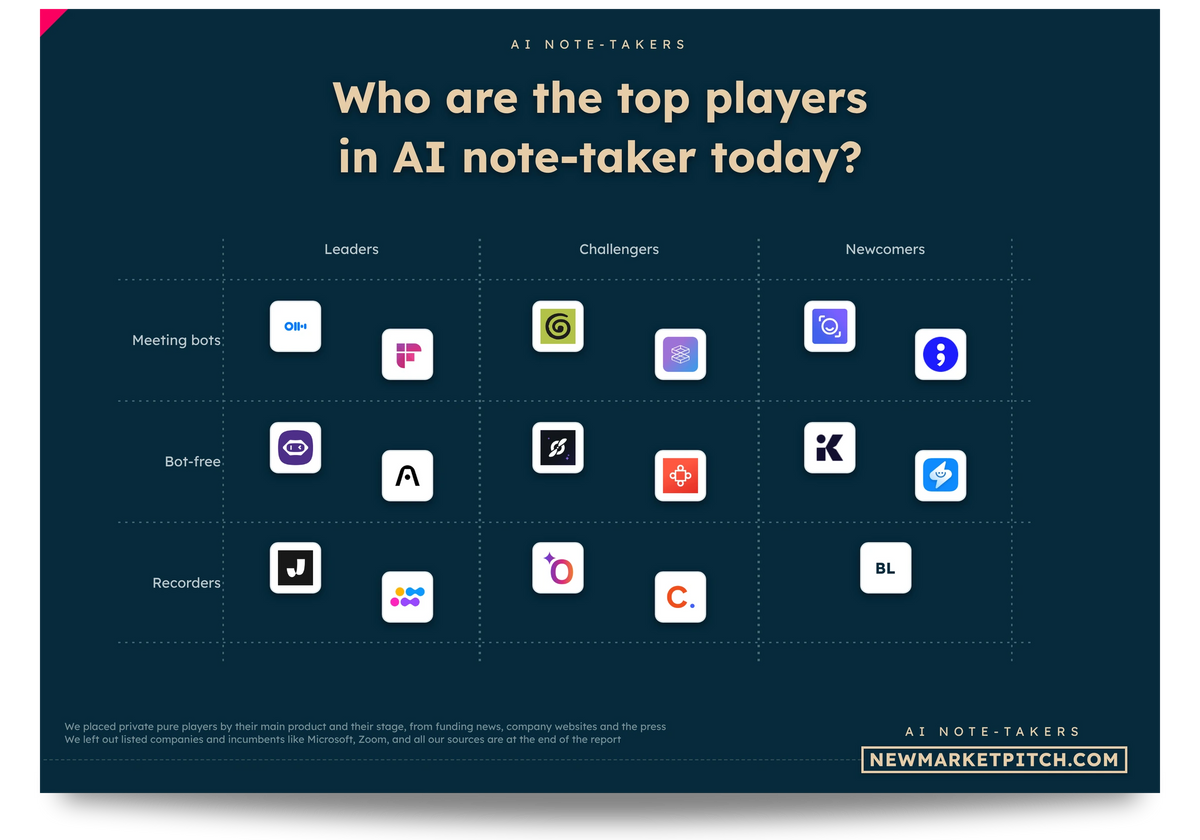
In our research about AI note-taker startups, we turn what is vague and complex into simple, useful visuals. Market maps like this one show you at a glance where every startup stands.
Is Lightspeed Venture Partners doubling down on AI meeting notes?
Yes, Lightspeed Venture Partners has doubled down on two AI note-takers, Granola and Zocks, rather than spreading its counted investments across many competing apps.
Zocks' latest $45M Series B was co-led by Lightspeed Venture Partners and QED Investors, and the company's announcement said Lightspeed had led its earlier seed round. Lightspeed also joined Granola's Series A, Series B and Series C without leading them. Lightspeed therefore has 5 counted rounds, 2 of them led, a stronger pattern of continued backing than a fund simply joining a long investor list.
Zocks turns client meetings into preparation notes, CRM records and follow-up work. Its Series B announcement named Ameritas, Carson Group, Kestra Financial and Osaic among its enterprise customers, and described links to financial-planning and tax software. A financial advisor can use those links to act on what was discussed instead of copying information between systems.
We should still be precise about what this proves. Lightspeed has followed two companies through several funding stages. That says plenty about its belief in Granola and Zocks, but much less about whether it wants a large portfolio of unrelated AI note-taker startups.
Is Y Combinator backing AI note-taking software or recording devices?
Y Combinator is backing both AI note-taker software and recording hardware, through Circleback and Pocket.
Y Combinator's counted activity covers 2 seed rounds, and it was not named as lead in either. Circleback turns online meetings into searchable notes and tasks. In its own seed announcement, the startup said it wanted teams to find useful information that usually gets buried after a call.
Pocket takes another route. Its compact device records in-person conversations and sends transcripts, summaries and to-do lists to an app. The startup's Y Combinator page says the recorder can attach to a phone and capture calls without speakerphone mode. Pocket later raised a seed round led by Accel, with Y Combinator participating.
For Y Combinator, those are different ways of solving the same everyday problem: people forget useful things said aloud. We cannot yet tell which method will produce the better business. A recording device is convenient in a room; software can be easier to distribute across a company. Y Combinator has a stake in each approach.

In our market report about AI note-taker startups, we always try to gather several sources and make estimates that make sense, so you can work with solid numbers.
Why does Citi Ventures keep investing in Jump?
Citi Ventures keeps backing Jump because the AI note-taker is built around financial advisors' work, from client meetings to compliance records and CRM updates.
Citi Ventures participated in Jump's $20M Series A, which Battery Ventures led, and returned for its $80M Series B led by Insight Partners. It was not named as lead in either round. That makes Citi Ventures a repeat participant, while other firms set the terms of the disclosed financing rounds.
When Jump announced its later round, the company said 27,000 advisors were using its tools. The product helps advisors prepare for meetings, record decisions, update client files and handle follow-ups. Those tasks are familiar to financial-services firms, which gives Citi Ventures an understandable reason to pay attention.
There is a limit to the conclusion. Investing in Jump does not prove Citi's banking business distributes the product or has signed a separate commercial contract. What the funding does show is that Citi Ventures remained involved as Jump moved beyond simple notes and attracted a new lead investor.
Is Index Ventures betting that Granola can beat built-in meeting notes?
Index Ventures is betting that Granola's AI note-taker can become useful company memory, even while Google and Microsoft give users meeting notes inside their existing software.
Index Ventures led Granola's $125M Series C. Granola used that announcement to introduce shared Spaces, APIs and more controls for enterprise teams. It also named Vanta, Gusto, Thumbtack and Asana as customers. The company wants colleagues and AI tools to retrieve useful details from past conversations, not just read a meeting summary afterward.
That gives Granola something clear to prove. Google Meet can write notes into a Google Doc, and Microsoft Teams offers intelligent recaps. Granola needs to make the stored context easier to search, share and use across different tools. Its new APIs and shared Spaces show how it plans to do that.
Index Ventures appears in only 1 counted round in this market, despite leading a substantial deal. Its importance here comes from the company it chose and the round it led, rather than a long run of separate AI note-taker investments.
Are Sequoia and Andreessen Horowitz dominating AI note-taker funding?
Neither Sequoia nor Andreessen Horowitz dominates AI note-taker investing by the number of rounds we can attribute to named investors.
It is easy to assume that the best-known Silicon Valley firms must also be the biggest backers of every AI software category. But the leader by counted activity here is Lightspeed Venture Partners, followed by Y Combinator and Citi Ventures. Other recognizable names lead individual deals: Index Ventures backed Granola, Insight Partners backed Jump, and RTP Global backed Attention.
AI note-taking is also narrower than the entire market for speech recognition, enterprise AI or meeting software. A fund can have large investments across those adjacent businesses without regularly appearing in rounds for independent startups whose main product is turning work conversations into usable notes and actions.
The more interesting question is why investors with very different backgrounds are finding companies they like. Financial-advisor workflows, meeting memory and dedicated recording hardware all solve different problems. So far, no household-name VC has cornered those opportunities.
Which AI note-taker investors are still investing this year?
Lightspeed Venture Partners leads this year's AI note-taker activity with 2 rounds, Zocks' Series B in January and Granola's Series C in March.
Of the 20 ranked investors, 9 have participated this year and 11 have not joined a counted round this year. Index Ventures backed Granola, Insight Partners led Jump, and Accel joined the market through Pocket.
These investors are picking very different products. RTP Global led Attention's sales-workflow round, while Basis Set Ventures backed Quill Meetings' approach to private meeting data. We count 7 rounds with named investors this year versus 12 in all of last year, and this year is not over yet. Lightspeed is ahead, but by a small number of deals. Instead, the fresh deals show where established funds think standalone note-taking software can still earn its place.
The table below shows, year by year, how many rounds 12 of the most active AI note-taker investors joined, so it is easy to see who is still investing and who has slowed down.
If you want to go more into detail and see which investors are still writing checks and which have slowed down, please check our AI note-taker report.
| Investor | 2024 | 2025 | 2026* | Total |
|---|---|---|---|---|
| Lightspeed Venture Partners | 2 | 1 | 2 | 5 |
| Y Combinator | 1 | 1 | 2 | |
| Citi Ventures | 1 | 1 | 2 | |
| Accel | 1 | 1 | ||
| RTP Global | 1 | 1 | ||
| Index Ventures | 1 | 1 | ||
| Basis Set Ventures | 1 | 1 | ||
| Insight Partners | 1 | 1 | ||
| QED Investors | 1 | 1 | ||
| Granite-Integral Capital | 1 | 1 | ||
| Ant Group | 1 | 1 | ||
| Early Game Ventures | 1 | 1 |
* 2026: January to 19 November. Darker cells mean more rounds that year. Data from January 2024 through 19 November 2026.

Our document detailing everything you need to know about AI note-taker gets updated several times a month, so you always get the latest view of where things stand.
Can a new AI note-taker still get funded by a major VC?
Yes, a new AI note-taker can still attract established investors, provided it gives customers a reason to choose it over the meeting tools they already use.
Accel led Pocket's $11M seed round, and Basis Set Ventures led Quill Meetings' $6.5M seed round. Pocket records conversations that take place away from scheduled video calls. Quill gives organizations more control over where their meeting data is stored and processed. Circleback, which Y Combinator backed, makes conversations searchable for a team and can pull out follow-up tasks.
Those are more concrete promises than simply producing a readable transcript. Google's meeting-note feature and Microsoft's recap tools already cover that basic job for people inside their platforms. A startup has to win through a better recording experience, stronger data controls or deeper links to work a customer needs to finish.
The seed investments tell us major investors have not given up on new entrants. They also show why copying a generic AI notepad has become a difficult pitch.
Are AI note-taking devices actually getting venture funding?
AI note-taking devices are attracting venture investors, with Pocket and Based Hardware showing that recording hardware still has room beside meeting software.
Accel led Pocket's seed round, with Y Combinator participating. Tim Draper backed Based Hardware's $2M seed round for Omi, a wearable that aims to keep useful context from everyday conversations. Pocket focuses on a small recorder people can use when they meet in person; Omi places more weight on an always-available wearable and its open-source community.
The founders have made the hardware case unusually tangible. Pocket told TechCrunch in June 2026 that it had sold more than 130,000 units. That is a company-reported figure, not an audited result, but it shows the device has moved beyond a concept video.
There are real costs attached to that progress. Devices have to be built, shipped, charged, returned and worn or carried. They also raise sensitive questions about consent when a conversation takes place outside an online meeting with a visible recording notification. Hardware can win customers, but investors still need to see whether device buyers keep using the software.
Why are financial-advisor AI note-takers attracting major investors?
Financial-advisor AI note-takers are drawing major investors because a meeting can lead straight into client records, compliance work and paid follow-up services.
Insight Partners led Jump's Series B, while Lightspeed Venture Partners and QED Investors co-led Zocks' later round. These are companies serving an identifiable profession rather than selling the same general-purpose notepad to everyone.
Jump said it had reached 27,000 advisors when it announced its new funding. Zocks said more than 5,000 financial firms used its product when it announced its Series B, and it named firms including Osaic and Ameritas. Both products connect conversations with tasks that financial advisors already have to complete. The customer can judge whether the software saves administrative work and keeps client information accurate.
That is the appeal for investors. A generic meeting summary is easy for a larger platform to copy, while a product deeply connected to advisors' existing software has more ways to become part of a daily routine. Jump and Zocks also compete with each other, so neither has been handed the market. Still, their financings show serious backing for the same professional problem.
Does Attention show where AI meeting notes are headed next?
Attention shows why investors now want AI note-takers to complete sales work after a call, rather than stop at a summary.
RTP Global led Attention's $30M Series B. In its announcement, the company said its software could draft follow-up emails, update CRM systems and run approved sales tasks. Attention also reported more than 20 million agent actions per month and over 500 customers. Those are company-reported usage figures, but they offer a clearer test than a polished demo of meeting notes.
Attention is not alone in moving past transcripts. Jump builds client follow-ups into financial-advisor workflows; Zocks can turn a conversation into structured planning data; Granola is connecting meeting memory to other AI tools. What users pay for increasingly depends on what happens to the information after it is captured.
Automating a follow-up also raises the stakes. A wrong transcript may be annoying. An incorrect CRM change or message sent to a customer can damage a relationship. Attention's bet will be stronger if customers can see the useful work the software completes without giving up control over important decisions.

In our report covering the AI note-taker market, we look at what the winners do differently, so you can learn from the best instead of guessing.
Can privacy-first AI note-takers still get VC funding?
Privacy-first AI note-takers can still get venture funding, and Quill Meetings has attracted a backer willing to support that approach at seed stage.
Basis Set Ventures led Quill Meetings' $6.5M seed round. Quill describes a meeting assistant built around local control of data and a choice over which AI systems process conversations. For a company discussing hiring, clients or internal plans, that control may determine whether employees are allowed to record a meeting at all.
Privacy means different things across these products. Granola has added enterprise permissions, consent management and scheduled transcript deletion. Jump and Zocks emphasize controls needed by financial-services customers. Quill starts from the concern that organizations may want to keep more of their conversation data under their own control.
The funding is proof that someone will back this product position, not that every company will pay more for it. We would look for customers that face a clear reason to reject ordinary cloud meeting notes. A privacy feature becomes a stronger business advantage when it removes that obstacle and lets a team use the software in practice.
Which AI note-taker investors back seed rounds, and which back growth rounds?
Seed is currently the busiest stage in AI note-taker financing, accounting for 13 of the 30 rounds with named investors and a known stage.
Y Combinator is the sole most active seed investor, with 2 rounds. It backed Circleback's meeting-note software and Pocket's recorder. Basis Set Ventures backed Quill Meetings, while Tim Draper joined Based Hardware. These early bets cover software memory, physical capture and data control.
Later-stage investors are backing startups that can point to established products and customers. Lightspeed Venture Partners is the most active Series B investor, with 2 rounds, Granola's and Zocks'. Insight Partners led Jump's expansion into more work for financial advisors, Lightspeed Venture Partners and QED Investors backed Zocks' broader automation plans, and Index Ventures led Granola's push into company-wide memory. Only 1 round in the market reached Series C or later, so the later-stage group remains small. The stage split tells us where investor interest starts and which companies have managed to keep raising as their products grow.
The table below shows, for 12 of the most active AI note-taker investors, how many rounds they joined at each stage, from seed to growth.
If you want to go more into detail and see where each investor places its bets, from seed to growth, please check our AI note-taker report.
| Investor | Seed | Series A | Series B | Series C | Series D+ | Growth |
|---|---|---|---|---|---|---|
| Lightspeed Venture Partners | 1 | 1 | 2 | 1 | · | · |
| Y Combinator | 2 | · | · | · | · | · |
| Citi Ventures | · | 1 | 1 | · | · | · |
| Accel | 1 | · | · | · | · | · |
| RTP Global | · | · | 1 | · | · | · |
| Index Ventures | · | · | · | 1 | · | · |
| Basis Set Ventures | 1 | · | · | · | · | · |
| Insight Partners | · | · | 1 | · | · | · |
| QED Investors | · | · | 1 | · | · | · |
| Granite-Integral Capital | · | · | 1 | · | · | · |
| Ant Group | · | 1 | · | · | · | · |
| Early Game Ventures | · | · | · | · | · | · |
Most active at each stage, among all AI note-taker investors: Seed, Y Combinator · Series A, no investor joined more than one round · Series B, Lightspeed Venture Partners · Series C, no investor joined more than one round. Bigger dots mean more rounds. Data from January 2024 through 19 November 2026.
Are bigger AI note-taker rounds bringing in new lead investors?
Bigger AI note-taker rounds are drawing new lead investors, even when earlier backers remain involved with the startups.
Index Ventures led Granola's Series C, Insight Partners led Jump's Series B, and RTP Global led Attention's Series B. Each appears in 1 counted round in the investor ranking. Their role in those financings matters more than their frequency: they led companies taking meeting notes into shared knowledge, financial-advisor work or sales automation.
Earlier backers stayed involved too. Citi Ventures returned for Jump's later financing, and Lightspeed Venture Partners stayed with both Zocks and Granola as they raised again. That mix allows a new firm to lead a large deal while earlier backers continue to support the business.
The public announcements do not tell us each participant's check size. We know who led and how much each whole round raised, which are different facts. A newcomer can be important to a startup's next stage without becoming a frequent investor across the entire AI note-taker market.
Which AI note-taker investors actually lead funding rounds?
Lightspeed Venture Partners stands out for repeated lead roles in AI note-taker funding, while several other major firms have led an individual startup round.
We found Lightspeed Venture Partners named as lead in 2 qualifying rounds. Index Ventures led Granola, Insight Partners led Jump, Accel led Pocket, RTP Global led Attention, and Basis Set Ventures led Quill Meetings. Y Combinator and Citi Ventures, ranked just behind Lightspeed by rounds joined, were not named as leads in their counted deals.
A lead investor helps make a financing happen, but a company's announcement rarely reveals how much each firm personally contributed. Nor does joining a funding announcement mean that every named investor played the same role. We keep those facts separate so a large company-level round is not mistaken for a single investor's outlay.
The table below shows selected investors ranked by their counted participation and identified lead roles.
| Investor | Rounds joined | Rounds led | Startup |
|---|---|---|---|
| Lightspeed Venture Partners | 5 | 2 | Granola and Zocks |
| Y Combinator | 2 | 0 | Pocket and Circleback |
| Citi Ventures | 2 | 0 | Jump |
| Accel | 1 | 1 | |
| RTP Global | 1 | 1 | Attention |
| Index Ventures | 1 | 1 | Granola |
| Insight Partners | 1 | 1 | Jump |

Learning from others' mistakes is the cheapest lesson there is. In our research about AI note-taker startups, we look at what broke startups before you, so you don't repeat it.
Are accounting AI note-takers attracting their own investors?
Accounting AI note-takers have attracted investors who know the daily work inside accounting and bookkeeping firms.
Tidal Ventures was named as lead in Vinyl's $1.3M seed round. Vinyl takes notes from client conversations and puts tasks and decisions into the systems accountants already use. Its website shows integrations with Karbon, FYI, Ignition and Xero Practice Manager, which make the product more specific than a generic meeting transcript.
Vinyl's funding announcement also named backers with experience at Dext, Ignition and KeyPay. People who have built software for accountants can judge whether a note-taking tool actually fits a firm's workflow. That is a different kind of expertise from simply predicting that speech-to-text software will become popular.
The comparison with Jump and Zocks is useful. Financial advisors and accountants both spend time turning conversations into records and next steps, but their software and responsibilities differ. Vinyl is betting that a tool designed around accounting work will be easier to keep using than a general meeting assistant. The funding supports that idea; customer retention will be the harder proof.
Are Asian investors backing AI note-taker startups too?
Asian investors are backing AI note-taker startups, including products built for multilingual meetings and local business customers.
GL Ventures and Mizuho Leaguer Investments were named as leads in Notta's ¥990M Series A+ (about $6.9M) in May 2025, while Ant Group was named as lead in Future Intelligence. These investments widen the picture beyond the familiar American venture firms backing Granola, Jump and Pocket.
Notta combines meeting transcription software with a dedicated recording device called Notta Memo. In a company announcement about its expansion, Notta emphasized Japanese enterprise customers and its ambitions in the United States. Its product needs to work across languages, online calls and in-person conversations. Those demands make local adoption and hardware distribution relevant to the funding story.
We would not read these deals as proof that Asian investors now lead the global market. They show something more specific: investor interest depends partly on where a product is sold and how its customers work. Not every winning AI note-taker has to look like a software subscription sold from Silicon Valley.
Is corporate money taking over AI note-taker startups?
Corporate investors have a place in AI note-taking, but independent VCs still lead many of the best-known startup rounds.
Citi Ventures repeatedly participated in Jump's fundraising, and Ant Group was named as lead in Future Intelligence. Jump's Series A was led by Battery Ventures, while Insight Partners led its later Series B. Citi Ventures stayed involved without being named as lead in either deal.
The mix makes sense. A financial-services investor may understand why advisors need compliance records and better client follow-ups. An independent venture firm can focus on how quickly a startup sells, expands and keeps customers. Those viewpoints can overlap without one group taking control of the funding market.
There is an important distinction between investing in a startup and buying or distributing its product. Citi Ventures' participation does not by itself prove a commercial agreement with Citi's banking operations. We would need a separate announcement for that claim. At present, the named round leaders include firms such as Lightspeed Venture Partners, Index Ventures and RTP Global, so a corporate takeover is not what the disclosed deals show.
Which AI note-taker investors most often invest together?
No pair of AI note-taker investors has teamed up twice: none joined more than 1 round together.
The named investors have not formed a recurring partnership across qualifying rounds. Lightspeed Venture Partners and QED Investors co-led Zocks' Series B. Accel and Y Combinator appeared together in Pocket's seed financing. Insight Partners and Citi Ventures participated in Jump's later round. Each collaboration belongs to a specific fundraising event.
These combinations make sense on their own: Zocks works in financial advice, Pocket sells recording hardware, and Jump serves advisor firms. Still, investors appearing together once does not establish a lasting partnership. We cannot yet point to a recurring pair that consistently backs new AI note-taker companies as a team.

If you build or invest in the AI note-taker market, you need to know which business models pay off now and which ones are fading. That's why our report covering it has a whole section on it.
Can the customers of an AI note-taker become investors too?
Yes, customers can become AI note-taker investors, and Attention has already brought users of its sales software into a fundraising round.
Attention said its Series B included angel investors drawn from its customer base. Its announcement named leaders connected to Preply, Abridge, Scale AI and other businesses using the product. Customers who see the software updating records and handling follow-ups have firsthand experience of what works, although that does not tell us what return they will earn as investors.
Vinyl shows a related pattern in accounting, where its investors include founders who know how firms buy and use specialist software. Jump and Zocks cite customers from the financial-advice industry as evidence of growing adoption. Those cases are not identical: being a paying customer is different from buying shares, and an industry founder is not necessarily a customer.
Still, users investing in a tool is worth watching. They have a direct reason to test whether the software solves a problem rather than merely looking good in a demonstration. For Attention, the stronger long-term sign will be whether those customers keep using its automation after the investment announcement fades.
So, who really backs the leading AI note-taker startups today?
Lightspeed Venture Partners is the most active AI note-taker investor today, with 5 qualifying rounds joined, ahead of Y Combinator and Citi Ventures with 2 each.
Their choices point in different directions. Lightspeed Venture Partners has followed Granola and Zocks through several fundraising stages, Y Combinator has backed both Circleback and Pocket, and Citi Ventures has stayed involved with Jump. Lightspeed leads by a few rounds, not by a wide margin.
Other investors matter most as leads of specific deals. Index Ventures led Granola's $125M Series C, Insight Partners led Jump's $80M Series B, Accel backed Pocket's recording hardware, and Basis Set Ventures financed Quill Meetings' privacy-focused approach. Those deals help explain where investors see something worth paying for beyond an ordinary meeting transcript.
So far, no VC has captured this market. It is still split between general meeting memory, specialist work software and physical recording devices. The investors with the best outcomes will be the ones whose startups keep getting used even when Microsoft, Google and Zoom give away the basic notes.
The table below shows what we found.
| Question | Answer |
|---|---|
| Has one investor pulled away from everyone else? | Not far, although Lightspeed Venture Partners leads with 5 rounds. We found 61 named investors across the rounds we studied. Most of them appear in a single round. |
| Does backing the same startup count as commitment? | Lightspeed Venture Partners has stuck with Granola and Zocks. Lightspeed joined 5 rounds and led 2 of them. That repeated support is clearer than a broad list of investments. |
| Is Y Combinator choosing software over physical devices? | Y Combinator has backed software as well as recording hardware. Circleback and Pocket account for its 2 seed rounds. The approaches compete to capture conversations in different settings. |
| Have corporate investors replaced traditional venture firms? | Corporate investors have joined deals without replacing independent venture funds. Citi Ventures appeared in Jump financing without leading either round. Battery Ventures and Insight Partners led the disclosed rounds instead. |
| Can a single huge deal change investor standing? | A large round can be influential without creating frequent appearances. Index Ventures led Granola's $125M Series C financing round. Index Ventures still has just 1 deal in this market. |
| Will financial advisors pay for more than summaries? | Advisor software ties meeting notes to daily client work. Jump raised an $80M Series B led by Insight Partners. CRM updates and compliance tasks make that product more useful. |
| Are sales teams buying notes or completed tasks? | Attention wants its assistant to handle sales follow-ups directly. RTP Global led its $30M Series B financing round. The startup now has to prove those actions improve customers' work. |
| Can hardware companies attract established venture firms? | Recording devices are getting attention from recognizable technology investors. Accel led Pocket's $11M seed round with Y Combinator participating. The physical product captures conversations outside scheduled video calls. |
| Does privacy give startups a funding advantage? | Investors will back meeting software built around customer control. Basis Set Ventures led Quill Meetings' $6.5M seed round. The harder test is whether that control wins paying teams. |
| Have most note-takers reached large growth rounds? | Most tracked AI note-taker financing still happens early. Seed represents 13 of the 30 known-stage rounds with named investors. Only 1 later round reached Series C or beyond. |
| Are investor partnerships becoming a permanent feature? | No enduring co-investor pair has appeared in our counted deals. No pair joined more than 1 round together. Investors have backed different products without repeatedly forming the same teams. |

In our document detailing everything you need to know about AI note-taker, we like to show you the big picture. We know your time is precious, so we make every page quick to read and packed with as much learning as possible per minute.
Our methodology
Our data runs through November 19, 2026. We then reviewed this article and updated its answers on November 24, 2026, the date shown under the title. We track equity funding rounds systematically, deal by deal, since January 2024, a window long enough to distinguish recent participants from older investors. The AI note-taker market covers independent startups whose main product turns spoken work conversations into transcripts, organized notes, searchable meeting memory and follow-up actions. We include online and in-person capture, purpose-built recording devices, privacy-first and multilingual products, and specialized meeting applications; companies near the boundary are included rather than discarded. Every company counted meets our startup definition: an independent, growth-oriented company founded in 2007 or later, financed privately and not long-established as a listed business.
We count the equity rounds an investor joined and separately record the rounds it led, not the amount of money that investor personally contributed. We exclude IPOs and post-listing offerings. We reconcile investor names across announcements and credible reporting, merge duplicate accounts of the same financing, and do not infer participation from phrases such as “existing investors” or “angel investors.” Our current-year investor column begins in March, once we have three months of data. An investor can appear in several funding rounds, whereas the funding tracker counts each company round only once; a company round without a named investor remains in the market total but not in the investor ranking.
Announcements name lead investors more reliably than smaller participants, so rounds that an investor joined without leading are undercounted and lead rates are an upper bound.
Rounds confirmed by a company announcement, a press article or a regulatory filing are counted in full. Where no article exists, a round is counted only when at least two recognised databases agree on its date (within one month) and amount (within 5%), and it is marked as low confidence; a round found in a single database stays in the company's history but is left out of totals. For companies that have raised more than $100M, every round counted is backed by an article.
We do not treat investor lists on commercial databases such as Crunchbase and PitchBook as sufficient evidence by themselves: such lists can add investors who did not join a particular round or include debt and grants. Named investors are available for 31 of 32 counted rounds, or 97%, so participation counts are a floor rather than a complete map of every check. We keep the investor's role separate from the total round size because only the latter is routinely published.
Counting appearances rather than dollars is a deliberate choice. A prominent fund can lead a very large company round and still rank below another investor that repeatedly backed a smaller startup; neither result is contradictory. Frequency shows who keeps returning to this market, lead roles identify publicly acknowledged decision-makers, and stage and company context explain what each backer is betting on. We report those dimensions separately rather than constructing an unsupported estimate of how much each investor personally spent.
Key sources include Zocks' Series B announcement and named co-leads, Zocks' Cetera customer partnership, Jump's Series B, participating investors and advisor adoption, Jump's earlier Series A and Citi Ventures participation, Granola's Series C lead, enterprise customers, Spaces and APIs, Granola's earlier round and product changes, Pocket's device, shipments and reported run rate, Pocket seed announcement and participating investors, Circleback's seed round and meeting-memory features, Attention's Series B, customer participation and agent-action data, Quill Meetings' seed round and privacy controls, Based Hardware's Omi financing and wearable design, Vinyl's accounting product, funding and named investors, Early Game Ventures lists MeetGeek in its portfolio, Notta's company-announced financing and market expansion, Microsoft Teams meeting recaps, Google Meet AI note-taking feature, Zoom meeting summaries and AI Companion, and Pocket's June 2026 seed round and company-reported unit sales.

When you build or invest in the AI note-taker market, you need clarity, not confusion. In our report covering the AI note-taker market, we always try to put numbers on and quantify whatever is usually vague and confusing.
Written by the New Market Pitch teamWe track new markets so founders and investors can move faster. About us