What are the top AI personal assistant startups by total funding raised?
Whether you're building or investing in the AI personal assistant market, our report covers everything you need to know: the players, the money, and what's coming next.
Summary
Perplexity leads AI personal assistant startups in lifetime funding, with $1.7B raised. Instinct is next at $1.4B, and Hark has secured at least $700M. Their products and fundraising histories tell three very different stories.
Perplexity raised money repeatedly while expanding from AI search into Comet, a browser that can take action for users. Instinct raced toward the top with an agent built to handle errands, bookings, and purchases through messages and calls.
Hark has chosen the expensive route: developing its own AI models and hardware. It has attracted large checks before showing the kind of everyday use that would make those investments easier to judge.
Manus is also near the top after its acquisition by Meta was unwound. Its new independent funding puts a general-purpose task agent back into direct competition with larger technology companies.
Genspark has raised $535M while moving beyond search into a workspace that creates documents, spreadsheets, and other finished work. That shift brings it closer to what people expect from an assistant.
The big checks can give the wrong impression of the market. Only 6 of the 56 startups we track have raised nine-figure sums, and the median total is at least $11M. Most founders are working with far smaller budgets.
Look just below the biggest names. Town wants assistants to coordinate work across teams, while Fyxer AI concentrates on email, meetings, and follow-up. Neither needs to build a new foundation model to test its product.
Hardware is still a gamble. rabbit sold its r1 handheld device and later shifted toward software. Limitless and Bee became acquisition targets, while Sandbar is trying a voice ring that remembers what people say.
The United States accounts for 42 companies in our group. Yet Singapore's Manus, Spain's Luzia, India's Equal, and Britain's Fyxer AI have all found distinct ways into personal assistance.
Perplexity is the clear funding winner for now. Whether it wins the everyday assistant market depends on what users actually delegate and how reliably the products finish those jobs. The smaller companies have plenty of room to challenge it on individual tasks.

Written by the New Market Pitch teamWe track new markets so founders and investors can move faster. About us

In our report covering the AI personal assistant market, you will always find fresh funding data, taken straight from our own verified funding database.
Top startups in the AI personal assistant market ranked by total funding raised
Here is the current ranking of the AI personal assistant startups that raised the most, with the total each one has raised and our confidence level.
If you want to go deeper into the AI personal assistant startup landscape, check our report covering the AI personal assistant market.
| # | Startup | Total raised | Last round | Status | Confidence |
|---|---|---|---|---|---|
| $1B and above | |||||
| 1 | PerplexityAI answer engine and Comet browser assistant | $1.7B | Sep 2025~$200M · Series D+ | Active | Full |
| 2 | InstinctPersonal AI assistant automating everyday tasks | $1.4B | Sep 2026$1.0B · Series C | Active | Full |
| $500M to $1B | |||||
| 3 | HarkDevelops proprietary models for personal intelligence | $700M+ | Aug 2026Undisclosed · Other | Active | Full |
| 4 | ManusAutonomous general-purpose AI agents | $585M+ | Oct 2026$500M+ · Undisclosed stage | Active | Full |
| 5 | GensparkAutonomous AI workspace and research | $535M | Jun 2026$100M · Series B extension | Active | Full |
| $100M to $500M | |||||
| 6 | TownPersonal AI assistants for workplace tasks | $181M | Oct 2026$108M · Series B | Active | Full |
| Below $100M | |||||
| 7 | WabiConversational personal assistance and mini apps | $75M | Oct 2026$55M · Series A | Active | Full |
| 8 | rabbitHandheld AI device carries out user requests | $59M | Mar 2024$29M · Equity financing | Active | Full |
| 9 | Highlight AIScreen-aware assistant recalls information from work | $50M | Mar 2026$40M · Series A | Active | Full |
| 10 | LuziaWhatsApp assistant for everyday personal requests | $43M | May 2025$14M | Active | Full |
| 11 | EqualScreens and responds to unwanted phone calls | $40M | Jun 2026$30M · Series B | Active | Full |
| 12 | Fyxer AIAI executive assistant manages inbox and meetings | $40M | Sep 2025$30M · Series B | Active | Full |
| 13 | SandbarSmart ring capturing voice notes with AI memory and recall | $36M | Mar 2026$23M · Series A | Active | Full |
| 14 | LimitlessPersonal memory pendant records and recalls context | $33M | Jun 2023$18M · Series A | Acquired | Full |
| 15 | PineCalls providers to negotiate consumer bills | $25M | Dec 2025$25M · Series A | Active | Full |
| 16 | CadenUses permissioned personal data for assistance | $24M | Aug 2023$15M · Series A | Active | Full |
| 17 | SimularAutomates Mac applications for personal tasks | $22M | Dec 2025$22M · Series A | Active | Full |
| 18 | PleaseAutomates web tasks across multiple sites | $20M | Aug 2024$20M · Series A | Active | Full |
| 19 | ArioCoordinates family schedules, emails and logistics | $16M | Jun 2024$16M · Seed | Active | Full |
| 20 | VerceptVy desktop agent automates computer applications | $16M | Jan 2025$16M · Seed | Acquired | Full |
| 21 | Hello HavenConstructs personal memory for contextual assistants | $15M | Sep 2026$15M · Pre-Seed | Active | Full |
| 22 | PokeHandles everyday tasks through messaging conversations | $15M | Sep 2025$15M · Seed | Acquired | Full |
| 23 | YutoriRuns browser tasks on users behalf | $15M | Mar 2025$15M · Seed | Active | Full |
| 24 | ZapiaWhatsApp assistant for Latin American consumers | $14M | Mar 2026$7M · Seed | Active | Full |
| 25 | ConvergenceProxy agent performs tasks inside browsers | $12M | Sep 2024$12M · Seed | Acquired | Full |
| 26 | Voyage LabsBuilds Atlas, a personal travel agent that plans, books and monitors trips across a persistent workflow. | $12M | Nov 2026$12M · Seed | Active | Full |
| 27 | BoardyIntroduces people by telephone and messaging | $11M | Jan 2025$8M · Seed | Active | Full |
| 28 | GhostAI personal assistant for daily tasks | $11M | Oct 2026$11M · Seed | Active | Full |
| 29 | LittlebirdRemembers work context to answer later requests | $11M | Mar 2026$11M · Seed | Active | Full |
| 30 | ShortwaveAI email client organizes and drafts replies | $9M | Apr 2020$9M · Series A | Active | Full |
| 31 | Jarvie AICoordinates tasks inside group text conversations | $8.3M | Jun 2026$8.3M · Seed | Active | Full |
| 32 | OllieFamily operations assistant reachable through texts | $7.5M | 2025$2M · Funding (stage not disclosed) | Shutdown | Low |
| 33 | HowieSchedules meetings and follows up by email | $7M | Sep 2025$6M · Seed | Active | Full |
| 34 | SkyMac assistant controls apps and workflows | $6.5M | Nov 2023$6.5M · Seed | Acquired | Full |
| 35 | MindyExecutes requests made through email messages | $6M | Feb 2024$6M · Seed | Shutdown | Full |
| 36 | Ohai.aiManages household calendars, lists and reminders | $6M+ | Aug 2025Undisclosed · Other | Active | Full |
| 37 | StrawberryAgent browser carries out personal web workflows | $6M | Oct 2025$6M · Seed | Active | Full |
| 38 | BeeWearable personal AI tracks daily context | $5.5M | Jul 2024$5.5M · Seed | Acquired | Full |
| 39 | PallyRemembers relationships and assists over messages | $5.2M | Aug 2026$5.2M · Seed | Active | Full |
| 40 | CatchAI assistant for everyday tasks | $5M | Sep 2026$5M · Seed | Active | Full |
| 41 | TomoText coach follows up on goals habits | $5M | Jun 2026$5M · Seed | Active | Full |
| 42 | FambotActs as an AI family chief-of-staff | $3.5M | Sep 2026$3.5M · Pre-seed | Active | Full |
| 43 | Personal AITrains private assistant on personal knowledge | $3.2M | Jan 2021$3.2M · Seed | Active | Full |
| 44 | irisgo.aiAutomates planning and personal administrative tasks | $3.1M | 2026$3.1M · Seed | Active | Full |
| 45 | Rhise AIBuilds Lucie, a proactive personal AI assistant connecting email, calendar, health and everyday context. | $2.9M | Nov 2026$2.9M · Angel round | Active | Low |
| 46 | Based HardwareWearable AI captures context and helps recall | $2.7M | Jan 2025$2M · Seed | Active | Strong |
| 47 | MartinVoice assistant organizing users daily lives | $2M | Jan 2025$2M · Seed | Active | Full |
| 48 | Memorae AISaves reminders and schedules through WhatsApp | $2M | Mar 2026$2M · Seed | Active | Low |
| 49 | OrbitsCoordinates household appointments, errands and calendars | $2M | Sep 2026~$2M · Pre-seed | Active | Full |
| 50 | The LibrarianOrganizes reminders and information on WhatsApp | $2M | Nov 2025$2M · Seed | Active | Full |
| 51 | AkiflowCombines task management with intelligent scheduling | $1.8M | May 2022$1.8M · Seed | Active | Full |
| 52 | PassabotBooks flights by messaging the assistant | $1.7M | Aug 2026$1.5M · Pre-Seed | Active | Full |
| 53 | Eden AI LabsAI personal concierge assistant | $1.5M | Oct 2026$1.5M · Seed | Active | Full |
| Undisclosed | |||||
| 54 | DuckbillCombines AI and humans for personal errands | Undisclosed | Sep 2023Undisclosed · Series A | Active | Low |
| 55 | NinjaTech AIAI assistant researches and schedules work | Undisclosed | Aug 2026Undisclosed · Other | Active | Low |
| 56 | Wajo AIPersonal agents completing everyday errands | Undisclosed | 2026Undisclosed · Seed | Active | Low |
No startups match this search.

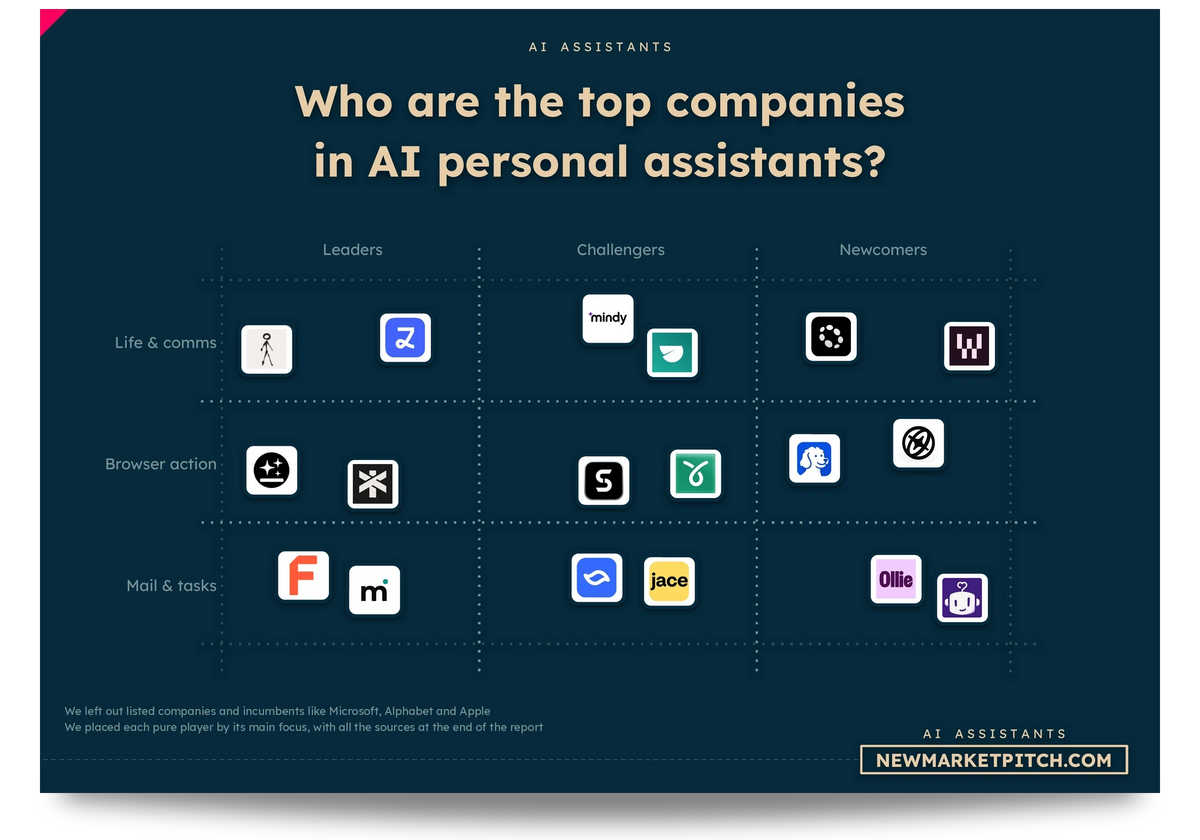
In our research about AI personal assistant startups, we turn what is vague and complex into simple, useful visuals. Market maps like this one show you at a glance where every startup stands.
Is Perplexity still the best-funded personal AI startup?
Perplexity still leads AI personal assistant startups in lifetime equity funding, with $1.7B raised across 9 rounds.
Comet is a big part of why that funding history now belongs in the personal-assistant conversation. Perplexity started with an AI answer engine, then put an agent inside a browser where people already shop, read, plan trips, and manage accounts. The company says Comet can tackle tasks such as inbox work and grocery orders. It is asking users to move from getting answers to handing over actions.
Perplexity's last recorded round was in September 2025. Since then, the funding race has gained a very different challenger in Instinct, which puts calls and transactions at the center of its product. Manus also competes on autonomous digital work. We see Perplexity's lead as evidence of years of successful fundraising, alongside a product that has changed substantially during that time.
The open test is repeat use. A well-funded browser agent still has to earn permission to act, complete tasks correctly, and persuade people to return. Perplexity has the money and distribution to run that test at scale.
Can Instinct catch Perplexity in personal AI funding?
Instinct is the closest challenger to Perplexity in AI personal assistant funding, with $1.4B raised and a much shorter fundraising history.
Instinct's $1.0B Series C in September 2026 was the largest single equity round among the startups we examined. It brought a young company close to the funding total of a business that had spent years raising money. Users can ask Instinct to make calls, book restaurants, find travel, buy things, or cancel subscriptions. The assistant uses a phone and computer to do work on their behalf.
That access creates a real problem alongside the convenience. TechCrunch reported privacy concerns around Instinct's early terms in August 2026. The company subsequently updated its policy, but its approach still asks people to hand over personal details and access to other services. The September financing showed that investors were prepared to back that trade-off at a very large scale. TechCrunch also pointed to Meta's Muse as a new competitor, with direct access to Meta's social products that Instinct lacks.
Instinct could pass Perplexity in lifetime funding with another major round. For a user deciding which agent to trust, the more useful question is how often Instinct finishes the requested work without a mistake or an unwanted action.

In our market report about AI personal assistant startups, we always try to gather several sources and make estimates that make sense, so you can work with solid numbers.
Did one huge round make Perplexity the funding leader?
Perplexity reached the top of personal AI startup funding through repeated rounds, while Instinct made its biggest jump with one enormous check.
We count 9 equity rounds for Perplexity, the most of any company in this group. Its financing history includes major rounds in December 2024 and June 2025. Those came as the product grew from search into a browser assistant. Instinct, by comparison, has 4 recorded rounds, with its largest raise coming after its task-taking agent reached early users.
The difference is bigger than fundraising style. Perplexity already had a consumer search product before asking people to let Comet perform actions. Instinct went straight to personal errands and transactions, with much more trust required from day one. Hark is following a third route by investing in models and hardware before its consumer proposition is widely tested.
One giant round can change the order very quickly, as Instinct showed. But Perplexity's longer history has also funded several changes in what the company sells. That's why the accumulated total and the size of the latest check tell different stories.
Can Hark's expensive personal AI hardware bet pay off?
Hark has raised at least $700M to build a personal AI assistant around its own models and hardware, although broad consumer adoption remains unproven.
Hark describes an assistant that remembers personal context and works across services. In a 2026 announcement, the company also described computing infrastructure using NVIDIA B200 systems. Its plan requires investment in model research, computing power, device design, and software before the finished product has much chance to prove itself with ordinary customers.
There are cheaper ways to start. Perplexity brings an agent into an existing browser, Instinct reaches people through messages and calls, and Town says it can use models from several providers for workplace assistants. Fyxer AI likewise builds its executive-assistant workflow around OpenAI models. For a product focused on inboxes or meetings, owning a foundation model may be unnecessary.
Hark could still gain an advantage if it makes personal memory and action-taking work better together on its own device. Today, the amount raised proves investors believe in that possibility. It tells us much less about whether customers will prefer it to the assistants they already use.

Our document detailing everything you need to know about AI personal assistant gets updated several times a month, so you always get the latest view of where things stand.
Is Manus still independent after its Meta deal fell apart?
Manus is again an independently funded AI agent startup, with at least $585M raised to build software that performs tasks for users.
Reuters reported in October 2026 that Manus parent Butterfly Effect had completed a new financing after the Meta acquisition was unwound. We record Manus's round of at least $500M in October 2026, of undisclosed stage. Boyu Capital and IDG Capital co-led the deal, according to Reuters, with earlier investors also joining. That is a striking outcome for a startup that had briefly appeared destined to become part of a technology giant.
Manus lets people give an agent a goal, then has software research, browse, and carry out a sequence of digital steps. That puts it against browser agents such as Perplexity's Comet and computer-use products built by smaller teams. It also puts Manus near larger platforms that can distribute agents through software people already have.
Manus has retained the chance to build its own product and business after the reversal. Its funding gives it room to compete, but the hard proof will come from sustained, accurate task completion rather than another ownership headline.
Is Genspark still just an AI search engine?
Genspark has become a broader AI workspace for personal tasks, backed by $535M in cumulative equity funding.
The company started with AI-powered search and then added a Super Agent and tools that produce slides, spreadsheets, and other files. Genspark's $100M Series B in June 2026 came after that move toward work people can actually use. Instead of stopping at a web answer, the product aims to help finish the next step.
Perplexity is pursuing a related goal inside its Comet browser. Manus starts with multistep agent work, while Town places assistants inside office workflows. Each takes a different route to the moment a user can say, in ordinary language, what needs doing and receive an outcome instead of instructions.
That makes Genspark a personal assistant business, even though search remains part of its story. Its funding supports a wider product than the one it launched with. Whether customers prefer a workspace, browser, or messenger is still up for grabs.
Do AI personal assistant startups really need $100M to compete?
Most AI personal assistant startups have raised far less than $100M: only 6 of the 56 we track have reached nine-figure totals.
The top end is unusually steep. Two startups have raised at least $1B, three sit between $500M and $1B, and only one is in the bracket immediately below that. Another 50 sit below the nine-figure mark. The median is far closer to the budgets of focused products than to the sums attached to giant agent platforms.
Hark needs to fund proprietary models and hardware. Perplexity has a browser product and costly AI services to run. A startup that handles only email, family scheduling, or phone calls can try to win one daily habit first. Fyxer AI, Ario, and Equal show how different those narrower jobs can be.
We would be cautious about treating a huge funding total as the minimum needed to compete. It buys time to build ambitious technology. A smaller company can still become the tool someone reaches for every day if it does one job well.

In our report covering the AI personal assistant market, we look at what the winners do differently, so you can learn from the best instead of guessing.
Can a personal AI assistant get off the ground with a seed round?
A single seed round can get a personal AI assistant into users' hands, and 33 companies in our group have raised just one equity round.
Yutori raised a $15M Seed in March 2025 to develop agents that navigate websites for users. Voyage Labs has launched Atlas, a travel assistant that can plan trips, make bookings, and keep watching prices and availability. Hello Haven is building personal memory, while Ario is trying to keep family schedules and messages organized. These founders are starting with specific problems rather than promising to run somebody's entire digital life.
A seed-backed agent can still fail on something as basic as a changed web page, a missed calendar invitation, or permission to access an account. Training better models is one approach; building reliable integrations and asking for confirmation at the right moment is another. Smaller funding amounts make that focus more important.
The table below shows a selection of personal assistant startups that launched with one recorded equity round, ordered by total raised.
| Startup | Total raised | Rounds |
|---|---|---|
| Ario | $16M | 1 |
| Yutori | $15M | 1 |
| Voyage Labs | $12M | 1 |
| Ghost | $11M | 1 |
| Jarvie AI | $8.3M | 1 |
| Sky | $6.5M | 1 |
| Mindy | $6M | 1 |
| Bee | $5.5M | 1 |
Can AI assistants really use your computer for you?
Computer-using personal AI agents can operate actual desktop apps and websites, although reliable completion still varies by task.
Simular builds agents that move through Mac applications and carry out sequences of clicks and edits. Simular's $22M Series A in December 2025 backed that work. Yutori is focused on web tasks; Vercept developed the Vy desktop agent, and Sky built a Mac assistant that could interpret what was on screen. These startups share a practical ambition: people should be able to ask for a result without learning every step in the software.
An agent can work well in a demo and still get stuck on a pop-up, an unfamiliar form, or a page that has changed since it last visited. The more serious the action, the more users need control. Ordering a product or changing a financial document requires much more care than gathering restaurant options.
This is why browser and desktop access attract money. Perplexity's Comet and Genspark offer their own routes into users' work, while the smaller computer-use teams concentrate on making the underlying actions dependable. Finishing the task correctly is the test.

In our research about AI personal assistant startups, we don't want to repeat what boring consulting reports say. Instead, we show you the real and latest market signals that matter.
Why did OpenAI buy a small Mac assistant startup?
OpenAI acquired Sky, a personal AI assistant for Mac applications, to bring screen-aware actions closer to everyday computer use.
OpenAI announced the purchase of Software Applications Incorporated in October 2025. Sky could read the context of a user's screen and help perform actions in applications. The startup had raised $6.5M, a modest amount beside the biggest personal agents, but its technology addressed something that users and major model developers both want: help inside the programs they already use.
Salesforce made a similar move when it bought Convergence, whose browser agent could work through changing web interfaces. Convergence had raised $12M. Vercept is another acquired computer-use startup in our research. These deals give larger companies specialized teams and technology without forcing the original product to keep raising funds alone.
A small funding total can hide useful technology. An acquisition can end a standalone product, or help its technology reach a far bigger audience. What happens after the purchase is the part customers will actually notice.
Did rabbit's r1 convince people to buy AI assistant hardware?
rabbit's r1 proved that consumers would try a dedicated AI assistant gadget, although rabbit is now putting more of its effort into software.
rabbit said the r1 sold more than 100,000 units after its 2024 debut. That showed genuine curiosity about a device designed around asking an AI to do things rather than opening apps. rabbit has raised $59M, far below the sums devoted to Hark's proposed model-and-hardware system.
The next chapter was telling. WIRED reported in September 2026 that rabbit had stopped manufacturing the r1 and was concentrating on its OS3 agent platform. OS3 works across computers people already own, removing the need to buy a dedicated device. The r1 can still be used with the platform, but the company's priority has shifted.
Sandbar is taking a different hardware route with a voice ring, while Bee explored an ambient wearable that remembers context. Those devices have to earn a place beside a phone, watch, and laptop. Initial sales can show interest; repeat use decides whether a separate gadget is worth carrying.

Learning from others' mistakes is the cheapest lesson there is. In our market report about AI personal assistant startups, we look at what broke startups before you, so you don't repeat it.
What did Meta and Amazon want from AI assistant wearables?
Meta and Amazon acquired personal AI wearable startups to develop assistants that remember more of a user's everyday context.
Meta bought Limitless in December 2025. Limitless had raised $33M and sold a pendant that captured conversations for later recall. After the deal, the company said it would stop selling new pendants and support existing users only for a limited period. Meta gained technology and a team, while the original standalone product began winding down.
Amazon bought Bee, a wearable startup with $5.5M in equity funding. In January 2026, Amazon described expanding Bee's personal context and voice-note features. Its product story emphasized giving users control over what gets captured and avoiding retention of raw audio. The company can develop those capabilities alongside an existing range of consumer devices.
Neither acquisition settles whether people want an always-listening assistant. Consent, mistakes in memory, and control over sensitive conversations remain serious questions. But both buyers clearly see value in an assistant that remembers the circumstances around a request, rather than only the words typed at that moment.
Can an AI assistant actually remember your life?
Personal-memory AI assistants are getting better at recalling a user's context, but remembering accurately is still easier than taking the right action.
Highlight AI has raised $50M, including a $40M Series A in March 2026, to help users find and reuse information from work. Caden has raised $24M around personal data people choose to share. Littlebird also builds memory around work context. All three are tackling a familiar annoyance: telling an assistant the same details again every time.
Hello Haven launched with a plan to connect personal information across calls, messages, email, and other sources. Its $15M Seed in September 2026 backs a persistent memory system. Sandbar's voice ring approaches the problem through speech, while Bee has tested a wearable that captures selected moments throughout the day. These are different ways of keeping an assistant informed between tasks.
A correct memory can prevent a missed appointment or help someone resume interrupted work. Acting on that memory requires another layer of judgment and permission. The product that earns trust will need to know what to remember, what to forget, and when to ask before doing anything.

If you build or invest in the AI personal assistant market, you need to know which business models pay off now and which ones are fading. That's why our report covering it has a whole section on it.
Can Fyxer AI do more than write email drafts?
Fyxer AI is already doing useful executive-assistant work around email and meetings, although a complete hands-off workflow remains a tougher goal.
The company organizes inboxes, writes replies, and prepares meeting follow-ups. OpenAI reported in a September 2026 case study that 53% of Fyxer's generated drafts were accepted without edits. That is a useful measure of how often the writing works, but it does not tell us how often a whole task gets finished without human attention.
Town is trying something broader. Town's $108M Series B in October 2026 supported assistants that exchange context and hand work between people in a company. Shortwave focuses on email, while Howie handles scheduling and follow-ups. Fyxer AI has raised $40M, making its funding profile much smaller than Town's while addressing an everyday need users can recognize immediately.
For office assistants, the next test is closing the loop: did the meeting get booked, the message answered, and the task finished? A fluent draft is helpful. A completed job is better.
Are investors backing AI assistants for families yet?
Family AI assistants have begun attracting venture funding, with Ario and Ohai.ai working on shared household tasks, while Ollie has already closed.
Ario has raised $16M to organize family calendars, emails, and logistics. Ollie raised $7.5M across two rounds for a text-based family assistant before closing, and Ohai.ai has raised at least $6M for schedules, reminders, and lists. Fambot and Orbits also target household coordination. The jobs may sound small until several people need to keep the same plans straight.
Family assistants face a different challenge from a workplace tool. Parents and children have different permissions, and one person's private information shouldn't automatically become available to everyone else. Ollie discussed privacy and subscription funding in a September 2026 interview, putting user trust near the center of its product pitch, then announced in October 2026 that it was shutting down.
Town can rely on company-managed accounts and work software. A household has no comparable administrator. These early products will need to make shared coordination easy without turning the family calendar into a complicated access-control project. Funding shows that investors see a business here; widespread daily adoption still has to follow.
Can WhatsApp AI assistants compete with bigger agents?
WhatsApp-based personal AI assistants such as Luzia and Zapia can reach large audiences without asking users to install another app.
Spain's Luzia has raised $43M to serve people through a channel they already know. In its May 2025 financing announcement, the company said it had reached over 65 million users in more than 40 countries. Those are company-reported reach figures, rather than proof that every user delegates complex tasks. Still, familiar messaging gives Luzia an easy entry point that a brand-new browser or device lacks.
Zapia, based in Uruguay, has raised $14M and expanded its WhatsApp assistant toward booking and other actions across websites. Singapore's The Librarian manages reminders and information over messaging, while Brazil's Passabot uses conversation to help book flights. Their products start with a clear job and a familiar interaction.
The limits show up once an assistant needs payment details, account access, or confirmation from another service. A chat window makes asking easier, but it can't remove those steps. Focused messaging assistants have a credible route to users even if their funding never approaches a general-purpose agent's budget.

In our report covering the AI personal assistant market, we like to show you the big picture. We know your time is precious, so we make every page quick to read and packed with as much learning as possible per minute.
Are American startups dominating the personal AI funding race?
American startups lead the personal AI assistant funding field by company count, with 42 based in the United States across a group spanning 12 countries.
Perplexity, Instinct, Hark, Genspark, and Town are all American. But some of the more distinctive challengers are elsewhere. Singapore's Manus builds autonomous agents, Spain's Luzia uses WhatsApp, India's Equal screens calls, and the United Kingdom's Fyxer AI handles executive work. Each comes at personal assistance through a different daily task.
Equal's $30M Series B in June 2026 backed a call-screening service that TechCrunch said had more than a million monthly active users. Britain's Convergence instead built computer-using technology and eventually joined Salesforce. The examples explain why a country count alone misses what customers are actually buying.
The table below shows selected personal assistant startups outside the United States, ordered by funding total.
| Startup | Country | Total raised |
|---|---|---|
| Manus | Singapore | $585M+ |
| Luzia | Spain | $43M |
| Equal | India | $40M |
| Fyxer AI | United Kingdom | $40M |
| Zapia | Uruguay | $14M |
| Convergence | United Kingdom | $12M |
| Boardy | Canada | $11M |
| Strawberry | Sweden | $6M |
Can a specialized AI assistant beat a general-purpose agent?
A specialized personal AI assistant can be more useful than a broad agent for a specific job, even with much less funding.
Pine has raised $25M to contact service providers and negotiate bills. Equal screens incoming calls, while Boardy introduces people by phone and Howie helps arrange meetings. These products have a clear result a user can check. If the call was screened, the bill reduced, or the meeting booked, the assistant has done its job.
Voyage Labs makes the comparison concrete with Atlas, an agent that plans trips, makes reservations, and watches changes after booking. The company says it combines supplier relationships with software that can navigate sites when no direct integration exists. Travel requires a record of what was booked and what happens if plans change. A generic answer about flights is a smaller accomplishment.
Instinct and Manus offer much wider scopes. That makes them attractive for varied errands, but a specialist can spend its time learning one kind of transaction and dealing with the exceptions. We see room for both until independent evidence shows which products get more jobs right for real users.

When you build or invest in the AI personal assistant market, you need clarity, not confusion. In our research about AI personal assistant startups, we always try to put numbers on and quantify whatever is usually vague and confusing.
Are most funded personal AI assistant startups still independent?
Most venture-backed personal AI assistant startups are still active, while acquisitions have already absorbed several smaller products.
We count 48 active companies, 6 acquired startups, and 2 shutdowns. Limitless joined Meta, Bee joined Amazon, Sky went to OpenAI, and Convergence became part of Salesforce. Poke and Vercept are also recorded as acquired. Mindy, which handled requests by email, and Ollie, the family assistant, are recorded as shut down.
Those endings are different for the people who used the products. Limitless stopped new pendant sales after the Meta deal; a technology giant may reuse the team's work even as an original service disappears. Sky's screen-aware technology may reach more people inside OpenAI products than it could have as a separate startup. There is no automatic answer about whether either outcome is better for customers.
Manus shows another possibility: after its Meta acquisition was unwound, investors backed it again as a standalone agent business. Its story makes clear why a funding total and a company's current status belong together. One tells us what was raised; the other tells us whether the company is still selling its own product.
So, which personal AI assistant startups have raised the most?
Perplexity is the number one AI personal assistant startup by lifetime equity funding, ahead of Instinct, Hark, Manus, and Genspark.
Perplexity raised money over multiple years while adding Comet to its search business. Instinct caught up quickly with a huge round for an agent that handles personal transactions. Hark is financing its own models and hardware, Manus has returned to independent operations, and Genspark has grown from search into an AI workspace.
The next group looks different again. Town builds connected workplace assistants; Wabi offers conversational personal help and mini-apps; rabbit experimented with a handheld device before turning harder toward software. Highlight AI, Luzia, Equal, and Fyxer AI are putting money into memory, messaging, call screening, and executive work.
Perplexity currently leads the lifetime funding contest. We still wouldn't treat that as a verdict on which assistant works best: a focused product can win a daily habit without ever matching a billion-dollar fundraising history.
The table below shows what we found.
| Question | Answer |
|---|---|
| Has the funding leader also won users' trust? | Perplexity leads personal AI funding, but trust needs its own proof. Perplexity has raised $1.7B across 9 equity rounds. Users still need reliable results when they delegate real tasks. |
| Could Instinct soon move into first place? | Instinct is already the closest challenger in lifetime funding. Instinct has raised $1.4B through a much shorter history. Another giant round could change the order without proving better reliability. |
| Is Hark funding a proven consumer product? | Hark is backing an ambitious personal model-and-hardware project. Hark has raised at least $700M for that approach. Broad everyday use would make the bet much easier to judge. |
| Did Manus lose its chance to compete independently? | Manus returned to independent operations after the Meta deal unraveled. Manus's lifetime equity total is at least $585M. Fresh backing gives its general-purpose agents another chance to compete. |
| Has Genspark moved far beyond AI search? | Genspark now produces useful work through a broader agent workspace. Genspark's total funding is $535M across several equity rounds. The product now competes for tasks beyond answering search questions. |
| Is nine-figure funding ordinary for personal assistants? | The biggest personal agent budgets are still unusual. Only 6 tracked startups have reached nine-figure funding totals. Most teams are trying to win narrower daily tasks. |
| Did Instinct secure the biggest individual round? | Instinct recorded the largest single equity raise in this group. Instinct's September 2026 Series C brought in $1.0B. That one check quickly narrowed the lifetime funding gap. |
| Can a small team still launch after seed? | Seed financing can get a focused personal assistant launched. We count 33 companies with only one recorded equity round. A launch still leaves long-term demand and reliability unproven. |
| Has a separate AI gadget become essential? | Dedicated devices have yet to become the default interface. rabbit raised $59M before focusing more heavily on software. Existing phones and computers remain formidable alternatives for everyday use. |
| Are promising personal agents built outside America? | Yes, personal assistants are being built across several countries. Our group includes startups from 12 countries in total. American teams dominate the count, but not every useful approach. |
| Do acquisitions guarantee that an assistant survives? | An acquisition can preserve technology while changing the customer product. We count 6 acquired personal assistant startups in this group. What the buyer keeps running matters more than the headline. |

A good product starts with a real problem. In our market report about AI personal assistant startups, we show you the ones customers still live with.
Our methodology
Our data runs through November 19, 2026. We then reviewed this article and updated its answers on November 24, 2026, the date shown under the title. We define the AI personal assistant market as companies whose central product acts for an identifiable person to organize, remember, coordinate, or finish everyday personal and professional tasks. We include proactive voice and text agents, browser and computer-use assistants, executive and household coordinators, personal-memory systems, and meaningful AI concierge or wearable products; we retain companies near the boundary where personal task execution is central. Every company in this ranking meets our startup definition: an independent, growth-oriented company founded in 2007 or later that was venture-, angel-, founder-, or grant-backed and is private or recently listed. Acquired, shutdown, and recently listed companies keep their historical place, with status shown; totals stop at acquisition or at the IPO, including its primary proceeds.
A funding total includes equity raised since founding, including the oldest private rounds and primary proceeds from an IPO. It excludes debt, venture debt, grants, unconverted convertibles and SAFEs, post-IPO offerings, and secondary share sales; a converted SAFE remains part of the equity round that absorbed it. Duplicate reports of one round are merged. A total ending in "+" is a minimum because one or more rounds lack a published amount. Unlike a recent-deals tracker, this ranking covers each company's entire financing history.
Rounds confirmed by a company announcement, a press article or a regulatory filing are counted in full. Where no article exists, a round is counted only when at least two recognised databases agree on its date (within one month) and amount (within 5%), and it is marked as low confidence; a round found in a single database stays in the company's history but is left out of totals. For companies that have raised more than $100M, every round counted is backed by an article.
We do not adopt funding totals or valuations published by commercial databases as our own figures, because those totals can include debt, grants, unpaid commitments, or estimates. A database is not the sole basis for any round counted in full; two agreeing database records qualify only as low-confidence evidence. When a company or news outlet reports a different lifetime total, we retain the sum of the equity rounds we can substantiate and explain major gaps in notes alongside the full ranking. Its confidence field distinguishes Full, Strong, Partial, and Low according to the share of financing supported by confirmed rounds.
That choice explains why a well-known company may appear lower than a press headline suggests. Announced financing can be grouped differently, include instruments that we exclude, or describe a transaction before the equity component is fully clear. We apply one definition across the companies rather than substituting a headline number when it is larger. Likewise, a business acquired by a technology giant can remain in a historical fundraising ranking without being portrayed as an independent competitor today.
We checked company announcements, regulatory information, investor material, and established news reporting for the developments used to interpret the ranking. We separate lifetime equity raised from company valuations, product usage, revenue, and acquisition prices: each describes a different outcome, and none can be derived reliably from the funding total alone.
Key sources include Perplexity's Comet browser and personal-task assistant capabilities., Instinct's September 2026 financing, product scope, and privacy concerns., Hark's proprietary-model, hardware, and computing plans., Reuters reporting on Manus's independent financing after the Meta deal reversal., Genspark's transition from search to agents, slides, and spreadsheets., Town's fundraising and networked workplace-assistant approach., Wabi's conversational-agent and mini-app product direction., rabbit's initial r1 device sales and product rollout., rabbit's later shift toward an agent software platform., Sandbar's Stream voice ring and personal-memory ambitions., Meta's Limitless acquisition and the status of the pendant and services., Amazon's account of Bee's wearable and post-acquisition product development., OpenAI's acquisition of Sky and its Mac computer-use capabilities., Salesforce's acquisition of Convergence and its browser-agent technology., Simular's computer-using agents for desktop applications., Yutori's seed financing and web-task agent design., Fyxer's executive-assistant workflows, draft acceptance, and retention., Luzia's WhatsApp assistant and international user footprint., Zapia's browser-action, booking, and messaging assistant features., Equal's call-screening assistant, user adoption, and financing., Voyage Labs' Atlas travel agent and supplier integrations., Hello Haven's persistent personal-memory and digital-twin product., Ollie's family assistant and privacy-led product strategy., and Ollie's shutdown announcement..
In our document detailing everything you need to know about AI personal assistant, you will always find fresh funding data, taken straight from our own verified funding database.
Written by the New Market Pitch teamWe track new markets so founders and investors can move faster. About us