What’s funding like in the AI personal assistant market right now?
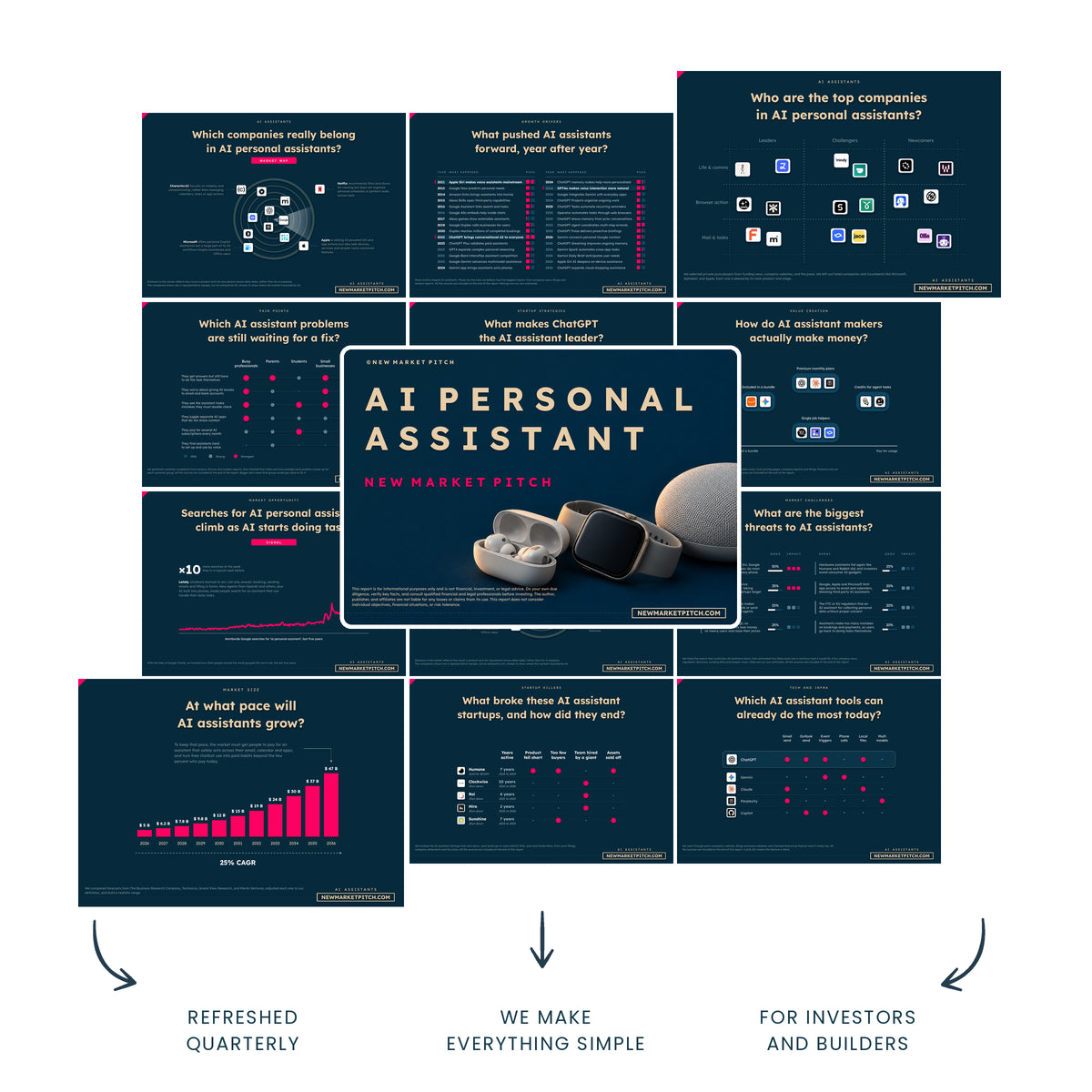
Whether you're building or investing in the AI personal assistant market, our report covers everything you need to know: the players, the money, and what's coming next.
Summary
AI personal assistant funding is growing across the market, although a few huge bets still take most of the money. We tracked 33 deals worth at least $3.4B in the last 12 months, and Instinct raised the most of any startup, at $1.4B. More companies are getting funded, too.
The growth survives a tougher test. Even after leaving out rounds above $50M, startups raised more than in the 12 months before. Investors have also increased the typical disclosed check, although the sums at the very top are in another league.
New founders are getting a chance. First financings became more frequent, but the median first check fell. A startup can find backing for a focused assistant without convincing investors to finance a universal AI platform.
Those focused products now cover real chores: booking trips, sorting family calendars, remembering work across apps and dealing with consumer bills. The question for each business is whether people keep using it after the novelty wears off.
At the other end, Instinct is raising successive rounds for a consumer agent that acts on requests. Hark wants to build its own models and devices. Manus and Genspark are going after tasks inside browsers and other software. Investors are placing very different bets under one market label.
Messaging and voice assistants now draw the largest share of disclosed capital, helped enormously by Instinct. Computer-use agents have won larger checks even as their deal count has declined. Meanwhile, dedicated memory tools are getting funded without promising to do every task.
The United States has pulled further ahead in financing. That does not mean people elsewhere have stopped using personal agents: companies in Singapore, India and Latin America are building products around different workflows and communication habits.
More venture firms are also willing to lead rounds. Yet impressive fundraisings can hide how little we know about paid retention, task success and the cost of keeping an agent running. Ollie's shutdown shows what happens when a promising product cannot keep up.
Google, Microsoft, OpenAI and Anthropic already offer assistants that know more about users or take actions across services. For an independent startup, a useful niche is now a necessity rather than a marketing choice.
So this is a healthier funding market, but still an unsettled business market. The money gives startups time to prove their assistants can save real work, earn trust and keep customers. It does not prove they will succeed.

Written by the New Market Pitch teamWe track new markets so founders and investors can move faster. About us

In our report covering the AI personal assistant market, you will always find fresh funding data, taken straight from our own verified funding database.
All funding deals in the AI personal assistant market over the last 24 months
Below is the table listing all the deals. You can find our methodology at the end of this page.
If you want a deeper understanding of the market and its current dynamics, get our AI personal assistant market report.
| Company | Category | Date | Stage | Deal size | What they do | Region | Lead investors | Country | Rank |
|---|---|---|---|---|---|---|---|---|---|
| Voyage Labs | Concierge and delegated errands | November 2026 | Seed | $12M | Builds Atlas, a personal travel agent that plans, books and monitors trips across a persistent workflow. | North America | Kleiner Perkins | United States | |
| Rhise AI | Personal memory and context | November 2026 | Seed | $2.9M | Builds Lucie, a proactive personal AI assistant connecting email, calendar, health and everyday context. | Europe | Not disclosed | Germany | |
| Wabi | General-purpose assistant platforms | October 2026 | Series A | $55M | Conversational personal assistance and mini apps | North America | IVP | United States | |
| Town | Executive and productivity assistants | October 2026 | Series B | $108M | Personal AI assistants for workplace tasks | North America | Forerunner Ventures, Menlo Ventures | United States | |
| Manus | Computer-use and web-task agents | October 2026 | Unknown | $500M+ | Autonomous general-purpose AI agents | Asia-Pacific | Boyu Capital, IDG Capital | Singapore | |
| Ghost | General-purpose assistant platforms | October 2026 | Seed | $11M | AI personal assistant for daily tasks | North America | Andreessen Horowitz | United States | |
| Eden AI Labs | Concierge and delegated errands | October 2026 | Seed | $1.5M | AI personal concierge assistant | North America | Gaea Ventures | United States | |
| Instinct | Messaging and voice personal agents | September 2026 | Series C | $1.0B | Personal AI assistant automating everyday tasks | North America | Sequoia Capital, Benchmark, Coatue | United States | |
| Hello Haven | Personal memory and context | September 2026 | Seed | $15M | Constructs personal memory for contextual assistants | North America | Mayfield | United States | |
| Orbits | Family and household coordination | September 2026 | Seed | ~$2M | Coordinates household appointments, errands and calendars | North America | a16z speedrun | Canada | |
| Catch | General-purpose assistant platforms | September 2026 | Seed | $5M | AI assistant for everyday tasks | Middle East | Entrée Capital, Pitango | Israel | |
| Fambot | Family and household coordination | September 2026 | Seed | $3.5M | Acts as an AI family chief-of-staff | North America | NextView Ventures, Baukunst | United States | |
| Passabot | Messaging and voice personal agents | August 2026 | Seed | $1.5M | Books flights by messaging the assistant | Latin America | Parceiro Ventures | Brazil | |
| Instinct | Messaging and voice personal agents | August 2026 | Series B | $250M | Personal AI assistant automating everyday tasks | North America | Index Ventures, Benchmark | United States | |
| Hark | General-purpose assistant platforms | August 2026 | Unknown | Undisclosed | Develops proprietary models for personal intelligence | North America | Not disclosed | United States | |
| Pally | Executive and productivity assistants | August 2026 | Seed | $5.2M | Remembers relationships and assists over messages | North America | Cyber Fund, Y Combinator | United States | |
| Instinct | Messaging and voice personal agents | August 2026 | Series A | $75M | Personal AI assistant automating everyday tasks | North America | Kleiner Perkins | United States | |
| NinjaTech AI | Executive and productivity assistants | August 2026 | Unknown | Undisclosed | AI assistant researches and schedules work | North America | Not disclosed | United States | |
| Tomo | Personal memory and context | June 2026 | Seed | $5M | Text coach follows up on goals habits | North America | Bain Capital Ventures | United States | |
| Jarvie AI | Messaging and voice personal agents | June 2026 | Seed | $8.3M | Coordinates tasks inside group text conversations | North America | Andreessen Horowitz, Base10 Partners, Lightspeed Venture Partners | United States | |
| Equal | Messaging and voice personal agents | June 2026 | Series B | $30M | Screens and responds to unwanted phone calls | Asia-Pacific | Prosus Ventures, Tomales Bay Capital | India | |
| Genspark | Computer-use and web-task agents | June 2026 | Series B | $100M | Autonomous AI workspace and research | North America | Not disclosed | United States | |
| Town | Executive and productivity assistants | June 2026 | Series A | $55M | Personal AI assistants for workplace tasks | North America | Andreessen Horowitz | United States | |
| Hark | General-purpose assistant platforms | May 2026 | Series A | $700M+ | Develops proprietary models for personal intelligence | North America | Parkway Venture Capital | United States | |
| Highlight AI | Personal memory and context | March 2026 | Series A | $40M | Screen-aware assistant recalls information from work | North America | Khosla Ventures | United States | |
| Littlebird | Personal memory and context | March 2026 | Seed | $11M | Remembers work context to answer later requests | North America | Lotus Studio | United States | |
| Sandbar | Ambient and wearable assistants | March 2026 | Series A | $23M | Smart ring capturing voice notes with AI memory and recall | North America | Adjacent, Kindred Ventures | United States | |
| Zapia | Messaging and voice personal agents | March 2026 | Seed | $7M | WhatsApp assistant for Latin American consumers | Latin America | Prosus Ventures | Uruguay | |
| Memorae AI | Messaging and voice personal agents | March 2026 | Seed | $2M | Saves reminders and schedules through WhatsApp | North America | Mucker Capital | United States | |
| Instinct | Messaging and voice personal agents | January 2026 | Seed | $25M | Personal AI assistant automating everyday tasks | North America | Conviction, Greenoaks | United States | |
| Pine | Concierge and delegated errands | December 2025 | Series A | $25M | Calls providers to negotiate consumer bills | North America | Not disclosed | United States | |
| Simular | Computer-use and web-task agents | December 2025 | Series A | $22M | Automates Mac applications for personal tasks | North America | Felicis | United States | |
| Genspark | Computer-use and web-task agents | November 2025 | Series B | $275M | Autonomous AI workspace and research | North America | Emergence Capital | United States | |
| The Librarian | Messaging and voice personal agents | November 2025 | Seed | $2M | Organizes reminders and information on WhatsApp | Asia-Pacific | Golden Gate Ventures | Singapore | |
| Wabi | General-purpose assistant platforms | November 2025 | Seed | $20M | Conversational personal assistance and mini apps | North America | Andreessen Horowitz | United States | |
| Strawberry | Computer-use and web-task agents | October 2025 | Seed | $6M | Agent browser carries out personal web workflows | Europe | General Catalyst, EQT Ventures | Sweden | |
| Howie | Executive and productivity assistants | September 2025 | Seed | $6M | Schedules meetings and follows up by email | North America | True Ventures | United States | |
| Perplexity | General-purpose assistant platforms | September 2025 | Series D+ | ~$200M | AI answer engine and Comet browser assistant | North America | Not disclosed | United States | |
| Fyxer AI | Executive and productivity assistants | September 2025 | Series B | $30M | AI executive assistant manages inbox and meetings | Europe | Madrona Venture Group, Lakestar | United Kingdom | |
| Poke | Messaging and voice personal agents | September 2025 | Seed | $15M | Handles everyday tasks through messaging conversations | North America | General Catalyst | United States | |
| Ohai.ai | Family and household coordination | August 2025 | Unknown | Undisclosed | Manages household calendars, lists and reminders | North America | Muse Capital | United States | |
| Perplexity | General-purpose assistant platforms | July 2025 | Unknown | $100M | AI answer engine and Comet browser assistant | North America | Not disclosed | United States | |
| Perplexity | General-purpose assistant platforms | June 2025 | Growth Equity | $500M | AI answer engine and Comet browser assistant | North America | Accel | United States | |
| Luzia | Messaging and voice personal agents | May 2025 | Unknown | $14M | WhatsApp assistant for everyday personal requests | Europe | Prosus Ventures | Spain | |
| Zapia | Messaging and voice personal agents | April 2025 | Seed | $7.3M | WhatsApp assistant for Latin American consumers | Latin America | Prosus Ventures | Uruguay | |
| Manus | Computer-use and web-task agents | April 2025 | Series B | $75M | Autonomous general-purpose AI agents | Asia-Pacific | Benchmark | Singapore | |
| Yutori | Computer-use and web-task agents | March 2025 | Seed | $15M | Runs browser tasks on users behalf | North America | Radical Ventures | United States | |
| Fyxer AI | Executive and productivity assistants | March 2025 | Series A | $10M | AI executive assistant manages inbox and meetings | Europe | 20VC | United Kingdom | |
| Town | Executive and productivity assistants | March 2025 | Seed | $18M | Personal AI assistants for workplace tasks | North America | First Round Capital | United States | |
| Genspark | Computer-use and web-task agents | February 2025 | Series A | $100M | Autonomous AI workspace and research | North America | Emergence Capital | United States | |
| Sandbar | Ambient and wearable assistants | February 2025 | Seed | $10M | Smart ring capturing voice notes with AI memory and recall | North America | True Ventures | United States | |
| Based Hardware | Ambient and wearable assistants | January 2025 | Seed | $2M | Wearable AI captures context and helps recall | North America | Tim Draper | United States | |
| Martin | Messaging and voice personal agents | January 2025 | Seed | $2M | Voice assistant organizing users daily lives | North America | Not disclosed | United States | |
| Boardy | Messaging and voice personal agents | January 2025 | Seed | $8M | Introduces people by telephone and messaging | North America | Creandum | Canada | |
| Vercept | Computer-use and web-task agents | January 2025 | Seed | $16M | Vy desktop agent automates computer applications | North America | Not disclosed | United States | |
| Perplexity | General-purpose assistant platforms | December 2024 | Series D+ | $500M | AI answer engine and Comet browser assistant | North America | IVP | United States |

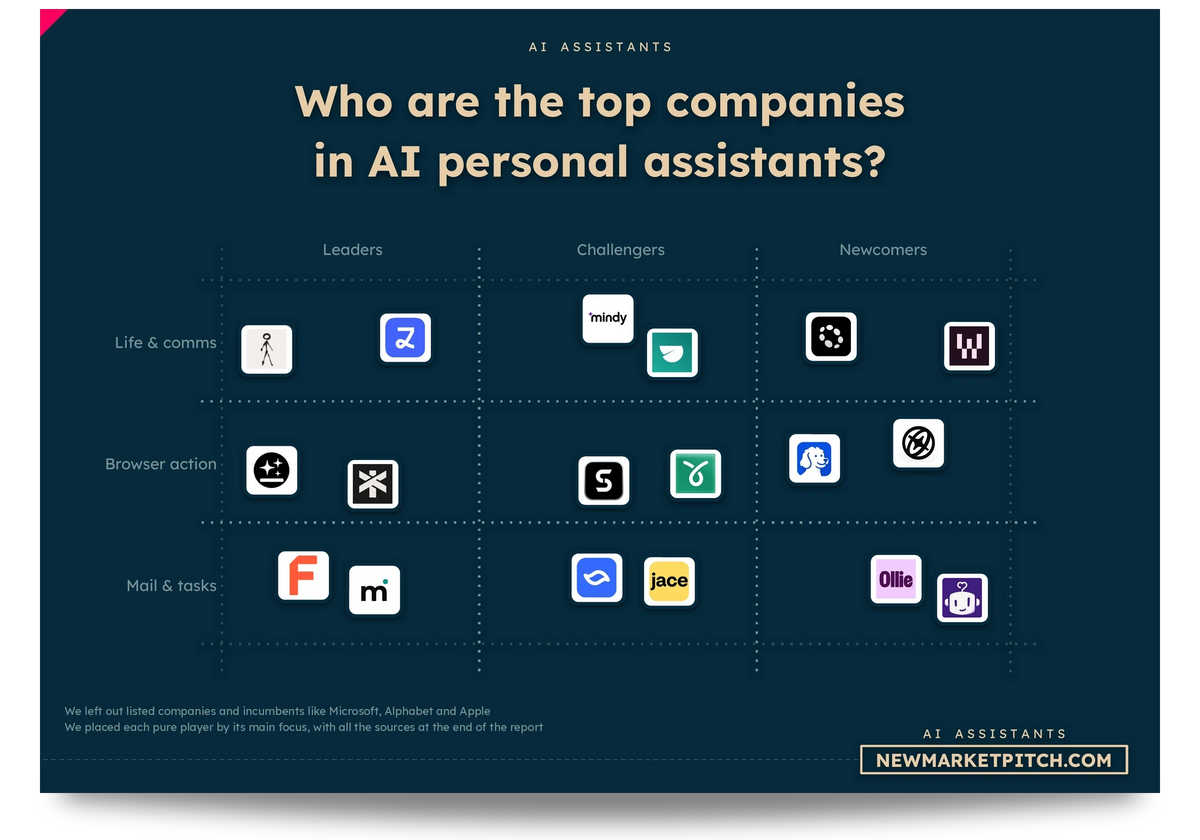
In our research about AI personal assistant startups, we turn what is vague and complex into simple, useful visuals. Market maps like this one show you at a glance where every startup stands.
Is AI personal assistant funding actually getting healthier?
Yes, AI personal assistant startups are raising more money, and the growth reaches more companies rather than just one lucky winner.
We tracked 33 deals involving 27 companies in the last 12 months, against 23 deals and 19 companies in the 12 months before. Deal count rose 43%, funded-company count grew 42%, and disclosed capital climbed 104%, from at least $1.7B to at least $3.4B. Together, these changes tell a much stronger story than a soaring capital total on its own.
Why is this happening now? People can increasingly ask an AI assistant to take a step for them rather than merely write an answer. Google introduced Gemini Personal Intelligence in January 2026, connecting information from Gmail, Photos and other Google apps. Microsoft's Copilot Actions, announced in April 2025, already described making reservations and handling web tasks. OpenAI's July 2026 ChatGPT Work launch pushed the same idea into longer projects across apps and files.
These product launches show what customers can now expect; they don't prove that each funded startup has found paying demand. Still, the funding figures make the verdict clear: more businesses are finding backers and more capital is moving into the category.
Would AI assistant funding still look strong without the giant rounds?
It would: smaller AI personal assistant rounds grew too, even though the biggest deals still swallow most of the money.
Leave out rounds above $50M and the last 12 months still brought in at least $257M, compared with at least $181M in the 12 months before, up 42%. Exclude only rounds above $100M and the totals are at least $542M and at least $456M, up 19%. This is a useful reality check on a market dominated by headlines about extraordinary raises.
Instinct's $1.0B Series C in September 2026 and Hark's $700M+ Series A in May 2026 involve very different plans. Instinct offers an assistant that handles daily requests; Hark is building models and hardware around a planned personal interface. Neither tells us what an ordinary new entrant can raise. The wider market looks healthier even when we remove checks of that size, but the distance between small and huge deals remains striking.
The table below shows the funding measures for both periods, including the totals after large rounds are excluded.
| Measure | Last 12 months | 12 months before |
|---|---|---|
| Deals | 33 | 23 |
| Companies | 27 | 19 |
| Disclosed capital | $3.4B+ | $1.7B+ |
| Excl. above $50M | $257M+ | $181M+ |
| Excl. above $100M | $542M+ | $456M+ |
| Median round | $22M | $15M |
| Lead investors | 36 | 18 |
Medians are rounded; exact values are given in the text.
Are new AI assistant startups finding investors, or are the same names raising again?
New AI personal assistant companies are getting funded alongside familiar names that raise repeatedly.
Across the last 12 months, 23 companies completed one tracked round, 3 completed two, and 1 completed three or more. In the 12 months before, 17 companies completed one round, 1 completed two and 1 completed three or more. So repeat fundraising has not shut newcomers out, even though the repeat-company rate edged up from 11% to 15%. Follow-on rounds still attracted at least $2.5B across 15 deals in the recent period, compared with $1.6B across 13 deals earlier.
The range of newcomers is revealing. Littlebird's $11M seed in March 2026 supports an assistant that remembers activity across desktop apps. Voyage Labs' $12M seed in November 2026 backs Atlas, which plans and books travel. Town's $108M Series B in October 2026, by contrast, supports assistants that work with teammates and outside contacts.
These startups are tackling the same daily frustration from different angles. A travel agent must complete a booking, a memory assistant needs to recall useful details, and a work agent has to cooperate with people. Investors are giving several approaches a shot instead of demanding one universal design.
Can a new AI personal assistant startup still raise its first check?
Absolutely: first-time AI personal assistant funding is reaching more startups, although those first checks have become smaller.
Among deals whose source says whether it was a company's first round, 9 first financings brought in $68M in the last 12 months, against 5 financings worth $70M in the 12 months before. Their median fell from $15M to $5M. The median age of a company at the time of financing also dropped from 2 years to 1 year. Investors are willing to move early, but founders should not mistake an easier opening for an unlimited budget.
The products show how narrow a first pitch can be. Fambot's $3.5M Seed in September 2026 backs a family assistant that turns school messages, calendars and other updates into a daily plan. Its launch announcement said more than 1,000 families had tried it. Voyage Labs is betting that people will pay for an assistant that actually books the trip, while Littlebird is trying to save users from repeatedly explaining their work to AI.
None of those launch claims establishes how many customers stay. A founder can currently get funded with one clear job to do. The harder challenge begins once that product has to earn its place in someone's routine.

In our market report about AI personal assistant startups, we always try to gather several sources and make estimates that make sense, so you can work with solid numbers.
Has seed funding dried up for AI personal assistants?
No, seed funding remains a busy part of the AI personal assistant market, even as more startups reach Series A and Series B.
Seed rounds accounted for 16 deals in the last 12 months, compared with 13 in the 12 months before. Their share of all deals fell from 57% to 48%, mostly because Series A grew from 2 deals to 8 and Series B from 2 to 5. Among deals with a named stage, early-stage financings made up 80% recently, versus 75% earlier. Seed founders have more company at the next stages, rather than fewer chances to begin.
Town is a useful example of what the next step requires. After its $55M Series A in June 2026, the company announced a $108M Series B in October 2026 and reported that paying teams had grown 9x since July. That is a company claim, but it gives investors something more concrete than a promising demonstration. Fambot and Littlebird, meanwhile, are still testing whether family logistics and desktop memory can become lasting habits.
We should not assume that every Series A or Series B company has already proved its economics. The funding pattern simply shows investors are willing to pay for the next experiment as well as the first one.
Are $100M personal AI assistant rounds becoming normal?
Nine-figure checks are still unusual for AI personal assistants, despite the size of the latest headline deals.
In the last 12 months, 7 disclosed financings reached $100M or more, versus 5 in the 12 months before. They made up 23% of rounds with disclosed amounts in both periods. That hardly supports the idea that a nine-figure check is becoming standard. The median disclosed round did rise 43%, to $21.5M from $15.0M, so even the middle of the market has moved up.
Look at what investors are buying at the top. Manus raised at least $500M in a round of undisclosed stage in October 2026 after its separation from Meta, according to Reuters. Hark's own May 2026 announcement described a company working on foundation models and bespoke hardware. Instinct is pursuing an action-taking consumer assistant. Those plans demand different levels of spending and proof.
For most founders, the question remains whether a smaller product can win repeat customers before its cash runs out. Nine-figure rounds now exist in several corners of this market. They have not become the normal route from idea to business.
Does Instinct's fundraising prove people want a personal AI agent?
Instinct's huge funding proves investors want an AI personal agent badly; it doesn't yet prove that people will use one every day for years.
The startup raised a $25M Seed in January 2026, a $75M Series A and $250M Series B in August 2026, then a $1.0B Series C in September 2026. It led company funding across the last 12 months at $1.4B. Reuters reported that Sequoia Capital, Benchmark and Coatue backed the September financing, while The Information said the assistant had passed 100,000 users as access expanded.
That user figure gives Instinct a real audience, but it doesn't show paid retention or the cost of successfully completing requests. The service also needs permission to interact with personal accounts, messages and purchases. TechCrunch's August 2026 reporting raised questions about privacy terms, and Instinct's subsequent policy described choices around approvals and model training.
The company has clearly persuaded major investors that a consumer agent could become a new everyday interface. Whether people will trust it with their lives, and keep paying after the first impressive task, is still a separate question.

Our document detailing everything you need to know about AI personal assistant gets updated several times a month, so you always get the latest view of where things stand.
Is Hark bringing back the dream of an AI device that does everything?
Hark has enough funding to try building a personal AI device and assistant together, but its product is still largely a promise.
Hark announced a $700M+ Series A in May 2026, led by Parkway Venture Capital. The company said it was training its own models, building bespoke hardware and preparing a universal interface for people to use computers and services. It had also secured NVIDIA B200 computing systems. TechCrunch noted at the time how little Hark had shown of the eventual consumer product.
Sandbar makes a useful contrast with Hark. Sandbar's Stream smart ring is built around one job: capturing thoughts by voice and returning useful context later. Hark wants the freedom to design both the assistant and the device around it. One company can test a narrow interaction; the other must make a much broader experience work.
The giant check buys Hark time to build, not an advantage that automatically carries over to every wearable assistant. It has to convince people to use new hardware when a phone, a laptop and increasingly capable software are already in their pockets.
Are Manus and Genspark making browser agents a safer bet?
Manus and Genspark are getting bigger checks for AI agents that act on the web, but the number of funded companies in that category has not taken off.
Computer-use and web-task agents recorded 4 deals worth at least $897M in the last 12 months, compared with 5 deals worth $212M in the 12 months before. Manus' $500M+ round in October 2026, of undisclosed stage, followed the unwinding of Meta's acquisition, according to Reuters. Genspark's $275M Series B in November 2025 and $100M Series B in June 2026 backed a product that aims to complete work instead of returning a set of search links.
The technology has become more useful, but the competition is getting closer. Anthropic released Claude's browser-action tools to paying users in August 2026. Stanford's 2026 AI Index found that even improved computer-use agents still failed roughly one in three structured tasks on a leading benchmark. That is a serious obstacle when an assistant must book, buy or edit something correctly.
Investors are putting more money into selected web agents despite fewer deals overall. The winners will have to deliver reliable results while the companies building the underlying models offer similar tools themselves.
Are messaging assistants becoming the main AI personal assistant business?
Messaging and voice assistants now lead AI personal assistant fundraising, although one fast-growing startup accounts for much of the money.
The category drew 9 deals in the last 12 months, or 27% of transactions and 41% of the disclosed capital. In the 12 months before it recorded 6 deals and $48M, equal to 3% of disclosed capital. Instinct explains much of the funding jump, but smaller products help explain the format's appeal: Jarvie AI works through group texts, Equal handles unwanted calls, and Zapia built a personal assistant around everyday messaging. Wabi, which we count among general assistant platforms, mixes chat-based personal help with shared mini-apps and raised a $55M Series A in October 2026.
There is a catch. On January 19, 2026, Zapia explained that Meta's WhatsApp policy had forced it out of the messaging app in several countries, pushing users toward Zapia's own app instead. A founder can reach people through a familiar channel without controlling that channel.
For now, texting an assistant looks like a powerful way to introduce the product. Keeping access to users, and getting tasks done without mistakes, will decide whether this turns into a lasting business.

In our report covering the AI personal assistant market, we look at what the winners do differently, so you can learn from the best instead of guessing.
Will people pay for an AI assistant that just remembers things?
Investors are backing dedicated personal AI memory products, but whether people will pay for memory on its own is still unproven.
Personal memory and context assistants attracted 5 deals worth $74M in the last 12 months. Highlight AI's $40M Series A in March 2026 backed a screen-aware work assistant. Littlebird's $11M Seed that month went toward remembering activity across desktop applications. Hello Haven's $15M round in September 2026 was another attempt to make an assistant useful because it retains context. These companies sell different routes to the same relief: users should not have to explain their situation from scratch every time.
The threat is obvious. Google's Gemini Personal Intelligence can draw on information from its connected services, so a specialist must remember something its customers cannot easily get from their existing software. Littlebird emphasizes context across applications rather than inside a single platform; that is a useful distinction, provided its users trust it to observe sensitive work.
The table below shows where AI personal assistant deals and disclosed capital went across categories in the last 12 months.
| Assistant category | Deals | Capital |
|---|---|---|
| Messaging and voice | 9 | $1.4B |
| Computer-use agents | 4 | $897M+ |
| General platforms | 5 | $771M+ |
| Executive assistants | 4 | $168M+ |
| Personal memory | 5 | $74M |
| Concierge errands | 3 | $39M |
| Wearable assistants | 1 | $23M |
| Family coordination | 2 | $5.5M |
Can an AI travel agent or bill negotiator really beat ChatGPT?
A specialized personal AI concierge can beat a general assistant on a specific job if it actually completes the booking or saves the customer money.
Concierge and delegated-errand assistants received 3 deals worth $39M in the last 12 months. Voyage Labs' $12M Seed in November 2026 funds Atlas, which aims to arrange and book trips. Pine's $25M Series A in December 2025 backs an assistant that contacts providers to negotiate bills. Eden AI Labs' $1.5M Seed in October 2026 takes a broader personal-concierge approach. Each has a task with a clear finish line, rather than a promise to make every conversation smarter.
Voyage Labs said it would build connections with travel, dining and experience suppliers. Such relationships can make an assistant more useful than one that only recommends a place and leaves the customer to book it. Pine has an equally straightforward test: did the bill go down? The product still needs to handle exceptions and avoid costly mistakes.
Microsoft has been working on bookings through Copilot Actions since its April 2025 announcement. So these startups have to offer better access, follow-through or service than a large platform can offer by default. Their opportunity is real precisely because customers care about the outcome, not the chatbot behind it.
Will families really pay for an AI household assistant?
Family AI assistants are getting seed money, but convincing households to keep paying is proving difficult.
Family and household coordination attracted 2 deals worth $5.5M in the last 12 months, after 1 deal with an undisclosed amount in the 12 months before. Fambot's $3.5M Seed in September 2026 supports a tool that handles school emails and family schedules. Orbits' ~$2M Seed in September 2026 backs an assistant for appointments, errands and household calendars. Both aim to organize the scattered messages and tasks that make family life tiring.
There is genuine demand for fewer reminders and less coordination, but family products must deal with sensitive information about children, appointments and home routines. Their builders also need to make the benefits obvious to people who already use calendars and group chats.
Ollie shows how tough the business can be. The privacy-focused family assistant had raised money in 2023 and 2025, and TechCrunch reported in October 2026 that it was shutting down. Its founder said stronger competitors had made it harder to stand out, grow and raise the capital needed to continue. We can see investors willing to finance new attempts; we cannot yet point to a proven pattern of households paying for them over time.
Are AI wearable assistants still getting funded?
Dedicated wearable AI assistants still attract venture checks, but they remain a small piece of personal assistant funding.
Ambient and wearable assistants recorded 1 deal worth $23M in the last 12 months, compared with 2 deals worth $12M in the 12 months before. Sandbar's $23M Series A in March 2026 backed Stream, a smart ring that lets people capture spoken thoughts and find them later. Investor True Ventures described the product's combination of voice input and AI memory in its November 2025 introduction.
This is a much narrower proposition than Hark's plan for a general personal interface. Sandbar can ask one practical question: will people wear a ring to remember an idea when they could speak into a phone? The answer depends on comfort, speed, privacy and whether recalling the note actually helps later. Shipping a device also brings manufacturing and customer-service problems that software startups can avoid.
We see a market willing to pay for experiments with new ways of talking to AI, but little evidence that wearables are the main place investors are putting their personal assistant money. A product that people keep wearing would change that argument more than another impressive prototype.

In our research about AI personal assistant startups, we don't want to repeat what boring consulting reports say. Instead, we show you the real and latest market signals that matter.
Is the US getting nearly all the AI personal assistant funding?
American startups currently dominate personal AI assistant fundraising, although useful products are emerging outside the United States.
In the last 12 months, the United States accounted for 26 deals across 20 companies, representing 79% of transactions and 84% of disclosed capital. In the 12 months before, it recorded 15 deals across 12 companies and 65% of transactions. North America as a whole produced 27 deals, or 82% of the recent count, against 16 deals previously. The money is piling up in the US, even as the kinds of assistants getting funded keep multiplying.
Singapore's Manus raised at least $500M in October 2026, in a round of undisclosed stage, after resuming independent operations. India's Equal raised a $30M Series B in June 2026 for handling unwanted calls. In Latin America, Zapia is building personal task tools around the messaging habits of its users. These businesses do not need to copy the same interface to be useful.
For founders, the US advantage is access to investors prepared to finance large experiments again and again. That advantage matters. It does not mean a product designed for American workflows will automatically serve customers everywhere else.
Have European investors stopped funding personal AI assistants?
Europe's AI personal assistant funding has slowed sharply, even though European-developed assistants can still build paying businesses.
We counted 1 European deal worth $2.9M in the last 12 months, compared with 4 deals worth $60M in the 12 months before. The earlier group included Fyxer AI's $30M Series B in September 2025. Rhise AI's $2.9M Seed in November 2026 was the recent European entry. With so few deals, this tells us about reported fundraising, not about demand for assistants across the continent.
Fyxer AI makes the distinction clear. In a September 2026 OpenAI customer story, the company reported 90% retention after 90 days and said users accepted 53% of its suggested email drafts without editing. Those are company-reported product figures, but they are a more direct sign of usage than the absence of a new financing announcement. A business can keep selling while a funding comparison looks quiet.
Still, the gap with US fundraising is uncomfortable for European founders. Competing against well-financed assistants takes staff, access to models and time to win trust. Europe has products worth watching; the recent flow of new deals is simply much thinner.
Are the same venture capital firms backing every personal AI assistant?
No, more venture firms are leading AI personal assistant rounds, although some familiar names keep returning to the market.
We identified 73 unique investors in the last 12 months, up from 45 in the 12 months before. Distinct disclosed lead investors grew from 18 to 36. Repeat lead investors edged up from 3 to 4, and they were involved in 32% of rounds with disclosed leads in both periods. More investors are willing to make the call, and the firms that come back are not taking a bigger share of the leading roles.
Andreessen Horowitz was the most active disclosed lead investor in the recent period, leading 3 rounds. Benchmark took part in large assistant financings, while Kleiner Perkins was involved in both consumer-agent and travel-agent deals. Town's October 2026 round brought in Forerunner Ventures and Menlo Ventures as co-leads, according to the company's announcement. These firms are backing different products and taking different risks.
A firm leading a large round is not necessarily putting up the full amount. We should be equally careful not to treat a crowded investor list as proof of product demand. Still, the wider choice of potential lead investors is useful news for founders who can show a believable plan.
Are personal AI assistants raising their next round faster?
AI personal assistant startups are not raising again faster overall, despite how quickly a few famous companies have returned to investors.
The median observed gap between successive rounds was 11 months in the last 12 months, versus 7 months in the 12 months before. Those intervals could be measured for 52% of qualifying recent deals and 61% of earlier deals. Among the measured gaps, 59% were shorter than 12 months recently, compared with 57% previously; 88% were shorter than 18 months, against 79% earlier. These are shares of the gaps between rounds, not percentages of companies.
The fast cases grab attention. Instinct's $250M Series B in August 2026 was followed by its $1.0B Series C in September 2026. Town's $55M Series A in June 2026 preceded its $108M Series B in October 2026. Both attracted rapid new investment, but the measured median interval actually lengthened across the broader sample.
For a new founder, raising again quickly is possible when investors think a company is pulling ahead. It is hardly a safe fundraising plan. Most businesses still need time to find out whether users will keep delegating tasks.

Learning from others' mistakes is the cheapest lesson there is. In our market report about AI personal assistant startups, we look at what broke startups before you, so you don't repeat it.
Can small AI personal assistant startups survive Google and OpenAI?
Independent personal AI assistants can survive the major platforms, but they need to do a real job better than the tools customers already have.
Google's January 2026 Personal Intelligence launch let Gemini use information from connected services. Microsoft's Copilot Actions, announced in April 2025, aimed to make reservations and purchases through partners. OpenAI introduced ChatGPT Work in July 2026 for bigger tasks across apps and files, and Anthropic made Claude's browser-action tools available more widely in August 2026. People now have serious options from companies they already know.
That leaves startups with a hard choice. Fyxer AI focuses on inboxes and professional communication. Littlebird remembers work across apps. Voyage Labs works on actual travel arrangements. Town aims to help colleagues' assistants cooperate, with company-reported growth in paying teams. Each is trying to become especially good at a job the larger tools cover only in part.
The danger is depending on someone else's distribution. Zapia's account of its WhatsApp restrictions shows how a platform can suddenly change the rules. Small assistants are most defensible when customers value a specific service, outcome or trusted relationship enough to seek it out.
What could kill the AI personal assistant funding boom?
AI personal assistant startups could lose investor support if agents keep making costly mistakes and customers stop paying after trying them.
The technical gap is measurable. Stanford's 2026 AI Index reported major gains in computer-use agents, yet they still failed roughly one in three structured tasks on a leading benchmark. A failed draft is annoying; a wrong reservation, misplaced order or message to the wrong recipient is a much bigger problem. Agents also need access to personal accounts and data, making privacy controls part of the product rather than a detail in the terms.
The commercial warning is already here. Ollie closed after trying to sell a privacy-focused assistant for families. Its founder told TechCrunch that competition had made growth and further fundraising too difficult. Cognition took a different route when it acquired the developer behind messaging agent Poke in July 2026. Neither outcome guarantees that an independent assistant can keep growing by itself.
Some startups are reporting better evidence. Town described strong growth in paying teams, and Fyxer AI published retention figures. We still need to separate those company claims from a market-wide result. Currently, funding gives teams the chance to prove their agents work, but it cannot make customers stay.
So, what does AI personal assistant funding look like right now?
Funding for AI personal assistants is genuinely stronger today, with more companies and smaller rounds gaining ground, even though giant checks still dominate the money.
The last 12 months brought broader investor interest and a healthier path for new founders. Instinct remains the most heavily financed company in the period; Hark, Manus and Genspark show how much investors are willing to risk on ambitious approaches. Yet focused assistants for memory, family organization and specific errands have also found backers.
Our verdict is positive on funding and more cautious on the business itself. People now have more agents to try, and the biggest software companies are making their own. The independent winners will be the ones that finish useful tasks reliably, earn access to personal information and persuade customers to return.
The table below shows what we found.
| Question | Answer |
|---|---|
| Is the boom reaching more individual startups? | Yes, the number of funded companies grew 42% between periods. More founders are getting backing, not merely the biggest names. That gives the market more chances to find winners. |
| Does growth survive without the giant financings? | It does, although large checks still dominate the total. Funding excluding rounds above $100M rose 19% between periods. Smaller financings support the broader growth story too. |
| Are newcomers getting a proper chance now? | First financings grew from 5 deals to 9 deals. Investors are opening the door to more first-time founders. Smaller median checks mean those founders must spend carefully. |
| Has the typical funding check changed materially? | The median disclosed round rose 43% between comparable periods. That improvement reaches beyond the rare nine-figure financing. An ordinary raise still looks different from a giant one. |
| Has money spread evenly across assistant products? | No, messaging and voice still take the largest share. The category attracted 41% of the recent disclosed capital. One standout fundraiser makes that share unusually high. |
| Will investors finance apps built around memory? | They will, but customer payment remains an open question. Dedicated memory assistants drew 5 deals in the period. The big platforms already offer competing context features. |
| Are browser agents winning through sheer volume? | No, they attracted bigger checks despite fewer deals. Computer-use agents received at least $897M in recent funding. Reliability still has to catch up with investor ambition. |
| Are household assistants becoming a dependable business? | Not yet, despite new seed rounds for family tools. The category received $5.5M in recent disclosed financing. Ollie's shutdown shows why money alone cannot secure loyalty. |
| Is American dominance stopping overseas assistant products? | No, although North America leads the financing count. North American startups took 82% of the recent deals. Regional habits still create room for different products. |
| Is every successful assistant racing to raise again? | Some are, but the observed median gap lengthened. The recent measured interval stood at 11 months. Famous rapid fundraisers do not describe every company. |
| Do founders have more investors to approach? | Yes, more venture firms now lead personal assistant rounds. There were 36 distinct leads in the recent period. More options come with intense competition for standout teams. |

If you build or invest in the AI personal assistant market, you need to know which business models pay off now and which ones are fading. That's why our report covering it has a whole section on it.
Our methodology
Our data runs through November 19, 2026. We then reviewed this article and updated its answers on November 24, 2026, the date shown under the title. We compared the last 12 months, November 20, 2025 to November 19, 2026, with the 12 months before, November 20, 2024 to November 19, 2025. Both periods fall within our complete deal coverage, which begins in January 2024. We used equal windows instead of comparing a partial calendar year with a complete one.
We count equity financings of private companies worth at least $300K. We exclude debt, grants, loans, unconverted convertible instruments, SAFEs and public offerings. Each financing counts once, even when several publications report it or several investors announce their participation. Duplicate reports are merged.
The AI personal assistant market covers products built around an assistant acting for an identifiable person: organizing information, remembering context, coordinating life or work, or completing everyday tasks across digital and physical settings. We include text and voice assistants, browser agents, executive helpers, family coordinators, concierge tools, context products and relevant wearables. Borderline companies remain in our research when acting on someone's behalf is a substantive part of the product. We exclude general model providers, customer-service bots, coding-only tools, pure transcription apps, search-only products and companion chatbots without practical tasks.
Every company counted meets our startup definition: an independent business founded in 2007 or later, built to grow quickly around a new product or technology, financed by venture capital, angels, founders or qualifying early funding. Businesses listed within the last 5 years and businesses acquired within the last 3 years can remain eligible. Established platform companies appear only as competitive context, not as startups in our totals.
Rounds confirmed by a company announcement, a press article or a regulatory filing are counted in full. Where no article exists, a round is counted only when at least two recognised databases agree on its date (within one month) and amount (within 5%), and it is marked as low confidence; a round found in a single database stays in the company's history but is left out of totals. For companies that have raised more than $100M, every round counted is backed by an article.
We classify stages as Seed, Series A, Series B, Series C, Series D+ and Growth Equity, or mark the stage as undisclosed when it cannot be established. Early-stage and later-stage shares use only deals with a named stage. Each company is placed in a category based on its core assistant job and in a region based on its headquarters country. We prefer company announcements, filings and reliable reporting; databases are used only under the agreement rule above.
Undisclosed rounds still count toward deals and funded companies, but do not enter capital totals or disclosed-round medians. Totals with missing amounts are minimums, shown with a plus sign. A press figure may differ because it covers other dates, uses a broader meaning of AI or counts a financing differently. This comparison covers the last 12 months against the 12 months before; our all-deals tracker, year-to-date trends and company rankings cover other periods and answer different questions.
Key sources include Reuters reporting on Instinct's September 2026 financing, Instinct's reported user reach and financing discussions, Reporting on Instinct's privacy concerns, Instinct's policy on account access and user controls, Hark's models, hardware plans and financing announcement, Town's Series B, assistant design and paying-team growth, Wabi's product and reported funding, Voyage Labs' travel product and supplier approach, Genspark's AI workspace strategy, Reuters on Manus' independent operations and new financing, Littlebird's cross-application context product, Fambot's product, family testing and launch, Orbits' household-task assistant, Sandbar's Stream wearable and memory product, Fyxer AI's reported retention and email draft acceptance, Ollie's closure and founder's explanation, Zapia's account of WhatsApp restrictions, Cognition's acquisition of Poke's developer, Gemini's Personal Intelligence launch, Microsoft's Copilot Actions announcement, OpenAI's ChatGPT Work announcement, Anthropic's browser-action tool launch, and Stanford's findings on computer-use agent reliability.

In our report covering the AI personal assistant market, we like to show you the big picture. We know your time is precious, so we make every page quick to read and packed with as much learning as possible per minute.
Written by the New Market Pitch teamWe track new markets so founders and investors can move faster. About us