What are the most valuable AI personal assistant startups?
Whether you're building or investing in the AI personal assistant market, our report covers everything you need to know: the players, the money, and what's coming next.
Summary
Perplexity is the most valuable AI personal assistant startup at $20.0B. Instinct follows at $10.0B, with Hark at $6.0B. Their prices tell us how much investors want a piece of personal AI, though the companies have very different ideas about how it should work.
Perplexity starts with the browser. Instinct asks people to hand over errands through messages and phone calls. Hark wants its own models to operate websites on a user's behalf. Each is trying to become the assistant someone turns to before opening an app or contacting a business.
The big question is whether people will trust an agent to finish a task, especially when money, personal messages or private accounts are involved. A good answer is useful. A completed booking, a negotiated bill or an inbox kept under control can save someone work every day.
So far, the billion-dollar valuations belong to a small club. We count 7 AI personal assistant unicorns, including just 2 valued at $10B or more. Most startups in this market are working on smaller and more specific jobs.
Manus and Genspark are making a case for agents that handle long digital workflows. Wabi is testing shared mini apps, while Town wants personal work assistants to collaborate with colleagues. There is plenty of money behind each idea, but no single way of using an assistant has won.
The United States dominates the list of leading companies. Still, Singapore's Manus, India's Equal and the UK's Fyxer AI show why local needs and frequent professional tasks can be attractive places to start.
The smaller companies are worth a close look as well. Equal screens phone calls, Pine negotiates bills, and Ario and Ohai.ai help families keep track of everyday obligations. Their narrower products could turn out to be easier to use regularly than an agent that promises everything.
Private valuations need some perspective. The most famous companies have reported or announced prices. Many smaller startups have only estimates based on their last funding rounds, which are much less certain than a price paid in a new deal.
Recent product launches have made the race tougher. Meta's Muse, Google's connected Gemini tools and Apple's Siri integrations can reach people through devices and accounts they already use. Independent startups have to do something those defaults cannot do as well.
Perplexity leads on valuation today. But if we want to know which assistants will still matter later, we should watch who completes real tasks, earns repeat use and keeps customers' trust, rather than assuming the largest private price settles the question.

Written by the New Market Pitch teamWe track new markets so founders and investors can move faster. About us

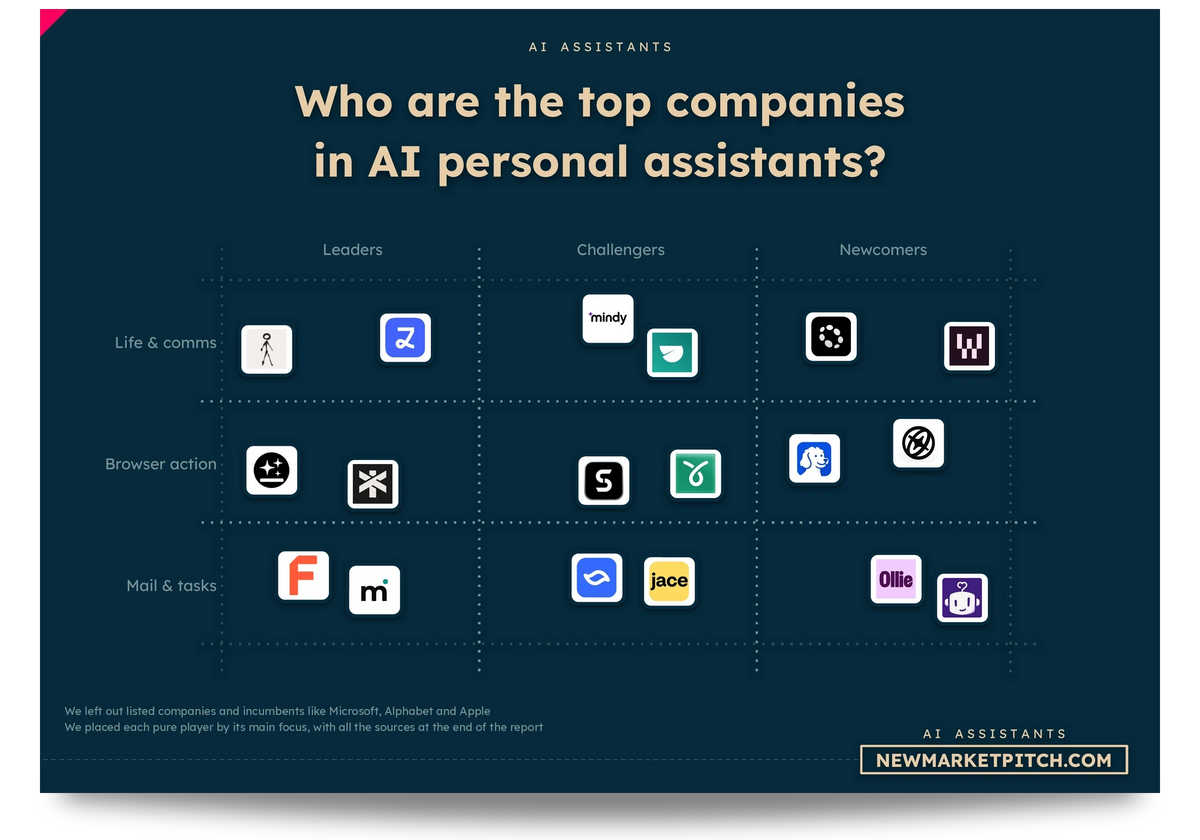
In our report covering the AI personal assistant market, we turn what is vague and complex into simple, useful visuals. Market maps like this one show you at a glance where every startup stands.
Top startups in the AI personal assistant market ranked by valuation
Here is the current ranking of the most valuable AI personal assistant startups. For each one you will also find our confidence level and the valuation basis we used.
If you want to go deeper into the AI personal assistant startup landscape, check our report covering the AI personal assistant market.
| # | Startup | Valuation | Confidence | Valuation basis | Last round | Total funding |
|---|---|---|---|---|---|---|
| 1 | PerplexityAI answer engine and Comet browser assistant | $20.0Bas of Sep 2025 | Strong | Reported private round valuation | ~$200MSeries D+ · Sep 2025 | $1.7Bvalued at 11.7× this |
| 2 | InstinctPersonal AI assistant automating everyday tasks | $10.0Bas of Sep 2026 | Full | Announced private round valuation | $1.0BSeries C · Sep 2026 | $1.4Bvalued at 7.4× this |
| 3 | HarkDevelops proprietary models for personal intelligence | $6.0Bas of May 2026 | Full | Announced private round valuation | UndisclosedOther · Aug 2026 | $700M+valued at 8.6× this |
| 4 | ManusAutonomous general-purpose AI agents | $2.0B–$5.0Bas of Oct 2026 | Low | Estimated from last round | $500M+Undisclosed stage · Oct 2026 | $585M+valued at 5.4× this |
| 5 | GensparkAutonomous AI workspace and research | $2.6Bas of Jun 2026 | Strong | Reported private round valuation | $100MSeries B extension · Jun 2026 | $535Mvalued at 4.9× this |
| 6 | WabiConversational personal assistance and mini apps | $1.25Bas of Oct 2026 | Full | Announced private round valuation | $55MSeries A · Oct 2026 | $75Mvalued at 16.7× this |
| 7 | TownPersonal AI assistants for workplace tasks | $1.0Bas of Oct 2026 | Full | Announced private round valuation | $108MSeries B · Oct 2026 | $181Mvalued at 5.5× this |
| 8 | EqualScreens and responds to unwanted phone calls | $200M–$375Mas of Jun 2026 | Low | Estimated from last round | $30MSeries B · Jun 2026 | $40Mvalued at 6.8× this |
| 9 | Fyxer AIAI executive assistant manages inbox and meetings | $200M–$375Mas of Sep 2025 | Low | Estimated from last round | $30MSeries B · Sep 2025 | $40Mvalued at 6.8× this |
| 10 | Highlight AIScreen-aware assistant recalls information from work | $200M–$333Mas of Mar 2026 | Low | Estimated from last round | $40MSeries A · Mar 2026 | $50Mvalued at 5.2× this |
| 11 | rabbitHandheld AI device carries out user requests | $115M–$287Mas of Mar 2024 | Low | Estimated from last round | $29MEquity financing · Mar 2024 | $59Mvalued at 3.1× this |
| 12 | PineCalls providers to negotiate consumer bills | $125M–$208Mas of Dec 2025 | Low | Estimated from last round | $25MSeries A · Dec 2025 | $25Mvalued at 6.4× this |
| 13 | SandbarSmart ring capturing voice notes with AI memory and recall | $115M–$192Mas of Mar 2026 | Low | Estimated from last round | $23MSeries A · Mar 2026 | $36Mvalued at 4.1× this |
| 14 | SimularAutomates Mac applications for personal tasks | $108M–$179Mas of Dec 2025 | Low | Estimated from last round | $22MSeries A · Dec 2025 | $22Mvalued at 6.5× this |
| 15 | PleaseAutomates web tasks across multiple sites | $100M–$167Mas of Aug 2024 | Low | Estimated from last round | $20MSeries A · Aug 2024 | $20Mvalued at 6.5× this |
| 16 | CadenUses permissioned personal data for assistance | $75M–$125Mas of Aug 2023 | Low | Estimated from last round | $15MSeries A · Aug 2023 | $24Mvalued at 4.0× this |
| 17 | LuziaWhatsApp assistant for everyday personal requests | $54M–$135Mas of May 2025 | Low | Estimated from last round | $14MMay 2025 | $43Mvalued at 2.0× this |
| 18 | ArioCoordinates family schedules, emails and logistics | $64M–$107Mas of Jun 2024 | Low | Estimated from last round | $16MSeed · Jun 2024 | $16Mvalued at 5.2× this |
| 19 | Hello HavenConstructs personal memory for contextual assistants | $60M–$100Mas of Sep 2026 | Low | Estimated from last round | $15MPre-Seed · Sep 2026 | $15Mvalued at 5.2× this |
| 20 | YutoriRuns browser tasks on users behalf | $60M–$100Mas of Mar 2025 | Low | Estimated from last round | $15MSeed · Mar 2025 | $15Mvalued at 5.2× this |
| 21 | Voyage LabsBuilds Atlas, a personal travel agent that plans, books and monitors trips across a persistent workflow. | $48M–$80Mas of Nov 2026 | Low | Estimated from last round | $12MSeed · Nov 2026 | $12Mvalued at 5.2× this |
| 22 | GhostAI personal assistant for daily tasks | $44M–$73Mas of Oct 2026 | Low | Estimated from last round | $11MSeed · Oct 2026 | $11Mvalued at 5.2× this |
| 23 | LittlebirdRemembers work context to answer later requests | $44M–$73Mas of Mar 2026 | Low | Estimated from last round | $11MSeed · Mar 2026 | $11Mvalued at 5.2× this |
| 24 | Jarvie AICoordinates tasks inside group text conversations | $33M–$55Mas of Jun 2026 | Low | Estimated from last round | $8.3MSeed · Jun 2026 | $8.3Mvalued at 5.2× this |
| 25 | BoardyIntroduces people by telephone and messaging | $32M–$53Mas of Jan 2025 | Low | Estimated from last round | $8MSeed · Jan 2025 | $11Mvalued at 3.8× this |
| 26 | ZapiaWhatsApp assistant for Latin American consumers | $28M–$47Mas of Mar 2026 | Low | Estimated from last round | $7MSeed · Mar 2026 | $14Mvalued at 2.5× this |
| 27 | HowieSchedules meetings and follows up by email | $24M–$40Mas of Sep 2025 | Low | Estimated from last round | $6MSeed · Sep 2025 | $7Mvalued at 4.4× this |
| 28 | Ohai.aiManages household calendars, lists and reminders | $24M–$40Mas of Jan 2024 | Low | Estimated from last round | UndisclosedOther · Aug 2025 | $6M+valued at 5.2× this |
| 29 | StrawberryAgent browser carries out personal web workflows | $24M–$40Mas of Oct 2025 | Low | Estimated from last round | $6MSeed · Oct 2025 | $6Mvalued at 5.2× this |
| 30 | PallyRemembers relationships and assists over messages | $21M–$35Mas of Aug 2026 | Low | Estimated from last round | $5.2MSeed · Aug 2026 | $5.2Mvalued at 5.2× this |
| 31 | CatchAI assistant for everyday tasks | $20M–$33Mas of Sep 2026 | Low | Estimated from last round | $5MSeed · Sep 2026 | $5Mvalued at 5.2× this |
| 32 | TomoText coach follows up on goals habits | $20M–$33Mas of Jun 2026 | Low | Estimated from last round | $5MSeed · Jun 2026 | $5Mvalued at 5.2× this |
| 33 | FambotActs as an AI family chief-of-staff | $14M–$23Mas of Sep 2026 | Low | Estimated from last round | $3.5MPre-seed · Sep 2026 | $3.5Mvalued at 5.2× this |
| 34 | irisgo.aiAutomates planning and personal administrative tasks | $12M–$21Mas of 2026 | Low | Estimated from last round | $3.1MSeed · 2026 | $3.1Mvalued at 5.2× this |
| 35 | Rhise AIBuilds Lucie, a proactive personal AI assistant connecting email, calendar, health and everyday context. | $12M–$20Mas of Nov 2026 | Low | Estimated from last round | $2.9MAngel round · Nov 2026 | $2.9Mvalued at 5.2× this |
| 36 | Based HardwareWearable AI captures context and helps recall | $8M–$13Mas of Jan 2025 | Low | Estimated from last round | $2MSeed · Jan 2025 | $2.7Mvalued at 3.8× this |
| 37 | MartinVoice assistant organizing users daily lives | $8M–$13Mas of Jan 2025 | Low | Estimated from last round | $2MSeed · Jan 2025 | $2Mvalued at 5.2× this |
| 38 | Memorae AISaves reminders and schedules through WhatsApp | $8M–$13Mas of Mar 2026 | Low | Estimated from last round | $2MSeed · Mar 2026 | $2Mvalued at 5.2× this |
| 39 | OrbitsCoordinates household appointments, errands and calendars | $8M–$13Mas of Sep 2026 | Low | Estimated from last round | ~$2MPre-seed · Sep 2026 | $2Mvalued at 5.2× this |
| 40 | The LibrarianOrganizes reminders and information on WhatsApp | $8M–$13Mas of Nov 2025 | Low | Estimated from last round | $2MSeed · Nov 2025 | $2Mvalued at 5.2× this |
| 41 | AkiflowCombines task management with intelligent scheduling | $7.2M–$12Mas of May 2022 | Low | Estimated from last round | $1.8MSeed · May 2022 | $1.8Mvalued at 5.2× this |
| 42 | Eden AI LabsAI personal concierge assistant | $6M–$10Mas of Oct 2026 | Low | Estimated from last round | $1.5MSeed · Oct 2026 | $1.5Mvalued at 5.2× this |
| 43 | PassabotBooks flights by messaging the assistant | $5.8M–$9.7Mas of Aug 2026 | Low | Estimated from last round | $1.5MPre-Seed · Aug 2026 | $1.7Mvalued at 4.5× this |
No startups match this search.

Our research about AI personal assistant startups gets updated several times a month, so you always get the latest view of where things stand.
Why are investors paying billions for AI personal assistants?
Investors are paying billions for AI personal assistant startups because a tool that finishes everyday tasks could become something people use constantly.
The change is easy to see in the products. Perplexity's Comet browser can work across websites, Instinct can arrange errands by message or phone, and Hark's Handoff can click through online tasks. These companies want users to hand over a job rather than spend an afternoon opening tabs and copying information around. For someone booking a trip or dealing with an unwanted subscription, that could be genuinely useful.
But this is a hard business to get right. The assistant may need a password, access to an inbox, permission to spend money and enough judgment to ask for help when a website changes. The University of Washington showed in April 2026 how hostile instructions on webpages could be used against some browser agents. That is a real obstacle to everyday adoption, not a theoretical worry.
Private investors are pricing the chance to own a new daily habit. There is evidence that agents can do more work than earlier chatbots, but we still need to see which services keep working reliably after the novelty wears off.
Is Perplexity still the most valuable AI personal assistant startup?
Yes, Perplexity remains the highest-valued AI personal assistant startup at $20.0B, with a lead of 2.0x over Instinct.
Perplexity began as a service for getting answers from the web. Its Comet browser brought the assistant into the place where many people actually do their work: searching, comparing, booking and shopping. In October 2025, the company opened Comet to everyone and added background assistants that could tackle several jobs. That gives Perplexity a route to personal tasks through a product people already recognize.
The price comes from Reuters' September 2025 reporting on investor commitments, rather than a valuation announced by Perplexity itself. It is a reported private-market price. Perplexity has an advantage over a newly launched agent because it can offer browser tasks to people who already know its answer engine.
Yet a valuable browser is different from a browser people cannot do without. Meta has since introduced Muse, and Google is connecting Gemini to services users already rely on. Perplexity is in front on price; its next test is whether people keep choosing Comet to get actual work done.

In our market report about AI personal assistant startups, we look at what the winners do differently, so you can learn from the best instead of guessing.
Can Instinct overtake Perplexity in personal AI?
Instinct is the closest valuation challenger to Perplexity in personal AI, although its $10.0B price still leaves a large gap.
Instinct raised a $1B Series C in September 2026 and has raised $1.4B in total. Its assistant accepts messages, uses a computer to complete online tasks and can make phone calls. That last part is important. A person can ask it to arrange an appointment without having to know which website or phone number will get the job done. TechCrunch's September 2026 coverage described help with bookings and coordination that ordinary online forms often cannot handle.
Perplexity's approach starts from a browser people use themselves. Instinct wants the user to send a request and let the agent do the work elsewhere. That could be more convenient for recurring errands, but it asks people to trust a separate company with messages, accounts and potentially purchases.
Investors have given Instinct a striking price very early in its life. Catching Perplexity will require more than another funding round. Instinct needs to show that people keep delegating tasks after trying the service, and that its agents handle those tasks without expensive mistakes.
Is Hark's personal AI agent worth billions yet?
Hark’s personal AI agent has attracted a $6.0B valuation long before its everyday use has been demonstrated at scale.
Hark introduced Handoff as a research preview in August 2026. The agent uses a virtual computer to navigate websites, click through pages and complete jobs, from reservations to shopping. Hark said it studied nearly 3 million minutes of screen activity and found that 74.9% of the time was spent in browsers. That helps explain the product choice: the internet is where a lot of unfinished personal work lives.
Hark has raised at least $700M in equity. It is also building its own models and working toward hardware, a much wider technical bet than Fyxer AI's inbox assistant or Town's workplace coordination tool. Handoff's own benchmark results suggest serious progress, although company-run tests do not establish what happens across millions of unfamiliar accounts and websites.
We can see the ambition behind Hark's valuation. The harder part will be getting people to use the assistant regularly, at a price that covers its computing costs. For now, the company's high value rests more on what its technology may enable than on publicly demonstrated mass-market adoption.
Is Manus still one of the biggest AI agents outside America?
Yes, Singapore-based Manus is among the most valuable non-American personal AI agent startups, which we estimate at $2.0B–$5.0B.
Manus built its name around an agent that takes a broad goal and works through the steps on its own. It can conduct research and handle digital tasks without making the user approve every small move. That puts it in the same broad contest as Perplexity's browser, Hark's computer-use agent and Genspark's workspace, even though their interfaces differ.
The company's financing story is unusually complicated. TechCrunch reported in October 2026 that Butterfly Effect, the company behind Manus, raised new money after its acquisition by Meta was unwound. The report also discussed valuation negotiations, but no price for the completed round has been published. Our range is therefore an estimate from the size of the October 2026 round, dated to that round. The range is wide, which is why Manus sits just ahead of Genspark ($2.6B) even though Genspark's reported price is above Manus's low end: ranges are ordered by their middle. Manus has raised at least $585M in equity.
Its position shows that the most ambitious agent companies do not all come from the United States. But a high private price still leaves unanswered questions about how often customers finish useful work, what they pay and whether they stay. Manus has attracted attention for the right technical reason: it attempts whole tasks. Attention alone cannot support a lasting valuation.

In our document detailing everything you need to know about AI personal assistant, you will always find fresh funding data, taken straight from our own verified funding database.
Is Genspark making enough money to justify its valuation?
Genspark has more evidence of customers paying for AI-assisted work than many highly valued personal agent startups, though its $2.6B valuation still assumes continued growth.
In March 2026, Genspark said its AI Workspace had passed a $200M annual run rate. That means revenue at the current pace expressed over a year, rather than audited sales for a completed year. An Anthropic case study later put Genspark's ARR at $250M as of June 2026. The company had moved well beyond producing answers and documents: Genspark Claw runs tasks inside a dedicated cloud computer, and Call for Me contacts businesses, navigates phone menus and returns transcripts. These are jobs users can recognize as finished.
Genspark has raised $535M in equity. Its software competes with broad agents such as Manus, but its workspace and team tools may give customers more reasons to return during the workweek. The company has also expanded from its earlier search product, showing that it can adjust when a crowded feature stops being enough.
A useful measure now is how much of the announced run rate comes from subscribers who keep paying, not simply how much work an agent can demonstrate. Genspark has given investors a stronger business signal than a preview alone. It still has to defend its place as larger AI platforms add similar tools.
Why is Wabi already worth $1B as an AI assistant startup?
Wabi reached a billion-dollar AI assistant valuation quickly because investors are betting that people will use personal agents together, not just as private chatbots.
Wabi announced a $55M Series A in October 2026 at $1.25B and has raised $75M altogether. Founded by Replika creator Eugenia Kuyda, it originally let users create mini apps with prompts, then moved toward a shared personal agent. Wabi says friends use the product to find music, plan dates and run group activities. Its personalized mini apps let people revisit a plan rather than start over each time they open a conversation.
That puts Wabi on a different path in a crowded market. Perplexity leads with a browser, Instinct with delegated errands and Town with colleagues' work. Wabi is trying to make the assistant useful between people. The company has not yet published the kind of long-term paying-customer record needed to show that shared mini apps are a durable subscription business.
Wabi also has the highest stated valuation-to-equity-raised multiple among the comparable companies we studied, at 16.7x. That tells us investors see substantial potential beyond the money already put in; it tells us nothing directly about profit. Wabi's next challenge is turning social curiosity into repeat use.

Learning from others' mistakes is the cheapest lesson there is. In our report covering the AI personal assistant market, we look at what broke startups before you, so you don't repeat it.
Can Town keep its $1B AI assistant valuation?
Town has a credible shot at keeping its $1.0B valuation because companies are already paying for its AI work assistants, but the growth is still very young.
Town launched publicly in June 2026 and said it reached seven-figure annual recurring revenue within weeks. When it announced its $108M Series B in October 2026, the company said paying customers had grown 4x and paying teams 9x since July. Those are strong early changes, although the starting base was small and neither figure establishes how many customers will still be paying much later.
Town gives employees their own assistants, called Townies, which remember colleagues, work and ongoing projects. Townies can then ask one another questions and hand off tasks across a team. That makes Town closer to a service a business can budget for than an occasional consumer errand tool. The company also says customer information is not used to train models by default.
Town has raised $181M in equity. Its valuation is backed by more than a demo, but large software platforms already have access to the teams and documents Town wants to help. To keep its place, Town needs businesses to find that its assistants save enough time to pay for them month after month.
How many AI personal assistant startups are worth $1B or more?
There are 7 AI personal assistant startups valued at $1B or more, and only 2 are valued at $10B or more.
Among the 43 startups we track, the highest-priced group spans browsers, digital agents, personal models, work assistants and shared mini apps. That variety is worth paying attention to. Perplexity and Instinct are trying to become broad everyday services, while Wabi and Town take narrower routes through groups and workplace tasks. The investors who priced those companies are backing different ideas about what people will use every day.
Most of the market is still much smaller: 36 companies, or 84%, fall below the billion-dollar mark. We count a company as a unicorn only when its valuation, or the whole of an estimated range, clears the threshold. A range whose optimistic end touches $1B does not count. That keeps the term tied to a defensible minimum rather than the best possible case.
The table below shows the AI personal assistant unicorns in valuation order.
| Startup | Valuation | Country | Basis |
|---|---|---|---|
| Perplexity | $20.0B | United States | Reported |
| Instinct | $10.0B | United States | Announced |
| Hark | $6.0B | United States | Announced |
| Manus | $2.0B–$5.0B | Singapore | Estimated |
| Genspark | $2.6B | United States | Reported |
| Wabi | $1.25B | United States | Announced |
| Town | $1.0B | United States | Announced |

In our research about AI personal assistant startups, we always try to gather several sources and make estimates that make sense, so you can work with solid numbers.
Can AI assistant startups outside the US catch the American leaders?
Non-American AI assistant startups can win important markets, but American companies currently hold most of the largest personal AI valuations.
We track 30 startups based in the United States. Singapore's Manus is the exception among the unicorns, and the rest of the field includes India's Equal, the United Kingdom's Fyxer AI, Spain's Luzia, Uruguay's Zapia and Germany's Rhise AI. The difference is not just how much money investors have put in. These startups are often solving different problems for different users.
Equal, for instance, screens unwanted calls in India, including conversations across local languages. TechCrunch reported in June 2026 that it had passed a million monthly active users. Fyxer AI handles professional email and meetings, a daily burden for many workers. Zapia, meanwhile, grew around the way Latin American consumers already communicate with businesses through messages. A company does not need to defeat Perplexity at web search to be useful in one of those markets.
American teams have an edge in raising money for broad browsers and personal agents. But local language, payment habits and existing channels can make a focused assistant better than a general product. We would not call the international race settled simply because one country dominates private valuation headlines.
Can AI browser agents actually be trusted with personal tasks?
AI browser agents can already do useful personal work, but handing them open-ended access to accounts and websites is still risky.
Perplexity's Comet, Hark's Handoff and Manus all try to complete multistep tasks through digital interfaces. The attraction is that users do not have to learn a new tool for every website. Smaller startups such as Simular, Please and Yutori are working on related ways to control computers and pages. If a task starts online, a capable agent may be able to carry it through to the end.
Now look at the security problem. In research published in April 2026, the University of Washington tested seven agentic browsers and found that some designs could let malicious webpage instructions cross security boundaries. Google's own work has also described hostile instructions hidden in web content. A person browsing a bad page should not have to worry that an assistant will send information from another account.
The answer is better controls, not simply a more confident model. Simular offers reviewable desktop actions and approval steps for sensitive changes, while Meta's Muse asks permission before sending messages or spending money. Agents that reliably know when to stop may prove more valuable than agents that attempt the most tasks.
Is rabbit still a serious competitor in personal AI?
rabbit is still trying to build a useful personal AI assistant, although its old handheld device is no longer its whole story.
We estimate rabbit at $115M–$287M from the size of its March 2024 undisclosed-stage equity round. That is our estimate dated to the round, rather than a valuation announced by rabbit or its investors. The range is wide, which is why rabbit sits just ahead of Pine ($125M–$208M) even though Pine's low end is higher: ranges are ordered by their middle. The company originally drew attention with the r1, a separate device for asking an AI to do things. A dedicated gadget seemed like a way to make the assistant feel more immediate than a phone app.
Since then, rabbit has been expanding the software. Its 2026 updates added early computer control, proactive reminders and a broader OS3 experience with persistent context across devices. The product is moving toward an assistant that can remember and act in several places rather than wait for someone to pick up the r1.
That keeps rabbit in the conversation, but raises a difficult question about the hardware. If the useful part is software that connects to a computer or phone, will people still pay for a separate object? Sandbar is trying a voice ring, and Hark has described hardware ambitions. None has yet shown that an extra device is essential for personal AI to work.

If you build or invest in the AI personal assistant market, you need to know which business models pay off now and which ones are fading. That's why our report covering it has a whole section on it.
Can Fyxer AI and Equal become billion-dollar personal assistants?
Fyxer AI and Equal could eventually reach billion-dollar valuations by solving frequent personal tasks, but neither has a confirmed unicorn price today.
We estimate Fyxer AI at $200M–$375M from the size of its September 2025 Series B, and Equal at $200M–$375M from its June 2026 Series B. Both ranges are our estimates dated to those rounds, not valuations announced by the companies. The identical displayed ranges do not mean their products or commercial progress are identical.
Fyxer AI handles emails, meetings and follow-ups. OpenAI reported in September 2026 that 53% of its generated email drafts were accepted without edits and that users showed 90% retention after 90 days. Equal screens calls, explains why someone is calling and helps users reply. Its value depends on making that experience work in the languages and phone habits of its Indian customers.
Neither company needs to build a browser for every task. Fyxer is judged on whether people trust it with professional relationships every day. Equal has to keep spam and unwanted interruptions out without blocking calls that matter. Their focus could support strong businesses, even though a narrowly useful assistant does not automatically become a billion-dollar company.
Can AI assistants make calls that browsers cannot handle?
AI phone assistants can handle real-world jobs that browser agents often miss, especially when a booking, bill or service problem requires a conversation.
Equal handles incoming calls. Genspark's Call for Me reaches businesses, moves through phone menus and gives users a transcript afterward. Instinct can call on a person's behalf, while Pine focuses on negotiating consumer bills and subscriptions. These are practical services because many businesses still make customers call to change an appointment, cancel something or ask for a better rate.
Pine said in May 2026 that its agent had saved consumers over $3 million, with a 93% negotiation success rate. Those are figures reported by the company, but they describe an outcome customers can check on their bills. Genspark's transcript serves another purpose: a user can review what the agent said or agreed to rather than accept a vague claim that a call succeeded.
Telephone agents have their own problems. They can misunderstand accents, promise something the user never approved, get stuck in automated menus or reach a person who refuses to speak with them. The best personal assistants may use a website when it works and a phone when it does not. Customers care about the completed job, not the channel the agent chose.

In our document detailing everything you need to know about AI personal assistant, we don't want to repeat what boring consulting reports say. Instead, we show you the real and latest market signals that matter.
Could family AI assistants ever become unicorns?
Family AI assistants have a believable everyday use, but the household startups we track remain well below unicorn valuations.
We estimate Ario at $64M–$107M from its June 2024 Seed and Ohai.ai at $24M–$40M from its August 2025 undisclosed-stage round. These are our estimates from the sizes of their last equity rounds, dated to those rounds; none is a price announced by investors.
Families deal with the same small jobs repeatedly: school messages, shared calendars, appointments, groceries and reminders that one person often has to chase. Ario and Ohai.ai organize household details across services. Ollie tried the same through text messages and promised not to depend on advertising, but it announced in October 2026 that it was shutting down, a reminder of how hard this business is.
Will families pay for it? They may like a tool that brings schedules together but still rely on free calendars and messaging apps. A lasting paid product will have to make the household noticeably easier to run, and it must work for everyone involved. That is a demanding but understandable path to a bigger business.
Can WhatsApp-based AI assistants survive Meta's rules?
WhatsApp-based personal AI assistants can attract users quickly, but Meta's control of the messaging platform makes that success fragile.
Luzia, based in Spain, is estimated at $54M–$135M from its May 2025 undisclosed-stage round. Uruguay's Zapia is estimated at $28M–$47M from its March 2026 Seed. These are our estimates from the sizes of those equity rounds, dated to the rounds, not company-announced prices. Luzia's wide range is why it sits just ahead of Ario ($64M–$107M), whose low end is higher: ranges are ordered by their middle. Both used familiar messaging habits to help people ask questions and manage everyday tasks.
Prosus reported that Zapia had attracted over 6 million users and was moving from responses toward actions such as requesting prices and booking services. Zapia had already said that Meta's January 2026 WhatsApp policy change had blocked its assistant in several markets. It encouraged people to move to its own app and website. The restrictions also faced regulatory challenges in Brazil and Italy.
We can see the trade-off clearly. WhatsApp saves a startup the work of persuading people to install yet another app, but it also gives the platform owner considerable power over access to users. For a personal assistant, the strongest business is one that people keep using even when its original messaging channel disappears.

In our report covering the AI personal assistant market, we like to show you the big picture. We know your time is precious, so we make every page quick to read and packed with as much learning as possible per minute.
Is personal AI memory valuable enough to build a startup around?
Personal AI memory is becoming a real startup market, although most of these assistants still have estimated rather than publicly stated valuations.
Highlight AI helps people recover context from their screens and work. Sandbar's Stream ring captures voice and lets users return to what they said. Caden works with personal data users have permitted it to access, Hello Haven builds long-term context, and Littlebird remembers work activity. Pally and Based Hardware take different routes through relationships and wearables. They are aiming at a basic frustration: people forget a detail and then spend time finding it again.
A memory assistant gets genuinely useful when it recalls the right fact during another task, such as booking a follow-up or finding a promise buried in a conversation. But it needs sensible deletion and correction controls, because a wrong or unwanted memory can create as much trouble as forgetting something. It also has to give users a reason to pay instead of relying on memory features inside a bigger AI product.
Every range in the comparison below is our estimate from the size of the company's last equity round, dated to that round; none is an announced valuation.
The table below shows selected personal-memory and context assistants in valuation order.
| Startup | Valuation | Last round |
|---|---|---|
| Highlight AI | $200M–$333M | March 2026 |
| Sandbar | $115M–$192M | March 2026 |
| Caden | $75M–$125M | August 2023 |
| Hello Haven | $60M–$100M | September 2026 |
| Littlebird | $44M–$73M | March 2026 |
| Pally | $21M–$35M | August 2026 |
| Based Hardware | $8M–$13M | January 2025 |
Are people actually paying for AI personal assistants yet?
Yes, some AI personal assistant startups already have paying users, although only a few have shared convincing evidence of lasting revenue.
Genspark's March 2026 announcement put its annual run rate at $200M. Town reached seven-figure annual recurring revenue soon after its public launch. OpenAI's case study of Fyxer AI said users accepted many drafts without editing and kept using the assistant to manage email. These are useful signs of customers doing more than trying a demo. They also describe different measures: an annualized pace, an early recurring-revenue figure and product usage, rather than a common set of audited accounts.
The way these products charge customers could differ just as much. A company may pay Town to help a whole team. A professional may subscribe to Fyxer because an inbox never stops filling. A person could use Pine occasionally to negotiate a bill. Wabi still needs to show that shared mini apps bring people back frequently enough to support a paid product.
For the largest valuations to hold up, assistants must make ordinary tasks easier again and again. The important question is how many customers return and pay after the first impressive result, while the provider still covers the cost of running its agent.
Does raising more money make an AI assistant more valuable?
No, money raised is a poor way to judge an AI personal assistant startup’s valuation, even when investors have stated its price.
Wabi has the highest valuation-to-total-equity multiple in our comparable group, at 16.7x. Genspark sits at the other end with 4.9x. Perplexity is at 11.7x, Instinct at 7.4x and Town at 5.5x. These figures compare a stated private valuation with the total equity raised, not company revenue. A high number means investors value the business far beyond the capital already invested; it cannot tell us whether the shares are cheap or expensive.
Wabi's big price reflects a bet on shared personal agents despite a short public commercial record. Genspark has disclosed a substantial annual revenue pace, yet its multiple of money raised is lower. Those two examples are enough to show why the amount of funding cannot explain the whole valuation. Growth prospects, timing, competition and how much money a business needs all play a part.
Hark and Manus have minimum reported funding totals, so we leave them out of this like-for-like comparison. We also exclude the smaller companies whose valuations are estimated from round sizes rather than stated by a source.

When you build or invest in the AI personal assistant market, you need clarity, not confusion. In our research about AI personal assistant startups, we always try to put numbers on and quantify whatever is usually vague and confusing.
Can Meta, Google and Apple wipe out AI assistant startups?
Meta, Google and Apple could make life very difficult for independent AI personal assistants, but focused startups still have room to build useful paid products.
Meta introduced Muse in September 2026, with a separate virtual computer that can send messages, work through websites, handle travel and ask permission before sensitive steps. Google connects Gemini with Gmail, Photos and other familiar services, while Apple gives Siri ways to call actions inside apps. Those companies already have users' devices and accounts. A startup asking someone to sign up, connect everything and learn a new assistant faces a harder sell.
The risk is especially obvious when a product mainly drafts routine messages or summarizes calendar entries. An existing platform can build comparable features into software people already use. Zapia's disruption on WhatsApp shows that an outside assistant can also lose its original way of reaching people when a platform changes the rules.
Still, a general assistant may struggle with the details of one job. Town understands team context, Fyxer AI handles professional correspondence, and Equal works with the habits of Indian phone users. These startups have a better chance if customers can point to a task they complete more reliably than the default tools. Novelty will not be enough.
So, which AI personal assistant startups are worth the most today?
Perplexity is the most valuable AI personal assistant startup today, with Instinct and Hark next in line and no clear winner yet in everyday usage.
The top companies are trying different approaches. Perplexity has the browser, Instinct lets people delegate errands by message, and Hark is working on computer use. Manus and Genspark aim to complete long digital tasks, while Wabi and Town focus more on groups and working relationships. The narrower companies have a chance too: answering unwanted calls, remembering commitments and handling family schedules are all jobs people repeatedly need done.
We put more weight on repeat customers, real task completion and what people are willing to pay than on a polished launch. Town has shown early team adoption, Fyxer AI has published usage results, and Genspark has disclosed an annualized sales pace. At the same time, browser security research and the arrival of Muse show why keeping users' trust will be difficult. An estimated value based on a last round also deserves less confidence than a price set in a disclosed transaction.
The leader by valuation is clear. The long-term winner is the assistant people trust with the next task, and the task after that.
The table below shows what we found.
| Question | Answer |
|---|---|
| Has one personal AI startup pulled ahead? | Perplexity remains the highest-valued personal assistant startup in our research. Perplexity's private valuation is 2.0x the price of Instinct. But a lead in price does not prove customer loyalty. |
| Can messaging-based agents challenge browser assistants? | Instinct now challenges Perplexity with an assistant that takes errands. Instinct has already raised $1.4B in equity funding. People still have to trust it with sensitive personal tasks. |
| Are computer-use agents priced ahead of adoption? | Hark has an ambitious personal agent, built to use computers. The company has raised at least $700M in equity. Now it needs wider daily use to support investor expectations. |
| Has a challenger emerged beyond the US? | Singapore-based Manus is a major challenger in broad personal AI. Our equity count records at least $585M for Manus. Even so, its valuation is our estimate, as no price for its latest round has been published. |
| Are billion-dollar personal assistants already common? | Unicorns remain unusual in the AI personal assistant market. Only 7 companies are valued at $1B or more. That keeps the biggest headlines separate from everyday startup reality. |
| Does America control every useful assistant niche? | American startups dominate the largest personal AI assistant valuations. Our count includes 30 companies based in the United States. Still, local languages and habits leave room for other players. |
| Can businesses become steady customers for agents? | Town has made early progress with paying business customers. Town's number of paying teams rose 9x after July. The harder test is whether those companies keep renewing subscriptions. |
| Can shared mini apps win lasting customers? | Wabi has persuaded investors to back shared personal AI. Across its history, the company has raised $75M in equity. Yet recurring paid use has not been demonstrated in detail. |
| Are focused inbox tools worth serious attention? | Fyxer AI has real signs of demand in professional email. Fyxer AI reports 90% user retention after the first 90 days. That gives its narrow focus a plausible commercial advantage. |
| Could remembering people become a paid product? | Highlight AI is an interesting contender in persistent personal memory. We estimate its value at $200M–$333M from the last round. It still must turn useful recall into lasting customer payments. |
| Is total funding a reliable valuation guide? | Raised capital alone cannot explain how startup investors set prices. Genspark's valuation-to-equity multiple is 4.9x in our comparable group. That figure measures neither annual revenue nor business profitability. |

A good product starts with a real problem. In our market report about AI personal assistant startups, we show you the ones customers still live with.
Our methodology
Our data runs through November 19, 2026. We then reviewed this article and updated its answers on November 24, 2026, the date shown under the title. We define AI personal assistant startups as companies whose main product helps an identifiable person organize, remember, coordinate or complete everyday tasks across digital or real-world settings. We include proactive agents, browser assistants, personal memory tools, ambient interfaces and durable specialist workflows; companies near the boundary are included rather than arbitrarily left out. The main ranking covers independent, venture-backed startups founded in 2007 or later under our startup definition. Acquired and publicly listed companies are shown apart.
Every startup in this ranking has raised equity funding, and each valuation comes with a confidence level that shows how it was obtained. A Full rating means the company announced the valuation itself, or several independent sources report the same figure. A Strong rating means a credible press report gives the valuation, or it follows directly from the terms of a funding round, such as the amount raised and the stake sold.
When no valuation has been disclosed, it is estimated. A Partial rating means the startup was compared with similar companies at the same stage, using indicators such as revenue, deal terms or recent transactions in the sector. A Low rating means the only reliable data point is the last equity round: the valuation is then derived from the amount raised and the share of the company that startups usually give up at that stage, which is why it is shown as a range and dated to that round.
Several safeguards keep these figures honest. Valuations that appear only in commercial databases, with no article or company statement behind them, are not used, and neither are share sales between existing shareholders, which often take place at a discount or a premium. Rounds older than five years are not used to estimate a valuation, debt and grants never count as equity, and companies whose claims are disputed are left out of the ranking. Startups that have since been acquired or have gone public are listed separately, valued at their acquisition price or market capitalization rather than at a past private round.
We order companies with valuation ranges by the geometric mean of their lower and upper endpoints, which prevents an optimistic upper estimate from dominating the ordering. Total funding includes confirmed equity rounds across a company's whole history, not debt, grants or post-IPO offerings; a total marked with '+' is a minimum. We include a round when a company announcement, regulatory filing or credible press article confirms it, or when two recognized databases agree on its date and amount. Database-only corroboration carries low confidence and is not used for companies above $100M raised. A round listed in only one database stays out, and a valuation without a public source is never adopted merely from a commercial database.
The natural objection is that an estimate based on an old funding round can appear ahead of a smaller valuation actually stated by investors. That ordering is deliberate but does not give the estimate the same evidentiary weight. We use the geometric mean of the range, not its most optimistic endpoint, and date every Low estimate to the round from which it was derived. The confidence rating then distinguishes those ranges from sourced prices. A famous company may also be absent because it belongs to an incumbent platform, a model provider or another adjacent market, rather than an independent personal-assistant startup. These rules keep broad comparisons useful without pretending that private valuations are continuously observable market prices.
Key sources include Reuters reporting on Perplexity's private valuation and Comet browser, Perplexity's Comet public availability and background assistants, Instinct's funded agent and delegated personal tasks, Hark's computer-use research preview and browser-usage study, Manus financing and the canceled Meta acquisition, Genspark's workspace expansion and self-reported annual run rate, Anthropic case study on Genspark's ARR, Genspark's outbound calling capabilities and safety limits, Wabi's company-issued announcement and collaborative mini-app product, Town's Series B, customer and team growth, and assistant design, Equal's call-screening users and multilingual product, Fyxer AI's email-drafting usage and user retention, Pine's stated consumer savings and negotiation outcomes, rabbit's r1 and OS3 development through September 2026, Simular's desktop automation and approval controls, Zapia's account of WhatsApp access restrictions, Prosus on Zapia's users and delegated tasks, Ollie's product positioning and family-assistance commitments, Ollie's shutdown announcement, Sandbar's personal voice ring and AI memory interface, University of Washington research on agentic browser security, Google's research on malicious instructions placed on websites, Meta's Muse product launch and personal task execution, Google's Personal Intelligence connections to Google services, and Apple's Siri app-action integration capabilities.
In our document detailing everything you need to know about AI personal assistant, we turn what is vague and complex into simple, useful visuals. Market maps like this one show you at a glance where every startup stands.
Written by the New Market Pitch teamWe track new markets so founders and investors can move faster. About us