Who are the top investors in AI personal assistant?
Whether you're building or investing in the AI personal assistant market, our report covers everything you need to know: the players, the money, and what's coming next.
Summary
Prosus Ventures, Andreessen Horowitz and NVIDIA are tied as the most active investors in AI personal assistant startups, with 5 equity rounds joined each. General Catalyst and IVP follow them with 4 each, while 131 named investors appear across the market. The top names back very different kinds of assistants.
Prosus Ventures was named lead in every round we found for it, and Andreessen Horowitz in 4 of its 5. NVIDIA was not named lead in any. The first two repeatedly pick and lead assistant deals, while NVIDIA joins companies building on an AI ecosystem it helps power.
Fresh investing has its own leader. Andreessen Horowitz has joined the most rounds this year, 4 in all, while General Catalyst has not joined a round in this market this year. Last year's familiar names do not necessarily tell us who is writing new checks now.
Most personal AI bets still begin small. Seed accounts for 41 of the 66 rounds with a known stage, and early funding is split among established VC firms rather than controlled by one specialist.
At the other end, some backers will finance far more expensive experiments. Instinct drew Benchmark and Sequoia Capital for its later-stage expansion. Such a round shows which firms back an ambitious product, without revealing each investor's check.
Prosus Ventures has backed services people can reach through messages and phone calls: Luzia, Zapia and Equal. These companies aim to become part of someone's ordinary routine instead of asking them to learn a new kind of software.
The investor relationships are sometimes narrower than they look. IVP and NVIDIA have repeatedly joined Perplexity rounds; Prosus Ventures and Tomales Bay Capital have done the same with Equal. Those are repeated bets on individual companies, not evidence that the firms always invest together.
Big Tech has made the contest harder. Meta's Muse can take actions across apps, Google's Gemini can handle personal tasks, and OpenAI bought the team behind Sky in October 2025. An independent assistant now needs a good reason for people to choose it over something already built into their accounts.
The risks are real. Ollie shut down after venture backing, while Anthropic acquired Vercept for its computer-use technology. Those opposite outcomes show how quickly an appealing assistant can become either an acquisition target or a product that cannot survive.
Our judgment is that Prosus Ventures, Andreessen Horowitz and NVIDIA share the participation lead, and that Andreessen Horowitz matters most among the VCs leading new rounds. The eventual winning assistant is still an open question; the investors taking the biggest risks are easier to identify than the companies likely to repay them.

Written by the New Market Pitch teamWe track new markets so founders and investors can move faster. About us

In our report covering the AI personal assistant market, you will always find fresh funding data, taken straight from our own verified funding database.
Which VCs invest the most in AI personal assistant right now?
Prosus Ventures, Andreessen Horowitz and NVIDIA are tied as the most active AI personal assistant investors, with 5 rounds joined each.
General Catalyst and IVP are tied behind them with 4 each.
Those names hide a big difference. Prosus Ventures was named lead in every round we found for it, backing Luzia, Equal and Zapia. NVIDIA joined Perplexity, Hark and Simular without being named lead. Andreessen Horowitz was named lead in 4 of its 5 rounds, across Town, Ghost, Wabi and Jarvie AI, and also joined Wabi's Series A, which IVP led. Joining a round and leading it are different jobs, and the most active investors do not all do both.
Prosus operates consumer services in areas such as payments and delivery, where an assistant could eventually help people complete purchases and plans. NVIDIA works with developers whose agents need substantial computing power. Meanwhile, Andreessen Horowitz has backed personal agents that can help inside familiar work apps or through new devices. The three firms at the top are in this market for very different reasons.
The table below ranks the 20 most active AI personal assistant investors by the number of equity rounds they joined, with the rounds they led, their main stages, the startups they backed and the biggest round they joined.
If you want to go more into detail and get more data to understand what investors are betting on now, please check our AI personal assistant report.
| # | Investor | Rounds | Led | Main stages | AI personal assistant startups backed | Biggest round joined | Latest round |
|---|---|---|---|---|---|---|---|
| 1 | Prosus Ventures ▲ | 5 | 5Named as lead in every round found | Seed 2Series A 1 | Luzia, Equal, Zapia | $30MEqual · 2026 | Jun 2026 |
| 2 | Andreessen Horowitz ▲ | 5 | 4Usually leads (80% of its rounds) |
Seed 3Series A 2 | Wabi, Town, Ghost, Jarvie AI | $55MWabi · 2026 | Oct 2026 |
| 3 | NVIDIA | 5 | 0Never led | Series A 2Series B 1 | Perplexity, Hark, Simular | $700MHark · 2026 | May 2026 |
| 4 | General Catalyst | 4 | 4Named as lead in every round found | Seed 3Series A 1 | Highlight AI, Please, Poke, Strawberry | $20MPlease · 2024 | Oct 2025 |
| 5 | IVP | 4 | 3Named as lead in every round found (lead known for 3 of 4 rounds) |
Series A 1Series B 1 | Perplexity, Wabi | $500MPerplexity · 2024 | Oct 2026 |
| 6 | Benchmark ▲ | 3 | 3Named as lead in every round found | Series B 2Series C 1 | Instinct, Manus | $1.0BInstinct · 2026 | Sep 2026 |
| 7 | Emergence Capital ▼ | 3 | 2Named as lead in every round found (lead known for 2 of 3 rounds) |
Series B 2Series A 1 | Genspark | $275MGenspark · 2025 | Jun 2026 |
| 8 | Kleiner Perkins | 2 | 2Named as lead in every round found | Seed 1Series A 1 | Instinct, Voyage Labs | $75MInstinct · 2026 | Nov 2026 |
| 9 | Sequoia Capital | 2 | 2Named as lead in every round found | Seed 1Series C 1 | Instinct, Mindy | $1.0BInstinct · 2026 | Sep 2026 |
| 10 | Tomales Bay Capital | 2 | 2Named as lead in every round found | Series A 1Series B 1 | Equal | $30MEqual · 2026 | Jun 2026 |
| 11 | True Ventures | 2 | 2Named as lead in every round found | Seed 2 | Sandbar, Howie | $10MSandbar · 2025 | Sep 2025 |
| 12 | Y Combinator | 2 | 1Named as lead in every round found (lead known for 1 of 2 rounds) |
Seed 2 | Pally, Martin | $5.2MPally · 2026 | Aug 2026 |
| 13 | Khosla Ventures | 2 | 1Named as lead in every round found (lead known for 1 of 2 rounds) |
Seed 1Series A 1 | Highlight AI, Wajo AI | $40MHighlight AI · 2026 | Mar 2026 |
| 14 | Lenny Rachitsky | 2 | 0Never led | Seed 1Series A 1 | Fyxer AI, Voyage Labs | $12MVoyage Labs · 2026 | Nov 2026 |
| 15 | SV Angel | 2 | 0Never led | Seed 2 | Voyage Labs, Ghost | $12MVoyage Labs · 2026 | Nov 2026 |
| 16 | Tencent | 2 | 0Never led | Series B 1 | Manus | $500MManus · 2026 | Oct 2026 |
| 17 | Salesforce Ventures | 2 | 0Never led | Seed 1Series A 1 | Hark, Convergence | $700MHark · 2026 | May 2026 |
| 18 | Jeff Dean | 2 | 0Lead not published | Seed 2 | Vercept, Wajo AI | $16MVercept · 2025 | 2026 |
| 19 | Forerunner Ventures | 1 | 1Named as lead in its only round found | Series B 1 | Town | $108MTown · 2026 | Oct 2026 |
| 20 | Menlo Ventures | 1 | 1Named as lead in its only round found | Series B 1 | Town | $108MTown · 2026 | Oct 2026 |
No investors match this search.
Data from January 2024 through 19 November 2026, which is enough to show who is active today and who has been for years. Rounds: equity rounds in which the investor is named. Led: rounds it led or co-led. ▲ more rounds in 2026 so far than its 2025 pace, ▼ fewer.

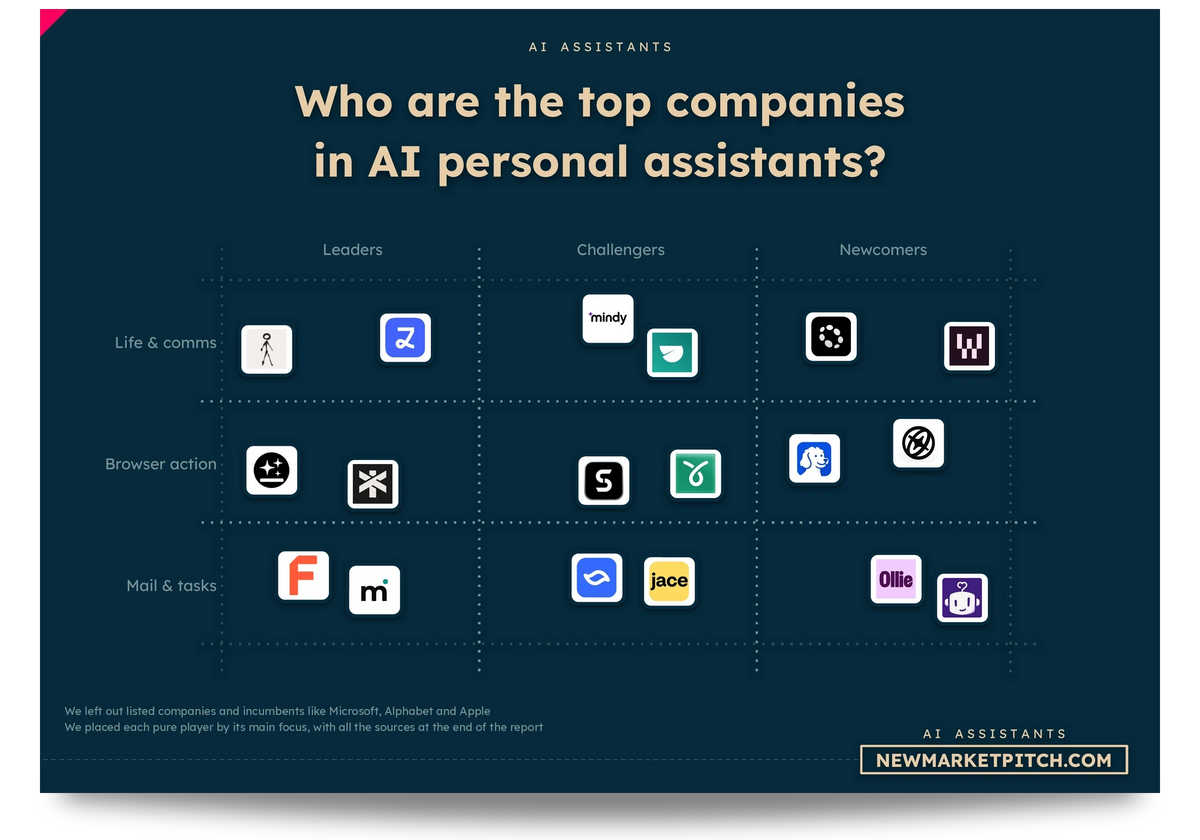
In our research about AI personal assistant startups, we turn what is vague and complex into simple, useful visuals. Market maps like this one show you at a glance where every startup stands.
Are Andreessen Horowitz and Sequoia both betting on personal AI?
Andreessen Horowitz is making a broader bet on AI personal assistants than Sequoia Capital right now.
We counted 5 rounds joined and 4 led by Andreessen Horowitz, compared with 2 joined and 2 led by Sequoia Capital.
Andreessen Horowitz has backed Town, Ghost, Wabi and Jarvie AI. Town works across email, calendars and other apps, while Ghost wants to give personal agents their own computer. The firm led Town's $55M Series A, and its announcement argued that useful assistants need to remember context and act without constant prompting. Sequoia Capital's bets include Mindy and Instinct. The latter puts Sequoia beside a messaging-based agent that secured a much larger later-stage financing.
We see Andreessen Horowitz trying several ways to reach the user early, from ordinary apps to dedicated hardware. Sequoia Capital has made fewer counted moves, with Instinct standing out as a bet on an agent people already use for errands and coordination. Both firms are involved, but Andreessen Horowitz gives founders a more visible track record of leading new personal-assistant rounds.
Does NVIDIA actually lead AI personal assistant rounds?
NVIDIA has not been named lead in any AI personal assistant round we counted, even though it shares the participation lead.
Its role is to join promising agent companies rather than regularly organize their financing.
Perplexity, Simular and Hark show what attracts NVIDIA. Perplexity has expanded beyond answers into tasks people can hand off. Simular works on agents that operate software. Hark is developing its own models and hardware for personal intelligence. In announcing its $700M+ Series A, Hark named Parkway Venture Capital as lead and NVIDIA as a participant. The company also said it would train models at a new facility using NVIDIA B200 hardware.
For NVIDIA, these relationships put it near products that could demand more AI computing. They also give it a view of which interfaces and tasks developers are pursuing. None of that tells us what check NVIDIA wrote or which assistant will ultimately win. If the question is who actually leads financings in this market, Prosus Ventures and Andreessen Horowitz offer clearer examples.

In our market report about AI personal assistant startups, we always try to gather several sources and make estimates that make sense, so you can work with solid numbers.
Why does Prosus Ventures keep funding AI assistants?
Prosus Ventures keeps backing personal AI assistants because it sees a chance to make them everyday consumer services.
Luzia, Zapia and Equal all help people through channels they already know, although they handle different jobs.
Luzia made its name as a conversational assistant for Spanish-speaking users. Zapia can act across apps and websites to help book reservations or organize plans. Equal started with a practical problem in India: screening incoming calls and identifying what callers want. When Equal announced its $30M Series B, it said it had passed 1 million monthly active users and was extending its assistant into shopping, communications and concierge services. Prosus Ventures and Tomales Bay Capital co-led the round, just as they had co-led an earlier financing.
That pattern fits Prosus's wider interest in consumer payments, commerce and other services. A phone call or message gives an agent an obvious place to start, and a completed task gives people a reason to return. We can see why Prosus keeps selecting these companies. Whether enough people pay for the service after the early excitement is still a separate test.
Which AI personal assistant investors are still investing this year?
Andreessen Horowitz is the most active AI personal assistant investor this year, with 4 rounds joined.
Among the 20 ranked investors, 18 joined a round this year and 2 have not.
Prosus Ventures joined 2 rounds this year and 2 last year. Andreessen Horowitz backed Town, Ghost, Jarvie AI and Wabi, while Khosla Ventures joined rounds for Highlight AI and Wajo AI. General Catalyst and True Ventures have not joined a newly counted round this year. Their older portfolios still exist, but they are not making the same visible run of new bets.
The fresh activity reveals where investors are still willing to experiment: personal memory, group texting, software that acts across apps, and new ways to reach an assistant. Not every new bet will work. The clearest recent failure is Ollie, a family assistant that said in October 2026 it would close. The current-year leaders are taking more shots, and we cannot yet turn those shots into a list of winners.
The table below shows, year by year, how many rounds 12 of the most active AI personal assistant investors joined, so it is easy to see who is still investing and who has slowed down.
If you want to go more into detail and see which investors are still writing checks and which have slowed down, please check our AI personal assistant report.
| Investor | 2024 | 2025 | 2026* | Total |
|---|---|---|---|---|
| Andreessen Horowitz | 1 | 4 | 5 | |
| Prosus Ventures | 1 | 2 | 2 | 5 |
| Benchmark | 1 | 2 | 3 | |
| Kleiner Perkins | 2 | 2 | ||
| Khosla Ventures | 2 | 2 | ||
| SV Angel | 2 | 2 | ||
| NVIDIA | 3 | 1 | 1 | 5 |
| IVP | 3 | 1 | 4 | |
| Emergence Capital | 2 | 1 | 3 | |
| Sequoia Capital | 1 | 1 | 2 | |
| Tomales Bay Capital | 1 | 1 | 2 | |
| Y Combinator | 1 | 1 | 2 |
* 2026: January to 19 November. Darker cells mean more rounds that year. Data from January 2024 through 19 November 2026.
Has General Catalyst stopped investing in personal AI?
General Catalyst has stopped joining new AI personal assistant rounds this year, at least among the deals we could confirm.
General Catalyst joined 4 rounds overall, including 2 last year, and none this year.
Its earlier investments covered Highlight AI, Please, Poke and Strawberry. Poke shows why a quiet fundraising year can hide an important development. Cognition acquired the company behind the text-based agent in July 2026, reporting that users had exchanged more than 100 million messages with it in the previous three months. The acquiring team wanted Poke's habit of messaging first and following up to influence the experience of its own agent, Devin.
That acquisition gives General Catalyst a portfolio event to point to, although the deal did not disclose what its investors received. It is also a reminder that an agent may find a valuable home inside a larger company without becoming a lasting independent app. General Catalyst is no longer among the busiest investors for new rounds this year; its older bets may still prove important.
Has Khosla Ventures found the next family AI hit?
Khosla Ventures has not yet found a proven hit among family AI assistants, and Ollie's closure exposed how hard this business can be.
TechCrunch named Khosla Ventures among Ollie's backers, but none of Ollie's counted rounds names its investors, so our ranking credits Khosla with 2 rounds, in Highlight AI and Wajo AI.
Ollie tried to take chores off families' plates through text messages. It connected with email and calendars and aimed to handle meal planning, appointments and bills. The startup had an easily understood pitch and emphasized privacy. In October 2026, however, TechCrunch reported that Ollie would close its app after struggling to stand out and raise more money. Its founder pointed to growing competition from Muse, Instinct and others.
Khosla Ventures has not limited itself to that one use case. Its other bets explore personal context and agents that help people take action. Still, Ollie is a useful warning: an assistant can tackle a real household problem and have prominent backers without becoming a viable business. The harder question for investors is whether people will use it often enough to cover the cost of doing the work.

Our document detailing everything you need to know about AI personal assistant gets updated several times a month, so you always get the latest view of where things stand.
Which AI personal assistant investors back seed rounds, and which back growth rounds?
Andreessen Horowitz and General Catalyst back the most AI personal assistant seed rounds, while Andreessen Horowitz and NVIDIA lead at Series A and Benchmark and Emergence Capital at Series B.
Seed is the busiest stage, covering 41 of the 66 rounds with a known stage, and those two firms joined 3 seed rounds each.
The names change as companies get bigger. Andreessen Horowitz and NVIDIA are tied at Series A with 2 rounds each, while Benchmark and Emergence Capital are tied at Series B with 2 each. Only 5 rounds are classified as Series C or later. That leaves much less evidence about which firms will repeatedly finance mature independent assistants than about who backs their first experiments.
Ghost and Voyage Labs illustrate the early search for useful tasks and reliable interfaces. Instinct, by contrast, has reached later-stage financing while building an assistant people can contact through messages and calls. Benchmark and Sequoia Capital joined its Series C, and Tencent appeared among Manus's backers. Different investors turn up as the products move from proving a use case toward serving many more people.
The table below shows, for 12 of the most active AI personal assistant investors, how many rounds they joined at each stage, from seed to growth.
If you want to go more into detail and see where each investor places its bets, from seed to growth, please check our AI personal assistant report.
| Investor | Seed | Series A | Series B | Series C | Series D+ | Growth |
|---|---|---|---|---|---|---|
| Prosus Ventures | 2 | 1 | 1 | · | · | · |
| Andreessen Horowitz | 3 | 2 | · | · | · | · |
| NVIDIA | · | 2 | 1 | 1 | 1 | · |
| General Catalyst | 3 | 1 | · | · | · | · |
| IVP | · | 1 | 1 | · | 1 | 1 |
| Benchmark | · | · | 2 | 1 | · | · |
| Emergence Capital | · | 1 | 2 | · | · | · |
| Kleiner Perkins | 1 | 1 | · | · | · | · |
| Sequoia Capital | 1 | · | · | 1 | · | · |
| Tomales Bay Capital | · | 1 | 1 | · | · | · |
| True Ventures | 2 | · | · | · | · | · |
| Y Combinator | 2 | · | · | · | · | · |
Most active at each stage, among all AI personal assistant investors: Seed, Andreessen Horowitz and General Catalyst · Series A, Andreessen Horowitz and NVIDIA · Series B, Benchmark and Emergence Capital · Series C, no investor joined more than one round · Series D+, no investor joined more than one round · Growth, no investor joined more than one round. Bigger dots mean more rounds. Data from January 2024 through 19 November 2026.
Are billion-dollar AI assistant rounds changing who invests?
Yes, very large AI personal assistant rounds are drawing investors who rarely show up in the smallest seed deals.
Instinct's $1.0B Series C included Benchmark and Sequoia Capital, while Hark's $700M+ Series A included NVIDIA and Salesforce Ventures.
The two companies need money for different reasons. Instinct has been building a messaging-first assistant for bookings, shopping and everyday coordination. Hark is developing its own models, devices and computing setup, so its ambitions include technology far beyond a standard consumer app. Both rounds are exceptional in a market where seed financings are common. They bring large established firms into deals whose risks look different from an early application launch.
We should not read either total as the amount one investor contributed. Round announcements rarely disclose each participant's check, and a financing can have several large backers. The useful finding is which investors are prepared to support these ambitious companies and at what stage. The eventual results depend on whether the products work and whether people keep using them.
Why is Benchmark backing both Instinct and Manus?
Benchmark is backing Instinct and Manus because both aim to complete jobs for people instead of stopping at an answer.
Benchmark joined 3 AI personal assistant rounds across those companies and was named lead in all 3.
Instinct lets people delegate everyday work by messaging or calling. Sequoia Capital and Coatue also backed Instinct as it moved quickly to a major Series C. Manus took a different route: its agent can use a computer to carry out complicated digital tasks. The interfaces differ, but each product is trying to take responsibility for a result while the person does something else.
Those products also face different headaches. A messaging assistant must become trusted enough to handle errands repeatedly. A computer-use agent needs to cope with websites, changing interfaces and unexpected errors. Benchmark has placed bets on both approaches; its investment pattern does not tell us which way users will prefer to delegate their work.
Is IVP betting on Perplexity or the next consumer AI app?
IVP is backing both Perplexity, an established consumer AI name, and Wabi, a newer AI personal assistant.
IVP's 4 counted rounds span Perplexity and Wabi, and IVP was named lead in 3.
Perplexity built its audience around finding answers, then expanded into products that can do work on a user's behalf. The Financial Times described that shift when covering Perplexity's Computer product. Wabi is starting with a different idea: an agent that lets people create and share small personalized apps with friends. Wabi's company announcement named IVP as lead and also listed Andreessen Horowitz among the participants.
Perplexity can introduce action-taking features to people who already use its search product. Wabi needs to make a new, social way of using AI feel natural enough to keep. IVP gets a place in both experiments without committing to a single interface. We still need to see whether search habits or shared mini-apps lead to the stronger personal-assistant business.

In our report covering the AI personal assistant market, we look at what the winners do differently, so you can learn from the best instead of guessing.
Are corporate investors pushing traditional personal AI VCs aside?
Corporate investors have become prominent in personal AI, but they have not pushed traditional venture firms out of the market.
Prosus Ventures and NVIDIA share the participation lead with Andreessen Horowitz, while General Catalyst and IVP remain close behind.
The companies bring different interests. Prosus Ventures backs assistants linked to everyday consumer services. NVIDIA joins developers whose AI products may run on demanding computing systems. Salesforce Ventures backed Convergence, which Salesforce later acquired to strengthen its Agentforce technology. Tencent has also appeared among the investors behind Manus. These companies have reasons to watch and help build the technologies that could affect their larger businesses.
Traditional VCs still lead many of the deals: Andreessen Horowitz led Town and Ghost financings, and Benchmark led rounds across Instinct and Manus. The investor lists point to a market where corporate and venture capital overlap, often with different motivations. We have no published investor-level check amounts that would support a claim that either group supplied more money.
Which AI personal assistant investors most often invest together?
IVP and NVIDIA are tied with Prosus Ventures and Tomales Bay Capital as the most frequent co-investor pairs in AI personal assistant startups.
Each pair joined 2 rounds together, in Perplexity and Equal respectively.
The ties are specific to those companies. IVP and NVIDIA repeatedly participated in Perplexity as the company moved from AI search toward task-taking products. Prosus Ventures and Tomales Bay Capital returned to Equal, whose Indian call assistant is expanding into personal services. Equal's announcement explicitly said the firms had co-led its earlier financing too.
Neither pair is evidence of a general alliance across the market. Each worked together on 1 startup, while 131 named investors appear in our research overall. For someone asking who backs these companies together, the answer is repeat support for individual bets, not an established club of firms moving from deal to deal.
The table below lists the pairs of AI personal assistant investors named together in at least two equity rounds, with the startups they backed together.
If you want to go more into detail and see which investor networks back the same startups, please check our AI personal assistant report.
| Investor pair | Rounds together | Startups backed together |
|---|---|---|
| IVP + NVIDIAPerplexity | 2 | Perplexity |
| Prosus Ventures + Tomales Bay CapitalEqual | 2 | Equal |
Pairs of investors named in the same equity round. Data from January 2024 through 19 November 2026.
Are angels still backing personal AI assistants?
Yes, individual investors are still appearing in personal AI assistant rounds alongside venture firms.
Lenny Rachitsky and Jeff Dean each joined 2 rounds we counted, while Y Combinator and SV Angel also joined 2 each.
The investments cover different products. Rachitsky appears in Fyxer AI and Voyage Labs; Jeff Dean appears in Vercept and Wajo AI. SV Angel backed Ghost and Voyage Labs. Voyage Labs recently unveiled Atlas, an assistant designed to plan, book and manage a trip rather than simply suggest places. TechCrunch reported that Kleiner Perkins led its $12M seed financing and SV Angel participated.
There is room for experienced individual backers where founders are still trying to prove a specific personal workflow. The announcement of an angel's participation tells us a founder attracted that person, not how large the investment was or how much influence the angel has. A strong network can help, but early consumer AI businesses still need people who return to use the product.
Have personal AI assistant acquisitions made investors money?
Acquisitions of personal AI assistants may reward early investors, but the announced deals do not tell us what individual backers earned.
Cognition acquired Poke's maker, Anthropic bought Vercept, and Salesforce acquired Convergence.
The buyers wanted specific capabilities. Cognition saw value in Poke's proactive texting behavior. Anthropic said Vercept would help Claude operate real software more effectively. Salesforce brought Convergence into its work on agents that navigate complicated web interfaces. In October 2025, OpenAI also acquired the company behind Sky, which had built an assistant that understands the screen and acts across Mac apps. Together, these deals show large software companies buying talent and techniques for getting agents to do things.
An acquisition price, when disclosed, would still not reveal the proceeds of each investor without information about ownership and deal terms. Here, the public announcements leave those personal outcomes unknown. We can confidently say there is buyer demand for personal-agent capabilities; calling every acquisition a profitable VC exit would go further than the evidence permits.

In our research about AI personal assistant startups, we don't want to repeat what boring consulting reports say. Instead, we show you the real and latest market signals that matter.
Can personal AI startups compete with Google and Meta?
Startups making personal AI assistants can still compete, but Google and Meta have made it harder to win through general-purpose features alone.
Muse can act across apps and messages, while Gemini now handles tasks involving calendars, payments and connected services.
Meta introduced Muse as a personal agent with its own secure virtual computer. It can keep working on long tasks and ask before making purchases or sending messages. Google's latest Gemini update also lets people hand off errands and control connected apps from an account they already use. These launches put powerful task-taking agents in familiar products, with distribution and customer context that startups must work hard to match. OpenAI's purchase of Sky's maker shows the same push toward computer use.
The opening for startups is to finish a particular job better. Equal has focused on phone calls in India, and Voyage Labs wants to manage the full life of a trip. Both have to build trust and repeat use in a way a broad assistant might struggle to copy. For investors, the question is whether a startup owns a relationship with its users or is building a feature that a platform can add next month.
Does privacy make personal AI assistants too risky for investors?
Privacy is a major risk for personal AI assistants, but it has not stopped investors from backing them.
An agent that reads private messages, operates accounts or buys things for a user has to earn far more trust than a chatbot answering general questions.
The products are approaching that risk differently. Ghost wants a dedicated computer that can keep a person's context available to their agents. Instinct has described isolated environments and short-lived credentials. Meta says Muse gives people control over connected apps and asks for approval before sensitive actions. Google says Gemini's task mode runs inside isolated virtual machines, with checks around purchases and account access.
Those protections are important, but investors still need to know whether people want the service and what happens when the agent makes a mistake. Privacy features can help someone choose an assistant, especially for email, money and family information. They do not prove that the business will retain users or that its tasks will work reliably. That is the trade-off investors have to assess today.
Are investors funding personal AI gadgets again?
Investors are funding dedicated personal AI hardware again, with Hark and Ghost taking different approaches to making an assistant available beyond a chat window.
Both are betting that more persistent access to a person's context can make agents more useful.
Hark is developing its own AI models alongside bespoke devices, and its financing included several major technology investors. It also described plans to train models using NVIDIA B200 systems. Ghost is pursuing a smaller dedicated computer that can keep agents running across apps, files and home devices. A user would not have to start from a blank prompt every time something needs doing.
The hardware brings extra challenges: devices cost money to produce and support, while an always-on agent must persuade people to trust it with a lot of personal information. An assistant that reliably finishes jobs could make that trade worthwhile. For now, the financing proves investors are willing to try a more physical interface; neither startup has shown that buying another device will become the normal way people use AI.
Can a travel AI assistant beat Gemini or Muse?
Voyage Labs' Atlas has not yet proved it can beat Gemini or Muse across an entire trip.
Voyage Labs is testing exactly that with Atlas, its travel assistant.
Travel has a natural sequence: choosing a destination, comparing options, booking, adjusting plans and handling surprises during the journey. Voyage Labs says Atlas will stay involved through that process, with supplier partnerships for flights, hotels and experiences. Voyage Labs was started by people with product experience at Google Maps and Uber. Its recent seed financing was led by Kleiner Perkins, suggesting investors see room for a specialist despite the arrival of broader agents.
Google and Meta already offer travel-related help, so a specialist cannot rely on an attractive itinerary alone. It needs dependable bookings, good changes and customer support when plans fail. Equal's call screening and Zapia's everyday reservations pose similar questions in other areas. Some focused assistants could become useful services in their own right. Many others will have to work harder as the platforms keep adding features.

Learning from others' mistakes is the cheapest lesson there is. In our market report about AI personal assistant startups, we look at what broke startups before you, so you don't repeat it.
Can investors already tell which personal AI assistant will win?
No AI personal assistant investor can claim a proven overall winner today.
Message-based agents, browser operators, phone assistants and dedicated devices are competing for the same place in people's routines, while larger platforms keep adding similar capabilities.
There are promising signs, but they measure different things. Equal disclosed more than 1 million monthly active users for a specific calling product. Instinct moved quickly to a major later-stage financing. Hark attracted backing for a much more ambitious technical system. None of those facts alone reveals how often people finish tasks successfully, how much they pay or whether they stay for years. Investors are making judgments with different kinds of evidence.
Acquisitions offer another possible outcome. Vercept's computer-use work found a home at Anthropic, while other assistants have had to shut down. In our view, the strongest companies will show repeated completed tasks and a reason for users to choose them even when Google or Meta offers something similar. We can identify the active backers now; the enduring consumer habit remains unproven.
So, who are the biggest investors in AI personal assistants today?
Prosus Ventures, Andreessen Horowitz and NVIDIA are tied as the most active AI personal assistant investors by rounds joined.
Prosus Ventures and Andreessen Horowitz have repeatedly led funding, while NVIDIA has joined rounds without being named lead.
General Catalyst and IVP make up the next tied group. Andreessen Horowitz is also the busiest by fresh participation, and the seed-stage lead is shared by Andreessen Horowitz and General Catalyst. These firms are betting on different paths to the same goal: an assistant that people trust to carry out real tasks.
Prosus Ventures stands out for repeatedly leading consumer-service assistants, NVIDIA for its broad participation, and Andreessen Horowitz for making fresh lead investments in different personal-agent ideas. They are the most defensible names to give someone asking who backs this market. Which investor eventually gets the best return is a separate question, and the private check sizes and exit proceeds are not public.
The table below shows what we found.
| Question | Answer |
|---|---|
| Does one investor own the participation lead? | No, Prosus Ventures, Andreessen Horowitz and NVIDIA share first place. Each joined 5 rounds in the market we examined. Their different roles make the tie worth understanding. |
| Is joining a deal the same as leading? | No, participation alone cannot establish who controls a round. NVIDIA was not named lead in any round we counted. Prosus Ventures led far more of its reported deals. |
| Are top VC brands still backing personal agents? | Yes, Andreessen Horowitz remains a major lead investor. Andreessen Horowitz joined 5 rounds covering different approaches to personal help. Its track record goes beyond a famous brand name. |
| Have new rounds shifted to different funds? | Yes, recent activity favors Andreessen Horowitz. It joined 4 rounds during the current year. Earlier leaders are no longer setting the pace alone. |
| Has anyone cornered the early assistant market? | No, seed investing has a shared lead. Andreessen Horowitz and General Catalyst each joined 3 seed rounds. Several firms still compete to back the first experiments. |
| Do billion-dollar rounds reveal individual investor checks? | No, a funding total includes all participating investors. Instinct raised $1.0B in its Series C financing. Each fund's actual contribution remains undisclosed in that announcement. |
| Are the closest investor pairs permanent partners? | No, the leading pairs kept returning to specific companies. Each top pair appeared together in 1 startup. Their repeated support does not establish a wider alliance. |
| Can a phone assistant build a real audience? | Yes, Equal has already reported substantial monthly usage. Equal's call assistant passed 1 million monthly active users. Repeat use beyond call screening is the next challenge. |
| Are later-stage personal agents attracting big investors? | Yes, Benchmark backs ambitious agents beyond seed. Benchmark joined 3 rounds across Instinct and Manus. Larger deals demand more evidence that the assistant works. |
| Does an acquisition guarantee a good exit? | No, a buyer's announcement rarely reveals shareholder proceeds. Cognition acquired Poke for its proactive texting capabilities. The returns to its earlier investors were not disclosed. |
| Has the personal assistant winner emerged yet? | No, competing products still handle different tasks. We found 47 startups with qualifying funding rounds. Round counts alone cannot tell us which becomes habitual. |

If you build or invest in the AI personal assistant market, you need to know which business models pay off now and which ones are fading. That's why our report covering it has a whole section on it.
Our methodology
Our data runs through November 19, 2026. We then reviewed this article and updated its answers on November 24, 2026, the date shown under the title. We systematically tracked equity rounds in the AI personal assistant market from January 2024, deal by deal, to capture a period long enough to show which investors are active today. We define this market around standalone companies whose core products act for an identifiable individual to organize, remember, coordinate or complete everyday tasks. It includes personal agents that use messages, calls, browsers, computers, devices and persistent memory; focused workflows qualify when the assistant handles tasks rather than merely generating content. Every company counted is a startup under our definition: an independent, growth-oriented technology company founded in 2007 or later, privately funded or recently listed, with recently acquired companies retained where relevant. We include companies at the boundary of this definition rather than silently excluding them.
We count each equity round an investor joined and identify the rounds in which the investor was named lead. We do not estimate how much an investor put into a round, because individual commitments are rarely public. IPOs and offerings after listing are excluded because they are not private rounds joined by venture investors. We merge duplicate announcements of the same round, reconcile alternate investor names against company announcements and reliable press reports, and exclude unidentifiable labels such as "existing investors" or "angel investors." Our current-year activity column begins in March, once at least three months of information can be reviewed.
Announcements name lead investors more reliably than smaller participants, so rounds that an investor joined without leading are undercounted and lead rates are an upper bound.
Rounds confirmed by a company announcement, a press article or a regulatory filing are counted in full. Where no article exists, a round is counted only when at least two recognised databases agree on its date (within one month) and amount (within 5%), and it is marked as low confidence; a round found in a single database stays in the company's history but is left out of totals. For companies that have raised more than $100M, every round counted is backed by an article.
We never accept an investor list from Crunchbase, PitchBook or a similar commercial database on its own: such lists can confuse investors across rounds or include debt and grants. At least one investor is named in 72 of the 78 rounds we counted, or 92%. Unnamed rounds keep their place in the funding history but cannot be assigned to particular investors, so each investor's count is a floor. Our investor participations also differ from the deal count in a funding tracker: a single financing can count once for several named investors, but it remains only one financing in the market total.
We rank investors by confirmed rounds joined, then examine rounds led, recent activity, stage and repeated co-investment separately. That choice explains why a corporate investor or broad venture firm may outrank a well-known specialist: a fund's reputation, announced capital or exposure to the wider AI sector is not evidence that it joined more personal assistant rounds. Counting participation, rather than guessing check sizes, makes the comparison reproducible and keeps the conclusions tied to actual deals.
Key sources include Equal product usage, repeat investors and call-assistant strategy, Prosus rationale and Zapia's autonomous personal tasks, Luzia's conversational distribution and Prosus participation, Hark's technology ambitions, named investors and computing plans, Andreessen Horowitz's Town thesis and leading role, Ghost's dedicated personal AI computer and venture backing, Wabi's collaborative AI agent and investors, Reuters reporting on Instinct's financing and product, Voyage Labs' travel agent, founding team and seed investors, Ollie's closure after venture funding, Cognition's acquisition of Poke and engagement description, Anthropic's acquisition of Vercept for computer use, Salesforce's acquisition of Convergence and rationale, OpenAI's acquisition of Sky's maker for personal computer assistance, Meta's personal agent, secure execution and task capabilities, Gemini's newly announced personal task execution, Perplexity's transition from search into AI agents, and IVP's earlier leadership in Perplexity financing.

In our report covering the AI personal assistant market, we like to show you the big picture. We know your time is precious, so we make every page quick to read and packed with as much learning as possible per minute.
Written by the New Market Pitch teamWe track new markets so founders and investors can move faster. About us