What’s funding like in the ai-powered market research market right now?
Whether you're building or investing in the ai-powered market research market, our report covers everything you need to know: the players, the money, and what's coming next.
Summary
AI-powered market research is raising much bigger checks, but we would not call the market healthier yet. Over the last 12 months, we tracked 18 deals worth at least $572M, against 24 deals worth at least $193M in the 12 months before. Simile raised the most: $300M across 2 rounds.
A few unusually large checks make the total look spectacular. Take away rounds above $50M and the latest pool drops to at least $203M. That is still substantial funding for young research products, though the big-money story suddenly looks less universal.
Fewer businesses got funded. We found 17 companies in the latest period, down from 23 in the one before. The median disclosed round reached $10M, but a larger typical check cannot help founders who never get one.
Investors have put the boldest bets on synthetic respondents and behavioral simulation. Those startups attracted at least $366M across 7 deals. The unanswered question is whether computer-generated consumers can predict what actual buyers will do.
Investors still pay for interviews with real people too. AI-moderated qualitative interviews and focus groups drew $167M across 7 deals, with Listen Labs, Conveo and Outset showing how faster research can fit into a company's everyday work.
Listen Labs has since joined Salesforce. That sale gives AI research a place inside a huge business software ecosystem, although an acquisition tells us nothing about how easy it is for a new startup to raise its first round.
Seed funding looks considerably thinner. The recent period had 6 Seed deals worth at least $14M, while the earlier one had 12 Seed deals worth at least $37M. Meanwhile, Series B deals absorbed far more of the disclosed money.
There are still new teams getting their first checks. Yet the identified first financings range from Simile's unusually large starting round to Echovane's much smaller one. It's hard to turn that gap into a reassuring story for the average founder.
The people leading these deals are spread across fewer names. We identified 17 distinct disclosed lead investors recently, compared with 25 before. There is interest from serious venture firms, but only Index Ventures led more than one recent round, both of them at Simile.
Our verdict is straightforward: investors will pay serious money for the strongest AI research products, especially simulation and enterprise interviews. For everyone else, funding remains patchy, and the small number of deals makes any claim of a lasting boom premature.

Written by the New Market Pitch teamWe track new markets so founders and investors can move faster. About us

In our report covering the ai-powered market research market, you will always find fresh funding data, taken straight from our own verified funding database.
All funding deals in the ai powered market research market over the last 24 months
Below is the table listing all the deals. You can find our methodology at the end of this page.
If you want a deeper understanding of the market and its current dynamics, get our ai powered market research market report.
| Company | Category | Date | Stage | Deal size | What they do | Region | Lead investors | Country | Rank |
|---|---|---|---|---|---|---|---|---|---|
| Newton Research | AI creative, concept and advertising pretesting | November 2026 | Unknown | $18M | AI research for advertising effectiveness decisions | North America | Not disclosed | United States | |
| QualSights | Consumer, category and market intelligence | November 2026 | Unknown | $5M | Smart sensors, a participant app and physical AI analytics measure actual consumer use of household products. | North America | Duo Partners | United States | |
| Verso | AI-moderated qualitative interviews and focus groups | October 2026 | Seed | $6M | AI-led consumer interviews and evolving personas | Europe | Angular Ventures | France | |
| Autentic AI | AI-moderated qualitative interviews and focus groups | October 2026 | Seed | $1.7M | AI market research interviews platform | Europe | Not disclosed | Spain | |
| askpolly | Synthetic respondents and behavioral simulation | September 2026 | Seed | $3M | AI market research through synthetic consumers | North America | Differential Ventures | Canada | |
| Intellicia | Synthetic respondents and behavioral simulation | September 2026 | Seed | $2.5M | Synthetic consumer research with AI personas | Asia-Pacific | Kakao Ventures | South Korea | |
| Conveo | AI-moderated qualitative interviews and focus groups | September 2026 | Series A | $50M | Automated consumer interview and research agents | Europe | DST Global | Belgium | |
| Hiasynth | Synthetic respondents and behavioral simulation | September 2026 | Seed | Undisclosed | Queryable synthetic population for European market insights | Europe | Further Than Capital | Sweden | |
| Echovane | AI-moderated qualitative interviews and focus groups | August 2026 | Seed | $1M | Autonomous end-to-end market research agents | North America | Titan Capital, Neon Fund | United States | |
| Simile | Synthetic respondents and behavioral simulation | July 2026 | Series B | $200M | Foundation models simulating human behavior | North America | Greenoaks, Index Ventures | United States | |
| Ideally | AI-powered survey and quantitative research | April 2026 | Series A | $10M | AI-guided consumer survey testing and segmentation | Asia-Pacific | Shearwater Capital | New Zealand | |
| Simile | Synthetic respondents and behavioral simulation | February 2026 | Series A | $100M | Foundation models simulating human behavior | North America | Index Ventures | United States | |
| Electric Twin | Synthetic respondents and behavioral simulation | February 2026 | Unknown | $10M | Synthetic consumer audiences for research and prediction | Europe | Atomico | United Kingdom | |
| Dragonfly AI | AI creative, concept and advertising pretesting | January 2026 | Growth Equity | $6.9M | Predictive attention analytics for creative effectiveness | Europe | 24Haymarket | United Kingdom | |
| Listen Labs | AI-moderated qualitative interviews and focus groups | January 2026 | Series B | $69M | AI-powered customer research interviews | North America | Ribbit Capital | United States | |
| Outset | AI-moderated qualitative interviews and focus groups | December 2025 | Series B | $30M | AI-moderated customer interviews and usability studies | North America | Radical Ventures | United States | |
| Bolt Insight | AI-moderated qualitative interviews and focus groups | December 2025 | Series A | $9.4M | AI-moderated global consumer insight interviews | Europe | Pembroke VCT | United Kingdom | |
| Aaru | Synthetic respondents and behavioral simulation | December 2025 | Series A | $50M+ | Simulates human behavior for market research | North America | Redpoint Ventures | United States | |
| BluePill | Synthetic respondents and behavioral simulation | November 2025 | Seed | $6M | AI consumer twins for rapid concept testing | North America | Ubiquity Ventures | United States | |
| Dialogue AI | AI-moderated qualitative interviews and focus groups | October 2025 | Seed | $6M | Conversational customer interviews and automated insight analysis | North America | Lightspeed Venture Partners | United States | |
| Strella | AI-moderated qualitative interviews and focus groups | October 2025 | Series A | $14M | AI-moderated customer interviews and focus groups for market research | North America | Bessemer Venture Partners | United States | |
| i-Genie | Consumer, category and market intelligence | October 2025 | Series A | $7.5M | AI consumer signals from digital behavior | North America | Mudita Ventures, Silicon Road Ventures | United States | |
| Propane | Consumer, category and market intelligence | September 2025 | Seed | $1.4M | AI-powered customer intelligence and market insights | Europe | EIFO, Heartfelt Capital | Denmark | |
| Keplar | AI-moderated qualitative interviews and focus groups | September 2025 | Seed | $3.4M | Voice interviews for customer and market research | North America | Kleiner Perkins | United States | |
| Newton Research | AI creative, concept and advertising pretesting | August 2025 | Series A | $9M | AI research for advertising effectiveness decisions | North America | Greycroft, Bessemer Venture Partners | United States | |
| Knit | AI-moderated qualitative interviews and focus groups | July 2025 | Series A | $16M | AI-powered consumer research and qualitative synthesis | North America | GFT Ventures, Sound Ventures | United States | |
| Cafeteria | AI-moderated qualitative interviews and focus groups | July 2025 | Growth Equity | $3M | AI-moderated feedback from youth consumers | North America | Not disclosed | United States | |
| Hootology | AI-moderated qualitative interviews and focus groups | July 2025 | Seed | $1.1M | Generative AI simulated qualitative research discussions | North America | Not disclosed | United States | |
| GetWhy | AI-moderated qualitative interviews and focus groups | July 2025 | Series A | $20M | AI analysis of video-based consumer research | Europe | PeakSpan Capital | Denmark | |
| Outset | AI-moderated qualitative interviews and focus groups | June 2025 | Series A | $17M | AI-moderated customer interviews and usability studies | North America | 8VC | United States | |
| Artificial Societies | Synthetic respondents and behavioral simulation | May 2025 | Seed | $3.4M | Simulated societies for public and consumer insight | Europe | Point72 Ventures | United Kingdom | |
| Listen Labs | AI-moderated qualitative interviews and focus groups | April 2025 | Series A | ~$20M | AI-powered customer research interviews | North America | Sequoia Capital | United States | |
| Conveo | AI-moderated qualitative interviews and focus groups | March 2025 | Seed | $5.3M | Automated consumer interview and research agents | Europe | 6 Degrees Capital | Belgium | |
| Artificial Societies | Synthetic respondents and behavioral simulation | March 2025 | Seed | $2M | Simulated societies for public and consumer insight | Europe | Not disclosed | United Kingdom | |
| Aaru | Synthetic respondents and behavioral simulation | March 2025 | Seed | Undisclosed | Simulates human behavior for market research | North America | Not disclosed | United States | |
| Bridgetown Research | Consumer, category and market intelligence | February 2025 | Series A | $19M | AI market research and competitive intelligence | North America | Accel, Lightspeed Venture Partners | United States | |
| Behavix | Consumer, category and market intelligence | February 2025 | Seed | $2.5M | AI market research and consumer behavior analytics | North America | Vendep Capital, Superhero Capital | United States | |
| GetWhys | AI qualitative coding, synthesis and reporting | February 2025 | Seed | $2.8M | AI interview analysis for market research | North America | Next Frontier Capital | United States | |
| Unwrap | AI qualitative coding, synthesis and reporting | January 2025 | Series A | $12M | AI customer feedback analysis software | North America | Scale Venture Partners | United States | |
| CoLoop | AI qualitative coding, synthesis and reporting | January 2025 | Seed | $3.5M | AI analysis and coding of qualitative research | Europe | Y Combinator | United Kingdom | |
| Bounce Insights | AI-powered survey and quantitative research | December 2024 | Unknown | $4.5M | AI-driven consumer survey research and insights | Europe | ACT Venture Capital | Ireland | |
| Happydemics | AI-powered survey and quantitative research | December 2024 | Series B | $14M | AI-aided advertising measurement and brand surveys | Europe | Wille Finance, Adelie Capital | France |

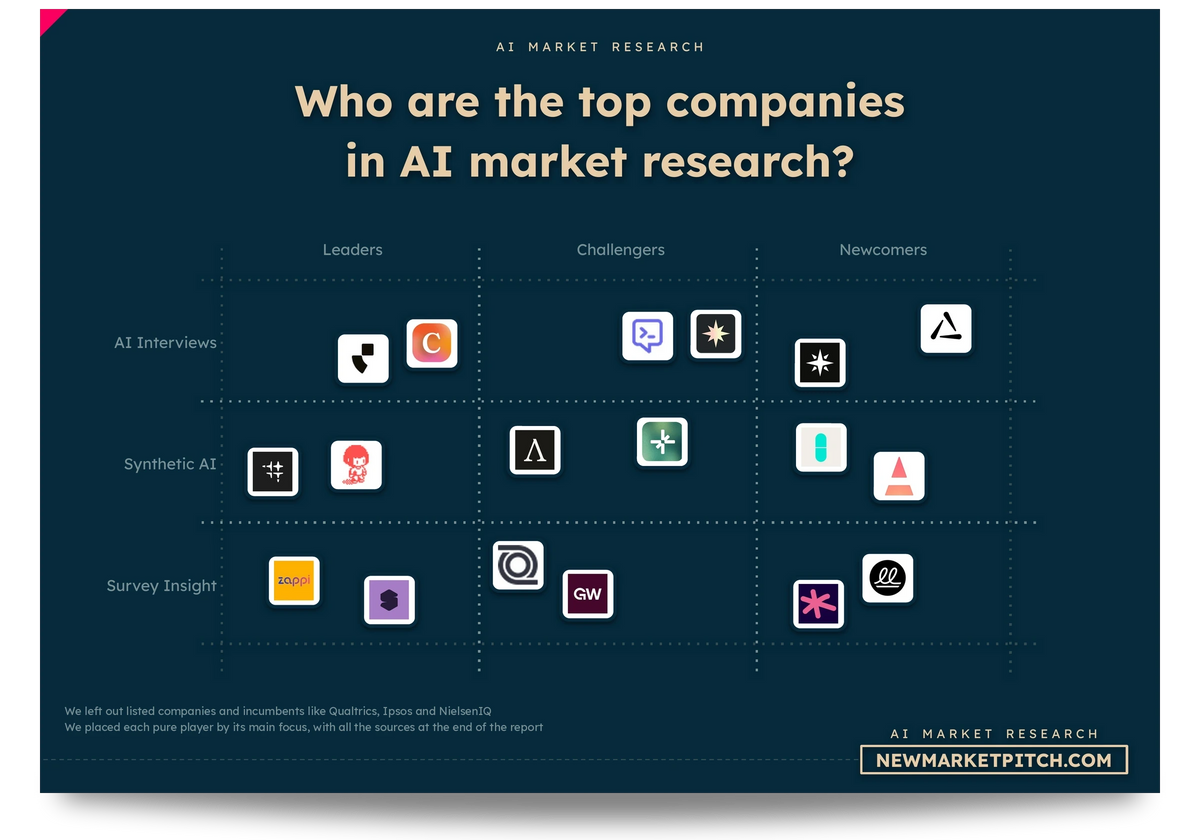
In our research about ai-powered market research startups, we turn what is vague and complex into simple, useful visuals. Market maps like this one show you at a glance where every startup stands.
Is AI-powered market research funding actually getting healthier?
AI-powered market research is attracting bigger checks, but fewer startups are getting funded, so the industry's financial health is still in doubt.
We recorded 18 qualifying deals in the last 12 months, against 24 in the 12 months before. The disclosed total climbed sharply, but the money reached fewer companies. A founder trying to raise a modest seed round would have little reason to celebrate a headline dominated by an exceptional financing.
Look at the companies behind those headlines. Simile's $200M Series B in July 2026 was the largest recent deal, while GetWhy's $20M Series A in July 2025 led the preceding period, level with Listen Labs' Series A of about $20M in April 2025. Listen Labs, Outset and Conveo also went on to raise bigger checks for AI interviews with real customers. Those businesses have made genuine progress, but their successes tell us more about which products investors favor than about every startup's prospects.
Salesforce's completed purchase of Listen Labs adds a commercial endorsement. Even so, the number of deals is small enough that a few decisions by individual firms can change the whole picture. We see a market choosing winners more aggressively, without enough evidence that the average founder has an easier time.
Would AI research funding still look strong without the giant rounds?
AI-powered market research would still attract meaningful money without its giant rounds, but the fundraising picture would be far less impressive.
Take out rounds above $100M and at least $372M is left over the last 12 months. Excluding rounds above $50M leaves at least $203M. Aaru's Series A is counted at $50M because its exact amount, reported only as above $50M, was never published, so it stays on the smaller side of that line. During the 12 months before, no qualifying deal topped $50M. The ordinary pool is therefore much closer to the earlier one than the headline would suggest.
Simile's two financings show how quickly the total can swell. Its work on predicting human decisions won support from Index Ventures and Greenoaks. Listen Labs, meanwhile, sold investors a product that interviews real people at scale, and Conveo backed its pitch with enterprise customers including major consumer brands. Each company offered something specific that a generic AI survey tool would struggle to match.
The median disclosed round also rose, to $10M from $6M. Yet the smaller deal count and fewer funded companies tell their own story. We would treat the large rounds as evidence that investors believe in a few ambitious products, rather than proof that cash is flowing freely throughout the industry.
The table below shows how the two funding periods compare with and without the largest checks.
| Measure | Last 12 months | 12 months before |
|---|---|---|
| All capital | $572M+ | $193M+ |
| Excluding above $50M | $203M+ | $193M+ |
| Deals | 18 | 24 |
| Funded companies | 17 | 23 |
| Disclosed deals | 17 | 23 |
| Distinct leads | 17 | 25 |
| Median round | $10M | $6M |
| Above $50M deals | 3 | 0 |
| Above $100M deals | 1 | 0 |
“+” means at least; some deal amounts were not publicly disclosed.
Are fewer AI research startups getting funded while the winners raise more?
Yes, funding now reaches fewer AI-powered market research companies, even as some of the successful ones raise much larger rounds.
The latest 18 deals went to 17 companies, and the previous 24 deals went to 23 companies. In each period, just 1 company completed multiple financings inside the window. So the drop in funded companies did not come from a crowd of familiar names squeezing out everyone else through repeated rounds in the same period.
What changed was the size of the checks available to certain companies. Listen Labs and Outset each raised a Series A in the earlier period before reaching Series B in the latest one. Conveo moved from a Seed round to a $50M Series A in September 2026. These are fast-moving businesses with a clear reason for enterprise customers to pay: they can conduct more interviews and make past research easier to reuse.
But we should not extrapolate from their progress to the entire market. Startups testing synthetic audiences, running surveys with real consumers or analyzing feedback face different buyers and different hurdles. The recent deals show that investors are willing to back a company again when its product catches on. They do not show that more founders are getting a first chance.
Does Simile's fundraising prove synthetic consumers are ready for prime time?
Simile's huge backing has made synthetic consumers a serious venture bet, but the technology still needs to prove that its predictions match real people.
Simile raised a $100M Series A in February 2026 led by Index Ventures, followed by a $200M Series B in July 2026 co-led by Greenoaks and Index Ventures. The company builds models intended to predict how people make decisions, using information collected from real people rather than relying only on a chatbot's invented persona. That is a bigger technical ambition than producing quick fictional focus-group quotes.
Businesses are already trying related ideas. CVS Health described in February 2026 how it uses generative agents to explore patient journeys, messages and service designs before putting promising options in front of humans. It presented simulation as a way to choose what to test, with actual customer feedback remaining essential.
The limits are real too. Pew Research Center's September 2026 tests found substantial gaps between AI-generated survey answers and human responses. Pew was testing a particular way of building synthetic respondents, so that result does not settle the performance of Simile's product. It does, however, make the burden of proof clear. Investors have paid for the possibility of reliable behavioral prediction, and buyers will need evidence that it works in their own decisions.

In our market report about ai-powered market research startups, we always try to gather several sources and make estimates that make sense, so you can work with solid numbers.
Can AI-generated consumers really replace surveys of real people?
No, AI-generated consumers cannot reliably replace real respondents in consumer research today, even though they are useful for exploring ideas.
Pew Research Center tested AI replicas against human surveys and, in September 2026, reported an average gap of 12 percentage points across nearly 300 questions. The findings came from public-opinion polling rather than a test of every commercial market research product. Still, they show how easily a synthetic sample can produce polished answers that miss what humans actually think. The American Association for Public Opinion Research also distinguishes generated responses from real participants.
That hasn't stopped investors from experimenting. Aaru raised a Series A of more than $50M in December 2025 to develop simulated human behavior. Electric Twin's $10M round in February 2026, whose stage was not published, supported synthetic audiences that businesses can use to explore scenarios. Neither product has to replace every real-world survey to be useful. A brand may pay to screen many ideas quickly and then spend its human research budget on the most promising options.
AI surveys of real people have their own investors. Ideally's $10M Series A in April 2026 backed testing with actual consumers. The practical question for every synthetic product is whether its recommendations improve after they are checked against real behavior. Without that test, fast answers may simply be fast mistakes.
Are investors still funding AI interviews with real customers?
Yes, AI interview startups that speak to real people are still drawing substantial funding, even while synthetic-consumer companies get the biggest headlines.
AI-moderated qualitative interviews and focus groups raised $167M across 7 deals over the last 12 months, compared with $106M across 10 deals in the 12 months before. Investors have backed fewer deals in this group, but they have clearly not abandoned the products. Listen Labs, Outset and Conveo all grew beyond simple automatic interview transcription.
The products have distinct selling points. Listen Labs said in January 2026 that it had interviewed over one million people, with Microsoft, Sweetgreen and Robinhood among its customers. Conveo offers brands a continuing record of consumer conversations that they can revisit. Outset broadened its product from AI-moderated studies to customer-experience software. All still depend on hearing from actual participants.
There is a reason that distinction may prove valuable. When a company makes an expensive pricing, branding or product choice, somebody needs to explain where the evidence came from. Human interviews bring recruitment, sampling and interpretation problems of their own, but at least the underlying words came from customers. The strongest platforms are making those conversations faster to run and easier to use again.
Does Salesforce's purchase of Listen Labs make AI research startups more attractive?
Salesforce's purchase of Listen Labs makes AI-powered customer research more credible to large software buyers, although it could make life tougher for independent startups.
Listen Labs raised a $69M Series B in January 2026, led by Ribbit Capital with Sequoia Capital and Pear VC also investing. Salesforce announced its agreement to acquire the startup in September and confirmed completion on November 2, 2026. The price was not disclosed. TechCrunch also reported in September that Listen Labs had walked away from a planned Series C during the acquisition discussions, so that round never closed.
Salesforce wants research inside Marketing Cloud, Service Cloud and its other AI products. That is a very different buying experience from commissioning a separate project whenever a business needs customer feedback. Teams could collect, search and use interviews alongside the software where they already manage customer relationships.
For investors, the sale offers a concrete example of where a strong AI research startup might end up. It also raises the competitive bar. A new interview company now has to convince customers why they need another vendor when Salesforce is building similar capabilities into its existing products. The acquisition validates demand, but it doesn't guarantee another wave of independent companies will get funded.

Our document detailing everything you need to know about ai-powered market research gets updated several times a month, so you always get the latest view of where things stand.
Why are investors giving Conveo so much money for AI interviews?
Conveo has persuaded investors that its AI interviews can become software used across a large company, rather than an occasional research shortcut.
Conveo raised a $50M Series A in September 2026, led by DST Global, with Balderton Capital, Y Combinator and Visionaries Club also backing it. Balderton said more than 400 enterprises used the platform, including over 50 Fortune 500 brands, and named Unilever, Google, AB InBev and Canva. We should treat those as company and investor claims rather than audited revenue, but they describe a genuine set of buyers using the product.
Conveo's StoryLines keeps research conversations going around topics a brand follows over time. That lets a marketing or product team ask a new question against earlier consumer discussions, instead of starting every study from scratch. The company has also described expansion into the United States. Both the product and the customer list help explain why investors might back another stage of growth.
Conveo is pursuing a different outcome from a one-off interview chatbot. Salesforce's move into Listen Labs, and Outset's expansion into customer experience, point in a similar direction: research is being pulled into the software people use every week. Whether Conveo can keep those customers paying is still a live commercial test, but the reason for the large check is easier to understand than a pitch based on automation alone.
Is seed funding drying up for AI market research startups?
Seed funding for AI-powered market research startups has become noticeably thinner, although a small sample cannot tell us whether the slowdown will last.
We recorded 6 Seed deals worth at least $14M in the last 12 months, compared with 12 Seed deals worth at least $37M during the 12 months before. Series A financing remained active, with 5 deals worth at least $219M in the recent window. And the 3 Series B deals brought in $299M. Among deals with a named stage, early rounds represented 73% of the latest period and 91% of the previous one.
The people receiving smaller checks are still trying different ideas. Canada's askpolly raised a $3M Seed round in September 2026 for synthetic consumer research. South Korea's Intellicia raised a $2.5M Pre-Series A round the same month, which we count with Seed deals. France's Verso raised a $6M Seed round in October for AI-led interviews. None looks like a simple copy of the largest U.S. model developer.
Seed investors haven't walked away from the market. Fewer early rounds closed, while later-stage companies drew much larger checks. New founders should judge the market by the small-check opportunities, not by its biggest announcements.
Can a new AI market research startup still get its first check?
Yes, new AI-powered market research startups can still raise their first round, but the examples we found are worlds apart in size.
We identified 2 first financings over the last 12 months, worth $101M together. Simile's $100M Series A in February 2026 accounts for the unusual size of that total, and Echovane's $1M Seed round in August 2026 was the other identified first financing. Echovane wants agents to run market research from end to end, while Simile is building models of human behavior. They began fundraising from very different positions.
In the 12 months before, Dialogue AI raised a $6M Seed round in October 2025 and Keplar raised a $3.4M Seed round in September 2025, for $9.4M across the identified first financings. Both focused on conversations with real customers. There is an important gap in what we can conclude: the financing history was unknown for 8 recent deals and 12 earlier deals. We cannot assume those startups were all newcomers or all repeat fundraisers.
A first check remains possible for a useful product or an ambitious technical idea. The evidence offers no credible basis for saying that it has become easier for an average founder to get one.

In our report covering the ai-powered market research market, we look at what the winners do differently, so you can learn from the best instead of guessing.
Are investors mostly backing AI research startups they already know?
Known AI market research startups receive a lot of the identifiable follow-on funding, although we cannot tell whether all investors now prefer familiar companies.
We found 8 follow-on financings worth at least $409M over the last 12 months, compared with 10 worth at least $118M in the 12 months before. The latest checks went to different businesses: Simile's simulation models, Listen Labs' interviews, Conveo's continuing research programs and Aaru's synthetic consumers. Newton Research and QualSights pursued narrower ways of understanding creative effectiveness and consumer behavior.
Those examples help explain why existing teams can attract more money. They have products investors can inspect, customers to speak with and previous rounds to compare with current plans. But financing sequence was unknown for 8 deals in the latest period, so we cannot claim that identified repeat fundraisers represent the whole market. The distinction is especially important with such a short list of financings.
The table below shows the identified follow-on rounds in the latest period, ordered by their disclosed deal amounts.
| Company | Deal | Stage | Month |
|---|---|---|---|
| Simile | $200M | Series B | July 2026 |
| Listen Labs | $69M | Series B | January 2026 |
| Conveo | $50M | Series A | September 2026 |
| Aaru | $50M+ | Series A | December 2025 |
| Newton Research | $18M | Unknown | November 2026 |
| Electric Twin | $10M | Unknown | February 2026 |
| Dragonfly AI | $6.9M | Growth Equity | January 2026 |
| QualSights | $5M | Unknown | November 2026 |
Are AI research startups taking less time between funding rounds?
Some AI-powered market research startups raise again very quickly, but the typical wait between rounds has not become shorter in the deals we can measure.
The median time between consecutive financings was 12 months in the latest period and 12 months in the period before. Gaps under 12 months made up 50% of the observed intervals recently, compared with 40% previously. These are shares of the gaps between rounds, rather than shares of companies. The measurement covers 44% of the latest deals and 42% of the earlier deals, so its reach is limited.
The fast cases are easy to spot. Outset raised a $30M Series B in December 2025, only a few months after its $17M Series A in June 2025. Listen Labs also moved from Series A to Series B across the comparison periods. Conveo advanced from Seed to Series A while building relationships with large brands.
That pace can reward founders whose product already has customers and clear business uses. But a handful of successful companies cannot set a timetable for everyone else. We found no convincing change in the typical interval, despite several very visible quick returns to investors.
Is Simile carrying the whole AI market research funding story?
Simile carries an unusually large share of recent AI-powered market research fundraising, although other companies are attracting serious money too.
The startup raised $300M across 2 rounds during the last 12 months, more than any other company we tracked in that period. Listen Labs raised $69M in its Series B, and Aaru and Conveo also secured large single rounds. The contrast is important because Simile sells an ambitious system for predicting people's decisions, while several of the other heavily backed products interview actual consumers.
There is some breadth behind the synthetic-research idea. Electric Twin is building virtual audiences, and smaller teams such as askpolly and Intellicia are developing their own approaches. Investors have clearly found several ways to bet on this technology, but the big-company totals are nowhere near evenly spread across them.
The business test is still open. CVS Health's use of simulated customer journeys gives a real example of how an organization might benefit, yet the company still relies on human testing. Research buyers will eventually judge these tools by the decisions they improve. Until those results are clearer, one exceptional fundraising run should not set expectations for every company working on synthetic consumers.
Do AI market research startups have paying customers yet?
Yes, several AI-powered market research startups already have serious enterprise customers, although we know much less about how durable those relationships will be.
Listen Labs said in January 2026 that its annualized revenue had grown 15x since launch and reached eight figures. It named Microsoft, Sweetgreen, Perplexity and Robinhood as customers. In the same announcement, it described having interviewed over one million people. These are company-reported figures, but they are concrete claims that customers and investors can test.
Outset said its business grew more than 8x before its December 2025 Series B, and named customers across technology and consumer brands. Conveo has pointed to large multinational users. Ideally, in New Zealand, has focused on helping brands test concepts and messages with real people, with its backer Shearwater Capital describing repeat research inside product and marketing teams.
What we cannot see consistently is how many customers renew, how much they spend or which products turn a profit. A successful rollout is encouraging, but the most useful next evidence would be repeat contracts and more disclosed business results. For now, customer use is real in several high-profile companies, while the business model is less fully proven across the rest of the field.

In our research about ai-powered market research startups, we don't want to repeat what boring consulting reports say. Instead, we show you the real and latest market signals that matter.
Are most AI research funding dollars still going to U.S. startups?
American AI-powered market research startups still receive most of the disclosed money, even though fewer U.S. companies raised in the latest period.
United States startups received at least $473M across 8 deals involving 7 companies during the last 12 months. In the 12 months before, the country recorded 16 deals worth at least $139M involving 16 companies. For the broader regions, North America raised at least $476M across 9 recent deals, while Europe raised at least $84M across 7 deals.
The big American checks went to developers of simulated consumers and AI interview software. Yet location does not dictate where a startup can win customers. Belgium's Conveo works with global brands, and New Zealand's Ideally has built a presence beyond its home market. We classify these companies by their headquarters, not by the countries where they sell or the investors who joined their rounds.
It would be easy to assume that America's lead comes from bigger venture firms or proximity to corporate buyers. Both could help, but our deal figures alone cannot prove those causes. What we can say is that the biggest checks remain heavily concentrated in the United States, while credible competitors keep emerging elsewhere.
Can European AI research startups raise big rounds too?
Yes, European AI market research startups can raise substantial venture rounds, although large checks are much rarer there than in the United States.
Europe recorded 7 deals worth at least $84M over the last 12 months, compared with 8 deals worth $54M in the 12 months before. Conveo's $50M Series A in September 2026 stands out, helped by international backers and customers. The United Kingdom recorded 3 deals worth $26M during the latest period. France's Verso and Spain's Autentic AI also drew seed funding for AI-led interviews.
European teams are taking different routes. Electric Twin builds simulated audiences that companies can question about possible future choices. Verso wants interviews and changing consumer personas to become a regular part of business decisions. Conveo runs ongoing conversations with real participants and is investing in a U.S. presence. Those products are competing for related research budgets, but they are solving different problems.
The tougher question is whether Europe can produce a regular supply of companies that reach large rounds. One successful Belgian financing cannot answer it. Still, these deals are enough to dismiss the idea that major AI research backing is available only to American founders.
Are big VC firms backing AI market research again and again?
Not consistently, because well-known venture firms back AI-powered market research, and only Index Ventures led more than one deal in the latest period, both at Simile.
We identified 17 distinct lead investors during the last 12 months, against 25 in the 12 months before. Only Index Ventures led more than one qualifying round in the latest period, while the earlier period had 2 repeat leads. Across all disclosed investor roles, we recorded 45 distinct investors recently and 48 in the earlier period. These figures track participation and disclosed leadership, not the size of each investor's personal check.
Index Ventures led Simile's Series A and co-led its Series B with Greenoaks. Ribbit Capital led Listen Labs' Series B. DST Global led Conveo's Series A, while Atomico backed Electric Twin. The names are familiar, but apart from Index Ventures returning to the same company, none came back to lead another deal within the window.
A single large commitment can be a strong vote of confidence in a product. It tells us less about whether the same investor will finance the next generation of AI research businesses. Right now, founders have examples of major firms to approach, without evidence of a deep group repeatedly leading new rounds across this niche.
Will Kantar and Ipsos make AI research startups harder to fund?
Kantar and Ipsos are making life harder for AI-powered market research startups selling little more than faster interviews or synthetic answers.
Kantar introduced Converser in March 2026, a product that uses AI to moderate conversations with real people while drawing on the company's qualitative research expertise. Ipsos has published guidance on calibrating confidence when using synthetic data. These established research businesses are not in our startup funding totals, but they compete for the customer budgets that newer companies want.
An established provider can offer trusted client relationships, years of research experience and access to other datasets. A startup may deliver a simpler product and update its methods faster. Yet the startup must give customers a clear reason to leave a familiar supplier. Conveo's continuously updated research, Outset's move into customer-experience software and Ideally's fast concept testing each offer a more specific answer than a claim to automate an interview.
We cannot show that Kantar or Ipsos caused any of the recent fundraising slowdown. But their products change the pitch a new founder has to make. Investors will want to know what customers can do with the startup's software that they cannot already buy from a research group they trust.

Learning from others' mistakes is the cheapest lesson there is. In our market report about ai-powered market research startups, we look at what broke startups before you, so you don't repeat it.
Would investors rather fund an AI research platform than another survey tool?
Investors have recently written their largest AI interview checks for products that businesses can use repeatedly, rather than buy for a single research project.
Conveo's StoryLines keeps collecting and organizing conversations around questions a brand follows. Outset has expanded from moderated interviews into customer-experience management. Listen Labs described a searchable archive of interviews before becoming part of Salesforce. Bolt Insight has outlined an AI insights assistant that works with both existing studies and new research requests.
Those are concrete product changes, though none by itself proves higher renewal rates. A product manager might commission a one-off survey before launching a feature. The same team may return every week if the software holds earlier conversations, finds fresh evidence and brings feedback into a product decision. That gives people a reason to keep using and paying for the software.
There is still room for narrower offerings. Ideally raised money for fast concept testing with real consumers, and Unwrap raised a $12M Series A in January 2025 for analyzing customer feedback. So the practical divide is whether a buyer keeps finding new reasons to use the product. The companies turning research into a regular habit have the clearest story to tell investors.
Is AI research funding too patchy for new founders to rely on?
AI-powered market research funding is still too uneven to assume that a good startup will find investors whenever it needs them.
Across the 11 completed months of the latest period, the median monthly deal count was 1, versus 2 in the comparable completed months before. The recent period contained 3 months with no qualifying deal, compared with none previously. The median monthly disclosed capital was $10M recently, against $17M in the preceding period. Those ordinary months look a lot quieter than the impressive annual total.
September 2026 was the busiest recent month, with 4 deals. Conveo announced its large round, while askpolly and Intellicia secured smaller checks and Hiasynth reported a round without a public amount. The month's variety is encouraging: investors were willing to look beyond the most prominent U.S. company. But activity in a niche market can bunch together without creating a steady stream of opportunities.
A founder can take some comfort from the range of products funded, from synthetic audiences to real-consumer interviews and creative testing. What founders should not do is use the largest round as a benchmark for what their own company can raise. The typical month, and the gaps between active months, tell a more practical story.
So, what does ai-powered market research funding look like right now?
AI-powered market research funding looks promising for a few strong companies, but too patchy and concentrated to call it a healthy boom.
Investors have written much bigger checks for simulated consumers and AI interviews that businesses use repeatedly. Simile raised the most of any startup in the latest period, and Salesforce's purchase of Listen Labs shows that large software companies want this technology. Those are meaningful achievements for a young industry.
The problems are clear too. Fewer companies received qualifying funding, early rounds were less common, and monthly activity had gaps. The synthetic research companies also need to prove their predictions against actual people. Products that interview humans have a more direct source of evidence, but must keep winning customers against both startups and established research firms.
We see real demand for better research software, with investors making selective bets on who can deliver it. The next sign of a healthier market would be broader access to checks, along with repeat customers who pay for these tools when the novelty wears off.
The table below shows what we found.
| Question | Answer |
|---|---|
| Is the funding surge reaching ordinary new founders? | Not very widely, as fewer startups secured qualifying funding this period. The latest window reached 17 companies versus 23 before. Bigger checks still leave plenty of founders outside the market. |
| Are giant checks changing how healthy funding looks? | Yes, the largest financings make the overall total look spectacular. Excluding rounds above $50M leaves at least $203M. The smaller pool looks much closer to ordinary fundraising conditions. |
| Do more dollars mean more funding rounds? | No, the market received fewer completed checks despite bigger sums. We found 18 deals recently against 24 previously. Investors have become more selective about the companies they back. |
| Are synthetic consumers now getting the biggest bets? | Yes, simulated audiences have attracted an exceptional amount of money. Synthetic research raised $366M+ across the latest period's deals. Buyers still need predictions that survive real-world tests. |
| Can research using real people still attract capital? | Definitely, companies that interview actual consumers still raise meaningful checks. AI-moderated interview companies drew $167M in recent funding. Customer speech offers evidence that generated personas cannot directly reproduce. |
| Can early AI research founders raise easily now? | No, small early financings are harder to spot recently. We counted 6 Seed deals in the latest period. Founders should plan around selective rather than automatic investor interest. |
| Are repeat financings still available to known startups? | Yes, investors keep funding selected companies after their initial checks. Identified follow-on rounds reached at least $409M in the latest period. Unknown deal histories limit any claim about the whole market. |
| Has America lost its lead in venture dollars? | No, the largest rounds remain concentrated among American companies. U.S. startups received at least $473M during the latest period. European founders nevertheless showed they can attract major international checks. |
| Do big investors keep leading rounds in this niche? | Not often, as the disclosed lead group changes from deal to deal. We identified 17 distinct lead investors in the recent period. A famous name backing one startup guarantees little for others. |
| Is corporate demand for AI-led interviews becoming real? | Yes, named customers are using these tools for actual decisions. Listen Labs reported 15x annualized revenue growth in January 2026. Salesforce then brought its interview product into a broader software business. |
| Is the funding flow dependable from month to month? | No, financing remains sporadic beneath the largest public announcements. The recent period included 3 months with no qualifying deals. A founder cannot assume investors will always be ready. |

If you build or invest in the ai-powered market research market, you need to know which business models pay off now and which ones are fading. That's why our report covering it has a whole section on it.
Our methodology
Our data runs through November 19, 2026. We then reviewed this article and updated its answers on November 24, 2026, the date shown under the title. We compare the last 12 months, November 20, 2025 to November 19, 2026, with the 12 months before, November 20, 2024 to November 19, 2025. We examined whether a longer comparison was appropriate, but an 18-month comparison would begin before January 2024, the start of our complete deal coverage. The recent period has fewer than 20 deals, so this is a thin comparison and we do not publish percentage or multiple changes between periods.
We count qualifying equity financings of private startups of at least $300K, including rounds that meet that threshold even when their exact amounts are not public. We exclude debt, grants, loans, unconverted convertible instruments, SAFEs and public share offerings. Each financing appears once, with duplicate reports merged into a single announcement rather than treated as separate rounds.
Our definition of ai-powered market research covers independent software vendors whose main product uses AI to gather, simulate, interpret or analyze evidence about consumers, audiences, buyers and markets for research-led decisions. It includes AI-moderated interviews, surveys, synthetic respondents, qualitative synthesis, market intelligence and creative pretesting, including borderline products whose core commercial purpose is research. It excludes generic AI assistants, undifferentiated data infrastructure, traditional agencies without scalable proprietary technology, broad marketing activation software and sales-prospecting tools.
Every company counted meets our startup definition: independent, founded in 2007 or later, built to grow around a new product or technology, and funded through venture capital, angels, its founders or other eligible capital. Companies listed within the last 5 years or acquired within the last 3 years remain eligible. Stages follow the reported financing designation, with early and later groupings assessed only when the stage is known. We assign geography by headquarters country and put each company into one principal research category.
Undisclosed financings count toward deal totals when they qualify, but contribute no assumed amount to capital totals. We therefore identify some dollar sums as minimums rather than invent the missing checks. Our source hierarchy favors direct company and investor announcements, regulatory filings and reliable original reporting, and database entries serve as corroboration under a stricter rule.
Rounds confirmed by a company announcement, a press article or a regulatory filing are counted in full. Where no article exists, a round is counted only when at least two recognised databases agree on its date (within one month) and amount (within 5%), and it is marked as low confidence. A round found in a single database stays in the company's history but is left out of totals. For companies that have raised more than $100M, every round counted is backed by an article.
Readers may see larger market totals elsewhere because other studies include acquisitions, debt, generic AI applications, traditional agencies or different date windows. Our funding analysis keeps the product boundary and the two consecutive periods consistent. A completed acquisition is commercial context, not another financing round, and a quieter latest month is not evidence that qualifying deals have been omitted.
Key sources include Salesforce acquisition agreement and confirmation of Listen Labs completion in November 2026, Index Ventures on Simile's models and initial institutional backing, Simile's later financing and the company's customer context, CVS Health's use and limitations of generative-agent customer simulations, Pew Research Center's comparison of human polling with AI-generated responses, Professional standards distinguishing synthetic responses from research participants, Listen Labs' customer, usage and commercial claims accompanying its financing, Conveo's enterprise customer relationships and continuous research product, Outset's product expansion and company-reported growth, Electric Twin's synthetic audience product and Atomico-backed financing, Ideally's real-consumer research platform and international expansion, Shearwater Capital on Ideally's buyers and repeated concept testing, Bolt Insight's research assistant strategy and interview platform, Dragonfly AI's predictive attention product and corporate client examples, Kantar's March 2026 announcement of AI-moderated research offering Converser, Ipsos' caution about statistical confidence from synthetic data, Hexa's October 2026 announcement on Verso and AI-powered consumer research, QualSights financing and CEO appointment in November 2026, Scale Venture Partners' record of Unwrap's Series A, and Reporting that Listen Labs did not close a planned Series C before its Salesforce sale.

In our report covering the ai-powered market research market, we like to show you the big picture. We know your time is precious, so we make every page quick to read and packed with as much learning as possible per minute.
Written by the New Market Pitch teamWe track new markets so founders and investors can move faster. About us