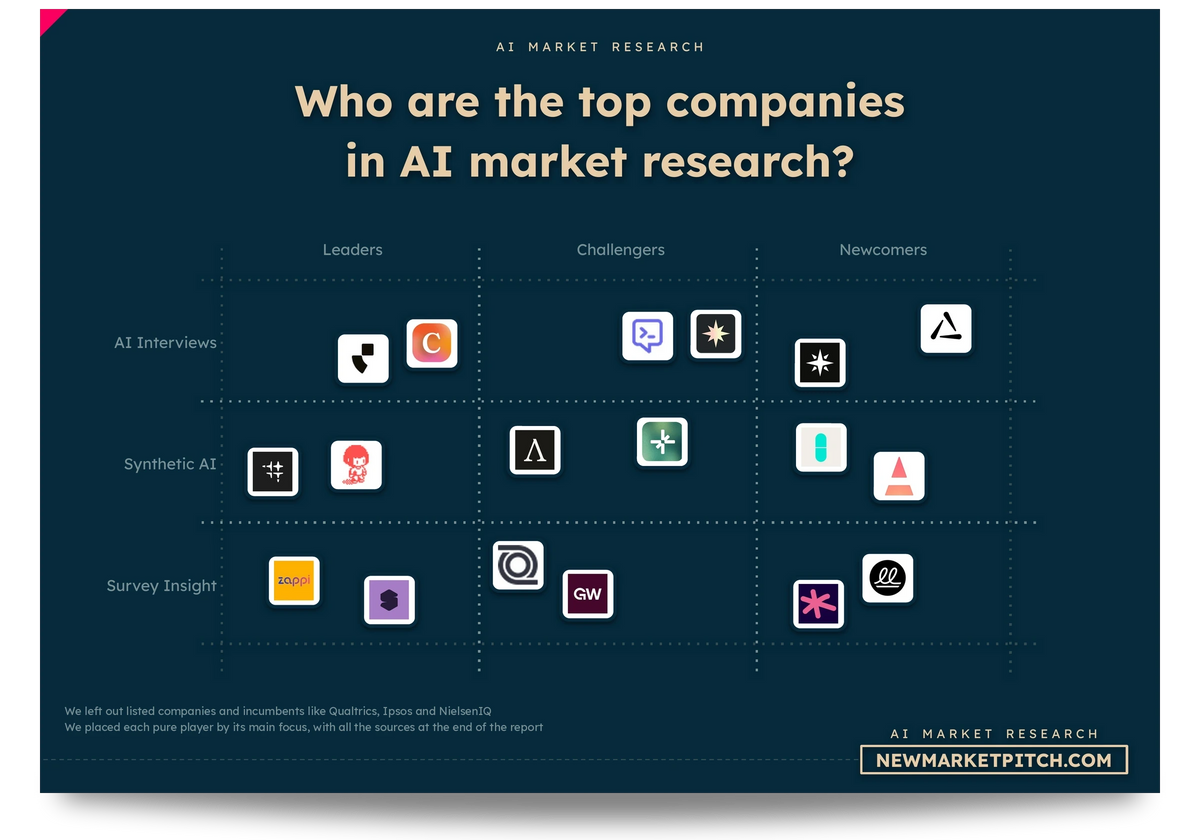
What are the top ai-powered market research startups by total funding raised?
Whether you're building or investing in the ai-powered market research market, our report covers everything you need to know: the players, the money, and what's coming next.
Summary
Simile leads AI-powered market research fundraising with $300M raised. GWI follows with $220M, and Suzy is third with $98M. A company that simulates human behavior now sits ahead of established businesses built around research with real people.
Simile got there quickly. Its $200M Series B in July 2026 backed the idea that companies could test more possible decisions with simulated consumers before spending time and money on fieldwork.
There is a real customer test behind that pitch. CVS Health has used Simile to explore patient experiences, while Brazilian bank Itaú has tested consumer journeys with it. Both cases still leave an important role for human checks.
GWI offers a different answer to the AI boom: make years of survey data easier to question through AI assistants. Zappi, which adds synthetic screening to an established system for testing products and advertisements, is left out of our ranking because a private equity firm has controlled it since December 2022.
Older research platforms also raised serious money. Suzy built its business through repeated rounds, while Attest focused on surveys that brands can run regularly. Their value to customers rests on getting useful responses from people.
AI-led interviews have brought another set of companies into the race. Listen Labs attracted Salesforce, which completed its acquisition, while Conveo, GetWhy and Outset help companies hear from customers without arranging every interview by hand.
Research does not always begin with a new interview. Dovetail, Knit and Unwrap help businesses make sense of conversations, surveys and feedback they have already collected. That work can save teams from asking questions they have answered before.
Huge fundraising totals remain unusual. Only 2 of the 47 startups we track have raised $100M or more, or 4%. The other 45 sit below that mark, and the median disclosed equity total is at least $8M.
The United States accounts for 22 companies, or 47%, and the United Kingdom has 8, or 17%. British research platforms, Belgian interview software and Danish video research show that serious competitors are spread across several countries.
Simile clearly leads on money raised. Customers still have to decide when to trust a prediction, ask real people, or use evidence already sitting in their systems. The funding leaders are betting on different answers.

Written by the New Market Pitch teamWe track new markets so founders and investors can move faster. About us

In our report covering the ai-powered market research market, you will always find fresh funding data, taken straight from our own verified funding database.
Top startups in the ai-powered market research industry ranked by total funding raised
Here is the current ranking of the ai-powered market research startups that raised the most, with the total each one has raised and our confidence level.
If you want to go deeper into the ai-powered market research startup landscape, check our report covering the ai-powered market research market.
| # | Startup | Total raised | Last round | Status | Confidence |
|---|---|---|---|---|---|
| $100M to $500M | |||||
| 1 | SimileFoundation models simulating human behavior | $300M | Jul 2026$200M · Series B | Active | Full |
| 2 | GWIConsumer audience intelligence and AI data querying | $220M | Feb 2022$180M · Series B | Active | Full |
| Below $100M | |||||
| 3 | SuzyContinuous consumer research and AI-powered insights | $98M | Jul 2021$50M · Series D | Active | Full |
| 4 | Listen LabsAI-powered customer research interviews | $96M | Jan 2026$69M · Series B | Acquired | Full |
| 5 | AttestConsumer surveys with AI-driven research assistance | $95M | Oct 2021$60M · Series B | Active | Full |
| 6 | DovetailAI repository and analysis for user interviews | $66M+ | Jan 2022$63M · Series A | Active | Full |
| 7 | ConveoAutomated consumer interview and research agents | $55M | Sep 2026$50M · Series A | Active | Full |
| 8 | GetWhyAI analysis of video-based consumer research | $55M | Jul 2025$20M · Series A extension | Active | Full |
| 9 | OutsetAI-moderated customer interviews and usability studies | $51M | Dec 2025$30M · Series B | Active | Full |
| 10 | AaruSimulates human behavior for market research | $50M+ | Dec 2025$50M+ · Series A | Active | Full |
| 11 | RemeshAI-assisted live focus groups and survey insight | $37M | Mar 2020$25M · Series A | Active | Full |
| 12 | quantilopeAutomated quantitative market research and AI insights | $36M | Jul 2020$28M · Series B | Active | Full |
| 13 | KnitAI-powered consumer research and qualitative synthesis | $29M | Jul 2025$16M · Series A | Active | Full |
| 14 | Newton ResearchAI research for advertising effectiveness decisions | $27M | Nov 2026$18M | Active | Full |
| 15 | HappydemicsAI-aided advertising measurement and brand surveys | $27M | Dec 2024$14M · Series B | Active | Full |
| 16 | Bridgetown ResearchAI market research and competitive intelligence | $19M | Feb 2025$19M · Series A | Active | Full |
| 17 | StrellaAI-moderated customer interviews and focus groups for market research | $18M | Oct 2025$14M · Series A | Active | Full |
| 18 | Electric TwinSynthetic consumer audiences for research and prediction | $14M | Feb 2026$10M · Funding (stage not disclosed) | Active | Full |
| 19 | VoxpopmeAI video feedback analysis for consumer insights | $13M | Sep 2019$9.2M · Series A | Active | Full |
| 20 | UnwrapAI customer feedback analysis software | $12M | Jan 2025$12M · Series A | Active | Full |
| 21 | Bolt InsightAI-moderated global consumer insight interviews | $11M | Dec 2025$9.4M · Series A | Active | Strong |
| 22 | Dragonfly AIPredictive attention analytics for creative effectiveness | $11M | Jan 2026$6.9M · Growth equity | Active | Full |
| 23 | IdeallyAI-guided consumer survey testing and segmentation | $10M | Apr 2026$10M · Series A | Active | Full |
| 24 | FairgenSynthetic respondent augmentation and audience twins | $8M | May 2024$5.5M · Seed | Active | Full |
| 25 | i-GenieAI consumer signals from digital behavior | $7.5M | Oct 2025$7.5M · Series A | Active | Full |
| 26 | DiscussAI-enabled qualitative market research interviews | $6.4M | May 2017$5M · Series A | Active | Full |
| 27 | CafeteriaAI-moderated feedback from youth consumers | $6.1M | Jul 2025$3M · Growth equity | Active | Full |
| 28 | BluePillAI consumer twins for rapid concept testing | $6M | Nov 2025$6M · Seed | Active | Full |
| 29 | Dialogue AIConversational customer interviews and automated insight analysis | $6M | Oct 2025$6M · Seed | Active | Full |
| 30 | VersoAI-led consumer interviews and evolving personas | $6M | Oct 2026$6M · Seed | Active | Full |
| 31 | Bounce InsightsAI-driven consumer survey research and insights | $5.6M | Dec 2024$4.5M · Other | Active | Full |
| 32 | Artificial SocietiesSimulated societies for public and consumer insight | $5.4M | May 2025$3.4M · Seed | Active | Full |
| 33 | QualSightsSmart sensors, a participant app and physical AI analytics measure actual consumer use of household products. | $5M | Nov 2026$5M | Active | Full |
| 34 | Ai PaletteAI software for market research | $4M | Mar 2024$4M · Series A | Active | Full |
| 35 | CoLoopAI analysis and coding of qualitative research | $3.5M+ | Jan 2025$3.5M · Seed | Active | Full |
| 36 | KeplarVoice interviews for customer and market research | $3.4M | Sep 2025$3.4M · Seed | Active | Full |
| 37 | askpollyAI market research through synthetic consumers | $3M | Sep 2026$3M · Seed | Active | Full |
| 38 | YabbleAI-assisted coding and synthesis of research data | $3M | Sep 2021$2.1M · Seed | Acquired | Full |
| 39 | GetWhysAI interview analysis for market research | $2.8M | Feb 2025$2.8M · Seed | Active | Full |
| 40 | IntelliciaSynthetic consumer research with AI personas | $2.5M | Sep 2026$2.5M · Pre-Series A | Active | Full |
| 41 | BehavixAI market research and consumer behavior analytics | $2.5M | Feb 2025$2.5M · Seed | Active | Full |
| 42 | Autentic AIAI market research interviews platform | $1.7M | Oct 2026$1.7M · Pre-Seed | Active | Full |
| 43 | PropaneAI-powered customer intelligence and market insights | $1.4M | Sep 2025$1.4M · Pre-Seed | Active | Full |
| 44 | HootologyGenerative AI simulated qualitative research discussions | $1.1M | Jul 2025$1.1M · Pre-Seed | Active | Full |
| 45 | EchovaneAutonomous end-to-end market research agents | $1M | Aug 2026$1M · Seed | Active | Full |
| Undisclosed | |||||
| 46 | AppinioMobile consumer panels and automated market studies | Undisclosed | Oct 2018Undisclosed · Seed | Active | Low |
| 47 | HiasynthQueryable synthetic population for European market insights | Undisclosed | Sep 2026Undisclosed · Seed | Active | Low |
No startups match this search.

In our research about ai-powered market research startups, we turn what is vague and complex into simple, useful visuals. Market maps like this one show you at a glance where every startup stands.
Is Simile now the best-funded AI-powered market research startup?
Simile is currently the best-funded AI-powered market research startup, with $300M in equity raised.
Founded in 2025, Simile builds AI models that simulate how people might react to products, services and other decisions. Its July 2026 financing announcement named CVS Health, Wealthfront, Deloitte and Gallup among organizations using its technology. Those are stronger signs of customer interest than a polished demo, although they do not tell us how often each organization uses the product.
We still need to know whether simulated reactions hold up when people make actual choices. CVS Health described using Simile to explore customer journeys and medication adherence, then deciding which ideas still needed testing with real customers. Brazilian bank Itaú offered another example in September 2026. In a case study published by Simile, the bank said it had cut a research process from five weeks to four business days while keeping human researchers responsible for interpreting the findings and deciding what to test next.
GWI and Suzy tackle consumer decisions from a different direction, using survey evidence collected from real people. Simile's lead tells us investors are willing to back prediction at a much bigger scale. Whether customers eventually trust those predictions as much as direct research remains an open test.
Did one giant round make Simile the AI research funding leader?
Yes. Simile's $200M Series B in July 2026 was the biggest single round among the AI-powered market research startups we track.
Greenoaks and Index Ventures co-led the financing, with investors including Bain Capital Ventures and CVS Health Ventures, according to Simile's announcement. Simile had completed only 2 counted equity rounds. Its rise was much faster than the long fundraising histories of established survey and research software companies.
Big checks were already part of this business before the latest wave of AI simulations. GWI raised a $180M Series B in February 2022, after years spent building data, products and relationships with consumer brands. Simile raised major capital while trying to establish a newer way of doing research.
There is a meaningful difference in what investors bought into. A survey company can show the responses it collected, while a simulation company must show how reliably its model predicts responses that have yet to happen. Simile says it has developed a model to estimate the accuracy of each simulation. That gives customers something specific to test. The fundraising milestone is clear, while the long-term accuracy contest is still being fought.

In our market report about ai-powered market research startups, we always try to gather several sources and make estimates that make sense, so you can work with solid numbers.
Is GWI still a major rival in AI-powered consumer research?
GWI remains one of the most heavily funded AI-powered consumer research companies, with $220M raised and years of survey data behind its products.
The London company built an audience intelligence business before generative AI became a standard feature in research software. Permira led its $180M Series B in February 2022 and described customers including Google, Spotify and WPP. Those relationships grew out of collecting information about real people, instead of generating answers from invented personas.
GWI has been putting that research into the AI tools its customers already use. It introduced Agent Spark in January 2026 and expanded its agentic portfolio in October, letting teams ask questions about consumer attitudes through assistants and business workflows. The October release described tools grounded in verified audience information, with controls intended to keep questions tied to the right datasets.
This gives GWI a clear reason to stay relevant while Simile develops simulated populations. Many brands want to know what consumers have actually said or done before asking what they might do next. A retailer might use GWI to understand an audience, then consider simulation for ideas that have never been tested. Investors have put more money behind Simile, but GWI has a different advantage: research data collected over many years that its AI tools can now make easier to use.
Is Zappi still an AI market research startup?
No, Zappi no longer counts as an AI-powered market research startup, because Sumeru Equity Partners, a private equity firm, has controlled it since December 2022.
Zappi's $170M financing in December 2022 was led by Sumeru, and the company's filed accounts describe a business majority-controlled by the firm since then. Part of that $170M was debt rather than equity. Our definition keeps companies owned by a private equity firm out of the startup rankings, in the same way it leaves out established research groups. Zappi therefore keeps its place in the market's story without sitting among the startups ranked by money raised.
The business itself remains a real competitor for the startups we rank. Its investor Cipio Partners said in December 2022 that Zappi already worked with more than 350 enterprises, including PepsiCo, McDonald's, Heineken and Reckitt. In August 2026, Zappi introduced a synthetic idea pre-screener that helps brands narrow a large set of early concepts before paying for deeper human research, and said it had checked the tool against hundreds of live-human surveys.
Without Zappi, Suzy moves to third place with $98M, behind Simile and GWI. The ranking compares independent companies funded to build dedicated research software, and Zappi's owner changes that comparison more than its product does.

Our document detailing everything you need to know about ai-powered market research gets updated several times a month, so you always get the latest view of where things stand.
Why did Suzy raise so many rounds for consumer research?
Suzy built its consumer research business through repeated venture rounds because it needed software, survey participants and enterprise customers working together.
Suzy has raised $98M across 7 counted rounds, the highest round count among the 47 AI-powered market research startups we track. Its $50M Series D in July 2021 was led by H.I.G. Growth Partners. At the time, the investor described a platform combining quantitative surveys, qualitative research and a consumer panel. It also named clients such as Microsoft, Unilever, Citibank and Kraft Heinz and reported annual recurring revenue above $25 million.
That history looks very different from Simile's fast rise or the large single round raised by GWI. Suzy built infrastructure and sold a research workflow over time. More recently founded interview startups can automate parts of that workflow, from recruiting participants to summarizing answers, using software that would have taken much more manual work earlier.
A long fundraising history can be an asset if it helped Suzy build dependable relationships with respondents and buyers. It can also leave a company needing to adapt while newer rivals offer cheaper or faster studies. We can see how Suzy was financed. Its future place in the market will depend on whether customers keep choosing its research over those newer options.
What happened to Listen Labs after Salesforce bought it?
Listen Labs is now part of Salesforce, but its $96M in equity funding still puts it among the leading AI-powered market research startups by lifetime capital raised.
Listen Labs raised a $69M Series B in January 2026. It said customers included Microsoft, Sweetgreen, Perplexity and Robinhood and described software that finds research participants, interviews them and pulls the findings together. The appeal was clear: companies could speak to more customers without hiring a human moderator for every conversation.
Salesforce agreed to buy Listen Labs in September 2026 and has since confirmed the acquisition was completed. In its announcement, Salesforce explained how interviews and customer simulations could help its software users understand people behind sales and service data. The technology now has a route into a much larger enterprise product family.
An acquisition changes the comparison with independent rivals such as Conveo and Outset. Listen Labs no longer needs to raise its own rounds to build a separate market research business. Its earlier financing still shows how much capital investors put into the product before Salesforce bought it. The purchase itself is a different kind of transaction, so it does not increase the company's historical equity funding total.
Does Attest still have a place beside AI interview startups?
Attest remains a well-funded consumer survey platform in the AI-powered market research industry, with $95M raised.
Attest's $60M Series B in October 2021 helped it make consumer surveys easier for brands to run regularly. A survey still solves a problem that a fluent AI interviewer cannot fix on its own: getting answers from a group of people who genuinely represent the audience a company wants to understand. Attest's financing announcement emphasized how brands needed quicker feedback as customers changed their habits.
Listen Labs and Outset now offer conversational studies that follow up on a customer's answers. GWI has made existing audience data easier to query. Attest sits closer to the structured-survey end of research, where teams need comparable responses across groups or across repeated studies.
That difference matters when choosing a product. A brand measuring whether an ad works with a particular demographic needs a credible sample and consistent questions. A team wondering why users abandon a checkout flow may learn more from an open conversation. Attest has a clear job to do even as AI interviews become easier to run. Its challenge is keeping that job quick and useful enough that companies still choose its surveys when newer methods are available.

In our report covering the ai-powered market research market, we look at what the winners do differently, so you can learn from the best instead of guessing.
Why has Dovetail raised so much for AI research software?
Dovetail has attracted substantial funding for AI-assisted research analysis because companies struggle to reuse what they have already learned from customers.
The Australian company has raised at least $66M, including a $63M Series A in January 2022 led by Accel. Dovetail said it served more than 2,600 customers at the time. Its software brings interviews, notes and feedback into a searchable place where researchers and product teams can find recurring problems and share what they learn.
That puts Dovetail beside AI interview startups for some budgets, although it sells a different starting point. Outset and Listen Labs help teams collect fresh responses. GetWhy works with filmed consumer research. Dovetail helps companies find useful evidence in material collected months or years ago. A product team can need both: new interviews to answer a fresh question and a repository to avoid repeating old studies.
AI has made tagging, summarizing and searching research easier, but the hard part for a company is getting people to save useful evidence and return to it. Dovetail's funding makes sense as a bet on that ongoing workflow. We should judge its product by how often teams actually find and use past research, rather than by whether it can run the flashiest AI interview.
How did Conveo raise so much for AI-moderated interviews?
Conveo has become a well-funded AI-powered market research challenger by selling automated interviews to large companies, with $55M raised. It ranks just ahead of GetWhy, also shown at $55M, because its exact total is $55.3M against GetWhy's $54.5M.
DST Global led its $50M Series A in September 2026, with Balderton Capital, Y Combinator and Visionaries Club also investing. Balderton named Google, Unilever, AB InBev and Canva among its customers. The product runs AI-moderated conversations over voice, video and text, then helps research teams look across the answers instead of reading every conversation from scratch.
The idea is attractive to businesses with questions that change every week. A consumer brand might want to understand a new campaign, then examine a pricing issue, then explore why buyers are leaving. Conveo wants customers to keep asking those questions inside the same research system instead of commissioning separate projects each time.
GetWhy has a longer track record with video research, while Outset is trying to extend AI interviews into customer experience management. Conveo's large early round shows investors think it can compete with those approaches. Customer names and funding alone cannot tell us whose interviews are most reliable. A brand needs to reach the right people, ask good follow-up questions and trust what comes back. Conveo now has resources to prove it can do all three across more customers.

In our research about ai-powered market research startups, we don't want to repeat what boring consulting reports say. Instead, we show you the real and latest market signals that matter.
Is GetWhy keeping up with newer AI interview startups?
GetWhy is keeping up in AI-powered video research, with $55M raised and relationships with major consumer brands.
GetWhy's $20M Series A in July 2025 followed an earlier financing in June 2024. The company and its investors have named brands including Nike, Adidas, Coca-Cola, Heineken and Unilever. Its software helps teams collect and interpret videos of people responding to research questions. The product keeps the person's own words, facial expressions and explanations available alongside the AI analysis.
GetWhy started years before the latest group of AI interview companies. That can help if its customers already trust its research process, but it also faces rivals that were built around automated moderation from day one. Conveo wants companies to run customer conversations continuously, Outset is expanding into a wider feedback workflow, and Strella focuses on conducting adaptive interviews quickly.
There is no good reason to treat every video research tool as the same product. Some buyers need a large set of comparable responses, while others want the depth of a carefully moderated discussion. GetWhy's investment history and customer examples show it has built a real business around consumer voices. Whether it keeps pace now depends on how quickly it can deliver useful findings without losing the context that makes video worth collecting.
Can Outset become more than an AI interview tool?
Outset could become more than an AI interview tool because it is building a wider customer research platform around its AI-moderated studies.
It has raised $51M, including a $30M Series B in December 2025. In announcing that round, Outset said its business had grown more than eightfold during the year and laid out plans for an AI-native customer experience management platform. The company has highlighted use by teams at Microsoft, Nestlé and WeightWatchers.
Running an interview faster is a strong way to get a customer's attention. Keeping that customer means being useful after the report arrives. Outset wants teams to return to the product when they change an app, compare feedback from different groups or need to check whether a complaint keeps coming up.
This puts it closer to Dovetail's research repository and Conveo's ongoing interview system. Salesforce's purchase of Listen Labs shows that large software companies also want these capabilities inside their own products. Outset's funding gives it room to build beyond the interview itself. We still need evidence that customers use the wider workflow regularly, because a fast first study is only the beginning of a lasting software business.

Learning from others' mistakes is the cheapest lesson there is. In our market report about ai-powered market research startups, we look at what broke startups before you, so you don't repeat it.
Is Aaru's synthetic consumer research worth backing?
Aaru is a credible AI-powered synthetic consumer research bet, but its predictions still need to prove accurate with real buyers.
Aaru raised a Series A of more than $50M in December 2025, without publishing the exact amount, and has raised at least $50M in all. Its AI agents are designed to model how groups may react to products, messages and events. TechCrunch reported in December 2025 that the company had worked with Accenture and EY. The report also described investors paying different prices for shares in the same financing, a reminder that a much-discussed valuation does not directly measure prediction quality.
Simile shares Aaru's ambition to model behavior. Other startups are taking narrower routes. Fairgen generates statistical additions to survey groups that would otherwise be too small, while Electric Twin lets organizations explore reactions from synthetic audiences. These tools may all use simulated people, yet the evidence needed to trust them differs by task.
CVS Health's work with Simile offers a useful boundary: use simulations to decide which questions deserve direct testing, then ask real people when the stakes require it. Aaru's backing shows that investors think simulated consumers are worth pursuing. Its lasting place in AI-powered market research depends on whether brands can check its predictions against real outcomes, repeatedly and in unfamiliar situations.
Do AI market research startups usually raise $100M?
No. Only 2 of the 47 AI-powered market research startups we track have raised $100M or more, representing 4%.
The other 45 companies, or 96%, are below that mark. Simile and GWI have attracted exceptionally large amounts of equity, but the rest of the market includes substantial companies with smaller totals. Suzy has built a repeat-use consumer research product, Listen Labs developed interview software strong enough to interest Salesforce, and Attest has made ongoing brand surveys easier to run.
The biggest checks can leave the impression that every competitive research startup must raise vast sums. That misses how different the products are. Behavioral simulations need specialized models and validation. Survey businesses maintain panels and research software. Some newer companies can begin with a focused interview or feedback tool that a customer tries on a particular project.
Large funding is useful, particularly for hiring and selling into big enterprises. It is a poor shortcut for judging research quality. When we look at these companies side by side, the rare giant financings tell us what investors are excited to build, while the much longer list of smaller firms shows how many customer problems can be tackled without them.
The table below shows the best-funded research startups and the products they sell.
| Startup | Total raised | Main approach |
|---|---|---|
| Simile | $300M | Behavioral simulation |
| GWI | $220M | Audience intelligence |
| Suzy | $98M | Consumer surveys |
| Listen Labs | $96M | AI interviews |
| Attest | $95M | Consumer surveys |
| Dovetail | $66M+ | Research synthesis |
“+” indicates a minimum equity total because some round amounts were not published.

If you build or invest in the ai-powered market research market, you need to know which business models pay off now and which ones are fading. That's why our report covering it has a whole section on it.
Can British AI research startups compete with Simile?
Yes. British AI-powered market research startups such as GWI and Attest have raised large amounts and sell to global brands.
The American group includes Simile, Suzy, Listen Labs and Outset. The United Kingdom has GWI and Attest among its established research businesses, plus Electric Twin working on synthetic audiences. British companies have attracted major funding without needing to be headquartered in Silicon Valley.
Look at how they sell, too. GWI turns human audience data into something teams can query through AI tools. Attest runs consumer surveys that brands repeat over time. Electric Twin announced backing from Atomico in February 2026 for its synthetic-audience business. Outside the two biggest countries, Belgian company Conveo and Denmark's GetWhy have also won work with well-known international businesses.
We count companies by their headquarters rather than trying to assign global customers to one country. That gives a clear picture of where the startups began, while avoiding claims about which region is attracting the most new money today. The United States has the broadest group, but European companies occupy important places among the funding leaders and have products that large brands already use.
Can AI market research startups succeed with much less money?
Yes. Many AI-powered market research startups sell useful tools without raising anywhere close to the amounts attracted by the industry's biggest names.
The median disclosed equity total across the 47 startups we track is at least $8M. The products range from narrow tools that sort existing customer feedback to bigger systems for interviews, surveys and behavior simulation. The amount needed to build them varies just as much. A team that helps researchers code interviews faces different costs from one developing models intended to predict whole populations.
Older companies show the range of approaches. quantilope used its $28M Series B in July 2020 to expand automated quantitative research, while Remesh raised a $25M Series A in March 2020 for live group discussions and insight analysis. Newer businesses such as Strella and Unwrap focus on jobs customers can test without replacing a whole research department.
Less money does not automatically mean a more efficient business. Some startups are smaller, while others may have harder sales or product challenges ahead. Still, the funding spread should stop us from treating Simile's financing as the entry fee for the entire industry. Customers pay to solve a research problem, and a smaller tool can be enough for the right one.
Could Strella challenge the better-funded AI interview companies?
Strella could become a major AI interview competitor without matching the funding totals of Listen Labs, Conveo or Outset.
Strella has raised $18M, including a $14M Series A in October 2025 led by Bessemer Venture Partners. Bessemer described an AI moderator that asks follow-up questions, recruits participants and pulls themes out of conversations. Its 2026 account also discussed work with Duolingo, where the company used Strella for concept testing on a much shorter timeline than the traditional process.
This is the kind of customer case that makes a smaller company credible. Product teams want research they can start quickly, with responses they can inspect and follow-up questions that go beyond a fixed survey. Conveo and Outset aim for similar buyers, and GetWhy has deeper experience analyzing videos of real consumers. Strella needs to show why a team should keep using it after that first successful study.
A focused interview product can win contracts without a huge fundraising history. Smaller funding can also make enterprise sales, new features and international expansion harder. Strella's existing examples show the product has a use, but they do not establish that every customer gets the same time savings. If the company can keep research quality high while customers use it repeatedly, its funding gap may matter less than expected.

In our report covering the ai-powered market research market, we like to show you the big picture. We know your time is precious, so we make every page quick to read and packed with as much learning as possible per minute.
Why are investors funding AI startups that just analyze customer feedback?
Investors are funding AI customer feedback startups because companies already have more interviews, reviews and complaints than their teams can use.
Knit has raised $29M, including a $16M Series A in July 2025. It combines AI analysis with human review for consumer research. Unwrap has raised $12M, all of it in a Series A in January 2025. In its announcement, Unwrap named Lyft, JetBlue, GitHub, Oura and Microsoft among customers using its software to find recurring problems in reviews, support conversations and product feedback.
These products can solve a problem that begins before anyone runs a new survey. A company may already have thousands of customer explanations scattered across support tickets or research folders. Unwrap looks for themes in that material, Dovetail helps people find and reuse past studies, and Voxpopme focuses on video feedback. The work is less eye-catching than building an AI version of a population, but the business case is easy to understand.
The same point helps explain why smaller firms can win recognizable customers. A team can start with the feedback it already owns and check whether the software finds something useful. It does not have to change how an entire company conducts research on day one. Investors are backing that practical route into the market alongside the much larger simulation bets.
Are smaller synthetic consumer research startups getting funded too?
Yes. Investors are also funding smaller AI-powered market research startups that simulate audiences or add synthetic responses to human surveys.
Electric Twin has raised $14M, including $10M in February 2026 in a round of undisclosed stage. Its product creates synthetic audiences that organizations can question before they commit to a decision. Fairgen has raised $8M and developed FairBoost to add statistically generated respondents where a survey sample is thin. BluePill is developing consumer twins, while Artificial Societies explores simulated groups and askpolly builds synthetic consumer research tools.
The products are related, but they do different jobs. Filling an underrepresented survey segment asks whether synthetic additions match the missing real respondents. Testing an idea with a simulated audience asks whether a model can anticipate what a real group will do. Both depend on validation, and buyers should ask to see how each tool performs against responses the system did not already know.
There is room for a focused specialist beside Simile and Aaru. The best product for a limited survey problem may differ from the one a large enterprise wants for repeated scenario planning. The smaller funding totals tell us these approaches are still being explored across several companies, with no single method proven to cover every research question.
The table below shows smaller funded startups working on different synthetic research problems.
| Startup | Total raised | Research focus |
|---|---|---|
| Aaru | $50M+ | Behavior simulation |
| Electric Twin | $14M | Synthetic audiences |
| Fairgen | $8M | Sample augmentation |
| BluePill | $6M | Consumer twins |
| Artificial Societies | $5.4M | Simulated societies |
| askpolly | $3M | Synthetic consumers |
| Intellicia | $2.5M | AI personas |
“+” indicates a minimum equity total because some round amounts were not published.

When you build or invest in the ai-powered market research market, you need clarity, not confusion. In our research about ai-powered market research startups, we always try to put numbers on and quantify whatever is usually vague and confusing.
Are Qualtrics and Ipsos AI market research startups?
No, Qualtrics and Ipsos are major research businesses, but neither is an AI-powered market research startup.
Ipsos is a longstanding listed research group, with a much broader business than AI-first market research software. Qualtrics sells experience-management software across several functions and has been through a public listing and a corporate buyout. Qualtrics said Silver Lake and CPP Investments completed that acquisition in June 2023. A purchase of an established company cannot sensibly be treated like a new startup equity round.
We also exclude general AI assistants, ad buying systems, ordinary transcription software and research agencies that lack a scalable proprietary technology product. They may all be useful to researchers, but that alone does not make them independent AI market research startups.
Some of the companies we include sit near a boundary. Dovetail helps teams interpret research they already have, while Fairgen adds generated respondents to human survey samples. Both make research central to their product, which is why we compare their funding with interview and simulation startups. The distinction keeps the question useful: it lets readers compare companies funded to build dedicated research software instead of mixing them with every large business that can help a marketer understand customers.
So, which AI-powered market research startups have raised the most?
Simile is the number one AI-powered market research startup by total funding raised, followed by GWI and Suzy.
The three leaders have taken different routes. Simile is building models that predict human behavior, GWI collects and organizes real audience responses, and Suzy combines surveys, qualitative research and its own consumer panel. Their funding histories are clear, even though those totals tell us little about which product has the most users or earns the most revenue.
Attest remains an important survey software business. Listen Labs shows that an AI interview company can grow quickly enough to attract a major enterprise buyer. Conveo, GetWhy and Outset are competing to make customer conversations easier to run and use. Dovetail and Unwrap start with another practical problem: businesses already have valuable feedback they cannot easily find or analyze.
The ranking therefore has a clear leader without settling every competitive question. A customer planning a campaign, testing a service or examining complaints may need different tools.
The table below shows what we found.
| Question | Answer |
|---|---|
| Did simulated consumers change the funding pecking order? | Yes, behavioral simulation now leads this market's fundraising. Simile closed a $200M Series B in July 2026. That gave its approach far greater financial backing than most alternatives. |
| Can real audience data still compete with simulations? | Absolutely, brands still need answers grounded in actual people. GWI raised a $180M Series B in February 2022. Its survey data now feeds research questions asked through AI tools. |
| Do established survey platforms still attract big checks? | They do, especially when brands run their surveys repeatedly. Attest raised a $60M Series B in October 2021. Its surveys give brands comparable answers from real people. |
| Does raising round after round make a startup stronger? | Sometimes, but repeated funding says little about research quality. Suzy has completed 7 counted equity rounds since founding. Its future depends on customers continuing to choose its surveys. |
| Can an AI interview startup attract a giant buyer? | Yes, enterprise software companies want access to customer conversations. Listen Labs raised a $69M Series B in January 2026. Salesforce subsequently brought its research technology into a larger business. |
| Can new AI interview platforms win large brands quickly? | Yes, automated interviews already appeal to global consumer companies. Conveo raised a $50M Series A in September 2026. Its challenge now is making results consistently useful for customers. |
| Are real video interviews still worth investing in? | Yes, recorded explanations remain valuable even with faster AI summaries. GetWhy raised a $20M Series A in July 2025. Its product keeps real consumer voices available for researchers. |
| Can organizing old research become a big business? | It can, because companies struggle to reuse customer evidence. Dovetail has raised at least $66M for research software. Its value comes from helping teams retrieve past findings. |
| Are giant lifetime funding totals normal for research startups? | No, most AI market research startups remain far smaller. Only 4% have raised $100M or more. Specialized products can still compete for important customer projects. |
| Can smaller AI research tools win corporate customers? | Yes, useful feedback software can reach buyers without giant rounds. Unwrap raised $12M for AI-powered customer feedback analysis software. Its named clients include major technology and travel companies. |
| Will synthetic surveys make human respondents unnecessary? | No, synthetic responses still need testing against real people. Fairgen has raised $8M for AI-assisted survey sample augmentation. Its approach fills gaps rather than eliminating human evidence. |

A good product starts with a real problem. In our market report about ai-powered market research startups, we show you the ones customers still live with.
Our methodology
Our data runs through November 19, 2026. We then reviewed this article and updated its answers on November 24, 2026, the date shown under the title. We define AI-powered market research as independent technology vendors whose principal software uses AI to collect, simulate or interpret evidence about consumers, audiences and markets for research-led decisions. This includes AI-moderated interviews, surveys, synthetic respondents, consumer signal intelligence and concept testing. Borderline companies are included rather than silently excluded. Every company in the ranking qualifies as a startup under our definition: founded in 2007 or later, built around a scalable new product and funded by founders or external backers, with only recent listings and acquisitions retained. Companies that have gone public, been acquired or closed keep their status and historical place, and their totals stop at IPO or acquisition, with primary IPO proceeds included.
We measure equity raised since founding across every private equity round, including the oldest, and add the primary proceeds of an IPO when applicable. We exclude debt, venture debt, grants, unconverted convertible notes and SAFEs, post-IPO offerings, secondary share sales and duplicate accounts of the same financing. A converted SAFE stays within the round that absorbed it. A total ending in + is a minimum because at least one round lacks a public amount. The ranking compares lifetime qualifying equity, not capital raised over a recent reporting window.
Rounds confirmed by a company announcement, a press article or a regulatory filing are counted in full. Where no article exists, a round is counted only when at least two recognised databases agree on its date (within one month) and amount (within 5%), and it is marked as low confidence. A round found in a single database stays in the company's history but is left out of totals. For companies that have raised more than $100M, every round counted is backed by an article.
We do not adopt the fundraising totals or valuations published by Crunchbase, PitchBook or comparable commercial databases as our figures: their entries can mix equity with loans, grants, commitments or estimates. Those databases are never the sole basis of a round counted in full, and agreement between 2 databases supports only a low-confidence round. Where a press release states a different cumulative total, we retain the sum of qualifying, sourced equity rounds and note material gaps under the full ranking. The confidence field shows whether the total rests on confirmed rounds at the Full, Strong, Partial or Low level.
This approach explains why a familiar press total can differ from ours, and why a heavily publicized transaction does not automatically move a company higher. We count the financing that actually meets the equity definition, not the largest headline attached to a company. An acquisition price is not a financing round, and a promised or unclosed investment is not automatically money raised. Companies outside the defined product market are not inserted to make the ranking appear more comprehensive.
We reviewed each company's whole qualifying funding history, rather than using the January 2024 onward period employed in our deal and trend articles. We also checked company announcements, investor releases, filings and independent reporting for the products and customer examples discussed in the analysis. Those external facts explain commercial context but do not replace our own equity totals or change the recorded order.
Key sources include Simile's Series B, simulation product and enterprise customers, CVS Health's use and limits of behavioral simulation, GWI's Series B and enterprise audience research, GWI's October 2026 agentic research product expansion, Zappi's growth investment and enterprise customer base, Zappi's synthetic concept-screening launch, Suzy's enterprise panel business, Series D and historical revenue, Listen Labs' Series B and enterprise customers, Listen Labs acquisition and Salesforce integration plans, Attest's consumer survey product and Series B, Dovetail's Series A, research software and customers, Conveo's Series A and large-brand adoption, GetWhy's subsequent Series A financing and strategy, Outset's Series B, customer experience plans and users, Reporting on Aaru's simulation product and enterprise relationships, Fairgen's seed funding and synthetic sample augmentation, Electric Twin's synthetic audience financing and product, Strella's AI interviews, customers and commercial history, Knit's investor-backed hybrid research approach, Unwrap's financing and customer feedback platform, Itaú case study on faster concept research and later human checks, Ideally's enterprise customers and rapid research platform, and Qualtrics' corporate ownership and acquisition history.
In our document detailing everything you need to know about ai-powered market research, you will always find fresh funding data, taken straight from our own verified funding database.
Written by the New Market Pitch teamWe track new markets so founders and investors can move faster. About us