Ai-powered Market Research Funding Tracker (50+ deals)
Whether you're building or investing in the ai-powered market research market, our report covers everything you need to know: the players, the money, and what's coming next.
Summary
The ai-powered market research industry raised at least $836M in 51 financings involving 37 startups from January 2024 to November 2026. Simile raised $300M, more than any other startup in the market during that period.
The big checks get attention, but most founders are raising far less. The median round was $6.4M, and 3 rounds above $50M attracted $369M. Take those out and at least $467M remains. There is a real business beneath the biggest announcements.
Investors are betting on two quite different products. Synthetic respondents and behavioral simulation attracted at least $386M. AI-moderated interviews and focus groups raised $331M and brought in more deals.
One approach tries to predict what people might do. The other asks real people questions and uses AI to make those conversations faster. Simile and Aaru work on simulated behavior, while Listen Labs, Conveo, GetWhy and Outset interview actual participants.
The other research products have their place, too. Startups are getting checks for surveys, feedback analysis, consumer intelligence and creative testing, though these smaller specialties have yet to attract funding on the same scale.
A lot of startups are still finding their feet. Seed and Series A make up most of the named-stage financings. We found no Series C or Series D+ deal, even as a few companies have raised substantial Series B rounds.
Youth helps explain that split. The median company age when it raised funding was 2 years, and 70% of funded startups were founded since 2022. Investors are paying for what these products could become before many have long customer histories.
The money is concentrated geographically as well. The United States recorded 29 deals and at least $635M. European companies such as Conveo and GetWhy nevertheless sell research products to large international buyers.
Funding also comes in bursts. A quiet month can be followed by one enormous round or several smaller ones, so a single announcement rarely tells us much about the entire market.
The important question now is whether these products keep earning customers' trust. Real interviews still need credible participants and good questions. Simulated consumers need to prove that their answers match real behavior. Investors are funding both ideas before either has settled the argument about how businesses should research their customers.

Written by the New Market Pitch teamWe track new markets so founders and investors can move faster. About us

In our report covering the ai-powered market research market, you will always find fresh funding data, taken straight from our own verified funding database.
Our funding tracker covering the ai powered market research market
Below is the table listing all the deals. You can find our methodology at the end of this page.
If you want a deeper understanding of the market and its current dynamics, get our ai powered market research market report.
| Company | Category | Date | Stage | Deal size | What they do | Region | Lead investors | Country | Rank |
|---|---|---|---|---|---|---|---|---|---|
| Newton Research | AI creative, concept and advertising pretesting | November 2026 | Unknown | $18M | AI research for advertising effectiveness decisions | North America | Not disclosed | United States | |
| QualSights | Consumer, category and market intelligence | November 2026 | Unknown | $5M | Smart sensors, a participant app and physical AI analytics measure actual consumer use of household products. | North America | Duo Partners | United States | |
| Verso | AI-moderated qualitative interviews and focus groups | October 2026 | Seed | $6M | AI-led consumer interviews and evolving personas | Europe | Angular Ventures | France | |
| Autentic AI | AI-moderated qualitative interviews and focus groups | October 2026 | Seed | $1.7M | AI market research interviews platform | Europe | Not disclosed | Spain | |
| askpolly | Synthetic respondents and behavioral simulation | September 2026 | Seed | $3M | AI market research through synthetic consumers | North America | Differential Ventures | Canada | |
| Intellicia | Synthetic respondents and behavioral simulation | September 2026 | Seed | $2.5M | Synthetic consumer research with AI personas | Asia-Pacific | Kakao Ventures | South Korea | |
| Conveo | AI-moderated qualitative interviews and focus groups | September 2026 | Series A | $50M | Automated consumer interview and research agents | Europe | DST Global | Belgium | |
| Hiasynth | Synthetic respondents and behavioral simulation | September 2026 | Seed | Undisclosed | Queryable synthetic population for European market insights | Europe | Further Than Capital | Sweden | |
| Echovane | AI-moderated qualitative interviews and focus groups | August 2026 | Seed | $1M | Autonomous end-to-end market research agents | North America | Titan Capital, Neon Fund | United States | |
| Simile | Synthetic respondents and behavioral simulation | July 2026 | Series B | $200M | Foundation models simulating human behavior | North America | Greenoaks, Index Ventures | United States | |
| Ideally | AI-powered survey and quantitative research | April 2026 | Series A | $10M | AI-guided consumer survey testing and segmentation | Asia-Pacific | Shearwater Capital | New Zealand | |
| Simile | Synthetic respondents and behavioral simulation | February 2026 | Series A | $100M | Foundation models simulating human behavior | North America | Index Ventures | United States | |
| Electric Twin | Synthetic respondents and behavioral simulation | February 2026 | Unknown | $10M | Synthetic consumer audiences for research and prediction | Europe | Atomico | United Kingdom | |
| Dragonfly AI | AI creative, concept and advertising pretesting | January 2026 | Growth Equity | $6.9M | Predictive attention analytics for creative effectiveness | Europe | 24Haymarket | United Kingdom | |
| Listen Labs | AI-moderated qualitative interviews and focus groups | January 2026 | Series B | $69M | AI-powered customer research interviews | North America | Ribbit Capital | United States | |
| Outset | AI-moderated qualitative interviews and focus groups | December 2025 | Series B | $30M | AI-moderated customer interviews and usability studies | North America | Radical Ventures | United States | |
| Bolt Insight | AI-moderated qualitative interviews and focus groups | December 2025 | Series A | $9.4M | AI-moderated global consumer insight interviews | Europe | Pembroke VCT | United Kingdom | |
| Aaru | Synthetic respondents and behavioral simulation | December 2025 | Series A | $50M+ | Simulates human behavior for market research | North America | Redpoint Ventures | United States | |
| BluePill | Synthetic respondents and behavioral simulation | November 2025 | Seed | $6M | AI consumer twins for rapid concept testing | North America | Ubiquity Ventures | United States | |
| Dialogue AI | AI-moderated qualitative interviews and focus groups | October 2025 | Seed | $6M | Conversational customer interviews and automated insight analysis | North America | Lightspeed Venture Partners | United States | |
| Strella | AI-moderated qualitative interviews and focus groups | October 2025 | Series A | $14M | AI-moderated customer interviews and focus groups for market research | North America | Bessemer Venture Partners | United States | |
| i-Genie | Consumer, category and market intelligence | October 2025 | Series A | $7.5M | AI consumer signals from digital behavior | North America | Mudita Ventures, Silicon Road Ventures | United States | |
| Propane | Consumer, category and market intelligence | September 2025 | Seed | $1.4M | AI-powered customer intelligence and market insights | Europe | EIFO, Heartfelt Capital | Denmark | |
| Keplar | AI-moderated qualitative interviews and focus groups | September 2025 | Seed | $3.4M | Voice interviews for customer and market research | North America | Kleiner Perkins | United States | |
| Newton Research | AI creative, concept and advertising pretesting | August 2025 | Series A | $9M | AI research for advertising effectiveness decisions | North America | Greycroft, Bessemer Venture Partners | United States | |
| Knit | AI-moderated qualitative interviews and focus groups | July 2025 | Series A | $16M | AI-powered consumer research and qualitative synthesis | North America | GFT Ventures, Sound Ventures | United States | |
| Cafeteria | AI-moderated qualitative interviews and focus groups | July 2025 | Growth Equity | $3M | AI-moderated feedback from youth consumers | North America | Not disclosed | United States | |
| Hootology | AI-moderated qualitative interviews and focus groups | July 2025 | Seed | $1.1M | Generative AI simulated qualitative research discussions | North America | Not disclosed | United States | |
| GetWhy | AI-moderated qualitative interviews and focus groups | July 2025 | Series A | $20M | AI analysis of video-based consumer research | Europe | PeakSpan Capital | Denmark | |
| Outset | AI-moderated qualitative interviews and focus groups | June 2025 | Series A | $17M | AI-moderated customer interviews and usability studies | North America | 8VC | United States | |
| Artificial Societies | Synthetic respondents and behavioral simulation | May 2025 | Seed | $3.4M | Simulated societies for public and consumer insight | Europe | Point72 Ventures | United Kingdom | |
| Listen Labs | AI-moderated qualitative interviews and focus groups | April 2025 | Series A | ~$20M | AI-powered customer research interviews | North America | Sequoia Capital | United States | |
| Conveo | AI-moderated qualitative interviews and focus groups | March 2025 | Seed | $5.3M | Automated consumer interview and research agents | Europe | 6 Degrees Capital | Belgium | |
| Artificial Societies | Synthetic respondents and behavioral simulation | March 2025 | Seed | $2M | Simulated societies for public and consumer insight | Europe | Not disclosed | United Kingdom | |
| Aaru | Synthetic respondents and behavioral simulation | March 2025 | Seed | Undisclosed | Simulates human behavior for market research | North America | Not disclosed | United States | |
| Bridgetown Research | Consumer, category and market intelligence | February 2025 | Series A | $19M | AI market research and competitive intelligence | North America | Accel, Lightspeed Venture Partners | United States | |
| Behavix | Consumer, category and market intelligence | February 2025 | Seed | $2.5M | AI market research and consumer behavior analytics | North America | Vendep Capital, Superhero Capital | United States | |
| GetWhys | AI qualitative coding, synthesis and reporting | February 2025 | Seed | $2.8M | AI interview analysis for market research | North America | Next Frontier Capital | United States | |
| Unwrap | AI qualitative coding, synthesis and reporting | January 2025 | Series A | $12M | AI customer feedback analysis software | North America | Scale Venture Partners | United States | |
| CoLoop | AI qualitative coding, synthesis and reporting | January 2025 | Seed | $3.5M | AI analysis and coding of qualitative research | Europe | Y Combinator | United Kingdom | |
| Bounce Insights | AI-powered survey and quantitative research | December 2024 | Unknown | $4.5M | AI-driven consumer survey research and insights | Europe | ACT Venture Capital | Ireland | |
| Happydemics | AI-powered survey and quantitative research | December 2024 | Series B | $14M | AI-aided advertising measurement and brand surveys | Europe | Wille Finance, Adelie Capital | France | |
| Strella | AI-moderated qualitative interviews and focus groups | October 2024 | Seed | $4M | AI-moderated customer interviews and focus groups for market research | North America | Decibel | United States | |
| Listen Labs | AI-moderated qualitative interviews and focus groups | October 2024 | Seed | ~$7M | AI-powered customer research interviews | North America | Sequoia Capital | United States | |
| Knit | AI-moderated qualitative interviews and focus groups | September 2024 | Unknown | $9M | AI-powered consumer research and qualitative synthesis | North America | Revolution's Rise of the Rest Seed Fund | United States | |
| Cafeteria | AI-moderated qualitative interviews and focus groups | July 2024 | Seed | $3.1M | AI-moderated feedback from youth consumers | North America | Collaborative Fund, Imaginary Ventures | United States | |
| GetWhy | AI-moderated qualitative interviews and focus groups | June 2024 | Series A | $35M | AI analysis of video-based consumer research | Europe | PeakSpan Capital | Denmark | |
| Fairgen | Synthetic respondents and behavioral simulation | May 2024 | Seed | $5.5M | Synthetic respondent augmentation and audience twins | Middle East | Maverick Ventures Israel | Israel | |
| Ai Palette | Consumer, category and market intelligence | March 2024 | Series A | $4M | AI software for market research | Asia-Pacific | Tin Men Capital | Singapore | |
| Electric Twin | Synthetic respondents and behavioral simulation | 2024 | Seed | $4M | Synthetic consumer audiences for research and prediction | Europe | Not disclosed | United Kingdom | |
| Aaru | Synthetic respondents and behavioral simulation | 2024 | Seed | Undisclosed | Simulates human behavior for market research | North America | Not disclosed | United States |

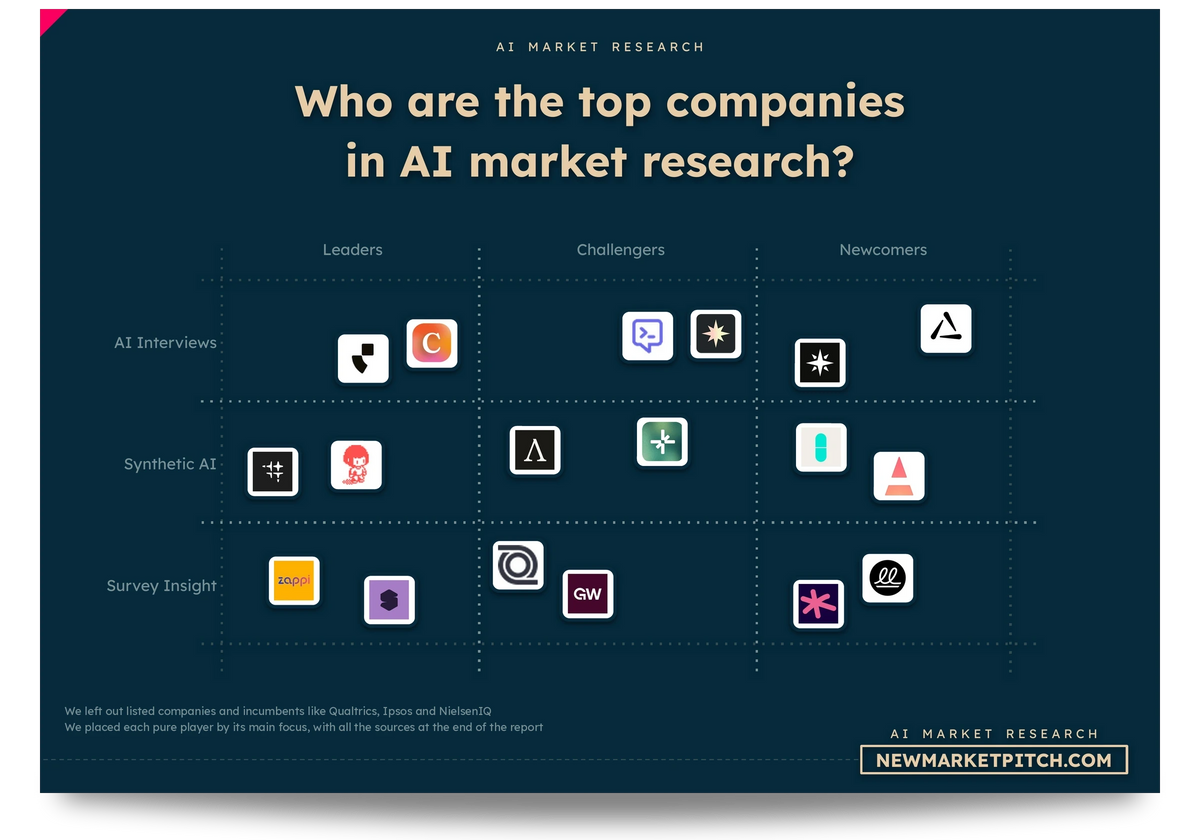
In our research about ai-powered market research startups, we turn what is vague and complex into simple, useful visuals. Market maps like this one show you at a glance where every startup stands.
Is AI-powered market research getting serious investor money or just hype?
AI-powered market research is attracting serious venture money: 51 financings involving 37 startups have brought in at least $836M in the deals we track.
We counted companies whose main product collects, interprets or simulates evidence about people and markets. Listen Labs talks to real customers, Electric Twin builds synthetic audiences, and Unwrap analyzes comments people have already left. They sell different research products, but all help brands answer questions that used to require more time from research teams and agencies.
The buyers are real, too. Listen Labs named Microsoft, Sweetgreen and Robinhood among its enterprise customers when announcing its January 2026 round. In September 2026, Balderton said Google, Unilever and Canva used Conveo. Bessemer's April 2026 case study of Strella reported that its original 12 design partners all became paying customers. Those are more useful signs of commercial demand than another AI demo.
There is still a difference between customers buying a tool and trusting every answer it gives. Brands can run an interview more cheaply and still ask a bad question. A synthetic audience can produce a plausible response that proves wrong in the market. The financing shows that companies will pay to try these new methods. Whether the results are good enough to keep using them is a tougher test.
How much does a typical AI market research startup actually raise?
A typical AI-powered market research round is $6.4M, far smaller than the giant checks associated with AI model developers.
Among rounds with a public amount, 18 were under $5M and 21 were $5M to under $20M. Those groups represented 38% and 44% of disclosed deals. The median startup raised $6M during the period, while 33% of companies raised under $5M and 11% raised over $50M. The normal funding story is a focused research product winning its first paying customers.
Strella's $4M Seed in October 2024 backed AI-moderated conversations. Keplar raised a $3.4M Seed in September 2025 for voice-led research, and CoLoop's $3.5M Seed in January 2025 supported qualitative coding. All three can sell software that improves one part of research without building a general model of human behavior.
Bessemer's April 2026 Strella case study shows what that can look like in practice. Duolingo used Strella to finish a concept-testing project in two days instead of more than six weeks. Such savings help explain why a specialized company can attract investors without a spectacular round. The checks get larger when a startup also wants to own the entire research workflow or train models that simulate customers.
Are giant funding rounds becoming normal for AI market research startups?
No, giant rounds are still exceptions in AI-powered market research; most startups raise much smaller amounts.
There were 3 rounds above $50M, making up 6% of financings and $369M of disclosed capital. Excluding those deals leaves at least $467M. That smaller-deal market includes interviews, surveys, feedback analysis and consumer-intelligence software. A headline financing can change the total dramatically without changing what a typical founder raises.
Simile's $200M Series B in July 2026 was the largest single transaction. Listen Labs' $69M Series B in January 2026 helped finance an enterprise interview platform. The two companies are pursuing different businesses: Simile tries to model people's decisions, while Listen Labs recruits and interviews real respondents. Both have bigger ambitions than a single-purpose research tool.
The size of the checks also says little about which method customers will prefer. An enterprise might use a synthetic model to explore possible responses, then test the idea with actual buyers. A smaller software company can build a solid business from just one stage of that process. Investors have made several exceptional bets, but the bulk of the market remains much less extravagant.

In our market report about ai-powered market research startups, we always try to gather several sources and make estimates that make sense, so you can work with solid numbers.
Why are investors putting so much money into Simile?
Simile has attracted the biggest bets in AI-powered market research because it is trying to simulate human decisions, rather than just speed up interviews and surveys.
The company raised a $100M Series A in February 2026 led by Index Ventures, then a $200M Series B in July 2026 co-led by Greenoaks and Index Ventures. Its ambition is broad: businesses could ask how people might react to a product, price or policy before spending money on a real-world launch. A model that could answer those questions reliably would be useful far beyond conventional survey teams.
In its July 2026 update, Simile said its foundation model had already run tens of millions of simulations for Fortune 100 enterprises. It named CVS Health, Wealthfront, Deloitte and Gallup as customers and said it had developed a confidence model to assess its own predictions. Those are company-reported claims, but they show what its backers expect the product to become.
There is a reason not to treat Simile as the inevitable blueprint for every research startup. Listen Labs and Conveo are building businesses around interviews with real people, and GetWhy adds researcher review to those conversations. Simulations promise a different kind of speed and reach. The money flowing to Simile shows how valuable investors think accurate prediction could be, while the evidence for accuracy still needs to be judged use by use.
Do investors prefer AI interviews with real people or synthetic consumers?
AI-moderated interviews win on the number of financings, while synthetic consumers attract more money in AI-powered market research.
AI-moderated qualitative interviews and focus groups recorded 22 deals across 14 companies, representing 43% of all deals and $331M. Synthetic respondents and behavioral simulation recorded 14 deals across 9 companies, representing 27% of deals and at least $386M. More investors are writing checks for businesses that talk to actual participants, but the biggest simulation bets pull the dollar totals in the other direction.
Listen Labs, Conveo, GetWhy and Outset help research teams recruit people, ask questions, follow up and review their answers. Simile, Aaru, Electric Twin and Fairgen use models to generate or extend responses. The difference is practical: an interview gives a buyer fresh testimony from a person, while a simulation lets the buyer explore possibilities immediately but adds a new problem of validation.
Investors are trying several versions of the idea. PeakSpan Capital led GetWhy rounds, Sequoia Capital backed Listen Labs, and Greenoaks and Index Ventures co-led Simile's July 2026 round. These are different bets, with different standards for proving the product works. We would be cautious about declaring one method the winner while brands are still testing where each belongs in the research process.
Why are investors betting on AI-generated consumers before they're proven?
Investors are betting on AI-generated consumers because the upside is huge, yet synthetic respondents in market research still can't reliably predict what people will buy without checks against real people.
Pew Research Center offered a useful reality check in September 2026. It asked AI models to reproduce answers from human opinion surveys and found an average difference of 12 percentage points across nearly 300 questions. On 28% of questions, the difference exceeded 15 points. This was public-opinion polling, not a validation test of every commercial simulation platform, but it shows how convincing synthetic answers can still miss real views.
Companies are working on the problem from different angles. Simile says its confidence model predicts where a simulation will be accurate. Fairgen works on augmenting real respondent samples, and Electric Twin builds synthetic audiences for scenario testing. The Market Research Society warned in 2025 that synthetic data can repeat biases in its training material and struggle to detect emerging behavior. That is particularly awkward when a brand is trying to spot a new consumer trend.
The 2025 ICC/ESOMAR research code also tells researchers to disclose synthetic data and personas and explain the level of human oversight. That makes sense: a simulated audience can help decide what to test, but a company should know when a decision rests on modeled answers rather than fresh human evidence. Faster research is only useful when the buyer understands what the findings can support.
Will companies keep paying for AI-moderated customer interviews?
Yes, AI-moderated customer interviews already have enterprise buyers, and the bigger test is whether companies keep running research after the first project.
The category's 22 financings and $331M in capital include Listen Labs' $69M Series B in January 2026, Conveo's $50M Series A in September 2026 and Outset's $30M Series B in December 2025. Those rounds back products that aim to make customer conversations a regular part of business decisions, rather than an occasional expensive study.
Listen Labs said in January 2026 that its platform had interviewed over one million people. Balderton said Conveo served more than 400 enterprises and had introduced StoryLines, which keeps research about important consumer questions running between studies. Outset's December 2025 announcement described its move toward customer-experience management after its business grew more than 8x that year. These are company and investor claims, not audited comparisons, but they show the kinds of repeat uses each wants to sell.
A product team may need new interviews whenever it changes a feature. A brand team might test messages every month. Removing the work of arranging, moderating and coding each discussion can make that rhythm practical. GetWhy's use of human researcher review is a reminder that speed does not replace quality control. The companies that keep customers will need both.

Our document detailing everything you need to know about ai-powered market research gets updated several times a month, so you always get the latest view of where things stand.
Are AI-powered surveys losing ground to AI interviews?
In venture funding, yes: AI-powered survey startups have attracted much less money than companies automating open-ended customer interviews.
AI-powered survey and quantitative research recorded 3 financings across 3 companies and $28M. Ideally raised a $10M Series A in April 2026, Happydemics a $14M Series B in December 2024, and Bounce Insights a $4.5M round of undisclosed stage in December 2024. Compare those checks with the larger rounds for platforms that can hold long conversations and automatically summarize what respondents mean.
Surveys still solve problems that voice interviews cannot solve as neatly. Teams need structured answers to compare products, track brand awareness and measure changes across a representative sample. Ideally describes a platform for testing ideas while products and campaigns are being developed. Established providers such as Qualtrics also combine questionnaires with interviews, human panels and emerging synthetic tools.
Survey startups therefore face a harder sales pitch. Faster questionnaire creation alone may not set them apart from tools that customers already use. They can still win by making sampling, experimentation or interpretation materially better. The smaller amount of funding says investors have put bigger checks behind conversational research and simulations, but it does not mean companies have stopped needing quantitative evidence.
Will AI customer-feedback analysis just become a feature in other tools?
Yes, AI feedback-analysis startups in market research could end up as a feature of bigger tools, even though products that find patterns in customer comments are already attracting funding.
AI qualitative coding, synthesis and reporting recorded 3 deals involving 3 companies and $18M. Unwrap's $12M Series A in January 2025, CoLoop's $3.5M Seed in January 2025 and GetWhys' $2.8M Seed in February 2025 all back products that turn interviews, reviews or other feedback into themes a team can use. The companies work with different kinds of evidence, but the basic job is easy to understand: find what customers keep complaining about or requesting.
Unwrap offers a good example. Its Series A announcement named Lyft, JetBlue, GitHub, Oura, Perplexity and Microsoft as customers using it to analyze support tickets, reviews and other comments. The advantage of that sort of tool is that a product team can see recurring issues without reading every message itself.
The competition comes from platforms that already collect the evidence. Strella and Outset summarize their own interviews, while GetWhy combines AI moderation with researcher-reviewed analysis. A stand-alone feedback product has to work across more sources, fit more deeply into a team's routine, or pick up patterns that built-in summaries miss. Otherwise customers may decide they already have enough analysis software.
Does AI-generated advertising make creative pretesting more important?
Yes, AI-generated advertising makes creative pretesting more useful because brands can make countless versions but still need to learn which ones people notice and remember.
AI creative, concept and advertising pretesting attracted 3 financings involving 2 companies and $34M. Newton Research received a $9M Series A in August 2025 and an $18M round of undisclosed stage in November 2026. Dragonfly AI raised $6.9M in Growth Equity in January 2026. These tools help clients assess creative ideas before buying media, rather than producing or placing the ads themselves.
Newton Research describes products for evaluating ad effectiveness and audience responses. Dragonfly AI uses visual-attention prediction, drawing on research documented by Queen Mary University of London. Both offer answers to a practical question: where should a marketer spend money when generating another version of an ad takes very little effort?
There is a limit to what an attention score or predictive test proves. A person looking at an image may still dislike the product, and an AI-generated response may not match what buyers do later. Creative pretesting has to show that its predictions are useful for real decisions. The funding is smaller than for simulated consumers, but the problem is likely to stick around as brands produce more content and need better ways to choose among the options.

In our report covering the ai-powered market research market, we look at what the winners do differently, so you can learn from the best instead of guessing.
Can smaller AI market-intelligence startups compete with Qualtrics?
Yes, but smaller AI-powered market-intelligence startups need more than a chatbot that summarizes research already sitting in another platform.
Consumer, category and market intelligence recorded 6 financings across 6 companies and $39M. Bridgetown Research's $19M Series A in February 2025, i-Genie's $7.5M Series A in October 2025 and Ai Palette's $4M Series A in March 2024 show that investors will still pay for tools that detect consumer or category changes from existing information.
Those products answer a different question from an AI interviewer. Bridgetown looks at markets and competitors, while i-Genie and Ai Palette work with consumer and category signals. A brand can use those findings to decide which problem deserves closer study. Qualtrics, meanwhile, offers surveys, panels, synthetic research and ways to search earlier findings. It can give customers several pieces of the workflow in one place.
A smaller vendor has to offer something customers cannot get as easily from that broader software. That might be better category data, faster coverage of a niche market or insight that directly changes a product decision. There is still room for specialists, but persuading a buyer to pay for another tool gets harder once existing research platforms add similar AI features.
Have AI market research startups reached Series C yet?
No, AI-powered market research has seen meaningful Series B funding but no Series C or Series D+ round yet.
Seed accounted for 24 deals and at least $75M, Series A for 16 deals and at least $393M, and Series B for 4 deals and $313M. There were also 2 Growth Equity deals worth $9.9M and 5 rounds of undisclosed stage worth $46M. Among deals with a named stage, early-stage rounds represented 87% of the count and 59% of disclosed capital. The next big stage of company building is still unusual in this market.
Happydemics' $14M Series B in December 2024 backed survey and brand-measurement software, while Outset's $30M Series B in December 2025 financed a company making enterprise interviews easier to repeat. The rounds show that later-stage money is available for different research methods, even if very few companies have reached that point.
Still, the lack of Series C and Series D+ rounds means we cannot point to a broad group of research companies that has already worked through the later stages of venture growth. Many are young enough that this is unsurprising. It leaves a practical question unanswered: how many will turn enthusiastic early customers into a business that lasts through several funding cycles?
The table below shows the number of deals and disclosed capital at each stage.
| Stage | Deals | Capital | Median |
|---|---|---|---|
| Series A | 16 | $393M+ | $17M |
| Series B | 4 | $313M | $50M |
| Seed | 24 | $75M+ | $3.4M |
| Unknown | 5 | $46M | $9M |
| Growth Equity | 2 | $9.9M | – |
| Series C | No deal | – | – |
| Series D+ | No deal | – | – |
“+” means at least; some financing amounts were not disclosed.
Are AI market research startups raising millions before they prove themselves?
Yes, AI-powered market research startups were just 2 years old at their median financing, and those receiving rounds above $50M had a median age of 1 year.
Among the funded companies, 95% were founded since 2015, 78% since 2020 and 70% since 2022. Investors have largely backed companies that started during the recent wave of language models and voice AI. Many have not had much time to show whether customer demand holds up after the first product launch.
Strella offers a concrete timeline. According to Bessemer, its founders started the company in July 2023 and arrived at the core AI voice-interview product in mid-2024. All 12 original design partners became paying customers at launch. Conveo, founded in April 2024, has since moved into larger enterprise research programs. Simile also reported substantial early enterprise use of its simulation products in July 2026.
Those examples show why investors sometimes move quickly: the software can be demonstrated and sold while a company is still young. But a buyer testing a product is different from a customer who trusts its findings for years. Research quality, renewals and willingness to use the results in expensive decisions will tell us much more about the staying power of these companies than how quickly they raised their first big check.

In our research about ai-powered market research startups, we don't want to repeat what boring consulting reports say. Instead, we show you the real and latest market signals that matter.
Is one AI market research startup already running away with the market?
No AI-powered market research startup has proved it dominates customer demand, even though investors have given a few companies far bigger checks.
Simile raised $300M, while Listen Labs raised $96M. Conveo and GetWhy each raised about $55M, Conveo slightly more at $55.3M against GetWhy's $54.5M, and Aaru raised at least $50M. The checks create a big difference in what each company can afford to build and sell. They tell us much less about who has the most customers, the best retention or the most reliable findings.
It helps to look at the actual products. Listen Labs, Strella, Conveo and GetWhy collect research from real respondents. Simile, Aaru and Electric Twin develop simulations of possible consumer behavior. Within each group, the companies compete on product design, research quality and ease of use. Across the groups, they may be solving different problems for the same customer.
Bessemer's Strella case study shows real paying customers, Balderton reports Conveo's enterprise adoption, and Simile describes model usage at large companies. Those are encouraging but different measures, so they cannot be turned into a reliable market-share ranking. Bigger funding rounds buy more time to recruit people and develop products. They do not automatically settle which software brands will continue buying.
The table below shows which startups attracted the most disclosed capital during the period.
| Startup | Capital | Rounds |
|---|---|---|
| Simile | $300M | 2 |
| Listen Labs | $96M | 3 |
| Conveo | $55M | 2 |
| GetWhy | $55M | 2 |
| Aaru | $50M+ | 3 |
| Outset | $47M | 2 |
| Newton Research | $27M | 2 |
| Knit | $25M | 2 |
| Bridgetown Research | $19M | 1 |
| Strella | $18M | 2 |
“+” means at least; some financing amounts were not disclosed.
Can European AI research startups really compete with American rivals?
European AI-powered market research startups are winning global customers, even though US companies have raised much more funding.
North America recorded 30 financings across 20 companies and at least $638M. Europe recorded 17 deals across 13 companies and at least $176M. In the United States alone, there were 29 deals worth at least $635M. The United Kingdom had 7 deals and $39M, while Denmark had 3 deals and $56M. The financing gap is clear, but it does not mean customers only buy American software.
Belgium's Conveo raised a $50M Series A in September 2026 and, according to Balderton, served brands including Google, Unilever and Canva. Denmark's GetWhy works with major international clients and combines AI interviews with human research review. The UK's Electric Twin builds synthetic audiences and names its own research partnerships. These companies do not need to limit themselves to local consumer studies.
The harder problem is growing as fast as a well-funded US rival. Conveo is using its financing to expand in the United States, close to major enterprise buyers. That helps explain why funding location and customer location can point in different directions. American startups have the financial advantage, but European startups have already shown that they can compete for the work.
Why does AI market research funding jump so much from month to month?
AI-powered market research funding arrives in bursts because a few big rounds can dominate an otherwise quiet month.
Across 34 completed months, the median was 1 financing and $8.3M per month. There were 8 months with no recorded deal, and 13 months exceeded the median deal count. September 2026 and July 2025 tied for the busiest month at 4 deals each. July 2026 had only 1 deal, but Simile's $200M Series B made it the largest month by announced capital.
The busy months can also be quite different. September 2026 combined a large automated-interview investment with early rounds for askpolly and Intellicia, plus an undisclosed financing for Hiasynth. That brought together interview software and synthetic-audience companies. July's headline, by contrast, came from a single simulation company.
Funding is announced when companies close or publicize a round, not when brands begin buying their software. A quiet month can therefore reflect reporting and timing rather than a sudden collapse in demand. The full record shows a market with frequent gaps and occasional spikes. Looking at a single month without the underlying deals would give readers a distorted sense of its size.
How quickly can AI market research startups get their next round?
Some AI-powered market research startups have returned to investors quickly, with a median gap of 12 months between consecutive dated rounds.
Among the round-to-round intervals we could measure, 43% were under 12 months, 62% under 18 months and 71% under 24 months. Those shares refer to gaps between financings, not to all startups. The measure covers 41% of the deals, so the figures should not be mistaken for a guaranteed fundraising timetable.
Outset received a $17M Series A in June 2025 and a $30M Series B in December 2025. Listen Labs raised its Series A in April 2025, then $69M in its January 2026 Series B. Conveo went from a $5.3M Seed in March 2025 to a $50M Series A in September 2026.
The fast follow-ons are easier to understand when a startup has customers asking for more research. Outset described rapid commercial growth, and Listen Labs reported widespread enterprise use. But each company still has to prove it can keep those accounts and deliver trustworthy results. A second check is evidence of investor confidence, not a substitute for renewal data.

Learning from others' mistakes is the cheapest lesson there is. In our market report about ai-powered market research startups, we look at what broke startups before you, so you don't repeat it.
Can a brand-new AI market research startup raise $100M right away?
It's rare, but it happens in AI-powered market research: Simile's first financing was a $100M Series A, while most first rounds are small seeds.
We identified 6 first financings, representing 12% of deals and at least $114M, alongside 20 follow-on financings representing 39% of deals and at least $566M. For another 25 deals, or 49% of the count, the first-versus-follow-on status was unknown. Treating all those unknown transactions as new company financings would overstate how much money is reaching newcomers.
The first financings include Echovane's $1M Seed in August 2026, Keplar's $3.4M Seed in September 2025 and Dialogue AI's $6M Seed in October 2025. Simile's $100M Series A in February 2026 also appears as a first financing in the period, showing that a newly financed business can attract an exceptional check if investors expect a much bigger product.
Among the follow-ons, Listen Labs, GetWhy and Outset came back after building products for enterprise research teams. Investors are clearly open to both new ideas and companies with some customer history. Those financing labels alone cannot tell us whether getting a first check has become easier or harder.
Will AI market research startups keep customers after the hype?
Some AI-powered market research startups already have paying customers, but big funding rounds do not prove those customers will stay.
Listen Labs reported in January 2026 that its annualized revenue had grown 15x since launch and that it served hundreds of enterprises. Outset said in December 2025 that its business had grown more than 8x that year. Bessemer reported in April 2026 that Strella reached $1.6M ARR in its first year of monetization. These are impressive company and investor claims, but they measure different things and cannot be ranked as if they were identical revenue figures.
The problem is also different depending on the product. AI interviews must recruit credible respondents, ask useful follow-up questions and produce findings customers can check against what people said. Synthetic-research vendors need to show that predicted behavior stands up when brands test it with humans. Pew Research Center's September 2026 study is a warning about the second task: one synthetic polling setup missed human survey estimates by an average of 12 percentage points.
Established vendors are moving into the same areas. Qualtrics now sells human and synthetic research options, while GetWhy emphasizes researcher validation and Conveo is developing a shared enterprise research knowledge base. For a startup to survive, it has to be the tool customers want to use again when the novelty has worn off. A large check helps it build that product, but only repeat business can prove it has succeeded.
So, what does funding for AI-powered market research really look like?
AI-powered market research has become a serious venture market, but most of its startups are raising modest checks while a few companies get extraordinary amounts.
The largest bets have gone to companies trying to predict human behavior or make customer conversations much easier to run. Simile raised the most funding, while AI-moderated interview platforms produced the most deals. Neither approach has yet proved it will own the customer's entire research budget.
There is still a big gap between early enthusiasm and maturity. Seed and Series A dominate the deal count, and no Series C or Series D+ round appears in the financings we reviewed. Large enterprise customers are already using the software, but research quality and repeat buying will decide which of these businesses endure.
Currently, venture investors are backing several ways to make consumer research faster. A useful AI interview still needs real participants and good questions, and a useful simulation must predict something that happens outside the model. Both have attracted money. Neither gets to skip those tests.
The table below shows what we found.
| Question | Answer |
|---|---|
| Is serious venture capital actually here to stay? | The sector has real backing beyond isolated announcements. We counted 51 financings across 37 independent startups. Its diversity now matters more than one spectacular headline. |
| Do huge AI checks describe the typical startup? | No, ordinary financings are substantially smaller than headline rounds. The median financing was $6.4M across the period. That changes how founders should understand fundraising expectations. |
| Is there meaningful money beneath the giant deals? | Yes, smaller transactions still represent considerable disclosed funding. Excluding rounds above $50M leaves at least $467M. The underlying industry survives without its largest announcements. |
| Are imaginary consumers replacing interviews with actual people? | Not yet, because investors are backing competing methodologies. Interview platforms recorded 22 deals across the period. Human evidence remains central to many enterprise research products. |
| Do simulation products still attract the biggest checks? | Yes, synthetic research captures the highest category total. Simulated respondents attracted at least $386M in disclosed financing. Accuracy remains the test that investors cannot buy. |
| Can survey software still attract specialist venture investors? | Yes, despite intense competition from richer research interfaces. Survey companies secured 3 deals and $28M together. Their advantage must extend beyond faster questionnaire creation. |
| Have research companies already reached mature funding stages? | No, very few startups have made it past Series A. We found 4 Series B deals during the period. Further maturity still needs to be demonstrated convincingly. |
| Are investors funding young firms before established track records? | They are, often very early in their development. The median company age at financing was 2 years. Repeat enterprise demand must now validate those early bets. |
| Does the United States still dominate available financing? | Yes, American startups have the clearest capital advantage. They raised at least $635M across 29 deals. European competitors nevertheless sell to major international buyers. |
| Does monthly funding show a smooth, reliable market? | No, individual announcements create pronounced changes in momentum. Across the period, the median month contained 1 deal. A quiet month therefore says little about underlying demand. |
| Will raising more money guarantee better research software? | No, trustworthy findings depend on method and validation. The sector has attracted at least $836M overall. Customer confidence matters more than the headline total. |

If you build or invest in the ai-powered market research market, you need to know which business models pay off now and which ones are fading. That's why our report covering it has a whole section on it.
Our methodology
Our data runs through November 19, 2026. We then reviewed this article and updated its answers on November 24, 2026, the date shown under the title. We examined financings dated January 1, 2024 through November 19, 2026, using one continuous period rather than extrapolating a partial year into a full one.
We count equity financings of private companies of at least $300K, including rounds that meet that threshold even when their exact amount is not public. We exclude debt, grants, loans, unconverted convertibles, SAFEs and public offerings. A financing counts once even when several articles report it or investors describe the same announcement separately. We merge duplicates before assigning its stage, date and investors.
We define ai-powered market research as technology whose principal product uses AI to collect, simulate, interpret or analyze evidence about consumers, audiences or markets for research-led decisions. The scope includes AI-moderated interviews, surveys, synthetic respondents, qualitative synthesis, consumer intelligence and creative pretesting. We include credible borderline research products rather than quietly omitting them. Generic AI assistants, advertising execution tools, lead-enrichment software and agencies without scalable proprietary technology are excluded.
Every company we count meets our startup definition: an independent venture-style business founded in 2007 or later around a product or technology intended to scale, including qualifying recently acquired businesses and companies listed within the previous five years. We distinguish successive financings of one company from the number of unique companies, rather than treating each round as a new startup.
We use headquarters country to assign geography, and our own product-based classification to group companies into six research categories. Seed and Series A are early stage, and Series B and subsequent stages are later stage when those classifications apply. We preserve Growth Equity and undisclosed stages separately instead of inventing labels. Some financing histories lack enough information to establish whether a round was a company's first or a follow-on.
Rounds confirmed by a company announcement, a press article or a regulatory filing are counted in full. Where no article exists, a round is counted only when at least two recognised databases agree on its date (within one month) and amount (within 5%), and it is marked as low confidence. A round found in a single database stays in the company's history but is left out of totals. For companies that have raised more than $100M, every round counted is backed by an article.
Our first sources are company announcements, filings and reliable reporting, with database-only entries subject to the rule above. An undisclosed financing contributes to the deal count but not to the amount raised, so totals ending in + are minimums for that reason. Differences from a company's widely reported lifetime funding figure usually reflect our specific period, minimum deal size and market definition. A quiet latest month does not by itself establish a slowdown because financings are announced irregularly and some rounds are reported later.
Key sources include Simile's simulation product, enterprise users and financing announcement., Reporting on Simile's business and sequential rounds., Listen Labs' enterprise clients, interviews and revenue-growth claims., Listen Labs' description of its AI interviewing platform., Conveo's enterprise adoption, StoryLines and interview model., Outset's customer-research product and enterprise expansion strategy., Strella's paid design partners, research workflow and customer examples., Bessemer's account of the Strella product and investment rationale., GetWhy's interviews, researcher review and platform capabilities., GetWhy's named enterprise clients and product-use evidence., Electric Twin's explanation of synthetic audiences and scenario simulation., Qualtrics' explanation of synthetic research limitations and complementary use., Qualtrics' human, synthetic and mixed research products., Market Research Society discussion of synthetic data's uses and limitations., ICC/ESOMAR requirements for AI disclosure and research oversight., Unwrap's customers and feedback-analysis research workflow., Unwrap's documentation for customer-feedback grouping and reporting., Ideally's product mission and international research customers., Newton Research's advertising measurement and audience-analysis functions., University research behind Dragonfly AI's attention-prediction approach., and Pew Research Center's comparison of human surveys with AI-generated respondents..

In our report covering the ai-powered market research market, we like to show you the big picture. We know your time is precious, so we make every page quick to read and packed with as much learning as possible per minute.
Written by the New Market Pitch teamWe track new markets so founders and investors can move faster. About us