Who are the top investors in ai-powered market research?
Whether you're building or investing in the ai-powered market research market, our report covers everything you need to know: the players, the money, and what's coming next.
Summary
Y Combinator is the most active investor in ai-powered market research, with 4 equity rounds joined and 1 led. Sequoia Capital and Pear VC follow with 3 rounds each, all of them in Listen Labs, and Sequoia led 2. The busiest name is not the firm that most often takes the lead.
No fund has pulled far ahead. We identified 103 named investors across 51 equity rounds involving 36 startups. Behind Y Combinator, Sequoia and Pear VC, 9 investors are tied on 2 rounds each.
Y Combinator backed Conveo, Outset and CoLoop, which tackle different parts of customer research. Its only round this year was Conveo's $50M Series A in September 2026. Being the overall leader and being the most active right now are different things.
Index Ventures has been busiest this year, with its repeat backing of Simile. The company simulates how people might behave, rather than asking a fresh set of people every question.
Other investors prefer software that delivers finished research. Lightspeed backed Bridgetown Research and Dialogue AI, and Bessemer backed Newton Research and Strella. Their common bet is that companies will pay for faster, usable answers, not just cheaper transcripts.
Some investors stand out for leading rounds. Index Ventures, Sequoia Capital and PeakSpan Capital join Lightspeed and Bessemer among firms named as lead in 2 rounds each. That is a better clue to their role than a long list of companies that merely mention them as backers.
Seed is still the busiest stage, with 21 of the 43 rounds whose stage is known. Y Combinator, A* and Abstract Ventures are tied on 2 seed rounds each, while Bessemer and PeakSpan are tied at Series A.
Fresh investors are still arriving. Angular Ventures, Differential Ventures, Kakao Ventures and Neon Fund backed smaller companies, while DST Global led Conveo's $50M Series A.
The partnerships are mostly company-specific. Pear VC invested alongside Sequoia in 3 Listen Labs rounds, and A* alongside Abstract Ventures in 2 Aaru rounds. Each pair involves a single startup.
Salesforce has now completed its acquisition of Listen Labs, giving early backers a real company outcome even though their returns are private. Our answer is therefore clear: Y Combinator leads by rounds joined, Index Ventures leads current activity, and several VCs share the strongest record of leading rounds.

Written by the New Market Pitch teamWe track new markets so founders and investors can move faster. About us

In our report covering the ai-powered market research market, you will always find fresh funding data, taken straight from our own verified funding database.
Which VCs invest the most in AI-powered market research right now?
Y Combinator is the most active investor in ai-powered market research, with 4 rounds joined and 1 led.
Y Combinator is alone at the top and joined 1 round this year, Conveo's Series A. Sequoia Capital and Pear VC follow with 3 rounds each, all in Listen Labs. Another 9 investors are tied on 2 rounds each, including Lightspeed Venture Partners and Bessemer Venture Partners, which led 2 apiece.
Y Combinator backed Conveo, Outset and CoLoop. Lightspeed's choices, Bridgetown Research and Dialogue AI, deal with business questions and customer interviews, while Bessemer's, Newton Research and Strella, cover advertising research and AI interviews with real people. We found 103 named investors overall, so nobody has anything close to a monopoly on backing these companies. Investors can also matter without appearing often: the firms that lead a financing usually have a different role from those that join it.
The table below ranks the 20 most active ai-powered market research investors by the number of equity rounds they joined, with the rounds they led, their main stages, the startups they backed and the biggest round they joined.
If you want to go more into detail and get more data to understand what investors are betting on now, please check our ai-powered market research report.
| # | Investor | Rounds | Led | Main stages | Ai-powered market research startups backed | Biggest round joined | Latest round |
|---|---|---|---|---|---|---|---|
| 1 | Y Combinator ▼ | 4 | 1Mostly follows (led 25% of its rounds) |
Seed 2Series A 1 | Conveo, Outset, CoLoop | $50MConveo · 2026 | Sep 2026 |
| 2 | Sequoia Capital | 3 | 2Usually leads (67% of its rounds) |
Seed 1Series A 1 | Listen Labs | $69MListen Labs · 2026 | Jan 2026 |
| 3 | Pear VC | 3 | 0Never led | Seed 1Series A 1 | Listen Labs | $69MListen Labs · 2026 | Jan 2026 |
| 4 | Index Ventures | 2 | 2Named as lead in every round found | Series A 1Series B 1 | Simile | $200MSimile · 2026 | Jul 2026 |
| 5 | Lightspeed Venture Partners | 2 | 2Named as lead in every round found | Seed 1Series A 1 | Bridgetown Research, Dialogue AI | $19MBridgetown Research · 2025 | Oct 2025 |
| 6 | Bessemer Venture Partners | 2 | 2Named as lead in every round found | Series A 2 | Newton Research, Strella | $14MStrella · 2025 | Oct 2025 |
| 7 | PeakSpan Capital | 2 | 2Named as lead in every round found | Series A 2 | GetWhy | $35MGetWhy · 2024 | Jul 2025 |
| 8 | 8VC | 2 | 1Leads half its rounds | Series A 1Series B 1 | Outset | $30MOutset · 2025 | Dec 2025 |
| 9 | Silicon Road Ventures | 2 | 1Leads half its rounds | Series A 1 | Knit, i-Genie | $9MKnit · 2024 | Oct 2025 |
| 10 | GFT Ventures | 2 | 1Leads half its rounds | Series A 1 | Knit | $16MKnit · 2025 | Jul 2025 |
| 11 | A* | 2 | 0Lead not published | Seed 2 | Aaru | Undisclosed | Mar 2025 |
| 12 | Abstract Ventures | 2 | 0Lead not published | Seed 2 | Aaru | Undisclosed | Mar 2025 |
| 13 | Duo Partners | 1 | 1Named as lead in its only round found | — | QualSights | $5MQualSights · 2026 | Nov 2026 |
| 14 | Angular Ventures | 1 | 1Named as lead in its only round found | Seed 1 | Verso | $6MVerso · 2026 | Oct 2026 |
| 15 | Differential Ventures | 1 | 1Named as lead in its only round found | Seed 1 | askpolly | $3Maskpolly · 2026 | Sep 2026 |
| 16 | Kakao Ventures | 1 | 1Named as lead in its only round found | Seed 1 | Intellicia | $2.5MIntellicia · 2026 | Sep 2026 |
| 17 | DST Global | 1 | 1Named as lead in its only round found | Series A 1 | Conveo | $50MConveo · 2026 | Sep 2026 |
| 18 | Further Than Capital | 1 | 1Named as lead in its only round found | Seed 1 | Hiasynth | Undisclosed | Sep 2026 |
| 19 | Neon Fund | 1 | 1Named as lead in its only round found | Seed 1 | Echovane | $1MEchovane · 2026 | Aug 2026 |
| 20 | Titan Capital | 1 | 1Named as lead in its only round found | Seed 1 | Echovane | $1MEchovane · 2026 | Aug 2026 |
No investors match this search.
Data from January 2024 through 19 November 2026, which is enough to show who is active today and who has been for years. Rounds: equity rounds in which the investor is named. Led: rounds it led or co-led. ▲ more rounds in 2026 so far than its 2025 pace, ▼ fewer.

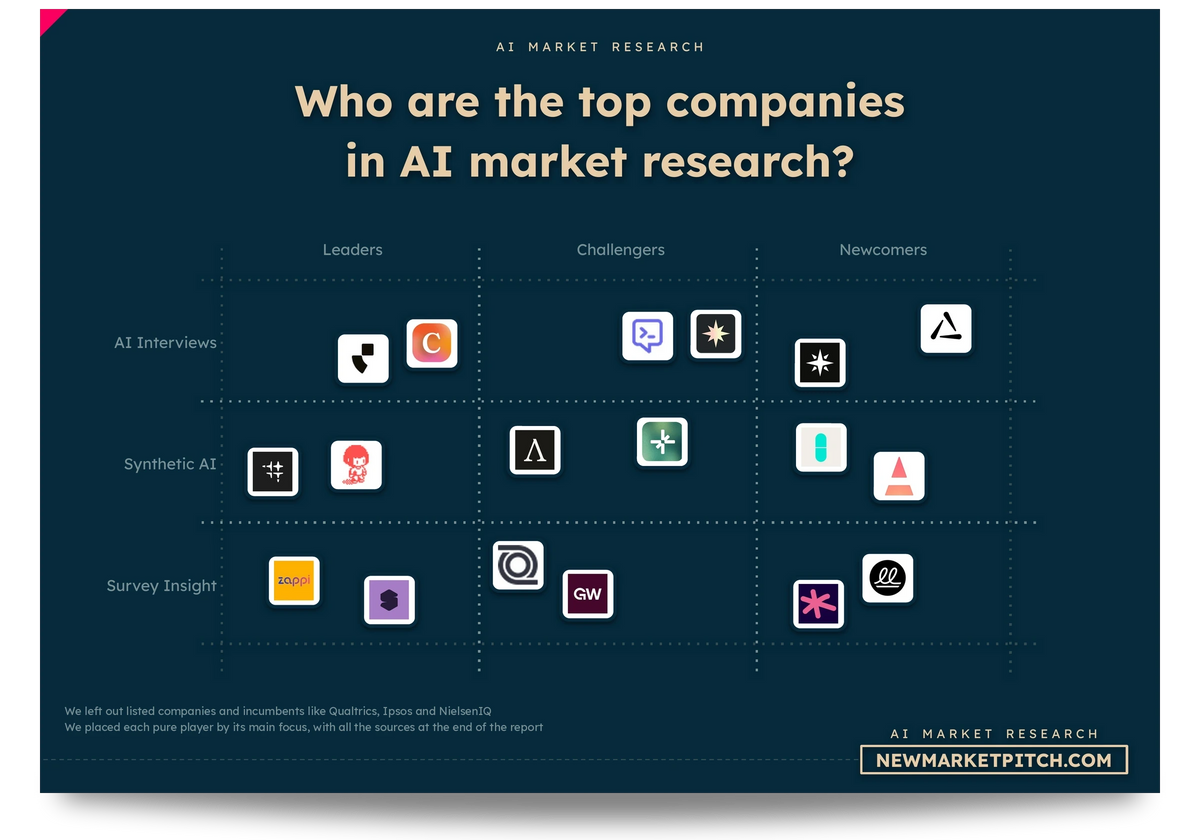
In our research about ai-powered market research startups, we turn what is vague and complex into simple, useful visuals. Market maps like this one show you at a glance where every startup stands.
Are Sequoia Capital and Andreessen Horowitz dominating AI market research investing?
No, Sequoia Capital and Andreessen Horowitz are not dominating AI-powered market research investing.
Sequoia joined 3 rounds, all for Listen Labs, which puts it second with Pear VC behind Y Combinator's 4. Andreessen Horowitz is a major name in AI, but its wider reputation does not make it the busiest investor in this particular market.
Sequoia's case is stronger when we look at what it backed. In its investment essay, the firm described how Listen Labs recruits research participants, interviews them and turns their answers into something a business can act on. That was a clear view of how customer research might change, and the company has since been acquired.
Lightspeed Venture Partners and Bessemer Venture Partners have also made repeat bets, on Bridgetown Research and Dialogue AI in the first case and Newton Research and Strella in the second. Famous funds help attract attention. To find out who is really backing AI research, though, we need to look at which companies each firm financed and whether it took the lead.
Which AI market research VCs actually lead their rounds?
Index Ventures, Lightspeed Venture Partners, Bessemer Venture Partners, PeakSpan Capital and Sequoia Capital are the clearest repeat leads in AI-powered market research.
Each was named as lead in 2 rounds. Y Combinator joined more rounds overall, but was named as lead in 1. So the firms with the most deals and the firms most often driving deals are not quite the same group.
Lightspeed led financings for Bridgetown Research and Dialogue AI. Bessemer did so for Newton Research and Strella, while PeakSpan returned to GetWhy. Sequoia's led rounds involved Listen Labs, and Index led both of Simile's rounds, co-leading the Series B with Greenoaks. Those companies sell quite different kinds of research, from AI interviews to business intelligence and consumer studies.
Being named as lead tells us something important about an investor's role, although it cannot reveal the size of the check. Smaller participants are also less likely to be named in announcements.
The table below shows the different records for joining and leading rounds.
| Investor | Rounds joined | Rounds led |
|---|---|---|
| Y Combinator | 4 | 1 |
| Sequoia Capital | 3 | 2 |
| Pear VC | 3 | 0 |
| Index Ventures | 2 | 2 |
| Lightspeed Venture Partners | 2 | 2 |
| Bessemer Venture Partners | 2 | 2 |
| PeakSpan Capital | 2 | 2 |
| 8VC | 2 | 1 |

In our market report about ai-powered market research startups, we always try to gather several sources and make estimates that make sense, so you can work with solid numbers.
Why does Lightspeed keep investing in AI market research?
Lightspeed Venture Partners sees AI-powered market research as a way to automate research jobs that still take people weeks.
The firm backed Bridgetown Research and Dialogue AI, and was named as lead in 2 rounds. The companies attack different problems, so the repeat activity is more interesting than a simple bet on AI interview software.
Lightspeed's February 2025 article about Bridgetown Research describes agents that gather information, talk to experts and put together answers for strategy teams, consultants and investors. Dialogue AI works closer to product teams. Lightspeed's October 2025 investment essay focused on finding respondents, conducting interviews and making sense of their replies without the usual delays.
Both companies are selling completed work. A business asking Bridgetown for help with a market decision has a different need from a product manager asking Dialogue AI what customers think. Lightspeed's bet is that software can do much of either job, leaving buyers with a decision they can use rather than a pile of raw interviews.
Is Bessemer Venture Partners making a serious bet on AI customer interviews?
Yes, Bessemer Venture Partners has repeatedly led funding for AI customer-research startups Newton Research and Strella.
Bessemer was named as lead in 2 rounds. The clearest public explanation of the bet comes from Strella, which uses AI to interview real people and then helps researchers pull together what they learned.
In Bessemer's account of the company, Strella first tested whether people would have a useful conversation with an adaptive AI moderator. The team then built recruitment, interviewing and analysis into one product. Bessemer says Duolingo used Strella for concept research that previously took weeks.
That customer example gives us something concrete to judge. A voice bot can ask questions, but a research platform also has to find suitable respondents, follow up intelligently and give a company evidence it can trust. Newton Research gives Bessemer another position in this market, while Strella shows the kind of useful customer work the firm has publicly highlighted. Bessemer's repeated lead role is what makes the bet serious.
Why do investors keep backing GetWhy?
Investors keep backing GetWhy because this AI-powered market research company sells to established global brands, and PeakSpan Capital is its repeat backer.
PeakSpan joined 2 GetWhy rounds and was named as lead in 2. The largest GetWhy round it joined was $34.5M, which is the whole company's financing, not PeakSpan's individual check.
GetWhy takes research briefs from brands, organizes consumer interviews on video and uses AI to analyze the answers. Its investor and company announcements have named customers including Nike, Unilever, Heineken and The Coca-Cola Company. The value for those buyers is practical: they already spend money learning what consumers think and want the process to take less time.
PeakSpan's later financing announcement focused on GetWhy's growth with large customers and its ability to conduct studies in different markets. Returning to an established platform carries a different risk from making a company's very first bet on AI research. Here, repeat backing follows a business that already has brands using its product, which helps explain PeakSpan's unusually visible commitment.
Is Y Combinator still the best starting point for AI market research founders?
Y Combinator remains a strong starting point for AI market research founders, but it is not the market's busiest investor this year.
Its investments include Conveo, Outset and CoLoop, and it took part in Conveo's $50M Series A in September 2026. They illustrate how an accelerator can back several ways of solving the same customer problem before the bigger venture funds arrive.
Outset runs adaptive AI interviews with actual respondents. Conveo has expanded from moderated conversations into research that brands can keep using over time. CoLoop helps teams search, organize and interpret research they have already collected. Y Combinator's directory identifies all of them as companies from its network, and Conveo's company history traces its early launch to the accelerator.
For a new company, that record is useful. It shows that founders with different research products have found support there. But founders with an enterprise platform already selling to major brands may need a lead investor who knows that sales process. Y Combinator's breadth and the sector-specific experience of later-stage firms answer different needs.

Our document detailing everything you need to know about ai-powered market research gets updated several times a month, so you always get the latest view of where things stand.
Which AI-powered market research investors are still investing this year?
Index Ventures is the most active AI-powered market research investor this year, with 2 rounds joined.
Y Combinator, the overall participation leader, joined 1 round this year. Of the 20 investors in our active-investor list, 12 joined a round this year and 8 did not.
Index returned to Simile, which uses generative agents to simulate how people may react to choices and changes. Its investment essay points to production customers including CVS, Deloitte, Wealthfront and Gallup. Elsewhere, recent investors backed products as different as Conveo's live consumer interviews and Verso's consumer-intelligence software. The market has seen 14 rounds with a named investor this year, compared with 23 last year. Those figures describe deals announced so far, not everything investors do for the companies they already back.
The table below shows, year by year, how many rounds 12 of the most active ai-powered market research investors joined, so it is easy to see who is still investing and who has slowed down.
If you want to go more into detail and see which investors are still writing checks and which have slowed down, please check our ai-powered market research report.
| Investor | 2024 | 2025 | 2026* | Total |
|---|---|---|---|---|
| Index Ventures | 2 | 2 | ||
| Y Combinator | 3 | 1 | 4 | |
| Sequoia Capital | 1 | 1 | 1 | 3 |
| Pear VC | 1 | 1 | 1 | 3 |
| Duo Partners | 1 | 1 | ||
| Angular Ventures | 1 | 1 | ||
| Differential Ventures | 1 | 1 | ||
| Kakao Ventures | 1 | 1 | ||
| DST Global | 1 | 1 | ||
| Further Than Capital | 1 | 1 | ||
| Neon Fund | 1 | 1 | ||
| Titan Capital | 1 | 1 |
* 2026: January to 19 November. Darker cells mean more rounds that year. Data from January 2024 through 19 November 2026.
Is Index Ventures betting big on synthetic consumers?
Yes, Index Ventures is making a serious, repeat bet on synthetic consumer research through Simile.
Index joined 2 Simile rounds this year, including a $200M Series B, and led both, co-leading the Series B with Greenoaks. This is one of the clearest differences between investors backing models of human behavior and investors paying to make live interviews quicker.
Simile comes out of work on generative agents at Stanford. Its models let businesses try out possible product or policy changes on simulated people before making decisions in the real world. In its July 2026 investment note, Index said CVS, Deloitte, Wealthfront and Gallup already use the platform in production.
Those customers make the investment easier to understand, but synthetic research still has a big test to pass. A model can generate a convincing answer without predicting what a real person will do. Companies need to compare simulations with actual results and know where their models fail. Index is betting that Simile can make those predictions useful enough for businesses to keep paying.
Do the same VCs back both synthetic consumers and real-people interviews?
Not really: in AI-powered market research, the funds betting on synthetic consumers are mostly not the ones backing interviews with real people, and both camps are still getting money.
Index Ventures is closely tied to Simile, while Lightspeed Venture Partners and Bessemer Venture Partners have invested in companies that gather answers from actual respondents. There is no clear winner between the approaches yet.
Simile, Aaru and Hiasynth work with modeled populations or simulations. They can let businesses explore several ideas without building a new human panel each time. But the answer depends on the model's assumptions. A plausible response alone cannot tell a brand how accurate a forecast will be.
Outset, Strella, Dialogue AI and Conveo use AI to interview real people at a larger scale. They still face questions about who gets recruited, how good the interviews are and whether the results change customer decisions. A company could eventually use simulations for early screening and human interviews to check the strongest ideas. For now, investors are funding both jobs instead of treating them as interchangeable.
Why did DST Global and Balderton Capital back Conveo?
DST Global and Balderton Capital backed Conveo as its AI-powered interviews won customers among large consumer brands.
DST Global led Conveo's $50M Series A, while Balderton Capital, Y Combinator and Visionaries Club also took part. The investment shows how a research company can attract large funds without those funds becoming the market's most frequent investors.
Conveo uses AI to interview consumers by video and turns their answers into evidence for brand, product and strategy teams. Its September 2026 announcement named Google, Unilever, AB InBev and Canva among its customers. The company has also introduced StoryLines, which lets clients keep using and querying research instead of starting a separate project for every question.
That is a more developed product than a tool that simply records and summarizes interviews. The investors are backing software that large brands can use repeatedly. Conveo is also a useful warning against reading too much into a single round: being part of a big financing says plenty about a company, but little about how often that firm backs the entire research market.

In our report covering the ai-powered market research market, we look at what the winners do differently, so you can learn from the best instead of guessing.
Can smaller investors still get into AI-powered market research startups?
Yes, smaller investors are still finding AI-powered market research startups to back.
Angular Ventures, Differential Ventures, Kakao Ventures, Further Than Capital and Neon Fund each joined 1 round this year. Their choices show how many different problems sit behind the broad label of AI market research.
Angular backed Verso, which works on consumer intelligence, while Differential backed askpolly, which builds synthetic consumers for research. Kakao Ventures backed Intellicia, and Neon Fund's portfolio lists Echovane, an AI research platform. Further Than Capital supported Hiasynth, whose synthetic-population product is built to answer questions about consumer groups without recruiting a new panel every time.
These are not all copies of a voice-interview tool. And a newcomer does not have to lead several rounds to be useful to a founder. A specialist in a particular product or region may be a better first call than a much bigger fund that only appears once in the sector.
The table below shows investors with a recent market entry and the startup they backed.
| Investor | Startup |
|---|---|
| Duo Partners | QualSights |
| Angular Ventures | Verso |
| Differential Ventures | askpolly |
| Kakao Ventures | Intellicia |
| DST Global | Conveo |
| Further Than Capital | Hiasynth |
| Neon Fund | Echovane |
| Titan Capital | Echovane |
Which AI-powered market research investors back seed rounds, and which back growth rounds?
Seed is the busiest known stage in AI-powered market research, with 21 of the 43 rounds whose stage is known.
Y Combinator, A* and Abstract Ventures share the seed lead with 2 rounds each. Bessemer Venture Partners and PeakSpan Capital are tied at Series A with 2 rounds each.
The companies help explain that division. Y Combinator backed early AI interviewing and research tools, while A* and Abstract Ventures backed Aaru as it developed simulated populations. Bessemer and PeakSpan have led companies selling research products to larger businesses. For a later-round example, Index Ventures returned to Simile in a $200M Series B, while Y Combinator participated in Outset's $30M Series B. Those are total round sizes, never the amount any one investor supplied.
The table below shows, for 12 of the most active ai-powered market research investors, how many rounds they joined at each stage, from seed to growth.
If you want to go more into detail and see where each investor places its bets, from seed to growth, please check our ai-powered market research report.
| Investor | Seed | Series A | Series B | Series C | Series D+ | Growth |
|---|---|---|---|---|---|---|
| Y Combinator | 2 | 1 | 1 | · | · | · |
| Sequoia Capital | 1 | 1 | 1 | · | · | · |
| Pear VC | 1 | 1 | 1 | · | · | · |
| Index Ventures | · | 1 | 1 | · | · | · |
| Lightspeed Venture Partners | 1 | 1 | · | · | · | · |
| Bessemer Venture Partners | · | 2 | · | · | · | · |
| PeakSpan Capital | · | 2 | · | · | · | · |
| 8VC | · | 1 | 1 | · | · | · |
| Silicon Road Ventures | · | 1 | · | · | · | · |
| GFT Ventures | · | 1 | · | · | · | · |
| A* | 2 | · | · | · | · | · |
| Abstract Ventures | 2 | · | · | · | · | · |
Most active at each stage, among all ai-powered market research investors: Seed, Y Combinator, A* and Abstract Ventures · Series A, Bessemer Venture Partners and PeakSpan Capital · Series B, no investor joined more than one round · Growth, no investor joined more than one round. Bigger dots mean more rounds. Data from January 2024 through 19 November 2026.
Do VCs keep backing AI market research startups after the first round?
Some AI-powered market research VCs do return for later rounds, although many others appear only once.
Index Ventures returned to Simile, PeakSpan Capital to GetWhy and 8VC to Outset, with 2 counted rounds each, while Sequoia Capital and Pear VC each backed Listen Labs in 3 rounds. That repeat behavior tells us more about ongoing financial support than a company's general list of investors.
PeakSpan's announcements describe its support for GetWhy as the company expanded among major brands. Index pointed to companies using Simile's simulations in production. Outset widened its product from AI interviews toward customer-experience software. In each case, the investment follows a startup that has changed since its earliest version.
There is an important distinction, though. An announcement saying a firm is an existing investor does not establish that the firm bought shares in the newest round. We only count investors whose participation in that particular round can be established. A founder can value introductions, hiring advice or commercial help without treating those contributions as another financing.

In our research about ai-powered market research startups, we don't want to repeat what boring consulting reports say. Instead, we show you the real and latest market signals that matter.
Are big companies investing in AI market research startups?
Yes, some large companies are investing in AI-powered market research startups, but their involvement is selective.
Outset's Series B announcement named M12, Microsoft's investment arm, among the participants. TechCrunch identified CVS Health Ventures among Simile's Series B investors. Those firms sit alongside regular venture investors rather than replacing them.
The corporate angle can go beyond a check. CVS is also among the customers that Index Ventures named when describing how businesses use Simile. That gives a company a chance to learn whether the product works in a real customer setting, although being both a customer and an investor does not prove that the technology is accurate.
M12 backed Outset as it moved from AI-led interviews toward broader customer-experience software. This shows why the technology interests companies that already work with customer data. Corporate investors may be customers, partners or future buyers, but those possibilities are different from actually joining an equity round. We count the latter here, and the biggest names still do not dominate the participation tally.
Did Salesforce's Listen Labs deal pay off for Sequoia Capital and Pear VC?
Salesforce's acquisition of Listen Labs validates Sequoia Capital and Pear VC's AI research bet, but their investment returns are not public.
Both firms joined 3 counted Listen Labs rounds, from its seed round to its January 2026 Series B, with Sequoia named as lead in 2 and Pear VC never named as lead. That tells us their roles in the financing, not how much either firm earned.
Salesforce announced the purchase in September 2026 and has confirmed that the acquisition is complete. The buyer says Listen Labs can design studies, recruit respondents, conduct interviews, summarize findings and simulate responses. Salesforce plans to use those capabilities alongside its customer and marketing products.
Sequoia's investment essay had emphasized fast interviews with real people and evidence teams could trace back to original responses. The later acquisition shows that a large software company wanted these research tools inside its own platform. That's a concrete result for both early backers. Without the purchase price, ownership stakes and other terms, however, nobody outside the deal can claim to know whether either investor made a large return.
Why are VCs funding synthetic-research startup Aaru?
Aaru attracts venture investors because it lets companies test possible reactions with simulated people instead of running a new survey each time.
A* and Abstract Ventures joined 2 rounds together for Aaru. The pair has returned to the same startup, not built a proven record of investing together across many unrelated research companies.
Aaru models how groups of people may respond to events, products and messages. TechCrunch has covered its attempts to predict human behavior without collecting a fresh panel for every scenario. That approach appeals to businesses that need to test many alternatives quickly, but it asks investors to judge something different from a live-interview product: whether the simulated answers hold up when compared with what people actually do.
Strella, Dialogue AI and Outset, by contrast, use AI moderators while real people supply the responses. A buyer can inspect interview evidence directly, while a buyer using simulations also needs to test how well the model predicts reality. Aaru's backers are paying for that second possibility, with its upside and the extra work required to validate it.
Which AI-powered market research investors most often invest together?
Pear VC and Sequoia Capital are the most frequent AI-powered market research investor pair, with 3 rounds together, ahead of A* and Abstract Ventures with 2.
The first pair backed Listen Labs, and the second backed Aaru. Each relationship covers 1 startup, so these figures describe investors returning to the same company, not a habit of financing one another's deals across the industry.
Their investments also involve different products. Aaru simulates how people might respond to decisions, while Listen Labs built tools for interviews with real respondents and later added simulation features. Sequoia was named as lead in its counted Listen Labs rounds, whereas Pear VC appeared as a participant. Backing the same startup therefore does not mean investors wrote equal checks or took equal responsibility. There are 103 named investors across the industry, and co-backing a successful startup is a weak basis for assuming that any pair will back the next startup together.
The table below lists the pairs of ai-powered market research investors named together in at least two equity rounds, with the startups they backed together.
If you want to go more into detail and see which investor networks back the same startups, please check our ai-powered market research report.
| Investor pair | Rounds together | Startups backed together |
|---|---|---|
| Pear VC + Sequoia CapitalListen Labs | 3 | Listen Labs |
| A* + Abstract VenturesAaru | 2 | Aaru |
Pairs of investors named in the same equity round. Data from January 2024 through 19 November 2026.

Learning from others' mistakes is the cheapest lesson there is. In our market report about ai-powered market research startups, we look at what broke startups before you, so you don't repeat it.
Which AI market research VC should a founder approach first today?
AI-powered market research founders should approach investors whose previous bets resemble the product they are actually building.
Y Combinator is a strong option for early startups, with Conveo, Outset and CoLoop showing the range of research ideas it has backed. A founder building AI interviews should also look at why Bessemer Venture Partners supported Strella and why Lightspeed Venture Partners backed Dialogue AI.
For software already selling to large consumer brands, PeakSpan Capital's relationship with GetWhy offers a closer example. For synthetic respondents, Index Ventures' public case for Simile is especially relevant. Angular Ventures and Differential Ventures have also backed younger companies tackling more specific consumer-research problems.
These are useful precedents, not a list of firms guaranteed to take a pitch. The real question for a founder is whether an investor has shown interest in the same buyer, product and stage. An investor that knows how to sell research software to brand teams can be more useful than a famous name that invests mainly in unrelated AI infrastructure.
So, who are the biggest backers of AI-powered market research today?
Y Combinator is the most active AI-powered market research investor, with 4 rounds joined, while several VCs share the lead on other measures.
Index Ventures, Lightspeed Venture Partners, Bessemer Venture Partners, PeakSpan Capital and Sequoia Capital each led 2 rounds. Index Ventures, meanwhile, has been the most active investor this year. That means the answer changes depending on whether we care about showing up, taking the lead or writing another check recently.
The choices behind those records are revealing. Lightspeed backed both business research and AI interviews, while Bessemer and PeakSpan favored platforms for established research buyers. Index returned to simulations. Founders therefore face a real choice between investors who know live consumer research, those funding synthetic models, and accelerators willing to support an earlier product.
The table below shows what we found.
| Question | Answer |
|---|---|
| Does joining more rounds mean leading them? | Not always, as Y Combinator led 1 of its counted rounds. Several VCs led more rounds despite appearing less often. Founders should check who actually took charge of a financing. |
| Has anyone pulled far ahead in investing? | No fund has built a huge lead here. Sequoia Capital and Pear VC follow Y Combinator with 3 rounds each. Founders still have a wide range of credible funding options. |
| Has Y Combinator been active lately? | Yes, Y Combinator joined 1 round this year. It took part in Conveo's $50M Series A in September 2026. Its other investments here include Outset and CoLoop. |
| Which investor has been busiest this year? | Index Ventures leads current activity in this market. It joined 2 rounds involving synthetic-research startup Simile. Its repeat backing centers on simulated customer behavior. |
| Are the leading funds actually leading rounds? | Yes, some well-known firms regularly take the lead. Lightspeed Venture Partners and Bessemer Venture Partners each led 2. Investors' roles can differ sharply even when their participation counts match. |
| Do established brands make research startups appealing? | Yes, GetWhy sells research software to major consumer brands. PeakSpan Capital joined 2 funding rounds involving that company. Existing enterprise customers give investors something concrete to evaluate. |
| Is synthetic customer research attracting big money? | Yes, Simile attracted a $200M Series B financing. Index Ventures joined that round and backed the company again. The business still needs proof that its predictions work. |
| Can AI interview startups attract major VCs? | Yes, DST Global led Conveo's $50M Series A. Balderton Capital also took part in the round. It shows that established funds now back AI-moderated consumer research. |
| Are seed investors backing several AI approaches? | Yes, Y Combinator invested in different research products. Its portfolio here includes Conveo, Outset and CoLoop. Their tools cover interviewing, consumer insights and research synthesis. |
| Do frequent investor pairs form permanent alliances? | No, recurring pairs can share just one startup. A* and Abstract Ventures joined 2 Aaru rounds. That does not promise future investments together in other companies. |
| Does an acquisition prove an investor made money? | Not without knowing the terms of the sale. Salesforce completed its purchase of AI researcher Listen Labs. Its early backers have a clear exit but undisclosed returns. |

If you build or invest in the ai-powered market research market, you need to know which business models pay off now and which ones are fading. That's why our report covering it has a whole section on it.
Our methodology
Our data runs through November 19, 2026. We then reviewed this article and updated its answers on November 24, 2026, the date shown under the title. We systematically tracked equity rounds in this market deal by deal from January 2024, a window long enough to distinguish established participation from investors active today. AI-powered market research means independent technology vendors whose core software uses AI to collect, simulate or interpret evidence about consumers, buyers, audiences and markets. It includes AI-led human interviews, surveys, calibrated simulated respondents, research synthesis, consumer intelligence and concept testing, but not generic search assistants, sales prospecting or agencies without scalable proprietary software. Every counted company meets our startup definition, and borderline products that still qualify are retained rather than silently excluded.
We count each investor's participation in a private equity round and separately whether it was named as a lead. We do not estimate what each investor contributed, because individual checks are rarely public. IPOs and post-listing offerings are excluded. We identify investors from company announcements and credible reporting, merge alternative names for the same firm, remove duplicate reports of a single round and exclude vague descriptions such as “existing investors” when no investor is named. The current-year column begins in March, once three months of activity are available.
Announcements name lead investors more reliably than smaller participants, so rounds that an investor joined without leading are undercounted and lead rates are an upper bound.
Rounds confirmed by a company announcement, a press article or a regulatory filing are counted in full. Where no article exists, a round is counted only when at least two recognised databases agree on its date (within one month) and amount (within 5%), and it is marked as low confidence. A round found in a single database stays in the company's history but is left out of totals. For companies that have raised more than $100M, every round counted is backed by an article.
We never rely on investor lists from Crunchbase, PitchBook or comparable commercial databases alone: those lists can confuse debt with equity or attach a fund to a round it did not join. We found named investors in 47 of the 51 equity rounds. The investor tables therefore give a floor for each investor's disclosed activity. The funding-deals tracker and this article also count differently: that tracker counts each round once, while this investor ranking counts that round once for each named investor that participated, and an unnamed round contributes nothing to investor totals.
Counting rounds rather than money is deliberate. The size announced for a round belongs to the company and all its participants, not to a particular VC, so ranking firms by the full size of rounds they joined would falsely attribute other investors' capital to them. A prominent fund can also appear below an accelerator if it chose to lead a smaller number of specialized companies. We show both participation and named leadership, identify the actual startups involved, and use later company outcomes as context rather than inventing private check sizes or returns.
Key sources include Outset product, accelerator affiliation and AI interviews, Conveo accelerator history and AI-moderated research, CoLoop product and Y Combinator affiliation, Lightspeed's thesis on automated business research, Lightspeed's rationale for backing Dialogue AI, Dialogue AI research workflow and financing announcement, Bessemer's account of Strella adoption and AI interviews, Bessemer investment thesis and Strella founders, PeakSpan's first announced GetWhy financing, PeakSpan follow-on financing and GetWhy customers, Sequoia's rationale for backing Listen Labs, Sequoia on the Listen Labs acquisition, Salesforce acquisition and confirmed closing, Index Ventures Simile investment and enterprise use cases, Simile funding and other participants including CVS Health Ventures, Balderton announcement and Conveo customers, Conveo product history and investors, Outset round participants and research expansion, Hiasynth synthetic population product and Further Than Capital investment, Neon Fund identifies Echovane as an AI research investment, and Aaru simulation model and early investors.

In our report covering the ai-powered market research market, we like to show you the big picture. We know your time is precious, so we make every page quick to read and packed with as much learning as possible per minute.
Written by the New Market Pitch teamWe track new markets so founders and investors can move faster. About us