
What's the best business model in AI protein design?
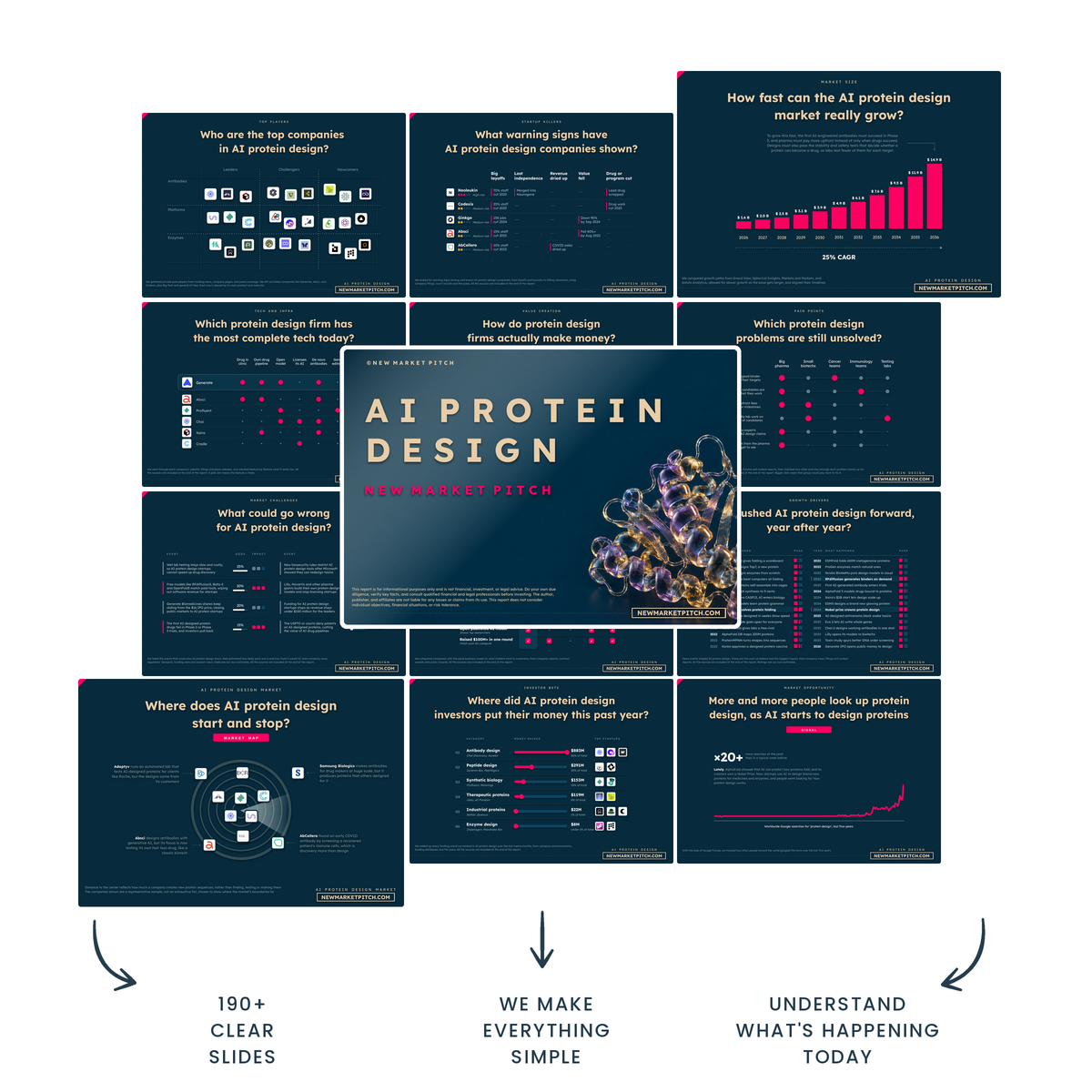
Whether you're building or investing in the AI protein design market, our report covers everything you need to know: the players, the money, and what's coming next.
Summary
The best business model in AI protein design is enterprise protein-engineering software, supported by proprietary experimental data and selective licensing. It offers the strongest combination of recurring revenue, gross-margin potential and manageable capital requirements, although pure-play profitability remains unproven.
The clearest financial benchmark comes from Schrödinger, whose broader scientific software business generated $199.5 million in 2025 revenue at a 74% gross margin. Its drug-discovery segment, by comparison, lost money at the gross-profit level, illustrating how different the economics become when a company moves from selling tools to developing biological assets.
Pharmaceutical companies are starting to make longer-term commitments. Bayer signed a three-year agreement with Cradle after evaluating competing vendors and completing a proof of concept, while Cradle reported customers at six of the world's 25 largest pharmaceutical companies.
Cradle's decision to let customers retain full ownership of their proteins, without paying royalties, may be as important commercially as its AI technology. Pharmaceutical companies can adopt the software without surrendering a share of potentially valuable future drugs.
Open protein models are weakening the business case for charging customers simply to generate sequences. The more defensible opportunity lies in predicting experimental success, learning from proprietary laboratory results and becoming integrated into research workflows that customers use repeatedly.
Owning laboratories can strengthen that advantage, but only when experimental data improves a platform used across many projects. Heavy laboratory infrastructure becomes dangerous when each additional customer requires substantial dedicated scientific work, as the wider synthetic biology industry's financial struggles have shown.
Billion-dollar pharmaceutical licensing announcements need a different interpretation. Profluent's Eli Lilly agreement offers up to $2.25 billion in potential milestone payments, but the actual cash received depends on technical, clinical and commercial achievements that may take years or never occur.
Developing proprietary therapeutics creates even more financial exposure. Absci spent approximately $81.4 million on research and development against just $2.8 million in 2025 revenue, demonstrating how expensive the path can become before an AI-designed drug reaches commercial sales.
Industrial protein design offers another attractive route. Arzeda's licensing agreement with MANE demonstrates how startups can commercialize enzymes and ingredients through established manufacturers rather than funding production facilities themselves. Novonesis's 37.1% adjusted EBITDA margin shows the potential economics of the mature biosolutions market, though not those of Arzeda specifically.
The strongest five-year strategy is therefore software first, experimental validation as a competitive advantage, and separate licensing agreements for inventions the company genuinely owns. The missing proof is financial: no major independent pure-play AI protein design software provider has yet publicly demonstrated sustained operating profitability at scale.

Written by the New Market Pitch teamWe track new markets so founders and investors can move faster. About us
Why are AI protein design companies starting to make real money?
AI protein design is becoming a commercial business, with pharmaceutical companies signing multiyear software agreements, licensing new proteins and bringing AI-engineered products closer to market.
Cradle provides one of the clearest examples. In December 2025, the company reported more than 50 active protein-engineering projects and customers at six of the world's 25 largest pharmaceutical companies. Weeks later, Bayer announced a three-year agreement to use Cradle's software for antibody discovery and optimization.
Other companies are taking different routes. In April 2026, Profluent signed a collaboration with Eli Lilly worth up to $2.25 billion in potential milestone payments, plus royalties, to develop AI-designed gene-editing proteins. Arzeda, meanwhile, expanded its partnership with MANE in July 2026, granting the ingredients manufacturer an exclusive global license to produce and commercialize its ViaLeaf sweetener technology.
These companies are tackling the same underlying scientific problem but selling very different things. Cradle charges customers to design better proteins. Profluent licenses potentially valuable biological inventions. Arzeda creates proteins that partners can turn into commercial products.
The question is which approach can generate reliable profits rather than impressive research results or enormous potential contract values.
Is selling AI protein design software better than selling discoveries?
Enterprise software is currently the strongest starting point for an AI protein design business because customers can pay repeatedly without the provider having to finance clinical trials or manufacture finished products.
Cradle follows this approach. Pharmaceutical and biotechnology customers subscribe to its platform, use it to design and optimize proteins, and retain ownership of the resulting intellectual property. Cradle does not require royalties on products developed through its software.
We can see why this appeals to pharmaceutical companies. An antibody developer might be willing to spend heavily on research software that reduces failed experiments, but surrendering even a small share of future drug sales could be far more expensive.
The financial advantage becomes clearer when we look at Schrödinger, a publicly traded computational drug-discovery company whose software business provides a useful benchmark, although it operates beyond protein design.
According to Schrödinger's February 2026 financial results, software generated $199.5 million in revenue during 2025, with a 74% gross margin. Drug discovery generated $56.4 million but incurred $62.3 million in direct costs.
Software accounted for approximately 78% of revenue and generated roughly $147.6 million in gross profit. The drug-discovery segment had a gross loss of about $5.9 million.
That's quite a difference. Software can generate revenue across many customers, whereas discovery programs depend on expensive scientific work and less predictable outcomes.
| Business model | How it makes money | Biggest advantage | Main weakness |
|---|---|---|---|
| Enterprise software | Annual subscriptions | Recurring revenue | Requires strong retention |
| Usage-based AI platform | Charges for model usage | Scales with activity | Vulnerable to price competition |
| Research services | Project fees | Immediate customer payments | Labor-intensive |
| Pharma partnerships | Upfront and research payments | Larger contracts | Irregular revenue |
| Protein licensing | Milestones and royalties | High value per discovery | Payments may never arrive |
| Proprietary drug development | Drug sales or asset deals | Very large potential returns | Expensive clinical trials |
| Industrial enzyme products | Recurring product sales | Repeat customer demand | Manufacturing and pricing pressure |
| Industrial IP licensing | Technology fees and royalties | Lower capital requirements | Depends on partner execution |
If you want more recent data on this point, please see our latest AI protein design market report.

A good product starts with a real problem. In our report covering the AI protein design market, we show you the ones customers still live with.
Are pharmaceutical companies actually paying for AI protein design software?
Pharmaceutical companies are now signing longer-term AI protein design agreements, and Cradle's growing customer base suggests that some buyers are moving beyond experimental projects.
When Cradle announced its $73 million Series B in November 2024, it reported more than 21 customers and 31 proteins under development. By December 2025, it had disclosed more than 50 projects, including work with Johnson & Johnson and Novo Nordisk.
The figures indicate greater disclosed commercial activity, although proteins under development and active projects are different measures and cannot support a precise growth rate.
The stronger evidence comes from Bayer's January 2026 announcement. Bayer selected Cradle after a successful proof of concept and a comparison with other vendors. Its three-year agreement gives antibody researchers access to the platform as part of their existing development work.
Bayer also agreed to conduct a joint machine-learning research project, so the relationship extends beyond purchasing software licenses.
Cradle has said that customers are expanding deployments and entering multiyear commitments. That pattern is more commercially meaningful than a growing count of pilot projects because repeat purchases are what make enterprise software financially attractive.
There is still one important gap: Cradle does not publish annual recurring revenue, customer retention or operating profit. We can establish that large pharmaceutical customers are willing to commit to its product, but the financial strength of those contracts remains undisclosed.
Can AI protein design software become a profitable business?
AI protein design software has a credible path to profitability, although no major independent pure-play provider has publicly demonstrated sustained profits at scale.
Schrödinger's financial history gives us a useful reference. Software revenue increased from $159.1 million in 2023 to $180.4 million in 2024 and $199.5 million in 2025. That represents approximately 25% cumulative growth over two years.
Its 74% software gross margin in 2025 shows that scientific software can generate attractive revenue after direct delivery costs. However, the margin declined from roughly 80% in 2024, and software net dollar retention fell from 113% to 100%.
Those changes are worth watching. Customer spending can fluctuate, and expensive scientific computing does not necessarily become cheaper at the same rate as conventional software.
Schrödinger also reported a companywide net loss of $103.3 million for 2025 despite having a profitable software segment at the gross-profit level.
So a strong software gross margin clearly isn't enough on its own. The broader company can still spend heavily on research and development.
For smaller AI protein design startups, the immediate challenge is covering model development, laboratory validation, engineering and enterprise sales with a recurring subscription base.
Companies that can reuse the same technology across hundreds of projects have the best chance of making those costs manageable.

If you build or invest in the AI protein design market, you need to know which business models pay off now and which ones are fading. That's why our report covering it has a whole section on it.
How much can AI protein design companies charge pharmaceutical customers?
AI protein design platforms can justify substantial enterprise pricing when they eliminate expensive laboratory experiments or improve the chances of developing a commercially useful molecule.
Cradle has reported development speed improvements of between twofold and twelvefold across customer applications, with cost reductions reaching 90% in some cases. These are company-reported results, and they should not be interpreted as an independently measured average.
Still, the economics are easy to understand.
Suppose a pharmaceutical research team spends $1 million on protein optimization. If better experimental selection reduces that expenditure by 40%, the potential saving is $400,000.
An annual software contract costing $100,000 would represent one-quarter of the savings. The customer could still come out substantially ahead.
Those amounts are illustrative rather than disclosed contract prices.
The opportunity is particularly attractive in antibody development, where improving protein stability, binding or manufacturability can reduce expensive downstream problems.
But pricing power varies by application. A pharmaceutical company developing a high-value therapeutic can justify spending more than an industrial biotechnology company trying to reduce the production cost of an inexpensive enzyme.
That gives enterprise software providers an incentive to concentrate first on expensive research workflows where a measurable improvement is worth far more than the subscription fee.
Could free AI protein models destroy the software business?
Open protein AI models are making basic sequence generation harder to monetize, but companies offering reliable laboratory results and integrated research workflows still have something valuable to sell.
The underlying technology has become much more accessible. AlphaFold 3 expanded molecular-structure prediction capabilities in 2024, RFdiffusion helped researchers generate new protein structures, and EvolutionaryScale released an openly available version of ESM3 under an MIT license.
These developments reduce the value of simply offering access to a model that generates protein sequences.
A pharmaceutical company can increasingly experiment with powerful models without buying an expensive proprietary platform.
What remains difficult is deciding which sequences are worth testing, combining multiple experimental objectives and learning from proprietary laboratory results.
Cradle addresses those requirements by integrating protein modeling with customer data and laboratory workflows. Customers retain control of their protein intellectual property, making the platform easier to adopt in sensitive pharmaceutical research.
The cost of generating a protein prediction may keep falling while the value of getting an experimentally successful protein remains high.
We expect generic model access to become increasingly competitive. The more defensible business is software that consistently improves real experimental outcomes and becomes part of the customer's routine research process.
If you want more recent data on this point, please see our latest AI protein design market report.

Learning from others' mistakes is the cheapest lesson there is. In our market report about AI protein design, we look at what broke startups before you, so you don't repeat it.
Are AI protein design companies wasting money on their own laboratories?
Internal laboratories can give AI protein design companies better training data and more reliable products, but excessive laboratory infrastructure can quickly destroy the financial advantages of software.
A protein that looks promising in a computer model still needs experimental validation. Researchers must determine whether it can be produced efficiently and whether its predicted activity, stability and other properties hold up in practice.
Cradle has invested in laboratory capabilities alongside its software platform. Arzeda has spent years developing design-build-test systems that combine computational engineering with physical experiments.
The commercial question is how much of that work can be reused.
If laboratory experiments help train a model that improves thousands of future predictions, the expenditure can benefit many customers. If each project requires a large dedicated scientific team, revenue becomes tied to the number of researchers the company employs.
Ginkgo Bioworks offers a warning from the wider synthetic biology industry. The company invested heavily in automated biological infrastructure but struggled to turn that capability into enough commercial demand. Its 2025 revenue declined 25% to $170 million.
Ginkgo is much broader than protein design, so its financial problems cannot be directly attributed to protein engineering. But the underlying problem is familiar: expensive laboratory capacity becomes a serious burden when customer demand disappoints.
For software-led companies, selective internal validation, customer-operated laboratories and outsourced experimental partners look more attractive than owning every step of the testing process.
Are billion-dollar AI protein design deals worth as much as they sound?
The biggest AI protein design partnerships are worth far less upfront than their headline figures suggest, because most of the announced value depends on future milestones.
Profluent's agreement with Eli Lilly is a good example. The April 2026 collaboration aims to create AI-designed recombinases capable of inserting long stretches of DNA into specific genomic locations.
Profluent is eligible for up to $2.25 billion in development and commercial milestone payments, plus royalties on potential product sales. The agreement also includes an upfront payment and committed research funding, but the upfront amount was not publicly disclosed.
The $2.25 billion figure therefore describes potential future payments rather than money received.
A program must clear multiple technical, clinical and commercial hurdles before the full milestone value can be realized.
We can also compare that headline with actual financial results from Absci, another company developing AI-designed biologics.
Absci recorded just $2.8 million in partner-program revenue in 2025, down from $4.5 million in 2024. The company continued spending heavily on proprietary therapeutic development.
There is no contradiction between pharmaceutical companies signing multibillion-dollar potential deals and AI drug developers recognizing relatively modest annual revenue. These agreements are structured around uncertain future success.
For investors and founders, upfront cash, funded research and near-term milestones give a much clearer view of a partnership's present economic value.

When you build or invest in the AI protein design market, you need clarity, not confusion. In our document detailing everything you need to know about AI protein design, we always try to put numbers on and quantify whatever is usually vague and confusing.
Is owning AI-designed drugs more profitable than selling the technology?
Developing proprietary AI-designed drugs offers much larger potential returns per successful product, but it is currently a far more expensive and uncertain business than selling protein-design technology.
Absci illustrates the difference. In 2025, the company generated $2.8 million in revenue while spending approximately $81.4 million on research and development and reporting a $115.2 million net loss.
Research spending alone was about 29 times annual revenue.
The company has also made real clinical progress. Its AI-designed antibody ABS-201 entered human testing, and Absci reported positive interim Phase 1 data in August 2026. Eli Lilly participated with a $40 million strategic investment in a $100 million equity financing.
Those developments are encouraging for the drug candidate. However, early clinical evidence leaves many years of development, safety testing and commercial uncertainty.
A successful biologic could eventually generate much more value than a software company earns from annual subscriptions. But the company developing the drug must keep financing the program while waiting for that outcome.
This is why owning drugs makes more sense for companies that have substantial capital, strong therapeutic development teams and genuinely differentiated molecules.
A startup whose main advantage is protein-design software may earn better returns by helping several pharmaceutical companies improve their pipelines rather than financing one pipeline itself.
If you want more recent data on this point, please see our latest AI protein design market report.
Can AI-designed proteins make money outside pharmaceuticals?
Industrial protein design offers a credible route to revenue because companies can commercialize useful enzymes and ingredients without going through the full clinical drug-approval process.
Arzeda is one of the strongest examples. Its ViaLeaf technology uses protein engineering to improve the production of Reb M, a desirable stevia sweetener.
The company began working with MANE on commercialization in March 2026. In July, the partnership expanded into an exclusive global license allowing MANE to produce and commercialize ViaLeaf Reb M.
That deal is particularly interesting because MANE already has manufacturing expertise, customer relationships and distribution channels in the food ingredients industry.
Arzeda has also collaborated with Unilever on detergent enzymes, reporting that protein engineering helped develop new enzyme solutions in 18 months, roughly five times faster than conventional approaches.
These applications have direct financial benefits. Better enzymes can improve manufacturing yield, reduce processing costs or produce ingredients with properties customers are willing to pay for.
Novonesis demonstrates how attractive the established industrial biotechnology market can become. The biosolutions group reported 7% organic revenue growth and a 37.1% adjusted EBITDA margin in 2025.
Novonesis is considerably larger and more diversified than Arzeda. Its results therefore serve as an industry benchmark rather than proof of Arzeda's margins.
Still, the commercial potential of industrial proteins is tangible, especially when an AI developer can license technology to a manufacturer instead of building production facilities itself.
| Application | What customers pay for | Main commercial challenge |
|---|---|---|
| Laundry detergents | Better cleaning enzymes | Performance at low cost |
| Sweeteners | More efficient Reb M production | Competitive ingredient pricing |
| Dairy processing | Faster or more efficient enzyme reactions | Food-grade consistency |
| Animal feed | Improved nutrient conversion | Measurable cost savings |
| Biofuels | Better biomass conversion | Industrial efficiency |
| Specialty chemicals | More selective reactions | Production economics |
| Agriculture | Improved biological proteins and tools | Field performance |
| Pharmaceutical manufacturing | Better protein expression and stability | Reliable regulated production |

In our report covering the AI protein design market, we look at what the winners do differently, so you can learn from the best instead of guessing.
Is licensing AI-designed proteins smarter than manufacturing them?
Licensing AI-designed proteins to established manufacturers is usually more attractive for a startup than building factories, particularly when the protein's intellectual property is more valuable than its production process.
Arzeda's expanded agreement with MANE is a useful example. MANE gained the right to produce and commercialize ViaLeaf Reb M, allowing Arzeda to concentrate more of its efforts on the technology that created the product.
This gives Arzeda access to a commercial infrastructure that would be expensive to reproduce independently.
Manufacturing industrial proteins requires reliable production processes, equipment, quality control, inventory management and distribution. Some products also face strong pricing pressure from established enzyme and ingredient suppliers.
Even a technically superior protein can fail commercially if its production cost is too high.
Licensing lets the AI developer capture part of the economic value while transferring much of that operational responsibility to a partner.
The drawback is that royalties and licensing payments depend on successful commercialization. Without access to the contract terms, we cannot establish how much of the product's eventual profit Arzeda will retain.
Owning manufacturing may still make sense when the production process itself is the company's main competitive advantage. For most early-stage AI protein design businesses, though, established industrial partners offer a less capital-intensive route to market.
If you want more recent data on this point, please see our latest AI protein design market report.
Can AI protein design companies keep customers from building their own tools?
AI protein design companies can keep large pharmaceutical customers if their software consistently outperforms internal alternatives, but the threat from in-house tools is already real.
Major pharmaceutical companies have strong computational biology teams, proprietary datasets and the financial resources to develop internal models.
Bayer's agreement with Cradle is particularly informative here. Bayer already had capabilities in antibody design, machine learning and biological research. It still selected Cradle after evaluating multiple vendors and completing a proof of concept.
Outside software can evidently provide enough additional value to justify paying for it even when customers have sophisticated internal teams.
But we should not assume that the advantage lasts forever.
As foundation models become cheaper and more accessible, pharmaceutical companies may be able to reproduce basic protein-design capabilities internally. Startups that mainly package public models could then struggle to maintain prices.
The harder capabilities to reproduce are reliable experimental predictions, proprietary training data, integrations with laboratory systems and accumulated experience across many different proteins.
A vendor that repeatedly saves customers expensive experimental cycles has a much stronger position than one whose main selling point is a more powerful model.
The real test will be renewals and expanded deployments after customers have had enough time to compare the software against their internal alternatives.

Your time is limited. In our research about AI protein design, we put numbers on each part of the market, so you can see where it makes sense to focus.
Why do AI protein design companies choose different business models?
AI protein design companies choose different ways to make money because a valuable protein discovery can be worth anything from a modest laboratory saving to a potential multibillion-dollar pharmaceutical product.
Cradle focuses on enterprise software because its customers already operate laboratories and own drug-development programs. They primarily need tools to make their existing research faster and more reliable.
Profluent concentrates on designing valuable biological technologies that pharmaceutical and industrial partners can incorporate into commercial products.
Its partnership portfolio now includes Eli Lilly, BioMarin, Ensoma, Corteva and Integrated DNA Technologies, spanning genetic medicines, agriculture and research technologies.
Arzeda has built its business around industrial protein engineering and commercialization. Customers care about improved ingredients, enzymes and manufacturing economics rather than direct access to a generative AI model.
These approaches also involve different levels of risk.
A subscription provider can spread its revenue across many customers. A licensing company may depend on a handful of valuable inventions. A proprietary drug developer can capture enormous returns but must fund long and uncertain development programs.
The best choice depends on where the company's technical advantage creates the most economic value and how much capital it must spend to capture that value.
Which AI protein design business model has the best economics today?
Enterprise protein-engineering software currently has the strongest demonstrated gross-margin potential, while licensing offers greater upside from individual discoveries and industrial products provide a more direct route to recurring commercial demand.
Our comparison of the available company evidence gives us a fairly clear picture.
Schrödinger has demonstrated nearly $200 million in annual scientific software revenue at a 74% gross margin. Its operations are broader than AI protein design, but it provides the best established financial reference for selling computational discovery tools.
Cradle's growing enterprise adoption suggests that this model can work specifically for protein engineering, although its undisclosed finances prevent a direct profitability comparison.
Profluent shows the value of specialized protein intellectual property. Its potential $2.25 billion Lilly agreement is much larger than a conventional software contract, but the realized revenue depends on development milestones.
Arzeda offers evidence of industrial commercialization progress. Its agreements with MANE and Unilever connect protein engineering with products that customers can repeatedly purchase, although product-level margins remain private.
Absci demonstrates why proprietary drug development is financially different: high operating costs can persist long before therapeutic revenue arrives.
From those examples, software looks strongest for repeatable revenue and gross margins. Licensing stands out for potential value per breakthrough, while industrial commercialization is particularly promising when a partner handles manufacturing.
There is not enough public financial information to declare an overall profit leader among pure-play AI protein design startups.

In our market report about AI protein design, we always try to gather several sources and make estimates that make sense, so you can work with solid numbers.
Should AI protein design companies sell software and license discoveries at the same time?
Combining software subscriptions with selective licensing can be an attractive business model, provided the company avoids financing too many unrelated activities.
Software creates a more predictable revenue base. Licensing gives the company a chance to participate in the value of particularly important proteins.
That combination can make sense when a platform repeatedly uncovers valuable discoveries while helping customers with routine protein optimization.
However, pharmaceutical customers will not always accept the same commercial terms. Cradle's appeal partly comes from allowing customers to retain full ownership of proteins developed through its software.
A company that suddenly demands royalties on ordinary customer discoveries could undermine that advantage.
A better hybrid approach separates standard software contracts from selected co-development projects where the AI company contributes its own proprietary technology.
We also need to be cautious about adding drug development to that combination. Schrödinger's 2025 results show how a strong software business can coexist with an expensive discovery division that absorbs substantial resources.
The most attractive hybrid would preserve the financial characteristics of enterprise software while adding licensing opportunities only where they provide enough additional value to justify the complexity.
What's the best business model in AI protein design over the next five years?
Enterprise protein-design software combined with experimental validation and selective licensing looks like the strongest business model for the next five years.
The evidence points toward three durable sources of value.
First, large pharmaceutical companies are willing to incorporate external protein-engineering software into their research workflows. Bayer's multiyear commitment to Cradle is particularly convincing because it followed competitive evaluation and experimental testing.
Second, specialized protein discoveries can attract substantial development funding. Profluent's pharmaceutical partnerships suggest that licensing valuable biological technologies can generate meaningful revenue opportunities even before products reach the market.
Third, industrial proteins can become real commercial products. Arzeda's partnerships show how AI-designed technologies can be commercialized through manufacturers that already serve large markets.
The winning companies will probably be those that concentrate on the part of this chain where they have the greatest advantage.
We would favor software-led businesses that can demonstrate high renewal rates, measurable experimental improvements and attractive gross margins. Selective licensing can add substantial upside when the company owns genuinely differentiated technology.
A startup building a proprietary therapeutic pipeline may ultimately create more value, but its success will depend heavily on clinical outcomes and continued access to capital.
If you want more recent data on this point, please see our latest AI protein design market report.

In our document detailing everything you need to know about AI protein design, we turn what is vague and complex into simple, useful visuals. Market maps like this one show you at a glance where every startup stands.
So, what's the best business model in AI protein design?
The best business model in AI protein design today is enterprise protein-engineering software, supported by proprietary experimental data and selective licensing of valuable discoveries.
Cradle provides one of the clearest examples of the software-first approach. Its growing pharmaceutical customer base and three-year Bayer agreement demonstrate that large research organizations are willing to integrate external protein AI into their workflows.
Profluent demonstrates the additional value of intellectual-property licensing, particularly when an AI-designed protein offers capabilities that pharmaceutical partners cannot easily reproduce.
Industrial applications deserve serious attention as well. Arzeda's commercial partnerships suggest that enzymes and ingredients can create more immediate product opportunities than therapeutics that require lengthy clinical development.
We would prioritize recurring software revenue for financial stability and use licensing to capture some of the upside from exceptional discoveries.
That judgment comes with an important distinction: the best business model does not necessarily belong to the company developing the most valuable individual protein.
A successful AI-designed drug could be worth billions, while a software company might never earn anything close to that from one customer. But software can generate revenue across many customers without depending on a single molecule succeeding in clinical trials.
For a startup trying to build a profitable and scalable business, those economics currently make software-led protein engineering the strongest choice. The remaining proof is sustained recurring revenue, customer retention and operating profitability at a pure-play provider.
Our methodology
This analysis examines which business model in AI protein design has the strongest economic foundations. Because software subscriptions, pharmaceutical licensing, proprietary drug development and industrial commercialization produce very different financial outcomes, we assessed them across separate dimensions rather than relying on company valuations, funding announcements or technological achievements.
For each dimension, we identified recent commercial and financial developments, aggregated the most relevant observations, compared the evidence across companies and assessed what could reasonably be concluded. Our principal criteria were revenue repeatability, gross-margin potential, capital requirements, customer commitment, commercialization risk and the sustainability of competitive advantages.
We distinguished recurring software income from upfront research payments, contingent pharmaceutical milestones, royalties and eventual product sales. These revenue streams carry different timing, costs and probabilities of realization. Announced partnership ceilings were treated as potential contract values rather than booked revenue, while signed customer agreements were assessed separately from evidence of renewal, retention and profitability.
Our financial comparison used Schrödinger's disclosed software and drug-discovery results to examine the economics of scientific software, Absci's filings to assess the costs of developing proprietary therapeutics, and Novonesis's reported performance to establish a mature industrial biotechnology benchmark. These businesses extend beyond pure-play AI protein design, so their financial results were used as comparative anchors rather than assigned directly to private startups.
We then examined the commercial evidence behind Cradle, Profluent and Arzeda. This included disclosed pharmaceutical customers, multiyear contracts, licensing structures, experimental results and industrial commercialization agreements. We gave more weight to completed agreements and observable business activity than to hypothetical market opportunities or the maximum value of future payments.
We also assessed how open protein models, internal pharmaceutical AI capabilities and laboratory infrastructure could alter the economics over time. Original research on protein structure prediction and generative design informed the technological comparison, while company case studies helped distinguish computational improvements from experimentally demonstrated performance. Company-reported efficiency gains were treated as application-specific observations rather than universal performance benchmarks.
The final judgment was formed by comparing the evidence across these dimensions, placing particular emphasis on the difference between potential upside and economically repeatable revenue. This approach favors business models supported by observable customer demand, defensible technology and credible unit economics, while preserving uncertainty where private-company financial information is not publicly disclosed.
Key sources include Cradle's 2025 commercial progress, Cradle's Series B announcement, Cradle's Bayer collaboration, Cradle's therapeutic peptide engineering research, Cradle's antibody optimization case study, Schrödinger's FY2025 financial results, Profluent's Eli Lilly partnership, Profluent's corporate announcements, Arzeda's expanded MANE agreement, Absci's FY2025 financial results, Novonesis's FY2025 performance, Novonesis's annual report, and original research on AlphaFold 3 and RFdiffusion.

Our report covering the AI protein design market gets updated several times a month, so you always get the latest view of where things stand.
Written by the New Market Pitch teamWe track new markets so founders and investors can move faster. About us