
AI protein design: what’s funding like now?
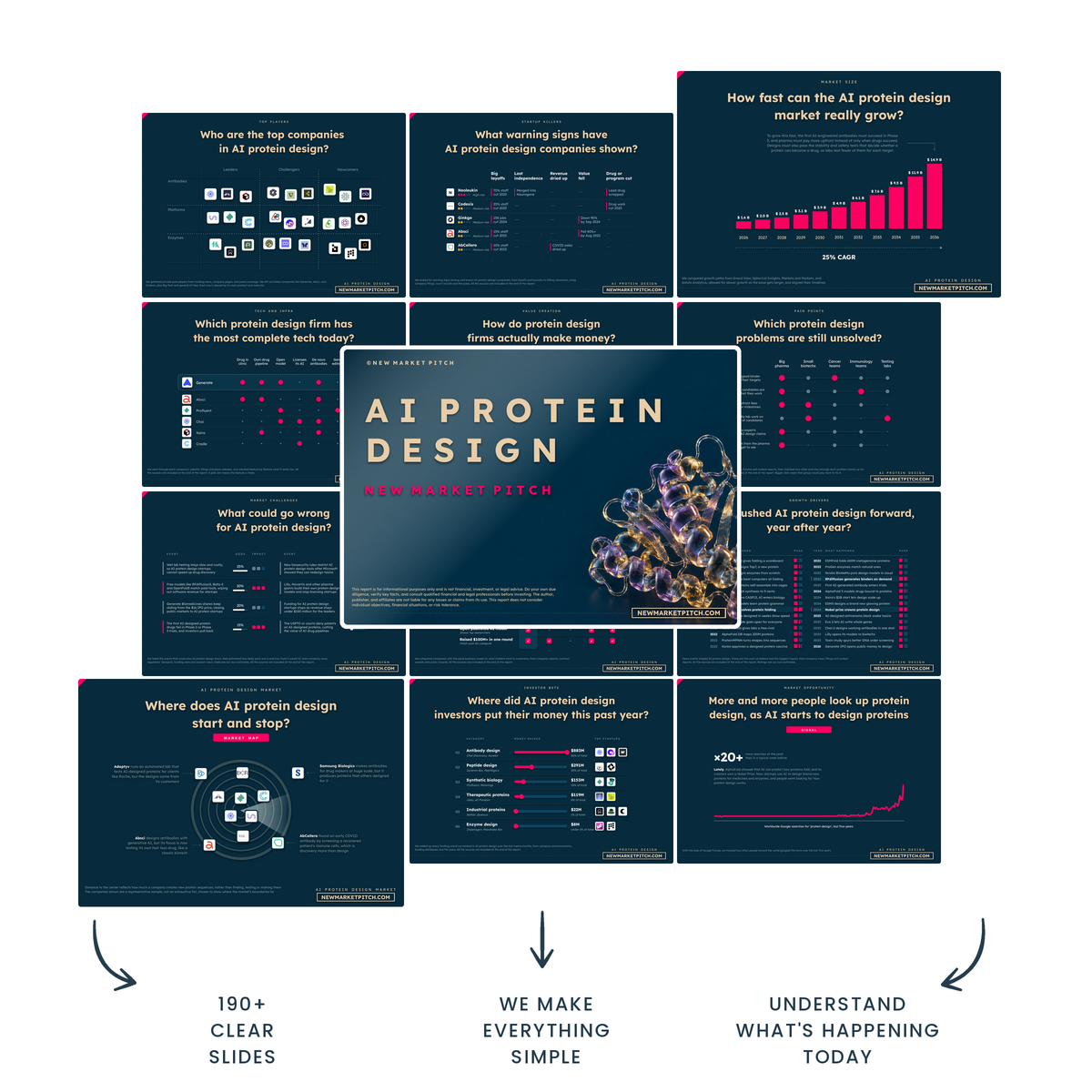
Whether you're building or investing in the AI protein design market, our report covers everything you need to know: the players, the money, and what's coming next.
Summary
AI protein design funding is much stronger in 2026, but mainly for established companies. Recorded investment nearly tripled to $1.477 billion over the latest 12 months, while first-time financings fell sharply. The market is attracting larger checks without becoming equally accessible to new startups.
Funding rose 198.1%, from $495.39 million to $1,476.73 million, across 34 deals versus 27 previously. But excluding transactions above $50 million reduces that growth to just 24.1%. Most of the additional capital came from a handful of unusually large investments.
The median disclosed round more than doubled, from $10 million to $23.2 million. Later-stage financings represented 29.4% of current deals but absorbed 78.4% of recorded capital, compared with 36.6% previously. Investors are committing much larger amounts to companies that have already progressed beyond their initial development stages.
The biggest weakness is first-time funding. First financings dropped from eight to three, and the capital committed to those deals collapsed from $86.5 million to $13.06 million. Meanwhile, follow-on financings increased from 19 to 31 and accounted for approximately 99% of current recorded investment.
Chai Discovery illustrates how far selected companies can pull ahead. Its $400 million Series C alone represented 27.1% of current funding, following a $130 million Series B about seven months earlier. Pharmaceutical agreements with Pfizer, Lilly, Novartis, and argenx helped establish the commercial relevance of its protein-design technology.
Antibody and binder design is the strongest category by both activity and capital. Deal count doubled from six to twelve, while funding increased from $192.1 million to $883.07 million. Peptide-design funding also surged, but across fewer transactions; enzyme-design investment fell approximately 86%.
Financing is becoming more closely connected to experimental validation, pharmaceutical partnerships, and clinical development. BigHat Biosciences raised $75 million while advancing an antibody-drug conjugate into Phase 1 testing, and Syneron Bio secured $150 million to support its peptide-discovery platform and therapeutic pipeline.
The geographic balance changed significantly. North American deals increased from eleven to eighteen, all involving US companies, while China's deal count rose from two to seven. Europe moved in the opposite direction, dropping from twelve financings to four, with recorded capital falling from $228.08 million to $18.67 million.
Strategic investors are also more visible. Their participation increased from five financings to twelve, representing 35.3% of current deals. Pharmaceutical companies are increasingly appearing around businesses that can connect computational design with real drug-discovery and development programs, although commercial partnerships and equity investments must be distinguished.
The conclusion is that AI protein design has become a more mature, capital-intensive funding market, with substantially better financing conditions for selected companies and much weaker evidence of opportunity for newcomers. The next test is whether first-time funding recovers, rather than whether another established platform can announce a nine-figure round.

Written by the New Market Pitch teamWe track new markets so founders and investors can move faster. About us

In our report covering the AI protein design market, you will always find fresh funding data, taken straight from our own verified funding database.
All funding deals in the AI protein design market over the last 24 months
Below is the table listing all the deals. You can find our methodology at the end of this page.
If you want a deeper understanding of the market and its current dynamics, get our report covering the AI protein design market.
| Company | Category | Date | Stage | Deal size | What they do | Region | Lead investors | Country |
|---|---|---|---|---|---|---|---|---|
| BigHat Biosciences | Antibody & Binder Design | September 2026 | Series C | $75M | Uses AI-guided protein engineering and automated experimentation to design therapeutic antibodies. | North America | DFJ Growth; Premji Invest | United States |
| Anew Labs | Antibody & Binder Design | September 2026 | Unknown | $290M | ByteDance spin-off building AI models for protein structure prediction and antibody design | Asia-Pacific | HSG; IDG Capital; Hillhouse Investment | China |
| Infinimmune | Antibody & Binder Design | August 2026 | Series A | $75M | Combines human antibody discovery and protein language models to optimize therapeutic antibodies. | North America | Regeneron Ventures; Playground Global | United States |
| Aureka Biotechnologies | Antibody & Binder Design | August 2026 | Series B | $100M | Develops biological foundation models for generative therapeutic antibody design. | North America | Not disclosed | United States |
| Accipiter Biosciences | Therapeutic Protein Design | July 2026 | Seed | $10.5M | Computationally designs multifunctional therapeutic proteins targeting multiple biological pathways. | North America | Not disclosed | United States |
| Quercus Biosolutions | Industrial Protein Design | July 2026 | Seed | $5M | Uses generative AI to design protein-based crop-protection compounds. | North America | Serra Ventures | United States |
| Mandrake Bio | Enzyme Design | July 2026 | Seed | ≈$1.8M | Uses generative AI to design gene-editing enzymes for agriculture and therapeutics. | Asia-Pacific | Activate; Antler | India |
| Chai Discovery | Antibody & Binder Design | July 2026 | Series C | $400M | Builds generative AI models to design therapeutic antibodies and protein binders. | North America | Index Ventures | United States |
| Matwings Technology | Research & Synthetic Biology Proteins | July 2026 | Series A | Not Disclosed | Develops protein foundation models and AI agents to generate and optimize functional proteins. | Asia-Pacific | Shanghai SDIC Pioneer; SDIC Innovation | China |
| LivingFilters | Antibody & Binder Design | June 2026 | Seed | ≈$470K | Uses computational protein design and generative AI to create selective protein binders for detecting and removing water contaminants. | Europe | Turbine Capital | Sweden |
| MoleculeMind | Research & Synthetic Biology Proteins | June 2026 | Series A | Not Disclosed | Provides MoleculeOS generative AI models for designing and optimizing antibodies, therapeutic proteins, peptides and industrial enzymes. | Asia-Pacific | Pudong Venture Capital; Zhangjiang Science and Technology Investment | China |
| BioGeometry (百奥几何) | Antibody & Binder Design | June 2026 | Unknown | Not Disclosed | Develops GeoFlow generative AI models for de novo antibody design, protein optimization and other biomolecular engineering applications. | Asia-Pacific | Shanghai Biomedical Innovation and Translation Fund; CAS Investment; Fortune Capital; Link-X Capital | China |
| Protuoso Biosciences | Therapeutic Protein Design | May 2026 | Seed | $9.5M | Uses AI-guided protein engineering to design multifunctional recombinant therapeutics combining antibody, cytokine and peptide components. | North America | Taya Venture; Darwin Ventures | United States |
| Imperagen Limited | Enzyme Design | May 2026 | Seed | ≈$6.7M | Combines quantum-physics simulation, AI models and automated experimentation to design improved enzymes for industrial applications. | Europe | PXN Ventures | United Kingdom |
| Resurrect Bio Ltd | Research & Synthetic Biology Proteins | May 2026 | Series A | $2.2M | Uses AI-guided protein-interaction analysis and engineering of plant immune receptors to design disease-resistance traits for crops. | Europe | Corteva Agriscience | United Kingdom |
| Aureka Biotechnologies | Antibody & Binder Design | April 2026 | Series A | $35M | Develops generative AI and automated experimental platforms for de novo design and optimization of therapeutic antibodies. | North America | HongShan (Sequoia China) | United States |
| Scala Biodesign | Research & Synthetic Biology Proteins | March 2026 | Series A | $16M | Provides ScalaOS, a computational and AI-based platform for optimizing protein sequences and properties across therapeutic and industrial applications. | Middle East | Grove Ventures | Israel |
| Syneron Bio (元思生肽) | Peptide Design | March 2026 | Series B | $150M | Uses an AI-driven discovery and optimization platform to design macrocyclic peptide therapeutics for difficult drug targets. | Asia-Pacific | Decheng Capital; CDH VGC | China |
| Matwings Technology | Research & Synthetic Biology Proteins | March 2026 | Series A | >$29M | Provides a generative protein foundation model and integrated R&D platform for designing functional proteins across biological applications. | Asia-Pacific | CNPC Kunlun Capital; Yonghua Capital; Shanghai Future Industries Fund | China |
| Unnatural Products | Peptide Design | March 2026 | Series B | $45M | Combines machine learning, computational design and experimental testing to engineer synthetic macrocyclic peptide therapeutics. | North America | The Venture Collective | United States |
| Antiverse | Antibody & Binder Design | March 2026 | Series A | $9.3M | Uses generative AI and laboratory validation to design therapeutic antibodies against difficult membrane-protein targets, including GPCRs and ion channels. | Europe | Soulmates Ventures | United Kingdom |
| Starget Pharma | Peptide Design | February 2026 | Series A | $18M | Uses AI-driven peptide backbone modeling and optimization to design targeted peptide radioligands for cancer therapy. | Middle East | Ilex Medical | Israel |
| Galux | Antibody & Binder Design | February 2026 | Series B | $29M | Develops AI models that generate and optimize therapeutic protein and antibody sequences, particularly de novo antibodies against challenging targets. | Asia-Pacific | Yuanta Investment | South Korea |
| Ukko | Therapeutic Protein Design | January 2026 | Series C | $45M | Uses computational protein design to re-engineer allergenic proteins into safer, immune-modulating therapeutic candidates. | North America | Israel Biotech Fund | United States |
| Syneron Bio (元思生肽) | Peptide Design | December 2025 | Series A | ≈$100M | Uses intelligent high-throughput discovery and computation to design and optimize macrocyclic peptide therapeutics. | Asia-Pacific | Not disclosed | China |
| Chai Discovery | Antibody & Binder Design | December 2025 | Series B | $130M | Develops generative AI models for de novo design and optimization of therapeutic antibodies and other protein binders. | North America | General Catalyst; Oak HC/FT | United States |
| Levinthal Biotech (杭州力文所生物科技有限公司) | Research & Synthetic Biology Proteins | December 2025 | Seed | Not Disclosed | Develops generative protein-design models to engineer enzymes, functional proteins, and therapeutic peptides. | Asia-Pacific | Jinyu Maowu (金雨茂物) | China |
| Aether Biomachines | Industrial Protein Design | December 2025 | Unknown | $15M | Uses AI to design functional proteins for advanced materials, industrial processing, and environmental applications. | North America | Tribe Capital | United States |
| immunitoAI Private Limited | Antibody & Binder Design | November 2025 | Series A | $6.1M | Uses generative AI to design novel therapeutic antibody sequences against specified biological targets. | Asia-Pacific | Ashish Kacholia | India |
| AI Proteins | Therapeutic Protein Design | November 2025 | Series A | $41.5M | Uses AI and high-throughput experimentation to create de novo miniprotein medicines for therapeutic applications. | North America | Mission BioCapital; Santé Ventures | United States |
| Profluent | Research & Synthetic Biology Proteins | November 2025 | Series B | $106M | Builds generative protein foundation models that design genome-editing enzymes, antibodies, and other functional proteins. | North America | Altimeter Capital; Bezos Expeditions | United States |
| Aureka Biotechnologies | Antibody & Binder Design | November 2025 | Series A | $23.2M | Combines generative AI and experimental screening to design and optimize therapeutic antibodies. | North America | 5Y Capital; Qiming Venture Partners | United States |
| Accipiter Biosciences | Therapeutic Protein Design | November 2025 | Seed | $12.7M | Designs de novo multifunctional protein therapeutics using computational protein engineering and high-throughput experiments. | North America | Takeda; Flying Fish Partners | United States |
| Beijing Zhiyuan Shenlan Technology Co., Ltd. (北京智源深澜科技有限公司) | Research & Synthetic Biology Proteins | November 2025 | Seed | Not Disclosed | Develops a generative-AI and automated experimental platform for designing and optimizing proteins, peptides, enzymes, and other biological macromolecules. | Asia-Pacific | Woyan Capital | China |
| Caravel Bio | Industrial Protein Design | October 2025 | Seed | $1.9M | Uses machine learning and high-throughput protein evolution to engineer functional proteins for industrial and synthetic biology applications. | North America | Not disclosed | United States |
| Peptilogics | Peptide Design | October 2025 | Series B | $78M | Uses computational and generative-AI methods to design engineered peptide therapeutics, including antimicrobials. | North America | Presight Capital; Thiel Bio; Founders Fund | United States |
| Scindo | Enzyme Design | September 2025 | Seed | ≈$5.4M | Develops an AI-driven enzyme-design platform to create biocatalysts for sustainable chemicals and bio-based ingredients. | Europe | Kadmos Capital; Clay Capital | United Kingdom |
| Arzeda | Industrial Protein Design | September 2025 | Unknown | $4.5M | Uses computational protein design and generative AI to engineer enzymes and proteins for industrial applications. | North America | Not disclosed | United States |
| Ridge Biotechnologies, Inc. | Enzyme Design | September 2025 | Seed | $25M | Uses machine learning and cell-free experimental data to design precision enzymes for therapeutic applications. | North America | Sutter Hill Ventures | United States |
| Toursynbio (途深智合) | Research & Synthetic Biology Proteins | September 2025 | Seed | Not Disclosed | Develops generative AI platforms for de novo protein design and optimization, including antibodies and enzymes. | Asia-Pacific | Not disclosed | China |
| Chai Discovery | Antibody & Binder Design | August 2025 | Series A | $70M | Develops generative AI foundation models for designing therapeutic antibodies and other protein molecules. | North America | Menlo Ventures | United States |
| Foundry BioSciences | Therapeutic Protein Design | July 2025 | Seed | Not Disclosed | Develops generative AI models to design novel proteins for longevity-related therapeutic and health applications. | North America | XtalPi | United States |
| ProteinQure Inc. | Peptide Design | May 2025 | Series A | $11M | Uses machine learning and molecular simulations to design therapeutic peptides and peptide-drug conjugates. | North America | Tom Williams (Heron Rock Fund) | Canada |
| RevolKa | Therapeutic Protein Design | May 2025 | Series A | $1.4M | Develops an AI-powered protein engineering platform that generates and optimizes protein sequences for therapeutic and industrial applications. | Asia-Pacific | D3 LLC; TOHOKU University Venture Partners Co., Ltd. | Japan |
| Solena Materials | Industrial Protein Design | May 2025 | Seed | $6.7M | Uses AI to design novel protein sequences that form biodegradable, high-performance fibres for textile applications. | Europe | Sir David Harding; SynBioVen; Insempra | United Kingdom |
| Meddenovo Drug Design | Peptide Design | May 2025 | Seed | $450K | Develops AI- and physics-based computational tools to design and optimize cyclic peptide drug candidates. | Europe | Not disclosed | France |
| BigHat Biosciences | Antibody & Binder Design | April 2025 | Series B | $44M | Uses machine learning and automated experimentation to design and optimize therapeutic antibodies and other protein biologics. | North America | Not disclosed | United States |
| Brink Therapeutics | Enzyme Design | April 2025 | Seed | ≈$4M | Uses generative AI and directed evolution to design programmable integrase and recombinase enzymes for gene-editing therapies. | Europe | Kurma Partners; Breega | France |
| GigaCrop | Enzyme Design | March 2025 | Seed | $4.5M | Uses machine learning and enzyme engineering to design improved photosynthetic pathways that increase crop productivity. | North America | Playground Global | United States |
| Epoch Biodesign | Enzyme Design | March 2025 | Series A | $18.3M | Uses AI-powered protein engineering to design enzymes that degrade plastics and synthetic textiles for industrial recycling. | Europe | Extantia Capital | United Kingdom |
| ZYMVOL Biomodeling, S.L. | Enzyme Design | February 2025 | Seed | $3.1M | Develops computational and AI-assisted enzyme discovery and engineering technology to design proteins with improved catalytic and industrial properties. | Europe | Faber Ventures | Spain |
| Latent Labs | Therapeutic Protein Design | February 2025 | Seed | $10M | Develops generative protein foundation models that enable pharmaceutical and biotechnology companies to design and optimize therapeutic proteins. | Europe | Pillar VC; Kindred Capital | United Kingdom |
| Latent Labs | Therapeutic Protein Design | February 2025 | Series A | $40M | Develops generative protein foundation models that enable pharmaceutical and biotechnology companies to design and optimize therapeutic proteins. | Europe | Radical Ventures; Sofinnova Partners | United Kingdom |
| Pepticom Ltd. | Peptide Design | January 2025 | Series A | $6.6M | Uses generative AI and computational modeling to design and optimize therapeutic peptides, including cyclic peptidomimetics. | Middle East | Japan Israel High Tech Ventures 2 LP | Israel |
| Cradle Bio | Research & Synthetic Biology Proteins | November 2024 | Series B | $73M | Provides a generative-AI platform for designing and optimizing protein sequences, including enzymes, antibodies and research proteins. | Europe | IVP | Netherlands |
| Aizen Therapeutics | Peptide Design | November 2024 | Seed | $13M | Uses generative AI to design de novo mirror-image D-peptide therapeutics with engineered binding and stability properties. | North America | Madrona | United States |
| Matwings Technology | Research & Synthetic Biology Proteins | November 2024 | Series A | >$13.8M | Develops AI models that predict protein function and optimize protein sequences for pharmaceutical, diagnostic and synthetic-biology applications. | Asia-Pacific | Qiming Venture Partners | China |
| Archon Biosciences | Antibody & Binder Design | October 2024 | Seed | $20M | Uses AI-driven computational protein design to create novel protein scaffolds that assemble antibodies into therapeutic antibody cages. | North America | Madrona Ventures | United States |
| Fable Therapeutics | Antibody & Binder Design | October 2024 | Seed | $10M | Applies generative AI and protein-engineering models to design therapeutic antibodies and peptides for metabolic diseases. | North America | Versant Ventures; DCVC Bio | United States |
| Fable Therapeutics | Antibody & Binder Design | October 2024 | Series A | $43.5M | Applies generative AI and protein-engineering models to design therapeutic antibodies and peptides for metabolic diseases. | North America | Versant Ventures; DCVC Bio | United States |
| Avenue Biosciences Oy | Peptide Design | October 2024 | Seed | $2.5M | Uses machine learning to screen and optimize signal-peptide sequences that improve the cellular secretion of therapeutic proteins. | Europe | Voima Ventures | Finland |
| Antiverse | Antibody & Binder Design | October 2024 | Seed | $4.6M | Uses generative AI and experimental screening to design therapeutic antibodies against difficult targets including GPCRs and ion channels. | Europe | i&i Biotech Fund I; Kadmos Capital | United Kingdom |
| Basecamp Research | Research & Synthetic Biology Proteins | October 2024 | Series B | $60M | Develops biological AI models trained on biodiversity data to design novel protein sequences, enzymes and biological systems. | Europe | Singular | United Kingdom |
| Generate:Biomedicines, Inc. | Therapeutic Protein Design | September 2024 | Unknown | $15M | Operates a generative-AI protein-design platform to create and optimize therapeutic antibodies, enzymes, cytokines and other protein medicines. | North America | Not disclosed | United States |

In our research about AI protein design, we turn what is vague and complex into simple, useful visuals. Market maps like this one show you at a glance where every startup stands.
Is the AI protein design market actually healthier than a year ago?
The AI protein design funding market is stronger today for established companies, but the sharp decline in first-time financings raises serious questions about its overall health.
We counted 34 financing events involving 29 companies in the latest 12 months, compared with 27 deals involving 25 companies in the previous period. The median disclosed round increased from $10 million to $23.2 million, showing that companies are generally securing larger investments.
But the improvement has been uneven. First financings fell from eight to just three, while follow-on rounds increased from 19 to 31. Much of the additional money went to companies already developing established platforms or therapeutic pipelines, including Chai Discovery, BigHat Biosciences, and Syneron Bio.
This is encouraging for companies that have moved beyond their earliest development stages. For founders trying to secure their first institutional financing, the picture is considerably weaker.
| Funding indicator | Previous 12M | Current L12M | Change |
|---|---|---|---|
| Total financing deals | 27 | 34 | +25.9% |
| Unique funded companies | 25 | 29 | +16.0% |
| Recorded capital | $495.39M | $1,476.73M | +198.1% |
| Median disclosed round | $10.0M | $23.2M | +132.0% |
| First financings | 8 | 3 | -62.5% |
| Follow-on financings | 19 | 31 | +63.2% |
| Later-stage deal share | 14.8% | 29.4% | +14.6 pp |
| Capital excluding rounds above $50M | $292.39M | $362.73M | +24.1% |
Is AI protein design funding really booming, or are a few giant rounds inflating the numbers?
AI protein design funding is growing, but the nearly 200% jump in capital makes the market look much stronger than it is for most companies.
Total recorded financing increased from $495.39 million to approximately $1.477 billion. Once we remove transactions above $50 million, however, the increase falls to 24.1%.
Of the roughly $981 million in additional funding, only about $70 million came from the pool of transactions worth $50 million or less.
Large rounds are doing most of the work. Eight current-period financings exceeded $50 million, compared with three previously. Four deals exceeded $100 million, whereas the previous period had none.
Still, there's a real improvement underneath those exceptional transactions. The median disclosed round more than doubled, and capital excluding rounds above $100 million increased 39.4%.
For companies capable of raising tens of millions of dollars, financing conditions have clearly improved. But the headline growth figure says relatively little about how easy it has become for smaller companies to raise money.

Your time is limited. In our market report about AI protein design, we put numbers on each part of the market, so you can see where it makes sense to focus.
Is Chai Discovery responsible for most of the AI protein design funding increase?
Chai Discovery accounts for a remarkable share of recent AI protein design funding, although the market would still have grown substantially without its $400 million Series C.
The company announced the financing in July 2026 at a $3.8 billion valuation. Index Ventures led the investment alongside Kleiner Perkins, Sequoia Capital, and Dimension.
That single transaction represented 27.1% of all recorded capital during the latest 12 months.
Removing it leaves approximately $1.077 billion in financing, still more than twice the previous period's total.
What makes Chai particularly interesting is how quickly it raised money. The company announced a $130 million Series B in December 2025, followed by the $400 million Series C roughly seven months later.
During that period, Chai expanded its pharmaceutical relationships. Pfizer announced a license agreement involving Chai-3 in June 2026, while Novartis and argenx announced antibody-discovery collaborations in July. Chai also worked with Eli Lilly through its biologics-discovery programs.
These partnerships help explain why investors were prepared to finance such rapid expansion. Chai had moved from developing molecular-design models toward getting its technology used by major pharmaceutical companies.
Its success is exceptional, however. Chai's fundraising trajectory should not be treated as representative of the wider industry.
Are more AI protein design companies getting funded now?
AI protein design funding is reaching more companies than a year ago, although the increase is much smaller than the rise in total investment.
The number of funded businesses grew from 25 to 29, while financing events increased from 27 to 34.
A larger proportion of companies also completed multiple financings during the same 12-month period. We identified four such businesses, compared with two previously. Their share of funded companies rose from 8% to 13.8%.
Funding activity became more consistent, too. Every month in the current period contained at least one recorded financing, compared with two months without any deals previously. Median monthly activity increased from two transactions to 2.5.
Yet the additional financing events are partly explained by companies returning for more capital. The number of businesses able to secure investment has improved moderately; the much bigger change is how much investors are prepared to commit to selected companies.

In our document detailing everything you need to know about AI protein design, we always try to gather several sources and make estimates that make sense, so you can work with solid numbers.
Are investors still funding new AI protein design startups?
New AI protein design startups are having a much harder time appearing in the funding figures, even as previously financed companies attract record amounts of money.
Only three financing events were classified as first financings in the latest period, down from eight. Their share of total transactions fell from 29.6% to 8.8%.
The decline goes beyond deal count. Recorded first-financing capital dropped from $86.5 million to $13.06 million, while the median first financing fell from $10 million to $1.9 million.
Meanwhile, follow-on funding increased substantially. Previously financed companies secured 31 rounds worth approximately $1.464 billion, compared with 19 rounds totaling $408.89 million a year earlier.
One limitation is that our first-financing classifications depend on the financing histories we could establish. A deal classified as a company's first recorded financing may not always represent its first-ever external investment.
Even with that caveat, the decline is substantial. First-time fundraising looks considerably weaker, while established companies are attracting more support.
| Financing measure | Previous 12M | Current L12M | Change |
|---|---|---|---|
| First-financing deals | 8 | 3 | -62.5% |
| First-financing share | 29.6% | 8.8% | -20.8 pp |
| First-financing capital | $86.50M | $13.06M | -84.9% |
| Median first financing | $10.00M | $1.90M | -81.0% |
| Follow-on deals | 19 | 31 | +63.2% |
| Follow-on share | 70.4% | 91.2% | +20.8 pp |
| Follow-on capital | $408.89M | $1,463.67M | +258.0% |
| Median follow-on financing | $8.85M | $29.00M | +227.7% |
Are AI protein design investors playing it safer now?
AI protein design investors are increasingly backing companies with funding histories, established technology, and progress toward drug development.
Several changes point in that direction. The median age of funded companies increased from approximately three years to four. The share of later-stage transactions nearly doubled, while first financings became much less common.
BigHat Biosciences shows the kind of company attracting larger checks. Founded in 2019, it announced a $75 million Series C in September 2026 after years of building its automated protein-design platform and advancing proprietary drug candidates.
Its lead program, BHB810, had already entered Phase 1 clinical testing. That gave investors evidence of progress toward patients, alongside the company's experimental-data and AI capabilities.
Syneron Bio presents another example. Its $150 million Series B followed earlier investment rounds and a strategic collaboration with AstraZeneca.
Company age alone does not explain investor behavior. Chai, founded in 2024, secured one of the sector's largest rounds despite being relatively young.
The common factor is progress. Investors appear increasingly willing to write large checks when companies can demonstrate valuable technology, pharmaceutical relationships, or therapeutic-development achievements.
The financing patterns strongly favor businesses that have already passed important development and funding milestones, even if they cannot establish a universal change in investors' requirements.

Our report covering the AI protein design market gets updated several times a month, so you always get the latest view of where things stand.
Is AI protein design moving away from seed funding?
AI protein design funding has shifted sharply toward Series B and Series C, even though early-stage companies still account for most transactions.
Seed activity declined from 15 rounds to ten, while Series A increased from eight to twelve. Series B rose from four to seven deals, and three Series C transactions appeared after none in the previous period.
The capital distribution changed much more dramatically.
Seed and Series A together attracted 63.4% of recorded funding previously. Their combined share is now just 20.6%. Later-stage transactions account for 78.4%.
The median Series B round also increased from $52 million to $100 million.
There's still meaningful early-stage activity, with 22 Seed and Series A financings in the current period. But the biggest checks increasingly support companies developing larger platforms and more advanced therapeutic programs.
| Financing stage | Previous deals | Current deals | Previous capital share | Current capital share |
|---|---|---|---|---|
| Seed | 15 | 10 | 22.1% | 3.3% |
| Series A | 8 | 12 | 41.3% | 17.3% |
| Series B | 4 | 7 | 36.6% | 43.2% |
| Series C | 0 | 3 | 0% | 35.2% |
| Unknown | 0 | 2 | 0% | 1.0% |
| Early stage total | 23 | 22 | 63.4% | 20.6% |
| Later stage total | 4 | 10 | 36.6% | 78.4% |
Which AI protein design category is attracting the most money?
Antibody and binder design is currently the strongest part of the AI protein design funding market, with growth in both deal count and capital.
We recorded twelve antibody and binder-design financings in the latest period, double the previous six. Funding increased from $192.1 million to $883.07 million.
Chai's $400 million financing contributed heavily to the increase. BigHat's $75 million Series C and financing activity around Aureka show that investor interest extends beyond a single company, although Aureka's multi-tranche disclosures need careful treatment.
Peptide design presents a different picture. Capital jumped from $33.55 million to $291 million, despite deal count falling from five to four. Syneron's $150 million Series B and Peptilogics' $78 million financing accounted for most of that increase.
Research and synthetic-biology protein design also gained attention, with deals doubling from four to eight. Recorded funding changed little, however, partly because several financing amounts remain undisclosed.
Antibody design therefore has the clearest combination of more financing activity and more money being invested. Peptide design is attracting much bigger individual investments without a comparable increase in financing breadth.
| Protein design category | Previous deals | Current deals | Previous capital | Current capital |
|---|---|---|---|---|
| Antibody & Binder | 6 | 12 | $192.10M | $883.07M |
| Peptide | 5 | 4 | $33.55M | $291.00M |
| Research & Synthetic Biology Proteins | 4 | 8 | $146.80M | $153.20M |
| Therapeutic Protein | 4 | 5 | $51.40M | $119.20M |
| Enzyme | 6 | 2 | $60.33M | $8.36M |
| Industrial Protein | 2 | 3 | $11.21M | $21.90M |
| All categories | 27 | 34 | $495.39M | $1,476.73M |

In our research about AI protein design, we look at what the winners do differently, so you can learn from the best instead of guessing.
Is AI enzyme design funding drying up?
AI enzyme design has experienced the sharpest funding slowdown of any protein-design category we tracked.
Deal count fell from six to two, a 66.7% decline. Recorded financing dropped from $60.33 million to $8.36 million, approximately 86% lower than in the previous period.
The contrast with antibody design is particularly striking. While antibody companies doubled their deal count and attracted several large financings, enzyme-design activity weakened considerably.
The wider research and synthetic-biology protein category also doubled its number of deals, suggesting that investors haven't simply abandoned all nontherapeutic applications.
The enzyme category is small enough that a single large round could change the comparison substantially. There isn't sufficient evidence to attribute the decline to specific problems with commercial adoption or technological progress.
For now, enzyme-design companies have attracted much less recorded financing while investment has grown in other parts of protein design.
Why are investors putting so much money into AI-designed peptides?
Investors are putting larger amounts into selected AI peptide companies because some are now financing serious drug-development programs, including clinical trials.
Syneron Bio announced in April 2026 that it had closed a $150 million Series B at the end of March. The financing supports its Synova macrocyclic-peptide discovery platform and the development of therapeutic candidates.
Syneron had already established a significant relationship with AstraZeneca. In March 2025, the companies announced a collaboration that included upfront and near-term milestone payments potentially totaling $75 million, additional development and commercial milestones, royalties, and an equity investment.
Peptilogics offers another example. Its $78 million Series B2, announced in October 2025, was intended to advance zaloganan, an investigational treatment for prosthetic joint infections, into a pivotal Phase 2/3 clinical trial. The company announced the enrollment of the first patient in March 2026.
These are expensive development programs with clinical and regulatory requirements. Investors are funding much more than the initial design of new peptides.
The category's capital growth is impressive, but heavily concentrated in these larger transactions. As seen in the table above, the number of financings actually decreased.

In our market report about AI protein design, we don't want to repeat what boring consulting reports say. Instead, we show you the real and latest market signals that matter.
Are AI protein design startups raising money faster now?
A few AI protein design startups are raising successive rounds remarkably quickly, but we still lack enough evidence to say that fundraising has accelerated across the whole market.
Chai is the clearest case. Its $130 million Series B in December 2025 was followed by a $400 million Series C approximately seven months later. The company linked that rapid progression to improvements in its technology and growing pharmaceutical adoption.
Syneron also moved quickly through successive stages. In December 2025, it announced nearly $100 million raised across Series A and A+ financings, followed by its $150 million Series B closing in March 2026. The announcement dates are clear, although the exact timing of earlier underlying closes requires care.
These examples show that substantial additional capital is available when investors are convinced by a company's progress.
But reliable previous-round closing dates aren't available for every follow-on financing. That prevents a meaningful calculation of the typical time between rounds, or the percentage of companies raising again within one or two years.
Rapid fundraising is well documented among selected winners. Whether the average protein-design startup can raise money faster remains an open question.
Is AI protein design funding leaving Europe for the US and China?
AI protein design funding has shifted strongly toward the United States and China, while Europe has suffered a steep decline in recorded deal activity.
Europe went from twelve financings to four, reducing its share of total deals from 44.4% to 11.8%. Recorded capital fell from $228.08 million to just $18.67 million.
North America moved in the opposite direction, with deals increasing from eleven to eighteen. Every current-period North American financing was associated with a US company.
Asia-Pacific also recorded substantial growth, from three deals to ten. China accounted for seven current transactions, compared with two previously.
The funding amounts require more caution than the deal counts. Five of the ten current Asia-Pacific transactions lack disclosed amounts, so the region's recorded $215.76 million provides an incomplete view of its financing.
Europe's decline, however, is visible in both the number of deals and disclosed capital. The US has strengthened its position as the largest funding center, while China is becoming more prominent in financing activity.
| Region | Previous deals | Current deals | Previous capital | Current capital |
|---|---|---|---|---|
| North America | 11 | 18 | $245.51M | $1,208.30M |
| Asia-Pacific | 3 | 10 | $15.20M | $215.76M |
| Europe | 12 | 4 | $228.08M | $18.67M |
| Middle East | 1 | 2 | $6.60M | $34.00M |
| Total | 27 | 34 | $495.39M | $1,476.73M |
| North America deal share | 40.7% | 52.9% | - | - |
| Asia-Pacific deal share | 11.1% | 29.4% | - | - |
| Europe deal share | 44.4% | 11.8% | - | - |

Learning from others' mistakes is the cheapest lesson there is. In our document detailing everything you need to know about AI protein design, we look at what broke startups before you, so you don't repeat it.
Are pharmaceutical companies becoming more important to AI protein design funding?
Pharmaceutical companies and other strategic investors are playing a bigger recorded role in AI protein design financing, especially around businesses with technology that can feed into real drug-development programs.
We identified strategic participation in twelve current-period financings, compared with five previously. Their share of total deals increased from 18.5% to 35.3%.
The median disclosed financing involving strategic participation also increased from $12.5 million to $29 million.
BigHat's September 2026 financing included existing investors such as Amgen Ventures, Eli Lilly, and Merck Global Health Innovation Fund. The company's platform also has relationships with pharmaceutical groups including Johnson & Johnson and AbbVie.
Syneron's relationship with AstraZeneca is another example of how a strategic partnership can combine drug-discovery collaboration and equity investment.
Chai has also built relationships with Pfizer, Lilly, Novartis, and argenx. These agreements demonstrate commercial interest in its technology, although a pharmaceutical collaboration should never automatically be counted as an equity investment.
The growth in strategic participation is meaningful, even allowing for classification uncertainty. Investors with direct experience in pharmaceutical development are becoming more visible around companies seeking to turn computational protein design into useful therapeutic products.
Are more venture capital firms competing to invest in AI protein design?
More investors are appearing in AI protein design financing announcements, but we can't confidently say that competition for deals has increased across the sector.
Our research identified 50 distinct named lead-investor entries during the latest period, compared with 30 previously. Lead-investor information was available for 31 of 34 current transactions.
Large rounds attracted substantial syndicates. Chai's Series C brought together major technology and venture investors. BigHat secured backing from DFJ Growth, Premji Invest, and several existing pharmaceutical-related investors. Syneron's financing involved international life-sciences investors alongside Asian investment groups.
However, investor disclosures aren't standardized. Some announcements name only leads, while others include co-leads, returning shareholders, and additional participants.
We therefore shouldn't treat the increase in named investor entries as proof of a proportionate expansion in the total investor base.
Successful companies can assemble large, varied financing syndicates. Whether smaller protein-design startups are attracting more potential investors is much harder to establish.

If you build or invest in the AI protein design market, you need to know which business models pay off now and which ones are fading. That's why our report covering it has a whole section on it.
Do AI protein design startups need clinical results to get funded now?
Clinical progress and experimental proof are becoming especially valuable in large AI protein design financings, although companies can still attract substantial investment before entering clinical trials.
BigHat provides one of the strongest examples. In September 2026, it announced that the first patient had been dosed in its Phase 1 trial of BHB810, an AI-designed antibody-drug conjugate targeting CDH17.
Later that month, Premji Invest explained why it co-led BigHat's $75 million Series C. The investor highlighted the company's ability to combine AI with automated experimental work and advance its own molecules toward patients.
Syneron's financing also supports movement toward clinical development. Peptilogics had progressed even further with zaloganan, beginning a Phase 2/3 trial in March 2026.
Chai follows a different route. Its commercial relationships with major pharmaceutical companies provide evidence of adoption without every AI-designed molecule needing to have reached clinical trials.
What investors want to see depends on the business. A therapeutic developer may need convincing preclinical or clinical results, while a discovery-platform company can demonstrate progress through experimental performance and pharmaceutical adoption.
Comparable milestone information isn't available for every round, so we can't calculate how many companies met each type of milestone. Still, major financing announcements increasingly connect investment to visible technical or development achievements.
What are AI protein design startups spending their funding on now?
Large AI protein design companies are increasingly raising money to expand research platforms, run experimental infrastructure, and advance drug candidates toward clinical development.
Chai said its $400 million Series C would support additional computing resources, data, research, and product development. The company also intends to bring its technology to more scientists working on difficult drug-discovery problems.
BigHat is combining platform development with proprietary therapeutics. Its Milliner system uses automated experimentation to generate biological data, while programs such as BHB810 require clinical trials and broader drug-development capabilities.
Syneron's $150 million financing has a similar dual purpose. The company plans to strengthen its Synova discovery platform while advancing therapeutic candidates.
Peptilogics shows how the spending can become more clinical as a program matures. Its $78 million financing supports a pivotal trial rather than an early computational-design demonstration.
Across these examples, the funding needs now extend well beyond software and model development. Companies are paying for experimentation, specialized scientific teams, and the expensive work needed to advance potential medicines.
Not every company provides a detailed breakdown of planned uses, so the exact market-wide spending shift cannot be measured. But the stated priorities of major financing recipients are consistent with a sector moving further into drug-development execution.

In our research about AI protein design, we like to show you the big picture. We know your time is precious, so we make every page quick to read and packed with as much learning as possible per minute.
Is AI protein design funding becoming too concentrated?
AI protein design funding is highly concentrated in large rounds, and dependence on exceptionally big transactions has increased considerably.
The largest financing represented 27.1% of current recorded capital, compared with 14.7% previously. Transactions above $50 million accounted for 75.4% of funding, up from 41%.
Interestingly, concentration among the five largest transactions barely changed. Those deals accounted for approximately 60% of current funding, versus 58.6% previously.
The top ten also represented a similar share in both periods, at around 82%.
Funding was already concentrated among a relatively small number of businesses. The latest change is that the biggest financings have become much larger.
Chai's $400 million Series C illustrates the extreme end, while Syneron and BigHat show how substantial later-stage investments are becoming more common.
For investors tracking the sector, total funding growth now depends heavily on whether a small group of companies continues attracting unusually large checks.
For founders, the concentration reinforces the differences between well-established companies and those still trying to secure early capital.
Can we trust the AI protein design funding numbers?
The broad increase in AI protein design funding is well supported, but some precise comparisons remain sensitive to missing amounts, uncertain closing dates, and unusual financing structures.
We established usable disclosed or estimated amounts for 29 of 34 current transactions, compared with 25 of 27 previously. That leaves five current deals and two previous deals without usable financing amounts.
Some transactions also need special treatment. Caravel Bio's $1.9 million pre-seed financing has an uncertain closing date. Ukko's $45 million Series C was reported in 2026 but described as having closed during 2025.
Fable Therapeutics disclosed separate seed and Series A financings together, while Aureka's financing history includes multiple tranches that require care to avoid double counting.
These uncertainties can affect comparisons of monthly activity, stages, and individual company fundraising histories.
The largest confirmed transactions are better established. Chai publicly announced its $400 million Series C, Syneron confirmed the closing of its $150 million round, and BigHat announced its $75 million financing on the final day of the comparison period.
Our strongest conclusions therefore concern larger late-stage investments, increased follow-on activity, and the decline in recorded first financings. We have less confidence in market-wide fundraising speed and exact capital totals where undisclosed or cumulative amounts are involved.
The figures represent a consistent comparison of recorded financing, rather than audited totals covering every private transaction.

When you build or invest in the AI protein design market, you need clarity, not confusion. In our market report about AI protein design, we always try to put numbers on and quantify whatever is usually vague and confusing.
What really changed over the last 12 months?
AI protein design has become a much better-funded market for established companies.
The median disclosed round more than doubled, later-stage financing became much more common, and follow-on capital increased dramatically. Investors are willing to finance expensive development programs at a scale that was far less visible a year earlier.
The weakest part of the market is new startup funding.
First financings declined sharply despite an increase in the total number of funded companies. That's a concern for the sector's longer-term development, especially in a field where scientific breakthroughs can come from young research teams.
The spectacular capital increase hides a much smaller improvement underneath.
Total funding nearly tripled, but excluding rounds above $50 million leaves growth of roughly one-quarter. Record capital doesn't mean financing opportunities have improved equally for most AI protein design startups.
Antibody design is gaining the most convincing momentum.
Antibody and binder-design financing doubled in deal count, alongside substantial capital growth. Peptide companies attracted much larger checks without an increase in financing events, while enzyme design experienced a pronounced decline.
Investors are putting more weight on demonstrated progress.
Chai's pharmaceutical adoption, BigHat's clinical-stage programs, and Syneron's therapeutic-development plans help explain why selected businesses can raise much larger rounds. Investors increasingly have concrete scientific and commercial achievements to evaluate.
The geography of funding has changed substantially.
The United States remains the strongest center for recorded financing activity and capital. China has become more prominent in deal count, while Europe's financing activity has weakened considerably.
The next challenge is getting more new companies funded.
The market can now support larger platforms, extensive experimental programs, and more advanced therapeutic development. What it has yet to demonstrate is a comparable improvement in first-time funding opportunities.
Overall, AI protein design is becoming a more mature and capital-intensive market. It is stronger for companies that have already made meaningful progress, but the latest financing cycle offers much less evidence of improving conditions for new entrants.
Our methodology
This analysis examines AI protein design funding across two consecutive, non-overlapping 12-month periods: September 25, 2025 to September 24, 2026, and September 25, 2024 to September 24, 2025. We compare financing activity, capital raised, company participation, funding stages, investment concentration, technology categories, geography, and investor behavior.
Our historical AI protein design database contained 84 records across its broader date coverage. Of these, 61 financing events fell within the two comparison periods: 34 in the current 12 months and 27 in the previous 12 months. All market-wide comparisons in this article refer to those 61 in-window events, not the full 84-record historical dataset. They involve 29 unique companies in the current period and 25 in the previous period.
Recorded capital totals $1,476.73 million in the current period and $495.39 million in the previous period, an increase of $981.34 million or 198.1%. These totals combine usable disclosed amounts and identified approximations from our financing records. The $50 million exclusion test uses the same totals, removing transactions above that threshold in both periods and leaving $362.73 million versus $292.39 million, a 24.1% increase. Undisclosed financings are counted as events but are not assigned invented funding amounts.
We classify Seed and Series A financings as early stage and Series B or later as later stage. First-financing and follow-on classifications reflect the company financing histories available in our research. Separate financing events are counted individually, while extensions, multiple closings, cumulative disclosures, and uncertain closing dates receive additional review to avoid duplication or misleading period attribution. Company age, investor participation, strategic relationships, and development milestones are assessed using the same approach across both periods.
We supplemented the funding records with company announcements, investor disclosures, pharmaceutical collaboration announcements, and clinical-development updates. These sources help explain individual financing decisions and company progress; they are not substitutes for the consolidated market-level funding calculations.
Key financing sources include Chai Discovery's $400 million Series C announcement, its earlier $130 million Series B, BigHat Biosciences' $75 million Series C, Syneron Bio's $150 million Series B, Syneron's earlier Series A and A+ financings, and Peptilogics' $78 million financing.
For pharmaceutical adoption and clinical progress, we used Chai's Pfizer license announcement, its Eli Lilly collaboration, Chai's additional pharmaceutical partnership announcements, BigHat's BHB810 Phase 1 update, Premji Invest's explanation of its BigHat investment, Syneron's AstraZeneca collaboration, and Peptilogics' pivotal-trial announcement.
The analysis separates deal counts from recorded investment amounts, distinguishes pharmaceutical partnerships from equity financing, and uses consistent period boundaries. This is particularly important when interpreting concentration, later-stage funding growth, and the decline in first-time financings.

A good product starts with a real problem. In our document detailing everything you need to know about AI protein design, we show you the ones customers still live with.
Written by the New Market Pitch teamWe track new markets so founders and investors can move faster. About us