Is the AI sales agents market big or just churn?
Whether you're building or investing in the AI sales agent market, our report covers everything you need to know: the players, the money, and what's coming next.
Summary
The AI sales agents market is a real and growing software business, but high churn among autonomous SDR startups makes the standalone market considerably less proven than the enthusiasm suggests. Companies are spending money on sales automation, yet the strongest evidence of durable demand comes from established CRM platforms rather than startups promising to replace salespeople.
There is still no defensible revenue estimate for dedicated AI sales agents. Salesforce reported more than $1.5 billion in Agentforce ARR in August 2026, but that includes agents serving customer service and other business functions, so it cannot establish the size of the sales-agent market alone.
Adoption is moving faster than the evidence of financial returns. More than 55% of HubSpot's Professional-and-above customers were using Breeze Assistant or agents, while agent-specific adoption was only in the high teens in July 2026. Many businesses are comfortable with AI assistance but haven't committed to autonomous execution.
The churn problem is particularly visible in autonomous outbound. TechCrunch reported allegations of 70% to 80% customer departures at 11x, although the company disputed the characterization and reported improved retention of 79%. The case raises questions about how much contracted ARR survives beyond early cancellation periods.
Cold outreach has a built-in economic problem that better AI models cannot solve by themselves. Automation makes personalized messages cheaper to produce, but it doesn't create additional buying demand. As more companies contact the same prospects, message volume can rise without a corresponding increase in qualified opportunities.
The strongest evidence for AI in sales concerns productivity rather than autonomous deal generation. LinkedIn's research found improvements in response rates and sales-cycle length among AI users, but those results largely reflect self-reported outcomes across multiple AI tools, not controlled evidence that autonomous SDRs outperform people.
Research, CRM administration and inbound qualification look more commercially defensible because customers can verify completed work. A vendor saving hours of administrative effort has a clearer value proposition than one claiming to generate pipeline through thousands of outbound messages whose commercial quality remains uncertain.
Cheap subscriptions can also conceal expensive sales outcomes. In an illustrative comparison, a $60,000 annual AI SDR operation generating 40 qualified meetings costs $1,500 per meeting, while a $100,000 employee generating 150 costs approximately $667. The number of genuinely qualified opportunities matters more than the sticker price of the software.
Salesforce and HubSpot have a substantial distribution advantage. They already control CRM data, established workflows and customer relationships, making it difficult for independent vendors to charge a premium for generic prospecting, message generation or record updates. Specialized agents will need measurable performance advantages to justify separate contracts.
A $5 billion annual AI sales agents market is plausible, but the route there may favor embedded software over independent AI workers. At $100,000 in annual spending, that market would require 50,000 paying organizations. The likeliest outcome is expanding automation spending, substantial vendor consolidation and a smaller group of successful specialists whose customers renew because the software produces genuinely useful sales results.

Written by the New Market Pitch teamWe track new markets so founders and investors can move faster. About us

Your time is limited. In our report covering the AI sales agent market, we put numbers on each part of the market, so you can see where it makes sense to focus.
Why are companies suddenly buying AI sales agents?
AI sales agents are attracting serious spending because companies can now automate prospecting, lead qualification and sales administration that previously required employees or several separate software tools.
The change goes beyond generating personalized emails. Products such as 11x's Alice, Artisan's Ava and Regie.ai can research potential customers, identify contacts, prepare outreach and handle parts of the follow-up process. Salesforce Agentforce and HubSpot Breeze bring similar capabilities into platforms where companies already manage their sales operations.
The demand for automation was there long before generative AI. LinkedIn's 2025 research with Ipsos, covering 1,250 sales professionals, found that 88% were using AI at least weekly and 56% daily. Those figures include ordinary AI assistants rather than autonomous agents, but they show how quickly salespeople have become comfortable using the technology.
What has changed is the amount of work software can execute independently. A salesperson might previously have used AI to draft an email. An agent can now research the recipient, prepare the message, send it under defined rules, monitor responses and update the CRM.
That creates two quite different businesses. One sells AI workers that promise to replace parts of an SDR's job. The other sells automation that helps existing sales teams work faster. Both are attracting customers, but their commercial results are starting to diverge.
How big is the AI sales agents market today?
The dedicated AI sales agents market is already generating real revenue, but there is no reliable public evidence that autonomous sales agents alone represent a multibillion-dollar annual market.
The difficulty comes from what vendors include in their numbers. An autonomous outbound agent is clearly part of the market. So is an agent that qualifies inbound leads or executes CRM workflows. But counting every AI feature inside Salesforce, HubSpot, Apollo or Outreach would turn the category into something much larger than autonomous selling.
Salesforce reported more than $1.5 billion in Agentforce annual recurring revenue in its August 2026 earnings, alongside nearly $3.9 billion in combined Agentforce and Data 360 ARR. Those figures cover customer service, general automation, data products and other activities besides sales. Salesforce also expanded its Agentforce ARR definition to include Slackbot and Headless 360.
Gartner forecast $206.5 billion in worldwide AI-agent software spending for 2026. That forecast covers a much broader software category, so it cannot be treated as sales-agent spending either.
Independent vendors such as 11x, Artisan and Regie.ai provide additional evidence of customer demand, although their audited product-level revenue and retention figures are generally unavailable.
We therefore have a credible emerging market with no defensible consolidated revenue estimate. The opportunity could eventually reach several billion dollars annually, but claims that dedicated sales agents have already reached that scale go beyond what the disclosures establish.
| Market segment | What customers buy | What we can verify |
|---|---|---|
| Autonomous AI SDRs | Prospecting and outbound execution | Private contracts, limited audited revenue |
| Inbound sales agents | Lead qualification and meeting booking | Deployments and some operational metrics |
| Hybrid AI sales agents | Automated workflows with human review | Software adoption, limited retention data |
| AI CRM assistants | Research, summaries and CRM updates | Broad adoption across established platforms |
| Salesforce Agentforce | Agents across business functions | Over $1.5B ARR, not sales-specific |
| Salesforce Agentforce + Data 360 | Agentic software and data infrastructure | Nearly $3.9B combined ARR |
| Broad AI-agent software | Agents across business functions | Gartner's $206.5B spending forecast |
If you want more recent data on this point, please see our latest AI sales agents market report.

In our research about AI sales agents, we always try to gather several sources and make estimates that make sense, so you can work with solid numbers.
Does Salesforce's $1.5 billion Agentforce business prove AI sales agents are taking off?
Salesforce's Agentforce growth proves that enterprises are paying for agentic software at scale, although sales-specific revenue remains undisclosed.
The company's reported Agentforce ARR reached approximately $800 million in fiscal Q4 2026, $1.2 billion in fiscal Q1 2027 and more than $1.5 billion in fiscal Q2 2027. That represents at least $700 million of additional annualized recurring revenue over two quarters.
However, the latest increase includes a broader product definition, so we cannot attribute the entire movement to new customer spending.
Usage has grown even faster. Salesforce reported 3.8 billion cumulative Agentic Work Units in its May earnings and 7 billion in August. Approximately 3.2 billion units were processed in the latest quarter, up 97% from the previous quarter.
An Agentic Work Unit measures a completed automated task. It doesn't tell us how many additional sales were closed, and the figures include activities outside selling.
The more revealing commercial detail is that bookings for Agentforce One Edition and Agentforce for Apps, premium offerings tied to Sales and Service, more than doubled quarter over quarter. Salesforce is getting existing enterprise customers to pay more for embedded agent capabilities.
Independent vendors face a tougher proposition. They must convince customers to introduce another supplier, integrate another product and maintain another contract. Salesforce can sell similar functionality through software its customers already use.
For now, Salesforce provides much stronger evidence for integrated AI agents than for standalone AI SDR companies.
Are companies actually using AI sales agents or just testing them?
Companies are moving AI sales agents into everyday workflows, but autonomous agents are still far less widely used than basic AI assistants.
HubSpot offered one of the clearest adoption comparisons in its August 2026 earnings commentary. More than 55% of its Professional-and-above customers were using Breeze Assistant or agents. Agent adoption specifically had risen from around 9% earlier in the year to the mid-teens by the second quarter and the high teens in July.
That puts dedicated agent adoption at roughly one-third of the broader AI-assistant adoption rate, using the reported high-teens and 55%-plus figures as an approximate comparison.
The usage figures are even more interesting. HubSpot said monthly agentic actions had increased more than threefold since the beginning of the year. Customers who adopt agents appear to be using them more, rather than simply registering for trials.
Salesforce has also reported increasing production deployments, including almost 50% quarter-over-quarter growth in Agentforce accounts running in production at the end of its previous fiscal year.
These numbers establish meaningful adoption. They still leave an important question unanswered: how many customers continue paying after the first year because the software produces better sales outcomes?

In our market report about AI sales agents, we don't want to repeat what boring consulting reports say. Instead, we show you the real and latest market signals that matter.
Why do AI sales agent startups have such high churn?
Autonomous AI SDR startups have faced serious retention problems because some early products failed to deliver the qualified meetings customers expected.
The clearest documented case is 11x. In March 2025, TechCrunch reported allegations from current and former employees about customer departures, product performance and how the company represented recurring revenue.
One employee claimed that 70% to 80% of customers were leaving. Another described a situation where the company could report $14 million in annual recurring revenue despite having approximately $3 million in contracts that had passed an early cancellation period.
11x disputed the characterization of its business. The company said its worst churn occurred among initial customer cohorts in late 2023 and reported a 79% retention rate after improvements to its product and customer targeting.
TechCrunch also reported that ZoomInfo tested 11x for roughly a month in early 2025 but did not continue because its human SDRs performed better.
These accounts expose a genuine commercial problem, although they don't establish a churn rate for the entire market.
A company might sign an AI SDR contract expecting to replace part of a sales team's workload, only to discover that employees still need to review the prospects, rewrite messages, troubleshoot integrations and qualify the meetings produced.
We also need to distinguish customer retention from revenue retention. A vendor can lose numerous small customers while retaining larger enterprise contracts, or maintain its customer count through discounting while recurring revenue deteriorates.
Until AI sales agent startups publish consistent cohort-level retention data, the actual industry-wide churn rate remains unknown. The documented early failures are serious enough that investors should demand those numbers before treating contracted ARR as durable revenue.
If you want more recent data on this point, please see our latest AI sales agents market report.
Is AI cold outreach getting worse because everyone uses automation?
AI-generated cold outreach is facing a growing attention problem, and producing more messages won't solve it.
Gartner surveyed 632 B2B buyers in August and September 2024 and reported that 73% actively avoided suppliers sending irrelevant outreach. The same research found that 61% preferred an overall buying experience without a sales representative.
Those figures describe buyer preferences rather than a measured decline in AI email performance. Still, they help explain why autonomous outbound can disappoint even when the technology works correctly.
AI makes research, personalization and message generation cheaper. It therefore allows more companies to contact the same buyers at greater frequency.
A recipient who receives ten reasonably personalized prospecting messages doesn't suddenly have ten times more purchasing needs. And mentioning someone's job title, recent funding round or LinkedIn activity doesn't necessarily make a sales pitch relevant.
The weakness becomes particularly obvious when vendors measure success through emails sent, replies received or meetings booked. None of those metrics establishes whether the recipient is a serious potential customer.
There is still room for autonomous outbound when agents target accounts with real purchasing signals. But generic prospecting based on widely available contact databases looks increasingly vulnerable to price competition and disappointing conversion rates.

In our document detailing everything you need to know about AI sales agent, we like to show you the big picture. We know your time is precious, so we make every page quick to read and packed with as much learning as possible per minute.
Do AI sales agents actually help companies close more deals?
AI is helping salespeople work more effectively, but independent evidence that fully autonomous sales agents consistently increase closed revenue remains thin.
LinkedIn's 2025 ROI of AI research found that sellers reporting improved response rates from AI saw an average increase of 28%. It also found that 69% of respondents using AI reported shorter sales cycles, averaging approximately one week, while 68% said AI helped them close more deals.
The findings are encouraging, especially because they cover numerous sales activities rather than a single vendor's customers. However, they are self-reported results from sales professionals, not controlled experiments isolating the effect of autonomous agents.
HubSpot has reported more specific product outcomes. During its August 2026 earnings call, CEO Yamini Rangan said its Prospecting Agent was generating response rates comparable to human-written outreach, contributing to more meetings and deals.
That's a useful early commercial result, although HubSpot did not publish a controlled comparison showing incremental closed-won revenue per customer.
Gartner's May 2026 research adds another perspective. It found that sales organizations providing AI-enabled recommendations about the best next actions were 2.6 times more likely to achieve commercial growth. The relationship is an association rather than proof that AI caused the growth.
Across these studies, the strongest evidence concerns helping human sellers make better decisions and complete work faster. We still lack sufficiently broad, independently verified comparisons showing that autonomous SDRs consistently outperform equivalent human-led sales processes.
Which AI sales agents are worth paying for right now?
AI agents for research, CRM administration and inbound lead qualification currently have the clearest economic value because their work is easier to measure and check.
Account research is a good example. LinkedIn's 2025 study found that 38% of sellers using AI for lead and company research saved more than 1.5 hours per week. At an illustrative labor cost of $50 an hour, that would represent over $3,900 of annualized capacity per employee if the weekly saving persisted throughout the year.
CRM administration offers similar potential. Agents can update contact records, summarize calls, prepare account notes and create follow-up tasks. Companies can measure completion rates, time saved and errors without waiting months to learn whether a deal closes.
Inbound qualification also makes economic sense. A potential customer has already requested information, so the agent can collect requirements, answer routine questions and arrange meetings rather than trying to generate interest from scratch.
Cold outbound is harder to evaluate. Even when an agent completes its workflow perfectly, recipients may ignore the message or have no real intention of buying.
HubSpot's reported 72% autonomous resolution rate for its Customer Agent illustrates how agents can produce measurable outcomes in bounded workflows, although that particular metric concerns customer service rather than selling.
The better sales applications follow the same principle: customers can see exactly what work was completed and check whether it helped the business.
| Sales task | What AI can improve | What customers should measure |
|---|---|---|
| Account research | Research time | Hours saved and accuracy |
| CRM updates | Record maintenance | Completion and error rates |
| Meeting preparation | Account summaries | Preparation time saved |
| Inbound qualification | Initial conversations | Accepted qualified leads |
| Scheduling | Calendar coordination | Meetings arranged successfully |
| Follow-up assistance | Response preparation | Time saved and relevant replies |
| Cold outbound | Prospecting at scale | Qualified pipeline generated |
| Deal support | Opportunity preparation | Win rate and sales-cycle changes |
If you want more recent data on this point, please see our latest AI sales agents market report.

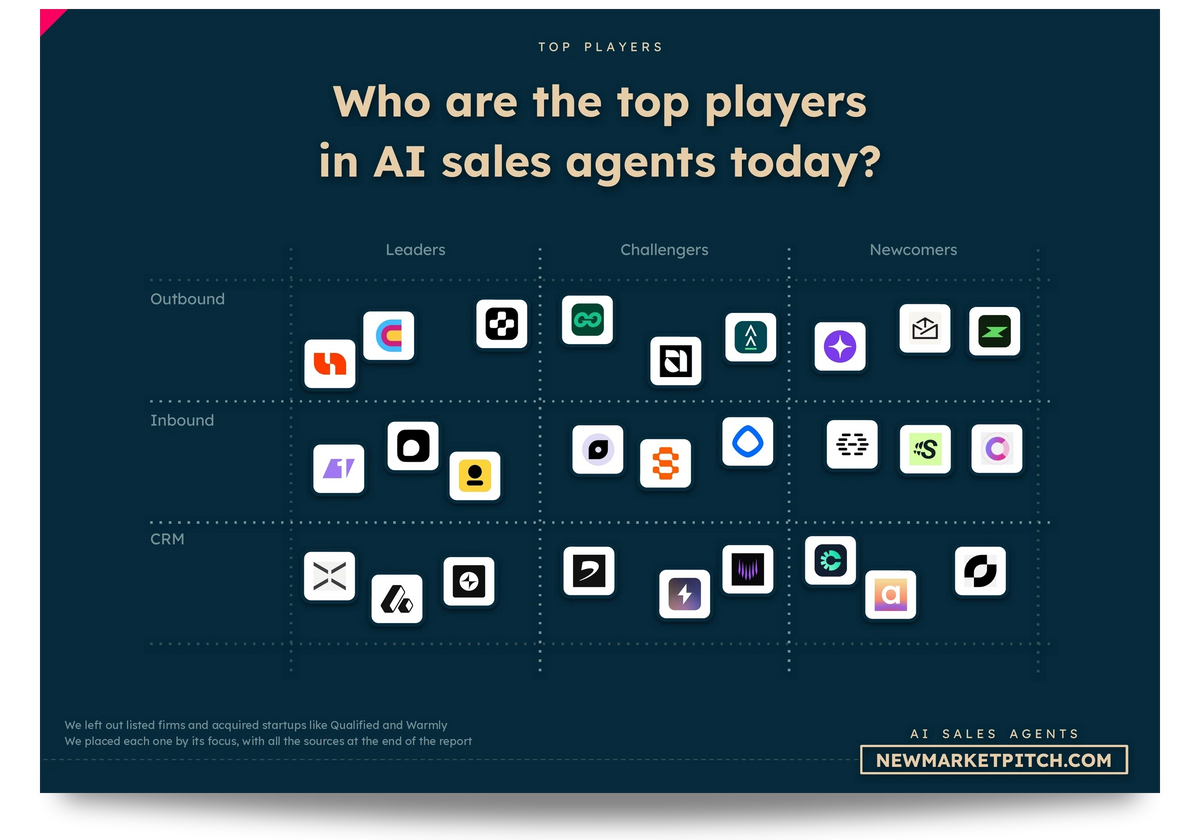
In our report covering the AI sales agent market, we turn what is vague and complex into simple, useful visuals. Market maps like this one show you at a glance where every startup stands.
Are AI sales agents really cheaper than hiring SDRs?
AI sales agents can be much cheaper than hiring additional SDRs for repetitive tasks, but their advantage becomes less certain when companies compare the cost of qualified opportunities.
Consider an illustrative AI SDR subscription costing $40,000 annually. Add another $20,000 for prospect data, outreach infrastructure, CRM integration and staff supervising the system. The total annual cost reaches $60,000.
If the agent generates 100 qualified meetings, the company pays $600 per meeting. If only 40 meetings are genuinely qualified, that increases to $1,500.
Now compare that with an employee costing $100,000 annually, including compensation and related expenses. If the employee produces 150 equally qualified meetings, the cost is approximately $667 per meeting.
These are illustrative calculations rather than published vendor benchmarks. They show why subscription savings alone can lead to the wrong conclusion.
The actual comparison also needs to account for how many meetings become opportunities and how many opportunities turn into profitable customers.
AI has a substantial advantage in research, routine follow-ups and administrative work, where it can operate at low marginal cost. For expensive B2B purchases involving negotiations, objections and several decision-makers, the economics are much more dependent on output quality.
A $20,000 agent that generates poor leads can easily be more expensive than a $100,000 salesperson who consistently closes valuable business.
Can AI sales agent startups survive if customers keep canceling?
High churn can destroy AI sales agent economics even when new customer acquisition is growing quickly, especially if vendors spend heavily to replace lost contracts.
Take a vendor with 100 customers paying $30,000 annually. Its starting ARR is $3 million. Losing 30 customers means losing $900,000 of recurring revenue before expansion from the remaining accounts. At 50% annual customer churn, $1.5 million disappears.
The vendor then needs substantial new sales simply to maintain its revenue base. Acquisition expenses become especially painful if customers cancel before the company recovers the cost of signing and onboarding them.
Contract terms also affect the economics. As the 11x reporting demonstrated, annual contracts with early cancellation provisions can create a gap between headline contracted ARR and revenue that is likely to remain.
Delivery costs deserve equal attention. AI SDR products may require contact databases, third-party enrichment, email infrastructure, language-model usage, CRM integration, technical support and human supervision. These expenses can differ considerably from the cost structure of conventional SaaS.
The companies most likely to survive are those that move customers from initial automation experiments into frequently used workflows. Larger contracts can help, but only when the underlying product produces enough value for customers to renew.
For this category, net revenue retention, gross margin after delivery costs and customer acquisition payback are more revealing than another announcement about reaching a new ARR milestone.

Our research about AI sales agents gets updated several times a month, so you always get the latest view of where things stand.
Will Salesforce and HubSpot make independent AI sales agents obsolete?
Salesforce and HubSpot could absorb a large share of the AI sales agents market because their products already contain the customer records, sales workflows and integrations that autonomous agents need.
Independent vendors have an obvious advantage when a new capability first appears. They can move quickly, focus on one problem and sell customers a specialized product without waiting for a large software company to release equivalent functionality.
That advantage weakens when incumbents add the same features to an existing subscription.
Salesforce can offer agents inside its CRM and enterprise automation environment. HubSpot can connect prospecting agents to customer records, marketing campaigns and its wider sales platform. LinkedIn Sales Navigator brings access to professional network data, while Apollo, Outreach and Salesloft already handle prospecting and sales engagement.
Independent products still have room to win. Regie.ai's hybrid approach, for example, focuses on combining automation with human sales engagement rather than promising unrestricted autonomy. Specialized vendors may also outperform general-purpose platforms in particular industries or complex outbound workflows.
But the commercial bar is rising. A startup offering generic contact enrichment, message writing and sequencing must now compete against software customers already pay for.
Competition will increasingly revolve around verified sales outcomes, proprietary data and deep workflow integration. Basic AI-generated outreach will be difficult to defend as a premium standalone product.
If you want more recent data on this point, please see our latest AI sales agents market report.
Can AI sales agents replace human salespeople?
AI sales agents will probably reduce the amount of repetitive work handled by SDRs, but the evidence doesn't support widespread replacement of human B2B salespeople.
Gartner made a striking prediction in July 2026: AI agents would outnumber human sellers by ten to one by 2028, yet fewer than 40% of sellers would report improved productivity from those agents.
The forecast illustrates the gap between deploying software and getting better commercial results. Gartner also surveyed 210 chief sales officers and senior sales executives earlier in 2026 and found that 60% felt their revenue outcomes were largely driven by factors outside their control.
Complex selling remains difficult to automate because buyers need help navigating product choices, negotiations, implementation concerns and internal decisions.
Gartner's May 2026 research found that 69% of B2B buyers turned to sales representatives to validate information generated by AI. Buyers still value knowledgeable human involvement even as they increasingly use AI themselves.
The clearer opportunity is changing the number of accounts one salesperson can manage. An SDR might spend less time finding contact information, drafting messages and updating records, leaving more time for actual conversations.
The workforce consequences could still be significant. Companies may hire fewer junior salespeople if existing employees can manage more pipeline. But replacing specific activities is much easier than automating the entire process of winning a complex customer.

In our market report about AI sales agents, you will always find fresh funding data, taken straight from our own verified funding database.
Could AI sales agents become a $5 billion market even with high startup churn?
The AI sales agents market could reach $5 billion in annual spending without replacing SDR teams, although the current evidence does not establish when that level will be reached.
We can test the scale through straightforward customer-spending scenarios.
At $10,000 per organization annually, reaching $5 billion would require 500,000 paying organizations. At $20,000, it would require 250,000. A higher-value enterprise product averaging $100,000 annually would need 50,000 customers.
These figures illustrate possible market sizes rather than forecast adoption.
The spending thresholds are plausible for businesses that automate several valuable sales workflows. Yet the revenue could be distributed across CRM subscriptions, consumption-based agent fees, standalone vendors and broader enterprise software contracts.
The market's eventual size therefore depends heavily on pricing structure. If AI prospecting becomes a standard feature inside software customers already own, the economic value created could grow faster than revenue separately identified as AI sales agents.
Standalone vendors would then capture a smaller share of a growing opportunity. Their success would depend on delivering enough additional value to justify a separate contract.
Substantial spending growth alongside considerable vendor consolidation looks like the most credible scenario. We have stronger evidence for expanding use of agentic software than for durable demand for hundreds of independent AI SDR suppliers.
Will AI sales agent churn improve as the technology gets better?
AI sales agent retention should improve for reliable, well-integrated products, but better models alone won't fix the problems affecting generic outbound sales.
Some limitations are clearly technical. Models can make mistakes in CRM updates, misunderstand instructions or execute a workflow incorrectly. Better evaluation, permissions, data access and verification can improve these outcomes.
Other problems come from the economics of selling. A more sophisticated agent cannot create purchasing demand where none exists. Nor can it guarantee that prospects will respond to cold messages simply because they are more personalized.
Gartner's research on agent reliability highlighted these risks. The firm forecast that 40% of agentic AI projects would be canceled by the end of 2027 because of costs, unclear business value or inadequate risk controls.
That forecast applies to agentic AI broadly, so it isn't an estimate of sales-agent churn. It is nevertheless relevant to products promising substantial autonomy before customers can reliably measure the benefits.
The gap between categories will likely widen. CRM administration and structured inbound qualification have clearer paths toward dependable automation. Autonomous outbound will require better targeting, stronger proprietary data and demonstrated conversion improvements.
The companies that survive will probably spend less time advertising how autonomous their agents are and more time proving how much useful sales work customers actually receive.
If you want more recent data on this point, please see our latest AI sales agents market report.

In our document detailing everything you need to know about AI sales agent, we look at what the winners do differently, so you can learn from the best instead of guessing.
Is the AI sales agents market big or just churn?
The AI sales agents market is a genuine growth opportunity with a serious churn problem in autonomous outbound. The long-term potential is substantial, but the independent AI SDR market is much less proven than the headline growth figures suggest.
Three findings stand out.
First, companies are spending real money on AI agents. Salesforce's enterprise revenue, HubSpot's adoption figures and the growing volume of automated work establish that agentic capabilities are becoming part of ordinary business software. The strongest public financial results, however, come from platforms whose products extend far beyond sales.
Second, autonomous SDR startups have a harder business to defend. The reported early churn at 11x, the limitations of automated cold outreach and the absence of comparable industry-wide retention figures leave substantial uncertainty about how durable standalone subscriptions will be.
Third, AI is already useful for sales research, CRM administration, lead qualification and supervised workflows. We have considerably less evidence that autonomous agents consistently outperform human sellers in creating profitable new customers.
The likely outcome is a large market for AI-powered sales automation, with far fewer successful standalone vendors than today's enthusiasm might suggest. Some specialized companies will build durable businesses, but generic prospecting and email-generation tools face particularly strong pressure from incumbents and cheaper alternatives.
So our answer is that the AI sales agents market is big enough to matter and has room to become much bigger. The churn problem is real, especially where vendors sell the promise of an autonomous replacement for an SDR. What will separate the winners is fairly simple: customers must keep paying because the agents generate useful pipeline, save meaningful labor costs or help close more deals.
Until vendors publish stronger retention and revenue-conversion evidence, we can be confident about the demand for sales automation while remaining skeptical of the valuations and growth claims surrounding autonomous AI SDRs.
Sources and methodology
This analysis examines whether AI sales agents represent a substantial and sustainable software market or a category where rapid customer acquisition conceals weak retention. We assess the market through dedicated agent revenue, enterprise adoption, product usage, customer churn, sales performance, unit economics, competitive positioning and potential future spending.
Our approach is based on a structured aggregation of recent signals. For each dimension, we collected relevant company disclosures, primary research, buyer surveys and investigative reporting, compared the available evidence and assessed what it established. We then combined those findings to determine where commercial demand is becoming durable and where the claims are still ahead of the evidence.
We define AI sales agents as software capable of autonomously executing meaningful sales workflows, including prospect research, outbound engagement, inbound qualification and CRM operations. General AI assistants are included for adoption comparisons but are not automatically counted as autonomous agents. Broad enterprise-agent revenue and software-spending forecasts are treated as context rather than sales-specific market estimates.
Commercial scale and adoption are assessed using Salesforce's reported Agentforce ARR, Agentic Work Units and bookings, together with HubSpot's disclosures on Breeze adoption and agentic activity. We distinguish recurring revenue from completed automated tasks, and broader AI-assistant usage from agent-specific adoption. These measures help establish whether customers are purchasing and using the technology without assuming that every automated action generates additional sales.
For customer retention, we examine TechCrunch's original investigation into 11x, including reported customer departures, contract cancellation provisions, product-performance allegations and the company's responses. We distinguish customer churn from revenue retention and treat individual company experiences as evidence of possible business-model weaknesses, rather than as representative industry-wide churn rates.
Sales effectiveness is evaluated using LinkedIn and Ipsos research on productivity, response rates, sales cycles and deal outcomes, alongside Gartner's research on B2B buyer behavior and AI-enabled sales recommendations. We separate self-reported performance improvements and statistical associations from independently demonstrated gains in closed revenue. Vendor product descriptions are used to establish capabilities, not to verify financial returns.
Our unit-economic comparisons are illustrative calculations based on explicitly stated assumptions about subscription costs, supporting expenses, employee compensation and qualified meeting volumes. The $5 billion market scenario similarly tests combinations of customer counts and annual spending rather than projecting a specific adoption date. These calculations show the financial conditions required for different outcomes without presenting modeled figures as observed industry results.
We also compare standalone AI SDR vendors with established platforms to assess distribution advantages, workflow integration and the risk of commoditization. Our conclusion weighs reported revenue, actual product adoption, retention evidence, customer economics and competitive pressure together. Greater weight is placed on verifiable commercial outcomes than on automation volume, announced contracts or claims of autonomous capability.
Key financial and adoption sources include Salesforce's Q2 FY2027 earnings, Salesforce's Q1 FY2027 earnings, Salesforce's quarterly financial reports, and HubSpot's Q2 2026 results. For sales adoption and performance, we use LinkedIn and Ipsos's 2025 ROI of AI research.
Independent market and buyer research includes Gartner's 2026 AI spending research, Gartner's B2B buyer outreach survey, Gartner's research on human validation of AI-generated insights, Gartner's forecast on AI agents and salesperson productivity, and Gartner's agent reliability analysis.
Startup retention evidence comes from TechCrunch's March 2025 investigation into 11x. Product capabilities and workflow boundaries are informed by HubSpot's documentation for Breeze AI Agents, AI-powered sales outreach, Data Agent, Customer Agent and Breeze Assistant. We prioritize original financial disclosures, primary research and first-hand reporting over unsupported market-size estimates or promotional performance claims.

If you build or invest in the AI sales agent market, you need to know which business models pay off now and which ones are fading. That's why our report covering it has a whole section on it.
Written by the New Market Pitch teamWe track new markets so founders and investors can move faster. About us