
Is AI customer support a big market if it kills seats?
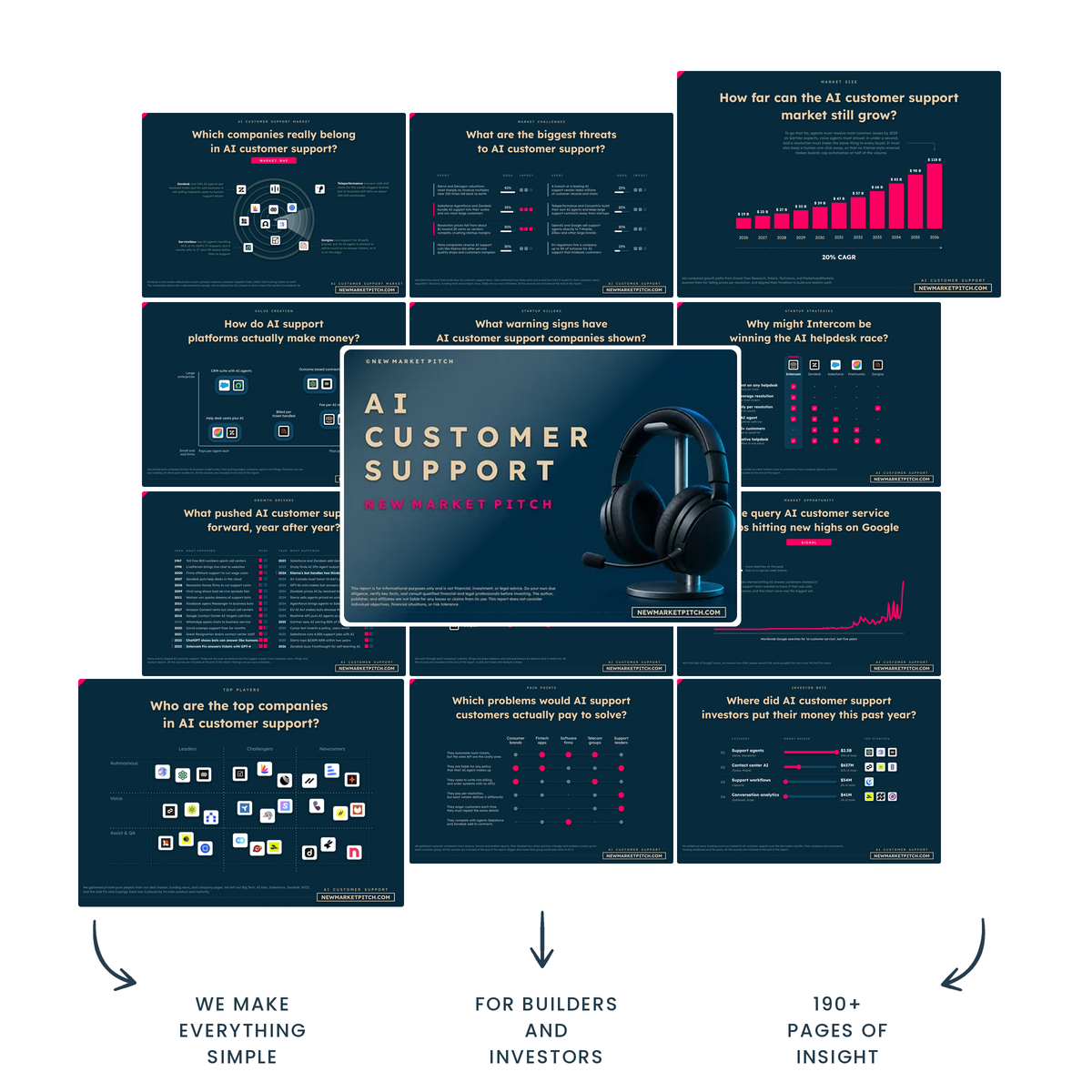
Whether you're building or investing in the AI customer support market, our report covers everything you need to know: the players, the money, and what's coming next.
Summary
Yes. AI customer support can become a much bigger software market even as companies eliminate human-agent seats. Vendors can replace lost subscription revenue by charging for automated resolutions, tapping into customer-service labor spending that is vastly larger than the traditional helpdesk software market.
US customer-service representatives alone represent approximately $119 billion in annual wages when employment is multiplied by median pay. That is not an addressable software market, but it shows why AI vendors are competing for a much larger budget than the one historically spent on support licenses.
The revenue replacement math is surprisingly favorable. A software vendor losing 60 of 100 seats priced at $100 per month would sacrifice $72,000 annually, but just 100,000 AI outcomes billed at $0.99 would lift its total annual customer revenue from $120,000 to $147,000.
Klarna shows that automation can reach serious operational scale. Its AI assistant handled 80% of customer-service chats in 2025, following reported savings of $39 million in 2024, although the company also demonstrated why aggressive cuts to human support can backfire.
Traditional support software vendors have not experienced a broad revenue collapse. Five9 grew revenue 10% in 2025, NICE increased cloud revenue nearly 13%, and Salesforce reported more than $1.5 billion in Agentforce ARR, although that Salesforce figure includes AI products beyond customer support.
The industry's next measurement problem is deciding what counts as a successful resolution. A conversation that ends without escalation is not necessarily a solved problem, and vendors charging per outcome have a financial incentive to define success generously. Recontacts, verified resolutions and customer satisfaction will become increasingly important commercial measures.
More automation does not guarantee more revenue. If the average price per resolution falls by half, billable volume must double just to keep revenue unchanged. Large customers processing millions of conversations have especially strong incentives to negotiate discounts or build their own systems.
Gross margins will separate scalable software businesses from expensive automation services. At $0.99 per outcome, direct costs of $0.20 support roughly 80% gross margins, while costs of $0.70 leave less than 30%. Complex workflows, failures, retries and human escalations can quickly change that equation.
There is another paradox: better customer service may reduce demand for customer service. AI can make round-the-clock, multilingual assistance affordable, but proactive automation can also prevent inquiries from happening. Vendors dependent entirely on per-conversation fees could eventually suffer from improving customer experiences.
Our assessment is that automated customer support can generate $10 billion or more in annual software revenue without preserving historical seat counts, although this remains a scenario rather than a measured market forecast. Incumbents have distribution and integration advantages; independent startups can still build large businesses if they resolve problems more reliably, operate more cheaply and retain a meaningful share of the savings they create.

Written by the New Market Pitch teamWe track new markets so founders and investors can move faster. About us
Is AI customer support destroying the business model that built the industry?
AI customer support is putting the traditional per-agent software model under pressure, but the amount of money available to vendors could actually grow as companies automate more customer conversations.
For years, customer-service software companies made more money when their customers hired more support employees. A company with 500 agents generally needed more paid licenses than one with 50. Zendesk, Salesforce Service Cloud, NICE and Five9 all built substantial businesses around software used by human support teams, although their products also include other pricing models.
AI changes that relationship. Intercom now sells Fin for $0.99 per outcome, Zendesk offers automated-resolution pricing, and Salesforce charges for Agentforce conversations or actions. All three can earn additional revenue when software handles work that would otherwise require employees.
This creates an unusual situation. A business might cut its support workforce in half while increasing its spending on automation. Conversely, a software company that depends heavily on human-agent licenses could lose revenue even while its customers become more productive.
The central question is how much money vendors can earn from automated work compared with the software seats they lose. That is where the future size of the AI customer support market will be decided.
How big is the AI customer support market beyond software seats?
AI customer support has access to a much larger pool of spending than traditional helpdesk licenses because companies spend far more employing customer-service workers than they spend licensing software for them.
The US Bureau of Labor Statistics counted approximately 2.67 million customer service representatives in 2025, with a median annual wage of around $44,780. Multiplying those figures gives roughly $119 billion in annual wages at the median rate. This is an illustrative benchmark rather than the actual wage bill, since salaries and working hours vary.
The broader spending pool is larger still. Employers pay benefits, supervisors and training expenses. Many companies outsource support to contact-center operators, while international service teams and related occupations sit outside that US employment figure.
At the same time, only part of this expenditure is realistically available to AI software providers. Some conversations require humans, and companies will keep much of the savings from automation.
A useful way to understand the scale is to take just the US payroll benchmark. Capturing 5% of that spending would represent almost $6 billion in annual revenue. At 10%, the figure approaches $12 billion. These are illustrative spending-transfer scenarios, not market forecasts.
Seat reductions alone are therefore a poor way to estimate the opportunity. AI companies are competing for money previously spent on labor and outsourced services, not merely for the existing software budget.

In our report covering the AI customer support market, we always try to gather several sources and make estimates that make sense, so you can work with solid numbers.
Are customer support software seats actually disappearing?
Customer-service employment is under pressure, but traditional support software companies are still growing. The financial evidence points to a gradual change in how the industry makes money rather than an immediate collapse in software spending.
Five9 generated $1.149 billion in 2025 revenue, up 10% from $1.042 billion in 2024. NICE reported $2.238 billion in cloud revenue, a 12.8% increase, while its total revenue rose 7.7% to $2.945 billion.
Meanwhile, the Bureau of Labor Statistics projects that US customer service representative employment will decline 5% between 2025 and 2035, equivalent to approximately 142,000 positions.
Those numbers describe different parts of the market, but the contrast is important. Contact-center software revenue can keep increasing even when customer-service employment falls. Vendors earn money from communications infrastructure, automation, analytics and other products beyond human-agent licenses.
There is still a major disclosure gap. Public vendors rarely report exactly how many paid seats customers eliminated because of AI, how many were replaced by automation contracts, and how much revenue changed hands as a result.
We have evidence of pressure on human support employment and continued growth among major software vendors. We do not yet have evidence of a broad seat-driven revenue collapse.
Can AI resolutions replace the revenue lost from support seats?
Yes. AI resolution fees can replace lost seat revenue surprisingly quickly, especially for businesses handling large numbers of customer inquiries.
Consider a support operation with 100 paid software seats costing $100 per month each. That is an illustrative price, rather than an industry average. The vendor earns $120,000 annually.
If automation allows the customer to eliminate 60 seats, annual subscription revenue falls to $48,000. The vendor loses $72,000.
At Intercom Fin's advertised $0.99 per outcome, approximately 72,728 additional annual billable outcomes would replace that loss. That works out to just under 200 per day across the entire support operation.
At Zendesk's advertised $1.50 committed-resolution price, roughly 48,000 annual resolutions would be enough. At $2 each, the threshold falls to 36,000.
The opportunity becomes more interesting when the same customer handles hundreds of thousands of inquiries annually. Seat revenue can decline sharply while total spending on the software platform increases.
One important condition is that the same vendor must capture both revenue streams. If an independent AI provider delivers the resolutions while an incumbent helpdesk retains the remaining human seats, the economics are split between two companies.
| Metric | Before AI | After AI |
|---|---|---|
| Paid human-agent seats | 100 | 40 |
| Monthly price per seat | $100 | $100 |
| Annual seat revenue | $120,000 | $48,000 |
| Annual AI outcomes | 0 | 100,000 |
| Price per AI outcome | - | $0.99 |
| Annual AI revenue | $0 | $99,000 |
| Total annual vendor revenue | $120,000 | $147,000 |
| Revenue change | - | +22.5% |
If you want more recent data on this point, please see our latest AI customer support market report.

In our research about AI customer support tools, we don't want to repeat what boring consulting reports say. Instead, we show you the real and latest market signals that matter.
Are companies saving enough money to pay for AI customer support?
AI customer support can produce substantial savings for companies with large support operations, which explains why outcome-based pricing is attracting attention.
Klarna is one of the clearest examples. The company launched an OpenAI-powered customer-service assistant in February 2024. During its first month, the system handled 2.3 million conversations, which Klarna estimated was equivalent to the work of approximately 700 full-time agents.
In its subsequent annual disclosures, Klarna reported $39 million in cost savings during 2024. It also said its assistant had handled 31 million conversations since launch and was available across 23 markets in more than 35 languages.
The savings are substantial compared with typical AI resolution pricing. At $0.99 per successful outcome, one million billable outcomes would produce $990,000 in software revenue.
Of course, Klarna's actual AI costs and contractual arrangements are different. Its assistant was developed in partnership with OpenAI, and its reported savings reflect changes across its own support operation. The $0.99 figure simply shows the economics of a commercial outcome-priced service at that volume.
Companies can potentially save many times what they pay an AI vendor, particularly when automated conversations replace expensive outsourced support.
That gives vendors room to charge meaningful prices. But customers have a strong reason to negotiate, especially once they start automating millions of conversations.
Has Klarna proved that AI can replace most customer support agents?
Klarna has shown that AI can handle most customer-service chats in a large international operation, although its results say less about eliminating the entire support workforce.
The adoption figures have improved substantially since the original launch. Klarna reported that its AI assistant handled 69% of customer-service chats over the twelve months ending June 2025. Its 2025 annual report subsequently put the share at 80% for the year, with no decline in consumer satisfaction according to internal surveys.
That increase is meaningful because Klarna was already operating at considerable scale. The system continued taking on more conversations after its first year, rather than posting an impressive figure from a short experiment.
There are limitations. Chat handling does not measure every support task. Complex disputes, phone calls, unusual account problems and escalations can still require people.
Klarna also attracted attention in 2025 when it began rebuilding parts of its human support capacity after concerns about relying too heavily on automation.
So the lesson cuts both ways. Klarna managed to automate a very large share of chat interactions, while also demonstrating the problems that arise when businesses cut human support too aggressively.
For AI vendors, this supports a market with enormous automated volume but continued demand for hybrid operations.

In our market report about AI customer support tools, we like to show you the big picture. We know your time is precious, so we make every page quick to read and packed with as much learning as possible per minute.
Is AI customer support already making serious money?
AI-powered customer service is becoming a real enterprise software business, although the biggest disclosed AI revenue figures still include products beyond customer support.
Salesforce reported that Agentforce annual recurring revenue exceeded $1.5 billion in its fiscal second-quarter 2027 results, growing more than 240% year over year. That is a particularly large figure for a commercial AI offering introduced only a few years earlier.
However, Salesforce expanded the Agentforce ARR definition to include additional AI products, Slackbot and Headless 360. We cannot count the full $1.5 billion as autonomous customer-service revenue.
Two major contact-center vendors also reported strong AI growth. NICE disclosed a 66% year-over-year increase in AI ARR in the fourth quarter of 2025. Five9 reported 50% growth in enterprise AI revenue during the same quarter.
These figures show adoption across several established enterprise vendors, although their AI offerings include different types of automation and assistance.
Another useful measure comes from Intercom. In September 2026, the company stated that Fin averaged a 76% resolution rate across more than 8,000 customers. This is a vendor-reported operational metric, not independently audited revenue, but it suggests that AI support has expanded well beyond a handful of enterprise pilots.
Enterprise AI contracts are getting bigger, usage is expanding, and established software companies are investing heavily in automated service. What remains hard to determine is the revenue generated specifically by autonomous customer-support resolutions, since few vendors disclose it separately.
Why are Zendesk, Intercom and Salesforce changing how they charge customers?
Zendesk, Intercom and Salesforce are introducing AI pricing based on conversations, actions and outcomes because charging only for human-agent seats would leave more and more automated work unmonetized.
Intercom's Fin combines $0.99-per-outcome pricing with conventional agent subscriptions. Its newer standalone offering can also run on another helpdesk without requiring customers to purchase Intercom seats.
Zendesk advertises automated resolutions at $1.50 under committed pricing and $2 on a pay-as-you-go basis. Salesforce offers $2 Agentforce conversations and Flex Credits priced at the equivalent of $0.10 per standard action.
The details matter because the billing units are different. One conversation can involve several actions, and an automated outcome may be counted differently from a verified resolution. A direct price comparison does not necessarily tell us which system is cheaper.
Still, the direction of the market is clear. Vendors increasingly charge for the work their AI performs, independently of the number of support employees using their software.
Hybrid pricing is also becoming common. Companies pay a platform subscription, maintain some human seats and purchase AI usage on top.
| Vendor or model | Public price example | What customers pay for |
|---|---|---|
| Intercom Fin | $0.99 | AI outcome |
| Zendesk committed | $1.50 | Automated resolution |
| Zendesk pay-as-you-go | $2.00 | Automated resolution |
| Salesforce Agentforce | $2.00 | Conversation |
| Salesforce Flex Credits | $0.10 | Standard action |
| Intercom Essential | $29/month | Human seat, billed annually |
| Intercom Advanced | $85/month | Human seat, billed annually |
| Intercom Expert | $132/month | Human seat, billed annually |

In our document detailing everything you need to know about AI customer support, we turn what is vague and complex into simple, useful visuals. Market maps like this one show you at a glance where every startup stands.
Could cheaper AI support make the market smaller than everyone expects?
Yes. AI customer support prices could fall enough to offset much of the growth in automated conversations, creating a difficult environment for vendors with little differentiation.
Today, public pricing already varies considerably. Intercom advertises $0.99 per outcome, while Salesforce offers a $2 conversation model and a separate action-based option. These services cannot be compared perfectly, but customers have several ways to purchase automated support.
As AI models become cheaper to run, enterprises will expect some of those cost reductions to appear in their contracts. Large customers have an especially strong incentive to negotiate because small price changes become significant across millions of resolutions.
The arithmetic is unforgiving. A company that doubles its billable resolution volume but cuts its average price by 50% generates the same revenue. To grow revenue 25% with that price reduction, it would need 150% more billable resolutions.
Market forecasts built almost entirely around rising automation rates deserve skepticism. An industry can automate many more conversations without generating proportionally more revenue.
The startups most exposed are those selling standard chatbot functionality with limited integration advantages. Better workflow execution, reliable resolution quality and proprietary customer-specific capabilities give vendors a stronger reason to defend their prices.
If you want more recent data on this point, please see our latest AI customer support market report.
Can AI customer support startups actually make good margins?
AI customer support can be a high-margin software business, but startups need to measure the total cost of resolving a customer's problem, including failures and retries.
At $0.99 per billable outcome, a provider spending $0.20 in direct delivery costs makes roughly 80% gross margin. If those costs rise to $0.40, the margin falls to about 60%. At $0.70, it drops below 30%.
The difference can come from how difficult the tasks are. Answering a straightforward delivery question may require a short model response and a simple database lookup. Handling a complicated refund, changing an account or resolving a technical issue can require multiple model calls, external integrations, checks and human intervention.
Voice support adds speech recognition, audio generation and latency constraints.
Established contact-center companies provide useful benchmarks, although their reported margins include a much broader product mix. NICE reported a cloud gross margin of approximately 65.6% in 2025. Five9's overall GAAP gross margin was 55.1%.
For a dedicated AI startup, those figures cannot substitute for its own economics. What we need is the cost per verified resolution after including the infrastructure and variable service work required to deliver it.
The best opportunities will likely be in workflows where the customer saves substantial labor expense while the vendor can complete each task at low cost.

Our report covering the AI customer support market gets updated several times a month, so you always get the latest view of where things stand.
Will AI customer support create more demand or just replace human work?
Most AI customer support spending currently comes from automating work that businesses already pay people to perform, but cheaper support can also make new services affordable.
A company that previously offered email assistance only during business hours can add 24-hour chat. An ecommerce business can cover more languages. A software provider can give smaller customers interactive support that previously would have been too expensive.
These changes can increase the number of interactions handled by AI even while human support teams become smaller.
Yet there is a competing trend: improving customer service can reduce how often customers need help.
Klarna originally reported that repeat inquiries declined 25% after introducing its AI assistant. More broadly, proactive delivery updates, clearer onboarding and automatic account changes can prevent requests from happening at all.
Gartner also predicted in December 2024 that third-party generative-AI tools could independently resolve 40% of customer-service issues by 2027, reducing demand for official support channels. That remains a forecast rather than an observed outcome.
Consider a business receiving one million annual inquiries and automating half of them. That generates 500,000 potential AI resolutions. Another business receiving only 600,000 inquiries but automating 70% generates 420,000.
The second company provides a better customer experience with a higher automation rate, yet generates 16% fewer billable resolutions.
Better customer service does not always translate into more transactions. Products that manage entire support workflows may eventually have a pricing advantage over those depending exclusively on per-contact fees.
If you want more recent data on this point, please see our latest AI customer support market report.
Will big companies eventually build their own customer support AI?
Large companies have good reasons to build their own AI support systems once their annual spending reaches millions of dollars, but buying specialist software will remain attractive for many businesses.
Klarna's partnership with OpenAI shows that a major enterprise can develop a customized assistant rather than depend entirely on a traditional helpdesk vendor.
Other companies can take a similar approach using commercially available language models and their existing customer databases.
The financial incentive increases with volume. At $0.99 per billable outcome, one million annual outcomes cost approximately $990,000. Ten million would cost almost $10 million before negotiated discounts or additional charges.
That is enough money to justify seriously evaluating internal development.
However, production customer support involves much more than connecting a language model to a knowledge base. Companies need secure account access, reliable integrations with billing and order systems, authorization controls, monitoring, testing and human escalation.
Those requirements create ongoing costs that companies must compare with vendor contracts.
For smaller support teams, buying an integrated product will often remain simpler. Large enterprises with engineering resources and very high conversation volumes are more likely to negotiate aggressively or develop their own systems.
Specialist startups therefore need to offer something difficult to reproduce, whether that is better resolution quality, deep workflow integrations, simpler deployment or lower total operating costs.

In our research about AI customer support tools, you will always find fresh funding data, taken straight from our own verified funding database.
Are AI customer support resolution rates misleading?
AI customer support resolution rates can be misleading when vendors count conversations that ended without proving the customer's problem was solved.
A customer might ask about a refund, receive an incomplete answer and leave the chat. Depending on the vendor's definition, the conversation could be counted as resolved even if the customer contacts support again later.
Intercom's current pricing documentation counts an outcome when a customer confirms the issue was resolved, stops asking for help after Fin responds, or when Fin completes certain configured procedures.
Zendesk has introduced more detailed resolution definitions, including verified resolutions, which illustrates how important measurement has become to the commercial model.
These differences matter when vendors charge for successful outcomes. A high automation percentage is commercially valuable only when customers get answers they can trust.
Verified resolution rates combined with recontact frequency, escalation rates and customer satisfaction deserve greater weight than deflection rates alone.
A provider resolving 60% of conversations accurately may deliver more savings than one reporting 80% deflection while customers repeatedly return with the same issue.
As AI support spending grows, buyers will have stronger reasons to audit what they are actually paying for.
If you want more recent data on this point, please see our latest AI customer support market report.
Will customer support agents disappear fast enough to hurt Zendesk and other vendors?
Human customer support jobs will keep facing automation pressure, but the employment outlook suggests a longer transition than the most aggressive AI forecasts imply.
The Bureau of Labor Statistics projects a 5% decline in US customer service representative employment from 2025 to 2035. That represents approximately 142,000 fewer positions, but still leaves more than 2.5 million people working in the occupation.
The agency also expects around 289,500 job openings annually, mainly to replace workers leaving the occupation.
Another warning came from Gartner in February 2026. The research firm predicted that half of companies cutting customer-service staff because of AI would rehire workers for similar functions by 2027, sometimes under different titles. It is a forecast, but it directly challenges assumptions of rapid, permanent workforce elimination.
Businesses still need employees to handle difficult disputes, sensitive financial matters and situations where the AI cannot confidently complete a task.
For Zendesk and other established vendors, the problem is likely to develop over several years. Customers may reduce seat counts, assign more difficult cases to remaining agents and increase AI spending at the same time.
Vendors that can charge for both human work and automated resolutions have a better chance of navigating that transition than those relying heavily on seats alone.

In our market report about AI customer support tools, we look at what the winners do differently, so you can learn from the best instead of guessing.
Can Zendesk, Salesforce and NICE keep AI customer support startups from winning?
Zendesk, Salesforce and NICE have powerful advantages because they already sit inside enterprise customer-service operations, but specialist AI companies can still win valuable automation contracts.
Existing platforms manage customer records, tickets, communication channels, routing and reporting. Companies rarely replace all of that infrastructure simply because a new AI provider offers better automated responses.
Salesforce also has the financial resources and enterprise relationships to bundle AI capabilities into broader contracts. NICE and Zendesk benefit from similar integration advantages within their respective customer bases.
But specialist providers are finding ways around that distribution barrier.
Intercom offers Fin as a standalone AI agent that works with existing helpdesks, including Salesforce. Customers can therefore choose another company's automation technology without immediately replacing their current service platform.
This creates a competitive opening. The incumbent keeps its ticketing and human-agent workflows while the specialist earns revenue from AI outcomes.
There is also an economic risk for startups. Incumbents can bundle automation, offer discounts or make basic AI features part of existing subscriptions. A challenger needs a noticeable advantage in cost, reliability or performance to persuade customers to maintain a separate contract.
We expect the market to support both integrated software suites and dedicated AI automation providers. The more difficult question is which group captures the majority of the profit.
How much revenue could AI customer support generate without human seats?
AI customer support could support $10 billion or more in annual software revenue from automated outcomes alone, but reaching that figure depends on billions of billable resolutions at prices customers will continue paying.
The relationship between volume and pricing is easy to calculate. Ten billion annual resolutions at $0.50 each produce $5 billion. At $1 each, the same volume produces $10 billion.
At 20 billion billable resolutions and an average price of $0.75, annual revenue reaches $15 billion.
Those numbers are scenarios rather than estimates of the current market. We do not have a reliable global count of customer-service interactions that can be automated, qualify as successful resolutions and remain billable under actual contracts.
There is also an important difference between published prices and realized revenue. Large customers negotiate discounts, and some platforms charge for actions or conversations rather than outcomes. Counting all those units as equivalent would exaggerate the opportunity.
Still, these calculations show why the industry can become large without preserving its historical seat count. The real challenge for vendors is to maintain reasonable prices while increasing the number of tasks they can complete successfully.
| Annual billable resolutions | $0.25 each | $0.50 each | $0.75 each | $1.00 each |
|---|---|---|---|---|
| 1 billion | $0.25B | $0.5B | $0.75B | $1B |
| 2 billion | $0.5B | $1B | $1.5B | $2B |
| 5 billion | $1.25B | $2.5B | $3.75B | $5B |
| 10 billion | $2.5B | $5B | $7.5B | $10B |
| 15 billion | $3.75B | $7.5B | $11.25B | $15B |
| 20 billion | $5B | $10B | $15B | $20B |
| 30 billion | $7.5B | $15B | $22.5B | $30B |

If you build or invest in the AI customer support market, you need to know which business models pay off now and which ones are fading. That's why our report covering it has a whole section on it.
Is AI customer support a big market if it kills seats?
Yes. AI customer support can become a much bigger software business even as companies eliminate human-agent seats. The spending opportunity extends far beyond traditional helpdesk subscriptions, although that does not mean every AI support startup will make money.
The evidence is increasingly convincing. US customer-service labor alone represents a spending pool of more than $100 billion annually using median wages as a rough benchmark. Large enterprises have already demonstrated that AI can automate substantial portions of support operations. Public software vendors continue growing, and newer outcome-based pricing models make it possible to earn more from automation even when seat counts decline.
The biggest uncertainty is how much of the labor savings vendors can keep. Customers will demand lower prices as models improve, established software companies will bundle AI into their products, and very large enterprises may build some capabilities internally.
Better automation could also reduce the total number of support requests over time. Vendors charging only per conversation could eventually face pressure from their own success.
Nevertheless, the commercial opportunity is substantial. A market built around millions of paid support employees is gradually opening to software that can perform billions of customer-service tasks.
Our judgment is that the seat-based portion of customer-support software will lose importance, while revenue tied to automated work has room to become a major category of enterprise spending. Established platforms are well placed to benefit, but independent AI providers can build large businesses if their resolution quality and economics are meaningfully better.
The winners will be the companies that solve customer problems reliably, keep the cost of doing so low and retain enough of the savings to build profitable businesses. Seat elimination changes the economics of the industry, but there is plenty of money left to compete for.
If you want more recent data on this point, please see our latest AI customer support market report.
Our methodology
This analysis examines whether AI customer support can become a larger software market as automation reduces the number of paid human-agent seats. We structured the research around customer-service labor spending, software revenue, commercial pricing, enterprise adoption, resolution economics, automation quality, competitive dynamics and changes in demand for support.
For each dimension, we gathered recent financial disclosures, official employment statistics, published software prices, enterprise deployment figures and original product documentation. We aggregated those observations, assessed what each established, and compared findings across dimensions before drawing conclusions. This approach helped distinguish genuine changes in industry economics from changes in how vendors report AI adoption.
We used US customer-service employment and median wages to estimate an illustrative labor-spending benchmark. The calculation multiplies occupational employment by median annual pay and does not represent the actual national payroll or a directly addressable AI software market. Employment projections and workforce estimates come from the US Bureau of Labor Statistics occupational profile and its official employment projection tables.
Our software monetization analysis compares published human-seat, conversation, action and automated-resolution pricing. We treated these as distinct billing units rather than assuming that every conversation, action or outcome represents the same amount of work. Principal references include Intercom's pricing documentation, Intercom's definition of billable Fin outcomes, Zendesk's pricing, Zendesk's automated-resolution documentation and Salesforce's explanation of Flex Credits.
To measure commercial traction, we compared reported vendor financial performance with customer-service workforce trends. The main company disclosures include Salesforce's second-quarter fiscal 2027 results, NICE's full-year 2025 financial results and Five9's full-year 2025 results. We separated company-wide AI revenue, cloud revenue and autonomous customer-support revenue rather than combining them into a single market figure.
Enterprise automation economics were examined using Klarna's reported deployment results, including conversation volumes, agent-equivalent productivity and reductions in repeat inquiries. The original OpenAI and Klarna deployment case study and Klarna's financial disclosures provide the principal operating evidence. We treated company-reported savings and automation rates as observations about a specific deployment, not as universal results that every enterprise should expect.
Our own calculations test whether automated-resolution revenue can offset declining seat revenue, how changes in delivery cost affect gross margins, and how resolution volume interacts with pricing. The $119 billion wage benchmark, seat-replacement examples and multibillion-dollar automated-resolution scenarios are illustrative calculations. They demonstrate the scale and conditions of potential revenue generation without presenting hypothetical outcomes as measured market size.
We also examined the forces that could limit vendor revenue, including declining resolution prices, enterprise insourcing, incumbent software bundling, human escalation requirements and the possibility that better support reduces future inquiry volumes. We distinguished company-reported operating metrics from independent outcomes and used Gartner's customer-service rehiring forecast and its research on third-party AI support to examine alternative paths for employment and customer-service demand.
Our final assessment brings these dimensions together: observed enterprise adoption, labor economics, vendor revenue, pricing structures, direct delivery costs and measurable resolution quality. The resulting judgment concerns the commercial potential of automated customer-support software, with explicit separation between existing revenue, achievable unit economics and longer-term scenarios.

When you build or invest in the AI customer support market, you need clarity, not confusion. In our report covering the AI customer support market, we always try to put numbers on and quantify whatever is usually vague and confusing.
Written by the New Market Pitch teamWe track new markets so founders and investors can move faster. About us