
AI shopping assistants: which company is ahead?
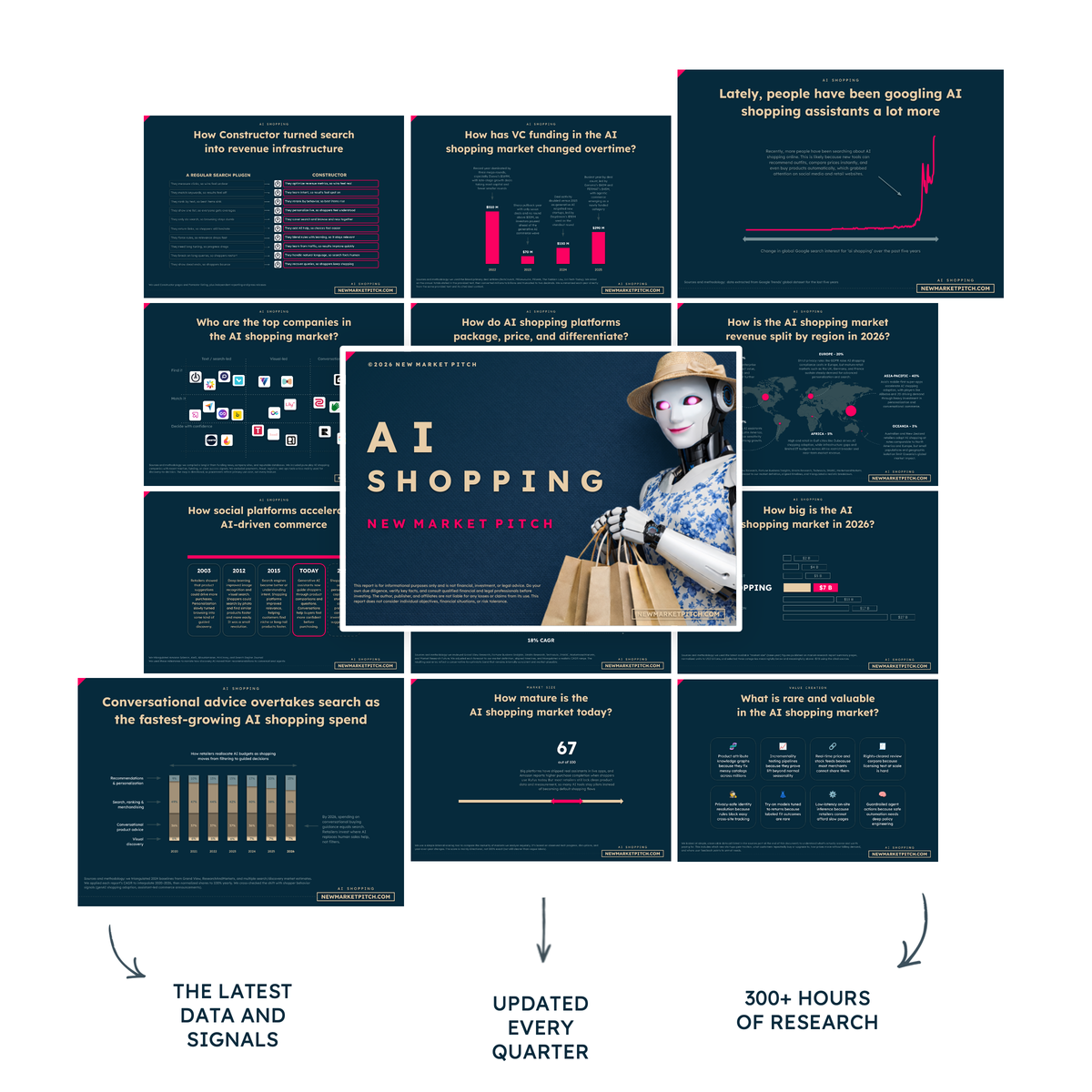
Whether you're building or investing in the AI shopping market, our report covers everything you need to know: the players, the money, and what's coming next.
Summary
Amazon is ahead in the AI shopping assistant race as of October 2026. It has the strongest evidence of actual shopping adoption and purchasing activity, while Google leads in cross-retailer infrastructure and OpenAI remains a major contender in product discovery.
AI shopping is growing much faster than conventional retail traffic. Adobe recorded a 693.4% year-over-year increase in generative AI referrals during the 2025 holiday season, and shoppers are increasingly arriving at retailers after researching products through AI conversations.
Amazon has the clearest adoption advantage. More than 350 million customers used Alexa for Shopping over its latest reported 12-month period, and interactions increased more than fivefold year over year. No major competitor has disclosed an equivalent shopping-specific audience figure.
Amazon's commercial evidence is also stronger than its rivals'. Assistant users have been associated with higher purchase likelihood and larger orders, although those comparisons cannot prove that AI caused the additional spending. The important advantage is that Amazon can measure the entire journey from recommendation to purchase.
Google is building a different kind of shopping system. Its Shopping Graph contains more than 60 billion product listings, and Universal Cart connects product discovery, price tracking and purchasing across retailers. That gives Google a potentially broader role than an assistant concentrated on one marketplace.
ChatGPT's enormous audience has not yet translated into proven shopping leadership. OpenAI passed one billion weekly ChatGPT users, but its retreat from the original Instant Checkout model suggests consumers are more comfortable getting buying advice from AI than completing transactions inside a chatbot.
Walmart is emerging as the strongest retailer-specific challenger. Around half of its shopping-app users had interacted with Sparky by February 2026, and subsequent disclosures showed faster engagement and larger average orders among assistant users. Walmart is also welcoming shopping traffic from external AI platforms.
The conversion data is beginning to favor AI-assisted discovery. Adobe found that AI-referred retail visitors converted 54% better than other visitors in May 2026. This makes product recommendations valuable even when the assistant never processes a payment.
The biggest unresolved weakness is reliable execution across stores. Shopping agents can monitor prices and arrange eligible purchases, but payment authorization, inventory accuracy, merchant access and returns still limit what they can do independently. Perplexity's legal dispute with Amazon shows that access itself is becoming a competitive battleground.
The next leader may not be the company with the biggest chatbot audience. Amazon already controls an integrated purchasing environment; Google has the strongest cross-merchant foundation; and OpenAI could become the dominant adviser before a purchase. The ranking will change only when competitors publish shopping-specific usage, conversion and transaction figures comparable to Amazon's.

Written by the New Market Pitch teamWe track new markets so founders and investors can move faster. About us
Why is everyone suddenly competing to become your AI shopping assistant?
AI shopping assistants are becoming a serious source of customers for retailers, and Amazon, Google, OpenAI and Walmart are now fighting over who gets to influence what people buy.
The change is measurable. Adobe Analytics found that visits from generative AI tools to U.S. retail websites increased 693.4% year over year during the 2025 holiday season. Salesforce's 2026 State of Commerce report found that the proportion of shoppers starting their buying journey with AI-powered search had tripled over the previous year.
The biggest companies have responded in different ways. Amazon merged Rufus and Alexa+ into Alexa for Shopping in May 2026. Google introduced Universal Cart, which began rolling out across Search and Gemini in the U.S. in October. OpenAI expanded ChatGPT's product comparisons while pulling back from its original Instant Checkout strategy. Walmart has been making Sparky a bigger part of its shopping app.
There is a reason these companies are taking different approaches. Amazon already has a store where customers can buy almost everything. Google helps people find products across thousands of retailers. ChatGPT has a huge audience that increasingly asks for buying advice. Walmart wants to make shopping easier for its existing customers while also welcoming shoppers from outside AI assistants.
The competition is becoming more serious, but the companies are still winning in different areas.
Who's actually winning the AI shopping assistant race right now?
Amazon is currently ahead in demonstrated AI shopping adoption, while Google has the strongest infrastructure for shopping across different retailers.
We reach that judgment by looking at actual shopping activity rather than total chatbot audiences. The most useful questions are how many people use the assistant to shop, whether those people go on to purchase something, and how much of the buying process the company can handle.
Amazon has disclosed more than 350 million shopping-assistant users over a 12-month period. Google says its services handle over one billion shopping activities every day, but that figure includes traditional shopping experiences as well as AI. OpenAI has more than one billion weekly ChatGPT users, though it has not disclosed how many actually use ChatGPT for shopping.
Those figures cannot be converted into comparable market shares. They describe different activities over different periods.
Amazon has the strongest evidence of shopping-specific adoption. Google has the broader network of merchants and product information. ChatGPT has an enormous potential customer base, but its ability to turn that audience into completed purchases is less established.
For now, the evidence puts Amazon first. The scale of Google's shopping infrastructure makes it the most credible challenger.
If you want more recent data on this point, please see our latest AI shopping market report.

In our report covering the AI shopping market, we turn what is vague and complex into simple, useful visuals. Market maps like this one show you at a glance where every startup stands.
How many people actually use Amazon's AI shopping assistant?
Amazon's Alexa for Shopping is the most widely used AI shopping assistant for which we have a large, clearly identified shopping-user figure.
During Amazon's second-quarter 2026 earnings call, CEO Andy Jassy reported that more than 350 million customers had used Alexa for Shopping over the preceding 12 months. Active users had nearly doubled year over year, while interactions had increased more than fivefold.
The longer history makes those numbers more convincing. Amazon reported over 250 million Rufus users in November 2025, when monthly users were already growing 140% year over year and interactions were up 210%.
The periods and product definitions differ, especially after Rufus and Alexa+ were combined, so we cannot calculate an exact growth rate between the two user totals. But the engagement figures reveal something important: people are asking the assistant questions much more frequently, rather than merely trying it once.
Amazon also reported that Alexa for Shopping customers in the U.S. spent over 40% more per order than shoppers who did not use the assistant. This is an observed difference between customer groups, not proof that the assistant caused the extra spending.
For now, no major competitor has published an equivalent worldwide figure combining shopping-specific users and year-over-year interaction growth. Amazon's lead is therefore the best-supported one, even though its precise market share remains unknown.
Can ChatGPT's massive audience make OpenAI the AI shopping leader?
ChatGPT gives OpenAI a huge advantage in reaching potential shoppers, but OpenAI has yet to show that its audience buys through AI at anything close to Amazon's demonstrated scale.
OpenAI's reported ChatGPT audience passed one billion weekly users in 2026. That gives the company immediate access to people who already use its assistant for research, recommendations and comparisons.
The shopping strategy has changed considerably, though.
In September 2025, OpenAI introduced Instant Checkout, initially allowing purchases from participating Etsy merchants inside ChatGPT. The company announced plans to expand through Shopify's merchant ecosystem.
By March 2026, OpenAI was shifting away from that original experience. The Information reported that users were researching purchases in ChatGPT but were less willing to complete transactions through the chatbot. OpenAI subsequently focused on richer product discovery and merchant-controlled checkout experiences.
That shift leaves ChatGPT in a potentially powerful position. It can influence which laptop, television, skincare product or piece of furniture someone chooses, even when the retailer ultimately handles payment.
OpenAI has announced shopping-data integrations involving Target, Sephora, Nordstrom, Best Buy, Home Depot and other major retailers. Those partnerships improve product coverage, but there is still no published breakdown showing how many ChatGPT users shop, how often they do it, or how many purchases result.
ChatGPT could become the most influential shopping adviser. Amazon currently has better evidence that consumers are already using its assistant as part of a retail transaction.

Our research about AI shopping assistants gets updated several times a month, so you always get the latest view of where things stand.
Is Google actually better positioned than Amazon to win AI shopping?
Google could become the biggest cross-retailer AI shopping platform because it already has a huge product database, merchant relationships and payment infrastructure.
At Google I/O 2026, the company said its Shopping Graph contained more than 60 billion product listings and that people performed over one billion shopping activities across Google services every day.
The Shopping Graph covers multiple sellers, including their prices, inventory and product details. Google previously reported that more than two billion listings were refreshed hourly, helping keep product information relatively current.
Google has also moved further into the buying process. Its Universal Commerce Protocol was developed with companies including Shopify, Walmart, Target, Etsy and Wayfair. Universal Cart, introduced in May and rolled out in the U.S. in October, lets shoppers save products from different retailers across Search and Gemini, monitor price or stock changes, and continue toward checkout.
Amazon already offers a familiar shopping experience, but Google can compare products across stores without requiring every purchase to happen on one marketplace.
That's a substantial advantage for someone looking for the best price or comparing independent brands.
The missing piece is actual usage. Google's one billion daily shopping activities cannot be treated as Gemini conversations, and the company has not published enough shopping-specific AI data to establish that Gemini has overtaken Alexa for Shopping.
Google has the strongest cross-retailer infrastructure today. Amazon remains ahead on demonstrated assistant adoption. But if shopping assistants become the default way to compare prices across stores, Google's position could prove more valuable in the long run.
If you want more recent data on this point, please see our latest AI shopping market report.
Which AI shopping assistant has the strongest advantages over competitors?
Amazon, Google and OpenAI each control something the others would struggle to reproduce quickly: Amazon has retail transactions and fulfillment, Google has cross-merchant product information, and OpenAI has a large conversational audience.
Walmart also deserves attention because it has customers, purchase histories, physical stores and delivery infrastructure. Shopify occupies a different position by helping millions of merchants make their products available to AI-powered channels.
Perplexity and Microsoft have shopping capabilities, but neither has released comparable figures showing leadership in consumer shopping-assistant adoption.
The differences help explain why the market has not settled around one obvious winner.
| Company | Shopping product | Biggest advantage | Biggest weakness |
|---|---|---|---|
| Amazon | Alexa for Shopping | Large verified shopping audience and integrated purchasing | Mostly Amazon-centered |
| Gemini and AI Mode | Cross-retailer data and payment infrastructure | Limited published AI-shopping conversion figures | |
| OpenAI | ChatGPT Shopping | Huge conversational audience | Few disclosed shopping-specific usage figures |
| Walmart | Sparky | Customer accounts, stores and fulfillment | Strongest inside Walmart's ecosystem |
| Perplexity | Comet and shopping search | Browser-based research and automation | Merchant-access disputes |
| Shopify | Agentic commerce integrations | Access to millions of merchants | No dominant standalone consumer assistant |
| Microsoft | Copilot shopping capabilities | Browser and AI distribution | Limited shopping adoption disclosures |
| Meta | AI shopping features | Social discovery and large consumer reach | Less established end-to-end shopping infrastructure |

In our market report about AI shopping assistants, we look at what the winners do differently, so you can learn from the best instead of guessing.
Does Amazon's AI shopping assistant actually make people buy more?
Amazon has the strongest publicly disclosed connection between AI shopping-assistant use and completed purchases, although its figures do not prove that the assistant caused the improvement.
In November 2025, Amazon said customers using Rufus during a shopping journey were more than 60% more likely to complete a purchase than those who did not.
Its second-quarter 2026 results added another comparison: U.S. customers using Alexa for Shopping spent more than 40% extra per order on average.
Amazon also disclosed that shoppers clicking sponsored prompts within its AI-powered shopping experiences converted to sales 48% more often and spent 21% more on average than those who did not click.
These three comparisons measure different groups and behaviors, so adding them together would be meaningless. They do show that Amazon is connecting conversational assistance with measurable commercial activity across recommendations, purchases and advertising.
There is an obvious limitation: consumers using a shopping assistant may already be more interested in purchasing. Without a controlled experiment, we cannot attribute the full conversion difference to AI.
Even with that caveat, Amazon has provided considerably more evidence about actual shopping behavior than most rivals. It can measure what happens after a recommendation because it also operates the marketplace, checkout and delivery network.
Is Walmart's Sparky catching up with Amazon's AI shopping assistant?
Walmart's Sparky is becoming a serious rival inside U.S. retail, and its latest engagement figures suggest that customers increasingly find it useful.
In February 2026, Walmart said approximately half of its shopping-app users had interacted with Sparky. At the time, customers using the assistant had average order values around 35% higher than nonusers.
Walmart's September 2026 investor discussions brought stronger numbers. Weekly engagement had increased by more than 60% quarter over quarter. Customers using Sparky were spending around 40% more per order, while its visual-shopping functionality was associated with a 57% conversion improvement compared with text-based shopping.
The 35% and 40% order-value figures come from separate disclosures, and their customer groups are not necessarily identical. We cannot claim that Sparky caused order values to rise by five percentage points. Still, both show a substantial spending difference among assistant users.
Walmart is also taking a different approach to competitors. At an October retail conference, Walmart executives said referrals from ChatGPT and Gemini were producing strong conversion rates and bringing in new or returning customers.
Amazon has generally been more restrictive toward outside shopping agents accessing its website. Walmart appears happy to benefit from those assistants as additional sources of traffic.
That combination makes Walmart worth watching: it is improving its own assistant while allowing other AI platforms to send it customers.
Amazon still has the stronger disclosed global adoption figure, but Sparky is no longer a minor experiment.
If you want more recent data on this point, please see our latest AI shopping market report.

In our document detailing everything you need to know about AI shopping, you will always find fresh funding data, taken straight from our own verified funding database.
Are shoppers really leaving Google Search for AI shopping assistants?
Consumers are increasingly starting product searches with AI assistants, and the change is already visible in retail traffic data.
Salesforce's 2026 State of Commerce report found that the proportion of people starting their shopping journey through agentic search increased 200% year over year.
The report combined surveys of 4,690 consumers with behavioral information from more than 1.5 billion global shoppers. Traffic referred from AI chats grew between 150% and 428% year over year across the quarters measured, compared with single-digit to low-double-digit growth in overall traffic.
Another part of the research compared consumer discovery channels between August 2025 and May 2026. Traditional search declined 15% as a reported product-discovery route, while brand-owned properties fell 7%. Newer channels, including AI assistants, social AI and delivery apps, grew 38%.
That does not mean Google has lost 15% of all shopping searches. The survey measures how consumers say they discover products, and the newer-channel category includes more than AI chatbots.
Adobe's retail data reinforces the direction of travel. AI-referred visits to U.S. retailers increased 138% year over year in May 2026 and were 1,324% above their October 2024 level.
More product research is starting in AI conversations. The harder question is how much of the total shopping-search market independent assistants have actually captured.
Are people who shop through AI assistants more likely to buy something?
AI-referred shoppers now convert better than other retail visitors in Adobe's measurements, reversing the weaker results seen during the early days of AI shopping.
Adobe Analytics reported that U.S. retail visitors coming from AI sources converted at a rate 54% higher than visitors from non-AI sources in May 2026.
Roughly a year earlier, AI-referred traffic had converted at nearly half the rate of other traffic. The direction of the change is striking: AI referrals moved from a substantial conversion disadvantage to a clear advantage.
The same May analysis found that AI-referred visitors generated 53% more revenue per visit, spent 53% longer on retail websites, viewed 23% more pages and were 36% less likely to leave immediately.
These measurements fit together. People arriving from an AI conversation may already have narrowed down their options, making them more prepared to buy when they reach a retailer.
We cannot prove that the assistant itself caused the improvement. Changes in user demographics, referral sources and shopping categories could also affect the results.
Still, the improvement is large enough to change how retailers view AI traffic. ChatGPT, Gemini and other assistants are becoming valuable product-discovery channels even when they do not process the payment themselves.

Learning from others' mistakes is the cheapest lesson there is. In our report covering the AI shopping market, we look at what broke startups before you, so you don't repeat it.
Why did OpenAI pull back from Instant Checkout in ChatGPT?
OpenAI pulled back from its original Instant Checkout strategy as shopping through ChatGPT was proving harder to turn into actual purchases than product research.
The feature launched in September 2025 with the ambition of letting users discover products and pay without leaving the conversation. Stripe supported the initial implementation, and OpenAI planned integrations with Etsy and Shopify merchants.
But adoption of the original checkout experience was disappointing. In March 2026, The Information reported that relatively few merchants were selling through ChatGPT's native checkout and that users preferred researching products there to completing purchases.
OpenAI's revised approach emphasized product comparisons, visual search and better merchant integrations. Retailers could retain more control over checkout through their own storefronts or dedicated ChatGPT applications.
Walmart's experience supported that change. Reporting from WIRED described disappointing early sales through the initial integration, despite Walmart having made around 200,000 products available.
The sequence is revealing. Within roughly six months of launching a high-profile shopping feature, OpenAI had moved toward a model where ChatGPT helps consumers choose products and merchants manage the transaction.
That leaves OpenAI with a large commercial opportunity in discovery, but it weakens the argument that ChatGPT is already leading in completed AI shopping transactions.
Can AI shopping assistants actually buy products for you now?
Amazon and Google already support AI-assisted purchasing under specific conditions, but shopping agents still need restrictions and authorization to handle real transactions reliably.
Amazon's Alexa for Shopping supports Price Alerts and Auto-Buy. Customers can define purchasing conditions for eligible products, and Amazon can monitor prices and act when those conditions are met.
Google introduced agentic checkout for eligible U.S. purchases in November 2025. Its system can track an item's price, notify the shopper and, with the required authorization, help complete a purchase through supported merchants.
Google's Universal Cart adds another useful capability. Shoppers can collect products from multiple retailers across Search and Gemini, then receive notifications about price drops or items returning to stock.
These experiences already go beyond answering questions about products. They can monitor conditions, remember shopping intentions and reduce the steps needed to buy.
Perplexity has pursued more flexible purchasing automation through its Comet browser, although that approach has faced merchant-access disputes.
The practical limit is still fairly clear. Payment authorization, stock availability, delivery rules and returns all have to work correctly. Existing retailer integrations handle these steps more predictably than a general-purpose agent interacting with arbitrary websites.
Amazon currently has the most complete shopping environment among the leading assistants, while Google is developing a broader system across independent merchants.

In our research about AI shopping assistants, we always try to gather several sources and make estimates that make sense, so you can work with solid numbers.
Can Perplexity's shopping agent challenge Amazon and Google?
Perplexity could appeal to people who want an independent AI shopping assistant, but it has not demonstrated the consumer scale needed to challenge Amazon or Google directly.
Perplexity's Comet browser can research products and perform browsing tasks. This gives it more freedom to work across websites than an assistant designed primarily for one store.
That freedom has created disputes.
Amazon sued Perplexity in November 2025 over Comet's access to its website. A district court granted Amazon a preliminary injunction in March 2026, but the Ninth Circuit vacated that injunction in August and sent the case back for further proceedings.
The appellate ruling concerned the legal grounds for that preliminary restriction. It did not give every AI agent unrestricted access to retailer websites.
Amazon has also taken steps to restrict other outside shopping agents. Walmart, meanwhile, has been much more welcoming toward referrals and integrations involving ChatGPT and Gemini.
Perplexity's challenge is therefore as much commercial as technical. An independent agent can offer an attractive experience, but it needs reliable access to product information and purchasing systems.
Without comparable shopping-user numbers, transaction volumes or revenue figures, there is little evidence that Perplexity is close to overtaking the established platforms.
Could Amazon's closed shopping ecosystem become a weakness?
Amazon's biggest AI shopping advantage could eventually limit its reach, particularly when customers want comparisons across different retailers.
Alexa for Shopping has access to Amazon's products, customer accounts, purchasing histories and delivery information. That makes personalized recommendations and checkout straightforward for existing Amazon customers.
But shoppers do not always want to buy from Amazon. Someone comparing prices across Walmart, Target, Best Buy and independent Shopify stores may prefer an assistant that searches broadly.
Google has designed its Shopping Graph and Universal Commerce Protocol around that kind of cross-retailer shopping. ChatGPT is also integrating merchant catalogs rather than concentrating on one marketplace.
Amazon has explored shopping beyond its own store through its Buy for Me experience. In November 2025, the company said the number of products available through the feature had grown from 65,000 at launch to more than 500,000.
That's a meaningful expansion, although it remains small compared with Google's tens of billions of product listings.
Amazon's approach still makes sense for customers who value familiar checkout, delivery and returns. But if consumers start expecting AI assistants to compare every available retailer, Amazon's closed ecosystem becomes a handicap. Google is much better positioned for that kind of shopping.
If you want more recent data on this point, please see our latest AI shopping market report.

If you build or invest in the AI shopping market, you need to know which business models pay off now and which ones are fading. That's why our report covering it has a whole section on it.
Which AI shopping assistant has the most accurate product information?
Google currently has the broadest disclosed cross-retailer product database, but there is no independent evidence proving that Gemini consistently gives more accurate shopping recommendations than Amazon or ChatGPT.
Google's Shopping Graph contains more than 60 billion product listings, refreshed continuously with information from merchants. This gives its shopping products access to a large collection of prices, inventory information and product attributes.
Amazon has a different kind of information. Its shopping assistant can work with product listings, reviews, customer preferences and previous orders inside an established marketplace.
OpenAI has been expanding ChatGPT's product data through direct merchant feeds and integrations. Its partnerships with companies such as Sephora, Target and Home Depot improve the chances of retrieving relevant product information.
There is no universal winner across every shopping question. Google has extensive cross-merchant coverage. Amazon can provide information tied to a customer's account and delivery options. ChatGPT is particularly useful for conversational comparisons involving different product requirements.
The remaining problem is reliability. Product listings change, reviews can be misleading, and recommendations may omit merchants whose data is unavailable.
We found no publicly established independent benchmark demonstrating that one assistant consistently wins on recommendation accuracy, real-time inventory and final purchase price across major retail categories.
Google leads on disclosed data breadth, but that alone doesn't prove it gives the best advice.
Which company could make the most money from AI shopping?
Amazon currently has the clearest route to making money from AI shopping because it can connect recommendations directly to purchases, merchant services and advertising.
Amazon already operates the retail infrastructure around Alexa for Shopping. When a recommendation leads to a purchase, the company can benefit through its established marketplace business.
Its AI shopping experience also creates new opportunities for advertising. In the second quarter of 2026, Amazon reported that customers clicking sponsored prompts within its AI-powered shopping experiences converted more often and spent more than shoppers who did not click.
Google could follow a similarly attractive model across a much larger merchant network. Its advertising business, Shopping Graph, Universal Commerce Protocol and Google Pay give it several ways to participate in purchases. However, Google has not disclosed separate revenue or profits generated by Gemini shopping.
OpenAI's economics are less established. The original Instant Checkout strategy included merchant transaction fees, but the subsequent emphasis on discovery and merchant-controlled checkout makes its future shopping-specific revenue model harder to evaluate.
Walmart benefits when Sparky helps customers place larger orders or return more frequently. The company has reported encouraging spending figures, although it has not isolated the assistant's incremental profit contribution.
Amazon has the strongest existing commercial foundation. None of the major contenders has released enough shopping-assistant financial data for us to compare standalone profitability.

In our document detailing everything you need to know about AI shopping, we don't want to repeat what boring consulting reports say. Instead, we show you the real and latest market signals that matter.
AI shopping assistants: which company is ahead today?
Amazon is currently winning the AI shopping assistant race on demonstrated consumer adoption and purchasing integration. Google is the strongest challenger, while OpenAI has a major opportunity to influence shopping decisions through a general-purpose chatbot.
Amazon's position is supported by several years of shopping-specific development, more than 350 million users over its latest reported 12-month period, rapidly growing interactions and measurable differences in purchasing behavior among customers using its assistant.
Google has a different advantage. Its Shopping Graph contains more than 60 billion product listings, and its commerce infrastructure is designed to work across competing retailers. Universal Cart's rollout across Search and Gemini makes that approach more practical for consumers.
ChatGPT is already a major destination for product research, but OpenAI's decision to pull back from its original checkout model shows how far the industry still has to go before conversational shopping routinely replaces traditional ecommerce transactions.
Walmart is making impressive progress with Sparky, especially through stronger engagement and higher observed order values. Perplexity remains an interesting independent contender, though its current shopping scale is much less established.
The evidence supports different leaders depending on the part of shopping we examine.
| Area | Company ahead | Main evidence |
|---|---|---|
| Verified shopping-assistant adoption | Amazon | More than 350M customers over 12 months |
| Growth in assistant engagement | Amazon | Interactions increased more than 5x YoY |
| Cross-retailer product information | More than 60B product listings | |
| General conversational audience | OpenAI | More than 1B weekly ChatGPT users |
| Integrated purchasing experience | Amazon | Assistant, checkout and fulfillment in one ecosystem |
| Cross-merchant shopping infrastructure | Universal Commerce Protocol and Universal Cart | |
| Retailer-specific challenger | Walmart | Sparky usage and improved engagement |
| Independent browser automation | Perplexity | Comet's purchasing and research capabilities |
For now, Amazon deserves first place. Its advantage comes from having customers already shopping through an assistant inside a functioning retail business.
Google has the clearest opportunity to challenge that lead by helping consumers compare and buy across many stores. OpenAI may become just as important earlier in the purchasing journey, when people are still deciding what to buy.
The next meaningful evidence will be whether Google and ChatGPT can publish shopping-specific adoption and completed-purchase figures comparable to Amazon's. Until then, Amazon has the strongest claim to leadership, and Google has the most credible route to changing that result.
If you want more recent data on this point, please see our latest AI shopping market report.
Sources and methodology
This analysis assesses which company leads the AI shopping assistant market as of October 2026. We compare Amazon, Google, OpenAI, Walmart and other competitors across consumer adoption, engagement, purchasing behavior, product discovery, transaction capabilities, merchant reach and commercial integration.
We gave the greatest weight to observed shopping activity and measurable commercial outcomes rather than general chatbot audiences or announced product ambitions. Amazon's disclosed assistant users, interaction growth and purchasing comparisons are particularly relevant because they directly concern shopping. Google's product-listing figures and daily shopping activities provide evidence of infrastructure and reach, but do not measure Gemini shopping-assistant adoption. Similarly, ChatGPT's total weekly audience is not a shopping-user count.
We examined each disclosure according to what it measured, the period it covered and whether the comparison was meaningful. Differences in average order value or conversion between assistant users and nonusers are treated as observed associations, not proof of causation. We did not combine incomparable metrics into an artificial market-share estimate or assume that larger product catalogs automatically produce more accurate recommendations.
We also examined the ability to move from product research to an actual purchase. This included merchant integrations, checkout authorization, price monitoring, product information, delivery and the ability of independent shopping agents to access retailer websites. Where companies had not disclosed comparable shopping-specific adoption or financial results, we assessed their competitive position using the available evidence without assigning unsupported market shares.
The main company sources include Amazon's Q2 2026 explanation of Alexa for Shopping adoption and engagement, Amazon's Q2 2026 financial results, Amazon's Q3 2025 financial results, and Amazon's disclosure on AI shopping advertising performance.
For Google's commerce infrastructure and purchasing capabilities, we used Google's announcement covering Universal Cart and Shopping Graph, the Universal Commerce Protocol announcement, the October 2026 Universal Cart rollout, and Google's agentic checkout announcement.
For OpenAI and merchant integrations, the principal references were OpenAI's original Instant Checkout announcement, its March 2026 product-discovery expansion, its shopping research announcement, Shopify's agentic commerce update, and Shopify's official documentation for selling through ChatGPT.
Walmart's adoption figures and approach to external AI platforms were assessed using Walmart's Q4 FY2026 earnings call transcript and Walmart's March 2026 Morgan Stanley conference transcript.
For consumer behavior and market-wide comparisons, we used Adobe's 2025 Holiday Shopping Report, Adobe's May 2026 findings on AI-referred retail traffic and conversion, and Salesforce's 2026 State of Commerce findings on agentic search and shopping discovery. Perplexity's dispute over automated merchant access was assessed using the U.S. Ninth Circuit's August 4, 2026 appellate opinion in Amazon v. Perplexity.
These sources were evaluated together, with greater weight assigned to disclosed consumer behavior and completed purchasing activity than to hypothetical reach. Our ranking distinguishes current demonstrated leadership from the ability to capture a larger share of AI shopping as adoption develops.

In our report covering the AI shopping market, we like to show you the big picture. We know your time is precious, so we make every page quick to read and packed with as much learning as possible per minute.
Written by the New Market Pitch teamWe track new markets so founders and investors can move faster. About us