
Who are the top investors in AI shopping?
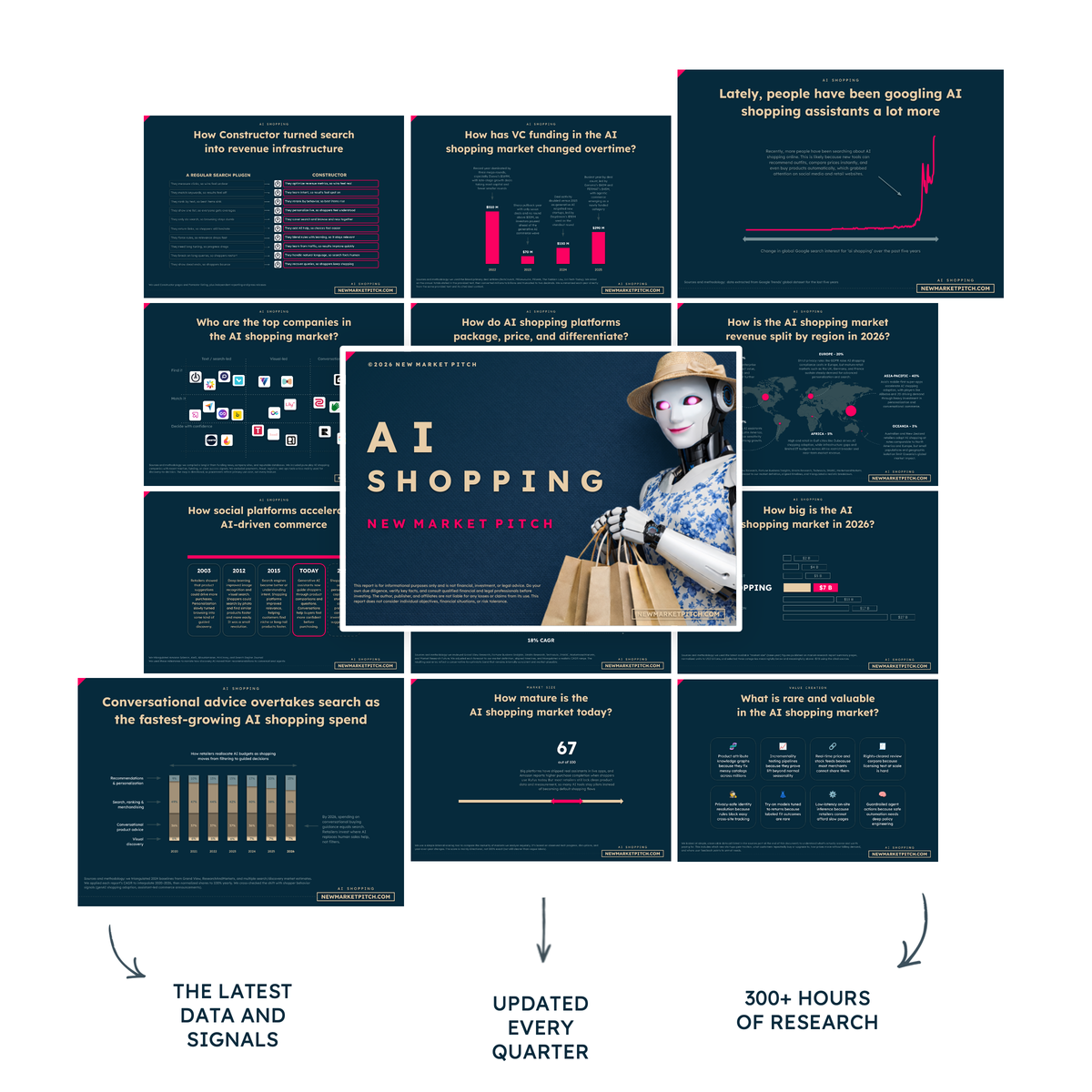
Whether you're building or investing in the AI shopping market, our report covers everything you need to know: the players, the money, and what's coming next.
Summary
Forerunner Ventures is our top investor in consumer AI shopping, while NewRoad Capital Partners has the strongest recent record of backing multiple specialist AI shopping startups. Index Ventures, Kleiner Perkins, Notable Capital and VMG Partners are also among the category's most important investors.
Forerunner's advantage goes beyond co-leading Daydream's $50 million seed round. It previously backed THE YES, founded by the same entrepreneur, Julie Bornstein, giving it a longer track record in personalized fashion shopping than most competing funds.
NewRoad is taking a different approach. Its leadership of Spangle's $15 million Series A and ReFiBuy's $13.6 million seed round gives it exposure to both storefront personalization and the infrastructure that helps products appear in AI shopping recommendations.
Kleiner Perkins has one of the clearest examples of sustained conviction. It backed Phia's $8 million seed round and returned for the $35 million Series A, which Notable Capital led after Phia reported more than one million users and 11-fold revenue growth.
The biggest investment rounds don't necessarily identify the biggest investors. Daydream raised $50 million and FERMÀT secured $45 million in Series B funding, but individual venture firms rarely disclose their actual contributions to those rounds.
Consumer applications and merchant-facing software are attracting different investors. Forerunner and Index are betting on new shopping destinations, while VMG, Bessemer, Gradient and NewRoad have backed technology that helps existing retailers sell more effectively.
AI shopping investment is becoming broader but less concentrated. Across the two twelve-month periods analyzed by New Market Pitch, deal counts increased from 31 to 32, while disclosed funding dropped by at least 37.6% and the median round fell from $4.50 million to $2.91 million.
Investors are increasingly financing the infrastructure behind AI-powered commerce. Recent deals involving Channel3, ReFiBuy and Malachyte suggest that making products discoverable and recommendations more accurate may be as valuable as building the shopping assistant consumers actually use.
Europe is becoming a more credible market for AI shopping investment. Recent European deal counts increased from five to twelve, with Systemiq Capital leading eComID's $17 million financing and Galion.exe repeatedly investing in conversational commerce.
Fashion remains the category's most visible consumer opportunity. Daydream, Phia, Doji and Alta announced a combined $118 million across selected rounds, reflecting investors' interest in solving product discovery, sizing, styling and price comparison.
The next test is commercial performance. Investors that backed businesses with repeat usage, measurable retailer sales and defensible product data will have a stronger position than those relying mainly on the excitement around AI shopping agents.

Written by the New Market Pitch teamWe track new markets so founders and investors can move faster. About us
Why are investors putting money into AI shopping startups now?
AI shopping is attracting major venture capital firms because AI assistants are starting to influence which products people discover, compare and buy online.
The shift became visible well before shopping agents were widely available. In June 2024, Forerunner Ventures and Index Ventures co-led Daydream's $50 million seed round to build a conversational fashion-shopping platform. In May 2025, Thrive Capital led Doji's $14 million financing for AI-powered virtual try-ons. Notable Capital later led Phia's $35 million Series A in January 2026, while Bessemer Venture Partners and Gradient Ventures co-led Malachyte's $10 million round in August.
These investors are backing quite different businesses. Daydream wants consumers to discover fashion through conversations instead of conventional search filters. Phia compares prices and shopping alternatives. Doji generates virtual try-on experiences, while Malachyte helps retailers personalize their own websites.
The common opportunity is control over product discovery. If shoppers increasingly ask AI assistants what to buy, the companies influencing those recommendations could become valuable intermediaries between consumers and retailers. Investors disagree on which businesses will capture that value, which explains why funding is spreading across consumer apps, retailer software and shopping infrastructure.
What counts as an AI shopping investor?
An AI shopping investor is a venture capital firm or strategic investor financing technology that directly helps people discover, compare, choose or purchase products using artificial intelligence.
We include consumer-facing shopping assistants such as Daydream, Phia and Onton, along with retailer-facing companies such as FERMÀT, Spangle and Remark. Product data businesses such as Channel3 and ReFiBuy also qualify because their software helps AI systems find and recommend merchandise.
This distinction changes the investor ranking. Forerunner Ventures and Index Ventures stand out in independent shopping assistants, while VMG Partners and NewRoad Capital Partners become more important when we include technology sold directly to retailers.
We exclude general-purpose AI model developers and ordinary e-commerce marketplaces unless the investment specifically concerns AI shopping technology. Otherwise, investors in OpenAI, Amazon or Shopify would dominate the comparison simply because those companies operate on a much larger scale.

In our report covering the AI shopping market, you will always find fresh funding data, taken straight from our own verified funding database.
Who are the biggest investors in AI shopping today?
Forerunner Ventures, Index Ventures, Kleiner Perkins, Notable Capital, NewRoad Capital Partners and VMG Partners are currently among the most prominent AI shopping investors, based on their disclosed lead investments, follow-on participation and the size of the rounds they have backed.
Forerunner and Index co-led Daydream's $50 million seed round. Kleiner Perkins backed Phia at seed stage and returned for its $35 million Series A, which Notable Capital led. NewRoad led Spangle's $15 million Series A in January 2026 and ReFiBuy's $13.6 million seed financing in May. VMG led FERMÀT's $45 million Series B in June 2025.
These transactions give us several ways to judge the investors. Forerunner and Index were willing to commit early to a large consumer-shopping idea. Kleiner Perkins demonstrated continued conviction through follow-on funding. NewRoad backed two separate companies, while VMG entered through a more mature commerce software business.
The amounts below represent total announced financing rounds. Startups generally do not disclose how much each investor contributed, so we cannot rank these firms accurately by their own dollars invested.
| Investor | AI shopping investments | Relevant announced financing | Main strength |
|---|---|---|---|
| Forerunner Ventures | Daydream | $50M seed, co-lead | Early consumer shopping |
| Index Ventures | Daydream | $50M seed, co-lead | Large early commitment |
| Kleiner Perkins | Phia | $8M seed; $35M Series A participation | Follow-on investing |
| Notable Capital | Phia | $35M Series A, lead | Consumer shopping growth |
| NewRoad Capital Partners | Spangle, ReFiBuy | $15M and $13.6M | Multiple specialist investments |
| VMG Partners | FERMÀT | $45M Series B, lead | Later-stage commerce software |
| Thrive Capital | Doji | $14M seed, lead | AI virtual try-ons |
| Bessemer Venture Partners | Malachyte | $10M round, co-lead | Retail personalization |
| Gradient Ventures | Malachyte | $10M round, co-lead | Retail AI software |
| Matrix | Channel3 | $6M seed, lead | Product data infrastructure |
Is Forerunner Ventures the top investor in AI shopping?
Forerunner Ventures is our strongest candidate for the leading consumer AI shopping investor because its Daydream investment builds on years of experience backing personalized commerce businesses.
Forerunner co-led Daydream's $50 million seed round with Index Ventures in June 2024. The company was founded by Julie Bornstein, who previously built THE YES, a personalized fashion-shopping startup acquired by Pinterest in 2022. Forerunner had also invested in THE YES.
That history makes the Daydream financing particularly interesting. Forerunner backed Bornstein's earlier attempt to improve fashion recommendations, saw that business acquired, and then supported her next company with a much larger initial financing. True Ventures, another Daydream investor, had also backed THE YES.
Daydream publicly launched in June 2025 with a conversational shopping experience covering products from more than 8,000 brands, according to its launch announcement. The company had therefore spent roughly a year building its product after announcing one of the category's biggest seed rounds.
Forerunner has a stronger claim to sector expertise than most funds appearing on a single AI shopping financing announcement. We still cannot establish that it has invested more money across the sector than every competing fund, and Daydream has not delivered an exit. Forerunner leads our ranking on conviction and relevant investing history rather than proven financial returns.
If you want more recent data on this point, please see our latest AI shopping market report.

In our research about AI shopping assistants, we turn what is vague and complex into simple, useful visuals. Market maps like this one show you at a glance where every startup stands.
Is Index Ventures as important as Forerunner in AI shopping?
Index Ventures deserves equal credit for leading Daydream's $50 million seed financing, although Forerunner has a more directly documented history with the company's founder and her earlier shopping businesses.
Both firms were named co-leads in June 2024, with GV and True Ventures also participating. The financing came approximately one year before Daydream's public launch, making it a substantial investment before the company had established broad consumer adoption.
Index's position matters because a $50 million seed round is far larger than the typical financing in this sector. According to New Market Pitch's September 2026 analysis, the median AI shopping round in the latest twelve-month period was $2.91 million. Daydream's original financing was more than 17 times that amount, although the two figures cover different periods and financing stages.
The available investment records show a major early bet by Index. They do not demonstrate the same repeated involvement in personalized shopping founders that we can trace through Forerunner's investments in THE YES and Daydream.
For a ranking based solely on the Daydream transaction, the firms stand together. Forerunner moves ahead when we consider its longer history in the specific type of shopping business Daydream is building.
Is Kleiner Perkins building a stronger AI shopping portfolio through Phia?
Kleiner Perkins has one of the clearest records of continued investment in a fast-growing AI shopping startup, having backed Phia before its major Series A and participated again after the company gained traction.
Phia announced an $8 million seed round in September 2025. Four months later, the company raised $35 million in a Series A led by Notable Capital, with Kleiner Perkins returning alongside Khosla Ventures.
The second round was approximately 4.4 times larger than the first. Phia reported more than one million users, over 6,200 retail brand relationships and 11-fold revenue growth since launching in April 2025. These figures came from Phia's January 2026 financing announcement; the company did not disclose the underlying revenue amounts.
The investor group also includes high-profile individuals associated with fashion and consumer brands. Reporting by Forbes identified backers such as Kris Jenner, Sara Blakely and Hailey Bieber. Those relationships may help with visibility and introductions, although individual investment amounts have not been disclosed.
Kleiner Perkins' stronger claim comes from its financing history. It backed Phia early and remained involved when another venture firm led a substantially larger round. That's more convincing evidence of sustained interest than appearing once in a long list of investors.
If you want more recent data on this point, please see our latest AI shopping market report.

In our market report about AI shopping assistants, we always try to gather several sources and make estimates that make sense, so you can work with solid numbers.
Is Notable Capital becoming the leading investor in consumer AI shopping?
Notable Capital has quickly become one of the leading investors in consumer AI shopping after leading Phia's $35 million Series A at a $185 million valuation.
The January 2026 financing brought Phia's announced cumulative funding to approximately $43 million. Its shopping assistant helps consumers compare fashion products and prices across retailers and resale marketplaces, making the business directly dependent on how people research purchases.
Phia had already reported more than one million users by the time of the Series A. According to the company's announcement, its platform was generating millions of dollars in monthly sales for partner brands and had recorded 11-fold revenue growth since launch.
Those figures help explain why Notable committed to the business. Phia could point to actual shopping activity, brand relationships and user adoption, although the announcement did not provide enough information to independently assess revenue quality or profitability.
The financing also illustrates how venture capital firms are approaching successful consumer shopping applications. Kleiner Perkins backed Phia at seed stage, while Notable took the lead when the business had stronger evidence of demand.
Notable is a serious contender for leadership in consumer AI shopping. Its disclosed position remains concentrated in Phia, so we would rank it behind Forerunner's longer commerce history and Kleiner Perkins' demonstrated follow-on involvement when judging overall experience.
Which AI shopping investors have backed more than one startup?
NewRoad Capital Partners stands out among AI shopping investors for backing multiple distinct companies, while Galion.exe has also appeared repeatedly in conversational commerce.
NewRoad led Spangle's $15 million Series A in January 2026 and ReFiBuy's $13.6 million financing in May. Spangle uses AI to personalize storefronts based on shopper behavior. ReFiBuy helps retailers prepare and improve their product catalogs so AI shopping agents can discover and recommend their merchandise accurately.
The combined announced financing for these two transactions was $28.6 million. That is the total funding raised by the companies in those rounds, not the amount NewRoad invested itself.
Galion.exe appeared in Dialog's $4.4 million financing in November 2025 and Lemrock's approximately $7 million round in March 2026. These investments also focus on connecting conversational AI with products and shopping experiences.
The repetition is worth examining. New Market Pitch's September 2026 funding analysis identified 35 distinct disclosed lead investors in the latest twelve-month period, compared with 33 previously. Only two investors appeared as lead more than once in the recent period: NewRoad and Galion.exe.
NewRoad therefore deserves particular attention from anyone trying to identify specialist AI shopping investors rather than funds that participated in one high-profile round. Among the investors in our comparison, it has the clearest recent record of leading financings across separate AI shopping infrastructure companies.
If you want more recent data on this point, please see our latest AI shopping market report.

Our document detailing everything you need to know about AI shopping gets updated several times a month, so you always get the latest view of where things stand.
Are AI shopping investors writing their biggest checks for consumer apps?
Consumer AI shopping startups have attracted some exceptionally large seed rounds, but established retailer-facing software companies have also raised tens of millions of dollars.
Daydream raised $50 million in its 2024 seed round. Gensmo disclosed more than $60 million in seed funding during 2025, without enough detail to rank its individual investors by contribution. Phia raised $35 million in its January 2026 Series A.
Merchant-facing companies have produced similarly meaningful financings at later stages. FERMÀT raised $45 million in Series B funding led by VMG Partners in June 2025. Cimulate raised $28 million in December 2024 with Spark Capital as lead investor, while Remark announced a $16 million Series A led by Inspired Capital in July 2025.
These transactions reveal different risk profiles. Daydream attracted a large amount of capital before launching publicly. FERMÀT raised its largest round after developing relationships with established retailers and completing earlier funding rounds.
We cannot conclude that consumer AI shopping consistently attracts more capital without comparing every deal by category and stage. The examples do show that investors are prepared to finance both independent shopping experiences and software that improves retailers' existing sales channels.
Is VMG Partners the biggest backer of AI shopping software?
VMG Partners is one of the strongest identifiable investors in merchant-facing AI shopping software, thanks to its leadership of FERMÀT's $45 million Series B.
FERMÀT had already completed a $12 million seed round in September 2022 and a $17 million Series A in March 2024. Adding the June 2025 Series B brings those three announced rounds to $74 million.
The company's investor base developed alongside its business. Greylock, QED Investors and Courtside Ventures participated at seed stage, Bain Capital Ventures was associated with the Series A, and VMG led the Series B.
FERMÀT builds personalized shopping experiences for retailers and brands. Its disclosed customers include Glossier, BISSELL, GNC and ILIA Beauty. These are commercial relationships with established brands, giving investors more to evaluate than product demonstrations or consumer sign-ups.
VMG's investment came after FERMÀT had already secured earlier funding and begun building a customer base. That's a different proposition from Daydream's or Doji's seed rounds, where investors were taking earlier bets on consumer behavior.
Among specialist merchant-facing AI shopping companies, FERMÀT is one of the clearest examples of meaningful later-stage financing. VMG consequently deserves a leading position in that part of the market.
If you want more recent data on this point, please see our latest AI shopping market report.

In our report covering the AI shopping market, we look at what the winners do differently, so you can learn from the best instead of guessing.
Are AI shopping investors still funding startups before they prove demand?
AI shopping investors still finance products before they have many users, but several of the larger recent rounds have followed measurable commercial progress.
Daydream's $50 million seed financing came before its public beta. Doji raised $14 million in May 2025 shortly after launching its AI-avatar shopping application. Those investors committed significant capital while the products were still at an early stage.
Phia presented a different case when it raised $35 million in January 2026. The company already reported more than one million users and thousands of retail brand relationships.
Spangle's $15 million Series A also followed earlier financing and product development. The company's valuation moved from approximately $30 million pre-money at seed stage to $100 million post-money at Series A, according to its disclosed financing history.
In August 2026, eComID announced a $17 million seed financing while reporting relationships with more than 60 brands and access to shopping interactions involving 20 million consumers monthly. That last figure measures shoppers reached through connected brands, rather than registered eComID users.
The examples show that funding is available at different levels of maturity. Investors can still be persuaded by an ambitious idea, but companies raising larger follow-on rounds increasingly have adoption, commercial relationships or product usage to support their claims.
Has AI shopping funding slowed down despite all the investor interest?
AI shopping funding has slowed sharply in dollar terms, even though the number of startups securing investment has barely changed.
In its September 2026 funding analysis, New Market Pitch counted 32 financings in the latest twelve-month period against 31 in the preceding period. Both periods contained 31 funded companies.
The amount raised tells a different story. Disclosed financing fell from at least $291.2 million to $181.8 million, a decline of at least 37.6%. The median round decreased from $4.50 million to $2.91 million, or 35.3%.
One unusually large transaction affected the comparison: Gensmo disclosed more than $60 million in financing during the earlier period. We can remove every deal above $50 million from both periods to reduce that distortion. Even then, the latest period shows 21.4% less disclosed capital.
The change is particularly visible in bigger transactions. The earlier period had four rounds above $20 million, while the latest contained only Phia's $35 million Series A above that threshold. There were also no verified Series B deals in the latest period, compared with two totaling $70 million previously.
Investors are still backing AI shopping startups. What has become much harder is raising a large round. The number of completed deals has remained stable, but capital is being spread across smaller financings.
| Metric | Previous 12 months | Latest 12 months | Change |
|---|---|---|---|
| Financing rounds | 31 | 32 | +3.2% |
| Funded companies | 31 | 31 | 0% |
| Disclosed funding | ≥$291.2M | $181.8M | At least -37.6% |
| Median round | $4.50M | $2.91M | -35.3% |
| Average round | ≥$9.39M | $5.68M | At least -39.5% |
| First financings | 13 | 12 | -7.7% |
| Follow-on financings | 18 | 20 | +11.1% |
| Verified Series B rounds | 2 | 0 | -2 |
| Disclosed lead investors | 33 distinct | 35 distinct | +2 |

In our research about AI shopping assistants, we don't want to repeat what boring consulting reports say. Instead, we show you the real and latest market signals that matter.
Are AI shopping investors moving away from consumer apps?
AI shopping investors are now financing more companies that help retailers appear in AI recommendations and personalize their stores, although consumer-facing shopping assistants are still attracting money.
Matrix led Channel3's $6 million seed financing in December 2025. The company builds product data infrastructure for AI search and shopping agents. NewRoad led ReFiBuy's $13.6 million financing in May 2026 to expand technology that helps brands make their products discoverable by AI.
Bessemer Venture Partners and Gradient Ventures co-led Malachyte's $10 million round in August 2026. Gradient's investment announcement explained that Malachyte uses real-time behavioral data to improve product recommendations within shopping experiences.
This growing interest also appears in broader funding data. New Market Pitch's September 2026 category analysis counted nine recent financings in AI merchandising tools, compared with three in the previous comparable period. The same analysis found four current financings in commerce decision support, compared with one previously.
Businesses such as Channel3 and ReFiBuy can potentially sell services to multiple retailers and shopping platforms without needing to become a popular consumer destination themselves.
The risk is that retailers, e-commerce platforms and major AI providers may develop similar capabilities internally. Still, the recent mix of funded companies shows investors are exploring more ways to make money from AI shopping than building another consumer assistant.
Which venture capital firms are leading AI shopping investment in Europe?
Systemiq Capital and Galion.exe are among the most visible AI shopping investors in Europe, with investments focused on personalized shopping data and conversational commerce.
Systemiq led Stockholm-based eComID's $17 million seed round in August 2026. Regeneration.VC, Course Corrected, Stadium and returning investor CapitalT also participated.
eComID develops a Shopping Passport that allows consumers' sizes, fit preferences and tastes to be used across participating retailers. At the time of its financing, the company reported relationships with more than 60 brands and monthly reach across 20 million shoppers.
Galion.exe has backed Dialog and Lemrock, two companies building technology for conversational shopping and AI-accessible product catalogs. Their announced financings were $4.4 million in November 2025 and approximately $7 million in March 2026, respectively.
Europe's growing presence is measurable. New Market Pitch counted twelve European AI shopping deals in the latest twelve-month period, compared with five previously. Disclosed European funding rose from approximately $9.2 million to $53.3 million, an increase of roughly 5.8 times.
That's a substantial increase, although the earlier funding base was relatively small. European investors are becoming more relevant to the AI shopping race, especially in technology designed to work across existing retailers.

Learning from others' mistakes is the cheapest lesson there is. In our market report about AI shopping assistants, we look at what broke startups before you, so you don't repeat it.
Are retailers themselves investing in AI shopping startups?
Retailers and corporate venture investors are participating in AI shopping financings, particularly when a startup's technology could improve product recommendations, customer relationships or conversion.
H&M Group backed eComID before the company's $17 million seed round. Stadium, which was already an early customer, also participated in that financing. The combination is interesting because both businesses have direct experience with the shopping problems eComID is trying to solve.
Corporate venture investors appear elsewhere in the market. GV participated in Daydream's $50 million seed financing, eBay Ventures backed Phia, and Stripe participated in Remark's $16 million Series A.
These investments do not all represent the same level of commercial involvement. A corporate venture fund may invest for financial reasons without creating a major product integration or distribution agreement.
Stadium's relationship with eComID is more concrete because the company was both a customer and an investor. That gives us evidence of commercial interest alongside the equity investment.
For AI shopping startups, such relationships can be valuable if they provide access to product catalogs, retailer expertise and actual customer behavior. But we would need disclosed contract values or adoption figures to determine how much commercial advantage those investor relationships have produced.
Why are AI shopping investors putting so much money into fashion?
Fashion attracts substantial AI shopping investment because consumers frequently struggle with product discovery, fit, personal taste and comparing prices across retailers.
Daydream's $50 million seed round targeted conversational fashion discovery. Phia raised approximately $43 million across its seed and Series A financings for price comparison and shopping recommendations. Doji raised $14 million for AI-powered virtual try-ons, while Alta secured $11 million in June 2025 for personalized wardrobe and styling technology.
Those four companies announced $118 million across the specified financings. This is a selected sample, rather than a complete estimate of funding for fashion-focused AI shopping businesses.
Fashion also offers several different opportunities. Daydream helps shoppers discover products they may not know how to search for. Phia compares prices and alternatives, including resale products. Doji tackles the difficulty of imagining how clothing will look on a particular person.
These problems give AI shopping startups more to work with than conventional product searches based on brand, category and price.
The investment opportunity extends to other retail categories through businesses such as Remark, Spangle and Channel3. Yet fashion remains one of the most visible areas for consumer AI shopping investment, with several of the sector's largest early financings tied to it.

If you build or invest in the AI shopping market, you need to know which business models pay off now and which ones are fading. That's why our report covering it has a whole section on it.
Can AI shopping startups make money without handling the purchase?
AI shopping startups can build valuable businesses around product discovery without processing the final payment, but investors still need evidence that recommendations generate lasting revenue.
Daydream helps consumers find fashion products across brands. Phia compares listings and prices across retailers and resale marketplaces. Onton, which raised $7.5 million led by Footwork in November 2025, offers AI-powered product search and discovery.
Channel3 approaches the problem from the infrastructure side, organizing product information so shopping agents can recommend merchandise accurately.
These companies could earn money through different arrangements, including referral payments, retailer partnerships and software subscriptions. The available public disclosures do not establish that every one of these models is already profitable or that any particular model will dominate.
The question becomes more difficult as major AI companies build shopping features into their own products. Independent assistants will need to persuade consumers that their recommendations are better, while infrastructure providers must convince retailers that their services produce enough additional sales to justify paying for them.
For investors, the strongest businesses will be those able to show a reliable connection between AI recommendations, completed purchases and revenue they can retain.
Who are the top investors in AI shopping overall?
Forerunner Ventures is our top choice for consumer AI shopping investment, while NewRoad Capital Partners has the strongest evidence of repeated specialist investments across different AI shopping companies.
Forerunner earns first place through its early backing of Daydream, its relationship with founder Julie Bornstein and its previous investment in THE YES. Index Ventures deserves equal recognition for co-leading Daydream's $50 million seed round, but Forerunner has the more directly relevant history in personalized commerce.
Kleiner Perkins follows closely through Phia, having participated before the company's $35 million Series A and returned as the business grew. Notable Capital deserves recognition for leading that financing, while VMG Partners stands out for leading FERMÀT's $45 million Series B in merchant-facing shopping software.
NewRoad offers the clearest example of repeated investment across different companies. Its leadership of Spangle's $15 million Series A and ReFiBuy's $13.6 million seed round shows interest in both storefront personalization and product discovery infrastructure.
Several other investors could become much more important. Bessemer Venture Partners and Gradient Ventures have backed Malachyte, Systemiq Capital has led eComID's financing, and Matrix has invested in Channel3.
We cannot establish a definitive winner by capital deployed or investment returns because individual check sizes and realized performance are not publicly available. Our ranking reflects documented activity, investor leadership, repeated participation and the commercial relevance of the startups financed.
For now, Forerunner leads in consumer AI shopping, NewRoad stands out for specialist portfolio breadth, and VMG is a major investor in later-stage retail AI software. The next few years should reveal which approach creates the most valuable businesses: independent shopping assistants that attract consumers directly or technology providers helping retailers sell through AI.
If you want more recent data on this point, please see our latest AI shopping market report.

In our report covering the AI shopping market, we like to show you the big picture. We know your time is precious, so we make every page quick to read and packed with as much learning as possible per minute.
Our methodology
This analysis identifies the leading investors in AI shopping based on disclosed financing activity, investment leadership, portfolio breadth, follow-on participation and relevant sector experience. We include consumer shopping assistants, retailer-facing AI commerce software and infrastructure directly supporting AI-powered product discovery, recommendations and purchasing.
We evaluated investors across several dimensions rather than ranking them solely by the financing rounds in which they participated. Lead and co-lead positions received particular attention, as did repeated investments in separate startups, participation across financing stages and earlier investments in related commerce businesses.
We also examined the commercial progress of the companies receiving investment. Consumer adoption, retailer relationships, reported revenue growth and product deployments were considered in the context of each startup's business model and maturity. Company-reported metrics were treated as disclosures rather than independently audited financial performance.
Announced financing amounts represent the full capital raised in each round, not the amount contributed by a particular investor. We therefore do not equate a $50 million financing co-led by two funds with a $50 million individual investment by either fund. The ranking is based on documented commitment and sector activity rather than estimated capital deployed or realized investment returns.
To evaluate broader funding patterns, we used New Market Pitch's September 2026 AI shopping funding analyses, comparing two consecutive twelve-month periods by financing volume, disclosed capital, median round size, investment stage, lead investor activity, business category and geography. We also examined the effect of transactions exceeding $50 million to distinguish changes in underlying funding activity from the influence of unusually large rounds.
We prioritized original company financing announcements, investor disclosures and established technology reporting. We excluded general-purpose AI investments and conventional e-commerce businesses without a direct AI shopping focus. When funding data was undisclosed or reported as a minimum, we preserved those limitations rather than assigning an estimated amount.
Key company and investor sources include Daydream's $50 million seed announcement, Daydream's official product information, Pinterest's acquisition of THE YES, Phia's Series A announcement, ReFiBuy's financing announcement, FERMÀT's Series B announcement, Gradient Ventures' investment thesis on Malachyte, Systemiq Capital's eComID investment briefing, Remark's Series A announcement, Onton's financing announcement, and Alta's seed announcement.
Additional transaction reporting comes from Channel3's seed financing release, TechCrunch on Spangle's Series A, TechCrunch on Doji, TechCrunch on Malachyte, and EU-Startups on eComID's investors. The aggregate financing comparisons are based on New Market Pitch's AI shopping funding analysis and its quarterly funding trends report. These two market analyses are used as the basis for the reported funding totals and category comparisons, rather than as independent corroboration of each other.

When you build or invest in the AI shopping market, you need clarity, not confusion. In our research about AI shopping assistants, we always try to put numbers on and quantify whatever is usually vague and confusing.
Written by the New Market Pitch teamWe track new markets so founders and investors can move faster. About us