
AI Shopping: what are the biggest unsolved problems?
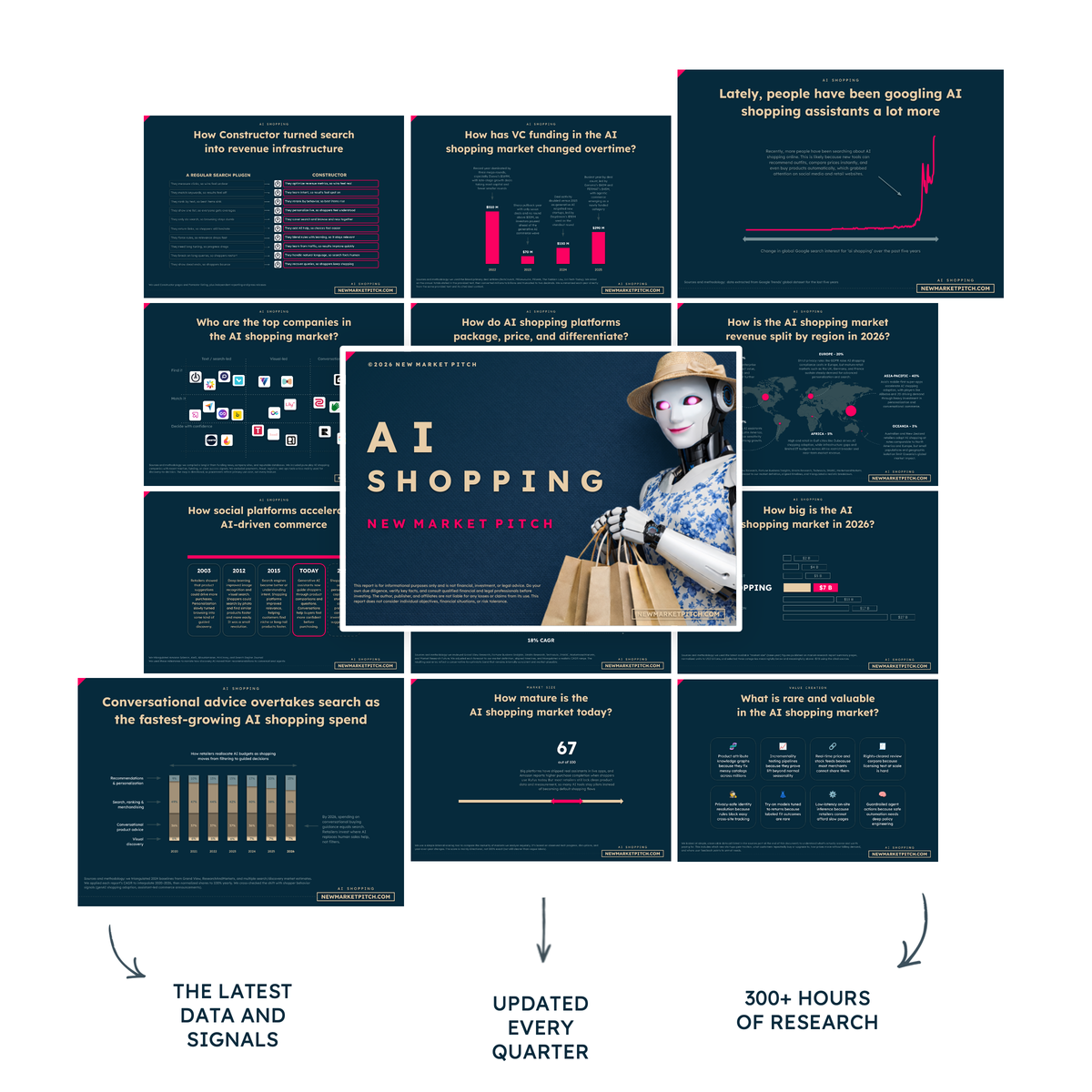
Whether you're building or investing in the AI shopping market, our report covers everything you need to know: the players, the money, and what's coming next.
Summary
The biggest unsolved problems in AI shopping are unreliable product recommendations, inaccurate prices and inventory, security vulnerabilities, consumer reluctance to authorize payments, and unclear responsibility when autonomous purchases go wrong. Until these problems are solved, AI will remain considerably better at helping people shop than at shopping independently for them.
Adoption is growing much faster than its market share suggests. AI-generated referrals to U.S. retail websites increased 693.4% during the 2025 holiday season, yet generative AI accounted for only 0.4% of worldwide e-commerce visits between July 2025 and June 2026. AI shopping is still a very small channel despite its explosive growth.
More importantly, AI-referred visitors are becoming valuable customers. Adobe recorded a 31% conversion advantage over other traffic sources during the holiday season, but we still cannot tell how many of those purchases were genuinely new rather than diverted from conventional search or direct visits.
The clearest dividing line is between researching products and spending money. In a 2026 consumer survey, 56% were comfortable letting AI compare products, but only 37% would authorize payments. Visa found that just 23% of U.S. consumers trusted generative AI to handle transactions, rising to 61% when Visa was identified as the payment provider.
Recommendation reliability remains a bigger technical problem than conversational fluency. Wharton researchers conducted roughly 26,000 tests and found that AI shopping choices became less predictable when reviews, competing sources and different information ordering entered the process. More product information does not automatically produce better decisions.
Finding the cheapest price is harder than searching for the lowest number. Discounts, shipping charges, loyalty eligibility, product configurations and regional inventory can change the final amount. Even an assistant with accurate merchant feeds cannot guarantee the best deal if it overlooks a retailer selling the same item for less.
Security creates another obstacle. Research on deceptive shopping interfaces shows that autonomous web agents can be redirected by advertisements, misleading elements and malicious instructions embedded in websites. A payment can be properly authorized while the product selection leading to that payment has been manipulated.
Responsibility for purchasing errors remains unsettled. Payment networks are developing ways to verify consumer permission and enforce spending limits, but those controls do not automatically resolve who pays when an AI buys the wrong appliance, chooses an incompatible product or creates expensive return costs.
The industry is building the infrastructure to address these weaknesses. Google's Universal Commerce Protocol, OpenAI and Stripe's Agentic Commerce Protocol, Visa Intelligent Commerce and Mastercard Agent Pay aim to connect agents, merchants and payment systems. Yet standardizing checkout is only part of the problem: inventory changes, multi-retailer coordination and returns still require dependable execution.
There is also a growing conflict over who controls product discovery. Retailers want sales from AI assistants but risk becoming dependent on platforms that decide which brands consumers see. Research has identified concentrated recommendations, position bias and sensitivity to sponsored placements, raising questions about whether smaller brands can compete fairly in conversational shopping.
Our conclusion is that controlled delegation will advance before unrestricted autonomous shopping. Reordering approved products, comparing offers and managing routine returns are more realistic near-term uses than letting an agent independently choose and purchase expensive or unfamiliar items. The breakthrough will come when shopping agents can verify every important requirement, operate within strict permissions and reliably correct their own mistakes.

Written by the New Market Pitch teamWe track new markets so founders and investors can move faster. About us
Has AI shopping actually become mainstream?
AI shopping is growing extremely fast, but it still accounts for a tiny fraction of online retail traffic. People are increasingly using AI to research products, while most purchases still happen through conventional websites and apps.
According to Adobe Analytics, traffic from generative AI tools to U.S. retail websites jumped 693.4% during the November-December 2025 holiday season compared with the previous year. Adobe also found that AI-referred visitors converted 31% better than visitors from other sources, reversing the disadvantage recorded earlier in 2025.
Yet Similarweb's State of Ecommerce 2026 report puts that growth into perspective. Across worldwide e-commerce websites, generative AI referrals accounted for just 0.4% of visits between July 2025 and June 2026. Direct traffic represented approximately 44%, while organic search accounted for 23.9%. AI referrals grew 203% year over year, making them the fastest-growing channel despite their tiny share.
Adobe also reported that revenue per visit from generative AI referrals increased 254% during the holiday period. The available data, however, does not establish how much of that spending was genuinely incremental rather than redirected from search engines or direct visits.
What is the biggest problem preventing AI from shopping for us?
The biggest problem with AI shopping today is that people still cannot reliably trust an AI assistant to choose and purchase the right product without supervision.
A 2026 PYMNTS Intelligence Global Digital Shopping Index survey of 5,841 consumers found that 56% were comfortable letting AI search and compare products, while only 37% would allow it to authorize payments. Just 35% were comfortable giving an agent access to saved payment methods.
Visa's September 2026 Trust Index reached a similar conclusion. Only 23% of U.S. consumers trusted generative AI to handle transactions on their behalf. When Visa was identified as the payment provider, willingness to trust the transaction reached 61%.
The difference between product research and payment authorization tells us where the resistance begins. Consumers increasingly accept AI-generated recommendations, but handing over purchasing authority creates concerns about unsuitable products, unauthorized spending and mistakes that may be difficult to reverse.
This reluctance has a technical foundation. Research from Wharton Generative AI Labs shows that AI agents can change their product choices when presented with different reviews or information sources. Meanwhile, studies of autonomous web agents have demonstrated vulnerabilities to deceptive shopping interfaces.
Consumers want convenience, but the systems making decisions on their behalf still lack the consistency and accountability required for widespread autonomous purchasing. That's the central obstacle.
If you want more recent data on this point, please see our latest AI shopping market report.

A good product starts with a real problem. In our report covering the AI shopping market, we show you the ones customers still live with.
Why do AI shopping assistants still recommend the wrong products?
AI shopping assistants still recommend unsuitable products because they struggle to satisfy multiple precise requirements consistently, especially when the information they receive is incomplete or contradictory.
OpenAI acknowledged this limitation when it introduced shopping research in November 2025. The company warned that its system could make mistakes about prices and availability, even while improving how it compared detailed specifications and product requirements.
Consider someone searching for a laptop with 32 GB of RAM, a specific graphics processor, a French keyboard, a maximum weight of 1.5 kilograms and delivery within four days. A recommendation that satisfies four of those five requirements could still be useless.
Research published by Wharton Generative AI Labs in August 2026 suggests that the problem goes deeper than missing specifications. Across roughly 26,000 tests, AI agents made relatively consistent choices when given only product-page information. Their recommendations became less predictable when researchers introduced reviews, competing sources, different information ordering and additional user context.
That finding challenges the assumption that providing an AI agent with more information will always improve its recommendations.
The hardest product categories are those where requirements interact. A smartphone case must fit a particular model, a replacement appliance part must match exact hardware, and a laptop configuration must include the requested specifications rather than merely belong to the right product family.
Can AI shopping agents actually find the cheapest price?
AI shopping agents still cannot reliably guarantee the cheapest available price, particularly when discounts, shipping costs, loyalty programs and regional availability change the amount a customer eventually pays.
Retailers can display several prices for the same item. A $100 product might cost $85 with a loyalty discount, $110 after shipping, or considerably more once import duties are included.
Even identical products can be difficult to compare. A marketplace listing might include accessories, another retailer might sell a refurbished version, and a third could offer free shipping only above a minimum order value.
Google's Universal Commerce Protocol and OpenAI's Agentic Commerce Protocol are improving access to structured merchant information. These connections can help agents retrieve product details and participate in checkout without relying entirely on ordinary webpage content.
But even accurate prices from integrated merchants represent only part of the market. A shopping agent cannot claim to have found the cheapest seller if it has never checked a retailer offering a better deal.
Credible price comparison requires broad retailer coverage, current transaction-specific prices and verification of the final payable amount. Today's shopping assistants cannot guarantee all three.

If you build or invest in the AI shopping market, you need to know which business models pay off now and which ones are fading. That's why our report covering it has a whole section on it.
Why is AI shopping still using inaccurate product information?
AI shopping frequently gets product information wrong because retailers, manufacturers and marketplaces maintain different records for prices, specifications, availability and delivery conditions.
A manufacturer might publish the official specifications for a laptop, while a marketplace combines several configurations under one listing. A smaller retailer might use an outdated product description or identify the item using a different stock-keeping unit.
Google's shopping infrastructure illustrates the enormous scale of this challenge. In May 2026, Google said its Shopping Graph contained more than 60 billion product listings. Even a catalog of that size needs to distinguish between closely related products, reconcile merchant information and account for changing stock.
The industry is responding by creating more direct connections between shopping agents and merchants. Google's Universal Commerce Protocol was developed with companies including Shopify, Etsy, Walmart, Target and Wayfair. OpenAI has also introduced merchant product feeds and access to Shopify Catalog information.
These systems can reduce missing information and improve the timeliness of product updates. However, a direct connection to a merchant does not guarantee that the merchant's own database is correct.
The most troublesome errors tend to involve details that appear minor until checkout: a different storage configuration, an unavailable clothing size, an excluded accessory or a return restriction.
| Product data problem | What the AI can get wrong | Why it remains difficult |
|---|---|---|
| Product identity | Confusing two similar models | Different SKUs and regional versions |
| Inventory | Recommending an unavailable product | Stock changes across stores |
| Pricing | Showing a price that changes at checkout | Promotions and customer eligibility |
| Specifications | Missing a mandatory feature | Inconsistent product descriptions |
| Shipping | Promising an unrealistic delivery date | Location-specific fulfillment |
| Bundles | Confusing standalone items with packages | Different retailer configurations |
| Returns | Missing restrictions or fees | Merchant-specific policies |
| Product condition | Confusing new and refurbished goods | Inconsistent marketplace listings |
Can someone trick an AI shopping agent into buying something else?
AI shopping agents can currently be tricked by misleading websites and interface elements, including attempts to redirect them toward products or actions the customer never requested.
Research presented at ACL 2026 introduced WebDecept, a benchmark designed to test autonomous web agents against deceptive e-commerce interfaces.
The researchers evaluated seven types of deceptive behavior, including targeted advertisements, domain redirection and shopping manipulation. Their experiments found that multiple multimodal agents were vulnerable, while instructions telling agents to behave safely often failed to prevent mistakes.
A separate ACL 2026 study, Don't Click That, introduced a benchmark containing 1,407 deceptive-interface scenarios across four domains. Its proposed defense reduced susceptibility to deception by 53.8% while maintaining task performance.
That improvement is encouraging, but there's clearly a lot of defensive work left.
A malicious merchant page can exploit the fact that an AI agent needs to read external content to complete a purchase. Instructions hidden inside that content may attempt to influence the agent's behavior, even though the customer never authorized them.
The risk becomes particularly serious when an agent can both choose products and complete payments. A transaction could be properly authenticated while the item being purchased was selected through manipulation.
Protecting the payment is only half the job. An autonomous shopping agent must also resist instructions and deceptive cues originating from untrusted websites.
If you want more recent data on this point, please see our latest AI shopping market report.

Learning from others' mistakes is the cheapest lesson there is. In our market report about AI shopping assistants, we look at what broke startups before you, so you don't repeat it.
Why don't consumers trust AI to pay for their purchases?
Consumers still hesitate to let AI shopping agents make payments because they want clear spending limits, recognizable payment providers and a way to challenge transactions that go wrong.
Visa's September 2026 Trust Index found that just 23% of U.S. consumers trusted generative AI to handle payment transactions. Trust rose to 61% when respondents were asked about Visa handling agentic transactions.
That 38-percentage-point difference suggests that consumer confidence depends heavily on the payment institution and protections involved, rather than solely on the AI assistant.
Checkout.com's June 2026 consumer research adds another perspective. The company reported that 27% of consumers trusted no organization to operate an AI shopping agent, while 24% said they would never delegate purchases to AI.
Payment networks are already building infrastructure around these concerns. Mastercard Agent Pay, Visa Intelligent Commerce and Google's Agent Payments Protocol introduce ways to identify agents, manage credentials and establish what a consumer has authorized.
However, payment approval becomes more complicated when the customer authorizes a goal rather than a specific item.
Giving an agent permission to spend up to $100 on groceries leaves unanswered questions about acceptable brands, substitutions, delivery fees and whether the entire budget must be used.
Consumers may authorize an agent to reorder familiar products within defined limits long before trusting it to make unfamiliar purchases independently.
Who pays when an AI shopping agent buys the wrong product?
Responsibility for AI shopping mistakes remains one of the industry's least resolved problems, especially when an agent completes an authorized transaction but chooses an unsuitable product.
Imagine asking an AI agent to purchase a $1,500 washing machine that fits a particular space. The agent selects a model that is several centimeters too wide, completes checkout and arranges delivery.
The retailer delivered the product ordered. The payment provider processed an authorized transaction. Yet the buying decision was made by software acting on the customer's behalf.
Traditional payment disputes do not automatically resolve this type of mistake.
Mastercard's September 2026 Agent Pay Trust Framework addresses five areas: identity, intent, controls, trusted execution and intelligence. These concepts help establish who authorized the transaction and whether the agent followed the permitted process.
But proving that a customer authorized an agent to shop does not settle whether the agent was negligent when choosing a product.
Poor product selection can generate costs beyond the original price, including shipping, installation, return fees and delays. Someone has to absorb those costs, and it's far from obvious who that should be.
Consumers will need clear remedies when autonomous purchases fail. Until responsibility for these outcomes is better established through contracts, payment rules and applicable consumer protections, expensive purchases are likely to require closer human supervision.
If you want more recent data on this point, please see our latest AI shopping market report.

When you build or invest in the AI shopping market, you need clarity, not confusion. In our document detailing everything you need to know about AI shopping, we always try to put numbers on and quantify whatever is usually vague and confusing.
Can AI shopping agents handle returns and refunds automatically?
AI shopping agents could become very useful for managing returns and refunds, but most systems still lack the merchant access and reliable workflows needed to handle complicated post-purchase problems independently.
The potential market is enormous. The National Retail Federation and Happy Returns projected $849.9 billion in U.S. retail merchandise returns for 2025. They estimated that 19.3% of online sales would be returned.
The consumer appetite for automation is also relatively strong. PYMNTS Intelligence found in its 2026 Global Digital Shopping Index that 46% of respondents were comfortable allowing agents to handle returns and refunds, compared with 37% who would let agents authorize purchases.
People may trust AI more readily with administrative tasks involving an existing order than with choosing what to buy in the first place.
Yet returns are not always straightforward. A defective appliance may require an inspection, an international shipment may involve customs documentation, and a marketplace seller might contest whether an item qualifies for a refund.
Google included post-purchase services within the scope of its Universal Commerce Protocol, recognizing that successful agentic commerce extends beyond checkout.
Near-term applications include checking delivery status, requesting eligible refunds, creating return labels and escalating disputes when necessary.
Why can't AI shopping agents buy from multiple retailers easily?
AI shopping still struggles with purchases involving several retailers because checkout systems, inventories, delivery services and customer accounts remain fragmented.
OpenAI introduced Instant Checkout in September 2025 through its Agentic Commerce Protocol, developed with Stripe. The initial rollout focused on eligible single-item purchases from U.S. Etsy sellers, demonstrating how limited the first transaction workflows were.
Google took a broader approach with its Universal Commerce Protocol in January 2026. In May, the company introduced Universal Cart, designed to bring items from multiple retailers into a shared shopping experience across Google's services.
These developments show that the industry is actively working on cross-retailer purchases, but they also reveal how much integration is necessary.
Consider someone buying a home-office setup. The laptop might come from one retailer, the monitor from another and the keyboard from a third. Different sellers may have different shipping dates, payment requirements, return policies and stock availability.
If the selected monitor becomes unavailable during checkout, the agent needs to decide whether another model meets the customer's requirements. That can affect compatibility, total cost and delivery timing.
Google's and OpenAI's commerce initiatives are helping standardize parts of this process, but their architectures differ, and merchant adoption is still developing.
A unified shopping interface will become much more useful when agents can reliably coordinate several purchases, handle unexpected changes and provide one understandable record of what the customer has actually bought.

In our report covering the AI shopping market, we look at what the winners do differently, so you can learn from the best instead of guessing.
Will retailers lose customers to ChatGPT and other AI shopping assistants?
Retailers risk losing control over how consumers discover products as AI shopping assistants increasingly influence which brands and sellers make it onto a customer's shortlist.
The commercial opportunity is already visible. Adobe's 2025 holiday research showed that AI-referred shoppers converted better than traffic from other sources, suggesting that assistants can direct valuable customers toward retailers.
But the longer-term concern is who controls product discovery.
A consumer who previously browsed several retailer websites might now ask ChatGPT or Gemini for the best laptop under $1,000 and visit only the two stores the assistant recommends.
This changes the retailer's relationship with the shopper. Even if the final transaction happens on the merchant's website, the AI platform may have determined which brands were considered.
Google occupies a particularly powerful position because its Shopping Graph contains more than 60 billion product listings, and its shopping services already operate at enormous scale. OpenAI is developing a different route through conversational research, merchant feeds and checkout integrations.
Retailers do have reasons to participate. AI referrals may create sales they would not otherwise have won, and merchant integrations can preserve access to inventory, fulfillment and customer service.
The unresolved question is whether those additional sales outweigh the potential loss of direct traffic and influence over product comparisons.
We would need merchant-level data comparing incremental orders, acquisition costs and repeat purchases to establish the answer. Current referral growth alone cannot tell us whether retailers are becoming more dependent on AI platforms.
Will AI shopping recommendations favor advertisers and hurt smaller brands?
AI shopping recommendations could become less trustworthy if assistants favor advertisers, commercial partners or higher-commission retailers over products that genuinely suit the customer. Smaller brands could lose visibility if recommendation systems repeatedly favor a narrow group of familiar products.
Search engines and marketplaces have dealt with similar tensions for years, but conversational interfaces make commercial influence harder for users to inspect.
A traditional shopping results page might display sponsored listings alongside ordinary results. An AI assistant can produce a single answer, potentially making the distinction between independent recommendation and paid placement less obvious.
A September 2026 research paper by Davood Wadi and Yu Ma, Whom Do AI Agents Work For?, tested how agent roles affected responses to sponsored listings.
The researchers found that agents instructed to represent booking platforms were less skeptical of sponsored placements than agents representing consumers. The experiments suggest that the objectives assigned to an AI agent can influence how it treats commercial content.
OpenAI currently states that its shopping recommendations are selected independently of advertising and merchant partnerships. That separation is important, but the wider industry still needs ways to verify recommendation independence rather than relying entirely on platform assurances.
The potential conflict is straightforward. A shopping assistant is expected to find the best product for the user, while the platform operating it may eventually earn money from advertising, merchant services or completed transactions.
Beyond commercial incentives, the agents' own selection behavior may also disadvantage smaller brands. Research by Allouah and colleagues found that shopping agents displayed concentrated choices, position bias and substantial differences between models.
If an assistant consistently recommends the same few brands, other suitable products may receive little attention even when they are competitively priced or highly rated.
The effect could be stronger than in conventional online shopping because conversational interfaces typically present fewer options. An e-commerce website might show dozens of products across several pages, allowing users to filter results and explore alternatives. A shopping assistant might recommend three products and explain why one is the best.
Researchers also observed that model versions could produce different product preferences, suggesting that a brand's visibility might change after an AI provider updates its system.
There is not yet sufficient evidence to conclude that AI shopping has increased market concentration across retail categories. The studies establish credible mechanisms, but they do not measure economy-wide sales redistribution.
For smaller brands, visibility may increasingly depend on whether shopping agents discover, understand and recommend their products, as well as how AI platforms manage their commercial incentives.
If you want more recent data on this point, please see our latest AI shopping market report.

In our research about AI shopping assistants, we always try to gather several sources and make estimates that make sense, so you can work with solid numbers.
Why can't AI shopping assistants understand exactly what people want?
AI shopping personalization still falls short because shoppers often have preferences they cannot describe precisely, while AI agents can misinterpret what previous purchases reveal about future needs.
OpenAI's shopping research system asks users additional questions and can use remembered preferences when available. This helps narrow recommendations around requirements such as budget, brand, material and intended use.
But many buying decisions involve preferences that are difficult to turn into precise instructions.
Running shoes are a good example. Two models can have similar cushioning, weight and technical specifications yet feel completely different on someone's feet. Clothing fit, perfume preferences and furniture comfort create similar problems.
Previous purchases can help, but they may also be misleading. Someone who bought an expensive laptop three years ago might now want a budget model. A customer who regularly buys one brand may do so because of local availability rather than strong loyalty.
There is also a privacy problem. Better personalization may require collecting clothing measurements, payment information, household habits and potentially sensitive health-related preferences.
Consumers need to know what information their assistant remembers, how long it keeps that information and whether it can use it across different shopping situations.
The most reliable assistants will probably combine remembered preferences with fresh questions about each purchase. Personalization works better when the customer can correct assumptions rather than being permanently defined by previous buying behavior.
Which products are easiest for AI shopping agents to buy?
AI shopping agents are best suited to repeat purchases and products with clear specifications, while fashion, gifts and other subjective purchases remain harder to automate reliably.
The difference comes from how much judgment the agent must exercise.
Reordering the same household supplies involves a relatively small number of decisions: quantity, availability, price and delivery. Purchasing an unfamiliar outfit introduces fit, personal taste, occasion and expectations that may be difficult to express.
A 2026 PYMNTS Intelligence survey found that 45% of consumers were willing to delegate rules-based orders, compared with 36% who were comfortable with predictive automatic purchasing.
That nine-percentage-point difference suggests that consumers are more comfortable when an AI follows established instructions than when it anticipates needs and decides what to buy.
Some categories have technical complications despite having clear specifications. Electronics require compatibility checks, appliances may need installation services, and replacement parts must match exact product versions.
The comparison below reflects the kinds of decisions and operational problems involved rather than verified differences in real-world adoption across retail categories.
| Product category | Where AI shopping works best | Biggest remaining problem |
|---|---|---|
| Household essentials | Reordering familiar products | Stock and substitutions |
| Groceries | Managing recurring shopping lists | Freshness and local availability |
| Consumer electronics | Comparing technical specifications | Compatibility and configurations |
| Beauty products | Comparing ingredients and characteristics | Individual suitability |
| Fashion | Discovering styles and alternatives | Fit and personal taste |
| Furniture | Comparing prices, materials and dimensions | Comfort, delivery and assembly |
| Home appliances | Matching technical requirements | Installation and service conditions |
| Gifts | Generating personalized suggestions | Understanding the recipient |

In our market report about AI shopping assistants, we turn what is vague and complex into simple, useful visuals. Market maps like this one show you at a glance where every startup stands.
What needs to improve before AI can handle an entire purchase alone?
Fully autonomous AI shopping will require better product verification, safer purchasing permissions and dependable post-purchase support before consumers can routinely leave the entire transaction to an agent.
Technology companies are approaching the problem from different directions.
Google's Universal Commerce Protocol is designed to connect shopping agents and merchants throughout the purchasing process. OpenAI and Stripe's Agentic Commerce Protocol focuses on enabling transactions through AI interfaces. Visa Intelligent Commerce and Mastercard Agent Pay are developing payment infrastructure that can identify agents and enforce authorization rules.
These initiatives address important weaknesses, but their launches do not establish that autonomous shopping is already reliable in everyday use.
We would need to see consistent results across several measurable outcomes: whether agents select products meeting every mandatory requirement, complete purchases without unauthorized changes, respect spending limits, handle checkout failures and recover effectively from returns or disputes.
Successful order placement alone is an incomplete measure. An agent that buys the wrong product quickly has not performed better than one that asks for confirmation before proceeding.
Current research on deceptive interfaces also shows why agent autonomy needs limits. Even advanced web agents can be influenced by misleading content, while defensive methods are still being tested and improved.
The most practical approach today is controlled delegation. An agent could reorder approved products below a fixed spending limit, compare offers from trusted retailers or request confirmation before making substitutions.
Expanding those permissions makes sense once the system has demonstrated that it can consistently respect them.
So what are the biggest unsolved problems in AI shopping?
The biggest unsolved problems in AI shopping are trustworthy product recommendations, accurate pricing and inventory data, secure payment authorization, protection against manipulation and clear responsibility when purchases go wrong. These problems are currently holding back the transition from AI-assisted shopping to genuinely autonomous commerce.
Shopping discovery is growing rapidly, and recent retail data shows that AI referrals can bring valuable customers to merchants. Google, OpenAI, Stripe, Visa and Mastercard are also building much of the infrastructure needed for automated purchasing.
But consumers remain cautious about handing over payment authority. Large-scale research has shown that shopping agents can change their recommendations when information is presented differently, while security studies demonstrate that deceptive websites can still influence their actions.
There is also a commercial tension. Retailers want access to AI-driven customers, but they do not want to lose control of product discovery. Consumers want independent recommendations, while AI platforms need business models that may create incentives to influence those recommendations.
Our judgment is that AI shopping will become increasingly useful for product research, price comparison, repeat purchases and post-purchase assistance before it becomes dependable for unrestricted autonomous buying.
The next major breakthrough will come from systems that can verify their choices, follow strict purchasing rules and fix mistakes when they happen. Better conversational recommendations alone will not be enough.
If you want more recent data on this point, please see our latest AI shopping market report.

Our document detailing everything you need to know about AI shopping gets updated several times a month, so you always get the latest view of where things stand.
Our methodology
This analysis examines the biggest unresolved problems in AI shopping using the evidence available as of October 2026. We evaluate consumer adoption, recommendation reliability, product and pricing accuracy, payment trust, security, merchant integration, post-purchase operations and the commercial incentives shaping AI-generated recommendations. Our objective is to identify the obstacles most directly preventing AI shopping assistants from completing purchases reliably and independently.
We organized the research around the full shopping journey, from discovering and comparing products to authorizing payments, completing checkout and handling returns. For each stage, we compared consumer survey findings, measured retail traffic, experimental research, technical benchmarks and documented product developments. We prioritized original datasets, peer-reviewed or publicly available research, official technical documentation and first-hand company disclosures.
For market adoption, we used Adobe Analytics' 2025 holiday shopping research and AI-sourced traffic findings alongside Similarweb's State of Ecommerce 2026. Adobe provides evidence on the growth and conversion performance of AI-referred visitors to U.S. retail websites, while Similarweb provides a broader perspective on AI referrals' share of worldwide e-commerce traffic. We treated these figures as complementary measurements rather than directly comparable estimates because they cover different populations and periods.
For consumer trust and willingness to delegate purchases, we examined the PYMNTS Intelligence Global Digital Shopping Index, Visa's September 2026 Agentic Commerce Trust Index and Checkout.com's 2026 consumer research. We distinguished consumer comfort with product searches and comparisons from willingness to authorize payments, share payment credentials or permit predictive purchases. These survey results measure attitudes and stated willingness, not verified autonomous shopping behavior.
Recommendation reliability was assessed using Wharton Generative AI Labs' research involving roughly 26,000 shopping-agent tests, alongside OpenAI's published documentation on shopping research and product-information accuracy. We focused on the ability of agents to maintain consistent choices when product information, reviews, ordering and user context change. We also examined whether recommendations could satisfy multiple mandatory requirements, rather than simply identifying broadly relevant products.
For security, we relied on two research benchmarks: WebDecept, published at ACL 2026, and Don't Click That, which evaluates deceptive-interface scenarios and defenses. These studies provide experimental evidence of how autonomous agents respond to misleading shopping pages and potentially manipulative content. We treated their findings as evidence of specific technical vulnerabilities rather than as measurements of fraud rates in actual consumer transactions.
To examine commerce infrastructure, we reviewed Google's Universal Commerce Protocol and Universal Cart announcements, OpenAI's Agentic Commerce Protocol and merchant-feed documentation, Stripe's technical disclosures, and Mastercard's Agent Pay Trust Framework. We used these materials to understand the capabilities being developed for merchant connectivity, product information, checkout authorization, agent identification and post-purchase services. Announced features and technical standards were not treated as proof of broad merchant adoption or consistently successful autonomous transactions.
For post-purchase complexity, we used the National Retail Federation and Happy Returns' 2025 Retail Returns Landscape, together with consumer survey findings on willingness to delegate refund and return activities. For commercial incentives and recommendation independence, we examined the research of Wadi and Ma on sponsored placements and agent roles, and Allouah and colleagues on shopping-agent concentration, position bias and model-dependent product choices. We separated experimentally demonstrated mechanisms from claims about broader retail market concentration.
We gave greater weight to conclusions supported by several independent types of evidence. Rapid referral growth was distinguished from mainstream adoption; stated trust from real-world purchasing behavior; technical integrations from verified reliability; and the successful authorization of a payment from the suitability of the underlying purchase. The final assessment combines these dimensions to identify the problems most likely to limit end-to-end autonomous shopping.
Key sources for adoption and consumer behavior include Adobe's 2025 Holiday Shopping Report, Adobe's AI-Sourced Traffic Insights, Similarweb's State of Ecommerce 2026, PYMNTS Intelligence's Global Digital Shopping Index, Visa's Agentic Commerce Trust Index, and Checkout.com's consumer research.
Key sources for recommendation reliability and security include Wharton Generative AI Labs' Agentic Shopping Is Complicated and Contingent, OpenAI's introduction to shopping research, OpenAI's shopping research documentation, the WebDecept research published at ACL 2026, and Don't Click That: Teaching Web Agents to Resist Deceptive Interfaces.
Key sources for commerce infrastructure and post-purchase processes include Google's Universal Commerce Protocol announcement, Google's Universal Cart announcement, OpenAI's merchant product-feed specifications, OpenAI's Instant Checkout announcement, Stripe's Agentic Commerce Protocol overview, Mastercard's Agent Pay Trust Framework, and the National Retail Federation's 2025 Retail Returns Landscape.
For recommendation bias and commercial incentives, we used Wadi and Ma's Whom Do AI Agents Work For?, Allouah and colleagues' What Is Your AI Agent Buying?, and OpenAI's published explanation of shopping recommendations and merchant selection.

In our report covering the AI shopping market, we don't want to repeat what boring consulting reports say. Instead, we show you the real and latest market signals that matter.
Written by the New Market Pitch teamWe track new markets so founders and investors can move faster. About us