What are the most valuable AI security operations startups?
Whether you're building or investing in the AI SOC market, our report covers everything you need to know: the players, the money, and what's coming next.
Summary
Arctic Wolf leads our AI security operations startup ranking at an estimated $3.2B–$5.2B. ReliaQuest has an announced $3.4B valuation, and Securonix is estimated at $1.8B–$3.2B. They occupy different parts of the SOC workflow, which helps explain their high prices.
Arctic Wolf sells an ongoing managed security operation. ReliaQuest's GreyMatter platform connects tools that enterprises already use. The two businesses show why customers may pay more for a working security operation than for another detector.
Now the younger companies want a piece of that work. Torq has a directly announced unicorn valuation, while Exaforce reached a reported $725M valuation with its May 2026 Series B. Both are making a case for AI agents that investigate incidents and trigger responses.
Billion-dollar prices are still unusual. Only 7 of the 91 AI SOC startups we track qualify as definite unicorns. Many new agents have raised large rounds without reaching a disclosed unicorn valuation.
Funding and valuation tell different stories. Securonix has raised at least $1.1B in equity, while Huntress reached an announced $1.5B valuation with $250M raised. The amount investors put in does not tell us what customers will pay for the product.
Huntress offers a useful commercial check on the headline prices. It reported passing $250 million in annual recurring revenue in July 2026, helped by serving smaller businesses through managed service providers.
The enterprise vendors are chasing a different buyer. Securonix and Devo handle security analytics, while ReliaQuest focuses on workflows that stretch across several vendors. Their products do more than hand an analyst another alert.
Newer firms are trying to automate that analyst's next steps. 7AI and Vega Security have already attracted reported valuations in the hundreds of millions, but their longer-term position depends on production use and customer renewals.
Almost all of the most valuable companies are American: Israel's Corma, in 23rd place, is the first one based elsewhere. Israel and France have serious specialist challengers, though their valuations are still below the American leaders.
For now, the highest AI SOC valuations belong to companies that already own important parts of security operations. The new agent firms have raised the stakes; they still need to prove they can win and keep those workflows.

Written by the New Market Pitch teamWe track new markets so founders and investors can move faster. About us

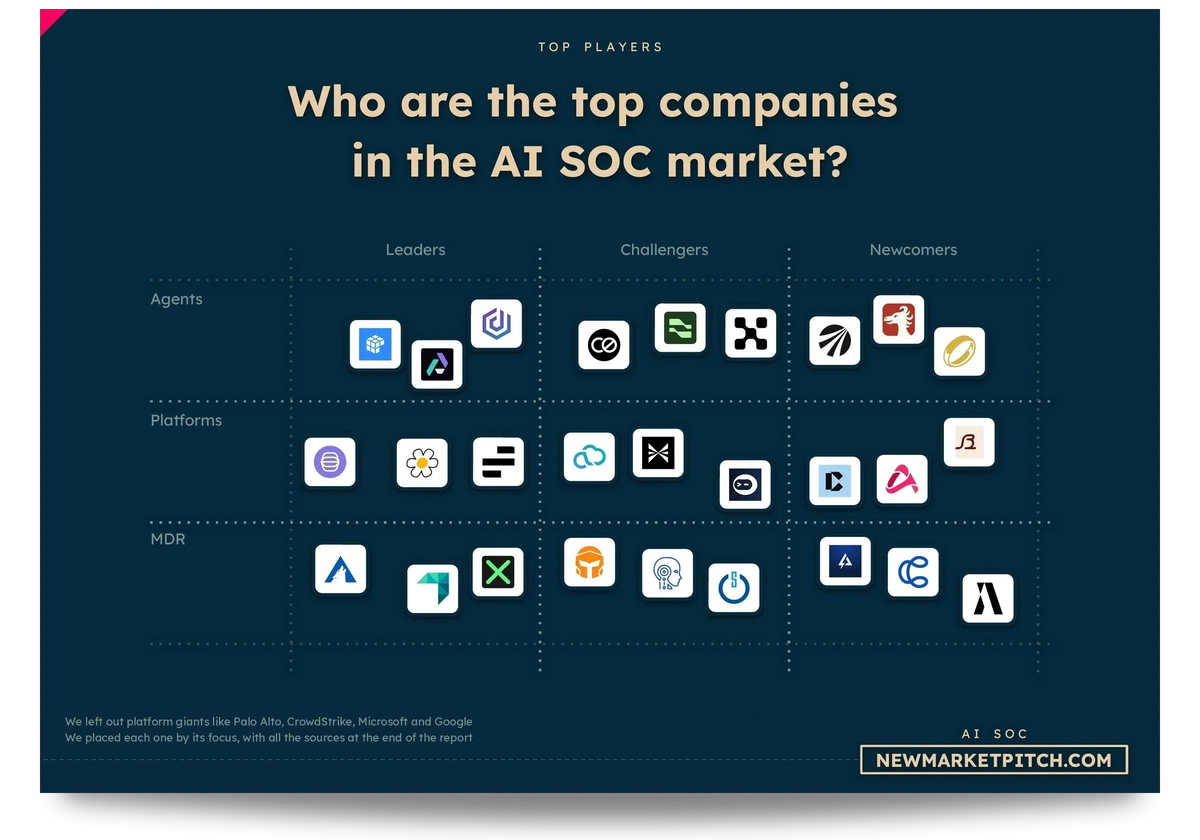
In our report covering the AI SOC market, we turn what is vague and complex into simple, useful visuals. Market maps like this one show you at a glance where every startup stands.
Top startups in the AI SOC market ranked by valuation
Here is the current ranking of the most valuable AI SOC startups. For each one you will also find our confidence level and the valuation basis we used.
If you want to go deeper into the AI SOC startup landscape, check our report covering the AI SOC market.
| # | Startup | Valuation | Confidence | Valuation basis | Last round | Total funding |
|---|---|---|---|---|---|---|
| 1 | Arctic WolfAI-driven managed security operations | $3.2B–$5.2Bas of Nov 2026 | Partial | Comparables-based estimate | $150MSeries F · Jul 2021 | $471Mvalued at 8.7× this |
| 2 | ReliaQuestAI-powered enterprise security operations | $3.4Bas of Mar 2025 | Full | Announced private round valuation | $500M+Growth equity · Mar 2025 | $830M+valued at 4.1× this |
| 3 | SecuronixAI-powered SIEM and threat detection | $1.8B–$3.2Bas of Nov 2026 | Partial | Comparables-based estimate | $1.0B+Growth equity / Series D · Feb 2022 | $1.1B+valued at 2.3× this |
| 4 | DevoCloud-native security analytics and SIEM | $2.0Bas of Jun 2022 | Full | Announced private round valuation | $100MSeries F · Jun 2022 | $421M+valued at 4.8× this |
| 5 | HuntressManaged AI-powered threat detection | $1.5Bas of Jul 2026 | Full | Announced private round valuation | $150MSeries D · Jun 2024 | $250Mvalued at 6.0× this |
| 6 | BlueVoyantAI-powered managed cybersecurity and intelligence | $1.0B–$1.6B | Partial | Comparables-based estimate | $140M+Series E · Nov 2023 | $696Mvalued at 1.8× this |
| 7 | TorqAutonomous AI security operations platform | $1.2Bas of Jan 2026 | Full | Announced private round valuation | $140MSeries D · Jan 2026 | $330Mvalued at 3.6× this |
| 8 | CorelightNetwork detection and threat analysis | $800M–$1.4Bas of Nov 2026 | Partial | Comparables-based estimate | $150MSeries E · Apr 2024 | $309M+valued at 3.4× this |
| 9 | TENEX.AIAI-native managed detection and response | $850M–$1.2B | Partial | Comparables-based estimate | $250MSeries B · Mar 2026 | $277Mvalued at 3.6× this |
| 10 | Blackpoint CyberManaged detection and threat response | $760M–$1.1B | Partial | Comparables-based estimate | $190MGrowth / Series C · Jun 2023 | $190Mvalued at 4.8× this |
| 11 | Kai SecurityAutonomous cybersecurity investigation and response | $500M–$1.2Bas of Mar 2026 | Low | Estimated from last round | $125MEquity (stage not disclosed) · Mar 2026 | $125Mvalued at 6.3× this |
| 12 | ExaforceAutonomous AI security operations platform | $725Mas of May 2026 | Strong | Reported private round valuation | $125MSeries B · May 2026 | $200Mvalued at 3.6× this |
| 13 | Vega SecurityAI-native federated security analytics | $700Mas of Feb 2026 | Strong | Reported private round valuation | $120MSeries B · Feb 2026 | $120Mvalued at 5.8× this |
| 14 | 7AIAutonomous AI security investigation agents | $700Mas of Dec 2025 | Strong | Reported private round valuation | $130MSeries A · Dec 2025 | $166Mvalued at 4.2× this |
| 15 | ExpelManaged threat detection and response | $450M–$900Mas of Nov 2026 | Partial | Comparables-based estimate | $140MSeries E · Nov 2021 | $180Mvalued at 3.5× this |
| 16 | Deepwatch1AI-assisted managed detection and response | $450M–$780Mas of Nov 2026 | Partial | Comparables-based estimate | $72MSeries B extension · Feb 2023 | $148Mvalued at 4.0× this |
| 17 | Critical StartAI-assisted managed cybersecurity operations | $330M–$650Mas of Nov 2026 | Partial | Comparables-based estimate | $215MGrowth equity · Apr 2022 | $255M+valued at 1.8× this |
| 18 | SwimlaneAgentic AI security workflow automation | $300M–$550Mas of Nov 2026 | Partial | Comparables-based estimate | $45MGrowth / Series E · Jun 2025 | $184M+valued at 2.2× this |
| 19 | Daylight SecurityHybrid AI-human managed threat defense | $400Mas of Nov 2026 | Strong | Reported private round valuation | $80MSeries B · Nov 2026 | $120Mvalued at 3.3× this |
| 20 | BlinkOpsAI security automation and orchestration | $300M–$450M | Strong | Implied valuation from raise | $50MSeries B · Jul 2025 | $74Mvalued at 5.0× this |
| 21 | HuntersAutonomous threat detection and investigation | $270M–$410M | Partial | Comparables-based estimate | $68MSeries C · Jan 2022 | $98Mvalued at 3.4× this |
| 22 | AnvilogicAI-powered detection engineering platform | $250M–$400M | Partial | Comparables-based estimate | $45MSeries C · Apr 2024 | $45Mvalued at 7.0× this |
| 23 | CormaCybersecurity-specific defensive foundation models | $240M–$400M | Strong | Implied valuation from raise | $60MSeed · Aug 2026 | $60Mvalued at 5.2× this |
| 24 | MitigaCloud and AI agent security | $200M–$375Mas of Jan 2025 | Low | Estimated from last round | $30MSeries B · Jan 2025 | $75M+valued at 3.7× this |
| 25 | AnomaliAI-powered security intelligence and analytics | $170M–$350Mas of Nov 2026 | Partial | Comparables-based estimate | $40MSeries D · Jan 2018 | $70M+valued at 3.5× this |
| 26 | Stellar CyberUnified AI-powered security operations platform | $180M–$300M | Partial | Comparables-based estimate | $38MSeries B · Nov 2021 | $38Mvalued at 6.1× this |
| 27 | Mate SecurityAutonomous AI security investigation agents | $175M–$292Mas of Jul 2026 | Low | Estimated from last round | $35MSeries A · Jul 2026 | $50Mvalued at 4.5× this |
| 28 | Dropzone AIAutonomous AI security alert investigation | $165M–$280Mas of Nov 2026 | Partial | Comparables-based estimate | $37MSeries B · Jul 2025 | $57Mvalued at 3.7× this |
| 29 | Legion SecurityBrowser-native autonomous SOC investigation | $170M–$260M | Partial | Comparables-based estimate | $30MSeries A · Jul 2025 | $38Mvalued at 5.5× this |
| 30 | IntezerAI-powered autonomous incident investigation | $150M–$290Mas of Nov 2026 | Partial | Comparables-based estimate | $33MSeries C · Sep 2024 | $58Mvalued at 3.6× this |
| 31 | CywareThreat intelligence and security orchestration | $150M–$280M | Partial | Comparables-based estimate | $30MSeries C · Jun 2023 | $60M+valued at 3.4× this |
| 32 | RADICLManaged cybersecurity and compliance platform | $155M–$258Mas of Feb 2026 | Low | Estimated from last round | $31MSeries A · Feb 2026 | $31Mvalued at 6.5× this |
| 33 | Prophet SecurityAgentic security investigation and response | $150M–$260Mas of Nov 2026 | Partial | Comparables-based estimate | UndisclosedStrategic venture · Feb 2026 | $41Mvalued at 4.8× this |
| 34 | Qevlar AIAutonomous SOC alert investigation platform | $150M–$250Mas of Mar 2026 | Low | Estimated from last round | $30MSeries A / Series B · Mar 2026 | $45Mvalued at 4.3× this |
| 35 | Fig SecuritySecurity operations resilience software | $150M–$250Mas of Mar 2026 | Low | Estimated from last round | $30MSeries A · Mar 2026 | $38Mvalued at 5.1× this |
| 36 | SekoiaAI-native SOC and threat intelligence | $160M–$230M | Partial | Comparables-based estimate | $29MSeries B · Apr 2025 | $78Mvalued at 2.5× this |
| 37 | NebulockAutonomous threat hunting and detection | $140M–$190M | Strong | Implied valuation from raise | $25MSeries A · Jun 2026 | $34Mvalued at 4.9× this |
| 38 | CroglAgentic AI security investigation automation | $125M–$208Mas of Mar 2025 | Low | Estimated from last round | $25MSeries A · Mar 2025 | $30Mvalued at 5.4× this |
| 39 | Abstract SecuritySecurity analytics and SIEM platform | $125M–$208Mas of Jul 2026 | Low | Estimated from last round | $25MSeries A · Jul 2026 | $40Mvalued at 4.0× this |
| 40 | MixModeSelf-learning AI threat detection platform | $110M–$200M | Partial | Comparables-based estimate | Undisclosed | |
| 41 | TuskiraAI-powered unified cyber threat defense | $115M–$190M | Partial | Comparables-based estimate | $28MUndisclosed stage · Dec 2024 | $28Mvalued at 5.2× this |
| 42 | Binary DefenseManaged detection and response services | $110M–$190M | Partial | Comparables-based estimate | $36MGrowth equity · Nov 2022 | $36Mvalued at 4.0× this |
| 43 | LumuContinuous network compromise detection | $105M–$180M | Partial | Comparables-based estimate | $24MSeries B · Sep 2023 | $40Mvalued at 3.5× this |
| 44 | AndesiteHuman-AI collaborative security operations | $110M–$160M | Partial | Comparables-based estimate | $23MSeed extension · Feb 2025 | $38Mvalued at 3.5× this |
| 45 | Method SecurityAutonomous offensive and defensive cybersecurity | $105M–$165M | Strong | Implied valuation from raise | $26MCombined Seed/Series A · Nov 2025 | $26Mvalued at 5.1× this |
| 46 | BinalyzeAutomated digital forensics and investigations | $100M–$170M | Strong | Implied valuation from raise | $19MSeries A · Sep 2023 | $31Mvalued at 4.2× this |
| 47 | ConifersAgentic security operations automation | $100M–$167Mas of Jan 2025 | Low | Estimated from last round | UndisclosedGrowth equity · Oct 2025 | $25M+valued at 5.2× this |
| 48 | Command ZeroAutonomous cybersecurity investigation platform | $105M–$145M | Partial | Comparables-based estimate | $10MStrategic equity · Jul 2025 | $31Mvalued at 4.0× this |
| 49 | D3 Security2AI-driven security orchestration and investigation | $80M–$170M | Partial | Proxy-based estimate | $10MGrowth equity · Aug 2021 | $10Mvalued at 11.7× this |
| 50 | SeceonAI-driven threat detection and response | $75M–$180M | Partial | Proxy-based estimate | Undisclosed | |
| 51 | Spectrum SecurityAutonomous security operations and threat detection | $76M–$127Mas of Apr 2026 | Low | Estimated from last round | $19MSeed · Apr 2026 | $19Mvalued at 5.2× this |
| 52 | BreachRxIncident response coordination and automated response plans | $75M–$125Mas of May 2025 | Low | Estimated from last round | $15MSeries A · May 2025 | $22Mvalued at 4.5× this |
| 53 | RAD SecurityAI-driven cloud workload defense | $65M–$110M | Partial | Comparables-based estimate | $14MSeries A · Mar 2025 | $20Mvalued at 4.2× this |
| 54 | Artemis SecurityContext-aware autonomous threat detection | $60M–$100Mas of Apr 2026 | Low | Estimated from last round | $15MSeed · Apr 2026 | $70Mvalued at 1.1× this |
| 55 | BlumiraAutomated cloud threat detection response | $60M–$100M | Partial | Comparables-based estimate | $15MSeries B · Jun 2023 | $28M+valued at 2.8× this |
| 56 | StrikeReadyAI-powered security investigation automation | $60M–$100Mas of Apr 2024 | Low | Estimated from last round | UndisclosedStrategic equity · Sep 2026 | $16M+valued at 5.0× this |
| 57 | Brava SecurityMulti-agent security operations platform that generates attack telemetry, validates detection coverage, and rewrites SIEM detections. | $60M–$100Mas of Nov 2026 | Low | Estimated from last round | $15MSeed · Nov 2026 | $15Mvalued at 5.2× this |
| 58 | Beacon SecurityAI security operations investigation platform | $52M–$87Mas of Jul 2026 | Low | Estimated from last round | $13MSeed · Jul 2026 | $13Mvalued at 5.2× this |
| 59 | LimaCharlieCloud-native security operations infrastructure | $45M–$85M | Partial | Comparables-based estimate | $10MSeries A · Feb 2024 | $16Mvalued at 3.8× this |
| 60 | CognnaAgentic AI security operations platform | $46M–$77Mas of Dec 2025 | Low | Estimated from last round | $9.2MSeries A · Dec 2025 | $11M+valued at 5.2× this |
| 61 | AirMDRAI-powered managed detection and response | $45M–$75M | Partial | Comparables-based estimate | $10MSeed · Jul 2025 | $16Mvalued at 3.7× this |
| 62 | SimbianAI agents for security operations | $40M–$75Mas of Nov 2026 | Partial | Comparables-based estimate | UndisclosedOther · Sep 2025 | $10M+valued at 5.5× this |
| 63 | BacklineAutonomous security vulnerability remediation agents | $36M–$60Mas of Jan 2025 | Low | Estimated from last round | $9MSeed · Jan 2025 | $9Mvalued at 5.2× this |
| 64 | StrangeBeeCollaborative cybersecurity incident response platform | $25M–$65M | Partial | Proxy-based estimate | Undisclosed | |
| 65 | CotoolAI agent operating system cybersecurity | $30M–$49M | Strong | Implied valuation from raise | $7.4MSeed · Mar 2026 | $7.4Mvalued at 5.2× this |
| 66 | AiStrikeAI-native preemptive cyber defense | $28M–$47M | Strong | Implied valuation from raise | $7MSeed · Jan 2026 | $12Mvalued at 3.0× this |
| 67 | CopperhelmAI security operations platform | $28M–$47Mas of Apr 2026 | Low | Estimated from last round | $7MSeed · Apr 2026 | $7Mvalued at 5.2× this |
| 68 | System Two SecurityAI threat hunting and detection engineering | $28M–$47Mas of Dec 2024 | Low | Estimated from last round | $7MSeed · Dec 2024 | $7Mvalued at 5.2× this |
| 69 | Arcanna.aiAI-assisted SOC decision intelligence | $25M–$45M | Partial | Comparables-based estimate | $3.5MSeed · Dec 2023 | $3.5M+valued at 9.6× this |
| 70 | PRE SecurityAI-native security automation platform | $22M–$45M | Partial | Proxy-based estimate | UndisclosedSeed · Dec 2025 | Undisclosed |
| 71 | MaveAgentic enterprise security operations orchestration | $24M–$40Mas of Oct 2026 | Low | Estimated from last round | $6MSeed · Oct 2026 | $34Mvalued at 0.9× this |
| 72 | CircumventAutonomous cloud security risk remediation | $24M–$40M | Strong | Implied valuation from raise | $6MSeed · Jun 2025 | $6Mvalued at 5.2× this |
| 73 | SurgeAI-driven security operations | $23M–$39Mas of Mar 2024 | Low | Estimated from last round | $5.8MSeed · Mar 2024 | $8.4Mvalued at 3.6× this |
| 74 | WraithwatchAI-powered proactive cyber threat defense | $20M–$45M | Partial | Comparables-based estimate | $8MSeed · Nov 2023 | $8Mvalued at 3.8× this |
| 75 | Embed SecurityAI-powered security alert investigation | $20M–$40M | Partial | Comparables-based estimate | $6MSeed · Nov 2024 | $6Mvalued at 4.7× this |
| 76 | Bricklayer AIAutonomous AI cybersecurity analyst agents | $20M–$33Mas of Oct 2025 | Low | Estimated from last round | $5MSeed · Oct 2025 | $7.5Mvalued at 3.4× this |
| 77 | Secure.comGoverned AI cybersecurity teammates | $18M–$35M | Strong | Implied valuation from raise | $4.5MPre-Seed · Nov 2025 | $4.5Mvalued at 5.6× this |
| 78 | Asymmetric SecurityAI-driven cyber forensics and incident response | $17M–$28Mas of Jan 2026 | Low | Estimated from last round | $4.2MSeed · Jan 2026 | $4.2Mvalued at 5.2× this |
| 79 | RedCarbonAI security operations and threat triage | $16M–$28Mas of Oct 2025 | Low | Estimated from last round | $3.3MSeries A · Oct 2025 | $3.3Mvalued at 6.5× this |
| 80 | UnderDefenseManaged cybersecurity and automated response | $12M–$35M | Partial | Proxy-based estimate | Undisclosed | |
| 81 | BeelzebubAI-native deception and autonomous defense platform that detects intrusions, investigates attacker activity and isolates compromised systems automatically. | $14M–$23Mas of Jul 2026 | Low | Estimated from last round | ~$3.4MSeed · Jul 2026 | $3.4Mvalued at 5.2× this |
| 82 | ContraForceAI security operations and incident response software | $13M–$22Mas of Oct 2024 | Low | Estimated from last round | $3.2MSeed · Oct 2024 | $3.2Mvalued at 5.2× this |
| 83 | CyberKordAI platform that investigates security alerts, simulates remediation in a digital twin, and autonomously contains or resolves incidents across existing security tools. | $13M–$21Mas of Nov 2026 | Low | Estimated from last round | ~$3.1MSeed · Nov 2026 | $3.1Mvalued at 5.2× this |
| 84 | CydelphiAI digital forensics and incident response | $12M–$20Mas of Feb 2026 | Low | Estimated from last round | $3MSeed · Feb 2026 | $3Mvalued at 5.2× this |
| 85 | RileveraAutomated security operations and threat response | $12M–$20Mas of Nov 2025 | Low | Estimated from last round | $3MSeed · Nov 2025 | $3Mvalued at 5.2× this |
| 86 | Miru LabsAI-powered security operations automation | $10M–$23M | Partial | Proxy-based estimate | $2.7MPre-Seed · Sep 2025 | $2.7Mvalued at 5.6× this |
| 87 | Priam Cyber AIAI-driven cybersecurity threat analysis | $9M–$20M | Partial | Proxy-based estimate | UndisclosedPre-Seed · May 2023 | Undisclosed |
| 88 | WiseBeeAI-driven autonomous security operations | $10M–$17Mas of Aug 2025 | Low | Estimated from last round | $2.5MPre-Seed · Aug 2025 | $2.5Mvalued at 5.2× this |
| 89 | ZaunAI agents for security operations centers | $6M–$10Mas of Mar 2025 | Low | Estimated from last round | $1.5MPre-Seed · Mar 2025 | $1.5Mvalued at 5.2× this |
| 90 | Strand IntelligenceAI security operations investigation platform | $5.1M–$8.5Mas of Jun 2026 | Low | Estimated from last round | $1.3MSeed · Jun 2026 | $1.3Mvalued at 5.2× this |
| NR | Vectra AIAI-powered network threat detection | Undisclosed | Last published price over 5 years old (2021) | $130MSeries F · Apr 2021 | $266M+ |
No startups match this search.
- Total funding includes strategic financing alongside equity.
- Total funding: equity only; excludes a $5M credit facility from the $15M round.

Our research about AI security operations gets updated several times a month, so you always get the latest view of where things stand.
Is Arctic Wolf still the most valuable AI SOC startup?
Arctic Wolf still leads AI SOC startup valuations, at an estimated $3.2B–$5.2B.
Arctic Wolf's business goes well beyond triaging alerts. Its Aurora platform brings together security software, threat intelligence and a managed team that investigates and responds for customers. The company's last tracked equity round was a Series D+ in July 2021, but its offering has changed since then. In February 2025, Arctic Wolf completed its purchase of BlackBerry's Cylance endpoint-security assets. It acquired Sevco Security's exposure-assessment technology in February 2026.
Those acquisitions add more security work to a relationship Arctic Wolf already has with customers. They did not establish a new equity price, so our current valuation is based on comparable businesses. That estimate puts Arctic Wolf first, while leaving room for ReliaQuest and younger AI-agent platforms to challenge it. The harder test for those challengers will be winning customers who already trust another provider to handle incidents.
Is ReliaQuest now worth as much as Arctic Wolf?
ReliaQuest is close to Arctic Wolf at the top of AI SOC valuations, and its $3.4B price has stronger direct evidence.
ReliaQuest disclosed that valuation in its March 2025 Growth Equity financing, which raised at least $500M. Arctic Wolf's higher-ranked range comes from our comparison with similar companies. ReliaQuest's stated price falls inside that range, so no deal has shown yet that one is clearly worth more than the other.
ReliaQuest's GreyMatter software connects security tools companies already own. Its March 2025 announcement said it worked across more than 200 products. The company later introduced SIEM-less detection in July 2026, allowing customers to detect threats without putting every log in one central place. Arctic Wolf supplies more of the managed operation itself. Both want a central place in a customer's SOC, but they get there through different products.

In our market report about AI security operations, we look at what the winners do differently, so you can learn from the best instead of guessing.
Why are investors paying billions for ReliaQuest?
Investors value ReliaQuest in the billions because its AI SOC platform helps security teams use their existing tools together.
A large company can own excellent detection products and still struggle to connect alerts, investigations and response actions. GreyMatter is designed to handle those handoffs across vendors. In March 2025, ReliaQuest described integrations with more than 200 cybersecurity products. Its July 2026 SIEM-less launch also challenged the idea that a company must move all its security data into one system before detecting threats.
One customer example makes the pitch easier to understand. In a June 2026 case study, Circle K described how GreyMatter used operational context to distinguish fuel-terminal events from alerts on retail devices. An automated action that makes sense at a store could disrupt a terminal. That is the kind of context customers need before giving a platform more control. Investors are paying for that day-to-day role in security operations, not just for the AI model.
Is Securonix worth more than Devo right now?
We cannot say for certain that Securonix is worth more than Devo in the AI SOC market today.
Securonix has an estimated $1.8B–$3.2B valuation, while Devo announced a $2.0B price with its June 2022 Series D+. The estimate crosses Devo's stated figure. We rank Securonix higher using the midpoint of its range, but buyers have not publicly priced both businesses in the same transaction period.
The two companies also sell different kinds of security operations software. Securonix combines cloud SIEM, behavioral analysis and governed AI agents. Devo focuses on cloud-native security data and investigation tools. In 2026, Securonix announced expanded analysis of behavior by both people and AI agents. Devo's June 2022 financing announcement highlighted threat-hunting capabilities following its Kognos acquisition. Neither announcement tells us the price an acquirer would pay today. They do show why both businesses remain relevant as SOC work becomes more automated.

In our document detailing everything you need to know about AI SOC, you will always find fresh funding data, taken straight from our own verified funding database.
Is Huntress really a billion-dollar AI SOC company?
Yes. Huntress has unusually strong commercial support for its $1.5B AI SOC valuation.
Huntress disclosed the price when it announced a $150M Series D+ in June 2024. In July 2026, the company reported protecting more than 270,000 businesses and passing $250 million in annual recurring revenue. Those are Huntress's own figures, but paying customers and recurring revenue offer a much firmer test than a product demonstration alone.
The customer base also explains its approach. Huntress works with smaller businesses and their IT service providers, many of which cannot run a security operations center at night or on weekends. Huntress spreads managed detection and response across those customers and uses software to reduce repetitive work. We still cannot infer profit or a fresh market price from that success. But the service has clear commercial demand, which makes the unicorn valuation easier to understand than one based only on an early funding round.
How many AI SOC startups are unicorns today?
Only 7 of the 91 AI SOC startups we track have valuations that qualify them as definite unicorns.
For an estimated range, the whole range must be at least $1B. BlueVoyant clears that bar at $1.0B–$1.6B. Corelight, TENEX.AI, Blackpoint Cyber and Kai Security have ranges that cross the threshold, which makes them possible future unicorns rather than confirmed ones at every point in the range. Torq has an announced valuation that clears the unicorn threshold. Vectra AI is no longer in this group: its last published price, $1.2B in April 2021, is more than five years old, and no priced round has followed.
The qualifying companies also tell us something about what investors value. Several sell managed response or major analytics platforms; Torq sells automation for the SOC itself. Most AI analyst startups are still far from a billion-dollar price. The largest prices still sit with companies trusted to handle important parts of live security operations.
The table below shows the AI SOC startups whose full valuation or estimated range clears the unicorn threshold.
| Startup | Valuation |
|---|---|
| Arctic Wolf | $3.2B–$5.2B |
| ReliaQuest | $3.4B |
| Securonix | $1.8B–$3.2B |
| Devo | $2.0B |
| Huntress | $1.5B |
| BlueVoyant | $1.0B–$1.6B |
| Torq | $1.2B |

Learning from others' mistakes is the cheapest lesson there is. In our report covering the AI SOC market, we look at what broke startups before you, so you don't repeat it.
Is Torq really worth $1B as an AI SOC startup?
Torq's announced $1.2B AI SOC valuation has a real automation product behind it, although the price still depends on future growth.
Torq's $140M Series D+ in January 2026 established that value and brought its total equity funding to $330M. Instead of staffing a customer's SOC, Torq sells agents that investigate alerts and carry out response actions using the customer's existing security tools. That makes it a different business from Arctic Wolf or Huntress, which provide ongoing managed detection and response.
The valuation is 3.6x Torq's total funding, against 6.0x for Huntress. Those figures compare financing with valuation, rather than revenue with valuation, so they do not tell us which company is cheaper. What matters for Torq is whether its software keeps making safe decisions across integrations and company-specific permissions. A mistaken account shutdown can be costly. Its financing shows belief in the product; years of dependable deployment will decide whether the price holds.
Could Exaforce become the next AI SOC unicorn?
Exaforce could become an AI SOC unicorn, but its reported $725M valuation still sits well below that threshold.
The price was reported with Exaforce's $125M Series B in May 2026. Kai Security ranks just ahead of it at an estimated $500M–$1.2B, because we order ranges by their midpoint, which is $850M for Kai. Exaforce's figure is the firmer of the two, since it comes from a reported priced round rather than an estimate. In its May 2026 announcement, Exaforce described a security knowledge graph and AI reasoning system for detecting, triaging, investigating and responding to threats. TechCrunch also reported early customers including Replit and Guardant Health.
Those deployments are encouraging because investigations are far messier in production than in a controlled demo. Exaforce has raised $200M in total equity, giving it room to keep improving its integrations and threat analysis. Moving from $725M to a billion-dollar price will take customers who repeatedly trust the system with live incidents.

Your time is limited. In our research about AI security operations, we put numbers on each part of the market, so you can see where it makes sense to focus.
Can 7AI compete with the big AI SOC companies?
7AI is becoming a real AI SOC competitor in autonomous investigations, but its reported $700M valuation still trails the established unicorns.
The company raised a $130M Series A in December 2025, bringing its equity funding to $166M. The valuation was reported by the press rather than announced by 7AI. In May 2026, the company said its agents had completed more than 7 million investigations in production. That is a useful workload measure, although it does not tell us the revenue or cost of each investigation.
7AI expanded its offer with Federated SIEM and Build in July 2026, giving customers more control over data queries and agent workflows. That puts it into more direct competition with wider SOC platforms such as Torq and ReliaQuest. We see substantial early use and an ambitious product, but the case for a higher valuation will depend on customers keeping those agents in production and expanding what they let them do.
Why is AI SOC startup Vega Security worth so much?
Vega Security attracted a reported $700M AI SOC valuation by attacking the cost of moving security data around.
TechCrunch reported the valuation alongside Vega Security's $120M Series B in February 2026. Vega Security has raised $120M in equity, and its price comes from press reports rather than from the company. Vega's system detects threats across data stored in different places, rather than requiring every log to pass through one central analytics platform. For large enterprises, collecting and storing that data can be an expensive part of running a SOC.
ReliaQuest's SIEM-less product and 7AI's Federated SIEM show that Vega is not alone in pursuing this model. The commercial test is straightforward: can customers save enough on data handling while maintaining strong detection? A funding deal confirms investors are interested. Deployment results and renewals will tell us whether Vega's federated architecture earns its price.

In our market report about AI security operations, we always try to gather several sources and make estimates that make sense, so you can work with solid numbers.
Are young AI SOC startups getting unicorn valuations too soon?
Some new AI SOC startups have reached estimates near unicorn status before showing the long operating history of established security vendors.
Kai Security was founded in 2025 and carries an estimated $500M–$1.2B valuation. That range is our estimate from the size of its $125M round in March 2026, whose stage was not disclosed, and is dated to that round, rather than a value announced by investors. TENEX.AI, founded in 2024, has a separate comparables-based range of $850M–$1.2B after its $250M Series B in March 2026. Neither range makes the company a definite unicorn at every point.
Big rounds are not enough to settle the question. Vega Security's $120M Series B and 7AI's $130M Series A also led to significant reported prices below the definite unicorn group. Kai focuses on automated investigation and response, while TENEX.AI combines AI-driven triage with human analysts in a managed service. Both need repeat customers and reliable incident handling. A first wave of enthusiastic funding can speed up that work; it cannot prove that the product has already succeeded.
Why are managed AI SOC companies worth more than AI security agents?
Managed AI SOC providers such as Arctic Wolf, Huntress and BlueVoyant sit ahead of most AI security agent startups because they run more of the customer's security operation.
Arctic Wolf and ReliaQuest lead the valuation comparison, while Huntress and BlueVoyant also sit near the top. Their customers pay for ongoing detection and response, expert help and accountability when something goes wrong. By contrast, newer companies such as 7AI and Dropzone AI focus on automating investigations. Torq shows that a software automation platform can also reach an announced unicorn value.
The product differences are practical. Securonix and Devo supply security analytics, Vectra AI detects suspicious network and cloud activity, Corelight supplies network evidence, and Torq automates actions across tools. A single company might use several of them. In March 2026, TENEX.AI said its new funding would also support hiring human security experts, even as it built its AI platform. For now, the highest prices reward businesses that already own important customer workflows, whether they use people, agents or both.

If you build or invest in the AI SOC market, you need to know which business models pay off now and which ones are fading. That's why our report covering it has a whole section on it.
Can AI SOC startups survive CrowdStrike and Palo Alto Networks?
Yes, independent AI SOC startups can survive CrowdStrike and Palo Alto Networks, but both giants put real pricing pressure on them by selling more security capabilities to customers they already serve.
Both are listed cybersecurity companies, not startups in our comparison. Their advantage is access to buyers and security tools that are already installed. A new AI SOC vendor has to show why its separate subscription is worth paying for. It may need to connect multiple vendors, automate a particularly painful job or deliver incident response better than the larger suite.
ReliaQuest works across existing platforms; Corelight concentrates on network evidence; 7AI and Dropzone AI automate alert investigation. In April 2024, Corelight's financing included Cisco Investments and CrowdStrike Falcon Fund, showing how large security vendors can also back specialists. That mixture of competition and partnership is part of the market today. Independent startups still have room to grow, but the easiest features for a large suite to copy will face the hardest price pressure.
Do valuable AI SOC startups actually have paying customers?
Some highly valued AI SOC startups have paying customers and real revenue, though newer agent companies often report product usage instead.
In July 2026, Huntress reported more than 270,000 protected businesses and annual recurring revenue above $250 million. Dropzone AI said in January 2026 that more than 300 enterprises used its autonomous investigations in production. 7AI's May 2026 update focused on the volume of investigations completed. These numbers answer different questions: revenue measures what customers pay, customer counts show reach, and investigation volume shows how much work the software performs.
We cannot turn those measures into one tidy valuation ranking. The useful test is whether customers renew, expand usage and trust the product during actual incidents. In a market where AI demos are easy to show, the companies that can publish both recurring revenue and dependable operating results will have a much stronger case for their prices.

In our report covering the AI SOC market, we don't want to repeat what boring consulting reports say. Instead, we show you the real and latest market signals that matter.
Are the most valuable AI SOC startups mostly American?
Yes, the most valuable AI SOC startups are almost all American: the first one based elsewhere, Israel's Corma, only comes in 23rd, at an implied $240M–$400M.
Arctic Wolf, ReliaQuest, Securonix, Devo, Huntress and BlueVoyant are headquartered in the United States. That is a company-headquarters measure, rather than a claim about where all their founders, engineers or customers live. Many American security companies also run large operations abroad.
Israel has the strongest challengers outside the United States, with Corma, Mitiga and Mate Security, while Qevlar AI and Sekoia lead in France. These countries have notable specialists, but the American leaders have built broader funding histories and enterprise relationships. The geography alone says little about which technology is best.
The table below shows the most valuable AI SOC startups based outside the United States.
| Startup | Country | Valuation |
|---|---|---|
| Corma | Israel | $240M–$400M |
| Mitiga | Israel | $200M–$375M |
| Mate Security | Israel | $175M–$292M |
| Qevlar AI | France | $150M–$250M |
| Fig Security | Israel | $150M–$250M |
| Sekoia | France | $160M–$230M |
| Binalyze | Estonia | $100M–$170M |
Could an Israeli or French AI SOC startup be the next unicorn?
Israeli and French AI SOC companies could become unicorns, but none yet clears that threshold across its whole current valuation range.
Corma, the highest-ranked Israeli company, has a $240M–$400M implied valuation range from its August 2026 Seed and focuses on defensive security models. Mitiga follows at an estimated $200M–$375M, dated to its January 2025 Series B.
In France, Qevlar AI has an estimated $150M–$250M range and builds software for alert investigations. Its March 2026 financing focused on taking repetitive work away from analysts. Sekoia, estimated at $160M–$230M, combines threat intelligence with SOC software. These are distinct bets, not copies of the same managed security product. Their products could attract much larger customers, but a real unicorn price has yet to be established for any of them.

In our research about AI security operations, we like to show you the big picture. We know your time is precious, so we make every page quick to read and packed with as much learning as possible per minute.
Is Vectra AI still worth $1.2B?
We no longer give Vectra AI a valuation: its last published price, $1.2B in April 2021, is more than five years old, and no priced round has followed.
That is why Vectra AI now sits unranked at the end of our table. Other well-known AI SOC prices are also aging, though still within five years: Devo's dates from June 2022 and Huntress's from June 2024. Those rounds gave investors a price at the time. They cannot tell us what a buyer would pay for the business now. Arctic Wolf's product has also changed since its July 2021 round, particularly after its Cylance and Sevco acquisitions.
There are newer comparisons: Torq priced a Series D+ in January 2026, while Vega Security's Series B was reported in February 2026. They sell different products and are at different stages, so recent does not automatically mean more comparable. Investors should care most about the business the company operates today and the evidence behind the price.
So, which AI security operations startups are worth the most today?
Arctic Wolf is currently the most valuable AI SOC startup, followed by ReliaQuest and Securonix.
The leading companies own broad parts of security operations: managed response, cross-vendor workflows and analytics. Torq, Exaforce and 7AI are building software that can take over individual investigation and response tasks. That newer approach has attracted serious investment, though it has yet to displace established providers at the top of the valuation list.
The table below shows what we found.
| Question | Answer |
|---|---|
| Can managed SOC providers keep their lead? | Yes, managed platforms currently occupy several leading AI SOC positions. BlueVoyant is estimated at $1.0B–$1.6B. Ongoing response work helps build durable customer relationships. |
| Has ReliaQuest secured a firmer market price? | Yes, ReliaQuest has an announced valuation from a financing deal. Its March 2025 Growth Equity round raised at least $500M. The disclosed price gives buyers a clearer benchmark than estimates. |
| Can security agents reach billion-dollar prices already? | They can, although most AI SOC agents remain below that threshold. Torq raised a $140M Series D+ in January 2026. Its challenge is keeping automated responses dependable over time. |
| Is Exaforce already a confirmed AI SOC unicorn? | Not yet, since its reported price is still below $1B. Exaforce reached a reported $725M valuation in May 2026. Live incident work will decide whether it climbs higher. |
| Does revenue support the best-known SOC valuations? | Yes, Huntress has reported substantial recurring revenue and customer adoption. It reported protecting more than 270,000 businesses. Customer subscriptions give its valuation a stronger commercial foundation than publicity. |
| Are investors backing alternatives to central security logs? | Yes, several startups are building distributed detection and investigation platforms. Vega Security reportedly reached a $700M private valuation. Customer savings will determine whether this approach holds up. |
| Are AI SOC unicorns common yet? | No, billion-dollar prices are still rare in AI SOC. Only 7 AI SOC startups have a valuation fully above $1B. Most companies sit far below the largest private price tags. |
| Can a large early round prove product leadership? | No, capital alone cannot establish trust in live security operations. Kai Security's estimated range reaches $1.2B at its top. Successful incident response matters much more than a financing headline. |
| Are non-American SOC startups catching up on value? | They are building credible products but trail the largest American firms. Corma has an implied $240M–$400M valuation in Israel. A higher price will need further customer and financing evidence. |
| Can old funding prices stand in for today? | Not reliably, because security vendors can change after a financing. Vectra AI's last published price dates from April 2021. New features and customers can change the business significantly. |

When you build or invest in the AI SOC market, you need clarity, not confusion. In our market report about AI security operations, we always try to put numbers on and quantify whatever is usually vague and confusing.
Our methodology
Our data runs through November 12, 2026. We then reviewed this article and updated its answers on November 14, 2026, the date shown under the title. The ranking covers each company's whole funding history, from its first equity round to its latest. We define AI SOC as software and technology-led managed security operations that materially automate or augment threat detection, triage, investigation, hunting, orchestration, containment or incident response. We include companies at the boundary when operational security work is a core product, rather than exclude them for also offering adjacent cybersecurity services. Every company in the main valuation ranking is an independent startup under our definition: founded in 2000 or later, developed for rapid growth and financed privately or within five years of listing. Acquired and listed companies are shown separately where relevant.
Every startup in this ranking has raised equity funding, and each valuation comes with a confidence level that shows how it was obtained. A Full rating means the company announced the valuation itself, or several independent sources report the same figure. A Strong rating means a credible press report gives the valuation, or it follows directly from the terms of a funding round, such as the amount raised and the stake sold.
When no valuation has been disclosed, it is estimated. A Partial rating means the startup was compared with similar companies at the same stage, using indicators such as revenue, deal terms or recent transactions in the sector. A Low rating means the only reliable data point is the last equity round: the valuation is then derived from the amount raised and the share of the company that startups usually give up at that stage, which is why it is shown as a range and dated to that round.
Several safeguards keep these figures honest. Valuations that appear only in commercial databases, with no article or company statement behind them, are not used, and neither are share sales between existing shareholders, which often take place at a discount or a premium. Rounds older than five years are not used to estimate a valuation, debt and grants never count as equity, and companies whose claims are disputed are left out of the ranking. Startups that have since been acquired or have gone public are listed separately, valued at their acquisition price or market capitalization rather than at a past private round.
We order companies by the midpoint of a valuation range. Total funding counts equity only, excludes debt, grants and post-IPO offerings, and a plus sign marks a minimum where some amount is not public. A round enters our total when confirmed by a company announcement, regulatory filing or credible article, or, without an article, when two recognized databases agree on its date and amount; the latter receives low confidence and is not accepted for companies above $100M raised. A single-database round remains excluded. Valuations themselves require company statements, filings or reliable press evidence, never a commercial database figure alone.
An estimate can appear ahead of an announced valuation because the ranking uses each range's midpoint, not a claim that every possible price is higher. A Low estimate is derived from the amount of equity sold at the last disclosed round and typical stage dilution, and is dated to that round; the confidence rating shows that it is less directly observable than a completed, priced transaction. We preserve wide ranges where the evidence requires them instead of turning an uncertain value into one precise-looking figure.
Key sources include Kai Security emergence and financing, Arctic Wolf acquisition of Cylance assets, Arctic Wolf Sevco acquisition, ReliaQuest announced valuation and GreyMatter integrations, ReliaQuest SIEM-less product, ReliaQuest customer deployment, Securonix behavioral analytics for AI agents, Devo announced financing and SIEM strategy, Huntress Series D financing, Huntress disclosed revenue and customer adoption, Torq Series D and stated valuation, Exaforce financing and product, Exaforce product deployment and customer details, 7AI reported valuation and Series A financing, 7AI investigations and deployment claims, 7AI federated SIEM launch, Vega reported financing valuation and product model, TENEX.AI Series B and human-AI managed model, Dropzone AI customer and growth disclosures, Corelight strategic financing and security-operations product, Daylight financing and customer context, Reported Daylight valuation, and Qevlar AI investigation platform and financing.

A good product starts with a real problem. In our document detailing everything you need to know about AI SOC, we show you the ones customers still live with.
Written by the New Market Pitch teamWe track new markets so founders and investors can move faster. About us