Which AI SOC startups raised the most?
Whether you're building or investing in the AI SOC market, our report covers everything you need to know: the players, the money, and what's coming next.
Summary
Securonix has raised more equity than any other AI SOC startup we track: at least $1.1B. ReliaQuest follows with at least $830M, and BlueVoyant has raised $696M. Securonix's lead is largely the result of one enormous growth investment.
The oldest security analytics and managed detection companies had years to raise money before autonomous AI analysts became a major product category. They also had to build enterprise sales teams, integrate data and handle live incidents for customers.
ReliaQuest's March 2025 financing brought at least $500M into its GreyMatter platform, which connects security products across vendors. Investors are still paying for businesses that make established security tools work better together.
BlueVoyant has taken a managed-service route, raising capital repeatedly as it expanded its technology and customer services. That model needs people as well as software, which helps explain its long financing history.
Newer AI SOC companies can raise serious money, too. Torq has raised $330M, TENEX.AI $277M and Exaforce $200M. They focus more heavily on autonomous investigation, response and newer managed models.
The largest new agent financings are striking. TENEX.AI announced a major Series B in March 2026, while Exaforce raised a $125M Series B in May 2026. Investors are prepared to finance those products well before they have the history of the established vendors.
7AI has also raised $166M to build autonomous security investigators. Its progress gives the older platforms a reason to take the new generation seriously.
These giant checks are exceptions. Of the 95 AI SOC startups we track, 75 have raised less than nine figures. The median verified equity amount is at least $28M, far below the headline financings.
The United States accounts for 75 of the companies, or 79% by number. Israel and several European countries have specialist vendors, but the biggest lifetime totals remain with American-headquartered businesses.
Securonix remains the historical fundraising leader, while the newer agent companies are catching up faster than their age suggests. A big funding total tells us how much equity a company has raised, not whether customers prefer its product today.

Written by the New Market Pitch teamWe track new markets so founders and investors can move faster. About us

In our report covering the AI SOC market, you will always find fresh funding data, taken straight from our own verified funding database.
Top startups in the AI SOC market ranked by total funding raised
Here is the current ranking of the AI SOC startups that raised the most, with the total each one has raised and our confidence level.
If you want to go deeper into the AI SOC startup landscape, check our report covering the AI SOC market.
| # | Startup | Total raised | Last round | Status | Confidence |
|---|---|---|---|---|---|
| $1B and above | |||||
| 1 | SecuronixAI-driven SIEM and threat detection | $1.1B+ | Feb 2022$1.0B+ · Growth equity / Series D | Active | Strong |
| $500M to $1B | |||||
| 2 | ReliaQuestAI-powered security operations automation | $830M+1 | Mar 2025$500M+ · Growth equity | Active | Partial |
| 3 | BlueVoyantAI-driven cybersecurity and managed SOC | $696M | Nov 2023$140M+ · Series E | Active | Strong |
| $100M to $500M | |||||
| 4 | Arctic WolfManaged security operations and threat response | $471M | Jul 2021$150M · Series F | Active | Strong |
| 5 | DevoCloud-native security analytics and SIEM | $421M+ | Jun 2022$100M · Series F | Active | Full |
| 6 | TorqAgentic AI security operations automation | $330M | Jan 2026$140M · Series D | Active | Strong |
| 7 | CorelightNetwork detection and threat response | $309M+ | Apr 2024$150M · Series E | Active | Strong |
| 8 | TENEX.AIAI-native managed detection and response | $277M | Mar 2026$250M · Series B | Active | Strong |
| 9 | Vectra AIAI-powered threat detection and response | $266M+ | Apr 2021$130M · Series F | Active | Full |
| 10 | Critical StartManaged detection and response services | $255M+2 | Apr 2022$215M2 · Growth equity | Active | Partial |
| 11 | HuntressManaged cybersecurity detection and response | $250M | Jun 2024$150M · Series D | Active | Strong |
| 12 | ExaforceAutonomous AI-powered security operations | $200M | May 2026$125M · Series B | Active | Full |
| 13 | Blackpoint CyberManaged detection and threat response | $190M | Jun 2023$190M · Series D / growth | Active | Partial |
| 14 | SwimlaneAgentic AI security automation platform | $184M+ | Jun 2025$45M · Growth / Series E | Active | Partial |
| 15 | ExpelManaged threat detection and response | $180M | Nov 2021$140M · Series E | Active | Low |
| 16 | 7AIAutonomous AI security operations agents | $166M | Dec 2025$130M · Series A | Active | Full |
| 17 | DeepwatchManaged detection and response platform | $148M | Feb 2023$72M · Series B extension | Active | Partial |
| 18 | Kai SecurityAutonomous cybersecurity investigation and response | $125M | Mar 2026$125M · Seed and Series A | Active | Full |
| 19 | Vega SecurityDistributed AI-native threat detection platform | $120M | Feb 2026$120M · Series B | Active | Full |
| 20 | Daylight SecurityHybrid AI and human cyber defense | $120M | Nov 2026$80M · Series B | Active | Full |
| Below $100M | |||||
| 21 | SekoiaAI-native cyber detection and response | $78M | Apr 2025$29M · Series B | Active | Strong |
| 22 | MitigaCloud and AI agent security | $75M+ | Jan 2025$30M · Series B | Active | Full |
| 23 | BlinkOpsAI-powered security automation platform | $74M | Jul 2025$50M · Series B | Active | Partial |
| 24 | AnomaliAI-powered threat intelligence and analytics | $70M+ | Jan 2018$40M · Series D | Active | Full |
| 25 | Artemis SecurityAI-native threat detection and response | $70M | Apr 2026$15M · Series A | Active | Strong |
| 26 | CywareThreat intelligence and response orchestration | $60M+ | Jun 2023$30M · Series C | Active | Full |
| 27 | CormaDefensive cybersecurity foundation models | $60M | Aug 2026$60M · Seed | Active | Partial |
| 28 | IntezerAI-driven security investigation and triage | $58M | Sep 2024$33M · Series C | Active | Partial |
| 29 | Dropzone AIAutonomous AI security alert investigations | $57M | Jul 2025$37M · Series B | Active | Full |
| 30 | Mate SecurityAutonomous AI SOC investigation agents | $50M | Jul 2026$35M · Series A | Active | Full |
| 31 | AnvilogicAI-driven security detection engineering platform | $45M | Apr 2024$45M · Series C | Active | Full |
| 32 | Qevlar AIAutonomous security alert investigation agents | $45M | Mar 2026$30M · Series A / Series B | Active | Strong |
| 33 | Prophet SecurityAgentic AI security operations platform | $41M | Feb 2026Undisclosed · Strategic venture | Active | Partial |
| 34 | LumuContinuous cyber compromise detection platform | $40M | Sep 2023$24M · Series B | Active | Full |
| 35 | Abstract SecuritySecurity analytics and SIEM platform | $40M | Jul 2026$25M · Series A | Active | Full |
| 36 | Stellar CyberUnified AI-powered security operations platform | $38M | Nov 2021$38M · Series B | Active | Full |
| 37 | AndesiteAI-powered security operations platform | $38M | Feb 2025$23M · Seed extension | Active | Full |
| 38 | Legion SecurityBrowser-native autonomous AI SOC analyst | $38M | Jul 2025$30M · Series A | Active | Full |
| 39 | Fig SecuritySecurity operations resilience software | $38M | Mar 2026$30M · Series A | Active | Full |
| 40 | Binary DefenseManaged detection and response services | $36M | Nov 2022$36M · Growth equity | Active | Full |
| 41 | MaveAgentic enterprise security operations platform | $34M | Oct 2026$6M · Series A | Active | Strong |
| 42 | NebulockAutonomous threat hunting and response | $34M | Jun 2026$25M · Series A | Active | Strong |
| 43 | BinalyzeAutomated digital forensics and incident response | $31M | Sep 2023$19M · Series A | Active | Strong |
| 44 | Command ZeroAI-powered autonomous cyber investigations | $31M | Jul 2025$10M · Strategic equity | Active | Full |
| 45 | RADICLManaged cybersecurity and compliance platform | $31M | Feb 2026$31M · Series A | Active | Full |
| 46 | HuntersAutonomous security operations and detection | $30M | Aug 2021$30M · Series B | Active | Full |
| 47 | CroglAutonomous AI cybersecurity investigation agents | $30M | Mar 2025$25M · Series A | Active | Strong |
| 48 | TuskiraAI-powered unified threat defense platform | $28M | Dec 2024$28M · Series A | Active | Partial |
| 49 | BlumiraCloud SIEM and automated threat response | $28M+ | Jun 2023$15M · Series B | Active | Strong |
| 50 | Method SecurityAI-driven synthetic security engineers | $26M | Nov 2025$26M · Combined Seed/Series A | Active | Strong |
| 51 | ConifersAgentic AI security operations platform | $25M+3 | Oct 2025Undisclosed · Growth equity | Active | Partial |
| 52 | BreachRxIncident response coordination and automated response plans | $22M | May 2025$15M · Series A | Active | Full |
| 53 | RAD SecurityAI-driven cloud threat detection platform | $20M | Mar 2025$14M · Series A | Active | Full |
| 54 | Spectrum SecurityAutonomous security operations and threat detection | $19M | Apr 2026$19M · Seed | Active | Full |
| 55 | StrikeReadyAI-powered SOC command and assistance | $16M+ | Sep 2026Undisclosed · Strategic equity | Active | Full |
| 56 | CantinaAutonomous AI security vulnerability remediation | $16M | Jul 2026$8M · Venture financing | Active | Partial |
| 57 | LimaCharlieAPI-first security operations infrastructure platform | $16M | Feb 2024$10M · Series A | Active | Full |
| 58 | AirMDRAI-native managed detection and response | $16M | Jul 2025$10M · Seed | Active | Full |
| 59 | Brava SecurityMulti-agent security operations platform that generates attack telemetry, validates detection coverage, and rewrites SIEM detections. | $15M | Nov 2026$15M · Seed | Active | Full |
| 60 | Beacon SecurityAI security operations investigation platform | $13M | Jul 2026$13M · Seed | Active | Full |
| 61 | AiStrikeAI-native preemptive cyber defense | $12M | Jan 2026$7M · Seed | Active | Full |
| 62 | CognnaAgentic AI security operations platform | $11M+ | Dec 2025$9.2M · Series A | Active | Partial |
| 63 | SimbianAI-powered autonomous security operations | $10M+ | Sep 2025Undisclosed · Other | Active | Partial |
| 64 | D3 SecurityAI-driven security orchestration and investigation | $10M | Aug 2021$10M · Growth equity | Active | Full |
| 65 | RunRevealAI-native security data analytics platform | $9.5M | Jul 2025$7M · Seed extension | Acquired | Full |
| 66 | BacklineAI agents automate security remediation | $9M | Jan 2025$9M · Seed | Active | Strong |
| 67 | SurgeAI-driven security operations | $8.4M | Mar 2024$5.8M · Seed | Active | Full |
| 68 | WraithwatchAutonomous AI cyberattack simulation platform | $8M | Nov 2023$8M · Seed | Active | Full |
| 69 | Bricklayer AIAutonomous AI security analysts | $7.5M | Oct 2025$5M · Seed | Active | Full |
| 70 | CotoolAgent operating system for cybersecurity | $7.4M | Mar 2026$7.4M · Seed | Active | Full |
| 71 | CopperhelmAI security operations platform | $7M | Apr 2026$7M · Seed | Active | Full |
| 72 | System Two SecurityAI threat hunting and detection engineering | $7M | Dec 2024$7M · Seed | Active | Full |
| 73 | Cyclops SecurityAI-driven security operational decision support | $6.4M | Jul 2023$6.4M · Seed | Acquired | Full |
| 74 | CircumventAI-driven cloud security and remediation | $6M | Jun 2025$6M · Seed | Active | Full |
| 75 | Embed SecurityAI-powered security alert triage | $6M | Nov 2024$6M · Seed | Active | Full |
| 76 | Secure.comAI-powered digital security teammates | $4.5M | Nov 2025$4.5M · Pre-Seed | Active | Full |
| 77 | Kenzo SecurityAI-driven security operations automation | $4.5M | Apr 2025$4.5M · Seed | Acquired | Full |
| 78 | Asymmetric SecurityAI-driven cyber forensics and incident response | $4.2M | Jan 2026$4.2M · Seed | Active | Full |
| 79 | Arcanna.aiAI-assisted SOC decision intelligence | $3.5M+ | Dec 2023$3.5M · Seed | Active | Full |
| 80 | BeelzebubAI-native deception and autonomous defense platform that detects intrusions, investigates attacker activity and isolates compromised systems automatically. | $3.4M | Jul 2026~$3.4M · Seed | Active | Low |
| 81 | RedCarbonAI security operations and threat triage | $3.3M | Oct 2025$3.3M · Series A | Active | Full |
| 82 | ContraForceAI security operations and incident response software | $3.2M | Oct 2024$3.2M · Seed | Active | Full |
| 83 | CydelphiAI digital forensics and incident response | $3M | Feb 2026$3M · Seed | Active | Full |
| 84 | RileveraAutomated security operations and threat response | $3M | Nov 2025$3M · Seed | Active | Full |
| 85 | Miru LabsAI-native cybersecurity investigation graph platform | $2.7M | Sep 2025$2.7M · Pre-Seed | Active | Full |
| 86 | WiseBeeAI-driven autonomous security operations | $2.5M | Aug 2025$2.5M · Pre-Seed | Active | Full |
| 87 | ZaunAI agents for security operations centers | $1.5M | Mar 2025$1.5M · Pre-Seed | Active | Low |
| 88 | Strand IntelligenceAI security operations investigation platform | $1.3M | Jun 2026$1.3M · Seed | Active | Full |
| Undisclosed | |||||
| 89 | CounterShadowAutonomous AI security operations platform | Undisclosed | Feb 2026Undisclosed · Pre-Seed | Active | Low |
| 90 | ImperumAutonomous security operations center software | Undisclosed | Jun 2026Undisclosed · Seed | Active | Low |
| 91 | MalloryAI security operations investigation agents | Undisclosed | Apr 2026Undisclosed · Seed | Active | Low |
| 92 | PRE SecurityAI-native security automation platform | Undisclosed | Dec 2025Undisclosed · Seed | Active | Low |
| 93 | Priam Cyber AIAI-driven cybersecurity threat analysis | Undisclosed | May 2023Undisclosed · Pre-Seed | Active | Low |
| 94 | RilianAgentic security investigation and orchestration | Undisclosed | Apr 2026Undisclosed · Seed | Active | Low |
| 95 | SeviiAutonomous cyber defense and incident response | Undisclosed | Feb 2026Undisclosed · Seed | Active | Low |
No startups match this search.
- Minimum: the 2021 round is undisclosed; two investments exceeded stated amounts.
- The $215M deal may include secondary share purchases, not only new equity.
- Minimum: the October 2025 growth investment has no disclosed amount.

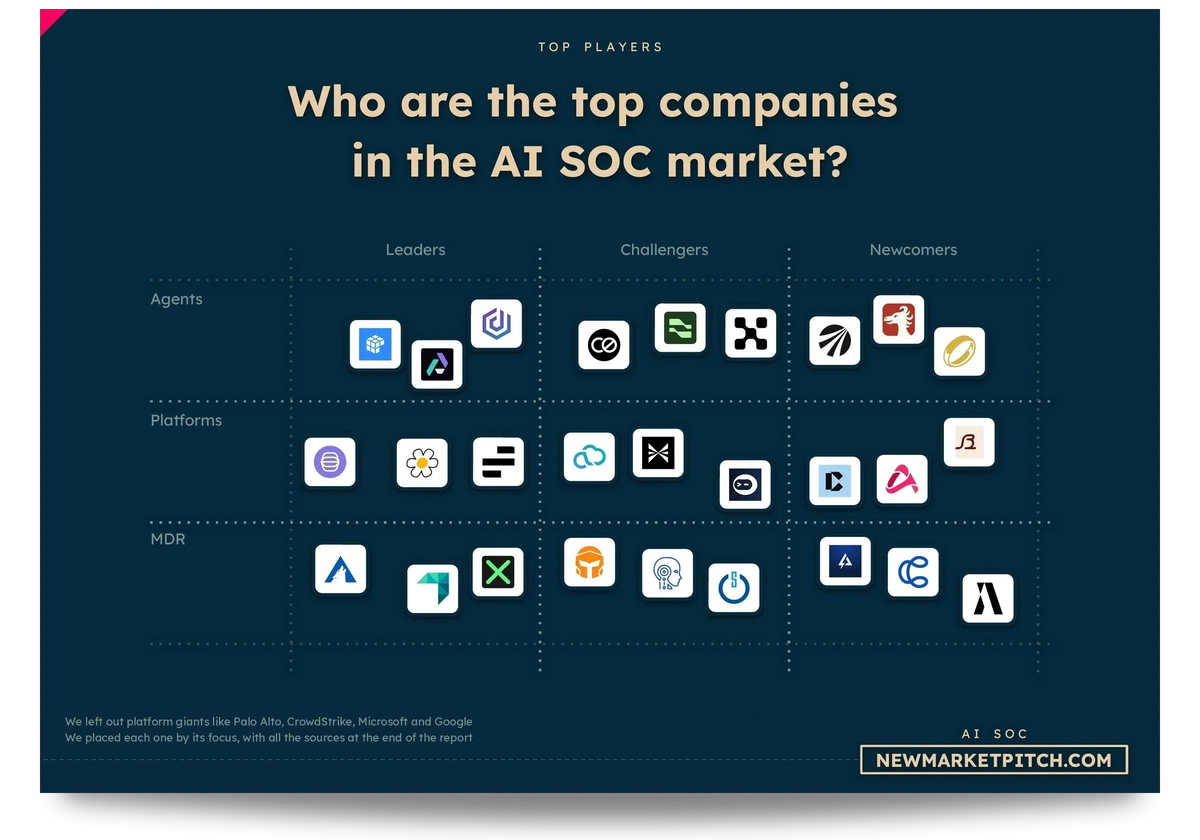
In our research about AI security operations, we turn what is vague and complex into simple, useful visuals. Market maps like this one show you at a glance where every startup stands.
Why has Securonix raised more than any other AI SOC startup?
Securonix leads AI SOC fundraising with at least $1.1B in equity, thanks largely to one exceptionally big investment.
The company received Growth Equity financing of at least $1.0B in February 2022, led by Vista Equity Partners. It was the largest single equity round in the startup histories we track. Securonix has 4 recorded rounds overall, so this one deal is central to its lifetime total.
Securonix had already developed cloud SIEM and behavioral threat detection for enterprise security teams before autonomous AI agents became a major selling point. That history helps explain why investors financed a broad analytics business rather than a new alert-triage experiment. In October 2026, the company announced behavioral analytics for unusual activity involving enterprise AI agents. Its product has continued to move with the market, but the record total is still historical funding, not a measure of current revenue or product quality.
Is ReliaQuest catching up with Securonix in AI SOC funding?
Not yet: ReliaQuest is the closest AI SOC startup to Securonix, with at least $830M raised, but a wide gap remains.
Its Growth Equity round in March 2025 brought at least $500M, the standout financing of that year among the companies in our set. ReliaQuest sells GreyMatter, which connects tools that enterprises already use for detection, investigation and response. In announcing the funding, the company said the platform could integrate more than 200 cybersecurity products.
In July 2026, ReliaQuest added SIEM-less detection, extending the product beyond a managed service into a broader security operating system. That gives investors a reason to fund it at scale. Still, the company would need another major financing to challenge Securonix's accumulated total. The two totals describe equity raised since founding; they cannot tell us which company has more customers or the stronger AI technology today.

Your time is limited. In our market report about AI security operations, we put numbers on each part of the market, so you can see where it makes sense to focus.
Why has BlueVoyant needed so much funding for its AI SOC?
BlueVoyant's $696M equity history reflects the cost of building a managed AI SOC business that sells software and ongoing expert response.
BlueVoyant combines managed detection with threat intelligence and services for complicated enterprise environments. Its Series D+ round of at least $140M in November 2023 was announced alongside its acquisition of Conquest Cyber. The deal was aimed at broadening defenses for customers with demanding security needs.
Unlike a standalone AI analyst, a managed provider must staff response teams, support deployments and work with customers' existing tools. BlueVoyant also builds services around Microsoft's security products. It has completed 6 tracked financing rounds, matching Torq for the highest number in the AI SOC group. BlueVoyant has raised again and again to grow its products and its service teams, a very different story from a young agent company built on one big early check.
Is Arctic Wolf still one of the best-funded AI SOC startups?
Arctic Wolf remains among the most heavily funded AI SOC startups, with $471M in tracked equity.
Its last recorded financing was a $150M Series D+ in July 2021. The company runs managed detection and response through its Aurora platform, so its business involves both software and people who deal with incidents. It has also changed significantly since that funding round. Arctic Wolf completed its purchase of BlackBerry's Cylance endpoint-security assets in February 2025 and bought Sevco Security's exposure-assessment technology in February 2026.
Those deals extend the company's offering, even without a new equity round in the record. They also show the limit of judging a vendor by the date of its last fundraising announcement. Arctic Wolf can keep expanding its security platform while its lifetime equity total stays where it was. The money raised is historical capital, not proof of a fresh funding surge.

In our document detailing everything you need to know about AI SOC, we always try to gather several sources and make estimates that make sense, so you can work with solid numbers.
Does more funding mean more customers for AI SOC startups?
Not necessarily. Devo has raised at least $421M in AI SOC equity, compared with $250M for Huntress, yet Huntress is the one publishing big customer numbers.
Devo's June 2022 Series D+ added $100M for its cloud-native security analytics business. The company had also bought Kognos to bring threat hunting into its platform. Huntress took a different route, raising a $150M Series D+ in June 2024 for a managed security service aimed at smaller companies and their IT providers.
More capital does not necessarily mean more customer demand. In July 2026, Huntress reported annual recurring revenue above $250 million and more than 270,000 businesses protected. Devo serves enterprise security analytics customers with different needs, so those Huntress metrics cannot be compared directly with Devo's total funding. The clear answer is about lifetime equity raised; product adoption requires separate operating figures.
Is Torq now one of the best-funded AI SOC agent startups?
Torq has become one of the best-funded agentic AI SOC platforms, with $330M raised in 6 equity rounds.
Its $140M Series D+ in January 2026 backed a product that automates alert investigation and response across enterprise security tools. Torq has pursued this model through repeated financings rather than depending on one early capital raise. Only BlueVoyant matches its round count in the AI SOC companies we track.
That history is meaningful because selling workflow automation to enterprises takes more than a convincing demo. The software needs integrations, permission controls and reliable handling of potentially disruptive actions. An agent that disables the wrong account can create new problems for a customer. Investors have repeatedly financed Torq's attempt to solve those practical issues. The next test is continued adoption by security teams, rather than the size of another round.

Our report covering the AI SOC market gets updated several times a month, so you always get the latest view of where things stand.
How did AI SOC startup TENEX.AI raise so much so quickly?
TENEX.AI reached $277M in AI SOC equity after just 2 rounds, led by its $250M Series B in March 2026.
That was the biggest individual AI SOC financing in our tracked companies for the year. TENEX.AI sells an AI-native managed detection and response service. Its pitch combines automated triage and investigation with human analysts who oversee the response. The company said the new money would help it expand globally and hire more of the defenders and engineers behind its service.
That is an expensive operating model to build from scratch. TENEX.AI needs technology, global service capacity and people customers trust when an incident is underway. Torq mainly sells automation software to teams already running their own SOCs. TENEX.AI is trying to provide more of that operation directly. Its financing is unusually large for such a young company, but the real test will be whether the service wins long-term customers.
Can Exaforce catch up with the biggest AI SOC fundraisers?
Not without more big rounds. Exaforce has raised $200M for autonomous AI SOC software, and it still trails the established funding leaders.
The company closed a $125M Series B in May 2026 after a previous Series A. Its product uses a security knowledge graph and AI reasoning to detect, triage, investigate and respond to threats. TechCrunch reported early deployments with Replit and Guardant Health in May 2026, giving the fundraising story some customer context.
Exaforce is pursuing a different way to run security operations from older managed providers. The goal is to automate more of the manual investigative work. Securonix and ReliaQuest accumulated much larger amounts while building broader enterprise platforms. Exaforce could close that funding gap, but another check would be only part of the story. The more demanding test is whether its software keeps working across messy customer environments and live incidents.

In our research about AI security operations, we look at what the winners do differently, so you can learn from the best instead of guessing.
Has 7AI raised enough to challenge the larger AI SOC startups?
7AI has raised $166M for autonomous AI SOC investigations, enough to make it a serious challenger but still below the largest funding totals.
Its $130M Series A in December 2025 followed the launch of a security investigation platform by former Cybereason executives. In May 2026, 7AI said its agents had completed more than 7 million investigations in production. That is a company-reported measure of work completed, not revenue or proof that every investigation led to the right response.
Dropzone AI has raised $57M across 3 rounds, and Qevlar AI has raised $45M across 3. Both also focus on reducing manual alert investigations. 7AI is pursuing a wider platform, adding Federated SIEM and tools for building custom workflows in July 2026. Its funding gives it room to try that broader approach. Whether it can compete with Torq or ReliaQuest will depend on customers keeping those tools in regular use.
Has Huntress kept growing without another big funding round?
Yes. Huntress has kept growing its AI SOC and managed security business since its last equity round in June 2024.
The company has raised $250M across 4 rounds. In July 2026, Huntress reported protecting more than 270,000 businesses and passing $250 million in annual recurring revenue. Those figures are company-reported, but they point to commercial growth after the last equity event in its history.
Huntress sells subscriptions through service providers that protect smaller organizations. That gives it a way to add customers without announcing another round every year. We cannot work out profitability or its cash balance from those figures. We can say that its recent customer and revenue disclosures tell us more about present demand than the date of its last financing.

In our market report about AI security operations, we don't want to repeat what boring consulting reports say. Instead, we show you the real and latest market signals that matter.
Why did Corelight raise so much for network threat detection?
Corelight has raised at least $309M because AI SOC teams still need hard network evidence to see what really happened.
Its $150M Series D+ in April 2024 was led by Accel, with Cisco Investments and CrowdStrike Falcon Fund taking part. Corelight analyzes network activity so investigators can spot threats and reconstruct what happened during an incident. The company said the financing would support AI-driven detection, cloud security and integration with other tools.
An autonomous investigator still needs reliable evidence about what computers and users actually did. That gives Corelight a role even when AI agents handle more of the analysis and response. Its investors also show how a specialist vendor can fit beside bigger cybersecurity platforms. The bet behind Corelight's financing is that trustworthy network visibility remains valuable as the rest of the SOC becomes more automated.
Are investors putting the biggest AI SOC checks into new agents or older firms?
The biggest lifetime AI SOC funding totals belong to older platforms, although young agent companies are now raising very large individual rounds.
Securonix received major Growth Equity investment in February 2022, ReliaQuest followed with another big growth deal in March 2025, and BlueVoyant raised repeatedly while expanding managed services. TENEX.AI's Series B in March 2026 and 7AI's $130M Series A in December 2025 show how quickly a young company can now raise capital.
A giant round does not mean a company is mature. Kai Security has $125M after 1 tracked Seed round in March 2026, Vega Security has $120M after 1 tracked Series B in February 2026, and Blackpoint Cyber has $190M after a tracked Series D+ in June 2023. These companies are at contrasting stages. Capital helps a startup hire people, build integrations and win customers; it cannot establish that its product already works at scale.
The table below shows a selected group of AI SOC companies with large lifetime equity totals.
| Startup | Equity raised |
|---|---|
| Securonix | $1.1B+ |
| ReliaQuest | $830M+ |
| BlueVoyant | $696M |
| Arctic Wolf | $471M |
| Devo | $421M+ |
| Torq | $330M |
| Corelight | $309M+ |
A plus sign means a minimum because some round amounts were not disclosed.

Learning from others' mistakes is the cheapest lesson there is. In our document detailing everything you need to know about AI SOC, we look at what broke startups before you, so you don't repeat it.
Do successful AI SOC startups need lots of funding rounds?
No. AI SOC startups can build substantial businesses through very different financing paths.
BlueVoyant and Torq each have 6 tracked rounds, while Securonix, ReliaQuest and Huntress each have 4. In the wider set of 95 AI SOC startups, 40 have only 1 recorded equity round. A company with one round might simply be new, or it might have raised one very large amount early on.
Compare Torq's repeated fundraising with Kai Security's large early raise. Both are trying to change parts of security operations, but they need capital for different stages of growth. The number of rounds alone will not tell an investor which business is growing faster. It is more useful to look at customers, the product and what happened after each investment.
Are the best-funded AI SOC startups mostly American?
Yes. The best-funded AI SOC startups are almost all American: Securonix, ReliaQuest, BlueVoyant, Arctic Wolf and Devo are all U.S.-headquartered, and so are 75 of the 95 startups we track.
That is 79% of the companies by number, not a calculation of the share of all dollars raised. Securonix, ReliaQuest, Arctic Wolf and Corelight are examples of heavily funded American-headquartered security firms. Israel accounts for 9 companies, including Daylight Security and Mitiga; France has 3, including Sekoia and Qevlar AI.
A headquarters address does not tell us where every engineer, investor or customer is located. Security firms often run teams in several countries. This count also says nothing about where cyberattacks happen. It just tells us where most AI SOC startups choose to put their headquarters.
The table below shows AI SOC startup counts and shares by headquarters country.
| Country | Startups | Share |
|---|---|---|
| United States | 75 | 79% |
| Israel | 9 | 9% |
| France | 3 | 3% |
| Italy | 2 | 2% |
| United Kingdom | 2 | 2% |
| Canada | 1 | 1% |
| Estonia | 1 | 1% |
| Netherlands | 1 | 1% |
| Saudi Arabia | 1 | 1% |

If you build or invest in the AI SOC market, you need to know which business models pay off now and which ones are fading. That's why our report covering it has a whole section on it.
Can European AI SOC startups catch up with the U.S. funding leaders?
Not for now. European AI SOC startups are building serious products, but the money they have raised is still far below what the biggest U.S. players have.
Sekoia in France has raised $78M, including a $29M Series B in April 2025. Another French company, Qevlar AI, has raised $45M, with a $30M Series A in March 2026 for automated alert investigations. Estonia's Binalyze has raised $31M for digital forensics, while the United Kingdom's Strand Intelligence has raised $1.3M.
These firms tackle different parts of the SOC. Sekoia combines threat intelligence with detection, Qevlar AI reduces investigation work and Binalyze focuses on understanding incidents after they happen. Qevlar AI's March 2026 financing announcement emphasized reducing routine work for security analysts. Their smaller equity totals do not establish that the technology is worse. But a direct comparison with Securonix and ReliaQuest makes the current funding gap clear.
Have acquisitions already taken AI SOC startups off the market?
Yes. RunReveal, Cyclops Security and Kenzo Security have been acquired and no longer compete as independent AI SOC startups.
RunReveal raised $9.5M, Cyclops Security $6.4M and Kenzo Security $4.5M before being bought. Those earlier investments helped build specialist security products that could later be folded into larger platforms.
An acquisition can be a way for a bigger cybersecurity vendor to bring in investigation tools or security-data technology rather than build it internally. In AI SOC, a buyer can show up long before a young startup gets anywhere near the big rounds.

In our research about AI security operations, we like to show you the big picture. We know your time is precious, so we make every page quick to read and packed with as much learning as possible per minute.
Is raising $100M now normal for an AI SOC startup?
No. Raising nine figures in total equity is still unusual for an AI SOC startup.
Of the 95 companies in our set, 75 have raised less than $100M and only 20 have crossed that line. The median sourced equity total is at least $28M. Securonix alone sits above the billion-dollar lifetime-funding threshold, a financial history unlike that of most young SOC software companies.
Public attention tends to fall on large rounds from TENEX.AI, Exaforce and 7AI. All are serious agentic security startups, but their financings are far from typical. Many smaller companies are still building a narrow product and trying to win their first long-term customers. A founder does not need to match the spending history of a large managed-security operation to build useful SOC software.
So, which AI SOC startups have raised the most money?
Securonix leads AI SOC startups in total equity raised, followed by ReliaQuest and BlueVoyant.
The biggest totals mostly come from companies that spent years building security analytics, managed detection and enterprise integrations. Torq, TENEX.AI, Exaforce and 7AI show that new agents can now attract huge checks quickly. That gives them resources to challenge the established group, though total equity raised cannot tell us which company has the best product or the most customers.
The table below shows what we found.
| Question | Answer |
|---|---|
| Did a single deal create the funding leader? | Yes, Securonix received a huge growth investment years ago. Its February 2022 Growth Equity round was at least $1.0B. That transaction still shapes the top of lifetime funding. |
| Has ReliaQuest recently gained major new backing? | Yes, investors financed ReliaQuest's cross-vendor security operations platform again. Its March 2025 financing brought at least $500M. The money supports a wider role for GreyMatter in enterprises. |
| Why does BlueVoyant keep raising money? | Because delivering managed response takes much more than building software. BlueVoyant has completed 6 tracked rounds of equity financing. Its service business also needs people and customer support. |
| Have autonomous SOC agents attracted serious capital? | Yes, agentic orchestration can now draw large institutional financing. Torq received a $140M Series D+ in January 2026. Repeated backing gives it more room to build integrations. |
| Can AI-native managed security raise huge early rounds? | Yes, TENEX.AI has quickly built a heavily funded hybrid model. It has raised $277M in 2 rounds. Investors are financing both automation and human response capacity. |
| Are autonomous investigators already funded at enterprise scale? | Yes, 7AI has attracted substantial financing for AI investigators. It has raised $166M in sourced equity to date. Customers must still decide how far to trust those agents. |
| Has Huntress grown beyond its last funding event? | Yes, Huntress reported strong revenue and customer growth afterward. Its last tracked equity round was in June 2024. That makes financing history different from current commercial performance. |
| Does a typical AI SOC startup need massive funding? | No, most AI SOC startups are much less capitalized. The median verified equity total is at least $28M. Big announcements can make normal funding needs seem larger. |
| Are nine-figure equity totals now the norm? | No, only a minority have raised that much capital. Just 20 of 95 AI SOC startups have crossed that threshold. Most are still building products with smaller equity totals. |
| Where are the biggest AI SOC fundraisers based? | Mostly in the United States, home to Securonix, ReliaQuest and BlueVoyant. Israel comes next by number, with 9 companies including Mitiga. Europe has serious players, but none close to the U.S. leaders. |

A good product starts with a real problem. In our document detailing everything you need to know about AI SOC, we show you the ones customers still live with.
Our methodology
Our data runs through November 12, 2026. We define AI SOC as software and technology-led managed operations that automate or materially support detection, triage, investigation, threat hunting, orchestration, containment and incident response. We include firms on the boundary with adjacent cybersecurity categories when SOC workflows are central to the offering. Every company is a startup under our definition: founded in 2000 or later and developed around scalable technology or services. Companies subsequently acquired, listed or shut down retain a historical place with their status shown; equity totals stop at acquisition or IPO, including the primary IPO proceeds where relevant.
We count equity raised since the company was founded, including the oldest verified private rounds and the primary capital from an IPO if one occurred. We exclude debt, venture debt, grants, unconverted SAFEs or convertible notes, secondary share sales and post-IPO offerings. A SAFE converted into equity is counted within the round that absorbed it rather than counted twice. Duplicate reports of the same round are merged. A plus sign means the total is a minimum because some historical financing amounts were not disclosed.
Rounds confirmed by a company announcement, a press article or a regulatory filing are counted in full. Where no article exists, a round is counted only when at least two recognised databases agree on its date (within one month) and amount (within 5%), and it is marked as low confidence; a round found in a single database stays in the company's history but is left out of totals. For companies that have raised more than $100M, every round counted is backed by an article.
We do not adopt cumulative funding figures or valuations from commercial databases such as Crunchbase and PitchBook, because these can include debt, grants, uncompleted financing or estimates. Database agreement can support one low-confidence historical round under the rule above, but a single commercial database never establishes our total. If a company or article describes a different lifetime amount, we retain the sum of individually sourced equity financings and explain major divergences near the ranking. Full, Strong, Partial and Low confidence labels reflect how much of a company's tracked total is grounded in independently confirmable rounds.
A historical funding leaderboard can contain companies whose most recent round happened years ago and companies acquired by another vendor. That is deliberate: the question is how much sourced equity the business raised over its full history, not how much money is newly available today. Keeping those histories, while stopping a total at the relevant transaction, gives a consistent comparison across older managed operations firms and young agent-native companies.
Key sources include Securonix historical growth investment, Securonix expanded security analytics in 2026, ReliaQuest major growth financing and security platform, ReliaQuest SIEM-less security operations, BlueVoyant financing and acquisition of Conquest Cyber, BlueVoyant managed security model, Arctic Wolf historical equity financing, Arctic Wolf acquisition of Cylance, Arctic Wolf Sevco acquisition, Devo financing and threat-hunting strategy, Huntress financing and managed platform, Huntress customer adoption and revenue update, Torq financing and agentic security orchestration, TENEX.AI Series B and managed-service strategy, Exaforce fundraising and reasoning platform, Exaforce commercial deployments, 7AI Series A financing, 7AI production investigations, Dropzone AI Series B and autonomous analysts, Corelight financing and strategic investors, Qevlar AI Series A and investigation product, Blackpoint Cyber growth financing, and Kai Security launch and financing.

In our report covering the AI SOC market, we try to remove everything that could confuse you, especially if you're investing or building in this market.
Written by the New Market Pitch teamWe track new markets so founders and investors can move faster. About us