Who are the top AI security operations startups analysts actually trust?
Whether you're building or investing in the AI SOC market, our report covers everything you need to know: the players, the money, and what's coming next.
Summary
Dropzone AI, Intezer, 7AI, Prophet Security, and Torq are the top AI security operations (AI SOC) startups analysts actually trust, based on documented production deployments, customer adoption, and the security work organizations have delegated to their products. Dropzone leads for routine autonomous investigations, while Intezer stands out for forensic depth.
AI SOC adoption is widespread, but operational trust remains uneven. The 2026 SANS SOC Survey found that 79% of security operations centers use AI or machine learning, yet only 36% have integrated it into defined workflows. Experimentation is much further ahead than routine reliance.
The strongest evidence comes from production customers rather than vendor demonstrations. Dropzone reports more than 300 production enterprises, Intezer processed over 25 million alerts in 2025, and 7AI had completed more than seven million autonomous investigations by May 2026. These figures demonstrate different kinds of scale and should not be treated as interchangeable.
Dropzone has the most convincing collection of documented outcomes for routine investigations. Zapier reported an 85% reduction in manual alert investigations, UiPath saved more than 700 analyst hours, and ECS automatically closed 70% of Tier 1 alerts. Three separate deployments make a stronger case than one impressive pilot.
Intezer and 7AI demonstrate two different forms of technical credibility. Intezer brings malware analysis, endpoint forensics, and deep investigation capabilities, while 7AI's deployment at DXC Technology shows that autonomous security agents can operate across a major enterprise and support managed security services.
Prophet and Torq address problems that simple alert automation does not solve. Prophet connects investigations with threat hunting and detection improvement. Torq coordinates security workflows across complex enterprise environments where approvals, integrations, and response procedures matter as much as the initial verdict.
Exaforce is the challenger to watch, particularly for companies reconsidering their entire security operations architecture. It raised $200 million in disclosed funding by May 2026, but had approximately 20 customers at that point. Its ambition is substantial; its public operating history is still relatively short.
The biggest weakness in AI SOC performance claims is the lack of comparable accuracy testing. A 95% reduction in false positives, a large decline in analyst workload, and millions of completed investigations do not establish how often an agent misses a genuine attack. False negatives remain the critical missing measurement.
Security teams are beginning to trust AI with autonomous investigation and selected low-risk alert closure, but disruptive responses remain a different proposition. Isolating production systems, disabling accounts, and handling unusual attacks still require stricter controls and often human authorization.
CrowdStrike, Microsoft, and Palo Alto Networks have enormous distribution advantages, but independent AI SOC startups can compete by investigating threats across multiple vendors. Their survival depends on proving that cross-platform investigation produces better operational results than the AI features already included in major security platforms.
Our conclusion is that autonomous SOC investigation has crossed into real production use, with Dropzone, Intezer, and 7AI providing particularly strong evidence. The next competitive advantage will come from proving that AI can safely handle more consequential decisions without increasing the risk of missed attacks.

Written by the New Market Pitch teamWe track new markets so founders and investors can move faster. About us

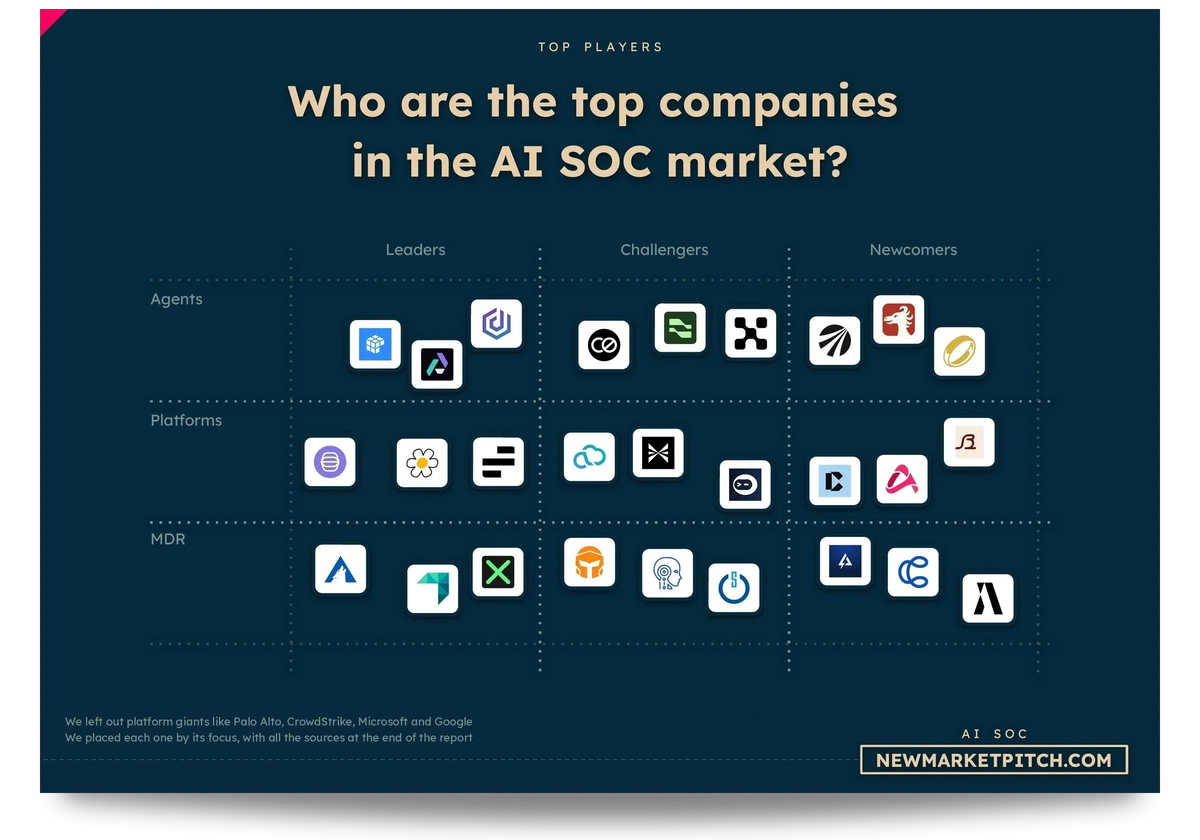
In our report covering the AI SOC market, we turn what is vague and complex into simple, useful visuals. Market maps like this one show you at a glance where every startup stands.
Are security analysts actually trusting AI SOC startups now?
AI SOC startups are now trusted to investigate routine security alerts, but most security teams still want humans making the final call on serious threats.
According to the 2026 SANS SOC Survey, which collected responses from 444 security practitioners and 69 senior security leaders, 79% of SOCs use AI or machine learning, while only 36% have incorporated it into a defined workflow. That 43-percentage-point gap shows how many organizations are experimenting with AI without making it a normal part of security operations.
Some startups have moved much further. Dropzone AI reports more than 300 enterprises using its platform in production. Intezer processed more than 25 million security alerts during 2025. By May 2026, 7AI had reported completing more than 7 million autonomous investigations.
Those numbers describe different activities, so we cannot compare them directly. Still, they show that autonomous investigations have become a real production workload. The remaining question is whether analysts trust the conclusions enough to stop checking the work themselves.
Why is it so hard to tell which AI SOC startup is actually the best?
There is still no reliable industry-wide ranking of AI SOC startups by investigation accuracy or analyst trust, and most impressive performance figures come from the vendors themselves.
KuppingerCole's April 2026 research on the emerging AI SOC market tracked 39 vendors and identified another 84 candidates for further screening. That gives us 123 companies in or around the category, although many offer very different products.
Dropzone AI focuses on investigating existing security alerts. Intezer adds malware analysis and endpoint forensics. Torq automates security workflows across multiple tools, while Exaforce is building a broader detection-and-response platform.
Their published metrics also measure different things. A 95% reduction in false positives cannot be compared directly with 98% investigation accuracy or 70% automatic alert closure. Each figure can be meaningful, but none proves that a product consistently identifies genuine attacks.
Security researchers Anton Chuvakin and Oliver Rochford reached a similar distinction after more than 30 vendor interactions and practitioner interviews: enrichment, summarization, and repetitive triage were established applications, while unrestricted autonomous security decisions had much weaker production evidence.
We therefore put the most weight on named customers, actual deployment scale, measurable investigation outcomes, and how much work analysts are comfortable delegating.

Our research about AI security operations gets updated several times a month, so you always get the latest view of where things stand.
Which AI SOC startups have actually earned analysts' trust?
Dropzone AI, Intezer, 7AI, Prophet Security, and Torq currently have the strongest combination of public customer evidence, production activity, and credible security workflows.
Dropzone has named customers including UiPath, Zapier, and ECS. Intezer has documented enterprise deployments involving Salesforce and RSM. 7AI has publicly identified DXC Technology, BigID, Duck Creek Technologies, and OneSpan among its customers. Prophet has published customer outcomes involving Zip and Upwind.
These references are particularly valuable because they show that established security organizations are prepared to use the products in real environments. Several have also disclosed specific changes in investigation workload.
Exaforce is another serious contender, although its public customer history is shorter. Tines deserves consideration for teams that prefer controlled automation, while Radiant Security competes more directly in AI-assisted investigations.
Our shortlist separates the best-documented autonomous investigation specialists from broader security automation platforms.
| Startup | Main strength | Public evidence | Our assessment |
|---|---|---|---|
| Dropzone AI | Autonomous alert investigation | 300+ production enterprises reported | Strongest default pure-play choice |
| Intezer | Deep technical investigations | 25M+ alerts processed in 2025 | Strong forensic specialist |
| 7AI | Agentic security at scale | 7M+ investigations; DXC deployment | Strong enterprise-scale contender |
| Prophet Security | Investigation and detection improvement | Named customer outcomes and case studies | Strong specialist contender |
| Torq | AI SOC orchestration | Established enterprise automation business | Strong for complex workflows |
| Exaforce | Integrated detection and response | 20 customers disclosed in May 2026 | Promising newer challenger |
| Tines | Controlled security automation | Billion-plus weekly automated actions reported | Established workflow alternative |
| Radiant Security | AI-assisted alert triage | Enterprise references; less comparable public data | Worth testing directly |
If you want more recent data on this point, please see our latest AI SOC market report.
Is Dropzone AI the safest choice for an autonomous SOC analyst?
Dropzone AI is currently our strongest default recommendation for companies that want AI to investigate security alerts without replacing their existing security tools.
In July 2025, Dropzone announced a $37 million Series B and said it had more than 100 enterprise customers. Its later year-end update reported more than 300 production enterprises, alongside elevenfold annual recurring revenue growth and net revenue retention above 370%. Those financial metrics are company-reported.
The individual customer results are more useful for judging the product. Zapier reported an 85% reduction in manual alert investigation. UiPath reported an 86% reduction in false positives and more than 700 analyst hours saved. ECS described automatically closing 70% of Tier 1 alerts while supporting a workload exceeding 30,000 alerts per month without increasing analyst headcount.
These are three different organizations reporting substantial reductions in repetitive investigation work. Although their results were not measured through a common independent benchmark, the pattern is harder to dismiss than a single successful pilot.
Dropzone's appeal is straightforward: a security team can keep using Microsoft Sentinel, CrowdStrike, and other existing tools while allowing an AI investigator to handle much of the repetitive work generated by those systems.
We would choose Dropzone first for a team overwhelmed by routine alerts. We would still test its ability to recognize genuine threats before allowing it to close alerts without review.

In our market report about AI security operations, we look at what the winners do differently, so you can learn from the best instead of guessing.
Can Intezer investigate cyberattacks more deeply than other AI SOC startups?
Intezer is one of the strongest AI SOC startups for detailed threat investigations, especially when an alert requires malware analysis, endpoint evidence, or examination of suspicious files.
The company comes from a malware-analysis and reverse-engineering background. Its ForensicAI platform builds on that expertise to investigate alerts, examine technical artifacts, and produce findings that security analysts can review.
In March 2026, Intezer reported processing more than 25 million alerts during the previous year. It also disclosed 126% net revenue retention, meaning that spending from existing customers increased by 26% after accounting for expansion and contraction. That is useful evidence that customers were continuing to invest in the product.
Its published customer examples cover different problems. Salesforce has used Intezer for employee-reported phishing investigations, while RSM has applied the platform to broader security operations.
An interesting finding from Intezer's February 2026 research was that genuine threats can originate from alerts initially classified as low severity or informational. The analysis used the company's dataset of more than 25 million alerts and found that organizations risk overlooking real threats when they routinely ignore those categories.
That strengthens the case for investigating more alerts rather than relying entirely on severity rankings.
Intezer also introduced native Workflows in August 2026, extending its product toward customizable response automation.
For SOCs dealing with malware, suspicious endpoint activity, and technically complicated incidents, we would put Intezer at the top of the evaluation list. Its forensic background offers a credible advantage, although no independent head-to-head test establishes that it outperforms every competitor.
If you want more recent data on this point, please see our latest AI SOC market report.
Has 7AI proved that autonomous security agents can work at enterprise scale?
7AI has some of the strongest public evidence that AI security agents can handle large investigation workloads, particularly through its deployment with DXC Technology.
The startup announced a $130 million Series A in December 2025, bringing total funding to $166 million. Five months later, it reported completing more than 7 million investigations across production customers. The company also said its customer base had tripled quarter over quarter.
Its relationship with DXC is the more convincing evidence. DXC operates a global technology services business with more than 130,000 employees and security operations spanning multiple delivery centers. Its agentic security deployment progressed from proof of concept to worldwide production in eight weeks.
DXC reported an 80% reduction in Tier 1 analyst time and a 95–99% reduction in tickets requiring human review within the relevant workflows.
The two companies also expanded their relationship into a managed security service offering. That is an important commercial step: DXC moved beyond using the technology internally and began offering agentic SOC capabilities to its own customers.
7AI subsequently introduced PLAID ELITE, a fully managed AI-native security operations offering, in May 2026.
We see 7AI as a particularly strong candidate for large enterprises and managed security providers. Millions of completed investigations demonstrate scale, while the DXC relationship provides a named example of production adoption. The remaining test is how consistently its agents recognize genuine attacks across different customers and security environments.

In our document detailing everything you need to know about AI SOC, you will always find fresh funding data, taken straight from our own verified funding database.
Is Prophet Security one of the most trustworthy AI SOC startups?
Prophet Security belongs among the leading AI SOC specialists because its product emphasizes investigations that security analysts can inspect, question, and use to improve their detections.
The company raised a $30 million Series A led by Accel in July 2025 and subsequently announced strategic investments from Amex Ventures and Citi Ventures in February 2026.
Its customer case studies provide more useful evidence than the financing. Prophet has published examples reporting a tenfold increase in SOC throughput, 6,727 hours of work avoided at Zip, and a separate deployment describing a 19-fold productivity improvement. Another customer reported 96% noise reduction.
These outcomes are customer-reported and measured under different conditions. Still, they show that Prophet has progressed beyond laboratory investigations.
The company's broader product direction is interesting. Prophet connects AI-driven investigations with threat hunting, detection engineering, and response. That gives analysts opportunities to use investigation findings to improve the rules generating future alerts.
For example, repeatedly identifying the same benign activity should eventually help a team adjust its detections rather than investigate that activity indefinitely.
We see Prophet as a strong fit for security teams that want AI to assist both routine investigations and the ongoing improvement of their detection systems. It has earned a place beside Dropzone and Intezer, although its public performance data does not justify declaring it the outright accuracy leader.
Is Torq a better AI SOC choice for large companies?
Torq is one of the better AI SOC choices for large companies that need to coordinate investigations and responses across many security tools, rather than simply automate alert triage.
The company already had an established security automation platform before pushing heavily into AI-driven SOC operations. In January 2026, it raised a $140 million Series D at a $1.2 billion valuation, bringing total disclosed funding to $332 million.
That history gives Torq a different starting point from younger investigation-focused vendors.
Consider a large organization where one security incident requires data from an endpoint product, identity provider, SIEM, cloud platform, and ticketing system. The investigation might also involve approval from a human analyst before an account is suspended or a device is isolated.
Torq's strength lies in coordinating that entire process. Its AI capabilities operate within an existing platform for connecting tools, managing workflows, and executing security actions.
The company's 2026 AI SOC research found that surveyed organizations used an average of seven AI tools in their SOC, with 85% expressing a preference for a unified AI SOC platform. Those are vendor-sponsored survey findings rather than proof that customers prefer Torq specifically.
For an enterprise with complicated response procedures, Torq deserves serious consideration. A smaller team primarily trying to clear its alert backlog may find Dropzone or Intezer easier to evaluate against that narrower objective.
If you want more recent data on this point, please see our latest AI SOC market report.

Learning from others' mistakes is the cheapest lesson there is. In our report covering the AI SOC market, we look at what broke startups before you, so you don't repeat it.
Is Exaforce already catching up with the top AI SOC startups?
Exaforce has become a serious AI SOC challenger remarkably quickly, although its publicly documented customer base remains much smaller than those of the more established specialists.
In May 2026, Exaforce raised $125 million in Series B funding at a reported $725 million valuation. Combined with its previous $75 million Series A, the company had raised $200 million.
TechCrunch reported that Exaforce had approximately 20 customers at the time, including Replit and Guardant Health. The company had only launched commercially in the fourth quarter of 2025 after spending roughly two years working with design partners.
That is a striking contrast: $200 million raised while the disclosed commercial customer base was still measured in dozens.
Exaforce's product also takes a broader approach. Its Exabots combine AI-driven investigations with threat hunting, detection, and response. Analysts can investigate suspicious behavior using natural-language queries rather than writing complicated searches themselves.
The company has promoted the possibility of eliminating up to 90% of manual security work, although that remains a vendor claim without a sufficiently broad independent performance record.
We would take Exaforce seriously when evaluating a new security operations architecture. For a buyer simply looking to automate investigations inside an existing SOC, Dropzone and Intezer have stronger publicly documented deployment histories.
Exaforce could become a major competitor, but we need more evidence from customers operating the platform for extended periods.
Are analysts letting AI SOC tools close security alerts without checking them?
Security analysts are already allowing AI SOC tools to resolve selected alerts without repeating every investigation, particularly when the work is routine and the product has been tested against known cases.
One European managed security provider evaluating Dropzone reported approximately 90–95% investigation accuracy during a proof of concept involving historical and live Microsoft Defender and Sentinel alerts. Its analysts subsequently relied on the findings without routinely repeating the entire process.
DXC's deployment of 7AI offers another example. The company reported a sharp reduction in tickets requiring human attention, suggesting that agents were completing much of the repetitive investigative work.
However, closing a low-risk alert and isolating a production server are very different decisions.
Security teams can allow AI to collect evidence, correlate logs, and recommend verdicts while reserving disruptive actions for authorized personnel. That arrangement already removes substantial manual work.
Trust also grows unevenly. An AI product might be reliable enough to close common phishing false positives but still struggle with unusual identity attacks or complex cloud compromises.
Analysts increasingly trust AI for bounded investigative tasks. Giving an agent unrestricted authority over high-impact responses remains a much harder decision.

Your time is limited. In our research about AI security operations, we put numbers on each part of the market, so you can see where it makes sense to focus.
Can AI SOC startups really eliminate 95% of false positives?
Some AI SOC startups report removing more than 95% of false positives in specific customer environments, but that figure alone tells us very little about whether they are missing real attacks.
Imagine a SOC receiving 100,000 security alerts, including 1,000 genuine threats. Removing 95,000 alerts would dramatically reduce the workload. Yet the result could still be dangerous if genuine threats were among those dismissed.
That is why the public performance figures require care.
7AI has reported 95–99% reductions in tickets requiring human review in DXC's relevant workflows. Prophet has published a case describing 96% noise reduction. Dropzone has documented deployments where a large proportion of Tier 1 alerts were automatically closed.
The numbers are impressive within their respective environments, but each describes a different process. They also come primarily from vendors and their customers rather than independent cross-product testing.
We would want to know how many confirmed threats were present, how many the AI correctly escalated, and how many it mistakenly dismissed. Those last mistakes are especially important because a missed attack can cost far more than the analyst time saved on thousands of benign alerts.
| Metric | What it tells us | Why it matters |
|---|---|---|
| Alert reduction | How much work leaves the human queue | Measures workload savings |
| False-positive rate | How often benign activity triggers threat findings | Measures unnecessary noise |
| False-negative rate | How often real attacks are missed | Exposes dangerous failures |
| Precision | How many positive findings are genuine threats | Tests the reliability of alerts |
| Recall | How many genuine threats are successfully identified | Measures threat coverage |
| Investigation accuracy | How often verdicts match verified outcomes | Tests investigative quality |
| Escalation rate | How often analysts still need to intervene | Measures the remaining workload |
| Response time | How quickly relevant action is taken | Measures operational speed |
Are AI SOC startups really saving analysts time?
AI SOC startups are producing substantial time savings in documented deployments, particularly by taking over repetitive alert investigations that previously consumed analyst hours.
The strongest examples show several ways this happens. Dropzone's Zapier deployment reduced manual alert investigations by 85%, while UiPath reported hundreds of hours saved. Prophet's Zip case described thousands of hours of work avoided. These results suggest that automation can make a small SOC team considerably more productive.
However, those hours do not automatically translate into equivalent reductions in staffing costs.
An organization handling 10,000 monthly alerts might use automation to investigate alerts that were previously ignored, reduce its backlog, or free analysts to improve detection rules. In each case, security coverage can improve without eliminating jobs.
The 2026 SANS survey adds useful context. Meaningful work remained the leading factor in SOC employee retention for the third consecutive year, ahead of compensation. Security teams have a strong reason to move analysts away from repetitive tasks even when headcount reductions are not the goal.
The distinction we would make is between time saved and security improved. A company can save thousands of hours while still overlooking important threats. The best implementations should demonstrate both less repetitive work and better coverage of genuine incidents.

In our market report about AI security operations, we always try to gather several sources and make estimates that make sense, so you can work with solid numbers.
Can AI SOC startups detect attacks that CrowdStrike or Microsoft Defender miss?
Most AI SOC startups have stronger evidence for investigating existing alerts than for detecting attacks that established security products completely miss.
Dropzone typically works with alerts produced by endpoint, identity, email, cloud, and SIEM tools. Intezer can examine suspicious artifacts in greater forensic detail. Prophet uses investigations to support threat hunting and detection improvement, while Exaforce combines investigations with a broader detection platform.
These differences affect what each product can discover.
An AI investigator may connect evidence scattered across several tools and recognize a threat that an analyst would otherwise overlook. It may also examine low-severity alerts that a busy SOC would normally ignore.
Intezer's February 2026 analysis is particularly relevant here. Its research into more than 25 million alerts found genuine threats associated with alerts originally categorized as low severity or informational. That finding suggests that investigating neglected alerts can improve coverage even without inventing entirely new detection methods.
But there is a limit to what an investigation layer can achieve. If an attack generates no useful telemetry or detection evidence, an agent relying on those inputs may have little to investigate.
There are credible opportunities for AI SOC startups to uncover overlooked attacks. There is much less independent evidence that they systematically outperform leading endpoint and cloud detection platforms at discovering entirely new threats.
Will CrowdStrike, Microsoft, and Palo Alto Networks eventually beat the AI SOC startups?
CrowdStrike, Microsoft, and Palo Alto Networks have a major distribution advantage, but independent AI SOC startups can still win customers by investigating threats across competing security products.
The established vendors already operate much of the technology that generates security alerts. CrowdStrike offers Charlotte AI, Microsoft has Security Copilot, and Palo Alto Networks has been expanding its Cortex security operations platform.
These companies can integrate AI into products customers already own. That reduces the effort required to introduce new capabilities and may make procurement easier.
Independent vendors have another advantage: they can work across different platforms.
A company might use Microsoft Sentinel, CrowdStrike Falcon, Okta, and several cloud security products simultaneously. A vendor-neutral AI investigator can analyze information from all of them without forcing the organization to consolidate its security stack.
For companies with mixed environments, that flexibility can outweigh the convenience of using an incumbent's built-in AI features.
The competitive threat is serious. If established platforms deliver investigations of similar quality at a lower incremental cost, standalone vendors will need clear advantages in accuracy, depth, or workflow flexibility.
The strongest independent startups should survive where cross-platform investigation produces results that customers cannot easily get from a single security vendor. The rest will have a harder time justifying another security tool.
If you want more recent data on this point, please see our latest AI SOC market report.

If you build or invest in the AI SOC market, you need to know which business models pay off now and which ones are fading. That's why our report covering it has a whole section on it.
Which AI SOC startup should a company choose today?
Dropzone AI is our first choice for routine autonomous alert investigations, Intezer for deep technical analysis, 7AI for large-scale agentic security operations, Prophet for investigation tied to detection improvement, and Torq for complex enterprise workflows.
The right choice depends heavily on the problem the security team is trying to solve.
A small SOC overwhelmed by alerts from its existing tools needs a product that can investigate and close repetitive cases reliably. A global enterprise coordinating hundreds of response procedures needs stronger orchestration. A team investigating suspicious binaries and compromised endpoints may value Intezer's forensic capabilities more than broad workflow automation.
Tines is worth evaluating when security engineers want detailed control over automation logic and approval steps. The company reported more than one billion automated actions per week in February 2025, although those activities extend beyond AI SOC investigations.
Radiant Security is another relevant competitor in autonomous alert triage and response, but we found less comparable public evidence of production investigation volumes than for the strongest-documented specialists.
| Security team | Our first choice | Main reason |
|---|---|---|
| Small SOC overwhelmed by alerts | Dropzone AI | Automates repetitive investigations |
| Malware and endpoint investigation team | Intezer | Strong forensic analysis background |
| Large multinational SOC | 7AI | Documented enterprise-scale agent deployment |
| Detection engineering-focused SOC | Prophet Security | Connects investigations with detection improvement |
| Enterprise with complex response procedures | Torq | Broad security orchestration |
| Organization replacing its SOC architecture | Exaforce | Integrated detection and response approach |
| Team requiring tightly controlled workflows | Tines | Mature automation and approval mechanisms |
| Team evaluating alternative AI triage tools | Radiant Security | Dedicated investigation and response capabilities |
So who are the top AI SOC startups analysts actually trust?
Dropzone AI, Intezer, 7AI, Prophet Security, and Torq are our top AI SOC startups today, with Dropzone taking the lead for general-purpose autonomous investigations and Intezer standing out for forensic depth.
We reach that conclusion from their publicly documented customer deployments, production workloads, and the amount of investigative work that security teams have actually delegated.
Dropzone has the clearest combination of broad customer adoption and detailed investigation case studies. Intezer brings a strong technical foundation and large-scale alert analysis. 7AI has shown that autonomous agents can operate inside major enterprise security environments, while Prophet and Torq address different but important parts of security operations.
Exaforce is the newer challenger we would watch most closely, especially for companies reconsidering their entire security operations architecture.
There is still no independently verified winner across every dimension of AI SOC performance. Vendor-reported efficiency gains cannot establish which platform is least likely to miss a dangerous attack.
Nevertheless, the evidence is now strong enough to distinguish genuine production leaders from companies relying mainly on promises. Analysts are delegating repetitive investigations, accepting AI-generated findings, and allowing selected alerts to close without full manual review.
For now, that is where real trust has been established. The next winners will be the companies that can prove their agents deserve broader authority without exposing customers to more missed threats.
If you want more recent data on this point, please see our latest AI SOC market report.

In our report covering the AI SOC market, we don't want to repeat what boring consulting reports say. Instead, we show you the real and latest market signals that matter.
Our methodology
This analysis identifies which AI SOC startups have demonstrated meaningful trust among security analysts, using documented production deployments, enterprise adoption, investigation outcomes, operational performance, and the degree of autonomy customers have granted their products. We examine Dropzone AI, Intezer, 7AI, Prophet Security, Torq, Exaforce, Tines, and Radiant Security, alongside the competitive capabilities of established cybersecurity platforms.
We structured the research around several dimensions: market adoption, production maturity, customer validation, investigation reliability, operational efficiency, autonomy, and competitive positioning. For each dimension, we collected recent evidence, primarily from 2025 and 2026, then aggregated the findings and assessed which companies had the strongest support across multiple dimensions. Our conclusions reflect the combined evidence rather than funding levels, individual performance claims, or vendor prominence.
We distinguish actual enterprise adoption from experimentation. Named production customers, repeatable customer outcomes, and documented deployment scale carry greater weight than demonstrations or projected savings. The 2026 SANS SOC Survey provides the wider adoption context, while KuppingerCole's AI SOC market research helps establish the range of competing vendors and product categories.
Investigation volumes, alert reduction, customer retention, and analyst hours saved are assessed separately because they describe different aspects of performance. Our evaluation also distinguishes automation efficiency from security effectiveness. Reducing manual investigations does not, by itself, demonstrate better threat detection. For reliability, we place particular importance on the quality of security verdicts, escalation decisions, and the risk of genuine threats being incorrectly dismissed.
We examined the progression from AI-assisted investigation and automated triage to autonomous case closure and higher-impact security responses. That distinction helps identify where customers have demonstrated operational trust, and where human authorization remains important. We also compared products according to their actual scope: specialist alert investigation, forensic analysis, detection improvement, security orchestration, or integrated detection and response.
Our company assessments draw heavily on named customer evidence. For Dropzone AI, key references include its 2025 business update, the Zapier deployment, the UiPath case study, and ECS's SOC automation results. These provide evidence of production adoption, reduced investigation workload, and autonomous alert handling across distinct customer environments.
For Intezer, we used its 2025 enterprise adoption review and research on overlooked security threats. For 7AI, we examined its production milestones and PLAID ELITE announcement, alongside its DXC Technology deployment, which provides specific evidence of enterprise-scale adoption and reduced analyst intervention.
Prophet Security's operational evidence comes from its Zip customer case study, its wider customer results, and its Series A and product announcement. For the broader automation and platform competitors, we examined Torq's Series D announcement, Exaforce's Series B announcement, TechCrunch's reporting on Exaforce's funding and customer base, and Tines' financing and automation-scale disclosures.
Industry context and incumbent capabilities were checked against the 2026 SANS SOC Survey, KuppingerCole's analysis of 123 AI SOC vendors, Microsoft Security Copilot documentation, CrowdStrike's Charlotte AI product overview, and its agentic security workforce documentation. These sources establish the wider competitive environment and the extent to which established platforms already provide AI-assisted investigation and automation.
Our final assessment gives the greatest weight to converging evidence: named deployments, measurable operational results, substantial production activity, and clearly defined investigative responsibilities. Company-reported metrics are retained with their original context, rather than converted into an artificial common performance ranking. This produces a differentiated shortlist of AI SOC startups with demonstrated production credibility, while keeping the distinction between proven workload automation and independently verified threat-detection accuracy.

In our research about AI security operations, we like to show you the big picture. We know your time is precious, so we make every page quick to read and packed with as much learning as possible per minute.
Written by the New Market Pitch teamWe track new markets so founders and investors can move faster. About us