What’s funding like in the AI training data market right now?
Building a startup or looking for your next investment in AI training data? Our report gives you the full picture.
Summary
AI training data funding is clearly healthier right now. More than twice as many companies are raising, the typical disclosed round is larger, and the improvement remains substantial even after the biggest financings are stripped out.
The market is expanding at both ends, but in very different ways. First financings jumped from five to 18, while most of the additional dollars went to companies that had already raised before.
The headline $1.51 billion funding total overstates the scale of the boom because Mercor and Snorkel each raised $350 million. Even below $50 million per round, however, funding more than doubled from $232.3 million to $529.4 million.
That creates an unusually wide entry funnel alongside a steep funding curve. The median first financing fell to $6 million, while the median follow-on climbed from $8.3 million to $27 million.
The type of training data attracting money is also changing. Real-world collection, professional expertise, reinforcement-learning environments and proprietary multimodal datasets are gaining ground as model developers run into data that cannot simply be scraped from the open web.
Physical AI is one of the clearest new themes. Robotics-data companies increasingly need collection networks, teleoperation systems, sensor infrastructure and deliberate production of real-world demonstrations, turning data generation itself into an infrastructure business.
Traditional annotation is losing startup breadth. Data Annotation & Labeling fell from 27.3% of deals to 6.1%, even though scaled platforms such as Snorkel and Encord can still attract very large rounds by moving into harder data, evaluation and production workflows.
Synthetic data has cooled too. Its deal share fell from 27.3% to 12.2%, suggesting investors increasingly want synthetic generation tied to a specific problem such as privacy, simulation or reinforcement-learning environments rather than treated as a standalone moat.
The stage mix has become more polarized. Seed now represents more than half of deals, but later-stage companies absorb most known capital, while Series A and Series B round sizes have also moved sharply higher.
The clearest change is therefore bigger than the 273% jump in known funding. AI training data has become broader at entry, much more aggressive once a company proves demand or scarce data supply, and increasingly focused on information that is expensive, specialized or operationally difficult to create.

Written by the New Market Pitch teamWe track new markets so founders and investors can move faster. About us

In our report covering the AI training data market, you will always find fresh funding data, taken straight from our own verified funding database.
All funding deals in the AI training data market over the last 24 months
Below is the table listing all the deals. You can find our methodology at the end of this page.
If you want a deeper understanding of the market and its current dynamics, get our report covering the AI training data market.
| Company | Category | Date | Stage | Deal size | What they do | Region | Lead investors | Country | Rank |
|---|---|---|---|---|---|---|---|---|---|
| Proximal | Domain-Specific Training Data | September 2026 | Seed | $15M | Converts real-world model and workflow traces into targeted post-training datasets and RL environments for frontier AI systems. | North America | General Catalyst | United States | |
| micro1 | RLHF & Expert Feedback | September 2026 | Series B | >$100M | Recruits and manages domain experts who generate specialized human data for training frontier AI models. | North America | Not disclosed | United States | |
| Midcentury | Domain-Specific Training Data | September 2026 | Seed | $15M | Builds proprietary egocentric-action datasets and simulation environments for training physical-AI models. | North America | Not disclosed | United States | |
| Snorkel AI | Data Annotation & Labeling | September 2026 | Series D+ | $350M | Supplies completed training datasets and reinforcement-learning environments using a hybrid of synthetic generation and subject-matter experts. | North America | Insight Partners; S32 | United States | |
| Embra AI | Data Curation & Cleaning | September 2026 | Seed | $1M | Provides dataset discovery, evaluation, curation and sourcing infrastructure for robotics and physical-AI training data. | North America | Not disclosed | United States | |
| AfterQuery | RLHF & Expert Feedback | September 2026 | Series B | $50.3M | Produces expert-generated workflows, datasets and reinforcement-learning environments for training advanced AI models and agents. | North America | Not disclosed | United States | |
| Mundo AI | Domain-Specific Training Data | August 2026 | Seed | $4M | Produces multilingual and multimodal datasets for training AI systems across audio, video and emerging perceptual modalities. | North America | Not disclosed | Canada | |
| Mundo AI | Domain-Specific Training Data | August 2026 | Series A | $20M | Produces multilingual and multimodal datasets for training AI systems across audio, video and emerging perceptual modalities. | North America | GreatPoint Ventures | Canada | |
| Idler | Synthetic Training Data | August 2026 | Seed | $9M | Builds interactive reinforcement-learning environments used to train and evaluate frontier AI agents. | North America | Paradigm | United States | |
| IO-AI Tech | Data Collection Services | August 2026 | Unknown | Not Disclosed | Provides end-to-end capture, teleoperation, annotation and management infrastructure for embodied-AI and robotics training data. | Asia-Pacific | Not disclosed | China | |
| N.dot.light | Synthetic Training Data | August 2026 | Series A | $10.6M | Produces simulation-ready 3D assets and synthetic training data infrastructure for physical-AI development. | Asia-Pacific | Korea Development Bank (KDB) | South Korea | |
| Kaiwang Data (恺望数据) | Data Collection Services | August 2026 | Unknown | >$14M | Collects, labels and processes large-scale multimodal real-world data for autonomous-driving, world-model and embodied-AI training. | Asia-Pacific | Beijing Yizhuang Industrial Upgrade Fund; Huafang Capital; Tianji Capital | China | |
| Axis Robotics | Data Collection Services | July 2026 | Seed | $12M | Combines teleoperation, human capture, simulation and processing to produce training data for physical-AI models. | North America | Hack VC | United States | |
| Ropedia | Data Collection Services | July 2026 | Unknown | $22M | Captures and processes wearable multimodal human-behavior data into training datasets for embodied and physical AI. | Asia-Pacific | Not disclosed | Singapore | |
| Bespoke Labs | Domain-Specific Training Data | July 2026 | Seed | $8.3M | Builds curated reasoning and post-training datasets plus data-research tooling for advanced AI models. | North America | 8VC | United States | |
| Bespoke Labs | Domain-Specific Training Data | July 2026 | Series A | $31.8M | Builds high-complexity reinforcement-learning environments and curated post-training data for AI agents. | North America | Wing Venture Capital | United States | |
| Worldmodeldata | Licensed Proprietary Datasets | July 2026 | Seed | ≈$9.4M | Licenses gameplay and converts it into action-conditioned datasets for world-model and physical-AI training. | Europe | Iona Star Capital | United Kingdom | |
| XDOF | Data Collection Services | June 2026 | Series A | $70M | Builds large-scale pipelines, teleoperation operations and annotation systems that produce physical-interaction training data for robotics models. | North America | Not disclosed | United States | |
| BeatpulseLabs | Domain-Specific Training Data | June 2026 | Seed | $1.8M | Converts licensed and enterprise multimedia into expert-annotated, model-ready datasets for training and fine-tuning multimodal AI. | Europe | Araya Ventures; Lighthouse Ventures | United Kingdom | |
| Vision Lab | Data Collection Services | June 2026 | Seed | $6M | Captures and curates real-world factory workflows and industrial video as training data for robotics and physical-AI models. | North America | Race Capital | United States | |
| Poindexter Labs | Data Annotation & Labeling | June 2026 | Seed | ≈$2.7M | Uses specialist experts and collaborative review workflows to create high-complexity reasoning and annotation data for frontier AI models. | Europe | Episode 1 | United Kingdom | |
| Mecka AI | Data Collection Services | June 2026 | Series A | $25M | Captures human-motion data through body sensors, smartphones and custom equipment to train robotics models. | North America | Framework Ventures | United States | |
| Mecka AI | Data Collection Services | June 2026 | Unknown | $35M | Captures human-motion data through body sensors, smartphones and custom equipment to train robotics models. | North America | Framework Ventures | United States | |
| Human Archive | Data Collection Services | May 2026 | Seed | $8.2M | Collects sensor-rich real-world human activity data through wearable capture systems for training physical-AI and robotics models. | North America | Wing Venture Capital | United States | |
| Luel | Data Collection Services | May 2026 | Seed | $31.2M | Operates a global contributor marketplace collecting rights-cleared video, audio, sensor, image and annotation data for frontier AI labs. | North America | General Catalyst; Lightspeed Venture Partners | United States | |
| Wirestock | Licensed Proprietary Datasets | May 2026 | Series A | $23M | Supplies creator-sourced and custom multimodal image, video, 3D and interaction datasets to AI model developers. | North America | Nava Ventures | United States | |
| Origin Lab | Licensed Proprietary Datasets | May 2026 | Seed | $8M | Licenses video-game worlds and converts them into structured multimodal datasets for world-model and embodied-AI training. | North America | Lightspeed Venture Partners | United States | |
| Secludy | Synthetic Training Data | May 2026 | Seed | $4M | Generates privacy-preserving synthetic versions of sensitive enterprise datasets for AI training and fine-tuning. | North America | Impression Ventures | United States | |
| Config | Data Collection Services | May 2026 | Seed | $27M | Collects and transforms large-scale human-motion demonstrations into training data for robotics foundation models. | North America | Samsung Venture Investment | United States | |
| AfterQuery | RLHF & Expert Feedback | April 2026 | Series A | $30M | Produces expert-generated datasets and reinforcement-learning environments for training frontier AI models in specialized professional domains. | North America | Altos Ventures | United States | |
| Nomadic (NomadicML Inc.) | Data Curation & Cleaning | March 2026 | Seed | $8.4M | Turns autonomous-system video into structured, searchable, training-ready datasets and edge-case libraries for physical AI. | North America | TQ Ventures | United States | |
| Deccan AI | RLHF & Expert Feedback | March 2026 | Series A | $25M | Supplies expert-generated SFT/RLHF post-training data and feedback workflows for frontier and enterprise AI models. | North America | A91 Partners | United States | |
| Lightwheel | Synthetic Training Data | March 2026 | Series A | ≈$140M | Simulation-generated synthetic data, human video data and evaluation for physical AI. | Asia-Pacific | Not disclosed | China | |
| Encord | Data Annotation & Labeling | February 2026 | Series C | $60M | Provides AI-native infrastructure to curate, manage and annotate multimodal training data for physical-AI and other AI models. | Europe | Wellington Management | United Kingdom | |
| Rapidata AG | RLHF & Expert Feedback | February 2026 | Seed | $8.5M | Collects on-demand human judgments and labels at scale for RLHF, model training and iterative improvement. | Europe | Canaan Partners; IA Ventures | Switzerland | |
| Maniformer (Mifeng Technology) | Domain-Specific Training Data | February 2026 | Seed | Not Disclosed | Supplies real-world, simulated and human-demonstration training data infrastructure for embodied and physical AI. | Asia-Pacific | HSG China (HongShan) | China | |
| AI Verse | Synthetic Training Data | January 2026 | Unknown | ≈$5.8M | Generates photorealistic, fully annotated synthetic datasets for training computer-vision models. | Europe | Supernova Invest | France | |
| Protege | Licensed Proprietary Datasets | January 2026 | Series A | $30M | Licenses and curates private real-world datasets for AI builders’ pre-training, fine-tuning and post-training workflows. | North America | Andreessen Horowitz | United States | |
| Synapath AI (枢途科技) | Data Curation & Cleaning | December 2025 | Seed | Not Disclosed | Converts large-scale internet video into structured multimodal training datasets for embodied AI. | Asia-Pacific | Chentao Capital | China | |
| Cortex AI | Data Collection Services | December 2025 | Seed | $6M | Captures real-world egocentric human and robot-operation data for training embodied and robotics AI models. | North America | Not disclosed | United States | |
| Besimple AI | Domain-Specific Training Data | November 2025 | Seed | $3M | Collects, licenses and annotates multilingual conversational audio datasets for training speech and voice AI. | North America | Not disclosed | United States | |
| Humanola | Data Collection Services | November 2025 | Seed | $2.4M | Provides teleoperation infrastructure that generates training-ready human-motion and demonstration data for humanoid robots. | North America | Link Ventures | United States | |
| DataArc (数创弧光) | Synthetic Training Data | November 2025 | Seed | Not Disclosed | Develops synthetic-data technology and datasets used to address training-data shortages for large AI models. | Asia-Pacific | InnoAngel Fund; Oriental Fortune Capital | China | |
| Lightwheel | Synthetic Training Data | November 2025 | Series A | Not Disclosed | Generates simulation-based synthetic and behavioral data used to train physical-AI and robotics models. | Asia-Pacific | Not disclosed | China | |
| Mercor | RLHF & Expert Feedback | October 2025 | Series C | $350M | Supplies domain experts who generate feedback and training work used to improve frontier AI models. | North America | Felicis | United States | |
| Synapath AI (枢途科技) | Data Curation & Cleaning | October 2025 | Seed | Not Disclosed | Converts large-scale internet video into structured multimodal training datasets for embodied AI. | Asia-Pacific | Oriental Fortune Capital; Jiangu Capital | China | |
| Lucent | Data Collection Services | October 2025 | Seed | ≈$1.3M | Collected behavioral web-interaction datasets used to train browser-based AI agents. | Asia-Pacific | Not disclosed | Australia | |
| Datacurve | Domain-Specific Training Data | October 2025 | Series A | $15M | Produces expert-quality coding and post-training datasets for frontier language models. | North America | Chemistry | United States | |
| David AI | Domain-Specific Training Data | October 2025 | Series B | $50M | Produces proprietary speech and audio datasets used to train voice and audio AI models. | North America | Meritech | United States | |
| Invisible Technologies | RLHF & Expert Feedback | September 2025 | Growth Equity | $100M | Supplies human expert input, dataset operations and model training support, alongside enterprise AI workflow software. | North America | Vanara Capital | United States | |
| micro1 | RLHF & Expert Feedback | September 2025 | Series A | $35M | Sources and manages domain experts who generate, label and provide feedback on data used to train and post-train frontier AI models. | North America | 01 Advisors | United States | |
| CUBIG | Synthetic Training Data | August 2025 | Series A | $435K | Generates privacy-preserving synthetic datasets that enterprises can use for AI training without exposing sensitive source data. | Asia-Pacific | Iona Star LP; Friend Investment Partners | South Korea | |
| Protege | Licensed Proprietary Datasets | August 2025 | Series A | $25M | Operates a governed exchange through which proprietary real-world datasets are licensed to AI developers for model training. | North America | Footwork | United States | |
| Mecka AI | Data Collection Services | August 2025 | Seed | $8M | Collects, analyzes and labels egocentric human-activity video into task-specific training datasets for robotics and physical-AI models. | North America | Neo | United States | |
| Perle | Data Annotation & Labeling | August 2025 | Seed | $9M | Provides expert-in-the-loop data collection, annotation and feedback workflows for training and fine-tuning multimodal AI models. | North America | Framework Ventures | United States | |
| Poseidon | Domain-Specific Training Data | July 2025 | Seed | $15M | Collects, curates and licenses rights-cleared real-world datasets for training physical-AI models. | North America | a16z crypto | United States | |
| SuperAnnotate | Data Annotation & Labeling | July 2025 | Series B | $13.5M | Provides human- and agent-in-the-loop workflows for annotating, curating and refining datasets used to train and post-train AI models. | North America | Dell Technologies Capital | United States | |
| PublicAI | Data Collection Services | June 2025 | Series A | $8M | Runs a decentralized workforce platform that collects and labels multimodal human-contributed data for AI training. | North America | Saudi Telecom Company (stc Group) | United States | |
| Scale AI | Data Annotation & Labeling | June 2025 | Growth Equity | $14.3B | Data labeling and annotation provider for AI model developers. | North America | Meta | United States | |
| Snorkel AI | Data Annotation & Labeling | May 2025 | Series D+ | $100M | Provides data-development software and expert-data services for labeling, curating and generating specialized training and post-training datasets. | North America | Addition | United States | |
| David AI | Domain-Specific Training Data | May 2025 | Series A | $25M | Builds proprietary research-grade audio datasets for training voice and multimodal AI models. | North America | Alt Capital; Amplify Partners | United States | |
| Toloka | RLHF & Expert Feedback | May 2025 | Growth Equity | $72M | Supplies expert-generated human feedback, annotations and custom datasets for training and improving LLMs and AI agents. | Europe | Bezos Expeditions | Netherlands | |
| Unitlab AI | Data Annotation & Labeling | March 2025 | Seed | $400K | Provides automated multimodal data annotation, collection, curation and dataset management for AI/ML training. | Asia-Pacific | Not disclosed | Uzbekistan | |
| Orbifold AI | Data Curation & Cleaning | March 2025 | Seed | $5M | Curates raw multimodal enterprise data into high-quality, model-ready datasets for AI training and development. | North America | Bonfire Ventures; Fusion Fund | United States | |
| GenGenAI | Synthetic Training Data | March 2025 | Series A | ≈$8.3M | Generates synthetic datasets for training AI systems in defense, security, surveillance, automotive and other data-scarce domains. | Asia-Pacific | Not disclosed | South Korea | |
| Turing | Domain-Specific Training Data | March 2025 | Series D+ | $111M | Supplies technical expert data, coding tasks, evaluations and post-training services to leading foundation model labs. | North America | Khazanah Nasional | United States | |
| Mercor | RLHF & Expert Feedback | February 2025 | Series B | $100M | Connects domain experts with AI labs to generate expert feedback and advanced model training data. | North America | Felicis | United States | |
| David AI | Domain-Specific Training Data | January 2025 | Seed | $5M | Collects and structures high-quality audio datasets for training speech and audio AI models. | North America | First Round Capital | United States | |
| Rockfish Data | Synthetic Training Data | January 2025 | Seed | $4M | Generates privacy-preserving synthetic operational datasets used for AI/ML training, testing and data sharing. | North America | Emergent Ventures | United States | |
| Repli5 | Synthetic Training Data | December 2024 | Seed | ≈$453K | Generates realistic, automatically labeled synthetic image data for training computer-vision and perception models in autonomous systems. | Europe | Not disclosed | Sweden | |
| SuperAnnotate | Data Annotation & Labeling | November 2024 | Series B | $36M | Provides software and managed human-data workflows to create, annotate, curate and manage multimodal AI training datasets. | North America | Socium Ventures | United States | |
| Troveo | Licensed Proprietary Datasets | November 2024 | Seed | $4.5M | Licenses rights-cleared proprietary creator and media content to AI companies for model training. | North America | Seven Seven Six | United States | |
| Bifrost AI | Synthetic Training Data | October 2024 | Series A | $8M | Generates physically accurate 3D synthetic datasets and simulated scenarios for training physical-AI and robotics models. | North America | Carbide Ventures | United States | |
| Mindtech Global | Synthetic Training Data | October 2024 | Series A | ≈$5.7M | Creates configurable synthetic image datasets and data-generation tools for training computer-vision systems. | Europe | Edge | United Kingdom | |
| Centaur Labs | Data Annotation & Labeling | October 2024 | Series B | >$16M | Provides expert medical and scientific data annotation and on-demand labeling for AI model training. | North America | SignalFire | United States |

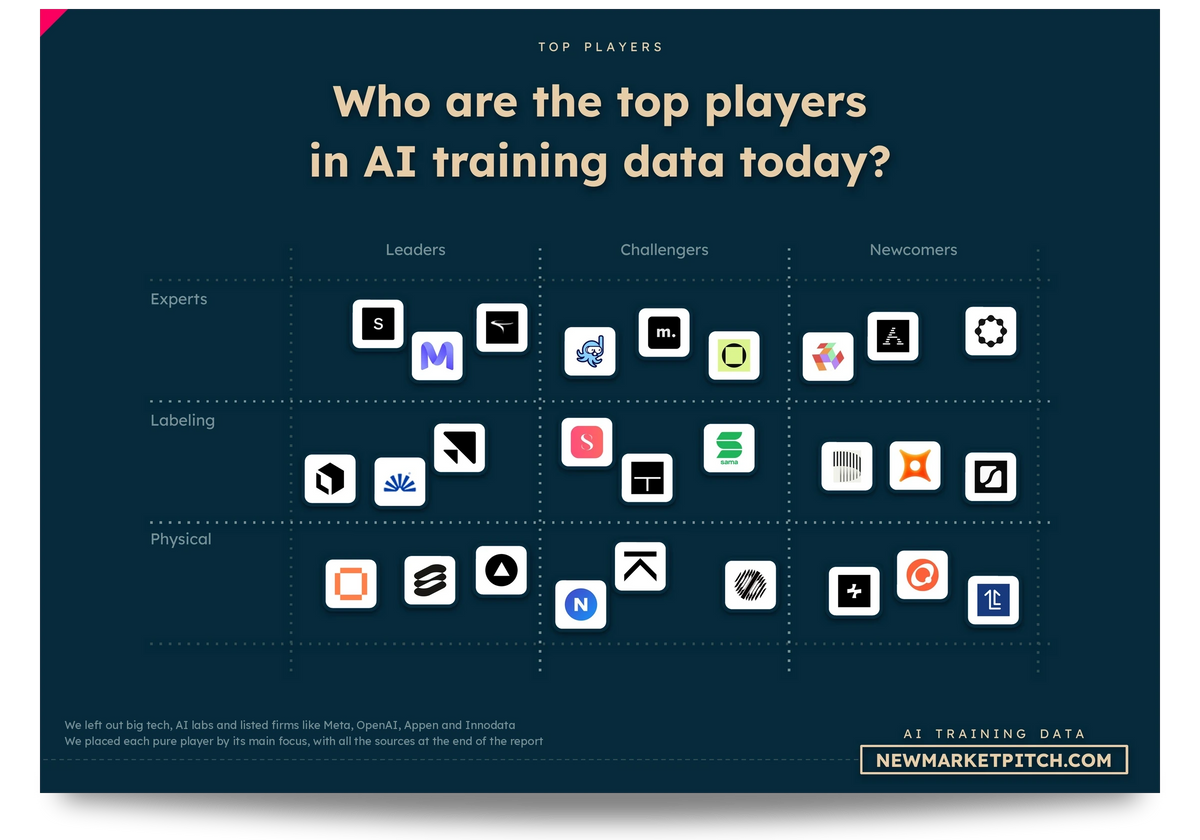
In our research about AI training data, we turn what is vague and complex into simple, useful visuals. Market maps like this one show you at a glance where every startup stands.
Is AI training data funding actually healthier right now?
Yes. AI training data funding is clearly healthier today: far more companies are raising, the typical round is bigger, and the improvement still holds once we remove the giant deals.
We counted 49 financings in the latest 12 months, compared with 22 in the previous period. The number of funded companies more than doubled from 20 to 44, while the median disclosed round climbed from $8.15 million to $14.5 million.
Known funding reached at least $1.51 billion, nearly four times the previous $404.3 million. That headline is flattering to the market because Mercor and Snorkel both raised $350 million, but the underlying numbers are also much stronger. Funding below $50 million rounds more than doubled, and first financings rose from five to 18.
The market has a much deeper bench now. A year ago, activity was thinner and relied more heavily on a relatively small group of companies. Today we see new data-collection startups, expert networks, proprietary-data platforms and physical-AI infrastructure companies entering at the same time that established businesses are raising much larger follow-ons.
| Metric | Current L12M | Previous 12M | Change |
|---|---|---|---|
| Deals | 49 | 22 | +122.7% |
| Funded companies | 44 | 20 | +120.0% |
| Known/minimum capital | $1.510B | $404.3M | +273.4% |
| Median disclosed round | $14.5M | $8.15M | +77.9% |
| First financings | 18 | 5 | +260.0% |
| First-financing share | 36.7% | 22.7% | +14.0 pp |
| Average deals per month | 4.08 | 1.83 | +123% |
Would AI training data funding still look strong without Mercor and Snorkel?
Yes. The AI training data boom survives easily without Mercor, Snorkel and the other very large rounds.
Mercor and Snorkel each raised $350 million, while micro1 disclosed a financing of more than $100 million. Those transactions clearly inflate the headline total.
Once every round above $50 million is removed, however, funding still rises from $232.3 million to $529.4 million, up about 128%. If we remove only rounds above $100 million, current funding still reaches roughly $710 million versus $404 million one year earlier.
The median round is also up 78%. A couple of monster checks cannot manufacture that change.
The billion-dollar headline exaggerates the magnitude of the improvement, but the boom underneath it is real.
Are more AI training data startups getting funded now?
Yes. AI training data funding is reaching more than twice as many companies as it did one year earlier.
We found 44 funded companies in the latest period versus 20 previously. First financings jumped from five to 18, so a large part of that increase comes from genuinely new entrants rather than companies simply returning for another round.
The new cohort is also unusually varied. Config is building robotics-data infrastructure. Origin Lab is turning licensed video-game worlds into data for embodied AI. Luel operates a contributor network for multimodal data. AfterQuery builds expert datasets and reinforcement-learning environments. Mundo AI focuses on perceptual and multimodal data.
These companies are attacking very different bottlenecks, which makes the increase in deal count more convincing than a surge concentrated in one narrow niche.

In our market report about AI training data, we always try to gather several sources and make estimates that make sense, so you can work with solid numbers.
Are new AI training data startups winning, or are existing winners taking the money?
Both are benefiting, but existing AI training data companies are taking almost all of the extra dollars.
First financings rose from five to 18, yet known capital going into those first rounds barely moved, from $104.5 million to $111.3 million. The median first financing actually fell from $8 million to $6 million.
Follow-ons went in the opposite direction. Known follow-on capital increased from about $300 million to almost $1.40 billion, while the median follow-on grew from $8.3 million to $27 million.
The entry funnel is wider, but the funding curve gets much steeper once companies prove themselves. Investors are happy to seed a larger number of ideas; the serious money is going to businesses that already have customers, proprietary supply, specialist networks or operational scale.
Mercor, Snorkel, Encord, Protege and AfterQuery all fit that second group.
| Metric | Current | Previous |
|---|---|---|
| First financings | 18 | 5 |
| First-financing share | 36.7% | 22.7% |
| Known first-financing capital | $111.3M | $104.5M |
| Median first financing | $6.0M | $8.0M |
| Follow-on financings | 30 | 17 |
| Known follow-on capital | $1.398B | $299.8M |
| Median follow-on | $27.0M | $8.3M |
Why are AI training data follow-on rounds getting so much bigger?
AI training data follow-on rounds are getting bigger because a few business models are starting to look much more scalable than they did one year ago.
Mercor raised $350 million after building a large network of domain specialists who help train advanced models. Snorkel raised another $350 million and said its newer data-as-a-service business had grown more than 18-fold, reaching a $375 million annualized revenue run rate. AfterQuery said after its $30 million Series A that it had already passed a $100 million revenue run rate.
Protege provides another good example. It raised a $25 million Series A and then announced another $30 million led by Andreessen Horowitz only months later, as demand expanded across healthcare, media, audio and motion-capture data.
These are very different companies, but investors can now point to actual usage, revenue, repeat customers and hard-to-copy data supply. That supports much larger checks than the market was writing a year earlier.
Which part of AI training data is actually gaining the most momentum?
Physical data collection is currently the clearest broad-based winner in AI training data, while expert feedback attracts the biggest checks.
Data Collection Services grew from 9.1% to 28.6% of deals. Its median financing also rose from $8 million to $14 million. Config, Luel, Human Archive, Vision Lab, Mecka and XDOF have all raised around the idea that real-world data itself needs industrial-scale collection infrastructure.
RLHF & Expert Feedback also strengthened, moving from two deals to seven and reaching 37.3% of known capital. Mercor and micro1 have a large effect on that dollar share, but the increase in the number of funded companies is real.
Domain-Specific Training Data is growing differently. Its share of deals rose from 13.6% to 22.4%, while its share of capital stayed near 11%. That looks like a young category filling up with new companies rather than one already dominated by huge rounds.
| Category | Current deal share | Previous deal share | Current capital share | Current median | Funding intensity |
|---|---|---|---|---|---|
| Data Collection Services | 28.6% | 9.1% | 17.2% | $14.0M | 0.60 |
| Domain-Specific Training Data | 22.4% | 13.6% | 10.9% | $15.0M | 0.48 |
| RLHF & Expert Feedback | 14.3% | 9.1% | 37.3% | $40.1M | 2.61 |
| Synthetic Training Data | 12.2% | 27.3% | 1.9% | $7.4M | 0.16 |
| Data Curation & Cleaning | 8.2% | 4.5% | 0.6% | $4.7M | 0.08 |
| Licensed Proprietary Datasets | 8.2% | 9.1% | 4.7% | $16.2M | 0.57 |
| Data Annotation & Labeling | 6.1% | 27.3% | 27.3% | $60.0M | 4.47 |

Our document detailing everything you need to know about AI training data gets updated several times a month, so you always get the latest view of where things stand.
Is old-school AI data labeling losing ground?
Yes. Traditional AI data labeling is losing breadth quickly, even though the strongest platforms can still raise enormous rounds.
Data Annotation & Labeling fell from 27.3% of deals to just 6.1%. That is the steepest loss of deal share among the main categories we track.
The surviving leaders are moving well beyond simple labeling. Snorkel now talks about expert-created tasks, reinforcement-learning environments, evaluation rubrics and a broader data factory for frontier AI. Encord's $60 million Series C was pitched around AI-native data infrastructure for physical AI.
Fewer investors appear interested in funding another generic annotation business. Platforms that can handle difficult workflows, proprietary data, evaluation and large-scale production still attract plenty of capital.
As seen above, the category's $60 million current median financing comes from that smaller group of scaled companies rather than from broad startup formation.
Why is expert AI training data suddenly worth so much?
Expert AI training data is becoming expensive because frontier models now need judgment and specialized workflows that cheap crowdwork cannot easily provide.
Mercor describes doctors, lawyers, bankers and other specialists teaching models how professional work is actually done. AfterQuery builds datasets and reinforcement-learning environments across areas such as finance, software engineering and enterprise workflows.
Snorkel is pushing in the same direction. Its latest work focuses on expert-created agent tasks, environments and evaluation criteria that can take hours or days to design properly.
The valuable output may now be a complete workflow, a difficult decision process, an interactive environment or a scoring system for an agent. Producing those assets requires expensive people and more operational infrastructure.
That helps explain why RLHF and expert-feedback companies are attracting much more capital per deal than many conventional labeling startups.
Why is robotics data getting so much investor attention now?
Robotics data is attracting much more funding because physical AI does not have an internet-sized dataset waiting to be scraped.
A language model can learn from vast quantities of existing text, images and code. A robot needs demonstrations of hands manipulating objects, factory processes, motion, sensor data and interactions between people and machines.
Companies therefore have to create that data deliberately.
XDOF is building production-scale robotics datasets and released an open teleoperation dataset with more than 130,000 episodes across 200 manipulation tasks. Config says high-quality training data is the main bottleneck for general-purpose robot foundation models and has built collection operations across several locations. Luel collects video, audio, sensor streams and other multimodal data through a global contributor network.
The money is following the work required to produce those datasets. Config's $27 million round attracted Samsung Venture Investment alongside investment arms connected to Hyundai, LG and SK Telecom. Human Archive raised $8.2 million around sensor-rich real-world human activity data.
Robotics data has started to look like a standalone infrastructure business.

In our report covering the AI training data market, we look at what the winners do differently, so you can learn from the best instead of guessing.
Is synthetic AI training data falling out of favor?
Yes, at least relative to the rest of the AI training data market. Synthetic data has lost a lot of its previous funding momentum.
Synthetic Training Data represented 27.3% of deals in the previous period and only 12.2% now. Its share of known capital fell from 6.7% to 1.9%.
There are still good reasons to generate synthetic data. Secludy uses it to work with sensitive enterprise information, while companies building reinforcement-learning environments can create interactions that would be difficult to collect naturally.
What has weakened is the broad idea that synthetic generation on its own is enough of a venture moat. Investors currently seem more interested when synthetic data solves a specific problem such as privacy, simulation, agent training or lack of access to real-world examples.
Is AI training data funding moving earlier stage or later stage?
AI training data is getting more Seed-heavy in the number of deals while the bulk of the money moves toward later rounds.
Seed rose from 40.9% to 53.1% of deals. Series A moved down from 36.4% to 22.4%. That is a clear increase in very young company formation.
Capital tells another story. Later-stage companies captured 63.6% of known dollars, and Series C plus Series D+ alone represented roughly half of current funding.
Round sizes are climbing too. The median Series A increased from $8.15 million to $25 million, while the median Series B reached about $50 million versus $16 million previously.
The market is becoming younger at the bottom and more capital-intensive at the top.
| Stage | Current deal share | Previous deal share | Current capital share | Current median | Previous median |
|---|---|---|---|---|---|
| Seed | 53.1% | 40.9% | 12.7% | $8.1M | $5.0M |
| Series A | 22.4% | 36.4% | 18.6% | $25.0M | $8.15M |
| Series B | 6.1% | 13.6% | 13.3% | $50.3M | $16.0M |
| Series C | 4.1% | 0% | 27.2% | $205M | - |
| Series D+ | 2.0% | 4.5% | 23.2% | $350M | $100M |
| Growth Equity | 0% | 4.5% | 0% | - | $72M |
| Unknown | 12.2% | 0% | 5.1% | $18M | - |
Are AI training data startups raising again faster now?
Some AI training data startups are raising again extremely quickly, but the evidence is still too thin to call faster fundraising a market-wide trend.
Among the seven current follow-ons where we could establish a reliable previous-round date, the median gap was about 4.9 months. Four raised within a year and six within 18 months.
Protege is a good recent example. Its $30 million financing followed a $25 million Series A announced only months earlier. David AI also moved quickly through a $5 million Seed, a $25 million Series A and then a $50 million Series B.
The comparison sample from the previous year contains only three reliable observations. Announcement dates also create noise: some rounds were made public long after they actually closed.
We can confidently say that selected winners are able to return to market very quickly these days. A broader claim about the average company would go beyond what the evidence can support.

In our research about AI training data, we don't want to repeat what boring consulting reports say. Instead, we show you the real and latest market signals that matter.
Do AI training data companies need more proof to raise a big round now?
Yes. The biggest AI training data rounds today usually come with clear evidence of customer demand, proprietary supply or a production system that would be difficult to reproduce quickly.
Snorkel said its newer data service had grown more than 18-fold before the $350 million round. AfterQuery reported a revenue run rate above $100 million after its Series A. Protege said adoption was expanding across healthcare, media, audio and motion capture before its latest financing.
Physical-AI companies show a different kind of proof. Config is already working with large enterprise customers and operates a full data-to-model adaptation loop. XDOF works with robotics labs and companies on production-scale datasets. Luel has built a global contributor network rather than simply a software interface.
Investors seem comfortable funding experiments with smaller Seed checks. The bar becomes much higher once the round gets large.
Is North America still dominating AI training data funding?
North America still dominates AI training data dollars, although Asia is producing a much larger share of funded companies than it did a year ago.
North America accounts for 65.3% of current deals and about 91% of known capital. The giant Mercor, Snorkel and micro1 financings explain a large part of that dollar dominance.
Asia-Pacific increased from 13.6% to 22.4% of deals. Its reported capital share looks much smaller, but that comparison is unusually unreliable because every current financing without an exact disclosed amount comes from APAC.
That missing-dollar problem affects seven deals, so we should not read the reported 3.2% APAC capital share literally.
Europe remains active but much smaller than North America in funding dollars. The previous period was also helped by Toloka's $72 million transaction, which makes the year-on-year decline look sharper.
Are more investors entering AI training data?
Yes. More investors are showing up in AI training data, and we are starting to see repeat investors build positions across several companies.
We identified 54 distinct named lead or strategic investors in the latest period versus 30 previously. Named lead participations rose from 22 to 45.
General Catalyst, Lightspeed, Framework Ventures, Wing Venture Capital and Oriental Fortune Capital each appeared more than once in the current period. We did not see that kind of repeat lead activity in the previous sample.
Investor disclosure is actually weaker today, so those counts probably understate the current breadth.
The more interesting change is specialization. Some investors are coming back repeatedly around expert data, physical AI or proprietary multimodal data rather than treating training data as one generic category.

Learning from others' mistakes is the cheapest lesson there is. In our market report about AI training data, we look at what broke startups before you, so you don't repeat it.
Are corporate investors becoming more important in AI training data?
Corporate investors look more selective today, with the clearest activity concentrated around physical AI and strategically scarce data.
We found named strategic investors in seven current financings versus eight previously. The visible participation rate therefore fell from 36.4% to 14.3%, although weaker investor disclosure makes that comparison imperfect.
Config shows why the corporate rounds that remain are interesting. Its financing brought together Samsung Venture Investment, Hyundai's ZER01NE, LG Technology Ventures and SKT America around robotics-data infrastructure.
Those investors have obvious industrial reasons to care about better physical-AI training data.
There is less evidence of broad corporate participation across the whole market today, but the strategic logic is strong in deals tied directly to robotics, manufacturing and proprietary data access.
What are AI training data companies spending all this money on?
AI training data companies are increasingly spending their funding on industrial-scale data production: specialist networks, multimodal collection, reinforcement-learning environments and physical-data operations.
Mercor said its $350 million round would expand its talent network, improve matching and speed up delivery. Snorkel is using its capital to scale a data factory built around expert tasks, environments and frontier-model development.
Luel raised $31.2 million to expand a worldwide contributor network collecting rights-cleared multimodal data. Wirestock's $23 million Series A is supporting a platform built around human-made image, video, 3D and other multimodal data. Config is investing in collection infrastructure and robot foundation models, while XDOF operates further down the physical stack with robotic systems, teleoperation and production-scale datasets.
More of the funding is moving into operations: people, hardware, collection networks and production systems that continuously generate scarce data.
What really changed in AI training data funding over the last 12 months?
AI training data funding became substantially healthier. We found more than twice as many deals and companies, while the median round increased sharply. The acceleration remains strong after removing the biggest financings.
The biggest structural change is the split between new companies and proven ones. Many more startups are receiving first checks, but those initial checks are relatively modest. Most of the incremental capital is flowing into follow-ons, where the median round has more than tripled.
Money is also moving toward a different kind of data. Real-world collection, professional expertise, reinforcement-learning environments and proprietary multimodal datasets have gained momentum as model developers look beyond easily available web data.
Traditional annotation is becoming a narrower business. Large platforms can still raise very large amounts, but new-company formation has moved elsewhere. Synthetic data has also cooled considerably compared with the rest of the market.
Physical AI may be the most important new funding theme. Robotics companies need large quantities of real-world interaction data that do not already exist on the internet, and investors are now financing the infrastructure needed to produce it.
The misleading headline would be that AI training data funding simply jumped 273%. The more useful conclusion is that the market has become broader at entry, much more aggressive when backing winners, and increasingly focused on data that is expensive or operationally difficult to create.
Our methodology
We analyzed fundraising activity in the AI training data market across two consecutive, non-overlapping 12-month periods: October 8, 2025 through October 7, 2026, and October 8, 2024 through October 7, 2025. The objective was to measure how the funding market changed rather than simply reproduce a database total.
We applied a strict market-definition test. AI training data had to represent the company's overwhelming core business at the time of the financing. Borderline companies were excluded when data, evaluation or AI infrastructure was only a secondary part of the business.
We focused on qualifying private-company equity financings. Debt, grants, loans, unconverted convertibles, public offerings and transactions where the equity component could not be isolated were excluded. When a financing was disclosed only as a minimum or range, we kept that uncertainty rather than estimating a cleaner-looking number.
Each financing was treated as a separate deal, while duplicate reports of the same round were consolidated. Extensions, additional closes and tranches were reviewed individually. Public announcement dates were used consistently for period assignment because actual closing dates are often unavailable, and unreliable dates were excluded from funding-velocity calculations.
Stages, investors, previous rounds, founding dates and company milestones were recorded only when they could be established from public evidence. We did not infer a stage from round size, assume that an investor led a financing simply because its name appeared prominently, or estimate undisclosed round amounts.
After compiling the dataset, we ran a separate quality-control pass for missing deals, date boundaries, company eligibility, financing structures and duplicate reporting. We also recalculated the market after excluding rounds above $50 million and $100 million to test whether a handful of very large financings were driving the conclusions. Seven current-period financings have no exact disclosed amount, all in Asia-Pacific, so regional capital comparisons are less reliable than regional deal counts.
Key sources included company and investor announcements alongside established financial and technology reporting. Among the main sources used were Mercor on its Series C and expert-network strategy, Snorkel AI on its $350 million financing and Data 2.0 strategy, AfterQuery on its $30 million Series A, Protege on its $30 million financing, Luel on its $31.2 million Seed round, Encord on its $60 million Series C, David AI on its $50 million Series B, TechCrunch on Config's $27 million financing, XDOF on its ABC-130K robotics dataset, Wirestock on its $23 million Series A, and Wing Venture Capital on Human Archive's $8.2 million Seed.

If you build or invest in the AI training data market, you need to know which business models pay off now and which ones are fading. That's why our report covering it has a whole section on it.
Written by the New Market Pitch teamWe track new markets so founders and investors can move faster. About us