AI training data funding tracker (81 deals)
Everything we know about the AI training data market, in one place. Get our report whether you build or invest.
Summary
The AI training data market is genuinely well-funded, with at least $2.04 billion in usable disclosed capital across 81 financings and 66 companies between January 2024 and October 8, 2026. But the typical startup raises far less than the headline suggests: the median round is $10 million, while eight transactions above $50 million account for 56.5% of measured capital.
Even after excluding those eight large financings, $886.3 million remains. This is a real venture ecosystem with substantial activity beneath its biggest names, although most companies are still raising relatively modest amounts.
Capital is concentrating faster than the number of funded companies suggests. The ten largest recipients capture 71.6% of usable funding, while the 18.2% of companies that raised multiple rounds account for approximately 55.9% of capital.
The two strongest funding categories are expert feedback and data annotation. Together, they attract approximately 64% of disclosed capital from just 22 of the 81 transactions, led by businesses such as Snorkel AI, Mercor, micro1 and Encord.
Expert feedback has become particularly valuable as AI developers pay for specialist judgment from doctors, lawyers, bankers and other professionals. Mercor's $350 million financing and micro1's reported $500 million gross annualized run rate illustrate the scale of demand, although gross revenue does not establish profitability.
Robotics data collection is emerging from the opposite direction: it has the largest number of deals, at 16, but no classified Series B-or-later transactions. Investors are financing a new generation of physical-world data suppliers before the category has established a conventional growth-stage funding history.
Synthetic training data presents a striking funding gap. It accounts for 13 transactions but only $63.3 million in usable capital, suggesting that investors currently commit much larger sums to integrated data platforms and scarce expertise than to standalone synthetic-data providers.
The funding ladder is heavily weighted toward early stages, with 40 Seed rounds and 22 Series As compared with seven Series Bs and two Series Cs. The median funded company is only one year old, so these ratios reveal limited observable middle-stage depth rather than a measured startup failure rate.
North America dominates disclosed funding, accounting for $1.765 billion, or 86.6% of usable capital. Asia-Pacific nearly matches Europe in transaction count but has far less precisely quantified capital, partly because several Chinese financings lack exact reported amounts.
Strategic investors participate in 21% of financings, and their associated rounds have a higher median size than non-strategic transactions. Yet lead-investor relationships remain fragmented, with relatively few venture firms repeatedly leading deals across the market.
The central question is whether today's broad population of young training-data companies can develop into a substantial middle tier. Initial funding is available across several business models, but repeated institutional financing and $50 million-plus rounds remain concentrated among a small group of companies with stronger commercial traction, established infrastructure or hard-to-replicate data capabilities.

Written by the New Market Pitch teamWe track new markets so founders and investors can move faster. About us

In our report covering the AI training data market, you will always find fresh funding data, taken straight from our own verified funding database.
Our funding tracker covering the AI training data market
Below is the table listing all the deals. You may find our methodology at the end of this page.
And, if you want to gain a deeper understanding of the market and its current dynamics, get our report covering the AI training data market.
| Company | Category | Date | Stage | Deal size | What they do | Region | Lead investors | Country | Rank |
|---|---|---|---|---|---|---|---|---|---|
| Proximal | Domain-Specific Training Data | September 2026 | Seed | $15M | Converts real-world model and workflow traces into targeted post-training datasets and RL environments for frontier AI systems. | North America | General Catalyst | United States | |
| micro1 | RLHF & Expert Feedback | September 2026 | Series B | >$100M | Recruits and manages domain experts who generate specialized human data for training frontier AI models. | North America | Not disclosed | United States | |
| Midcentury | Domain-Specific Training Data | September 2026 | Seed | $15M | Builds proprietary egocentric-action datasets and simulation environments for training physical-AI models. | North America | Not disclosed | United States | |
| Snorkel AI | Data Annotation & Labeling | September 2026 | Series D+ | $350M | Supplies completed training datasets and reinforcement-learning environments using a hybrid of synthetic generation and subject-matter experts. | North America | Insight Partners; S32 | United States | |
| Embra AI | Data Curation & Cleaning | September 2026 | Seed | $1M | Provides dataset discovery, evaluation, curation and sourcing infrastructure for robotics and physical-AI training data. | North America | Not disclosed | United States | |
| AfterQuery | RLHF & Expert Feedback | September 2026 | Series B | $50.3M | Produces expert-generated workflows, datasets and reinforcement-learning environments for training advanced AI models and agents. | North America | Not disclosed | United States | |
| Mundo AI | Domain-Specific Training Data | August 2026 | Seed | $4M | Produces multilingual and multimodal datasets for training AI systems across audio, video and emerging perceptual modalities. | North America | Not disclosed | Canada | |
| Mundo AI | Domain-Specific Training Data | August 2026 | Series A | $20M | Produces multilingual and multimodal datasets for training AI systems across audio, video and emerging perceptual modalities. | North America | GreatPoint Ventures | Canada | |
| Idler | Synthetic Training Data | August 2026 | Seed | $9M | Builds interactive reinforcement-learning environments used to train and evaluate frontier AI agents. | North America | Paradigm | United States | |
| IO-AI Tech | Data Collection Services | August 2026 | Unknown | Not Disclosed | Provides end-to-end capture, teleoperation, annotation and management infrastructure for embodied-AI and robotics training data. | Asia-Pacific | Not disclosed | China | |
| N.dot.light | Synthetic Training Data | August 2026 | Series A | $10.6M | Produces simulation-ready 3D assets and synthetic training data infrastructure for physical-AI development. | Asia-Pacific | Korea Development Bank (KDB) | South Korea | |
| Kaiwang Data (恺望数据) | Data Collection Services | August 2026 | Unknown | >$14M | Collects, labels and processes large-scale multimodal real-world data for autonomous-driving, world-model and embodied-AI training. | Asia-Pacific | Beijing Yizhuang Industrial Upgrade Fund; Huafang Capital; Tianji Capital | China | |
| Axis Robotics | Data Collection Services | July 2026 | Seed | $12M | Combines teleoperation, human capture, simulation and processing to produce training data for physical-AI models. | North America | Hack VC | United States | |
| Ropedia | Data Collection Services | July 2026 | Unknown | $22M | Captures and processes wearable multimodal human-behavior data into training datasets for embodied and physical AI. | Asia-Pacific | Not disclosed | Singapore | |
| Bespoke Labs | Domain-Specific Training Data | July 2026 | Seed | $8.3M | Builds curated reasoning and post-training datasets plus data-research tooling for advanced AI models. | North America | 8VC | United States | |
| Bespoke Labs | Domain-Specific Training Data | July 2026 | Series A | $31.8M | Builds high-complexity reinforcement-learning environments and curated post-training data for AI agents. | North America | Wing Venture Capital | United States | |
| Worldmodeldata | Licensed Proprietary Datasets | July 2026 | Seed | ≈$9.4M | Licenses gameplay and converts it into action-conditioned datasets for world-model and physical-AI training. | Europe | Iona Star Capital | United Kingdom | |
| XDOF | Data Collection Services | June 2026 | Series A | $70M | Builds large-scale pipelines, teleoperation operations and annotation systems that produce physical-interaction training data for robotics models. | North America | Not disclosed | United States | |
| BeatpulseLabs | Domain-Specific Training Data | June 2026 | Seed | $1.8M | Converts licensed and enterprise multimedia into expert-annotated, model-ready datasets for training and fine-tuning multimodal AI. | Europe | Araya Ventures; Lighthouse Ventures | United Kingdom | |
| Vision Lab | Data Collection Services | June 2026 | Seed | $6M | Captures and curates real-world factory workflows and industrial video as training data for robotics and physical-AI models. | North America | Race Capital | United States | |
| Poindexter Labs | Data Annotation & Labeling | June 2026 | Seed | ≈$2.7M | Uses specialist experts and collaborative review workflows to create high-complexity reasoning and annotation data for frontier AI models. | Europe | Episode 1 | United Kingdom | |
| Mecka AI | Data Collection Services | June 2026 | Series A | $25M | Captures human-motion data through body sensors, smartphones and custom equipment to train robotics models. | North America | Framework Ventures | United States | |
| Mecka AI | Data Collection Services | June 2026 | Unknown | $35M | Captures human-motion data through body sensors, smartphones and custom equipment to train robotics models. | North America | Framework Ventures | United States | |
| Human Archive | Data Collection Services | May 2026 | Seed | $8.2M | Collects sensor-rich real-world human activity data through wearable capture systems for training physical-AI and robotics models. | North America | Wing Venture Capital | United States | |
| Luel | Data Collection Services | May 2026 | Seed | $31.2M | Operates a global contributor marketplace collecting rights-cleared video, audio, sensor, image and annotation data for frontier AI labs. | North America | General Catalyst; Lightspeed Venture Partners | United States | |
| Wirestock | Licensed Proprietary Datasets | May 2026 | Series A | $23M | Supplies creator-sourced and custom multimodal image, video, 3D and interaction datasets to AI model developers. | North America | Nava Ventures | United States | |
| Origin Lab | Licensed Proprietary Datasets | May 2026 | Seed | $8M | Licenses video-game worlds and converts them into structured multimodal datasets for world-model and embodied-AI training. | North America | Lightspeed Venture Partners | United States | |
| Secludy | Synthetic Training Data | May 2026 | Seed | $4M | Generates privacy-preserving synthetic versions of sensitive enterprise datasets for AI training and fine-tuning. | North America | Impression Ventures | United States | |
| Config | Data Collection Services | May 2026 | Seed | $27M | Collects and transforms large-scale human-motion demonstrations into training data for robotics foundation models. | North America | Samsung Venture Investment | United States | |
| AfterQuery | RLHF & Expert Feedback | April 2026 | Series A | $30M | Produces expert-generated datasets and reinforcement-learning environments for training frontier AI models in specialized professional domains. | North America | Altos Ventures | United States | |
| Nomadic (NomadicML Inc.) | Data Curation & Cleaning | March 2026 | Seed | $8.4M | Turns autonomous-system video into structured, searchable, training-ready datasets and edge-case libraries for physical AI. | North America | TQ Ventures | United States | |
| Deccan AI | RLHF & Expert Feedback | March 2026 | Series A | $25M | Supplies expert-generated SFT/RLHF post-training data and feedback workflows for frontier and enterprise AI models. | North America | A91 Partners | United States | |
| Lightwheel | Synthetic Training Data | March 2026 | Series A | ≈$140M | Simulation-generated synthetic data, human video data and evaluation for physical AI. | Asia-Pacific | Not disclosed | China | |
| Encord | Data Annotation & Labeling | February 2026 | Series C | $60M | Provides AI-native infrastructure to curate, manage and annotate multimodal training data for physical-AI and other AI models. | Europe | Wellington Management | United Kingdom | |
| Rapidata AG | RLHF & Expert Feedback | February 2026 | Seed | $8.5M | Collects on-demand human judgments and labels at scale for RLHF, model training and iterative improvement. | Europe | Canaan Partners; IA Ventures | Switzerland | |
| Maniformer (Mifeng Technology) | Domain-Specific Training Data | February 2026 | Seed | Not Disclosed | Supplies real-world, simulated and human-demonstration training data infrastructure for embodied and physical AI. | Asia-Pacific | HSG China (HongShan) | China | |
| AI Verse | Synthetic Training Data | January 2026 | Unknown | ≈$5.8M | Generates photorealistic, fully annotated synthetic datasets for training computer-vision models. | Europe | Supernova Invest | France | |
| Protege | Licensed Proprietary Datasets | January 2026 | Series A | $30M | Licenses and curates private real-world datasets for AI builders’ pre-training, fine-tuning and post-training workflows. | North America | Andreessen Horowitz | United States | |
| Synapath AI (枢途科技) | Data Curation & Cleaning | December 2025 | Seed | Not Disclosed | Converts large-scale internet video into structured multimodal training datasets for embodied AI. | Asia-Pacific | Chentao Capital | China | |
| Cortex AI | Data Collection Services | December 2025 | Seed | $6M | Captures real-world egocentric human and robot-operation data for training embodied and robotics AI models. | North America | Not disclosed | United States | |
| Besimple AI | Domain-Specific Training Data | November 2025 | Seed | $3M | Collects, licenses and annotates multilingual conversational audio datasets for training speech and voice AI. | North America | Not disclosed | United States | |
| Humanola | Data Collection Services | November 2025 | Seed | $2.4M | Provides teleoperation infrastructure that generates training-ready human-motion and demonstration data for humanoid robots. | North America | Link Ventures | United States | |
| DataArc (数创弧光) | Synthetic Training Data | November 2025 | Seed | Not Disclosed | Develops synthetic-data technology and datasets used to address training-data shortages for large AI models. | Asia-Pacific | InnoAngel Fund; Oriental Fortune Capital | China | |
| Lightwheel | Synthetic Training Data | November 2025 | Series A | Not Disclosed | Generates simulation-based synthetic and behavioral data used to train physical-AI and robotics models. | Asia-Pacific | Not disclosed | China | |
| Mercor | RLHF & Expert Feedback | October 2025 | Series C | $350M | Supplies domain experts who generate feedback and training work used to improve frontier AI models. | North America | Felicis | United States | |
| Synapath AI (枢途科技) | Data Curation & Cleaning | October 2025 | Seed | Not Disclosed | Converts large-scale internet video into structured multimodal training datasets for embodied AI. | Asia-Pacific | Oriental Fortune Capital; Jiangu Capital | China | |
| Lucent | Data Collection Services | October 2025 | Seed | ≈$1.3M | Collected behavioral web-interaction datasets used to train browser-based AI agents. | Asia-Pacific | Not disclosed | Australia | |
| Datacurve | Domain-Specific Training Data | October 2025 | Series A | $15M | Produces expert-quality coding and post-training datasets for frontier language models. | North America | Chemistry | United States | |
| David AI | Domain-Specific Training Data | October 2025 | Series B | $50M | Produces proprietary speech and audio datasets used to train voice and audio AI models. | North America | Meritech | United States | |
| Invisible Technologies | RLHF & Expert Feedback | September 2025 | Growth Equity | $100M | Supplies human expert input, dataset operations and model training support, alongside enterprise AI workflow software. | North America | Vanara Capital | United States | |
| micro1 | RLHF & Expert Feedback | September 2025 | Series A | $35M | Sources and manages domain experts who generate, label and provide feedback on data used to train and post-train frontier AI models. | North America | 01 Advisors | United States | |
| CUBIG | Synthetic Training Data | August 2025 | Series A | $435K | Generates privacy-preserving synthetic datasets that enterprises can use for AI training without exposing sensitive source data. | Asia-Pacific | Iona Star LP; Friend Investment Partners | South Korea | |
| Protege | Licensed Proprietary Datasets | August 2025 | Series A | $25M | Operates a governed exchange through which proprietary real-world datasets are licensed to AI developers for model training. | North America | Footwork | United States | |
| Mecka AI | Data Collection Services | August 2025 | Seed | $8M | Collects, analyzes and labels egocentric human-activity video into task-specific training datasets for robotics and physical-AI models. | North America | Neo | United States | |
| Perle | Data Annotation & Labeling | August 2025 | Seed | $9M | Provides expert-in-the-loop data collection, annotation and feedback workflows for training and fine-tuning multimodal AI models. | North America | Framework Ventures | United States | |
| Poseidon | Domain-Specific Training Data | July 2025 | Seed | $15M | Collects, curates and licenses rights-cleared real-world datasets for training physical-AI models. | North America | a16z crypto | United States | |
| SuperAnnotate | Data Annotation & Labeling | July 2025 | Series B | $13.5M | Provides human- and agent-in-the-loop workflows for annotating, curating and refining datasets used to train and post-train AI models. | North America | Dell Technologies Capital | United States | |
| PublicAI | Data Collection Services | June 2025 | Series A | $8M | Runs a decentralized workforce platform that collects and labels multimodal human-contributed data for AI training. | North America | Saudi Telecom Company (stc Group) | United States | |
| Scale AI | Data Annotation & Labeling | June 2025 | Growth Equity | $14.3B | Data labeling and annotation provider for AI model developers. | North America | Meta | United States | |
| Snorkel AI | Data Annotation & Labeling | May 2025 | Series D+ | $100M | Provides data-development software and expert-data services for labeling, curating and generating specialized training and post-training datasets. | North America | Addition | United States | |
| David AI | Domain-Specific Training Data | May 2025 | Series A | $25M | Builds proprietary research-grade audio datasets for training voice and multimodal AI models. | North America | Alt Capital; Amplify Partners | United States | |
| Toloka | RLHF & Expert Feedback | May 2025 | Growth Equity | $72M | Supplies expert-generated human feedback, annotations and custom datasets for training and improving LLMs and AI agents. | Europe | Bezos Expeditions | Netherlands | |
| Unitlab AI | Data Annotation & Labeling | March 2025 | Seed | $400K | Provides automated multimodal data annotation, collection, curation and dataset management for AI/ML training. | Asia-Pacific | Not disclosed | Uzbekistan | |
| Orbifold AI | Data Curation & Cleaning | March 2025 | Seed | $5M | Curates raw multimodal enterprise data into high-quality, model-ready datasets for AI training and development. | North America | Bonfire Ventures; Fusion Fund | United States | |
| GenGenAI | Synthetic Training Data | March 2025 | Series A | ≈$8.3M | Generates synthetic datasets for training AI systems in defense, security, surveillance, automotive and other data-scarce domains. | Asia-Pacific | Not disclosed | South Korea | |
| Turing | Domain-Specific Training Data | March 2025 | Series D+ | $111M | Supplies technical expert data, coding tasks, evaluations and post-training services to leading foundation model labs. | North America | Khazanah Nasional | United States | |
| Mercor | RLHF & Expert Feedback | February 2025 | Series B | $100M | Connects domain experts with AI labs to generate expert feedback and advanced model training data. | North America | Felicis | United States | |
| David AI | Domain-Specific Training Data | January 2025 | Seed | $5M | Collects and structures high-quality audio datasets for training speech and audio AI models. | North America | First Round Capital | United States | |
| Rockfish Data | Synthetic Training Data | January 2025 | Seed | $4M | Generates privacy-preserving synthetic operational datasets used for AI/ML training, testing and data sharing. | North America | Emergent Ventures | United States | |
| Repli5 | Synthetic Training Data | December 2024 | Seed | ≈$453K | Generates realistic, automatically labeled synthetic image data for training computer-vision and perception models in autonomous systems. | Europe | Not disclosed | Sweden | |
| SuperAnnotate | Data Annotation & Labeling | November 2024 | Series B | $36M | Provides software and managed human-data workflows to create, annotate, curate and manage multimodal AI training datasets. | North America | Socium Ventures | United States | |
| Troveo | Licensed Proprietary Datasets | November 2024 | Seed | $4.5M | Licenses rights-cleared proprietary creator and media content to AI companies for model training. | North America | Seven Seven Six | United States | |
| Bifrost AI | Synthetic Training Data | October 2024 | Series A | $8M | Generates physically accurate 3D synthetic datasets and simulated scenarios for training physical-AI and robotics models. | North America | Carbide Ventures | United States | |
| Mindtech Global | Synthetic Training Data | October 2024 | Series A | ≈$5.7M | Creates configurable synthetic image datasets and data-generation tools for training computer-vision systems. | Europe | Edge | United Kingdom | |
| Centaur Labs | Data Annotation & Labeling | October 2024 | Series B | >$16M | Provides expert medical and scientific data annotation and on-demand labeling for AI model training. | North America | SignalFire | United States | |
| Protege | Licensed Proprietary Datasets | September 2024 | Seed | $10M | Operates a platform through which data holders make proprietary datasets available to AI developers for model training. | North America | CRV | United States | |
| Encord | Data Annotation & Labeling | August 2024 | Series B | $30M | Provides a multimodal AI data-development platform for curating, annotating and managing datasets used to train and improve AI models. | Europe | Next47 | United Kingdom | |
| Kognic | Data Annotation & Labeling | August 2024 | Series A | ≈$9.6M | Provides a sensor-fusion annotation platform for camera, LiDAR and radar data used to train autonomous-driving and robotics AI. | Europe | Metaplanet; Neudi Kapital; Stena Sessan | Sweden | |
| Human Native AI | Licensed Proprietary Datasets | June 2024 | Seed | ≈$3.6M | Operates a marketplace licensing rights-cleared content and datasets to AI developers for model training. | Europe | LocalGlobe; Mercuri | United Kingdom | |
| Scale AI | Data Annotation & Labeling | May 2024 | Series D+ | $1B | Provides human-in-the-loop labeling, expert feedback and AI-ready data used to train and fine-tune AI models. | North America | Accel | United States | |
| DatologyAI | Data Curation & Cleaning | May 2024 | Series A | $46M | Automates large-scale selection, cleaning and curation of datasets used to train AI models. | North America | Felicis Ventures | United States | |
| Sapien AI Corp. | Data Annotation & Labeling | April 2024 | Seed | $5M | Provides human-powered data labeling and annotation services that create training data for AI models. | North America | Not disclosed | United States | |
| 3LC Inc | Data Curation & Cleaning | February 2024 | Seed | $1.8M | Provides data-centric software for diagnosing and iteratively refining training datasets based on how machine-learning models learn from individual samples. | North America | Not disclosed | United States | |
| DatologyAI | Data Curation & Cleaning | February 2024 | Seed | $11.7M | Automatically selects, filters, balances, augments and batches training datasets to improve AI model training efficiency and performance. | North America | Amplify Partners | United States | |
| SKY ENGINE AI | Synthetic Training Data | January 2024 | Series A | $7M | Generates fully annotated multimodal synthetic datasets for training and improving computer-vision AI models. | Europe | Cogito Capital Partners | United Kingdom |

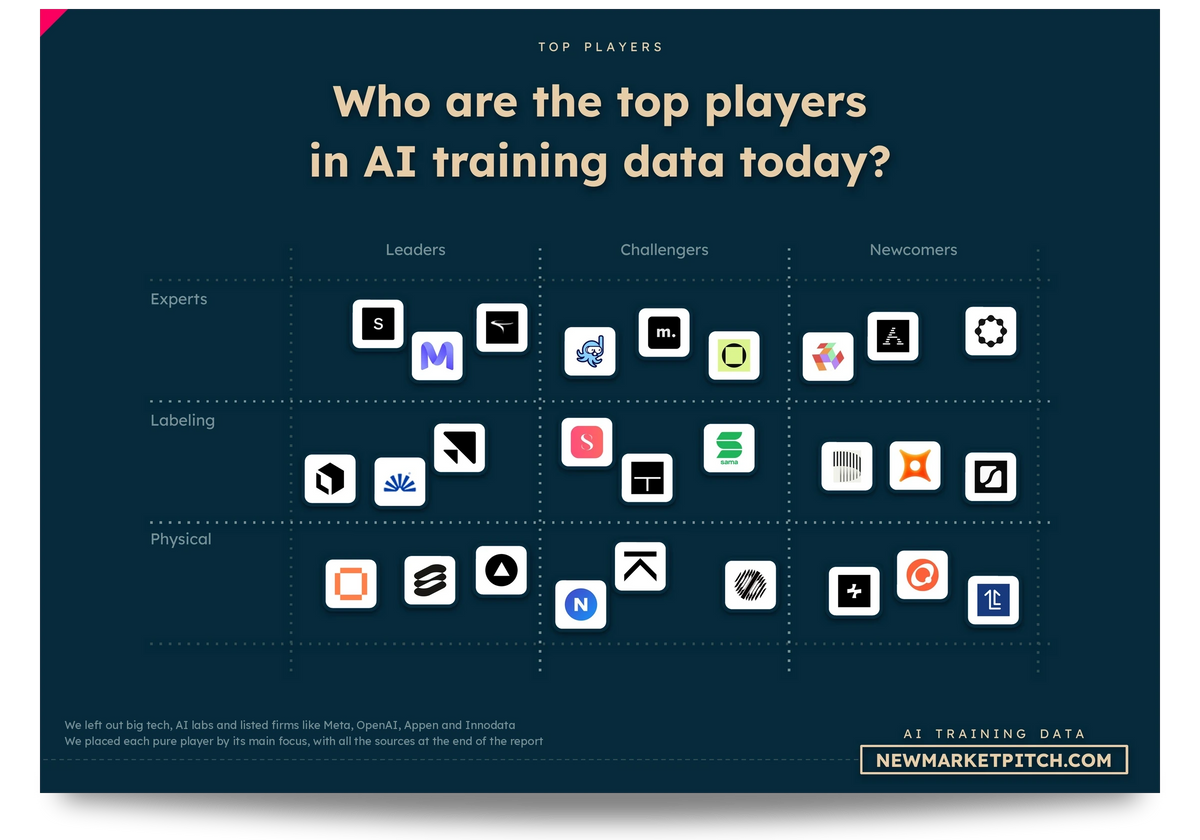
In our research about AI training data, we turn what is vague and complex into simple, useful visuals. Market maps like this one show you at a glance where every startup stands.
Is the AI training data market actually well-funded, or are a few giant deals making it look bigger?
The AI training data market is a genuinely substantial venture market, with at least $2.04 billion in usable disclosed funding across 81 deals, but a small number of exceptionally large financings make it look much richer than the typical startup experiences.
We identified 66 companies receiving funding between January 1, 2024 and October 8, 2026. The median transaction was $10 million, compared with an average of $27.9 million. A few unusually large investments pull the average well above what most startups actually raise.
The concentration becomes clearer when we remove the biggest rounds. Eight financings above $50 million accounted for 56.5% of disclosed capital. Excluding them leaves $886.3 million, spread across a much broader population of startups.
So there is real depth beneath the headline figures. Dozens of companies are receiving relatively modest amounts, while a small group can attract hundreds of millions.
Our $2.04 billion figure is also conservative. Eight transactions lack a usable numeric amount, including Scale AI's $1 billion financing announced in May 2024. Scale described that transaction as containing both primary and secondary shares, so we cannot count the entire amount as new capital entering the company.
How many AI training data startups are actually getting funded?
We found 66 distinct funded AI training data companies, but most have appeared in the financing market only once during the period.
Of those companies, 54 raised a single qualifying round, nine appeared twice, and three recorded at least three financings. Only 18.2% of companies therefore raised more than once within the window.
That distinction is worth making because 81 financing announcements can suggest a larger ecosystem of independently financed businesses. Several rounds actually belong to the same companies.
Snorkel AI, Encord, micro1, David AI and Protege illustrate the repeat-financing population. They have secured multiple investments while dozens of newer competitors have only one recorded financing event.
We should not interpret the absence of a second round as business failure. Many companies were founded in 2025 or 2026 and have not had enough time to return to investors. Still, the evidence of sustained financing is currently concentrated in a relatively small group.
Who actually holds most of the funding in AI training data?
A small group of AI training data companies controls most of the sector's disclosed capital: the ten largest recipients account for 71.6% of the entire usable financing pool.
Snorkel AI leads with $450 million raised within the period, followed by Mercor with $350 million and micro1 with at least $135 million. Together, these three companies account for almost half of the known capital.
The next group includes Encord, AfterQuery, David AI and Toloka, which have accumulated considerably more funding than the typical entrant.
These figures represent cumulative qualifying financing during our study period, not lifetime funding since incorporation.
| Company | Qualifying rounds | Capital raised in window |
|---|---|---|
| Snorkel AI | 2 | $450M |
| Mercor | 1 | $350M |
| micro1 | 2 | ≥$135M |
| Encord | 2 | $90M |
| AfterQuery | 2 | $80.27M |
| David AI | 3 | $80M |
| Toloka | 1 | $72M |
| XDOF | 1 | $70M |
| Mecka AI | 3 | $68M |
| Protege | 3 | $65M |

In our market report about AI training data, we always try to gather several sources and make estimates that make sense, so you can work with solid numbers.
Are repeat fundraisers taking most of the money?
Yes. Repeat-funded AI training data companies represent only 18.2% of the funded businesses, yet they capture approximately 55.9% of usable disclosed capital.
We find roughly $1.14 billion allocated to companies with multiple qualifying financings, compared with $899 million for companies appearing only once.
Investors are not distributing capital proportionately across the startup population. Larger commitments are going to a narrower group that has already demonstrated an ability to raise institutional funding repeatedly.
Snorkel's $100 million and subsequent $350 million financings illustrate this pattern at the high end. David AI's three rounds and Protege's three financing events show that younger businesses are also attracting repeat backing.
The sector keeps producing new entrants, but far fewer companies are accumulating the capital needed to build large operating platforms.
What does a normal AI training data startup actually raise?
A typical AI training data financing is around $10 million, and most companies raise considerably less than the amounts associated with headline-making industry leaders.
The most common financing range is $5 million to less than $20 million, containing 32 deals. Another 15 transactions were below $5 million. Together, these ranges account for 47 of the 81 financing events.
Only nine disclosed transactions reached $50 million or more, including four at or above $100 million.
For founders, a $350 million financing shows what the biggest businesses can attract. It is hardly a useful benchmark for an ordinary training-data startup.
The company-level figures reinforce the point: among businesses with fully quantifiable financing during the period, median cumulative capital was $9 million. For 27.1% of those companies, total recorded funding did not exceed $5 million.
| Deal size | Deals | Usable capital | Share of capital |
|---|---|---|---|
| Below $5M | 15 | $35.4M | 1.7% |
| $5M to <$20M | 32 | $303.9M | 14.9% |
| $20M to <$50M | 17 | $497.0M | 24.4% |
| $50M to <$100M | 5 | $302.3M | 14.8% |
| $100M and above | 4 | $900M | 44.1% |
| Unavailable or unusable size | 8 | Not quantified | - |
Which parts of the AI training data market attract the most investment?
Expert feedback and data annotation dominate AI training data funding today, collecting almost two-thirds of usable disclosed capital despite accounting for just over one-quarter of financing events.
RLHF and Expert Feedback leads with at least $670.8 million, followed closely by Data Annotation and Labeling at $632.2 million.
These categories contain some of the sector's largest financing recipients. Mercor and micro1 operate in expert-data markets, while Snorkel and Encord represent the more established annotation and data-development infrastructure segment.
The surprise is Data Collection Services. It produces more deals than either of the leading categories, yet attracts less than half the capital received by RLHF and Expert Feedback.
Synthetic Training Data shows an even sharper contrast. It accounts for 13 investments but only $63.3 million in usable disclosed funding.
The categories generating the most new financing activity are clearly not always the ones attracting the biggest checks.
| Category | Deals | Capital raised | Share of capital |
|---|---|---|---|
| RLHF & Expert Feedback | 9 | $670.8M+ | 32.9% |
| Data Annotation & Labeling | 13 | $632.2M | 31.0% |
| Data Collection Services | 16 | $276.1M+ | 13.5% |
| Domain-Specific Training Data | 14 | $208.8M | 10.2% |
| Licensed Proprietary Datasets | 8 | $113.5M | 5.6% |
| Data Curation & Cleaning | 8 | $73.9M+ | 3.6% |
| Synthetic Training Data | 13 | $63.3M+ | 3.1% |

Our document detailing everything you need to know about AI training data gets updated several times a month, so you always get the latest view of where things stand.
Why are investors putting so much money into human expert feedback?
Human expert feedback is attracting unusually large AI training data investments because frontier AI developers increasingly need specialized professional judgment, not simply large volumes of annotated information.
The funding figures are striking. Nine RLHF and Expert Feedback transactions account for almost 33% of disclosed market capital, making this the most capital-intensive category relative to its deal count.
Mercor provides a clear commercial explanation. Its October 2025 $350 million Series C, led by Felicis, valued the business at $10 billion. The company described a model in which doctors, bankers, lawyers and other specialists help train AI systems to perform complex professional tasks.
That financing was intended to expand the expert network, improve specialist matching and accelerate delivery to customers.
Micro1 demonstrates that Mercor is not an isolated case. In August 2026, TechCrunch reported that micro1 had reached approximately $500 million in gross annualized run rate, driven by demand for specialized training data.
These revenue figures help explain the financing scale. Expert-data businesses can command large budgets from model developers that need difficult, high-value tasks completed reliably.
But gross revenue or gross run rate should not be confused with net revenue or profit. Human-expert businesses can have substantial delivery costs, and their economics depend on how much value they retain after paying contributors.
Even allowing for that distinction, specialized human expertise has clearly developed into a serious commercial market.
Why is traditional data annotation still attracting huge rounds?
Data annotation remains one of the best-funded AI training data categories because its leading companies have evolved from labeling providers into broader data-development and model-improvement platforms.
The category received $632.2 million in usable disclosed capital across 13 deals. Unlike most newer segments, it has eight later-stage financing events.
Snorkel AI is the clearest example. On September 22, 2026, the company announced a $350 million Series E at a $3.5 billion valuation, co-led by Insight Partners and S32.
Snorkel also disclosed that its newer data-as-a-service offering had grown more than eighteenfold and reached a $375 million annualized revenue run rate. Its business now spans complex datasets, specialist tasks and environments used to improve frontier AI systems.
Encord, which received $90 million across two qualifying financings, represents another approach: software infrastructure for curating, annotating and managing multimodal datasets.
These are different businesses, but both have moved well beyond the old model of cheaply labeling images. Customers need systems that organize difficult data, measure model weaknesses, produce corrective examples and continually improve training pipelines.
This also helps explain why annotation companies are considerably older than most new entrants. Their median age at financing is six years, compared with approximately one year for several emerging data categories.

In our report covering the AI training data market, we look at what the winners do differently, so you can learn from the best instead of guessing.
Is robotics becoming the next big AI training data market?
Robotics training data is one of the most promising emerging investment clusters, but it is not yet a mature financing market.
Data Collection Services has 16 qualifying deals, more than any other category, and a median company age of just one year. Yet none of its classified transactions has reached Series B or later.
The technical problem is substantial. Language models can learn from enormous digital text collections, whereas robots need physical-world demonstrations involving movement, object manipulation, sensor readings and interactions with changing environments.
Collecting those demonstrations may require robot fleets, teleoperation systems, sensors, human operators and dedicated facilities. It's an expensive business to get off the ground.
XDOF illustrates the funding consequences. The company announced a $70 million Series A in June 2026. In September, TechCrunch reported that it was already discussing a Series B at a valuation of approximately $1.2 billion, with annualized revenue approaching $50 million. Those discussions were not equivalent to a completed new financing.
Mecka AI provides another example of rapid capital formation, with $68 million recorded across three financings. Newer businesses entering physical-data collection are also attracting early-stage backing.
The absence of later-stage transactions is understandable given the youth of the category. Investor appetite has emerged much faster than a conventional financing ladder.
The harder question is whether expensive physical-data collection can become a repeatable business with attractive margins.
Why is synthetic training data getting so little funding?
Synthetic training data is attracting plenty of startup activity but surprisingly little venture capital compared with expert feedback, annotation and physical-data collection.
We identified 13 synthetic-data financings, representing 16% of all deals, but only about 3.1% of usable disclosed funding.
No disclosed financing in the category exceeds approximately $10.6 million, and no classified company has raised a Series B-or-later round during the period.
That funding gap does not necessarily reflect weak commercial demand. Companies can generate useful training examples through simulations, models and software without needing the same operating infrastructure as physical-data businesses.
Synthetic generation is also present inside better-funded categories. Snorkel, for example, combines synthetic-data methods with specialist human input in its broader data offering.
Funding for standalone synthetic-data startups therefore captures only part of the industry's investment in the technology.
For now, investors appear far more willing to write large checks for integrated data platforms and scarce expertise than for standalone synthetic-data businesses.

In our research about AI training data, we don't want to repeat what boring consulting reports say. Instead, we show you the real and latest market signals that matter.
How young are AI training data startups when investors fund them?
AI training data startups are being funded remarkably early: the median company is only one year old when it receives a qualifying financing.
Across records with reliable founding dates, average company age is approximately 2.3 years. The funded population is strongly concentrated among businesses established recently, including 16 founded in 2024 and 20 founded in 2025.
That youth is visible in the types of rounds being raised. Seed financings typically go to companies around one year old, while Series A companies have a median age of two years.
Larger rounds generally involve older businesses. Companies raising more than $50 million have a median age of approximately four years, and Series D+ financings involve companies with a median age of seven years.
There are exceptions. Some expert-data companies have expanded rapidly enough to attract substantial funding at unusually young ages.
But generally, investors are prepared to finance new training-data approaches almost immediately. The largest checks tend to come later, once commercial traction or operating infrastructure is more established.
How far do AI training data startups actually get before funding dries up?
The AI training data funding ladder narrows sharply after Series A, with 22 Series A transactions falling to only seven Series Bs and two Series Cs.
Seed financings dominate deal count, accounting for 40 of the 81 transactions. Series A contributes another 22, meaning the great majority of classified financings sit at the beginning of the venture lifecycle.
The contrast in capital is considerable. Early-stage transactions represent 82.7% of classified deal count but only 37.4% of capital allocated to rounds with known stages.
Later-stage companies are much less numerous, but their individual financings are substantially larger.
These figures are not literal progression or failure rates. The financing window is too short, and many companies have not had time to graduate. The ratios compare financing events, not a single startup cohort followed over its lifetime.
Still, the scarcity of middle-stage rounds is hard to ignore. There are plenty of initial financings and a few very large winners, but relatively little observable activity in between.
| Stage | Deals | Usable capital | Median financing |
|---|---|---|---|
| Seed | 40 | $275.6M+ | $6M |
| Series A | 22 | $458.4M+ | $23M |
| Series B | 7 | $295.8M+ | $36M |
| Series C | 2 | $410M | $205M |
| Series D+ | 3 | $450M* | $225M* |
| Growth Equity | 1 | $72M | $72M |
| Unknown | 6 | $76.8M+ | $18M |
*Series D+ capital and median exclude Scale AI's $1 billion mixed primary-secondary transaction.

Learning from others' mistakes is the cheapest lesson there is. In our market report about AI training data, we look at what broke startups before you, so you don't repeat it.
Why do so few AI training data companies reach Series C?
Very few AI training data startups have demonstrated the scale needed to attract Series C capital, and the market's middle-stage financing history is still thin.
The sharpest conventional contraction occurs between Series A and Series B. There are more than three Series A events for every Series B event, followed by seven Series Bs against just two Series Cs.
The average Series B is already worth about $42 million, considerably above the $22 million Series A average. The two Series C financings average $205 million, although that figure is heavily influenced by Mercor and should not be interpreted as a normal Series C check.
Commercial requirements also change as financing sizes grow.
A young data collection company may be funded to demonstrate that it can obtain difficult robot-training examples. A larger platform needs to show that customers will purchase those datasets repeatedly, that production can scale, and that margins justify additional investment.
An expert-feedback provider faces comparable questions around specialist recruitment, customer concentration, delivery economics and the durability of demand.
Investors appear comfortable financing plenty of early experiments. Far fewer companies have yet built the commercial record needed to secure substantial growth capital.
The data cannot tell us how many Seed and Series A companies will eventually succeed. It does show that a broad, proven middle market has not emerged.
Is most funding going to new startups or companies investors already know?
Most AI training data funding is going to previously financed companies rather than first-time fundraisers.
We identified 27 rounds classified as first financings, compared with 53 follow-on rounds. First financings represent one-third of deal events but only approximately 12% of usable disclosed capital.
The median first financing is $7 million. For follow-on rounds, that figure rises to $22 million.
Venture investors are simultaneously supporting the creation of new companies in physical AI, specialized datasets and synthetic data, while making substantially larger commitments to businesses that have already secured financing and begun demonstrating their ability to operate.
That difference helps explain the apparent contradiction between the sector's very young median company age and the large amount of capital concentrated in mature platforms.
New ventures are being created quickly. Most of the money, though, is still flowing to businesses further along in development.
Is AI training data funding accelerating or just becoming more volatile?
AI training data financing activity has become denser toward the end of the period, but dollar volumes remain extremely volatile because individual megadeals can dominate entire months.
Across the 33 completed months from January 2024 through September 2026, we find an average of 2.45 transactions per month and a median of two.
Activity was often limited to one or two financings in individual active months during 2024. By May–September 2026, monthly deal counts more regularly reached five to seven.
September 2026 was the busiest month, with seven transactions, and also the largest by usable disclosed capital at approximately $531.3 million.
However, Snorkel AI and micro1 together contributed roughly $450 million of that month's total. Around 85% of the capital therefore came from just two events.
Announcement timing also complicates the monthly picture. Some deals first announced in 2026 had economically closed during 2025. Worldmodeldata and Proximal are examples, while Mecka's financing disclosures also complicate the apparent monthly sequence.
The increase in publicly announced deal activity is visible. The fluctuations in invested dollars are much less useful as an indication of the underlying market's momentum.

If you build or invest in the AI training data market, you need to know which business models pay off now and which ones are fading. That's why our report covering it has a whole section on it.
Is the AI training data funding market dominated by the United States?
The United States overwhelmingly dominates disclosed AI training data venture capital, although the market has a meaningful population of European and Asian companies.
North America accounts for 54 transactions and $1.765 billion in usable capital, representing 86.6% of the market's disclosed financing dollars.
The United States alone contributes 51 transactions across 40 companies, with approximately $1.733 billion in usable disclosed capital.
Europe represents the second-largest funding region, with $216.5 million across 13 transactions. Toloka's $72 million financing is one of its most important contributions.
Asia-Pacific contains 14 financing events across 13 companies, nearly matching Europe's activity by deal count. Yet only $57 million in usable financing amounts is disclosed.
That gap is partly a reporting problem. Several Chinese transactions report vague amounts such as tens or hundreds of millions of renminbi without a usable exact value.
Asia-Pacific's measured capital is therefore especially incomplete.
Even allowing for those missing amounts, the largest fully quantified financings are concentrated in North America. Startup formation is international, but the biggest disclosed venture checks are overwhelmingly American.
Which investors keep funding AI training data startups?
No single venture capital firm consistently controls AI training data financing. Investor leadership is fragmented, with relatively few firms repeatedly appearing as disclosed leads.
Across the database, 71 distinct lead or co-lead investor names appear, but only six participate as leads in more than one transaction.
Framework Ventures is the most frequent, appearing three times. General Catalyst, Wing Venture Capital, Lightspeed Venture Partners and Amplify Partners each appear twice.
This fragmentation contrasts with the high company-level concentration of capital.
Large companies can accumulate substantial funding without the industry depending on one dominant investor network. Snorkel's 2026 financing involved Insight Partners and S32, while Mercor's Series C was led by Felicis. Different investor groups are backing different parts of the market.
Disclosed lead-investor coverage is approximately 79%, so the table cannot capture every repeat relationship. Nevertheless, the observed market has a surprisingly dispersed group of lead investors relative to how concentrated its funding recipients have become.
| Lead investor | Led deals | Size of associated rounds |
|---|---|---|
| Framework Ventures | 3 | $69M |
| General Catalyst | 2 | $46.2M |
| Wing Venture Capital | 2 | $39.95M |
| Lightspeed Venture Partners | 2 | $39.2M |
| Amplify Partners | 2 | $36.65M |
| Oriental Fortune Capital | 2 | Undisclosed |

In our report covering the AI training data market, we like to show you the big picture. We know your time is precious, so we make every page quick to read and packed with as much learning as possible per minute.
Are strategic investors making a serious bet on AI training data?
Strategic investors are meaningful participants in AI training data funding, particularly in larger rounds, but they are not involved across the entire market.
We identified corporate or strategic investment participation in 17 of 81 financings, equivalent to 21%.
The median strategically backed financing was $21.5 million, versus $9 million for transactions without an identified strategic participant.
Corporate investors are more frequently present in larger transactions, especially where the technology is relevant to industrial AI development or the business has moved beyond initial experimentation.
Strategic participation is most common in annotation, with six deals, followed by synthetic data with four and data collection with three.
NVIDIA appears strategically in three financings, while LG Technology Ventures participates in two.
For data-infrastructure startups, corporate investors can bring potential customers, technical relationships and industry access alongside capital. Model developers, computing-platform providers and industrial technology businesses may have direct uses for the datasets or evaluation systems being developed.
Of course, an investment does not automatically imply a purchasing agreement, preferential data access or commercial deployment. Those arrangements require separate evidence.
What the financing data shows is selective strategic involvement, generally associated with larger rounds and commercially relevant AI infrastructure.
What is missing from the AI training data funding market today?
The most conspicuous absence is a broad population of mid-stage AI training data companies capable of raising substantial growth capital repeatedly.
Several categories are producing new startups without developing a visible late-stage financing ladder.
Data Collection Services has 16 transactions but no classified Series B-or-later rounds. Synthetic Training Data has 13 transactions and likewise no classified Series B+. Licensed Proprietary Datasets has eight financings, all at Seed or Series A.
Data Curation and Cleaning presents a different problem: concentration. DatologyAI's $46 million Series A represents more than 62% of usable category capital.
These gaps separate commercially promising technologies from financing markets with demonstrated scaling histories.
There is also limited evidence of repeat fundraising among newer companies. Most of the 66 businesses appear only once, leaving little observable history of company progression.
And while strategic investors are clearly present, we have not found evidence that a handful of industrial backers systematically support the entire ecosystem.
Much of the funded population is still very young, so it would be premature to read these absences as evidence of commercial failure.
For now, the sector has demonstrated that it can generate new ventures and finance a few very large companies. The diversified middle tier is still missing.

When you build or invest in the AI training data market, you need clarity, not confusion. In our research about AI training data, we always try to put numbers on and quantify whatever is usually vague and confusing.
What are investors really buying when they fund AI training data companies?
Investors are increasingly funding the ability to produce difficult, commercially valuable training experiences for AI systems, rather than merely the ability to supply large quantities of data.
Three economic models stand out in the financing data.
Mercor and micro1 organize specialist human knowledge into training and evaluation work for AI developers. Their challenge is delivering expertise at scale while maintaining quality and workable economics.
Snorkel and Encord provide the infrastructure to prepare, curate and improve datasets and model-training workflows. Their value comes partly from software, operational systems and integration with customers' AI development processes.
XDOF and Mecka represent a newer model built around collecting real-world experience for robotics and physical AI. Their operations can require equipment, teleoperators, facilities and physical data-production capacity.
These businesses have very different cost structures, competitive advantages and scaling constraints. Treating them all as conventional data-labeling companies misses much of what investors are actually financing.
One commercially important shift is toward increasingly complex tasks and interactive environments. Snorkel's September 2026 announcement explicitly emphasized expert agentic tasks, environments and detailed evaluation criteria rather than simple labeling.
The biggest checks are going to companies positioned around hard-to-obtain expertise, integrated training workflows and complex data-production systems.
Whether those businesses generate the strongest long-term returns remains to be seen. But the financing decisions already show which capabilities investors are willing to pay a premium to build.
What should we actually take away from the funding data?
The AI training data market is now a substantial but highly uneven venture ecosystem. Its defining characteristic is the gap between the number of companies receiving early funding and the small group capable of attracting genuinely large amounts of capital.
The market has meaningful breadth. We identified 66 funded companies and 81 financing events, with $886 million in usable capital remaining even after excluding rounds above $50 million. This is far more than a sector sustained by a few exceptional transactions.
Capital concentration is nevertheless severe. Ten companies account for nearly 72% of usable disclosed funding, and repeat fundraisers absorb more than half the money despite representing fewer than one in five funded businesses.
The most financially developed categories are expert feedback and annotation. Mercor, micro1, Snorkel and Encord demonstrate that these businesses can attract large institutional commitments, supported in several cases by substantial commercial run rates.
Physical-AI data collection is the most interesting emerging category by startup activity. It has the largest number of deals but no classified Series B-or-later financing. Investors are backing its potential before the market has developed a mature funding history.
The funding ladder is the central weakness. Forty Seed financings and 22 Series As contrast with just seven Series Bs and two Series Cs. That is not a measured startup failure rate, but it reveals how little middle-stage depth currently exists.
Strategic capital matters selectively rather than universally. Corporate investors participate in roughly one-fifth of transactions, disproportionately in larger rounds, while traditional venture leadership remains fragmented across many firms.
Ultimately, the evidence points to a market where raising initial capital is relatively common, but building a company that deserves $50 million, $100 million or more remains exceptional. The next test for AI training data will be whether today's large population of young companies develops into a diversified group of durable businesses, or whether commercial demand and venture capital continue concentrating around a small number of dominant data platforms.
Our methodology
This analysis examines the fundraising market for AI training data companies between January 1, 2024 and October 8, 2026. We assembled 81 distinct financing events involving 66 companies and compared disclosed capital, round sizes, financing stages, company maturity, business categories, geographic distribution, repeat fundraising and investor participation.
Our scope covers companies whose principal business involves creating, collecting, annotating, curating, licensing or supplying training data and related data-development services for AI systems. We include human expert feedback, RLHF, data annotation, domain-specific datasets, physical-world and robotics data collection, data cleaning and synthetic training data. The seven categories are used to compare funding activity across different business models, with each financing assigned to a primary category to avoid double-counting.
We count distinct financing transactions rather than press mentions. Multiple announcements concerning the same transaction are consolidated, while separate qualifying rounds by the same company remain distinct. Company-level funding totals refer to qualifying capital raised within the research window, not lifetime funding. Financing dates generally follow public announcements, with economically earlier closings distinguished where identifiable.
For the capital calculations, we use disclosed or defensibly quantified funding amounts. Of the 81 transactions, 73 have usable amounts and eight remain unquantified. The resulting approximately $2.04 billion is a minimum observable funding total, not a complete estimate of every dollar committed to the sector. When a transaction mixes primary and secondary shares without a reliable split, we do not treat the full headline amount as fresh company financing. Scale AI's May 2024 announcement is handled on that basis.
Round-size medians and averages use transactions with usable financing amounts. Capital-concentration calculations exclude unquantified transactions from the dollar denominator, and threshold comparisons distinguish rounds above $50 million from those at or above $50 million. Company-level totals aggregate qualifying transactions within the period, while first-financing and follow-on classifications reflect the financing history recorded in the research database.
Stage comparisons use reported round classifications, including Seed, Series A, Series B, Series C, Series D+, Growth Equity and Unknown. They measure the distribution of financing events rather than cohort progression or startup survival. Company age is calculated from available founding dates at the time of financing. Geographic figures are assigned by company location, while investor analysis distinguishes disclosed leads or co-leads from broader corporate and strategic participation.
We examined financing patterns across the full study period, including monthly announcement activity, category-level deal counts, capital concentration, later-stage availability and repeat financing. We also compared those aggregate results with recent company-level evidence on commercial traction, business models and intended uses of capital. This makes it possible to distinguish a genuinely broad funding market from one whose apparent scale depends heavily on exceptional transactions.
Key sources include company funding announcements and investor disclosures from Snorkel AI, Mercor, micro1, Encord and Scale AI; financing and commercial reporting from TechCrunch; and published announcements and company information from NVIDIA, Insight Partners, Felicis and other disclosed investors. The analysis combines those sources with transaction-level aggregation from our AI training data funding database.

A good product starts with a real problem. In our market report about AI training data, we show you the ones customers still live with.
Written by the New Market Pitch teamWe track new markets so founders and investors can move faster. About us