What are the top AI training data startups by total funding raised?
Everything we know about the AI training data market, in one place. Get our report whether you build or invest.
Summary
Scale AI leads the AI training data market by total funding raised, with $1.6 billion, followed by Snorkel AI with $588 million and Mercor with $484 million. The ten largest companies have attracted a combined $4.427 billion, reflecting the growing importance of specialized training information for advanced AI systems.
Capital is increasingly moving beyond traditional data labeling. Investors are backing companies that can supply expert-reviewed coding problems, difficult reasoning evaluations, licensed audio and video, robotics demonstrations and interactive environments for training AI agents.
Scale AI remains the biggest name by cumulative funding, but Meta's strategic investment and Alexandr Wang's move to the company have complicated its relationships with competing AI laboratories. Google's reported decision to reconsider its commercial relationship illustrates how ownership can become a competitive issue in this market.
Snorkel AI has emerged as one of the strongest challengers by moving from annotation software toward completed training datasets. Its reported annualized revenue run rate of more than $375 million and rapid growth in its data-as-a-service business suggest that customers are willing to outsource increasingly complex parts of data production.
Mercor represents another important shift. Its business connects AI developers with professionals in programming, mathematics, finance and other specialized fields, but the reported concentration of approximately 91% of its first-half revenue among foundation-model developers creates a significant dependency on a relatively small customer group.
Human expertise is attracting investment through several different business models. Handshake, Turing, micro1 and AfterQuery organize specialist contributors, while Mercor is building a particularly large professional network for frontier AI development. Their long-term economics will depend on how efficiently they recruit, assess and retain qualified people.
Robotics data is becoming one of the more interesting areas of the market. Lightwheel AI, XDOF and Mecka AI are building businesses around physical demonstrations, motion capture and simulation, addressing a shortage of information that cannot be solved simply by collecting more internet content.
Mecka AI stands out for its ambition to combine data collection with hardware, model post-training and robot deployment. Its reported revenue run rate is particularly striking, although maintaining attractive margins as physical operations expand will be a major test.
Another group is targeting information that can be difficult to reproduce or replace. David AI focuses on audio, Wirestock and Mundo AI on licensed multimodal material, and Troveo AI on video licensing. DatologyAI, meanwhile, is working on automated data curation, while synthetic-data companies are creating controlled training environments.
AI agent training is also emerging as a distinct category. Bespoke Labs, Halluminate, HUD and Preference Model are developing environments where AI systems can execute tasks, encounter errors and receive feedback. This creates a market for information about successful actions and failures, rather than simply examples of correct answers.
The biggest investment risk is that some of these services become increasingly automated or remain dependent on a handful of large AI customers. Basic annotation and repetitive data processing face pricing pressure, while proprietary information, expert evaluations and physical-world demonstrations have stronger potential to remain valuable.
Our conclusion is that AI training data is becoming strategic infrastructure for the wider AI industry. Scale AI, Snorkel AI and Mercor currently lead by funding, but the next generation of important companies could emerge from robotics, licensed multimodal information, specialized human expertise and interactive environments. The strongest businesses will ultimately be those whose information improves model performance and keeps customers coming back.

Written by the New Market Pitch teamWe track new markets so founders and investors can move faster. About us

In our report covering the AI training data market, you will always find fresh funding data, taken straight from our own verified funding database.
Top startups in the AI training data market ranked by total funding raised
Here is an updated table that ranks the top startups in the AI training data market based on the total amount of funding they have raised to date.
The table also includes the total number of funding rounds, the date and size of the latest round, the financing type (e.g. Series A, equity financing), key investors, the startup’s current status (active, IPO, acquired, or shut down), and a confidence score based on the data collected. Lower-confidence entries are identified in the table.
If you need to dig deeper and get more detailed data, please check our report covering the AI training data market.
| # | Startup | What They Do | Total Raised ($) | Total Rounds | Last Round Date | Last Round Amount ($) | Last Round Type | Key Investors | Current Stage | Confidence | Country |
|---|---|---|---|---|---|---|---|---|---|---|---|
| 1 | Scale AI | AI data labeling and evaluation | $1.6B1 | 7 | May 2024 | $1.0B | Series F | Accel, NVIDIA, Amazon | Active | Partial | United States |
| 2 | Snorkel AI | Automated AI training data development | $588M | 7 | September 2026 | $350M | Series E | Insight Partners, S32, Addition | Active | Strong | United States |
| 3 | Mercor | Expert recruitment and AI training data | $484M | 4 | October 2025 | $350M | Series C | Felicis, Benchmark, General Catalyst | Active | Partial | United States |
| 4 | Handshake | Expert human data for AI | $434M | 7 | January 2022 | $200M | Series F | Coatue, Valiant Peregrine Fund | Active | Partial | United States |
| 5 | Labelbox | AI training data and evaluation | $297M2 | 7 | October 2026 | $103M | Series E | Infinitum Partners, Wipro Ventures, B Capital | Active | Strong | United States |
| 6 | Lightwheel AI | Physical AI simulation and data | ~$293M3 | 7 | June 2026 | ~$147M | Strategic | Zhongguancun Science City Fund, Sichuan Development funds | Active | Partial | United States |
| 7 | Turing | Expert data for frontier AI | $247M | 5 | June 2025 | $111M | Series E | Khazanah Nasional, WestBridge Capital, Sozo Ventures | Active | Partial | United States |
| 8 | XDOF | Robotics AI training data infrastructure | $200M | 3 | September 2026 | $128M | Series B | 8VC | Active | Strong | United States |
| 9 | Invisible Technologies | Enterprise AI training and operations | ~$144M | 2 | September 2025 | $100M | Growth Equity | Vanara Capital, Acrew Capital, Greycroft | Active | Partial | United States |
| 10 | micro1 | Expert-generated AI training and evaluation data | $140M | 5 | September 2026 | $100M | Series B | Dream Ventures, G Squared, M12 | Active | Partial | United States |
| 11 | Mecka AI | Human motion data for robotics | $128M | 4 | October 2026 | $60M | Series B | Sequoia Capital, NVIDIA, M12 | Active | Partial | United States |
| 12 | Encord | AI data annotation, curation and infrastructure | $110M | 5 | February 2026 | $60M | Series C | Wellington Management, CRV, N47 | Active | Strong | United Kingdom |
| 13 | Sama | Ethical AI data annotation services | $85M | 2 | November 2021 | $70M | Series B | CDPQ, Salesforce Ventures, Vistara Growth | Active | Full | United States |
| 14 | AfterQuery | Expert data for AI model training | $83M | 4 | August 2026 | $50M | Series B | Undisclosed | Active | Strong | United States |
| 15 | David AI | Audio datasets for AI training | $80M | 4 | October 2025 | $50M | Series B | Meritech Capital, NVIDIA, Alt Capital | Active | Full | United States |
| 16 | Hangzhou Manfu Technology | AI data annotation and infrastructure | ~$80M | 5 | April 2026 | ~$28M | Series C | Cowin Capital, 5Y Capital, CMB International | Active | Partial | China |
| 17 | Defined.ai | AI training data marketplace and services | $78M | 4 | January 2022 | $15M | Series B | Evolution Equity Partners, Kibo Ventures | Active | Strong | United States |
| 18 | CloudFactory | Managed workforce for AI data operations | $76M | 4 | November 2019 | $65M | Growth Equity | FTV Capital, Weatherford Capital | Active | Strong | United States |
| 19 | Toloka | Expert human feedback for AI | $72M | 1 | May 2025 | $72M | Strategic Growth Equity | Bezos Expeditions, Mikhail Parakhin | Active | Strong | Netherlands |
| 20 | SuperAnnotate | Enterprise AI data annotation platform | $67M | 4 | May 2025 | $14M | Series B Extension | Dell Technologies Capital, Base10 Partners | Active | Strong | United States |
| 21 | Protege | Secure AI training data marketplace | $65M | 3 | January 2026 | $30M | Series A1 | Footwork, CRV, Bloomberg Beta | Active | Full | United States |
| 22 | DatologyAI | Automated data curation for model training | $58M | 2 | May 2024 | $46M | Series A | Felicis Ventures, Radical Ventures, Amplify Partners | Active | Full | United States |
| 23 | Parallel Domain | Synthetic data for autonomous systems | $44M | 3 | November 2022 | $30M | Series B | March Capital, Foundry Group, Costanoa Ventures | Active | Strong | United States |
| 24 | Kognic | Training data for autonomous systems | ~$43M | 4 | August 2024 | $10M | Series A Extension | Stena Sessan, Neudi & Co, Metaplanet | Active | Partial | Sweden |
| 25 | Bespoke Labs | Reinforcement learning environments for AI agents | $40M | 2 | July 2026 | $32M | Series A | Wing Venture Capital, Mayfield, The House Fund | Active | Full | United States |
| 26 | Halluminate | Reinforcement learning environments for knowledge work | ~$39M | 2 | October 2026 | $30M | Series A | Oak HC/FT, Orange Collective, Heavybit | Active | Partial | United States |
| 27 | Centaur Labs | Medical expert data annotation platform | $35M4 | 5 | October 2024 | $16M | Series B | Matrix Partners, SignalFire, Samsung Next | Active | Strong | United States |
| 28 | Config | Robotics foundation-model data infrastructure | $35M | 2 | May 2026 | $27M | Seed | Samsung Venture Investment, ZER01NE, LG Technology Ventures | Active | Strong | United States |
| 29 | Prolific | Human research and AI data collection | $33M | 3 | July 2023 | ~$32M | Series A | Partech, Oxford Science Enterprises | Active | Strong | United Kingdom |
| 30 | Kili Technology | AI data annotation software | $32M | 2 | July 2021 | $25M | Series A | Balderton Capital, Serena Capital, Headline | Active | Full | France |
| 31 | Luel | Marketplace for multimodal human data | $31M | 2 | May 2026 | $31M | Seed | General Catalyst, Lightspeed, Human Capital | Active | Strong | United States |
| 32 | HumanSignal | AI data labeling and evaluation | ~$30M | 2 | May 2022 | $25M | Series A | Redpoint Ventures, Swift Ventures, Unusual Ventures | Active | Partial | United States |
| 33 | Maxinsights | Real-world robotics training data | $30M | 1 | October 2026 | $30M | Seed | Peak XV Partners, Tola Capital, South Park Commons | Active | Strong | United States |
| 34 | Ropedia | Real-world robotics training data collection | $30M | 2 | July 2026 | $22M | Pre-Series A | Undisclosed | Active | Partial | Singapore |
| 35 | IO-AI Tech | Data infrastructure for embodied AI | ~$28M | 1 | August 2026 | ~$28M | Early VC | Shunwei Capital, Songhe Capital, Shenzhen Capital Group | Active | Partial | China |
| 36 | DataBaker | Speech and multimodal AI data services | $26M | 6 | April 2023 | $14M | Series B+ | Qingdao Jufeng, Qingdao Fortune Center | Active | Partial | China |
| 37 | Deccan AI | Expert data and evaluations for AI | $25M4 | 2 | March 2026 | $25M | Series A | A91 Partners, Susquehanna, Prosus Ventures | Active | Strong | United States |
| 38 | Wirestock | Licensed multimodal AI training datasets | $25M4 | 3 | May 2026 | $23M | Series A | Nava Ventures, Sandberg Bernthal Venture Partners, Formula VC | Active | Partial | United States |
| 39 | Mundo AI | Multilingual and multimodal training datasets | $24M | 2 | August 2026 | $20M | Series A | GreatPoint Ventures, Y Combinator, E12 Ventures | Active | Strong | Spain |
| 40 | N.dot.light | Simulation-ready 3D robotics training assets | $19M+ | 4 | August 2026 | ~$11M | Series B | Korea Development Bank, Naver D2SF, IMM Investment | Active | Partial | South Korea |
| 41 | Datacurve | Expert coding data for AI models | $18M | 3 | October 2025 | $15M | Series A | Chemistry, Afore Capital, Homebrew | Active | Strong | United States |
| 42 | Perle AI | Expert-powered AI data annotation | $18M | 2 | August 2025 | $9M | Seed | Framework Ventures | Active | Full | United States |
| 43 | HUD | Reinforcement learning environment development platform | $16M | 2 | June 2026 | $16M | Series A | Standard Capital, Exceptional Capital, Liquid 2 Ventures | Active | Strong | United States |
| 44 | Preference Model | Reinforcement learning environments for AI | $16M | 1 | October 2026 | $16M | Seed | Andreessen Horowitz, SignalFire, South Park Commons | Active | Strong | United States |
| 45 | Sapien | Decentralized human AI data labeling | $16M5 | 2 | October 2024 | $11M | Seed | Variant, Animoca Brands, Primitive Ventures | Active | Low | United States |
| 46 | Build AI | Egocentric video data for robotics | $15M4 | 1 | December 2025 | $15M | Seed | Abstract Ventures, Pear VC, HF0 | Active | Partial | United States |
| 47 | Midcentury | Human-behavior datasets and robotics simulation | $15M | 1 | September 2026 | $15M | Seed | Undisclosed | Active | Strong | United States |
| 48 | Poseidon | Licensed real-world physical AI datasets | $15M | 1 | July 2025 | $15M | Seed | a16z crypto | Active | Strong | United States |
| 49 | Proximal | Reinforcement learning data and environments | $15M4 | 2 | September 2026 | $15M | Seed | General Catalyst, Chemistry, SV Angel | Active | Partial | United States |
| 50 | FastLabel | AI data labeling and MLOps platform | $14M | 5 | September 2024 | $2M | Series B Extension | Panasonic, Marubeni, Sony Innovation Fund | Active | Strong | Japan |
| 51 | GenGenAI | Synthetic training data for computer vision | ~$13M | 3 | March 2025 | ~$9M | Series A | Korea Aerospace Industries | Active | Partial | South Korea |
| 52 | Axis Robotics | Crowdsourced robotic manipulation training data | $12M | 1 | July 2026 | $12M | Seed | Hack VC, Nomad Capital, Pi Network Ventures | Active | Strong | United States |
| 53 | PrismaX | Decentralized robotics data collection infrastructure | $11M | 1 | June 2025 | $11M | Seed | a16z CSX, Symbolic Capital, Volt Capital | Active | Partial | United States |
| 54 | Chakra Labs | AI agent training tasks and benchmarks | $10M | 1 | January 2026 | $10M | Seed | Race Capital, Castle Island Ventures, Collab+Currency | Active | Strong | United States |
| 55 | Kled AI | Marketplace for human-generated training datasets | ~$10M | 2 | March 2026 | $6M | Seed | Wischoff Ventures, Aglaé Ventures, K5 Global | Active | Partial | United States |
| 56 | PublicAI | Decentralized human AI training data | $10M5 | 2 | June 2025 | $8M | Series A | Saudi Telecom Group, NEAR Foundation, Yield Guild Games | Active | Low | United States |
| 57 | Sky Engine AI | Synthetic computer vision training data | $10M | 5 | January 2024 | $7M | Series A | Cogito Capital Partners, Edge Investments, Taiwania Capital | Active | Strong | United Kingdom |
| 58 | Worldmodeldata | Video game data for AI training | $9M | 1 | December 2025 | $9M | Seed | Iona Star Capital | Active | Strong | United Kingdom |
| 59 | AI Verse | Synthetic computer-vision training datasets | $9M | 2 | January 2026 | $6M | Series A | Supernova Invest, Bpifrance, Innovacom | Active | Strong | France |
| 60 | Mechanize | Simulated environments for agent training | $9M | 1 | April 2026 | $9M | Venture | Marco Mascorro, Adam D'Angelo, Devendra Chaplot | Active | Partial | United States |
| 61 | Idler | RL environments for agentic AI | $9M | 2 | August 2026 | $9M | Seed | Paradigm, Long Journey Ventures, Lynett Capital | Active | Strong | United States |
| 62 | Rapidata | Scalable human feedback for AI | $9M4 | 2 | February 2026 | $9M | Seed | Canaan Partners, IA Ventures, BlueYard Capital | Active | Partial | Switzerland |
| 63 | NomadicML | Searchable video datasets for autonomous systems | $8M | 1 | March 2026 | $8M | Seed | TQ Ventures, Pear VC, Jeff Dean | Active | Full | United States |
| 64 | Human Archive | Real-world data for robotics training | $8M | 2 | May 2026 | $8M | Seed | Wing Venture Capital, NVP Capital, Y Combinator | Active | Strong | United States |
| 65 | FrodoBots | Crowdsourced real-world robotics training data | $8M | 2 | February 2025 | $6M | Seed | Protocol VC, Big Brain Holdings, Solana Ventures | Active | Strong | Singapore |
| 66 | Origin Lab | Licensed game-world data for AI | $8M | 1 | May 2026 | $8M | Seed | Lightspeed Venture Partners, Eniac Ventures, FPV Ventures | Active | Full | United States |
| 67 | Vision Lab | Industrial training data for robotics | $6M | 2 | June 2026 | $6M | Seed | Race Capital, Foothill Ventures, 500 Global | Active | Strong | United States |
| 68 | Rendered.ai | Synthetic computer vision dataset generation | $6M4 | 2 | September 2022 | Undisclosed | Seed Extension | Undisclosed | Active | Partial | United States |
| 69 | Orbifold AI | Multimodal data curation for AI | $5M | 1 | March 2025 | $5M | Seed | Bonfire Ventures, Fusion Fund, Hat Trick Capital | Active | Full | United States |
| 70 | Pareto | Expert human data and evaluations | $5M | 1 | March 2022 | $5M | Seed | MaC Venture Capital, Seabed VC, Soma Capital | Active | Partial | United States |
| 71 | Refuel AI | Automated AI dataset labeling | $5M | 1 | June 2023 | $5M | Seed | General Catalyst, XYZ Venture Capital | Acquired | Strong | United States |
| 72 | Troveo AI | Video licensing for AI training | $5M | 1 | November 2024 | $5M | Seed | Mark Pincus, Seven Seven Six, Andreas Klinger | Active | Strong | United States |
| 73 | Rockfish Data | Enterprise synthetic data generation | $4M4 | 2 | January 2025 | $4M | Seed | Emergent Ventures, Foster Ventures, Dallas Venture Capital | Active | Partial | United States |
| 74 | Sieve | Multimodal AI datasets and environments | $4M | 1 | November 2022 | $4M | Seed | Matrix Partners, Y Combinator, Swift Ventures | Active | Strong | United States |
| 75 | Secludy | Privacy-preserving synthetic financial data | $4M | 1 | May 2026 | $4M | Seed | Impression Ventures, LAUNCH, Wedbush Ventures | Active | Full | United States |
| 76 | Good Start Labs | Game-based AI training environments | $4M | 1 | October 2025 | $4M | Seed | General Catalyst, Inovia Capital, Tirta Ventures | Active | Full | United States |
| 77 | OneView | Synthetic satellite imagery training data | $4M | 1 | June 2020 | $4M | Seed | TPY Capital | Active | Strong | Israel |
| 78 | Lightly | AI dataset curation and selection | $3M+ | 2 | May 2022 | $3M | Seed | Wingman Ventures, SICTIC | Active | Partial | Switzerland |
| 79 | Anyverse | Synthetic sensor data for perception models | $3M4 | 2 | January 2023 | Undisclosed | Seed II | Bullnet Capital, Inveready, CDTI | Active | Partial | Spain |
| 80 | Hub.xyz | Distributed multimodal data collection infrastructure | $2M | 1 | September 2025 | $2M | Pre-seed / Seed | SwissBorg | Active | Partial | United States |
| 81 | Cortex AI | Real-world robotics and egocentric datasets | $125K4 | 3 | June 2026 | Undisclosed | Seed II | Rebel Fund, Y Combinator, 500 Global | Active | Partial | United States |
| 82 | Deepen AI | Multisensor annotation for autonomous systems | $100K | 4 | March 2026 | Undisclosed | Seed | Majlis Advisory, Driventure, Plug and Play | Active | Low | United States |
- Series F included secondary sales; Meta's recapitalization is excluded from new funding.
- Latest round counted in equity tranches; a credit facility is excluded.
- Several Chinese tranches may overlap, so the total may change.
- Minimum: some rounds have no public or confirmed amount.
- Funding may include token-linked instruments, not only company equity.

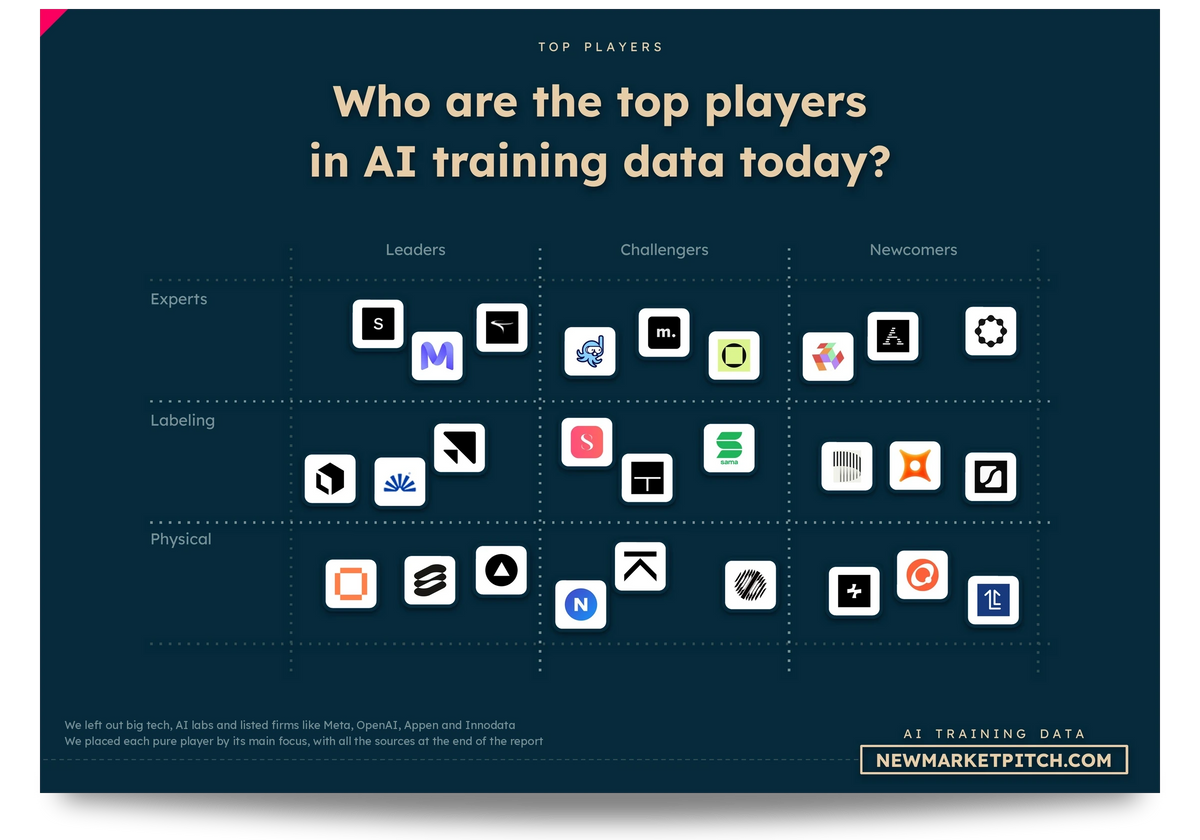
In our research about AI training data, we turn what is vague and complex into simple, useful visuals. Market maps like this one show you at a glance where every startup stands.
Why is the AI training data market attracting so much investment?
AI training data companies are attracting much more investment because frontier AI developers increasingly need specialized expertise, reliable evaluations and information that cannot easily be collected from the internet. The market is moving toward more difficult training tasks, creating opportunities for companies that can supply data that genuinely improves model performance.
The original market was largely built around data labeling. Companies such as Scale AI, Labelbox, Sama and SuperAnnotate helped technology companies organize, annotate and evaluate datasets. Their business models addressed a relatively straightforward problem: converting large volumes of raw information into structured material that machine-learning systems could use.
The requirements have since changed. Coding models need difficult programming problems and expert-reviewed solutions. Reasoning models need carefully constructed examples and evaluations. AI agents need environments in which they can perform tasks and receive feedback. Robotics models need information about physical movements, objects, forces and interactions that cannot simply be collected by scraping the internet.
We can see this evolution in Snorkel AI, which has moved from annotation software toward delivering completed datasets, and Mercor, which recruits specialized professionals to generate expert training material. Meanwhile, Mecka AI and XDOF are developing infrastructure to collect physical-world demonstrations for robotics.
Investors are consequently backing several different ways of solving the same underlying problem: making better training information available to increasingly capable AI systems.
Which AI training data startups have raised the most funding?
Scale AI, Snorkel AI and Mercor lead our funding ranking, with $1.6 billion, $588 million and $484 million raised respectively. Scale AI has raised approximately 2.7 times as much as Snorkel AI, while Snorkel AI has raised around 21% more than Mercor.
The gap between the leaders and the rest of the market is substantial. Handshake has raised $434 million, Labelbox $297 million and Lightwheel AI approximately $293 million. Below them, Turing and XDOF have raised $247 million and $200 million respectively.
The ten highest-ranked companies have raised a combined $4.427 billion. Scale AI alone accounts for approximately 36% of that amount, while the three leading companies represent just over 60%.
| Rank | Startup | Total raised | Rounds | Latest round |
|---|---|---|---|---|
| 1 | Scale AI | $1.6B | 7 | $1.0B |
| 2 | Snorkel AI | $588M | 7 | $350M |
| 3 | Mercor | $484M | 4 | $350M |
| 4 | Handshake | $434M | 7 | $200M |
| 5 | Labelbox | $297M | 7 | $103M |
| 6 | Lightwheel AI | ~$293M | 7 | ~$147M |
| 7 | Turing | $247M | 5 | $111M |
| 8 | XDOF | $200M | 3 | $128M |
| 9 | Invisible Technologies | ~$144M | 2 | $100M |
| 10 | micro1 | $140M | 5 | $100M |
The next group includes Mecka AI with $128 million, Encord with $110 million, Sama with $85 million, AfterQuery with $83 million and David AI with $80 million.
The ranking also illustrates how differently companies have accumulated their capital. Scale AI, Snorkel AI, Handshake and Labelbox have each completed seven rounds, while Mercor has reached its total through four. XDOF has raised $200 million across just three rounds.
These figures show the scale of investor financing behind each business, although they should not be confused with revenue, valuation or market share.

In our market report about AI training data, we always try to gather several sources and make estimates that make sense, so you can work with solid numbers.
Is Scale AI still the biggest name in AI training data?
Scale AI remains the clear funding leader and one of the most important companies in the industry. However, Meta's investment has complicated its position as an independent supplier to competing AI laboratories.
Scale AI's $1 billion Series F in May 2024 was its largest financing round. The company attracted investors including Accel, NVIDIA and Amazon, reinforcing its position at the center of the AI data supply chain.
The subsequent Meta transaction in June 2025 valued Scale AI at more than $29 billion. Meta acquired a substantial minority stake, reported at approximately 49%, and Scale's founder Alexandr Wang moved to Meta to lead its AI efforts. The transaction was a strategic investment rather than an ordinary primary venture round.
The commercial consequences appeared quickly. According to Reuters reporting in June 2025, Google, previously Scale AI's largest customer, planned to reduce or end its relationship with the company following Meta's investment. Google had reportedly expected to spend approximately $200 million on Scale's services during that year.
OpenAI, by contrast, indicated that it intended to continue working with Scale, although its CFO emphasized the importance of using multiple data suppliers.
Scale subsequently faced workforce reductions in its generative AI business, with The Information reporting that approximately 200 employees and 500 contractors were affected.
The company remains a major supplier, particularly across enterprise and government applications. But the Meta transaction exposed a problem that other data providers can exploit: AI laboratories want access to high-quality training data without becoming dependent on a supplier closely associated with a direct competitor.
Can Snorkel AI compete with Scale AI?
Snorkel AI has become a major challenger in AI training data by moving beyond annotation software and selling completed datasets to AI developers. Its $588 million in cumulative funding, including a $350 million Series E in September 2026, reflects how much investors value this broader approach.
Snorkel originally developed software that helped organizations build training datasets more efficiently through programmatic labeling and automated workflows. Its more recent business has moved closer to the actual production of AI training material.
In September 2026, Snorkel announced that its data-as-a-service business had grown more than 18 times since its launch approximately a year earlier. The company also reported an annualized revenue run rate exceeding $375 million.
The Series E was co-led by Insight Partners and S32, with participation from Addition and other existing investors.
This is a meaningful change in the commercial model. A customer purchasing annotation software is buying tools for its internal data team. A customer purchasing a completed dataset is outsourcing a much larger part of the training-data development process.
Snorkel's hybrid approach combines software, automated data generation and subject-matter experts. This allows it to address tasks that are too complex for basic automation but do not necessarily require a large manually managed workforce.
Scale AI still has a substantially larger funding base, but Snorkel has demonstrated that a different approach to supplying training data can attract substantial capital and significant commercial demand.

Our document detailing everything you need to know about AI training data gets updated several times a month, so you always get the latest view of where things stand.
Can Mercor become one of the biggest AI training data businesses?
Mercor is building one of the most ambitious businesses in expert-generated AI training data by connecting frontier AI developers with professionals who can contribute specialized knowledge. Its $484 million in cumulative funding includes a $350 million Series C in October 2025, backed by Felicis, Benchmark and General Catalyst.
The company's model connects AI developers with people who have expertise in programming, mathematics, finance, science and other professional fields.
This is increasingly useful as models become capable of answering ordinary questions but still struggle with complex professional work. Developers need people who can identify subtle mistakes, create difficult examples and judge whether an AI-generated answer is genuinely correct.
The Information reported in July 2026 that approximately 91% of Mercor's first-half revenue came from foundation-model developers. That concentration shows how closely the company's growth is tied to the spending of major AI laboratories.
There is also a financial distinction worth keeping in mind. Mercor's business relies on paying contractors for their contributions, so gross revenue should not be interpreted as the amount the company retains. The economics are different from those of a conventional software platform.
Mercor has an opportunity to become an important intermediary between professional talent and AI developers. Its biggest challenge will be maintaining attractive margins and diversifying its customer base as competition in expert-generated training data increases.
Are Handshake, Turing and micro1 competing for the same AI training data business?
Handshake, Turing and micro1 all operate in the broad human-expertise segment of AI training data, but they approach the opportunity differently. Their funding histories show that investors are backing several models for recruiting and organizing the people who help train advanced AI systems.
Handshake has raised $434 million across seven rounds, including a $200 million Series F in January 2022, backed by Coatue and Valiant Peregrine Fund. Its substantial funding history predates the latest acceleration in demand for expert-generated AI data.
Turing has raised $247 million across five rounds. Its $111 million Series E in June 2025 was led by Khazanah Nasional, with participation from WestBridge Capital and Sozo Ventures. The company supplies expert data and other services to frontier AI developers.
micro1 has raised $140 million across five rounds, including a $100 million Series B in September 2026. Its investors include Dream Ventures, G Squared and M12.
AfterQuery, with $83 million raised, is another specialist focused on expert data for model training.
The commercial challenge is the same across these businesses: finding people with the right expertise, checking the quality of their contributions and delivering the resulting information at a price that makes sense for AI developers.
As models become better, demand for simple labeling may weaken, while specialized knowledge and difficult evaluations could become much more valuable.

In our report covering the AI training data market, we look at what the winners do differently, so you can learn from the best instead of guessing.
Are robotics AI training data startups attracting more investment?
Robotics training data is attracting substantial investment because robots need information about the physical world that conventional language and image datasets cannot provide. Lightwheel AI, XDOF, Mecka AI and Config are among the companies in our ranking targeting this opportunity.
The problem is fundamentally different from language-model training. A robot must learn how to manipulate objects, coordinate movements, respond to physical contact and deal with unexpected situations. Much of this information has to be collected through real-world demonstrations or generated in specialized simulations.
Lightwheel AI has raised approximately $293 million across seven rounds, including a strategic financing of approximately $147 million in June 2026. Its business focuses on physical AI simulation and data.
XDOF has raised $200 million across three rounds, including a $128 million Series B in September 2026, with 8VC among its investors. It focuses on robotics AI training data infrastructure.
Mecka AI has raised $128 million across four rounds, including a $60 million Series B in October 2026. Sequoia Capital led the round, with participation from NVIDIA, M12, Qualcomm Ventures and Samsung.
Config has raised $35 million across two rounds, including a $27 million seed financing in May 2026. Its focus is robotics foundation-model data infrastructure.
The wider robotics and physical-AI group in our ranking also includes Parallel Domain, Kognic, Maxinsights, Ropedia, IO-AI Tech, N.dot.light, Build AI, Midcentury, Poseidon, Axis Robotics, PrismaX, Human Archive, FrodoBots, Vision Lab, Cortex AI and Deepen AI.
Their approaches cover synthetic environments, autonomous-system datasets, human demonstrations, egocentric video and multisensor annotation.
The category is attracting money because physical data is difficult to reproduce. A company collecting human demonstrations, another generating simulations and another labeling sensor information may serve different parts of the same development process.
Is Mecka AI becoming a major player in physical AI data?
Mecka AI is attracting serious attention in physical AI because it combines human-motion capture, specialized data infrastructure and commercial robot deployment. Its $128 million in cumulative funding includes a $60 million Series B led by Sequoia Capital in October 2026.
The company collects human motion data using specialized sensors and smartphones, allowing robotics developers to learn from real-world demonstrations.
Its financing announcement also revealed an unusually ambitious commercial trajectory. Mecka reported that it had exceeded a $100 million annualized revenue run rate in June 2026, only a few months after beginning operations, and projected a $300 million run rate by the end of the year. These figures are company-reported results and projections.
The investors are notable. Alongside Sequoia Capital, the Series B included NVIDIA, Microsoft's M12, Qualcomm Ventures and Samsung.
Mecka is also trying to extend its business beyond data collection. Its stated strategy combines capture hardware, data processing, model post-training and robotics integration, allowing customers to deploy robots and improve them through further real-world information.
That broader approach could give Mecka more commercial opportunities than a company selling datasets alone. However, the company will need to show that its deployment operations can scale without making the business excessively expensive to run.

In our research about AI training data, we don't want to repeat what boring consulting reports say. Instead, we show you the real and latest market signals that matter.
Who are the biggest investors in AI training data startups?
NVIDIA, Sequoia Capital, General Catalyst, Accel, Insight Partners and Lightspeed are among the most notable investors in our ranking. Their investments cover several different areas, from conventional annotation platforms to expert-generated data and physical AI.
NVIDIA has exposure to Scale AI, David AI and Mecka AI. These investments cover established data infrastructure, audio datasets and robotics training material.
General Catalyst appears among the investors in Mercor, Datacurve, Proximal and Good Start Labs. The companies cover expert-generated coding data, human expertise and environments for training AI systems.
Sequoia Capital's participation in Mecka AI is particularly interesting because it represents investment in the physical data layer rather than only the companies building conventional language-model datasets.
Accel's investment in Scale AI illustrates its exposure to established data-labeling infrastructure. Insight Partners, meanwhile, co-led Snorkel AI's September 2026 Series E alongside S32.
Other investors are targeting specific niches. CRV appears among the backers of Encord and Protege, while Lightspeed has exposure to Luel and Origin Lab. Samsung-related investment activity is visible through Samsung Next in Centaur Labs and Samsung Venture Investment in Config.
The investor landscape suggests that established venture firms are spreading their exposure across different ways of supplying the data required by advanced AI systems.
Which AI training data startups have raised the largest funding rounds?
Scale AI's $1 billion Series F in May 2024 is the largest individual financing event in our ranking. Snorkel AI and Mercor follow with $350 million rounds, while Handshake's $200 million Series F remains another particularly large historical financing.
| Startup | Latest round | Amount | Date | Key investors |
|---|---|---|---|---|
| Scale AI | Series F | $1.0B | May 2024 | Accel, NVIDIA, Amazon |
| Snorkel AI | Series E | $350M | September 2026 | Insight Partners, S32, Addition |
| Mercor | Series C | $350M | October 2025 | Felicis, Benchmark, General Catalyst |
| Handshake | Series F | $200M | January 2022 | Coatue, Valiant Peregrine Fund |
| Lightwheel AI | Strategic | ~$147M | June 2026 | Zhongguancun Science City Fund, Sichuan Development funds |
| XDOF | Series B | $128M | September 2026 | 8VC |
| Turing | Series E | $111M | June 2025 | Khazanah Nasional, WestBridge Capital, Sozo Ventures |
| Labelbox | Series E | $103M | October 2026 | Infinitum Partners, Wipro Ventures, B Capital |
| Invisible Technologies | Growth Equity | $100M | September 2025 | Vanara Capital, Acrew Capital, Greycroft |
| micro1 | Series B | $100M | September 2026 | Dream Ventures, G Squared, M12 |
Scale AI's round is a clear outlier, almost three times the size of the next-largest individual financing. The newer rounds also show how investment has spread. Snorkel AI and Mercor represent the expert-data and specialized-dataset segments, while XDOF and Lightwheel AI illustrate growing interest in physical AI.
Labelbox's announced $103 million financing included an equity component and a credit facility; the cumulative funding figure counts equity only.

Learning from others' mistakes is the cheapest lesson there is. In our market report about AI training data, we look at what broke startups before you, so you don't repeat it.
Which AI training data startups are building proprietary datasets?
David AI, Wirestock, Mundo AI, Troveo AI and Defined.ai are developing businesses around specialized or licensed information rather than simply providing annotation software.
David AI has raised $80 million, including a $50 million Series B in October 2025. Its focus is audio datasets for AI training, an area that becomes increasingly important as AI systems handle speech and other forms of audio information.
Wirestock has raised $25 million across three rounds and focuses on licensed multimodal datasets. Its $23 million Series A in May 2026 was backed by Nava Ventures, Sandberg Bernthal Venture Partners and Formula VC.
Mundo AI has raised $24 million across two rounds. Its $20 million Series A in August 2026 was backed by GreatPoint Ventures, Y Combinator and E12 Ventures. The company focuses on multilingual and multimodal training datasets.
Troveo AI has raised $5 million to develop video licensing for AI training, while Defined.ai has raised $78 million through four rounds and operates a training-data marketplace and services business.
The distinction is commercial as well as technical. Annotation companies help customers transform information into structured datasets, while licensing businesses attempt to control access to the underlying information itself.
As AI developers seek data that is legally usable, specialized and difficult for competitors to reproduce, ownership and licensing rights can become a competitive advantage.
Is synthetic data replacing human-generated AI training data?
Synthetic data is becoming an important part of AI training, but human-generated information remains essential for difficult evaluations, expert feedback and real-world validation. The companies attracting investment are developing several ways to combine automated generation with human contributions.
DatologyAI has raised $58 million across two rounds, including a $46 million Series A in May 2024. It focuses on automated data curation, helping customers select and organize information so that models can train more efficiently.
Parallel Domain and Rendered.ai operate in synthetic-data generation, creating simulated visual information for autonomous systems and computer vision applications.
Lightwheel AI also operates in physical AI simulation and data, while AI Verse and GenGenAI focus on synthetic computer-vision datasets.
The advantage of synthetic data is that developers can generate controlled examples, including rare situations that may be difficult or expensive to encounter in real-world datasets.
However, generated examples can fail to represent the complexity of real-world conditions. Models trained heavily on synthetic information may also inherit errors or unrealistic assumptions from the systems that produced it.
Human review therefore remains important, particularly when training material needs to reflect specialized knowledge or the complexity of physical environments.

If you build or invest in the AI training data market, you need to know which business models pay off now and which ones are fading. That's why our report covering it has a whole section on it.
Which AI training data startups are building environments for AI agents?
Bespoke Labs, Halluminate, HUD, Preference Model and several smaller companies are developing environments in which AI systems can perform tasks, receive feedback and improve through repeated interaction.
Bespoke Labs has raised $40 million across two rounds, including a $32 million Series A in July 2026, backed by Wing Venture Capital, Mayfield and The House Fund.
Halluminate has raised approximately $39 million, including a $30 million Series A in October 2026 backed by Oak HC/FT, Orange Collective and Heavybit.
HUD has raised $16 million in a June 2026 Series A, while Preference Model has raised $16 million in a single seed round in October 2026, with Andreessen Horowitz, SignalFire and South Park Commons among its investors.
Other companies in this category include Proximal, Chakra Labs, Mechanize, Idler and Good Start Labs.
The opportunity comes from the way AI agents are being developed. An agent learning to use business software needs more than a collection of screenshots. It needs environments that allow it to navigate interfaces, execute actions, encounter errors and receive meaningful feedback.
These environments can become an important part of the training process because they allow developers to test whether an AI system can actually complete a task rather than simply produce a convincing answer.
Which AI training data startups are benefiting from multimodal AI?
David AI, Wirestock, Mundo AI, DataBaker and several physical-AI specialists are positioned to benefit from the growing demand for information across audio, video, images and sensor data.
David AI has raised $80 million and focuses on audio datasets. Its $50 million Series B in October 2025 was backed by Meritech Capital, NVIDIA and Alt Capital.
DataBaker has raised $26 million across six rounds and focuses on speech and multimodal AI data services. Its latest listed financing was a $14 million Series B+ in April 2023.
Wirestock and Mundo AI approach multimodal data from the perspective of licensing and dataset development. Their businesses address the need for material that can train models across different media formats.
Physical AI introduces another dimension. Mecka AI, XDOF, Build AI and Human Archive focus on information involving human movements, video demonstrations and interactions with the physical world.
The underlying opportunity is that advanced AI systems increasingly need to understand information beyond written language. Audio, video, image and physical sensor datasets have different collection requirements, licensing issues and technical constraints.

In our report covering the AI training data market, we like to show you the big picture. We know your time is precious, so we make every page quick to read and packed with as much learning as possible per minute.
Which AI training data startups have raised money most recently?
Recent financing activity shows that investors are still writing substantial checks across expert data, robotics, agent environments and established enterprise data platforms.
Snorkel AI raised $350 million in September 2026, while Labelbox announced a $103 million Series E in October 2026. Both financings demonstrate continued interest in companies that already have established positions in AI data infrastructure.
Mecka AI raised $60 million in October 2026, with Sequoia Capital leading the round. micro1 raised $100 million in September 2026, reinforcing investor interest in expert-generated training material.
XDOF's $128 million Series B in September 2026 also demonstrates the scale of financing available to robotics data companies.
Other recent rounds include Halluminate's $30 million Series A in October 2026, Maxinsights' $30 million seed round in October 2026, Preference Model's $16 million seed round in October 2026 and Proximal's $15 million seed round in September 2026.
We also see financing activity among smaller companies such as Luel, Ropedia, IO-AI Tech, Mundo AI, N.dot.light, HUD and Config.
The interesting development is the spread of large rounds across very different business models. Expert-generated data, physical demonstrations and interactive environments are all attracting investors alongside the established annotation platforms.
Which countries have the strongest AI training data startup ecosystems?
The United States has the broadest representation among the companies in our ranking, but important AI training data businesses are also developing in the United Kingdom, China, France, the Netherlands, Sweden, Switzerland, Singapore, Japan, South Korea, Spain and Israel.
The United States has particularly strong representation in expert-generated data and enterprise AI infrastructure. Scale AI, Snorkel AI, Mercor, Handshake, Labelbox, Turing, Invisible Technologies and micro1 illustrate the depth of the American ecosystem.
The United Kingdom has several important companies, including Encord, Prolific, Sky Engine AI and Worldmodeldata. China has Hangzhou Manfu Technology, IO-AI Tech and DataBaker, covering annotation infrastructure, physical AI and multimodal data services.
France is represented by Kili Technology and AI Verse, while Sweden has Kognic and Switzerland has Lightly and Rapidata.
Asia also has emerging specialists. Japan's FastLabel, South Korea's N.dot.light and GenGenAI, and Singapore's Ropedia and FrodoBots are examples of companies addressing specific training-data requirements.
These differences partly reflect local strengths. Robotics data collection can benefit from access to manufacturing and industrial environments, while multilingual AI development depends on access to native speakers and regional content.

When you build or invest in the AI training data market, you need clarity, not confusion. In our research about AI training data, we always try to put numbers on and quantify whatever is usually vague and confusing.
Are AI training data startups becoming too dependent on OpenAI, Anthropic and Google?
Customer concentration is a serious risk for AI training data companies because a relatively small group of frontier AI developers accounts for a large share of demand for specialized training material. Mercor's reported customer concentration provides a particularly clear example.
According to The Information's July 2026 reporting, approximately 91% of Mercor's first-half revenue came from foundation-model developers. Its major customers included OpenAI, Anthropic and Google DeepMind.
That concentration has helped Mercor grow quickly, but it leaves the company exposed to changes in purchasing decisions, internal data operations and competitive relationships.
Scale AI experienced a different version of the same problem after Meta's investment. Google reportedly reconsidered its relationship with the company because of the new ownership structure.
Robotics data providers face another form of customer concentration. Mecka AI and XDOF need a relatively small group of advanced robotics developers to purchase their specialized information at meaningful scale.
The strongest businesses will need to sell to several categories of customers, including frontier laboratories, enterprises, robotics developers and government organizations.
Can AI training data startups build lasting competitive advantages?
AI training data startups can build defensible businesses, but basic annotation tools and access to large groups of workers are unlikely to provide lasting advantages on their own. The strongest positions come from proprietary information, specialized expertise, operational infrastructure and the ability to improve model performance.
Scale AI's advantage historically came from its ability to coordinate large annotation operations and serve demanding enterprise customers. Snorkel AI has developed a different advantage through its software and data-as-a-service model.
Mercor's potential defensibility lies in its network of qualified professionals and its ability to recruit people for specialized AI tasks.
Mecka AI and XDOF are pursuing another form of competitive advantage. Collecting physical-world data requires operational infrastructure, specialized capture systems and access to real environments. These assets are harder to reproduce than a conventional annotation interface.
DatologyAI offers another approach. Its focus on data selection and curation addresses a technical problem that cannot be solved simply by hiring more annotators.
The main challenge is proving that these advantages translate into repeat purchases and measurable improvements in AI performance. Customers can develop internal capabilities, competitors can automate existing workflows and some forms of data collection will become cheaper.

A good product starts with a real problem. In our market report about AI training data, we show you the ones customers still live with.
Is the AI training data market becoming overcrowded?
The AI training data market is becoming more competitive, particularly in basic annotation and generic human-feedback services, but the different categories of companies are not all competing for the same contracts.
Scale AI, Labelbox, Kili Technology and SuperAnnotate address data annotation and infrastructure. Mercor, Turing, micro1 and AfterQuery focus more heavily on expert-generated information. David AI and DataBaker concentrate on audio and speech, while Mecka AI, XDOF and Lightwheel AI are developing physical-AI data capabilities.
There is also a growing group of companies building synthetic datasets and simulated environments, including Parallel Domain, Rendered.ai, AI Verse and GenGenAI, alongside companies developing interactive agent-training environments.
The more immediate risk concerns companies whose services can be reproduced through cheaper software or increasingly capable AI systems. Basic image annotation, straightforward text labeling and repetitive data-processing tasks may become less attractive as standalone businesses.
Difficult expert evaluations, licensed information, physical demonstrations and high-quality interactive environments are more specialized. They require access to particular resources, contributors or technical infrastructure.
We expect the market to become more differentiated, with consolidation likely among companies that cannot demonstrate a clear advantage in data quality or customer value.
What are the biggest risks for investors in AI training data startups?
The biggest risks are customer concentration, pricing pressure, weak data differentiation, operational complexity and uncertainty over the long-term value of particular datasets. High funding totals demonstrate investor interest, but they do not establish that a company has achieved durable profitability.
Mercor's reported revenue concentration among foundation-model developers illustrates how quickly a company can become exposed to a small number of buyers.
Traditional annotation businesses face another challenge as models become capable of performing more labeling and data-processing tasks automatically. Companies that cannot move toward higher-value services risk competing primarily on price.
Data ownership and licensing also deserve attention. Companies selling proprietary datasets must demonstrate that they have the necessary rights to collect, process and license the underlying information. This is particularly important for video, audio, corporate information and content originating from third-party platforms.
Robotics data companies face substantial operational requirements. They must collect reliable information from physical environments, synchronize sensors, maintain quality standards and deliver datasets that work across different robotic systems.
Finally, companies that raise substantial amounts before establishing repeatable customer demand may struggle to turn their financing into durable revenue.

It's easy to get lost in the details. In our document detailing everything you need to know about AI training data, we give you some perspective first, so you see the whole market before you make a move.
Which AI training data startups have the greatest long-term potential?
Snorkel AI, Mercor, Scale AI, Labelbox, Encord, DatologyAI, Mecka AI and XDOF represent particularly interesting long-term opportunities, although their potential comes from very different sources.
Scale AI has the accumulated funding, established infrastructure and enterprise relationships to remain a major supplier, although its ownership structure creates a commercial challenge.
Snorkel AI has demonstrated that an established data platform can move into higher-value services and grow rapidly. Its transition toward completed datasets is one of the clearest examples of the market's evolution.
Mercor has benefited from the growing need for expert-generated data and has demonstrated significant commercial traction. Its main challenge will be diversifying its customer base and maintaining attractive economics as its workforce expands.
Labelbox and Encord are positioned in enterprise data infrastructure. As AI applications become more complex, organizations will need reliable systems to organize, evaluate and keep up the datasets behind them.
DatologyAI is addressing the efficiency of training itself. Better data selection can become valuable even if the total amount of information collected continues to grow.
Mecka AI and XDOF represent a more speculative but potentially important opportunity. If robotics development accelerates, the scarcity of real-world demonstrations could create a substantial market for specialized data collection.
Which startups are leading the AI training data market by funding?
Scale AI leads our cumulative funding ranking, followed by Snorkel AI and Mercor. However, the companies attracting the most interesting new investment are spread across several different parts of the AI data supply chain.
The funding figures show how much capital has accumulated behind the established leaders. The broader ranking also shows that specialized datasets and expert-generated information can attract very large rounds.
Turing, Handshake, micro1 and AfterQuery represent the continued demand for human expertise. David AI and DataBaker illustrate the importance of audio data. DatologyAI focuses on automated curation, while Bespoke Labs, Halluminate, HUD and other companies are developing environments for training AI agents.
Mecka AI, XDOF and Lightwheel AI represent another important direction: the collection and generation of information needed to train robots.
Our conclusion is that AI training data is becoming a strategic infrastructure market rather than a relatively narrow outsourcing category. The companies with the strongest long-term opportunities will be those that control access to scarce information, organize specialized human contributions or create environments that measurably improve model performance.
Fundraising leadership remains an important indicator of investor confidence, but the next generation of market leaders will ultimately be determined by the quality of their data, the customers willing to pay for it and the economics of delivering it.
Our methodology
This analysis ranks startups in the AI training data market by cumulative equity funding raised. We cover companies working on data annotation, curation, evaluation, expert-generated material, synthetic datasets, multimodal information and robotics training infrastructure. Companies that subsequently went public or were acquired remain eligible because their earlier startup financing is still relevant to their fundraising history.
We reviewed individual financing rounds, recording their dates, amounts, financing types and key investors wherever publicly available. The totals reflect equity financing and exclude debt, grants and other non-equity funding. Where a financing announcement combines different types of capital, only the relevant equity component is included.
Our research draws on company announcements, investor disclosures, regulatory filings, official press releases and established financial and technology publications. Key sources include Scale AI's Series F announcement, Scale AI's announcement of Meta's investment, Reuters reporting on Google's relationship with Scale AI, Snorkel AI's Series E announcement, Snorkel AI's explanation of its Data 2.0 strategy, Mercor's Series C announcement, Turing's Series E announcement, Handshake's Series F announcement, Labelbox's Series E announcement, Mecka AI's Series B announcement, TechCrunch reporting on XDOF, Encord's Series C announcement, David AI's Series B announcement, DatologyAI's Series A announcement and Prolific's financing announcement.
When sources disagreed, we prioritized direct company or investor disclosures, regulatory documents and authoritative reporting. We also checked for subsequent financing announcements to keep the funding histories as complete as possible. Where the available evidence was insufficient to establish a reliable total, the company was left out rather than assigned an unsupported figure.
Written by the New Market Pitch teamWe track new markets so founders and investors can move faster. About us