Is the AI video market big enough to pay for its compute?
Whether you're building or investing in the AI video generation market, our report covers everything you need to know: the players, the money, and what's coming next.
Summary
Yes, the AI video market is already big enough to pay for substantial computing capacity, but whether it can finance continuous frontier-model development remains unproven. Commercial demand is growing quickly, while the industry's underlying inference margins are still largely undisclosed.
Kling and Runway alone represent approximately $680 million in combined annualized commercial scale. Kling generated more than RMB850 million in the second quarter of 2026, equivalent to roughly $480 million annualized, while Runway reached an estimated $200 million in annual recurring revenue in August.
Growth is coming from actual spending, not just free experimentation. Kling's quarterly revenue increased more than 200% year over year, and Runway's estimated ARR roughly doubled between April and August 2026. Advertising, marketing, and professional content production are emerging as particularly valuable customers.
The critical unknown is gross margin. Published API prices range from $0.05 to $0.60 per generated second, but providers rarely disclose the GPU workloads, utilization, retries, and infrastructure expenses behind those prices. Strong revenue therefore tells us surprisingly little about profitability.
Generation quality can be as important economically as generation speed. A customer who needs four attempts to produce one acceptable scene may spend four times as much as someone getting the same result immediately. Models that reduce failed attempts can justify premium prices even as cheaper alternatives enter the market.
Pricing pressure is already severe. Google cut Veo 3 generation prices substantially in 2025, and its newer Lite tier starts at $0.05 per second. Moving from $0.40 to $0.05 per second requires eight times more billable output to preserve revenue, unless customers move toward other paid features or configurations.
OpenAI's Sora shutdown in 2026 exposed another dimension of the economics. A technically impressive product can still lose its place in a company's priorities when computing capacity and engineering resources could generate better returns elsewhere. Kling and Runway continuing to expand shows that commercial execution matters as much as frontier model quality.
Advertising offers a large recurring workload, although the industry's addressable revenue should not be confused with the more than $80 billion spent annually on U.S. digital video advertising. AI generation companies capture spending on creative production and related software, not the full value of advertising inventory.
Enterprise customers and production platforms may have stronger economics than standalone consumer generation tools. Businesses can justify recurring spending through production savings and campaign performance, while platforms integrating several competing models can retain customers through their workflows rather than through exclusive access to one model.
A multibillion-dollar AI video market is plausible without replacing Hollywood. The harder question is how many companies that market can support: providers with efficient inference and repeat professional usage have a credible path toward sustainability, while developers financing ever-larger frontier models may remain dependent on outside capital or profitable parent businesses.

Written by the New Market Pitch teamWe track new markets so founders and investors can move faster. About us
Is AI video generation becoming a real business or just an expensive experiment?
AI video generation is already bringing in hundreds of millions of dollars, but we still don't know whether the leading providers can make enough profit to cover their computing costs and keep developing better models.
Kling AI generated more than RMB850 million in revenue during the second quarter of 2026, equivalent to roughly $120 million. Runway reached an estimated $200 million in annual recurring revenue in August, according to Sacra. Google, Adobe, and several smaller providers also sell video generation through paid subscriptions and APIs.
These businesses have moved well beyond free demonstrations. Companies are buying generated videos for advertising, marketing, and creative production, while independent creators pay for tools that would have been impossible to use commercially a few years ago.
Yet OpenAI discontinued Sora's consumer experiences in April 2026 and its API in September. That happened while Kling and Runway were growing quickly, making it difficult to argue that demand alone determines whether an AI video business succeeds.
The unresolved question is how much of the money customers spend remains after inference, infrastructure, and model development. We have increasingly convincing revenue figures, but very little public information about the costs behind them.
If you want more recent data on this point, please see our latest AI video generation market report.
How big is the AI video generation market today?
The AI video generation market already has at least $680 million in combined annualized revenue from Kling and Runway alone, although that figure mixes different financial measures and excludes much of the industry.
Kuaishou reported that Kling generated more than RMB850 million in second-quarter 2026 revenue. Annualized, that represents approximately $480 million at prevailing exchange rates. Sacra estimates Runway reached $200 million in annual recurring revenue in August, compared with $96 million at the end of 2025.
Together, these figures establish a substantial commercial base. The $680 million calculation is a lower-bound indicator of the scale represented by these two businesses, rather than a measure of actual annual market revenue: Kling's number extrapolates one quarter, while Runway's ARR is an independent estimate.
The market also includes Google's Veo, Adobe Firefly, MiniMax's Hailuo, Luma, Pika, ByteDance's video models, and other paid generation platforms. Most do not report video-generation revenue separately.
Google and Adobe illustrate the measurement problem. Their subscriptions combine video generation with other AI features, editing software, storage, and creative tools. Counting all those payments as video revenue would exaggerate the market.
For this analysis, we count services that generate or transform synthetic moving images, including commercial API usage. We exclude conventional editing, subtitles, dubbing, and unrelated creative software revenue. The broader AI video software industry is considerably larger, but its costs are different too.

Your time is limited. In our report covering the AI video generation market, we put numbers on each part of the market, so you can see where it makes sense to focus.
Is AI video revenue growing fast enough to justify the hype?
AI video revenue is growing remarkably fast at Kling and Runway, with both companies showing that customers are spending more rather than merely trying the technology.
Kling's annualized revenue run rate reached $100 million in March 2025 and $240 million in December 2025, according to Kuaishou's January 2026 announcement. By the second quarter of 2026, its reported quarterly revenue exceeded RMB850 million, more than three times the comparable quarter a year earlier.
That last figure is particularly useful because it compares actual quarterly sales rather than two annualized snapshots.
Runway followed a similar trajectory. Sacra estimated $96 million in ARR at the end of 2025, approximately $100 million in April 2026, and $200 million in August. Revenue therefore roughly doubled within four months after its April milestone.
The two companies are expanding through different channels. Kling combines consumers, enterprise accounts, and integrations with Kuaishou's content ecosystem. Runway increasingly serves businesses producing advertising, branded content, and other commercial media.
We cannot infer an industry-wide growth rate from two successful businesses. Still, their revenue trajectories show that AI video demand is converting into actual spending, not simply accumulating free users.
| Company or metric | Earlier figure | Latest relevant figure |
|---|---|---|
| Kling annualized revenue | $100M, March 2025 | $240M, December 2025 |
| Kling Q2 revenue | Below RMB283M, Q2 2025, implied by reported growth | Above RMB850M, Q2 2026 |
| Kling Q2 year-on-year growth | Previous-year baseline | Above 200% |
| Kling implied annualized scale | $240M, December 2025 | Approximately $480M, Q2 2026 |
| Runway ARR | $96M, December 2025 | $200M, August 2026 |
| Runway ARR growth | December 2025 baseline | Approximately 108% |
| Combined annualized scale | Not consistently disclosed | Approximately $680M |
Kling's dollar figures are approximate. The Runway numbers are Sacra estimates, while Kling's quarterly revenue and growth figures come from Kuaishou's financial disclosures.
How expensive is it to generate an AI video today?
AI video generation currently costs customers anywhere from a few cents to several dollars for a short clip, depending on the model, quality, and resolution. The difference becomes substantial when someone needs hundreds of clips.
Google's published Veo 3.1 API prices range from $0.05 per second for Lite at 720p to $0.60 per second for Standard at 4K. Runway charges $0.05 per second for Gen-4 Turbo and $0.12 for Gen-4.5 through its published API pricing.
An eight-second video on Google's Veo Lite at 720p costs $0.40, compared with $3.20 using Standard at 1080p. For 100 generated clips, that becomes $40 versus $320.
These are customer prices, not Google's actual GPU expenses. We don't know how many accelerators each request occupies, how long inference takes internally, or what Google pays for its computing capacity.
There is also a difference between paying for generated footage and paying for footage that is usable. A marketing team might need several attempts to get the right movement, framing, and appearance. Those rejected generations still consume compute, even when they never appear in the final advertisement.
For that reason, the cost of an accepted scene is often more useful than the advertised price of a generated second.
| Model and tier | Published price per second | Eight-second video |
|---|---|---|
| Runway Gen-4 Turbo | $0.05 | $0.40 |
| Runway Gen-4.5 | $0.12 | $0.96 |
| Google Veo 3.1 Lite 720p | $0.05 | $0.40 |
| Google Veo 3.1 Lite 1080p | $0.08 | $0.64 |
| Google Veo 3.1 Fast 720p | $0.10 | $0.80 |
| Google Veo 3.1 Fast 1080p | $0.12 | $0.96 |
| Google Veo 3.1 Standard 1080p | $0.40 | $3.20 |
| Google Veo 3.1 Standard 4K | $0.60 | $4.80 |
Prices are based on the providers' published API rates for the stated configurations. Other processing, reference media, and related services may carry additional charges.

In our research about AI video generators, we always try to gather several sources and make estimates that make sense, so you can work with solid numbers.
Can AI video companies actually make money on each generated clip?
AI video companies can make money on individual generations if they run their models efficiently, but none of the leading proprietary providers has published enough information for us to verify its exact inference margins.
Consider a simplified GPU calculation. At $4 per H100 GPU-hour, one accelerator costs approximately $0.00111 per second of rental time. Running eight accelerators for one minute would therefore cost roughly $0.53 in nominal GPU rental expenses.
If that computing workload produced an eight-second video sold for $3.20, it would leave $2.67 before storage, networking, retries, idle capacity, and other direct expenses. Selling the same workload for $0.40 would fail to cover even the nominal GPU rental bill.
This is an illustrative calculation, not a description of how Veo or Runway operates internally. Modern video models use different hardware configurations, optimization methods, and processing times.
The important variable is how efficiently a provider turns GPU time into billable output. A model that produces a clip in 30 seconds has a major cost advantage over one requiring two minutes on equivalent hardware.
GPU rental rates also vary significantly. Public cloud pricing in 2026 includes H100 offerings at roughly $2 to more than $10 per GPU-hour, depending on the provider and contract. At continuous full utilization, 1,000 GPUs rented at $2 per hour would cost approximately $17.5 million annually, compared with $70 million at $8.
That difference could determine whether an otherwise identical video service makes money. Model optimization, hardware procurement, and utilization are not minor engineering details here. They can decide the economics of the entire business.
If you want more recent data on this point, please see our latest AI video generation market report.
Why does AI video cost so much more than AI images?
AI video is more expensive to generate because models must produce believable movement and keep objects consistent across time, while users often need several attempts before they get a usable result.
An eight-second clip at 24 frames per second contains 192 displayed frames. AI video models do not necessarily generate each one independently, but they must represent changing positions, camera motion, lighting, and relationships between objects throughout the sequence.
A single image can look convincing even when some details are slightly wrong. In video, those errors may become obvious as soon as an object moves. A character's appearance might change between frames, a hand might deform, or a camera movement might break the scene.
Longer clips make the problem harder. Higher resolution adds more computational work, and synchronized audio introduces additional requirements.
We can see the financial consequence in a simple production example. Suppose a creator needs one acceptable eight-second scene but generates four versions before finding it. At $0.40 per generated second, the 32 seconds of output cost $12.80.
If a better model gets the result right on the first attempt, the bill falls to $3.20 even at the same per-second price.
Customers may willingly pay more per second when they need fewer retries. Improving consistency can also lower the provider's wasted computing work, particularly when unsuccessful generations are absorbed through subscriptions or refunds.

In our market report about AI video generators, we don't want to repeat what boring consulting reports say. Instead, we show you the real and latest market signals that matter.
Are falling AI video prices good news for the companies selling it?
Cheaper AI video generation is attracting more customers, but providers face a difficult calculation: their usage must grow faster than their prices fall unless computing costs decline just as quickly.
Google provides a clear example. In September 2025, it reduced the published price of Veo 3 from $0.75 to $0.40 per second, a cut of approximately 47%. Veo 3 Fast fell from $0.40 to $0.15, a reduction of 62.5%.
The newer Veo 3.1 lineup includes Lite, Fast, and Standard configurations. Lite costs $0.05 per second at 720p, making basic generation much cheaper than the original premium offerings.
At $0.40 per second, generating 100 eight-second clips produces $320 in revenue. At $0.05, the same volume produces $40. A provider would need eight times the billable output to maintain revenue at those two price points.
Fortunately for customers, cheaper prices also make new uses affordable. A company may begin generating hundreds of product variants when the price becomes low enough, whereas previously it would have limited itself to a few experiments.
The profitability outcome depends on actual consumption and computing costs. If generation costs fall 80% while prices fall 50%, margins can improve. If prices fall faster than costs, growth in usage may still leave the provider financially worse off.
For now, published prices are falling substantially faster than the industry is disclosing its underlying cost reductions.
Did OpenAI shutting down Sora prove that AI video is too expensive?
OpenAI's decision to discontinue Sora shows that running a high-profile AI video product can be strategically unattractive even when the technology is impressive. It does not prove that video generation is inherently unprofitable.
OpenAI shut down Sora's web and app experiences on April 26, 2026, followed by its API on September 24. The company confirmed both dates in its official discontinuation notice.
Sora had been one of the industry's most recognizable video-generation products. Its closure therefore deserves more attention than another startup struggling to attract customers.
However, OpenAI never published a detailed Sora income statement showing revenue, inference expenses, user retention, and operating margins. We cannot attribute the decision exclusively to compute costs.
OpenAI also operates in a market where other products compete for engineering resources and computing capacity. Maintaining a separate video application may have been less attractive than directing those resources toward its other AI services.
What makes the decision especially interesting is the contrast with Kling and Runway. Both continued growing commercially while Sora disappeared.
The lesson is fairly sharp: frontier model quality and brand recognition are insufficient to guarantee a successful video business. Distribution, customer needs, repeat usage, and the opportunity cost of computing infrastructure can matter just as much.
If you want more recent data on this point, please see our latest AI video generation market report.

In our document detailing everything you need to know about AI video generation, we like to show you the big picture. We know your time is precious, so we make every page quick to read and packed with as much learning as possible per minute.
Are people paying for AI video, or are most of them using free credits?
AI video has a growing paying audience, but the biggest platforms still disclose too little about paid conversion and customer retention to tell us how much of their activity comes from free experimentation.
Kuaishou reported in December 2025 that Kling had served more than 60 million creators, generated more than 600 million videos, and established relationships with over 30,000 enterprise customers.
Dividing 600 million generated videos by 60 million creators gives approximately ten videos per creator over the reported lifetime of the service.
That average needs careful interpretation. Heavy users could account for a large proportion of generations, while millions of people might have tried the product only once. Cumulative creator counts also say little about monthly activity.
The revenue figures establish that paid demand exists, but we cannot use cumulative users to calculate revenue per active customer.
Runway offers a different view. Its estimated $200 million in ARR reflects subscription, API, and enterprise business rather than a simple count of everyone who has tried its models.
What we would particularly like to know is how much revenue comes from repeat paying users, how spending changes after the first few months, and what percentage of generated video is subsidized.
Those numbers would tell us much more about the strength of the AI video market than another announcement about total registered users.
Can AI video capture a meaningful share of advertising spending?
Advertising is currently one of the strongest commercial opportunities for AI video because advertisers repeatedly need new creative material and can measure whether better production improves campaign results.
The Interactive Advertising Bureau projected in May 2026 that U.S. digital video advertising spending would exceed $80 billion during the year, representing approximately 11% annual growth. The market includes connected television, online video, and social video.
Of course, the $80 billion represents spending on advertising inventory and related activity, not a budget available directly to AI generation companies.
The more revealing evidence concerns how advertisements are produced.
An IAB study in 2025 found that roughly half of surveyed advertisers were using generative AI to build video advertisements. Kuaishou subsequently reported that spending on AI-generated short-video marketing materials on its platform rose more than 70% year over year during the second quarter of 2026.
AI is becoming part of regular advertising production, particularly for short-form content and creative variations.
Consider a retailer testing dozens of product demonstrations across different audiences. Generative video can lower the cost of producing alternative scenes, backgrounds, and visual concepts. If the resulting clips help the retailer improve sales, the company has a concrete reason to keep paying.
We should expect much less straightforward adoption in premium film and television production, where continuity, creative control, rights management, and collaboration requirements are more demanding.
Advertising offers a large recurring workload, but the share of its economic value captured by model providers may remain relatively small. Advertisers benefit when production becomes cheaper, and those savings do not necessarily turn into higher software spending.

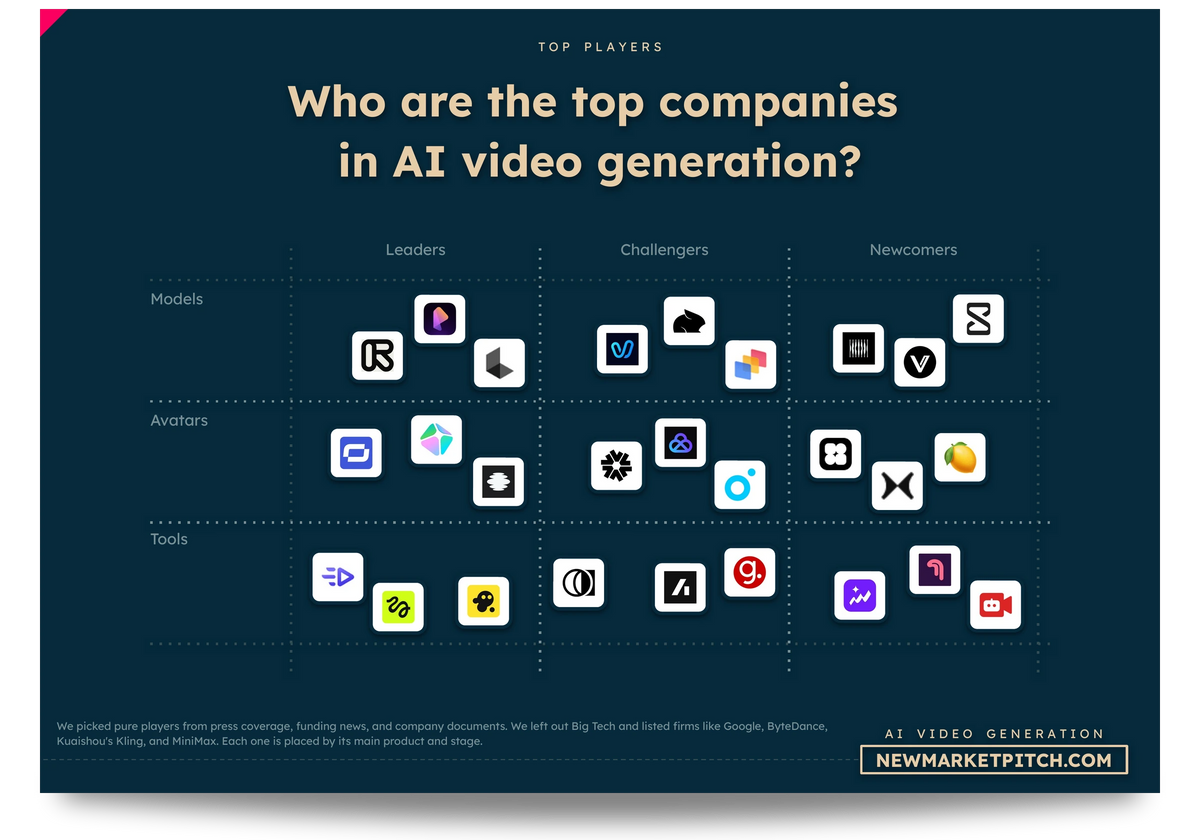
In our report covering the AI video generation market, we turn what is vague and complex into simple, useful visuals. Market maps like this one show you at a glance where every startup stands.
Could AI video become a multibillion-dollar market without replacing Hollywood?
AI video can realistically become a multibillion-dollar market through routine business production, even if high-end cinema and television remain largely dependent on traditional workflows.
The clearest opportunities include social advertisements, product demonstrations, localized campaigns, short promotional clips, and creative variations. These are already activities that businesses repeat frequently.
Wistia's 2025 State of Video research found that the proportion of surveyed professionals using AI to create video rose from 18% in the previous survey to 41%. Its 2026 research, covering more than 900 professionals and 13 million videos, continued to document AI's growing role in business-video workflows.
Still, these surveys include AI-assisted scripting, editing, captions, and other tasks. They should not be interpreted as showing that 41% of businesses were paying for fully synthetic video generation.
Another important finding from Wistia was that almost half of surveyed teams were maintaining their video budgets. Many companies appear more interested in producing additional content with existing resources than in dramatically increasing production spending.
We can illustrate the possible market size through customer spending rather than unsupported market forecasts.
One million businesses spending $1,000 annually on generated video would create $1 billion in revenue. Another scenario involving 100,000 professional customers spending $20,000 annually would produce $2 billion. These are hypothetical customer populations, and the two groups could overlap.
AI video would not need to replace expensive film productions to become a sizeable software business. A relatively modest number of companies using generated footage regularly could sustain several billion dollars in annual spending.
What remains uncertain is whether enough businesses will adopt that behavior, especially as traditional editing software adds cheaper AI features.
If you want more recent data on this point, please see our latest AI video generation market report.
Is AI video more profitable when sold to businesses instead of consumers?
Business customers give AI video companies a clearer way to earn back their computing costs because they can pay according to the work the software saves, rather than treating generation as entertainment.
Consumer subscriptions have an obvious weakness. A customer paying $20 or $30 monthly might generate dozens or hundreds of clips, while another subscriber barely uses the service. Generous plans can become expensive if heavy users consume far more compute than the subscription price covers.
Credit limits and usage-based pricing help control that exposure. Adobe Firefly, for example, uses credit allocations for premium generation features, with different consumption requirements depending on the product and output.
Business customers can support much higher spending, particularly when generated footage replaces paid production work or makes an advertising campaign more effective.
Runway's commercial expansion increasingly involves enterprise marketing and advertising. Sacra's October 2026 research names companies such as Amazon, Microsoft, and Allstate among the businesses associated with its enterprise push.
Kling has also developed commercial relationships beyond its creator audience, including advertising integrations and enterprise accounts.
Large clients certainly create additional obligations. They may negotiate discounts, require dedicated infrastructure, demand security protections, and expect consistent service quality.
But an enterprise paying $20,000 annually can justify that expense through production savings in a way that most casual consumers cannot.
The most attractive customers may therefore be marketing teams, production studios, and businesses with frequent video needs rather than the largest possible number of occasional users.

Our research about AI video generators gets updated several times a month, so you always get the latest view of where things stand.
Will video-generation companies lose customers to cheaper AI models?
AI video models are becoming easier to compare and switch between, which could make it difficult for individual providers to maintain high prices unless they offer better quality, reliability, or creative control.
Runway's recent strategy is particularly revealing. Although it develops proprietary models such as Gen-4.5, the company also integrates third-party models, including competitors' offerings, into its creative platform.
Sacra's October 2026 analysis describes Runway's move toward becoming a broader production platform, combining different models with tools for professional workflows.
Adobe has taken a similar direction through Firefly, integrating partner models alongside its own creative technology.
This gives customers more flexibility. A team might choose one model for character consistency, another for animation, and a third for dialogue or sound without rebuilding the entire production workflow.
It also creates a problem for companies whose only advantage is access to a particular model.
Chinese providers including Kling and MiniMax are competing internationally, while open-weight video models offer technically capable organizations another way to generate content without relying exclusively on premium APIs.
Models are competing on output quality and price while creative platforms try to own the customer's workflow.
That second position may become increasingly valuable. Customers who build their production process around a platform have more reasons to stay than customers who simply purchase generation seconds from the cheapest available API.
Can AI video companies pay for the next generation of models themselves?
Most frontier AI video companies have not yet shown they can fund continuous model development entirely from their own operating profits, even though commercial revenue is becoming substantial.
Runway raised $315 million in a Series E funding round in February 2026 at a reported valuation of approximately $5.3 billion. Against Sacra's estimated $200 million ARR in August, that valuation represents about 26.5 times annualized revenue.
The timing matters: the revenue figure is from several months after the financing, so the ratio is a retrospective comparison rather than the valuation multiple investors used when committing capital.
Runway has also expanded its ambitions beyond creative video toward world models and robotics-related applications. Its Praxis-1 robot action model, announced in September 2026, shows that some development expenditure is now aimed at markets beyond conventional video generation.
Kling operates under a very different financial structure. Its parent, Kuaishou, reported RMB142.8 billion in total revenue and RMB20.6 billion in adjusted net profit for 2025. That gives Kuaishou financial resources and operating businesses beyond Kling to support further AI investment.
Google and Adobe also have established businesses capable of funding research and integrating generation into larger product portfolios.
To understand the challenge for an independent provider, consider a hypothetical video company generating $500 million in annual revenue.
At a 30% gross margin, it would retain $150 million after direct service-delivery costs. At a 60% margin, it would retain $300 million. That remaining money must cover research, sales, marketing, administration, and other operating expenses before the company makes an operating profit.
A difference of $150 million in annual gross profit could determine whether the company can fund another major research program internally.
| Annual revenue | Gross margin | Annual gross profit |
|---|---|---|
| $100M | 30% | $30M |
| $100M | 60% | $60M |
| $250M | 30% | $75M |
| $250M | 60% | $150M |
| $500M | 30% | $150M |
| $500M | 60% | $300M |
| $1B | 30% | $300M |
| $1B | 60% | $600M |
These are illustrative operating scenarios, not reported margins for specific AI video companies.

In our market report about AI video generators, you will always find fresh funding data, taken straight from our own verified funding database.
Is the AI video market big enough to pay for its compute?
Partly yes. The AI video market is already large enough to support serious commercial generation businesses, but there is still no convincing public evidence that standalone video revenue can consistently pay for frontier model development and the infrastructure needed to serve customers.
Kling has reached more than RMB850 million in quarterly revenue and is growing at over 200% annually. Runway's estimated ARR has climbed to $200 million. Together, their annualized commercial scale is approximately $680 million, before counting Google, Adobe, MiniMax, and the rest of the market.
Those figures settle the basic demand question. Customers are paying for AI video, particularly in advertising, marketing, and professional production.
The compute economics are less clear. Google's API pricing shows that generation can now cost customers as little as $0.05 per second, while premium outputs sell for many times that amount. We can also see providers cutting prices, improving models, and expanding business usage. What we cannot verify is how much gross profit remains after running the infrastructure.
The industry faces another expensive challenge: today's efficient model may become tomorrow's outdated model. Companies pursuing frontier performance must repeatedly invest in research, training, and engineering.
OpenAI's Sora closure exposed the risks of that strategy. At the same time, Kling's commercial growth and Runway's expansion show that video generation can develop into a substantial business when customers have good reasons to keep paying.
AI video can already support significant inference spending when usage is priced carefully and tied to valuable commercial work. Whether it can fund the entire frontier development cycle remains unproven.
The market could reasonably grow into several billion dollars in annual revenue without replacing Hollywood. But that opportunity won't necessarily support dozens of expensive frontier model developers. We expect the strongest businesses to be those that combine efficient inference with repeat professional usage, while providers relying on impressive demonstrations and heavily subsidized generation face a much harder financial future.
If you want more recent data on this point, please see our latest AI video generation market report.
Sources and methodology
This analysis examines whether the AI video generation market can generate enough revenue to cover inference costs and sustain continued model development. We assessed commercial traction, pricing, customer adoption, computing economics, competitive positioning, and research funding requirements, combining recent evidence from each dimension before drawing conclusions about the industry's financial sustainability.
For commercial traction, we compared reported financial results from Kling's parent company, Kuaishou, with independent estimates of Runway's recurring revenue. Kling's reported second-quarter revenue was converted into an approximate annualized figure and combined with Runway's estimated ARR to establish a commercial scale indicator. This is not a complete market-size estimate or a standardized measure of recognized annual revenue. We excluded unrelated subscriptions, conventional video editing, dubbing, subtitles, and other software revenue that cannot reasonably be assigned to synthetic video generation.
Our revenue assessment uses fresh financial disclosures and estimates, aggregates the comparable evidence, and then examines what the resulting growth actually demonstrates. Kling's reported quarterly sales and Runway's estimated ARR establish commercial demand, while the distinction between reported financial results, independent estimates, and annualized calculations prevents that evidence from being confused with audited industry-wide revenue. We also considered cumulative users, enterprise relationships, and customer spending patterns, without interpreting registered users or generated-video counts as paying-customer metrics.
For inference economics, we collected published API prices for specific video-generation models and resolutions, then compared them with illustrative GPU rental costs. Our calculations use observable per-second selling prices and hypothetical H100 GPU workloads to explore possible direct margins. They are sensitivity tests rather than estimates of any provider's actual cost structure. Model architecture, acceleration hardware, processing time, utilization, rejected generations, networking, and infrastructure contracts can all materially change the economics. We distinguished the cost of generating a clip from the cost of producing usable footage.
We assessed pricing pressure using changes in Google's published Veo rates, the current price differences between generation tiers, and Runway's commercial API pricing. These observations were considered alongside the potential for increased usage, improved generation efficiency, and higher-value professional workloads. We did not assume that falling customer prices imply falling provider margins, since the underlying costs are not publicly disclosed.
To assess demand beyond early experimentation, we examined advertising expenditure, generative-AI adoption in creative production, business-video workflows, and enterprise usage. Advertising expenditure provides context for the scale of the potential customer industry but is not treated as addressable revenue for video-generation vendors. The IAB and Wistia surveys also cover activities beyond fully synthetic video, so their adoption figures were used to understand production behavior rather than to calculate direct generation-software revenue.
For competitive positioning, we compared providers pursuing different strategies: Kling's integration with a profitable parent company, Runway's combination of proprietary models and creative-platform tools, Google's and Adobe's diversified product ecosystems, and OpenAI's discontinuation of Sora. We used these contrasting outcomes to examine how distribution, customer retention, computing opportunity costs, and model independence can influence commercial viability. Sora's closure was treated as evidence of a strategic decision, not proof of a disclosed financial loss.
Finally, we evaluated the ability to finance further model development using Runway's reported financing and estimated revenue, Kuaishou's parent-company financial results, and hypothetical gross-margin scenarios. These calculations separate recurring service-delivery economics from the additional research and engineering expenses required to remain competitive. The assessment draws on the convergence of these dimensions: reported commercial growth, actual prices, observed adoption, competitive developments, and the funding requirements of frontier research.
Key sources include Kuaishou's Q2 2026 financial results, Kuaishou's Kling revenue and adoption announcement, Kuaishou's FY2025 results, Sacra's Runway financial estimates, and Sacra's October 2026 analysis of AI video platforms.
For generation pricing and infrastructure, we used Google's official Gemini API pricing, Runway's API pricing documentation, Runway's Gen-4.5 documentation, Lambda's published GPU rental prices, and Adobe's generative-credits documentation.
Market demand and adoption were assessed using the IAB's 2026 digital video advertising spending report, its 2025 generative AI advertising research, Wistia's State of Video research, Wistia's 2026 video marketing statistics, and Google Cloud's reporting on enterprise Veo adoption.
For competitive developments and product strategy, we also reviewed OpenAI's Sora discontinuation notice, Runway's documentation of third-party model integrations, and Adobe Firefly's plans and partner-model offerings. Company financial disclosures and official documentation were prioritized for reported figures and product details, while specialist estimates were identified separately. Hypothetical calculations were used only to explore the conditions under which inference and model development could become financially sustainable.

In our document detailing everything you need to know about AI video generation, we look at what the winners do differently, so you can learn from the best instead of guessing.
Written by the New Market Pitch teamWe track new markets so founders and investors can move faster. About us