What’s the latest funding news in the AI voice agents market? (October 2026)
Whether you're building or investing in the AI voice agent market, our report covers everything you need to know: the players, the money, and what's coming next.
The AI voice agents market is attracting funding for products that can hold natural phone conversations and complete real business tasks without constant human supervision.
Our latest selection covers 12 announced financings totaling approximately $70.1 million or more, led by healthcare voice agents, hospitality receptionists, and enterprise calling platforms.
The companies range from pre-product startups to established commercial providers, although four have broader product portfolios that make their voice-agent business share harder to verify.
And if you want to better understand this new industry, you can download our pitch covering the AI voice agents market.
Insights
- The 12 identified AI voice agent financings total approximately $70.1 million or more. The three largest, Vocca, Confido Health, and Dextr AI, account for $39.2 million, roughly 56% of the selected capital.
- Healthcare voice agents attracted approximately $35.6 million across Confido Health, Vocca, and InTouchNow. That is just three of the 12 companies, but around 51% of the funding represented in this shortlist.
- Vocca's $20 million Series A is the largest individual financing here. Its reported one million monthly patient calls show why investors are backing specialized voice agents with established distribution rather than general-purpose demonstrations.
- Six companies announced seed rounds, accounting for approximately $23.7 million or more. Dextr AI and HeyDiga raised $6.7 million and $6.4 million respectively, showing how widely seed-stage ticket sizes differ.
- Voice-agent platforms are developing different distribution models. Reecall sells white-label infrastructure through software vendors, while Hellobot offers managed enterprise agents and HeyDiga targets service businesses with industry-specific receptionists.
- Eight companies are strong conversational voice-agent matches, while four require qualification. Confido Health, FLÆ Robotics, Dextr AI, and Navana.ai also operate in broader automation or speech technology markets.
- Hospitality accounts for two financings totaling at least $7.86 million. FLÆ Robotics focuses on guest reception across several channels, whereas Dextr AI integrates voice reservations into a wider hotel workforce platform.
- Multilingual voice AI is becoming a distinct product strategy. NumaIQ targets Arabic, English, and French conversations, while Navana.ai focuses on Indian languages and dialects for regulated enterprise customers.
- The $300,000 NumaIQ financing sits at the eligibility threshold, but early reporting described the company as pre-product. Its inclusion illustrates how funding announcements can precede a commercially available conversational agent.
- The funding mix spans healthcare, hospitality, education, and enterprise operations across Europe, North America, and Asia. This geographical spread shows that automated calling is being adapted to local languages and sector-specific workflows.
- None of these 12 funding announcements establishes a reliable public transaction valuation. Round sizes therefore reveal where capital is flowing, but cannot by themselves establish comparable company valuations.

Written by the New Market Pitch teamWe track new markets so founders and investors can move faster. About us

In our report covering the AI voice agent market, you will always find fresh funding data, taken straight from our own verified funding database.
Summary table of the latest funding deals in the AI voice agents market as of October 2026
We define the AI voice agents market as AI systems that hold spoken conversations and perform tasks through voice.
We include autonomous calling agents, conversational phone systems and platforms used to build and operate voice agents.
We exclude speech transcription or synthesis alone, conventional phone menus and human-only call-center services.
The table covers the 12 selected financings, ordered by their earliest identifiable public announcement dates through October 16, 2026, rather than by deal size. Funding amounts are expressed in US dollars, with approximate conversions for foreign-currency rounds.
| Name | When | Amount in $ | Round Type | Category |
|---|---|---|---|---|
| Confido Health | Oct 14, 2026 | $12.50M | Series A Extension | Healthcare Voice Agents & Workflow Automation |
| FLÆ Robotics | Oct 8-9, 2026 | More than $1.16M | Seed | Hospitality AI Receptionists |
| Vocca | Oct 6, 2026 | $20.00M | Series A | Healthcare Voice Agents |
| Reecall | Sep 24, 2026 | Approx. $4.10M | Early-Stage Venture | White-Label Voice Agent Platforms |
| Dextr AI | Sep 24, 2026 | $6.70M | Seed | Hospitality Voice Agents & Operations Automation |
| InTouchNow | Sep 21, 2026 | Approx. $3.10M | Seed | Healthcare AI Receptionists |
| Hellobot | Sep 17, 2026 | Approx. $1.35M | Seed | Enterprise Autonomous Calling Agents |
| Aristotle | Sep 16, 2026 | $5.00M | Seed | Educational Conversational Voice Agents |
| nocall.ai | Sep 11, 2026 | Approx. $5.30M | Series A | Outbound Enterprise Voice Agents |
| HeyDiga | Sep 10, 2026 | Approx. $6.40M | Seed | Customer-Service Voice Agents & AI Receptionists |
| Navana.ai | Sep 6-7, 2026 | $4.20M | Series A | Multilingual Enterprise Voice AI |
| NumaIQ | Sep 5, 2026 | $0.30M | Angel / Pre-Seed | Multilingual Calling Agents & Voice Quality Assurance |
NumaIQ appeared in a September 29 funding tracker, but earlier reporting dated September 5 identifies the financing. The table uses that earlier date. FLÆ Robotics appeared in October 8-9 funding records, with wider news coverage published October 13-14. These are selected public transactions, not an exhaustive worldwide funding database.
All the latest funding deals in the AI voice agents market as of October 2026
Confido Health raised $12.5 million in a Series A extension in October 2026 to expand its healthcare AI operations platform.
When was it?
Confido Health announced the new financing on October 14, 2026, bringing its disclosed Series A funding to $22.5 million.
Who are they?
Confido Health develops AI agents that answer patient calls, schedule appointments, verify insurance, manage refill requests, and coordinate administrative work for medical practices.
Geographical focus?
Confido Health serves US healthcare providers, particularly multi-location medical groups that use different clinical and administrative software systems.
Why do we include them in the AI voice agents market?
Confido Health originated in healthcare voice agents, although its CareOS platform now extends into broader administrative automation, making it a qualified market match.
What is the company stage?
Confido Health is in commercial growth, with its latest announcement reporting deployment across 1,500-plus healthcare sites and integrations with more than 50 systems.
How much did they raise?
Confido Health raised $12.5 million in new capital, separate from the earlier $10 million Series A financing.
What round is it?
The financing was a Series A extension led by Z47, with Together Fund, Blume Ventures, and Justin Saks also participating.
Why did they raise?
Confido Health plans to expand CareOS and develop agents that complete healthcare workflows across scheduling, insurance, referrals, and payments.
FLÆ Robotics secured more than $1.16 million in seed funding in October 2026 for its AI hotel receptionist.
When was it?
FLÆ Robotics appeared in funding records dated October 8-9, 2026, followed by independent news coverage on October 13-14.
Who are they?
FLÆ Robotics develops BE-A, an AI hospitality assistant that handles hotel reservations, guest enquiries, and front-desk requests through phone calls and messaging.
Geographical focus?
FLÆ Robotics is based in the Czech Republic and serves hotels in the UK, Germany, and Czechia, with wider European and international expansion planned.
Why do we include them in the AI voice agents market?
BE-A can conduct spoken guest conversations and process reservation requests, although the company also develops messaging interfaces and future robotic reception products.
What is the company stage?
FLÆ Robotics is in early commercial growth, with BE-A reportedly deployed across more than 60 hotels.
How much did they raise?
FLÆ Robotics raised more than €1 million, equivalent to at least approximately $1.16 million using the indicative conversion in this research.
What round is it?
The financing was a seed round involving Purple Ventures and Garage Angels, with no consistently confirmed formal lead designation.
Why did they raise?
FLÆ Robotics will improve BE-A, expand hotel-management integrations, recruit employees, and enter additional international markets.

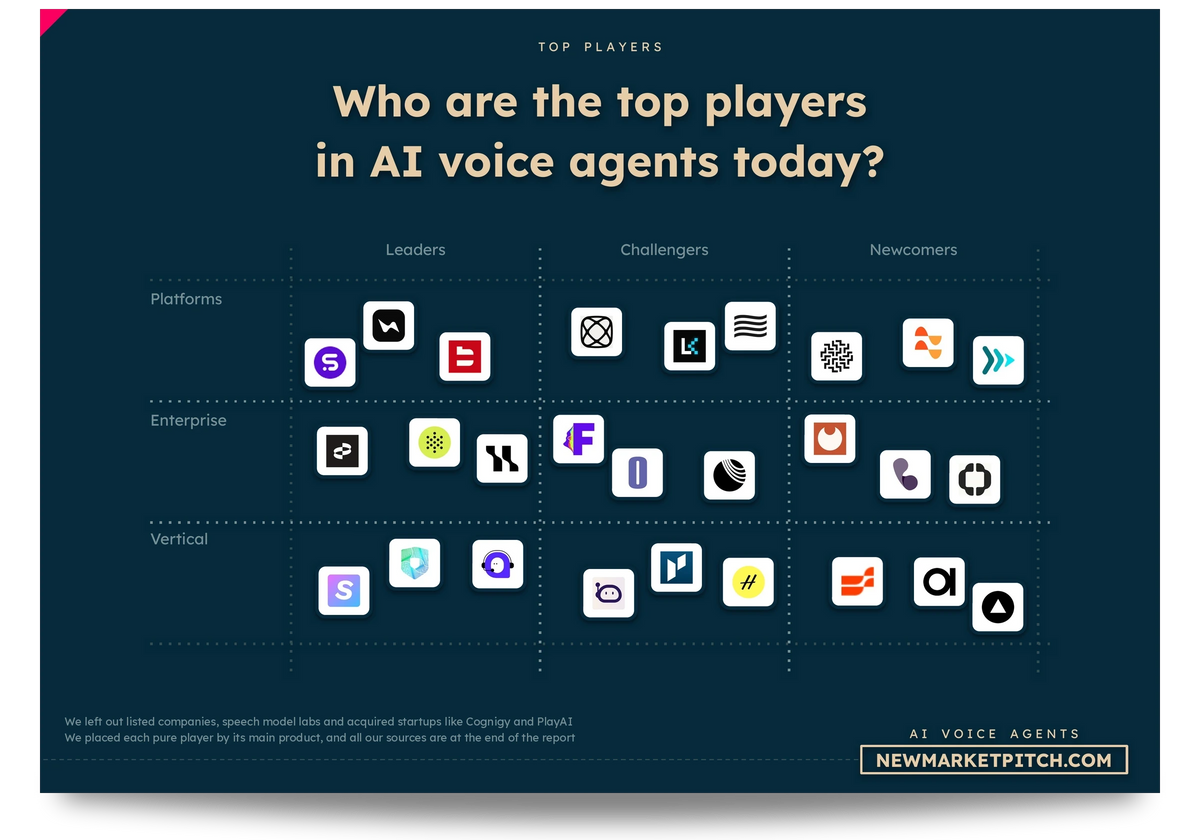
In our research about AI voice agents, we turn what is vague and complex into simple, useful visuals. Market maps like this one show you at a glance where every startup stands.
Vocca raised $20 million in a Series A round in October 2026 to scale its AI medical receptionist.
When was it?
Vocca announced its $20 million Series A on October 6, 2026.
Who are they?
Vocca builds an AI medical receptionist that answers patient calls, books appointments, reschedules visits, and manages routine enquiries for healthcare practices.
Geographical focus?
Vocca operates across the United States and Europe, with teams in Paris and New York and customers ranging from independent clinics to larger healthcare groups.
Why do we include them in the AI voice agents market?
Vocca is a strong healthcare voice-agent match because spoken patient conversations and appointment management form the foundation of its product.
What is the company stage?
Vocca is in commercial growth, reporting around 15,000 practitioners across 1,500 practices and more than one million patient conversations monthly.
How much did they raise?
Vocca secured $20 million in new funding, the largest individual round among the 12 selected announcements.
What round is it?
The financing was a Series A led by Norrsken VC, with Heal Capital, Speedinvest, Firstminute Capital, and several technology founders participating.
Why did they raise?
Vocca intends to improve healthcare scheduling workflows, serve additional medical specialties, and accelerate expansion in the United States.
Reecall raised approximately $4.1 million in September 2026 to expand its white-label AI voice-agent platform.
When was it?
Reecall announced the financing on September 24, 2026.
Who are they?
Reecall provides technology that lets software vendors and service providers deploy branded AI phone agents for appointments, customer enquiries, and routine business procedures.
Geographical focus?
Reecall is based in Lyon, France, and targets European software publishers, telecom operators, and outsourced customer-service providers.
Why do we include them in the AI voice agents market?
Reecall directly supplies the infrastructure used to build, deploy, and operate conversational phone agents, making it a strong voice-agent platform match.
What is the company stage?
Reecall is in commercial growth, having moved from direct software sales toward a partner-led, white-label distribution model.
How much did they raise?
Reecall raised €3.5 million, equivalent to approximately $4.1 million.
What round is it?
The financing was an early-stage venture round led by Founders Future, with Holnest, Mesh, Evolem, and several business angels participating.
Why did they raise?
Reecall plans to scale its infrastructure and help established software providers add AI calling capabilities without building the underlying technology themselves.

Your time is limited. In our market report about AI voice agents, we put numbers on each part of the market, so you can see where it makes sense to focus.
Dextr AI raised $6.7 million in seed funding in September 2026 to expand its AI workforce for hotels.
When was it?
Dextr AI announced its first institutional financing on September 24, 2026.
Who are they?
Dextr AI develops AI hotel employees that answer reservation calls, manage guest questions, support bookings, and coordinate operational requests through hotel software.
Geographical focus?
Dextr AI is headquartered in the United States and serves hospitality properties across the US, Canada, the UK, and continental Europe.
Why do we include them in the AI voice agents market?
Dextr AI offers conversational hotel reservation agents, but its wider portfolio includes housekeeping, marketing, and operational automation, so its voice-agent business share remains unverified.
What is the company stage?
Dextr AI is in commercial growth, with its technology reportedly operating across hundreds of hotels and resorts.
How much did they raise?
Dextr AI raised $6.7 million in new financing.
What round is it?
The company completed a seed round led by Elevation Capital, with Foundation Capital also participating.
Why did they raise?
Dextr AI plans to recruit engineers, deepen integrations with hotel systems, and develop additional agents for hospitality operations.
InTouchNow raised approximately $3.1 million in September 2026 to bring AI voice receptionists to more NHS practices.
When was it?
InTouchNow announced the financing on September 21, 2026.
Who are they?
InTouchNow builds AI phone receptionists that answer patient calls, collect triage information, arrange appointments, and handle routine administration for GP surgeries.
Geographical focus?
InTouchNow focuses on UK National Health Service primary care, particularly GP practices managing high volumes of inbound patient calls.
Why do we include them in the AI voice agents market?
InTouchNow's funded product directly automates spoken patient interactions and related tasks, despite the company's earlier experience in human-led call centers.
What is the company stage?
InTouchNow is in commercial growth, with its voice technology reportedly deployed at more than 150 GP practices.
How much did they raise?
InTouchNow raised £2.3 million, approximately $3.1 million.
What round is it?
The financing was a seed round led by Ada Ventures, with Exceptional Ventures and Kadmos Capital participating.
Why did they raise?
InTouchNow wants to expand NHS adoption, improve multilingual support, strengthen clinical safety features, and connect with more patient-record systems.

In our document detailing everything you need to know about AI voice agent, we always try to gather several sources and make estimates that make sense, so you can work with solid numbers.
Hellobot raised approximately $1.35 million in September 2026 to expand its managed enterprise voice agents.
When was it?
Hellobot's financing was publicly reported on September 17, 2026.
Who are they?
Hellobot provides AI phone assistants that handle appointments, identity checks, service enquiries, repair statuses, and other customer requests using connected business systems.
Geographical focus?
Hellobot operates primarily in Poland, serving enterprise customers while preparing to expand into additional European markets.
Why do we include them in the AI voice agents market?
Hellobot is a strong enterprise voice-agent match because its managed AI assistants conduct customer conversations and complete operational tasks without relying on conventional phone menus.
What is the company stage?
Hellobot is in commercial expansion, with reported enterprise deployments across transportation, automotive services, property, and healthcare.
How much did they raise?
Hellobot secured PLN 5 million, approximately $1.35 million.
What round is it?
The financing was an early-stage venture round led by Lowercap, with participation from private business angels.
Why did they raise?
Hellobot plans to improve its multi-agent technology, expand enterprise integrations, develop private-cloud deployments, and grow beyond Poland.
Aristotle raised $5 million in seed funding in September 2026 to launch its conversational AI tutoring platform.
When was it?
Aristotle announced the financing on September 16, 2026, alongside the public launch of its tutoring product.
Who are they?
Aristotle builds an AI tutor that talks with students, asks questions, explains problems using a shared whiteboard, and adapts lessons to previous interactions.
Geographical focus?
Aristotle initially targets students aged 13 to 18 across the United States, with a focus on personalized academic support.
Why do we include them in the AI voice agents market?
Aristotle is a conversational educational voice agent because spoken dialogue is central to how its AI tutor teaches and guides students through tasks.
What is the company stage?
Aristotle is at the commercial product-launch stage, following a closed beta involving more than 1,000 students.
How much did they raise?
Aristotle raised $5 million to support its launch and product expansion.
What round is it?
The financing was a seed round led by True Ventures, with Wicklow Capital and technology-sector angel investors participating.
Why did they raise?
Aristotle intends to grow its team, develop its voice-first tutoring experience, and reach more students across the United States.

Our report covering the AI voice agent market gets updated several times a month, so you always get the latest view of where things stand.
nocall.ai raised approximately $5.3 million in a Series A round in September 2026 for autonomous business calling.
When was it?
nocall.ai's financing was announced on September 11, 2026.
Who are they?
nocall.ai develops AI phone operators that call customers for appointment confirmations, recruitment scheduling, payment reminders, and business follow-ups.
Geographical focus?
nocall.ai focuses on Japan, particularly enterprise customers in automotive services, financial services, staffing, and related industries.
Why do we include them in the AI voice agents market?
nocall.ai is a strong outbound voice-agent match because its core technology automates real telephone conversations and records the resulting business actions.
What is the company stage?
nocall.ai is in commercial expansion, with established enterprise use cases and deployed automated calling workflows.
How much did they raise?
nocall.ai raised approximately ¥800 million, represented here as around $5.3 million, although published dollar conversions vary.
What round is it?
The financing was a Series A reported as co-led by JAFCO Group and Archetype Ventures, with Coreline Ventures also participating.
Why did they raise?
nocall.ai plans to hire engineers and improve its platform for high-volume business calling and integration with enterprise systems.
HeyDiga raised approximately $6.4 million in September 2026 to expand AI receptionists for service businesses.
When was it?
HeyDiga announced its seed financing on September 10, 2026.
Who are they?
HeyDiga provides AI receptionists that answer calls, book appointments, manage customer enquiries, and continue conversations through WhatsApp and web chat.
Geographical focus?
HeyDiga is based in Spain and targets European service businesses, with Latin America representing another potential expansion market.
Why do we include them in the AI voice agents market?
HeyDiga's core offering automates customer phone conversations and booking workflows, while messaging provides additional communication channels.
What is the company stage?
HeyDiga is in early commercial growth, reporting more than 200 customers and autonomous handling of over 78% of conversations.
How much did they raise?
HeyDiga secured €5.5 million, equivalent to approximately $6.4 million.
What round is it?
The financing was a seed round led by 6 Degrees Capital, with Kfund, Italian Founders Fund, Decelera, and business angels participating.
Why did they raise?
HeyDiga plans to strengthen its sector-specific products, expand commercial distribution, and help businesses convert missed calls into appointments and sales.

In our research about AI voice agents, we look at what the winners do differently, so you can learn from the best instead of guessing.
Navana.ai raised $4.2 million in a Series A round in September 2026 for multilingual enterprise voice AI.
When was it?
Navana.ai's financing was publicly reported on September 7, 2026, following funding records dated September 6-7.
Who are they?
Navana.ai develops Indian-language speech technology and enterprise voice agents for customer-service calls, financial workflows, and contact-center automation.
Geographical focus?
Navana.ai primarily serves Indian enterprises, particularly financial institutions requiring support for multiple Indian languages and regional dialects.
Why do we include them in the AI voice agents market?
Navana.ai provides conversational enterprise voice agents, although its separate speech-model products make it a qualified match rather than a confirmed voice-agent pure player.
What is the company stage?
Navana.ai is in commercial enterprise development, with established financial-sector customers and products designed for regulated environments.
How much did they raise?
Navana.ai raised a reported ₹40 crore, approximately $4.2 million using the conversion reported in the funding coverage.
What round is it?
The financing was a Series A led by Ronnie Screwvala, with participation from Antler India, Sharad Sanghi, Sandeep Singhal, and other investors.
Why did they raise?
Navana.ai plans to expand financial-sector deployments, improve Indian-language speech models, and develop its AI contact-center and automated evaluation products.
NumaIQ raised $300,000 in early-stage funding reported in September 2026 to develop multilingual AI calling technology.
When was it?
NumaIQ's financing was first reported on September 5, 2026, and subsequently appeared in funding coverage later that month.
Who are they?
NumaIQ develops multilingual AI voice agents designed to handle business calls, connect with enterprise records, and support conversation quality monitoring.
Geographical focus?
NumaIQ has Tunisian origins and links to the UAE, with a product strategy aimed at Arabic-speaking and international enterprise customers.
Why do we include them in the AI voice agents market?
NumaIQ directly targets conversational business calling and agent quality assurance, although the commercial readiness of its product remains less established than that of mature providers.
What is the company stage?
NumaIQ was at the pre-product stage when the financing was first reported, with no completed product or paying customers identified in that initial coverage.
How much did they raise?
NumaIQ announced $300,000 in committed angel funding, structured in tranches, with the first installment reportedly received.
What round is it?
The investment was an angel or pre-seed financing from a UAE-based business angel whose identity was not publicly disclosed.
Why did they raise?
NumaIQ plans to develop its voice AI product, improve business call handling, and prepare a demonstrable version of its technology for prospective customers.
Written by the New Market Pitch teamWe track new markets so founders and investors can move faster. About us